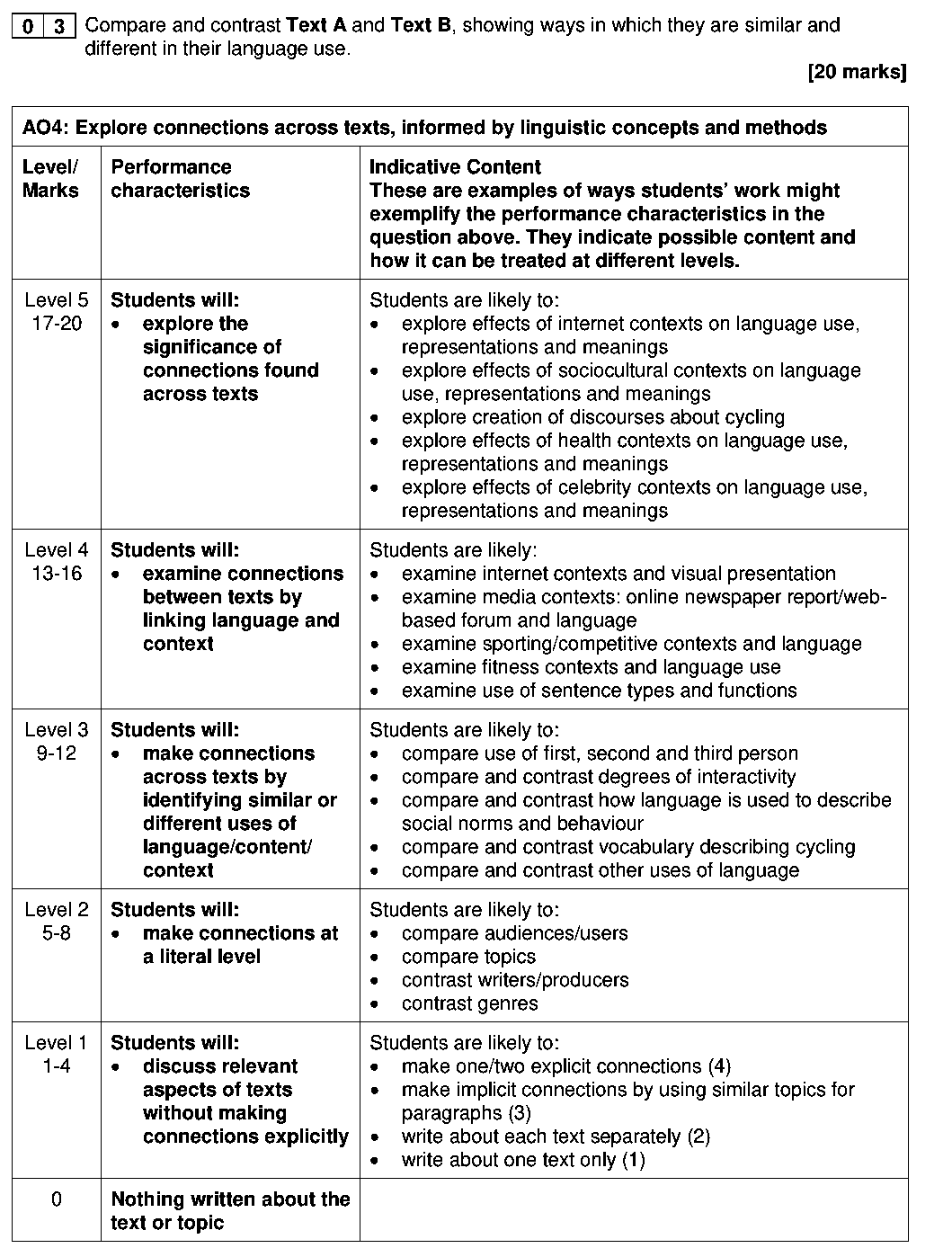
Text A (insert)
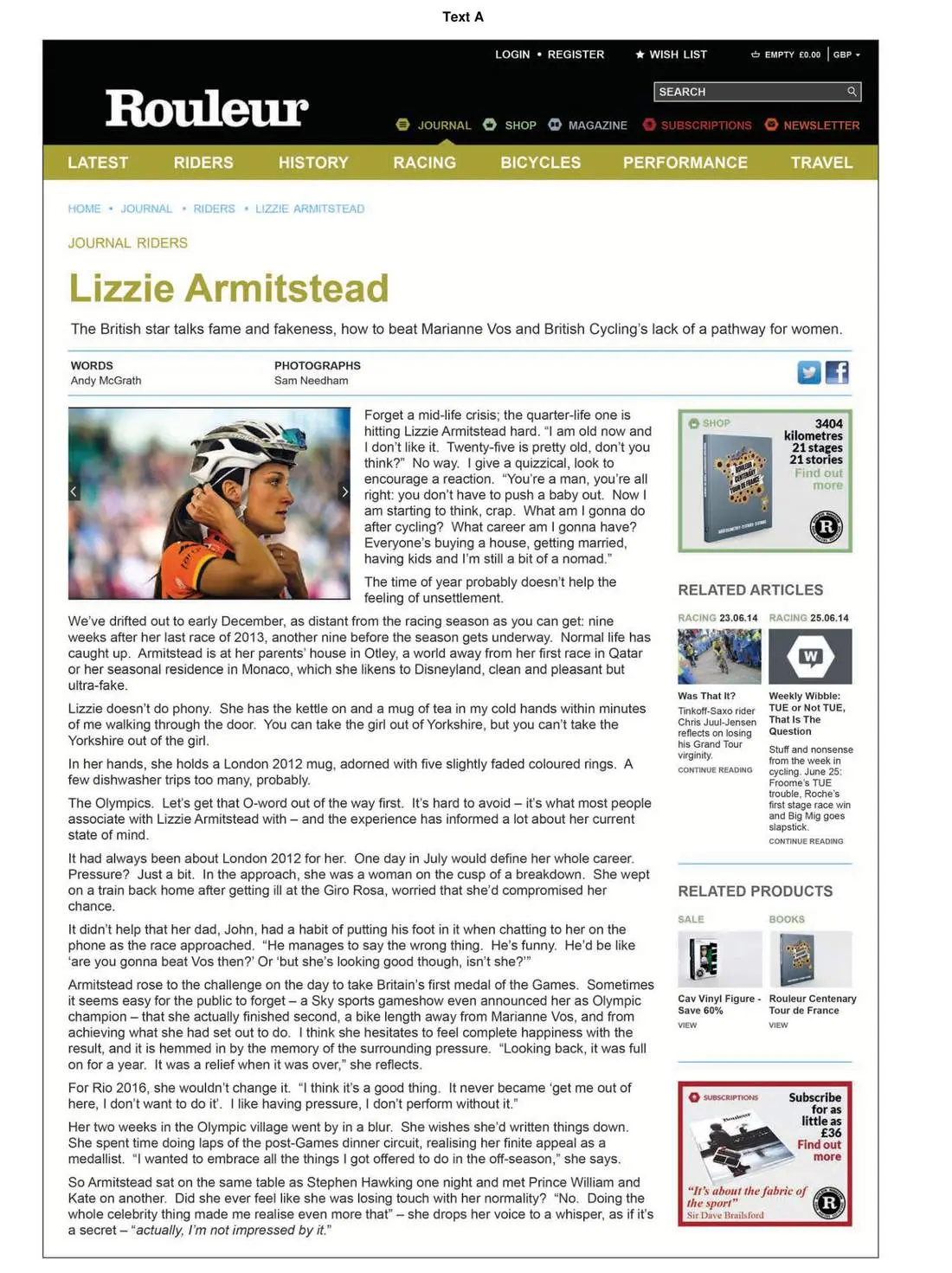
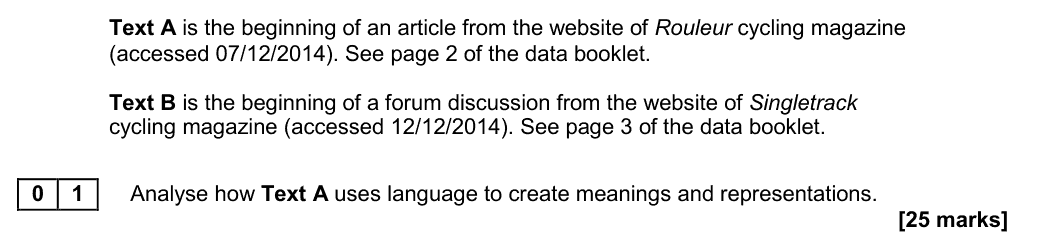
Mark scheme, including the levels and indicative content
Examiner's comment
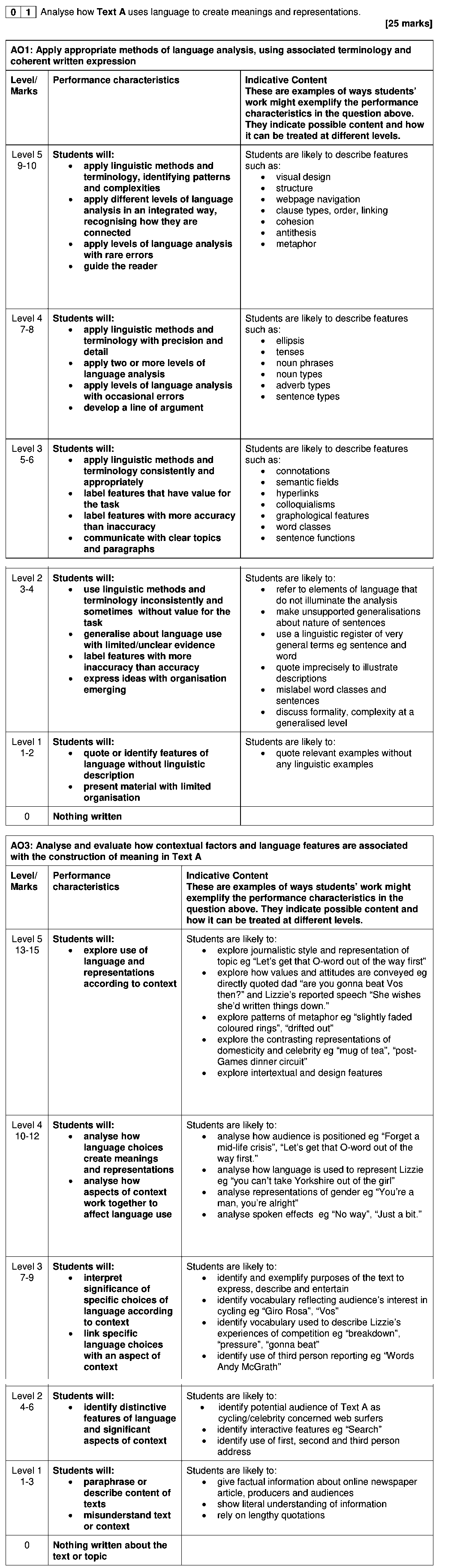
Assessment objectives for Question 1: AO1: Apply appropriate methods of language analysis, using associated terminology and coherent written expression (10 marks) AO3: Analyse and evaluate how contextual factors and language features are associated with the construction of meaning (15 marks) invited students to write about meanings and representations in an online article focusing on Lizzie Armitstead . Students of all abilities showed a clear awareness of genre, purpose and audience. Many commented, for example, on the genre conventions of an online article, particularly the web-based aspect of the text. Students commented on conventions such as the search bar, tabs, images, advertisements and the links to social media site. Many students wrote about the dual purpose of inform and entertain and recognised the possible specific audiences of the article (eg fans of Lizzie Armitstead , fans of sport or cycling). Focusing solely on these contextual factors is a feature of band 2 of the mark scheme. Students who scored in the lower mark bands often made generalised points about linguistic features ‘having an effect on the reader’. However, students who achieved a higher mark for AO3 considered other issues such as representation, particularly that of Lizzie Armitstead . Many students discussed how the cyclist was represented as ‘down or earth’ and not affected by her status. They recognised that she was represented as someone who had no interest in the celebrity life style and was, to quote many students, ‘normal’. Such discussions showed a good understanding of the requirements of this task: to consider meanings and representations. Students who achieved higher marks for AO3 also considered other aspects of representation. Students discussed how the writer of the article and the website were represented to an audience. Other students focused on how cycling was represented in the article, discussing both the positive and negative aspects of the sport. On occasions, this was developed by writing about how the Olympics were also represented, whilst other students explored gender representation and the position of women in sport. With regard to AO1, many students seemed aware of the need to identify specific language features, use linguistic terminology and exemplify their points. In line with the mark scheme, students were solely rewarded for this accurate identification. This meant students whose responses were rooted in language points scored most highly on AO1 even if the subsequent analysis was not as strong. Schools and colleges are therefore encouraged to ensure that their students in future series annotate and identify a range of relevant language features prior to writing their response. Unfortunately, students who scored low marks on AO1 only identified a few language features resulting in a very narrow range covered. Some students, for example, only identified two or three features from the whole text whilst some just referred to quotations rather than pinpointing linguistic features precisely. This placed them in the lower mark bands as they did not show a range of linguistic knowledge despite the text being of a length which allowed a range to be considered. Some schools and colleges appeared to have taught their students to follow a specific structure, identifying the same features. This was very restrictive as students did not explore the language of the text in detail and schools and colleges are encouraged not to prepare students in this way. It is also important that students are aware of the need to focus on features which are of value to the task rather than any ‘random’ feature. Lower achieving students appeared to struggle to select the most fruitful material. Almost all students, regardless of their final mark linked their AO1 points to AO3, thus fulfilling the second bullet point of AO3. However, some schools and colleges had seemingly taught students to write a long opening paragraph on context and representation without any reference to the data or specific language features. This limited the students’ success on both AOs.
Notes from the mark scheme and report
- AO1 10 + AO3 15
- top band explores journalistic style, representation of Armitstead as down-to-earth, contrasting domesticity and celebrity, gender, metaphor patterns and design/intertextual features
- audience/purpose/genre alone = Level 2
- AO1 credited only for accurate labelled examples, a narrow range of 2-3 features or a long context-only opening paragraph kept marks low
- Texts/data: Text A: Rouleur cycling magazine web article interviewing Lizzie Armitstead (2014)