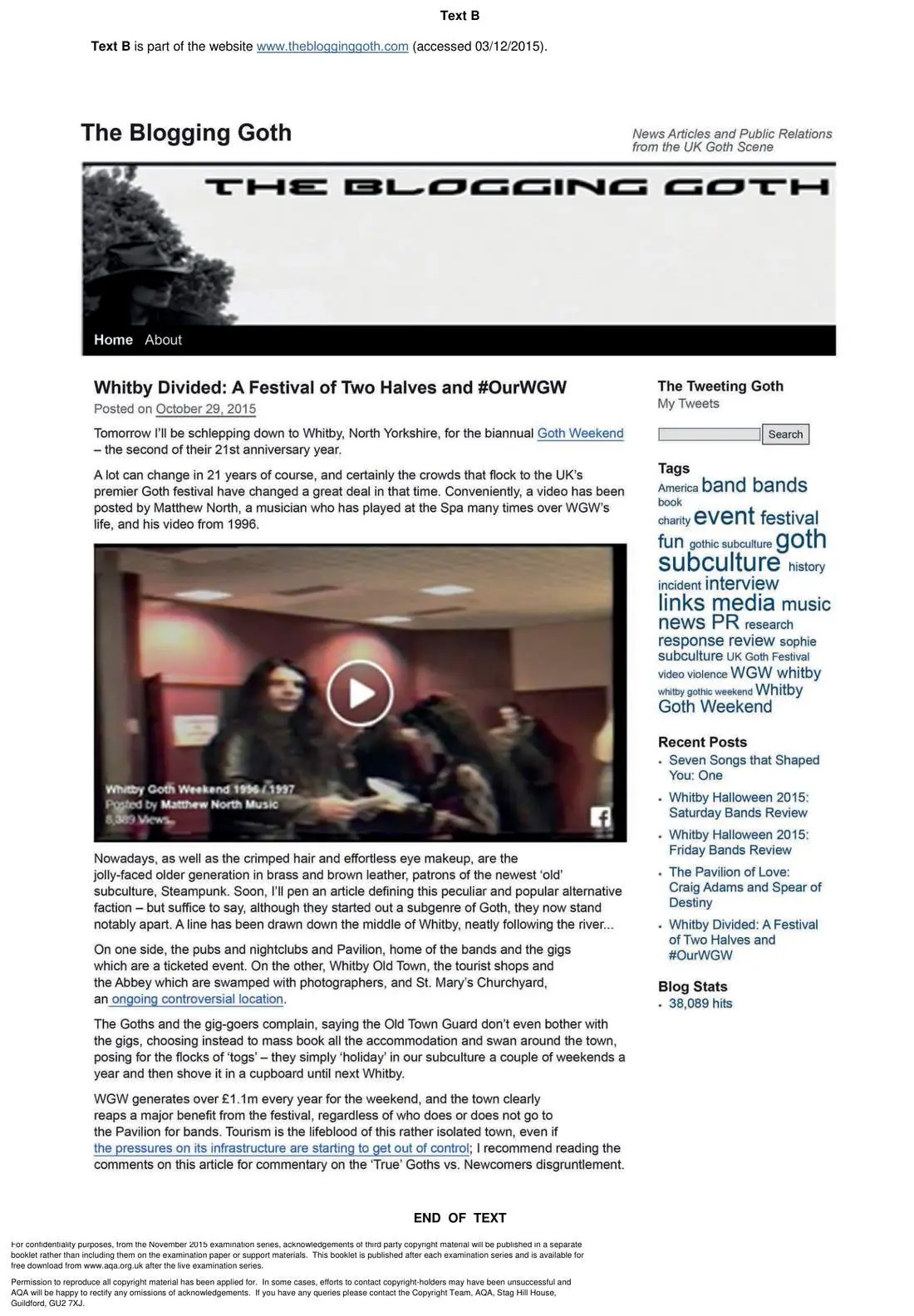
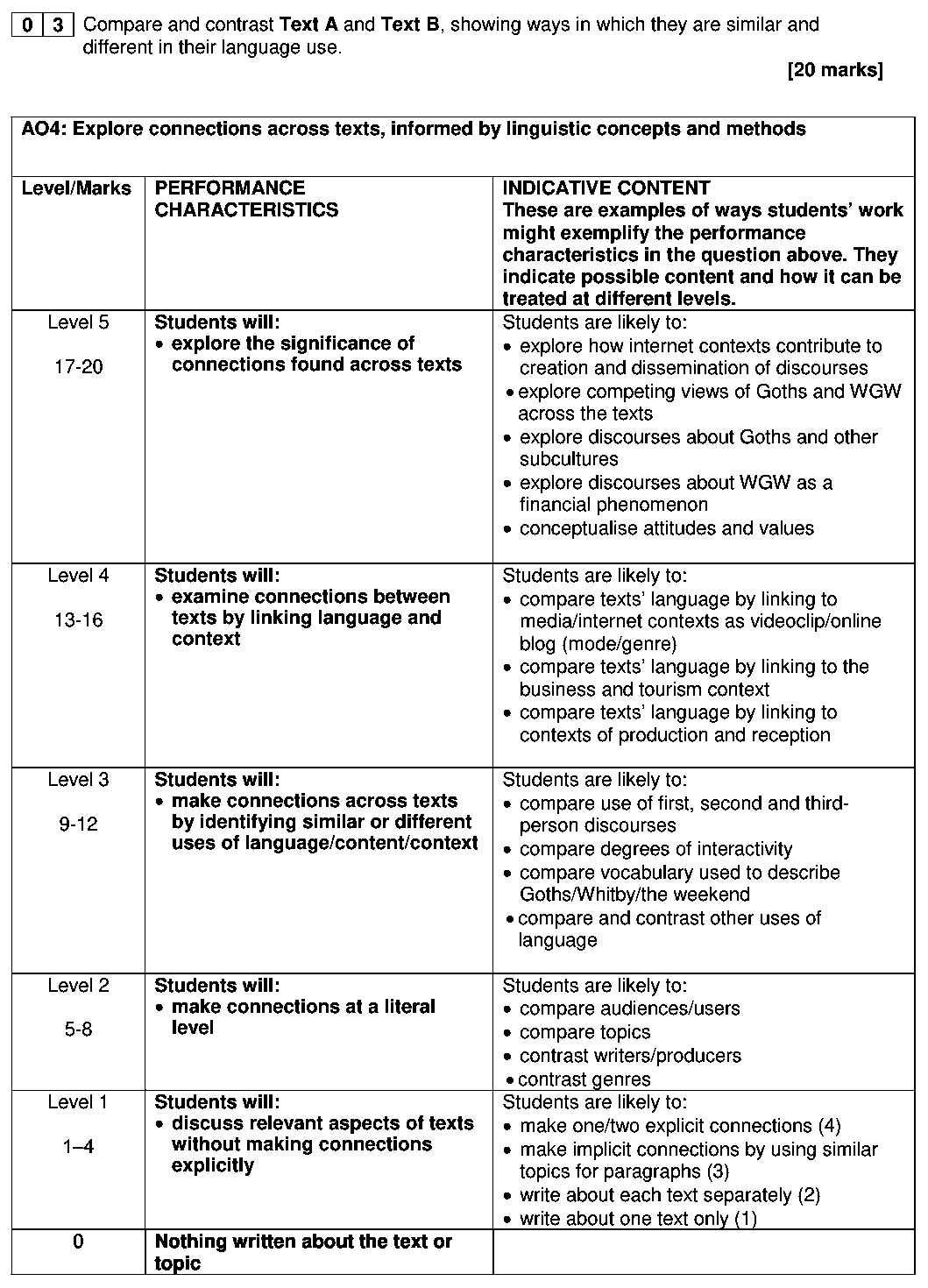
Text A (insert)
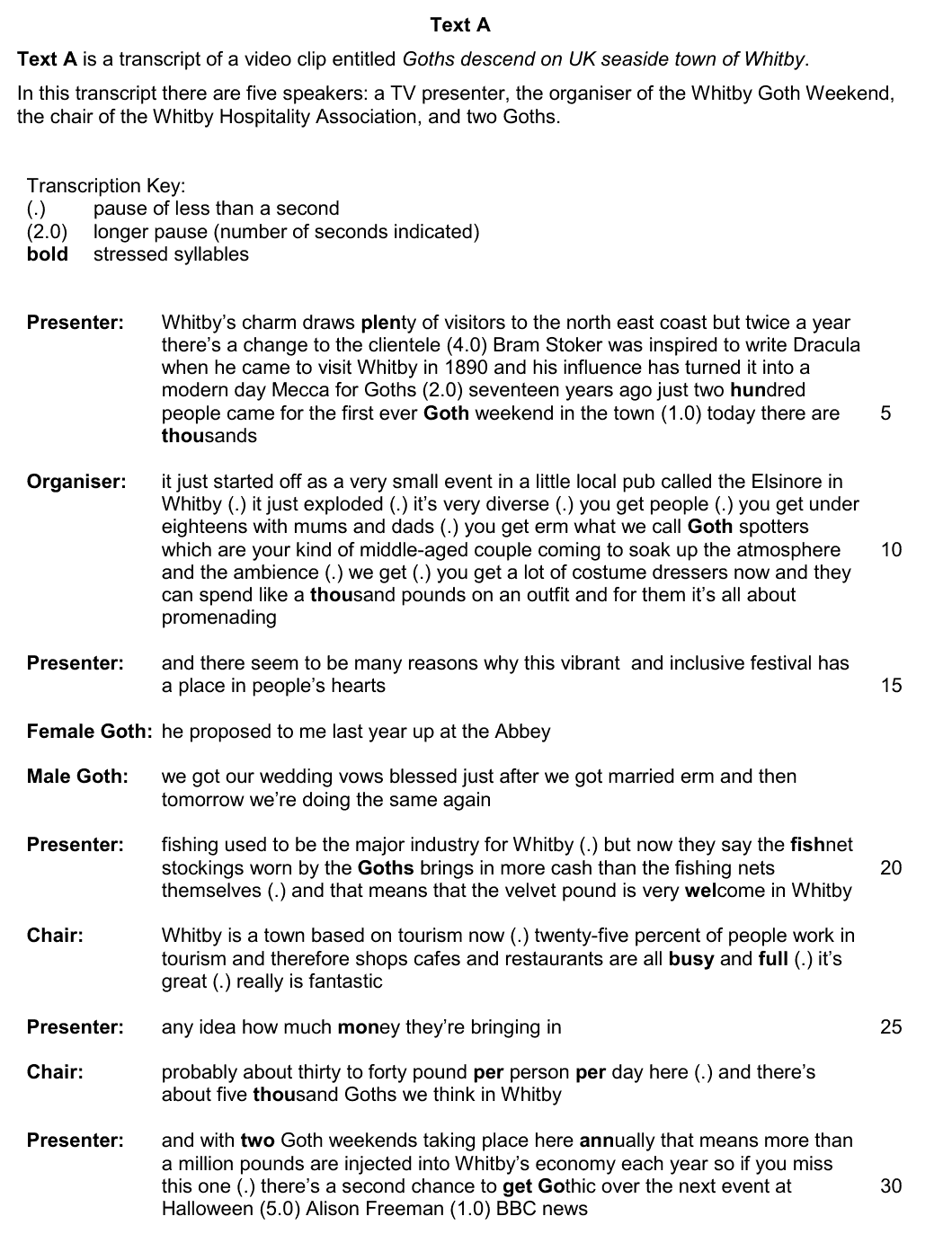
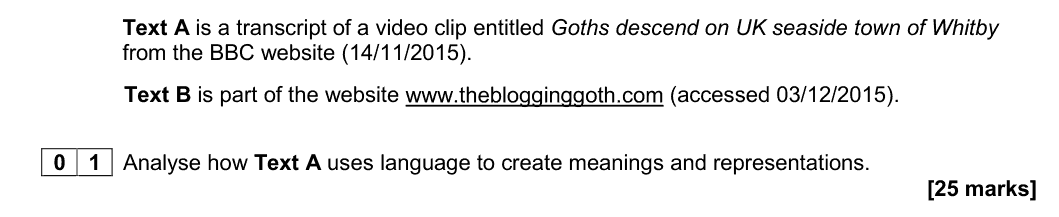
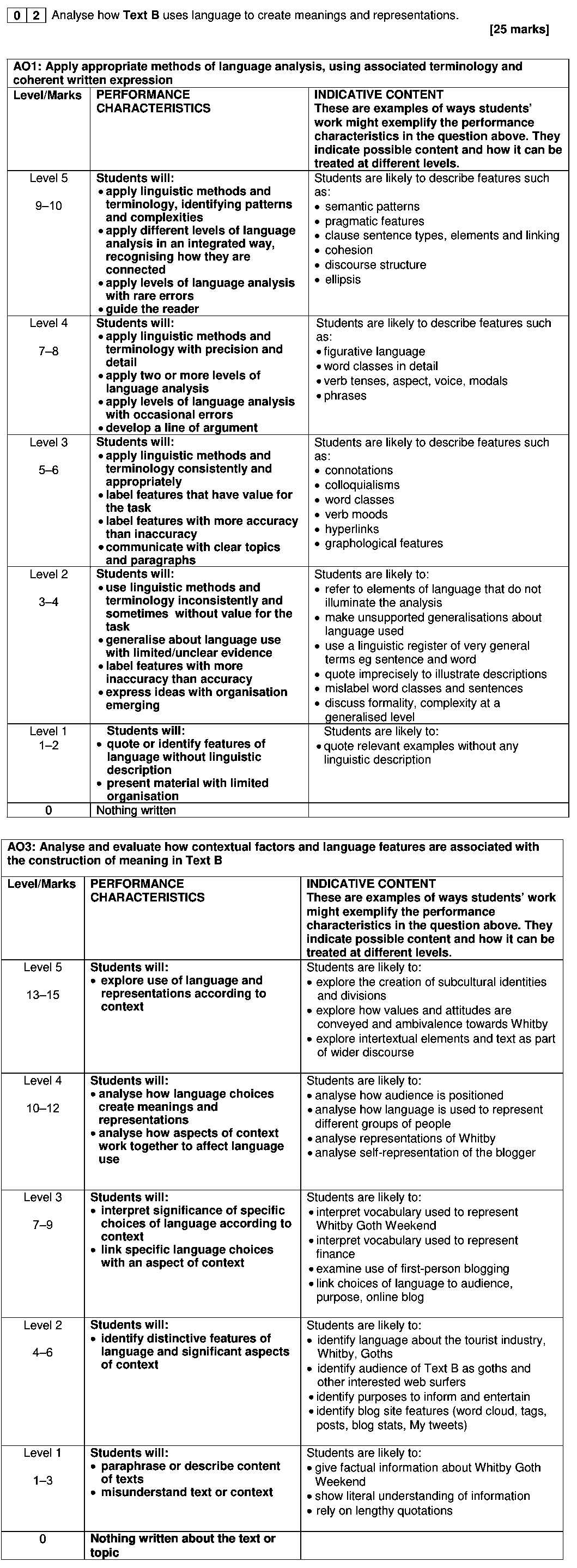
Mark scheme, including the levels and indicative content
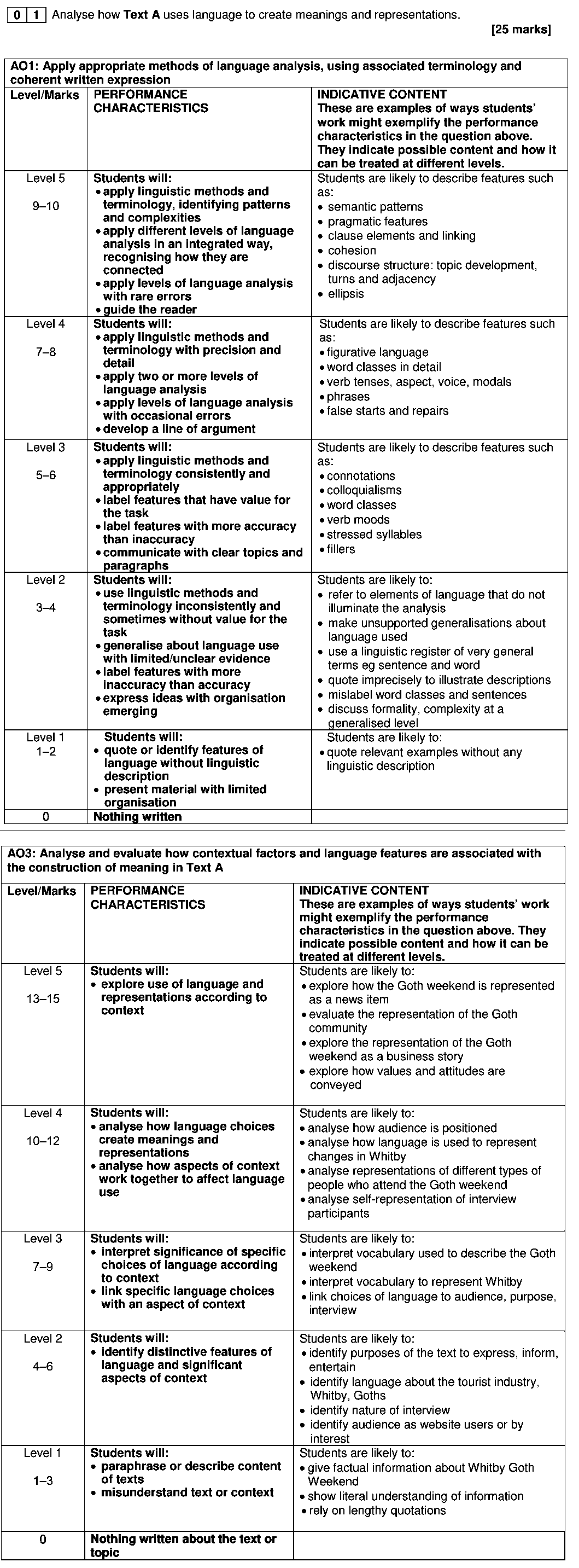
Examiner's comment
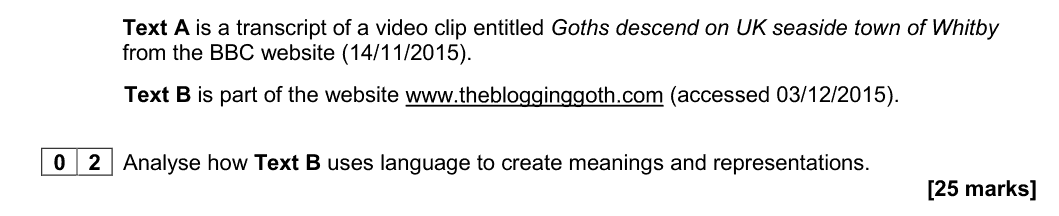
Assessment objectives for Question 1: AO1: Apply appropriate methods of language analysis, using associated terminology and coherent written expression (10 marks). AO3: Analyse and evaluate how contextual factors and language features are associated with the construction of meaning (15 marks) invited students to write about meanings and representations in a transcript of a video clip entitled Goths descend on UK seaside town of Whitby from the BBC website. Students of all abilities showed a clear awareness of mode, purpose and audience. Many students, for example, wrote about the dual purpose of inform and entertain and recognised the possible specific audiences of the article (for example, Goths, viewers from Whitby or those with a specific interest in the weekend). Focusing solely on these contextual factors is a feature of band 2 of the mark scheme and centres should remind students of the need to exemplify contextual points by referencing specific examples from the data. It was, however, very pleasing to see that there were far few students this year failing to exemplify. It is also very pleasing to report that the number of students who tried very hard to focus on representation was significantly higher this year. In last year’s Lead Examiner report, the lack of focus on representation was highlighted but it was far less of an issue this year. Students commented with confidence on the representation of: • Goths and their commitment to the weekend • Whitby as a tourist resort and how it has changed over time • the financial benefits of the Goth Weekend • those who attend the Goth Weekend (with a focus on diversity) • the BBC and the presenter (knowledgeable, professional etc.) • the Goth weekend (especially its evolvement in the past 17 years) Students who achieved the highest marks for AO3 considered all or most of these aspects of representation. Some students also discussed stereotypical representations, focusing on how these are challenged in the data by presenting goths in a particular manner (although at times, there were some rather sweeping generalisations of all goths being miserable, obsessed with vampires etc.) With regard to AO1, many students were aware of the need to identify specific language features, use linguistic terminology and exemplify their points. In line with the mark scheme, students were solely rewarded for this accurate identification. This meant students whose responses were rooted in language points scored most highly on AO1 even if the subsequent analysis was not as strong. Schools and colleges are therefore encouraged to ensure that their students in future series annotate and identify a range of relevant language features prior to writing their response; a key word here is ‘relevant’. Students need to be aware of the need to identify features which are of value to the task rather than any ‘random’ feature they have found. They should also be encouraged to be precise when identifying specific language features; for example they will be rewarded for identifying a ‘first person subject pronoun’ rather than just a ‘pronoun’; they will get greater credit for labelling an example as a ‘pre-modifying adjective’ rather than using the term ‘adjective’. Whilst the latter examples in these two scenarios will still be rewarded for AO1, students who achieved the highest marks offered that extra level of precision. Some common examples of students being precise included the identification of: • non-fluency features such as voiced pauses, fillers and self-correction • metaphors such as ‘modern day Mecca’, ‘it just exploded’ • post-modifying adjectives such as ‘diverse’ • pre-modifying adjectives such as ‘vibrant’, ‘exclusive’ • noun phrases such as ‘Goth spotters’ In addition to being precise, students who scored highly for AO1 also identified patterns. As an example of this, they recognised that language features do not always work in isolation and that a particular representation was achieved by the combined use of the second person pronoun, a modal verb and a noun phrase. • Linking AO1 – AO3 was often a clear focus in students’ responses. The most successful linked context to very specific language features, some less successful answers referenced more general quotations whilst the weakest responses did not make any links. In last year’s report, I highlighted how some schools and colleges had seemingly taught students to write a long opening paragraph on context without any reference to the data or language features. It was pointed out how this limited students’ success on both AOs. Unfortunately, there were examples of this occurring again this series with students writing, in particular, an opening paragraph on audience and purpose but with no links to the data. Centres are reminded again of the need to reference the data when discussing AO3 if students are to achieve a mark in levels 3 and above (the criteria for level 3 clearly states ‘link specific language choices with an aspect of context’).
Notes from the mark scheme and report
- AO1 10 + AO3 15
- top band explores the Goth weekend as news and business story, the Goth community, Whitby's change and values/attitudes
- credited representations of Goths, Whitby, the velvet pound, diversity of attendees and the BBC presenter
- precise labels rewarded (non-fluency features, metaphors 'modern day Mecca', pre-modifying adjectives)
- context-only opening paragraphs and sweeping Goth stereotypes held answers back
- Texts/data: Text A: transcript of BBC video clip 'Goths descend on UK seaside town of Whitby' (2015)