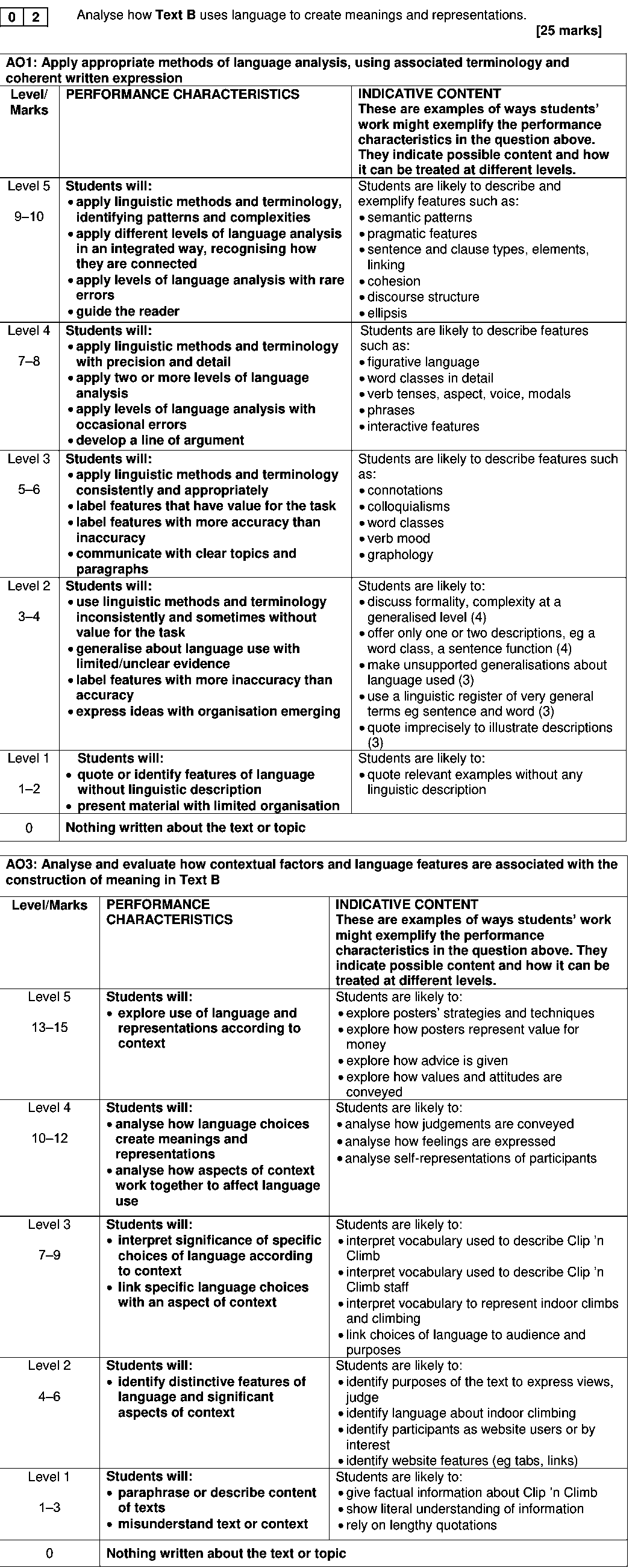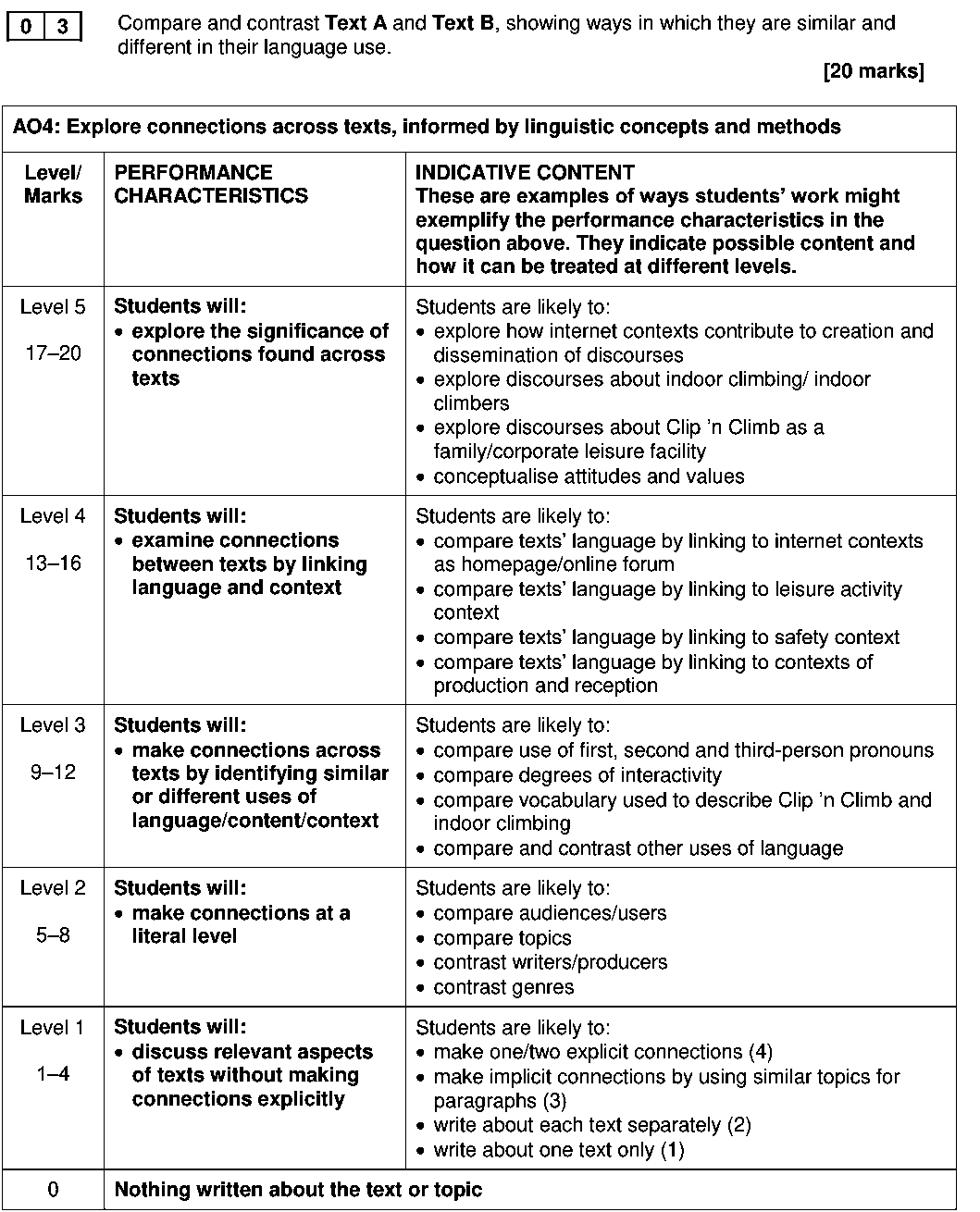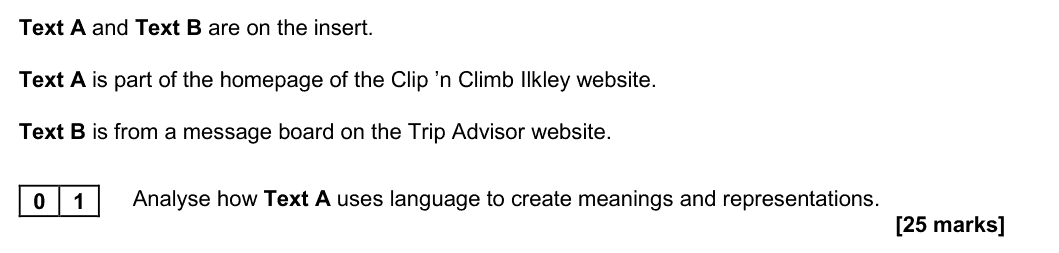
Mark scheme, including the levels and indicative content
Examiner's comment
Assessment objectives for Question 1: AO1: Apply appropriate methods of language analysis, using associated terminology and coherent written expression (10 marks). AO3: Analyse and evaluate how contextual factors and language features are associated with the construction of meaning (15 marks) invited students to write about meanings and representations in an extract taken from the ‘Clip ‘n’ Climb’ website. Students of all abilities showed a clear awareness of mode, purpose and audience. Many students, for example, wrote about the dual purpose of inform and persuade and recognised the wide range of audiences which the website could appeal to (young people, adults, and parents). It is also very pleasing to report that the number of students who tried very hard to focus on representation further improved this year. For AO3, students commented with confidence on the representation of: • Clip ‘n’ Climb as a fun activity • Clip ‘n’ Climb as a challenging activity • Clip ‘n’ Climb as an activity open to all ages • Clip ‘n’ Climb as a new and fresh activity • The staff at Clip ‘n’ Climb • The importance of safety at Clip ‘n’ Climb • The text receiver and producer. Focusing solely on these representation and contextual factors is a feature of band 2 of the mark scheme and centres should remind students of the need to exemplify such points by referencing specific examples from the data (AO1). It is important that students link language features with meanings and representation. Centres are reminded again of the need to reference the data when discussing AO3 if students are to achieve a mark in levels 3 and above (the criteria for level 3 clearly states ‘link specific language choices with an aspect of context’). To ensure the link between AO1 and AO3 is embedded throughout a response, students could begin planning their response by firstly identifying the various representations within a text and then annotating the data to find appropriate language features to support their points. This will ensure that representation is at the heart of the response and that the language features identified are relevant. With regard to identifying these specific language features for AO1, almost all students used some linguistic terminology – very few students relied on using ‘the word’ in place of the precise term. In line with the mark scheme, students were rewarded for this accurate identification. Students also need to be aware of the need to identify features which are of value to the task rather than any ‘random’ feature they have found (starting with representation in their planning will help this). Most importantly, all students should also be encouraged to be precise when identifying specific language features. Importantly, precision will be rewarded more than range. Real precision when labelling an appropriate number of relevant language features is far better than using more general terms in a wide range of less relevant features. For example they will be rewarded for precision when identifying a ‘deontic modal verb’ rather than just a ‘verb’; they will get greater credit for labelling an example as a ‘relative clause’ rather than using the term ‘clause’. Whilst the latter examples in these two scenarios will still be rewarded for AO1, students who achieved the highest marks offered that extra level of precision. In addition to being precise, students who scored highly for AO1 also identified patterns. As an example of this, they recognised that language features do not always work in isolation and that a particular representation was achieved by, for example, the combined use of the second person pronoun, a modal verb and a noun phrase.
Notes from the mark scheme and report
- insert texts not reproduced by AQA (copyright removed)
- AO1 10 + AO3 15
- top band explores how the homepage builds a brand for Clip 'n Climb and represents indoor climbing and the climbing community
- Level 4 analyses self-representation as safe, caring and responsible and audience positioning
- examiners rewarded precision over range ('deontic modal verb', 'relative clause') and planning from representations first
- representation/context points without data stay in Level 2
- AO split from AQA's standard grid for this question (not readable in this year's mark scheme)
- Texts/data: Text A: part of the Clip 'n Climb Ilkley homepage (indoor climbing centre)