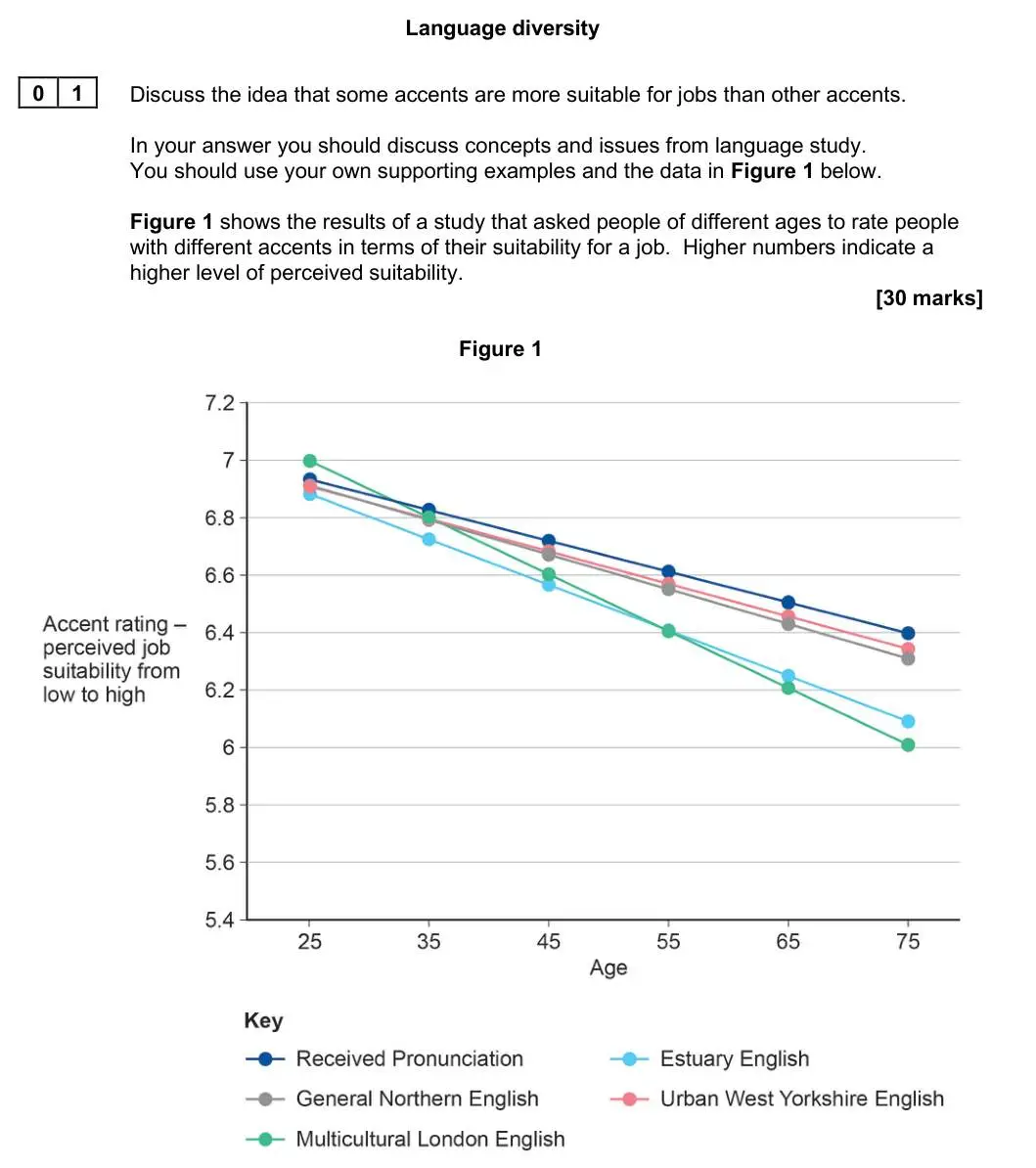
Language diversity Discuss the idea that some accents are more suitable for jobs than other accents. In your answer you should discuss concepts and issues from language study. You should use your own supporting examples and the data in Figure 1 below. Figure 1
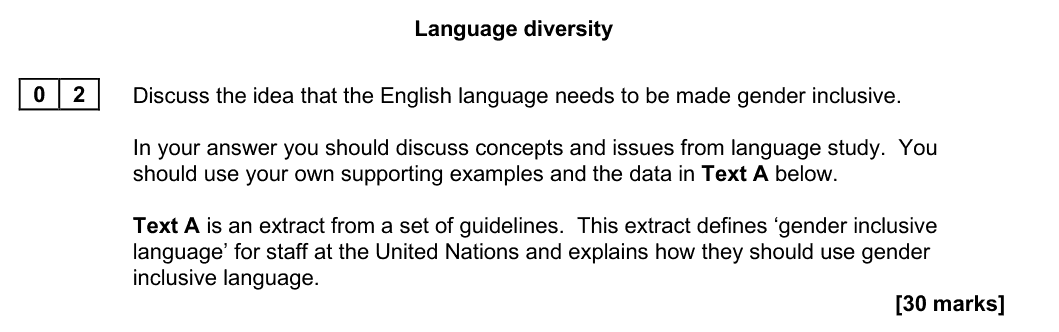
Language diversity Discuss the idea that the English language needs to be made gender inclusive. In your answer you should discuss concepts and issues from language study. You should use your own supporting examples and the data in Text A below. Text A is an e
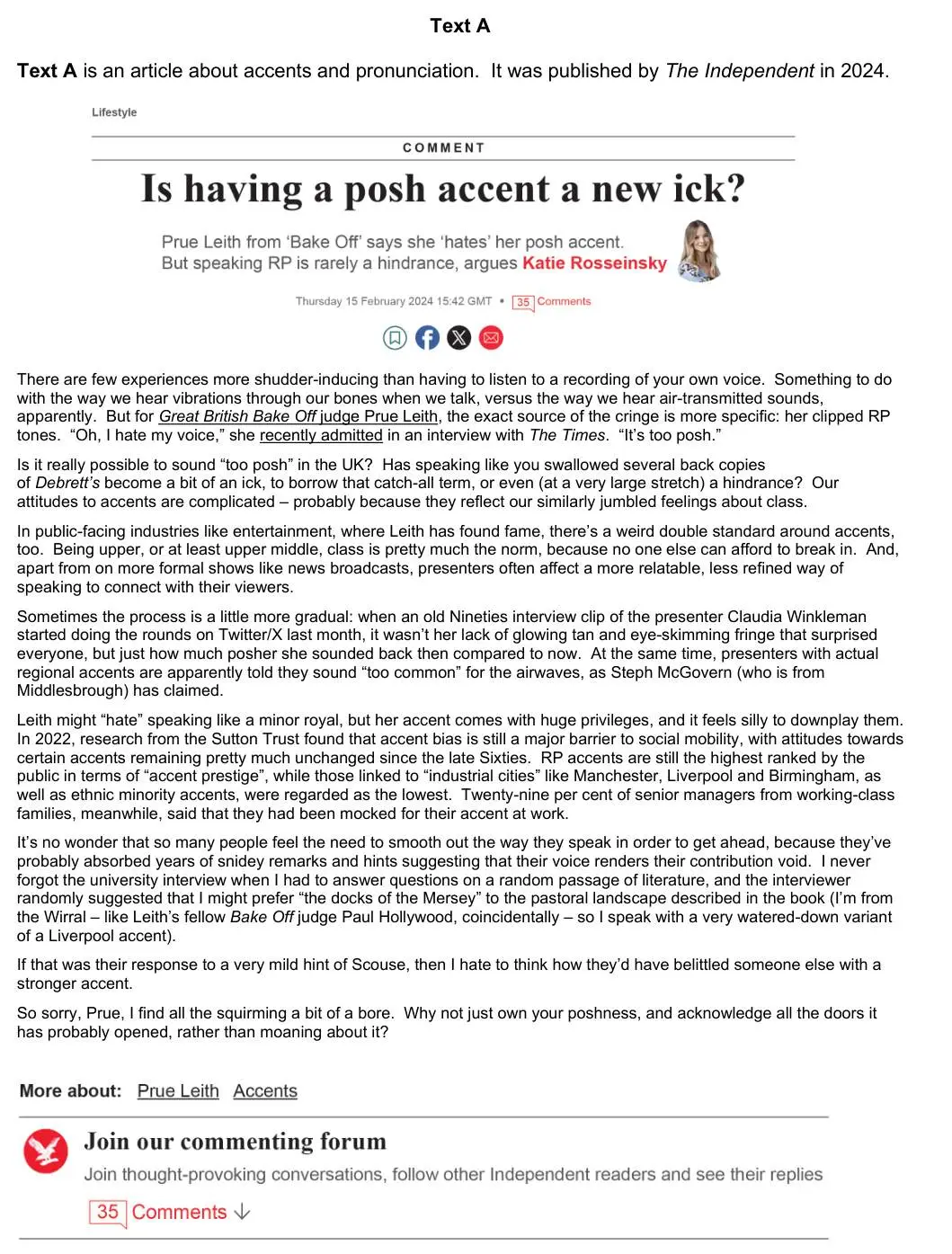
Language discourses Text A and Text B are on the Insert. Text A is an article about accents and pronunciation. It was published by The Independent in 2024. Text B is an article about accents in the media. It was published by The Telegraph in 2022. Write an opi
Language diversity Discuss the idea that there is a connection between a person’s social class and the language they use. In your answer you should discuss concepts and issues from language study. You should use your own supporting examples and the data in Tex
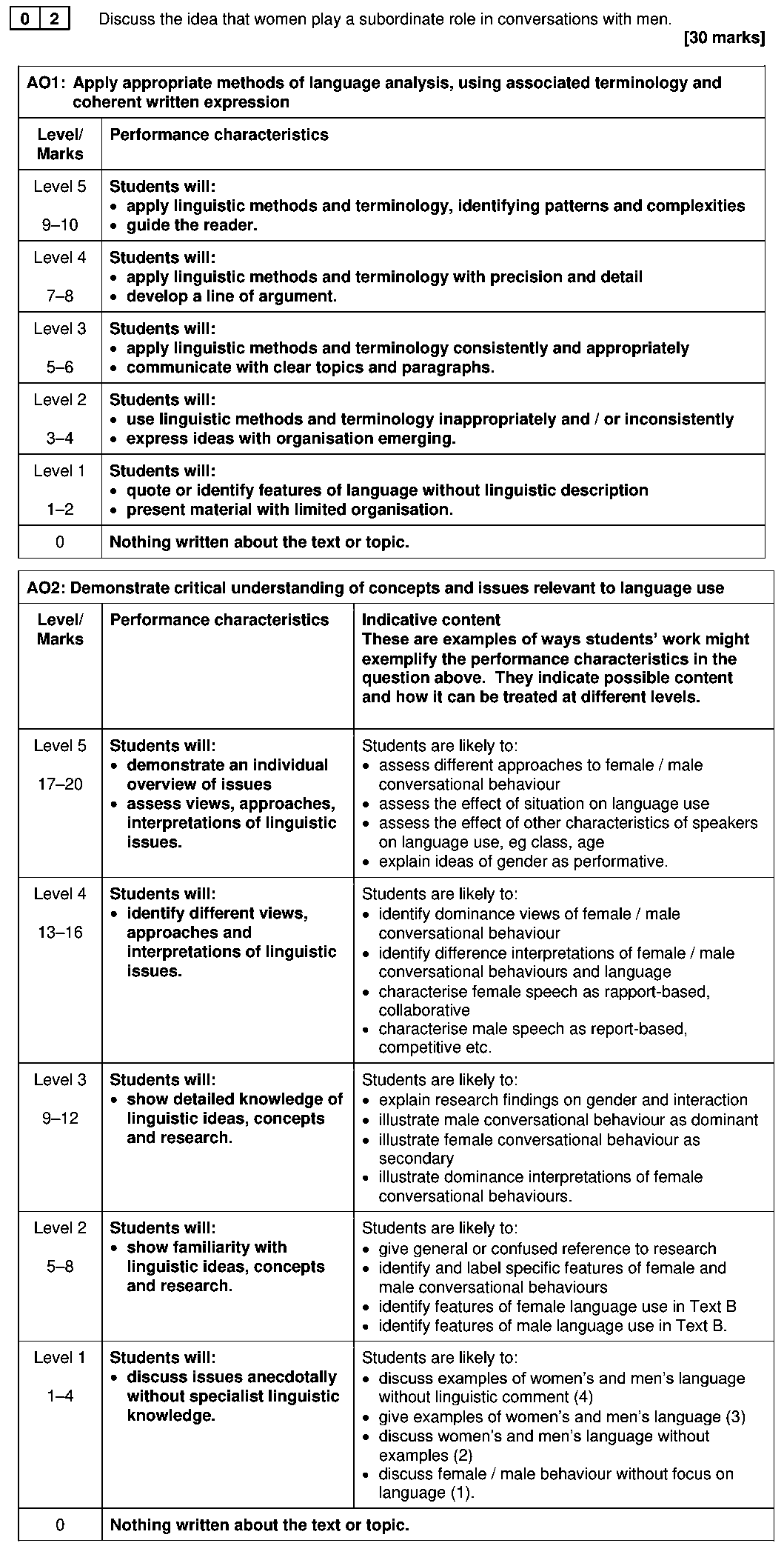
Language diversity Discuss the idea that women play a subordinate role in conversations with men. In your answer you should discuss concepts and issues from language study. You should use your own supporting examples and the data in Text B, below. Text B is a
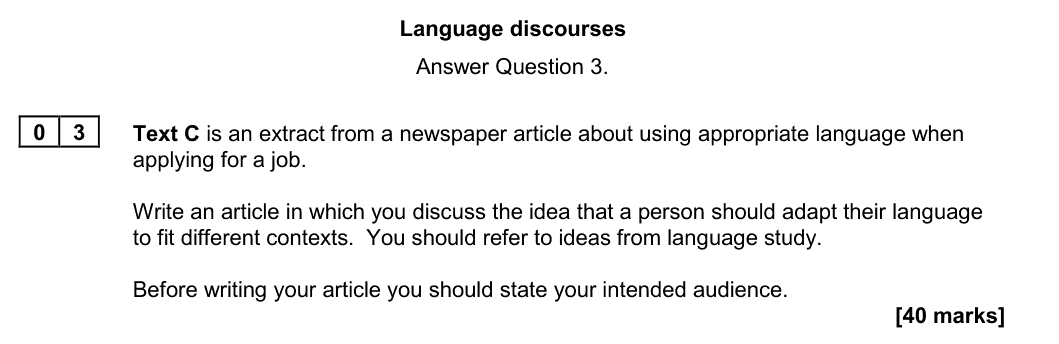
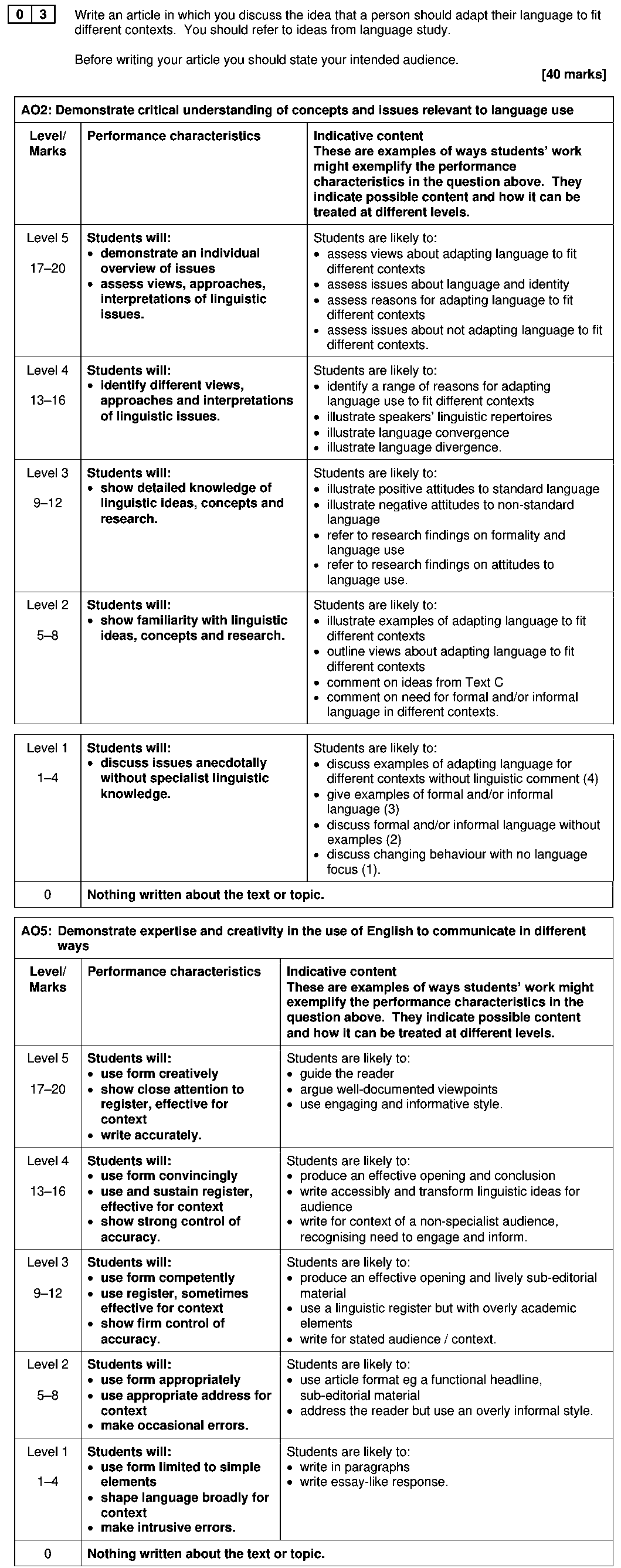
Language discourses Answer Question 3. Text C is an extract from a newspaper article about using appropriate language when applying for a job. Write an article in which you discuss the idea that a person should adapt their language to fit different contexts. Y
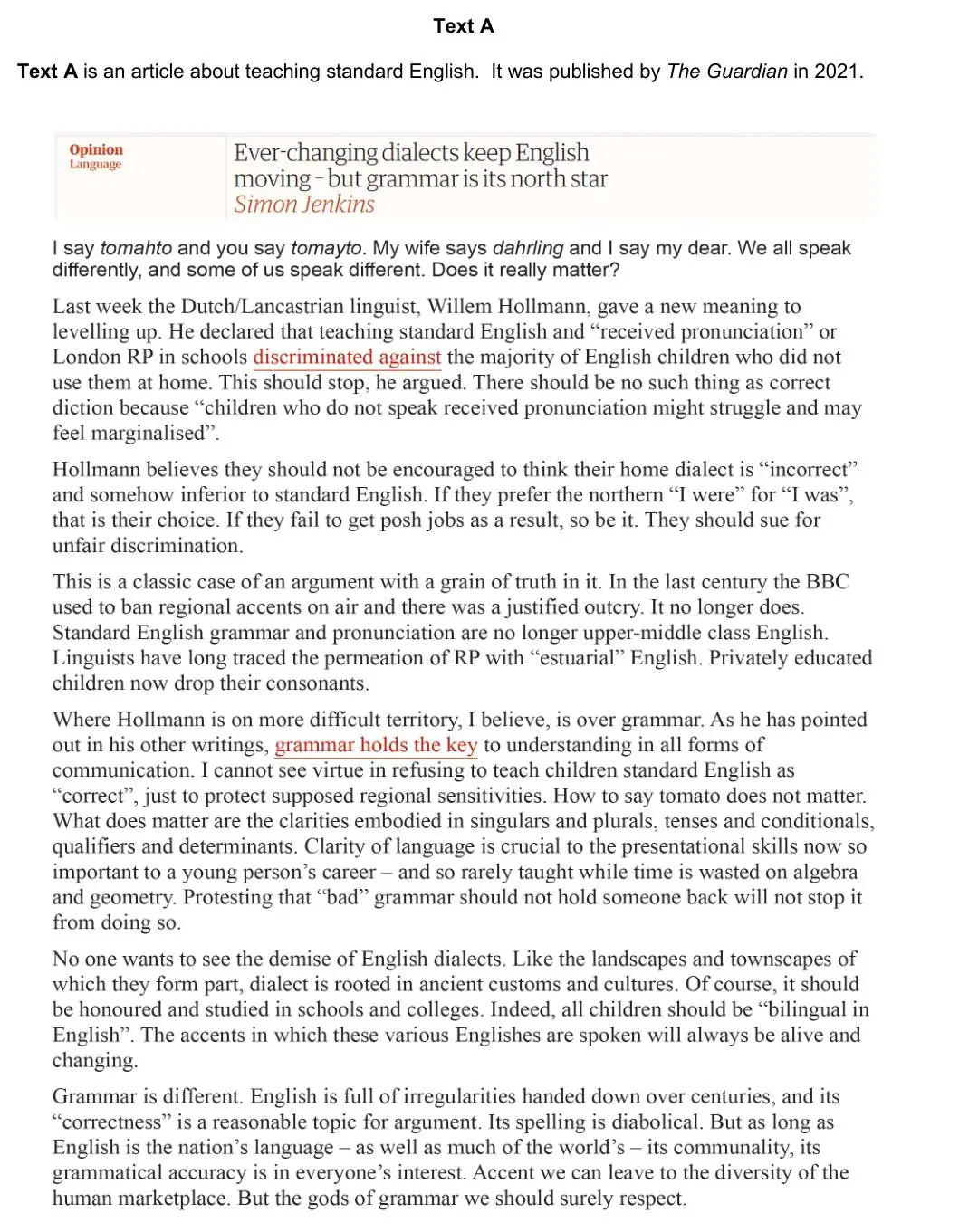
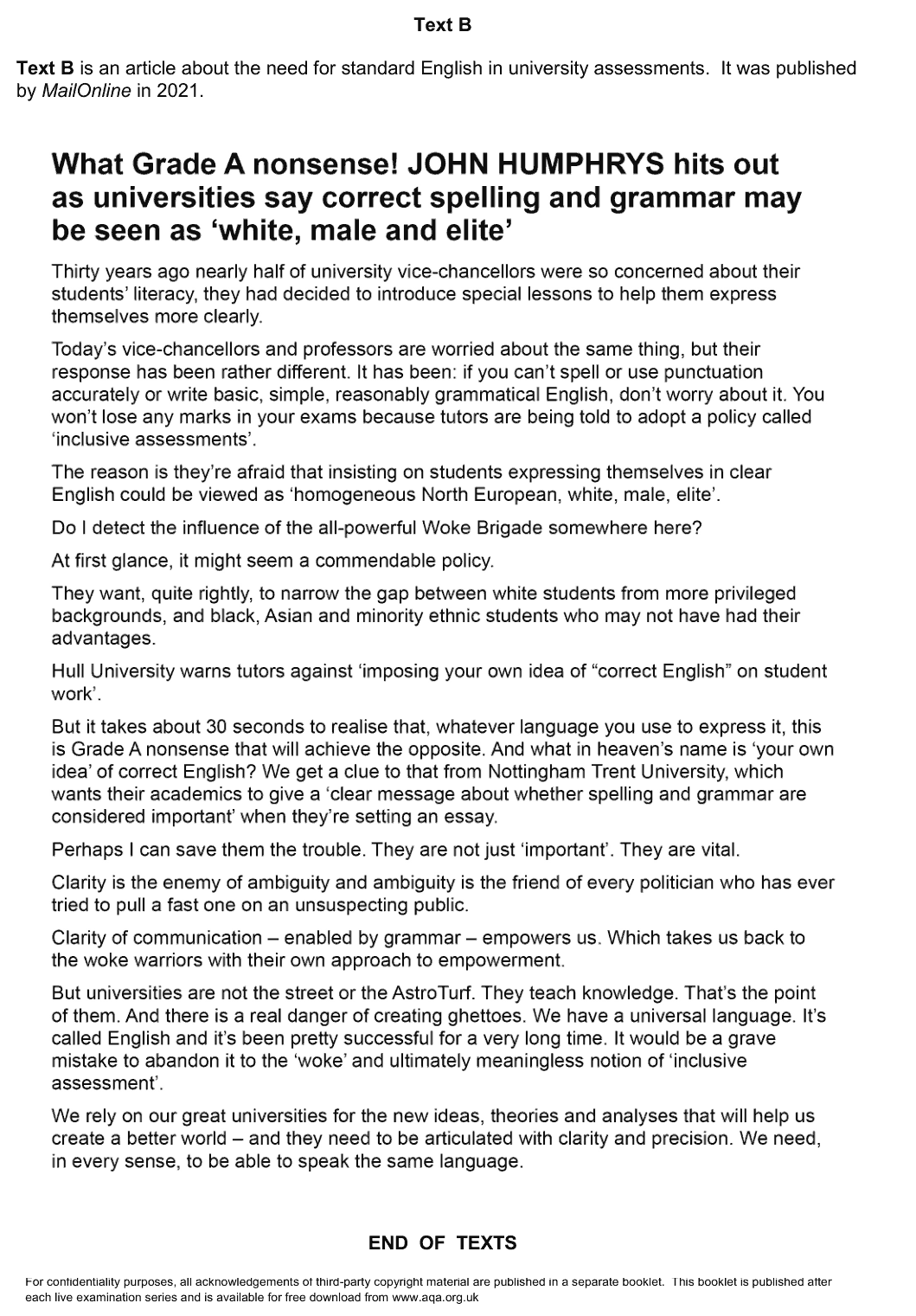
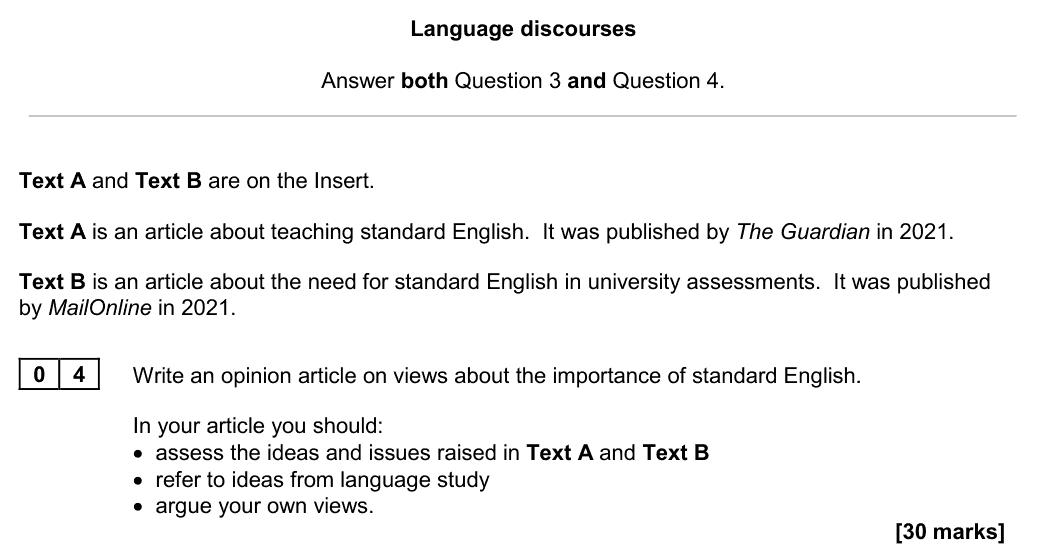
Language discourses Text A and Text B are on the Insert. Text A is an article about teaching standard English. It was published by The Guardian in 2021. Text B is an article about the need for standard English in university assessments. It was published by Mai
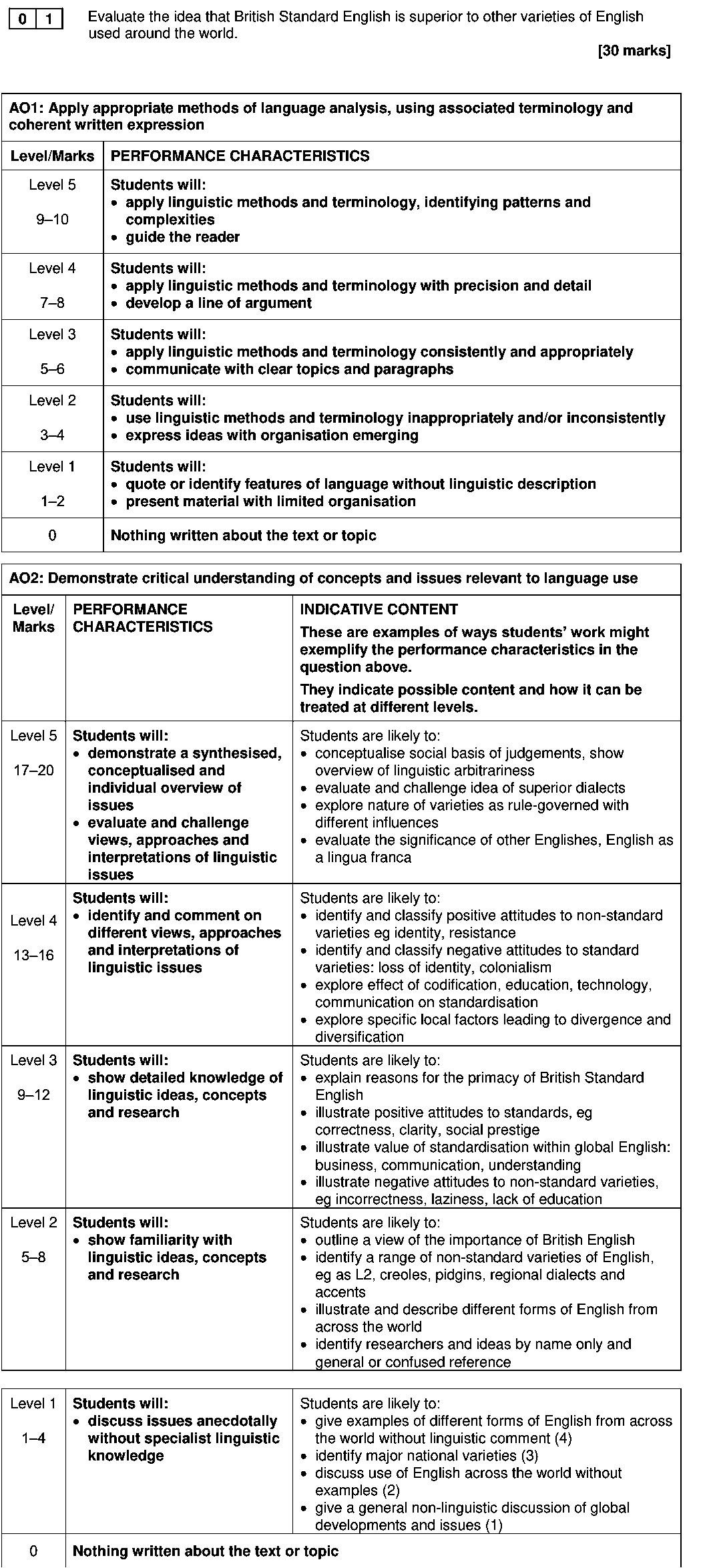
[image] [image] Discuss the idea that workplace jargon is a big problem. [Question wording from the mark scheme: AQA removed this page from the published paper for copyright reasons]
[image] This text not reproduced here due to third party copyright restrictions Discuss the idea that accents are influenced by social factors as well as regional factors. In your answer you should discuss concepts and issues from language study. You should us
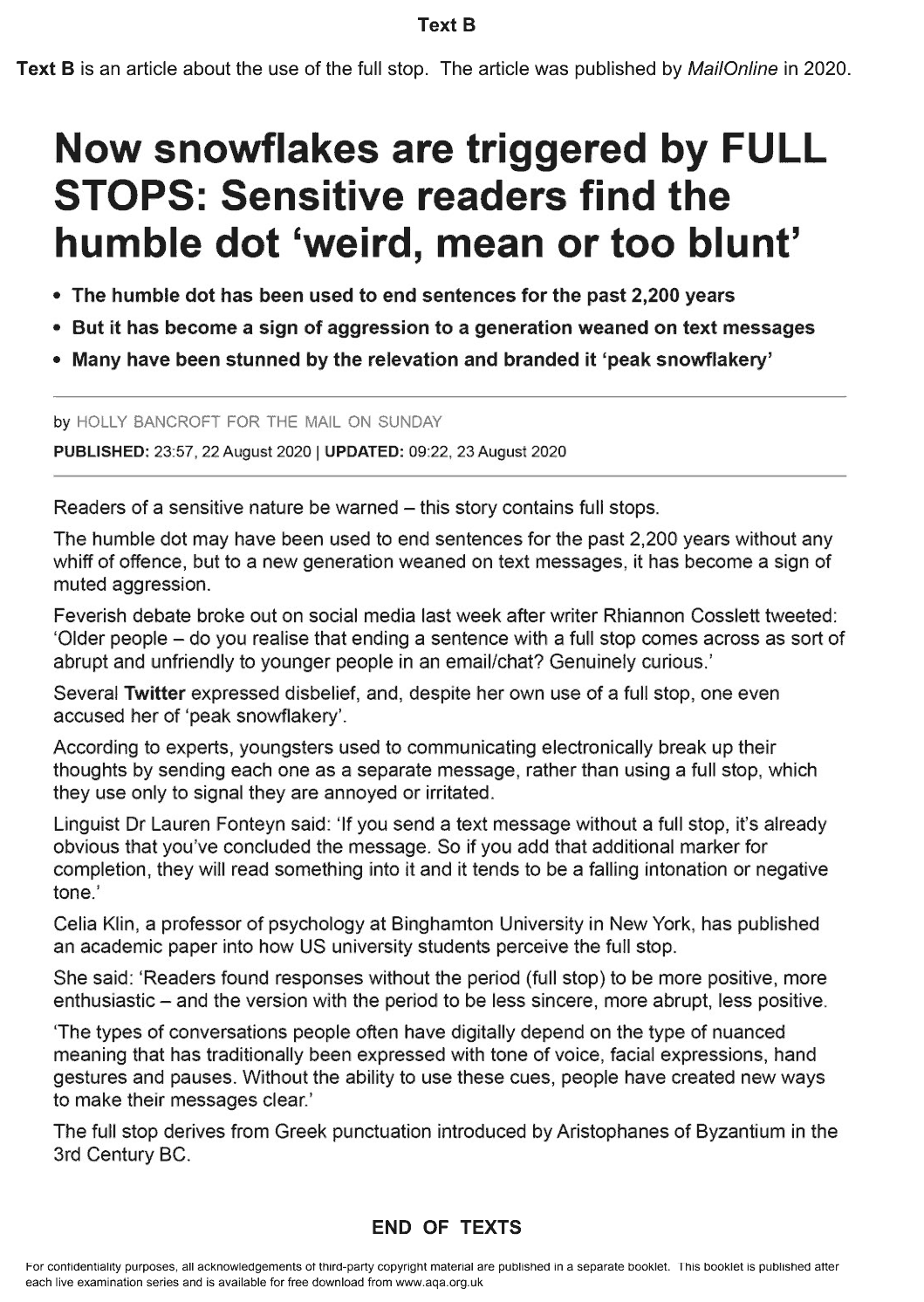
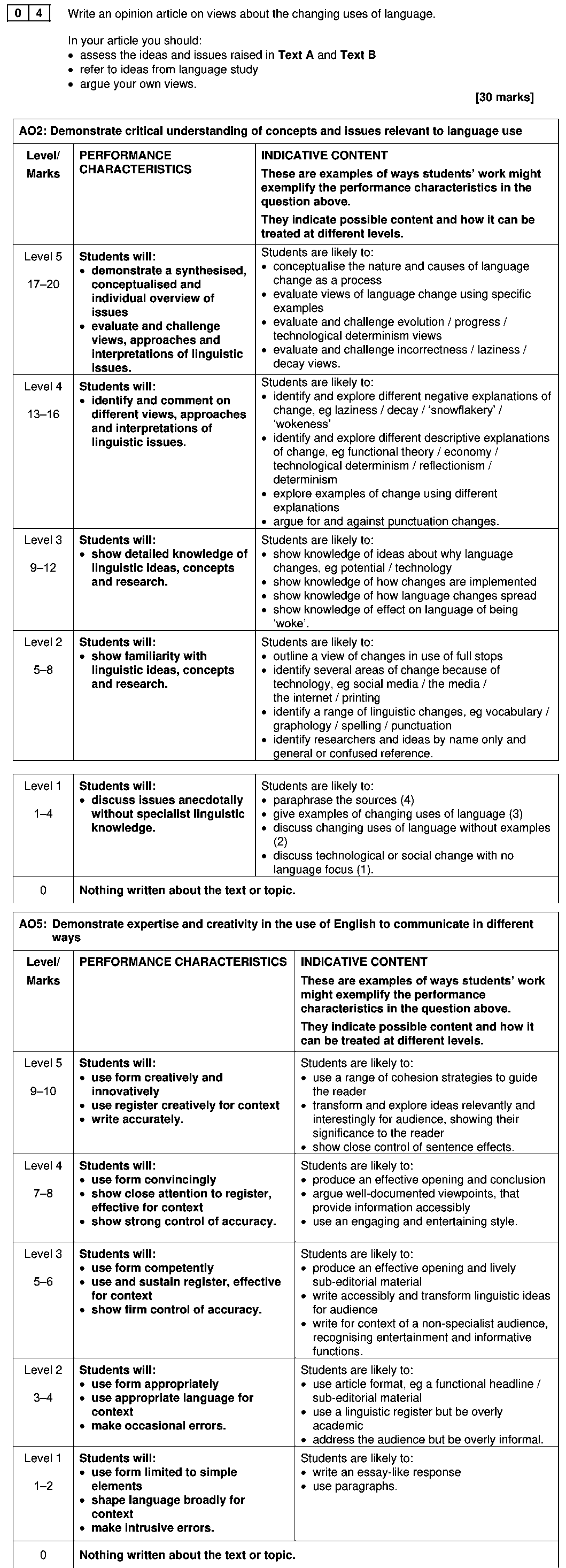
Language discourses Text A and Text B are on the insert. Text A is an article about the use of the full stop. The article was published on the website The Conservative Woman in 2020. Text B is an article about the use of the full stop. The article was publishe
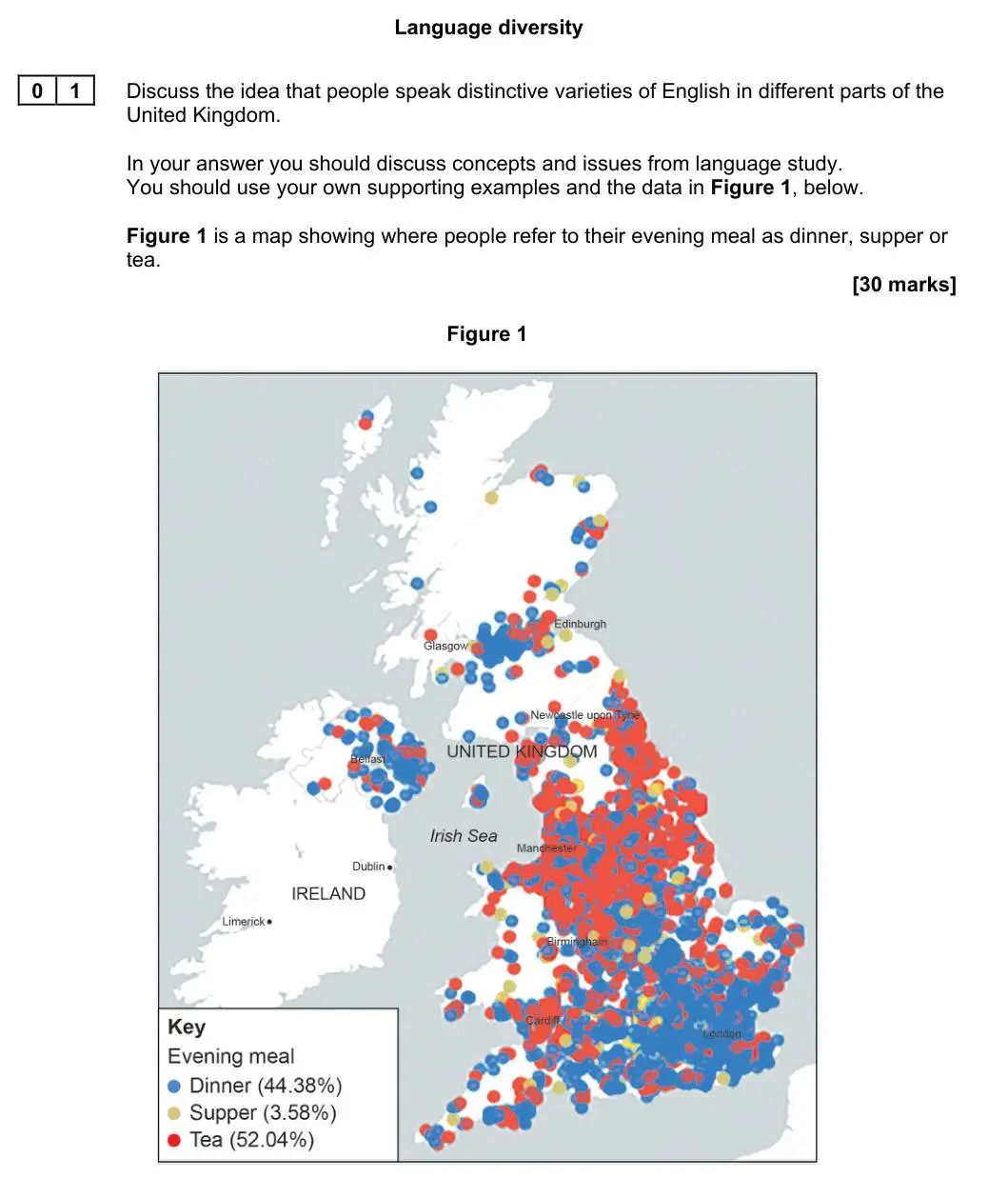
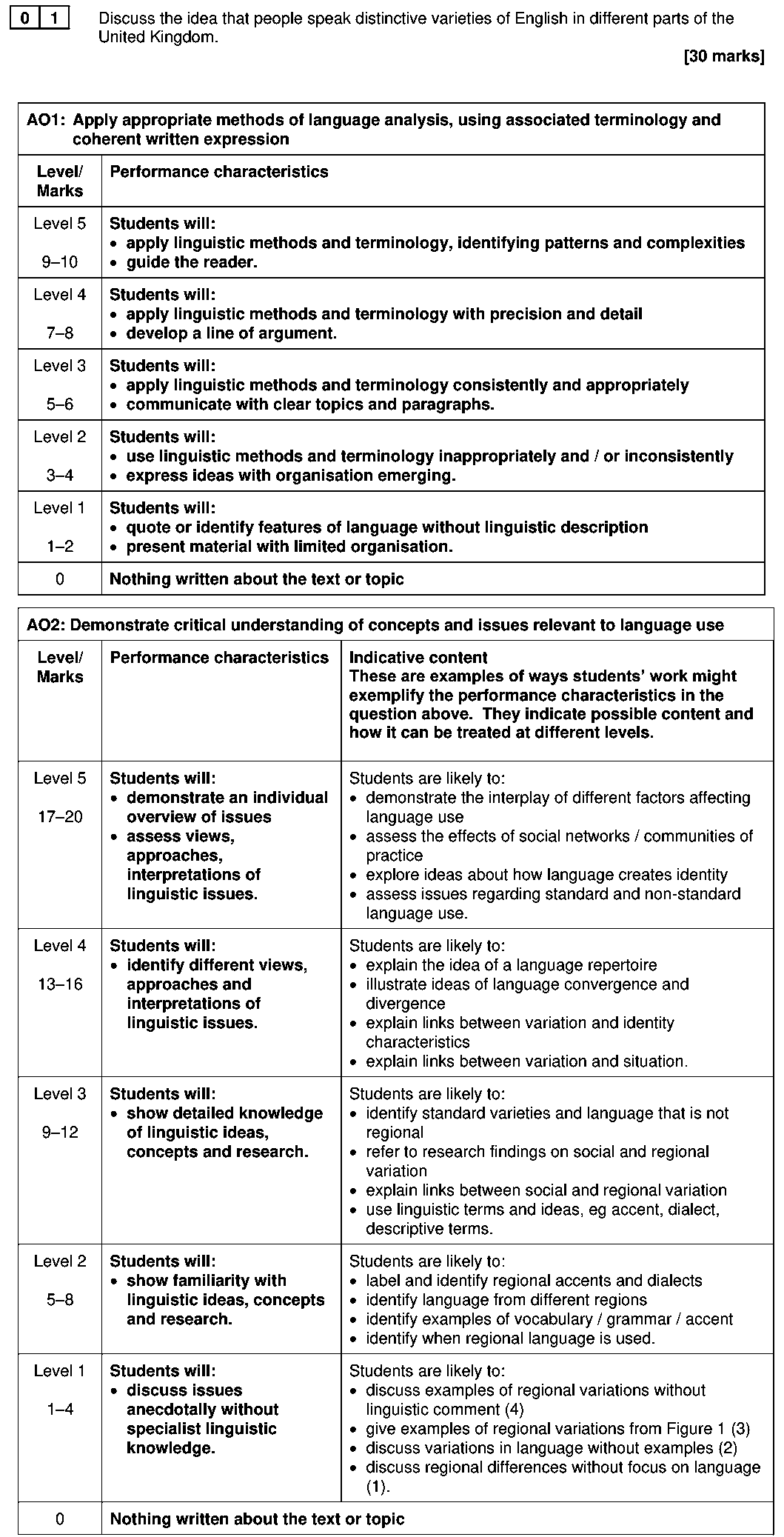
Language diversity Discuss the idea that people speak distinctive varieties of English in different parts of the United Kingdom. In your answer you should discuss concepts and issues from language study. You should use your own supporting examples and the data
Language diversity Discuss the idea that speech and writing are two different ways of using language. In your answer you should discuss concepts and issues from language study. You should use your own supporting examples and the data in Text A, below. Text A i
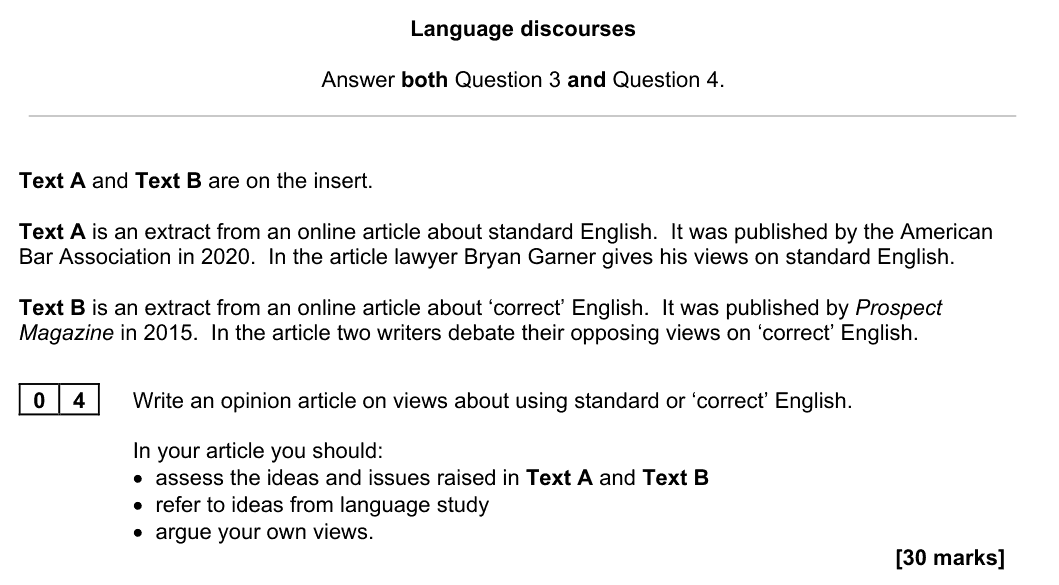
Language discourses Text A and Text B are on the insert. Text A is an extract from an online article about standard English. It was published by the American Bar Association in 2020. In the article lawyer Bryan Garner gives his views on standard English. Text
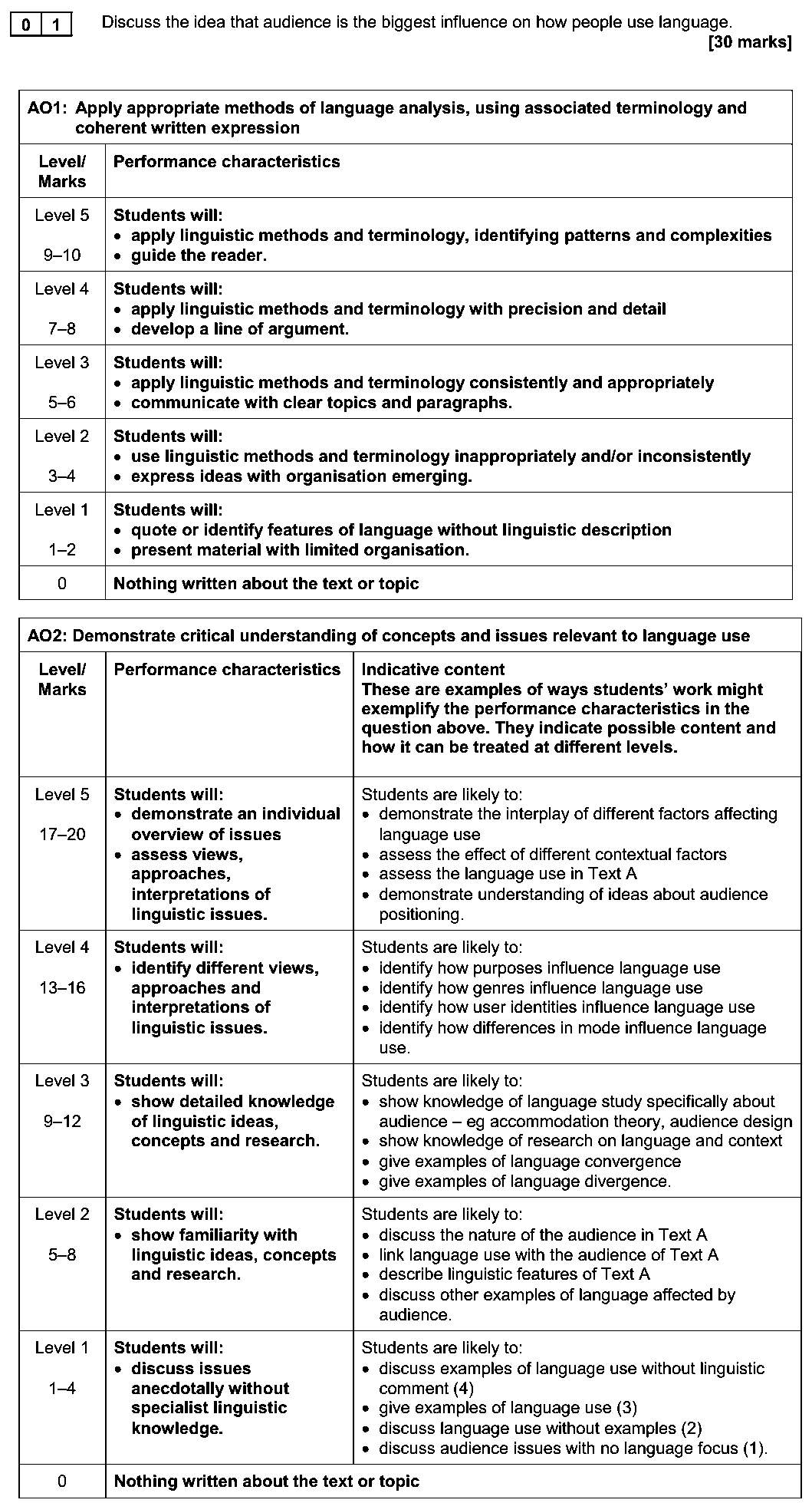
Language diversity Discuss the idea that audience is the biggest influence on how people use language. In your answer you should discuss concepts and issues from language study. You should use your own supporting examples and the data in Text A, below. Text A
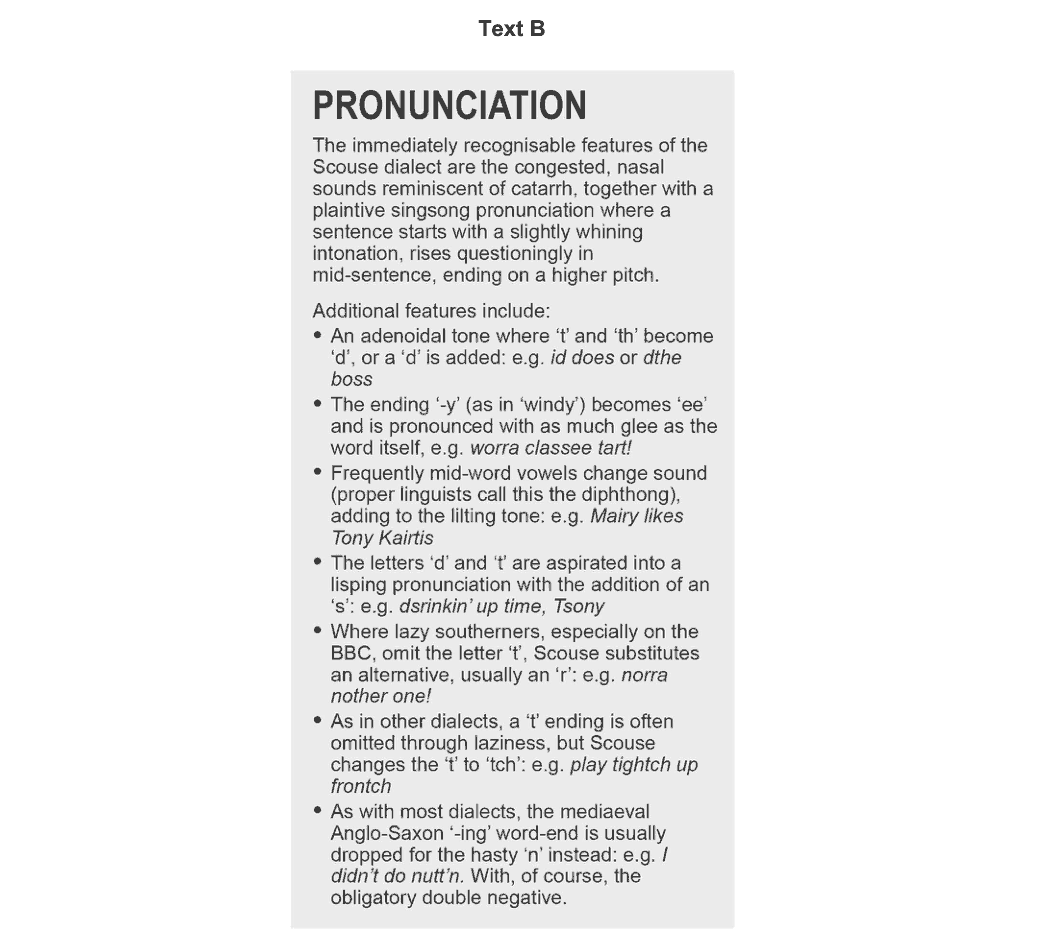
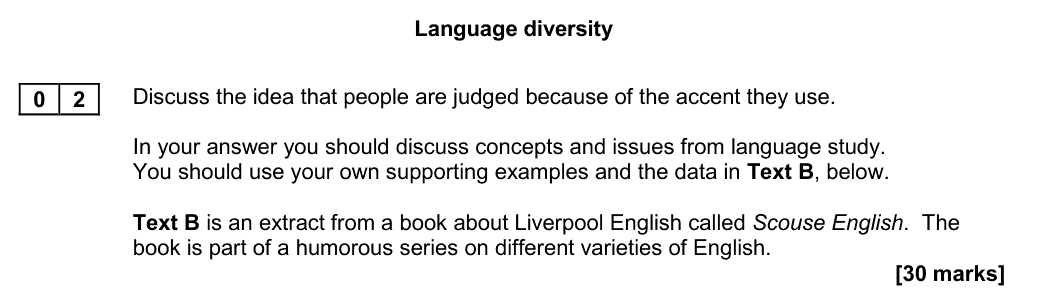
Language diversity Discuss the idea that people are judged because of the accent they use. In your answer you should discuss concepts and issues from language study. You should use your own supporting examples and the data in Text B, below. Text B is an extrac
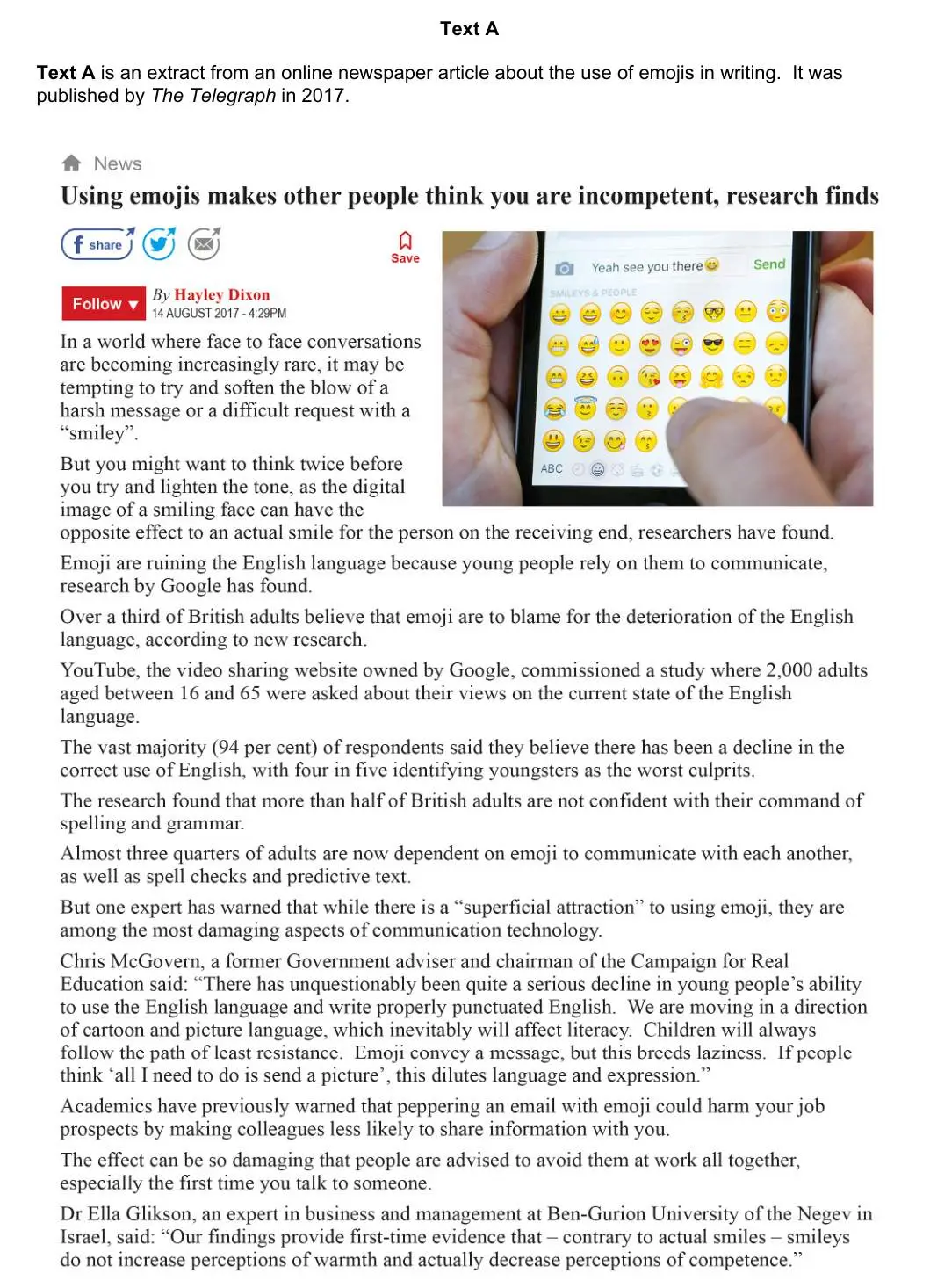
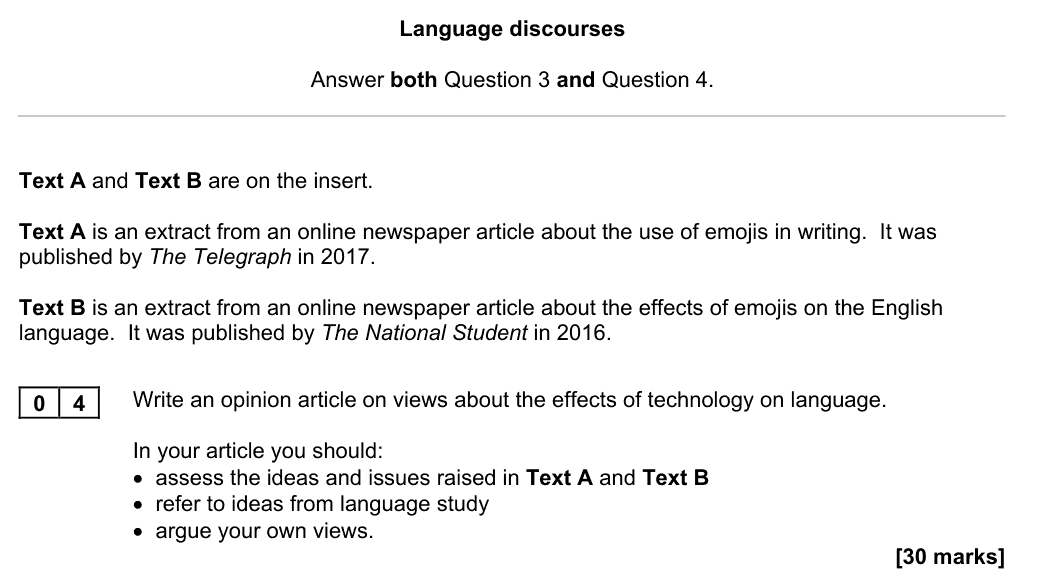
Language discourses Text A and Text B are on the insert. Text A is an extract from an online newspaper article about the use of emojis in writing. It was published by The Telegraph in 2017. Text B is an extract from an online newspaper article about the effect
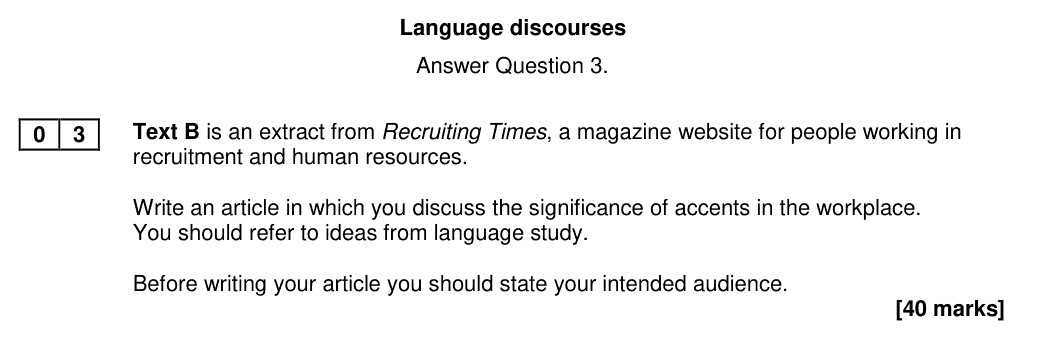
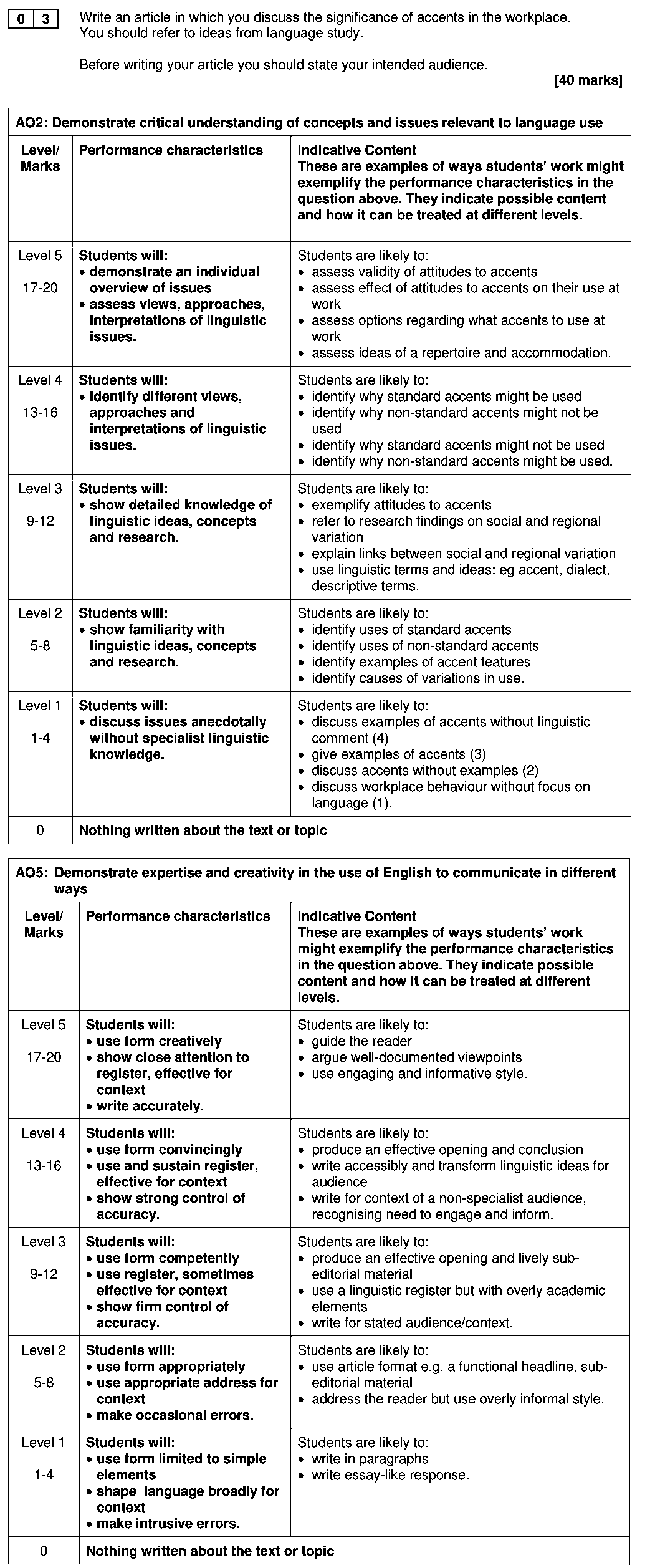
Language discourses Answer Question 3. Text B is an extract from Recruiting Times, a magazine website for people working in recruitment and human resources. Write an article in which you discuss the significance of accents in the workplace. You should refer to
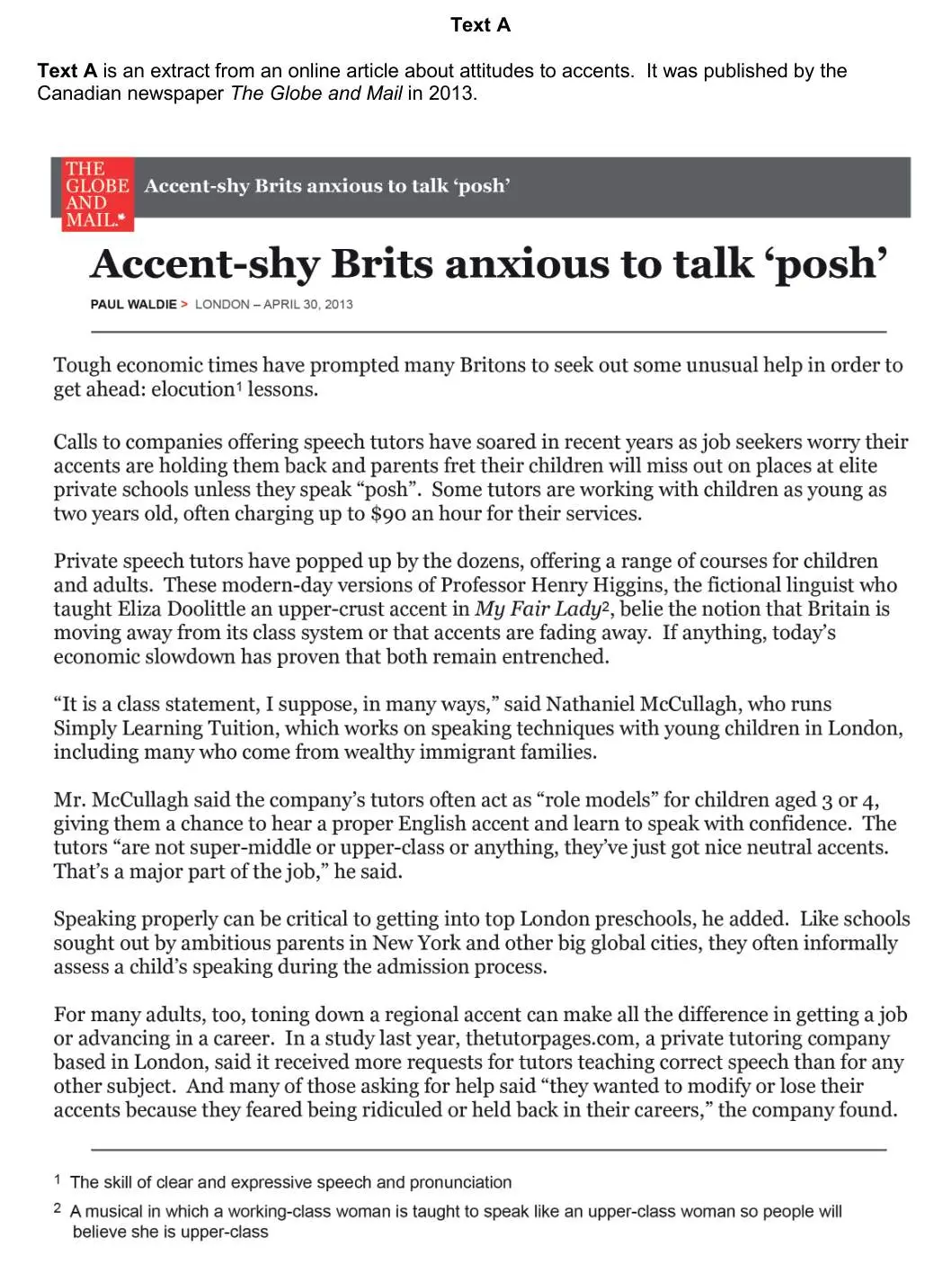
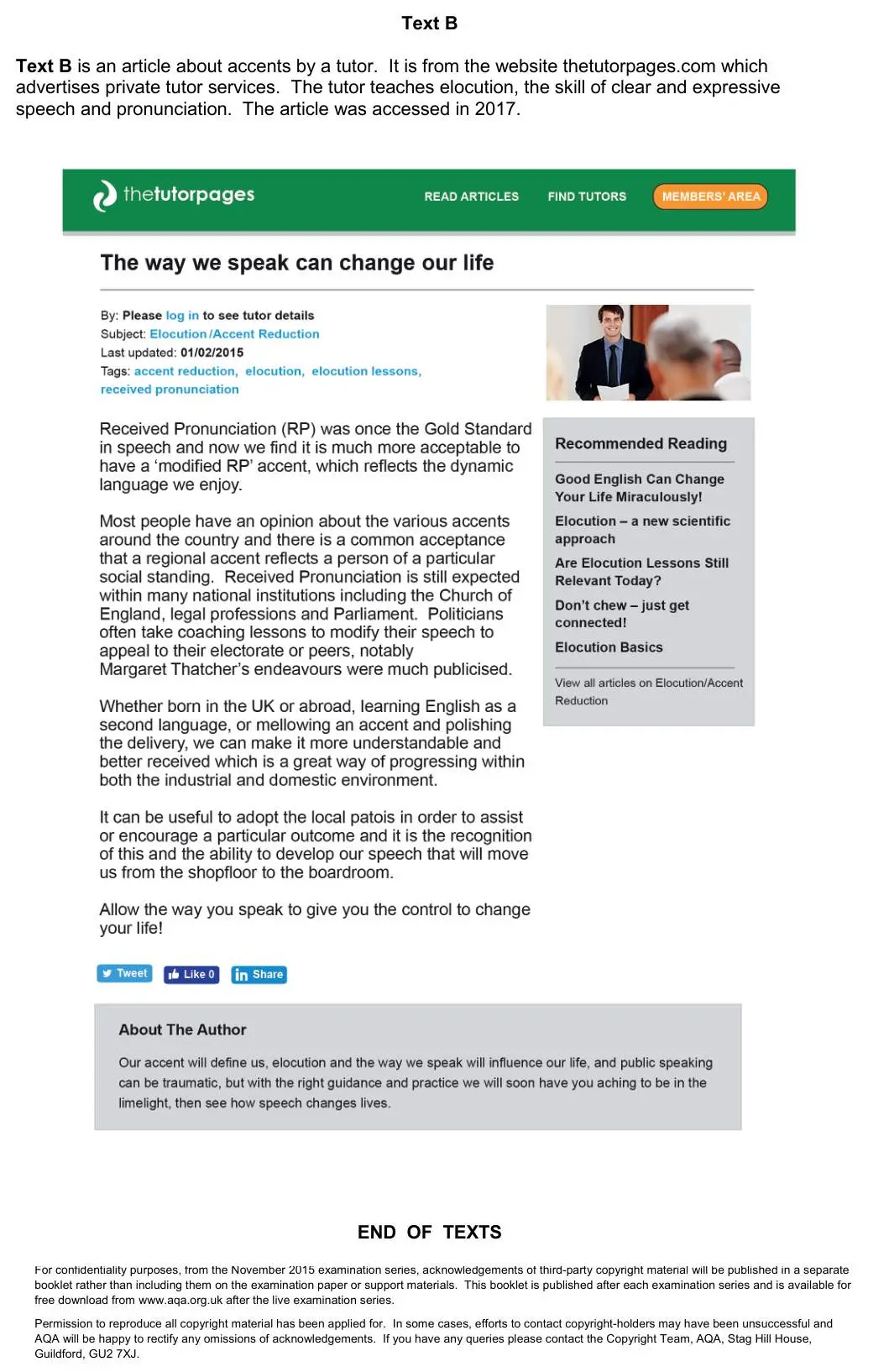
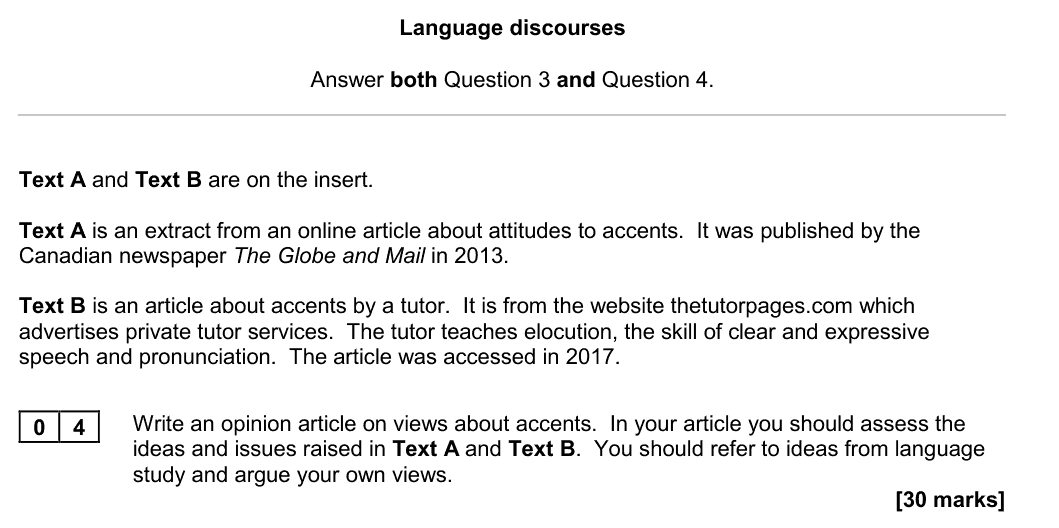
Language discourses Text A and Text B are on the insert. Text A is an extract from an online article about attitudes to accents. It was published by the Canadian newspaper The Globe and Mail in 2013. Text B is an article about accents by a tutor. It is from th
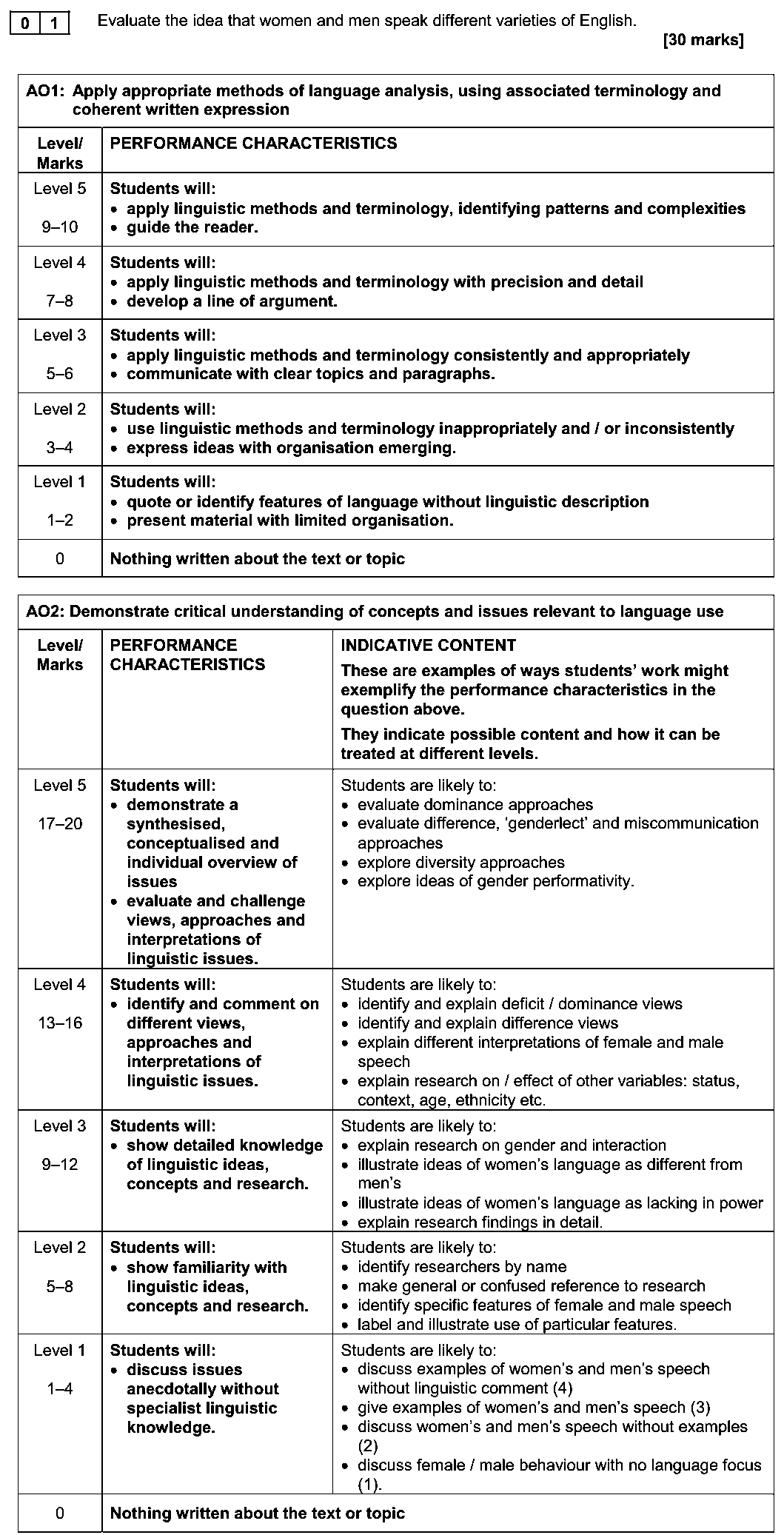
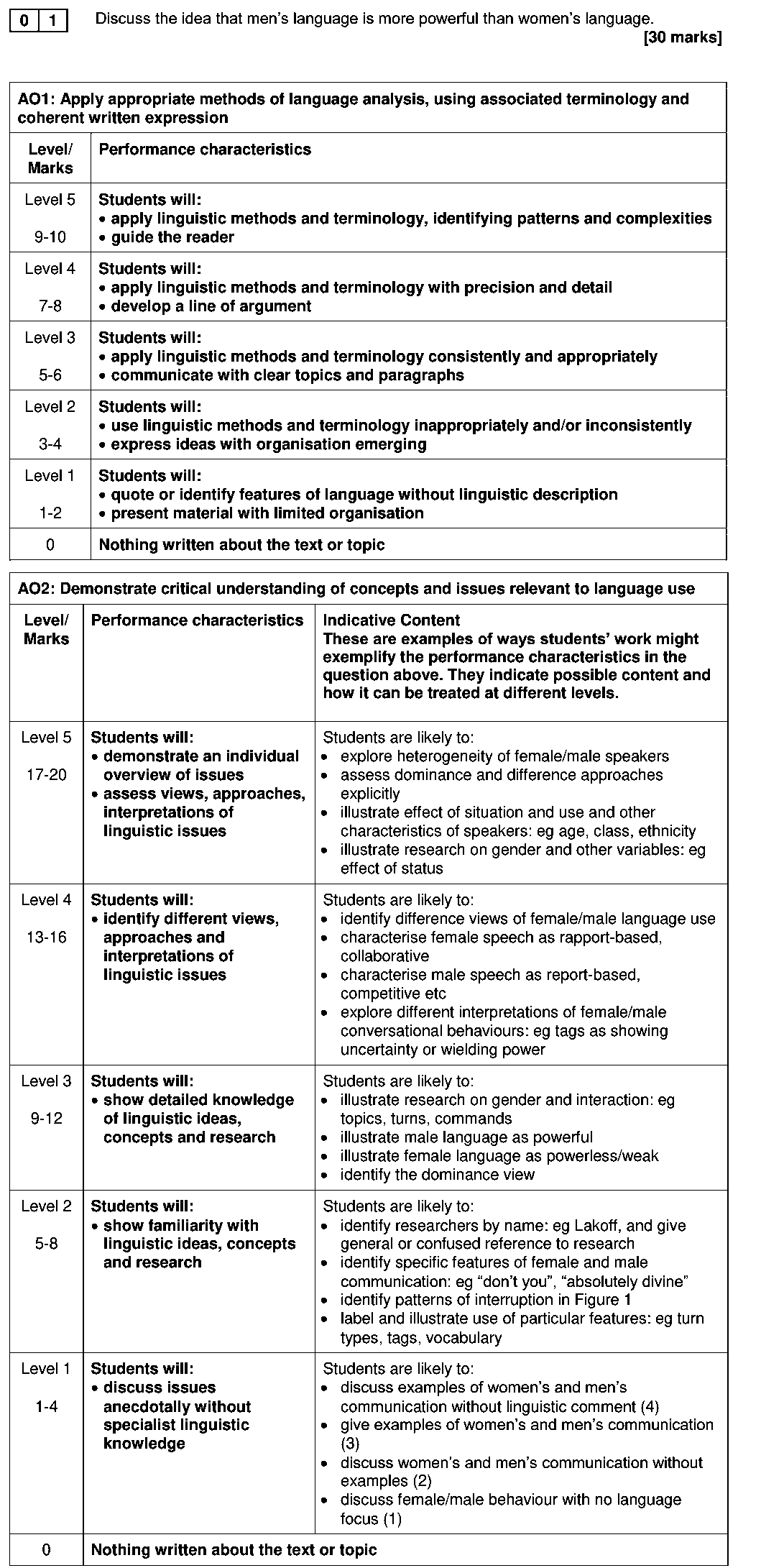
Language diversity Discuss the idea that men’s language is more powerful than women’s language. In your answer you should discuss concepts and issues from language study. You should use your own supporting examples and the data in Table 1, below. Table 1 gives
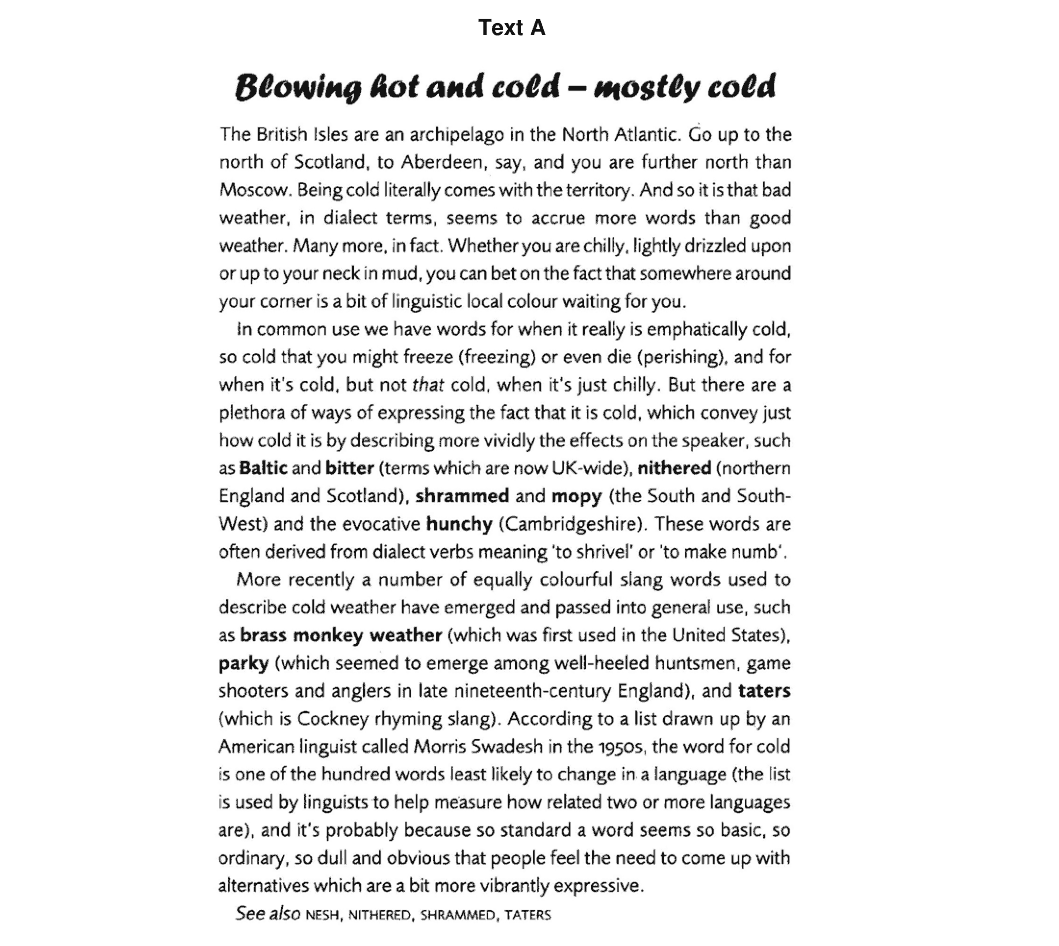
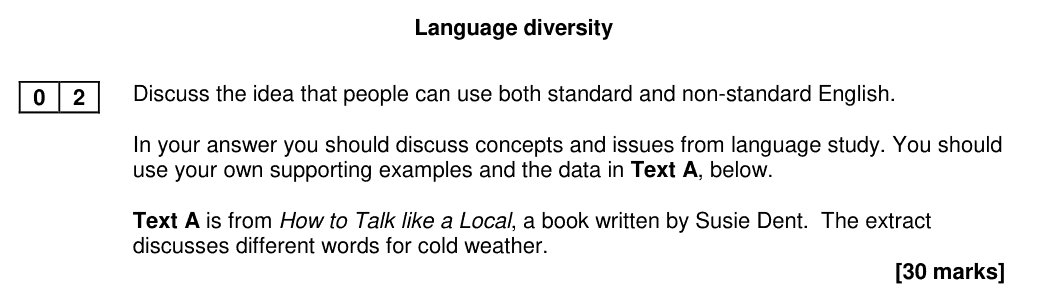
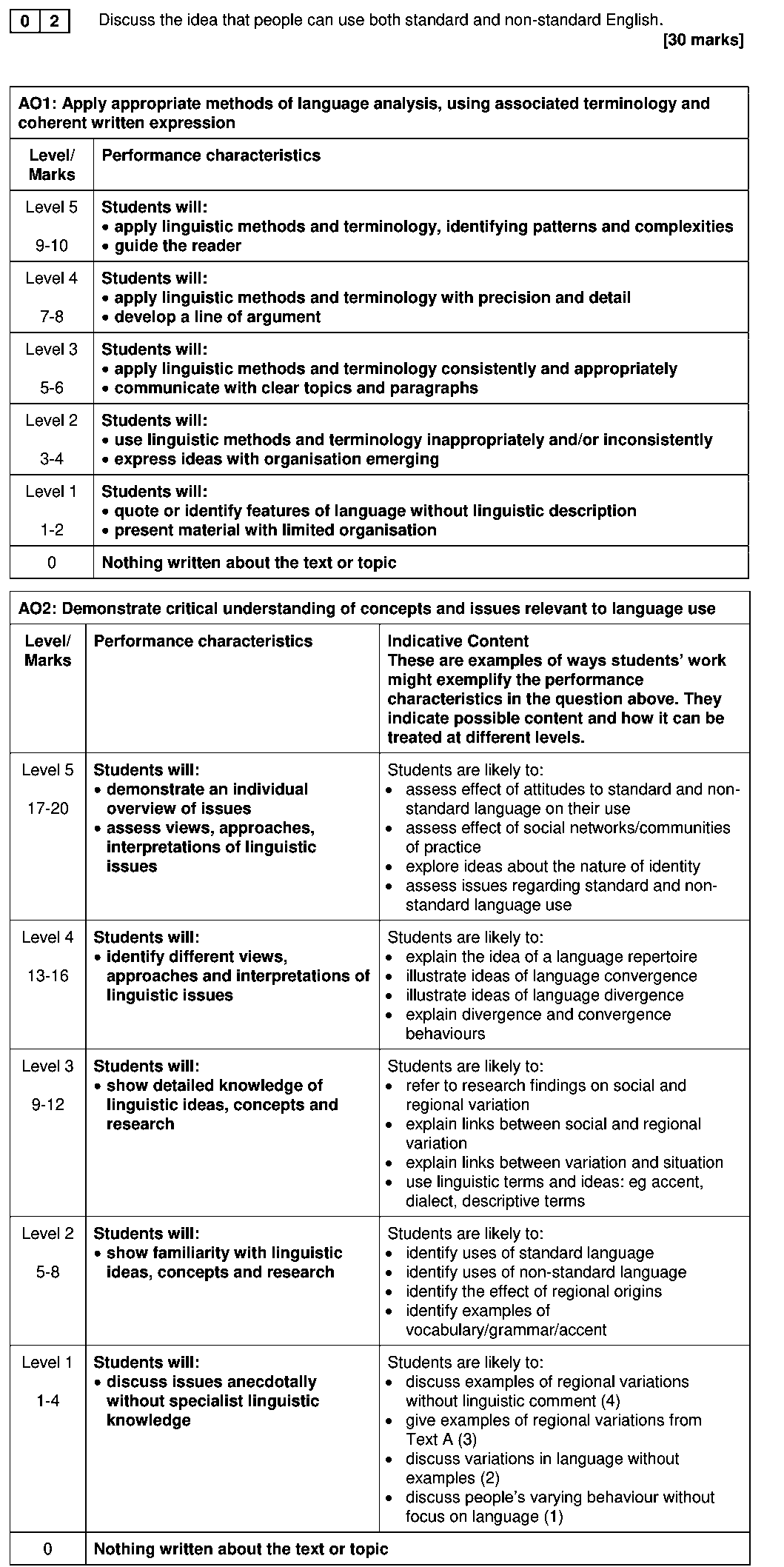
Language diversity Discuss the idea that people can use both standard and non-standard English. In your answer you should discuss concepts and issues from language study. You should use your own supporting examples and the data in Text A, below. Text A is from
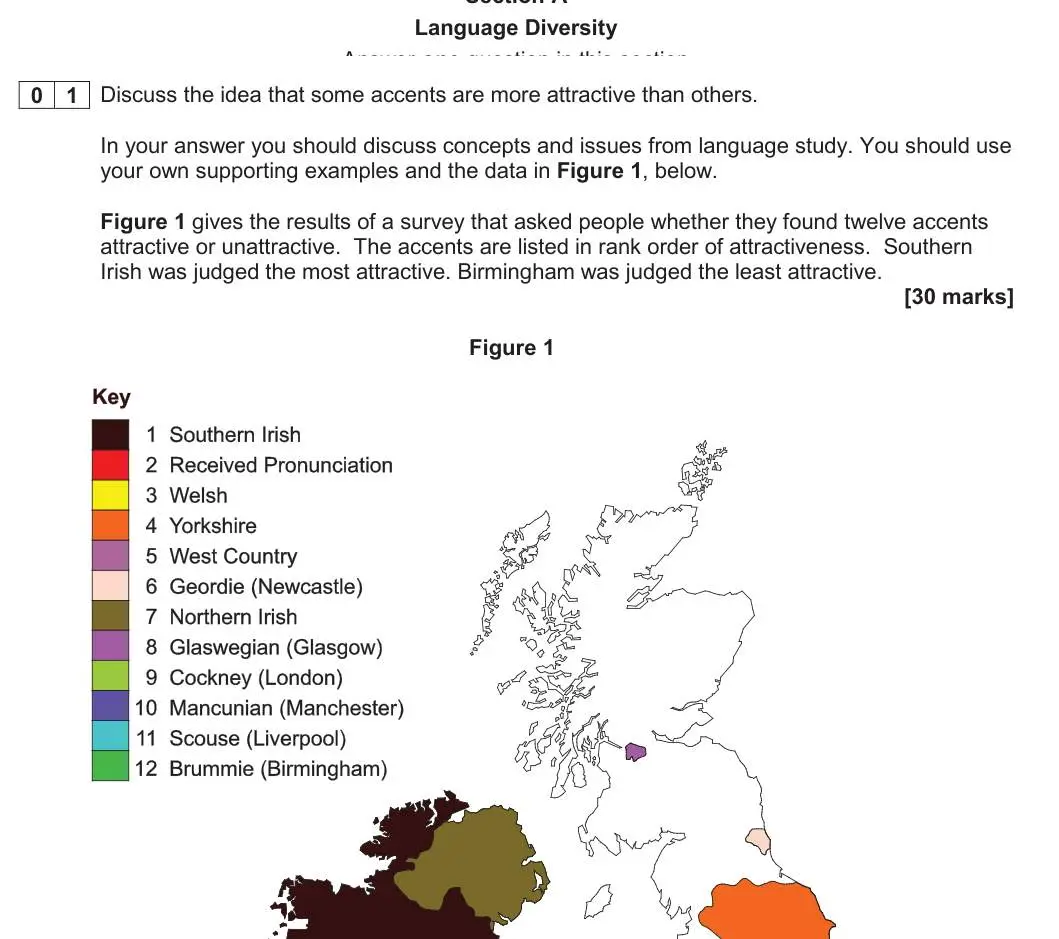
Language Diversity 0 1 Discuss the idea that some accents are more attractive than others. In your answer you should discuss concepts and issues from language study. You should use your own supporting examples and the data in Figure 1, below. Figure 1 gives th
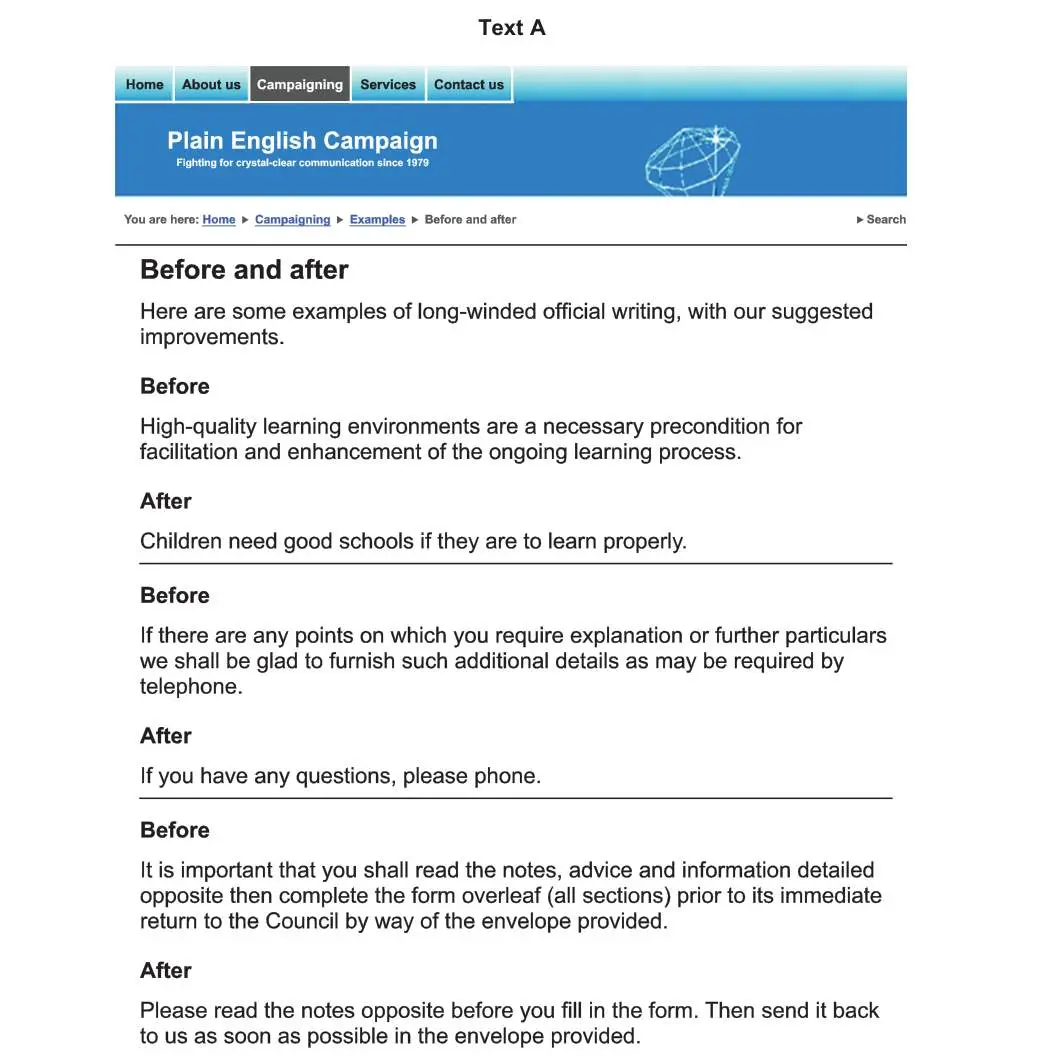
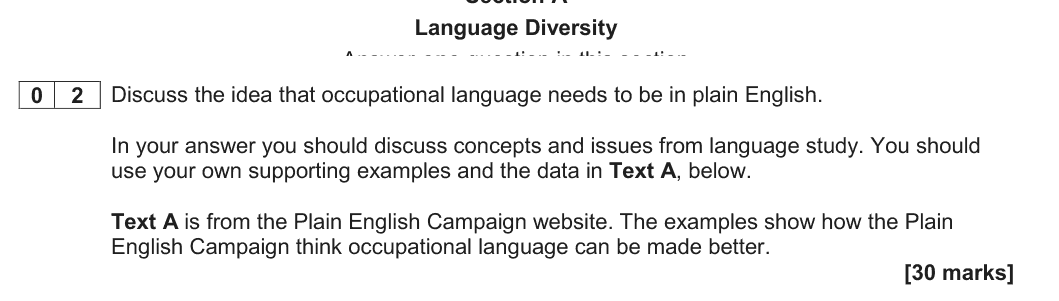
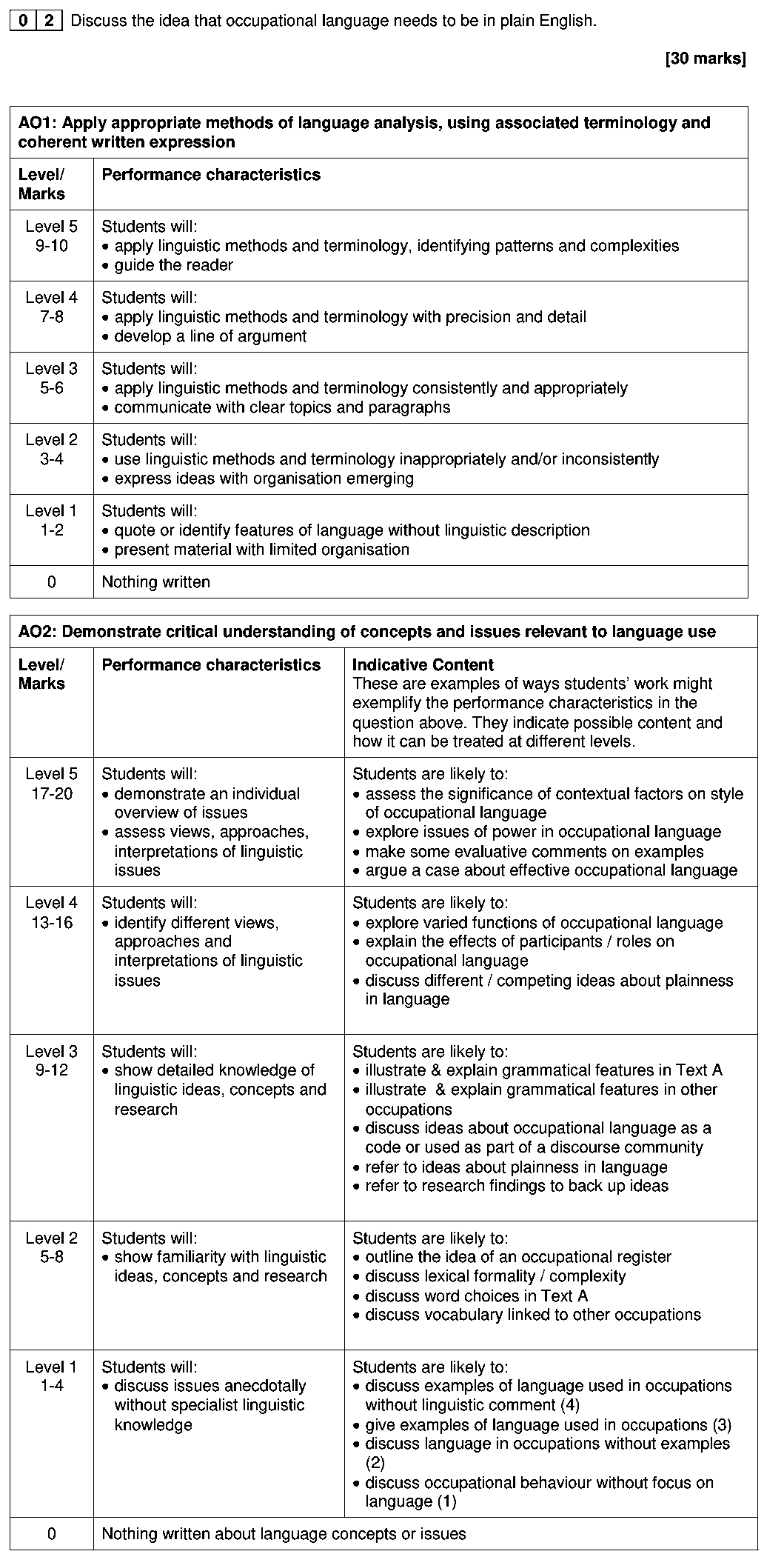
Language Diversity Discuss the idea that occupational language needs to be in plain English. In your answer you should discuss concepts and issues from language study. You should use your own supporting examples and the data in Text A, below. Text A is from th
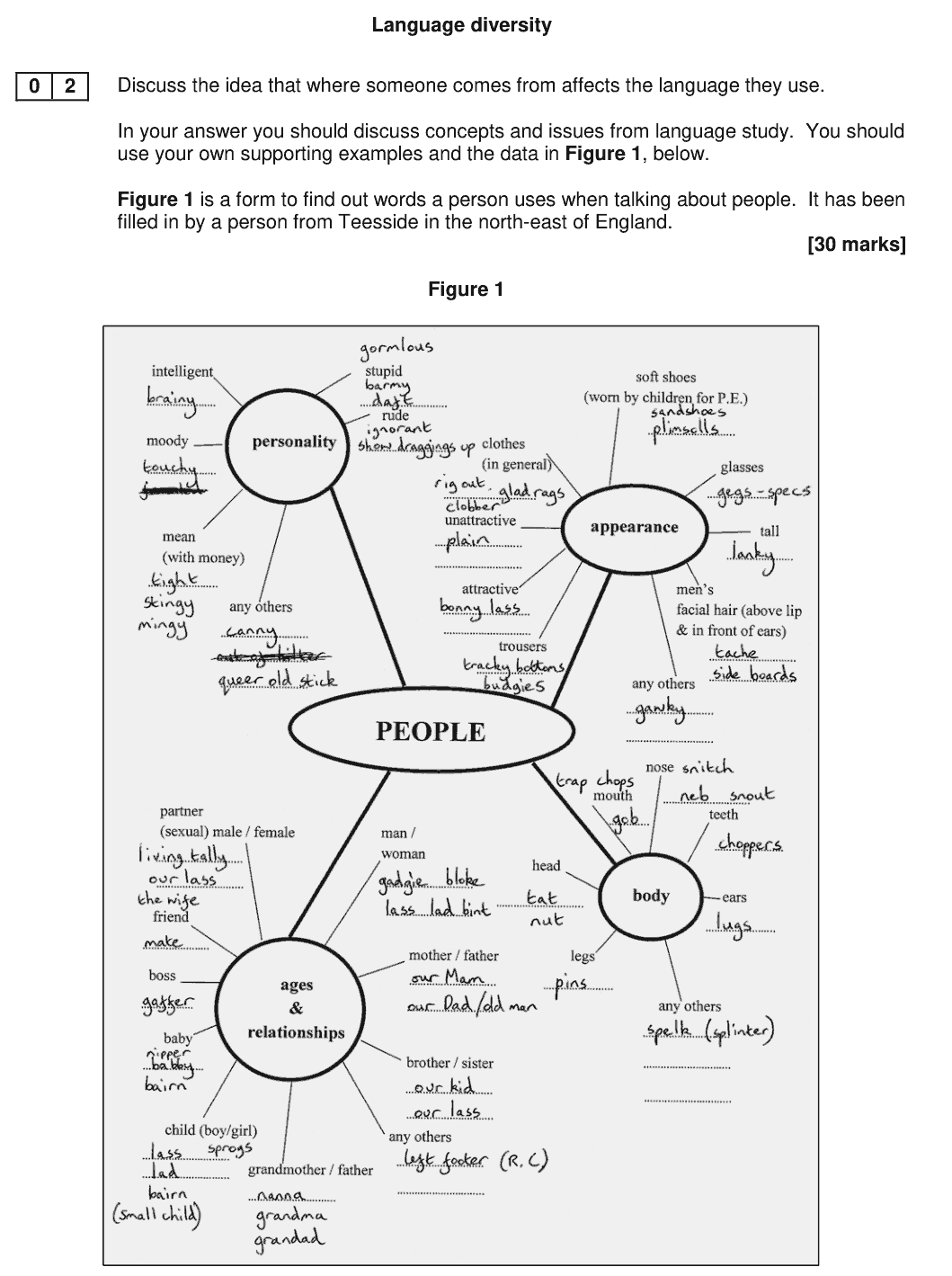
Language diversity Discuss the idea that where someone comes from affects the language they use. In your answer you should discuss concepts and issues from language study. You should use your own supporting examples and the data in Figure 1, below. Figure 1 is
Tap a question to zoom it. The texts and extracts open above it; the mark scheme (with its levels and indicative content) and the examiner's comment open underneath.
June 2025 · AS Paper 2 · Q130 marksAO1=10, AO2=20Diversity essay
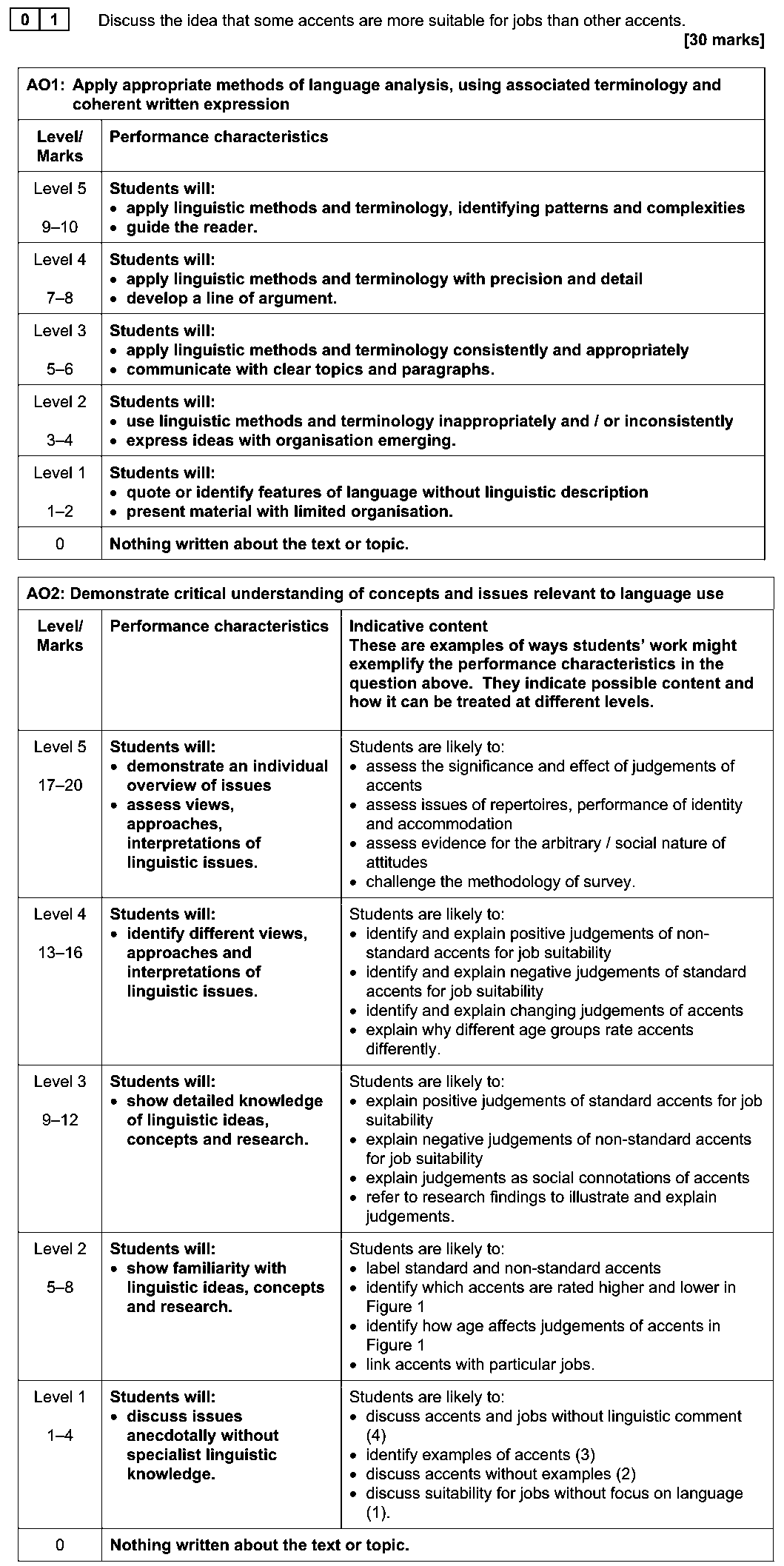
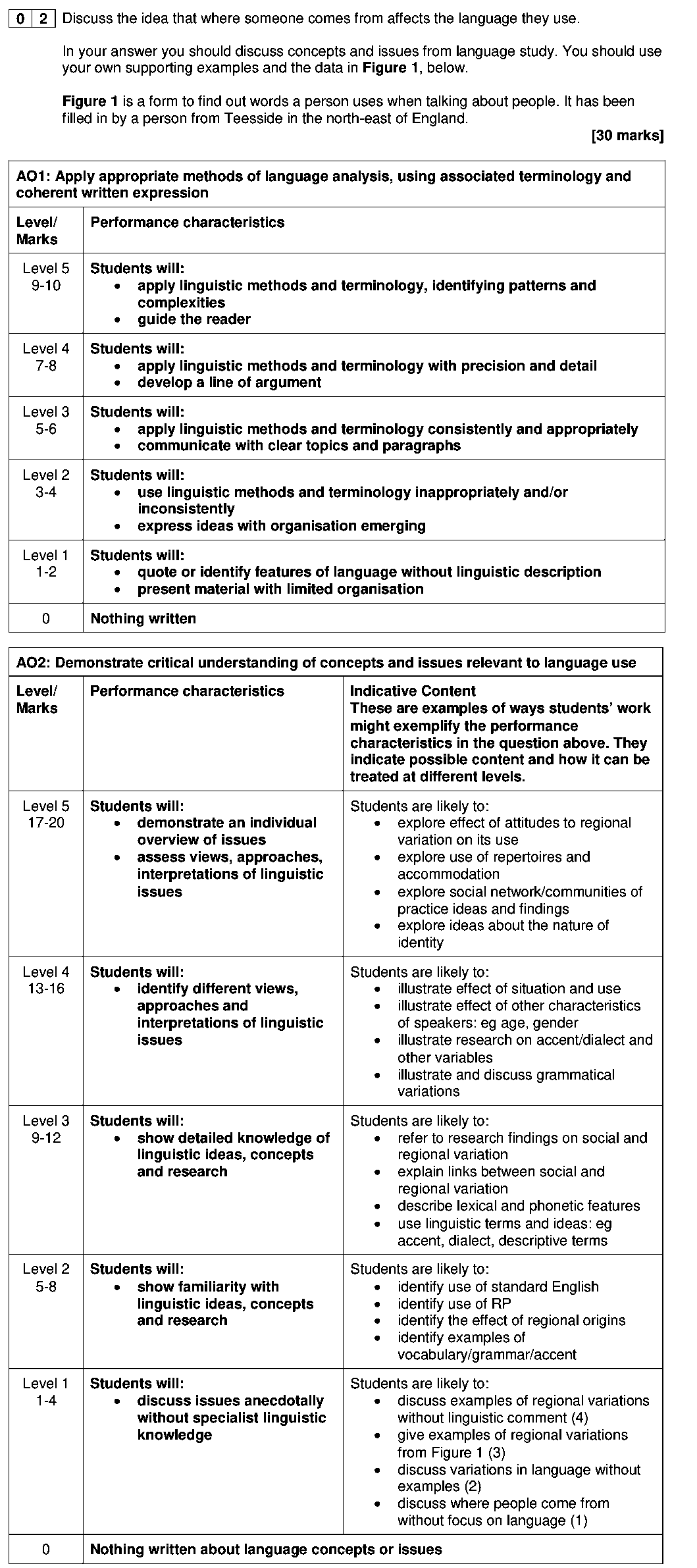
Mark scheme, including the levels and indicative content
Examiner's comment
Discuss the idea that some accents are more suitable for jobs than other accents. How students did well Students did well when they: • referenced very familiar names in the fields of accent, such as Labov and Giles • explained Matched Guise research methodology and findings • referenced a range of different studies on the perception of accents • wrote about more contemporary approaches to accent study, highlighting the work of Drummond in particular, with links drawn between MLE and M(U)BE • explored the reasons behind MLE’s growing acceptance with younger people in the graph data • considered reasons for the spread of MLE beyond London • explored which accents were seen as more suitable for particular jobs • explored why different people might hold different views • considered how people might respond to this situation • identified attitudes to accents as social rather than linguistic. How students did less well Students did less well when: • thought that the ‘age’ reference in the stimulus material meant age of prospective candidate for a job, rather than the age of the person offering a point of view on an accent’s suitability for a role • never moved away from interpreting the stimulus data and wrote an answer entirely based on the provided graph.
Notes from the mark scheme and report
AO1 10 + AO2 20
top band assesses the effect of accent judgements, repertoires, accommodation and identity, the arbitrary social nature of attitudes and challenges the survey's method
Level 4 explains why age groups rate accents differently
common error: reading 'age' as the job candidate's age rather than the rater's
weaker answers only described the graph
Texts/data: Figure 1: line graph of perceived job suitability of RP, General Northern, MLE, Estuary and Urban West Yorkshire accents by rater age
June 2025 · Paper 2 · Q130 marksAO1=10, AO2=20Diversity essay
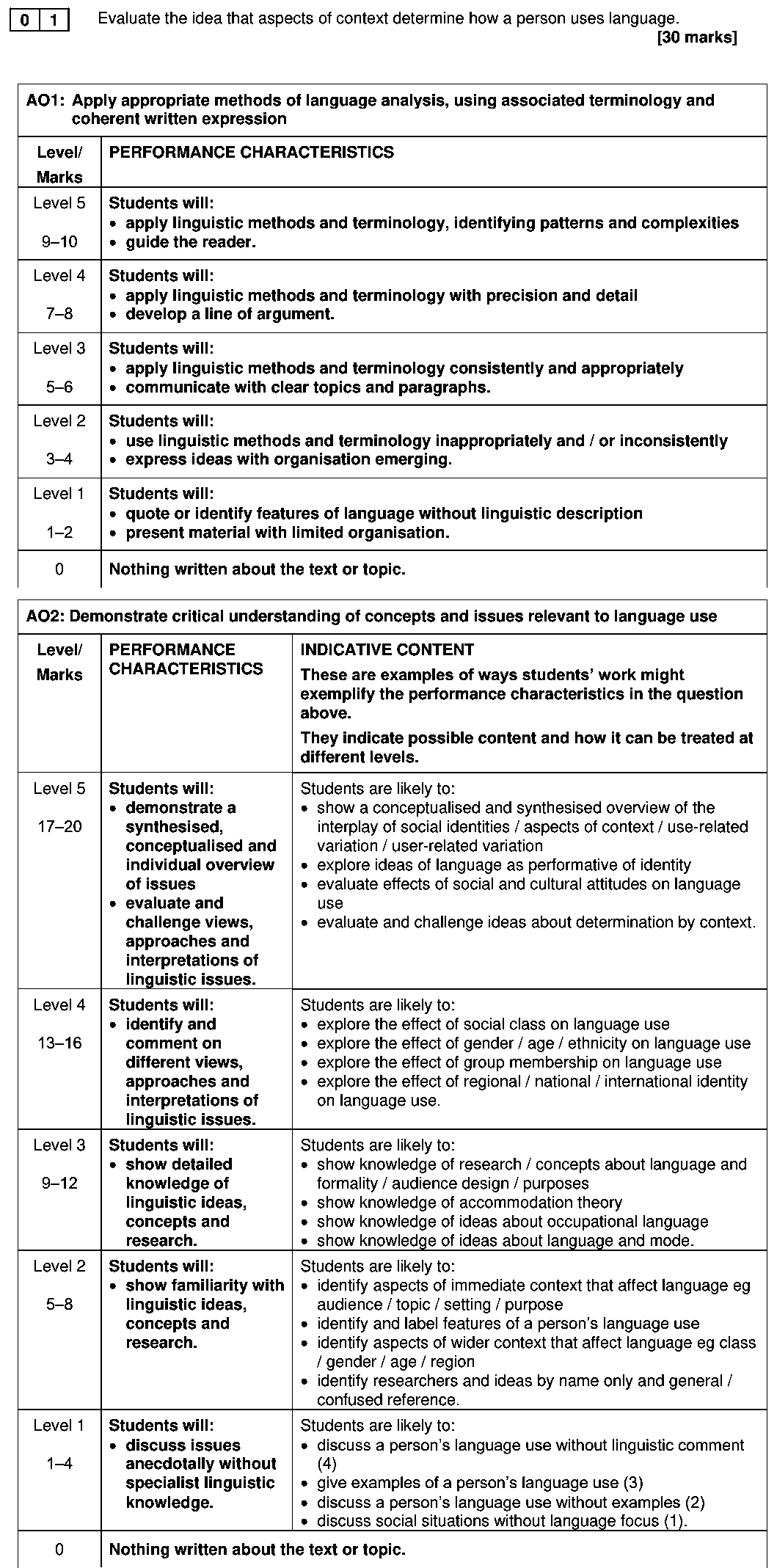
Mark scheme, including the levels and indicative content
Examiner's comment
Evaluate the idea that aspects of context determine how a person uses language. How students did well Students did well when they: • explored what context might mean and identified different types of contexts • examined the impact of immediate contextual factors such as audience, purpose, subject • considered wider social contexts such as gender, ethnicity, social class • paid attention to the implications of ‘determine’ • challenged the idea that language use was constrained by context • evaluated how far someone was free to use language as they wanted • explored ideas about performativity • explored how different aspects of context might work simultaneously • evaluated the relative effect of different aspects of context • examined the impact of audience, looking at ideas about audience design, accommodation and code-switching • looked at how mode affected language use, considering affordances, constraints and conventions • looked at how purposes affected language use • used occupational language as a way of considering a range of ways in which context affected language • explored accommodation theory • offered a critical view of dominance and difference explanations of the effect of gender on language • examined ideas of biological determinism critically • explored relationships between language and social class and group membership • examined the impact of regional, national and international contexts • looked at how social values affected language use, eg Polari • cited ideas about linguistic relativity and looked at how language was influenced by society and culture • examined how attitudes to language affected language use. How students did less well Students did less well when they: • devoted a lot of time to recounting older ideas and research about gender uncritically • recounted oft-cited studies (Jocks and Burnouts, Martha’s Vineyard, Ives’ Bradford study) spending time explaining the case study at the expense of discussing its significance in terms of the question.
Notes from the mark scheme and report
AO1 10 + AO2 20
top band synthesises the interplay of identities, context and use- vs user-related variation, explores performativity and challenges determination by context
Level 4 explores class, gender, age, ethnicity, group and regional/national identity
Level 3 uses audience design, accommodation, occupational language and mode
ER: best defined 'context', weighed 'determine' and freedom of choice and considered several contexts acting at once
weaker answers recounted older gender research uncritically or retold Jocks and Burnouts, Martha's Vineyard and Ives without linking to the question
Texts/data: Essay topic: whether aspects of context determine how a person uses language
June 2025 · AS Paper 2 · Q230 marksAO1=10, AO2=20Diversity essay
Text A (insert)
Mark scheme, including the levels and indicative content
Examiner's comment
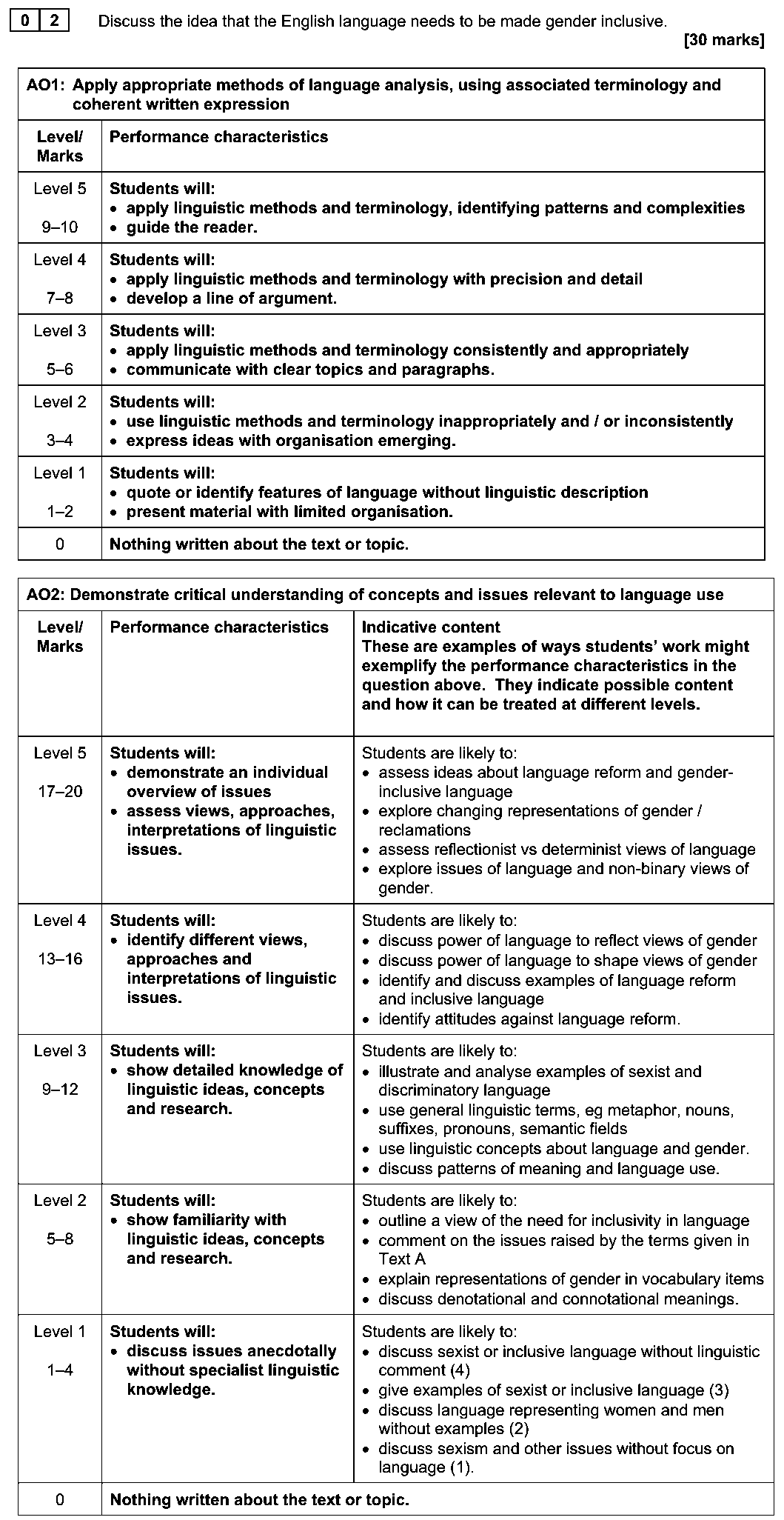
Discuss the idea that the English language needs to be made gender inclusive. What students did well Students did well when they: • used a range of examples and concepts to explore how the English language is not gender-inclusive • discussed a range of ways that language can be gender-inclusive • challenged the more traditional definitions of gender in a world where gender no longer operates in a binary way • explored neo-pronouns • discussed language reform programmes • examined reflectionist and determinist views of language and representation • cited the ideas of Sapir and Whorf • debated the need for changes to the English language. How students did less well Students did less well when: • focussed on research about how women and men communicate in spoken interaction as opposed to how they are represented in language use • wrote a very general answer based on the subject of gender • treated the stimulus data as the be-all-and-end-all of the question rather than using it as a springboard to reference wider language studies.
Notes from the mark scheme and report
AO1 10 + AO2 20
top band assesses language reform and gender-inclusive language, changing representations and reclamation, reflectionist vs determinist views (Sapir-Whorf) and non-binary views of gender
credited: marked terms, -ess and -man forms, neo-pronouns, reform programmes and opposition to them
weaker answers wrote about how men and women talk instead of representation, wrote generally on gender or stayed with the UN text
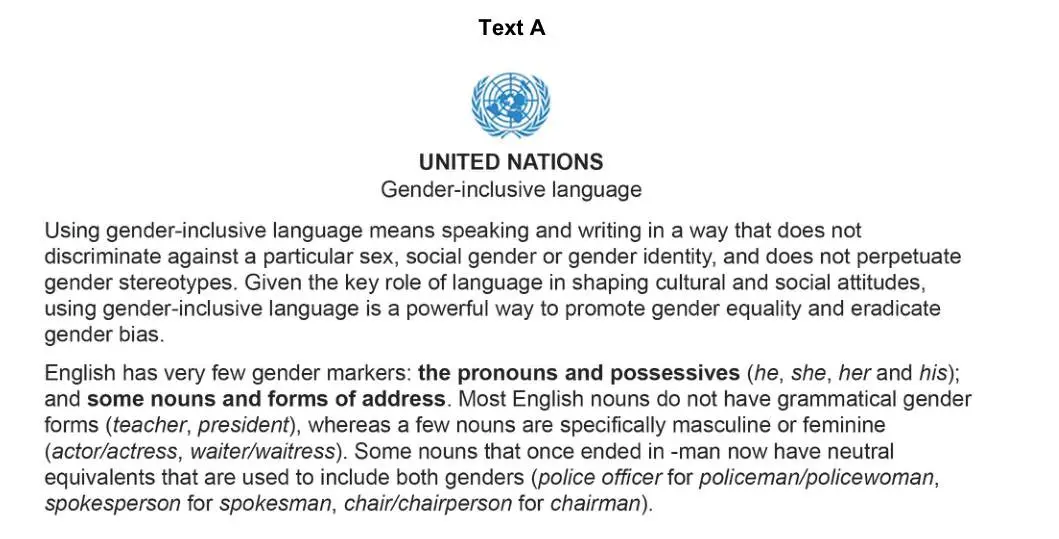
Texts/data: Text A: United Nations guidelines defining gender-inclusive language (pronouns, -man and -ess nouns)
June 2025 · Paper 2 · Q230 marksAO1=10, AO2=20Diversity essay
Mark scheme, including the levels and indicative content
Examiner's comment
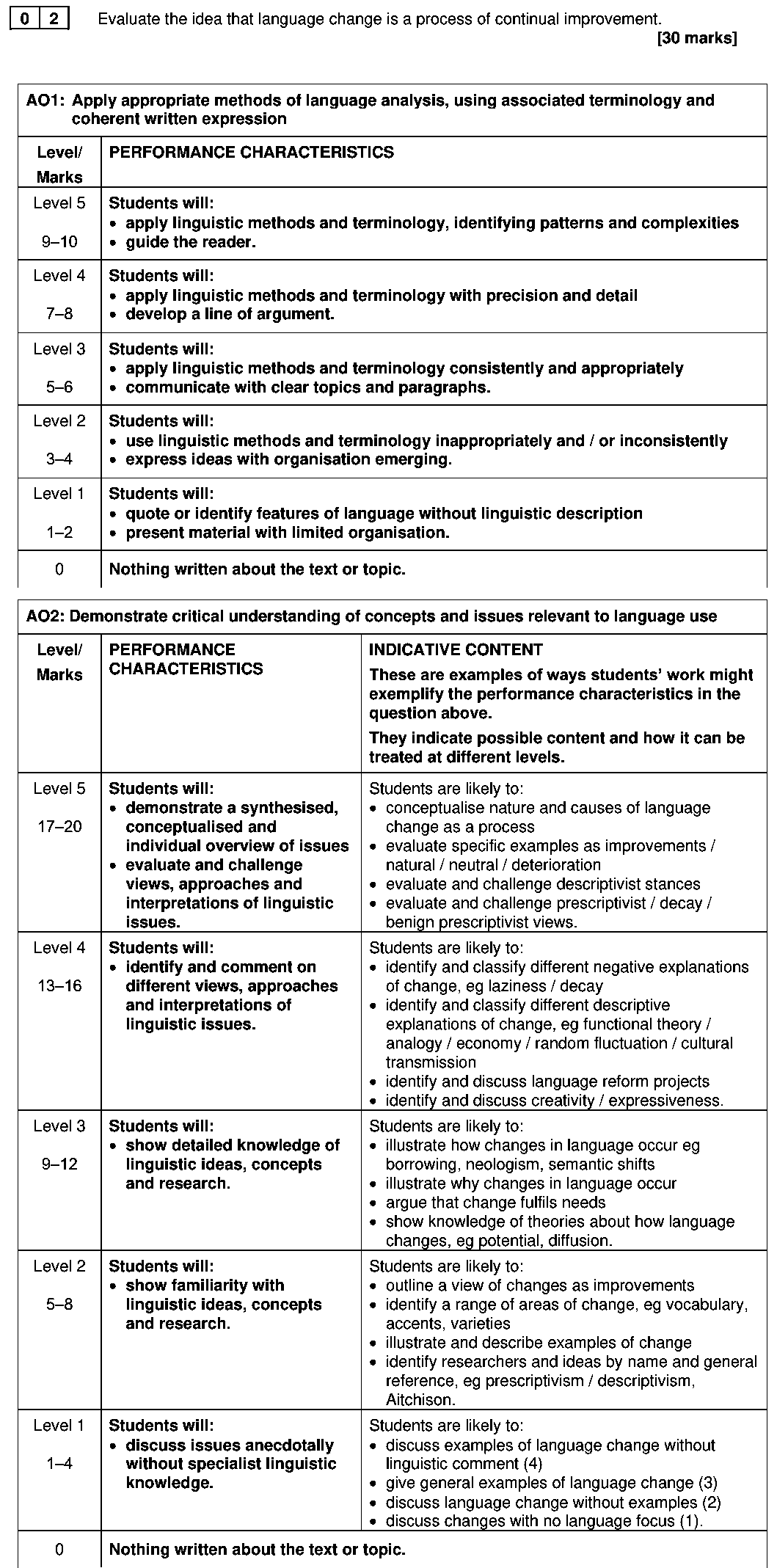
Evaluate the idea that language change is a process of continual improvement. What students did well Students did well when they: • explored what ‘improvement’ in language might actually mean • evaluated specific changes as improvements, deteriorations or simply changes • evaluated the metaphor of language evolution • interpreted Crystal’s tides metaphor with examples • considered Deutscher’s ideas of economy and creativity as drivers of change • challenged descriptivist stances • explored random fluctuation theory as a challenge to the idea of improvement • looked at functional explanations of language change to enable communication • examined cultural transmission and sub-stratum explanations of change • examined metaphors of language change as decay, laziness, invasion, infection • evaluated language reform and benign prescriptivism as attempts to improve how language represented society and individuals • evaluated the effectiveness of politically correct or woke language and illustrated Pinker’s Euphemism Treadmill • assessed whether reclamations were improvements • explored and evaluated the creation of pidgins and creoles • evaluated changes caused by English as a colonial or global language • weighed up the advantages and disadvantages of standardisation • evaluated the process of dialect levelling • evaluated the effect of new technologies from the printing press to the mobile phone • assessed the emergence of Multi-cultural London English • assessed borrowings, especially Americanisms • analysed specific examples from different perspectives. How students did less well Students did less well when they: • equated descriptivism with the idea that language change is a process of improvement • veered off onto previous questions • tacked on a link to the question after a lengthy factual discussion • gave historical accounts of the development of English without discussion of improvement • wrote at length about Caxton, Lowth, Swift, standardisation, the Bible without addressing the question clearly • thought the Euphemism Treadmill showed the continual improvement of language • believed Jean Aitchison held prescriptivist views characterised by her three metaphors • gave confused or simple rote explanations of Aitchison’s characterisations • thought Robert Lane Greene held declinist views.
Notes from the mark scheme and report
AO1 10 + AO2 20
top band conceptualises change as a process, evaluates specific changes as improvement, neutral or deterioration, and challenges descriptivist and prescriptivist/decay/benign prescriptivist views
Level 4 classifies explanations (functional, analogy, economy, random fluctuation, cultural transmission), reform and creativity
errors: equating descriptivism with improvement, thinking the euphemism treadmill shows improvement, calling Aitchison a prescriptivist, thinking Robert Lane Greene is a declinist
Texts/data: Essay topic: whether language change is a process of continual improvement
June 2025 · Paper 2 · Q430 marksAO2=20, AO5=10Directed writing
Text A (insert), Text B (insert)
Mark scheme, including the levels and indicative content
Examiner's comment
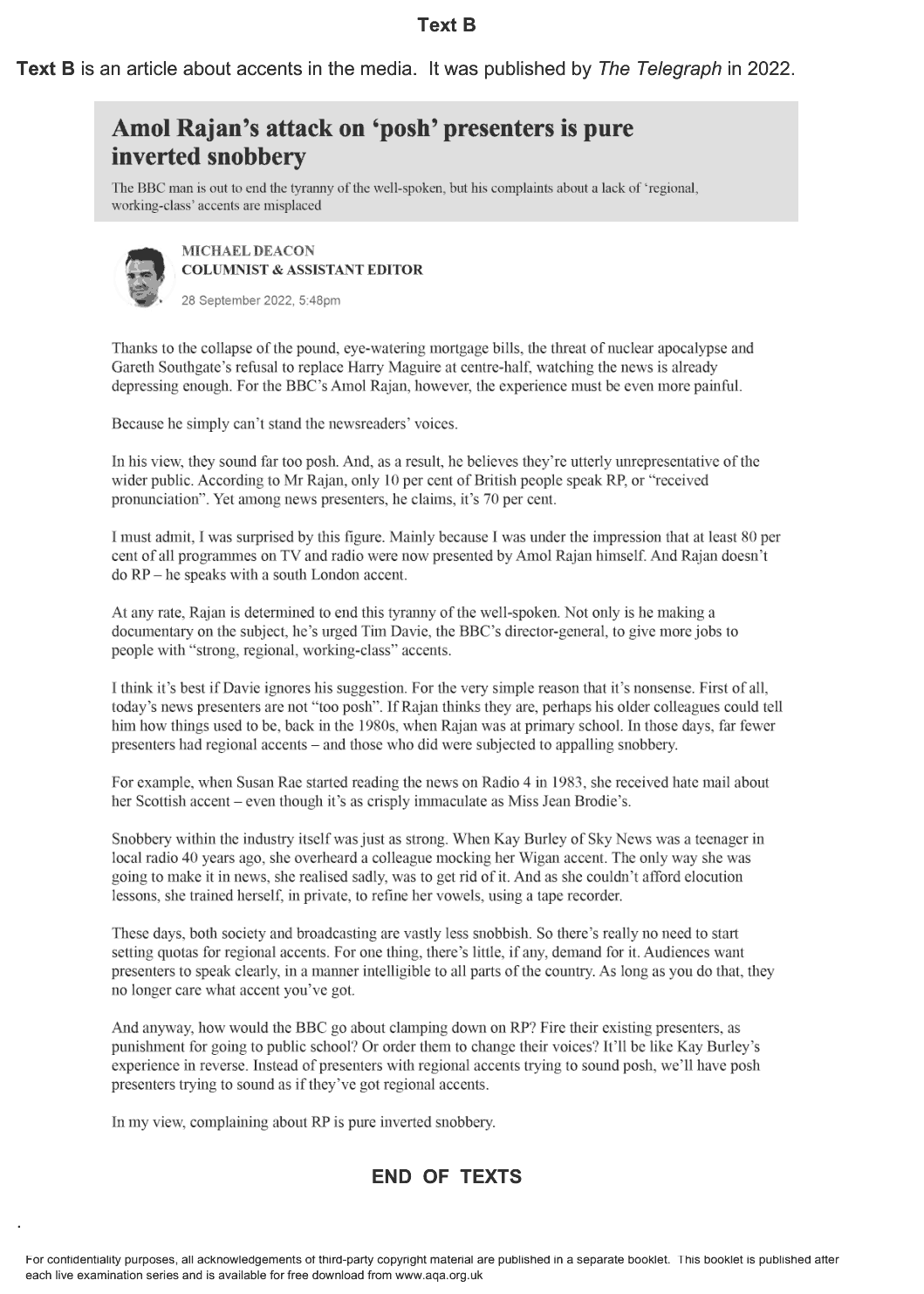
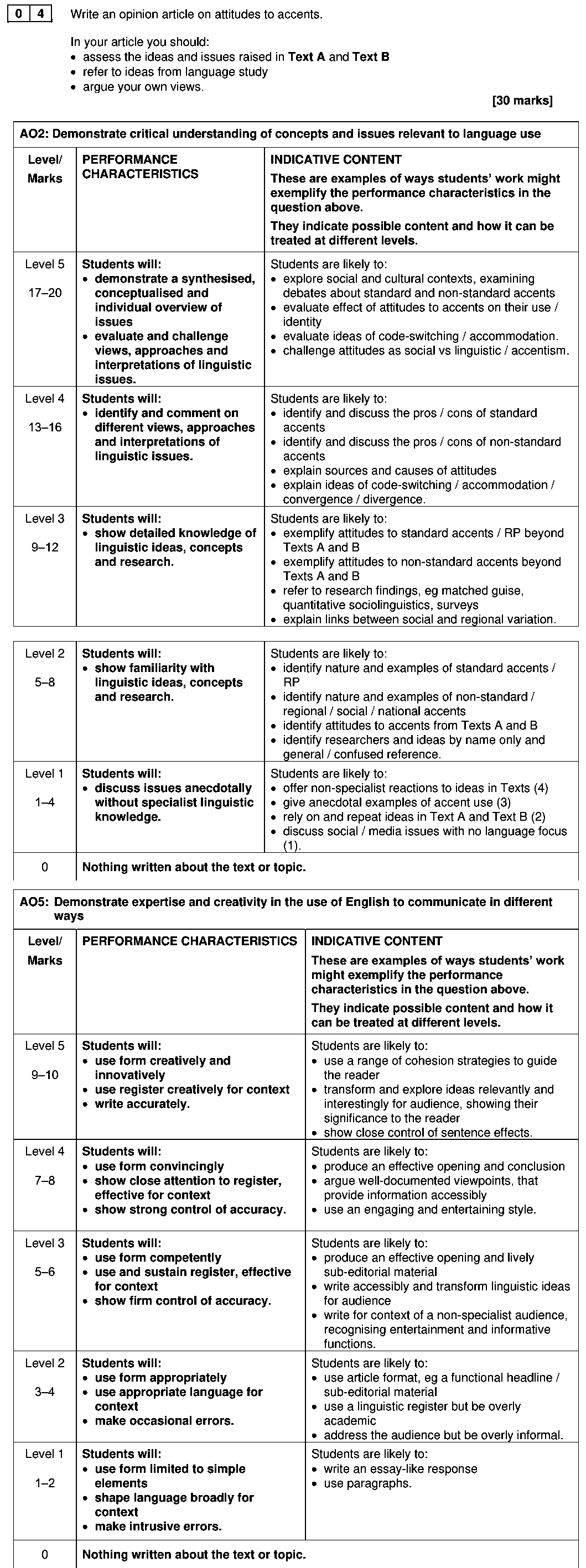
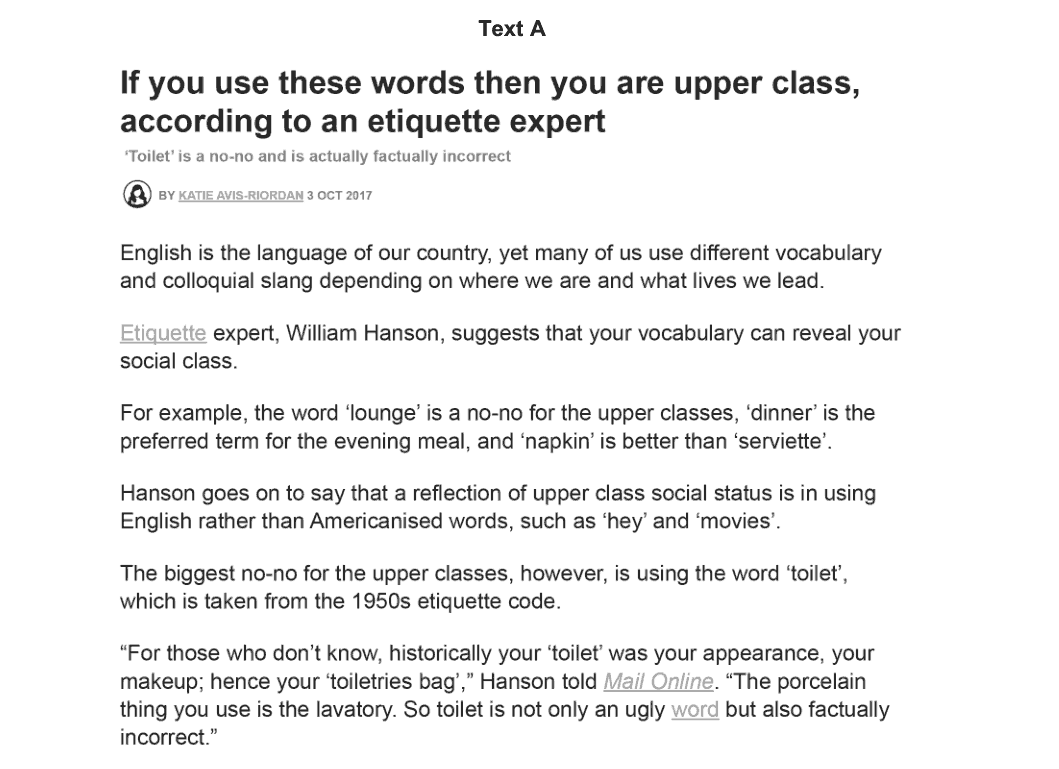
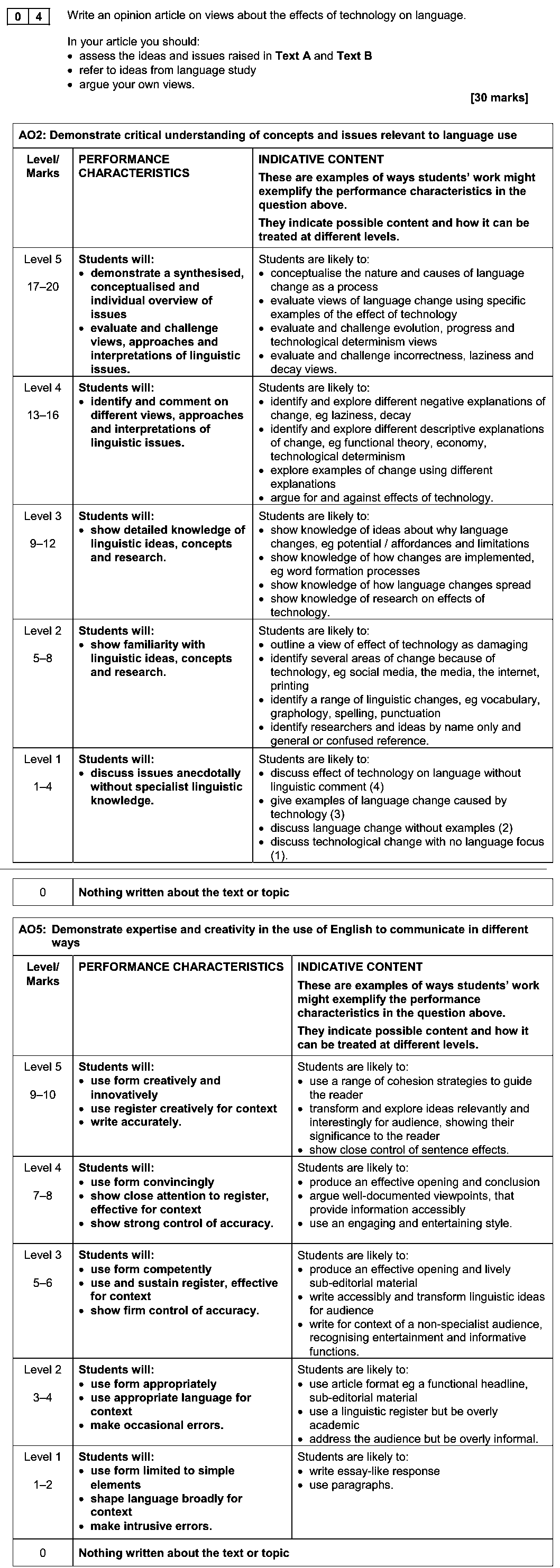
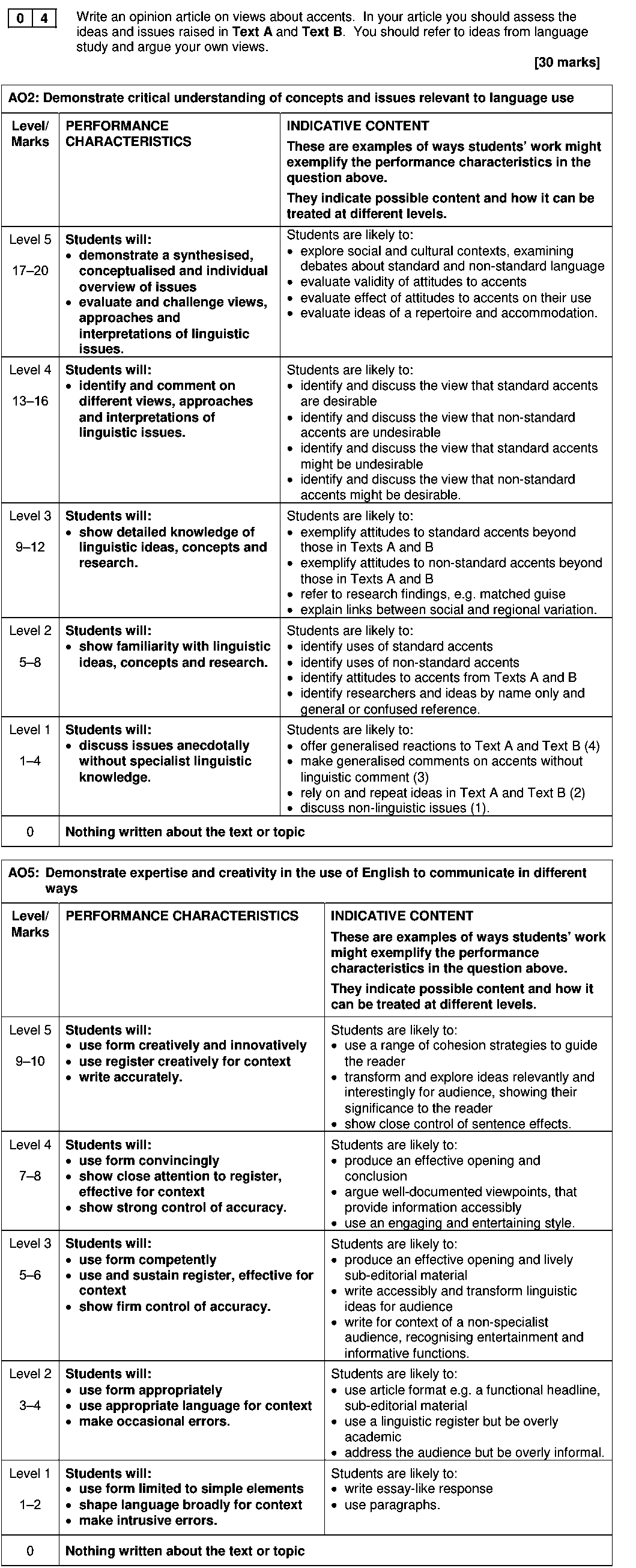
Write an opinion article on attitudes to accents. In your article you should: • assess the ideas and issues raised in Text A and Text B • refer to ideas from language study • argue your own views. How students did well Students did well when they: • had a clear understanding of the op-ed genre • referred to the articles to which they were responding and identified the ideas and issues they raised, drawing on their successful identification in their answer to Question 3 • explained why Prue Leith might hate her RP accent and how it might be a hindrance • explained how regional accents were seen as ‘too common’ • identified how some people in the media were adopting less posh sounding accents to sound more relatable • noted Deacon’s rejection of Rajan’s criticism about regional accents being under- represented • noted Rosseinsky’s view of accents as a barrier to social mobility • referred to and gave further examples of people changing their accents • looked at a range of attitudes to standard and non-standard accents • used various surveys and matched guise experiments to support this discussion • explored the pros and cons of both standard and non-standard accents • explored ideas about repertoires, code-switching and accommodation • established that attitudes to accent were based on social not linguistic grounds • evaluated changing accents as a response to prejudice and discrimination • identified the phenomenon of ‘accentism’ as a form of discrimination • argued that accents need to be treated as a protected characteristic • used witty sub-editorial material that hooked a reader and indicated the line of argument • made the issues concrete and relevant to the shared world of the writer and audience • informed the reader about linguistic concepts and research in an accessible manner • introduced researchers by first and second name to personalise the material and with an explanatory phrase to explain who they were • showed close control of sentence patterns, some of which were picked up from the articles. How students did less well Students did less well when they: • wrote a Section A style essay • did not use 1st and 2nd person pronouns • used an overly informal address to the reader • did not provide any linguistic information to develop a response to the articles • referred to the articles as ‘Text A’ and ‘Text B’ • did not transform linguistic ideas and terms for the reader • referred to linguists by their surname and gave no explanation of who they were or gave them inappropriate epithets • lost focus on accents, often for dialects, elaborated and restricted code, attitudes to language change • wrote long and over-elaborate explanations of how they came across the articles or scenarios • wrote that attitudes to accents ‘weren’t that deep’ and didn’t really matter.
Notes from the mark scheme and report
AO2 20 + AO5 10
opinion article
top band examines debates about standard and non-standard accents, evaluates effects of attitudes on use and identity and code-switching/accommodation, and challenges attitudes as social not linguistic (accentism)
Level 3 needs attitudes beyond the texts and research such as matched guise and surveys
ER: the most challenging question
weaker answers wrote Section A essays, gave little linguistic information, called the sources 'Text A/B', named linguists by surname without explanation or drifted to dialect and restricted code
Texts/data: Opinion article on attitudes to accents, responding to Texts A and B
June 2024 · AS Paper 2 · Q130 marksAO1=10, AO2=20Diversity essay
Text A (insert)
Mark scheme, including the levels and indicative content
Examiner's comment
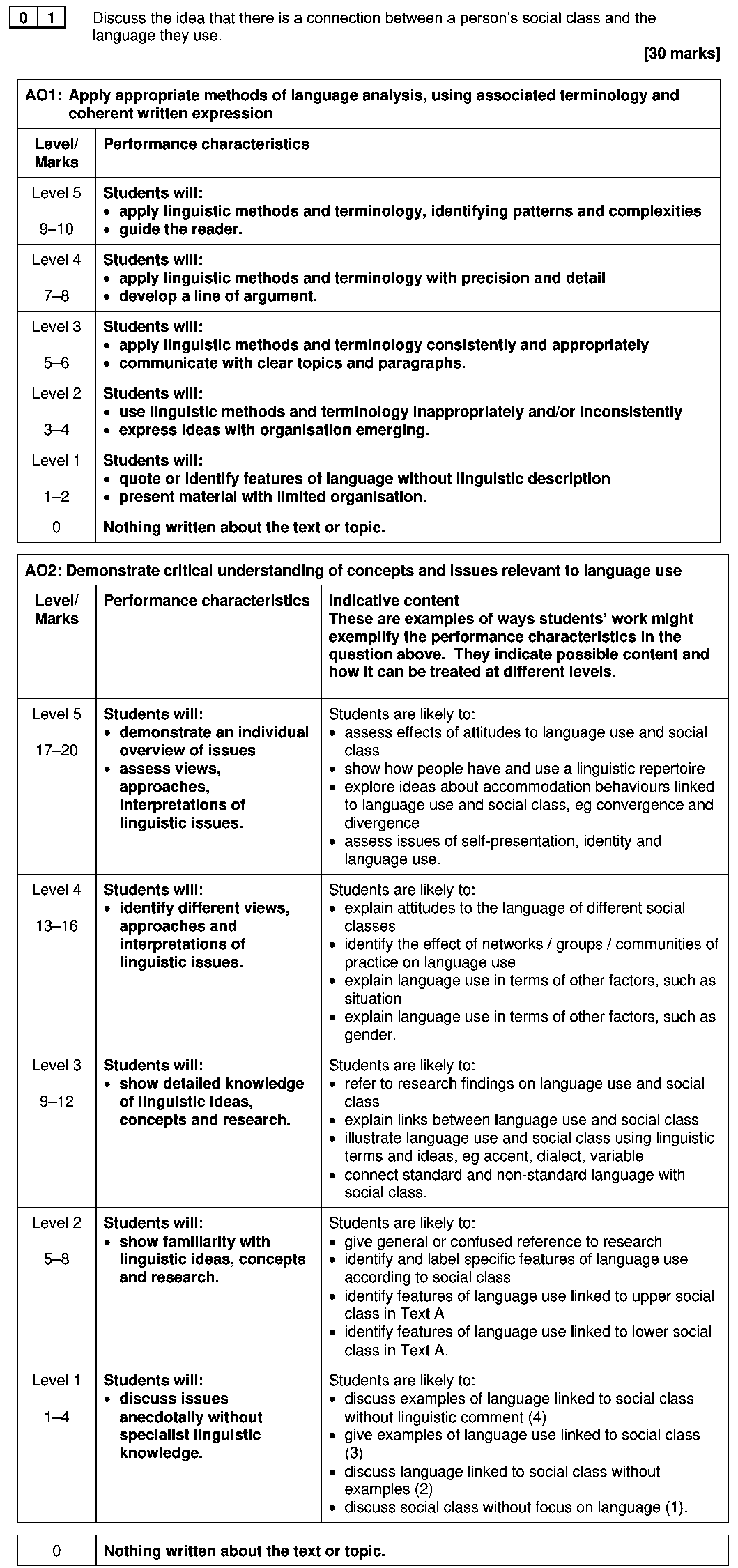
In this series, students were asked to ‘discuss the idea that there is a connection between a person’s social class and the language they use.’ The data provided was an article from Country Living, commenting on and offering examples of class and etiquette. The vast majority of students were able to move beyond the article to consider wider issues relating to language and class, often supported by an impressive range of theories and concepts. The work of Petyt, Cheshire, Eckert, Labov, Ives, Trudgill, Bernstein and Giles were all very popular, but students were credited for reference to a range of case studies, including more recent references to accent surveys, MLE, MUBE and the work of Drummond and Cole, for example. Better answers considered ideas such as code-switching, convergence/divergence, sociolect and idiolect and considered how views of accents and dialects impacted on notional views of class. Some students questioned the notion of class itself in 2024. Some students struggled to find the balance between making a range of points and demonstrating a detailed understanding of ideas in this question. Little credit can be given for name-checking a long list of theorists and better answers selected a smaller number of practitioners and covered their findings in more detail, linking back to the idea of distinctive varieties of English linked to class. At the highest level of the mark scheme, students were able to take a more conceptual approach and discuss ideas of performativity and group identity, seeing how a range of factors intermingled to create individual linguistic identities tied to different views of class. More successful answers: • used terminology accurately and illustrated their argument with specific examples from study or their own experience • selected relevant theorists and showed detailed understanding of their work, linking concepts and ideas to arrive at a conclusion about how different contextual factors influence perceptions of class and language • built and developed an argument, rather than treating the ideas and concepts covered as existing in isolation from each other • moved beyond prejudices about class and accent to consider how it could be useful to create group identity. Less successful answers: • made vague references to language studies or miscredited findings • made little attempt to develop a clear and focused line of argument, writing a series of vaguely connected paragraphs. • wrote briefly and sometimes inaccurately, with answers limited to the springboard data and with no development beyond this.
Notes from the mark scheme and report
AO1 10 + AO2 20
top band assesses attitudes to class and language, repertoires, accommodation (convergence/divergence) and self-presentation and identity
Level 4 adds networks, communities of practice, situation and gender
credited: Petyt, Cheshire, Eckert, Labov, Trudgill, Bernstein, Giles, Drummond, MLE/MUBE, questioning the notion of class today
name-checking long lists earns little
weaker answers stayed with the U/non-U word list in the article
Texts/data: Text A: Country Living article on words that mark upper-class speech (etiquette expert William Hanson, 2017)
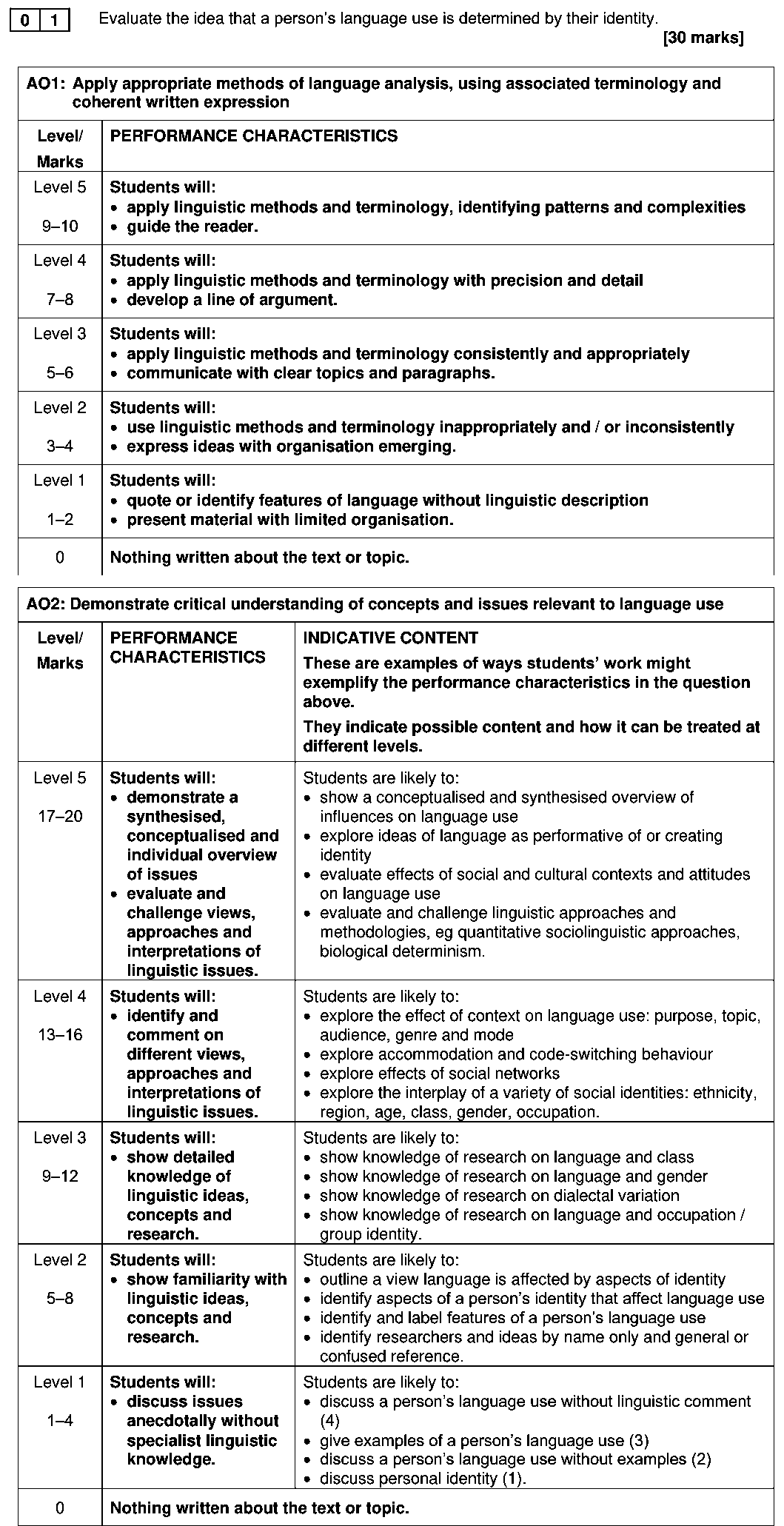
June 2024 · Paper 2 · Q130 marksAO1=10, AO2=20Diversity essay
Mark scheme, including the levels and indicative content
Notes from the mark scheme and report
AO1 10 + AO2 20
top band synthesises influences on language use, explores language as performing or creating identity, evaluates social and cultural contexts and challenges quantitative sociolinguistic methods and biological determinism
Level 4 explores context (purpose, audience, genre, mode), accommodation and code-switching, social networks and the interplay of identities
Level 3 shows research on class, gender, dialect and occupation
no examiners' report published for this series
Texts/data: Essay topic: whether a person's language use is determined by their identity
June 2024 · AS Paper 2 · Q230 marksAO1=10, AO2=20Diversity essay
Text B (insert)
Mark scheme, including the levels and indicative content
Examiner's comment
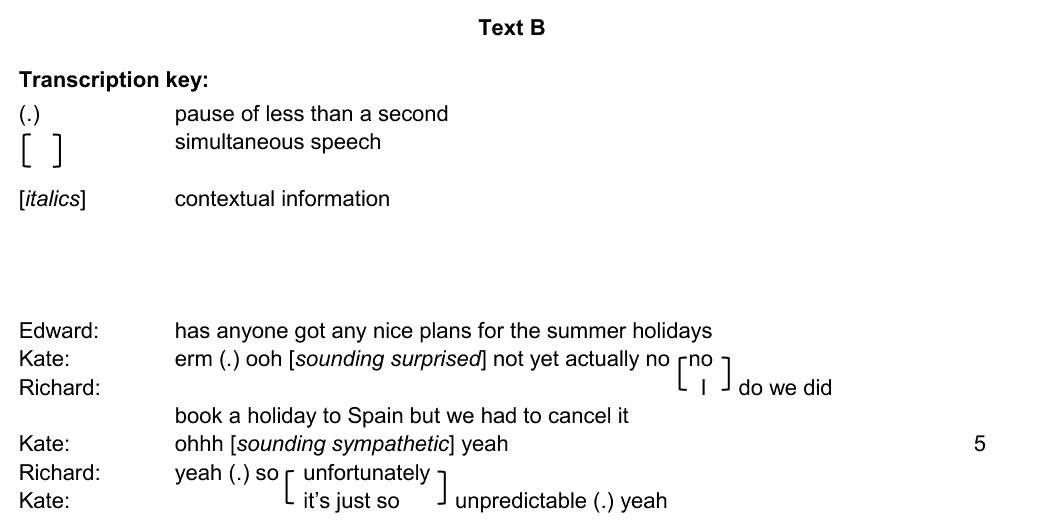
asked students to ‘discuss the idea that women play a subordinate role in conversations with men.’ The data provided was a brief transcript between two men and one woman. A range of relevant theorists were covered, such as Tannen, Zimmerman & West, Lakoff, Schulz, Holmes & Stanley, Fishman, Jespersen, O’Barr & Atkins. Better responses did not treat theorists and case studies in isolation, but combined ideas to create a more holistic view of language and its role in creating social and group identity and considered how gender was related to ideas of individual identity. Answers that were rewarded with the very top marks sometimes questioned what was meant by the word gender in 2024, looking at the ways in which this has changed since many of these theories were initially developed. Students who could offer ideas about socialisation or performativity and who looked at reasons for subordinate roles in conversations that went beyond biological sex were highly rewarded, as were those who demonstrated a clear understanding of gender as a linguistic performance. More successful answers: • clearly considered a range of case studies but also combined this with conceptual awareness, considering how linguistic identity is not just linked to gender, but other ideas such as context, occupation, and a whole host of social factors • considered the ways in which ideas of subordination can be learned as part of a process of socialisation and upbringing and consider how societal views affect use of language and vice versa • considered how language is linked to ideas of individual performativity that goes far beyond simple ideas of gender. Less successful answers: • listed a number of case studies with very little evidence that they had understood or internalised the work of those theorists • made simplistic observations about the springboard data with limited evidence that students had studied any related theories or ideas. Analysing the very short data in detail tended not to yield particularly interesting results.
Notes from the mark scheme and report
AO1 10 + AO2 20
top band assesses dominance and difference approaches, situation and other variables (class, age) and gender as performative
credited: Tannen, Zimmerman and West, Lakoff, Holmes, Fishman, O'Barr and Atkins, socialisation, questioning what gender means now
weaker answers listed studies without understanding or over-analysed the very short transcript
Texts/data: Text B: short transcript of Edward, Richard and Kate talking about summer holiday plans (overlaps, minimal responses)
June 2024 · Paper 2 · Q230 marksAO1=10, AO2=20Diversity essay
Mark scheme, including the levels and indicative content
Notes from the mark scheme and report
AO1 10 + AO2 20
top band examines debates about PC, reform and being 'woke', gate-keeping, change from above/below, dominant and muted groups, irony, reclamation, euphemism treadmill, social vs linguistic judgements, and challenges how far reform removes prejudice
Level 4 explains reflectionism vs determinism, prescriptivist/descriptivist views of reform and arguments for and against
no examiners' report published for this series
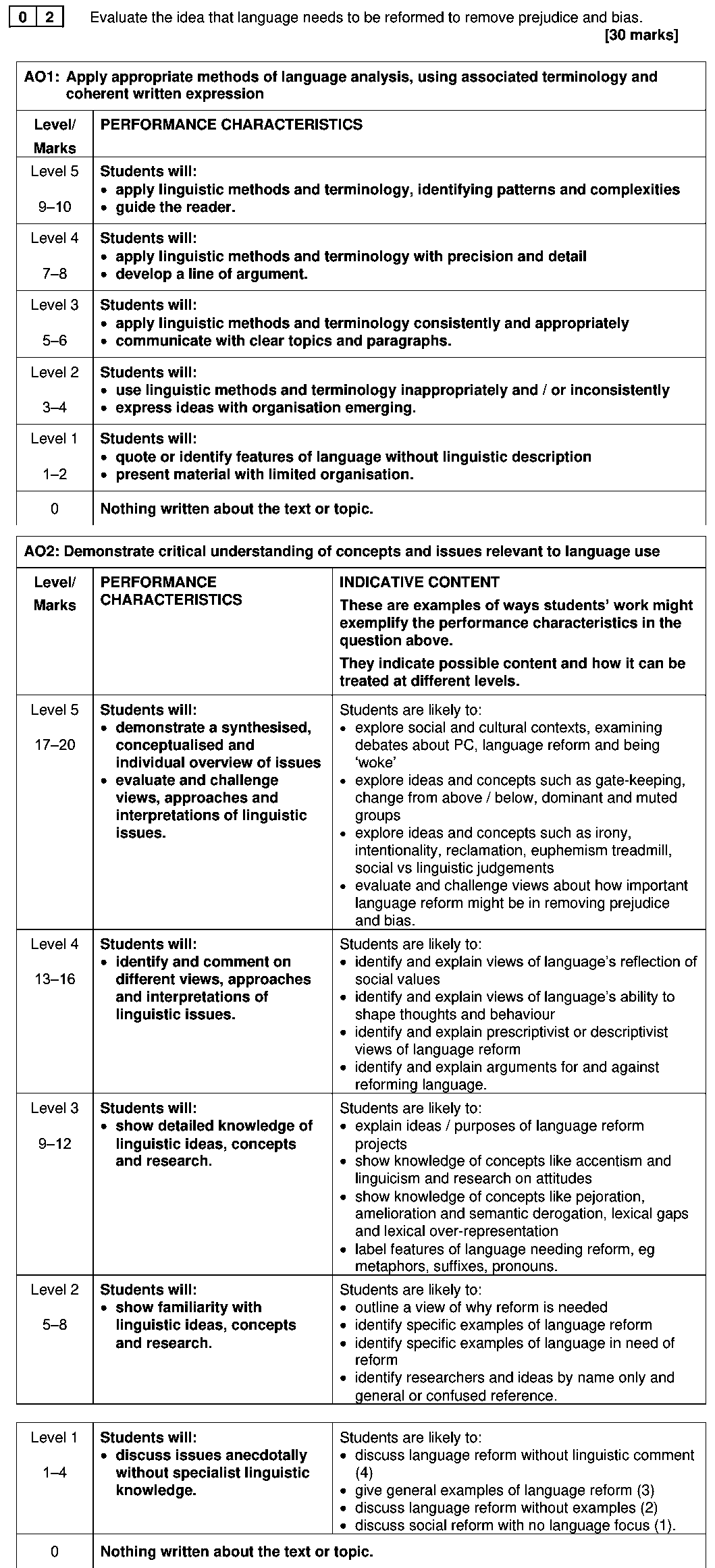
Texts/data: Essay topic: whether language needs to be reformed to remove prejudice and bias
June 2024 · AS Paper 2 · Q340 marksAO2=20, AO5=20Directed writing
Text C (insert)
Mark scheme, including the levels and indicative content
Examiner's comment
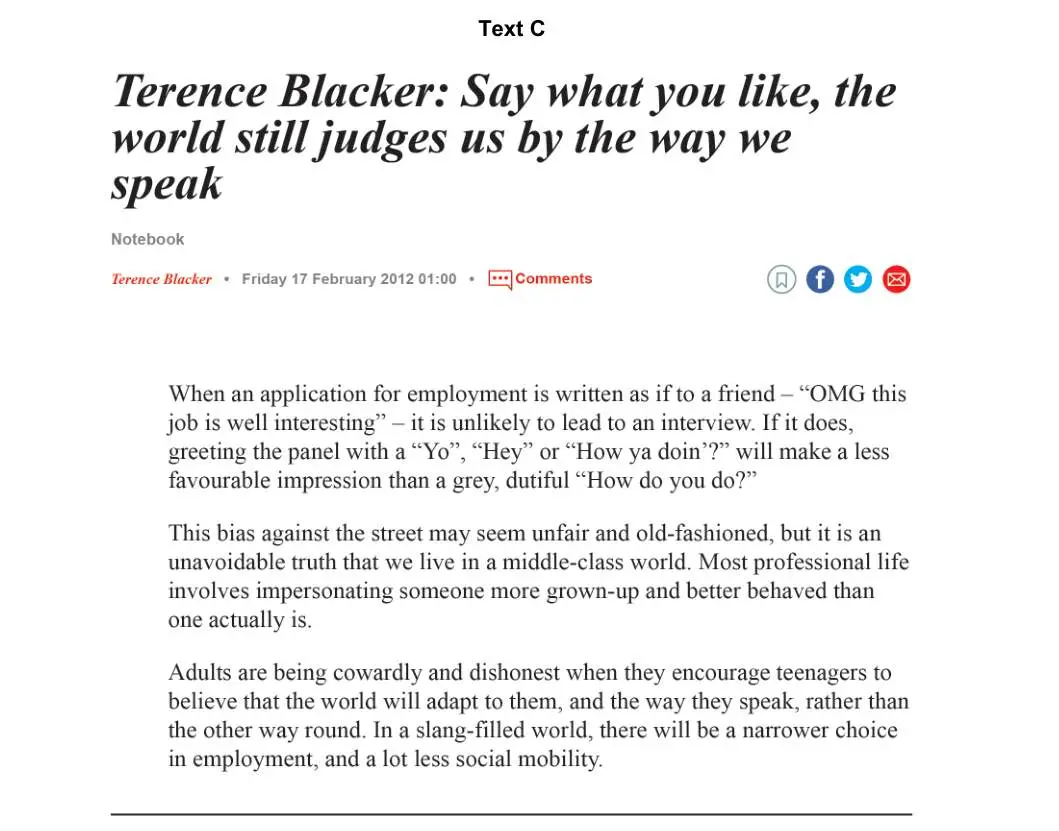
Students were provided with an extract from a newspaper article, discussing the use of appropriate language when applying for a job. They were asked to write an article in which they discussed the idea that people should adapt their language to fit different contexts. This question requires students to write informatively, but also to creatively adapt ideas from linguistic study into a form that would be accessible and engaging for a non-specialist audience. Students are also asked to state their chosen audience, and those who select a specific audience (an article for The Guardian or The Daily Mail tend to be the most popular) and tailor their writing accordingly tend to write more convincing pieces. A significant number of students still do not state their intended audience, or tried to avoid the processing of complex ideas for non-specialists by stating they were writing for A Level students. These are both unhelpful approaches. There were some commendable and creative uses of language, deploying extended metaphors to lend shape and structure to the article as a whole. Sub-editorial features such as a clear headline, strapline and other conventions of their chosen publication were often well used, as were clearly planned and structured answers where the closing moments echoed and revisited ideas from the start of the article. While the springboard data was about adapting language to fit a professional, occupational context, students did not have to limit their answers to this particular area, though many chose to do so. If this was the case, then the work of Drew & Heritage, Swales and Milroy & Milroy proved to be very popular, as was Koester, with references to phatic language and the switch from work-related talk to small talk. Many students illustrated their answer with real or imagined examples of ways in which language might be adapted to fit different contexts. Some students, however, produced very general answers that covered talk at work in very general terms without any reference to any theory or concept and some misunderstood and wrote a guide to how to write a letter to apply for a job. There are still a minority of students who did not use the stimulus data well in this question, basing all their examples in the article from the material provided. While the data is a way into the focus of the article, better answers were illustrated with ideas and examples that moved well beyond the material provided. As noted in the general introduction of this report, there were also a small number of students who wrote an article that analysed the stimulus text, commenting on its graphology and use of language. These answers invariably restricted themselves to the lower levels of the mark scheme for both AO2 and AO5 as this is not an appropriate approach to this question. More successful answers: • elected an appropriate audience for their piece of writing and clearly linked their point of view to the chosen publication • used appropriate subeditorial features • illustrated their points with a wide range of examples from outside the provided text • made clear reference to relevant linguistic concepts and theories, suitably processed for a non- specialist audience. Less successful answers: • relied heavily or exclusively on the material provided • wrote an essay-like response, or an essay with occasional rhetorical questions inserted in an effort to engage a reader • struggled to maintain an appropriate tone for their stated audience • failed to state any audience at all and produced highly generic writing
Notes from the mark scheme and report
AO2 20 + AO5 20
article on whether a person should adapt their language to fit different contexts, audience must be stated
top band assesses reasons for and against adapting and language and identity
Level 4 illustrates repertoires, convergence and divergence
credited: Drew and Heritage, Swales, Milroy, Koester (phatic small talk), real or imagined examples
weaker answers wrote job-application guides, essays, analysed Text C or named A-level students as audience
Texts/data: Text C: Terence Blacker newspaper column 'the world still judges us by the way we speak' on informal language in job applications (2012)
June 2024 · Paper 2 · Q430 marksAO2=20, AO5=10Directed writing
Text A (insert), Text B (insert)
Mark scheme, including the levels and indicative content
Notes from the mark scheme and report
AO2 20 + AO5 10
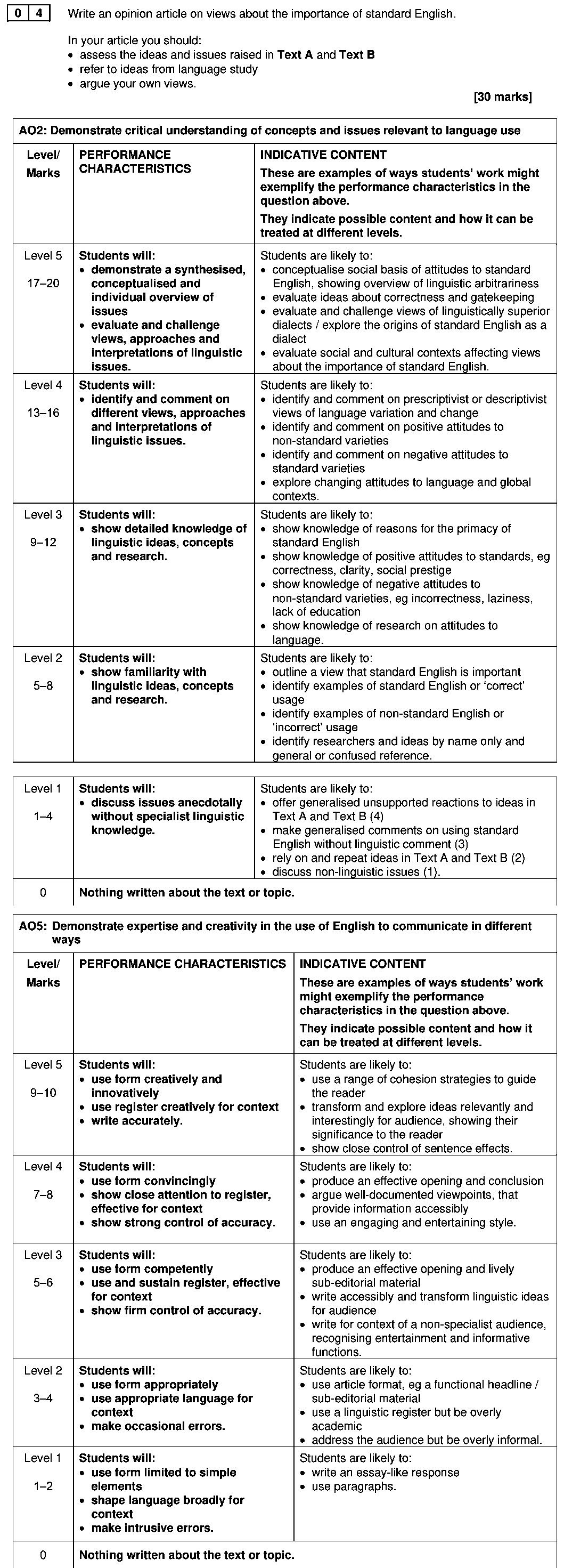
opinion article
top band conceptualises the social basis of attitudes to standard English and linguistic arbitrariness, evaluates correctness and gatekeeping, challenges ideas of superior dialects and explores standard English's origins as a dialect
Level 4 comments on prescriptivist/descriptivist views and attitudes to standard and non-standard varieties
Level 1 relies on reactions to or repetition of the texts
no examiners' report published for this series
Texts/data: Opinion article on views about the importance of standard English, responding to Texts A and B
June 2023 · AS Paper 2 · Q130 marksAO1=10, AO2=20Diversity essay
Mark scheme, including the levels and indicative content
Examiner's comment
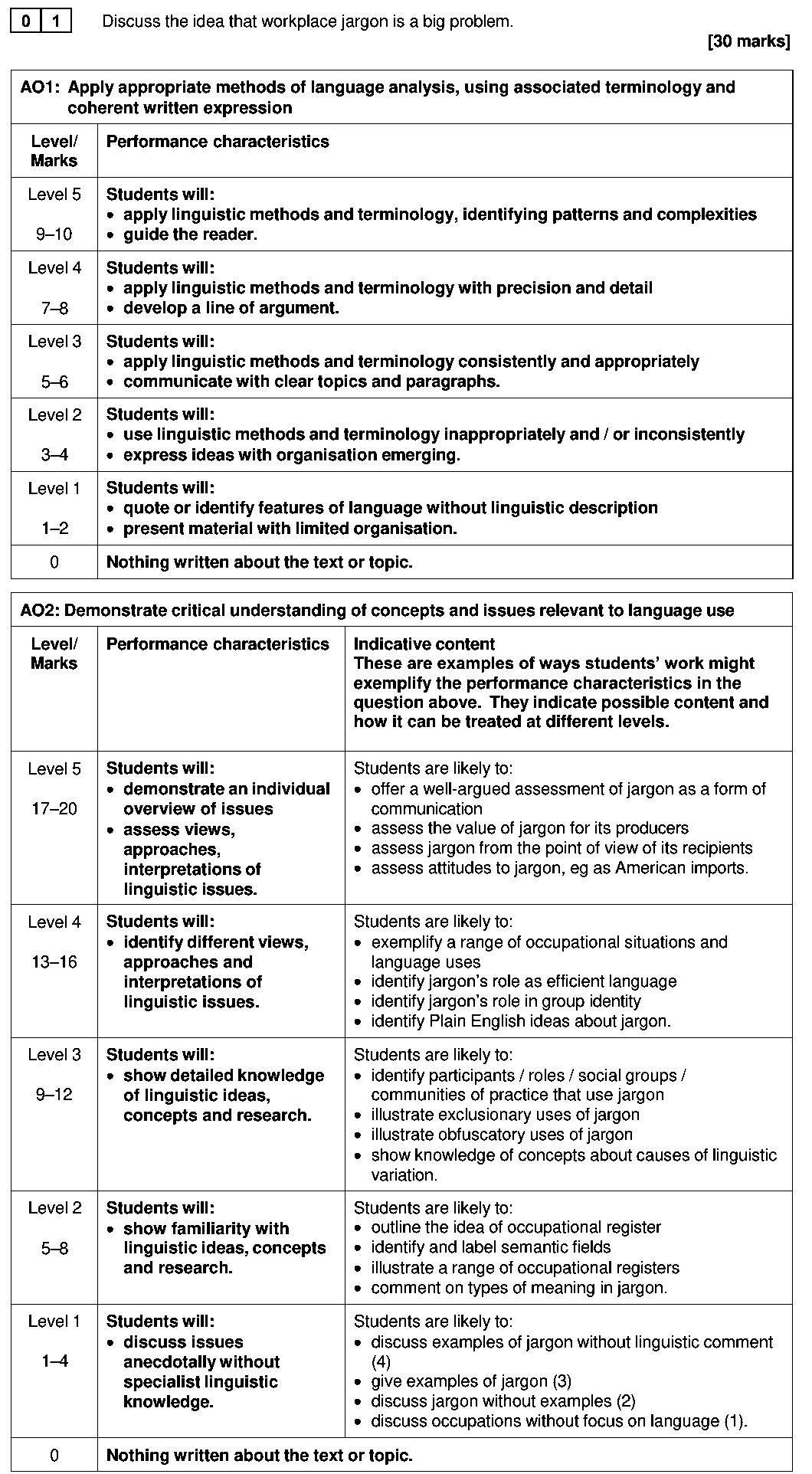
In this series, students were asked to ‘discuss the idea that workplace jargon is a big problem.’ The data provided was a shortened article from Huffpost, commenting on and offering examples of workplace jargon. The vast majority of students were able to move beyond the article to consider wider issues relating to occupational varieties of English, often supported by an impressive range of theories and concepts. The work of Drew & Heritage, Swales, Petyt and Koester were all very popular, but students were credited for reference to a host of occupation and/or jargon related theorists and case studies. Better answers considered ideas such as communities of practice and looked at both the positives and negatives of workplace related jargon. Some students struggled to find the balance between making a range of points and demonstrating a detailed understanding of ideas in this question. Little credit can be given for listing a series of theorists and better answers selected a smaller number of practitioners and covered their findings in more detail, linking back to the idea of distinctive varieties of English linked to occupation. At the highest level of the mark scheme, students were able to take a more conceptual approach and discuss ideas of performativity and group identity, seeing how a range of factors intermingled to create individual linguistic identities tied to occupational groups. More successful answers: • Used terminology accurately and illustrated their argument with specific examples from study or their own experience • Selected relevant theorists and showed detailed understanding of their work, linking concepts and ideas to arrive at a conclusion about how different occupational groups created a shared identity through language choices • Built and developed an argument, rather than treating the ideas and concepts covered as existing in isolation from each other • Moved beyond negative ideas about jargon to consider how it could be useful to create group identity, efficient communication etc Less successful answers: • Made vague references to language studies or miscredited findings (for example, Labov carried out extensive work into the occupational language of fishermen in New York) • Made little attempt to develop a clear and focused line of argument • Wrote briefly and sometimes inaccurately, with answers limited to the springboard data and with no development beyond this.
Notes from the mark scheme and report
copyright removed: question taken from mark scheme
Text A (shortened Huffpost article on workplace jargon) blacked out in AQA's published paper
AO1 10 + AO2 20
top band offers a well-argued assessment of jargon for producers and recipients and attitudes to it (eg as American imports)
credited: Drew and Heritage, Swales, Koester, communities of practice, efficiency and group identity vs exclusion and obfuscation, Plain English
listing theorists earns little
weaker answers miscredited studies or stayed with the article
Texts/data: Text A: shortened Huffpost article on workplace jargon (not reproduced)
June 2023 · Paper 2 · Q130 marksAO1=10, AO2=20Diversity essay
Mark scheme, including the levels and indicative content
Examiner's comment
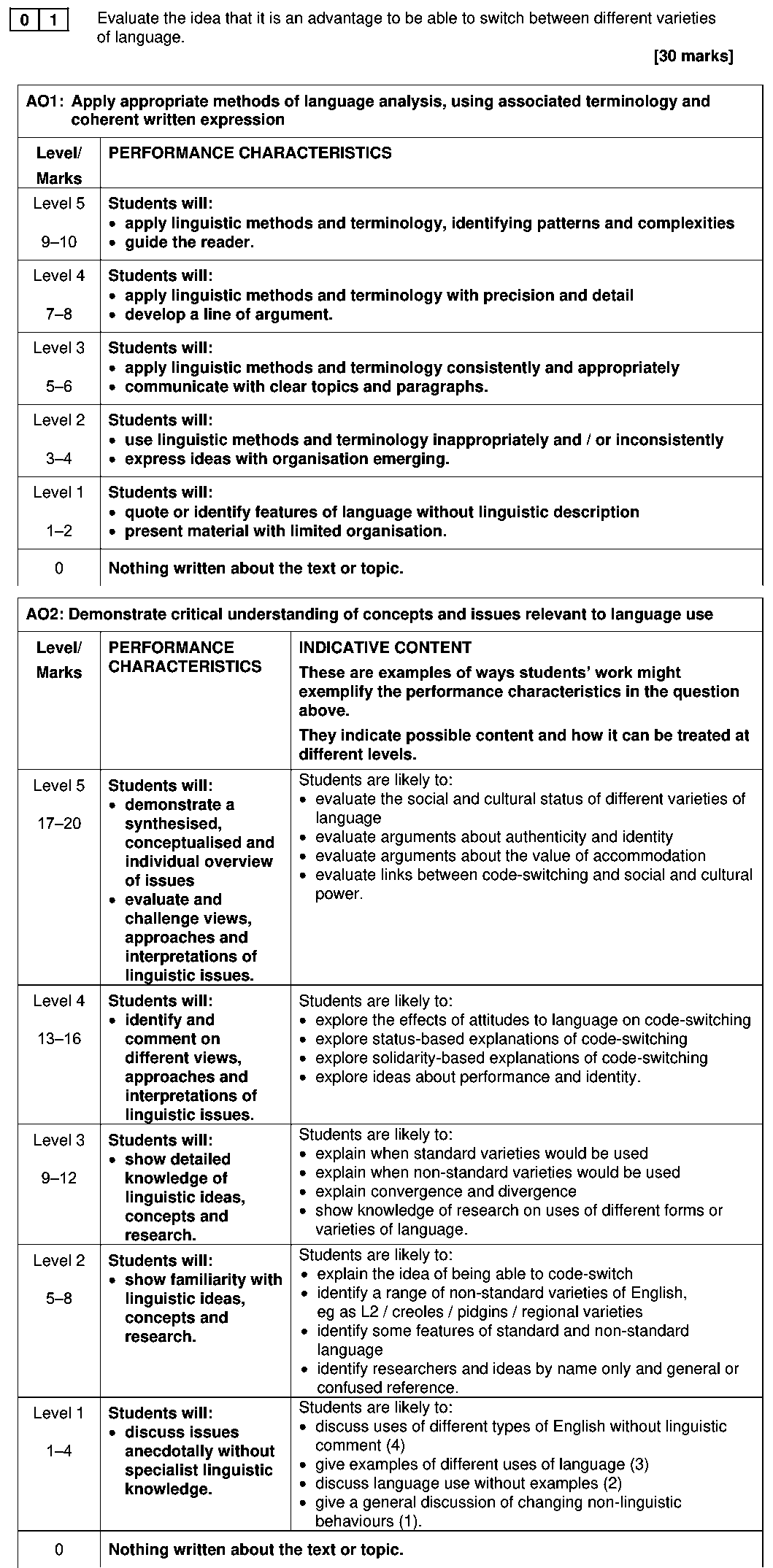
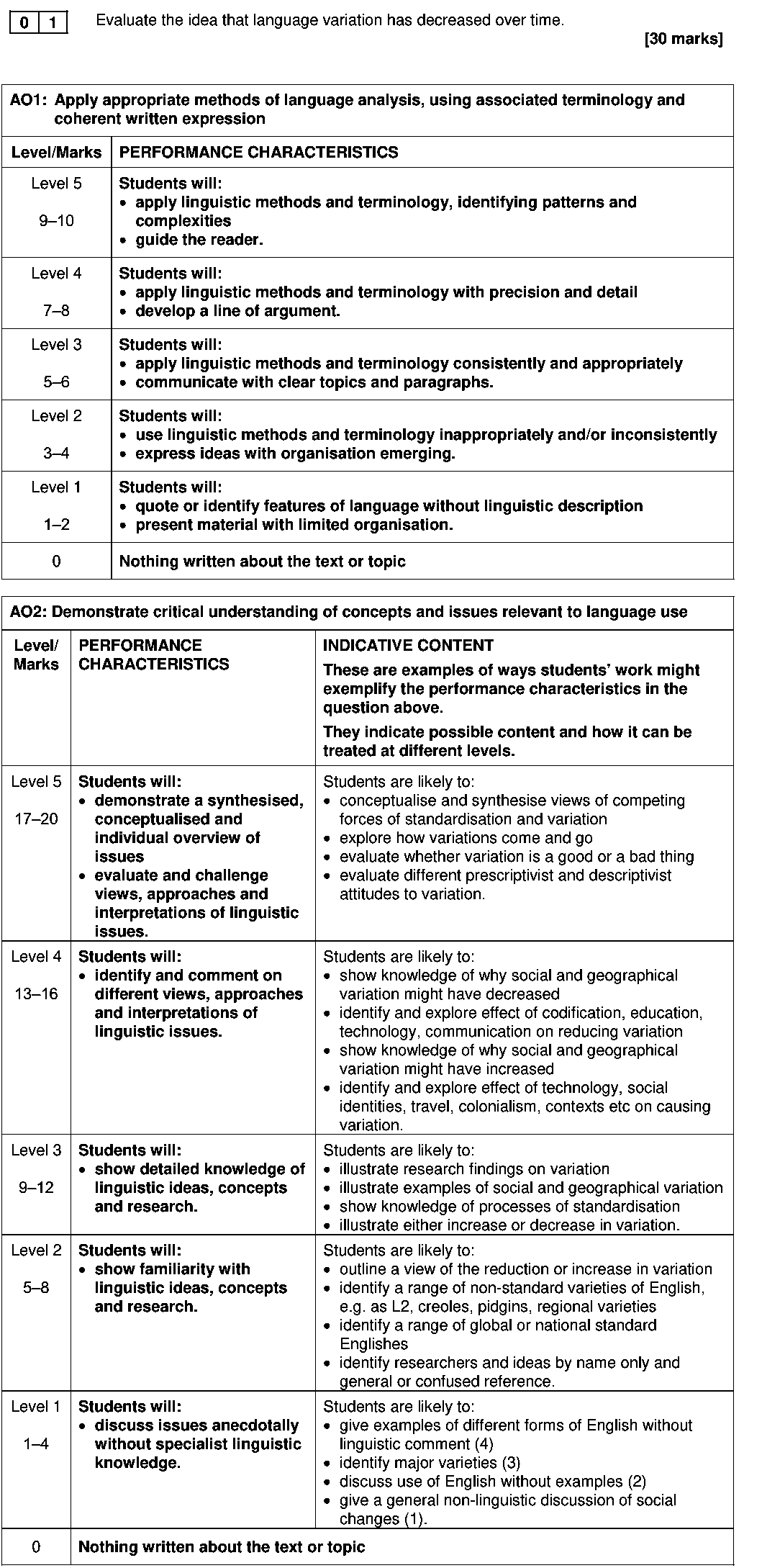
Question 1 focussed on language diversity. Students were asked to evaluate the idea that it is an advantage to be able to switch between different varieties of language (AO2). They then had to express their views in a coherent argument using linguistic terminology (AO1). Key discriminators were whether students could explain and evaluate the benefits of code- switching in specific situations. Most students could illustrate when standard and non-standard language would be used and could illustrate ideas of convergence and divergence which put them in Level 3. Many answers were able to explore the benefits of code-switching which moved them into Level 4. Fewer were able to evaluate the issues raised about identity and authenticity and standard language ideology and power. More successful answers: • recognised that the idea in the question relied on the concept of a language repertoire • identified and explained Giles’ Communication Accommodation Theory • explained convergence and divergence, upward, downward and mutual • explained Matched Guise findings and other research on attitudes to explain why people might change their language use • examined the covert and overt prestige attached to different varieties of language • cited quantitative sociolinguistic research on the effects of situation, eg Trudgill and Labov • discussed hypercorrection by the lower middle class in Labov’s New York research • examined the use of and switch into Polari as an anti-language designed to exclude other groups and to foster in-group identity • discussed Labov’s Martha’s Vineyard study to explore how changes in language were used to signify allegiances and identity • used Ives’ Bradford study to show how language choices varied with the speaker’s sense of identity and belonging • looked at Rob Drummond’s work on the significance of the language practices of different generations of Polish people in Manchester • explored the value of code-switching in occupational contexts • discussed the work of Garner and Rubin on the effects of attitudes to AAVE on the linguistic behaviours of lawyers • evaluated arguments about the authenticity of identity when people code-switched • explored how code-switching maintained language hierarchies and structures of power. Less successful answers: • did not focus on the act of code-switching • discussed examples of the language variation shown by different social groups • were over-reliant on learned explanations of research, struggling to discuss these relevantly for the task • confused researchers and what they actually researched • relied on anecdotal evidence.
Notes from the mark scheme and report
AO1 10 + AO2 20
top band evaluates the social and cultural status of varieties, authenticity and identity, the value of accommodation and links between code-switching and power
Level 4 explores attitudes, status- and solidarity-based explanations of code-switching and performance of identity
ER: most reached Level 3 by illustrating standard/non-standard use and convergence/divergence
best used repertoire, Giles' CAT, matched guise, covert/overt prestige, Labov's hypercorrection and Polari
weaker answers did not focus on the act of switching, just described group variation or confused researchers
Texts/data: Essay topic: whether it is an advantage to be able to switch between varieties of language
June 2023 · AS Paper 2 · Q230 marksAO1=10, AO2=20Diversity essay
Mark scheme, including the levels and indicative content
Examiner's comment
was the most popular question and asked students to ‘discuss the idea that accents are influenced by social factors as well as regional factors.’ The data provided looked at the use of glottal stops and phonological differences in middle class and working class boys and girls in Reading and Milton Keynes. A range of relevant theorists were covered, with Labov’s work in New York and Martha’s Vineyard proving to be very popular. Cheshire’s work in Reading, Gary Ives in Bradford, Trudgill’s Norwich study and Rob Drummond’s study of MLE and MUBE also featured in many responses. As ever, better responses do not treat theorists and case studies in isolation, but combine the ideas to create a more holistic view of language and its role in creating social, regional and group identity. More successful answers: • Clearly considered a range of case studies but also combined this with conceptual awareness, considering how linguistic identity is not just linked to regional and class, but other ideas such as gender, occupation and a whole host of social factors • Considered the ways in which a language variety such as MLE could start as a regional form and then spread through a range of social factors • Considered how language is linked to ideas of individual performativity that goes far beyond simple ideas of geography or class. Less successful answers: • Listed a number of case studies with very little evidence that they had understood or internalised the work of those theorists • Made simplistic observations about the springboard data with limited evidence that students had studied any related theories or ideas.
Notes from the mark scheme and report
AO1 10 + AO2 20
most popular option
top band assesses the interplay of contextual factors, attitudes, explanations of accent use and performing identity
Level 4 covers modifying accents, situation, social networks, convergence and divergence
data echoes Williams and Kerswill's Milton Keynes and Reading study (class and gender)
credited: Cheshire, Labov, Trudgill, Ives, Drummond, MLE spreading through social factors
listing case studies or simple description of the graph stays low
Texts/data: Figure 1: bar chart of glottal stop and th-fronting use by middle- and working-class girls and boys in Milton Keynes and Reading
June 2023 · Paper 2 · Q230 marksAO1=10, AO2=20Diversity essay
Mark scheme, including the levels and indicative content
Examiner's comment
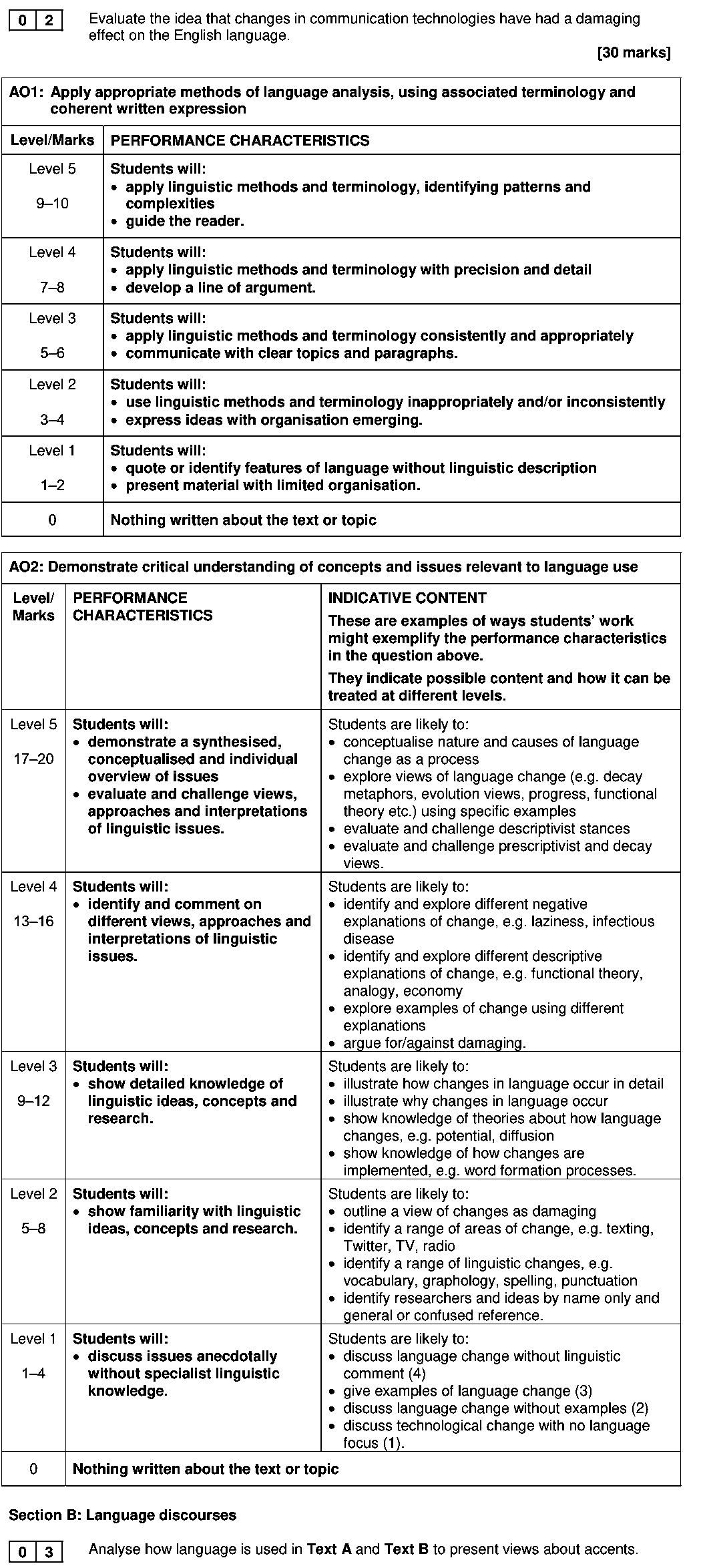
Question 2 focussed on language change. Students were asked to evaluate the idea that language change is caused by contact between different social groups. (AO2). They then had to express their views in a coherent argument using linguistic terminology (AO1). A major discriminator was whether students could identify diachronic changes caused by contact and other factors as opposed to identifying synchronic variation caused by group membership. Weaker answers tended to discuss the language associated with different social groups without engaging with the ideas of contact or change. Many students were able to give examples of contact situations and the effects they had on language. They were also usually able to discuss other causes of language change. They could also discuss different views and explanations of language change. A minority of students were able to evaluate and challenge different views of language change caused by contact between social groups. Many answers relied on pre-prepared discussions of Ives’ Bradford study, Eckert’s Jocks and Burnouts work and Labov’s Martha’s Vineyard findings. These often enabled students to discuss variation but weren’t used to discuss how variation might lead to change. Multi-Cultural London English was a productive focus for many. There was impressive knowledge of the social changes underlying its emergence, the linguistic innovations created, research by Sue Fox et al and the idea of a feature pool. Pidgins and Creoles were relatively rarely discussed. Answers that did examine them often engaged with the racist assumptions that drove many judgements of such varieties and showed an impressive grasp of the social, historical and ideological contexts of the development of such languages. Another relatively rare area of content was world or global Englishes. Where students did consider this area, Singapore was often used as a case study and the emergence and treatment of Singlish gave lots of opportunities to explore the complexities of the colonial contact between language groups and the post-colonial legacy. More successful answers: • identified the view offered in the question as only one aspect of how language change occurs • demonstrated a synthesised overview of the competing forces and agencies driving change • examined different types of social group and contact situations: invasion, colonialism, trade, travel, immigration • examined cultural transmission and sub-stratum explanations of language change and evaluated changes caused and the attitudes to them • discussed how new technology enabled more contact between different social groups and increased the speed by which language changes might spread • examined the phenomenon of cultural borrowing to fill lexical gaps • explored how social borrowing occurred, reflecting the prestige of social groups that were borrowed from • examined whether the spread of Americanisms and US English could be seen as cultural imperialism • examined the process of dialect levelling in Milton Keynes • explored the emergence of Multicultural London English • showed detailed knowledge of the social and cultural context in London • made use of the concept of a feature pool • examined Crystal’s claims that as soon as English is spoken in a new area a new variety is created, often citing South African English examples of vocabulary • explored how Viking and Norman invasions affected the development of English • recognised how power and status affected the kinds of vocabulary that was affected • explored the formation of pidgins as contact languages • showed detailed knowledge of the characteristics of pidgins and gave specific examples • evaluated views of pidgins as broken grammar or baby talk • argued a case for pidgins as optimal communication systems • explored the social and historical connections of pidgins and the slave trade • explained the emergence of creole languages • evaluated views of creoles as corruptions of European languages, full of errors caused by laziness or lack of intelligence • located such views within racist discourses linked to the slave trade • examined in detail the influence of African languages on the development of creoles in the Caribbean • evaluated debates about creoles in colonial and post-colonial contexts • used Singlish as a case study to explore agencies of language change and the cultural contexts of attitudes to varieties that developed • illustrated Schneider’s dynamic model of world Englishes • examined the development of Polari as an anti-language designed to exclude other social groups and to foster in-group identity • characterised the process of change by using the Potential, Implementation, Diffusion and Codification model • contrasted ‘crumbling castle’ explanations that saw changes as corruptions or deviations with ideas about the evolution of language • contrasted ‘infectious disease’ explanations of change with wave models and looked at the receptiveness of some people to linguistic changes • countered ‘damp spoon’ attitudes to the formation of pidgins and creoles as broken Englishes caused by the laziness or lack of intellect of speakers with detailed explanation of the influence of other languages’ grammar • explored other causes of language changing, often synthesising a view of multiple forces at work simultaneously. • examined functional theory and the idea that language change is motivated by needs • frequently used texting and the effect of technology as a case study of other factors that affected language change, producing new vocabulary and conventions • discussed language reform projects as an influence of language change • examined random fluctuation theory. Less successful answers: • did not address the issues of contact and change • wrote generally about the varieties of language used by different social groups • were over-reliant on learned explanations of research, struggling to discuss these relevantly for the task • wrote about differences between women’s and men’s language • wrote at great length about Caxton, Lowth and Swift, often with limited pertinent discussion • offered pre-learned and well-rehearsed explanations of prescriptivism vs descriptivism with limited discussion of examples and the issues raised by the question.
Notes from the mark scheme and report
AO1 10 + AO2 20
top band synthesises causes of change, evaluates attitudes to pidgins, creoles, world Englishes and ELF, evaluates how group interaction causes change and challenges corruption/invasion views
Level 4 classifies negative and descriptive explanations of contact change (borrowing, accommodation)
ER: key discriminator was diachronic change from contact vs synchronic group variation
MLE (Fox, feature pool) productive
weaker answers recycled Ives, Eckert and Martha's Vineyard as variation only, wrote about gender, or gave long Caxton/Lowth/Swift histories
Texts/data: Essay topic: whether language change is caused by contact between social groups
June 2023 · Paper 2 · Q430 marksAO2=20, AO5=10Directed writing
Text A (insert), Text B (insert)
Mark scheme, including the levels and indicative content
Examiner's comment
Students were asked to a write an opinion article in which they assessed the ideas presented in the texts they had analysed in question 3. These texts raised issues about changing uses of punctuation, linguistic conventions and etiquette. Students were expected to show knowledge and understanding of linguistic concepts and issues (AO2) when writing in a journalistic style for a non-specialist audience (AO5). This task asked students to take their knowledge of English Language and engage with, and intervene in, real- world debates. Again, this year this question was often answered less effectively than the other questions on the paper. Students generally understood the AO5 requirements of the task and most had clear ideas about the demands of writing feature or opinion pieces. The mean mark for AO2, however, was significantly below the mean marks for AO2 in Section A. Many struggled to select and deploy knowledge effectively. This was sometimes caused by a rather imprecise focus on the actual issues raised in the texts. A major distinguishing factor therefore was the recognition of the need to provide a satisfying level of information and argument about the linguistic issues. Nonetheless, many students recognised the need to integrate explicit linguistic knowledge into a text for a non-specialist audience. Some of the most effective responses began by explaining to their readers the views and arguments of Sheridan and those reported in Text B before dismantling them. More successful responses focussed on identifying and classifying the attitudes to language expressed in the sources. Most focussed on the issues of language change and relatively few the issues about young people being woke snowflakes. Less successful responses wrote rather broadly about language change as natural and found it difficult to find a clear focus for their article and develop an argument. Almost all students this year were prepared to write an article and provided a functional headline. Many also provided engaging sub-editorial features and arresting openings, though there were fewer really clinching conclusions as time ran out for many. Many recognised the need to link their article to having read the articles in question 3. This was done more effectively than in previous series with fewer elaborately contrived scenarios and late- night doom-scrolling. Far fewer responses referred to ‘Text A’ or ‘Text B’. There were still a few essay-like and over-academic answers, but far more very informal responses which did not inform in a satisfying way. There were a number of responses that relied on abuse of Weaver Sheridan and Holly Bancroft, boomers or the old in general. More successful answers: • focussed very tightly on the issues of changing uses of punctuation or etiquette in phone or online communication • cited the ideas of Sheridan and Bancroft so that they could challenge them • helped the reader to identify the ways of thinking about language they represented • located attitudes to change within discourses of correctness and tradition • classified the prescriptivist outlook, often identifying declinism or sticklerism as key discourses about language change • used Aitchison’s metaphors to categorise explanations of change as decay, laziness or an unwelcome spread or invasion • linked the articles with others that formed the discourse, many quoting John Humphrys • placed the views of young people within anti-woke discourses clustered around ideas of the young as snowflakes • challenged and evaluated the ideas in the sources and offered alternative views • examined other examples of changes, evaluating them from different points of view • examined the nature of texting as a mode of communication, trying to replicate aspects of spoken language • introduced language researchers by first and last name and indicated who they were for an unfamiliar audience • explored ideas of potential, implementation, diffusion and codification to explain how and why changes came about • discussed wave models, s-curves and style to style changes to explore how uses of language are spread • use Deutscher’s principles of economy and expressiveness to offer more neutral explanations • examined the nature of texting as a mode of communication, trying to replicate aspects of spoken language, referring to McWhorter’s idea of ‘fingered speech’ • discussed ways in which being woke affected language use and why • mounted a defence of being sensitive and aware when using language • developed a convincing persona and voice and addressed the experiences of their imagined audience • deployed techniques seen in the sources, shaping their syntax powerfully for effect • played with sentence punctuation, semantic fields and neologism to create engaging texts. Less successful answers: • re-hashed the views of Sheridan and Bancroft and approved the need to maintain correct use of punctuation • did not provide the reader with ideas and information about changing uses of language • wrote generally about language change as inevitable and natural • relied on assertion or abuse as a way of responding to the sources • let their creation of a persona and scenario take over from the conveying of linguistic ideas • wrote in an essay format • introduced names of language researchers without any explanation of who they were • introduced linguistic terms and concepts without any explanation for the non-specialist reader.
Notes from the mark scheme and report
AO2 20 + AO5 10
opinion article
top band conceptualises change as a process and challenges evolution/progress/technological determinism and incorrectness/laziness/decay views with specific examples
Level 4 explores 'snowflakery'/'wokeness', functional theory, economy and argues for and against punctuation changes
ER: AO2 mean again well below Section A
best explained Sheridan's and Text B's views before dismantling them
weaker articles just said change is natural, relied on abuse, or left researchers and terms unexplained
Texts/data: Opinion article on views about changing uses of language (full stops in digital communication)
June 2022 · AS Paper 2 · Q130 marksAO1=10, AO2=20Diversity essay
Mark scheme, including the levels and indicative content
Examiner's comment
In this series, students were asked to ‘discuss the idea that people speak distinctive varieties of English in different parts of the United Kingdom.’ The data provided was a dialect map looking at the three words (dinner, supper or tea) that people used to describe their evening meal. The vast majority of students were able to move beyond the dialect map to consider wider issues relating to dialect and regional varieties of English, including accents. A range of relevant theorists were covered, with Labov’s work in New York and Martha’s Vineyard proving to be very popular. Cheshire’s work in Reading, Gary Ives in Bradford, Trudgill’s Norwich study and Rob Drummond’s study of MLE and MUBE also featured in many responses. Some students struggled to find the balance between making a range of points and demonstrating a detailed understanding of ideas in this question. Little credit can be given for listing a series of theorists and better answers selected a smaller number of practitioners and covered their findings in more detail, linking back to the idea of distinctive varieties of English. Most students were able to see that while the question initially directed students to consider regional varieties of English, they were also able to move beyond this to consider the impact of class and other non-regional factors such as occupational or situational variation. At the highest level of the mark scheme, students were able to take a more conceptual approach and discuss ideas of performativity and group identity, seeing how a range of factors intermingled to create individual linguistic identities. More successful answers: • used terminology accurately and illustrated their argument with specific examples from study or their own experience • selected relevant theorists and showed detailed understanding of their work, linking concepts and ideas to arrive at a conclusion about how important geography was in forming the linguistic choices of an individual • built and developed an argument, rather than treating the ideas and concepts covered as existing in isolation from each other • moved beyond geographical variation to consider how gender, social class, age, occupation and a plethora of other variables combine to create the ways that individuals speak. Less successful answers: • made vague references to language studies or miscredited findings (for example, Labov carried out work in Cheshire) • made little attempt to develop a clear and focused line of argument • wrote briefly and sometimes inaccurately, with answers limited to the springboard data and with no development beyond this.
Notes from the mark scheme and report
AO1 10 + AO2 20
top band shows the interplay of factors (class, age, gender, occupation), social networks and communities of practice, identity and standard vs non-standard use
Level 4 explains repertoire, convergence and divergence
credited: Labov (New York, Martha's Vineyard), Cheshire, Ives, Trudgill, Drummond on MLE/MUBE
listing theorists earns little, fewer studies in more detail is better
weaker answers miscredited studies or stayed with the map
Texts/data: Figure 1: UK map of words for the evening meal (dinner, supper, tea)
June 2022 · Paper 2 · Q130 marksAO1=10, AO2=20Diversity essay
Mark scheme, including the levels and indicative content
Examiner's comment
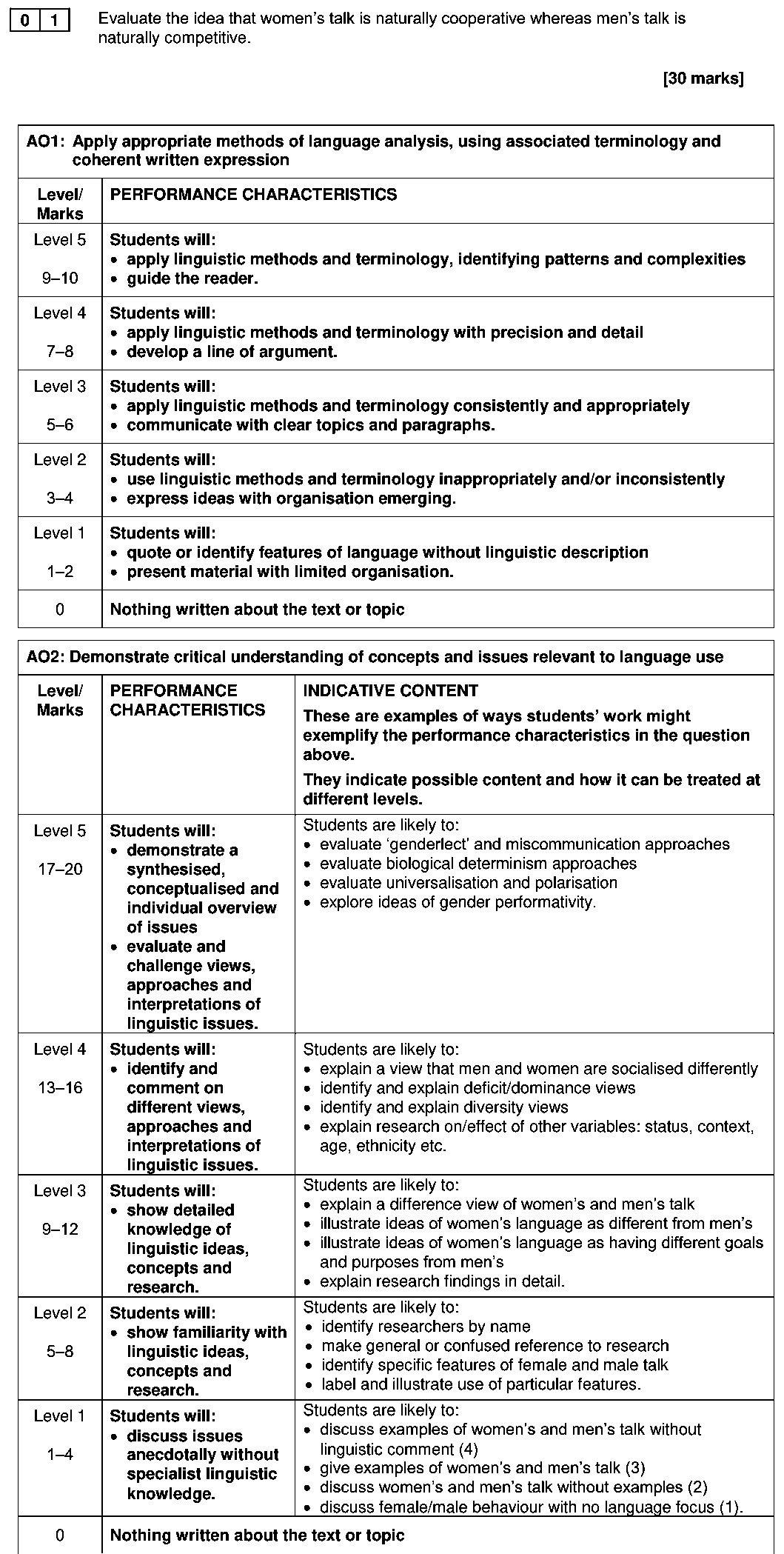
Question 1 focussed on language diversity. Students were asked to evaluate the idea that women’s talk is naturally cooperative whereas men’s talk is naturally competitive (AO2). They then had to express their views in a coherent argument using linguistic terminology (AO1). Key discriminators were whether students could illustrate and evaluate different views of women’s and men’s talk. Most students could illustrate the difference approach raised by the question which placed them in Level 3. Many answers were able to explore deficit and dominance views which moved them into Level 4. Fewer were able to discuss the effect of factors other than gender on people's talk and the idea that gender is performative. More successful answers: • identified the idea offered by the question as typical of the difference approach • offered a range of other binary oppositions formulated by difference approaches such as report vs rapport talk • referred to the ideas and research of Tannen, Holmes, Coates, Fishman • exemplified precise language behaviours characterised as male and female and explored their use • linked academic research in the difference tradition with popular linguistic texts by John Gray and others • identified other approaches such as the deficit and dominance views of gendered talk • cited the ideas and research of Jespersen, Lakoff, Zimmerman and West • interrogated the word ‘naturally’ and the implied biological determinism • discussed the idea that women and men are socialised differently and may even be different sub-cultures • challenged the biological determinism implied by ‘naturally’ • challenged the binary thinking, polarisation and universalisation of the proposition in the question • challenged the treatment of women and men as heterogenous groups • explored how variables other than gender might affect language use, often citing the very early work of O’Barr and Atkins • discussed Janet Hyde’s gender similarities arguments • explored ideas about the performativity of gender roles • criticised the methodologies of early research and considered how things might have changed over time • had an overview of the development of approaches over time. Less successful answers: • could only agree with proposition in the question • conflated ideas of difference and dominance • conflated ideas of dominance and deficit • confused researchers and what they actually researched • relied on anecdotal evidence.
Notes from the mark scheme and report
AO1 10 + AO2 20
top band evaluates genderlect/miscommunication and biological-determinism approaches, universalisation and polarisation, and explores gender performativity
Level 4 explains socialisation, deficit/dominance and diversity views and other variables (status, context, age, ethnicity)
ER: most could illustrate the difference view (Level 3), fewer went beyond gender or to performativity
best interrogated 'naturally' and cited Hyde, O'Barr and Atkins
weaker answers conflated dominance and deficit, confused researchers or relied on anecdote
Texts/data: Essay topic: whether women's talk is naturally cooperative and men's naturally competitive
June 2022 · AS Paper 2 · Q230 marksAO1=10, AO2=20Diversity essay
Text A (insert)
Mark scheme, including the levels and indicative content
Examiner's comment
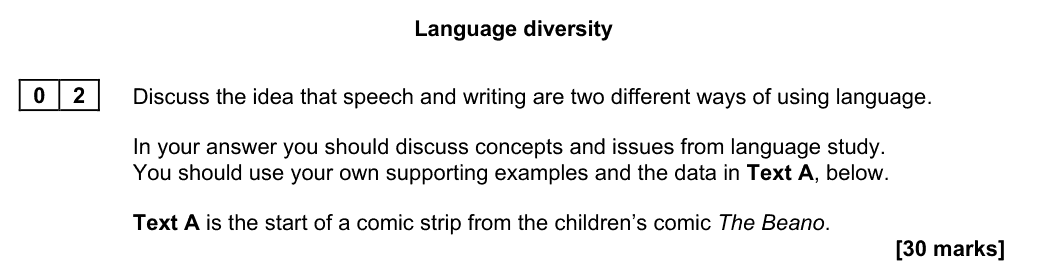
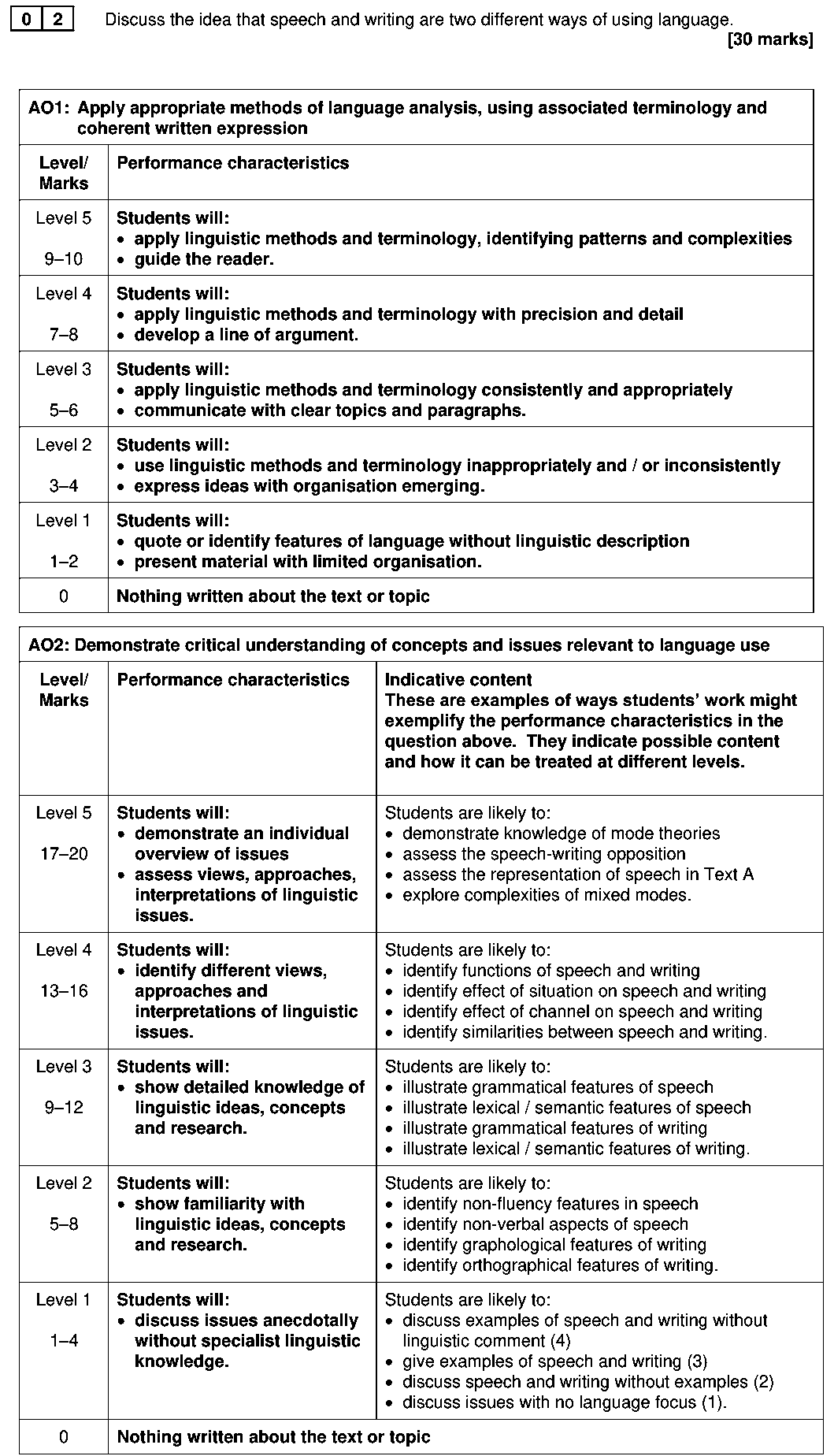
was attempted infrequently, with only about 10% of students attempting this question. The data was an extract from a comic strip from The Beano and students were asked to ‘discuss the idea that speech and writing are two different ways of using language.’ Students were less confident when applying their learned knowledge to this question and some struggled to move beyond the stimulus material at all. Those who performed well on this question were able to consider the idea that speech and writing are not binary opposites, but exist on a continuum and have elements of overlap. This idea was supported with examples from the comic strip provided and then examples from their own experiences, recognising that Text A was both written and spoken simultaneously. Some considered mode in detail and linked this to ideas from their own study, considering how we live in an increasingly multi-modal world. Occasionally, students performed a written analysis of the comic strip, something more appropriate to a Paper 1 question, and it was difficult to credit such responses anywhere other than at the lower end of the mark scheme. More successful answers: • clearly considered differences between speech and writing and contextual factors that might influence choices • considered the ways in which speech is both vocal and auditory • developed the idea that writing and speech can each take a range of different forms. Less successful answers: • analysed the comic strip in detail but without saying very much about speech and/or writing • made simplistic observations about the difference between speech and writing, with little link to AS-Level study of concepts and ideas.
Notes from the mark scheme and report
AO1 10 + AO2 20
chosen by only about 10%
top band knows mode theories, challenges the speech-writing opposition (continuum, mixed and multimodal forms) and assesses how Text A represents speech
Level 4 covers functions, situation and channel
non-fluency and graphological features alone = Level 2
a Paper 1 style analysis of the comic strip is credited only at the lower end
Texts/data: Text A: start of a Beano comic strip with speech bubbles and sound effects
June 2022 · Paper 2 · Q230 marksAO1=10, AO2=20Diversity essay
Mark scheme, including the levels and indicative content
Examiner's comment
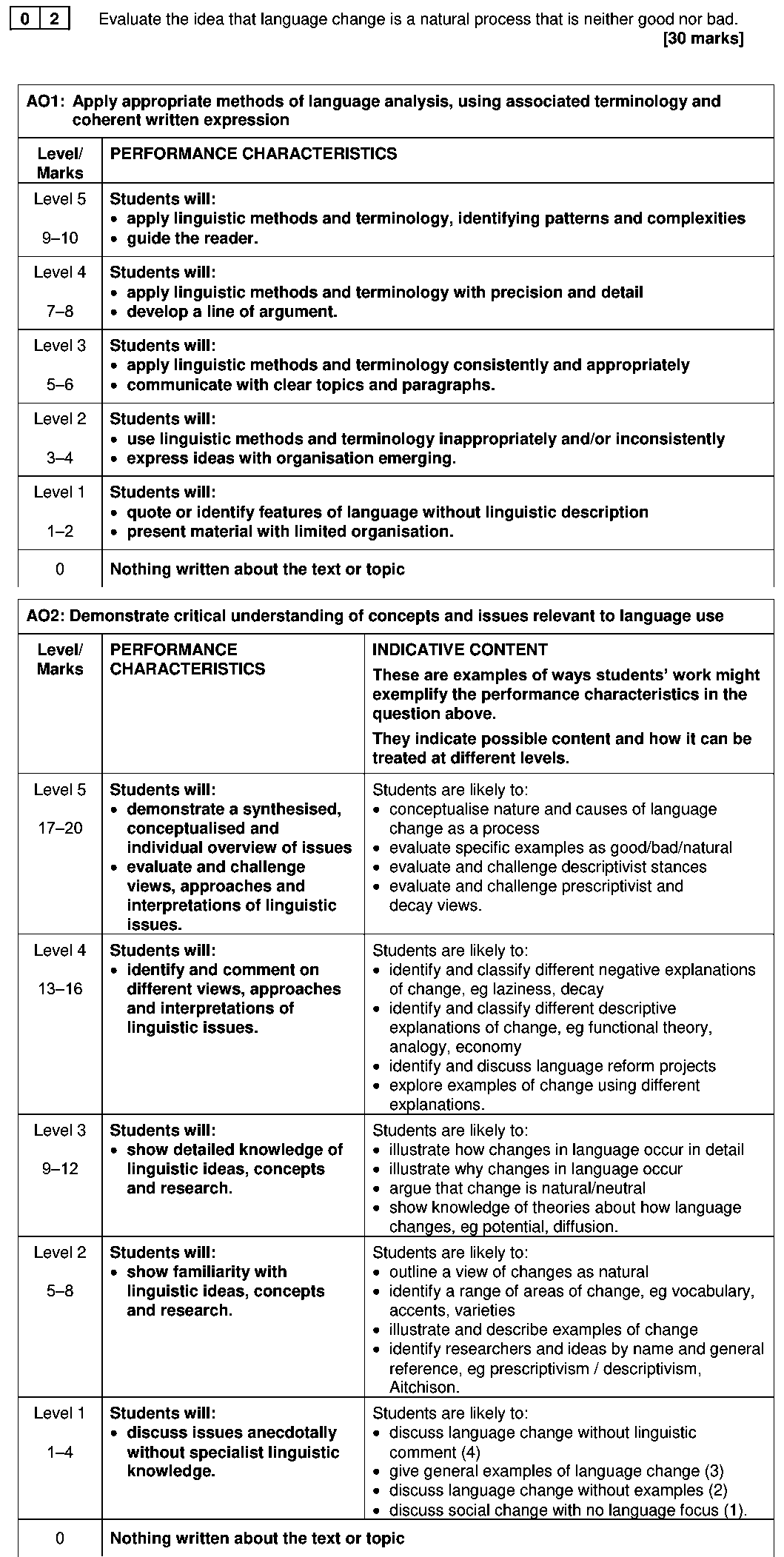
Question 2 focussed on language change. Students were asked to evaluate the idea that language change is a natural process that is neither good nor bad. (AO2). They then had to express their views in a coherent argument using linguistic terminology (AO1). A major discriminator was whether students could evaluate specific examples of language use and explore how they could be seen as natural, good or bad. Weaker answers spent a long time discussing key dates and events in the history of the English language without addressing the terms of the question. Some answers would explain an example of language change and then simply tag on a view that this was natural, good or bad. Some answers focussed on issues of the inevitability or controllability of language change at the expense of the terms of the question. There was a frequent tendency to treat inevitable and natural as synonyms. Many students rejected the idea that change could be good or bad and just needed to be accepted. War, slavery and invasion and their linguistic effects were often seen as natural and to be accepted. A minority of students challenged the idea of the analyst of language as a neutral observer and showed a detailed evaluation of the agency of human beings in the processes of change. More successful answers: • demonstrated a synthesised overview of the competing forces and agencies driving change • evaluated specific examples of changes and considered the extent to which they could be seen as natural, good or bad • characterised the process of change by using the Potential, Implementation, Diffusion and Codification model • showed knowledge of how changes were implemented, exemplifying a range of word formation processes • explained various models of diffusion including wave models and S-curves • frequently used texting and the effect of technology as a case study to evaluate the process of change • often looked at the lexical and semantic changes produced by the pandemic and evaluated these • used Crystal’s tides metaphor as an example of seeing change as a natural process, adapting to shifting circumstances • gave lexical examples of the development of new words and the obsolescence of others to illustrate Crystal’s tide metaphor • looked at metaphors of language change as a kind of evolution which enabled some to see it as a natural process while others used it to evaluate good and bad changes in terms of the survival and longevity • explained Aitchison’s characterisation of prescriptivist worries about language change • used a range of examples of initialisms, clippings and acronyms to illustrate arguments that changes were bad and the product of laziness • used Deutscher’s principle of economy to argue that such changes were in fact good and added to language’s efficiency • explored negative attitudes to the formation of pidgins and creoles as broken Englishes, lazy, grammatically incorrect • offered counterviews of these varieties as optimal and creative communication systems that were the products of their social and historical contexts • used Singlish as a case study to explore agencies of language change and the cultural contexts of their evaluation • examined whether the spread of Americanisms and US English could be seen as cultural imperialism • showed how worries about language were often signifiers of wider social and cultural attitudes and concerns • contrasted ‘infectious disease’ explanations of change with wave models and looked at the receptiveness of some people to linguistic changes • examined functional theory and the idea that language change is motivated by needs • examined random fluctuation theory and discussed whether random changes could be seen as natural or could be evaluated • examined cultural transmission and sub-stratum explanations of language change and evaluated changes caused and the attitudes to such changes • examined language reform projects and examples as changes designed to be beneficial, though frequently attacked as ‘woke’ or political correctness gone mad • considered other forms of benign prescriptivist programmes for change such as the Plain English Campaign • challenged descriptivist views of change as natural and inevitable and challenged the non- judgemental descriptivist stance • explored the agencies and social forces behind language change and questioned the idea of ‘natural’ when looking at the effects of invasion and slavery on language change. Less successful answers: • saw language change as a natural and inevitable process that just happens and is not subject to evaluation • offered lengthy accounts of the history of English • wrote at great length about Caxton, Lowth and Swift, often with limited pertinent discussion • offered pre-learned and well-rehearsed explanations of prescriptivism vs descriptivism with limited discussion of examples and the issues raised by the question.
Notes from the mark scheme and report
AO1 10 + AO2 20
top band conceptualises change as a process, evaluates specific examples as good, bad or natural and challenges both descriptivist and prescriptivist/decay views
Level 4 classifies negative and descriptive explanations and discusses language reform
ER: discriminator was evaluating specific examples
weaker answers recited history of English, tagged on a verdict, treated 'inevitable' and 'natural' as synonyms or gave rehearsed prescriptivism vs descriptivism
Texts/data: Essay topic: whether language change is a natural process that is neither good nor bad
June 2022 · Paper 2 · Q430 marksAO2=20, AO5=10Directed writing
Text A (insert), Text B (insert)
Mark scheme, including the levels and indicative content
Examiner's comment
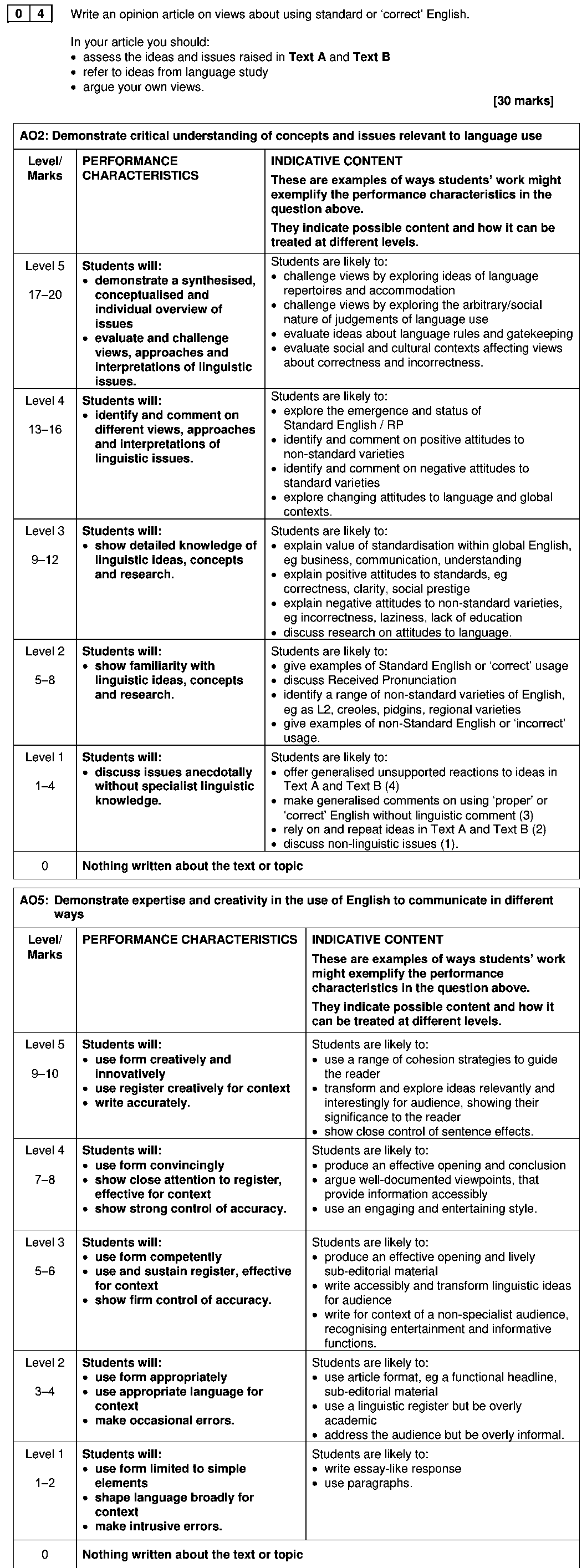
Students were asked to a write an opinion article in which they assessed the ideas presented in the texts they had analysed in question 3. These texts raised issues about what constituted standard or ‘correct’ English and the value of their use. Students were expected to show knowledge and understanding of linguistic concepts and issues (AO2) when writing in a journalistic style for a non-specialist audience (AO5). This task asked students to take their knowledge of English Language and engage with, and intervene in, real-world debates. This question was generally answered less effectively than the other questions on the paper. The mean mark for AO2 was significantly below the mean marks for AO2 in Section A. Many struggled to select and deploy knowledge effectively. This was often caused by a rather imprecise focus on the actual issues raised in the texts. Nonetheless, many students recognised the need to integrate explicit linguistic knowledge into a text for a non-specialist audience. Some of the most effective responses began by explaining to their readers what the views and arguments of Garner and Heffer were before dismantling them. A major distinguishing factor therefore was the recognition of the need to provide a satisfying level of information about the linguistic issues. There were still a few essay-like and over-academic answers, but far more very informal responses which did not inform in a satisfying way. More successful responses focussed on a discussion of what constituted a standard language, to what extent the idea of correctness applied in a linguistic context and the nature of linguistic rules. Less successful responses wrote rather broadly about attitudes to accents or language change and found it difficult to find a clear focus for their article and develop an argument. This problem may have been exacerbated by the frequent lack of close reading for meaning in question 3 as noted above. Almost all students this year were prepared to write an article and provided a functional headline. Many also provided engaging sub-editorial features and arresting openings, though there were fewer really telling conclusions. Many recognised the need to link their article to having read the articles in question 3. The most common device was to have found them accidentally while scrolling through the internet on a mobile. More successful answers: • focussed very tightly on the issues of what constituted standard or ‘correct’ English and debates about their teaching • cited the ideas of Garner and Heffer so that they could challenge them • followed Kamm’s distinction between standard and ‘correct’ English • challenged Garner’s claim that ‘Most of us are born into some type of dialect’ • discussed the relationship between a ‘language’ and a ‘dialect’ • challenged Heffer’s claim that correct English ‘is the English from which all other dialects and patois are derived’ • explained the regional origins of British standard English • showed knowledge of the processes of standardisation: selection, acceptance, elaboration of function, codification • explored processes of standardising in new Englishes • explained exonormative and endonormative stabilisation • considered the value of standard English(es) in the context of the global development of English • evaluated arguments about the value of native-speaker norms vs communicability in teaching and using English in global contexts • examined changing attitudes to RP and regional accents • evaluated Garner’s idea of learning to be tolerant of regional variation • explored ideas of having a language repertoire • evaluated the ability or need to accommodate one’s language use • assessed whether code-switching is a desirable response to accentism • explored the prescriptivist tradition of creating and imposing arbitrary linguistic rules • assessed the views and attitudes of the Queen’s English Society as a gate-keeping organisation • argued this was a method of exerting power and explored the way language use can be inclusive or exclusive • introduced language researchers by first and last name and indicated who they were for an unfamiliar audience • developed a convincing persona and voice and addressed the experiences of their imagined audience • deployed some of the techniques they had seen at work in the texts, shaping their syntax powerfully for effect. Less successful answers: • re-hashed the views of Garner and Heffer and approved the need for all to use standard English • wrote generally about language change as inevitable and natural and a good thing • wrote generally about language variation as a good thing and the right to speak how you want • railed intemperately against the unfairness of accentism • confused ‘correct’ English and politically correct English • let their creation of a persona and scenario take over from the conveying of linguistic ideas • wrote in an essay format • introduced names of language researchers without any explanation • introduced linguistic terms and concepts without any explanation for the non-specialist reader.
Notes from the mark scheme and report
AO2 20 + AO5 10
opinion article
top band challenges views via repertoires and accommodation and the arbitrary/social nature of judgements, and evaluates language rules and gatekeeping
Level 4 explores emergence and status of Standard English/RP and attitudes to standard and non-standard varieties
ER: weakest question on the paper (AO2 mean well below Section A)
best explained Garner's and Heffer's views before dismantling them
weaker articles drifted into accents or language change, were over-informal or left researchers and terms unexplained
Texts/data: Opinion article on views about using standard or 'correct' English, responding to Texts A and B
November 2021 · Paper 2 · Q130 marksAO1=10, AO2=20Diversity essay
Mark scheme, including the levels and indicative content
Notes from the mark scheme and report
AO1 10 + AO2 20
top band gives an overview of speakers' repertoires, evaluates performance and accommodation, challenges the arbitrary/social nature of standard vs non-standard judgements and evaluates social and cultural contexts
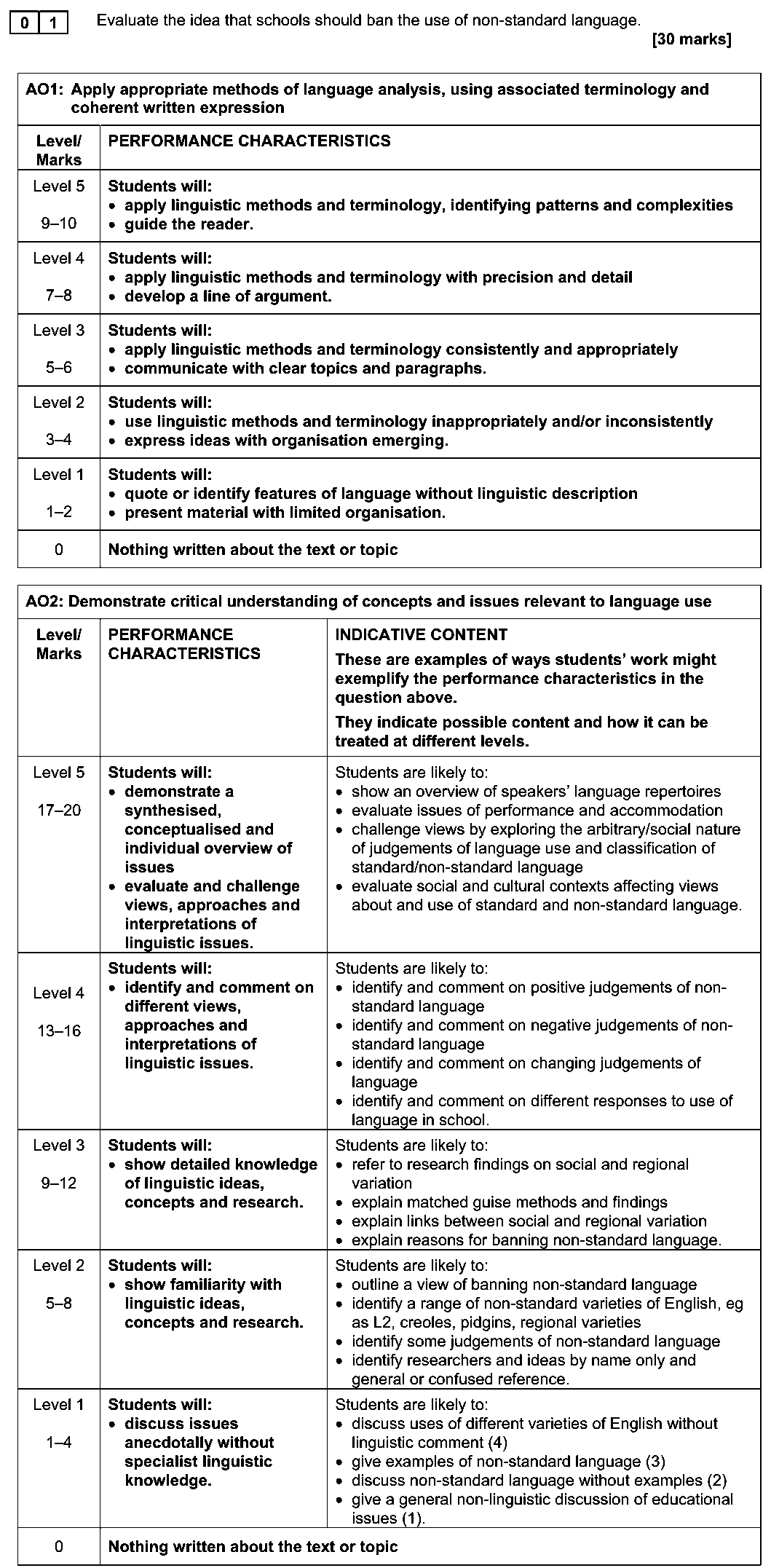
Level 4 comments on positive, negative and changing judgements and different school responses
Level 3 uses matched guise and research on social and regional variation
no examiners' report (November series)
AO split from AQA's standard grid for this question (not readable in this year's mark scheme)
Texts/data: Essay topic: whether schools should ban non-standard language
November 2021 · Paper 2 · Q230 marksAO1=10, AO2=20Diversity essay
Mark scheme, including the levels and indicative content
Notes from the mark scheme and report
AO1 10 + AO2 20
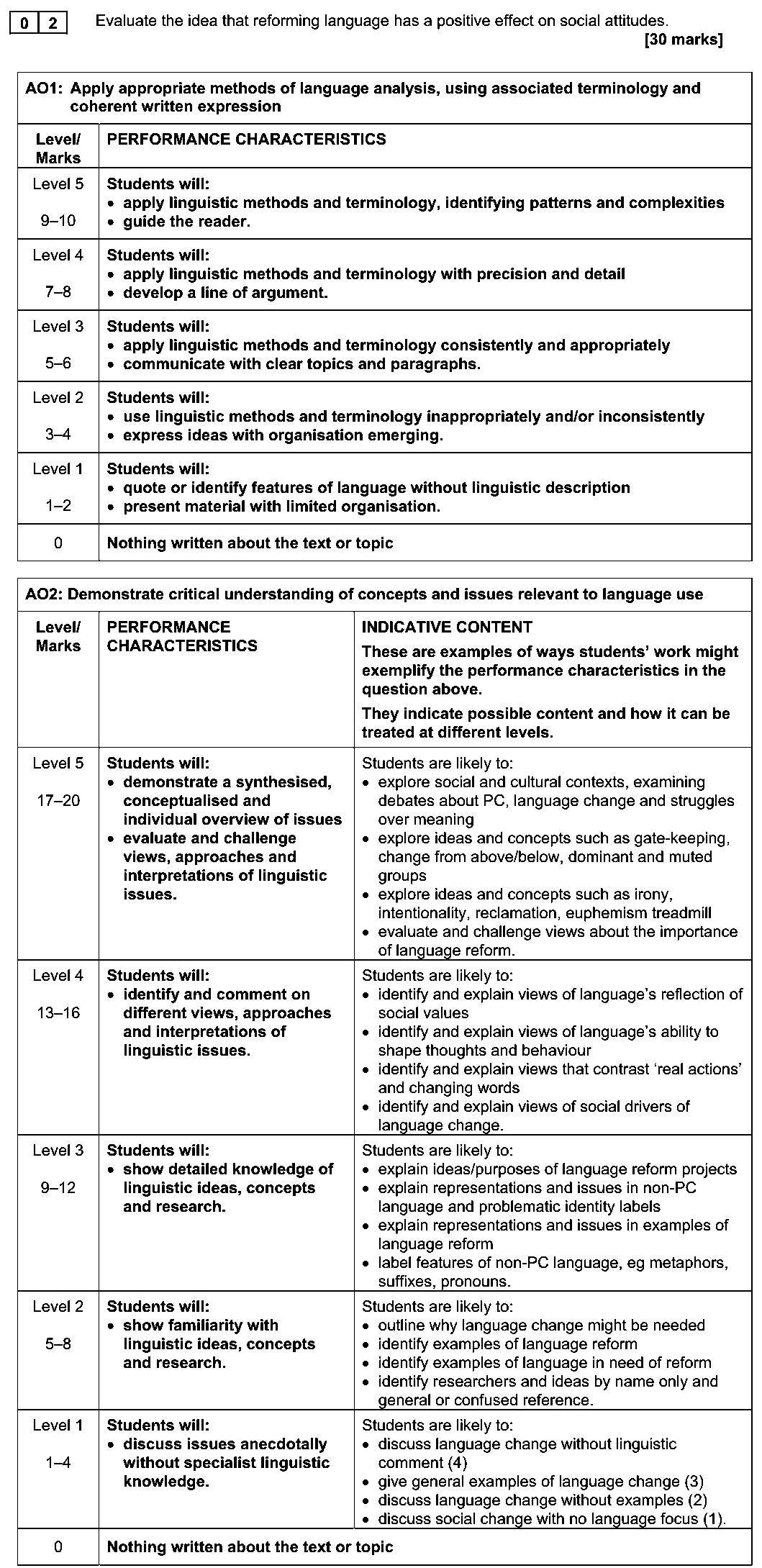
top band examines debates about PC and struggles over meaning, gate-keeping, change from above/below, dominant and muted groups, irony, reclamation and the euphemism treadmill, and challenges views about the importance of reform
Level 4 explains reflectionist vs determinist views and 'real actions' versus changing words
no examiners' report (November series)
AO marks not parsed into the packet
AO split from AQA's standard grid for this question (not readable in this year's mark scheme)
Texts/data: Essay topic: whether language reform has a positive effect on social attitudes
November 2020 · AS Paper 2 · Q130 marksAO1=10, AO2=20Diversity essay
Text A (insert)
Mark scheme, including the levels and indicative content
Notes from the mark scheme and report
AO1 10 + AO2 20
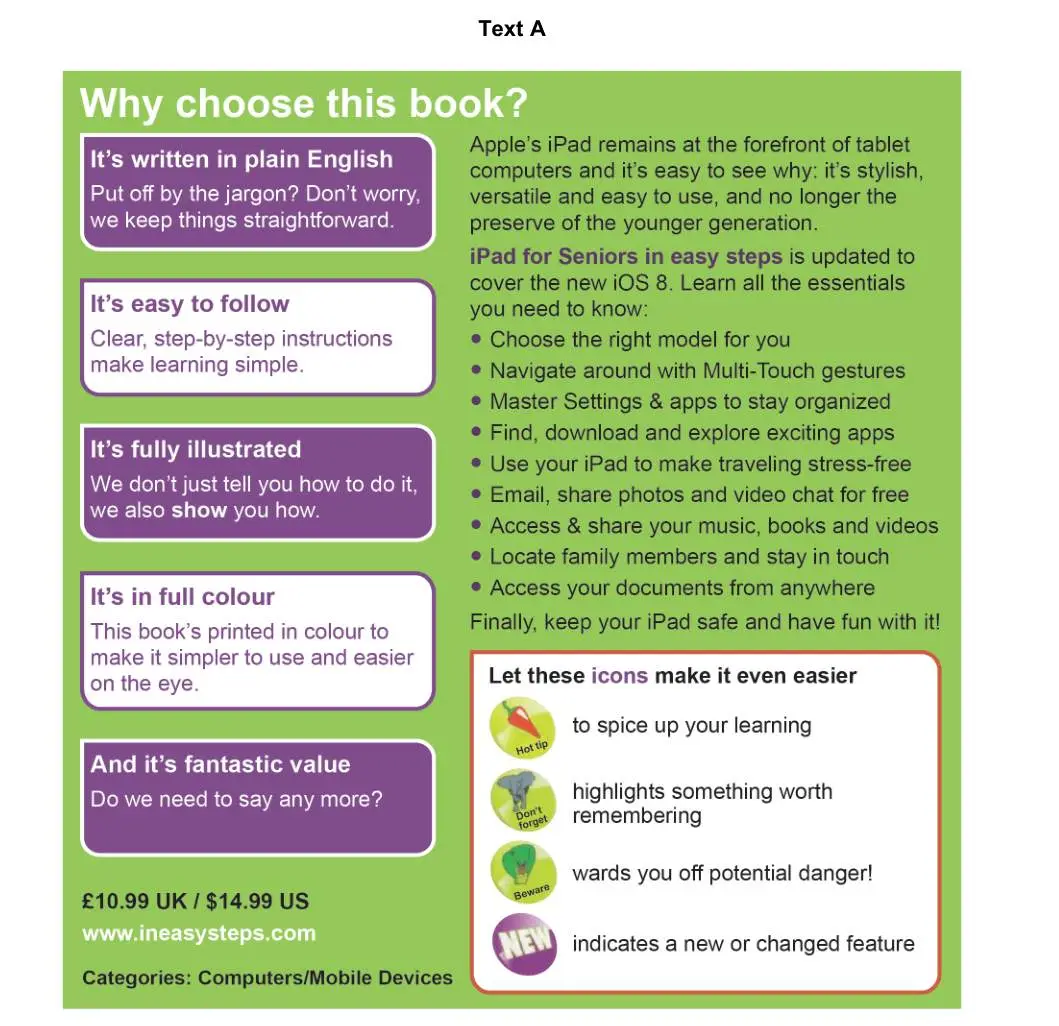
top band shows the interplay of factors affecting language use, assesses contextual factors and the language of Text A, and understands audience positioning
Level 4 weighs purpose, genre, user identity and mode against audience
Level 3 uses accommodation theory, audience design, convergence and divergence
describing Text A's features and audience alone = Level 2
no examiners' report published for the November 2020 series
AO split from AQA's standard grid for this question (not readable in this year's mark scheme)
Texts/data: Text A: back cover of iPad for Seniors in Easy Steps (book for older people)
November 2020 · Paper 2 · Q130 marksAO1=10, AO2=20Diversity essay
Mark scheme, including the levels and indicative content
Notes from the mark scheme and report
AO1 10 + AO2 20
top band evaluates dominance and difference/genderlect/miscommunication approaches and explores diversity approaches and gender performativity
Level 4 explains deficit/dominance and difference views and the effect of other variables (status, context, age, ethnicity)
Level 3 explains gender and interaction research in detail
no examiners' report (November series)
Texts/data: Essay topic: whether women and men speak different varieties of English
November 2020 · AS Paper 2 · Q230 marksAO1=10, AO2=20Diversity essay
Text B (insert)
Mark scheme, including the levels and indicative content
Notes from the mark scheme and report
AO1 10 + AO2 20
top band gives an overview of accent repertoires, assesses the effect of judgements on accent use, performance and accommodation and the arbitrary social nature of judgements
Level 4 identifies positive views of non-standard and negative views of standard accents and changing judgements
Level 3 explains matched guise methods and findings
Text B itself stereotypes Scouse ('lazy southerners', 'adenoidal')
no examiners' report published
AO split from AQA's standard grid for this question (not readable in this year's mark scheme)
Texts/data: Text B: humorous book Scouse English on Liverpool pronunciation
November 2020 · Paper 2 · Q230 marksAO1=10, AO2=20Diversity essay
Mark scheme, including the levels and indicative content
Notes from the mark scheme and report
AO1 10 + AO2 20
top band evaluates real attempts to control use and development of language, conceptualises diversity and change, explores gate-keeping and change from above/below, and challenges prescriptivist and descriptivist stances
Level 4 comments on negative (laziness, decay), descriptive (functional theory, analogy) and ameliorative (benign prescriptivism, reform, PC) views
no examiners' report (November series)
Texts/data: Essay topic: whether a national organisation should control the use and development of English
November 2020 · Paper 2 · Q430 marksAO2=20, AO5=10Directed writing
Text A (insert), Text B (insert)
Mark scheme, including the levels and indicative content
Notes from the mark scheme and report
AO2 20 + AO5 10
opinion article
top band conceptualises change as a process, evaluates views using specific examples of technology's effects and challenges evolution/progress, technological determinism and incorrectness, laziness and decay views
Level 3 shows affordances and limitations, word formation and spread of change
AO5 top band uses form and register creatively and accurately for a non-specialist reader
Text B copyright-removed
no examiners' report (November series)
Texts/data: Opinion article on views about the effects of technology on language, responding to Texts A and B
June 2019 · Paper 2 · Q130 marksAO1=10, AO2=20Diversity essay
Mark scheme, including the levels and indicative content
Examiner's comment
Question 1 focused on language diversity. Students were asked to evaluate the idea that language variation had decreased over time (AO2). They then had to express their views in a coherent argument using linguistic terminology (AO1). Key discriminators were whether students could illustrate variation and evaluate its increase or decrease. Not all students were certain what variation might mean. In some cases it was taken to mean any changes in the English language. A significant number of students brought in ideas from language and gender. Often they could cite ideas about variation in women’s and men’s language but could not address the issue of whether it had increased or decreased over time. Many students could illustrate varieties and variations but the more successful were those who could address the other key words in the question. More successful students: • considered variation in terms of varieties and the different ways an individual would look to use language • discussed the nature of standardisation and its effects on variation • had detailed knowledge of the processes of selection, acceptance, elaboration of function and codification • explored the emergence of world varieties and debates around standard and non-standard forms around the world, often exploring the situation in Singapore • explored processes of standardisation and variation in new Englishes, using Schneider’s model • explored dialect levelling and the social reasons for it • discussed whether dialect levelling in Milton Keynes had actually introduced a new variety • examined how Estuary English could be seen as removing some older social and regional distinction • gave some interesting insights into a less standardised world via online communication and the lack of gatekeepers for modern communication technologies • developed interesting arguments about identity and repertoires leading to increased variation even in the face of levelling elsewhere • discussed the repertoire analysis by Devyani Sharma of British born Asians • explored MLE and MUBE as case studies of the emergence of new varieties and variation, citing Rob Drummond’s UrBEn-ID project • examined technology’s role in spreading innovation and levelling (eg Americanisms, urban slang, online gamer jargon/slang growing beyond their base but also being used more widely and flattening out/killing more individual local forms) • discussed the emergence of Polari and its diminishing use as social conditions changed • explored the creation of pidgins as contact language and their disappearance when their need was no longer present • considered the very disparate nature of Old English and Middle English before the emergence of Standard English • examined classic variationist studies and questioned whether variables such as class and gender now saw different patterns of use • evaluated reasons for standardisation and variation: migration, globalisation, education, technology, identity politics • gave good examples of variation across different levels (eg phonological variants as markers for class and identity, dialect variation, sociolect and occupational jargon) • showed a subtle appreciation of the ebb and flow of variation • evaluated whether changes in variation were a good or a bad thing. Less successful students: • illustrated variation but without addressing the issue of increase or decrease • had detailed knowledge of case studies (Trudgill, Cheshire, Petyt, Labov et al) and what was found, but could not quite link it to the ideas of increase or decrease • were uncertain where to draw the line between change and variation and how to choose the right material to best answer the question set • were uncertain about what variation might mean • discussed changes in language as examples of variation • confused researchers’ names eg Labov versus Lakoff • confused Labov’s New York Department store study with his Martha’s Vineyard study • did not know how to use Kachru’s circles to explain an increase or decrease • forced gender and interaction into answers without linking the material into the question.
Notes from the mark scheme and report
AO1 10 + AO2 20
top band synthesises competing forces of standardisation and variation, explores how variations come and go and evaluates prescriptivist and descriptivist attitudes to variation
Level 4 explains why social and geographical variation may have decreased (codification, education, technology) or increased (identities, travel, colonialism)
ER: some took variation to mean any change or wrote on gender without addressing increase/decrease
credited dialect levelling (Milton Keynes), Estuary English, MLE/MUBE, Sharma's repertoires, Schneider and world Englishes
AO split from AQA's standard grid for this question (not readable in this year's mark scheme)
Texts/data: Essay topic: whether language variation has decreased over time
June 2019 · Paper 2 · Q230 marksAO1=10, AO2=20Diversity essay
Mark scheme, including the levels and indicative content
Examiner's comment
Question 2 focused on language change. Students were asked to evaluate the idea that changes in communication technologies have had a damaging effect on the English language (AO2). They then had to express their views in a coherent argument using linguistic terminology (AO1). Students seemed very well prepared for this question. There was good focus on a variety of communication technologies and good discussion of their effect. A major discriminator was whether students could evaluate specific examples of language use and explore how they could be seen as damaging or otherwise. Less effective answers spent a long time discussing history and dates but with no exploration of damage or focus on technologies. Some students agreed with the idea in the question and referred to any type of change as damaging. Such students often cited the views of John Humphrys or John Sutherland as evidence. More successful students: • looked at the effects of a range of technologies – for example TV, the internet, social media and smartphones • evaluated the effects of the printing press and its connection with standardisation and the dissemination of language • explored the affordances and limitations of new technologies • explore how technologies affected what people could use language to do • examined the impact of new technologies on vocabulary • evaluated the significance of grammar and spellcheckers as well as predictive text • explored how people had used the resources of technology to replicate spoken interaction • evaluated the social etiquettes associated with phones and digital communication • examined debates about the impact of mobile phones on literacy • explored debates about emojis and referred to Vyvian Edwards’ The Emoji Code • used Crystal to challenge decay views • cited Wood, Kemp and Plester and their Coventry University research on the impact of texting on literacy • placed the question’s debate within discourses of language change as decay • used Aitchison’s metaphors to characterise discourses about change as undesirable • used Guy Deutscher to formulate less pejorative accounts of the creativity and functionality of language change • argued that language’s evolution was accelerated by technology but that this was a positive benefit to society and paralleled the increase in faster communication • discussed the democratisation of language by the internet and the ability to publish • discussed the impact of technology on the standardisation of language and its impact on the creation of non-standard usages as well. Less successful students: • accepted the ‘damage’ argument far too easily and seemed to be writing an argument against their own behaviour (many asserted that technology was affecting students’ performance in exams for example) • mentioned the influence of technology on change, but gave no specific examples • claimed dictionaries as examples of communication technology • discussed the development of the printing press without discussing its impact • gave lengthy historical accounts of how the English language has changed • focused on examples of change that were not connected with communication technologies • misrepresented Aitchison’s views and models • claimed that Jean Aitchison is a prescriptivist • could not explain her metaphors clearly • lacked examples to evaluate the views • defined descriptivism as seeing language change as ‘positive’, rather than as observing/describing it.
Notes from the mark scheme and report
AO1 10 + AO2 20
top band conceptualises change as a process and evaluates decay, evolution, progress and functional views with specific examples of technology-driven change
Level 4 argues for and against 'damaging'
ER: discriminator was evaluating specific examples
weaker answers accepted 'damage' too easily (often citing Humphrys or Sutherland), gave long histories, called dictionaries a communication technology, mentioned printing without its impact, misrepresented Aitchison as a prescriptivist, defined descriptivism as seeing change as positive
AO split from AQA's standard grid for this question (not readable in this year's mark scheme)
Texts/data: Essay topic: whether changes in communication technologies have damaged English
June 2019 · AS Paper 2 · Q340 marksAO2=20, AO5=20Directed writing
Text B (insert)
Mark scheme, including the levels and indicative content
Examiner's comment
Students were given an article from the ‘Recruiting Times,’ which claimed that people with regional accents, specifically Birmingham (Brummie), were being discriminated against in job interviews. This prompted a lot of lively debate within responses, with most students challenging this notion as ‘unfair’ or ‘outdated’. This question requires students to write informatively, but for a different audience than questions 1 and 2. Most students were careful to state their audience/intended publication, with the Daily Mail and the Guardian remaining the most common choices. Others wrote a riposte for publication within the Recruiting Times, and some students wrote effectively for regional newspapers. Some students also wrote effectively for school leaver magazines. This resulted in some effective positioning of the author, especially when the persona adopted was a job-seeking regional language speaker, or as someone working in Recruitment writing for their ‘team.’ The most successful students wrote pieces which were fully believable, including paying close attention to register for their stated audience throughout, and with effective uses of headlines and other sub- editorial features. These students had evidently thought carefully about the conventions and ‘house style’ of their chosen publication, and responded well. Mid-performing students did this less effectively, but were able to use headlines and some sub-editorial features such as direct address or anecdote. There were some very creative uses of language, including the use of effective metaphors. These were sometimes extended, although they did at times appear a little laboured. Anecdotes were often well deployed, particularly illustrating examples of accent prejudice, although inauthentic quotation (e.g of celebrities, job applicants or, in some cases, researchers) and creation of new statistics to ‘support’ a view were much less helpful. Similarly, a small number of students struggled to maintain a measured tone. Whilst a degree of subjectivity is necessary to the piece, students must be reminded that their tone must be appropriate, and expletives and uses of crude language do little to support their argument. Although the question focus explicitly addressed ‘the significance of accents in the workplace,’ students were rewarded for a range of ideas relating to accents, accent prejudice, and occupational language. However, it is worth noting that those students who simply considered the nature of occupational language (e.g references to jargon studies, or occupational frameworks) struggled to keep an accent focus, and responses were less effective. The source data specifically referenced RP and Brummie, and these formed the focus of most students’ responses. Most students made good use of a range of Matched Guise studies, with effective reference to Giles, Giles and Powesland, Worcester College (Dixon, Mahoney and Cocks) and the University of Aberdeen. These studies enabled students to effectively consider accent prejudice, with more effective responses considering both positive and negative responses to specific accents. As in questions 1 and 2, those students who brought their own examples to their responses were more successful. A minority of students showed insecurity around RP, suggesting it was a ‘mainstream’ accent, or confusing it with Standard English. Similarly, some students showed insecurity with Labov’s New York stores study, wrongly asserting that RP is the standard accent of upper class America. Some students were able to connect their work on Matched Guise to justifications for the accent prejudice discussed in the text. For example, Geordies’ friendliness was often connected to work in call centres/customer facing roles, while RP was frequently connected with ‘business’. The most effective responses here considered international intelligibility. Some students were able to connect these stereotypes with ideas of power, with some effective discussions of French and Raven or Fairclough. Asymmetry was very well handled by most students who considered it, particularly when the focus remained on the way that stereotypes are perpetuated within occupations. The Army was an effective case study here, with some students considering the relationship between public schools and higher-ranking officers, and the impact this has on language use and representations. It was pleasing to see students taking ideas beyond theory into real-world social applications and implications, with some very effective discussions focused around class issues in contemporary society, or evaluating ideas of accent prejudice in a seemingly more diverse and equal society. More successful answers: • selected an appropriate target audience, and tailored their piece to their chosen publication and audience through register • clearly used subeditorial features • wrote in a measured but personal tone, maintaining this throughout • used ‘real life’ examples to support their ideas • clearly ‘glossed’ technical terms, or explained research or theorists in a helpful and engaging way • made explicit reference to learned knowledge. Less successful answers: • brought little or no new information to the response, relying heavily (sometimes exclusively) on the source data • showed confusion around Received Pronunciation, Standard English, or variations such as American English • struggled to consider the non-specialist audience, writing an essay-like response, or not maintaining awareness of the form beyond a headline • wrote in a similar style to questions 1 and 2, failing to target a non-specialist audience through register • struggled to maintain a measured tone.
Notes from the mark scheme and report
insert Text B not reproduced by AQA (copyright removed)
AO2 20 + AO5 20
article on the significance of accents in the workplace, audience must be stated
top band assesses validity and effects of accent attitudes, choices of accent at work, repertoire and accommodation
credited: matched guise studies (Giles, Dixon Mahoney and Cocks), RP vs Brummie, call-centre stereotypes, power, international intelligibility
avoid invented quotes and statistics, crude tone, confusing RP with Standard English, or drifting into jargon
Texts/data: Text B: Recruiting Times article on discrimination against regional (Brummie) accents in job interviews
June 2019 · Paper 2 · Q430 marksAO2=20, AO5=10Directed writing
Text A (insert), Text B (insert)
Mark scheme, including the levels and indicative content
Examiner's comment
Students were asked to write an opinion article in which they assessed the ideas presented in the texts they had analysed in question 3. These texts raised issues about language diversity and attitudes to accents. Students were expected to show knowledge and understanding of linguistic concepts and issues (AO2) when writing in a journalistic style for a non-specialist audience (AO5). This task asks students to take their knowledge of English language and engage with and intervene in real-world debates. This question was generally answered much more effectively than the equivalent question was last year. The mean mark for AO2 rose but was still below the AO2 marks in Section A. More students recognised the need to integrate explicit linguistic knowledge into a text for a non-specialist audience. Many struggled to select and deploy knowledge effectively however. Many students drew on variationist and matched guise research into accents, communication accommodation theory, opinion polls, TV documentaries and news stories about accents. It seemed like a very ‘live’ topic for many of them and it led to some engaged personal responses. Higher achieving students explored accentism and showed a good understanding of the social origins of accents and the arbitrary nature of judgements about accents. Many challenged negative attitudes towards regional accents, some in a rather rant-like style, but others were able to adopt a more subtle polemic approach, often injecting satirical humour. Some recurrent weaknesses were the conflation of accent and dialect/sociolect; asserting a position with little linguistic evidence; and simply parroting the accent reduction agenda. Less successful responses accepted that RP and/or elocution is necessary for success and agreed with negative judgements of regional accents, often prompting the reader to ‘learn RP’ or ‘abandon [their] accents’. While most students understood that they needed to show off their linguistic knowledge, many answers were still very light on specific linguistic knowledge. There were some passionate, articulate and witty pieces. Form was used really well and examiners received the impression that students were much better prepared for writing opinion pieces this year. Almost all students this year were prepared to write an article and provided a functional headline. Many also provided engaging sub-editorial features, though once again there were fewer really telling conclusions. There were many very creative and engaging pieces showing flair and sophistication. Many used cohesive devices eg ending with a point mentioned in the introduction, or linking back to the headline, and this was effective. A major distinguishing factor was the recognition of the need to provide a satisfying level of information about the linguistic issues. There were still a few essay-like and over-academic answers, but far more very informal responses which did not inform in a satisfying way. More successful students: • referred to the sources represented in Texts A and B as a starting point for their piece • informed their reader about these sources appropriately and identified the views and issues they contained • evaluated the views expressed in Texts A and B using knowledge about language • explored the ways non-standard and standard accents are judged and perceived • introduced their reader to matched guise research to illustrate these • noted that views about accents are really about class, politics and social values • explored how individual accents could be judged both positively and negatively • established that attitudes to accents are social rather than linguistic judgements • recognised that this did not mean that they had no effect or significance • explored the advantages and disadvantages of speaking with non-standard accents • explored the advantages and disadvantages of speaking with standard accents • weighed up issues of identity and authenticity • debated whether regional accents, often seen as more friendly than RP, might not be an advantage in dealing with all sorts of people • discussed the fact that RP is not necessarily any clearer to speakers of English around the world • examined how fashions in attitudes to accents have changed over time • examined the significance of the emergence of modified RP and Estuary English • explored the BBC’s role over time in promoting both RP and diversity of accents • considered what implications this might have for the individual reader • weighed up pragmatic responses against idealistic notions of freedom of choice and accent equality • explored the value of linguistic accommodation and code-switching (providing information about appropriate thinkers and researchers for their audience) • argued that changing a non-standard accent for a standard accent made a speaker complicit in the perpetuation of linguistic and social inequality • chose a wise and helpful place of publication • wrote answers which often incorporated well-judged humour and paid judicious attention to the need to entertain • used sentences which were varied and crafted for effect • used anecdotes skilfully to engage the reader • addressed the reader in an appropriate way • used witty and informative headlines that hooked and summarised • guided the reader by means of sub-editorial features • provided a thoughtful, memorable or witty conclusion. Less successful students: • recycled the language and ideas of both texts • wrote only a general response to the texts, often outraged that people should not be allowed to use their regional accents • simply accepted views that it was a good idea to learn to speak with an RP accent • made little or no reference to any concepts relevant to the study of accents and standard language ideology • misunderstood the views and attitudes of Paul Waldie • wrote as if their audience had read Text A and Text B • referred to the sources as Text A and Text B • used an inappropriately informal style of expression • included expletives and taboo language in their answer which became immoderate, abusive invective • showed little control of spelling and punctuation • showed little control of the ability to analyse and argue a case.
Notes from the mark scheme and report
AO2 20 + AO5 10
opinion article
top band examines debates about standard and non-standard accents, evaluates attitudes to accents and their effect, repertoire and accommodation
Level 3 needs attitudes beyond the texts and research such as matched guise
ER: better than 2018
best explored accentism and the arbitrariness of accent judgements
weaknesses: conflating accent and dialect, assertion without evidence, endorsing elocution/RP, very informal pieces light on linguistic information
AO split from AQA's standard grid for this question (not readable in this year's mark scheme)
Texts/data: Opinion article on views about accents responding to Texts A and B
June 2018 · AS Paper 2 · Q130 marksAO1=10, AO2=20Diversity essay
Mark scheme, including the levels and indicative content
Examiner's comment
This series, the question asked students to “Discuss the idea that men’s language is more powerful than women’s language.” The data was statistical, focusing on research into interruptions in mixed-sex conversations. Over 80% of students chose to respond to this optional question. Many students appeared confident when handling qualitative data. This was often successfully linked to the work of Zimmerman and West, with the dominance model often considered in some detail. It is worth noting, however, that Zimmerman and West’s work is now quite dated. It would be pleasing to see students making use of more recent studies, such as the work of Hancock and Rubin, or Jackobi and Schweers’ US courtroom study. Students often engaged well with other AO2 ideas, showing understanding of the different models of gendered language. Many responses were based on a clear progression from dominance and/or deficit into studies of difference and (at the higher end) diversity or gender similarities. These were often well supported with reference to relevant spoken language studies including Lakoff, Spender, Zimmerman and West, Tannen’s difference model, Holmes, Cameron and Hyde. Some higher achieving students considered gender similarities and performativity to great effect. Less frequently considered, but often usefully applied, was the work of Kuiper, Fishman, or O’Barr and Atkins. Again, however, it is worth noting more recent work, including Tannen’s work on managerial styles and floor holding, is not frequently being discussed. Interesting angles included exploring the relationship between dominance and deficit models, with many students taking a ‘sideways’ approach and considering marked terms or the work of Dale Spender. Although this is not directly responding to the question (as it is language about genders, rather than the language of genders) some students were able to successfully consider the relationship between the two. Many students showed some awareness of challenge to methodologies, or engaged with criticisms about the studies themselves. Whilst this was rewarded appropriately, it is important to note that simply referencing studies as “outdated,” or stating that samples were “too small” is not fully “evaluating.” Students who engaged explicitly with how these limitations affected the findings tended to “evaluate” much more effectively and gained higher marks. More successful answers: • Used the data to draw a particular view of male/female language, and used this as a ‘way in’ to exploring the issues. Zimmerman and West were often referenced as a starting point. • Kept the data at the centre of the response, often returning to it and considering the same findings from different interpretive angles. • Engaged with complexities from the data, particularly the lack of context given. This was often well linked to the distinction between interruptions and overlaps, and the purpose of the speaker in making the interruption. Many students applied Beattie’s and Fishman’s work well to this idea. The strongest answers often engaged well with complexities of context aside from the data, considering the direct relationship between Lakoff and O’Barr and Atkins’ work, for example. • Built up responses, working with the idea of ‘power’ at the centre. These responses often explored how one model builds on the concerns of the earlier model, e.g. the ways in which dominance/deficit indicate women’s language as less powerful, but difference suggests there is no more ‘powerful’ language, but different motivations. Some students were able to use this notion critically, exploring perceived power biases within the terms used for this model. “Status” and “support” were used to argue that women’s language, even when given strength, is still weaker in comparison to men’s when such gender dichotomies are created. Cameron’s work was often well applied here. • Considered the notion of ‘power,’ exploring ways in which women’s language can be seen as more powerful. Trudgill was at times used to good effect, although it should be noted that some students omitted to acknowledge the complexities of class as a complicating variable. • Challenged simplistic stereotypes of men and women, with good discussion often made of how social expectations may have shaped the language used. This was at times well developed into an exploration of gender identities more broadly. • Considered the ‘difference’ model in some detail, with Tannen particularly well cited. • Explored Holmes’ work on tag questions, or Fishman’s research, in some detail, effectively considering alternative uses of features associated with deficit models. • Offered methodological challenges to the data in the question, or specific pieces of research, clearly considering how the limitation affected the findings and what the implications of this were. This was particularly well handled with Lakoff. Less successful answers: • Paraphrased the data, at times describing each pair in sequence, without bringing any learned knowledge to the response. • Described men as powerful, and women as powerless, without reference to language. This often became socially-driven, and at times quite emotive. • Made errors in associating researchers with particular models, or confused the genders of the researchers. This was particularly true of Spender and Lakoff. • Made reference to language features without exemplification, or failed to link researchers to the specific features considered. • Recited all the information they knew about different studies, sometimes in an almost bullet-point approach. These students tended not to shape their responses or engage with the issues raised, and answers at times read almost like revision notes. • Made errors in written accuracy, including women’s/women and woman/women. ‘Interruption’ was also frequently spelled inaccurately, despite being included in the data. • Misinterpreted the data, for example inferring that the 75% figure related to the number of speakers who interrupted, not the number of interruptions made. • Attempted to engage with complexities, such as O’Barr and Atkins work on ‘powerless’ language, but without linking these explicitly to gender. This was particularly true of students who attempted to consider Cameron’s critique of dichotomies. • Created a response which was lacking in conscious shaping, e.g. without using discourse markers or without explaining how one idea fed into the next. Some students did not use paragraphs.
Notes from the mark scheme and report
Table 1 not reproduced by AQA (copyright removed)
AO1 10 + AO2 20
chosen by over 80%
top band explores heterogeneity of speakers, assesses dominance and difference explicitly and other variables (status, class, situation)
credited: Zimmerman and West, interruption vs overlap, Lakoff, O'Barr and Atkins, Tannen, Holmes on tags, Fishman, Cameron, gender similarities
calling studies 'outdated' or samples 'too small' is not evaluation
common errors: paraphrasing the data pair by pair, misreading the 75% figure, drifting into representation (marked terms)
MS calls the data 'Figure 1' (it is Table 1)
Texts/data: Table 1: 1983 study of interruptions in five mixed-sex conversations between strangers
June 2018 · Paper 2 · Q130 marksAO1=10, AO2=20Diversity essay
Mark scheme, including the levels and indicative content
Examiner's comment
Question 1 focussed on language diversity, in particular on the nature and status of British Standard English. Students were asked to evaluate the idea that British Standard English is superior to other varieties of English around the world (AO2). They then had to express their views in a coherent argument using linguistic terminology (AO1). Key discriminators were whether students could explain and interrogate the idea of superiority and the precision of their understanding of what British Standard English referred to. The question asked students to evaluate the idea that British Standard English is superior to other varieties of English used around the world. While most students referred to some varieties of World English outside the UK, others focussed entirely on varieties of English within the UK, discussing varieties such as MLE and Estuary English, which was fine. Many, however, did not differentiate between accent and dialect, so spent a lot of time talking about RP, which was acceptable but required acknowledgement that it was a different variety. Others did not attend precisely to the focus on a British standard. Answers were often stronger when it was recognised that there are other Standard Englishes and that there are other supra-national varieties. Many answers showed knowledge of the historical emergence of BSE and ideas about the process of standardisation. Many students mentioned the effect of colonialism and imperialism and linked it successfully to the primacy of English, the status of English in colonised countries in education and government and the idea of resistance identities. Some students wanted to use the idea of resistance to the standard by discussing Labov’s Martha’s Vineyard study, without acknowledging that this related to American, rather than English Standard English. Many students explained Kachru’s circles; fewer explained or evaluated the model in relation to debates about the ‘superiority’ of BSE. Schneider’s Dynamic Model of Post-colonial Englishes was well used. The most successful students tended to equate views of ‘superiority’ with economic and political power but also recognised the significance of how many people in the world speak Englishes. The best answers argued for the linguistic equality of varieties and the social nature of the values ascribed to them. They also had a sophisticated sense of the social and historical forces that have shaped Englishes. More successful answers: • addressed the key terms ‘evaluate’ and ‘superior’ and ‘other varieties’ throughout their answer • focussed precisely on what is meant by British Standard English • clearly identified standard and non-standard varieties of English • distinguished between accent and dialect issues when discussing different varieties • had an over-arching argument that superiority was a product of social and historical forces rather than inherent linguistic qualities • identified and explained in detail how BSE achieved its prestige and status in the UK and elsewhere • explored how standardisation and the functions of BSE lead to perceptions of its superiority • cited research on attitudes that evidenced the positive response to standard varieties and the negative responses to non-standard varieties • explored how research found that non-standard varieties also received positive valuations • examined how non-standard varieties were associated with identity, community and sometime resistance to dominant cultures and social groups • explored how attitudes to standard accents were changing, eg in the variety of voices heard on the BBC • examined pidgins, creoles and different types of Englishes, drawing on a variety of classifications • explored how ideas about the superiority of BSE and resistance to it were the product of colonial and post-colonial contexts • described in detail not only the specific lexical and grammatical features of some varieties, but how these were influenced by the native language of the country • gave relevant examples of the usefulness of BSE in business, law and air traffic control • explained why some communities reject BSE • explored how the rise and influence of America/American English and the economic power of China/India/Russia might affect the status of BSE • offered examples and detailed description of MLE and Estuary English, and accounted for their rise in social status at the expense of BSE • showed good knowledge of research and debates on World Englishes, Kachru, Nerriere, Crystal, Schneider, Jenkins et al. • explored post-colonial contexts and the move from looking to external standards to the creation of new standards • made excellent use of case studies eg Singlish, New Zealand, Canadian, Ghanaian, Indian Englishes • examined ideas about Globish, English as a Lingua Franca and a possible world standard English • evaluated ELF as ‘superior’ because it was more practical than BSE in many situations • criticised deficit models and Anglo-centrism • could use detailed examples of lexical, semantic and grammatical features to explore the nature of different Englishes and the attitudes to them. Less successful answers: • used the terms ‘more superior’ or ‘most superior’, rather than ‘superior’ • conflated BSE and RP • described Kachru’s circles inaccurately • gave inaccurate figures about numbers of speakers • believed that BSE will continue to be superior because Britain is so important • wrote at length about the history of the English language • had very sketchy knowledge of the time and sequence of events in the story of English.
Notes from the mark scheme and report
AO1 10 + AO2 20
top band conceptualises the social basis of judgements and linguistic arbitrariness, challenges the idea of superior dialects, treats varieties as rule-governed and evaluates other Englishes and English as a lingua franca
ER: key discriminators were interrogating 'superior' and being precise about what British Standard English is
weaker answers confused accent and dialect (RP), used Martha's Vineyard as if it concerned BSE, named Kachru without evaluating
best used Schneider, colonial/post-colonial contexts and case studies (Singlish, Indian English)
packet MS text is only the marking-instruction page
Texts/data: Essay topic: whether British Standard English is superior to other world varieties of English
June 2018 · AS Paper 2 · Q230 marksAO1=10, AO2=20Diversity essay
Text A (insert)
Mark scheme, including the levels and indicative content
Examiner's comment
This question was attempted much less frequently, but on the whole was handled well. The data given was an extract from a book by Susie Dent focusing on regional variation, and asked students to “Discuss the idea that people can use both standard and non- standard English.” Whilst most students considered this at an individual speaker’s level, some preferred to consider the notion of ‘people’ more generally. Both approaches were equally appropriate and at times, effective. Many students chose to use the data as a ‘springboard,’ and not engage with it directly. This is an acceptable approach, although it should be noted that this at times led to students steering away from the notion of ‘standard’ and ‘non-standard’ into less structured ideas relating to idiolect. Across the responses, students made useful references to a number of studies, including Labov (both New York and, often more effectively, Martha’s Vineyard), Trudgill’s Norwich Study, Giles’ Accommodation Theory, and various Matched Guise studies. Cheshire’s Reading Study was considered at times, but this wasn’t often well handled, with many students omitting to consider the impact of other variables in this study including age, gender and specific social groups. More successful answers: • Focused their answers on a specific interpretation of what was meant by ‘non- standard,’ with most following the lead of the data and exploring issues relating to regional dialectal variations. • Offered a range of examples of regional variations from their own knowledge. At times this involved an impressive technical register, with accurate references being made to various non-standard grammatical structures and phonological variations. • Explored how non-standard language can be used to indicate membership of a social group, not just a geographical area. Cockney Rhyming Slang was often well applied, as was Multicultural London English and Multicultural Urban British English (MLE / MUBE). Some students took the opportunity to consider teens’ use of non- standard English to good effect. Students effectively considered more recent work associated with Ives and Drummond, particularly relating to urban variations. • Explored the implications of the notion of one speaker using “both” standard and non-standard, and considered the appropriacy of specific contexts, e.g. in schools. Students often engaged explicitly with Giles’ Accommodation theory and code- switching, with good understanding of Labov’s Martha’s Vineyard study often demonstrated. • Considered the complexities of class and the ability of individuals to code-switch according to class and access to education. Bernstein’s work, as well as the work of Petyt in Bradford, was well considered here, with higher-achieving students grappling with issues of social class, social mobility and self-presentation. • Considered the ways that perceptions relating to either standard or non-standard language may have influenced conscious language choices. These students made clear and appropriate reference to figures including Margaret Thatcher, George Osborne and various members of the Royal Family. Scenarios such as job interviews were also often well explored, and technical terminology including convergence and divergence was often well deployed. • Explored how an individual’s language choices may be affected by their social networks, with good discussions of Milroy and Milroy’s work in Belfast, or Eckert’s work in Detroit. Some students considered the impact of multiple variables on language use, including class and gender, as well as context. • Engaged with complexities of language use, particularly the ideas of overt and covert prestige. Trudgill’s Norwich study was well applied here. Some students engaged with Labov’s New York study to support this idea, although it should be noted that very few considered the finer details of this study, particularly the difference between the relative class structures relating to the shop assistants and their customers. Notions of clarity were often well considered. Less successful answers: • Recited the variations given in the data without engaging in any comment. • Showed confused understanding of accent and dialect, or conflated Received Pronunciation and Standard English. Similarly, convergence and divergence were often misapplied, especially ideas of ‘upwards’ and ‘downwards’ accommodation. • Made unsupported generalisations relating to the perceptions of specific accents/dialects, or made sweeping statements about the desirability or otherwise of particular forms. This was often included in answers which took a deficit approach to non-standard use, where statements were at times made to “lazy,” “unpleasant” or “snobby” forms. • Made reference to studies but without explaining how they link to the use of standard/non-standard forms, e.g. reciting the stores used in Labov’s New York study, or offering Cheshire’s non-standard variations in their entirety, without explaining their significance. • Made confused statements relating to dialect levelling, considering it on an individual rather than regional level. • Took a simplistic approach to the question, arguing simply for the use of standard (or less frequently, non-standard) forms as appropriate and desirable. • Considered why a person may use standard or non-standard English, but without considering why both may be deployed in specific circumstances.
Notes from the mark scheme and report
AO1 10 + AO2 20
less popular option
top band assesses attitudes to standard and non-standard forms, social networks and communities of practice and identity
Level 4 explains repertoires and convergence/divergence
credited: Labov, Trudgill (covert prestige), Giles, Milroy, Eckert, Petyt, Cheshire, MLE, code-switching in interviews or school
weaker answers listed the dialect words, confused accent/dialect or RP/Standard English, took a deficit view or argued for only one form
Texts/data: Text A: Susie Dent, How to Talk like a Local, on regional dialect words for cold weather
June 2018 · Paper 2 · Q230 marksAO1=10, AO2=20Diversity essay
Mark scheme, including the levels and indicative content
Examiner's comment
Question 2 focussed on language change, in particular whether it is a process of decay. Students were asked to evaluate the idea that the English language has been decaying over time and continues to do so (AO2). They then had to express their views in a coherent argument using linguistic terminology (AO1). AO2 Students seemed very well prepared for this question. There was lots of good focus on what ‘decay’ might mean and how it might be countered by views of change as progress or evolution. While many essays followed similar structures, there was interesting variation in the examples, case studies and sources cited among many of them. A major discriminator was whether students could use examples to evaluate the validity of the range of explanations or views of language change that they could detail. All students understood that they were expected to weigh up the evidence as to whether the English language has been decaying over time and will continue to do so. A considerable number decided that it was decaying, citing the growth of slang, the influence of MLE and the effects of social media in support. Most students explained Jean Aitchison’s metaphors characterising prescriptivist views. As usual, a minority ascribed these views to Aitchison herself. Some subsequently spent a long time describing the metaphorical ‘crumbling castle’ in detail, complete with its ‘pinnacles, moat, turrets and gargoyles’. A majority saw language change as an inevitable process of evolution rather than decay, quoting Crystal in support. Most discussed, or at least described historical forces for change, including invasions, the invention of the printing press, Johnson’s Dictionary and Lowth’s grammar rules. These events were sometimes located in wildly inaccurate centuries. On the other hand, many students had clearly been taught very thoroughly in this area and were able to describe a range of interesting and relevant examples of historical change. Some students looked in detail at the changes to language brought about recently by technology. It was sometimes merely mentioned in passing without any specific examples being given at all. Answers which addressed the language changes brought about by Political Correctness were even rarer. The role of education in attempting to prevent ‘decay’, when it was addressed, was often well understood and its success carefully assessed. Students who wrote about the processes of language change usually concentrated on word formation, though often without any specific examples. Many cited wave and s-curve theories, sometimes inaccurately and with limited understanding of how to apply them to the question. A few answers explained processes such as potential, implementation, diffusion and codification accurately. Some students, having been undecided which question to answer, moved between addressing Question 1 and Question 2, and, having considered the question on World Englishes, wrote entirely on this topic, sometimes making it completely relevant, sometimes less so. More successful students: • agreed that language change could be seen as a process of decay, but that this would be a reductive view • saw the nature of change as inevitable, unstoppable and uncontrollable (following on from last year’s question) • supported their arguments with detailed examples throughout the answer • made references to different commentators and linguists: Oliver Kamm, Simon Heffer, John Humphrys, Lynne Truss, Lane Greene, the grammarians & Johnson et al. • explained and evaluated Prescriptivist views, explaining clearly Aitchison’s decay metaphors and challenging their validity • offered a range of other ways of describing change • explained Functional Theory and offered a range of modern examples • explained Substratum Theory clearly and gave a range of examples of ‘borrowed’ words • explained causes of Random Fluctuation • gave examples of changes and explored how they could be seen as decay • took the same examples and offered other interpretations of their nature • discussed the importation of Australian English and American English to the UK owing to media influences, usually interpreted as evidence of ‘decay’ • evaluated PC as benign prescriptivism and evaluated whether it should be seen as progress or decay • accurately explained historical attempts to standardise English • explained the need for standardisation for the sake of clarity and intelligibility • saw the idea of progress/decay as binary opposites as unhelpful • challenged neutral descriptivism to argue that some language change can actually be judged positively (political correctness and language reform, for example) • challenged neutral descriptivism to argue that some language change can actually be judged negatively (political euphemism and doublespeak, for example). Less successful students: • misrepresented Aitchison’s views and models • claimed that Jean Aitchison is a prescriptivist • could not explain her metaphors clearly • lacked examples to evaluate the views • defined descriptivism as seeing language change as ‘positive’, rather than as observing/describing it • wrote about topics and issues suited to Question 1 rather than Question 2 without making them relevant to the latter • began their answer with language change in the first century AD, then Viking invasions and the Norman conquest and ended it with Johnson’s Dictionary, all seen as evidence of decay • mentioned the influence of technology on change, but gave no specific examples • identified MLE as evidence of change, but described it inaccurately • did not mention attitudes to language change at all • listed word formation processes but gave no specific examples • attempted to discuss PC but gave confused or unsuitable examples • gave confused/inaccurate accounts of Wave and S-curve theory • almost always claimed that the English language is decaying and will continue to do so.
Notes from the mark scheme and report
AO1 10 + AO2 20
top band conceptualises causes of change as a process and evaluates both descriptivist and prescriptivist/decay views with specific examples
common errors: crediting Aitchison with the decay views, describing the crumbling castle at length, misdating historical events, garbled wave/S-curve models, word-formation discussion without examples
packet MS text is only the marking-instruction page
Texts/data: Essay topic: whether English has been decaying over time and continues to do so
June 2017 · AS Paper 2 · Q130 marksAO1=10, AO2=20Diversity essay
Mark scheme, including the levels and indicative content
Examiner's comment
This question asked students to "Discuss the idea that some accents are more attractive than others" and provided data in the form of survey results about UK and Irish accents. Students answering this question appeared well prepared, often using the data as a springboard into wider discussion of other surveys, social stereotypes around accents and studies into accent use, social prestige and status. For AO2, the different levels of the mark scheme were used to differentiate between those students at the lower end who could understand the rank order of accents and offer some basic comment on why some of them might be perceived in certain ways, and those at the higher end who could engage more closely with ideas around the choices people make to express identity with accents. Relevant studies were credited and examiners reported a range of useful references to Howard Giles, William Labov, Dixon, Mahoney and Cocks, Peter Trudgill and Malcolm Petyt, along with some interesting reports on accent prejudice in the media including ones by Rob Drummond and Paul Kerswill. More successful answers: • addressed the idea in the question and interrogated the idea of "attractive" as a description. • looked at how judgements are often made about speakers rather than purely about their speech. • examined social stereotypes in a way that did not recycle the stereotypes too crudely. • considered the differences in rank order from previous or similar studies. • explored the different attitudes that can exist towards the same accent and how those attitudes can change. • showed awareness of how individuals can change their accents - converging or diverging - depending on the situation they are in and the perceptions they might wish to create. • used the data to consider how certain areas might score better or worse because of the number of users of that accent. • considered how those with particular accents might change the ways they use language to avoid stigma. • referred accurately to relevant studies - either from similar surveys, from linguistic research or their own class work - related to attitudes to accents. • understood and described some of the phonological features of accents that might have been either stigmatised or given a higher status in some situations. • understood the arbitrary nature of some judgements about accents (e.g. the post-vocalic 'r' being seen as prestigious in the USA but often stigmatised as a rural feature in UK accents, or the glottal stop being viewed as 'lazy' by some listeners and 'relaxed' by others). • showed knowledge of other accents than those in the data (e.g. phonological features of Multicultural London English (MLE), Multicultural Urban British English (MUBE) or Estuary English). • considered the role of the media in shaping perceptions of certain accents (The Only Way Is Essex, Geordie Shore and Made in Chelsea being popular examples). • understood that accent and dialect are not the same thing. Less successful answers: • confused accent and dialect. • recycled offensive stereotypes about regional accents, without any sense of challenge. • assumed that large areas on the map automatically led to large numbers of speakers of that particular accent. • put forward deficit models about accents, referring to some accents "not sounding out all the letters in a word" or "not speaking properly". • ranged beyond accent into discussion of slang and/or dialect, without understanding that accent is about sounds and not words. • made generalised comments about individuals with accents and how physically attractive they might (or might not) be. • recounted the rank order in the data without linguistic comment. • referred solely to the data and did not engage with the 'idea' in the question. • misspelt basic words, including those provided in the task or data (e.g. Received Pronunciation).
Notes from the mark scheme and report
AO1 10 + AO2 20
top band assesses the effect of attitudes on accent use, repertoires, accommodation and performance of identity, the arbitrary social nature of judgements and challenges the survey's methodology
credited: Giles, Labov, Trudgill, Petyt, Dixon Mahoney and Cocks, MLE, Estuary English, media portrayals
weaker answers confused accent and dialect, recycled stereotypes or deficit views ('not speaking properly') or simply recounted the rank order
Texts/data: Figure 1: map of a survey ranking twelve UK and Irish accents by attractiveness (Southern Irish to Birmingham)
June 2017 · Paper 2 · Q130 marksAO1=10, AO2=20Diversity essay
Mark scheme, including the levels and indicative content
Examiner's comment
Question 1 focussed on language diversity and in particular on language and group membership. Students were asked to evaluate the idea that membership of social groups completely determines people’s language use (AO2). They then had to express their views in a coherent argument using linguistic terminology (AO1). A key discriminator was a student’s ability to balance conveying knowledge of research and concepts with an analysis of how they demonstrated the effect or otherwise of group membership. Research studies were not always explained accurately or in sufficient detail to support the candidate’s argument. Less successful candidates tended to claim that all research suggested that the language of the group ‘completely’ determined that of the individual. Students had to begin by deciding what might be meant by a ‘social group’. Most identified groups such as friendship groups, groups based on age (almost always the young), occupation, shared hobbies and school or college memberships. Some opted for wider groups including class, gender or ethnicity. There was also discussion of social groups formed around sexual orientation. Some students defined social groups by using ideas of social networks and communities of practice. The best answers using these approaches explored how groups work as norm enforcing mechanisms and the pressure they exert on linguistic conformity. Some students showed very good knowledge of network strength measurements and the impact of different patterns on language use. Good answers also considered the links between language and group identity. The majority of students were able to cite some suitable research or case studies to support their views, such as Labov’s New York and Martha’s Vineyard studies, Trudgill’s Norwich studies, Milroy’s research in Belfast, Cheshire’s Reading study and Eckert’s study of groups in a Detroit high school. Some answers made used of Bernstein’s ideas about restricted and elaborated codes. These were often used to illustrate how social group membership affected language use. In the best uses of these ideas there was a critique of this deterministic view. Some of the most successful answers explored occupational language in some detail, giving precise examples of medical, legal and sports jargon. There was often discussion of occupational groups as communities of practice with close analysis of their development of linguistic practices. These were also the most successful in recognising that the use of jargon did not determine the individual’s language use in other situations, such as at home. Evidence of the effective evaluation of methods was rare. Those who did attempt to evaluate often questioned issues about the definition of social class and the treatment of genders as homogenous groups. There was some discussion of the lack of consideration of context and meanings in quantitative results. One of the most productive approaches to this question was a case study of Polari, which enabled students to apply theories of divergence, in-group language, and word formation, and to consider the social and historical contexts in which people’s language use is negotiated. Ideas about accommodation and the ability to code switch characterised the most successful answers, demonstrating the ability to ‘evaluate’ the idea posited by the question. Such answers explored how people were actively, at whatever level of conscious awareness, to modify their language use to suit a variety of situational needs and factors. The most successful answers ultimately challenged the premise of the idea that people’s language is determined by external factors. Sophisticated answers restored a degree of conscious or subconscious choice to people’s language use and considered how they might perform identities through language. More successful students: • addressed the key terms ‘evaluate’, ‘completely’ and ‘determined’ throughout their answer • identified a number of specific social groups an individual might belong to • gave specific examples of the language of particular social groups • identified and explained in detail relevant case studies and research to support or challenge the question’s idea • explored how a social group might function as a norm enforcing mechanism • examined how social networks could be identified and their strengths measured as a way of explaining language use • used the concept of convergence to explain why people’s language would become similar • rejected the idea that people’s language use is determined by external factors in simple, uniform ways • evaluated quantitative research findings on language and class and questioned whether people spoke in just one way because of their class • used the concept of a repertoire to challenge ideas of people being determined by one particular factor to use one kind of language • recognised that within quantitative findings not everyone from the same class used the same kind of language • recognised that an individual’s language is likely to vary according to context and audience • explored the interplay of a range of factors that influenced language use • discussed how accommodation might affect language use • explored how people might diverge in their language use to signal difference from a social group • explored how gender might affect language use • considered whether gender constituted a social group or was an example of biological determinism • explored the idea that people performed their identity through language. Less successful students: • were able to show knowledge of research that linked language and group membership • did not attend to ‘determined’ and ‘completely’ • seemed very uncertain what might be meant by ‘social groups’ • were happy to accept that an individual’s language might be completely determined by their membership of one social group • wrote general pre-prepared essays that answered the question with more or less precision • offered few specific examples of language, contenting themselves with ‘very formal’, ‘’slang’ or ‘incorrect’ language • confused convergence and divergence • confused Labov and Lakoff • wrote about language change or World Englishes without regard to the question • used paragraphs, but not to develop a line of argument, only offering a series of illustrations of different groups and their language • showed weak control of expression, punctuation and spelling.
Notes from the mark scheme and report
AO1 10 + AO2 20
top band evaluates whether social group membership determines language and challenges quantitative sociolinguistic methods and biological determinism, exploring language as performance of identity
Level 4 explores interplay of identities, context, networks/communities of practice, accommodation and code-switching
ER: best answers attacked 'completely' and 'determined' and used repertoire, accommodation and Polari case study
weaker answers accepted determinism, confused Labov/Lakoff and convergence/divergence, wrote pre-prepared essays
packet MS text is only the marking-instruction page
Texts/data: Essay topic: whether social group membership completely determines a person's language use
June 2017 · AS Paper 2 · Q230 marksAO1=10, AO2=20Diversity essay
Text A (insert)
Mark scheme, including the levels and indicative content
Examiner's comment
This question asked students to "Discuss the idea that occupational language needs to be in plain English" and provided a Plain English Campaign document as data. Students again appeared well prepared for this task, with many responding effectively to the data and the role of plain English in workplaces and beyond. More successful answers: • considered the data from a grammatical as well as lexical point of view, identifying not just the simplification of vocabulary but the changes to syntax and sentence length. • pointed out that the 'after' data was not always syntactically less complex. • engaged with the need for plain English when dealing with non-specialists. • engaged with the competing arguments about plain English, considering that in some situations it might not be effective at all. • understood the need for specialist lexis and jargon in some situations, providing clear examples of such terms and how they might be used. • considered the varying functions of language in workplaces as going beyond the purely transactional into phatic, interactional and expressive. • looked at how language can be used to exclude outsiders to foster a sense of in-group identity. • looked at ideas of power and politeness as challenging the need for plain English. • made reference to relevant researchers and thinkers, such as John Swales, Drew & Heritage, Janet Holmes and Almut Koester. Less successful answers: • treated the data as a text to be analysed (rather like in Paper 1). • discussed occupational language without reference to plain English. • assumed that plain English would be beneficial in all situations. • treated 'language' as a very narrow term, only applying to vocabulary. • struggled to formulate an argument.
Notes from the mark scheme and report
AO1 10 + AO2 20
top band assesses contextual factors and power in occupational language and argues a case about effective workplace language
credited: syntax as well as lexis in the before/after examples, need for jargon among specialists, phatic and interactional functions, in-group exclusion, Swales, Drew and Heritage, Holmes, Koester
weaker answers analysed Text A as a Paper 1 text, ignored plain English or assumed it is always better
Texts/data: Text A: Plain English Campaign website before-and-after rewrites of official occupational writing
June 2017 · Paper 2 · Q230 marksAO1=10, AO2=20Diversity essay
Mark scheme, including the levels and indicative content
Examiner's comment
Question 2 focussed on language change and in particular whether it can be controlled or directed. Students were asked to evaluate the idea that language change can be controlled and directed (AO2). They then had to express their views in a coherent argument using linguistic terminology (AO1). The majority of students understood that they were expected to weigh up the evidence as to whether language change can be controlled and directed. Most decided that it could not, usually quoting David Crystal in support of this. Many gave examples of attempts to control language change but did not explored whether they had actually been successful Standardisation was often explored as a process of directing and controlling language. Students frequently gave examples of ‘successful’ standardisation through the printing press, Johnson’s Dictionary and Lowth’s grammar rules. There was frequent discussion of the Academie Francaise but less of the short-lived Queen’s English Society. Some students used programmes of language reform as case studies of attempts to direct language change. They were often able to explore the success of changes like Ms, chair and the ironic use of sexist language to consider whether reform had worked. Attitudes to PC were used to examine the countering of reform attempts. Pinker’s idea of the euphemism treadmill was used to argue that change could not occur without social change happening first. Some students took the opportunity to use this question to discuss World Englishes, focussing on attempts to control and standardise language use but also the way the spread of the language made control ever more difficulty. Students also used technology to explore the question. They demonstrated how technology could be an agent of standardisation but also an agent of grass roots uncontrolled change. The role of education in attempting to control change, when it was addressed, was often well understood and its success carefully assessed. Students who wrote about the processes of language change usually concentrated on word formation, though sometimes without any specific examples. Functional and need based explanations were used as examples of change not being directed and controlled by some and being controlled by necessity by others. Many cited wave and s-curve theories, sometimes inaccurately and with limited understanding of how to apply them to the question. Some were able to use the exponential growth modelled by the s-curve to argue for change being difficult to control.Some students made productive use of their knowledge of ideas about the processes and stages of standardisation. Common explanations of change that were considered involved random fluctuation, substratum, evolution, and functional theories. Students often cited prescriptivist views as predicated on a desire to arrest or direct change. Many were able to cite Jean Aitchison's metaphors but there was some confusion about Aitchison’s own stance. Some students, having been undecided which question to answer, moved between addressing Question 1 and Question 2, or, having expected a question on World English, wrote entirely on this topic, sometimes making it completely relevant, sometimes less so. More successful students: • argued that language change can sometimes be directed, but seldom controlled • explored issues of agency of change with subtlety of thought and analysis • when World Englishes were addressed, cited and explained Singlish as an example of a failed attempt to control change, the prestige of Standard English in India, and the importation of Australian English to the UK owing to media influence • evaluated language reform as successful benign prescriptivism or as a ‘short term fix’ because of the Euphemism Treadmill • briefly and accurately explained historical attempts to standardise English and evaluated pressures on the maintaining of standard English • explained Functional Theory and offered a range of modern examples as an example of change not being controlled but driven by need • explained Substratum Theory clearly and gave a range of examples of ‘borrowed’ words showing how linguistic proximity gives rise to undirected changes • examined the imposition of colonial language policies as attempts to control language • explored the nature and causes of Random Fluctuation as way of arguing that change is it not controlled • explained and evaluated Prescriptivist views, explaining clearly Aitchison’s decay metaphors and challenging their view that change can be arrested and controlled • explored the role of technology, e.g. printing, controlling and standardising language • explored the role of technology, e.g. the internet, in democratising language and spreading changes rapidly • considered the need for standardisation for the sake of clarity and intelligibility • explored the processes and stages of standardisation in detail • explored how the growth of Englishes across the world affected its control by inner circle varieties • explored how education worked to control language use through its specifications and examinations, including the rubric of this very paper • supported their argument with detailed examples throughout the answer. Less successful students: • wrote about topics and issues suited to Question 1 rather than Question 2 • asserted that language change can never be controlled because it is ‘natural’ and ‘inevitable’ and produced rather simplistic answers with limited exemplification • could provide detailed accounts of the history of the English Language, often with useful content, but did not address the issues about processes raised in the question • could exemplify changes and discuss their causes but did not explicitly evaluate what they revealed about whether change can be controlled • mentioned the influence of technology on change, but gave no specific examples • claimed that Jean Aitchison is a prescriptivist and could not explain her metaphors clearly • attempted to discuss language reform but gave confused or unsuitable examples • gave confused/inaccurate accounts of wave and s-curve theory • had some idea that someone might be directing language change, but were very unsure who that might be (the government was a frequent choice).
Notes from the mark scheme and report
AO1 10 + AO2 20
top band evaluates attempts to control and direct change and views of change (Aitchison's metaphors, functional theory, benign prescriptivism, standardisation) with specific examples
Level 3-4 classifies explanations and agencies of control (dictionaries, academies, language reform/PC)
ER: best answers argued change can be directed but seldom controlled
weaker answers just said change is natural and inevitable, narrated the history of English, called Aitchison a prescriptivist or garbled wave/S-curve models
packet MS text is only the marking-instruction page
Texts/data: Essay topic: whether language change can be controlled and directed
June 2016 · AS Paper 2 · Q230 marksAO1=10, AO2=20Diversity essay
Mark scheme, including the levels and indicative content
Examiner's comment
Assessment objectives for Question 2: AO1: Apply appropriate methods of language analysis, using associated terminology and coherent written expression (10 marks) AO2: Demonstrate critical understanding of concepts and issues relevant to language use (20 marks) offered a task that asked students to "Discuss the idea that where someone comes from affects the language they use". The data in Figure 1 was a form, filled in by someone from Teesside, used to find out words a person uses when talking about people. The examples on the form gave students opportunities to discuss regional dialect lexis (and in a few cases, phonology and grammar). Many students also referred to examples from their own localities, which is to be encouraged in questions like this. Successful answers: • Addressed the “idea” in the task, not just the data in Figure 1 • Defined “where someone comes from” as being related to one or more of the following: region, locality, nationality, social class, family background • Focused primarily on one or more of these areas before moving on to wider variables • Were clear in their understanding and use of key terms such as dialect, accent, idiolect, Standard and non-standard English, Received Pronunciation, sociolect, familect, slang and jargon • Were able to spell the key terms above accurately • Commented on a range of lexical, phonological, grammatical and discourse-pragmatic features of language variation • Used accurate descriptions of word classes (eg adjectives, nouns and possessive determiners), grammatical features (eg multiple negation, subject – verb agreement, plural marking), phonological features (eg glottal stops, long and short vowel sounds, th-fronting/ stopping) • Considered language users’ own choices about language styles and speakers’ performance of their identities • Examined convergence and divergence (communication accommodation theory) and considered whether the form being used for the data gathering task might have encouraged more deliberate divergence from Standard English • Made reference to other variables, such as class, age, gender, social group, ethnicity, sexuality and individual identity as potential factors in affecting language use • Made use of studies and research, including the following: o Malcolm Petyt – Bradford o Peter Trudgill – Norwich o William Labov – New York and Martha’s Vineyard o Jenny Cheshire – Reading o Sue Fox, Jenny Cheshire, Paul Kerswill & Eivind Togersen – Multicultural London English o David Rosewarne – Estuary English o Gary Ives - Bradford schools study o Howard Giles – matched guise capital punishment experiment o Dixon, Mahoney and Cocks - matched guise Birmingham accents o Kevin Watson – Liverpool English o Universities of Cambridge, Zurich and Bern - English Dialect App (and associated news stories from 2016) • Made use of students’ and centres’ own local and personal case studies • Showed understanding of how accents and dialects are changing, due to the influence of migration, media and technology. Less successful answers: • confused accent, dialect and slang • conflated Standard English and Received Pronunciation • used deficit models when discussing varieties of English, talking about 'incorrect', 'lazy' or 'broken' English • were imprecise in their descriptions of particular varieties • failed to use examples from either Figure 1 or their own studies • talked about other variables without addressing the actual task • spent too long discussing attitudes to variation without looking at variation itself.
Notes from the mark scheme and report
AO1 10 + AO2 20
must address the idea, not just Figure 1
top band explores attitudes, repertoires and accommodation, social networks and identity
credited: Trudgill, Labov, Petyt, Cheshire, MLE, Estuary English, matched guise studies, students' own local examples
common errors: confusing accent, dialect and slang, conflating Standard English with RP, 'lazy' or 'broken' English deficit views
Texts/data: Figure 1: dialect words for people filled in by a speaker from Teesside
Work with an AQA English Language tutor
Essays stuck in the middle bands, or not sure what the examiners want from an analysis? Book a trial lesson with a specialist AQA English Language tutor.