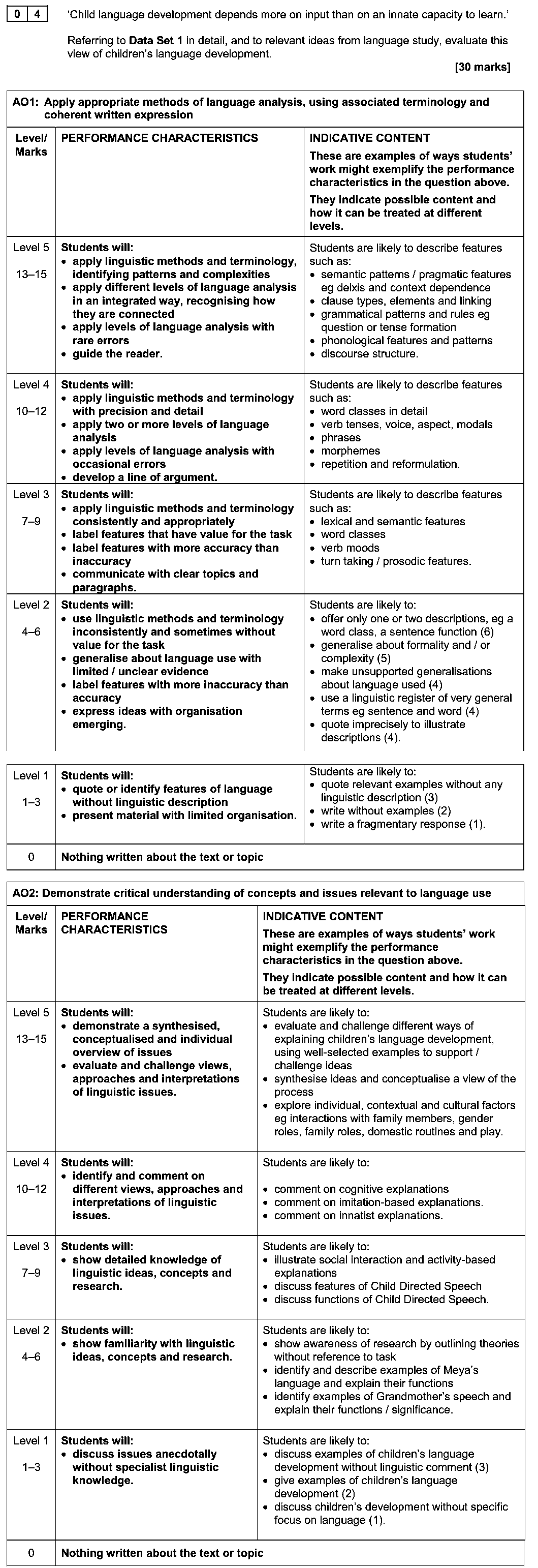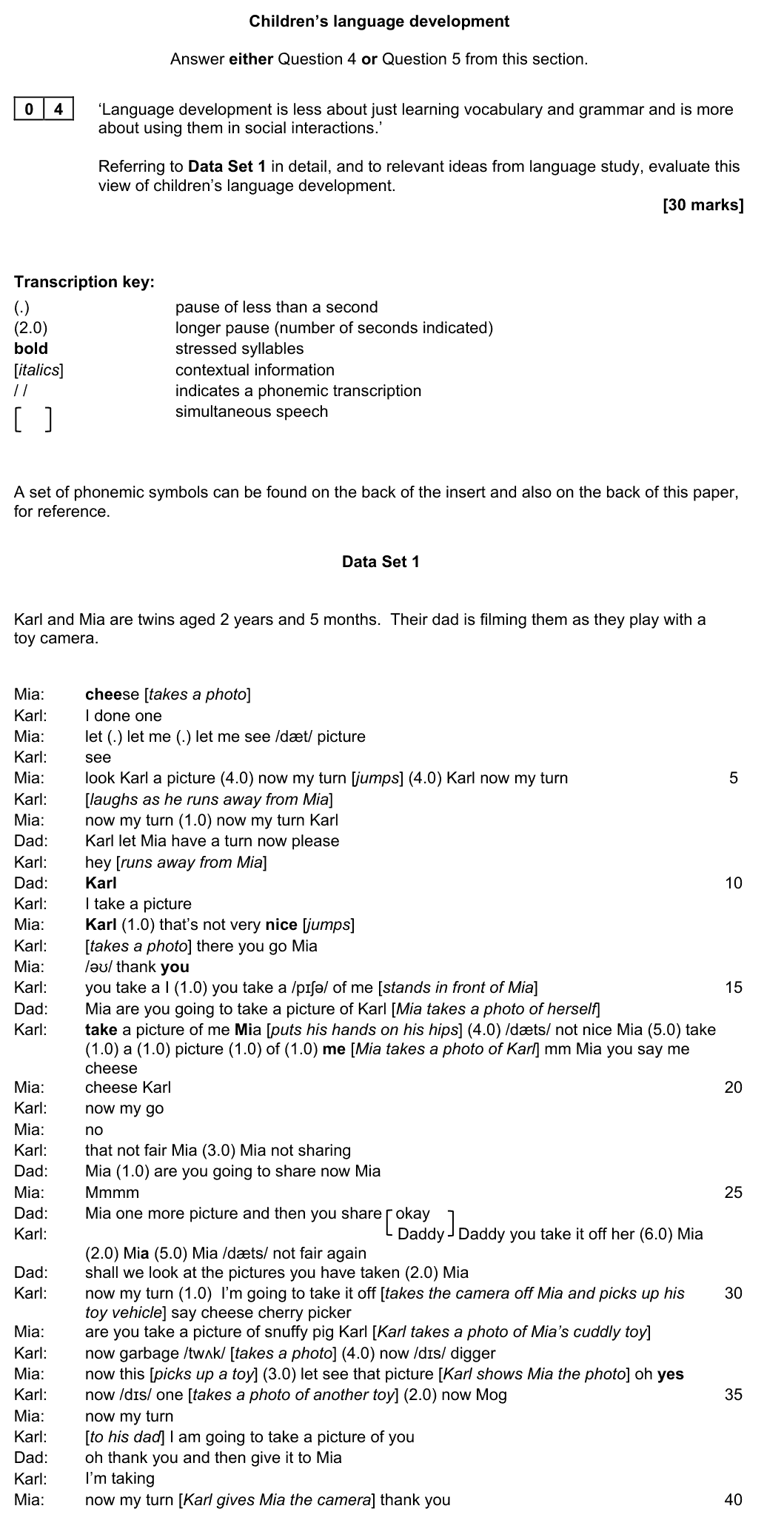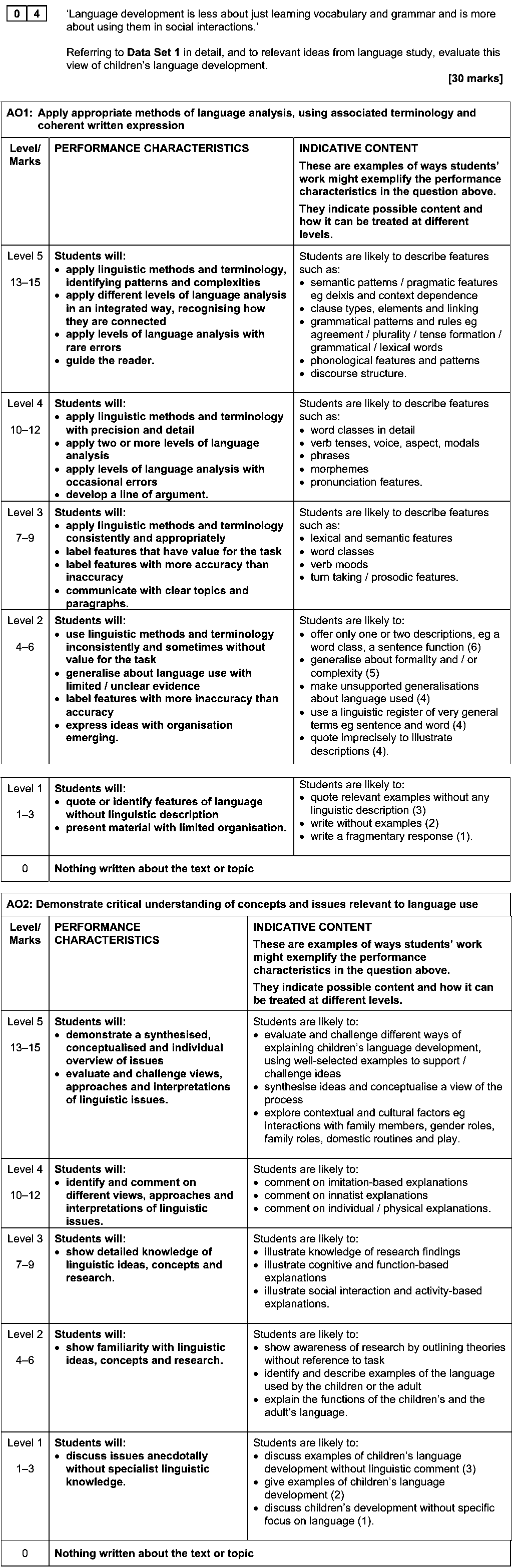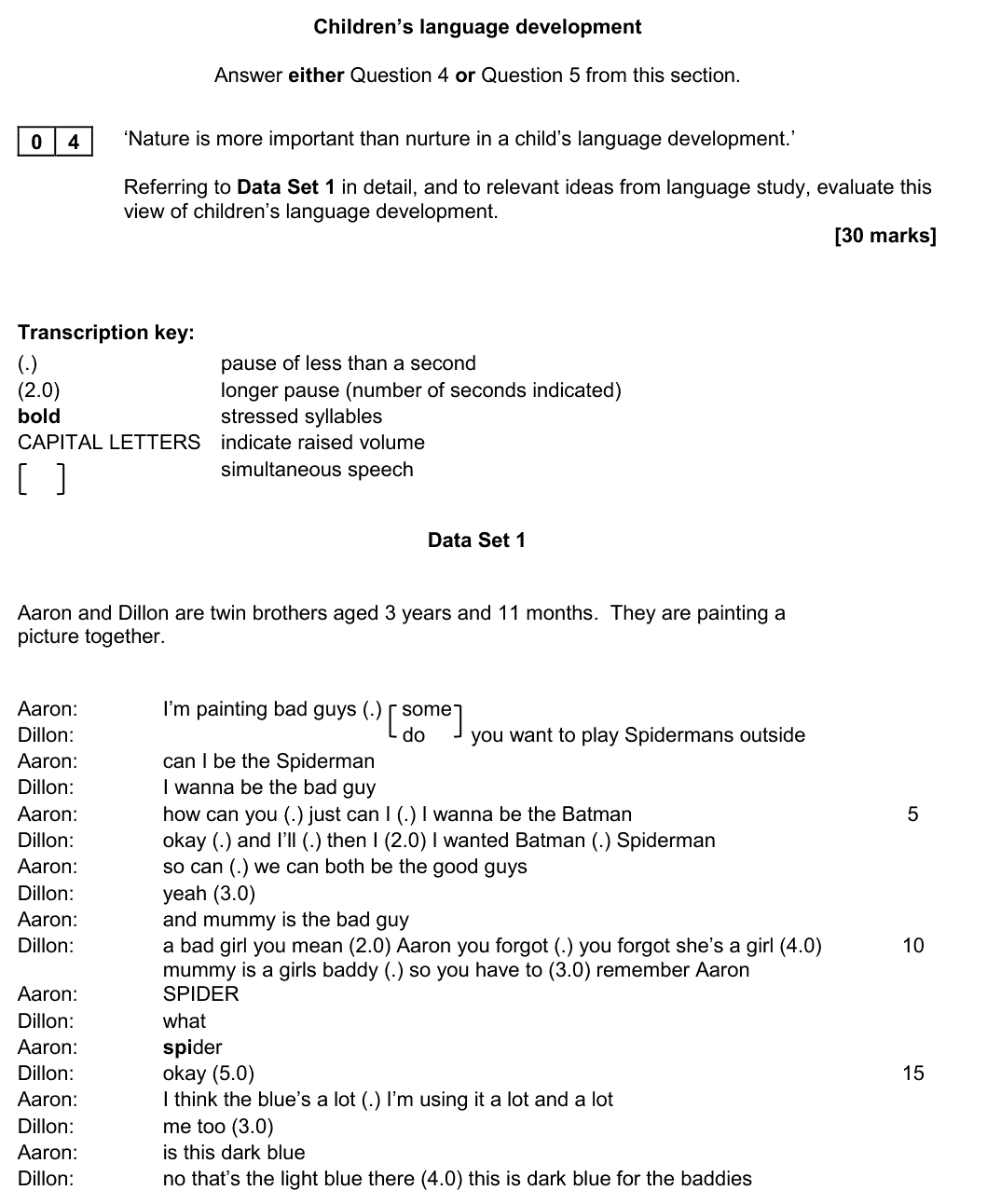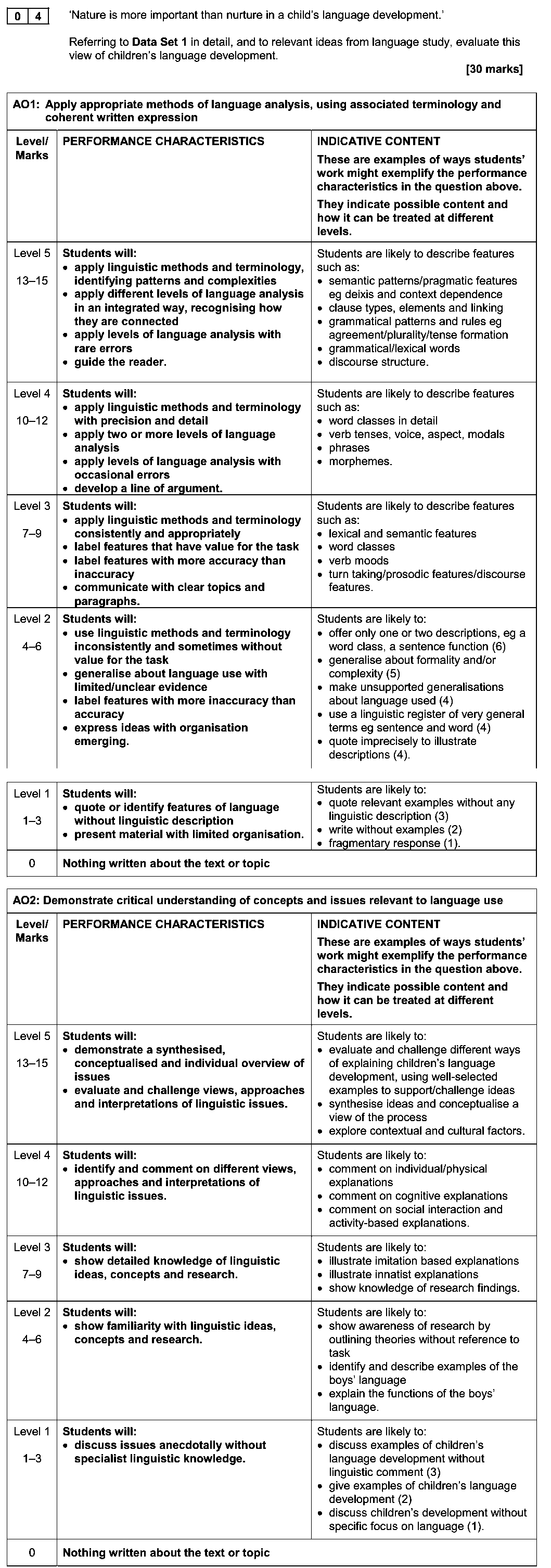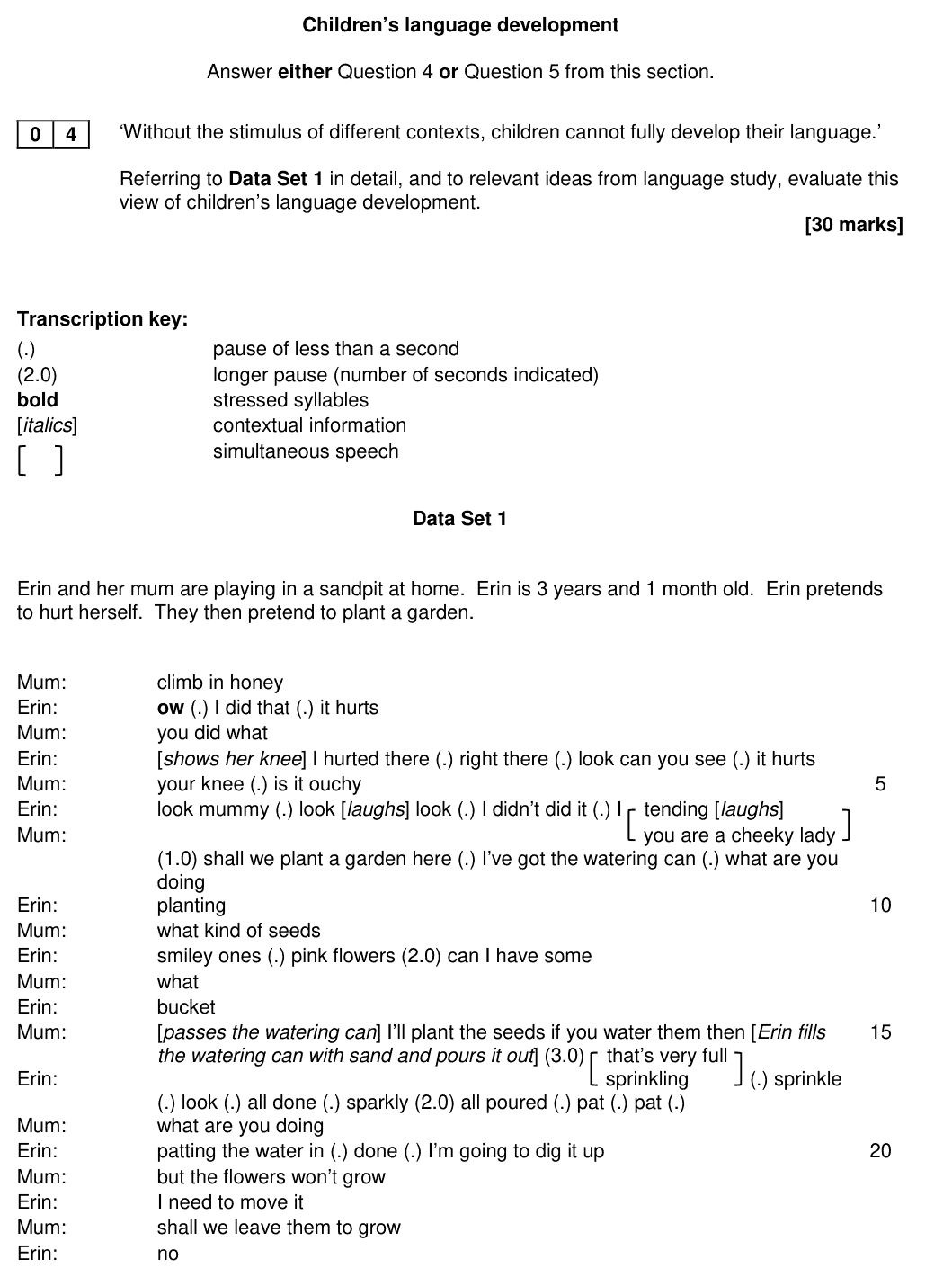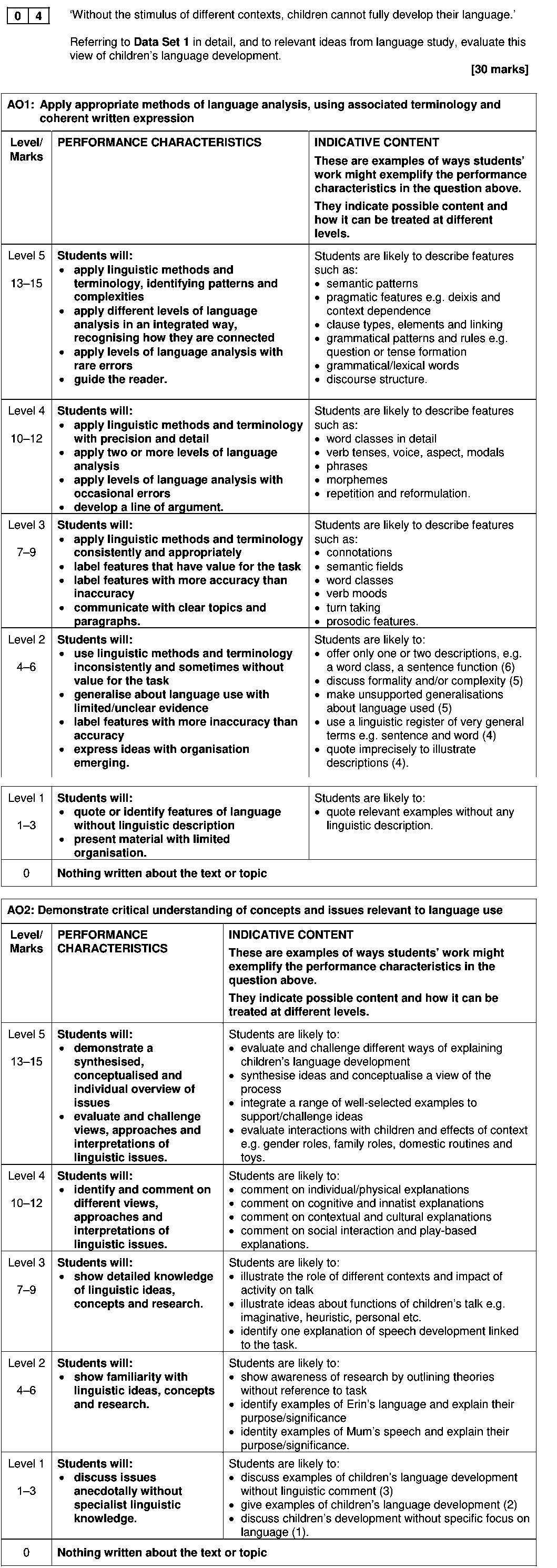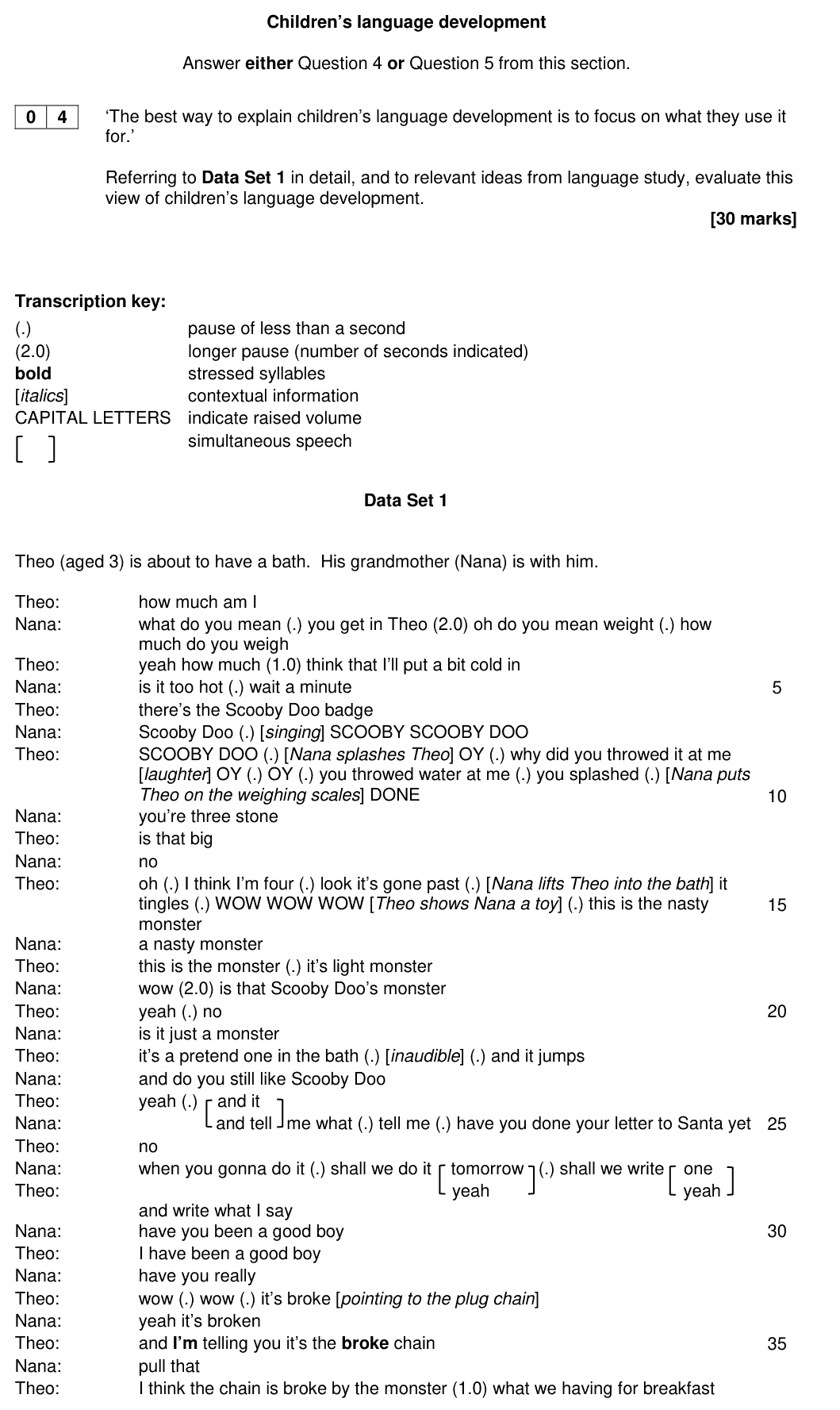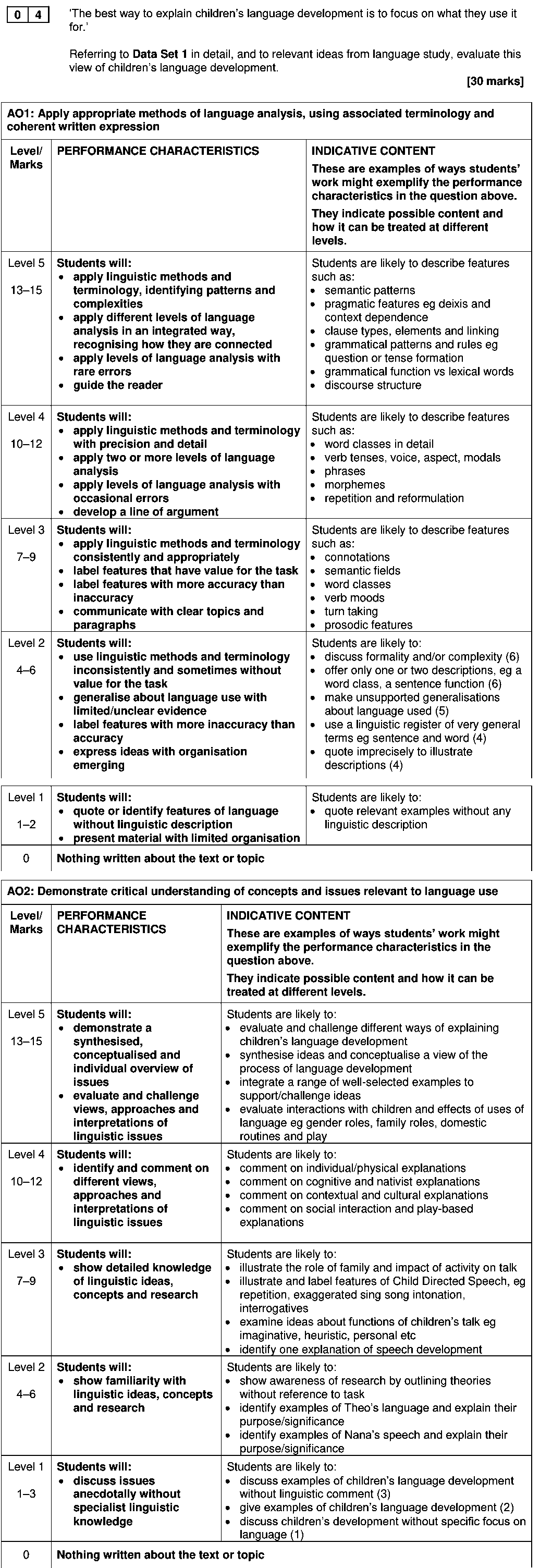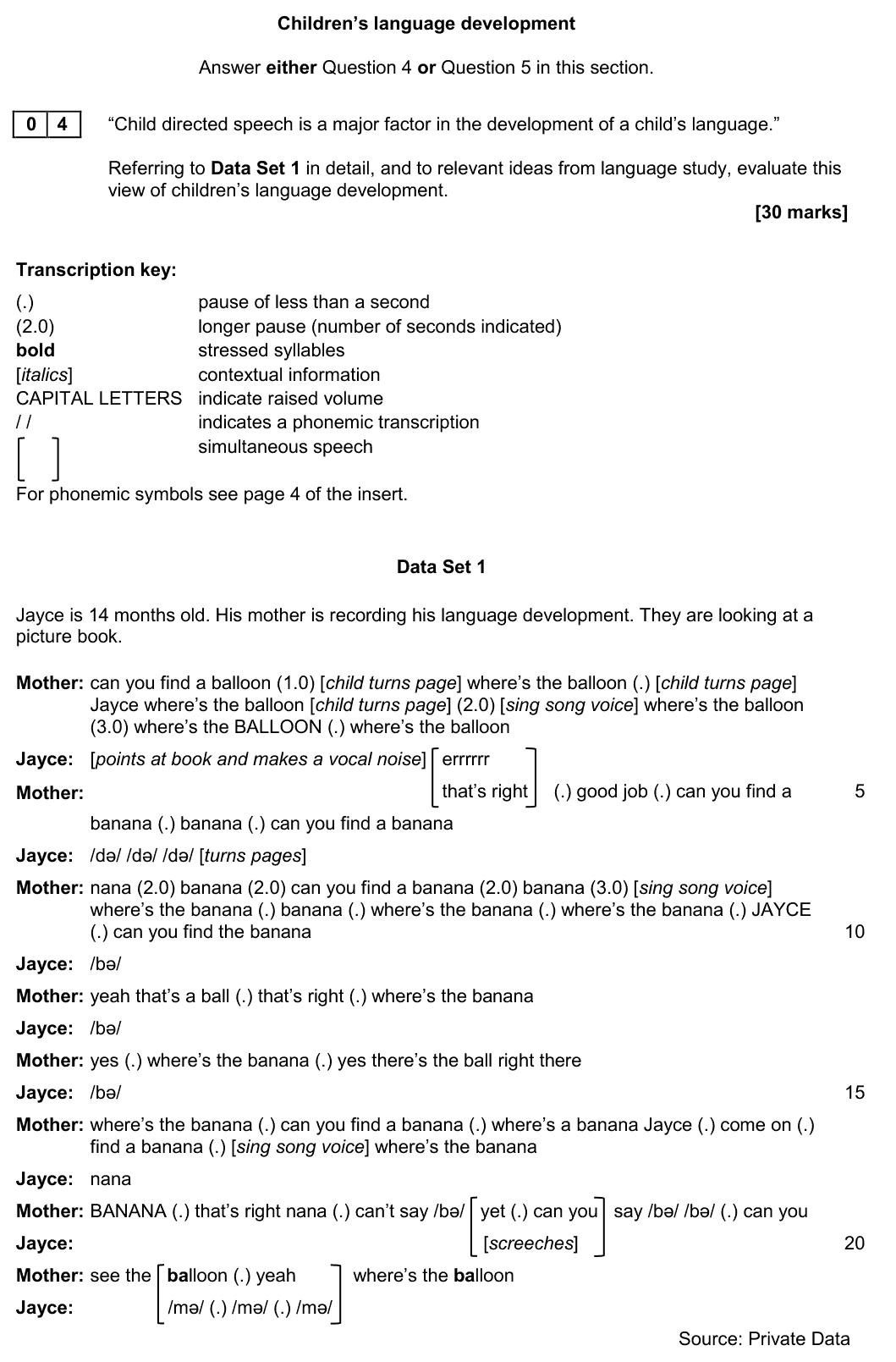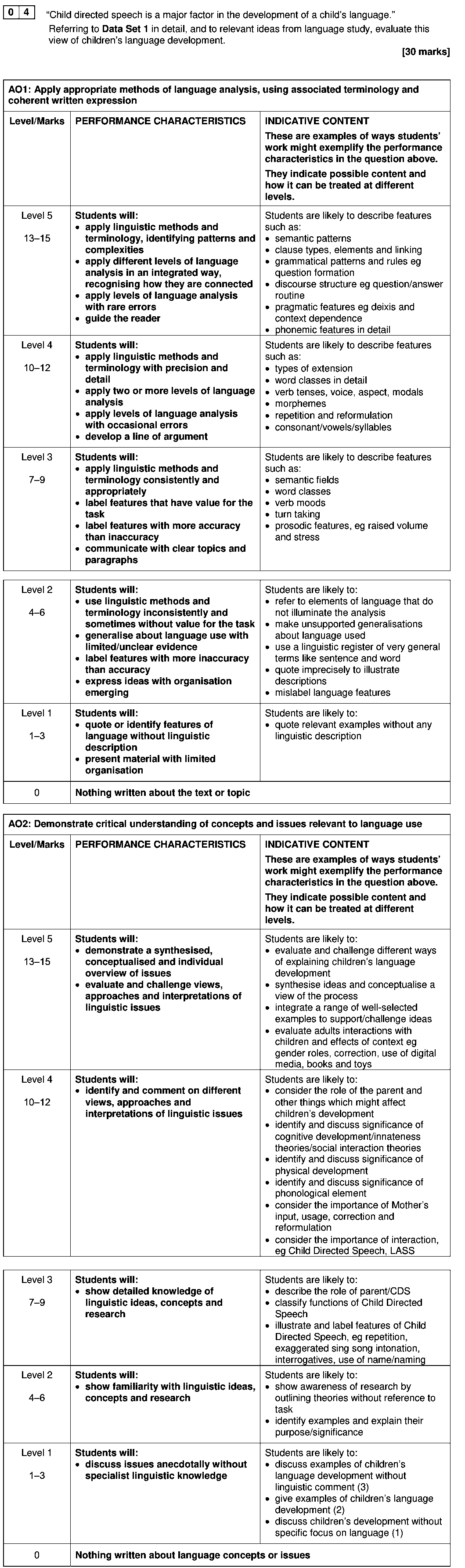
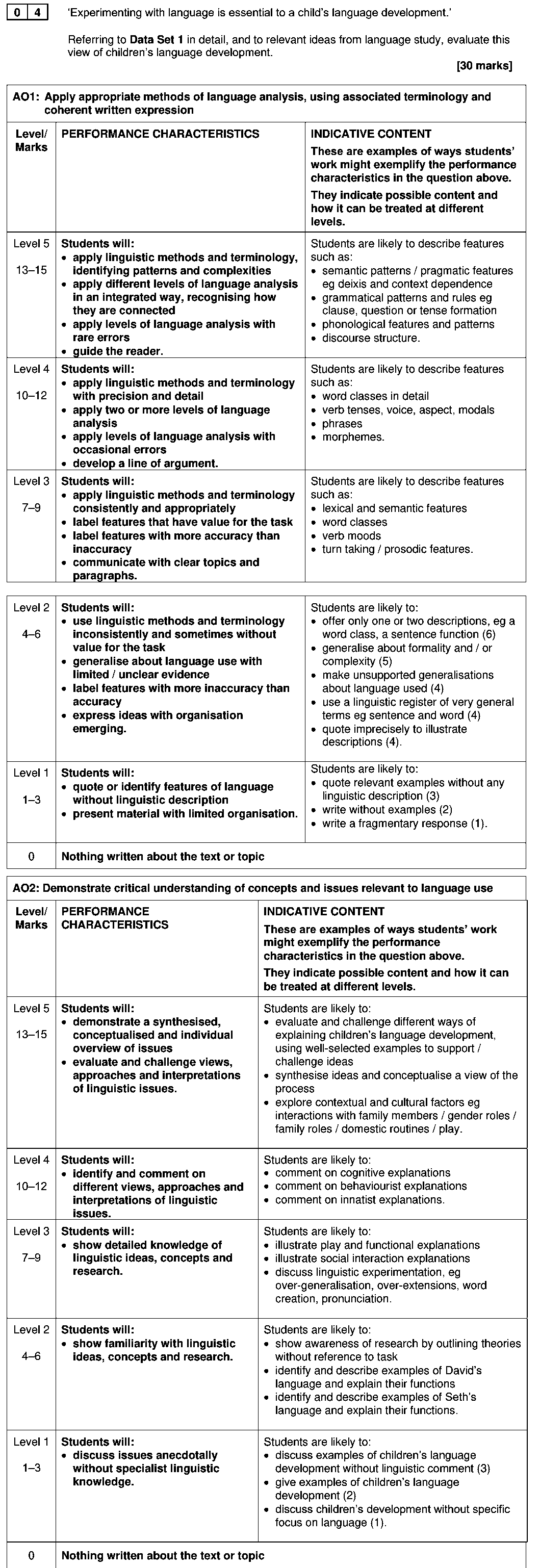
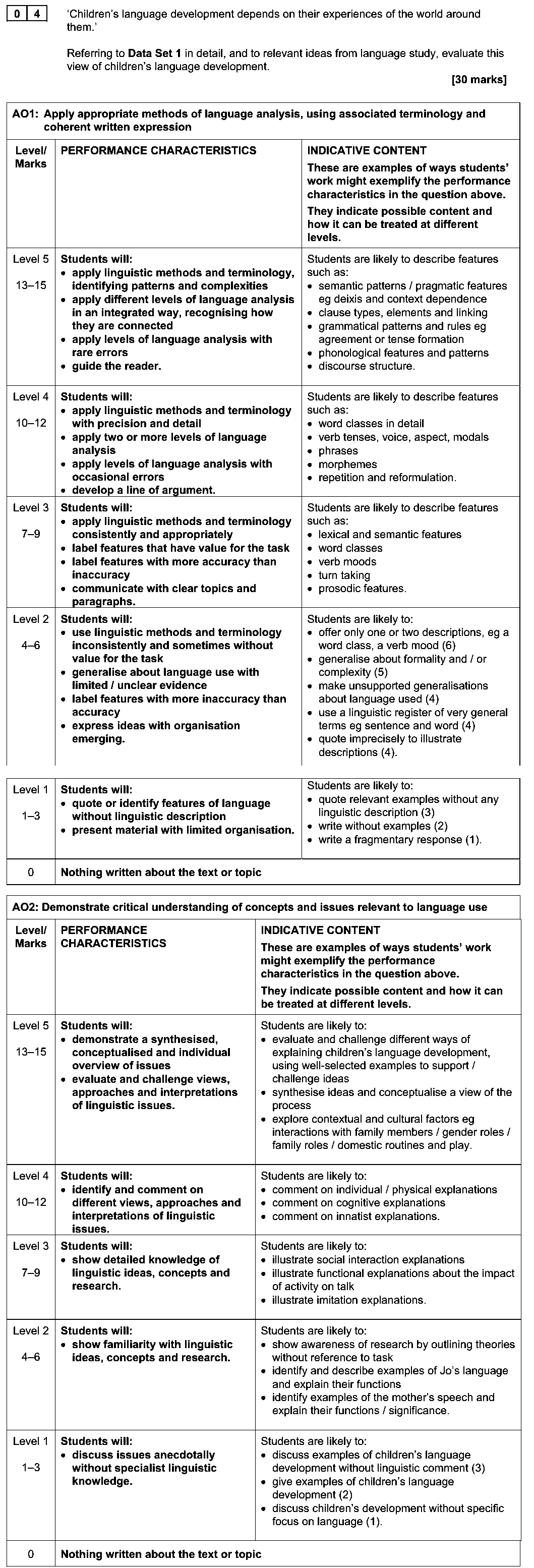
Mark scheme, including the levels and indicative content
Examiner's comment
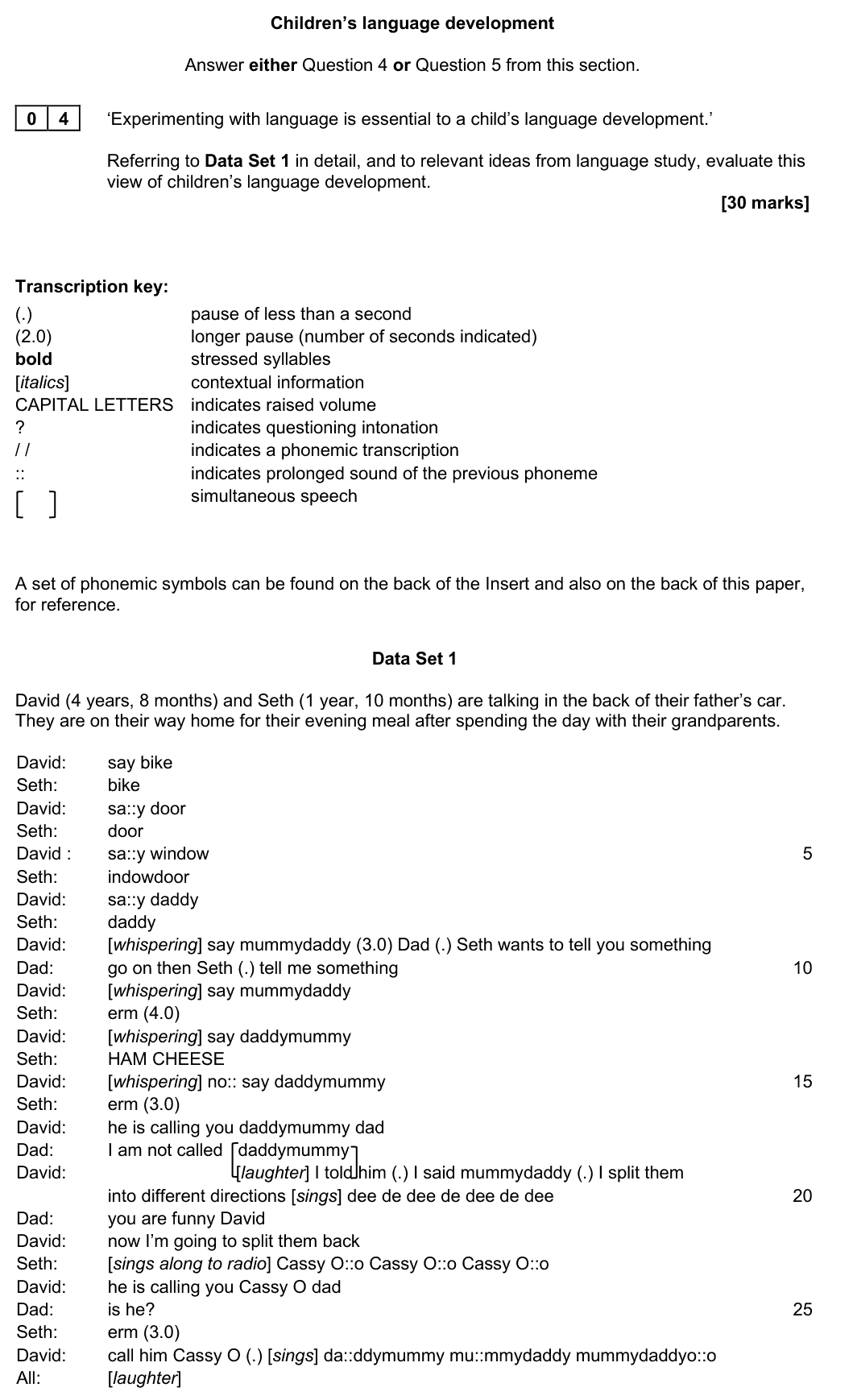
‘Experimenting with language is essential to a child’s language development.’ Referring to Data Set 1 in detail, and to relevant ideas from language study, evaluate this view of children’s language development. Data Set 1: David (4 years, 8 months) and Seth (1 year, 10 months) are talking in the back of their father’s car. They are on their way home for their evening meal after spending the day with their grandparents. How students did well Students did well when they: • made close reference to a range of features, mainly adjacency pairs, imperatives, types of nouns and prosody. • labelled structural patterns of the interaction, such as the use of imperatives, linking these to David’s role in leading the discussion and resulting in the subsequent pattern of Seth’s use of concrete nouns. • discussion of verb + object patterns, sometimes linked to Brown’s classification of syntactic structures. • referred to examples of simple structures as illustrative of child directed speech strategies. • provided some detailed description of phonological features. • demonstrated secure knowledge of a range of theories and research. • were able to discuss ideas about social interaction and the role of the more knowledgeable other, whether that was David or Dad. • addressed Behaviourist views in some detail, with clear reference to imitation and reinforcement. • referenced Chomsky and discussed ideas about Universal Grammar. • took examples from outside the data, such as reference to Berko-Gleason’s study. • engaged with strategies to shape Seth’s schema. • addressed ideas about cognitive stages of development or object permanence • discussed Seth’s use of ‘indowdoor’ as illustrating affixation and morphological structures. • referred to Tomasello and engaged with ideas about intention-reading and pattern- finding. • engaged with the nature of experimentation, seeing it as a factor of play and evaluating its pragmatic function. How students did less well Students did less well when they: • struggled to engage with the focus on experimentation, showing less certainty with the application of relevant theory. • provided detailed accounts of learned theory, discussing ideas surrounding nature and nurture, thus losing focus on the actual question. • tended to drift from the data set, with minimal focus on the exchange between David, Seth and their father. • attempted to apply innatist views, but not always successfully, such as describing aspects of Seth’s language as featuring virtuous errors. • noted cognitive development but did not discuss it in detail.
Notes from the mark scheme and report
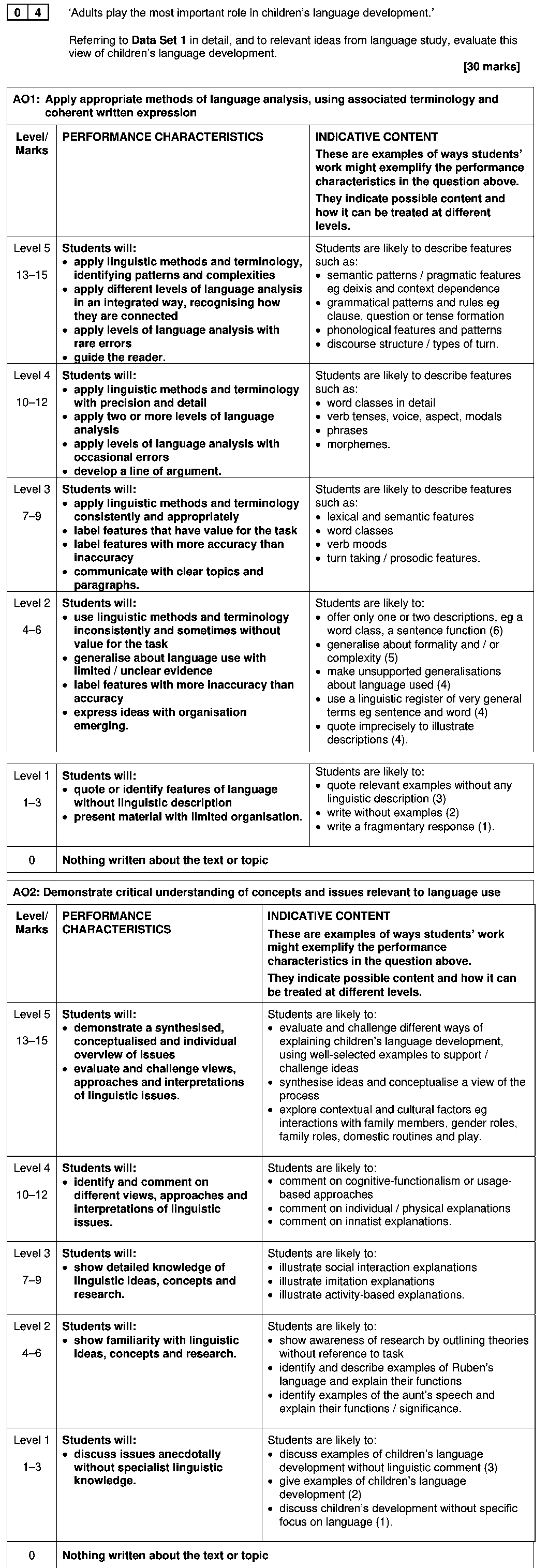
- AO1 15 + AO2 15
- must refer to Data Set 1 in detail and evaluate 'experimenting'
- credited: adjacency pairs, imperatives, concrete nouns, prosody, 'indowdoor' as morphological play, CDS, MKO, behaviourism, Chomsky, Tomasello, Berko-Gleason
- weaker answers wrote a pre-planned nature vs nurture essay, drifted from the data or misused 'virtuous errors'
- Section B answers had less linguistic description than Section A
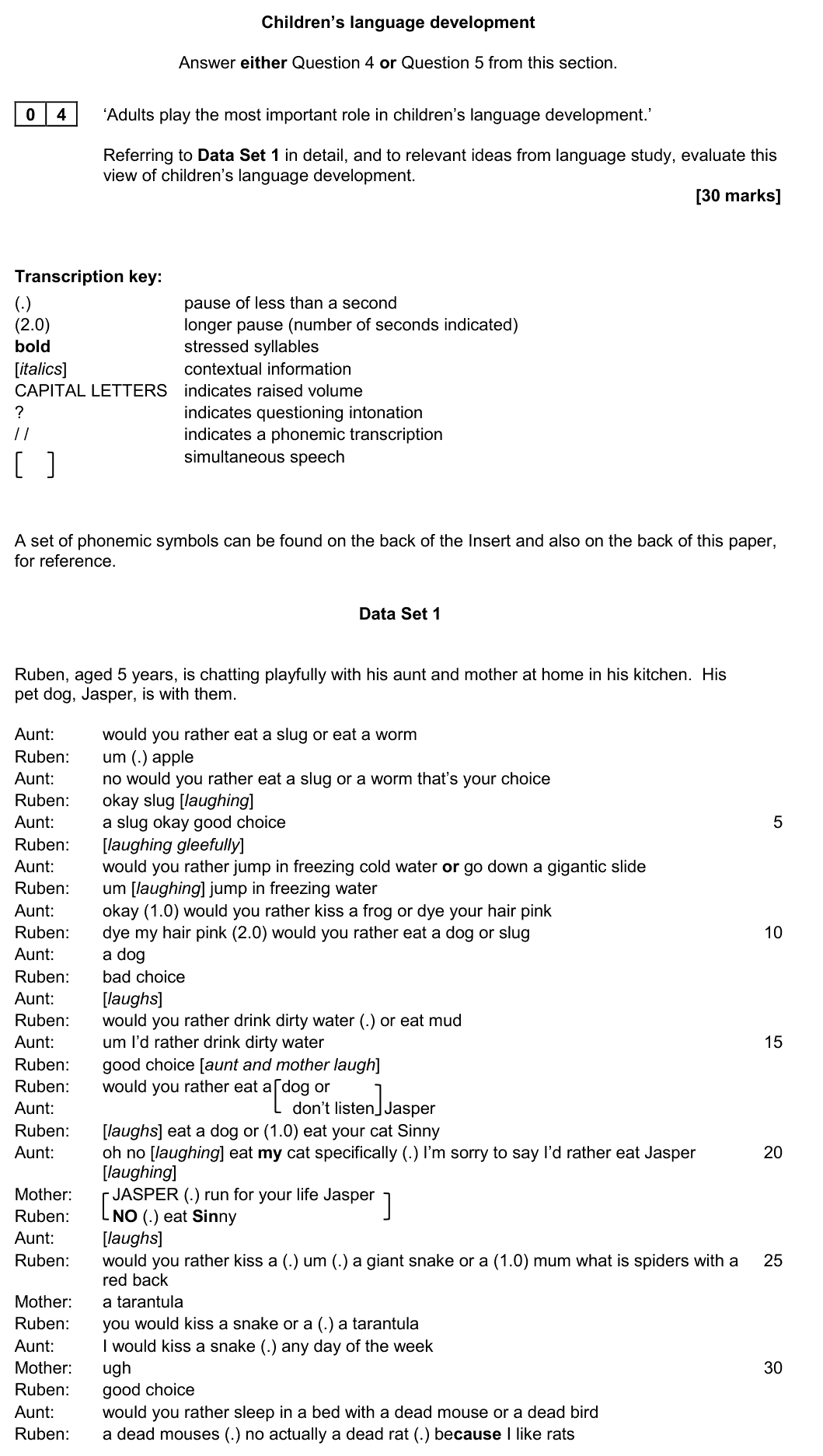
- Texts/data: Spoken: David (4;8) and Seth (1;10) playing a 'say...' repetition game in the car
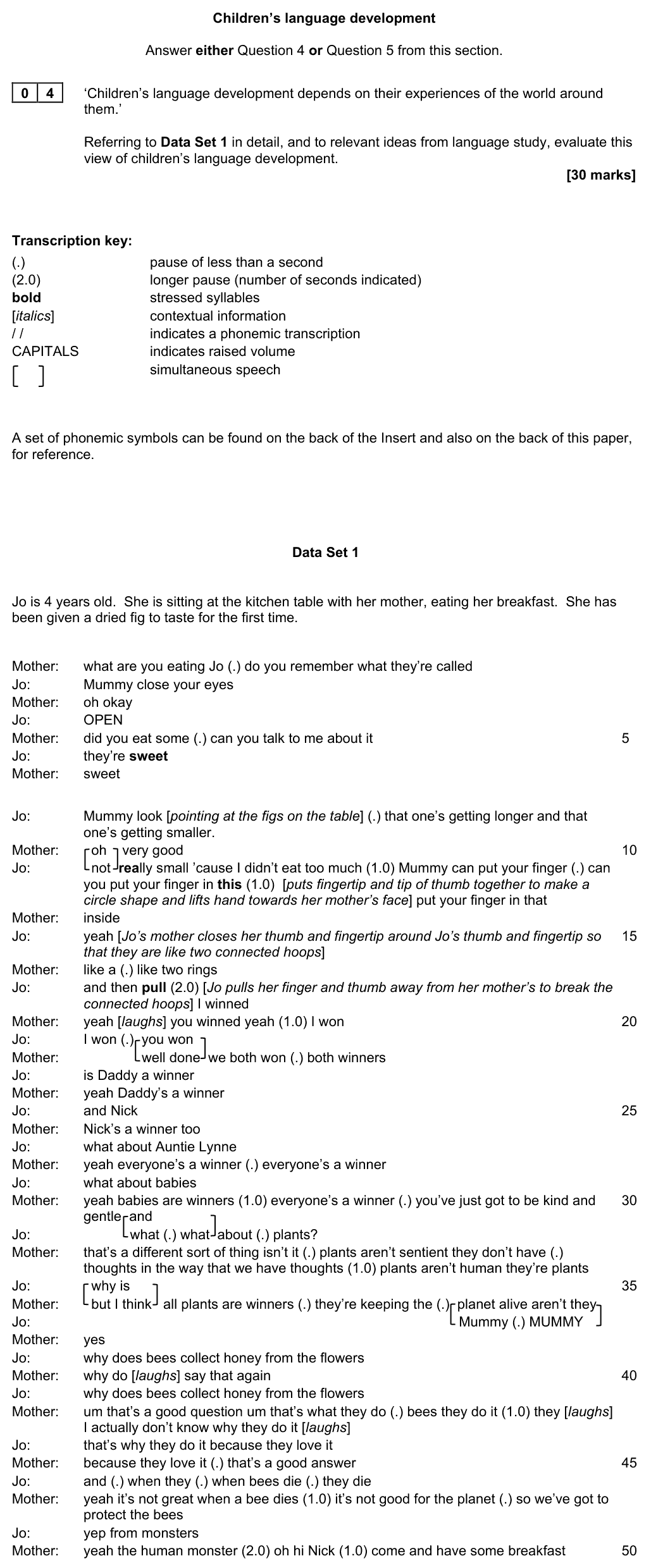
 thank you (.) [adds
piece to puzzle] there (3.0) now where’s the mouse’s nose (1.0) LOOK Meya (.)
where’s the nose](/img/JUN22_77021/JUN22_77021_04.webp)