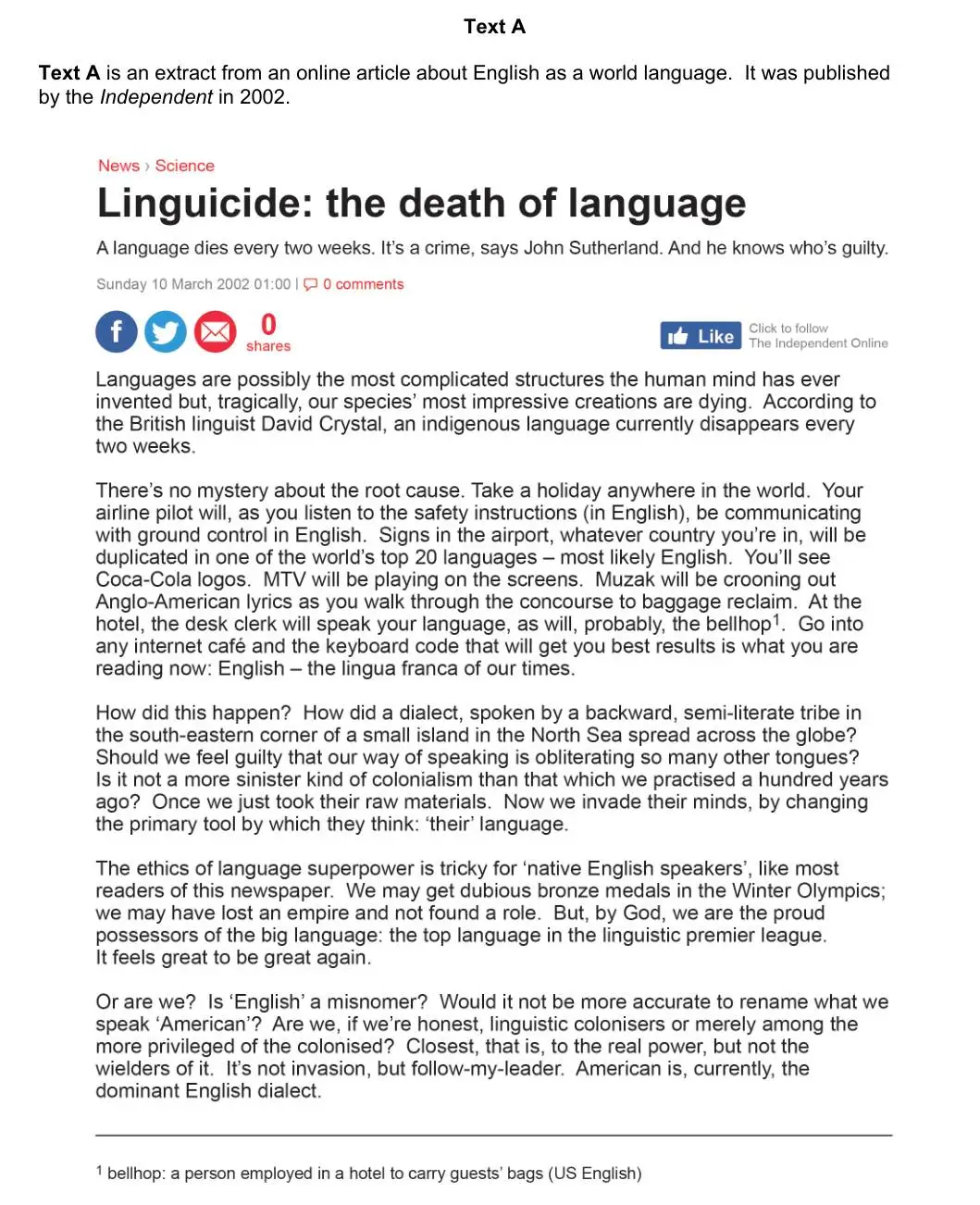
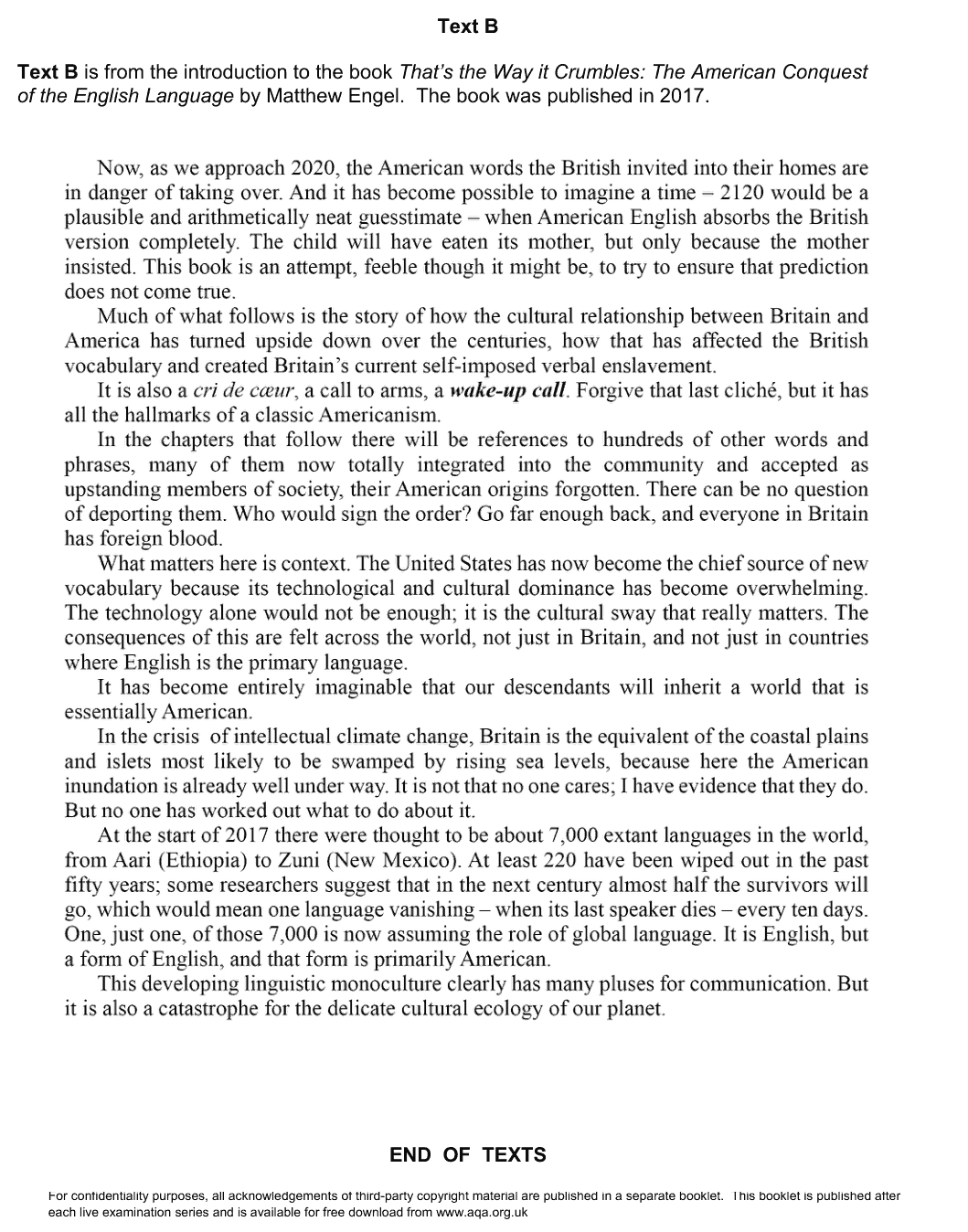
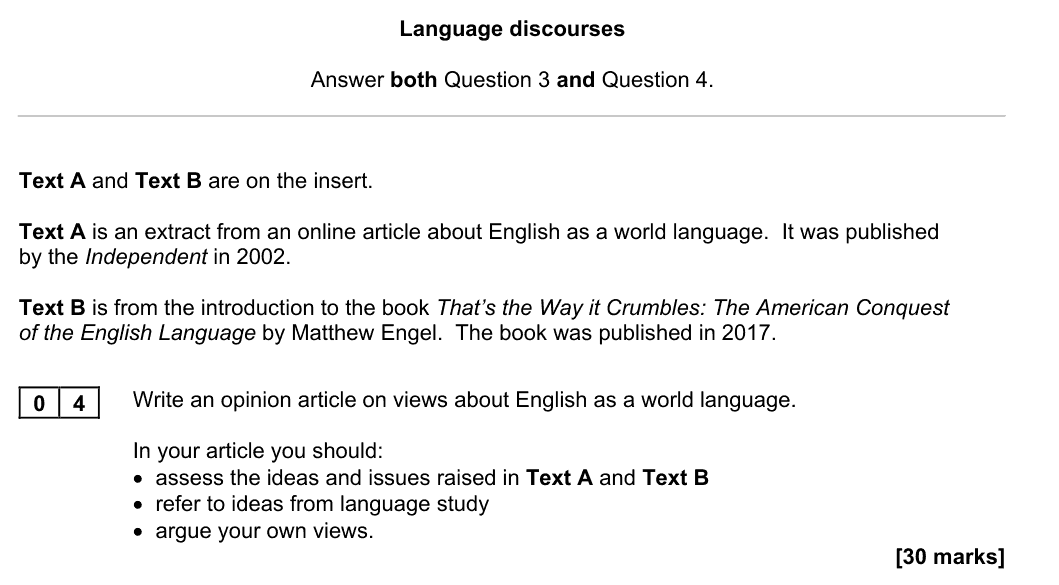
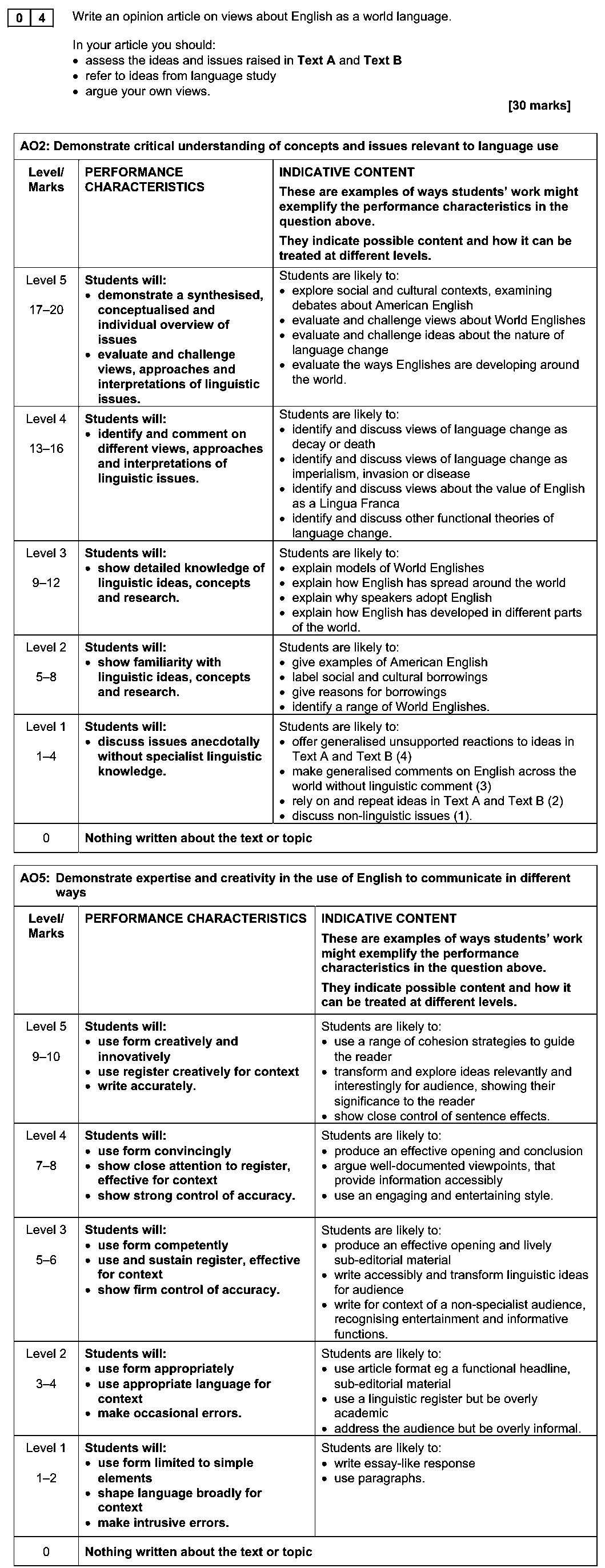
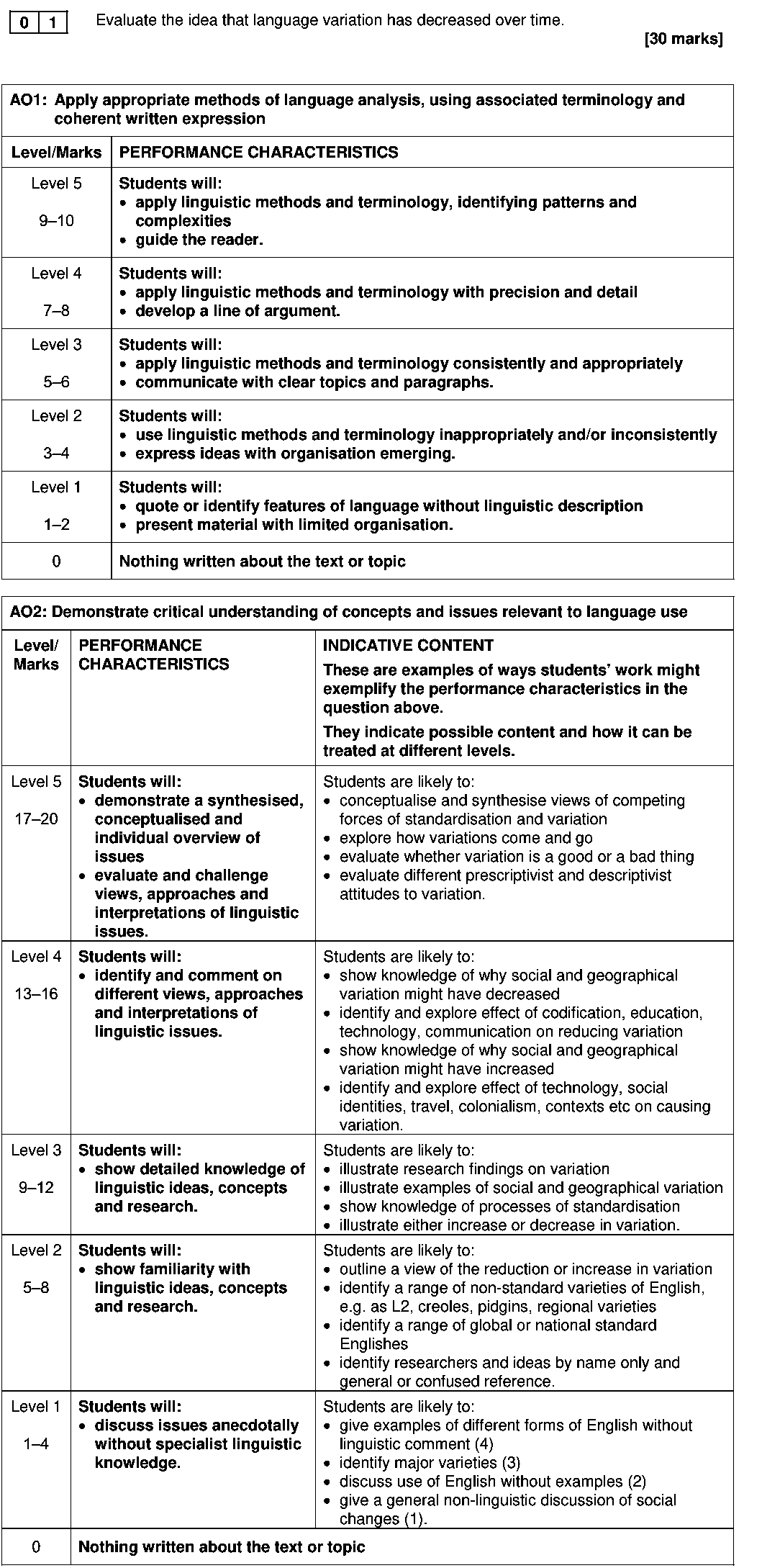
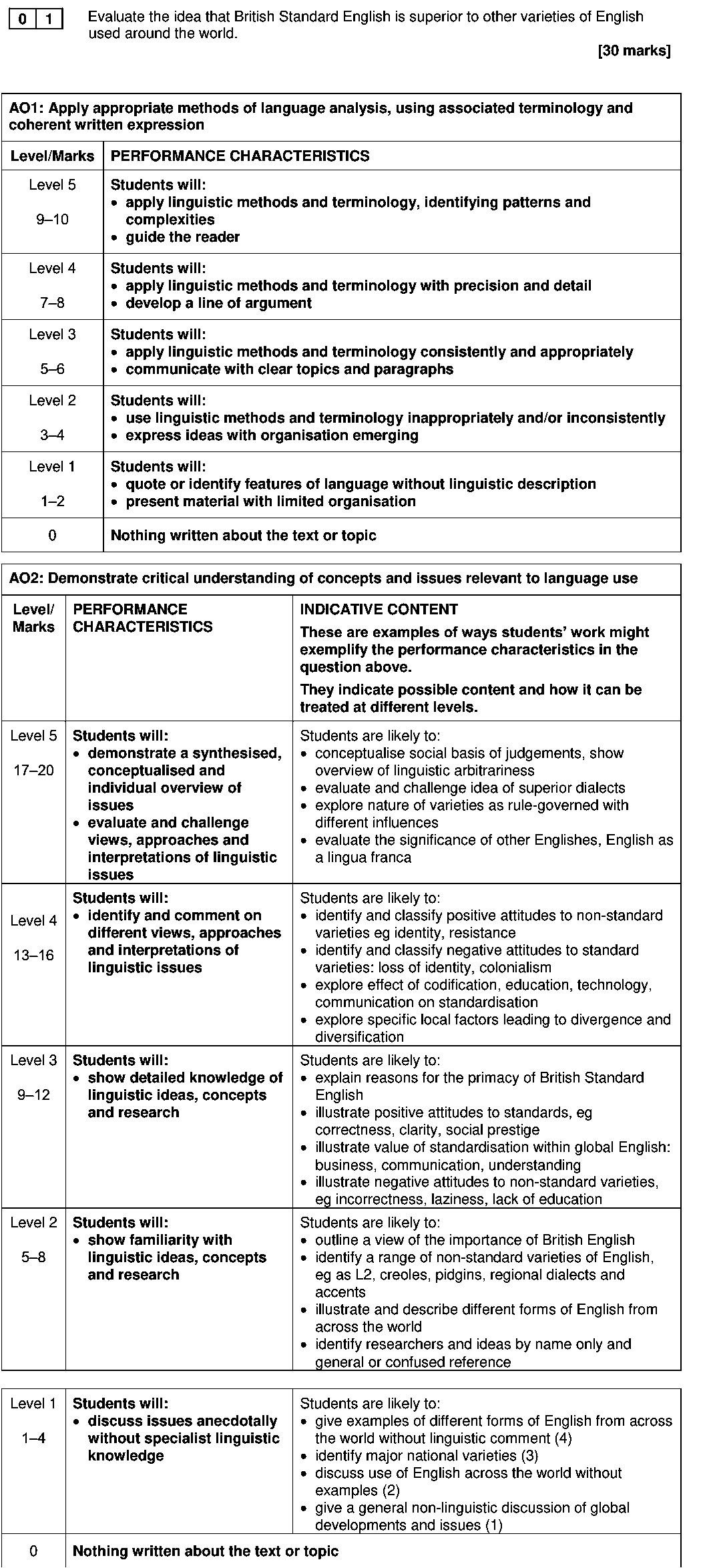
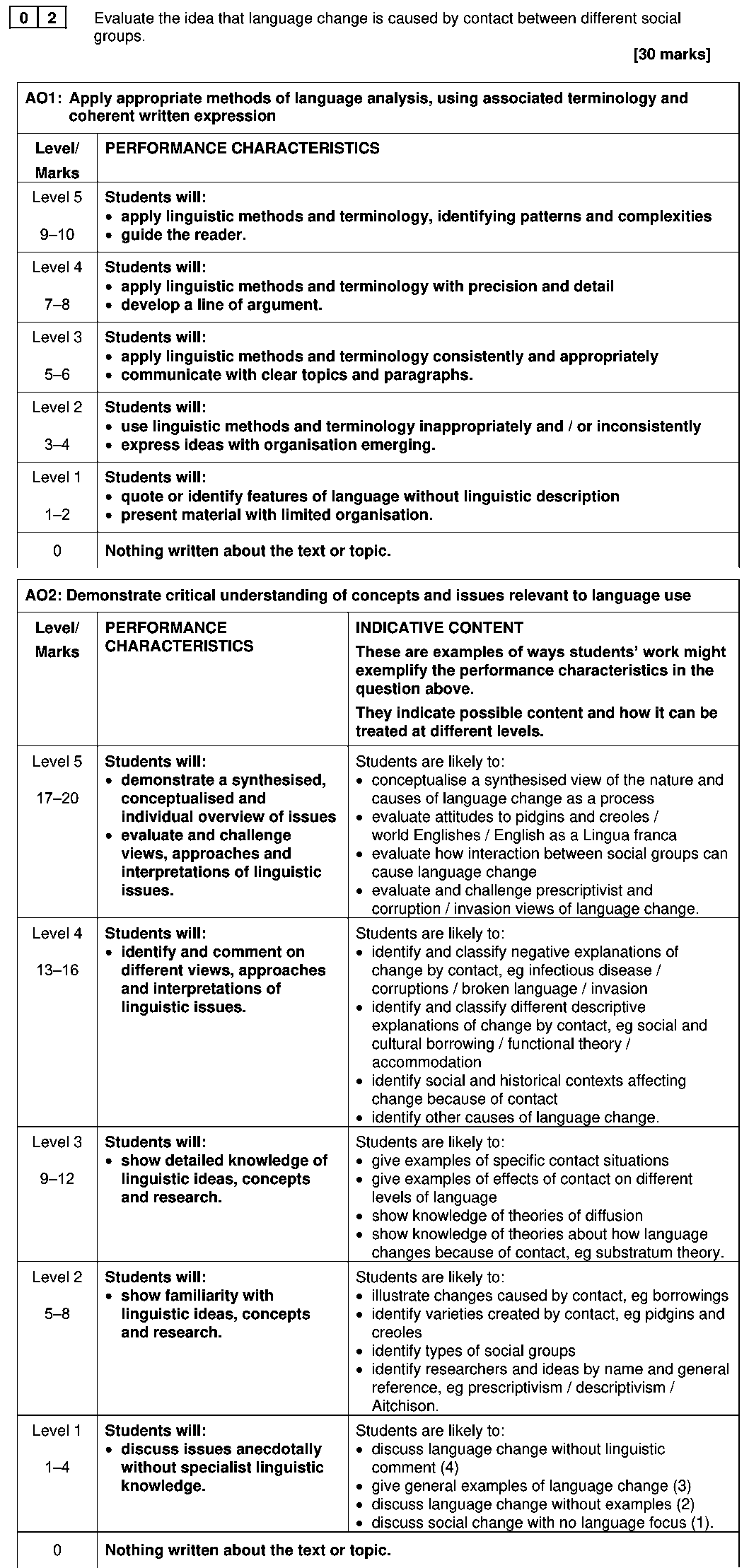
Mark scheme, including the levels and indicative content
Examiner's comment
Question 2 focussed on language change. Students were asked to evaluate the idea that language change is caused by contact between different social groups. (AO2). They then had to express their views in a coherent argument using linguistic terminology (AO1). A major discriminator was whether students could identify diachronic changes caused by contact and other factors as opposed to identifying synchronic variation caused by group membership. Weaker answers tended to discuss the language associated with different social groups without engaging with the ideas of contact or change. Many students were able to give examples of contact situations and the effects they had on language. They were also usually able to discuss other causes of language change. They could also discuss different views and explanations of language change. A minority of students were able to evaluate and challenge different views of language change caused by contact between social groups. Many answers relied on pre-prepared discussions of Ives’ Bradford study, Eckert’s Jocks and Burnouts work and Labov’s Martha’s Vineyard findings. These often enabled students to discuss variation but weren’t used to discuss how variation might lead to change. Multi-Cultural London English was a productive focus for many. There was impressive knowledge of the social changes underlying its emergence, the linguistic innovations created, research by Sue Fox et al and the idea of a feature pool. Pidgins and Creoles were relatively rarely discussed. Answers that did examine them often engaged with the racist assumptions that drove many judgements of such varieties and showed an impressive grasp of the social, historical and ideological contexts of the development of such languages. Another relatively rare area of content was world or global Englishes. Where students did consider this area, Singapore was often used as a case study and the emergence and treatment of Singlish gave lots of opportunities to explore the complexities of the colonial contact between language groups and the post-colonial legacy. More successful answers: • identified the view offered in the question as only one aspect of how language change occurs • demonstrated a synthesised overview of the competing forces and agencies driving change • examined different types of social group and contact situations: invasion, colonialism, trade, travel, immigration • examined cultural transmission and sub-stratum explanations of language change and evaluated changes caused and the attitudes to them • discussed how new technology enabled more contact between different social groups and increased the speed by which language changes might spread • examined the phenomenon of cultural borrowing to fill lexical gaps • explored how social borrowing occurred, reflecting the prestige of social groups that were borrowed from • examined whether the spread of Americanisms and US English could be seen as cultural imperialism • examined the process of dialect levelling in Milton Keynes • explored the emergence of Multicultural London English • showed detailed knowledge of the social and cultural context in London • made use of the concept of a feature pool • examined Crystal’s claims that as soon as English is spoken in a new area a new variety is created, often citing South African English examples of vocabulary • explored how Viking and Norman invasions affected the development of English • recognised how power and status affected the kinds of vocabulary that was affected • explored the formation of pidgins as contact languages • showed detailed knowledge of the characteristics of pidgins and gave specific examples • evaluated views of pidgins as broken grammar or baby talk • argued a case for pidgins as optimal communication systems • explored the social and historical connections of pidgins and the slave trade • explained the emergence of creole languages • evaluated views of creoles as corruptions of European languages, full of errors caused by laziness or lack of intelligence • located such views within racist discourses linked to the slave trade • examined in detail the influence of African languages on the development of creoles in the Caribbean • evaluated debates about creoles in colonial and post-colonial contexts • used Singlish as a case study to explore agencies of language change and the cultural contexts of attitudes to varieties that developed • illustrated Schneider’s dynamic model of world Englishes • examined the development of Polari as an anti-language designed to exclude other social groups and to foster in-group identity • characterised the process of change by using the Potential, Implementation, Diffusion and Codification model • contrasted ‘crumbling castle’ explanations that saw changes as corruptions or deviations with ideas about the evolution of language • contrasted ‘infectious disease’ explanations of change with wave models and looked at the receptiveness of some people to linguistic changes • countered ‘damp spoon’ attitudes to the formation of pidgins and creoles as broken Englishes caused by the laziness or lack of intellect of speakers with detailed explanation of the influence of other languages’ grammar • explored other causes of language changing, often synthesising a view of multiple forces at work simultaneously. • examined functional theory and the idea that language change is motivated by needs • frequently used texting and the effect of technology as a case study of other factors that affected language change, producing new vocabulary and conventions • discussed language reform projects as an influence of language change • examined random fluctuation theory. Less successful answers: • did not address the issues of contact and change • wrote generally about the varieties of language used by different social groups • were over-reliant on learned explanations of research, struggling to discuss these relevantly for the task • wrote about differences between women’s and men’s language • wrote at great length about Caxton, Lowth and Swift, often with limited pertinent discussion • offered pre-learned and well-rehearsed explanations of prescriptivism vs descriptivism with limited discussion of examples and the issues raised by the question.
Notes from the mark scheme and report
- AO1 10 + AO2 20
- top band synthesises causes of change, evaluates attitudes to pidgins, creoles, world Englishes and ELF, evaluates how group interaction causes change and challenges corruption/invasion views
- Level 4 classifies negative and descriptive explanations of contact change (borrowing, accommodation)
- ER: key discriminator was diachronic change from contact vs synchronic group variation
- MLE (Fox, feature pool) productive
- weaker answers recycled Ives, Eckert and Martha's Vineyard as variation only, wrote about gender, or gave long Caxton/Lowth/Swift histories
- Texts/data: Essay topic: whether language change is caused by contact between social groups