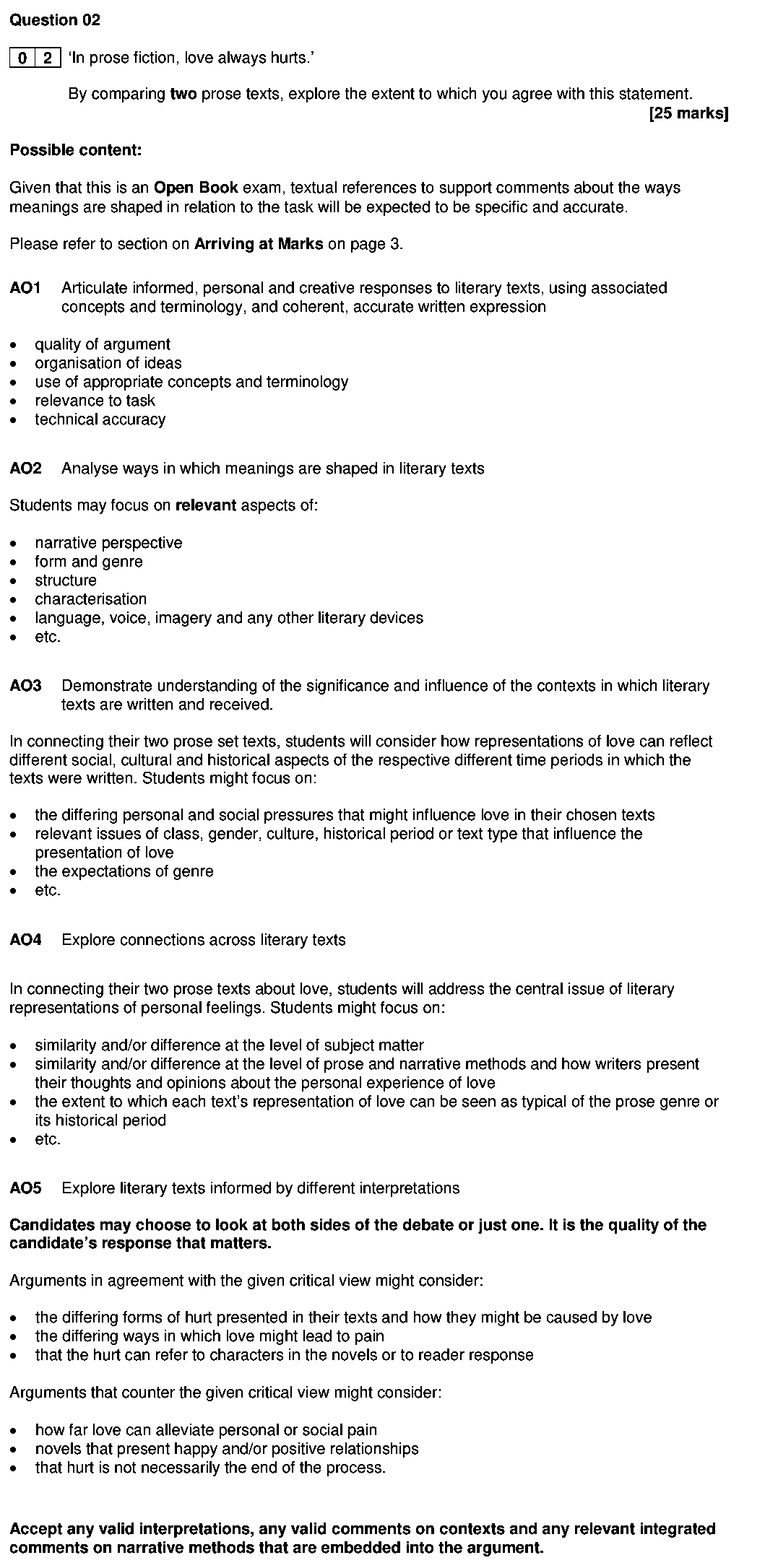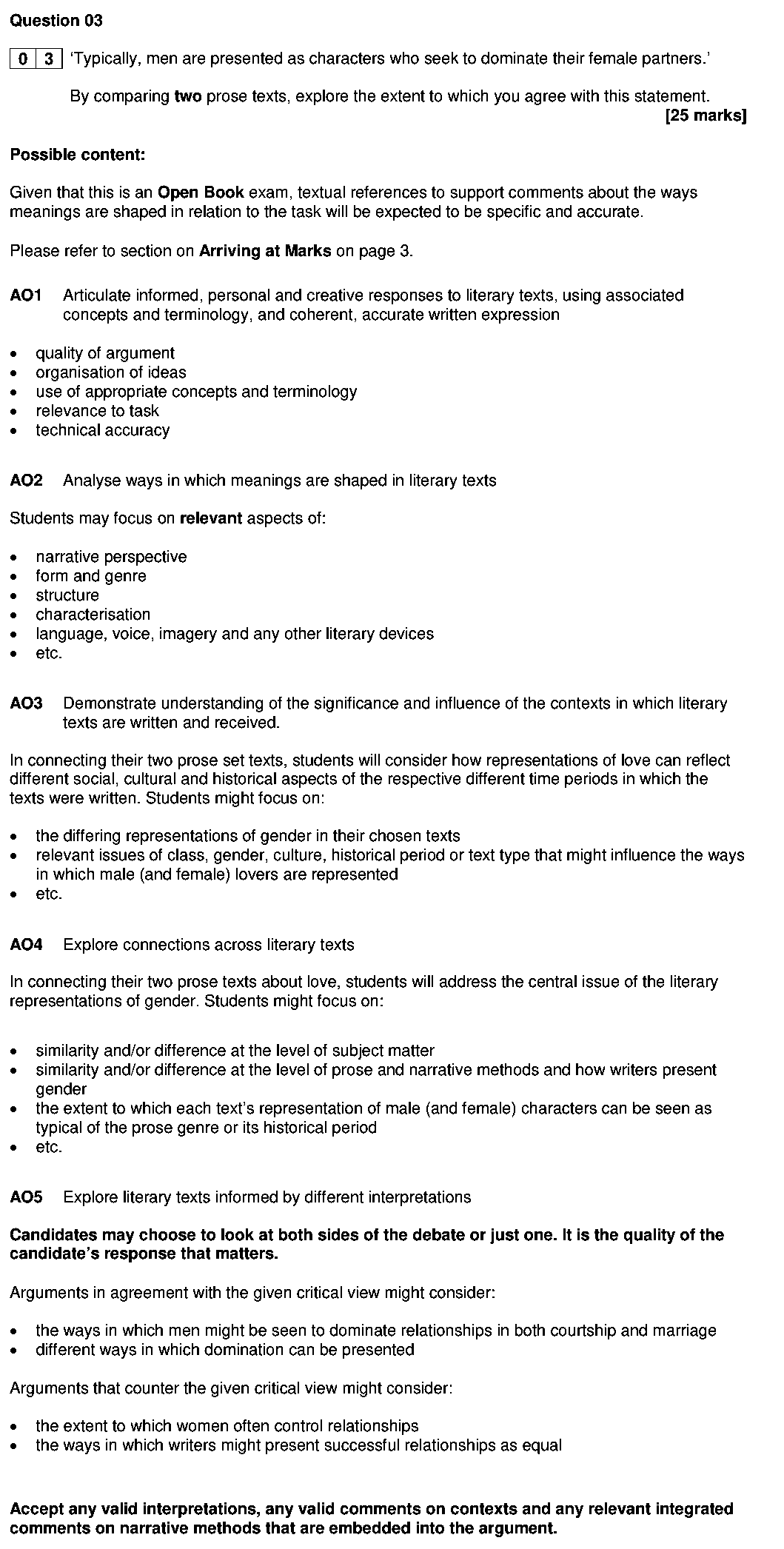
Mark scheme, including the levels and indicative content
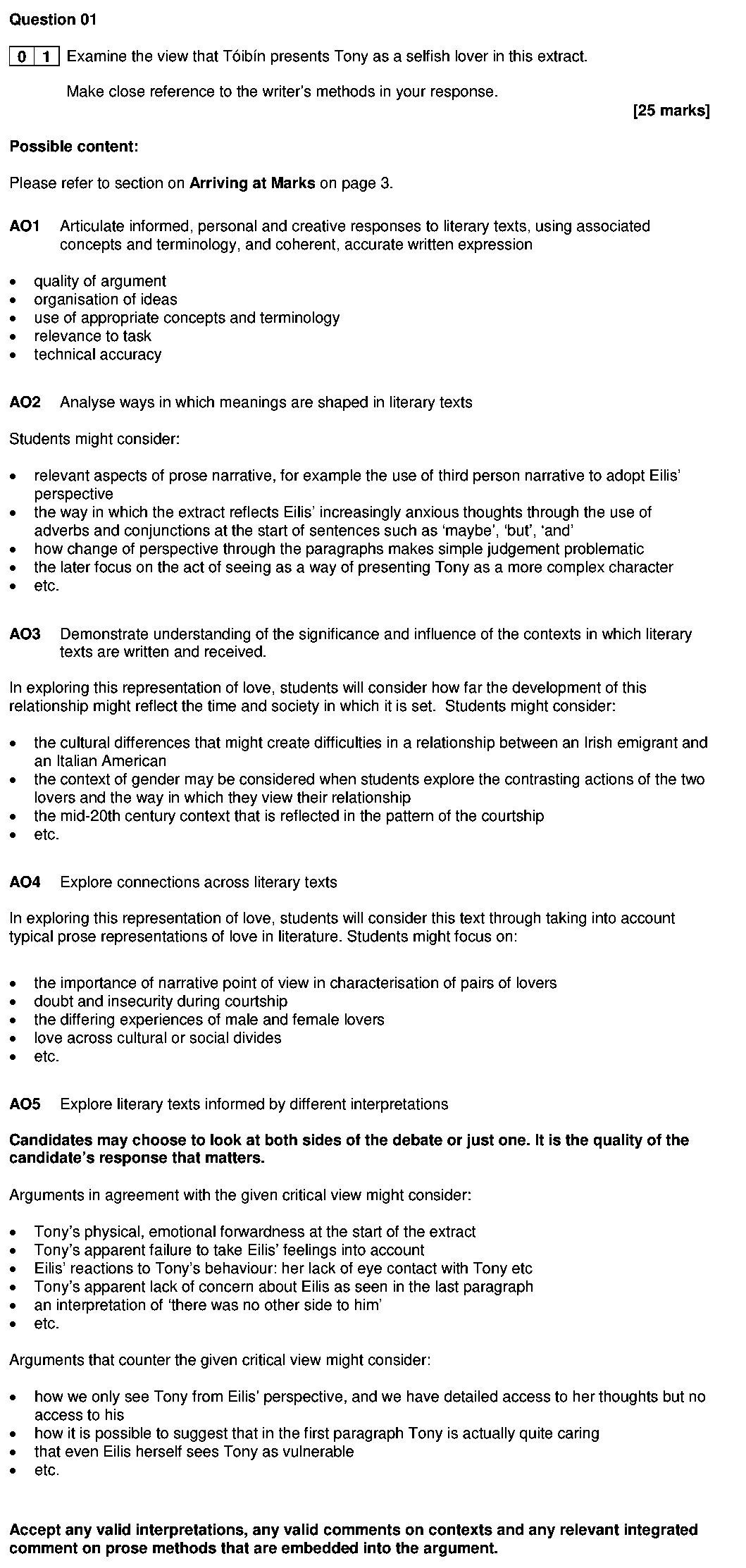
The general mark scheme (assessment objectives and bands)
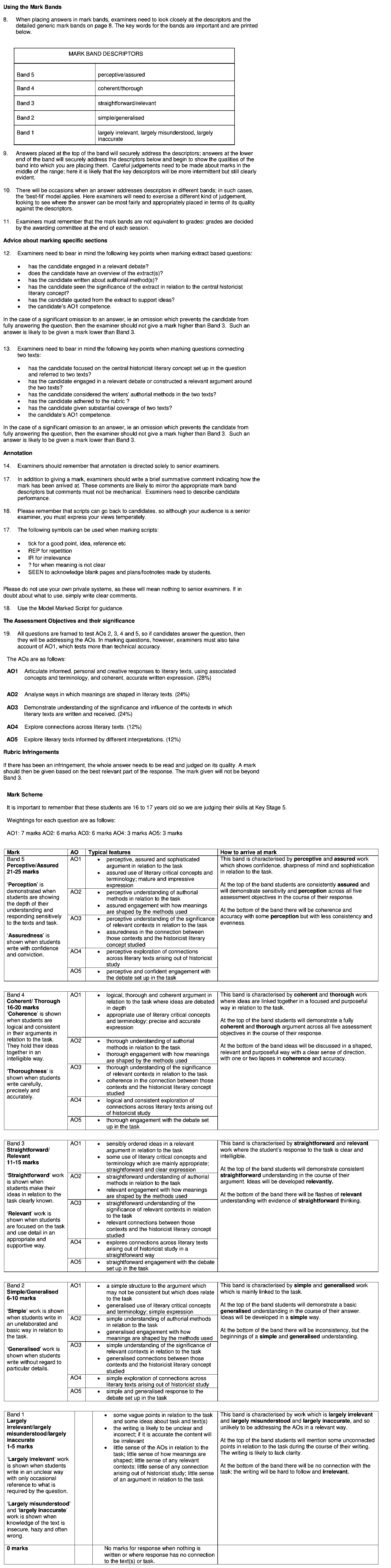
Examiner's comment
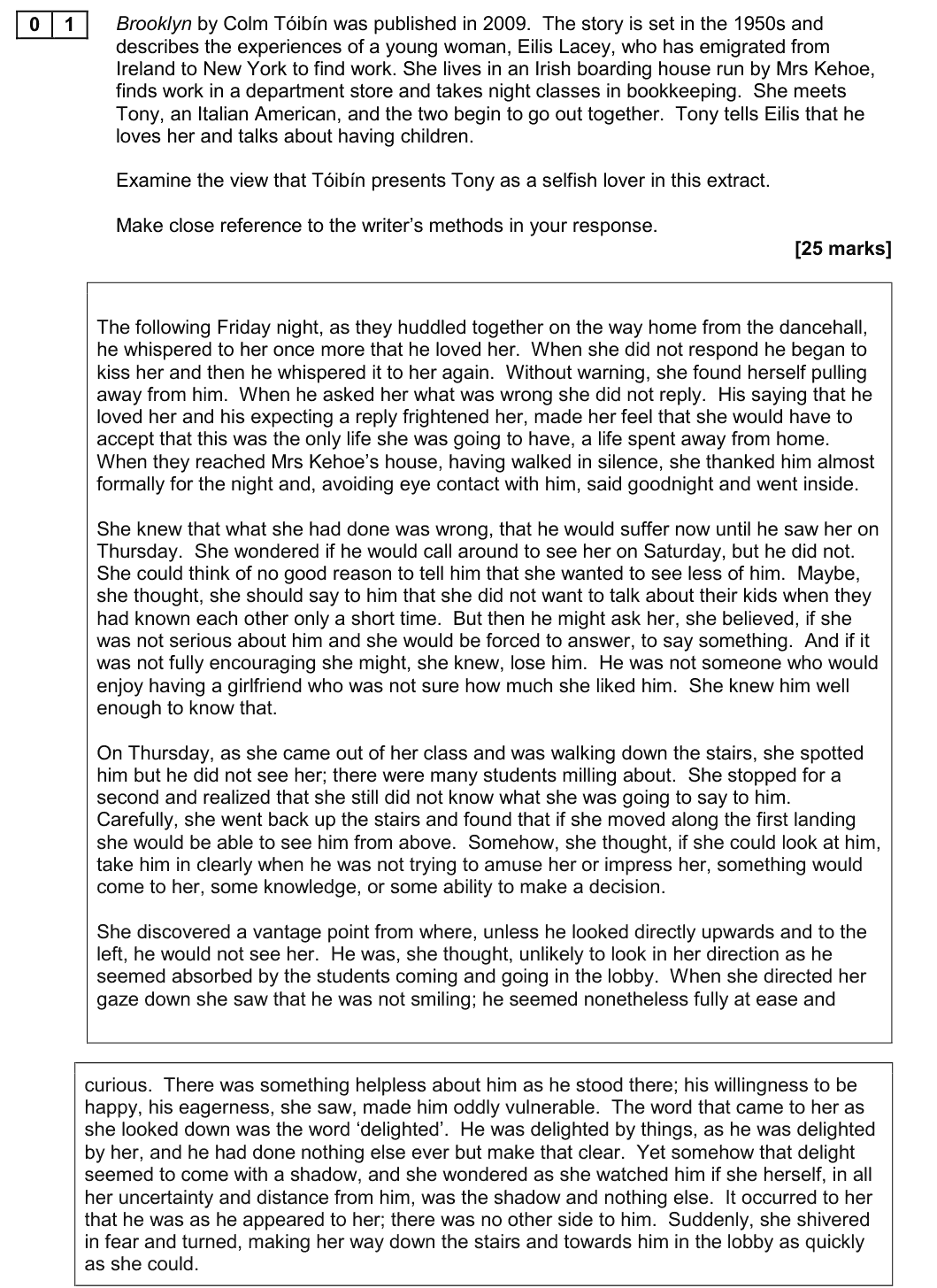
The structure of this question enables students to integrate their work in all assessment objectives by developing an autonomous reading of an unseen prose extract within the frame of a critical debate. Although brief, the preface offers important prompts that will suggest the contexts that could be discussed in more informed readings. The key command word ‘examine’ clearly guides the student to examine the extract through debating the critical view embedded in the task. The key word ‘presents’ also prompts students to consider how characters are constructed in prose texts rather than discussing them as surrogate, real people. Importantly, the third stem of Question 1 reminds the student that their reading of the text should be supported and developed through a detailed discussion of the writer’s methods. The choice of an extract from Colm Tóibín’s Brooklyn proved to be both accessible and challenging as it gave students opportunities to explore distinctive authorial methods as well as considering the varied contexts of a 21st century text set in the mid-20th century. The critical view of Tony as a ‘selfish lover’ also invited students to debate the extract by exploring the presentation of characters and relationship in differing ways. The majority of students were able to work towards AO2 through their study of this extract and took advantage of an assessment objective that now asks for analysis of ‘the ways in which meaning is shaped in literary texts’. Many considered relevant features rather than working through a checklist relating to form, structure and language. Many students were able to consider the narrative perspective of the text, as well as considering the significance of setting in a purposeful, relevant way. Although less successful students sometimes misinterpreted the authorial method by claiming it was written in the first person, they largely recognised that it privileged Eilis’s viewpoint. More successful students clearly explored narrative perspective through engaging with the debate regarding Tony’s presentation as a ‘selfish lover’. Here the exploration of the text fruitfully focused on Eilis’ perspective on Tony through considering the presentation of her thinking and exploring the significance of her ‘vantage point’ that enables her to observe Tony without being seen. More confident students were able to explore how far Tony is presented through the prism of Eilis’ anxieties by discussing the significance of the ‘shadow’ that is linked to him. Although only a minority of students considered the full significance of the cultural backgrounds of both characters, more were conscious of the vulnerability of Eilis’ position and some were able to explore the significance of her view that Tony is ‘oddly vulnerable’. The best discussion of context reflected the holistic approach of this specification by integrating points into a coherent reading of the extract. In these responses contextual reference was apt and focused, rather than laboured and generalised, allowing students to focus on debating the text rather ‘bolting on’ extraneous contextual points. More confident students, for example, were able to consider Eilis’ anxieties about Tony through considering her experience as an immigrant as well as the choices that were presented to women in the mid-twentieth century. Here the discussion of context brought the student closer to the text rather than moving them away into the generalised assertions that typified weaker responses. In the weaker responses, contextual references were often longer, more assertive and failed to comment on the fact that the text was written in the 21st century. Unfortunately this weaker work often muddled eras with reference to suffragettes and Irish famines in the 1950s, for example. Again, it is important to emphasise that students who made explicit references to wider reading were not helped; these references distracted them from both text and task, hampering them in a question where they have 45 minutes to read, plan and write. Unfortunately some students referred to other genres by making reference to their Shakespeare and poetry texts in spite of the fact that they were tackling a paper entitled ‘Love through the Ages: Prose’. Achievement in AO4 is often reflected holistically in other areas through a more thorough understanding of prose methods or through considering the typicality of a character’s presentation, for instance; Many students took advantage of the more flexible approach to AO5 and examiners were largely impressed by the variety of responses to the critical view. It is important to note, however, that weaker students who supported the critical view tended to ignore or misread key aspects of the text particularly towards the end of the extract. These less successful responses frequently over-stated the ‘abusive’ nature of Tony’s personality and behaviour. Such responses generally exaggerated rather than completely misread the subtleties of the extract. Weaker responses tended to be assertive, making unsubstantiated claims about the characters based on unfounded speculation, or repeating the same point several times. More successful students were able to integrate their debate into more explorative work that considered both authorial methods and alternate readings. Work from these students developed more subtle responses that were able to assess the critical view through a closer consideration of the whole text through considering the ways in which both characters are constructed. Here the work was supported by deft analysis, rather than undermined by unsupported assertions. Planning and preparation is clearly a significant key to success in a question which has to be completed in 45 minutes. Students who planned well were clearly advantaged as they had a secure grasp of the critical debate and were able to select apt textual references that demonstrated an overview of the text. This could not be achieved through chronological, more narrative approaches. More successful answers: • had a clear overview of the whole extract • demonstrated a clear, relevant grasp of authorial methods • explored the unseen extract through a clear, relevant debate of the critical view • integrated relevant and accurate contextual understanding into the examination of the prose text. Less successful answers: • often adopted a chronological approach to the unseen extract • tended to offer distorted interpretations of the unseen extract in order to support over assertive debates • were unable to consider key authorial methods such as narrative perspective • considered characters as people rather than constructs • considered context in an assertive, inaccurate way that led them away from a close examination of the unseen extract • made explicit reference to other texts which undermined their reading of the unseen extract
Notes from the mark scheme and report
- Focus: character: Tony as a selfish lover
- Unseen text printed
- unseen extract: Colm Tóibín, Brooklyn (2009), set in the 1950s
- debate 'selfish lover' and 'presents' (characters as constructs)
- credited: third-person narrative privileging Eilis' view, her 'vantage point' and the 'shadow', Tony as 'oddly vulnerable', immigrant and mid-20th-century gender contexts
- weaker answers called it first person, overstated Tony as 'abusive', worked chronologically, muddled eras (suffragettes, famine) or cited other texts and genres