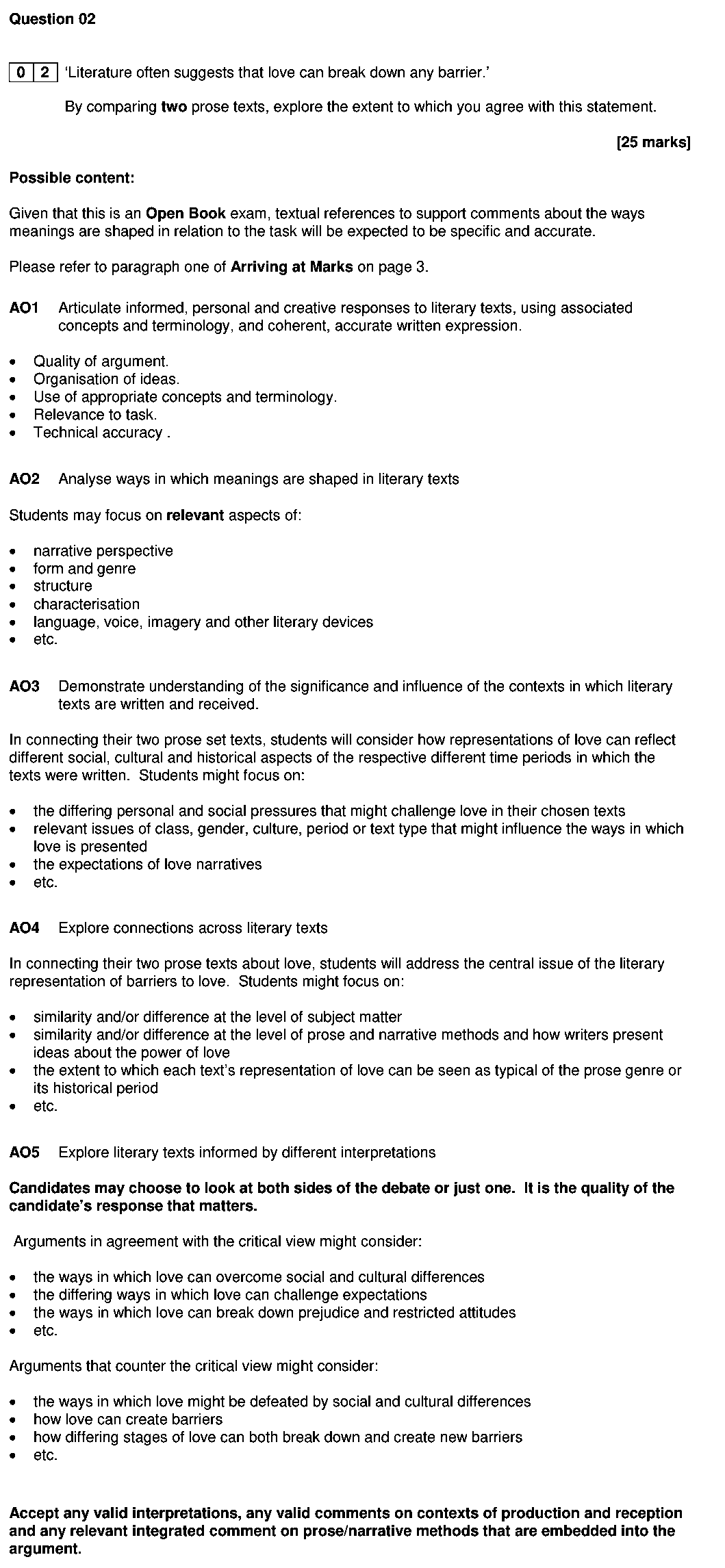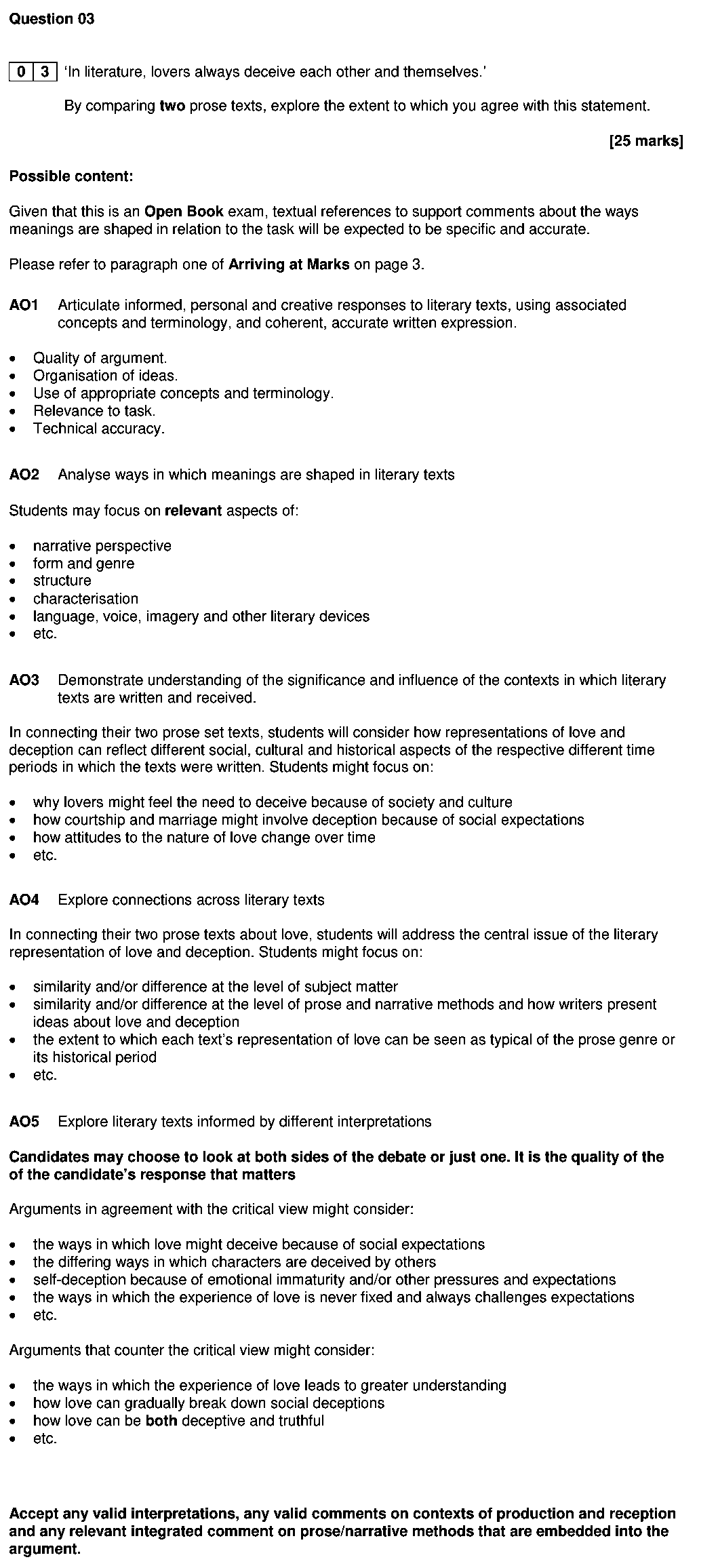
Mark scheme, including the levels and indicative content
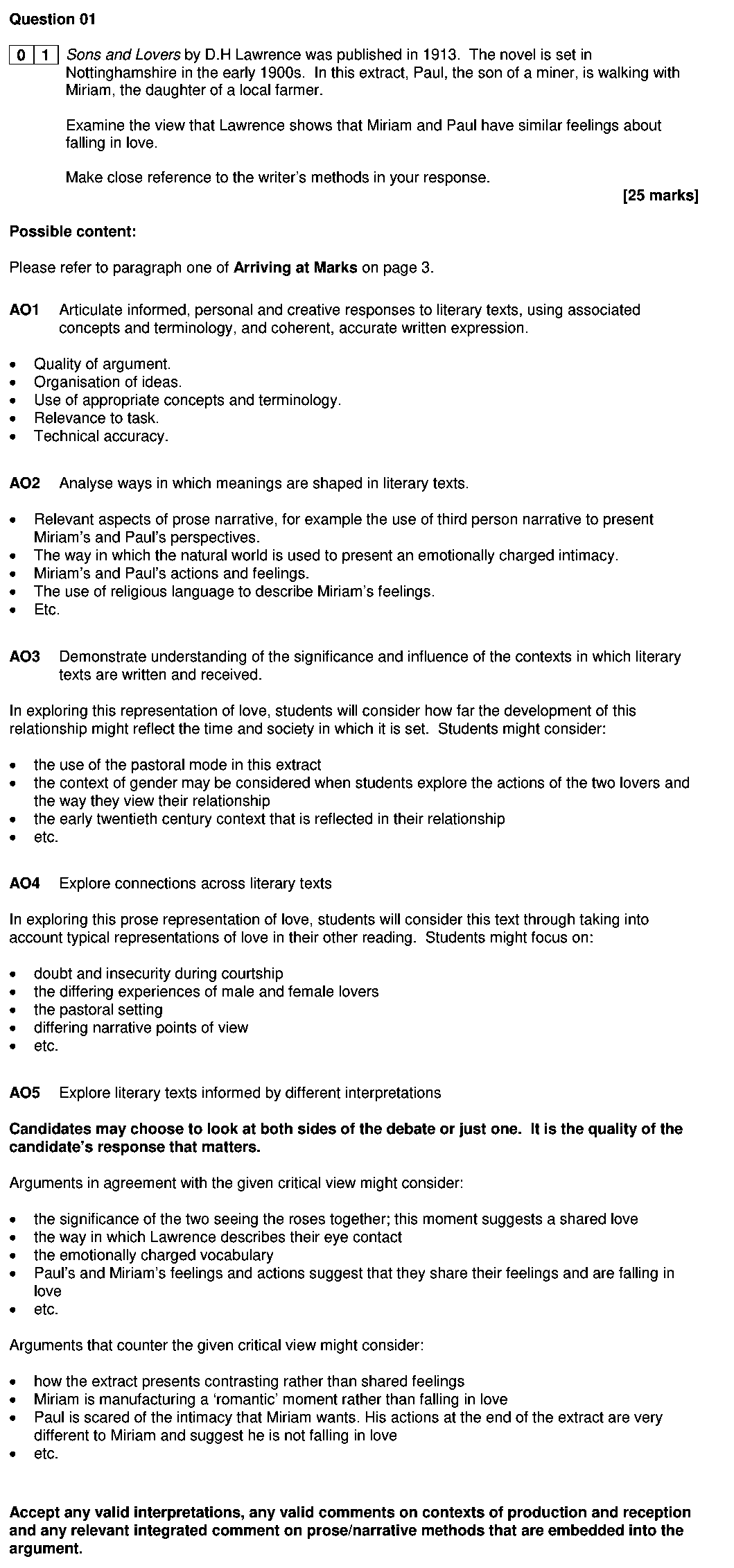
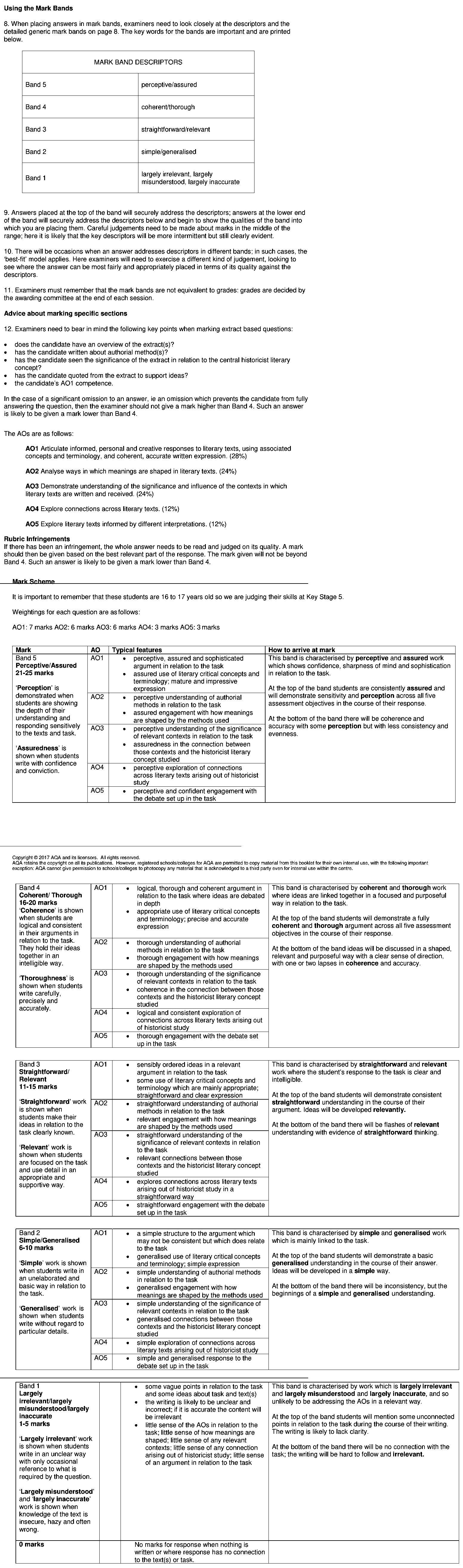
The general mark scheme (assessment objectives and bands)
Examiner's comment
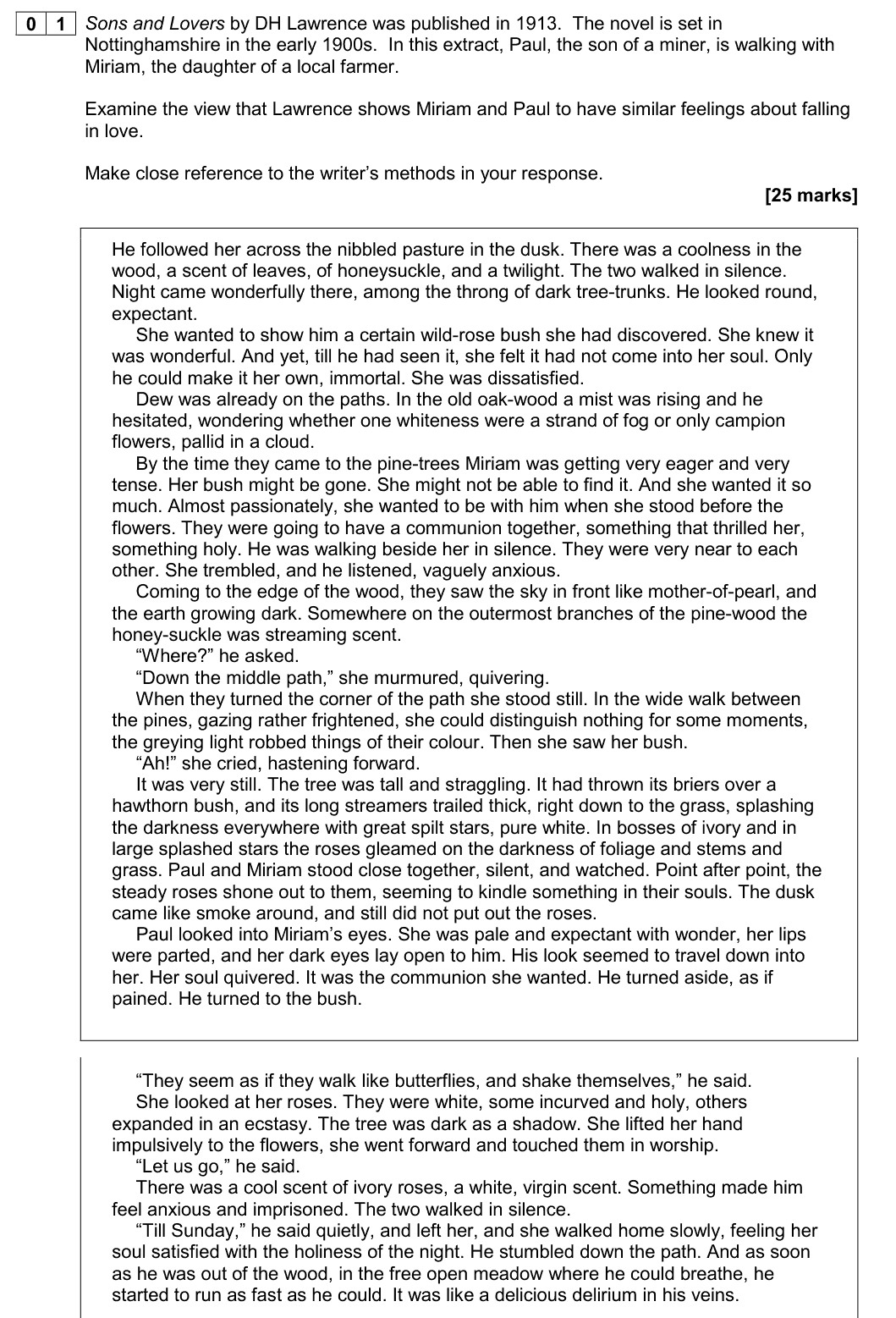
The unseen extract (from DH Lawrence’s Sons and Lovers) appeared to capture the interest of the vast majority of students. The introduction provides background information about this passage and the novel from which it comes as well as helps to inform the students’ interpretations. While most read this introduction carefully in the way it was intended, some students used it unhelpfully: either by repeating parts of it verbatim in their answers, or by extrapolating from its details to make unsupported claims. For example, occasionally students misread the detail about Paul’s father’s job and said that Paul was a miner and went on to make assertions about his mining background and how this was important in the extract. Strong readings demonstrated a confident understanding of the whole extract and used well-selected details as examples. The very best also explored how a range of features shape meaning and create effects. Students who produced such readings were comfortable exploring ambiguity and complexity and could comment on aspects such as symbolism and other elements of figurative language sensitively, without reducing literary effects to simple meanings. They were able to show how ambivalent the characters’ emotions, and the ways in which Lawrence evokes them, are. Less successful were responses that were preoccupied by defining characters’ feelings simply (sometimes using informal twenty-first century terms) and which saw them as clear and fixed. Similarly, when commenting on Lawrence’s methods, less successful responses assigned interpretations that were too concrete – and occasionally, crude – for Lawrence’s subtle and nuanced descriptions. Students explored a wide range of authorial methods. The best responses used critical terminology and concepts flexibly, with some commenting on prose aspects skilfully. For example, they explored aspects of narrative, such as the third person narrative which offers insight into mostly the feelings of Miriam while leaving the reader to deduce those of Paul from his actions and his (relatively few) speeches. Context was an area that sometimes closed down interpretation rather than opened it up. For example, the religious imagery sometimes led to unsubstantiated claims about the extreme authority of the church, with many of these reading Paul’s final words, ‘till Sunday’, as being indicative of his devout faith. Similarly, the dusky atmosphere led some to read the extract as being from a Gothic novel and led to seeing the relationship as sinister and threatening as well as failing to appreciate any of the romantic elements in the passage. Readings that saw Miriam as being affected by the suffragette movement or as one who was rebelling against patriarchy by dominating Paul and forcing him to do her bidding, or which saw Paul as a domineering patriarch, were unhelpful. Claims were also made about the text as a modernist novel; some of these might have borne fruit had the experimental elements in the passage been explored, but such labelling often led to digressive comments in which pre-learnt material was offered with little relevance to the unseen extract. A few students felt that they had to make a specific and detailed reference to another text. This is not necessary and, in many cases, an impediment in this examination which allows 45 minutes per answer. Making a link to another text on the specification rarely cast much light on the extract, and often a detailed link lead to a digression rather than a purposeful reading. More helpful references included those that used context sparingly and in ways that were integrated into the answer, or those that explored the typicality of elements such as the significance of flowers as a romantic image, Lawrence’s use of religious or transcendent imagery connected with love and the effects of the use of pastoral imagery. More successful answers • had a clear overview of the whole extract and selected relevant details judiciously • analysed the ways in which several authorial methods worked together to create meaning and effects • explored the unseen extract through a clear, relevant debate of the critical view • argued with conviction, taking a clear stance on the critical view and not necessarily treating each side of the debate equally • integrated brief, well-chosen and relevant contextual information into their response. Less successful answers • considered characters as real people rather than the constructs of an author • identified word classes without commenting on meaning or effects • gave a mechanical response to the view, treating each side of the debate equally but without a sense of conviction • used context in an assertive, inaccurate, irrelevant or digressive manner • made explicit, and sometimes lengthy, reference to other texts – often from elsewhere on the specification – that were of little or no relevance to the unseen extract.
Notes from the mark scheme and report
- Focus: relationship: Paul and Miriam falling in love
- Unseen text printed
- unseen extract: D.H. Lawrence, Sons and Lovers (1913), set in early-1900s Nottinghamshire
- debate 'similar feelings'
- credited: third-person narrative giving Miriam's feelings but Paul's mainly through actions, roses/pastoral and religious 'communion' imagery, eye contact, Paul's flight at the end
- weaker answers misread the preface (Paul as a miner), simplified feelings, read it as Gothic or the church as all-powerful, imposed suffragette/patriarchy readings or made lengthy links to other texts
- MS wording of the view differs slightly from the paper