Mark scheme, including the levels and indicative content
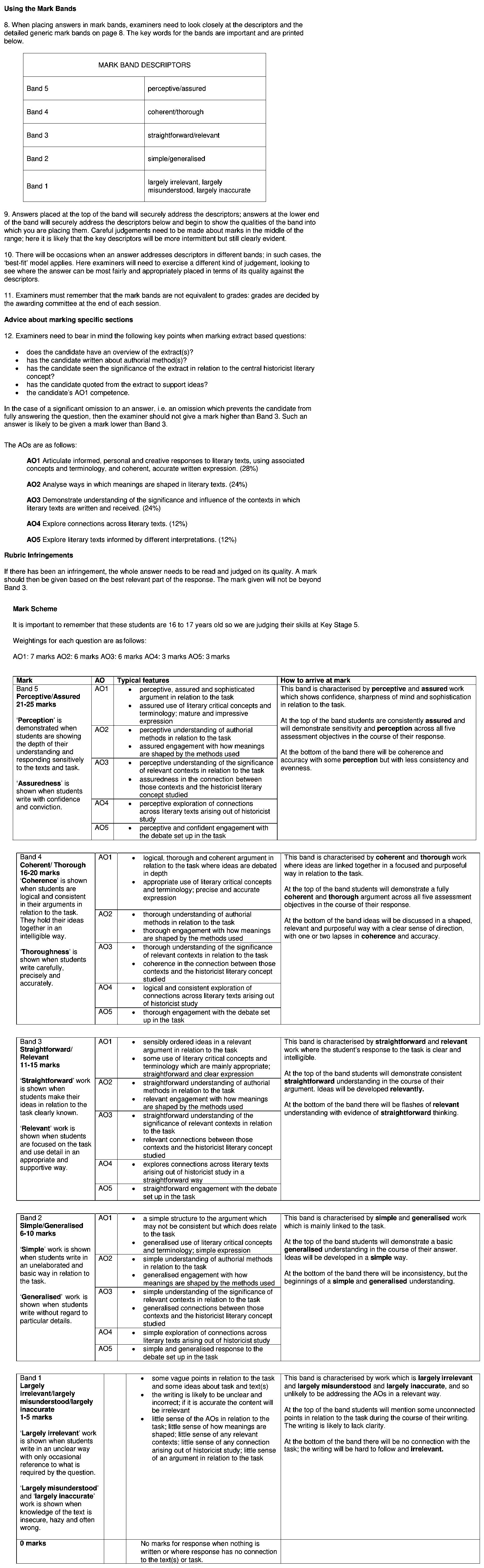
The general mark scheme (assessment objectives and bands)
Examiner's comment
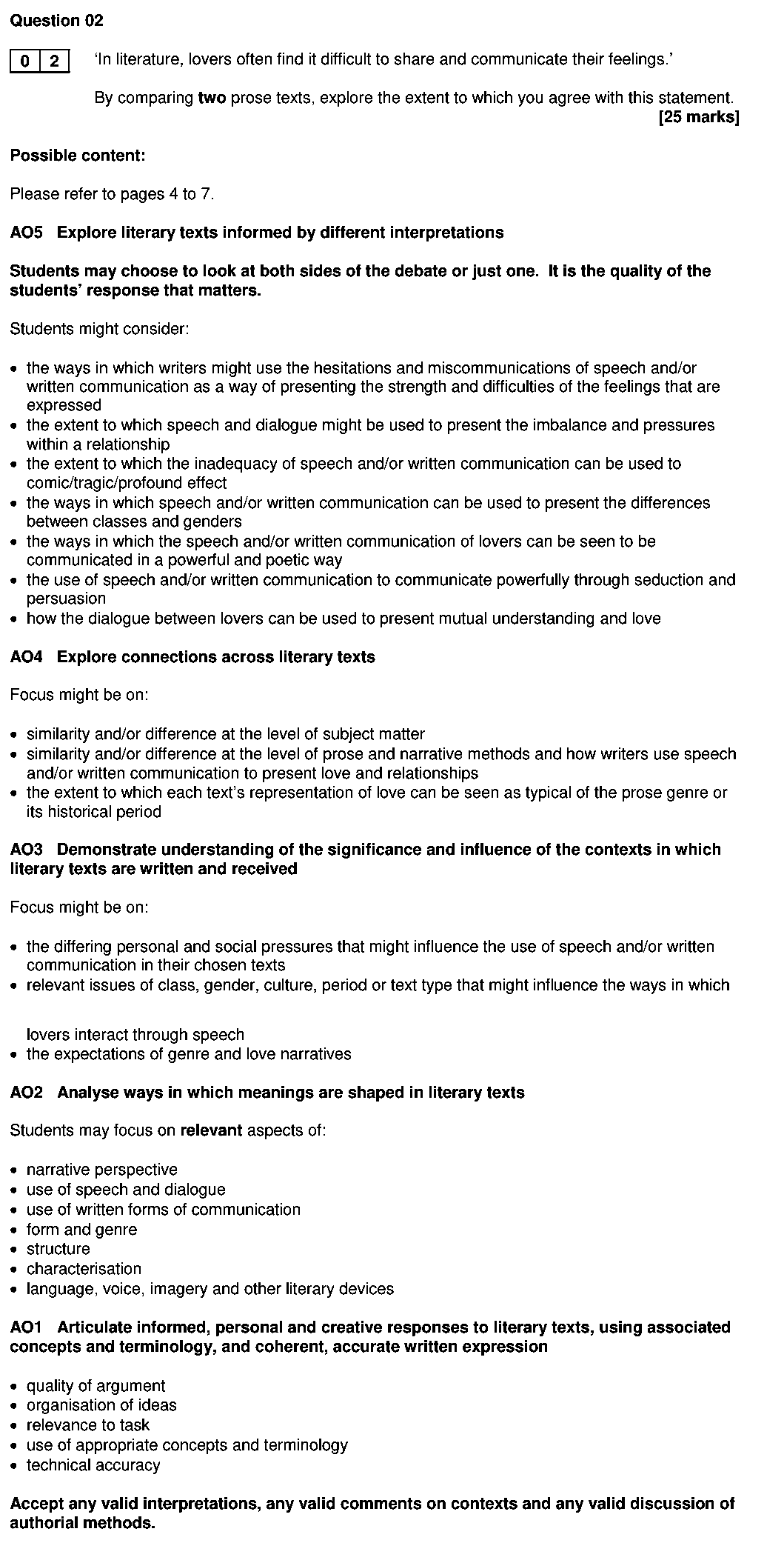
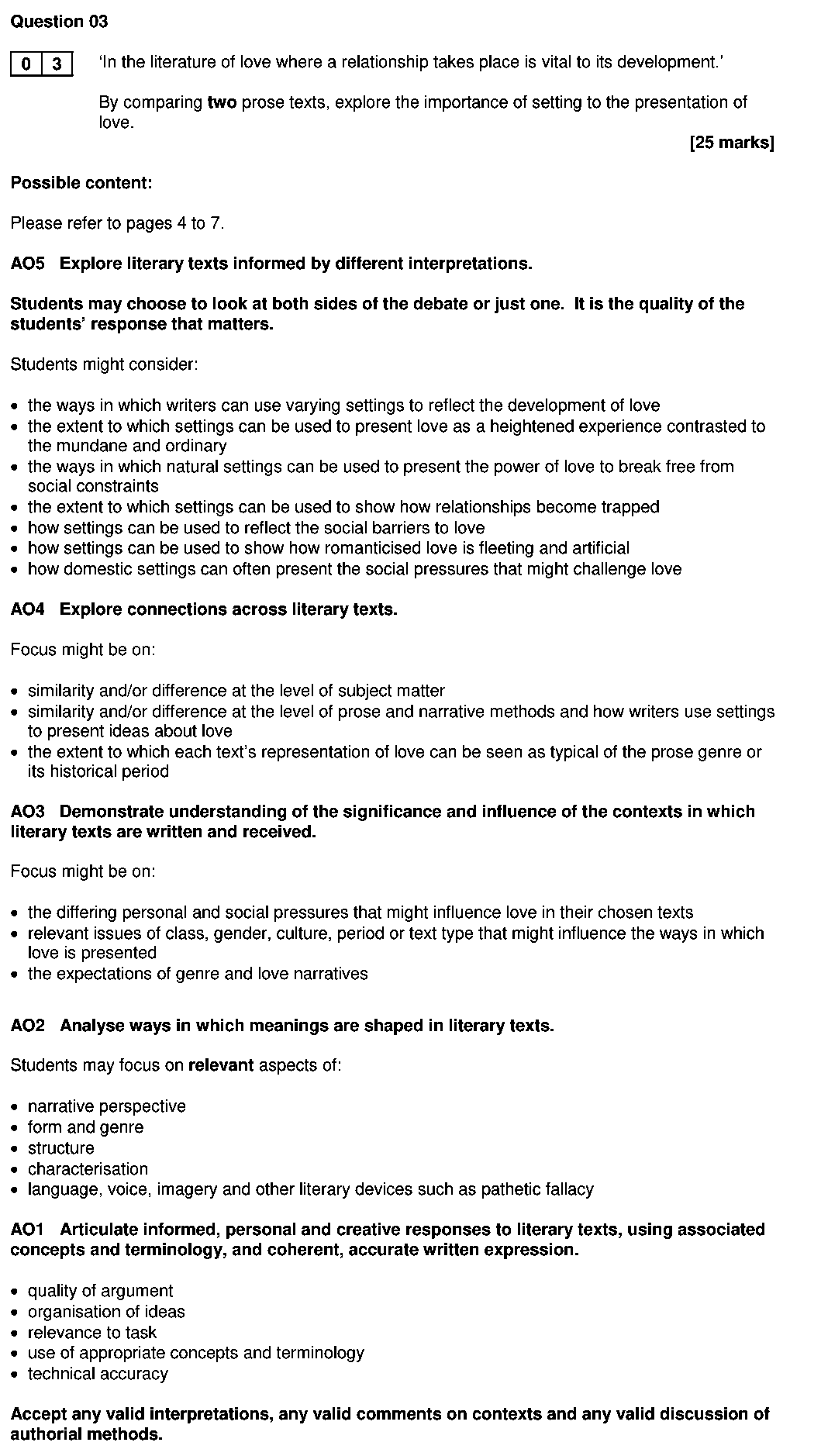
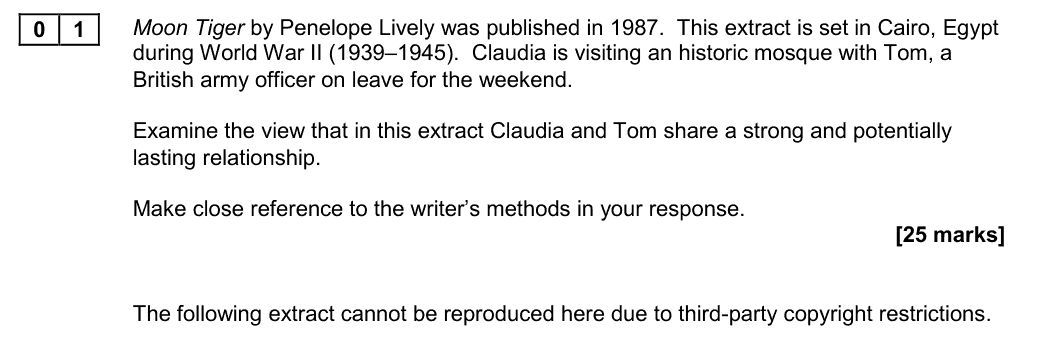
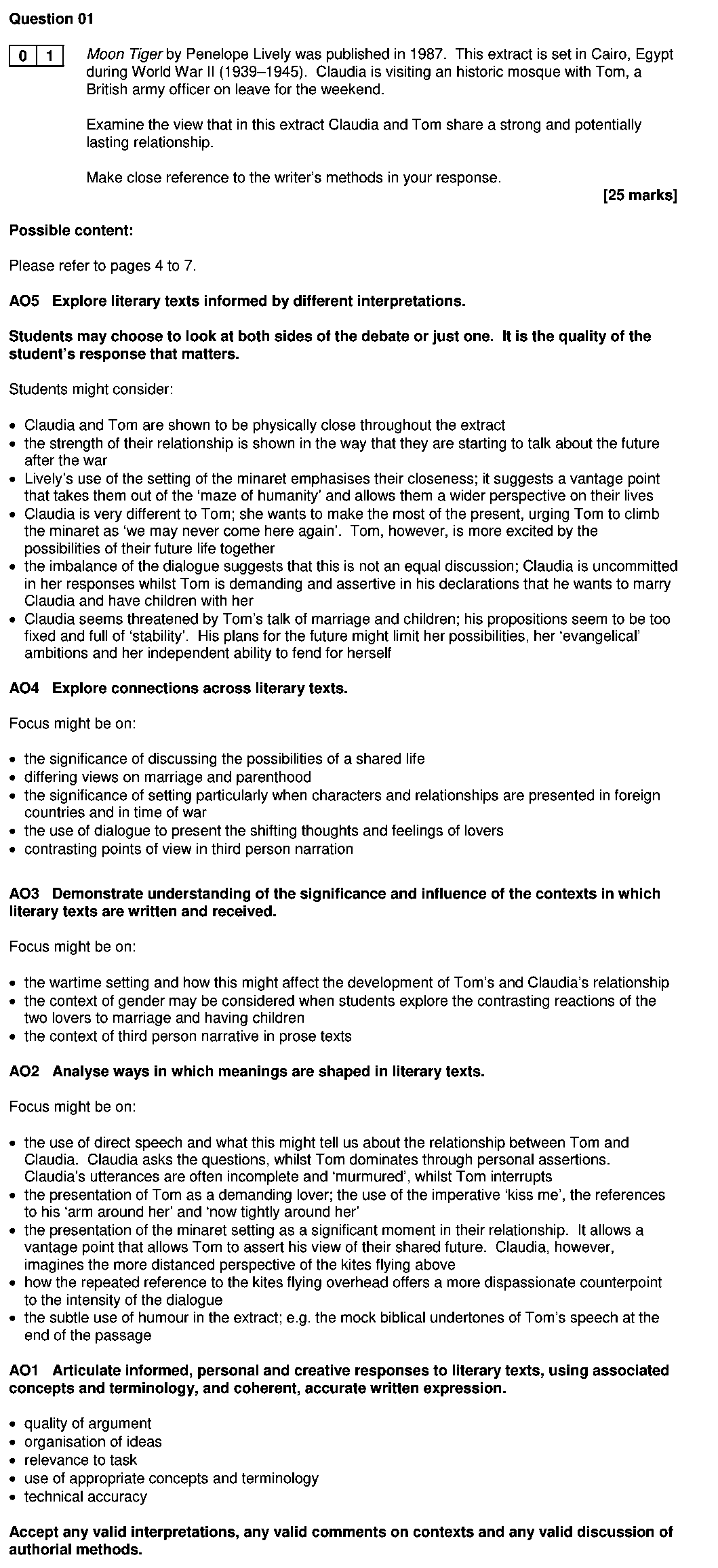
Most students found the extract from Moon Tiger by Penelope Lively to be accessible and yet there were complexities to stretch and challenge the more able too. Attention to the structure of the extract was useful. Initially, there is an awkward exchange about kissing in the mosque and what to do next before Tom settles to tell Claudia about his plans for the future. Her more withdrawn approach becomes linked to a pair of kites in the sky and the extract ends on perhaps ominous suggestions. Students readily engaged with the idea of Tom and Claudia as a couple and appeared to enjoy discussing the various hints about their individual commitment and their joint future that might be seen in the text. Perhaps the most effective responses saw a difference between Tom and Claudia from the outset and explored the different methods of presentation that Lively uses. Tom dominates the conversation and sees their current and future relationship in terms of himself and his own aspirations; Claudia is quieter and more ambiguous in her words and her behaviour. Whereas Tom is open about what might be seen as evidence of his enthusiasm and commitment, Claudia shows some signs of reciprocation but is altogether more ambiguous. Her point of view is partially privileged by Lively’s brief use of free indirect discourse at one stage to hint that Claudia’s fascination with the kites and their point of view, which might suggest her desire for escape from the very lifestyle to which Tom aspires. Many found it relatively easy to support the idea that Tom is selfish and controlling. It was common for responses to cite his preoccupation with ‘I want’ statements and to see the repeated reference to his arm around Claudia, the second time ‘tightly’. His two perhaps rather intimidating and uncomfortable references to how Claudia should listen and concentrate were also well handled to support this reading. It was more of a challenge to pin down Claudia’s views. Some seized on her question about Tom’s future and her suggestion that ‘We could be evangelical together’ to force a reading where she is equally enthusiastic about the relationship. It was often more convincing to explore the nuances and complexities of the ways in which Lively presents her attitudes. However, most responses recognised Claudia’s perhaps uncomfortable shock at Tom’s reference to wanting a child. Some close readers went on to explore the way in which one kite breaks away and ‘begins its slow descent upon some selected target’ and how this might suggest that Claudia is being trapped into marriage and motherhood. Such readings tended to be linked to contextual suggestions about changing attitudes to women between the novel’s WW2 setting and contexts of reception at the time of publication in 1987 and since. Summary More successful unseen prose responses: • looked at the whole extract in detail with relevant reference to the presentation of aspects of love and the key words of the given view • considered the extract from an overview of its structure • sustained focus on Lively’s prose narrative methods • explored interpretation, ie agreed with, disagreed with or debated the given view • scrutinised the key words of the given view and used them to shape their answer • made considered and accurate use of contextual factors arising out of the text • showed awareness and understanding of the typicality of the literature of love. Less successful prose unseen responses: • made sparse use of the details of the extract or neglected substantial sections • neglected the given critical interpretation • wrote about the characters as though they were real people • made assumptions and assertions about alleged similarities between the attitudes of Tom and Claudia • described the extract in narrative terms • made little or no reference to Lively or her prose narrative methods • made inaccurate or sweeping assertions about context.
Notes from the mark scheme and report
- Focus: relationship: Claudia and Tom's future together
- Unseen text printed
- unseen extract: Penelope Lively, Moon Tiger (1987), set in wartime Cairo
- extract removed from the paper for copyright
- debate 'strong and potentially lasting'
- credited: structure (awkward kiss, Tom's plans, the kites), Tom dominating the dialogue with 'I want' and his tightening arm, Claudia's ambiguity and shock at talk of a child, brief free indirect discourse, the descending kite as entrapment, WW2 vs 1987 attitudes to women
- weaker answers assumed shared attitudes, forced Claudia's 'evangelical' line into equal enthusiasm, narrated or neglected Lively's methods