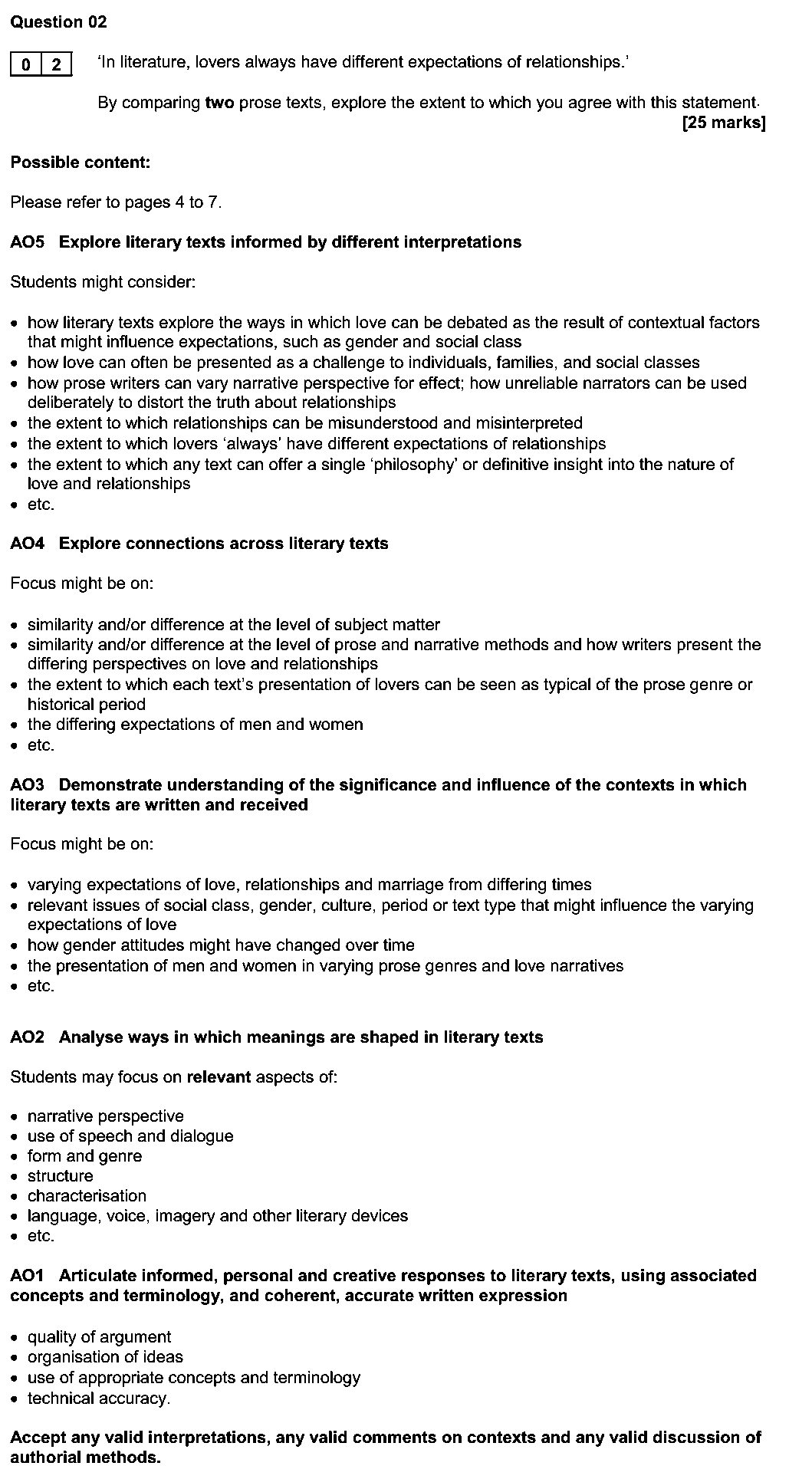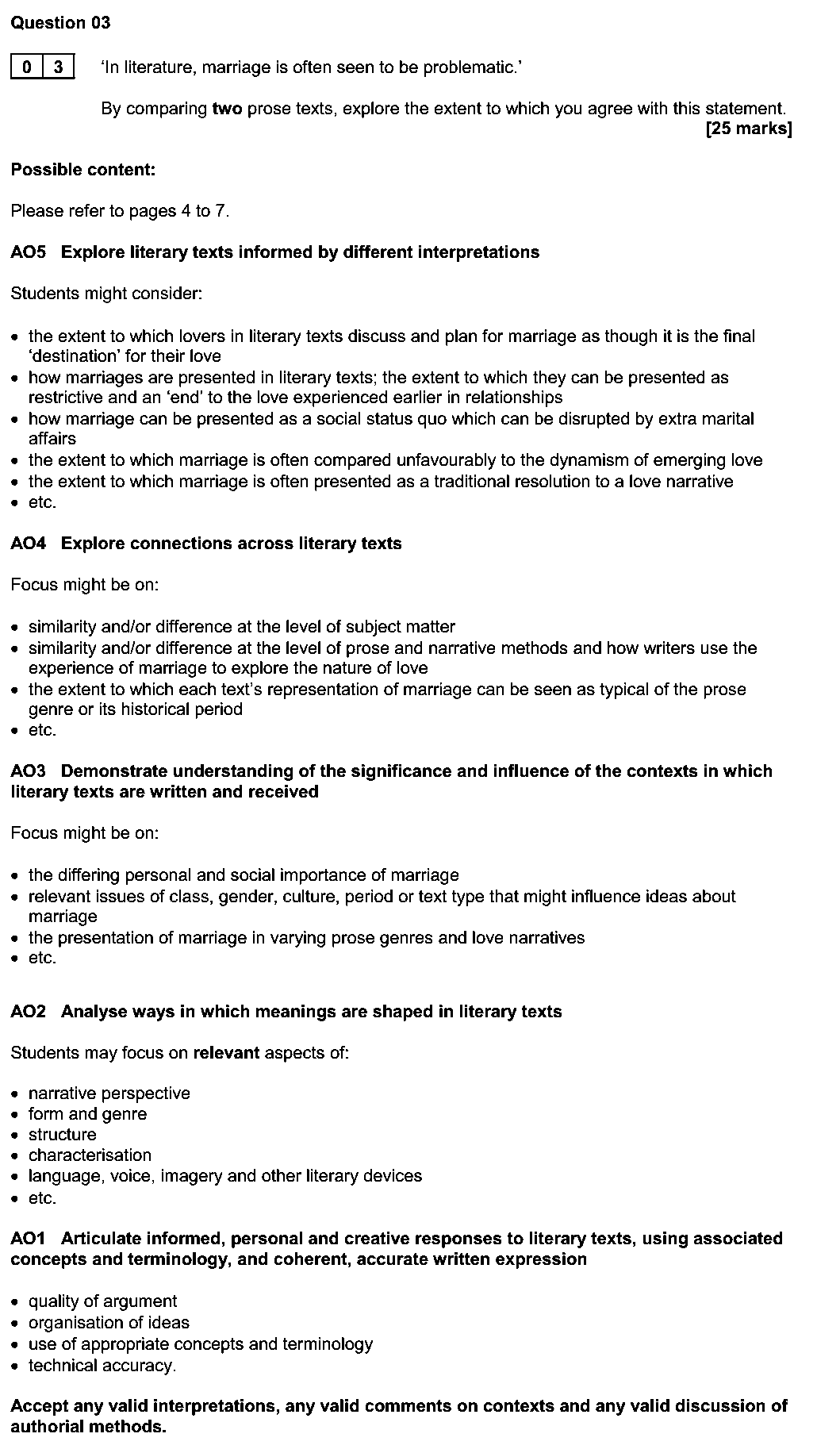
Mark scheme, including the levels and indicative content
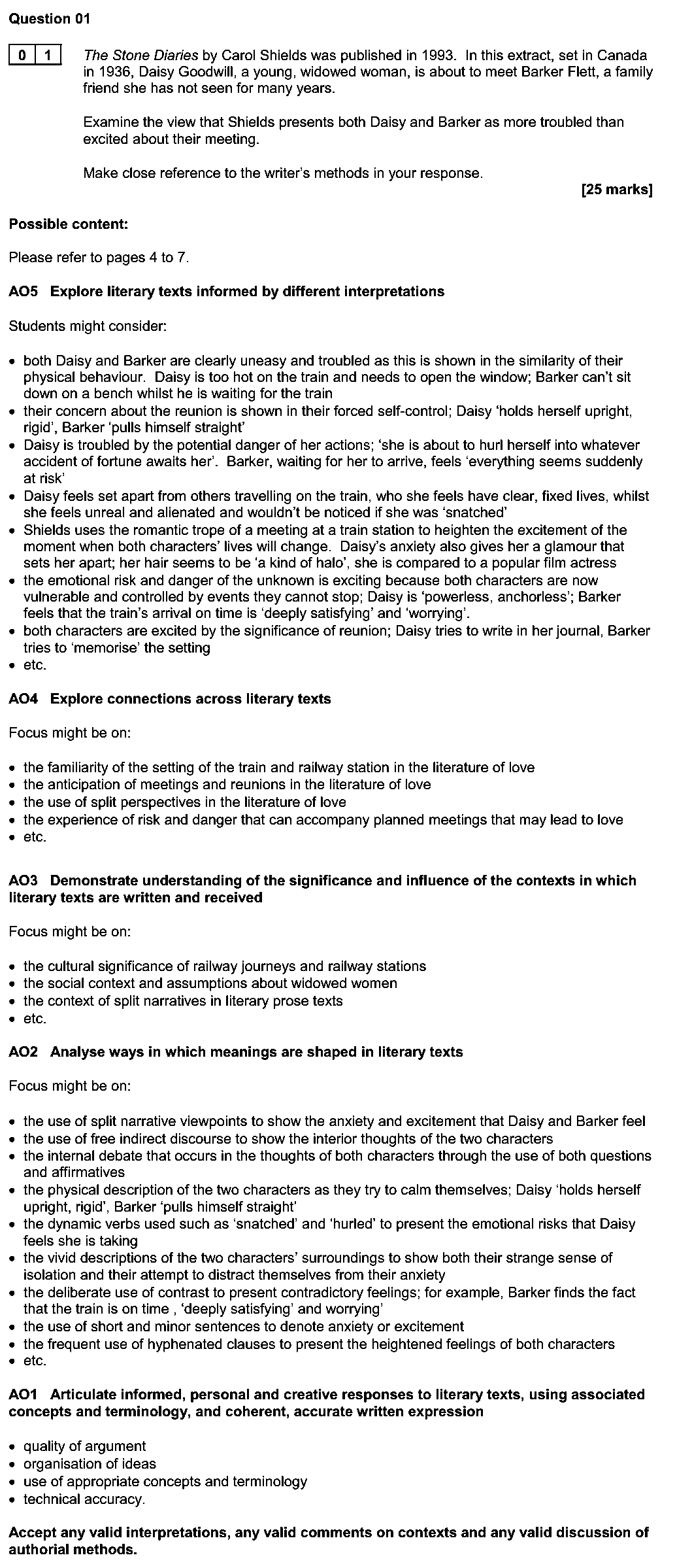
The general mark scheme (assessment objectives and bands)
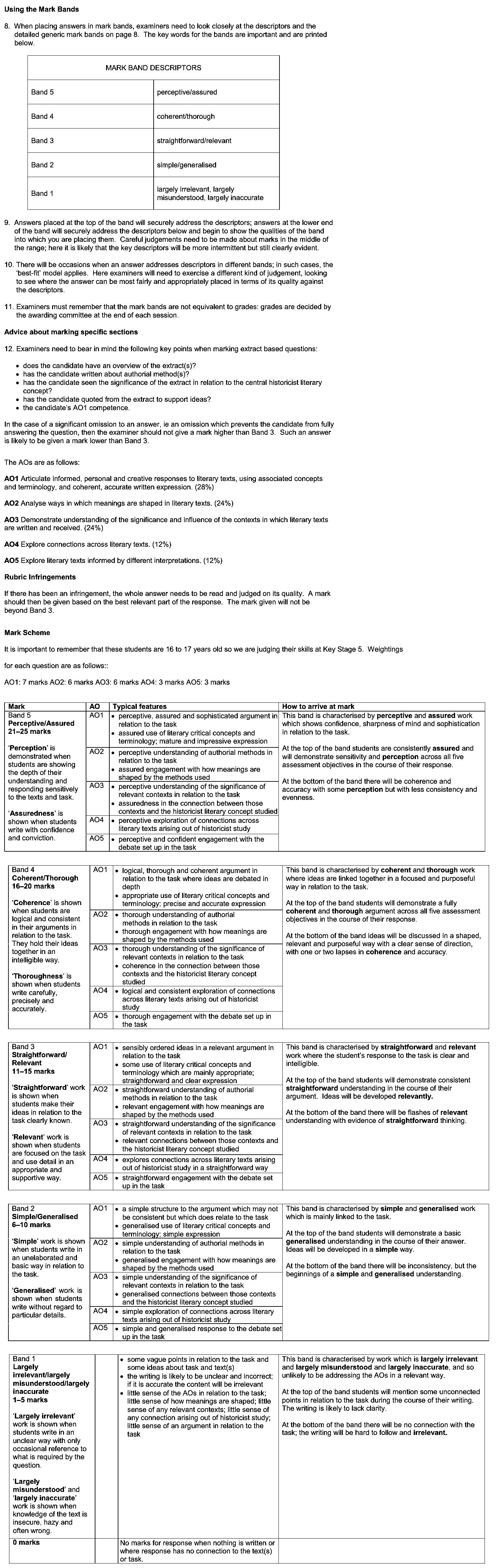
Examiner's comment
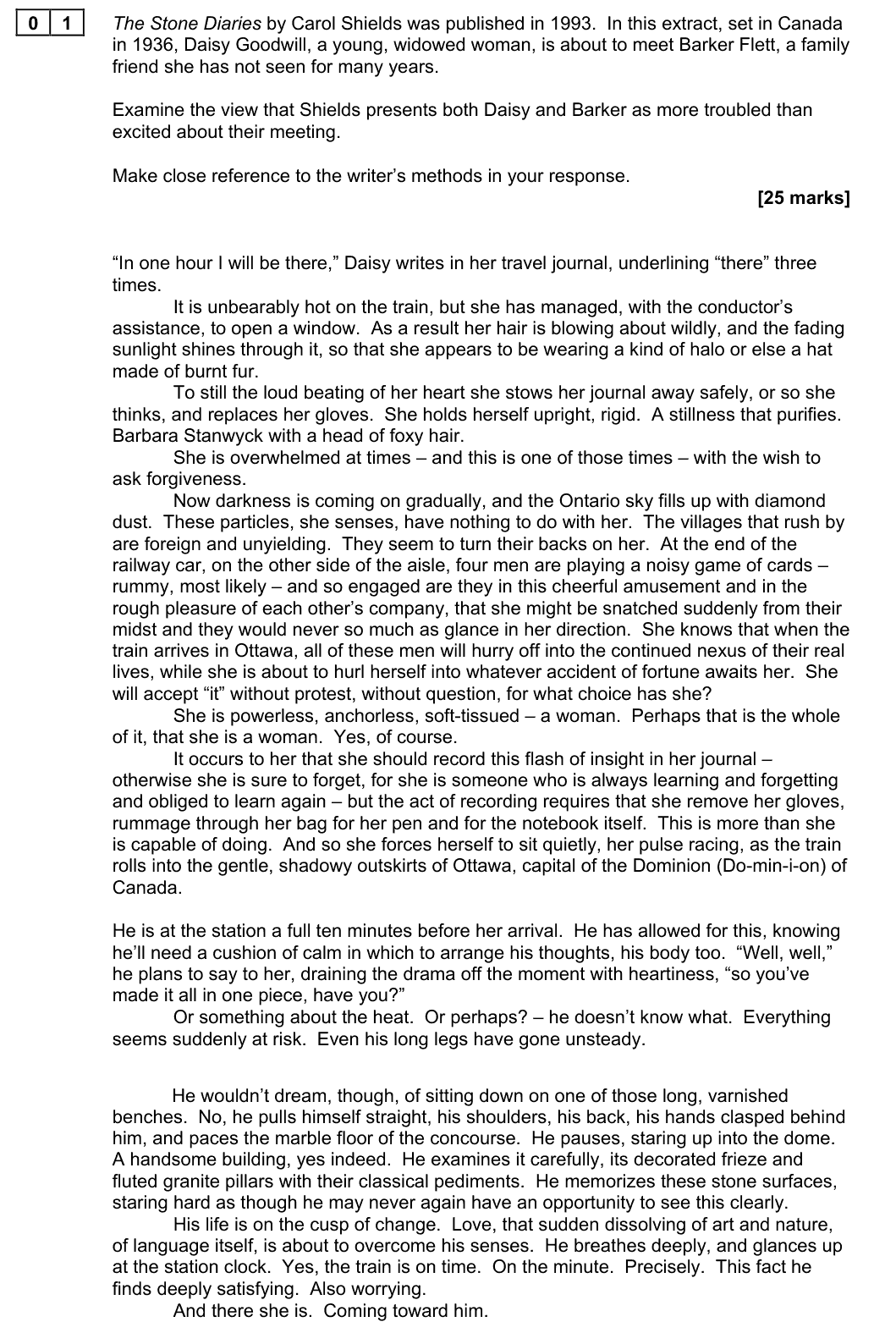
Most students found the extract from The Stone Diaries by Carol Shields accessible and yet there were complexities to stretch and challenge the more able too. Attention to the structure of the extract was instructive. The extract opens with Daisy Goodwill, sitting on a train, writing in her journal in anticipation of meeting Barker Flett in Ottawa. The heat is oppressive and Daisy clearly feel anxious as she approaches the meeting. The narrative perspective then shifts to Barker, waiting at the station for Daisy to arrive as he considers what he will say to her as he paces the concourse. The extract ends from Barker’s perspective, with Daisy walking towards him. Students readily engaged with the idea of both Daisy and Barker being more troubled than excited by their meeting. Many were able to comment on the fact that Daisy was a young widow, travelling alone, seemingly surrounded by men and that this caused her to feel troubled. Responses often began with the example of Daisy underlining ‘there’ three times to demonstrate that she was either troubled or excited. Some students successfully analysed Daisy’s appearance as the wind blew her hair making it appear like a ‘halo’ or ‘a hat made of burnt fur’. The unbearable heat on the train was also used to exemplify Daisy’s feelings. Some seized on Shields’ use of darkness and how this brought on a sense of foreboding, some successfully considered the ‘diamond dust’ in the Ontario skies and the beauty inherent in this image. The free indirect discourse in ‘She is powerless, anchorless, soft-tissued – a woman’ was successfully identified and analysed by many students and gave opportunity for some close reading. Such readings tended to be linked to contextual suggestions about changing attitudes to women between the novel’s 1936 setting and contexts of reception at the time of publication in 1993 and since. With such a wealth of material to consider regarding Daisy, some students dealt fleetingly with Barker’s feelings. However, the more successful were able to comment on his arrival at the station ten minutes early. The idea of him creating a ‘cushion of calm’ was used to demonstrate his feeling troubled or excited. Some picked up on the reference to Barker’s unsteady legs and that he felt everything was ‘at risk’ as evidence for his troubled feelings. Some students successfully considered Shields’ description of Barker’s posture and movement to comment on his character as he ‘wouldn’t dream…of sitting down’ and instead ‘pulls himself straight…his hands clasped behind his back’. Some seized on the way Barker seems to be trying to take his mind off of the meeting by looking around him at the building, examining it ‘carefully’. But thoughts of the impending meeting quickly return and students commented on Barker’s life being ‘on the cusp of change’. Some picked up on the reference to ‘Love’ and that perhaps this indicates that Barker is more excited about the meeting than Daisy in his hope that it would bring about love. Summary More successful unseen prose answers: • looked at the whole extract in detail with relevant reference to the presentation of aspects of love and the key words of the given view • engaged fully with the task with an understanding of the whole extract rather than fragmented detail • moved between the two viewpoints successfully • considered the extract from an overview of its structure • sustained focus on Shields’ prose narrative methods • explored interpretation, ie agreed with, disagreed with or debated the given view • scrutinised the key words of the given view and used them to shape their answer • considered gender roles from male and female perspectives • explored and tested out the debate through alternatives • made considered and accurate use of contextual factors arising out of the text • showed awareness and understanding of the typicality of the literature of love. Less successful prose unseen answers: • made sparse use of the details of the extract or neglected substantial sections • neglected the given critical interpretation • only considered Daisy • made assumptions and assertions about alleged similarities between the attitudes of Daisy and Barker • labelled simple/straightforward prose features • lacked overview • operated at word level analysis and constructed unconvincing interpretations out of this • over valued the effect of punctuation • were diverted by the need to write about other texts • described the extract in narrative terms • made little or no reference to prose narrative methods • made inaccurate or sweeping assertions about context.
Notes from the mark scheme and report
- Focus: relationship: Daisy and Barker's anticipated meeting
- Unseen text printed
- unseen extract: Carol Shields, The Stone Diaries (1993), set in Canada in 1936
- debate 'more troubled than excited' for both characters
- credited: split narrative moving from Daisy on the train to Barker at the station, free indirect discourse ('powerless, anchorless, soft-tissued – a woman'), heat, 'halo', darkness and 'diamond dust', Barker's 'cushion of calm', unsteady legs, posture and 'on the cusp of change', 1936 vs 1993 attitudes to widowed women
- weaker answers only considered Daisy, worked at word level or over-valued punctuation, lacked overview or digressed into other texts