June 2025: AS Paper 2, prose

50 marks · 3 questions (every option is included) · Paper, mark scheme and report on AQA's site

Question by question

QTopicMarksAOType
1 Unseen prose (AS) 25Unseen prose
2 Comparing prose texts (love through the ages) 25Comparing texts
3 Comparing prose texts (love through the ages) 25Comparing texts

The questions

123
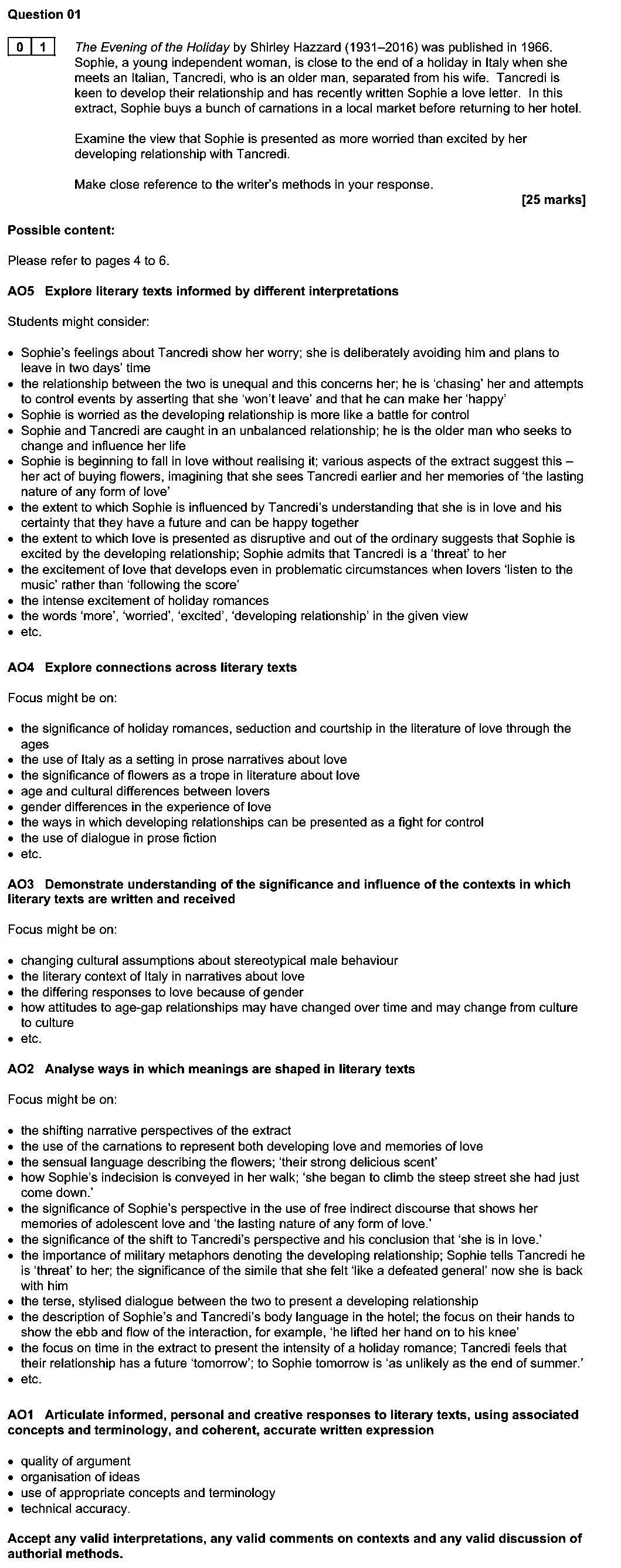
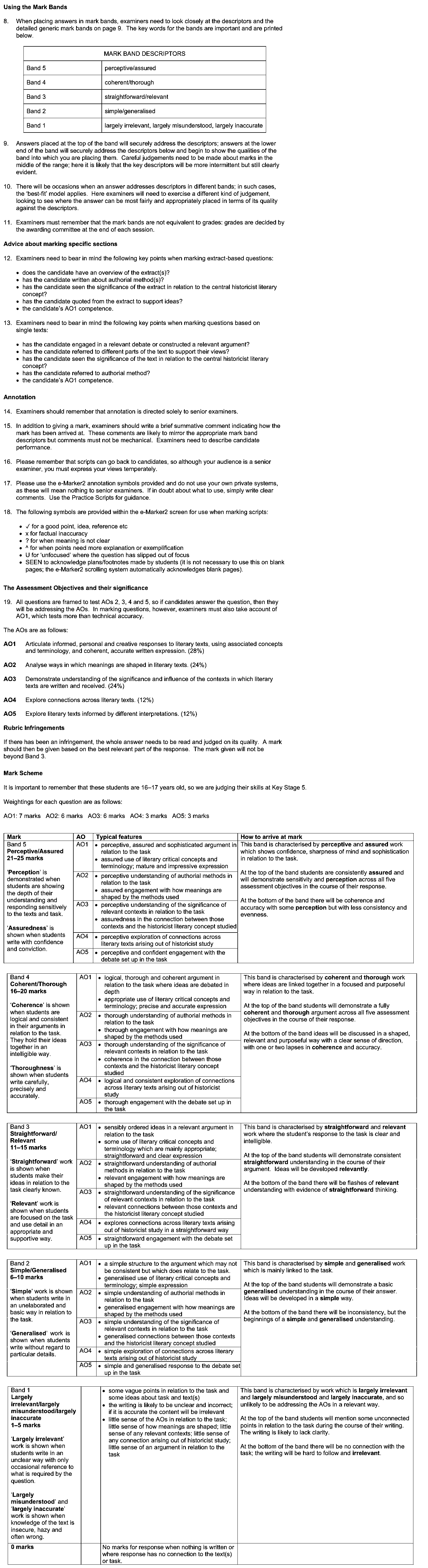
June 2025 · AS Paper 2 · Q1 25 marks Unseen prose unseen love prose
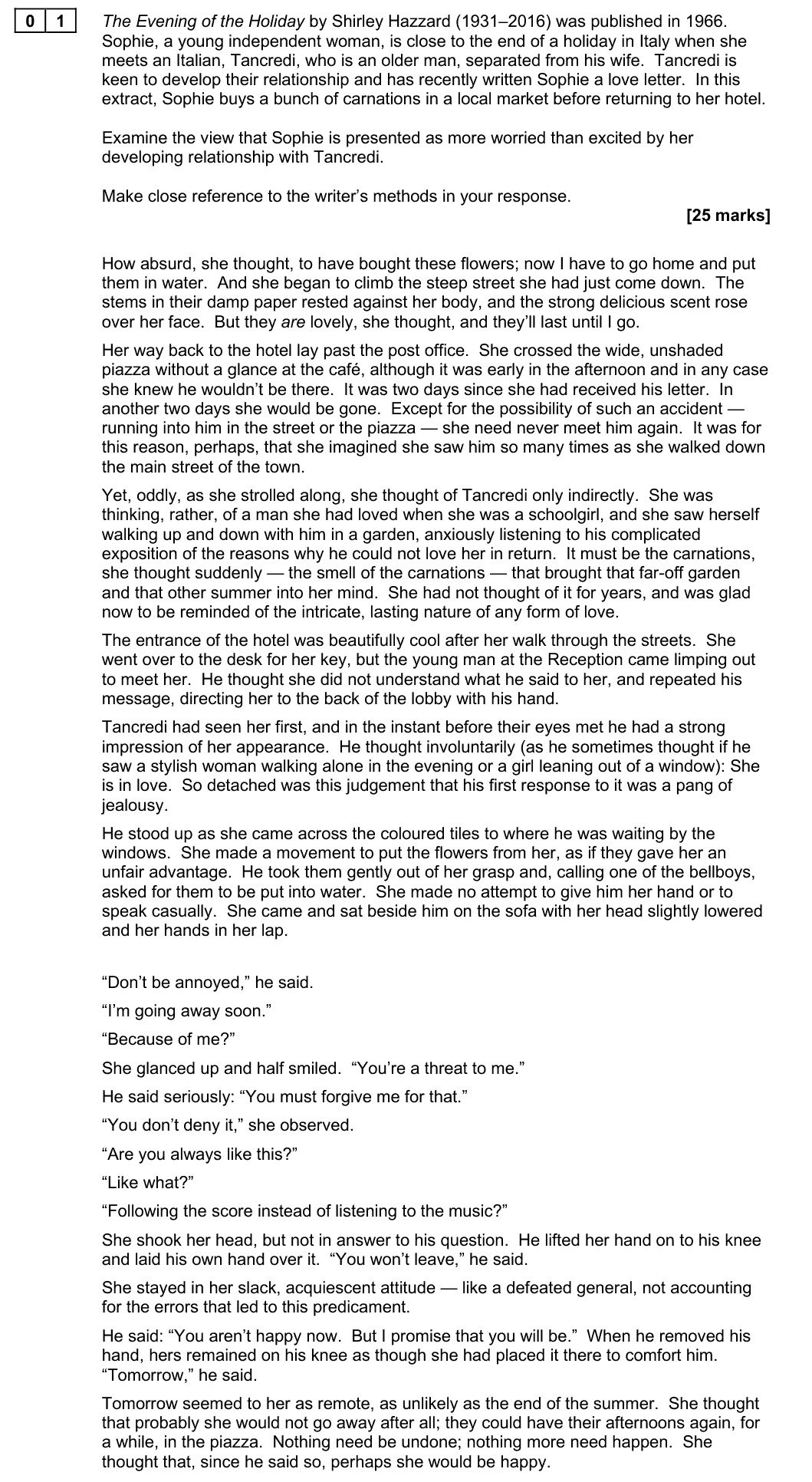
The Evening of the Holiday by Shirley Hazzard (1931–2016) was published in 1966.
Sophie, a young independent woman, is close to the end of a holiday in Italy when she
meets an Italian, Tancredi, who is an older man, separated from his wife. Tancredi is
keen to develop their relationship and has recently written Sophie a love letter. In this
extract, Sophie buys a bunch of carnations in a local market before returning to her hotel.
Examine the view that Sophie is presented as more worried than excited by her
developing relationship with Tancredi.
Make close reference to the writer’s methods in your response.
[25 marks]
How absurd, she thought, to have bought these flowers; now I have to go home and put
them in water. And she began to climb the steep street she had just come down. The
stems in their damp paper rested against her body, and the strong delicious scent rose
over her face. But they are lovely, she thought, and they’ll last until I go.
Her way back to the hotel lay past the post office. She crossed the wide, unshaded
piazza without a glance at the café, although it was early in the afternoon and in any case
she knew he wouldn’t be there. It was two days since she had received his letter. In
another two days she would be gone. Except for the possibility of such an accident —
running into him in the street or the piazza — she need never meet him again. It was for
this reason, perhaps, that she imagined she saw him so many times as she walked down
the main street of the town.
Yet, oddly, as she strolled along, she thought of Tancredi only indirectly. She was
thinking, rather, of a man she had loved when she was a schoolgirl, and she saw herself
walking up and down with him in a garden, anxiously listening to his complicated
exposition of the reasons why he could not love her in return. It must be the carnations,
she thought suddenly — the smell of the carnations — that brought that far-off garden
and that other summer into her mind. She had not thought of it for years, and was glad
now to be reminded of the intricate, lasting nature of any form of love.
The entrance of the hotel was beautifully cool after her walk through the streets. She
went over to the desk for her key, but the young man at the Reception came limping out
to meet her. He thought she did not understand what he said to her, and repeated his
message, directing her to the back of the lobby with his hand.
Tancredi had seen her first, and in the instant before their eyes met he had a strong
impression of her appearance. He thought involuntarily (as he sometimes thought if he
saw a stylish woman walking alone in the evening or a girl leaning out of a window): She
is in love. So detached was this judgement that his first response to it was a pang of
jealousy.
He stood up as she came across the coloured tiles to where he was waiting by the
windows. She made a movement to put the flowers from her, as if they gave her an
unfair advantage. He took them gently out of her grasp and, calling one of the bellboys,
asked for them to be put into water. She made no attempt to give him her hand or to
speak casually. She came and sat beside him on the sofa with her head slightly lowered
and her hands in her lap.
“Don’t be annoyed,” he said.
“I’m going away soon.”
“Because of me?”
She glanced up and half smiled. “You’re a threat to me.”
He said seriously: “You must forgive me for that.”
“You don’t deny it,” she observed.
“Are you always like this?”
“Like what?”
“Following the score instead of listening to the music?”
She shook her head, but not in answer to his question. He lifted her hand on to his knee
and laid his own hand over it. “You won’t leave,” he said.
She stayed in her slack, acquiescent attitude — like a defeated general, not accounting
for the errors that led to this predicament.
He said: “You aren’t happy now. But I promise that you will be.” When he removed his
hand, hers remained on his knee as though she had placed it there to comfort him.
“Tomorrow,” he said.
Tomorrow seemed to her as remote, as unlikely as the end of the summer. She thought
that probably she would not go away after all; they could have their afternoons again, for
a while, in the piazza. Nothing need be undone; nothing more need happen. She
thought that, since he said so, perhaps she would be happy.
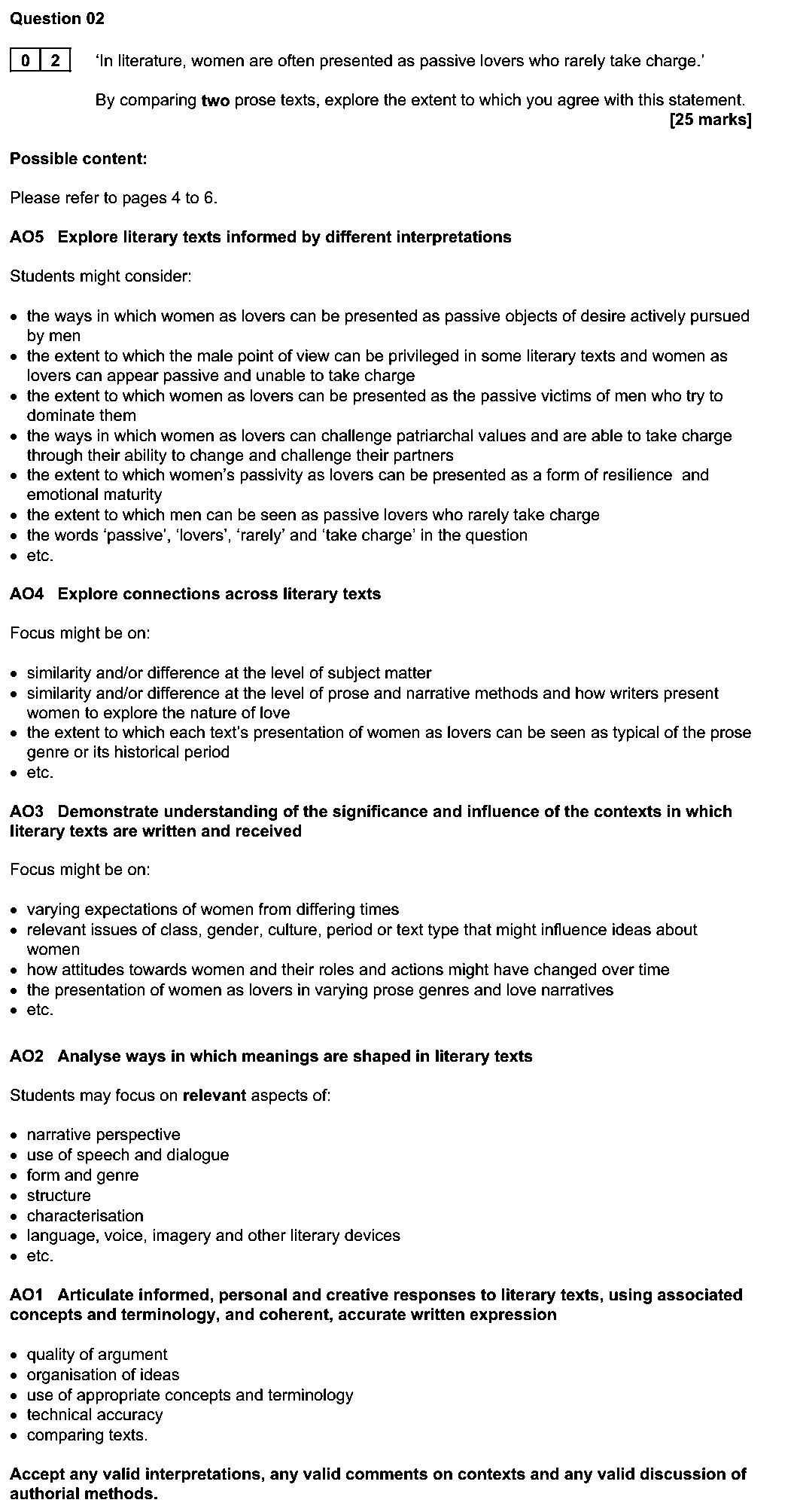
June 2025 · AS Paper 2 · Q2 25 marks Comparing texts comparing prose love
‘In literature, women are often presented as passive lovers who rarely take charge.’
By comparing two prose texts, explore the extent to which you agree with this statement.
[25 marks]
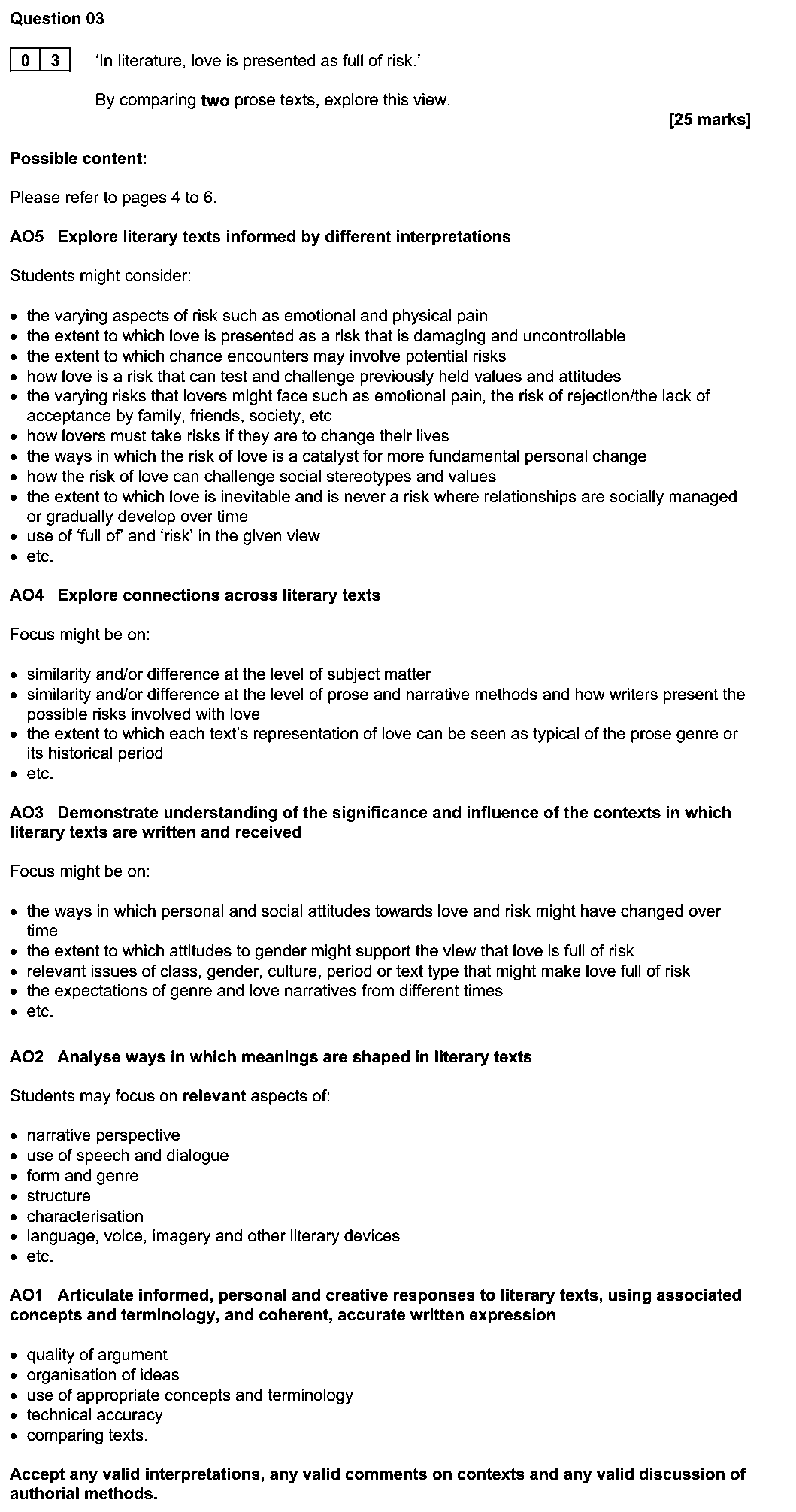
June 2025 · AS Paper 2 · Q3 25 marks Comparing texts comparing prose love
‘In literature, love is presented as full of risk.’
By comparing two prose texts, explore this view.
[25 marks]

Work with an AQA English Literature A tutor

Want a paper marked and gone through with you? Message us.

Prefer email? Send an enquiry

If you are under 18, please include a parent's contact details. Enquiries go to enquiries@alevelenglishtutor.com and are deleted once handled. All tutoring is online.