November 2020: AS Paper 2, prose

50 marks · 3 questions (every option is included) · Paper, mark scheme and report on AQA's site · Printed for the cancelled summer 2020 exams

Question by question

QTopicMarksAOType
1 Unseen prose (AS) 25Unseen prose
2 Comparing prose texts (love through the ages) 25Comparing texts
3 Comparing prose texts (love through the ages) 25Comparing texts

The questions

123
November 2020 · AS Paper 2 · Q1 25 marks Unseen prose unseen love prose
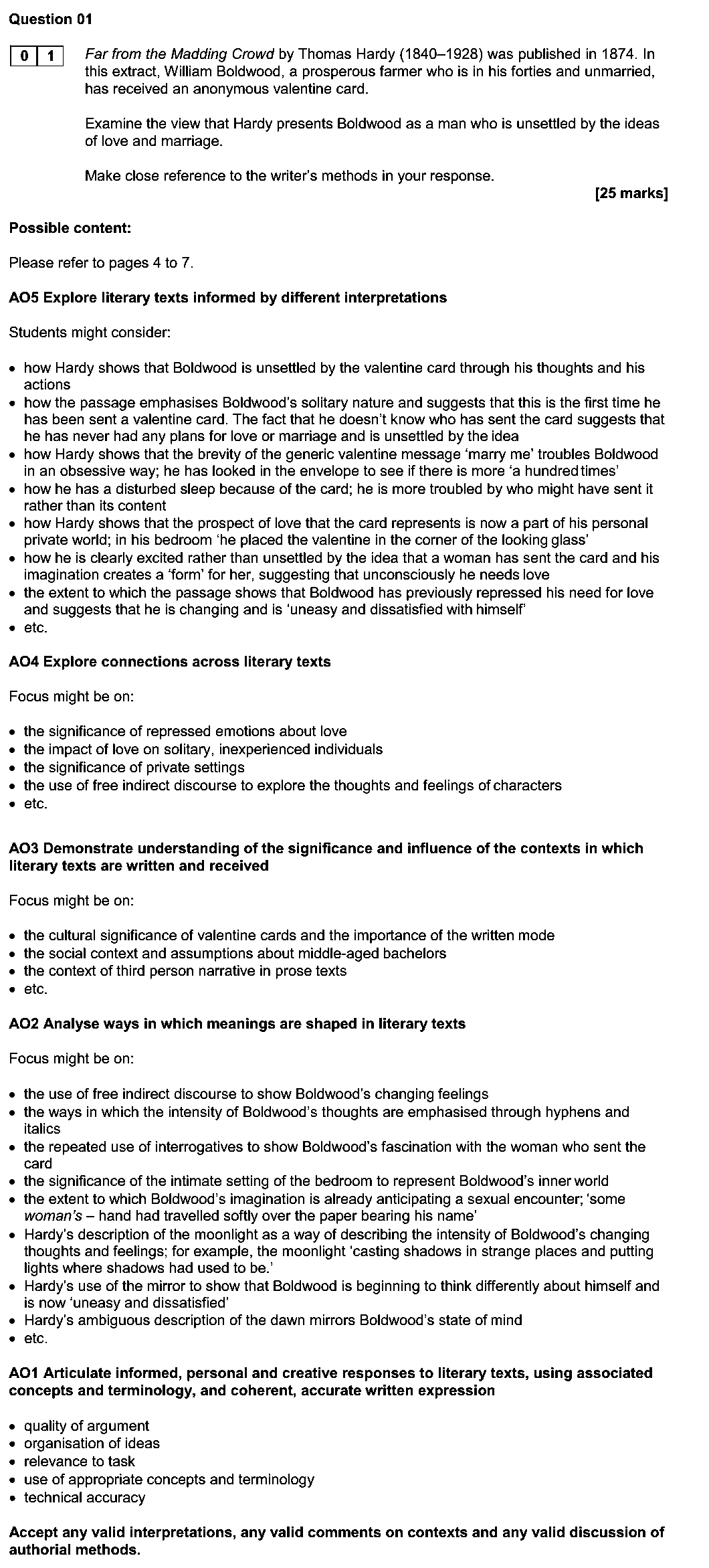
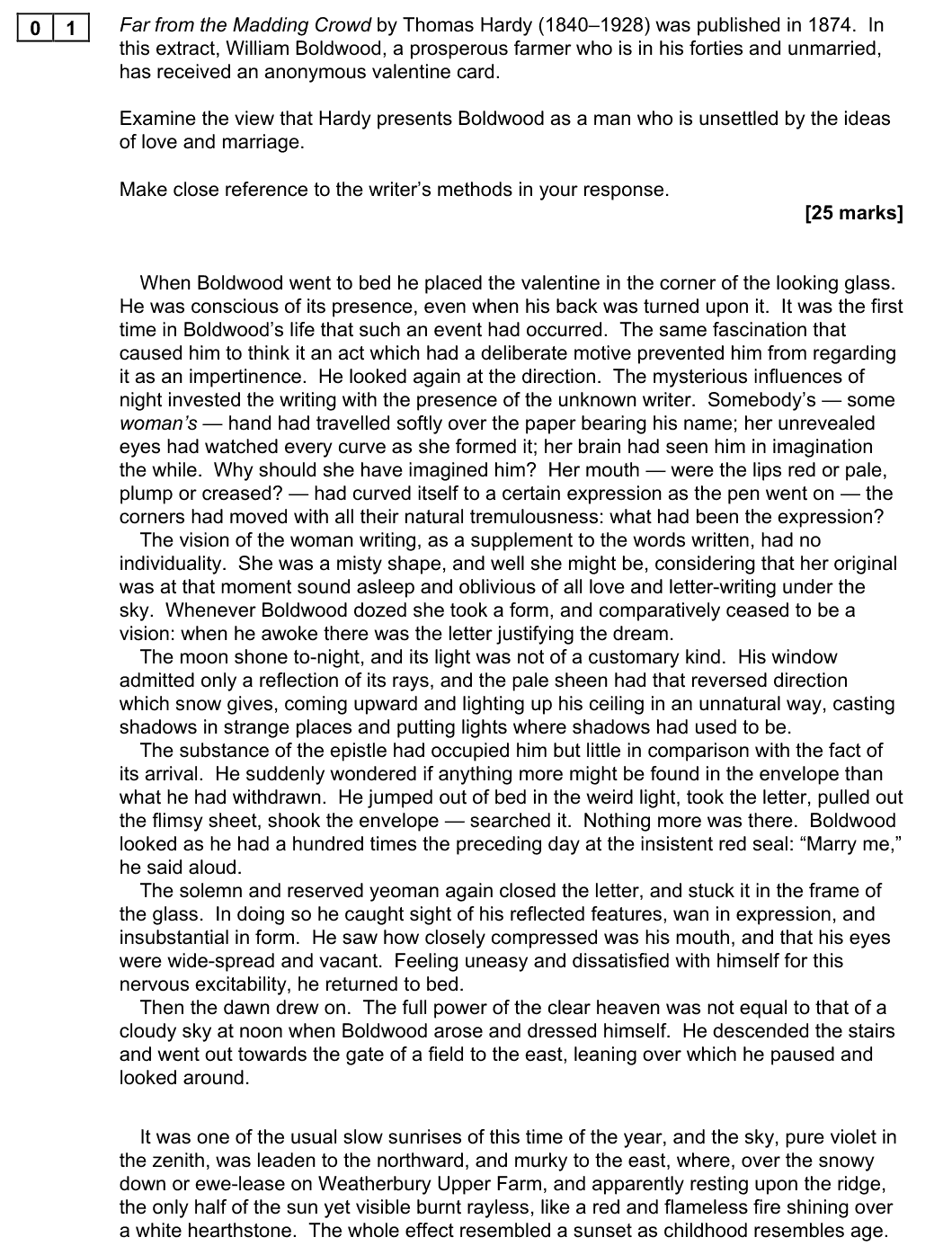
Far from the Madding Crowd by Thomas Hardy (1840–1928) was published in 1874. In
this extract, William Boldwood, a prosperous farmer who is in his forties and unmarried,
has received an anonymous valentine card.
Examine the view that Hardy presents Boldwood as a man who is unsettled by the ideas
of love and marriage.
Make close reference to the writer’s methods in your response.
[25 marks]
When Boldwood went to bed he placed the valentine in the corner of the looking glass.
He was conscious of its presence, even when his back was turned upon it. It was the first
time in Boldwood’s life that such an event had occurred. The same fascination that
caused him to think it an act which had a deliberate motive prevented him from regarding
it as an impertinence. He looked again at the direction. The mysterious influences of
night invested the writing with the presence of the unknown writer. Somebody’s — some
woman’s — hand had travelled softly over the paper bearing his name; her unrevealed
eyes had watched every curve as she formed it; her brain had seen him in imagination
the while. Why should she have imagined him? Her mouth — were the lips red or pale,
plump or creased? — had curved itself to a certain expression as the pen went on — the
corners had moved with all their natural tremulousness: what had been the expression?
The vision of the woman writing, as a supplement to the words written, had no
individuality. She was a misty shape, and well she might be, considering that her original
was at that moment sound asleep and oblivious of all love and letter-writing under the
sky. Whenever Boldwood dozed she took a form, and comparatively ceased to be a
vision: when he awoke there was the letter justifying the dream.
The moon shone to-night, and its light was not of a customary kind. His window
admitted only a reflection of its rays, and the pale sheen had that reversed direction
which snow gives, coming upward and lighting up his ceiling in an unnatural way, casting
shadows in strange places and putting lights where shadows had used to be.
The substance of the epistle had occupied him but little in comparison with the fact of
its arrival. He suddenly wondered if anything more might be found in the envelope than
what he had withdrawn. He jumped out of bed in the weird light, took the letter, pulled out
the flimsy sheet, shook the envelope — searched it. Nothing more was there. Boldwood
looked as he had a hundred times the preceding day at the insistent red seal: “Marry me,”
he said aloud.
The solemn and reserved yeoman again closed the letter, and stuck it in the frame of
the glass. In doing so he caught sight of his reflected features, wan in expression, and
insubstantial in form. He saw how closely compressed was his mouth, and that his eyes
were wide-spread and vacant. Feeling uneasy and dissatisfied with himself for this
nervous excitability, he returned to bed.
Then the dawn drew on. The full power of the clear heaven was not equal to that of a
cloudy sky at noon when Boldwood arose and dressed himself. He descended the stairs
and went out towards the gate of a field to the east, leaning over which he paused and
looked around.
It was one of the usual slow sunrises of this time of the year, and the sky, pure violet in
the zenith, was leaden to the northward, and murky to the east, where, over the snowy
down or ewe-lease on Weatherbury Upper Farm, and apparently resting upon the ridge,
the only half of the sun yet visible burnt rayless, like a red and flameless fire shining over
a white hearthstone. The whole effect resembled a sunset as childhood resembles age.
November 2020 · AS Paper 2 · Q2 25 marks Comparing texts comparing prose love
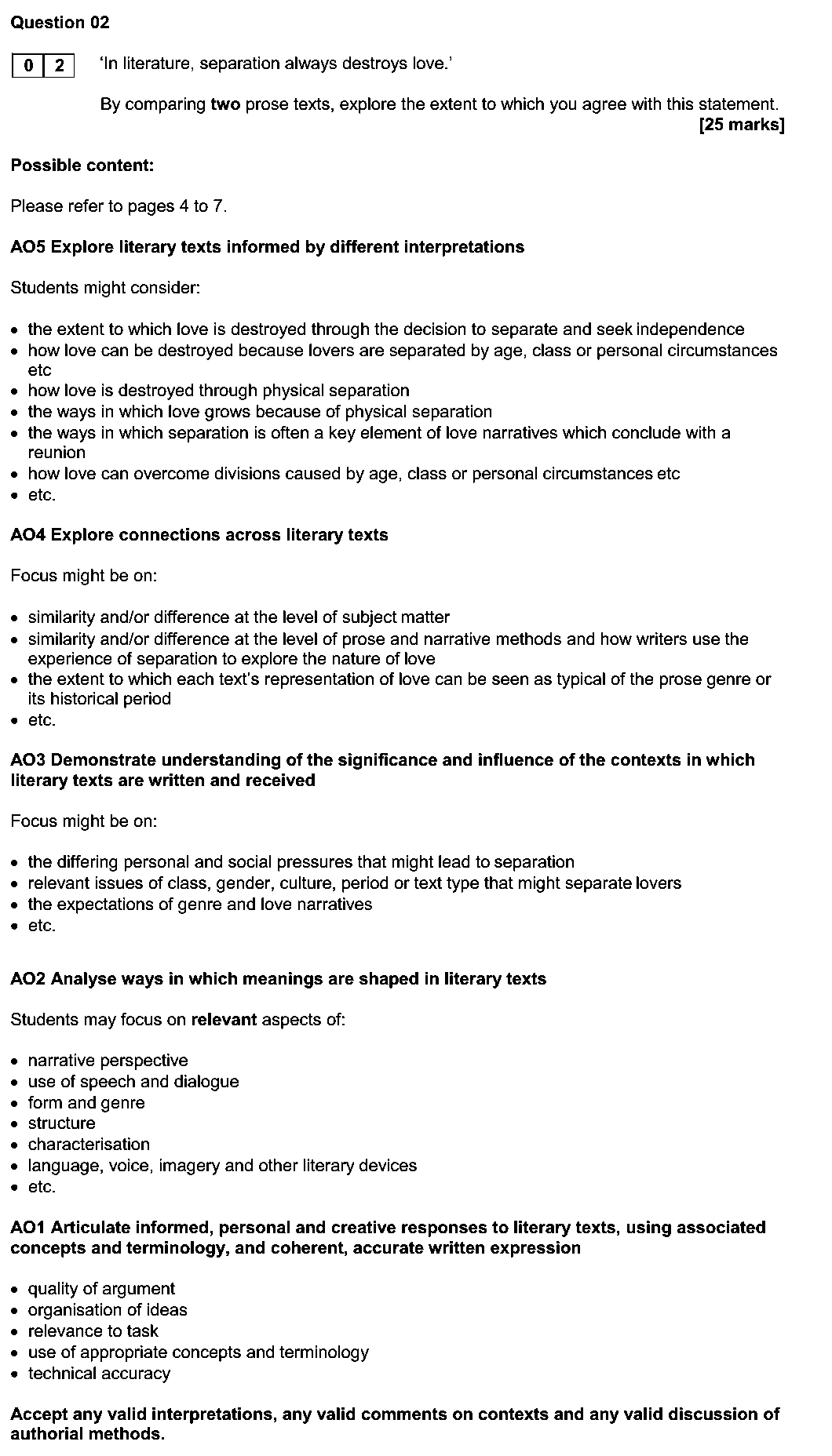
‘In literature, separation always destroys love.’
By comparing two prose texts, explore the extent to which you agree with this statement.
[25 marks]
November 2020 · AS Paper 2 · Q3 25 marks Comparing texts comparing prose love
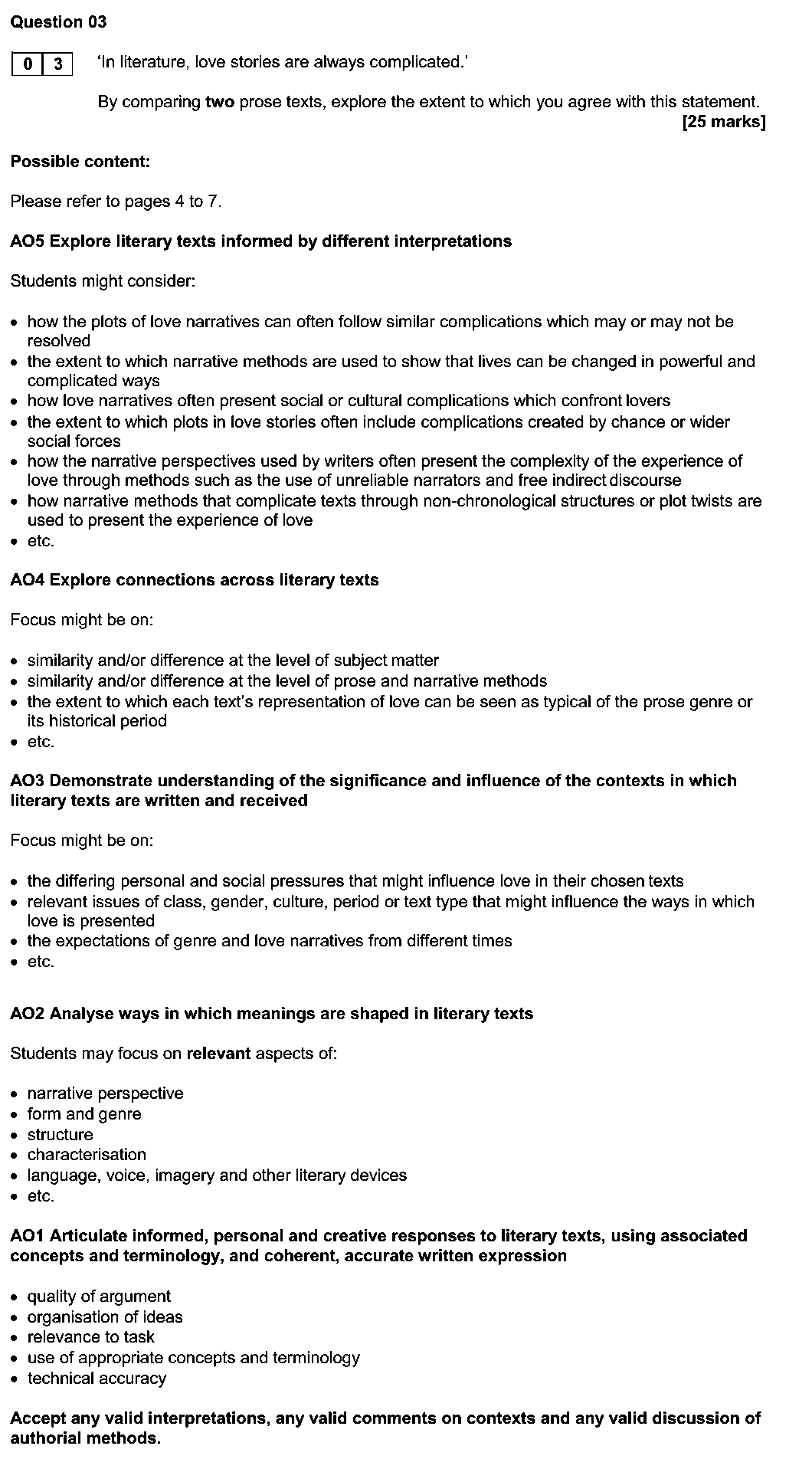
‘In literature, love stories are always complicated.’
By comparing two prose texts, explore the extent to which you agree with this statement.
[25 marks]

Work with an AQA English Literature A tutor

Want a paper marked and gone through with you? Message us.

Prefer email? Send an enquiry

If you are under 18, please include a parent's contact details. Enquiries go to enquiries@alevelenglishtutor.com and are deleted once handled. All tutoring is online.