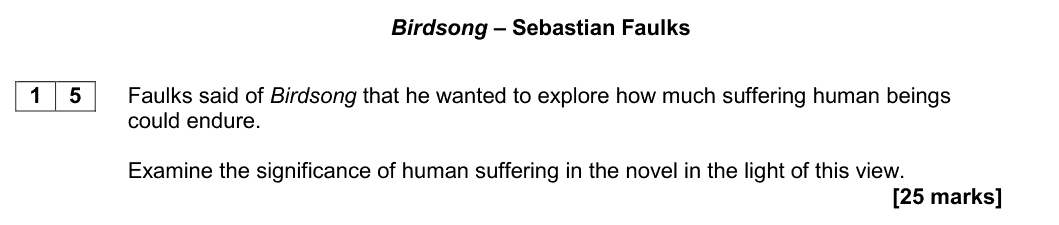
Birdsong – Sebastian Faulks ‘No child or future generation will ever know what this was like.’ Examine the significance of re-discovering and remembering the past within the novel.
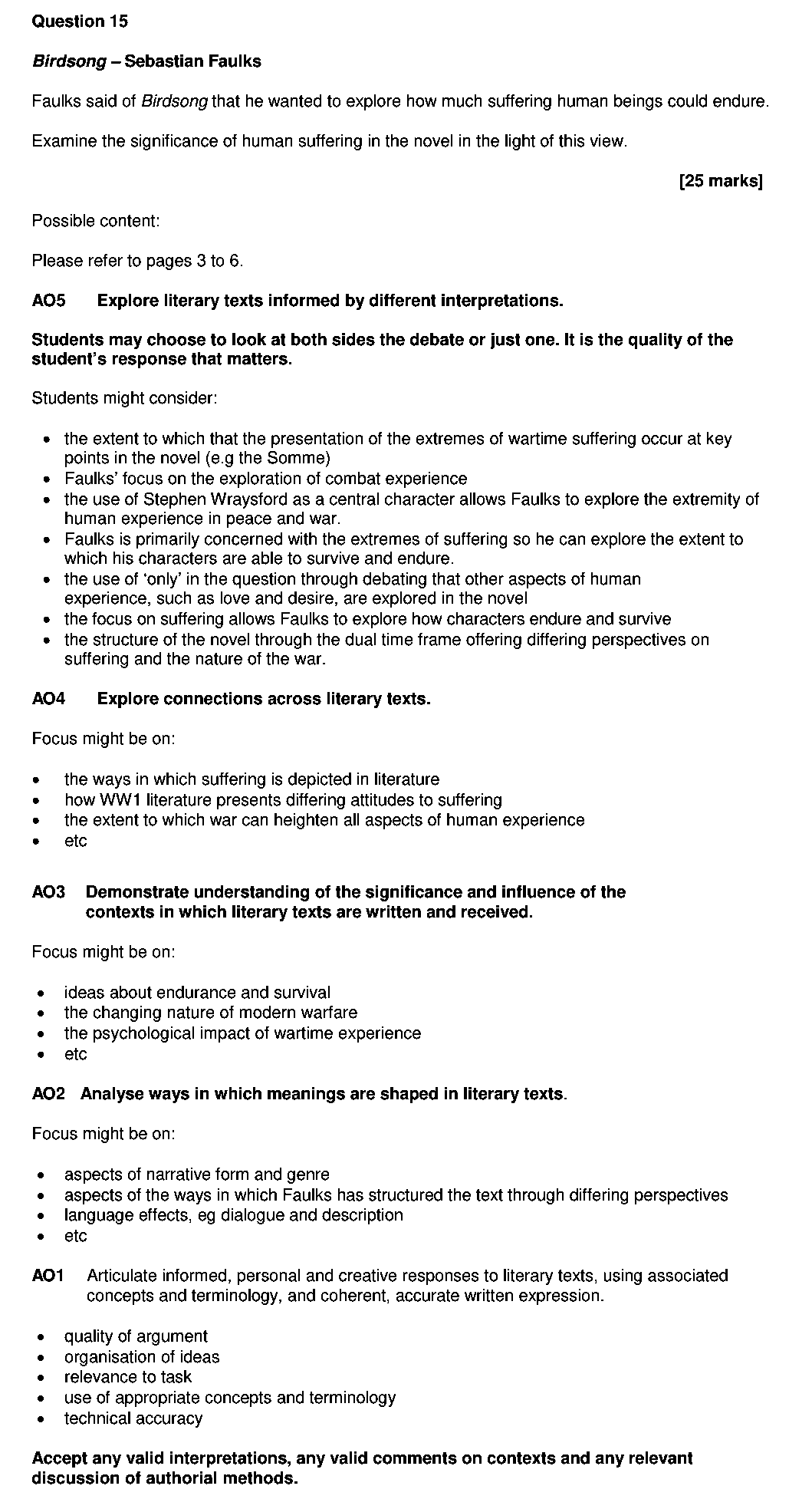
Birdsong – Sebastian Faulks Faulks said of Birdsong that he wanted to explore how much suffering human beings could endure. Examine the significance of human suffering in the novel in the light of this view.
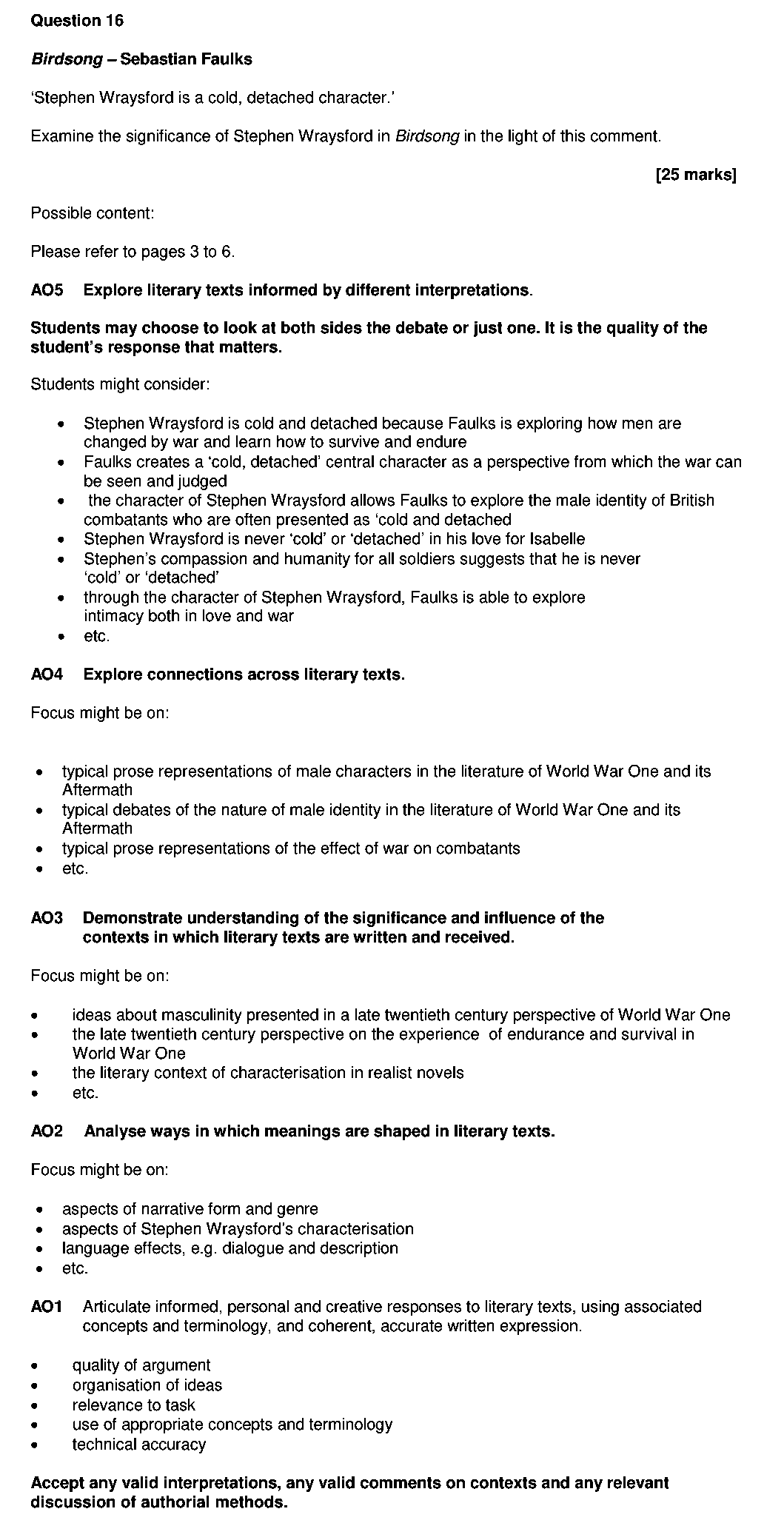
Birdsong – Sebastian Faulks ‘Stephen Wraysford is a cold, detached character.’ Examine the significance of Stephen Wraysford in Birdsong in the light of this comment.
Tap a question to zoom it. The texts and extracts open above it; the mark scheme (with its levels and indicative content) and the examiner's comment open underneath.
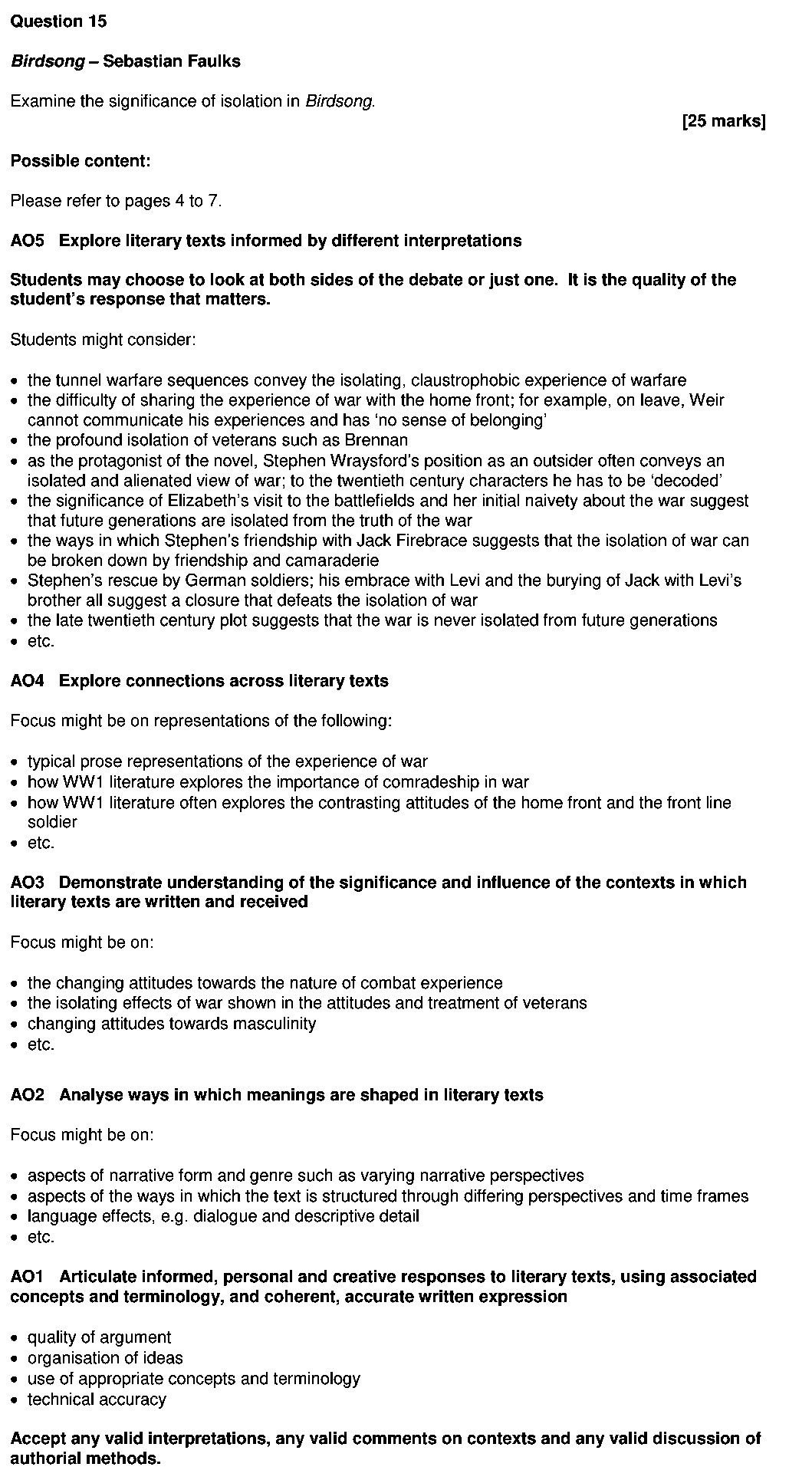
June 2025 · Paper 2A · Q1525 marksSet text essay
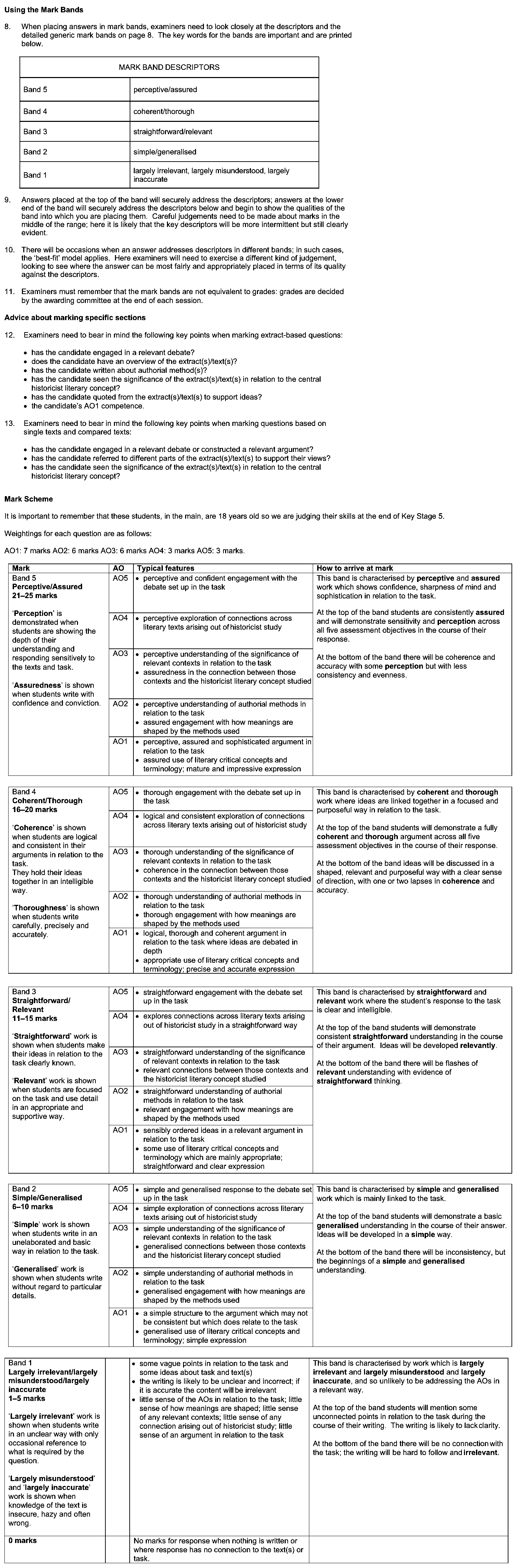
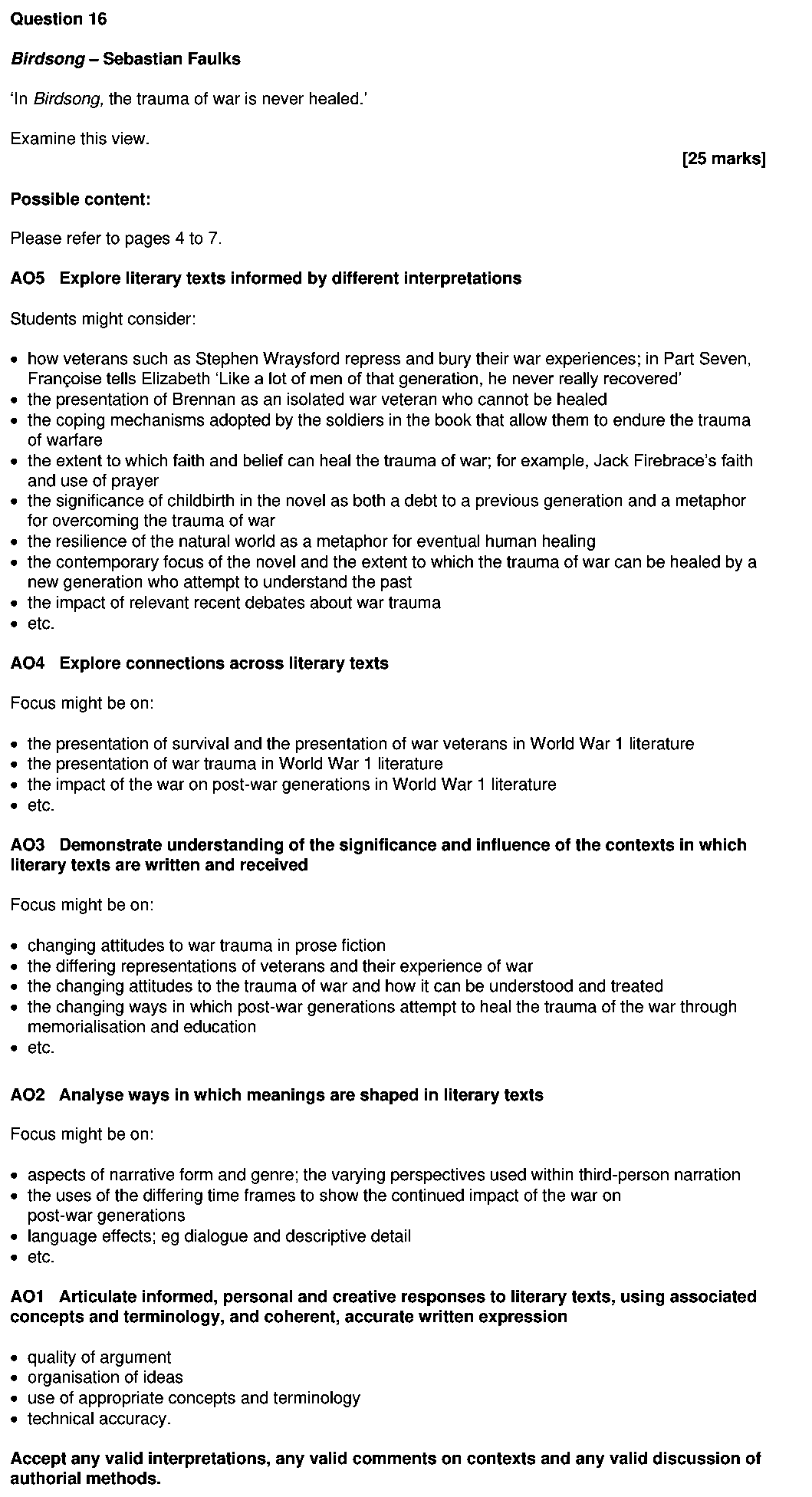
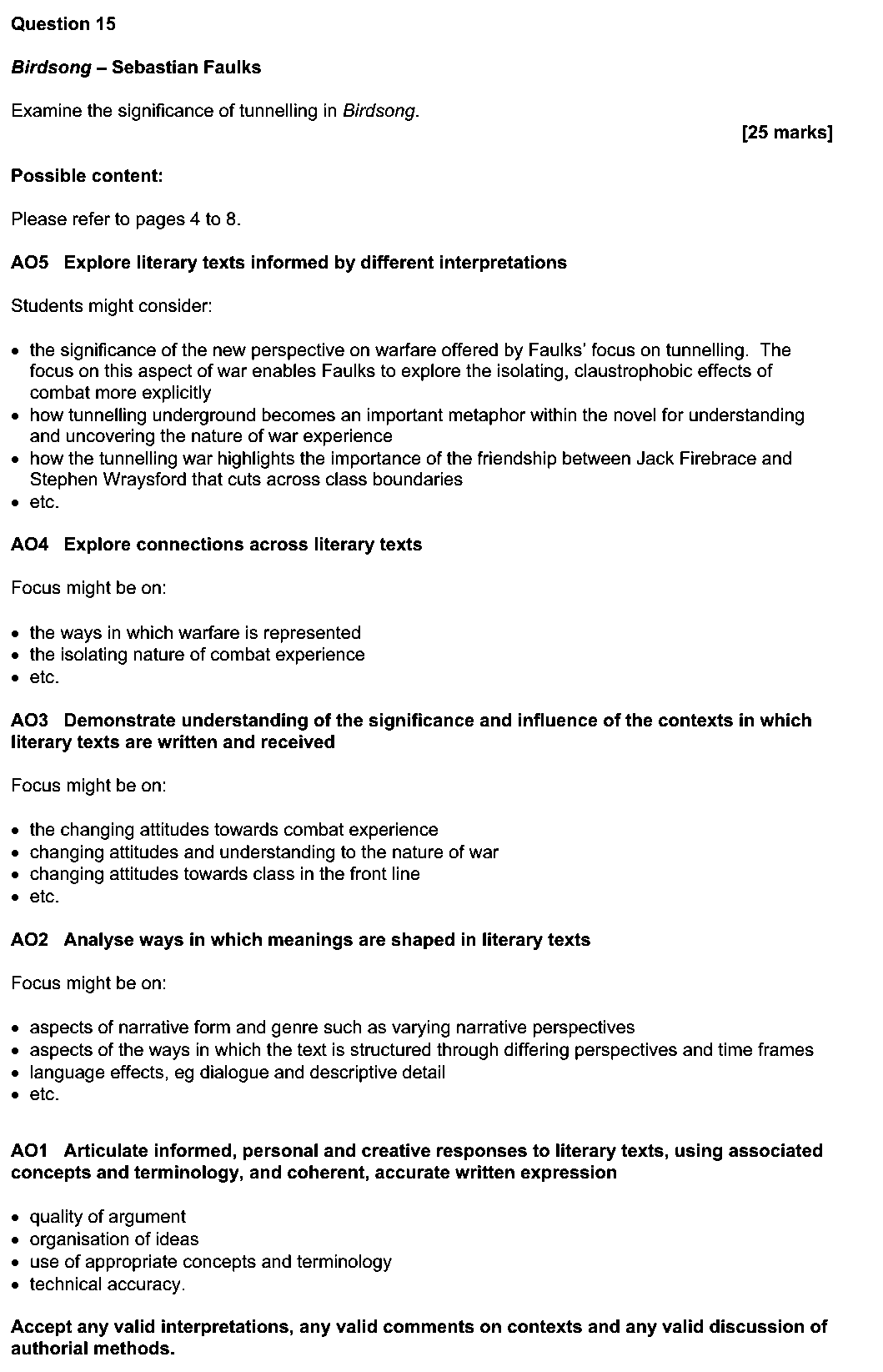
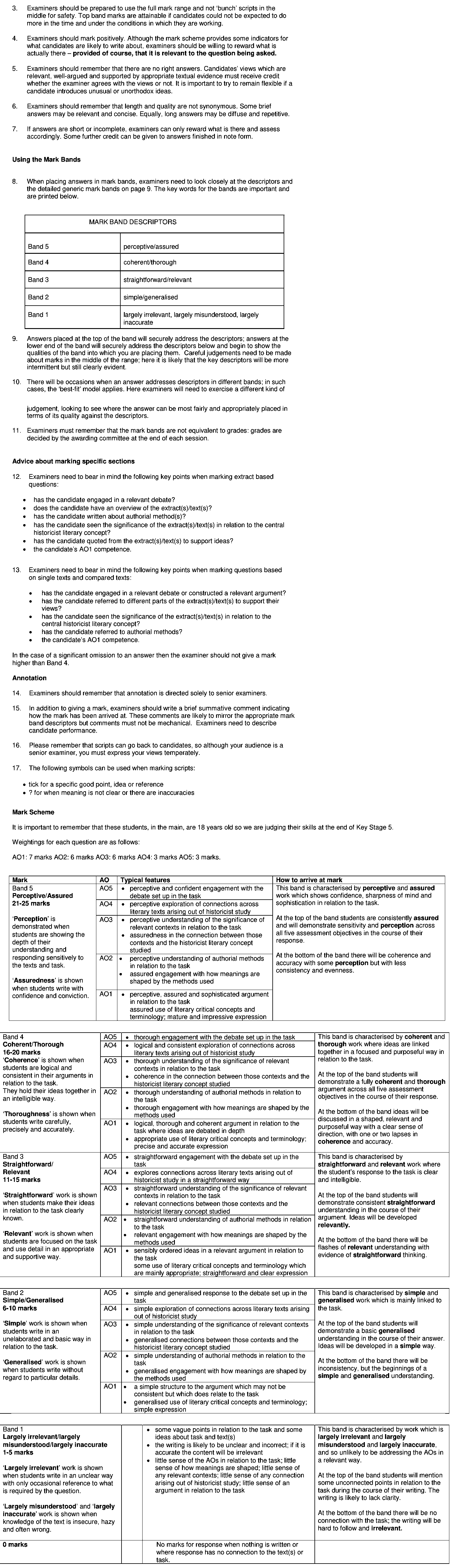
Mark scheme, including the levels and indicative content
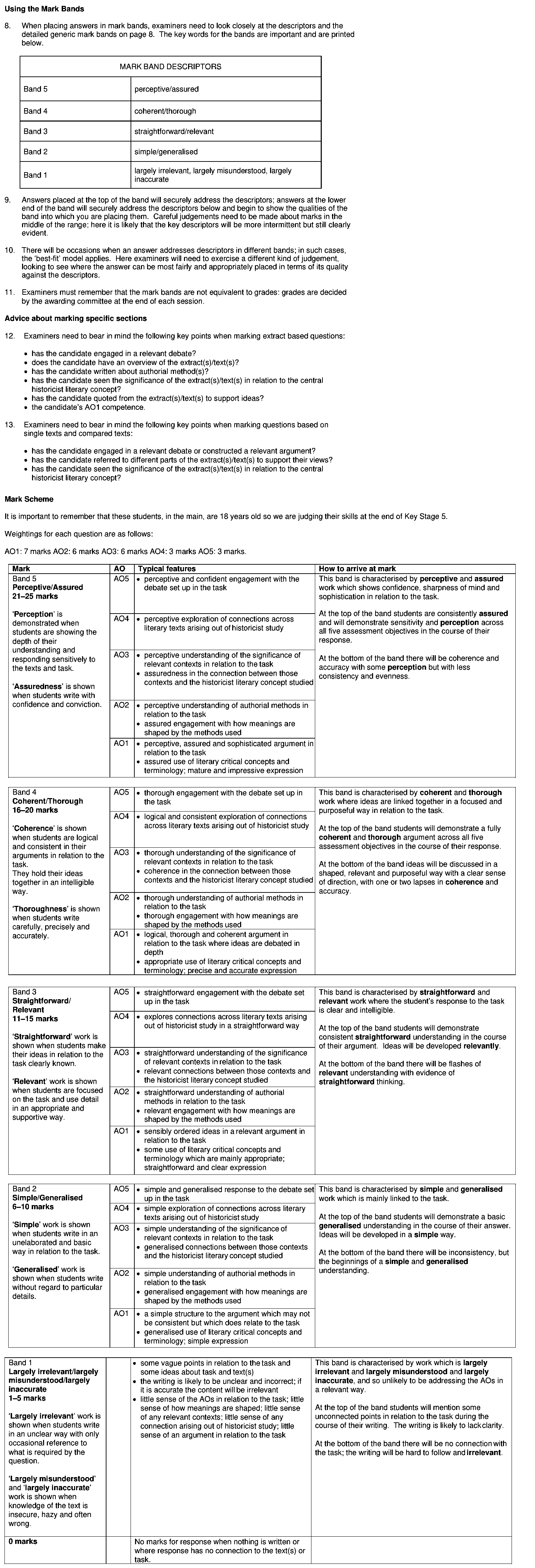
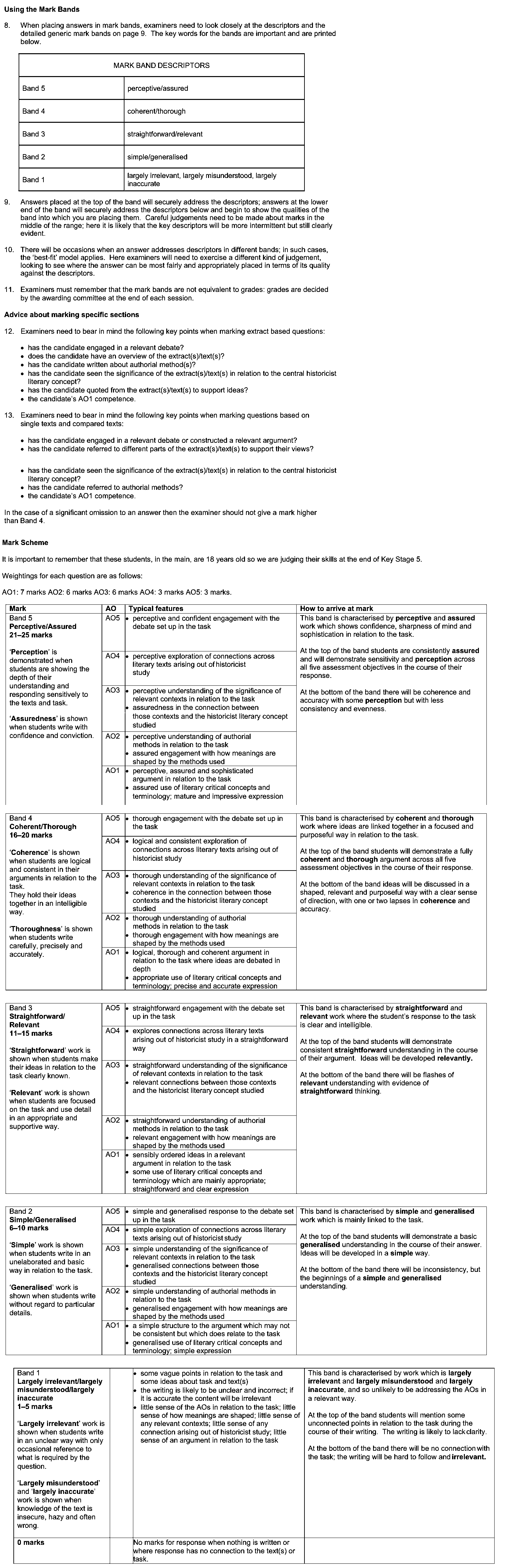
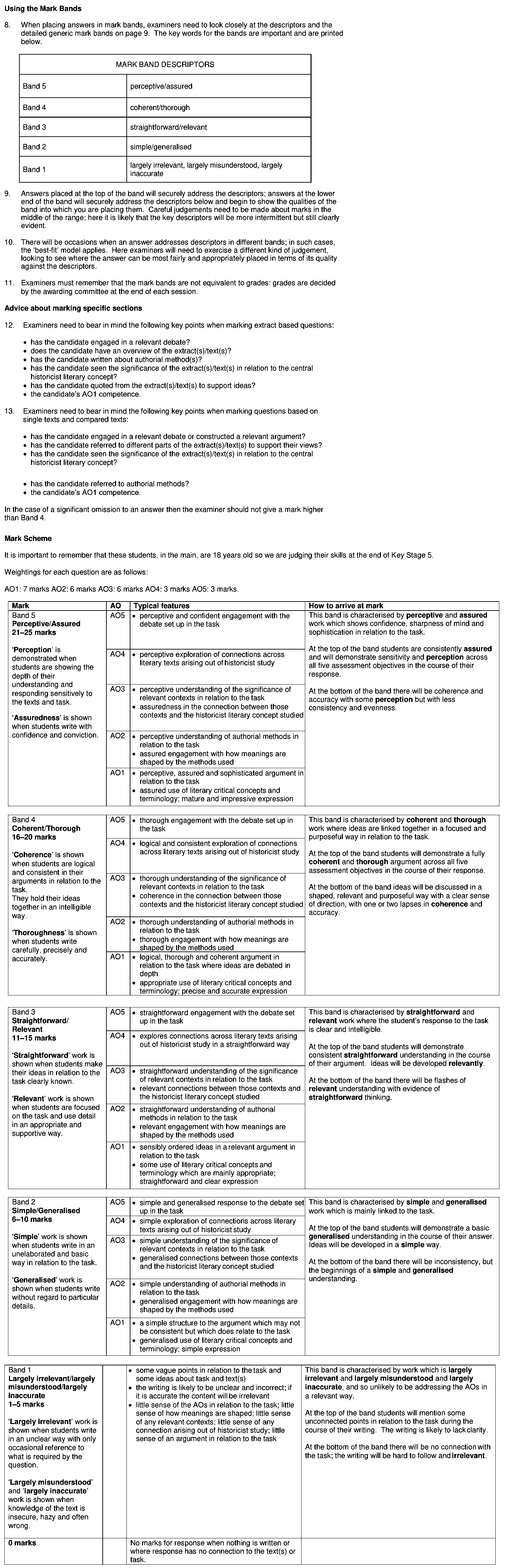
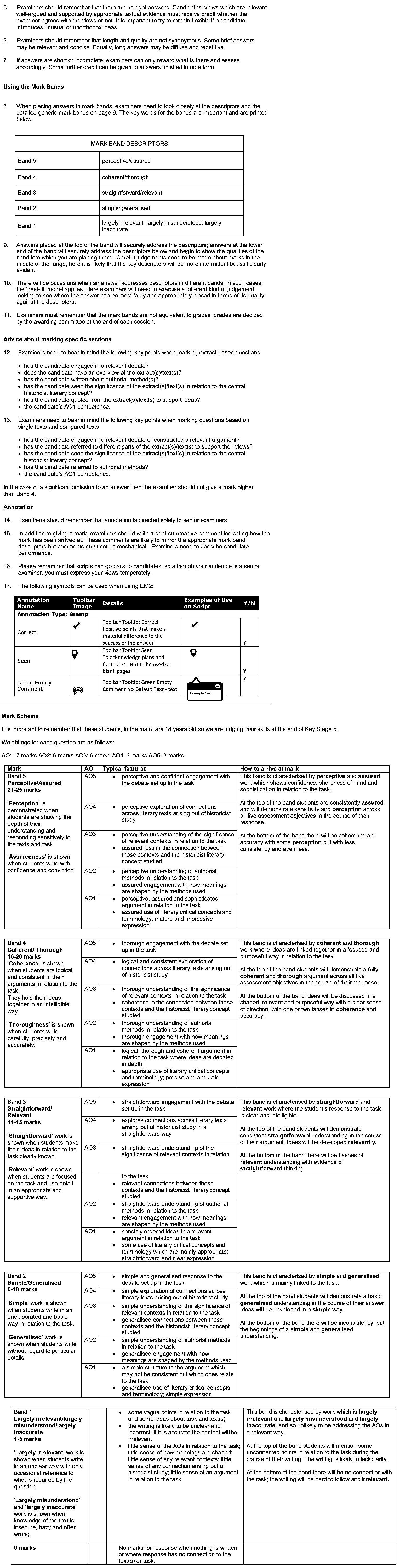
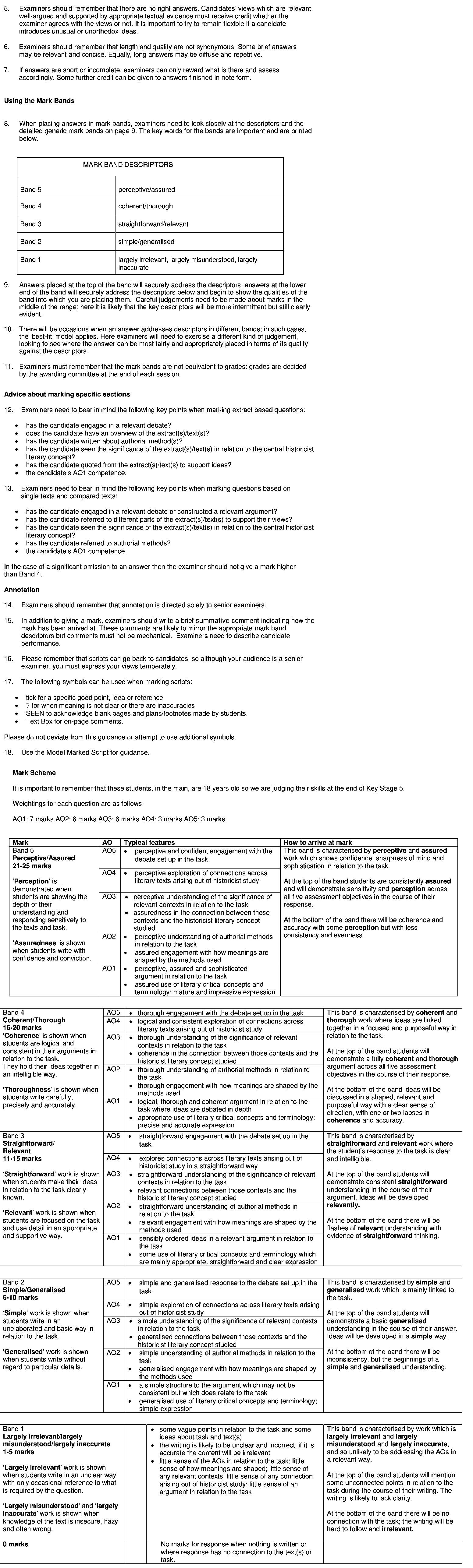
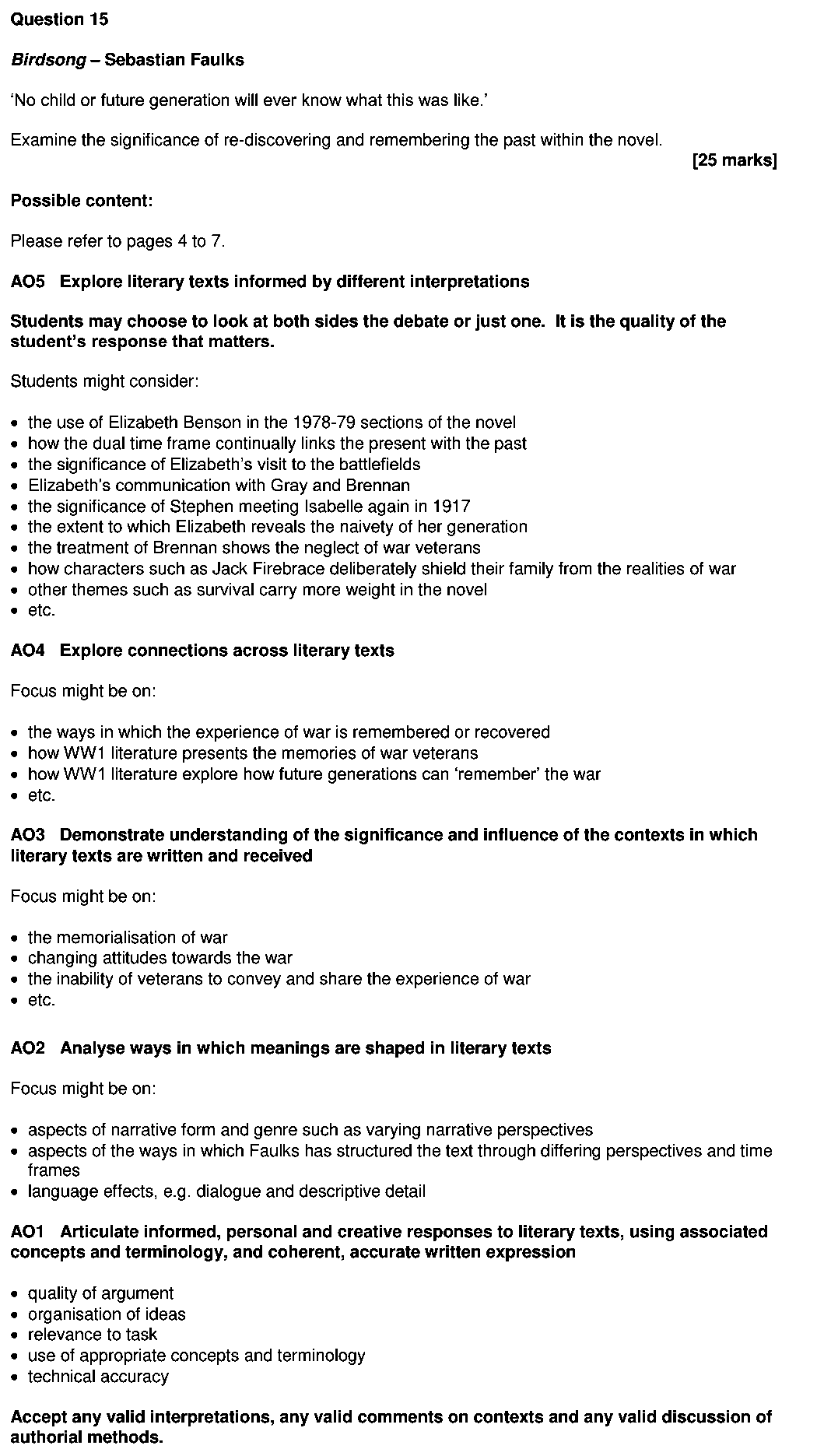
The general mark scheme (assessment objectives and bands)
Examiner's comment
Better answers: • demonstrated expert textual knowledge and considered material from all of the novel’s time frames • confidently considered the Somme setting in the pre-war, war and post-war sections • produced conceptual approaches that considered the pastoral aspects of the natural world presented in the prewar section on the visit to the Somme as a contrast to the ‘fall from grace’ shown in the presentation of the battle • considered remembrance and memorialisation through focusing on Elizabeth’s journey to Thiepval and her discovery of the truth about her grandfather’s wartime experiences. Less effective answers: • produced generalised work which largely just offered a narrative paraphrase focusing on the horrors of war • ignored the relevant pre- and post-war sections of the novel • failed to consider prose methods • produced work that sometimes echoed past questions.
Notes from the mark scheme and report
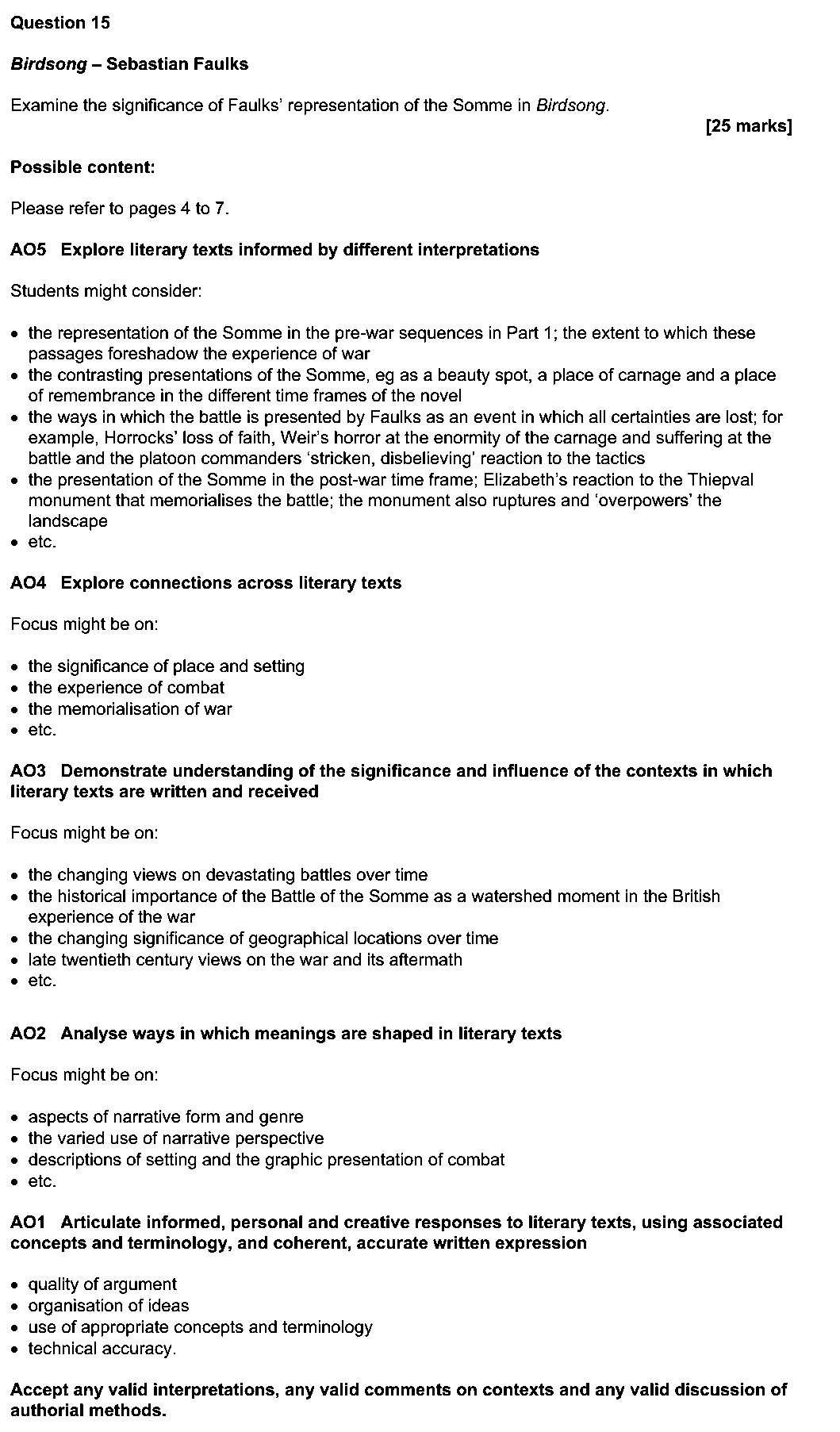
Focus: setting: the Somme
Open book, no extract
use all time frames: pre-war pastoral Somme visit foreshadowing the 'fall from grace', the battle as loss of all certainties (Horrocks, Weir), Elizabeth at the Thiepval memorial
weaker answers paraphrased the horrors of war, ignored the pre- and post-war sections or prose methods
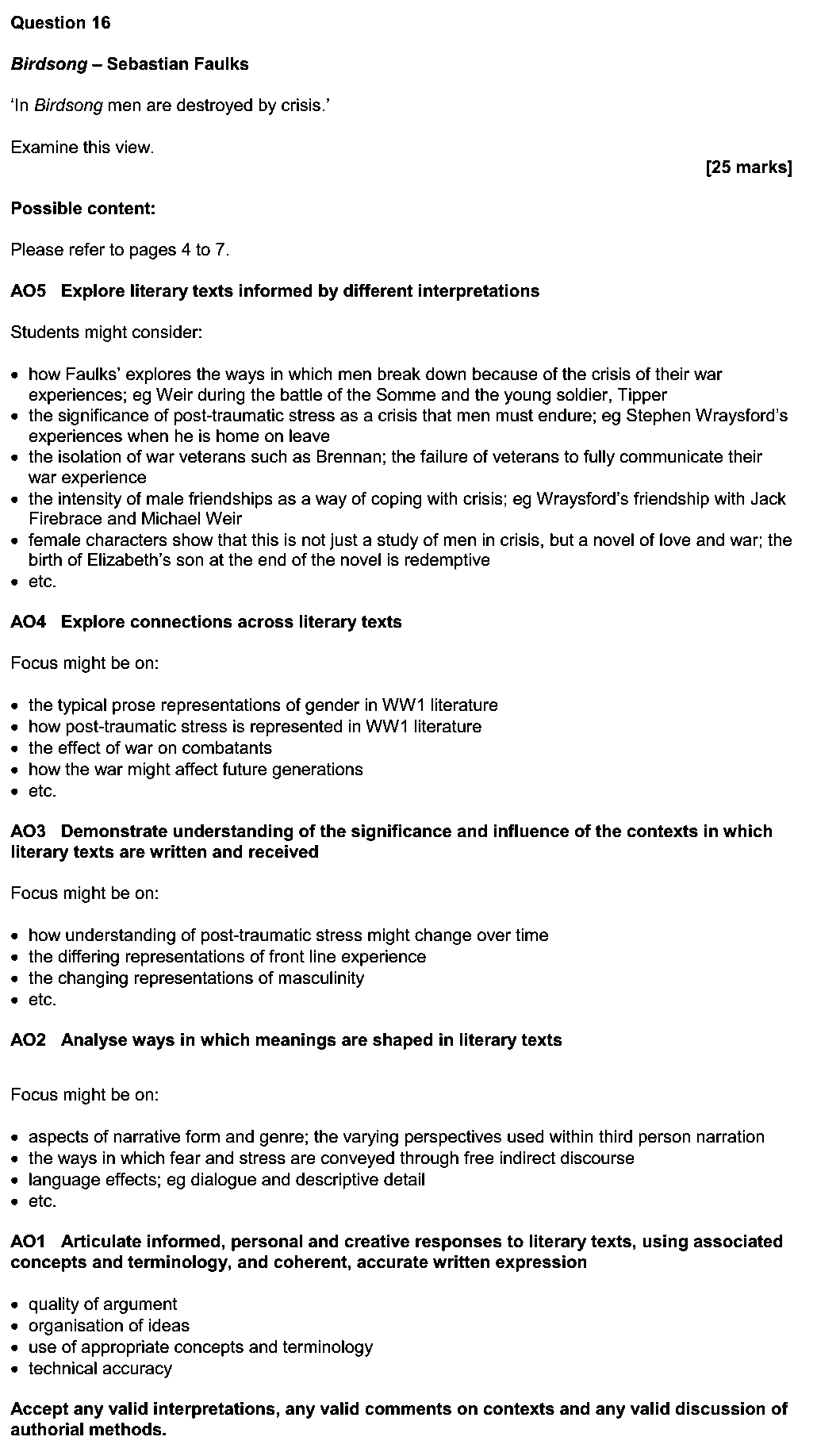
June 2025 · Paper 2A · Q1625 marksSet text essay
Mark scheme, including the levels and indicative content
The general mark scheme (assessment objectives and bands)
Examiner's comment
Better answers: • fully focused on all key words in the given view • always considered Faulks’ presentation of women within the wider context of his representation of war • could consider a range of characters such as Isabelle, Jeanne and Elizabeth in a purposeful, relevant way • confidently considered Elizabeth’s function as a surrogate for reader within the post war time frame. Explored the ways in which she is ‘crucial’ in a late twentieth century perspective on the war • demonstrated an understanding of how the brutalisation of war is shown in Stephen’s treatment of the prostitute and Isabelle’s physical scarring • considered the extent to which women could help men overcome the trauma of war through discussing Jeanne’s role within the novel as well as debating the significance of the birth and naming of Elizabeth’s child at the conclusion of the novel. Less effective answers: • were list-like responses that showed some knowledge of female characters, but failed to engage with all the keywords of the given view • supported thinking by narrative paraphrase rather than considering literary methods • discussed female characters as ‘real people’ rather than considering their function within the text • were often assertive and saw women as peripheral in a male-dominated novel • either ignored the contemporary sections of the novel or struggled to engage with Elizabeth’s function within Faulks’ representation of war.
Notes from the mark scheme and report
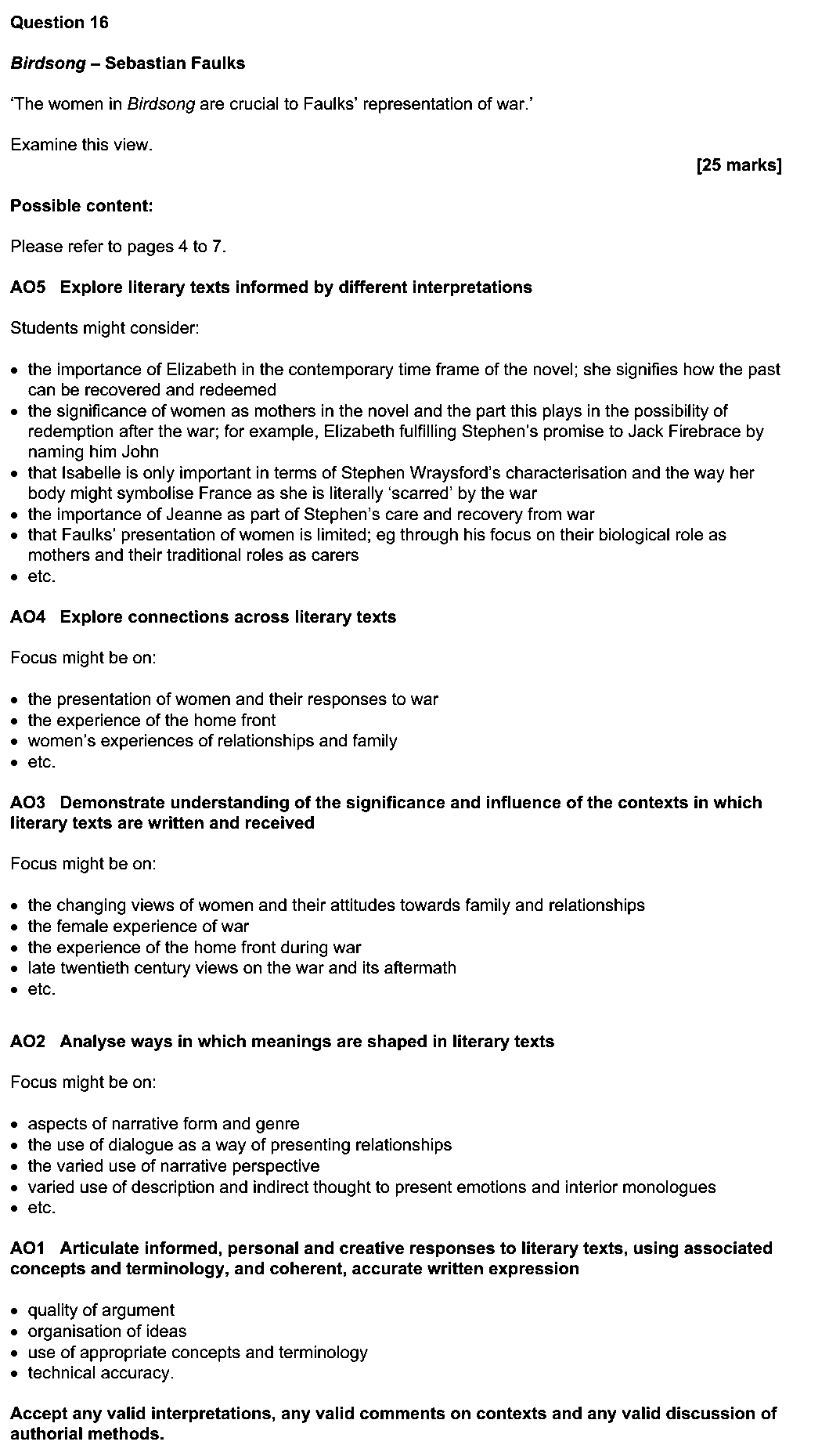
Focus: character: women in Birdsong
Open book, no extract
women within the representation of war: Isabelle's scarring, Stephen and the prostitute, Jeanne aiding recovery, Elizabeth as reader surrogate in the modern frame, naming her son John
debate whether women are limited to mothers and carers
weaker answers listed female characters as real people, saw women as peripheral or ignored the modern sections
June 2024 · Paper 2A · Q1525 marksSet text essay
Mark scheme, including the levels and indicative content
The general mark scheme (assessment objectives and bands)
Examiner's comment
Better answers: • demonstrated expert textual knowledge and considered material from all of the novel’s time frames • confidently considered the Somme setting in the pre-war, war and post-war sections • considered the significance of the novel’s title as well considering the motif of birds throughout the novel • explored the ways in which the natural world is juxtaposed with the experience of war • sometimes produced conceptual approaches that considered the pastoral aspects of the natural world presented in the prewar section as a contrast to the ‘fall from grace’ of the world of war. Less effective answers: • produced generalised work which lacked well-chosen textual detail • lacked focus on the keywords of the question and largely just discussed the unnatural qualities of modern warfare • failed to consider prose methods • produced work that sometimes echoed past questions.
Notes from the mark scheme and report
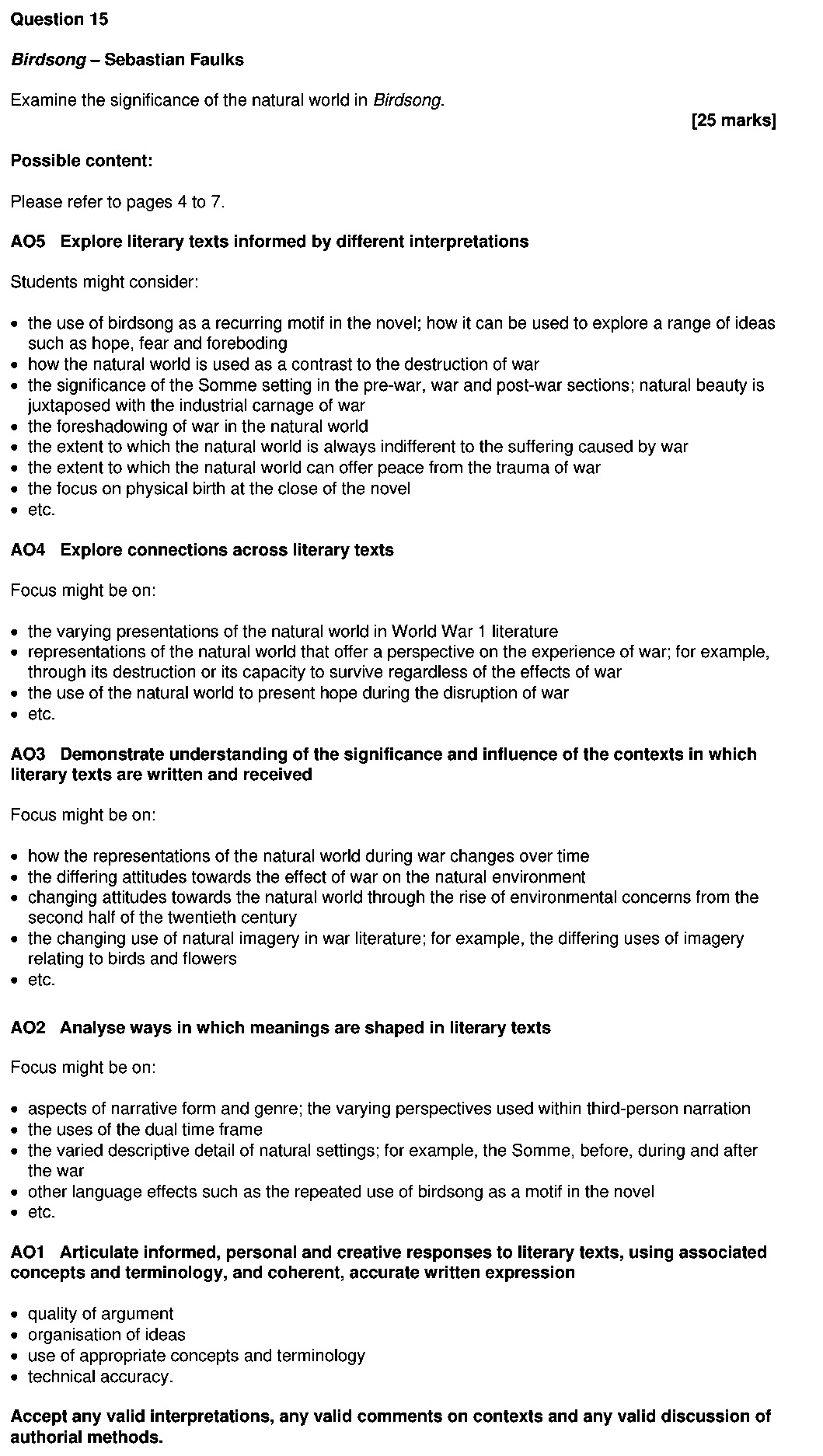
Focus: setting: the natural world
Open book, no extract
use all time frames: birdsong motif and title, the Somme setting pre-war, war and post-war, nature vs industrial carnage, foreshadowing, nature's indifference or peace, pastoral before the fall
weaker answers wrote only on the unnatural qualities of modern war, lacked textual detail or ignored prose methods
June 2024 · Paper 2A · Q1625 marksSet text essay
Mark scheme, including the levels and indicative content
The general mark scheme (assessment objectives and bands)
Examiner's comment
Better answers: • ranged widely through the novel and supported ideas by well-chosen integrated quotation • considered the isolation and claustrophobia of the tunnelling war as a presentation of the nature of trauma • confidently considered the intergenerational nature of trauma through exploring the function of the twin time frames of the novel • explored the presentation of Brennan as an isolated war veteran who can never be healed • could discuss Stephen Wraysford’s trauma within the contextual overview of the post war ‘silent generation’ • considered the all-enveloping trauma of war through discussing the home leave experiences of Michael Weir and Stephen Wraysford • fully debated the given view through considering the extent to which the past trauma of war is healed through the birth and naming of Elizabeth’s child. Less effective answers: • could only focus on trauma by picking out narrative descriptions of front line combat and attempting to analyse Faulks’ ‘graphic language’ • considered relevant context such as shell shock and the repression of war experience in separate sections that moved too quickly away from the text • often used narrative paraphrase and failed to consider prose methods • largely ignored the contemporary sections of the novel.
Notes from the mark scheme and report
Focus: theme: trauma never healed
Open book, no extract
debate 'never healed': Stephen's repression ('never really recovered'), Brennan, tunnelling claustrophobia, home leave of Weir and Stephen, the post-war 'silent generation', healing through the birth and naming of Elizabeth's child and the twin time frames
weaker answers analysed 'graphic' combat language, bolted on shell-shock context or ignored the modern sections
June 2023 · Paper 2A · Q1525 marksSet text essay
Mark scheme, including the levels and indicative content
The general mark scheme (assessment objectives and bands)
Examiner's comment
More effective answers: • integrated contextual understanding of the importance of tunnelling war into a literary discussion of Faulks’ aims as a writer to present the lesser known aspects of the war to the modern reader • were able to consider how the setting of the tunnels serves to heighten and highlight aspects of character and character relationships through considering Stephen Wraysford and Jack Firebrace • the extent to which tunnelling, and tunnels are echoed in the modern-day episodes in the novel • considered the use of the tunnelling episodes in the structure of the novel as a whole • explored tunnelling as a metaphor for broader themes within the novel, for example Stephen Wraysford’s rescue from the collapsed tunnel by German soldiers as a presentation of post war rebirth and reconciliation. Less effective answers: • adopted a list like structure that could only paraphrase the horrific aspects of tunnel warfare • over relied on contextual knowledge without integrating this into a literary discussion of tunnelling • ignored the modern-day sections of the novel • misunderstood ‘significance’ as importance
Notes from the mark scheme and report
Focus: setting: tunnelling
Open book, no extract
tunnelling as Faulks' new perspective on the war for modern readers, claustrophobia, the Stephen-Jack friendship across class, tunnels echoed in the modern-day sections, structural role, metaphor (Stephen's rescue by Germans as rebirth and reconciliation)
weaker answers listed horrors, bolted on context, ignored the modern sections or read 'significance' as importance
June 2023 · Paper 2A · Q1625 marksSet text essay
Mark scheme, including the levels and indicative content
The general mark scheme (assessment objectives and bands)
Examiner's comment
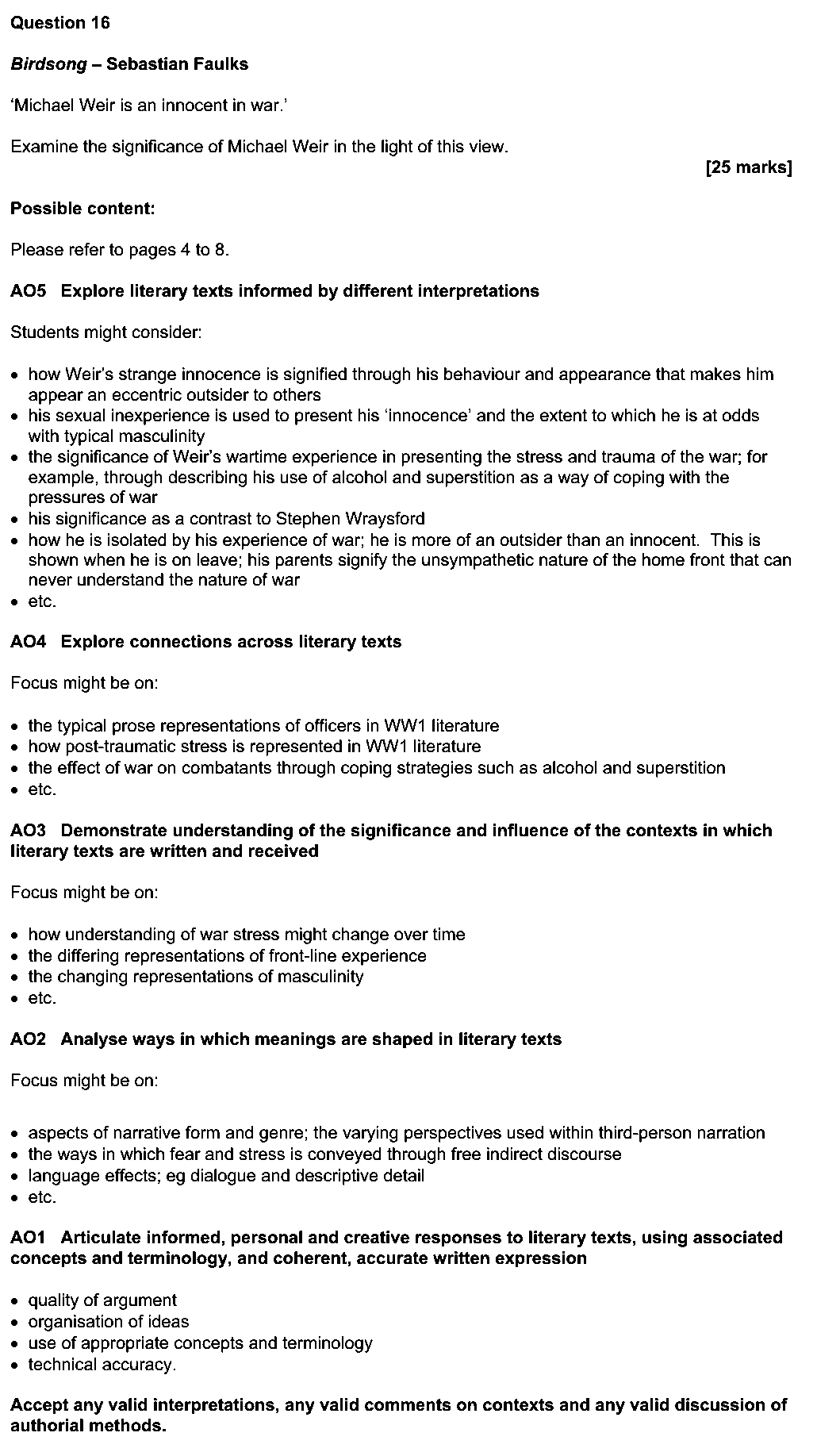
More effective answers: • approached the given view in a more nuanced way through considering varying aspects of ‘innocent in war’ • considered Michael Weir’s function within the novel, through exploring his relationship with Stephen Wraysford • explored Michael Weir’s experience of war and the significance of his response to the battle of the Somme • considered how Michael Weir is used to show the alienation of soldiers returning home on leave • explored the significance of the impact of Michael Weir’s death. Less effective answers: • only approached Michael Weir through offering narrative paraphrase • ignored the given view • did not address or fully understand the key word ‘significance’
Notes from the mark scheme and report
Focus: character: Michael Weir
Open book, no extract
nuance 'innocent in war': eccentric outsider, sexual inexperience, alcohol and superstition as coping, response to the Somme, contrast with Stephen, alienation on home leave with his parents, impact of his death
weaker answers paraphrased, ignored the view or misread 'significance'
June 2022 · Paper 2A · Q1525 marksSet text essay
Mark scheme, including the levels and indicative content
The general mark scheme (assessment objectives and bands)
Examiner's comment
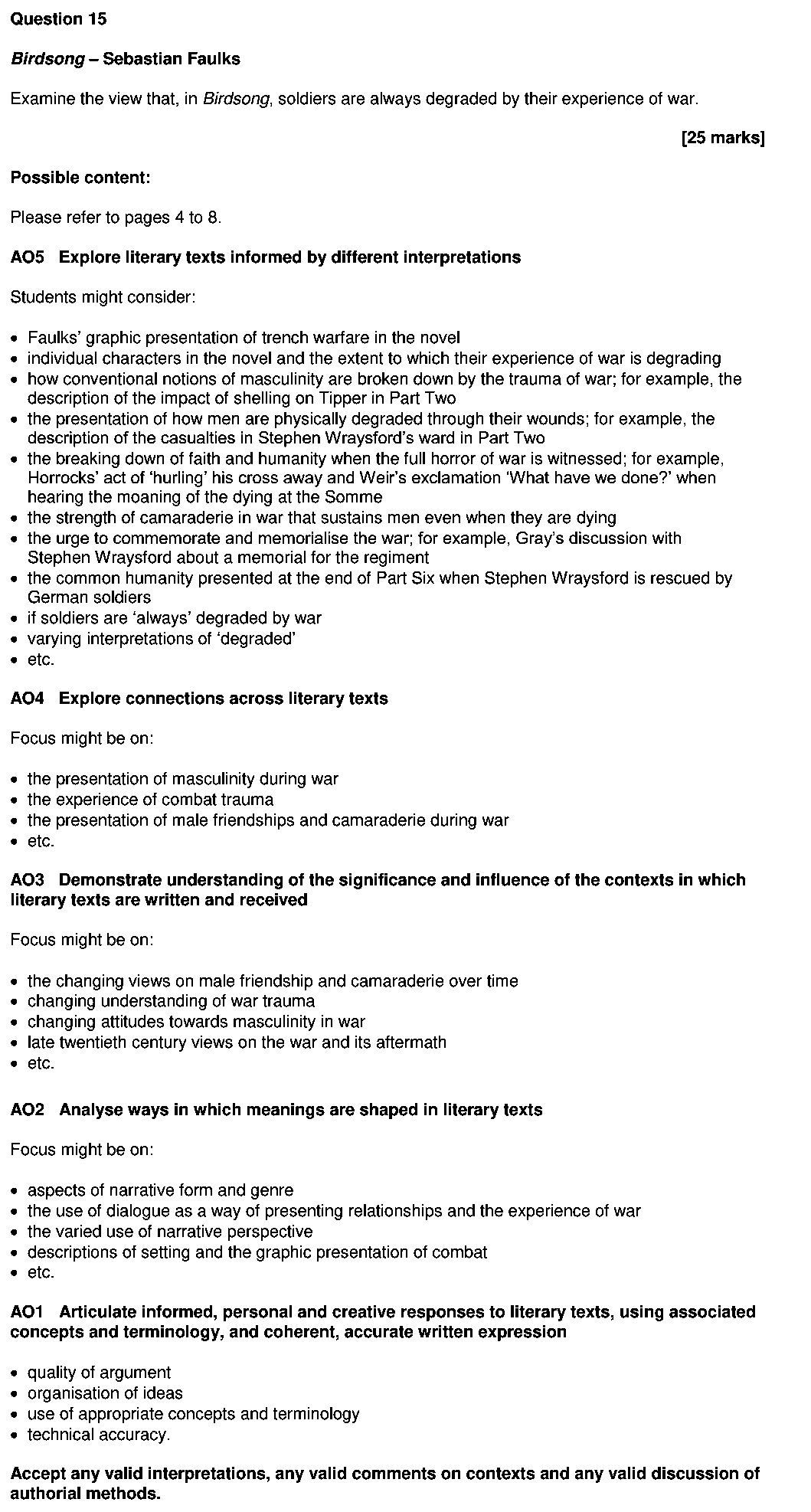
This was a popular choice amongst students who engaged with the keywords of the given view in a range of ways. A common approach was to focus mostly on the physical degradation of war and discuss the presentation of death and suffering in combat. In less successful responses students often failed to consider the presentation of ‘degradation’ and only used quotation to illustrate contextual points about the scale and nature of death and injury in the war. Stronger answers considered degradation through considering the varying forms of trauma within the novel; there was some good work that considered Stephen Wraysford’s alienation and the plight of veterans such as Brennan, for example. Perceptive, confident responses challenged the given view by considering the common humanity and friendship between soldiers that can transcend the degrading nature of war. Such responses often considered the significance of Stephen’s rescue by a German soldier in part 6 of the novel.
Notes from the mark scheme and report
Focus: theme: degradation of soldiers by war
Open book, no extract
popular
consider 'always' and 'degraded'
credited: physical and psychological degradation (Tipper, the ward, Horrocks' cross, Weir), Stephen's alienation, veterans like Brennan
best answers challenged the view through comradeship and Stephen's rescue by a German soldier in Part 6
weaker answers used quotation only to illustrate context about death
June 2022 · Paper 2A · Q1625 marksSet text essay
Mark scheme, including the levels and indicative content
The general mark scheme (assessment objectives and bands)
Examiner's comment
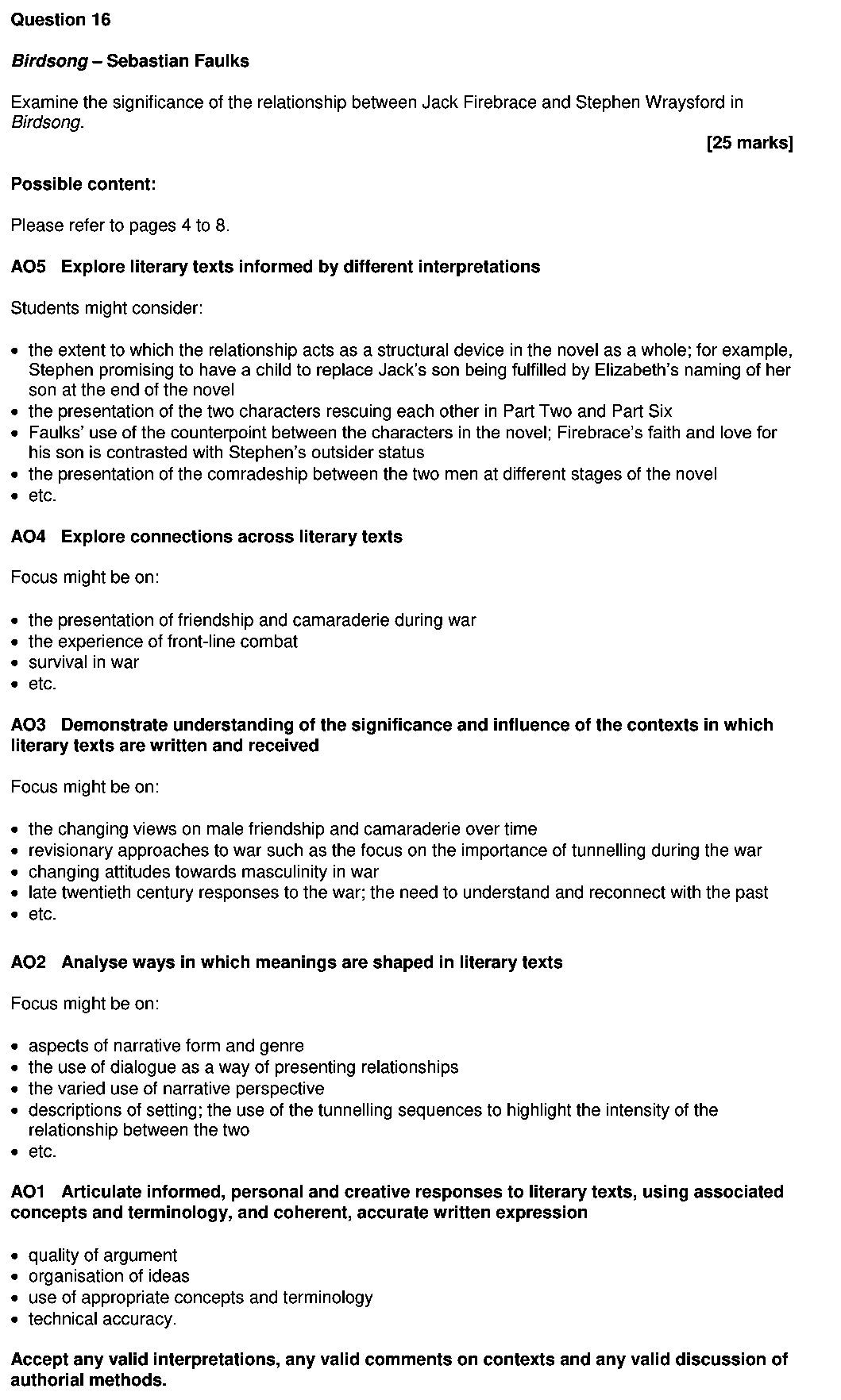
This less popular question elicited some interesting, varied responses. Many students considered the presentation of the relationship between Jack Firebrace and Stephen Wraysford as a way of exploring the significance of comradeship in the novel. More developed responses considered the presentation of their relationship through exploring the setting of the tunnelling war in section 6 of the novel where emotional intensity is mirrored in the claustrophobic entrapment of the two characters. The most successful responses demonstrated secure, confident knowledge of the novel as a whole. Such work was able to examine how the relationship is part of the novel’s narrative structure and is a bridge to the present-day sections where Stephen’s promise to have children for Jack is ‘honoured’ by Elizabeth’s naming of her son. Less successful responses could only offer character sketches of the two without considering their relationship. Such work produced descriptive accounts of plot rather than focusing on the presentation of their relationship and its function in the novel as a whole.
Notes from the mark scheme and report
Focus: relationship: Jack Firebrace and Stephen Wraysford
Open book, no extract
less popular
relationship as comradeship and structural device: mutual rescues in Parts 2 and 6, the tunnel's claustrophobia, Jack's faith vs Stephen's outsider status, the promise fulfilled by Elizabeth naming her son
weaker answers gave separate character sketches or plot narrative
November 2021 · Paper 2A · Q1525 marksSet text essay
Mark scheme, including the levels and indicative content
The general mark scheme (assessment objectives and bands)
Notes from the mark scheme and report
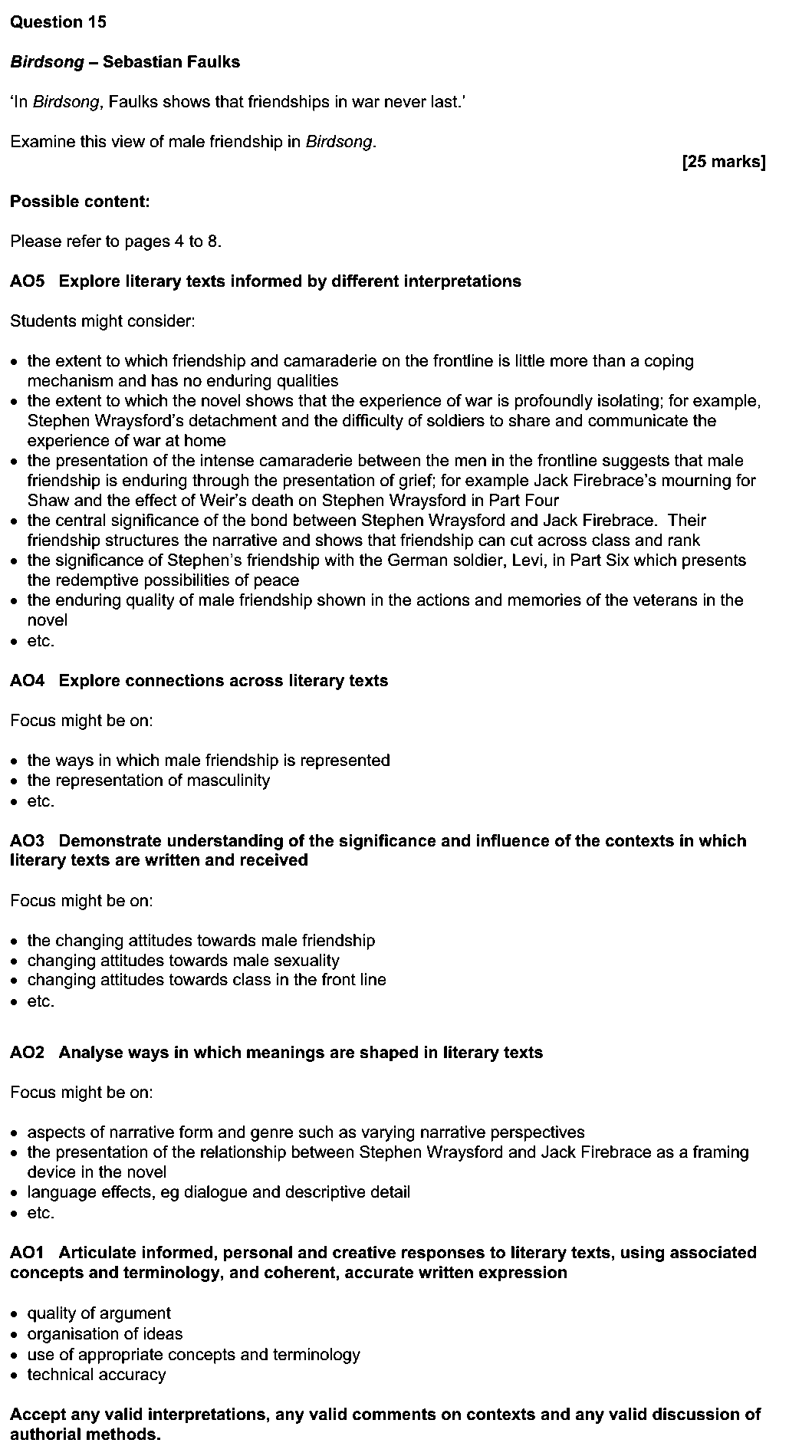
Focus: relationship: male friendship
Open book, no extract
view: friendships in war never last
no examiner report (November series)
MS: camaraderie as mere coping mechanism, isolation and Stephen's detachment, grief showing lasting bonds (Jack for Shaw, Stephen for Weir), Stephen and Jack across class and rank, Stephen and Levi, veterans' memories
November 2021 · Paper 2A · Q1625 marksSet text essay
Mark scheme, including the levels and indicative content
The general mark scheme (assessment objectives and bands)
Notes from the mark scheme and report
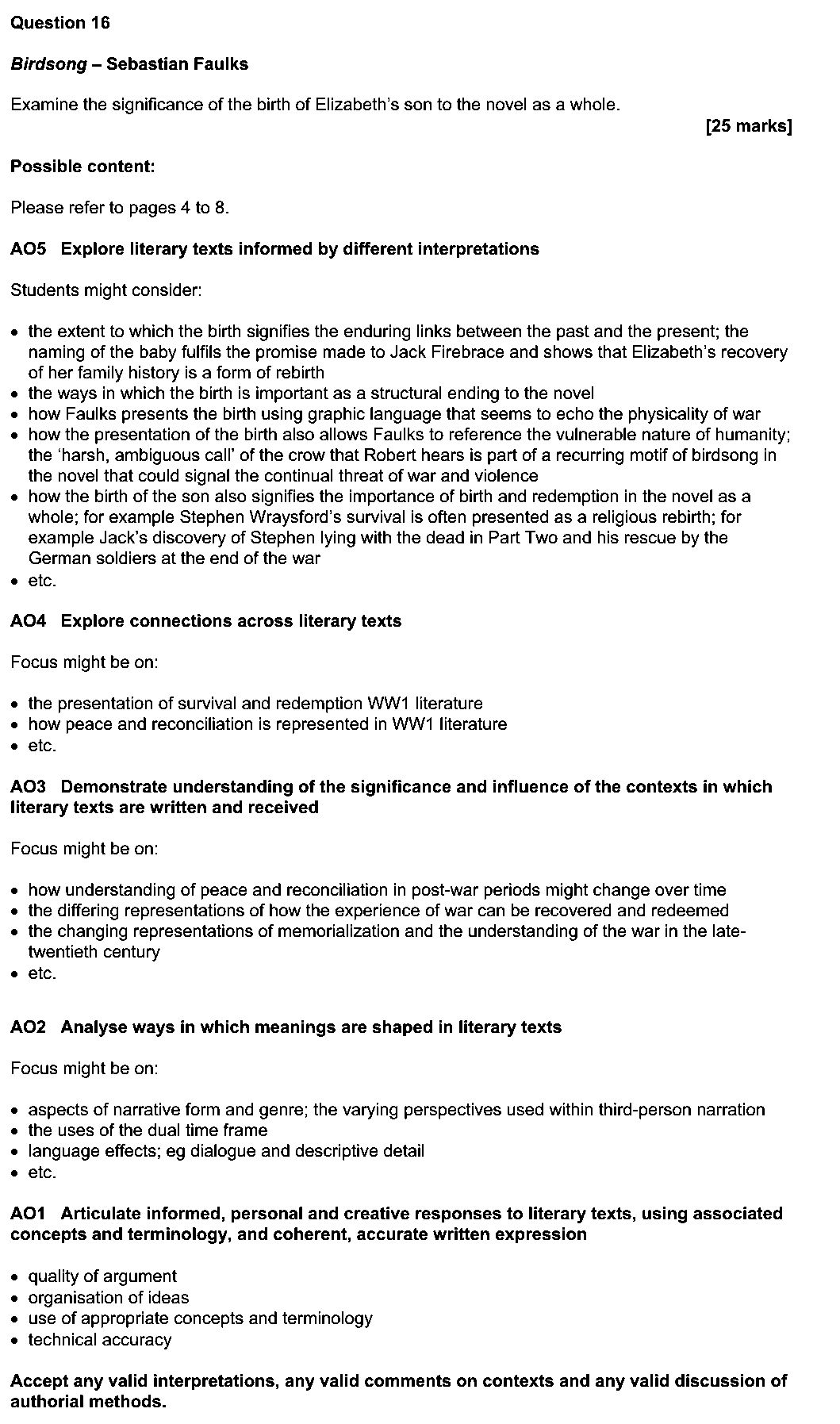
Focus: structure: the birth of Elizabeth's son
Open book, no extract
no examiner report (November series)
MS: link between past and present, naming fulfils promise to Jack, structural ending, graphic birth echoing war, crow's 'harsh, ambiguous call' and birdsong motif, birth and redemption elsewhere (Stephen found among the dead, rescue by Germans)
November 2020 · Paper 2A · Q1525 marksSet text essay
Mark scheme, including the levels and indicative content
The general mark scheme (assessment objectives and bands)
Notes from the mark scheme and report
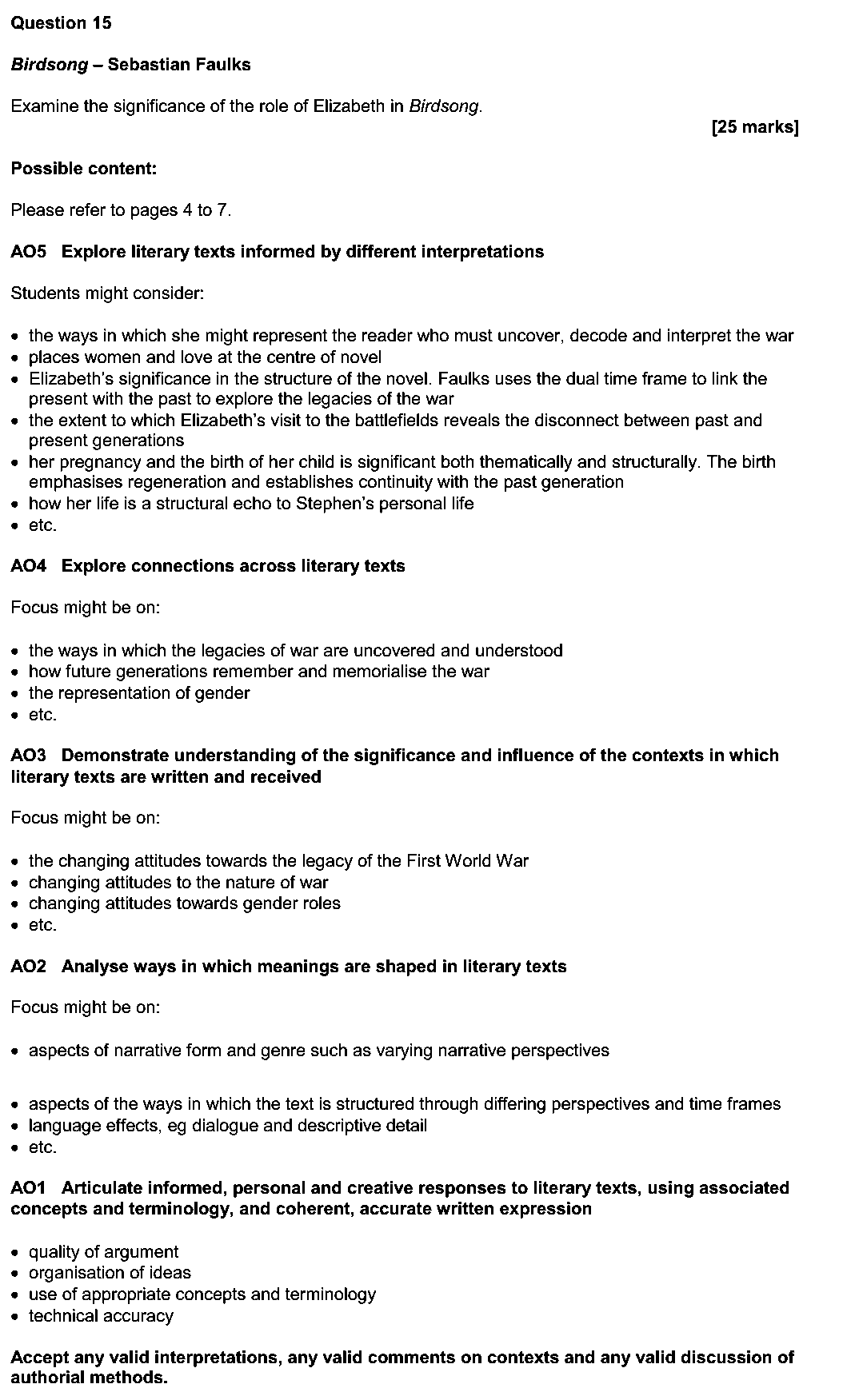
Focus: character: Elizabeth
Open book, no extract
no examiner report (November series)
MS: Elizabeth as reader-figure decoding the war, women and love at the centre, dual time frame and legacy, battlefield visit and generational gap, pregnancy and birth as regeneration, echo of Stephen's life
November 2020 · Paper 2A · Q1625 marksSet text essay
Mark scheme, including the levels and indicative content
The general mark scheme (assessment objectives and bands)
Notes from the mark scheme and report
Focus: theme: men in crisis
Open book, no extract
view: men destroyed by crisis
no examiner report (November series)
MS: breakdown of Weir and Tipper at the Somme, Stephen's trauma on leave, Brennan's isolation, male friendship as coping, love and the redemptive birth as counterweights
June 2019 · Paper 2A · Q1525 marksSet text essay
Mark scheme, including the levels and indicative content
The general mark scheme (assessment objectives and bands)
Examiner's comment
The two Birdsong questions were equally popular. This question allowed students to range widely through the text and examiners were impressed by the variety of responses offered. Many students focused on Stephen Wraysford and Weir and there was some excellent work on the isolating nature of war experience. Effective textual selection was a key to success in this question; less successful responses often resorted to a range of quotation only to illustrate a repeated point. The most effective responses were able to consider isolation as a way of presenting intense comradeship; there were some excellent discussions of how the isolation of the tunnels is used to highlight the significance of Stephen and Jack’s relationship. A few also explored Elizabeth’s sense of isolation from her ancestors and were able to reflect thoughtfully on the dual time frames of the text.
Notes from the mark scheme and report
Focus: theme: isolation
Open book, no extract
MS: tunnels, Weir unable to communicate on leave, Brennan, Stephen as outsider, Elizabeth's distance from the past, Stephen and Jack, Levi's embrace
ER: excellent on Stephen and Weir
best saw isolation highlighting comradeship (tunnels, Stephen and Jack) and Elizabeth's isolation from ancestors
weaker strung quotations on one point
June 2019 · Paper 2A · Q1625 marksSet text essay
Mark scheme, including the levels and indicative content
The general mark scheme (assessment objectives and bands)
Examiner's comment
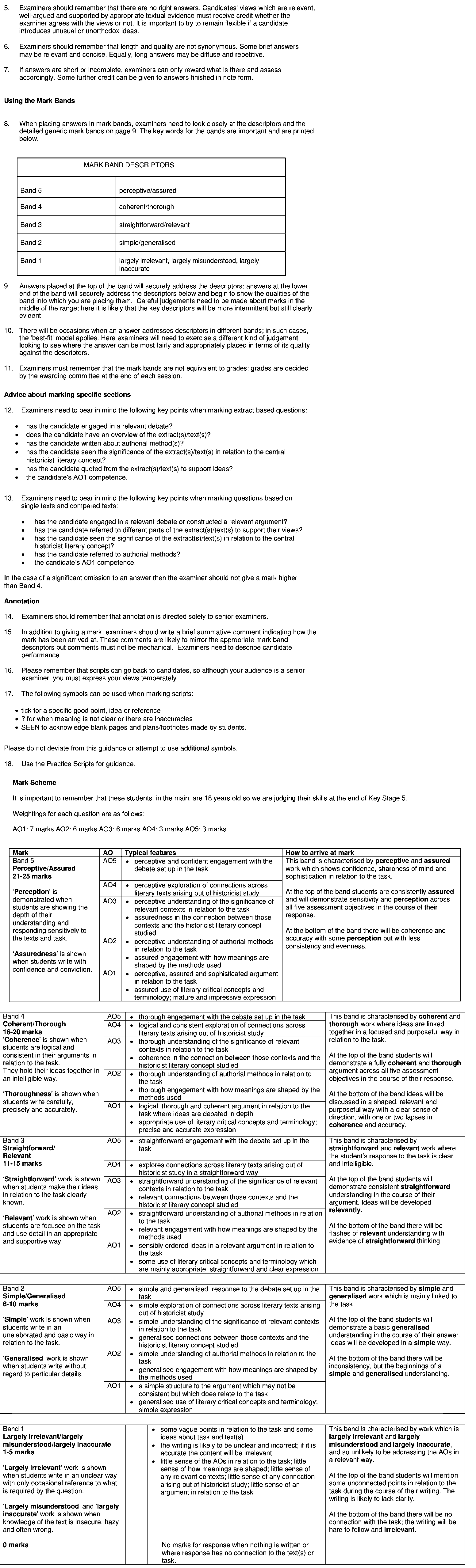
This question again elicited a range of interesting responses, which rewarded students who were prepared to think independently and make adventurous textual choices. Most students were able to consider both physical and psychological survival, and the most effective responses developed the debate through exploring the survival of Stephen’s memory and legacy at the end of the novel. Less successful responses asserted that survival was not a major concern and focused on an entirely different idea such as the horror of war. It is important to stress that the given view in a question should be debated and not arbitrarily rejected and replaced by an unrelated theme or idea.
Notes from the mark scheme and report
Focus: theme: survival
Open book, no extract
view: above all a novel about survival
MS: superstition and ritual, Stephen tested, friendship with Jack, rebirth (tunnels, birth of Elizabeth's son), the Somme and Thiepval, arbitrary death, truth surviving via Elizabeth
ER: best covered physical and psychological survival and Stephen's legacy
weaker rejected the view for an unrelated theme such as horror
June 2018 · Paper 2A · Q1525 marksSet text essay
Mark scheme, including the levels and indicative content
The general mark scheme (assessment objectives and bands)
Examiner's comment
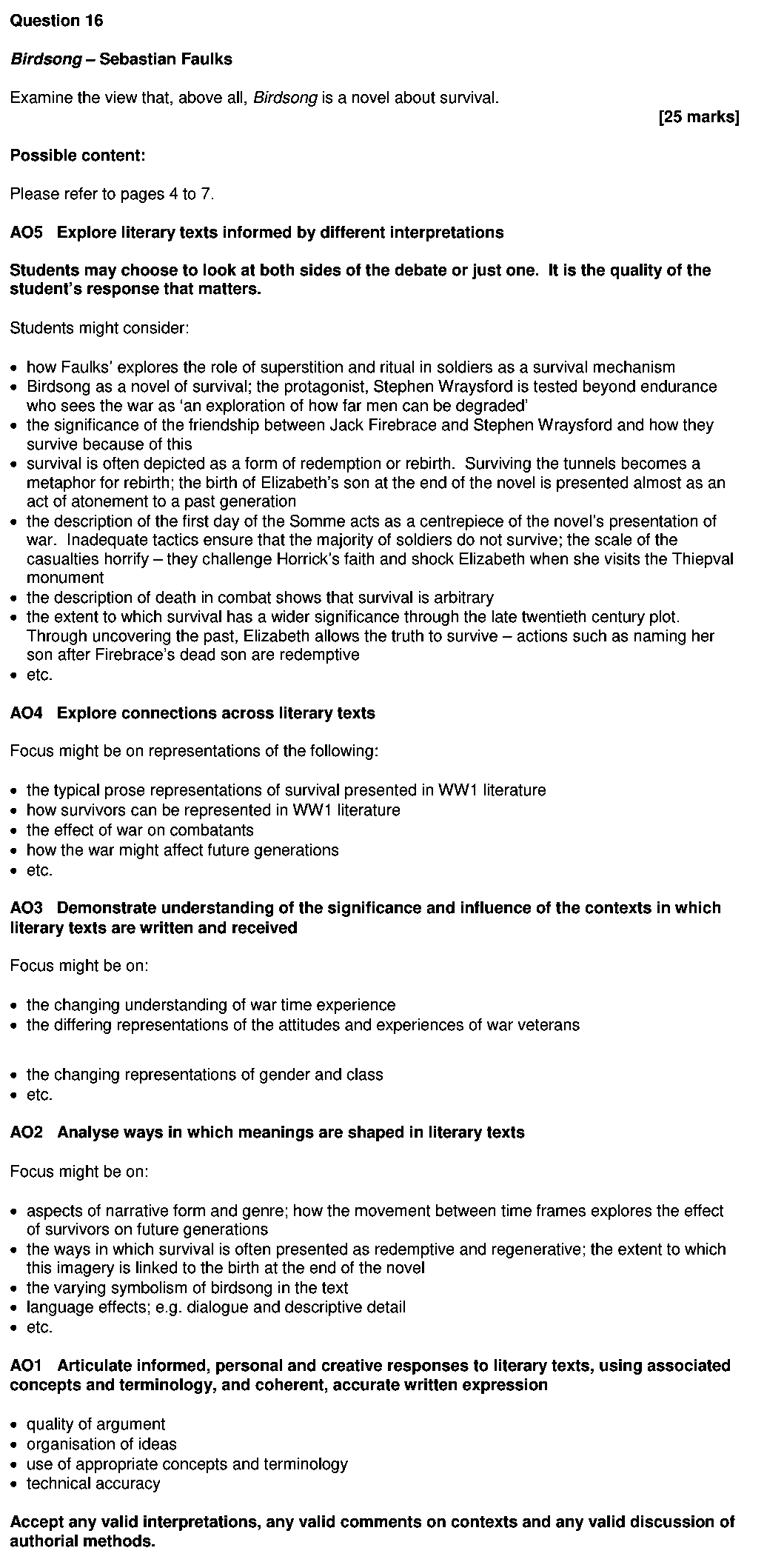
This was the more popular of the two questions set and examiners were impressed by the breadth and range of responses. Successful answers had a clear literary focus and considered how the differing time frames and the role of Elizabeth were significant within this debate. Strong responses didn’t just give overview about narrative structure, but worked hard to examine its effect through detailed close reading which examined the close links between the two time periods. Such answers were able to compare, for example, the linked tunnelling experience of Jack Firebrace with Elizabeth’s mundane impatience on an underground journey to show how the modern world is ignorant of the pain and sacrifices of the past. Thoughtful answers also broadened the debate through considering the ways in which veterans seek to bury and forget the past.
Notes from the mark scheme and report
Focus: theme: re-discovering and remembering the past
Open book, no extract
quotation 'No child or future generation will ever know what this was like'
MS: Elizabeth in 1978-79, dual time frame, battlefield visit, Gray and Brennan, neglect of veterans
ER: more popular
successful answers closely analysed links between time periods (Jack's tunnelling vs Elizabeth's tube journey) and veterans' wish to forget
June 2018 · Paper 2A · Q1625 marksSet text essay
Mark scheme, including the levels and indicative content
The general mark scheme (assessment objectives and bands)
Examiner's comment
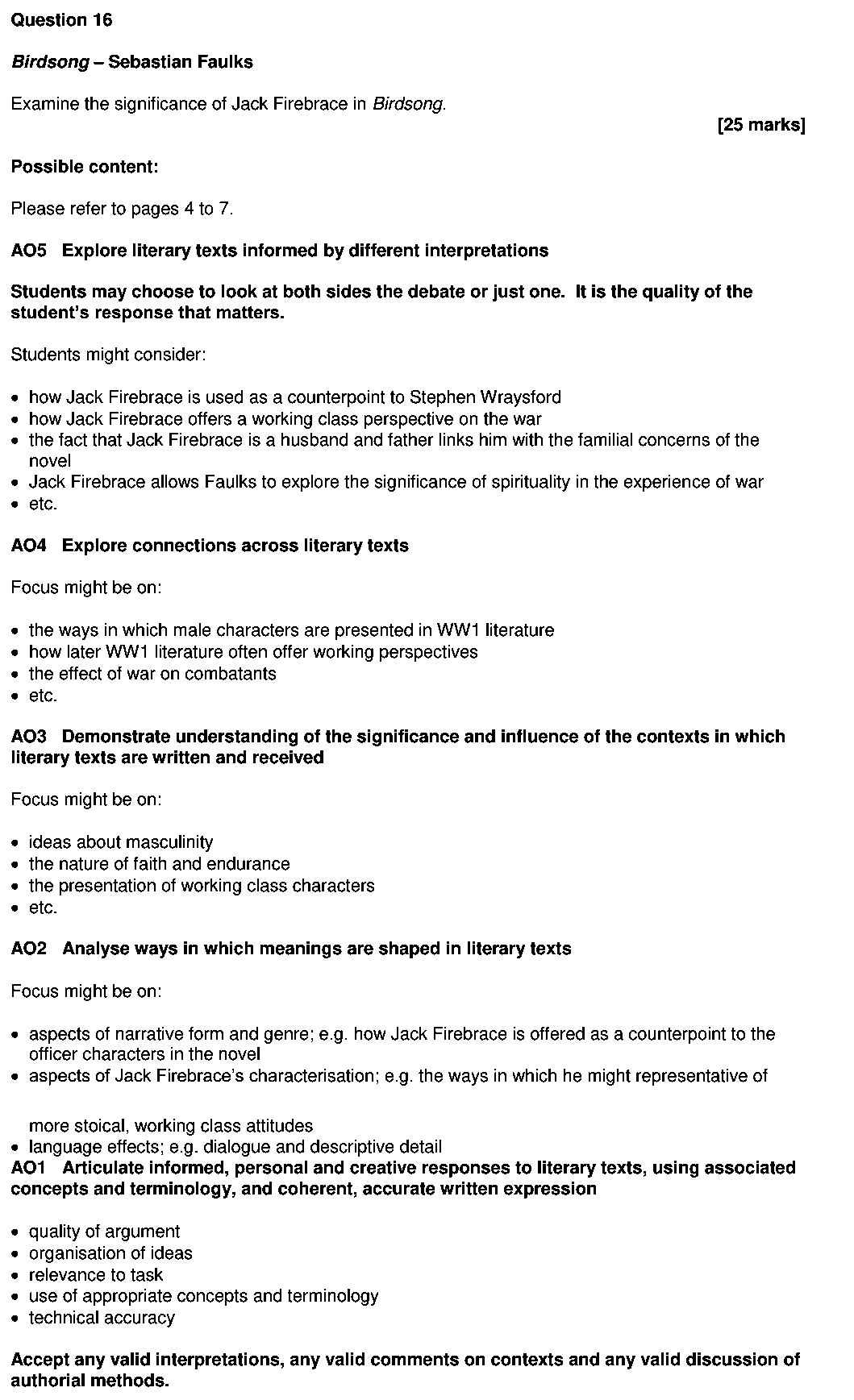
Fewer students attempted this question. Many who did were able to fully engage with the significance of Jack Firebrace’s role within the novel. More straightforward responses tended to resort to a narrative approach with generalised contextual discussion of tunnel warfare and social class. The strongest responses were built around close analysis of the text that allowed a more genuine discussion of Jack Firebrace as a construct. Such answers often explored Jack Firebrace as a counterpoint to Stephen Wraysford, allowing Faulks to widen the novel’s perspective on faith and the significance of social class. Examiners noted that more confident students made good use of the text and could consider, for example, the significance of the ‘wooden cross’ that ‘supports’ Jack’s back in the first tunnelling sequence when he is introduced to the reader.
Notes from the mark scheme and report
Focus: character: Jack Firebrace
Open book, no extract
MS: Jack as counterpoint to Stephen, working-class perspective, husband and father, spirituality
ER: fewer students
straightforward answers narrated with generalised context on tunnelling and class
strongest treated Jack as a construct, eg the 'wooden cross' at his introduction
June 2017 · Paper 2A · Q1525 marksSet text essay
Mark scheme, including the levels and indicative content
The general mark scheme (assessment objectives and bands)
Examiner's comment
This was a less popular question choice. Some examiners felt that too many students offered a list-like approach to the examples of suffering in the novel rather than fully engaging with the ‘significance’ of human suffering. Many students, however, were able to explore human suffering through considering the effect of the parallel narrations of the text. Thoughtful candidates fully engaged with the key word ‘endure’ and developed the debate through exploring the extent to which ‘human suffering’ can be alleviated through the rejuvenation suggested by the birth of Helen’s son.
Notes from the mark scheme and report
Focus: theme: human suffering and endurance
Open book, no extract
Faulks quotation on how much suffering humans can endure
MS: the Somme, combat, Stephen as extreme experience, dual time frame, love and desire as other concerns
ER: less popular
some listed examples of suffering instead of significance
better used the parallel narratives and 'endure', eg rejuvenation in the birth of Helen's son
June 2017 · Paper 2A · Q1625 marksSet text essay
Mark scheme, including the levels and indicative content
The general mark scheme (assessment objectives and bands)
Examiner's comment
This was an accessible question to many candidates. Some tended to just explain why Wraysford was seen to be a ’cold bastard’ and constructed a straightforward debate considering the ways in which war can gradually strip a man of his humanity. Stronger responses were more explorative by considering the ways in which Faulks explores the male gender through his presentation of Wraysford. Others were able to counter the critical view through considering the intimacy of Wraysford’s relationships with others.
Notes from the mark scheme and report
Focus: character: Stephen Wraysford
Open book, no extract
view: Stephen is 'cold, detached'
MS: war changes men, Stephen as a vantage point, male identity, warmth with Isabelle and compassion for soldiers
ER: straightforward answers argued war strips humanity
stronger explored Faulks's presentation of masculinity or intimacy of Stephen's relationships
Work with an AQA English Literature A tutor
Essays stuck in the middle bands, or not sure what the examiners want from an analysis? Book a trial lesson with a specialist AQA English Literature A tutor.