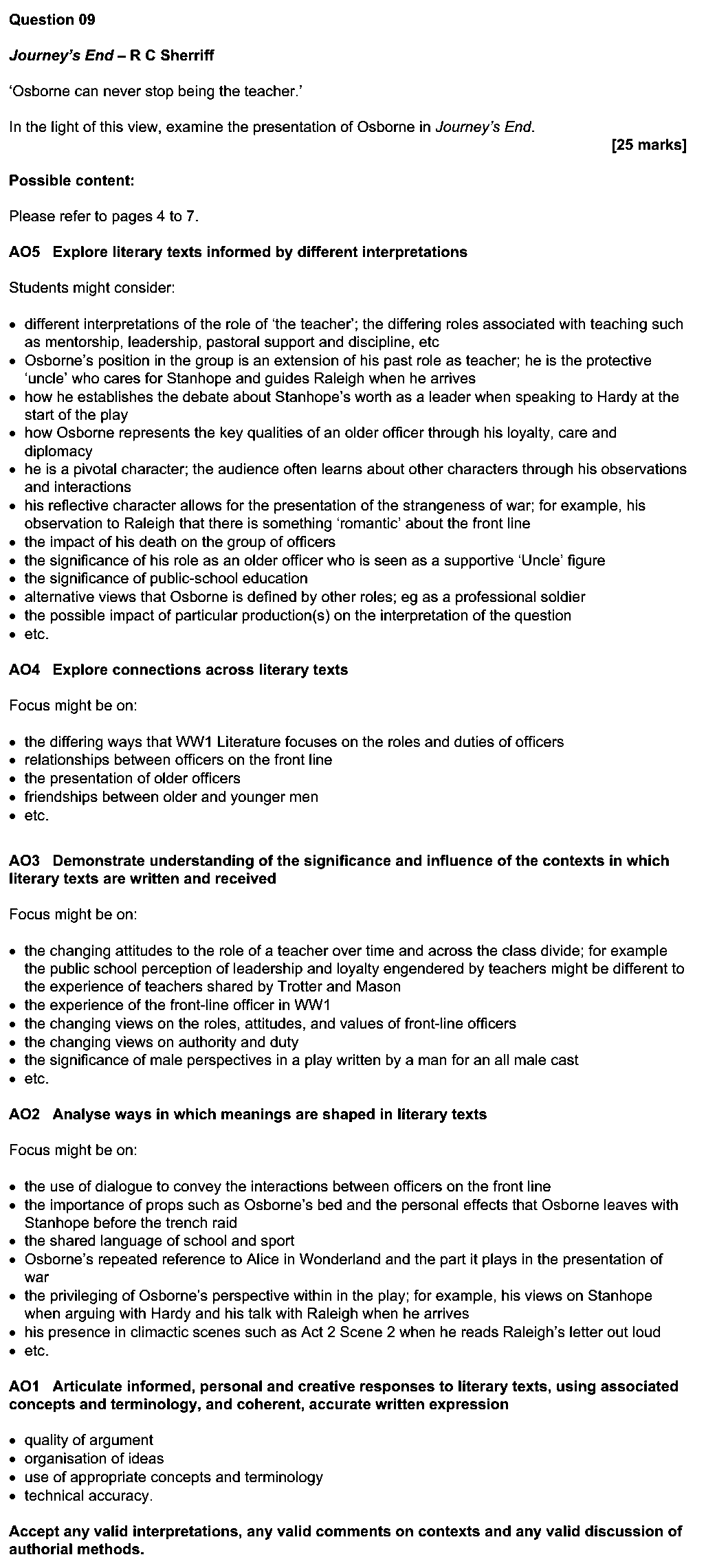
Journey’s End – R C Sherriff ‘Osborne can never stop being the teacher.’ In the light of this view, examine the presentation of Osborne in Journey’s End.
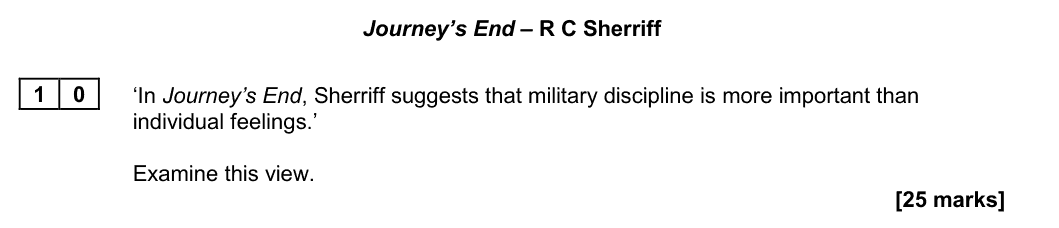
Journey’s End – R C Sherriff ‘In Journey’s End, Sherriff suggests that military discipline is more important than individual feelings.’ Examine this view.
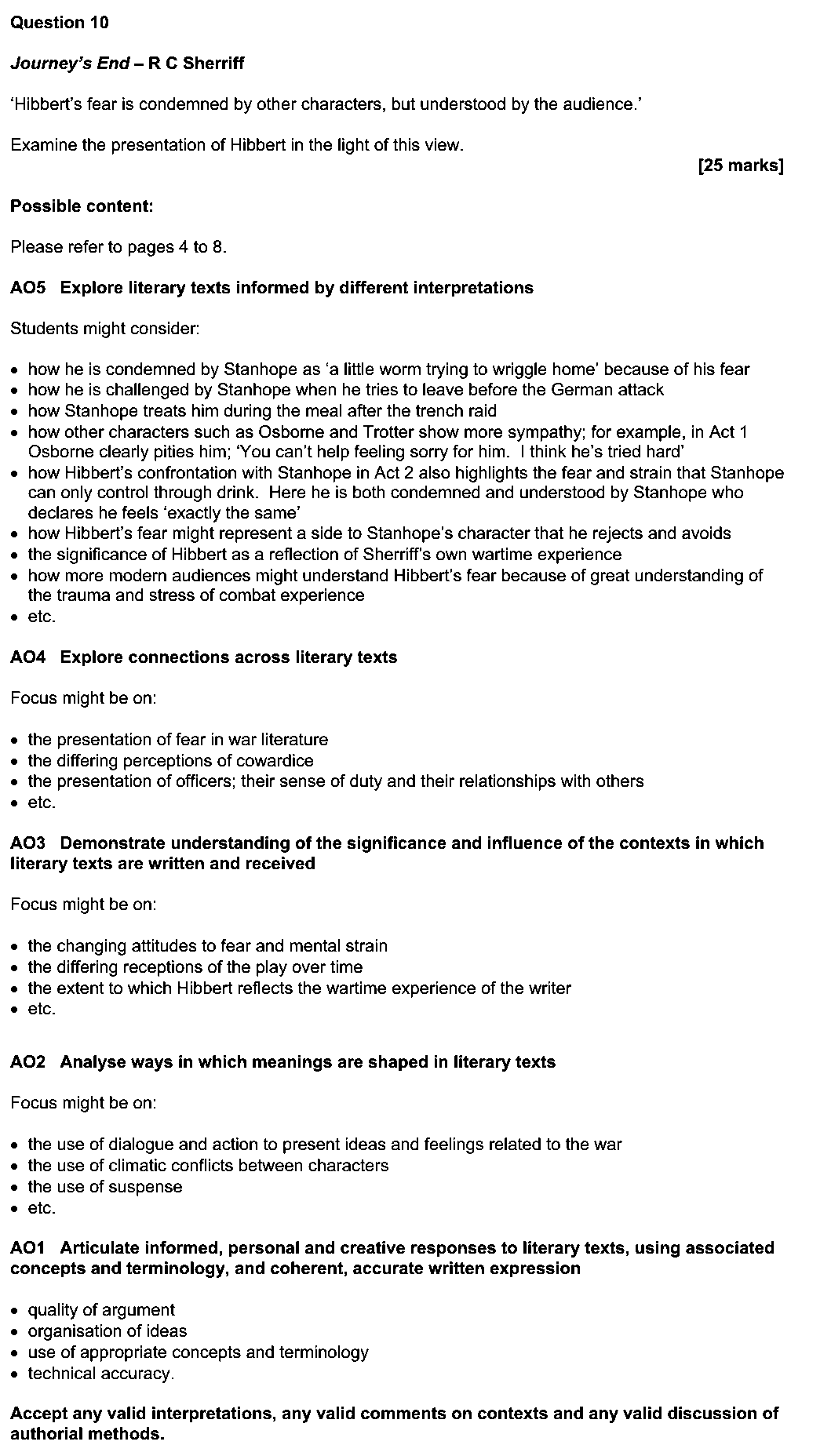
Journey’s End – R C Sherriff ‘Hibbert’s fear is condemned by other characters, but understood by the audience.’ Examine the presentation of Hibbert in the light of this view.
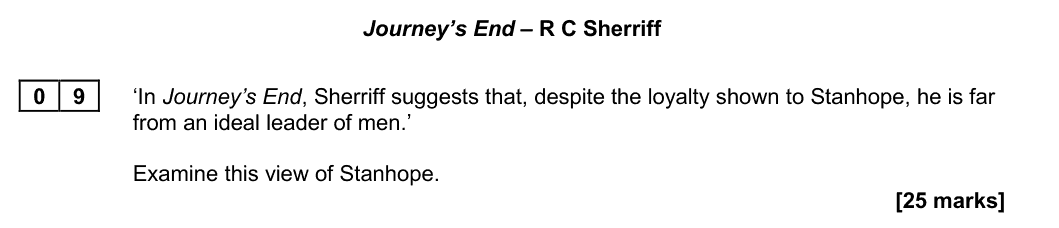
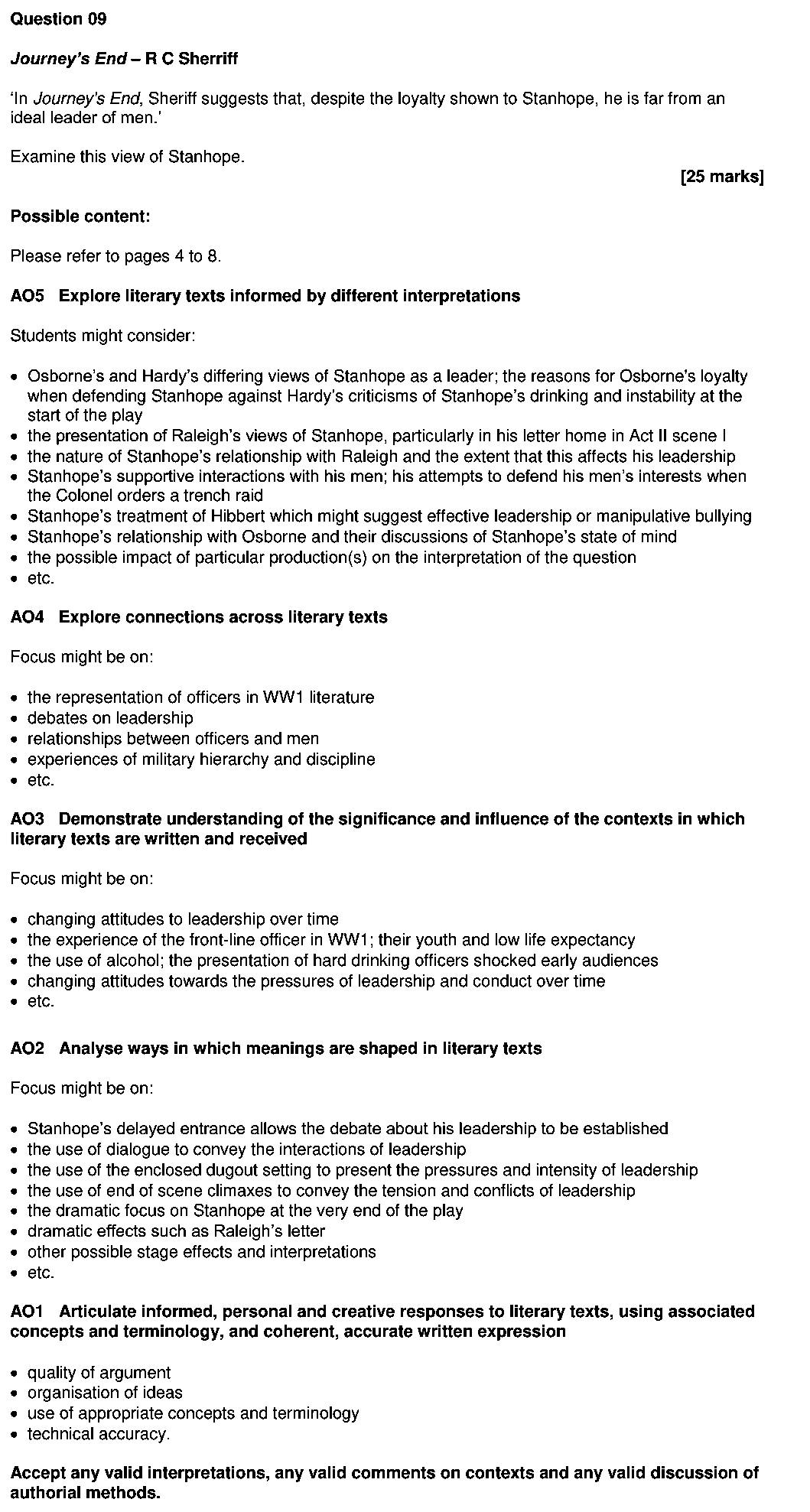
Journey’s End – R C Sherriff ‘In Journey’s End, Sherriff suggests that, despite the loyalty shown to Stanhope, he is far from an ideal leader of men.’ Examine this view of Stanhope.
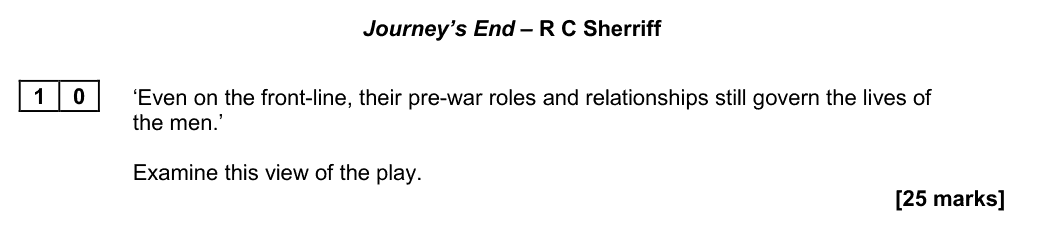
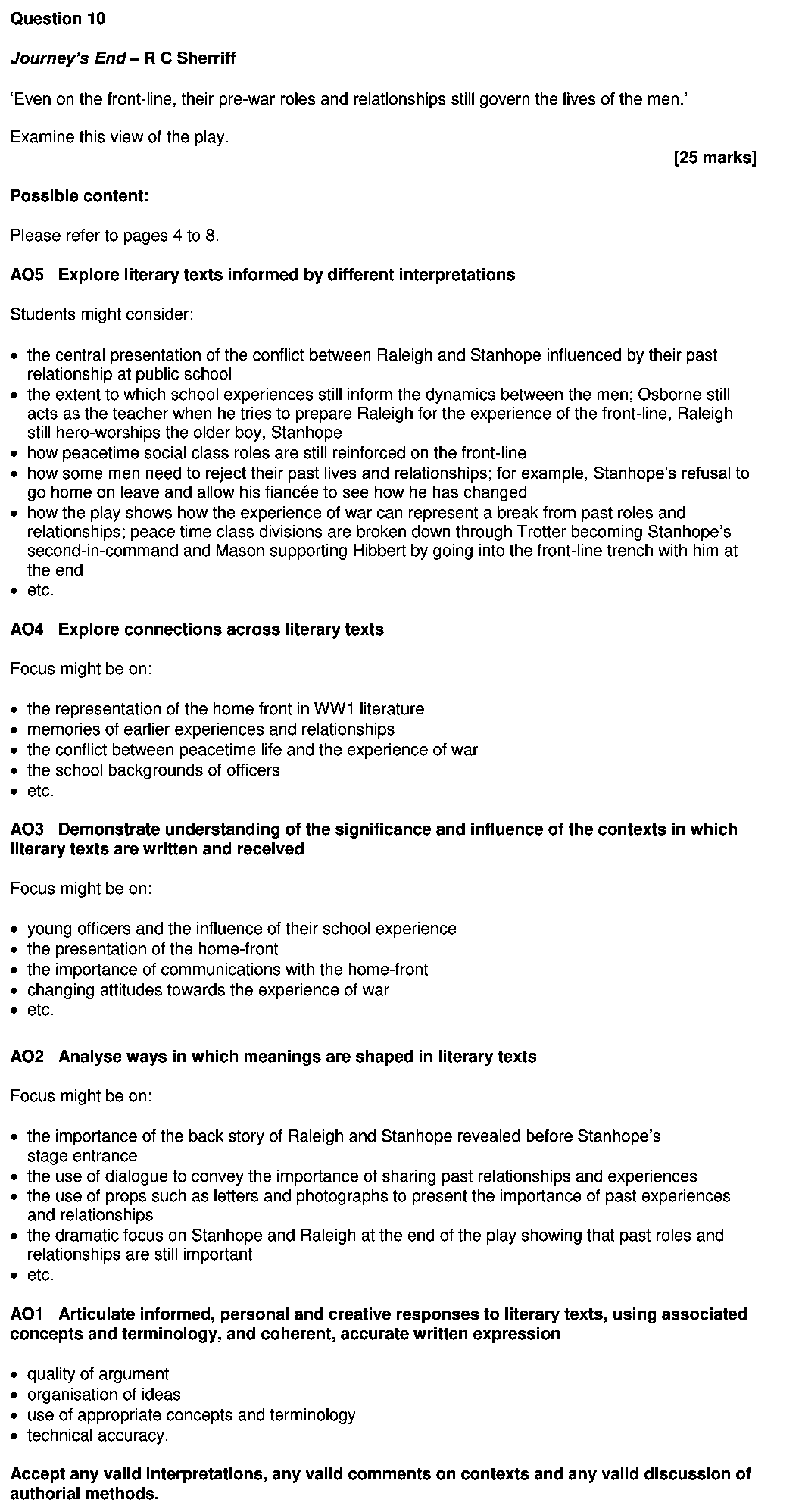
Journey’s End – R C Sherriff ‘Even on the front-line, their pre-war roles and relationships still govern the lives of the men.’ Examine this view of the play.
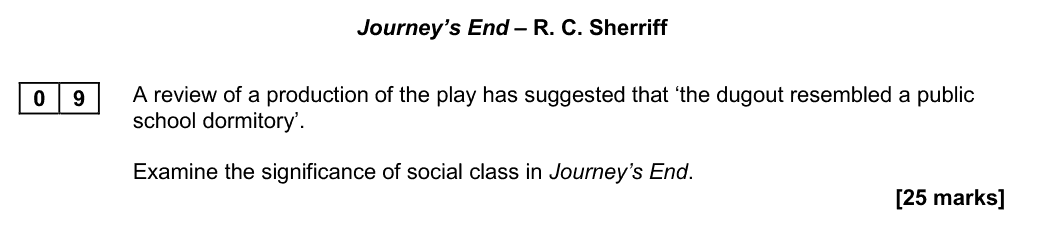
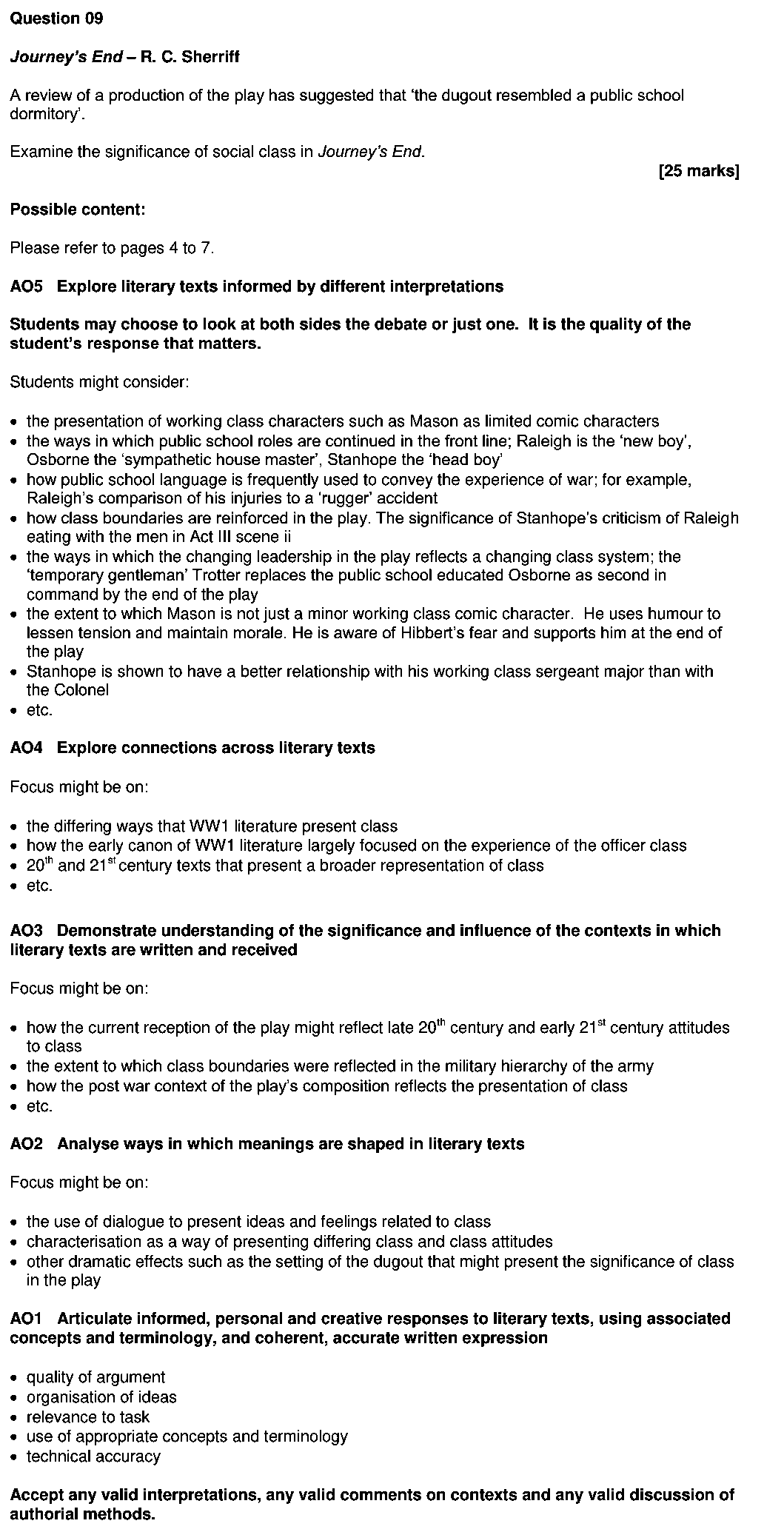
Journey’s End – R. C. Sherriff A review of a production of the play has suggested that ‘the dugout resembled a public school dormitory’. Examine the significance of social class in Journey’s End.
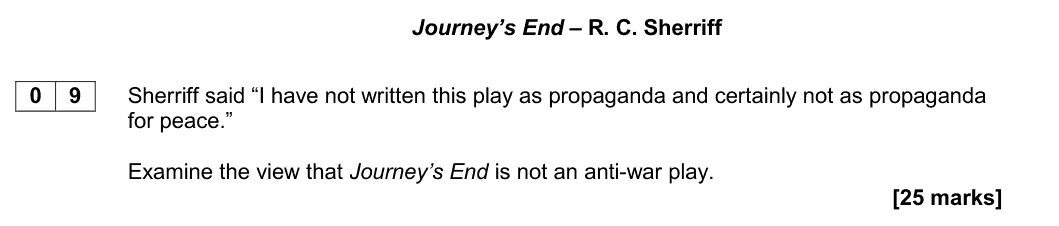
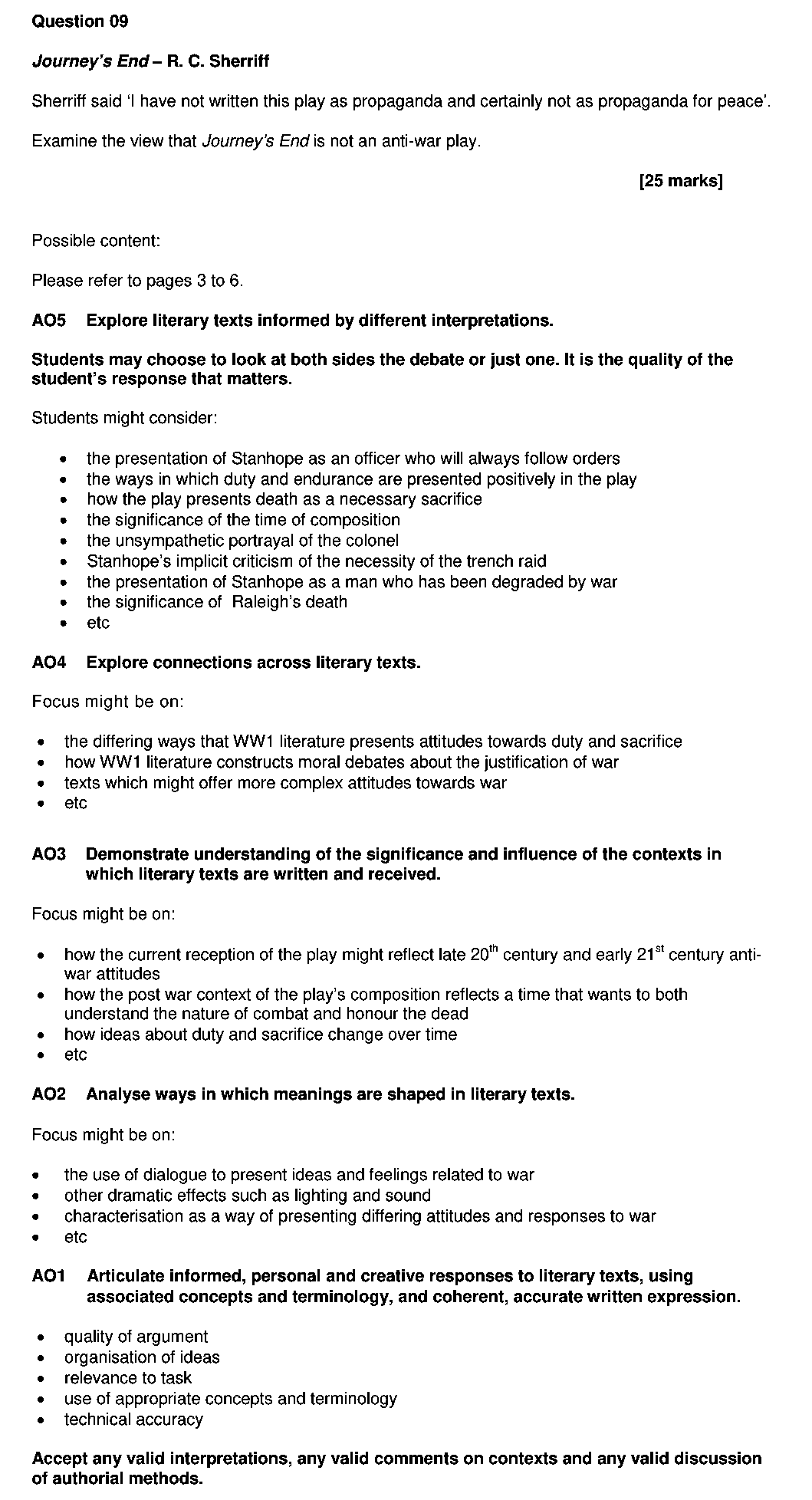
Journey’s End – R. C. Sherriff Sherriff said “I have not written this play as propaganda and certainly not as propaganda for peace.” Examine the view that Journey’s End is not an anti-war play.
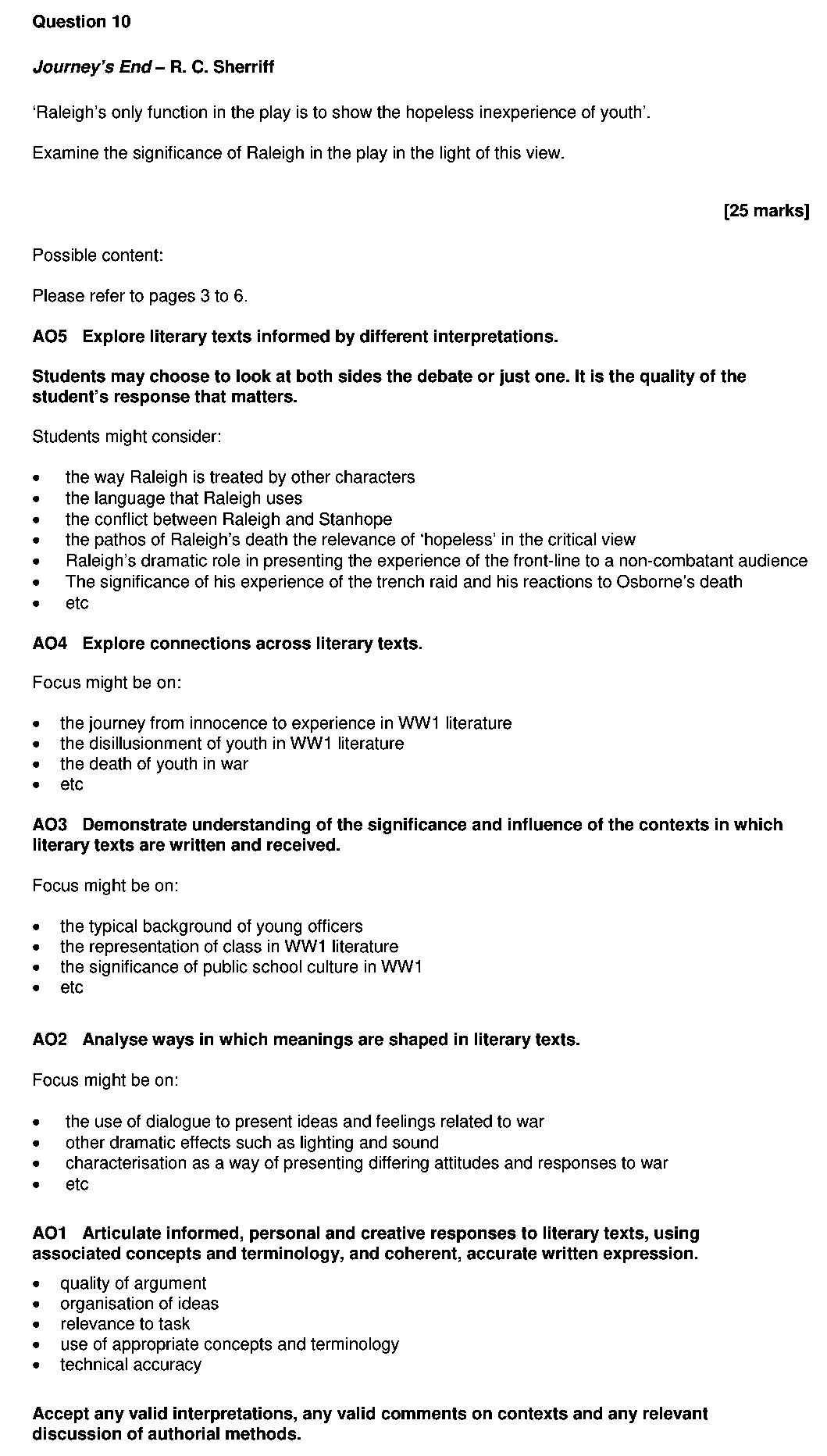
Journey’s End – R. C. Sherriff ‘Raleigh’s only function in the play is to show the hopeless inexperience of youth.’ Examine the significance of Raleigh in the play in the light of this view.
Tap a question to zoom it. The texts and extracts open above it; the mark scheme (with its levels and indicative content) and the examiner's comment open underneath.
June 2025 · Paper 2A · Q925 marksSet text essay
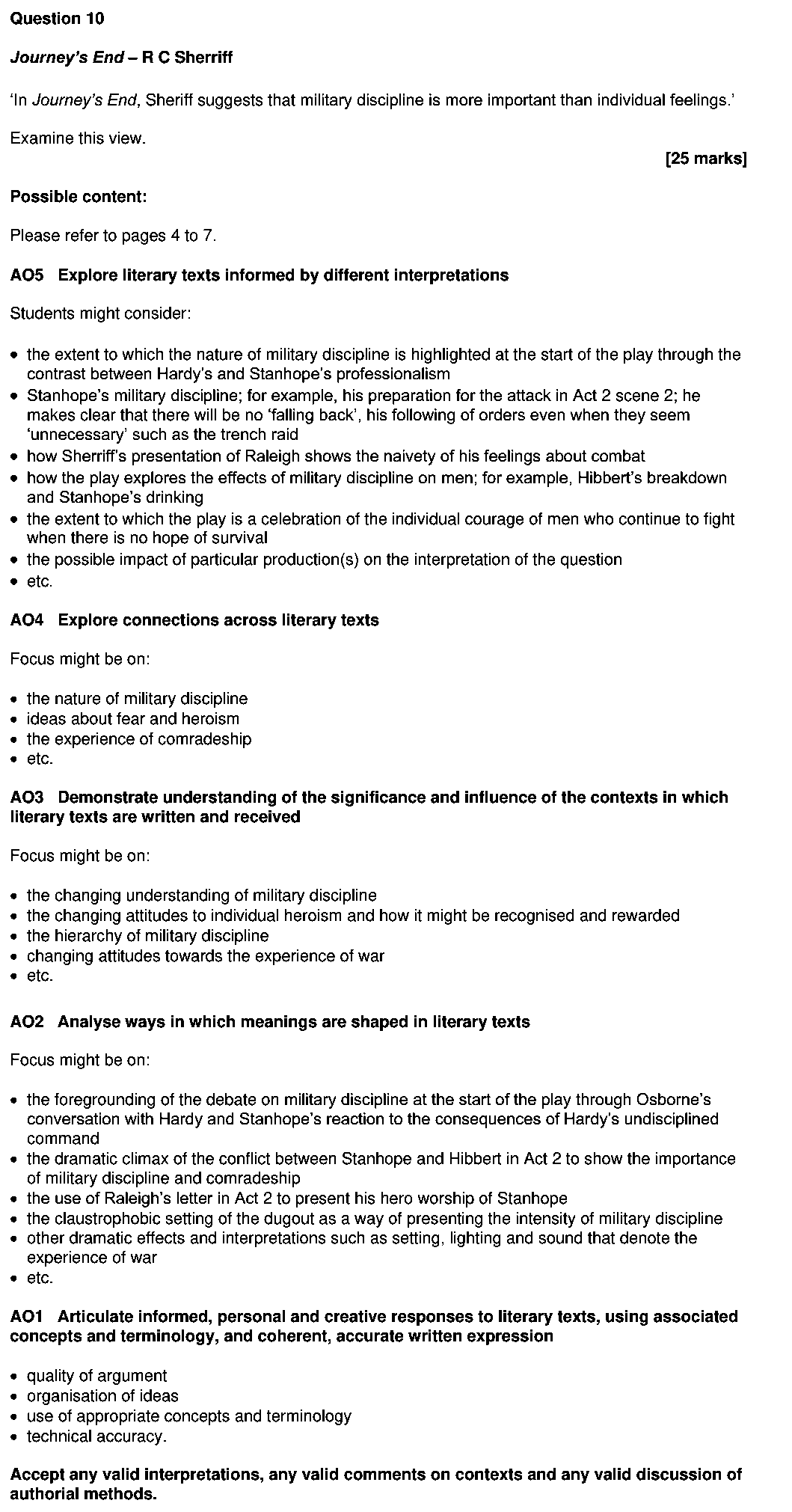
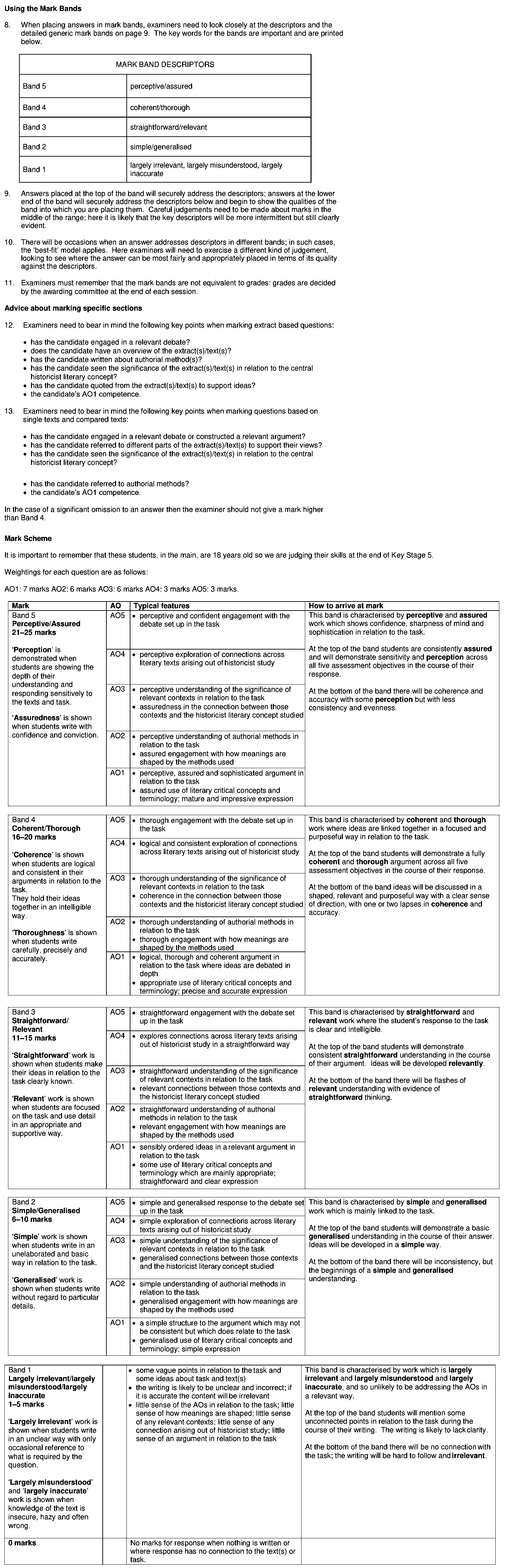
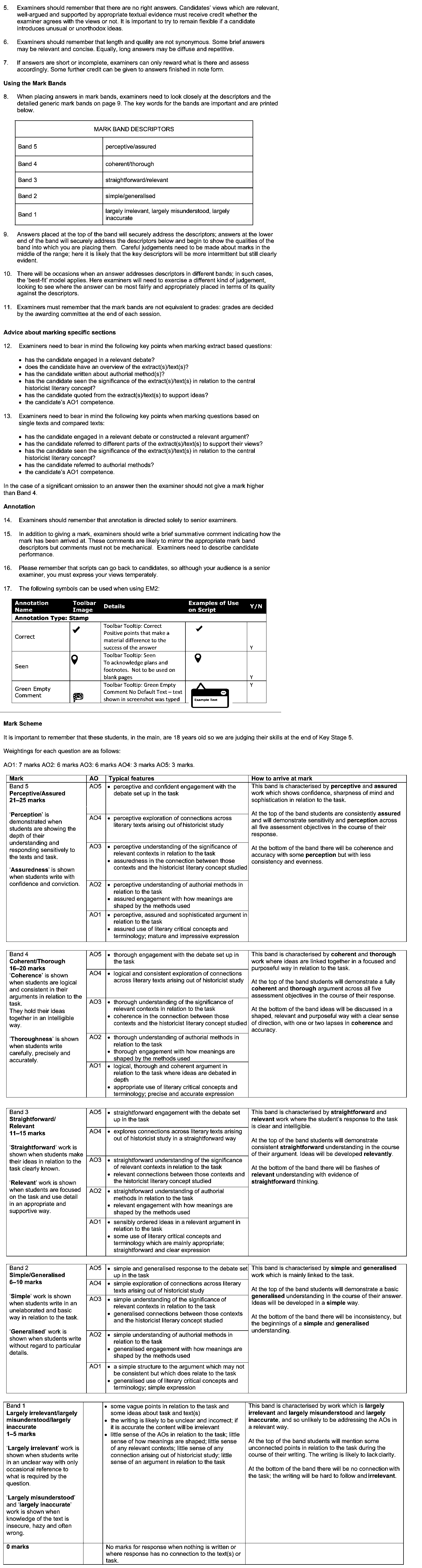
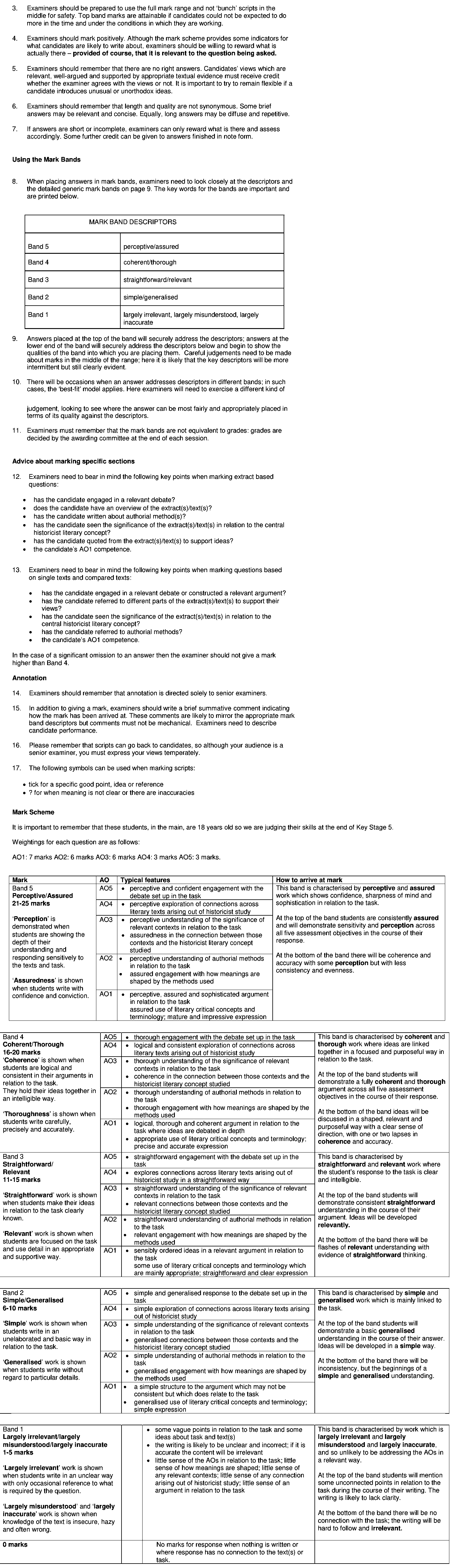
Mark scheme, including the levels and indicative content
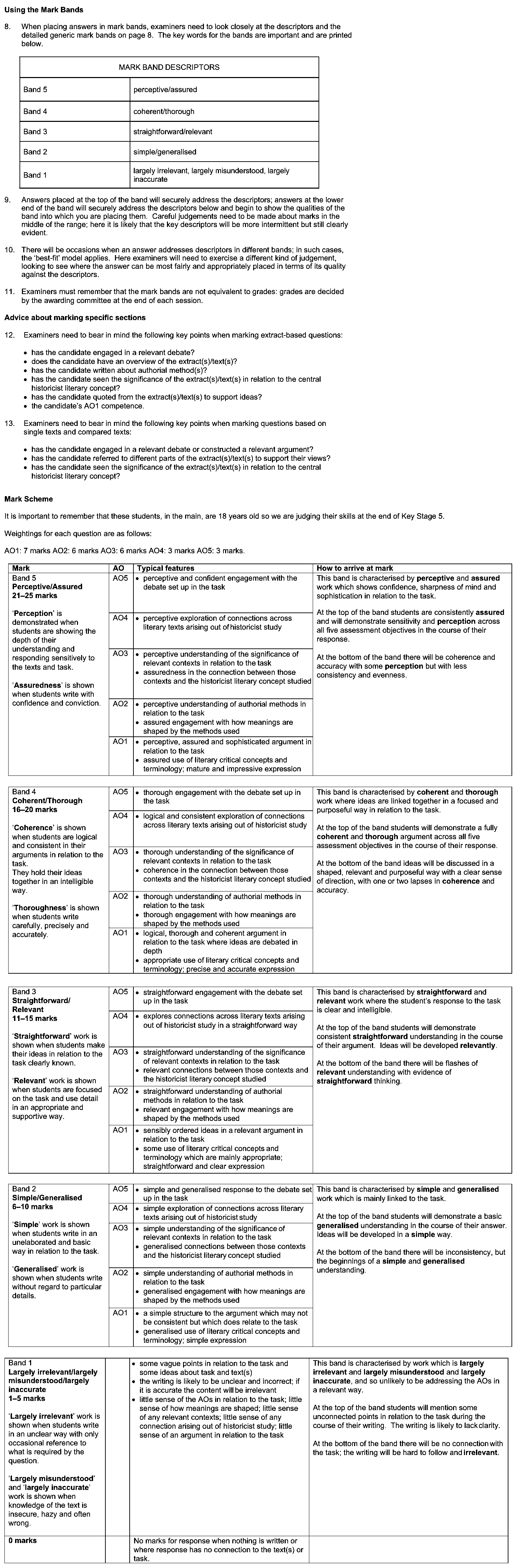
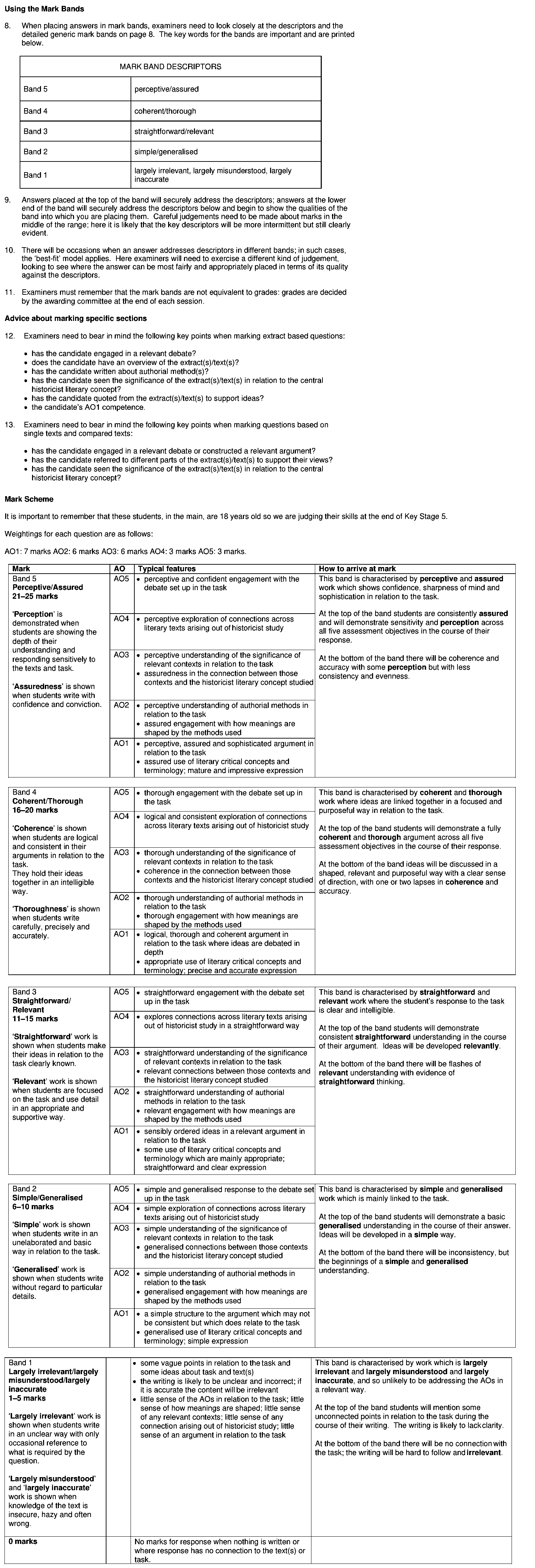
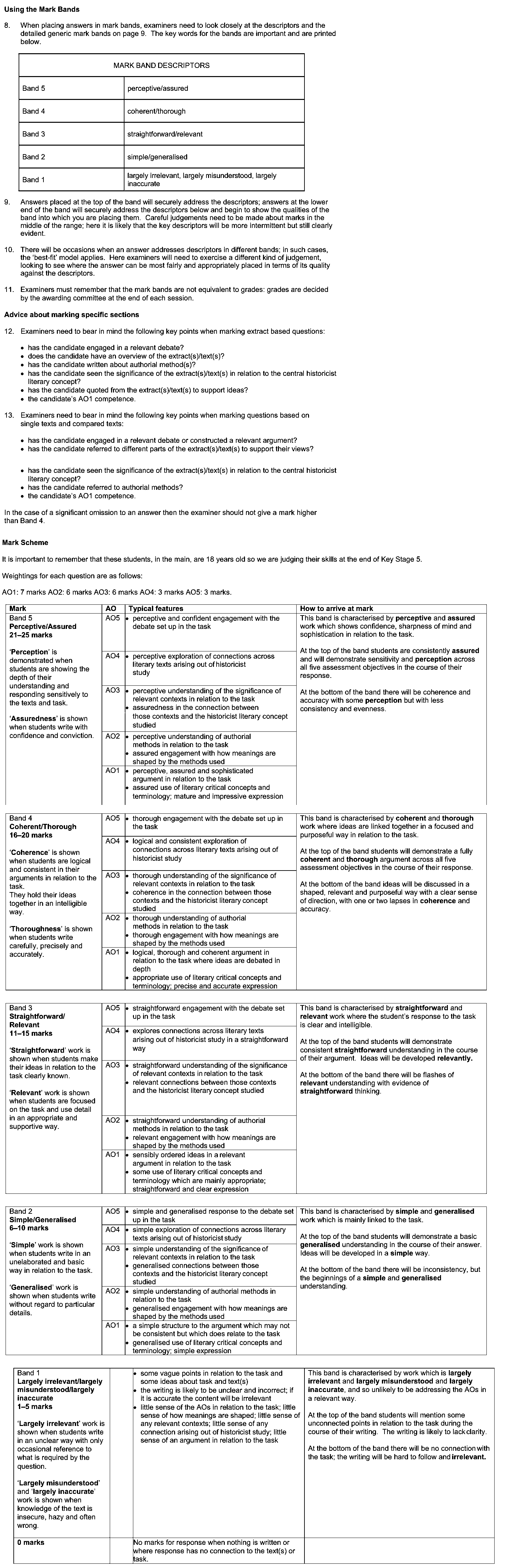
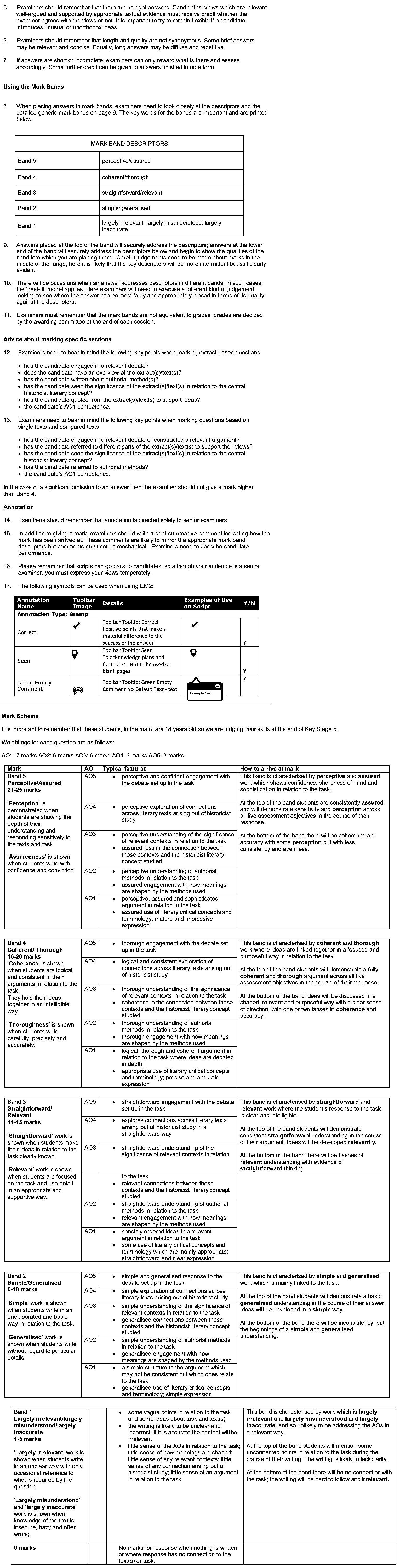
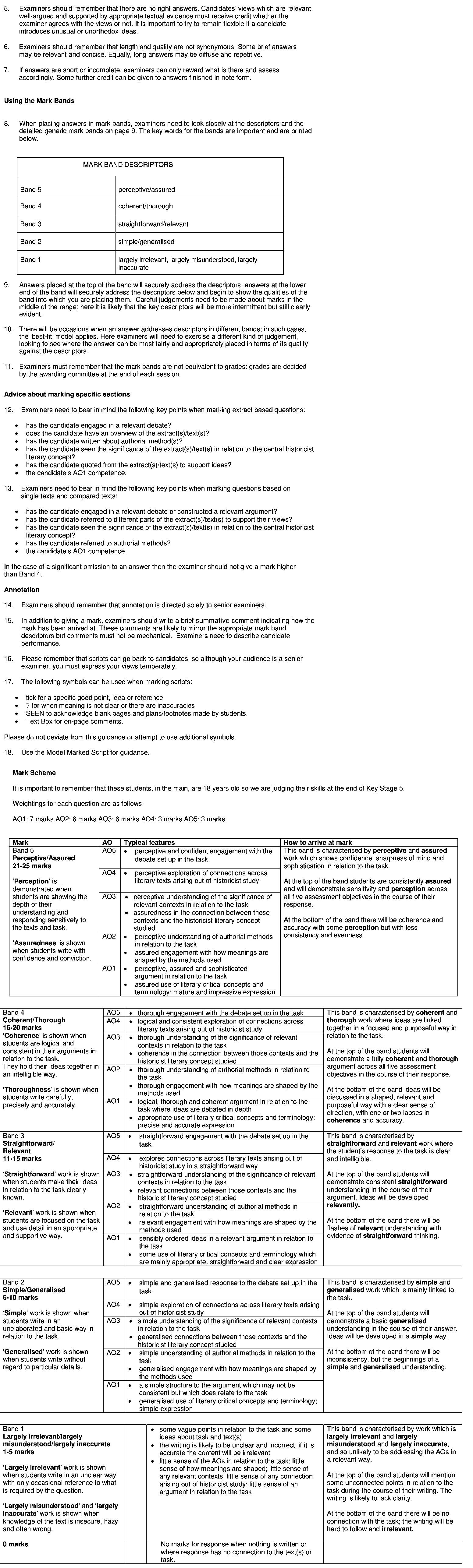
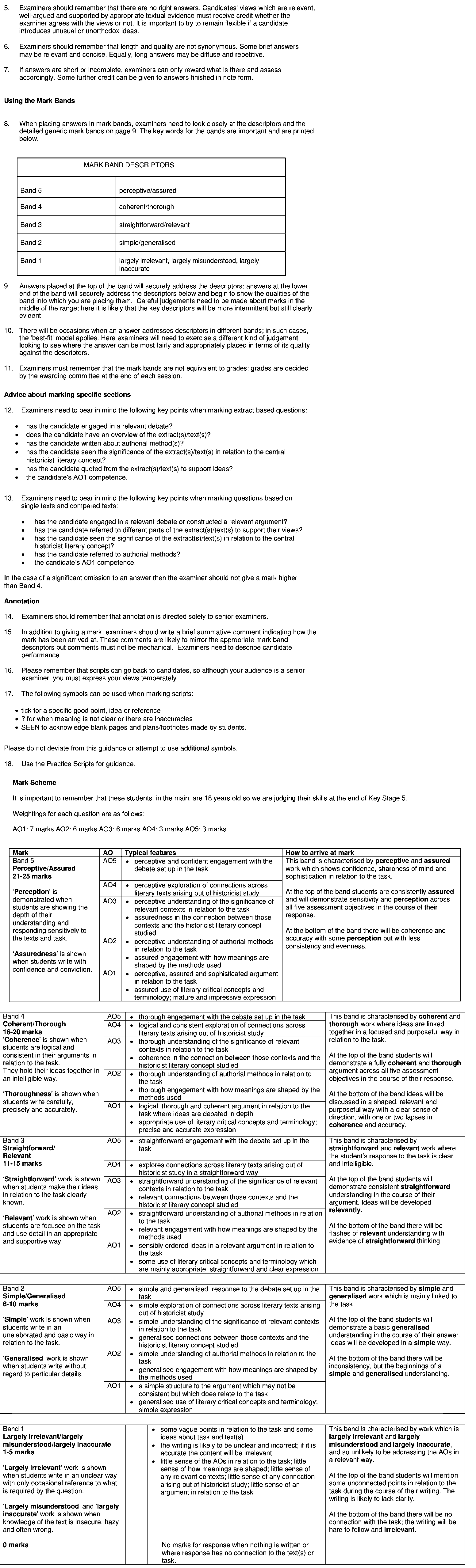
The general mark scheme (assessment objectives and bands)
Examiner's comment
Better answers: • engaged with the given view to develop a focused discussion on Osborne's presentation by considering his authority and interactions with other characters. • were able to consider his dramatic function within the play and discuss how he is used to present Stanhope through his interactions with Hardy and Raleigh • purposefully debated the view through considering his relationships with Raleigh and Stanhope • used contextual knowledge of public-school culture to consider Osborne and his relationships with the other men • confidently considered the dramatic significance of Osborne’s death through considering props such as Osborne’s bed and the varying reactions to his death. Less effective answers: • treated Osborne as a real person and could not discuss his dramatic presentation • used the given view as a simple essay frame to list Osborne’s qualities as a teacher in a generalised, assertive way • did not consider dramatic methods other than paraphrasing the stage notes on Osborne on the first page of the play • largely ignored the presentation of his death and the repercussions on the other characters • failed to comment on the common public-school background that unites Osborne, Raleigh and Stanhope. • made mistaken assertions that Osborne was a headteacher.
Notes from the mark scheme and report
Focus: character: Osborne
Open book, no extract
interpret 'teacher' as mentor, leader, pastoral 'Uncle', disciplinarian
his dramatic function in presenting Stanhope via Hardy and Raleigh, public-school context, 'romantic' front line, his death (bed as prop) and its impact
weaker answers treated him as a real person, listed teacher qualities, paraphrased the opening stage notes or called him a headteacher
June 2025 · Paper 2A · Q1025 marksSet text essay
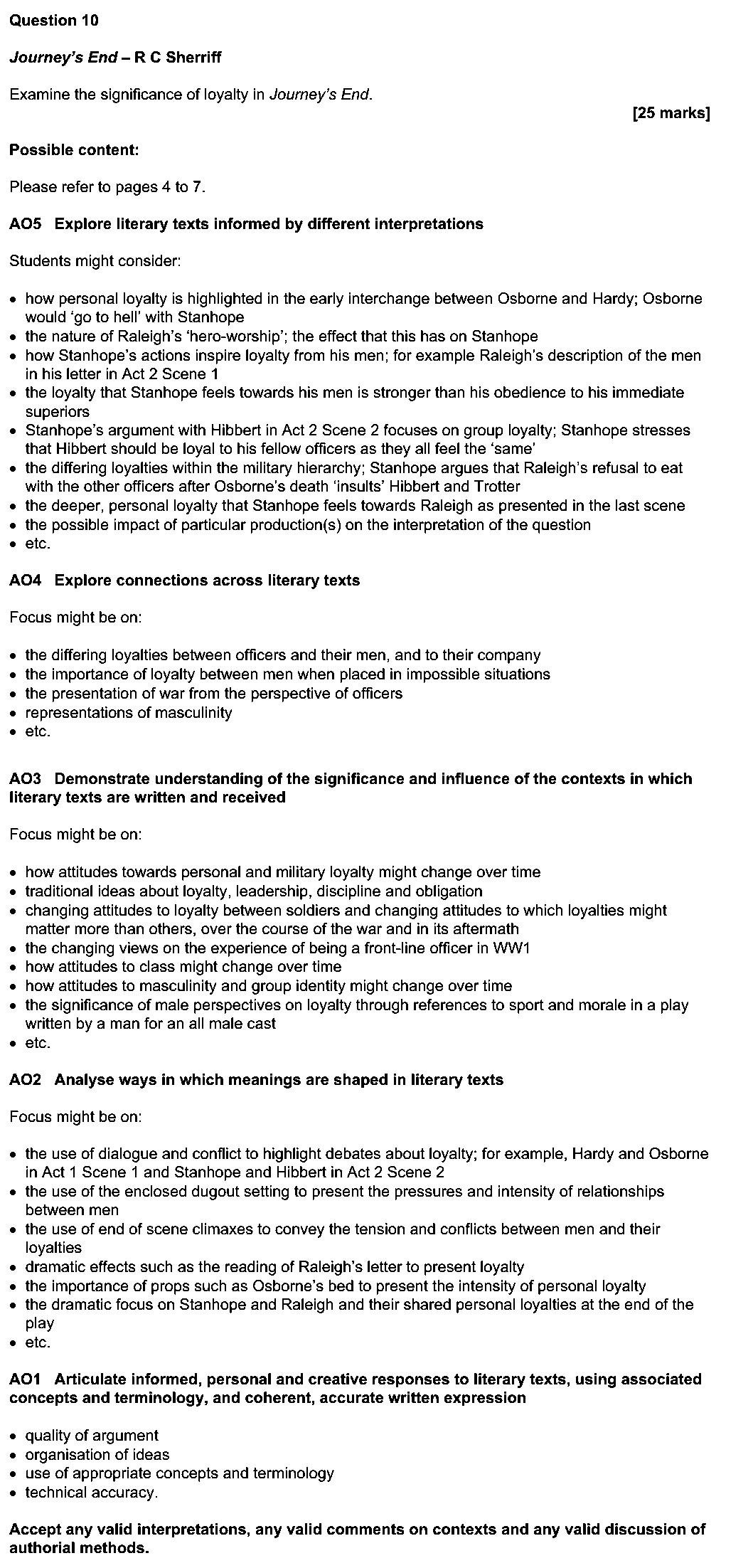
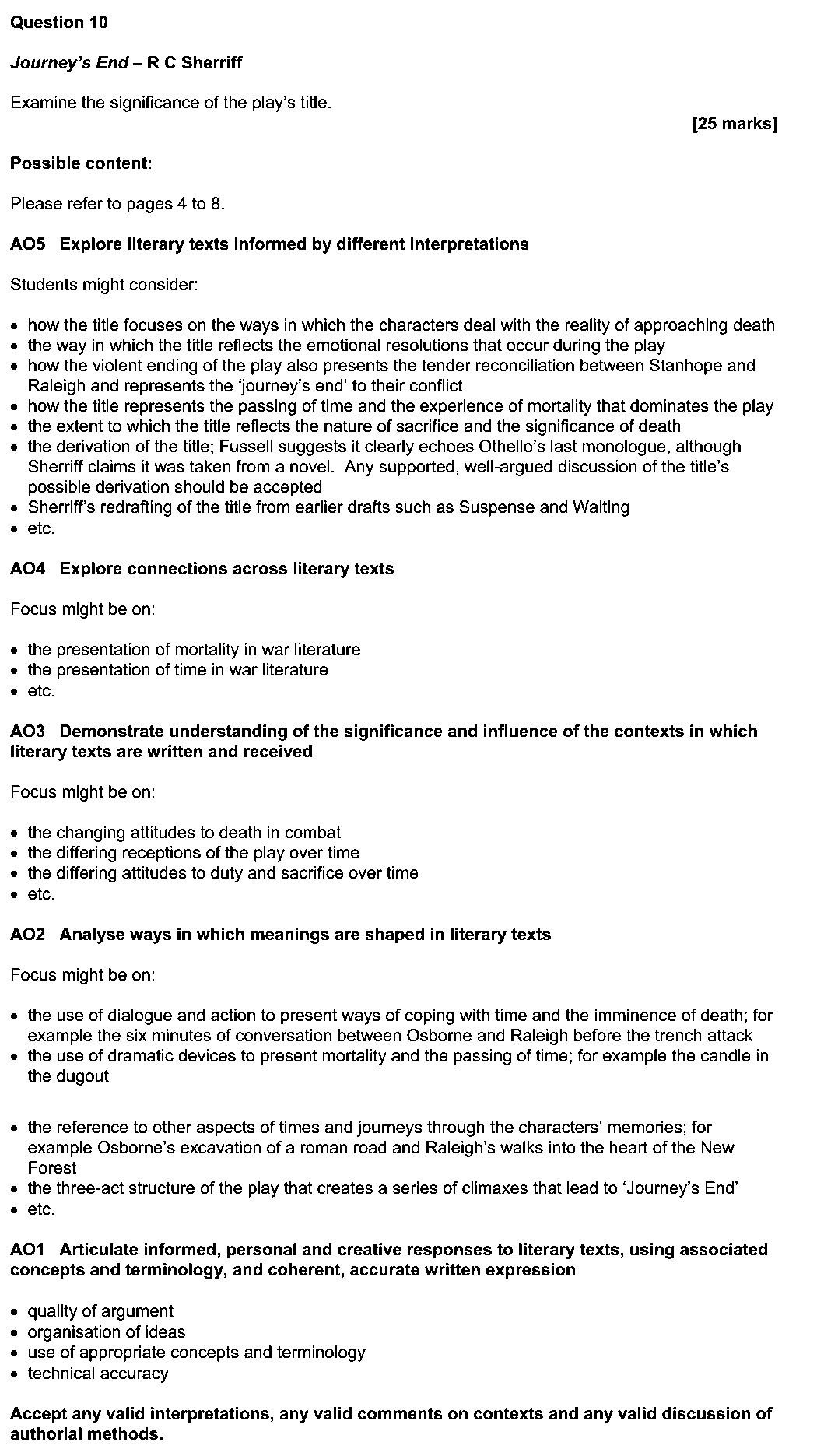
Mark scheme, including the levels and indicative content
The general mark scheme (assessment objectives and bands)
Examiner's comment
Better answers: • fully engaged with ‘the significance of loyalty’ and confidently discussed varying aspects of loyalty through considering personal relationships, military discipline and loyalty to country and its war effort • considered Sherriff’s intentions as a writer, and saw the play as an act of loyalty to his regiment and all who fought in the war • fully considered how loyalty to fellow soldiers is explored in the confrontation between Stanhope and Hibbert • considered the conflict between personal and military loyalties through considering the varying reactions of the Colonel, Stanhope and Raleigh to Osborne’s death in the trench raid • explored the significance of loyalty through exploring the tensions and final resolution of Stanhope and Raleigh’s relationship. Less effective answers: • failed to establish an overview on the differing aspects of loyalty and could only offer simple examples in a list-like way • resorted to using pre-written material on past questions • failed to consider dramatic methods and treated characters as real people or as if they were part of a prose text
Notes from the mark scheme and report
Focus: theme: loyalty
Open book, no extract
aspects of loyalty: personal, military, to country
Osborne would 'go to hell' with Stanhope, Raleigh's hero-worship and letter, Stanhope vs Hibbert on group loyalty, reactions to Osborne's death, Stanhope and Raleigh resolved in the last scene, the play as Sherriff's loyalty to his regiment
weaker answers listed examples, reused past answers or ignored dramatic methods
June 2024 · Paper 2A · Q925 marksSet text essay
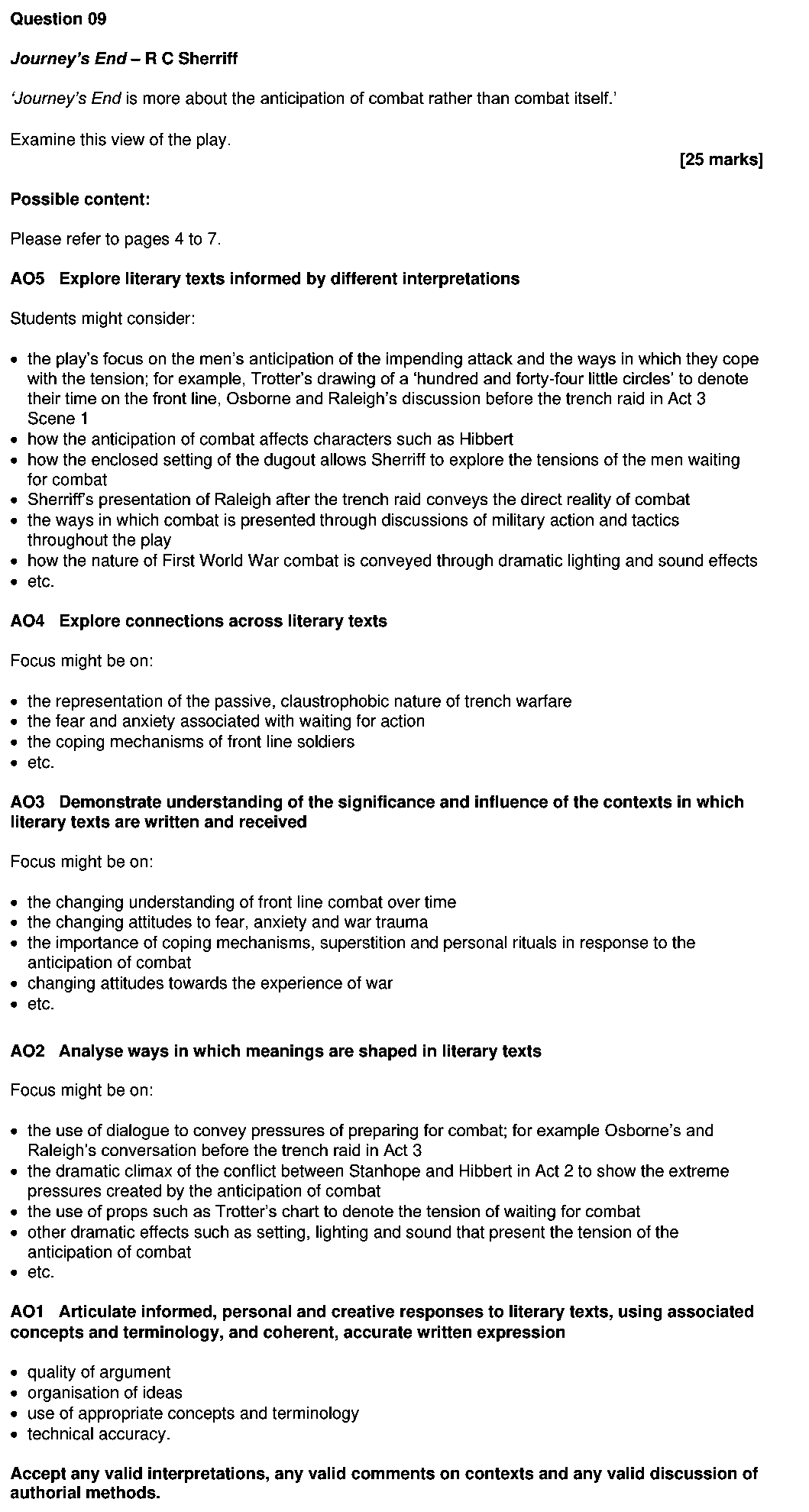
Mark scheme, including the levels and indicative content
The general mark scheme (assessment objectives and bands)
Examiner's comment
Better answers: • considered ‘anticipation of combat’ in a varied way through considering stress, coping mechanisms and the everyday realities of trench warfare • fully debated the given view through considering the presentation of the trench raid as well as the final German attack • demonstrated a detailed grasp of dramatic methods and structure through considering sound and lighting effects, the dugout setting and the creation of dramatic suspense • confidently considered the significance of the offstage presentation of combat and the presentation of characters finally leaving the stage • thoughtfully considered the context of trench warfare and frontline conditions. Less effective answers: • failed to consider all of the keywords in the question • did not consider dramatic methods and considered prose narrative effects • wrote more about the presentation of stress and trauma rather than a more precise focus on ‘the anticipation of combat’ • resorted to paraphrase rather than more precise analysis.
Notes from the mark scheme and report
Focus: theme: anticipation of combat vs combat
Open book, no extract
debate anticipation vs combat: waiting, stress and coping (Trotter's circles, Osborne and Raleigh before the raid), the trench raid and final attack, offstage combat, sound and lighting, suspense, characters leaving the stage
weaker answers ignored dramatic methods, wrote generally on stress and trauma or paraphrased
June 2024 · Paper 2A · Q1025 marksSet text essay
Mark scheme, including the levels and indicative content
The general mark scheme (assessment objectives and bands)
Examiner's comment
Better answers: • fully engaged with all keywords in the question and considered ‘more important than’ as a way of debating Sherriff’s presentation of combat • were clearly able to define and discuss aspects of ‘military discipline’ presented in the play • thoughtfully explored the interplay between ‘military discipline’ and ‘individual feelings’ through considering the presentation of male relationships, camaraderie and loyalty • explored the full significance of Stanhope and Raleigh’s relationship in terms of ‘military discipline’ and ‘individual feeling’ Less effective answers: • had a limited understanding of ‘military discipline’ as punishment or following orders • resorted to using prewritten material on past questions • offered contextual responses about military hierarchy which largely led away from the play itself.
Notes from the mark scheme and report
Focus: theme: military discipline vs individual feelings
Open book, no extract
define 'military discipline' and weigh 'more important than' against feelings: Stanhope vs Hardy, no 'falling back', the trench raid order, Hibbert's breakdown, Stanhope's drinking, Stanhope and Raleigh, camaraderie and loyalty
weaker answers saw discipline only as punishment, reused past questions or wrote on military hierarchy
June 2023 · Paper 2A · Q925 marksSet text essay
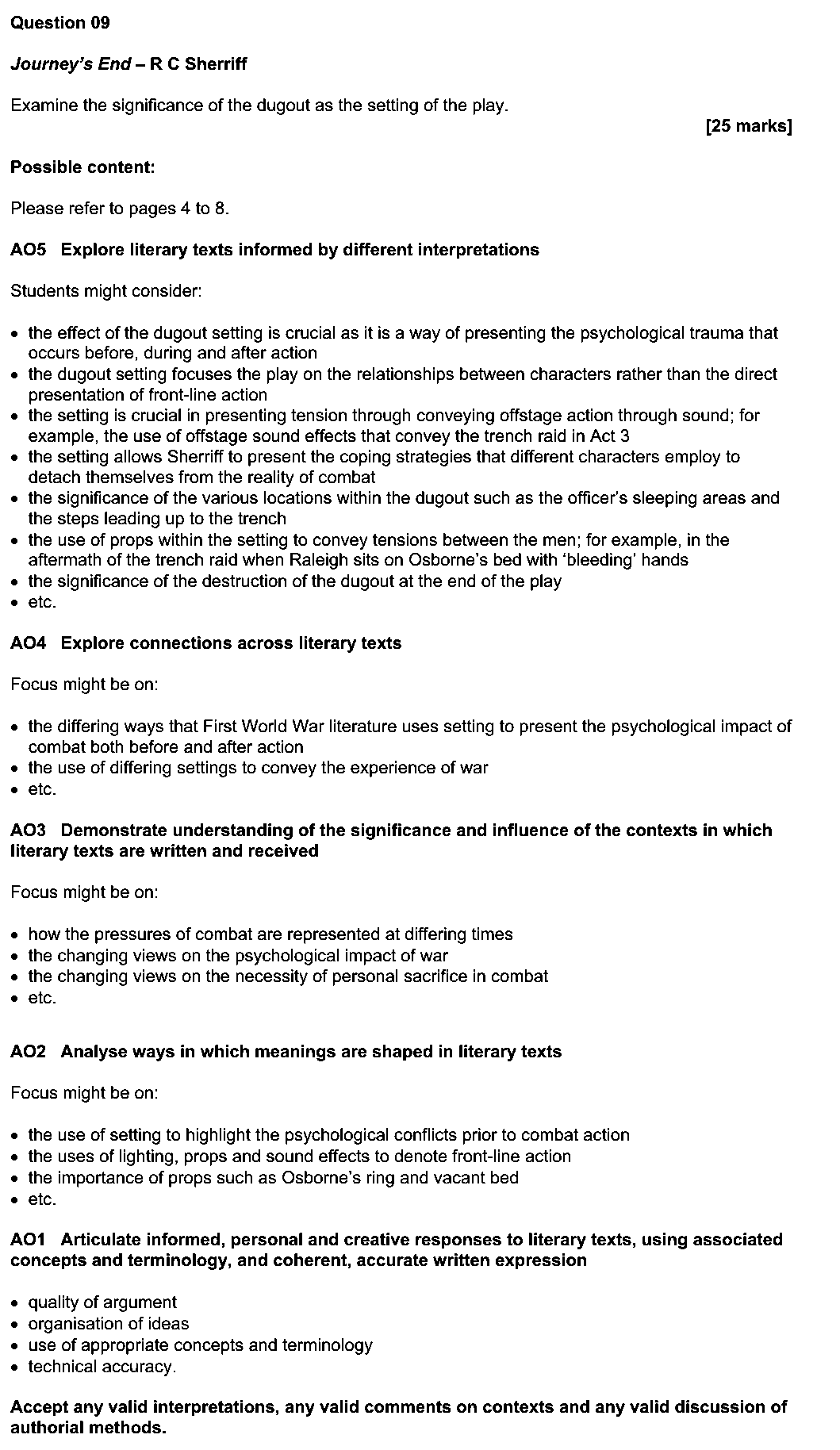
Mark scheme, including the levels and indicative content
The general mark scheme (assessment objectives and bands)
Examiner's comment
More effective answers: • were supported by a clear understanding of dramatic methods through considering sound and lighting effects and the ways in which the dugout setting is part of the presentation of characters and ideas within the play • were able to carefully consider the layout of the dugout and the extent to which this presents the differing relationships between the men • explored the strange domesticity of the setting and how it is part of Sherriff’s aim of creating a realistic representation of the frontline experience. • explored the extent to which the setting deliberately focused the play on the psychological experience of war • saw the dugout as a representation of the officer class and considered the significance of Raleigh’s decision to be with the men in the trenches after Osborne’s death • made effective use of the contextual understanding of trench warfare and frontline conditions. Less effective answers: • made little explicit reference to dramatic methods • largely ignored setting and chose to describe the character interactions in the dugout • used the question as an excuse to discuss trench warfare in a generalised way without much literary discussion of the use of setting to create meaning • made generalised assertions about how the dugout setting presents the futility of war without exploring how this might be achieved through dramatic methods.
Notes from the mark scheme and report
Focus: setting: the dugout
Open book, no extract
setting as dramatic method: sound and lighting, offstage raid, layout and locations (beds, steps to the trench), strange domesticity and realism, psychological focus, officer-class space and Raleigh's choice after Osborne's death, destruction at the end
weaker answers ignored setting, described character interactions or wrote generally on trench warfare and futility
June 2023 · Paper 2A · Q1025 marksSet text essay
Mark scheme, including the levels and indicative content
The general mark scheme (assessment objectives and bands)
Examiner's comment
More effective answers: • made good use of the given view to structure and develop a detailed consideration of Hibbert’s presentation • showed confident awareness of context through focusing on differing audience responses • fully understood the varying responses to Hibbert from other characters such as Osborne and Trotter as well as Stanhope • explored the function of Hibbert’s role within the play both as part of Stanhope’s characterisation and Sherriff’s presentation of the experience of war • analysed the dramatic impact of Hibbert’s confrontation with Stanhope through considering stage directions and the creation of tension and release • grasped the relevance of the biographical context of Sherriff’s frontline experience, his suffering from neuralgia and the extent to which this informs the presentation of Hibbert. Less effective answers: • made generalised assertions about audiences from differing times • did not consider Hibbert’s presentation in the play as a whole and only concentrated on his confrontation with Stanhope in Act 2 • tended to offer narrative paraphrase rather than consider how Hibbert is presented through dramatic methods.
Notes from the mark scheme and report
Focus: character: Hibbert
Open book, no extract
use the view to structure the answer
credited: Stanhope's 'little worm' condemnation and his 'exactly the same', Osborne's and Trotter's sympathy, Hibbert as a mirror of Stanhope, stage directions and tension in the Act 2 confrontation, Sherriff's own experience and neuralgia, differing audience responses
weaker answers made general claims about audiences, covered only Act 2 or paraphrased
June 2022 · Paper 2A · Q925 marksSet text essay
Mark scheme, including the levels and indicative content
The general mark scheme (assessment objectives and bands)
Examiner's comment
This was clearly the most popular question for this set text and examiners were impressed by the quality of the responses. The given view invited some interesting debates and, as ever, the ability to focus on the keywords of the task was an important discriminator. Many students aimed to produced balanced arguments and could relevantly consider Stanhope’s strengths and weaknesses as a leader through considering loyalty, professionalism, duty as well as discussing his temper, erratic decisions, and alcoholism. Many students chose to discuss Stanhope’s confrontation with Hibbert as a way of assessing his leadership, as well as examining the dramatic methods employed in this scene. Some more perceptive responses argued that Stanhope’s sense of duty was not a selfless patriotic act to die for his country, but more a death wish brought on by the trauma of war that will, in turn, lead to the death of his men. Less successful responses were more generalised and showed a more limited understanding of military leadership and the contextual significance of the German spring offensive in 1918.
Notes from the mark scheme and report
Focus: character: Stanhope as leader
Open book, no extract
most popular drama question
balanced debate on Stanhope's leadership: loyalty, professionalism, duty vs temper, erratic decisions, alcoholism
Osborne vs Hardy views, Raleigh's letter, the Hibbert confrontation
perceptive answers saw his duty as a trauma-driven death wish
weaker answers lacked understanding of military leadership and the 1918 German spring offensive
June 2022 · Paper 2A · Q1025 marksSet text essay
Mark scheme, including the levels and indicative content
The general mark scheme (assessment objectives and bands)
Examiner's comment
Although far less popular, this question produced an interesting range of responses. Many students considered the pre-war relationship between Raleigh and Stanhope as a ‘back story’ that created the tensions and dynamics at play between the officers. Other responses adopted a broader approach that focused on pre-war class relationships and the extent to which this is still evident on the front-line. Such responses were successful when there was a strong literary focus that considered the presentation of characters such as Trotter and Mason. Less successful responses made sweeping generalisations about class or attempted to answer a past question on the significance of social class in the play. Such work largely ignored important keywords such as ‘pre-war roles and relationships’ and how they might be presented in the play.
Notes from the mark scheme and report
Focus: relationship: pre-war roles on the front line
Open book, no extract
focus on 'pre-war roles and relationships': Raleigh/Stanhope school back story, Osborne as teacher, class roles, Trotter and Mason breaking class divisions
weaker answers made sweeping class generalisations or reused a past question on social class
November 2021 · Paper 2A · Q925 marksSet text essay
Mark scheme, including the levels and indicative content
The general mark scheme (assessment objectives and bands)
Notes from the mark scheme and report
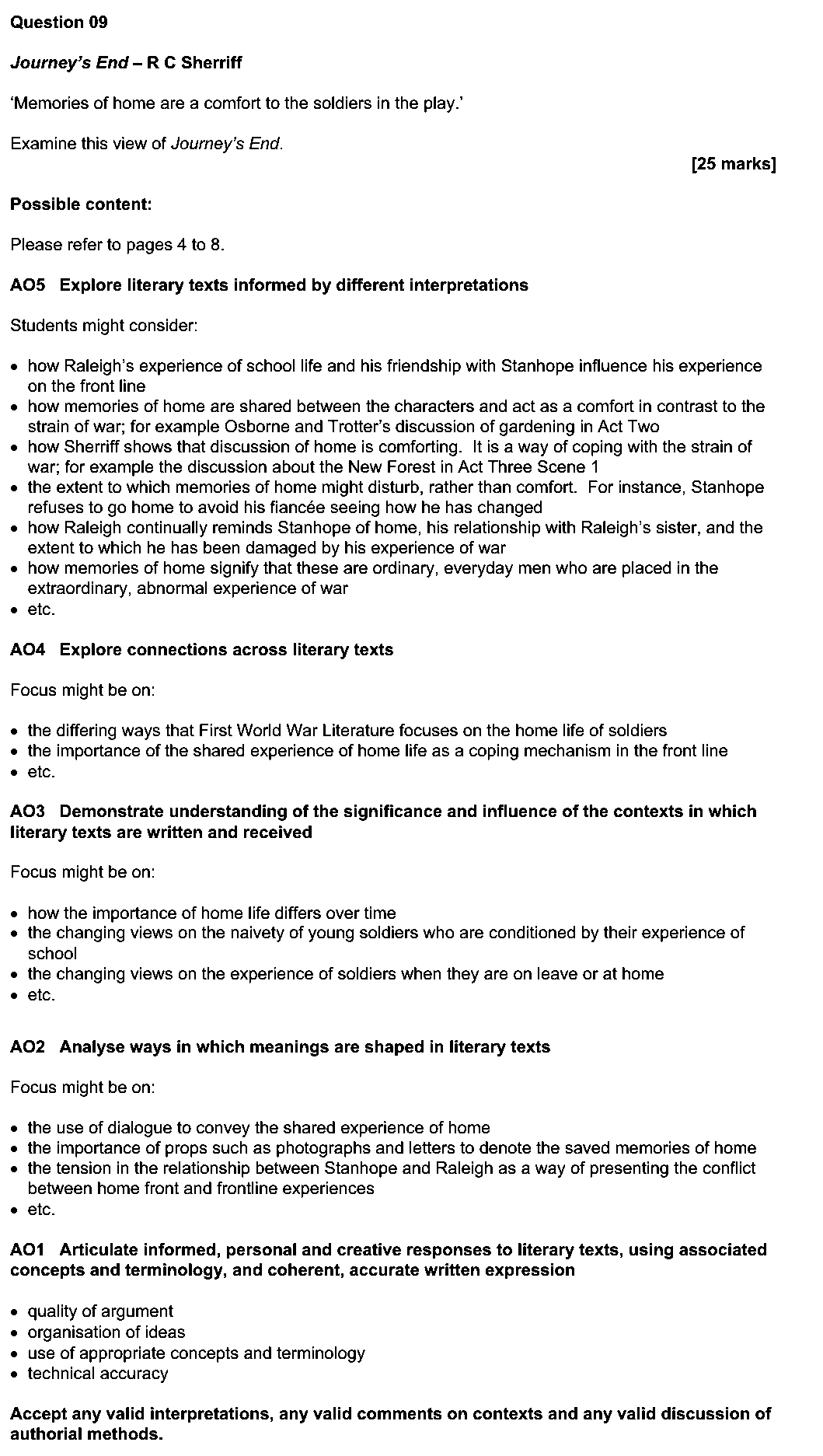
Focus: theme: memories of home
Open book, no extract
view: memories of home comfort the soldiers
no examiner report (November series)
MS: Raleigh's school memories and Stanhope, Osborne and Trotter on gardening, the New Forest (Act Three sc 1), Stanhope avoiding his fiancée, Raleigh as reminder of home, ordinary men in extraordinary war
November 2021 · Paper 2A · Q1025 marksSet text essay
Mark scheme, including the levels and indicative content
The general mark scheme (assessment objectives and bands)
Notes from the mark scheme and report
Focus: title
Open book, no extract
no examiner report (November series)
MS: approaching death, emotional resolutions, final reconciliation of Stanhope and Raleigh, passing time and mortality, sacrifice
derivation (Fussell's Othello echo vs Sherriff's novel source) accepted if argued
earlier draft titles 'Suspense' and 'Waiting'
November 2020 · Paper 2A · Q925 marksSet text essay
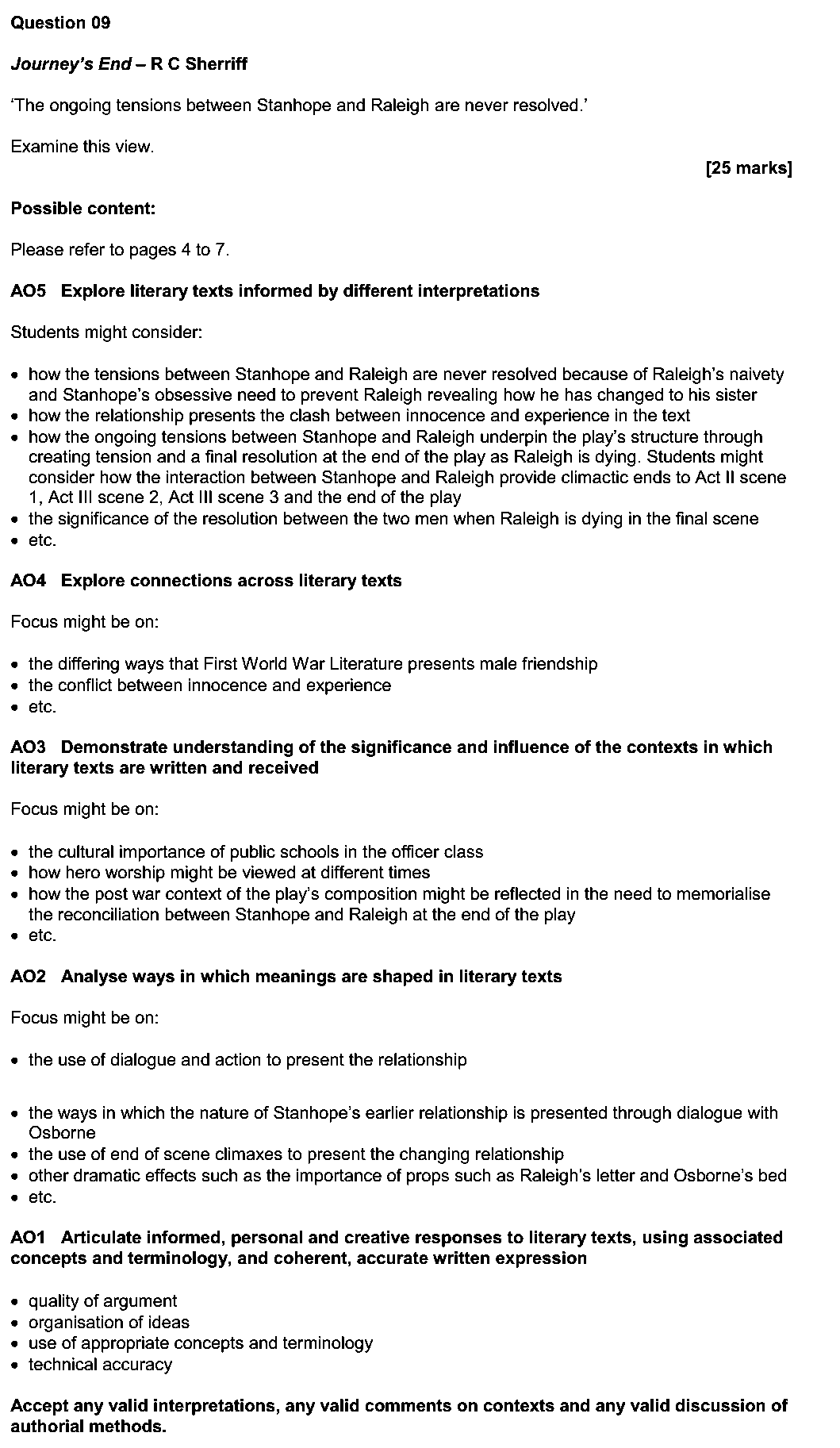
Mark scheme, including the levels and indicative content
The general mark scheme (assessment objectives and bands)
Notes from the mark scheme and report
Focus: relationship: Stanhope and Raleigh
Open book, no extract
view: Stanhope-Raleigh tensions never resolved
no examiner report (November series)
MS: Raleigh's naivety and Stanhope's fear of exposure to Madge, innocence vs experience, tensions creating act climaxes (Act II sc 1, Act III sc 2 and 3), reconciliation as Raleigh dies
November 2020 · Paper 2A · Q1025 marksSet text essay
Mark scheme, including the levels and indicative content
The general mark scheme (assessment objectives and bands)
Notes from the mark scheme and report
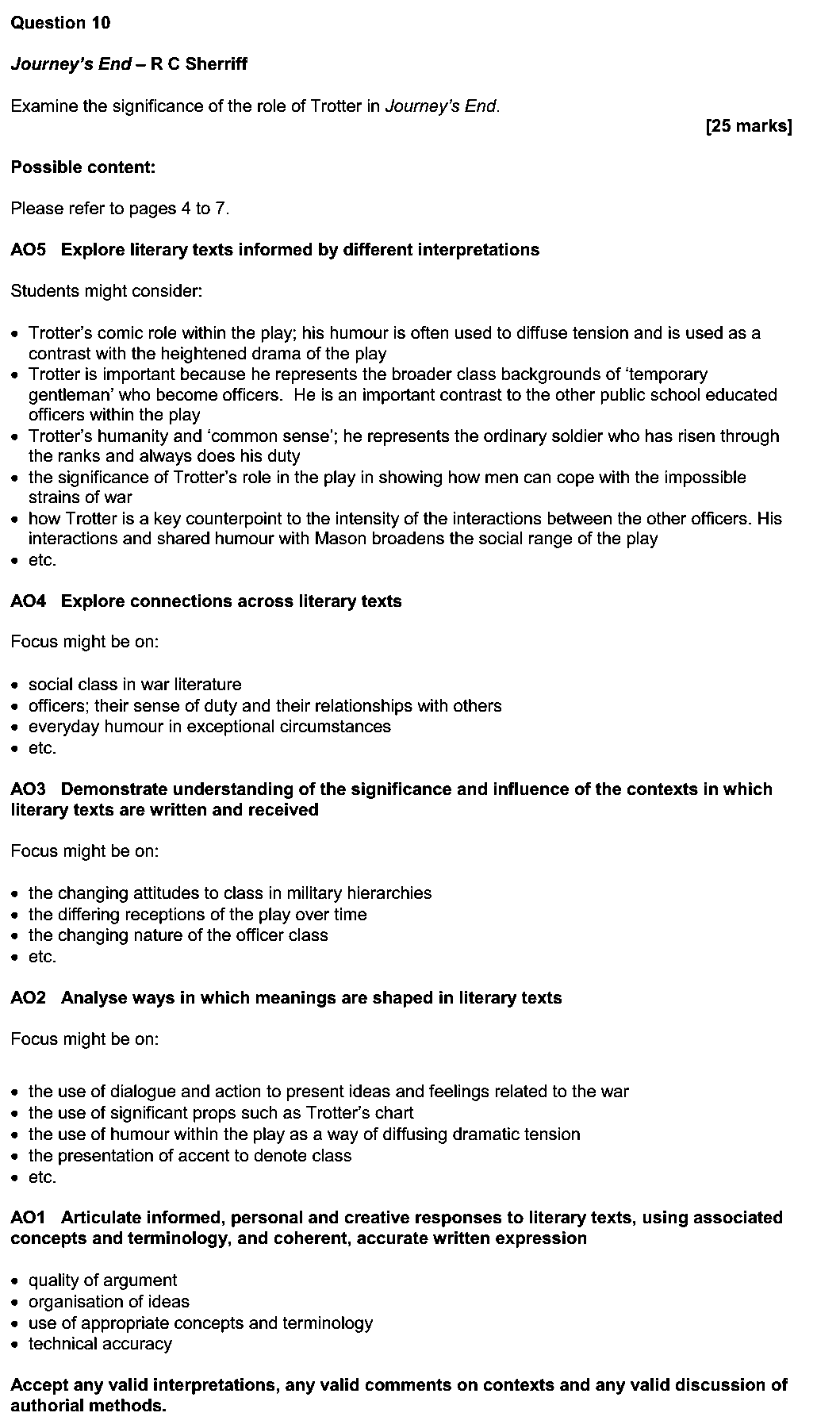
Focus: character: Trotter
Open book, no extract
no examiner report (November series)
MS: comic relief against heightened drama, 'temporary gentleman' from a different class, common sense and duty, coping with strain, rapport with Mason widening social range
June 2019 · Paper 2A · Q925 marksSet text essay
Mark scheme, including the levels and indicative content
The general mark scheme (assessment objectives and bands)
Examiner's comment
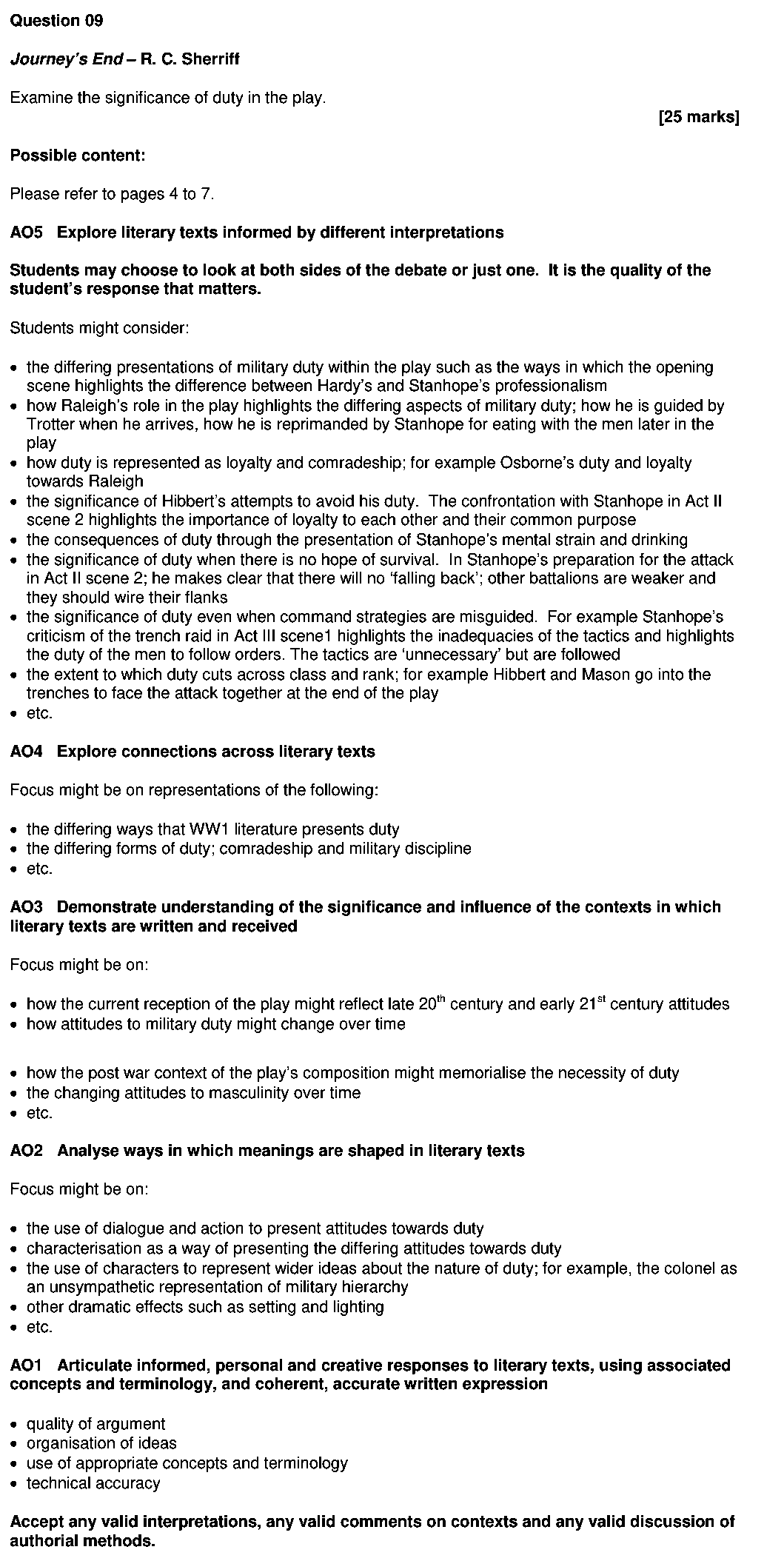
Students engaged in the debate on ‘duty’ in a variety of ways. Examiners were impressed by the textual knowledge and saw the majority of students making good choices in their responses. Students purposefully engaged with the nature of military duty and were able to debate this through the comparison of key characters. At times the discussion of the interplay between Hibbert and Stanhope was reductive; but the more confident answers explored how the confrontation between the two in Act II scene 2 signified duty as a collective act. The most effective answers were able to debate the differing types of duty explored in the text that moved beyond the military context and considered the personal duties reflected in the relationships between the officers.
Notes from the mark scheme and report
Focus: theme: duty
Open book, no extract
MS: Hardy vs Stanhope, Raleigh guided by Trotter and rebuked for eating with the men, Osborne's loyalty, Hibbert avoiding duty, Stanhope's strain, no 'falling back', the raid
ER: good textual knowledge
Hibbert and Stanhope sometimes reductive
best saw duty as collective and also personal between officers
June 2019 · Paper 2A · Q1025 marksSet text essay
Mark scheme, including the levels and indicative content
The general mark scheme (assessment objectives and bands)
Examiner's comment
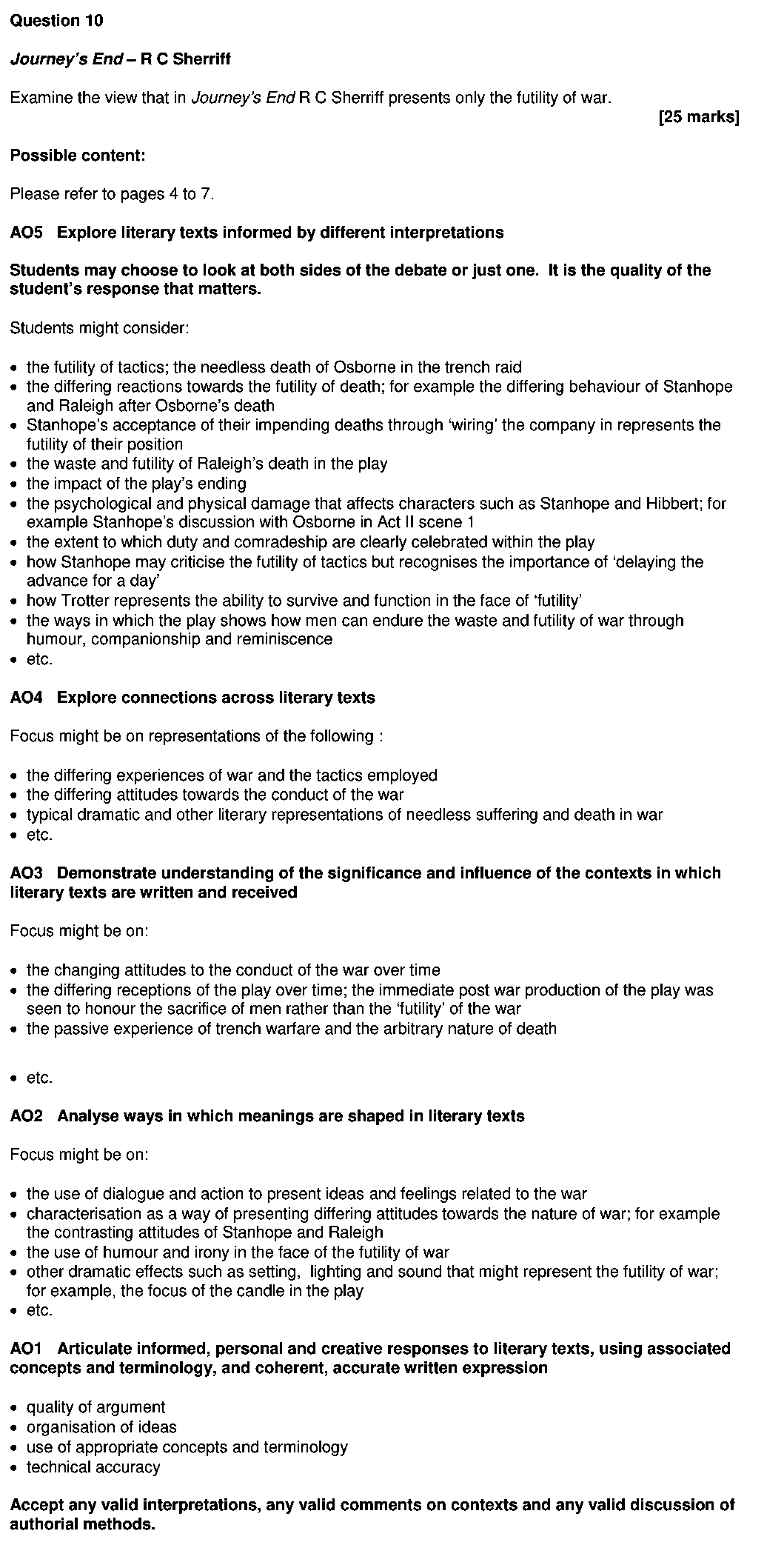
This was a popular question and allowed for a range of interesting responses. Textual choices were largely successful and there was some detailed work on Sherriff’s presentation of the trench raid through considering the extent to which Osborne’s death signifies futility. Responses to this question were wide ranging; the most effective were able to debate the extent to which the seeming ‘futility’ of war can be endured through humane qualities such as companionship and humour. Some examiners, however, noted that a number of responses seemed more focused on a question from the last series. Again, students should be reminded that ‘answer the question’ is a key message in this specification and that independent, relevant responses are always valued.
Notes from the mark scheme and report
Focus: theme: futility of war
Open book, no extract
debate 'only' futility
MS: Osborne's needless death in the raid, Raleigh's death, ending, Stanhope and Hibbert's damage vs duty, comradeship, Trotter's endurance, delaying the advance
ER: good on the raid
best debated futility endured through companionship and humour
some answered a previous series' question
June 2018 · Paper 2A · Q925 marksSet text essay
Mark scheme, including the levels and indicative content
The general mark scheme (assessment objectives and bands)
Examiner's comment
The best responses to this question didn’t just describe social class, but entered into a full debate concerning its significance within the play. Although some students muddled class with military rank, more thorough contextual knowledge was often used effectively; examiners were impressed by students who could reflect on Sherriff’s first failed attempt to become an officer because of his grammar school education and consider the significance of Trotter as a ‘temporary gentleman’. More straightforward answers tended to just describe the presentation of class through accent and non-standard English; the best answers, however, evaluated class attitudes expressed within the play such as Stanhope’s claim that Trotter had no ‘imagination’. Strong responses also debated significance through considering the extent to which Trotter and Mason’s class background relegates them to the role of minor comic characters. The very best answers were able to consider the breaking down of class barriers at the end of play through considering the significance of Mason accompanying Hibbert to the front line trench or Trotter assuming Osborne’s role.
Notes from the mark scheme and report
Focus: theme: social class
Open book, no extract
review: 'the dugout resembled a public school dormitory'
MS: Mason as comic, public-school roles (new boy, housemaster, head boy), rugger language, Trotter as 'temporary gentleman' replacing Osborne
ER: some muddled class with rank
best used Sherriff's grammar-school background, evaluated attitudes (Trotter's lack of 'imagination') and barriers breaking at the end (Mason with Hibbert)
June 2018 · Paper 2A · Q1025 marksSet text essay
Mark scheme, including the levels and indicative content
The general mark scheme (assessment objectives and bands)
Examiner's comment
This was the most popular question on Journey’s End and examiners were genuinely impressed by the range and variety of responses it elicited. The better answers impressed because of their literary focus; the significance of waiting was often explored through the chronological structure of the play and the creation of tension and suspense. Less successful answers tended to use context as a ‘crutch’ and were sometimes diverted into discussing the experience of trench warfare rather than considering the significance of waiting within the play. The most assured responses considered the presentation of time through discussing the significance of Osborne’s ‘old fashioned watch’ and the intensity of the single dug-out setting as opposed to the freer interpretation of the recent Saul Dibb’s film. These answers impressed because of their focus on specific moments of ‘waiting’ such as Stanhope’s threat to shoot Hibbert and the ‘real time’ that elapses as Osborne and Raleigh count down to the trench raid. Textual knowledge was impressive here and allowed students to explore less obvious avenues such as the significance of waiting in Stanhope’s relationship with his fiancée.
Notes from the mark scheme and report
Focus: theme: waiting
Open book, no extract
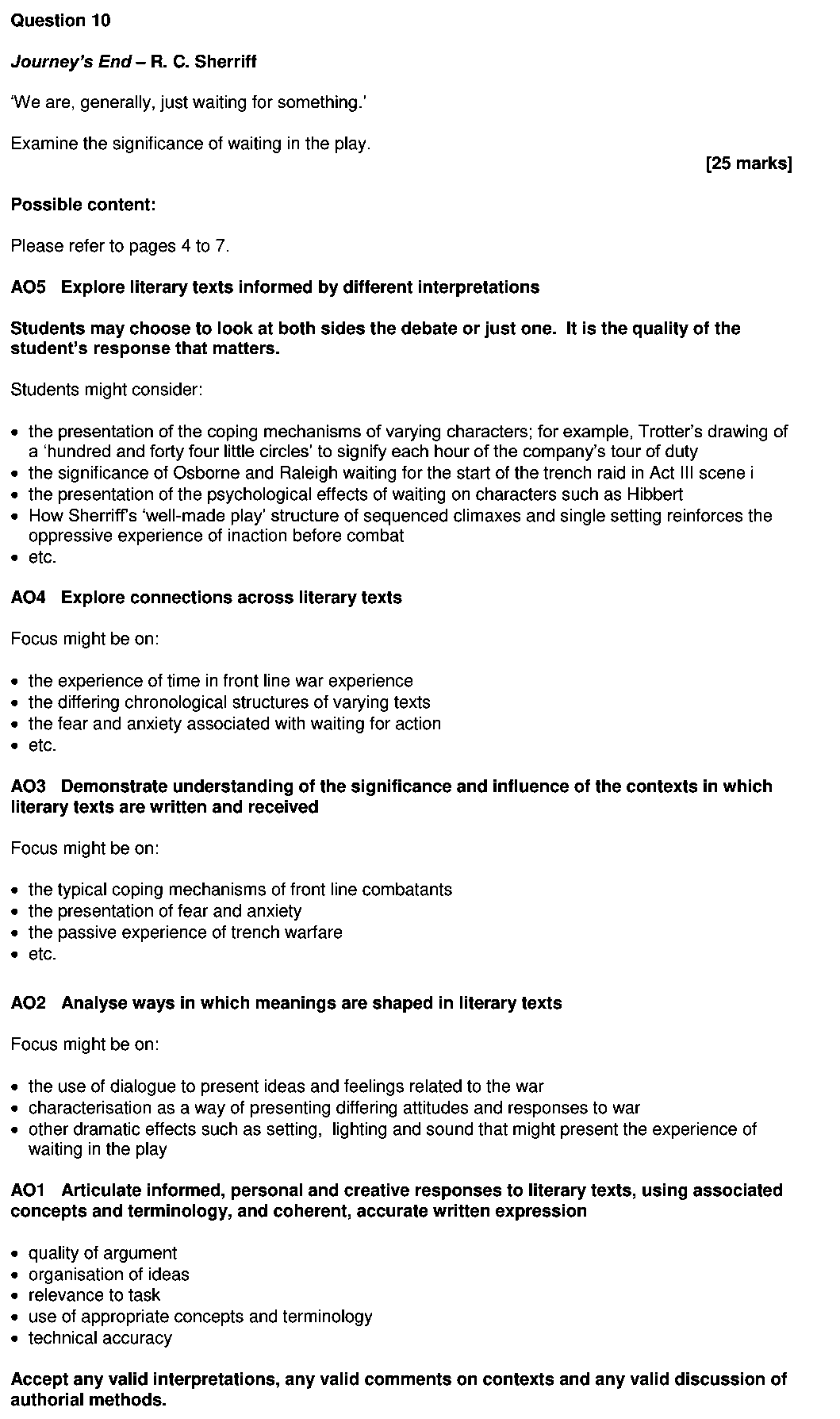
quotation 'We are, generally, just waiting for something'
MS: Trotter's circles, Osborne and Raleigh before the raid, Hibbert's fear, well-made play structure and single setting
ER: most popular JE question
better explored structure, tension and specific moments (Osborne's watch, real-time countdown, Stanhope's threat to Hibbert)
weaker used trench context as a crutch
June 2017 · Paper 2A · Q925 marksSet text essay
Mark scheme, including the levels and indicative content
The general mark scheme (assessment objectives and bands)
Examiner's comment
This was a minority choice for this highly popular core set text. The quality of debates offered impressed examiners who felt that the question attracted candidates who enjoyed offering conceptual responses. A key discriminator, however, was precise textual knowledge and students performed well if they developed the debate through exploring the varying roles of Stanhope, Raleigh and the Colonel. Some students tended to skirt over these characters or even ignore them and thus lost a sense of their importance to the debate. Significantly, only a minority considered the influence of the play on an audience today, an idea which, if included, added to the quality of discussion.
Notes from the mark scheme and report
Focus: genre: anti-war play or not
Open book, no extract
Sherriff quotation on propaganda
MS: Stanhope's duty and endurance, death as sacrifice, unsympathetic Colonel, the raid, Raleigh's death, post-war composition vs modern anti-war reception
ER: minority choice
precise knowledge of Stanhope, Raleigh and the Colonel discriminated
few considered a modern audience
June 2017 · Paper 2A · Q1025 marksSet text essay
Mark scheme, including the levels and indicative content
The general mark scheme (assessment objectives and bands)
Examiner's comment
This proved to be a popular question. For some students it offered the security of a character based task, for others it offered the chance to explore Raleigh’s ‘function’ and his significance in the play as a whole. Successful answers engaged with all aspects of the critical view and were able to consider other roles or functions by focusing on ‘only’ and debating inexperience in a more nuanced way through discussing ‘hopeless’. These answers moved beyond rehearsed character studies and fully explored Raleigh as a construct of the writer. The deeper and wider the discussion of the relevance of Raleigh’s background, the class system and the role or exploitation of youth in the war, the more relevant and impressive the discussion.
Notes from the mark scheme and report
Focus: character: Raleigh
Open book, no extract
view: Raleigh's 'only function' is to show 'hopeless inexperience of youth'
MS: treatment by others, conflict with Stanhope, the raid and Osborne's death, pathos of his death, his role for a non-combatant audience
ER: successful answers debated 'only' and 'hopeless', treated Raleigh as a construct, used class and exploitation of youth rather than rehearsed character studies
Work with an AQA English Literature A tutor
Essays stuck in the middle bands, or not sure what the examiners want from an analysis? Book a trial lesson with a specialist AQA English Literature A tutor.