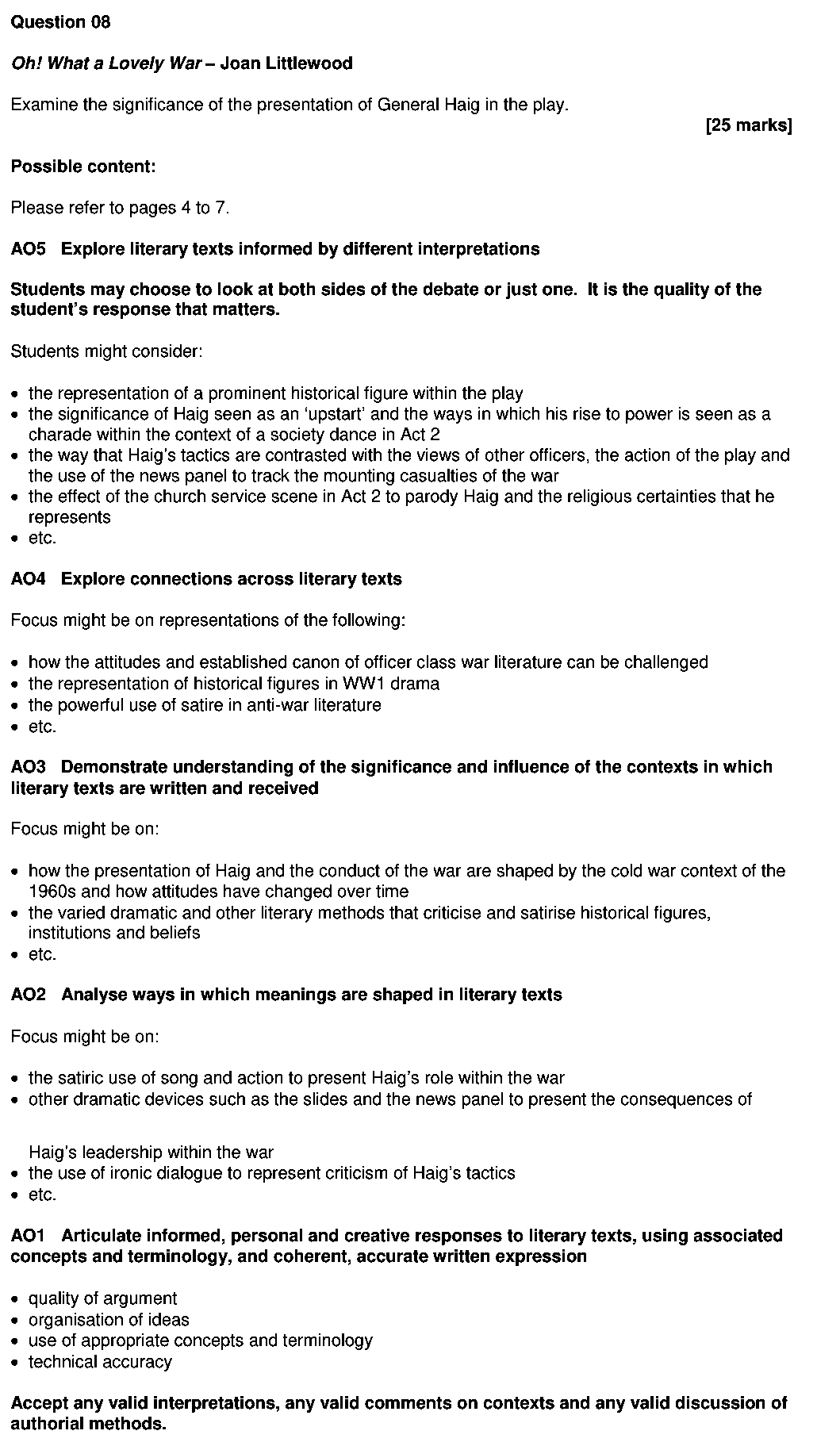
Oh! What a Lovely War – Joan Littlewood ‘Oh! What a Lovely War conveys its anti-war message more powerfully through props, images and slides than through spoken language.’ Examine this view.
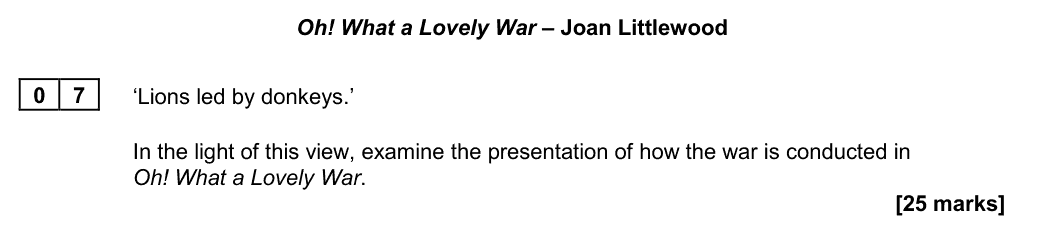
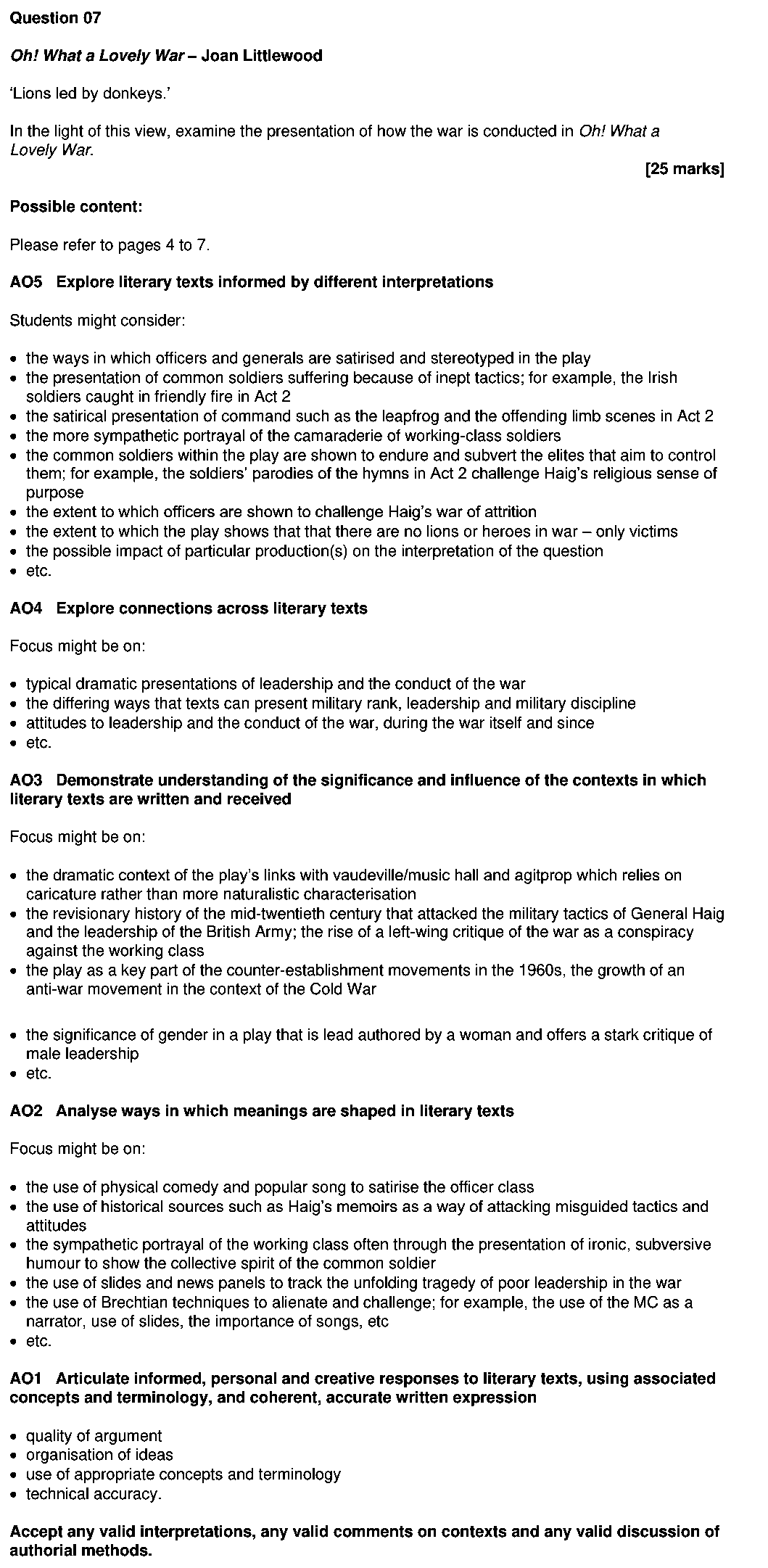
Oh! What a Lovely War – Joan Littlewood ‘Lions led by donkeys.’ In the light of this view, examine the presentation of how the war is conducted in Oh! What a Lovely War.
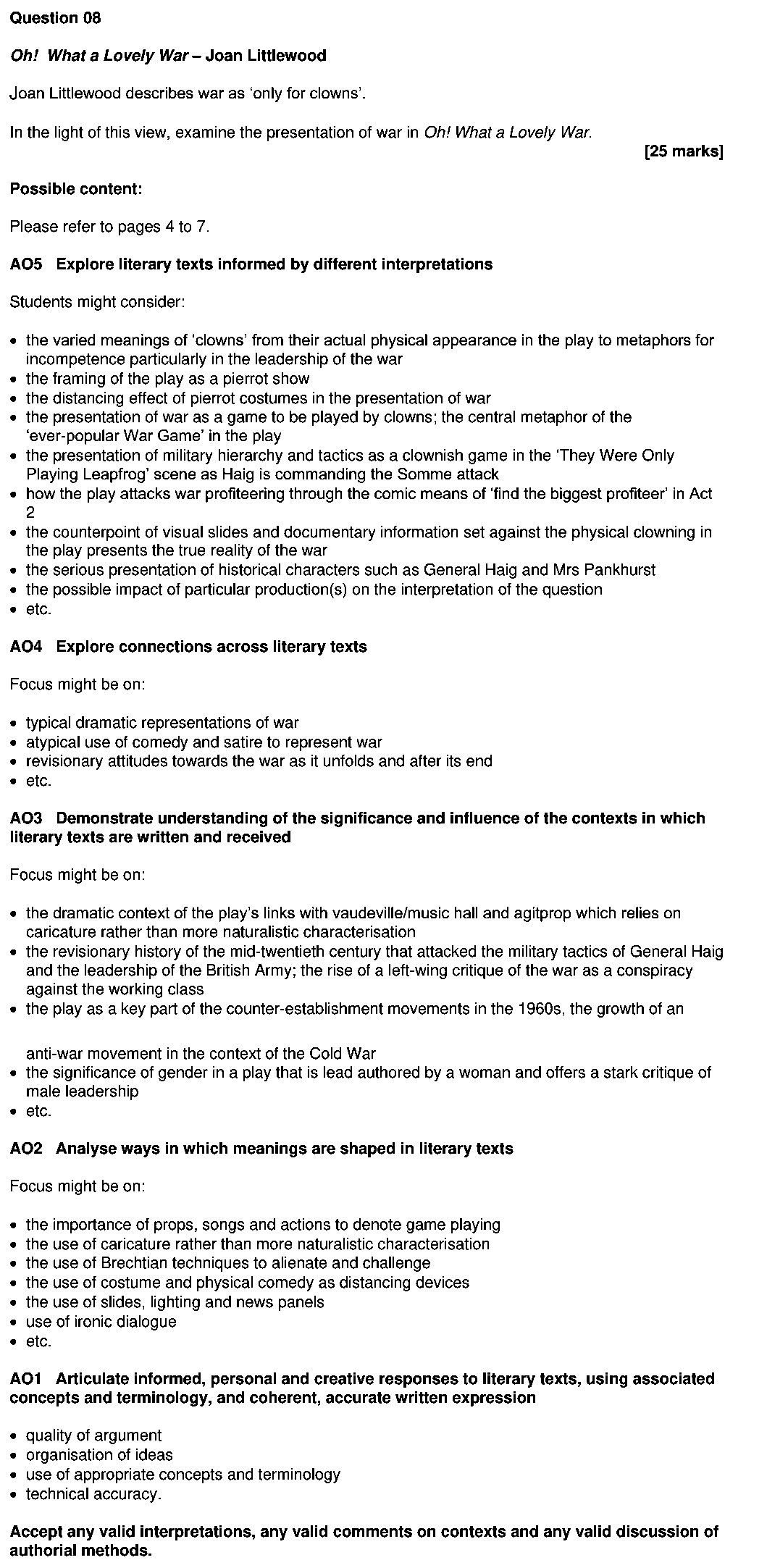
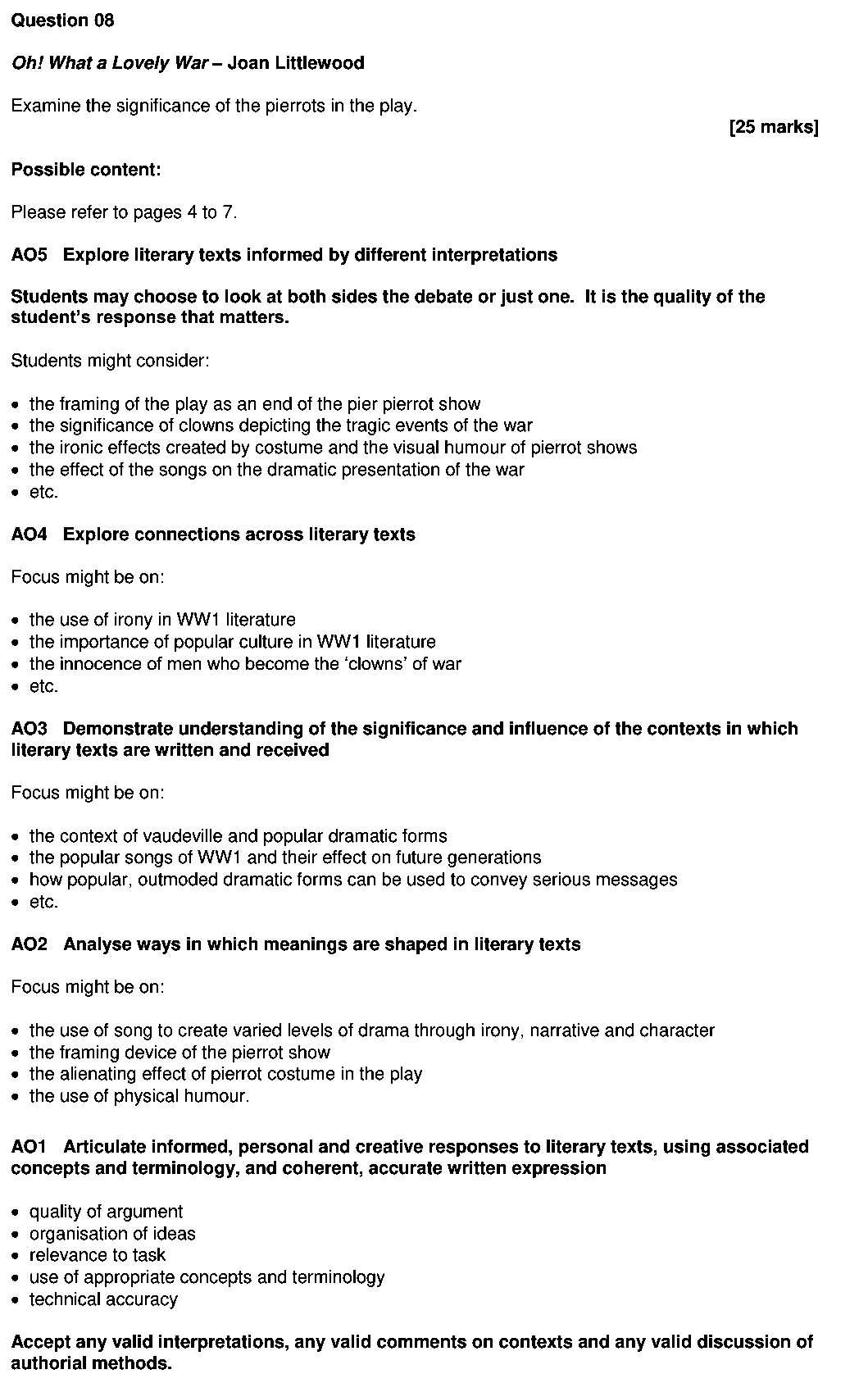
Oh! What a Lovely War – Joan Littlewood Joan Littlewood describes war as ‘only for clowns’. In the light of this view, examine the presentation of war in Oh! What a Lovely War.
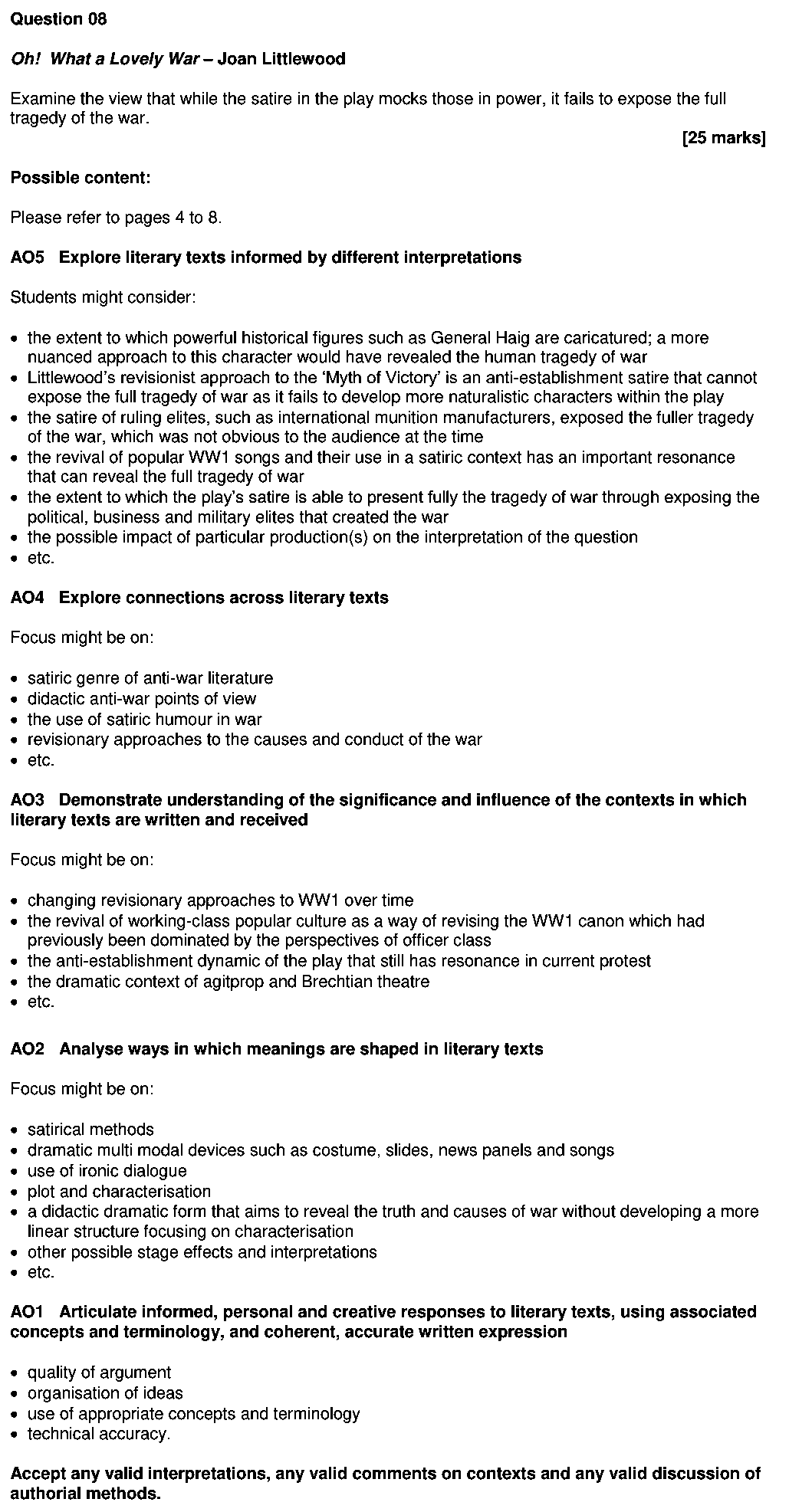
Oh! What a Lovely War – Joan Littlewood Examine the view that while the satire in the play mocks those in power, it fails to expose the full tragedy of the war.
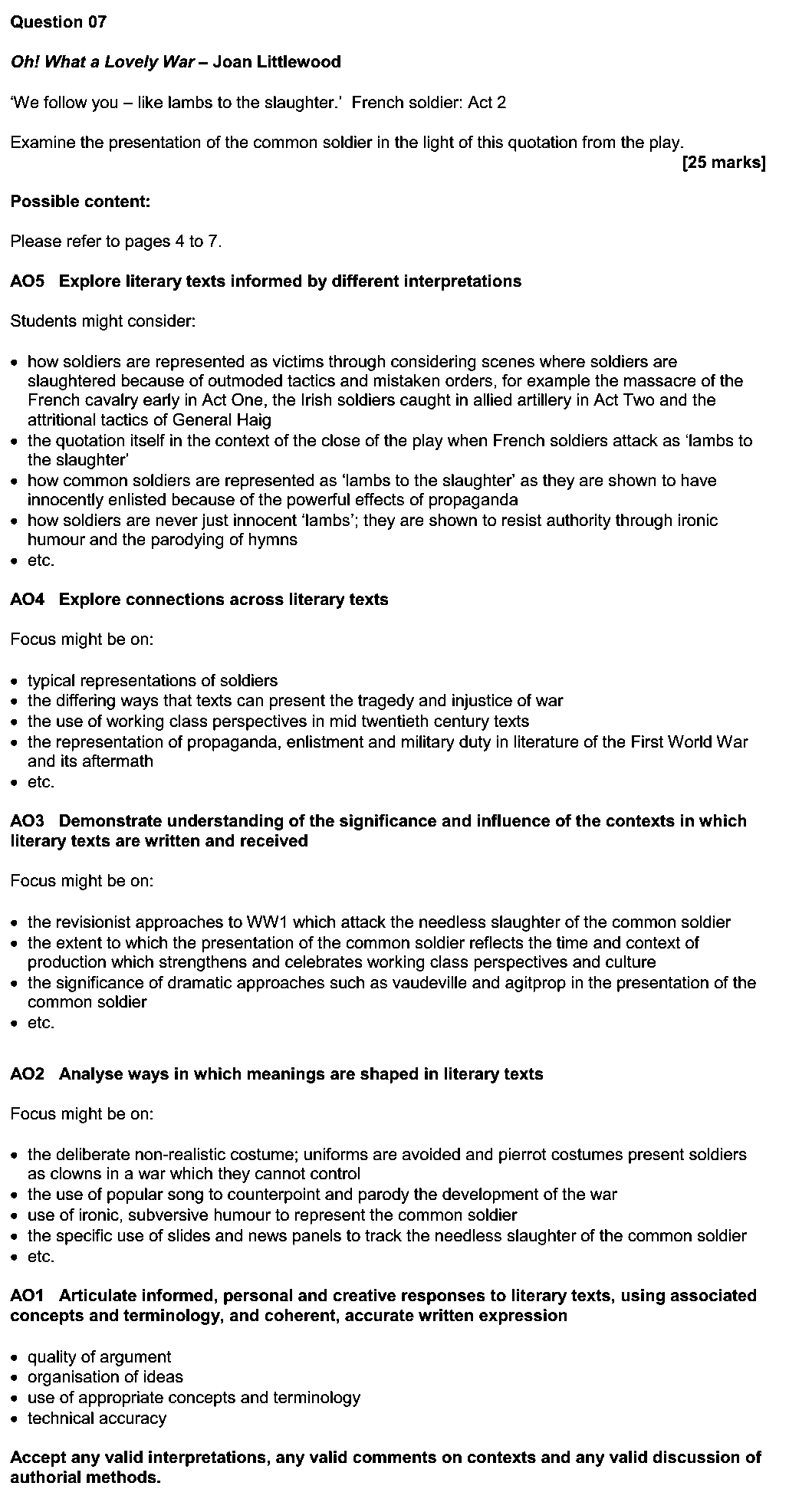
‘We follow you – like lambs to the slaughter.’ French soldier: Act 2 Examine the presentation of the common soldier in the light of this quotation from the play.
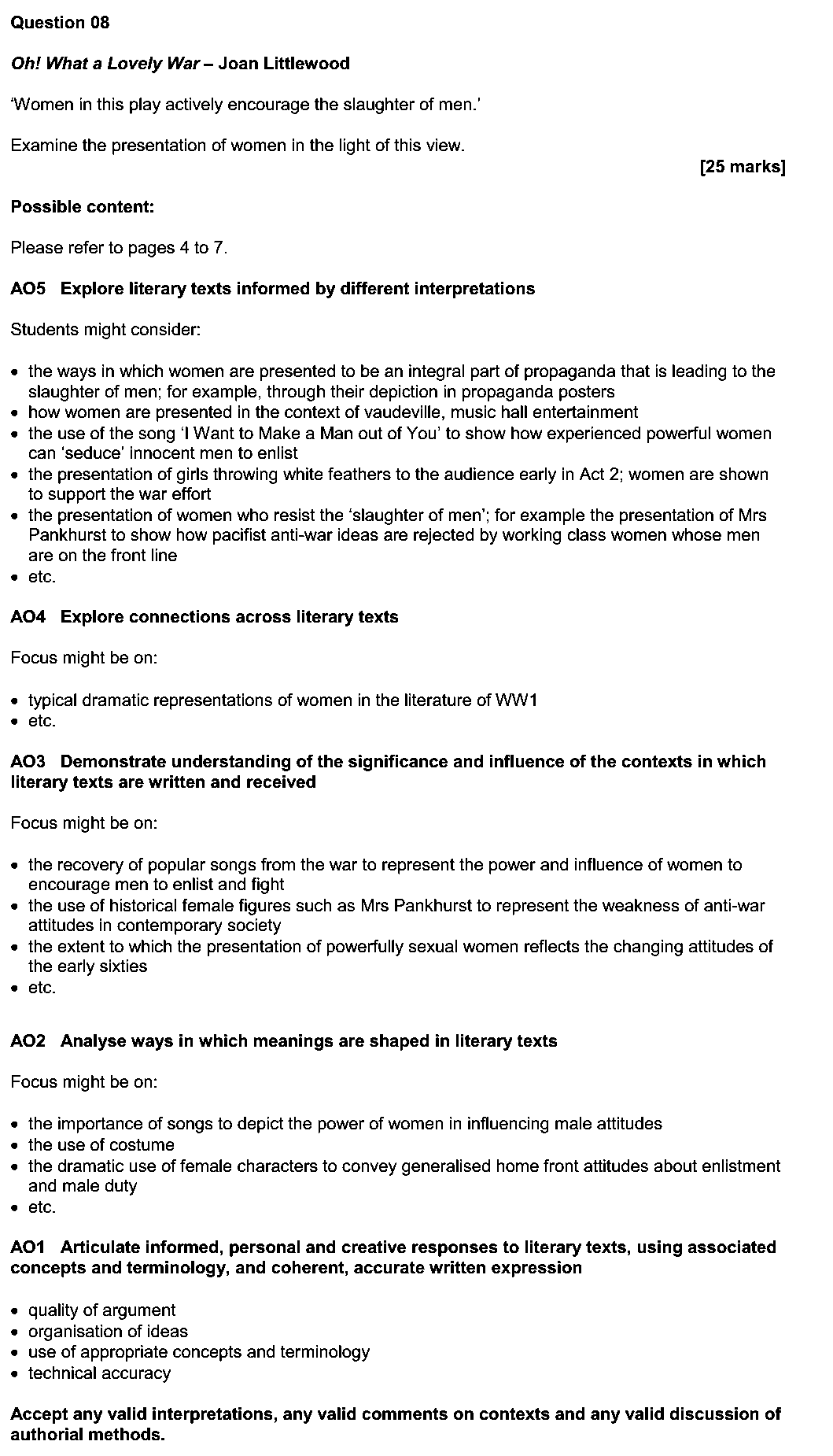
Oh! What a Lovely War – Joan Littlewood ‘Women in this play actively encourage the slaughter of men.’ Examine the presentation of women in the light of this view.
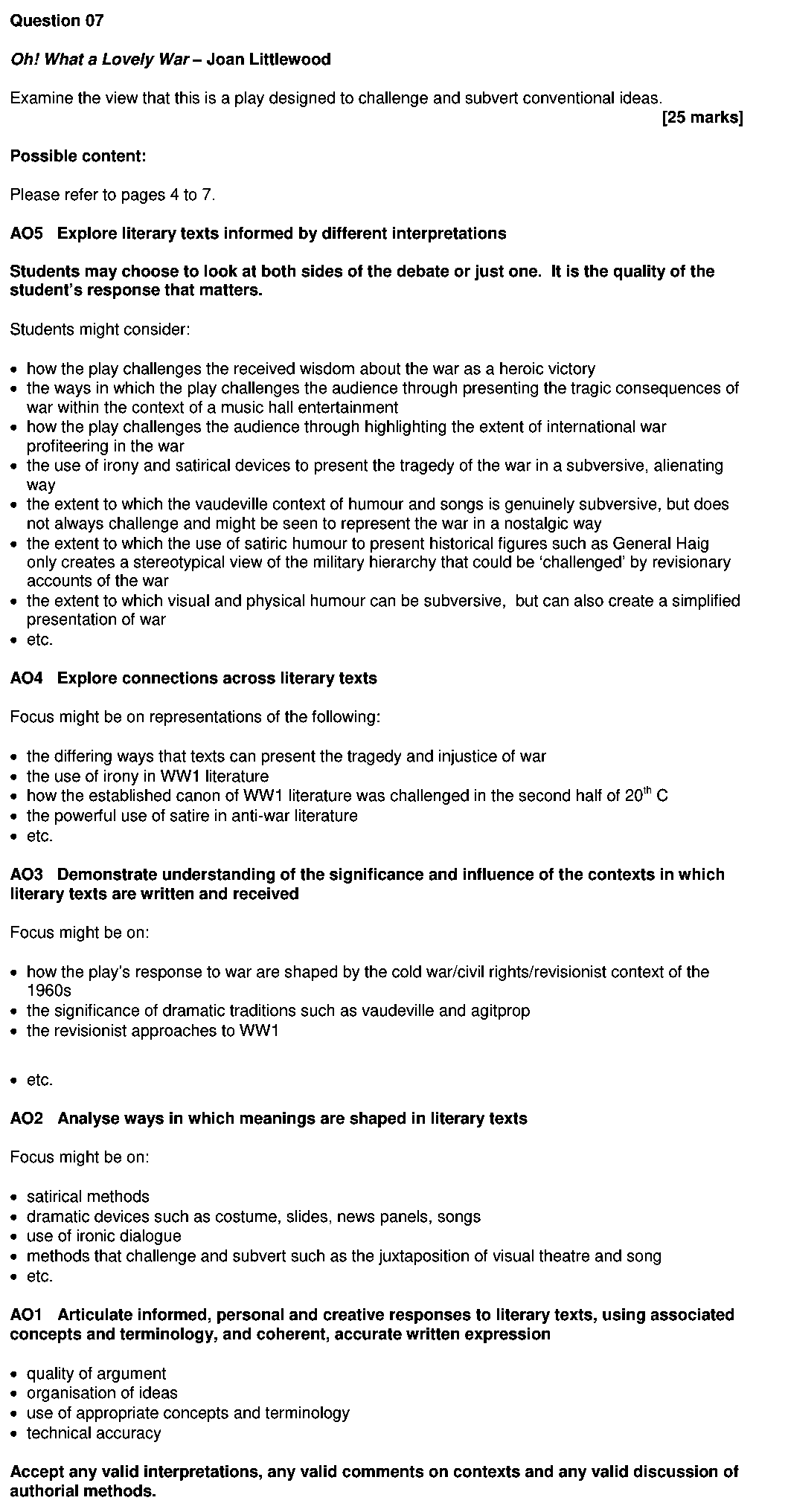
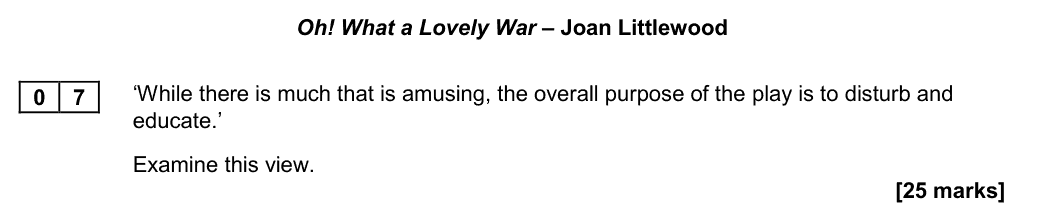
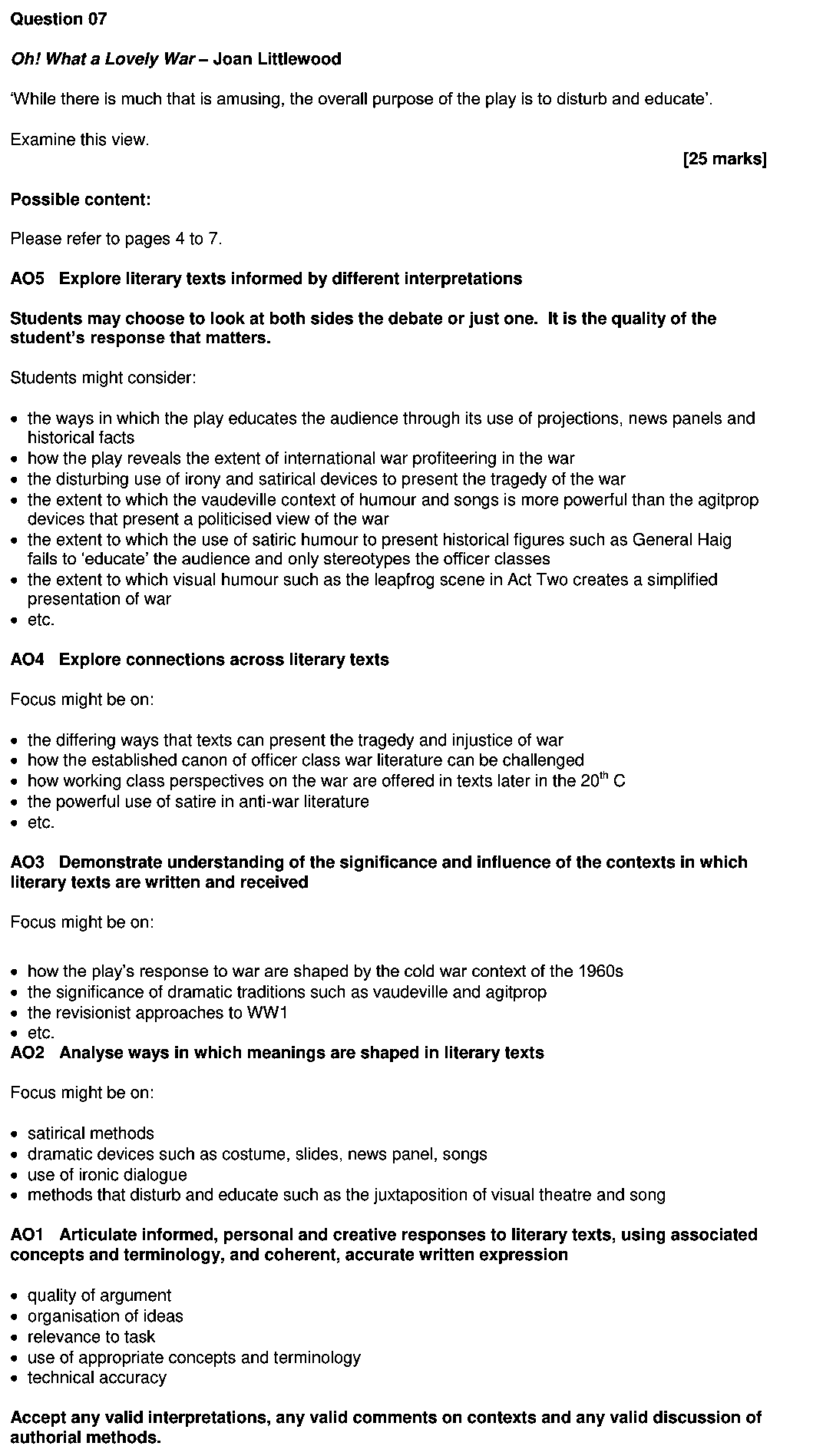
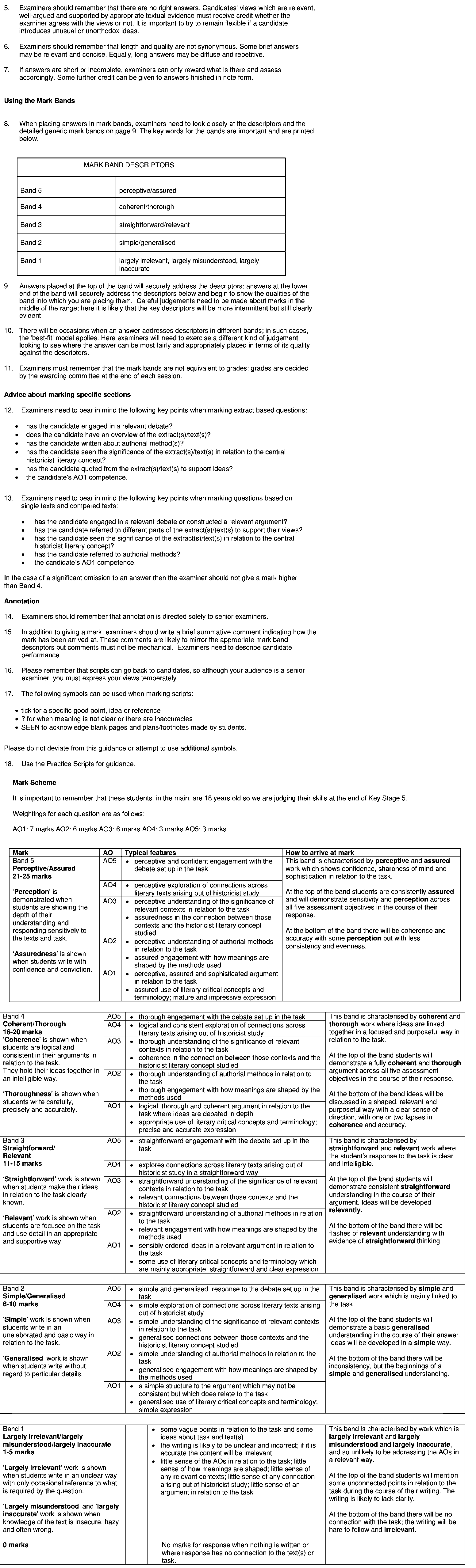
Oh! What a Lovely War – Joan Littlewood ‘While there is much that is amusing, the overall purpose of the play is to disturb and educate.’ Examine this view.
Tap a question to zoom it. The texts and extracts open above it; the mark scheme (with its levels and indicative content) and the examiner's comment open underneath.
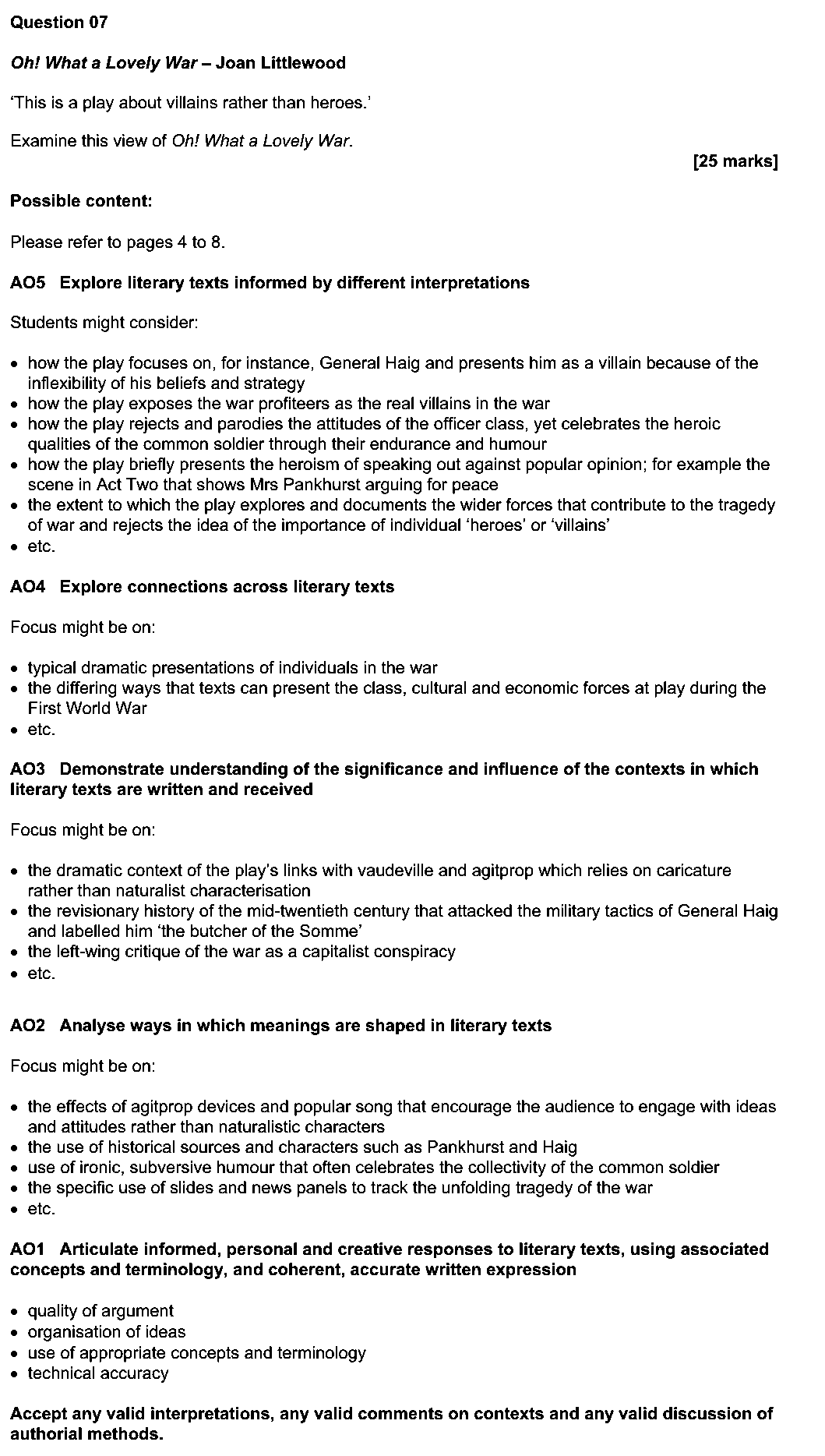
June 2025 · Paper 2A · Q725 marksSet text essay
Mark scheme, including the levels and indicative content
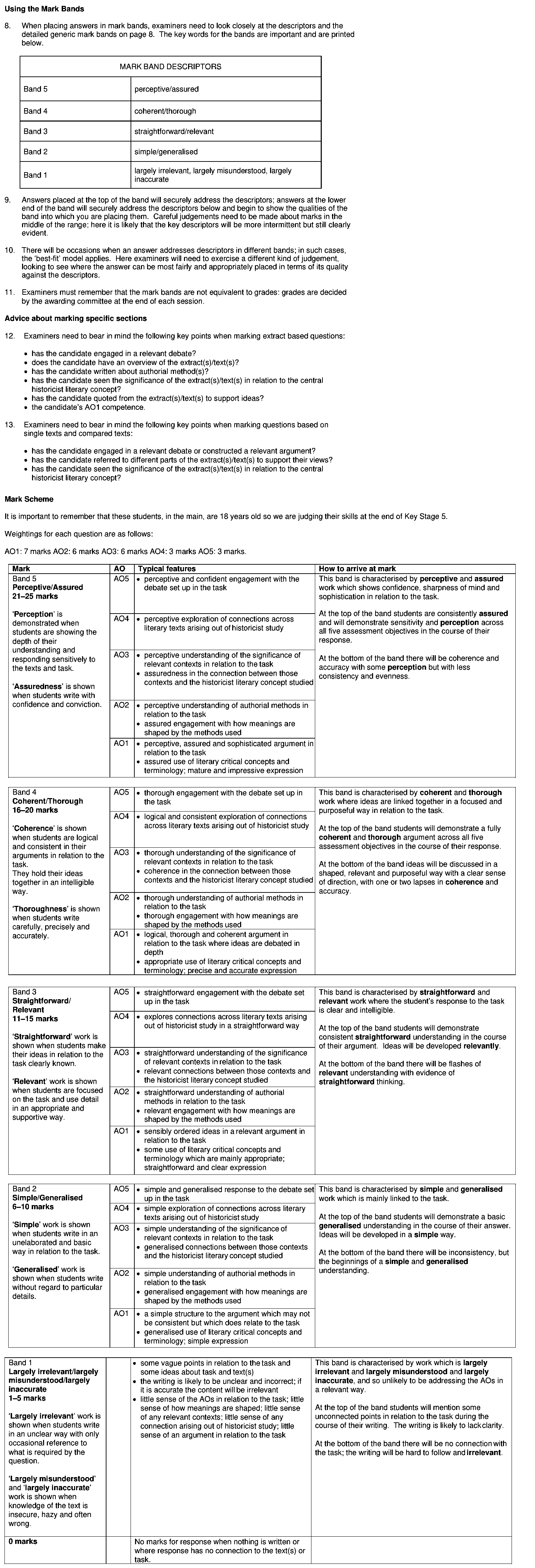
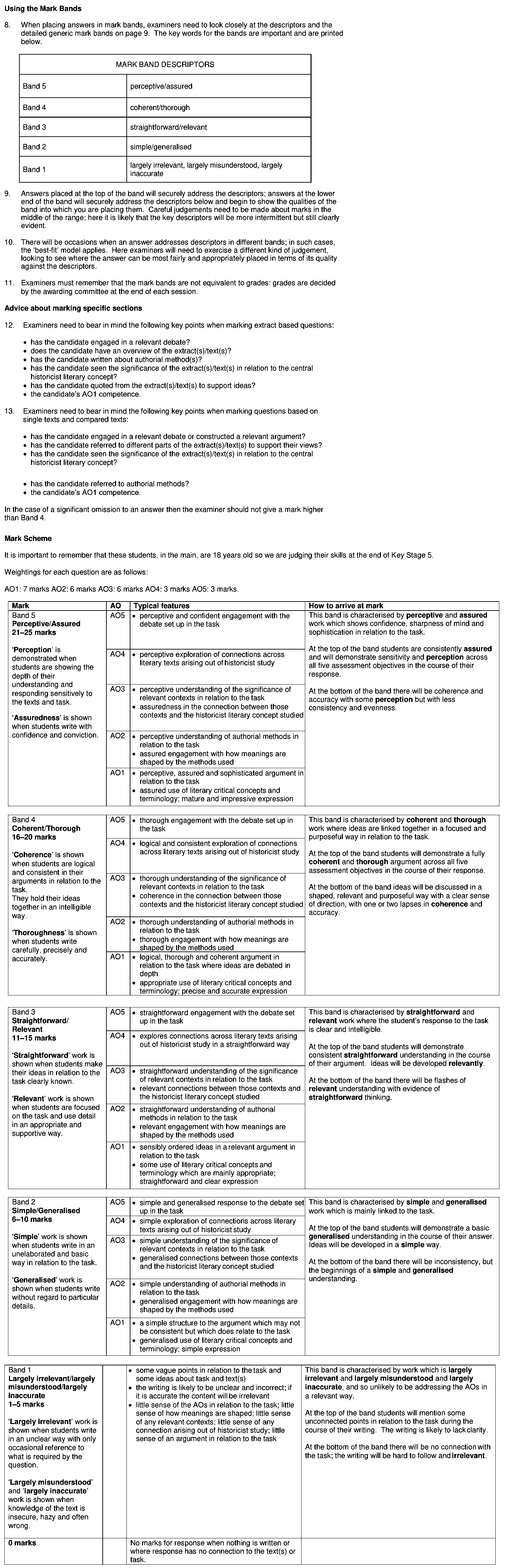
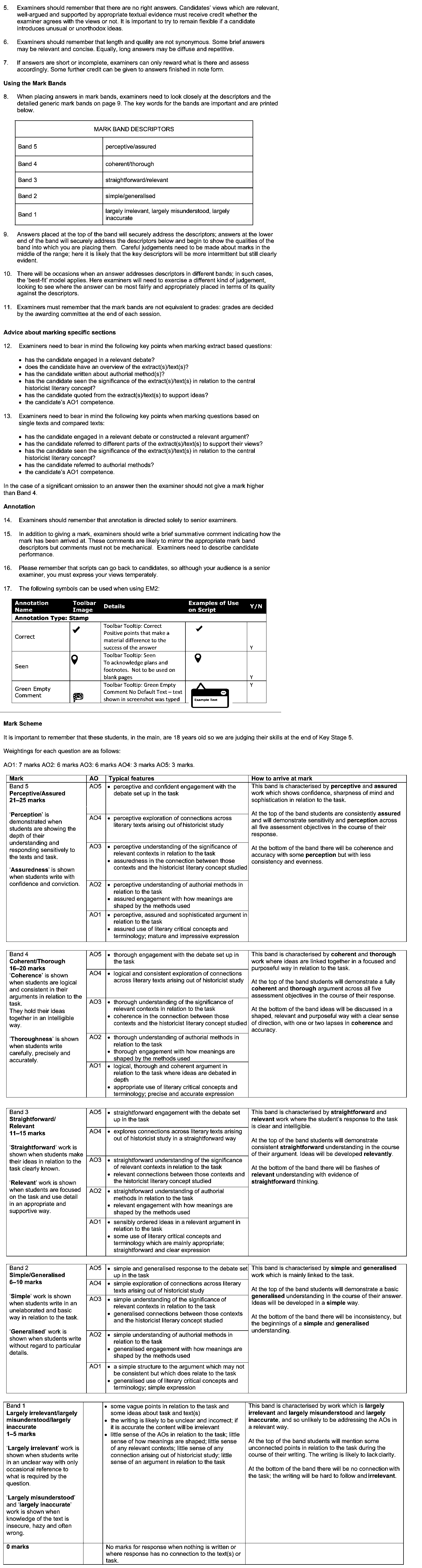
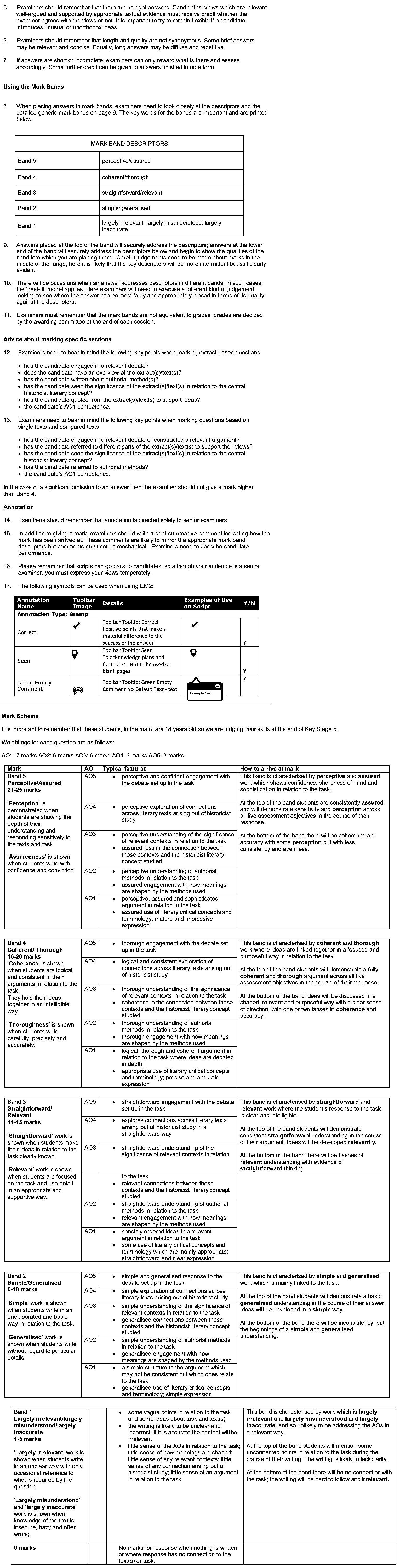
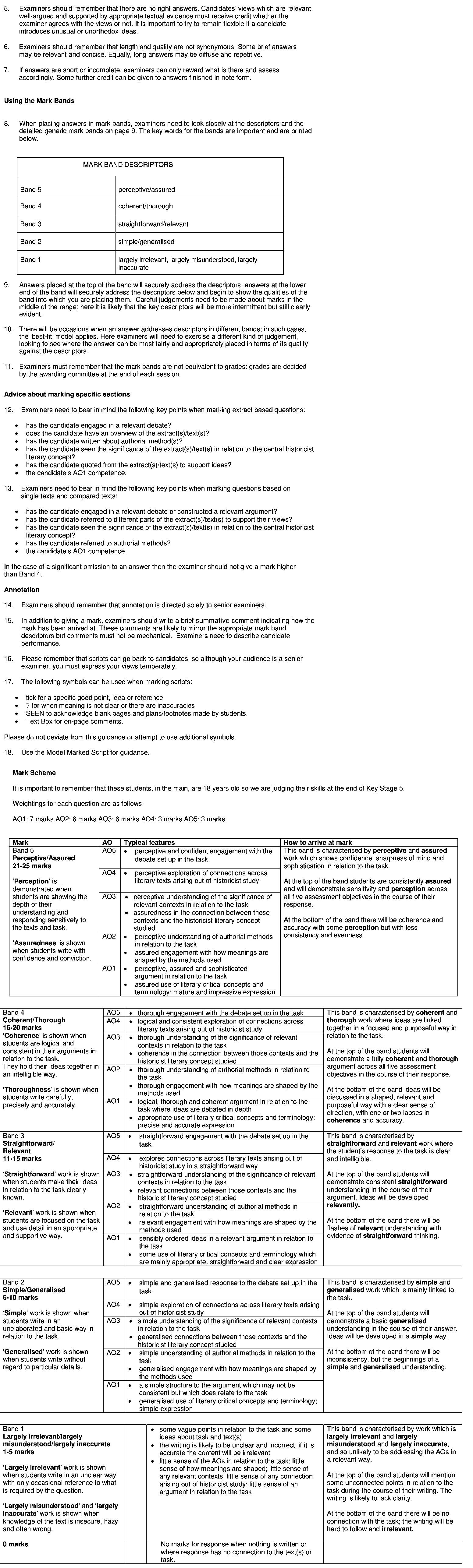
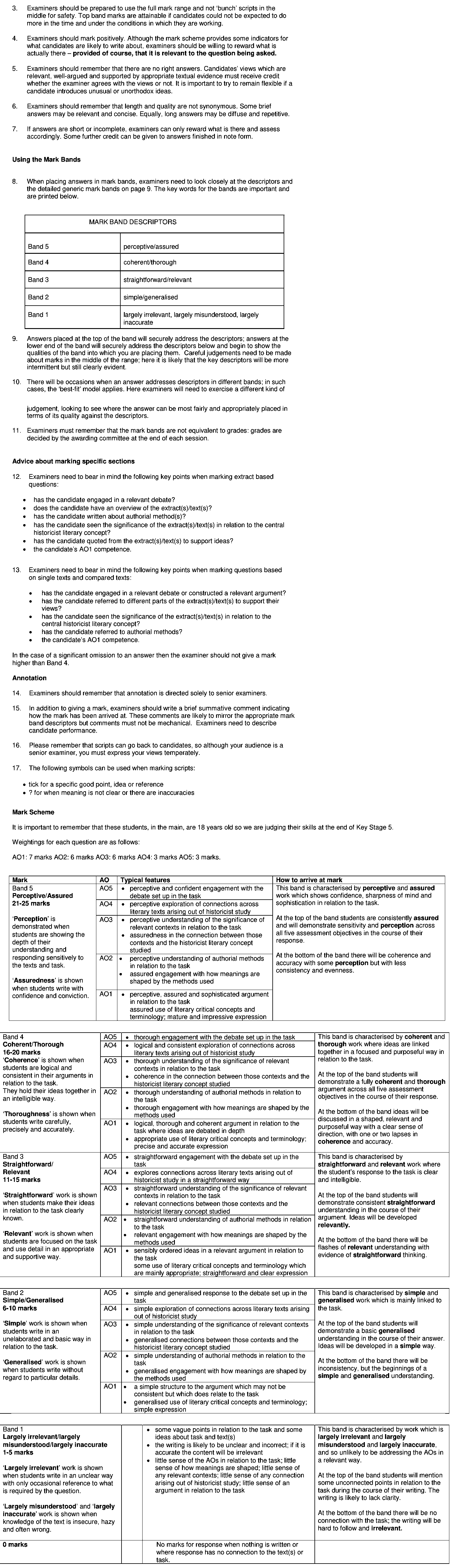
The general mark scheme (assessment objectives and bands)
Examiner's comment
The entry was very small for this text, making it difficult to provide a meaningful report.
Notes from the mark scheme and report
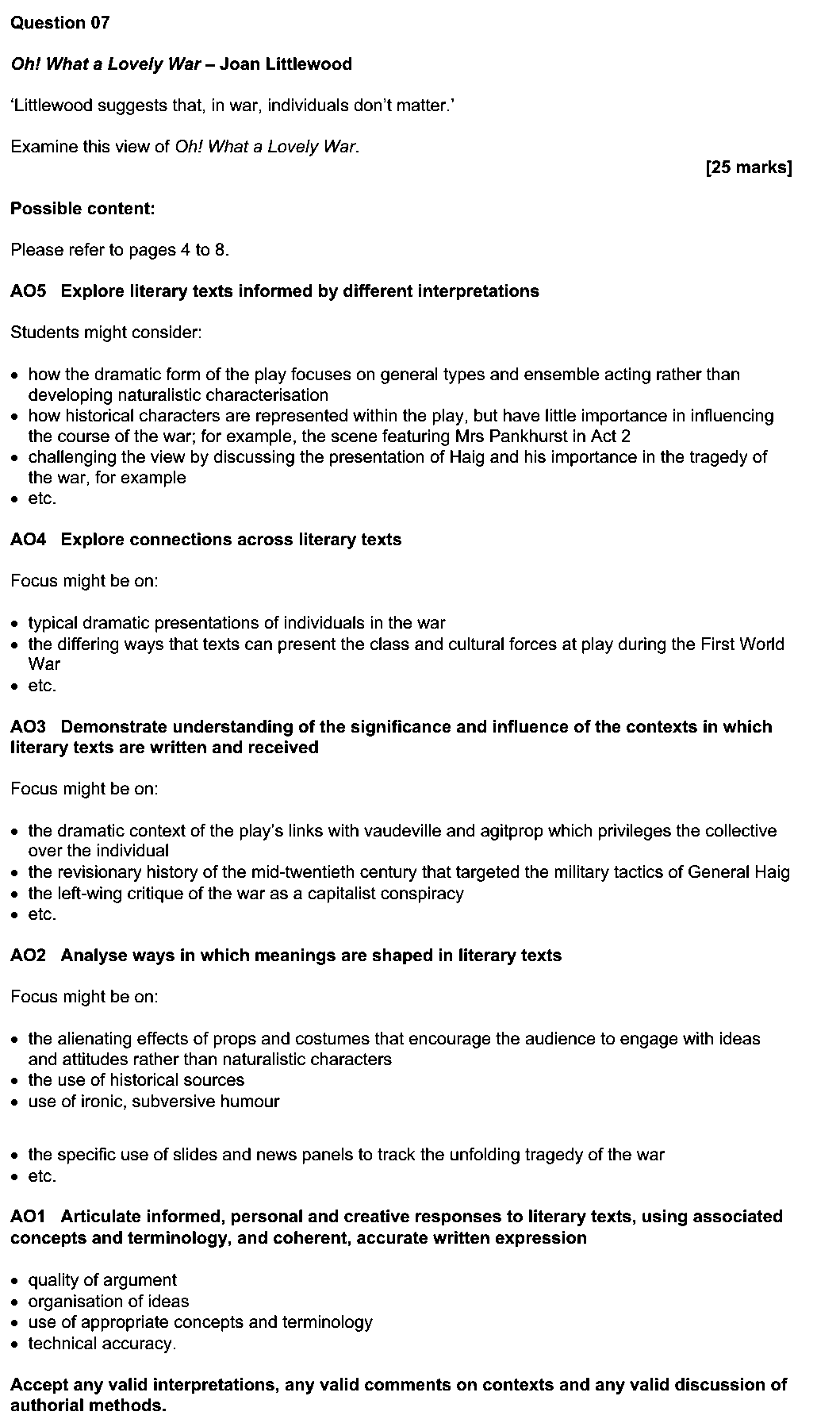
Focus: theme: politics vs the war itself
Open book, no extract
debate politics vs the war: anti-establishment reassessment of the 'Myth of Victory', breakdown of international politics, satire of allied and army game-playing, arms manufacturers in Act 2, non-realistic combat vs documentary slides and statistics, Irish soldiers and friendly fire
report: entry too small for a meaningful report
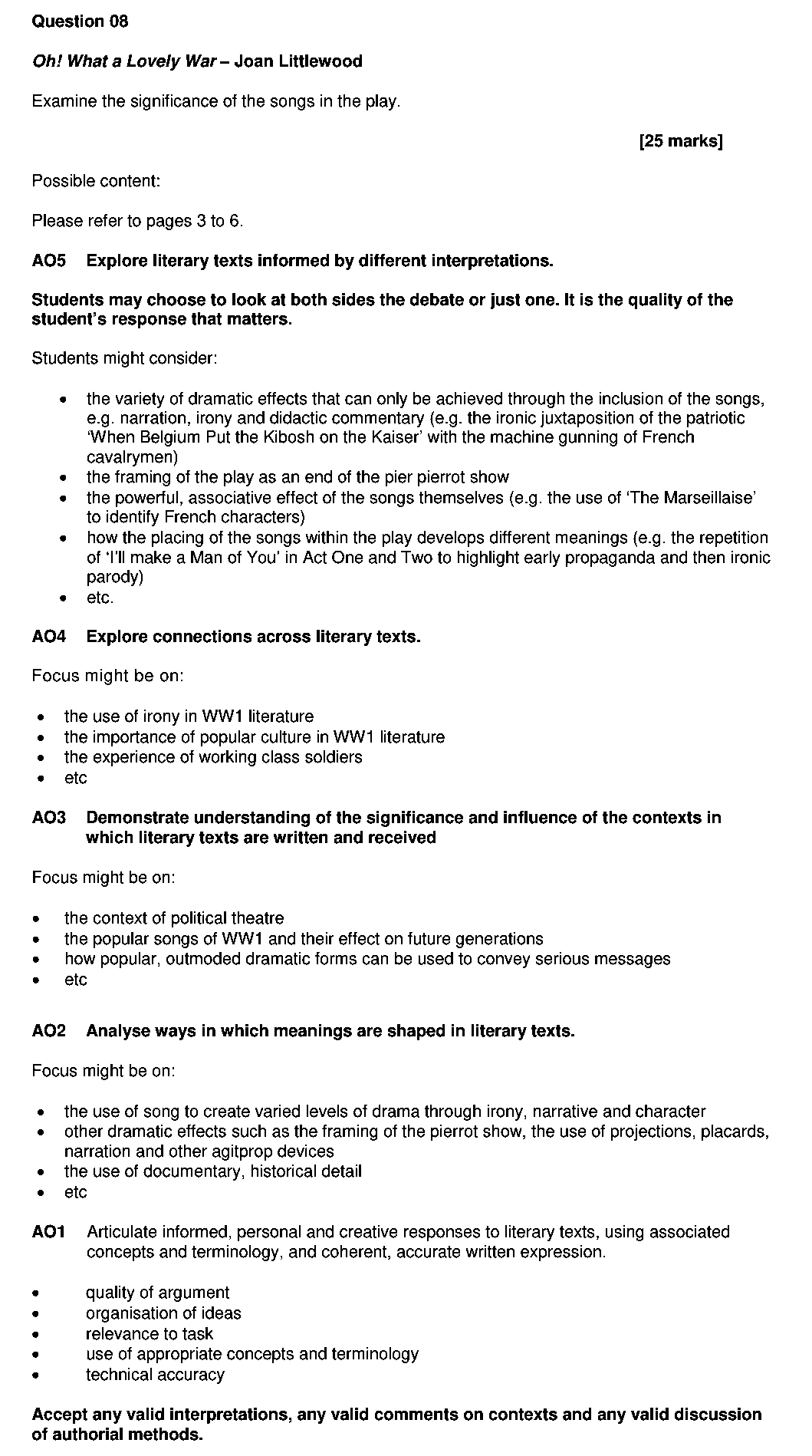
June 2025 · Paper 2A · Q825 marksSet text essay
Mark scheme, including the levels and indicative content
The general mark scheme (assessment objectives and bands)
Examiner's comment
The entry was very small for this text, making it difficult to provide a meaningful report.
Notes from the mark scheme and report
Focus: form/genre: props, images and slides vs spoken language
Open book, no extract
weigh visual vs verbal: slides and ticker-tape news panel statistics, agitprop, vaudeville and pierrot costumes vs the MC's direct address, ironic dialogue, Haig's words from his memoirs
argue counterpoint of all elements
report: entry too small for a meaningful report
June 2024 · Paper 2A · Q725 marksSet text essay
Mark scheme, including the levels and indicative content
The general mark scheme (assessment objectives and bands)
Examiner's comment
The entry was very small for this text, making it difficult to provide a meaningful report.
Notes from the mark scheme and report
Focus: theme: conduct of the war ('lions led by donkeys')
Open book, no extract
satire and stereotyping of officers and generals, soldiers suffering from inept tactics (Irish soldiers and friendly fire, leapfrog scene), soldiers' parodies of hymns vs Haig, whether there are only victims, not lions
report: entry too small for a meaningful report
June 2024 · Paper 2A · Q825 marksSet text essay
Mark scheme, including the levels and indicative content
The general mark scheme (assessment objectives and bands)
Examiner's comment
The entry was very small for this text, making it difficult to provide a meaningful report.
Notes from the mark scheme and report
Focus: theme: war as 'only for clowns'
Open book, no extract
meanings of 'clowns': pierrot framing and costumes as distancing, the War Game, leapfrog scene with Haig, 'find the biggest profiteer', slides and documentary facts set against clowning, serious historical figures
report: entry too small for a meaningful report
June 2023 · Paper 2A · Q725 marksSet text essay
Mark scheme, including the levels and indicative content
The general mark scheme (assessment objectives and bands)
Examiner's comment
The entry was very small for this text, making it difficult to provide a meaningful report.
Notes from the mark scheme and report
Focus: theme: the individual in war
Open book, no extract
ensemble acting and types rather than naturalistic characters, historical figures with little influence (Mrs Pankhurst in Act 2)
can challenge via Haig's importance
report: entry too small for a meaningful report
June 2023 · Paper 2A · Q825 marksSet text essay
Mark scheme, including the levels and indicative content
The general mark scheme (assessment objectives and bands)
Examiner's comment
The entry was very small for this text, making it difficult to provide a meaningful report.
Notes from the mark scheme and report
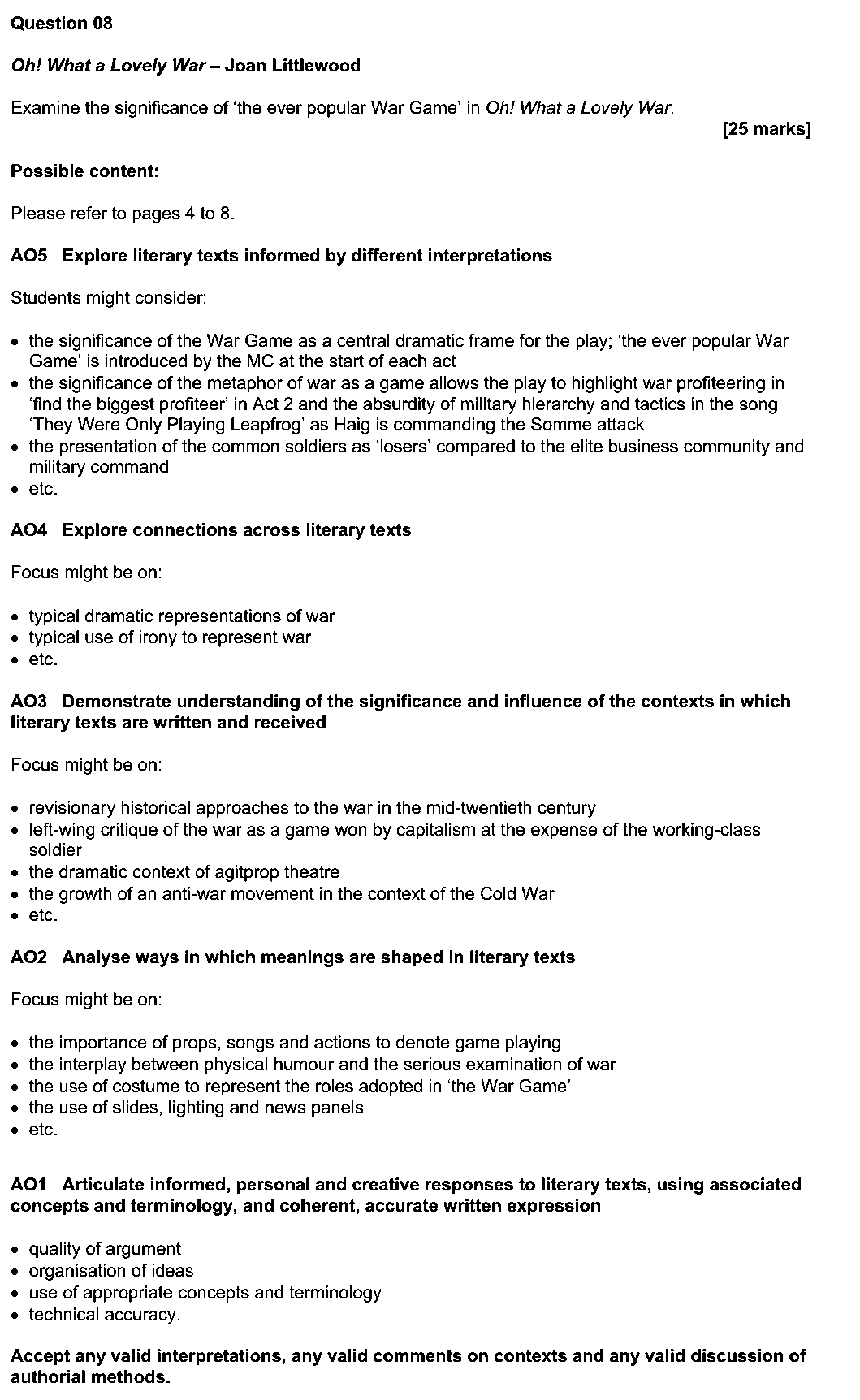
Focus: structure: 'the ever popular War Game'
Open book, no extract
the War Game as the play's central frame introduced by the MC each act
metaphor of war as a game: 'find the biggest profiteer', 'They Were Only Playing Leapfrog' with Haig at the Somme, soldiers as losers to elites
report: entry too small for a meaningful report
June 2022 · Paper 2A · Q725 marksSet text essay
Mark scheme, including the levels and indicative content
The general mark scheme (assessment objectives and bands)
Examiner's comment
Very few students chose these questions and the Lead Examiner and the senior examining team did not see any responses for this set text. In the past students who have answered questions on this play have confidently discussed dramatic methods through considering the influences of Brecht, agitprop and music hall and had a secure understanding of the context of the play in the counter culture of the 1960s.
Notes from the mark scheme and report
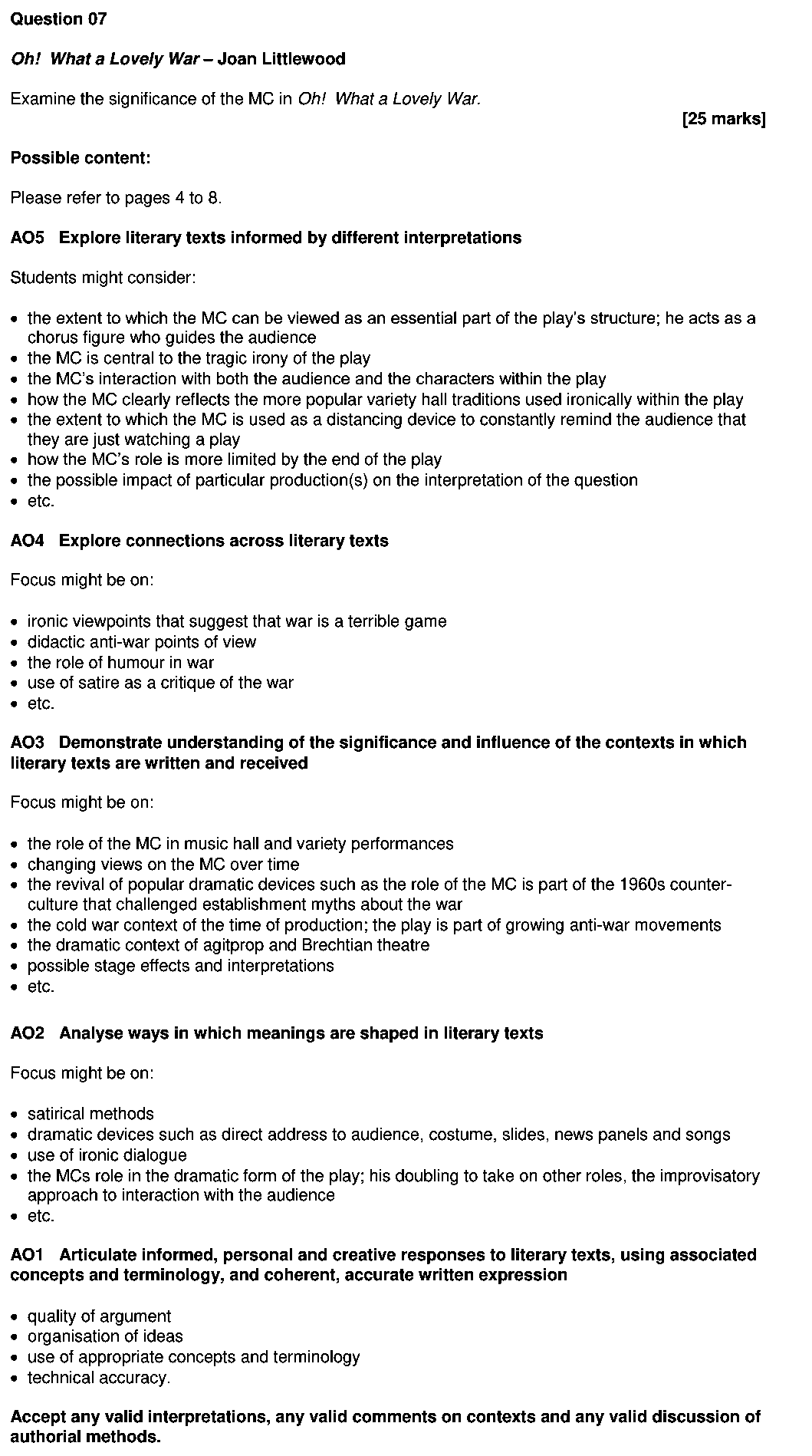
Focus: character: the MC
Open book, no extract
the MC as chorus figure guiding the audience, tragic irony, music-hall/variety tradition used ironically, distancing device, reduced role by the end
context of Brecht, agitprop and 1960s counter-culture
report: too few responses for the senior team to see any
June 2022 · Paper 2A · Q825 marksSet text essay
Mark scheme, including the levels and indicative content
The general mark scheme (assessment objectives and bands)
Examiner's comment
Very few students chose these questions and the Lead Examiner and the senior examining team did not see any responses for this set text. In the past students who have answered questions on this play have confidently discussed dramatic methods through considering the influences of Brecht, agitprop and music hall and had a secure understanding of the context of the play in the counter culture of the 1960s.
Notes from the mark scheme and report
Focus: theme: satire vs tragedy of war
Open book, no extract
debate whether satire of Haig, munitions makers and elites mocks power but misses the tragedy
credited: revisionist challenge to the 'Myth of Victory', satiric use of WW1 songs, lack of naturalistic characters
report: too few responses for the senior team to see any (Brecht, agitprop, music hall noted)
November 2021 · Paper 2A · Q725 marksSet text essay
Mark scheme, including the levels and indicative content
The general mark scheme (assessment objectives and bands)
Notes from the mark scheme and report
Focus: character: villains and heroes
Open book, no extract
view: a play about villains rather than heroes
no examiner report (November series)
MS: Haig as villain for inflexible strategy, war profiteers as real villains, officer class parodied but common soldiers' endurance and humour heroic, Mrs Pankhurst's courage, wider forces rather than individual heroes or villains
November 2021 · Paper 2A · Q825 marksSet text essay
Mark scheme, including the levels and indicative content
The general mark scheme (assessment objectives and bands)
Notes from the mark scheme and report
Focus: form/genre: comedy and horror
Open book, no extract
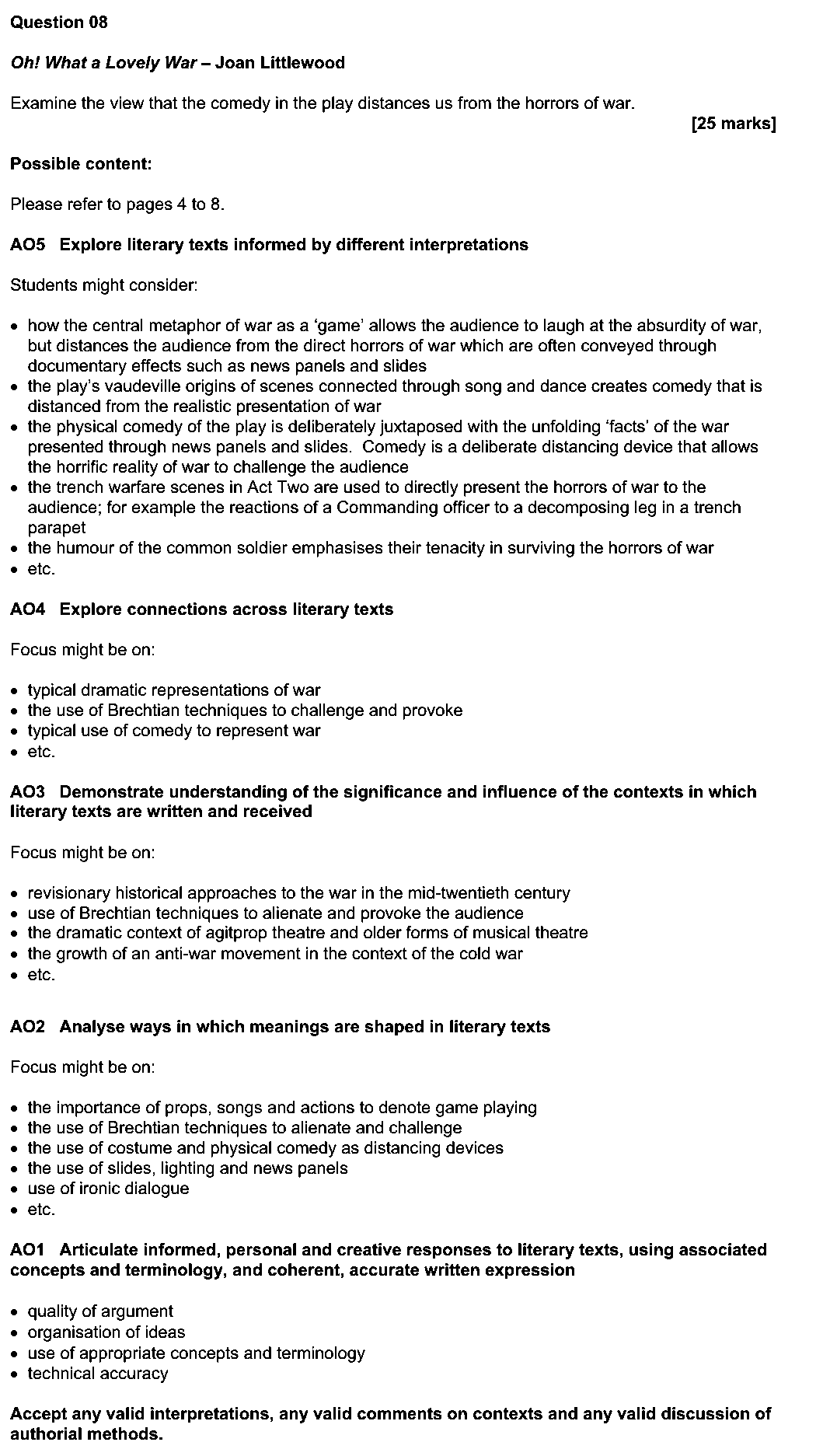
view: comedy distances us from the horrors of war
no examiner report (November series)
MS: war-as-game metaphor, vaudeville structure, physical comedy juxtaposed with news-panel facts as deliberate distancing, Act Two trench scenes (decomposing leg), soldiers' humour as tenacity
November 2020 · Paper 2A · Q725 marksSet text essay
Mark scheme, including the levels and indicative content
The general mark scheme (assessment objectives and bands)
Notes from the mark scheme and report
Focus: character: the common soldier
Open book, no extract
quotation 'We follow you – like lambs to the slaughter' (French soldier, Act 2)
no examiner report (November series)
MS: soldiers as victims of outmoded tactics (French cavalry, Irish soldiers shelled by allies, Haig's attrition), propaganda-driven enlistment, but soldiers resist through ironic humour and parodied hymns
November 2020 · Paper 2A · Q825 marksSet text essay
Mark scheme, including the levels and indicative content
The general mark scheme (assessment objectives and bands)
Notes from the mark scheme and report
Focus: character: women
Open book, no extract
view: women actively encourage the slaughter of men
no examiner report (November series)
MS: women in propaganda posters, music-hall context, 'I'll Make a Man of You' seduction, white feathers, Mrs Pankhurst's pacifism rejected by working-class women
June 2019 · Paper 2A · Q725 marksSet text essay
Mark scheme, including the levels and indicative content
The general mark scheme (assessment objectives and bands)
Examiner's comment
Oh! What a Lovely War still remains a minority core set choice and examiners only saw a very small range of responses. The few students who chose this question engaged with the debate in a confident varied way. Examiners were impressed with responses that considered the play’s ability to ‘challenge and subvert’ through purposefully engaging with the theatrical context of the text. Such work explored the key words of the debate through detailed consideration of dramatic effects such as the ironic counterpoint of slides and news panels and the deliberate alienating effects of pierrot costume. Students clearly had secure contextual knowledge and were able to consider the significance of the play’s inception in the 1960s. Less confident responses tended to ‘unload’ this contextual knowledge and led to some well-informed, yet generalised responses.
Notes from the mark scheme and report
Focus: purpose: challenge and subvert
Open book, no extract
view: designed to challenge and subvert conventional ideas
MS: challenges heroic-victory myth, music-hall frame, profiteering, irony and satire, possible nostalgia, Haig stereotype open to revisionist challenge
ER: minority text
strong work on slides, news panels and pierrot costume as alienation and 1960s inception
weaker unloaded context
June 2019 · Paper 2A · Q825 marksSet text essay
Mark scheme, including the levels and indicative content
The general mark scheme (assessment objectives and bands)
Examiner's comment
This question allowed students to explore the significance of the historical figure of General Haig in the play. Many answers successfully considered Haig’s significance through considering the representation of class in the military hierarchy and explored Haig’s outsider status as a trigger for his inflexible strategies. All responses were able to explore how Haig’s presentation within the play represents a powerful attack on the military hierarchy; the most effective answers were able to debate this through discussing specific dramatic effects such as parallel scenes and the parodying of religious language.
Notes from the mark scheme and report
Focus: character: General Haig
Open book, no extract
MS: Haig as historical figure, 'upstart' rise at the society dance, tactics vs other officers and casualty figures on the news panel, church-service parody
ER: good on class in the military hierarchy and Haig's outsider status
most effective used parallel scenes and parody of religious language
June 2018 · Paper 2A · Q725 marksSet text essay
Mark scheme, including the levels and indicative content
The general mark scheme (assessment objectives and bands)
Examiner's comment
Unfortunately Oh What a Lovely War remains a minority core set text choice and examiners only saw responses for question 7. The standard of responses was high and the majority of students engaged fully with the debate and made good use of the critical view. The stronger answers always kept the key words ‘disturb’ and ‘educate’ in view and were able to consider dramatic effects such as the role of the MC and the use of the news panels and slides in a focused way. The effect of comedy within the play was thoughtfully considered; many students were able to consider satire, and the extent to which comic effects were designed to alienate and disturb. Contextual understanding was used appropriately; in particular, students were able to use the literary context of Brecht and agitprop to inform and develop their responses.
Notes from the mark scheme and report
Focus: purpose: amuse, disturb and educate
Open book, no extract
view: amusing but purpose is to disturb and educate
MS: projections, news panel, profiteering, irony and satire, vaudeville vs agitprop, Haig stereotyped, leapfrog scene
ER: minority text, high standard
stronger kept 'disturb' and 'educate' in view, used the MC, news panels and slides, comedy as alienation, Brecht and agitprop
June 2018 · Paper 2A · Q825 marksSet text essay
Mark scheme, including the levels and indicative content
The general mark scheme (assessment objectives and bands)
Notes from the mark scheme and report
Focus: dramatic device: the pierrots
Open book, no extract
MS: end-of-the-pier pierrot frame, clowns presenting tragedy, irony of costume and visual humour, songs
no examiner comment (report says examiners saw responses only for question 7)
June 2017 · Paper 2A · Q725 marksSet text essay
Mark scheme, including the levels and indicative content
The general mark scheme (assessment objectives and bands)
Examiner's comment
This was a minority core set text choice and examiners only saw responses for question 7. The better answers demonstrated a detailed contextual grasp and were able to discuss both the context of WW1 and the significance of the 1960s when the play was devised. There was good understanding of dramatic techniques and effects, though at times this was unloaded rather than fully integrated into the answer. Generally, however, this question elicited some confident answers which considered a range of dramatic devices such as the use of costume, slides and news panels. Those who carefully read the question succeeded in developing confident debates through considering the importance of key words such as ‘primarily’ which allowed discussion of other targets ‘attacked’ by the play.
Notes from the mark scheme and report
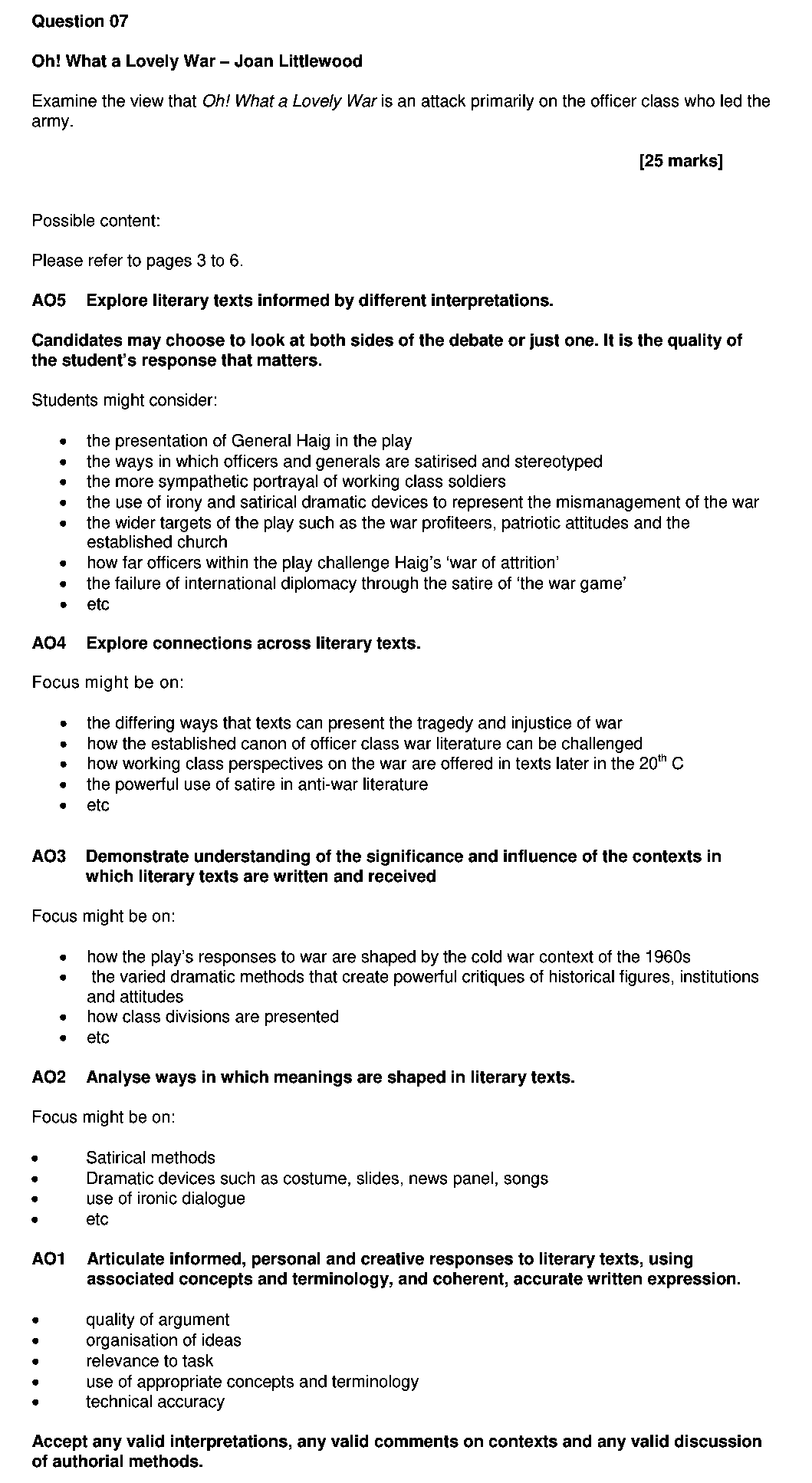
Focus: theme: attack on the officer class
Open book, no extract
debate 'primarily'
MS: satire of Haig and officers, sympathetic working-class soldiers, other targets (profiteers, church, patriotism), 1960s Cold War context, songs/slides/news panel
ER: minority text
better answers used both WW1 and 1960s contexts and debated 'primarily'
dramatic devices sometimes unloaded rather than integrated
June 2017 · Paper 2A · Q825 marksSet text essay
Mark scheme, including the levels and indicative content
The general mark scheme (assessment objectives and bands)
Notes from the mark scheme and report
Focus: dramatic device: the songs
Open book, no extract
MS: songs for narration, irony and didactic commentary, pierrot-show frame, 'I'll Make a Man of You' repeated as propaganda then parody, popular culture, political theatre
no examiner comment (report says examiners saw responses only for question 7)
Work with an AQA English Literature A tutor
Essays stuck in the middle bands, or not sure what the examiners want from an analysis? Book a trial lesson with a specialist AQA English Literature A tutor.