Othello SH

Part of
Shakespeare
Where it is examined
A-level Paper 1 Section A and AS Paper 1 Section A: an extract-based question on your play
Level
AS and A level
Specification
4.1.1, 1 set text
Since 2016
18 questions

Specification

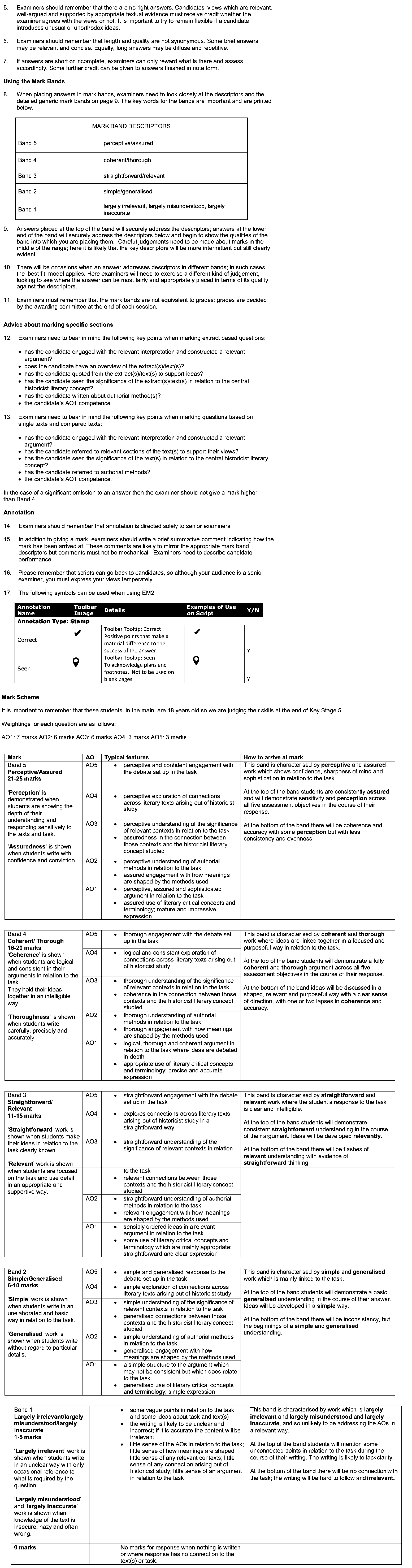
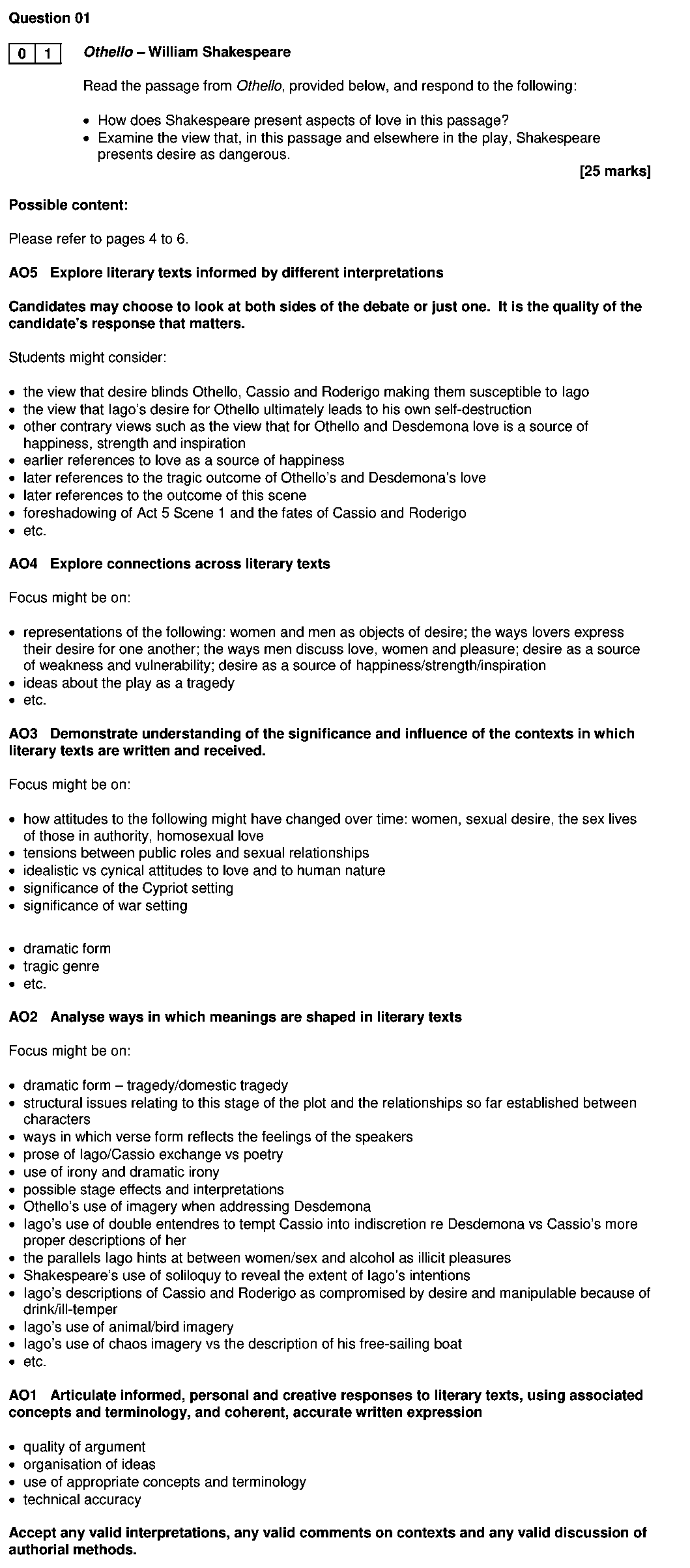
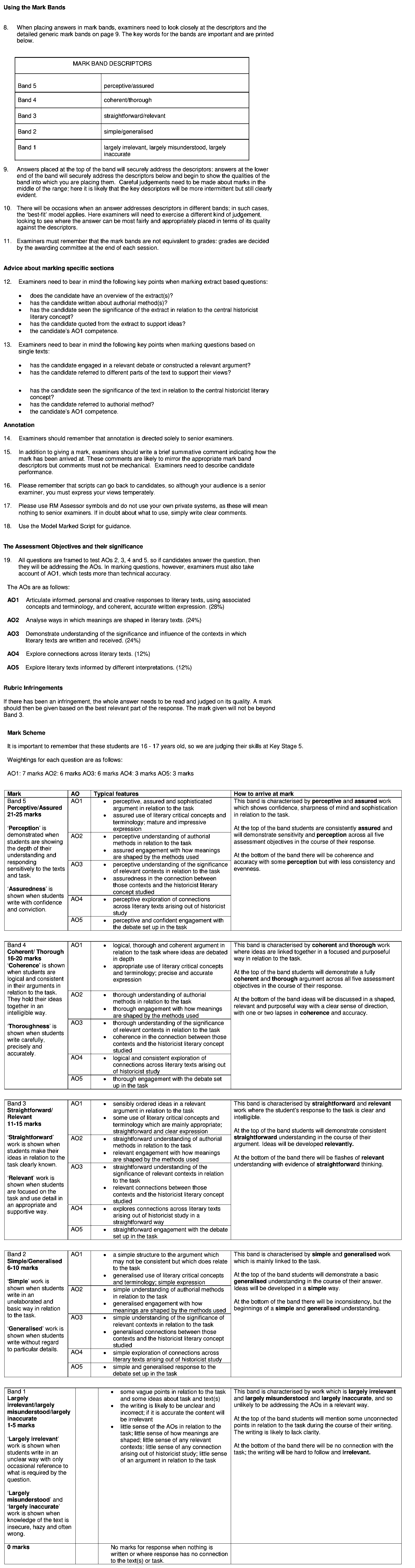
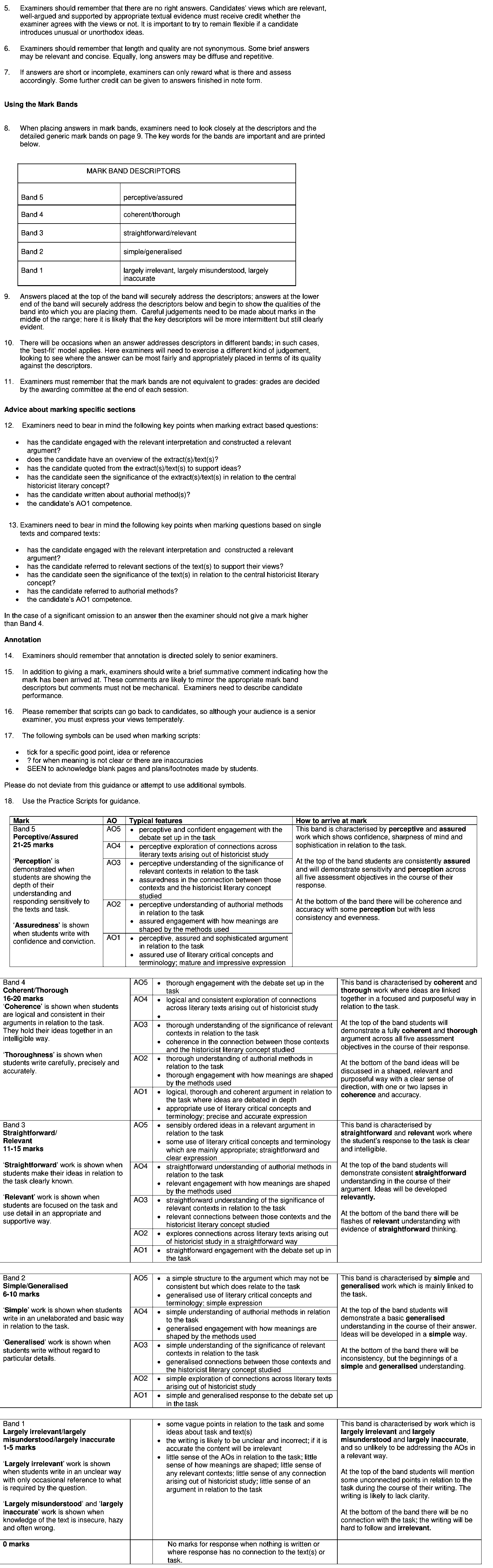
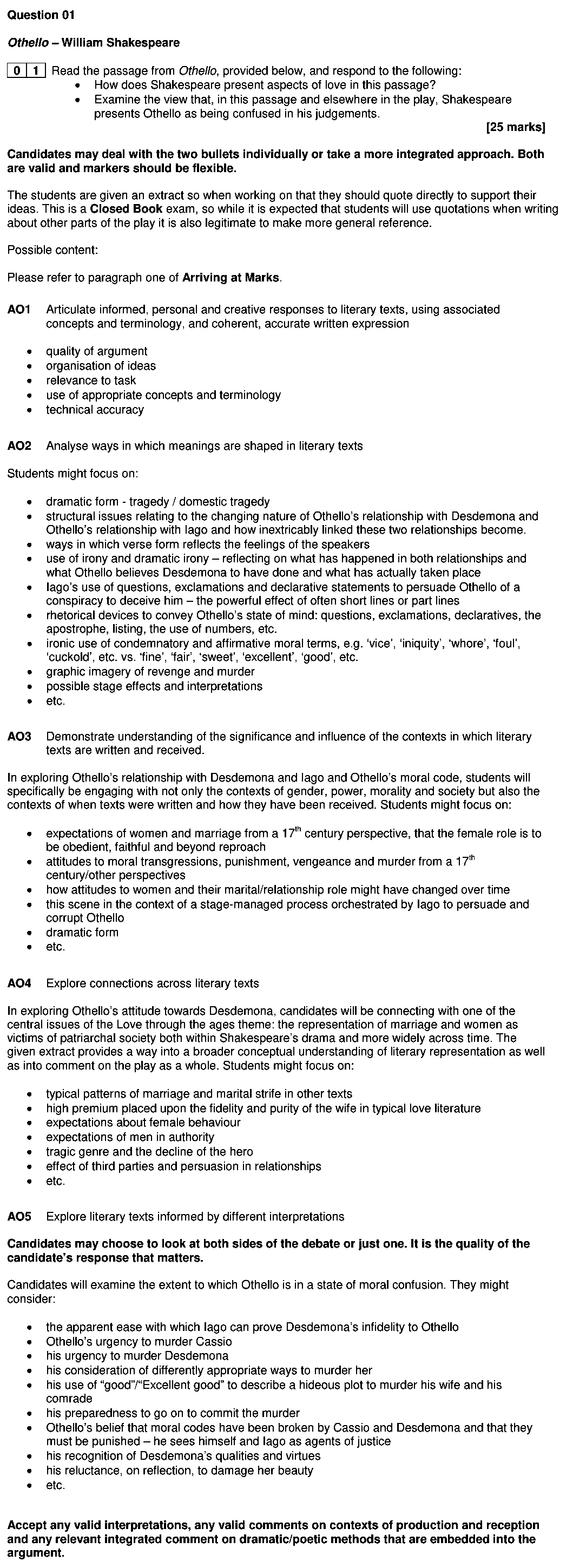
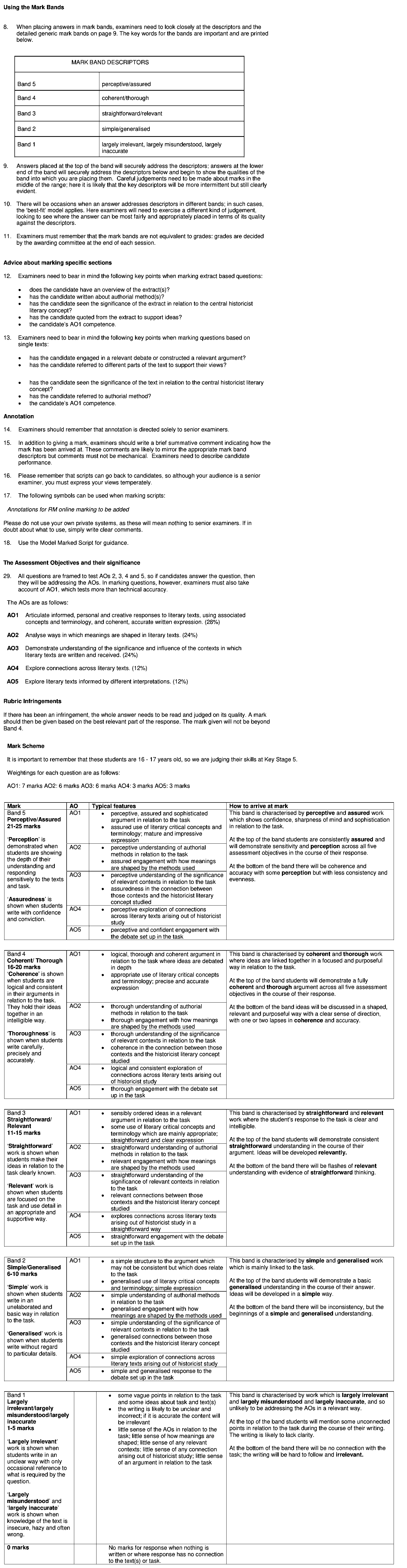
In the board's own words. Tick these off on the checklist.

Every question set on this text

SeriesPaperQMarksTitle
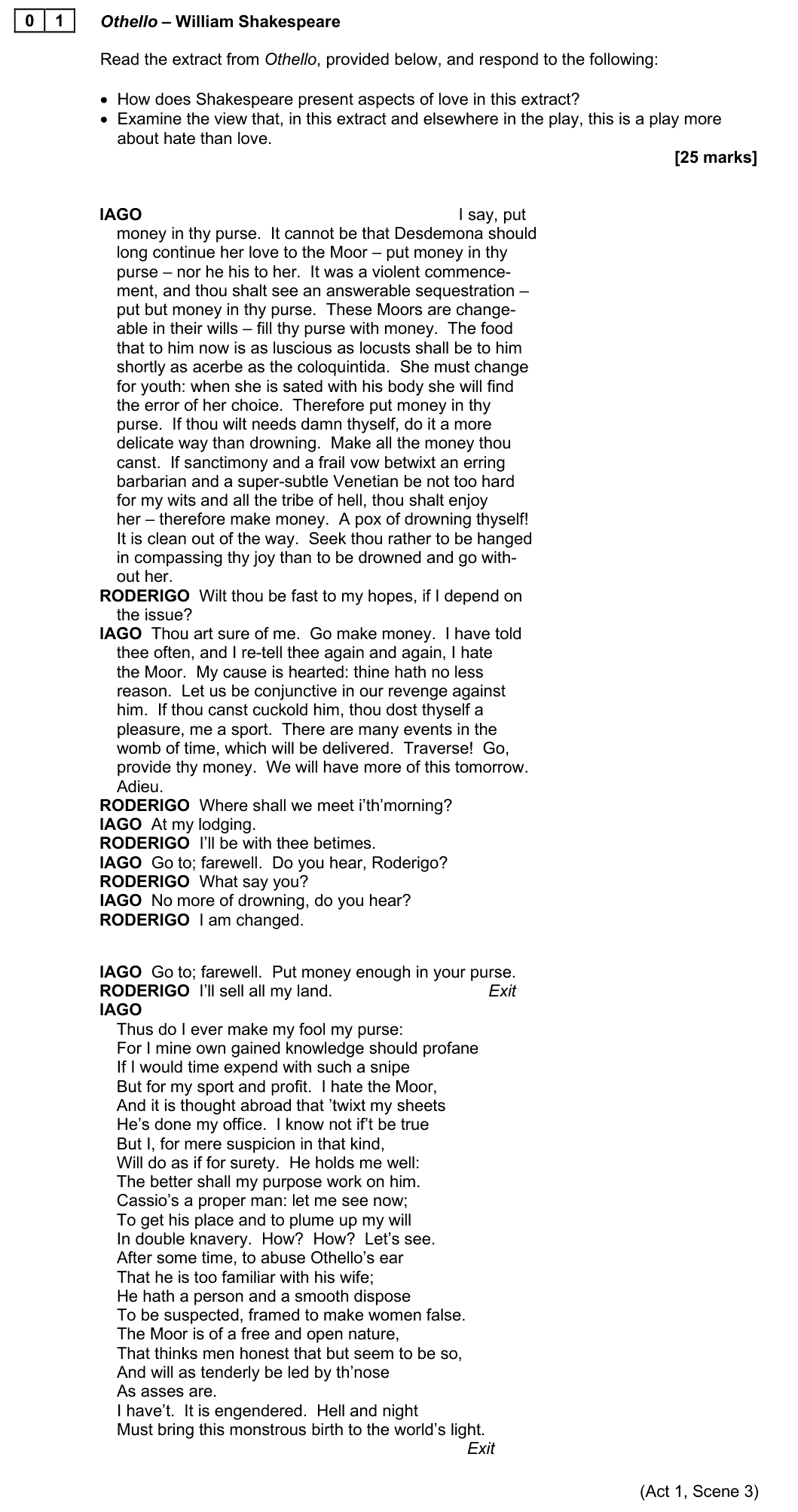
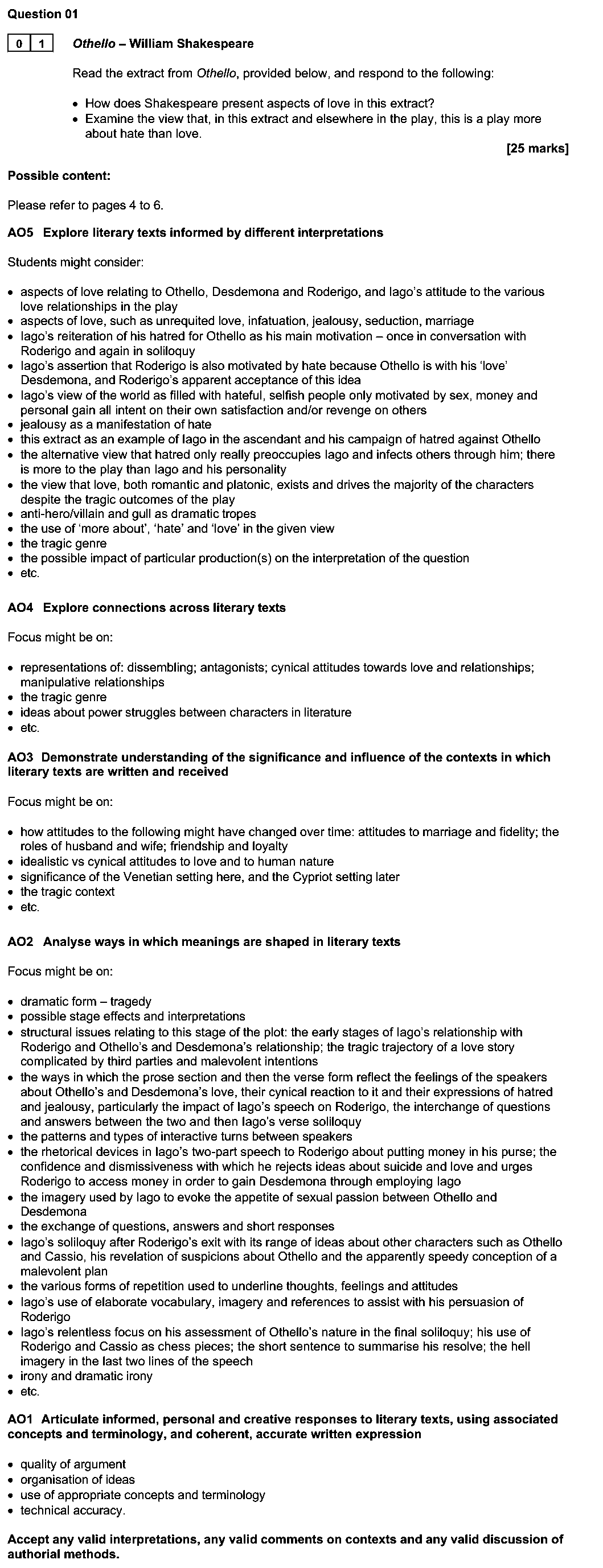
June 2025AS Paper 1125Othello – William Shakespeare Read the extract from Othello, provided below, and respond to the following: • How does Shakespeare present aspects of love in this extract? • Examine the view that, in this extract and elsewhere in the play, this is a play more a
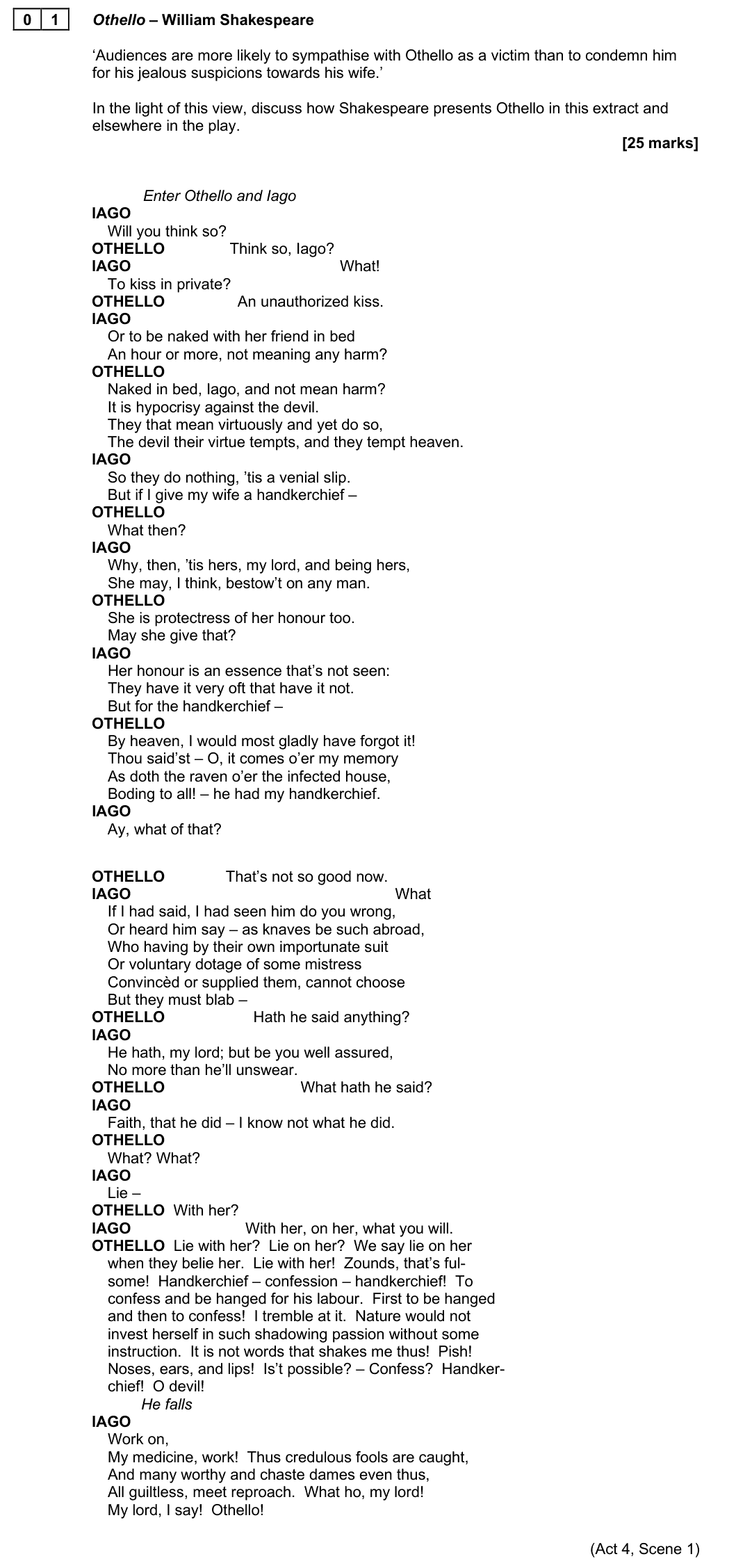
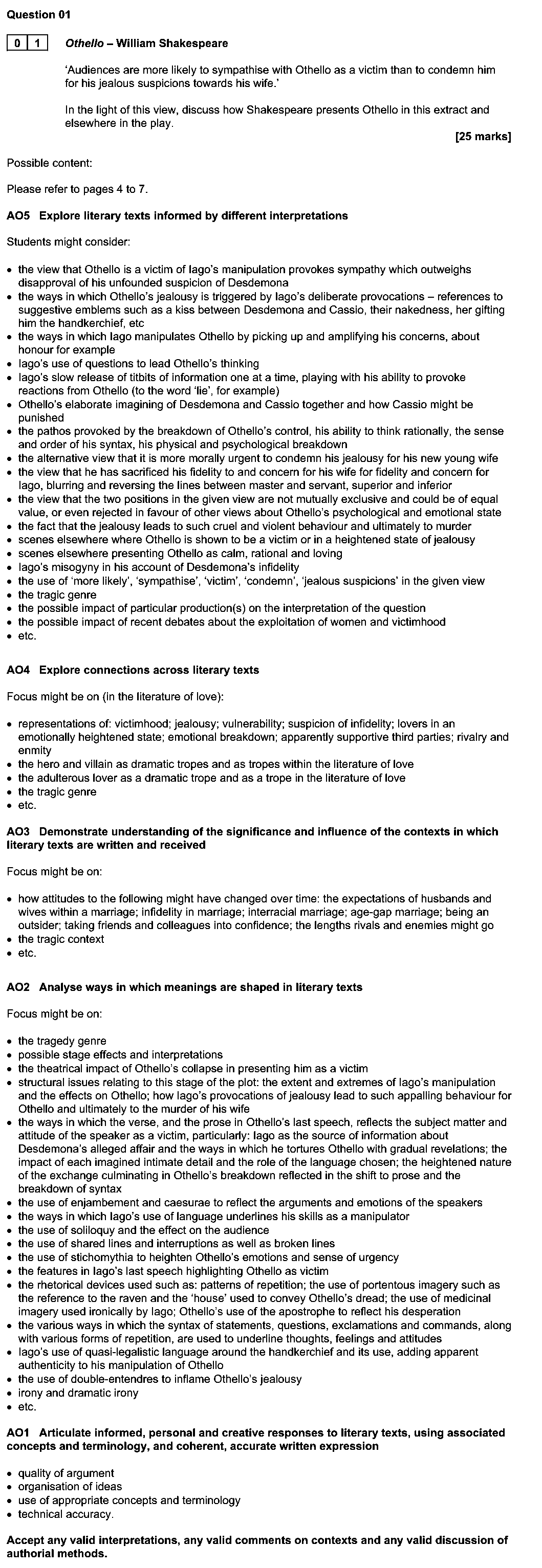
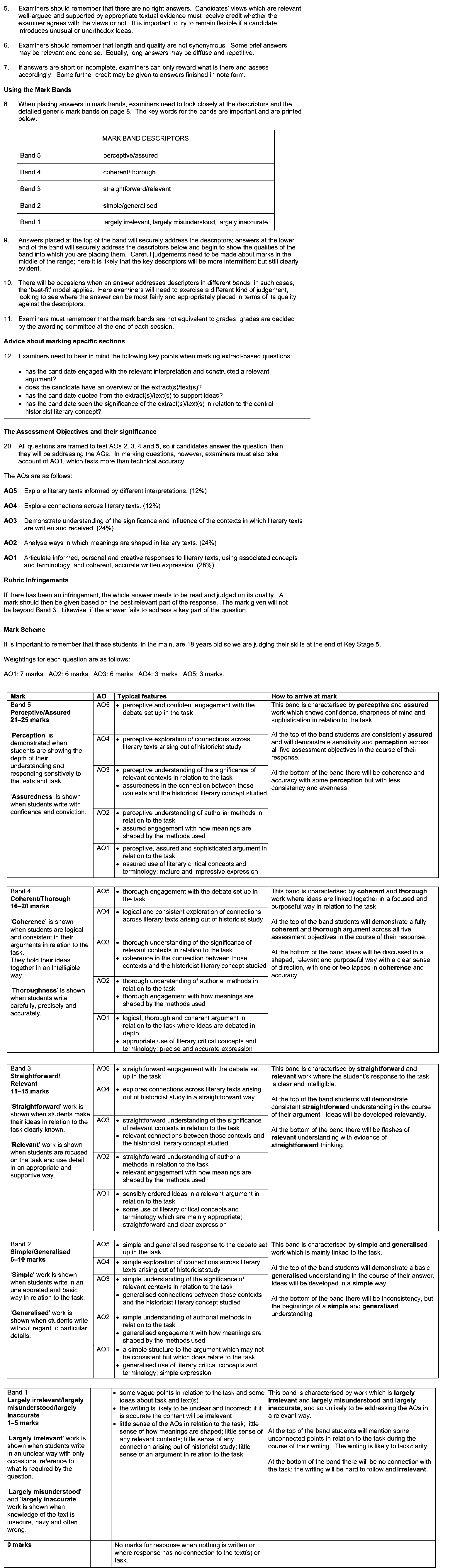
June 2025Paper 1125Othello – William Shakespeare ‘Audiences are more likely to sympathise with Othello as a victim than to condemn him for his jealous suspicions towards his wife.’ In the light of this view, discuss how Shakespeare presents Othello in this extract and elsewhere
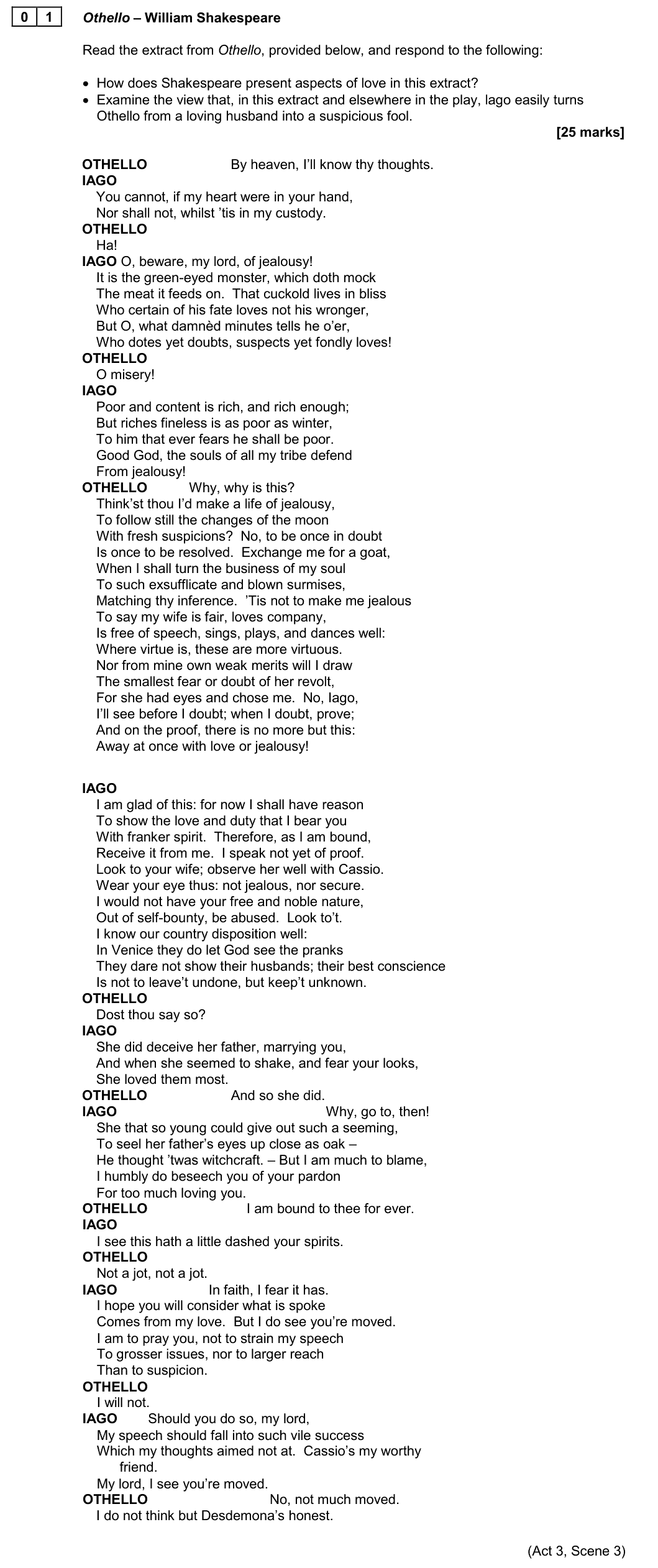
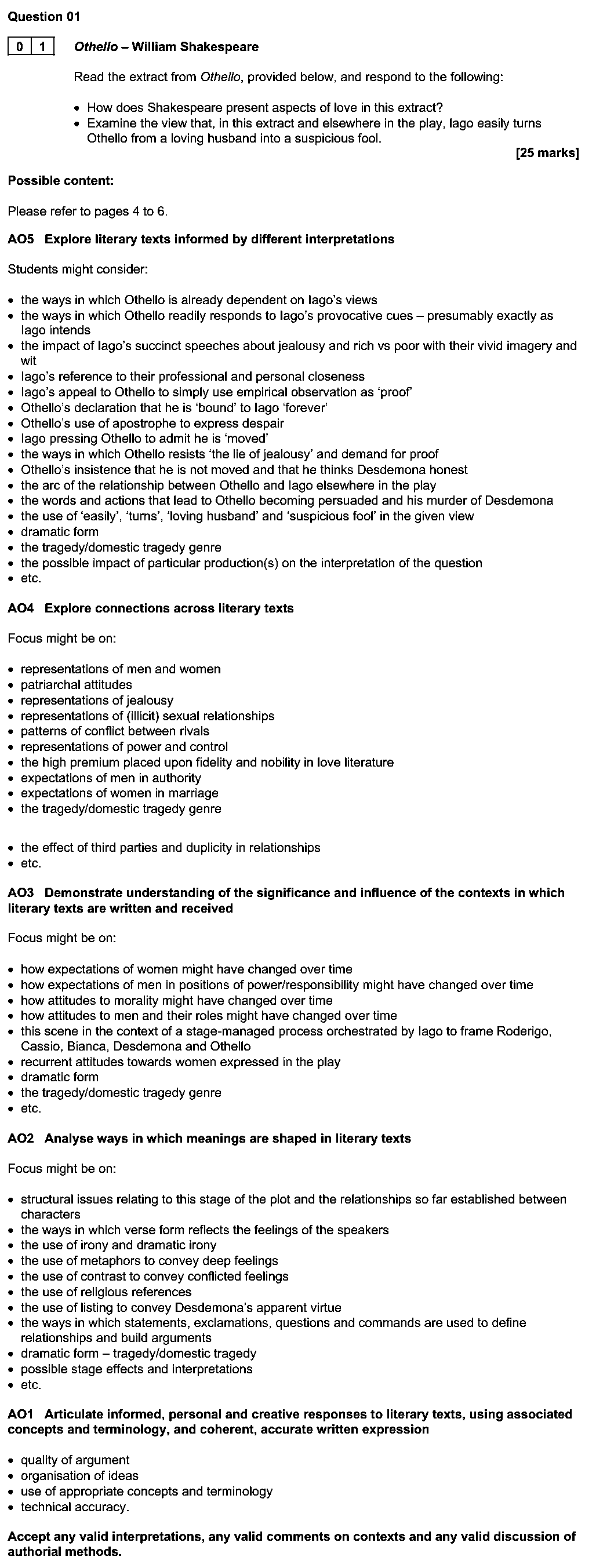
June 2024AS Paper 1125Othello – William Shakespeare Read the extract from Othello, provided below, and respond to the following: • How does Shakespeare present aspects of love in this extract? • Examine the view that, in this extract and elsewhere in the play, lago easily turns Oth
June 2024Paper 1125Othello – William Shakespeare ‘In Othello, Iago’s skills make him a likeable anti-hero rather than a hateful villain.’ In the light of this view, discuss how Shakespeare presents Iago’s attitudes to love in this extract and elsewhere in the play. IAGO Come, co
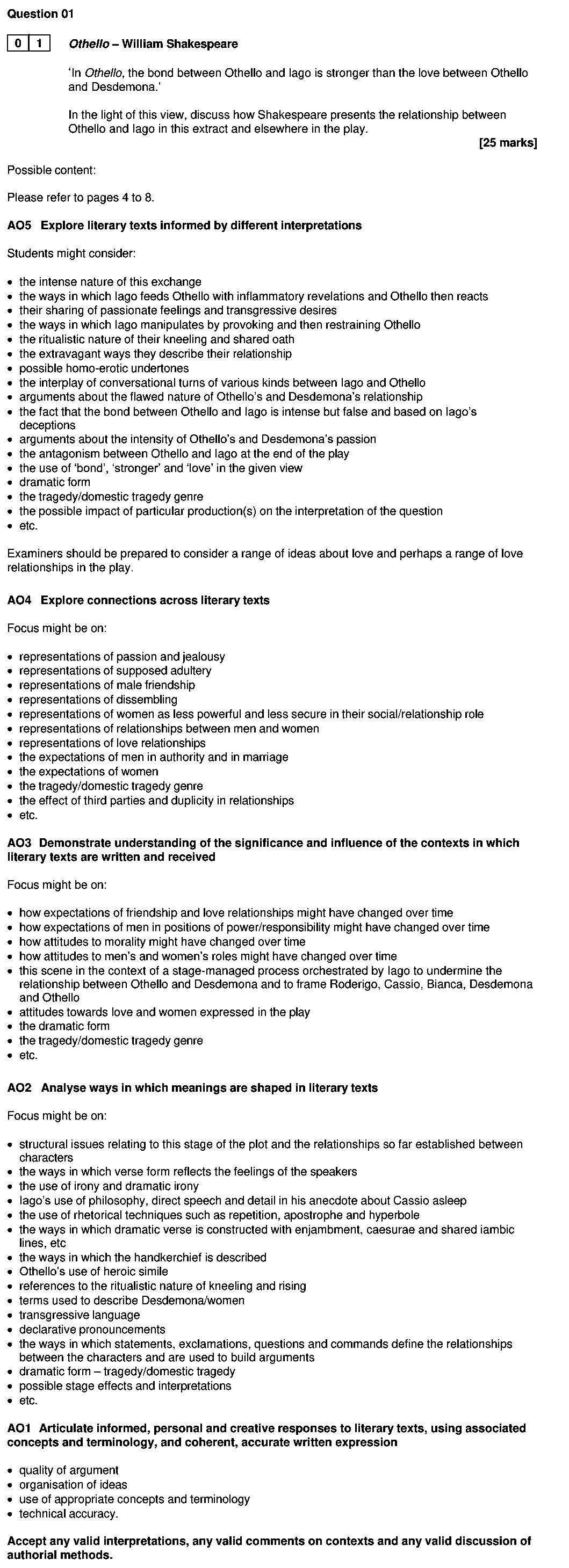
June 2023AS Paper 1125Othello – William Shakespeare Read the extract from Othello, provided below, and respond to the following: • How does Shakespeare present aspects of love in this extract? • Examine the view that, in this extract and elsewhere in the play, Shakespeare presents
June 2023Paper 1125Othello – William Shakespeare ‘In Othello, the bond between Othello and Iago is stronger than the love between Othello and Desdemona.’ In the light of this view, discuss how Shakespeare presents the relationship between Othello and Iago in this extract and els
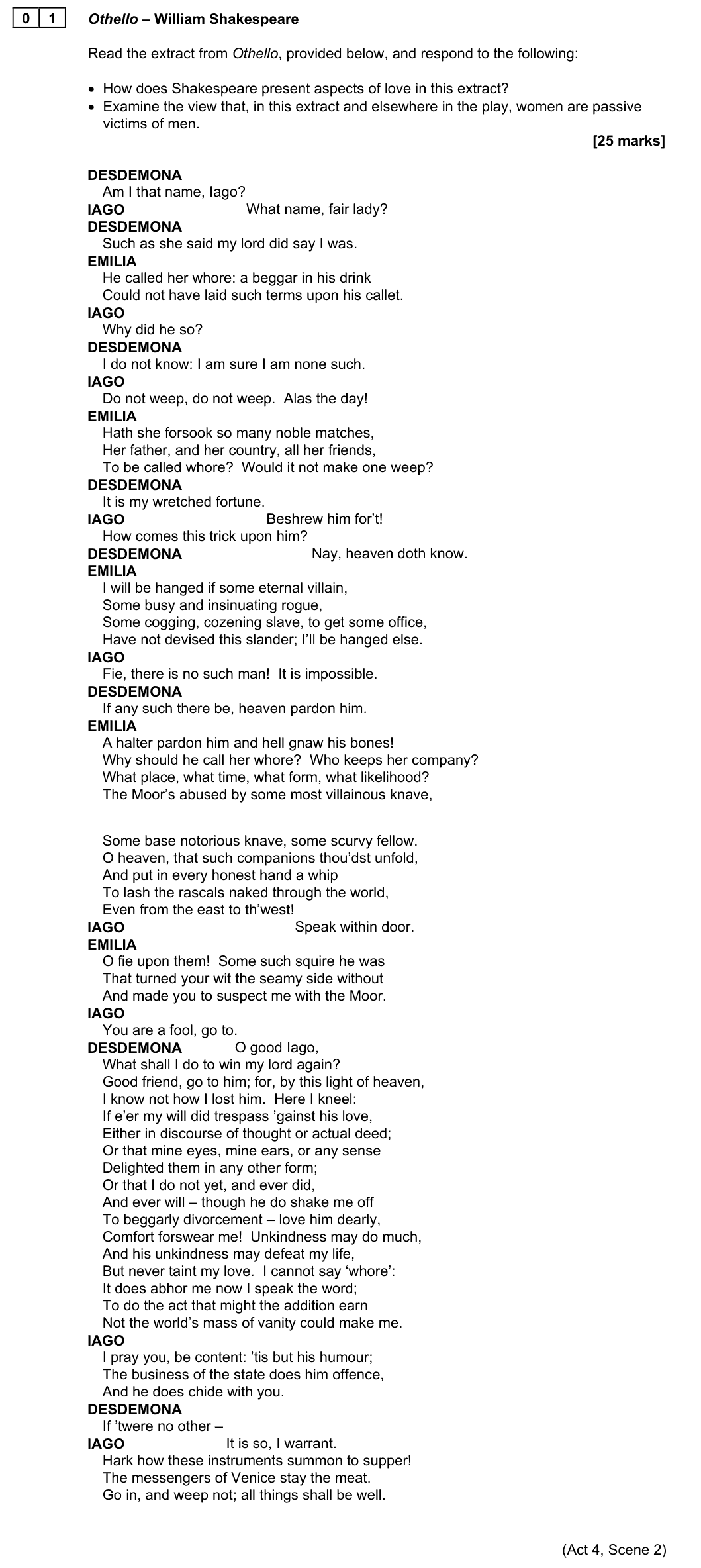
June 2022AS Paper 1125Othello – William Shakespeare Read the extract from Othello, provided below, and respond to the following: • How does Shakespeare present aspects of love in this extract? • Examine the view that, in this extract and elsewhere in the play, women are passive vic
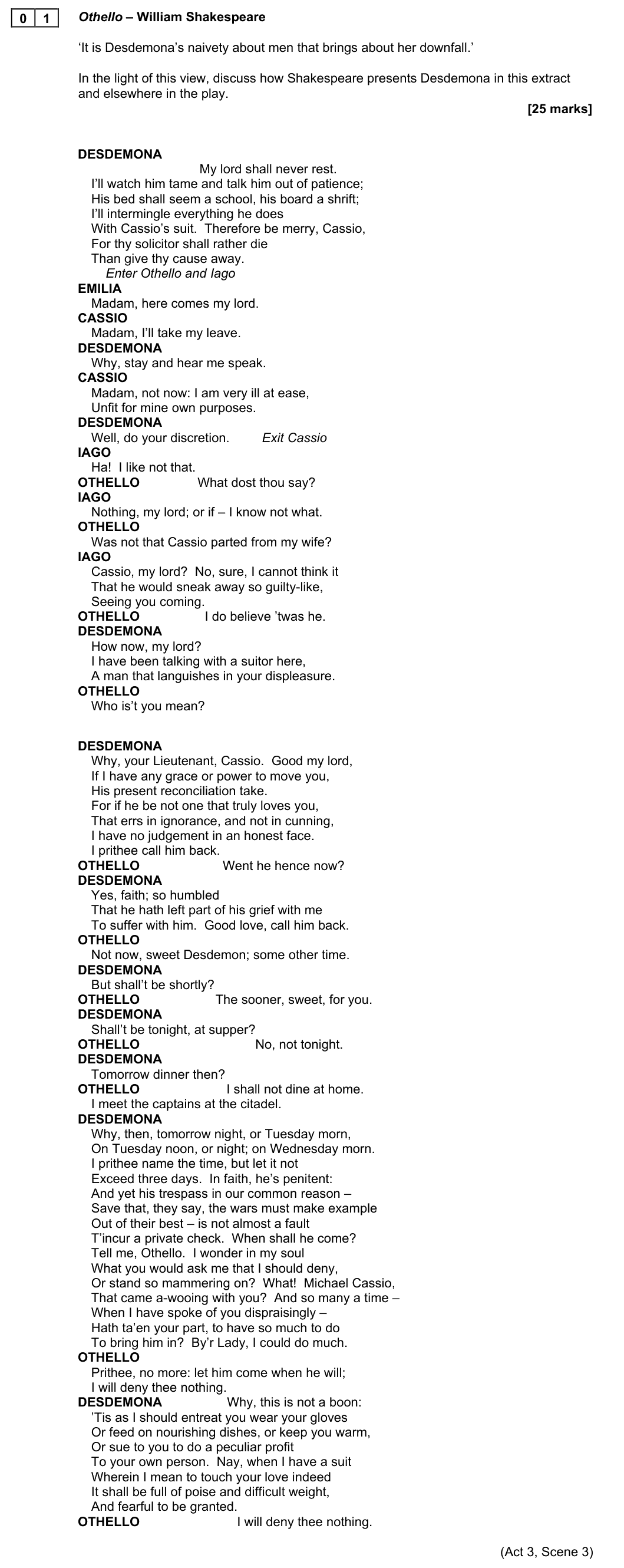
June 2022Paper 1125Othello – William Shakespeare ‘It is Desdemona’s naivety about men that brings about her downfall.’ In the light of this view, discuss how Shakespeare presents Desdemona in this extract and elsewhere in the play. DESDEMONA My lord shall never rest. I’ll watch
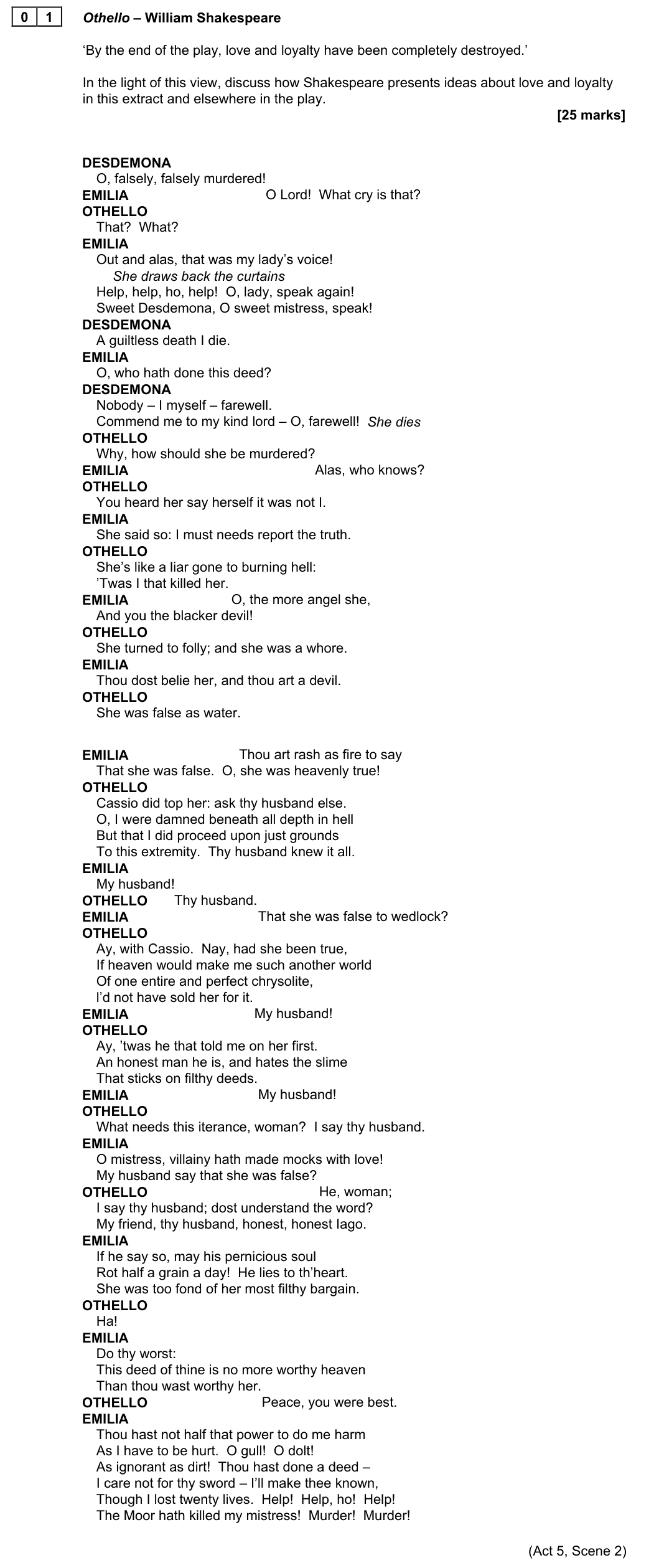
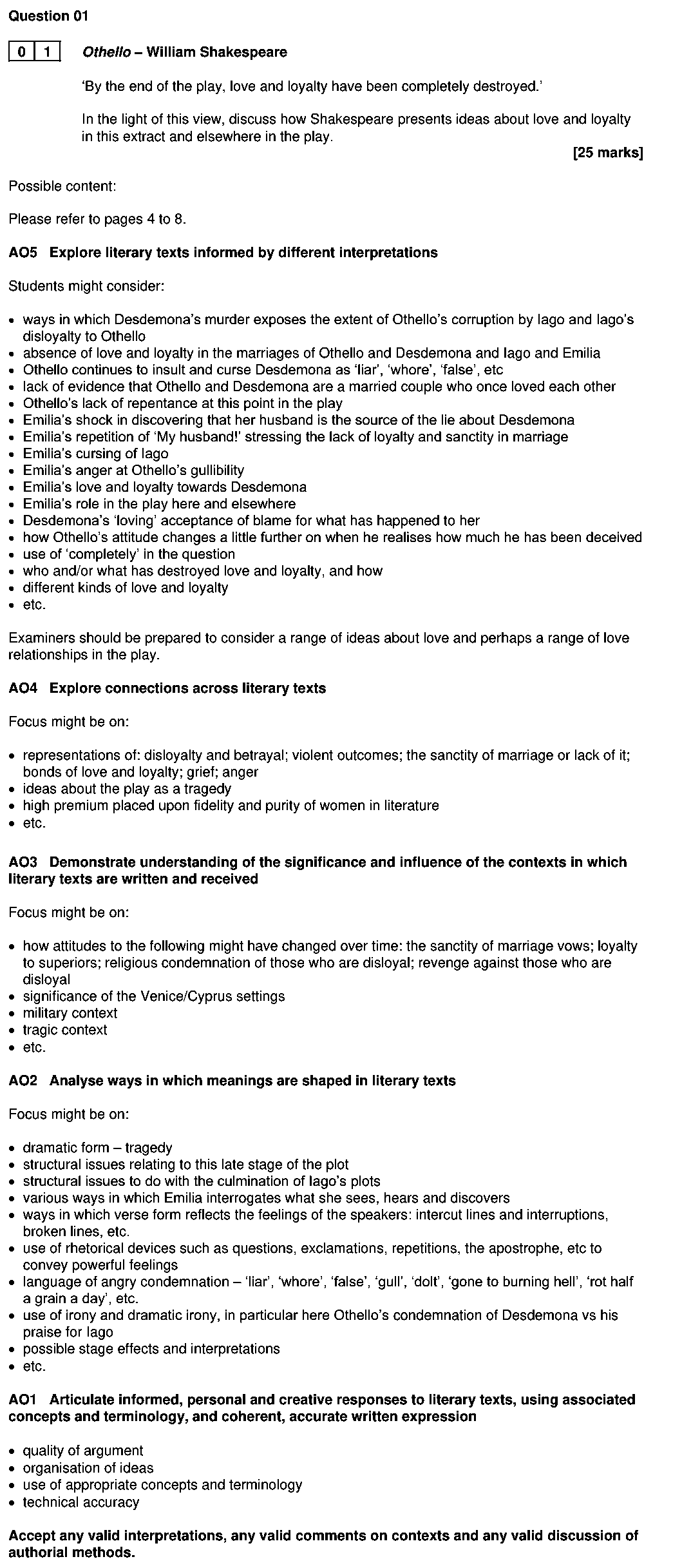
November 2021Paper 1125Othello – William Shakespeare ‘By the end of the play, love and loyalty have been completely destroyed.’ In the light of this view, discuss how Shakespeare presents ideas about love and loyalty in this extract and elsewhere in the play. DESDEMONA O, falsely, f
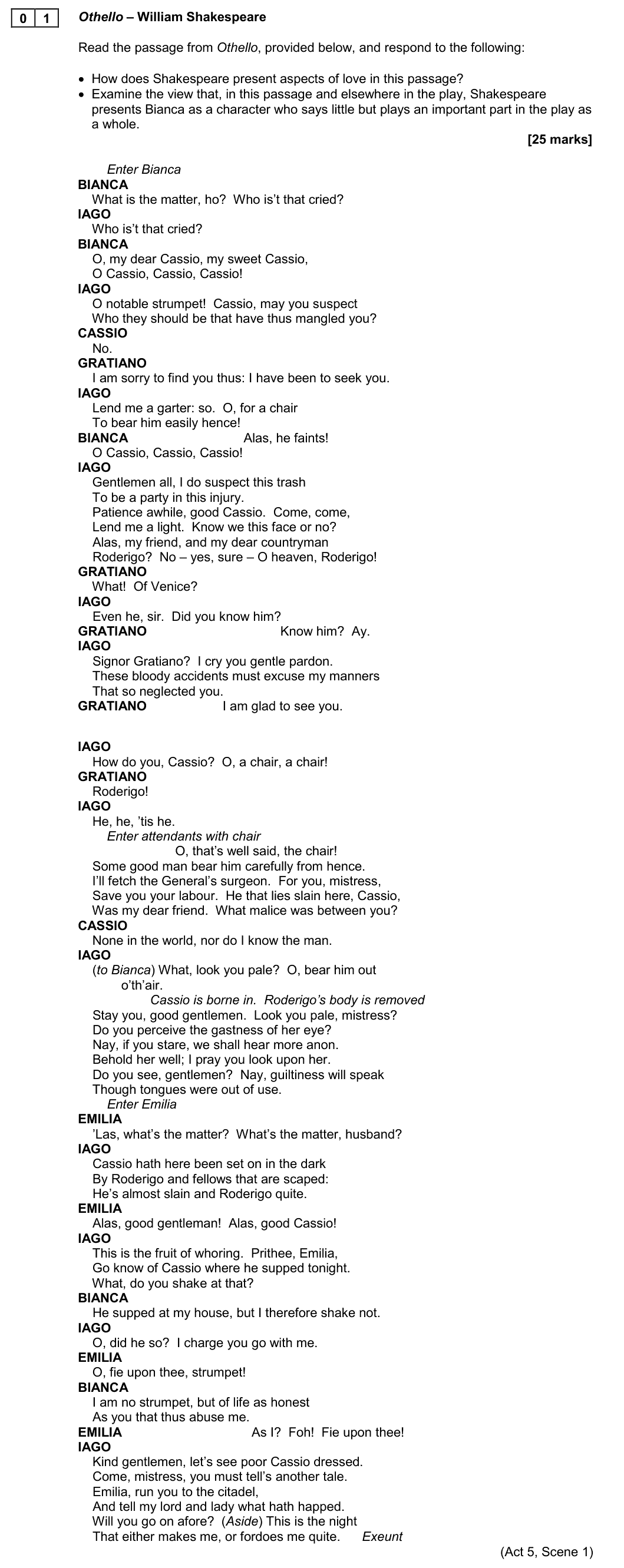
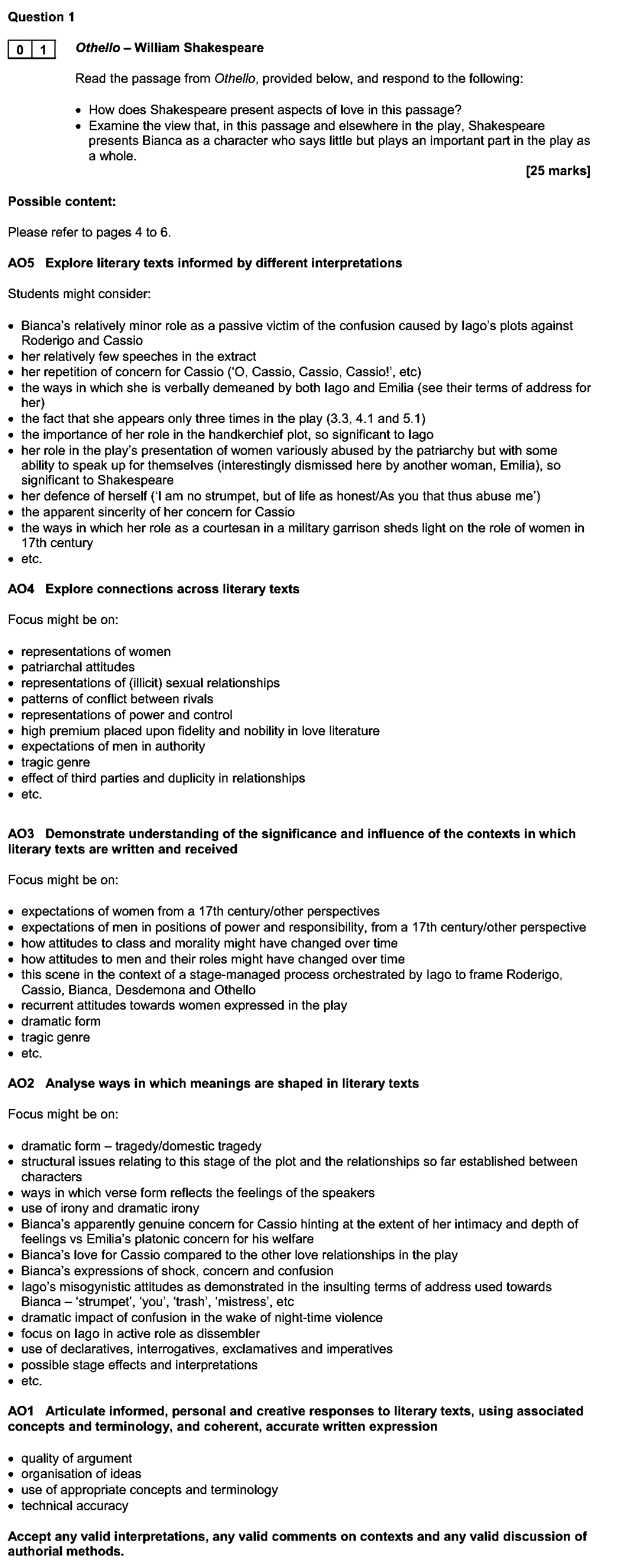
November 2020AS Paper 1125Othello – William Shakespeare Read the passage from Othello, provided below, and respond to the following: • How does Shakespeare present aspects of love in this passage? • Examine the view that, in this passage and elsewhere in the play, Shakespeare presents
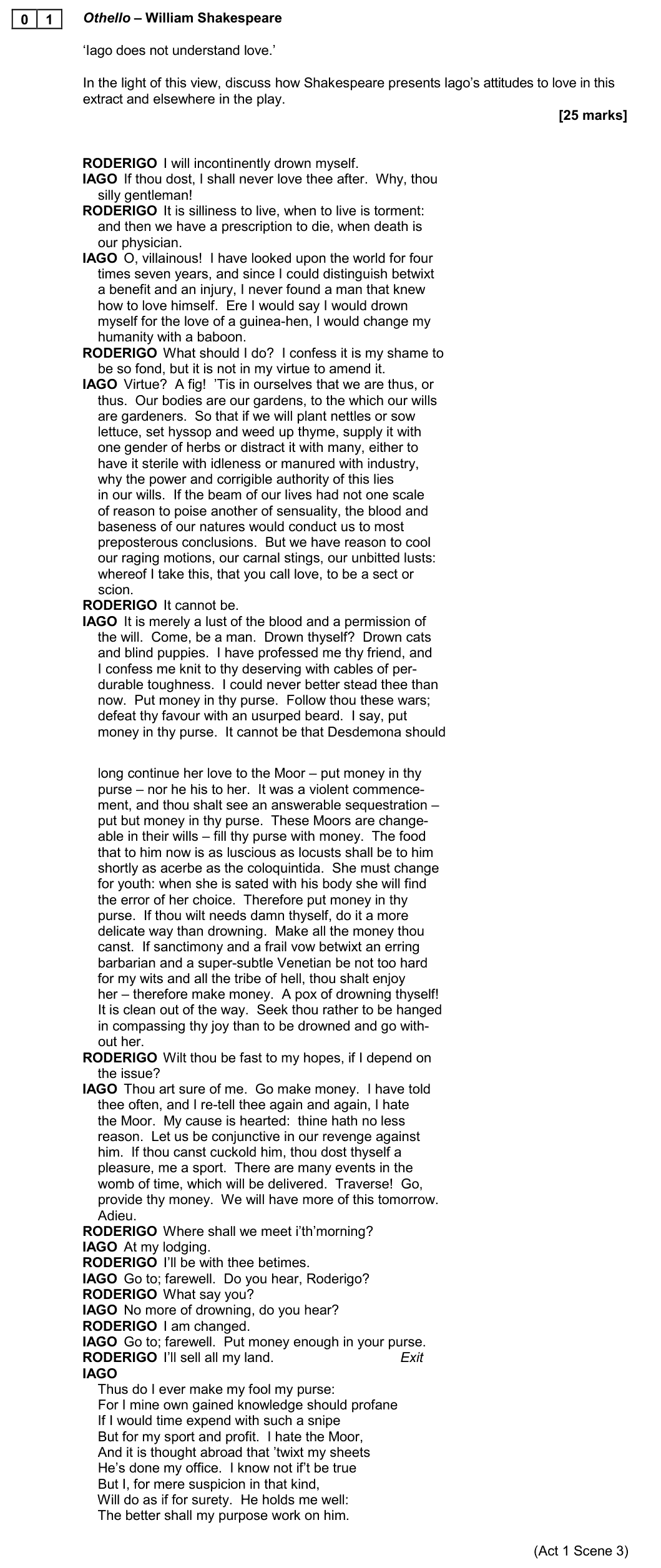
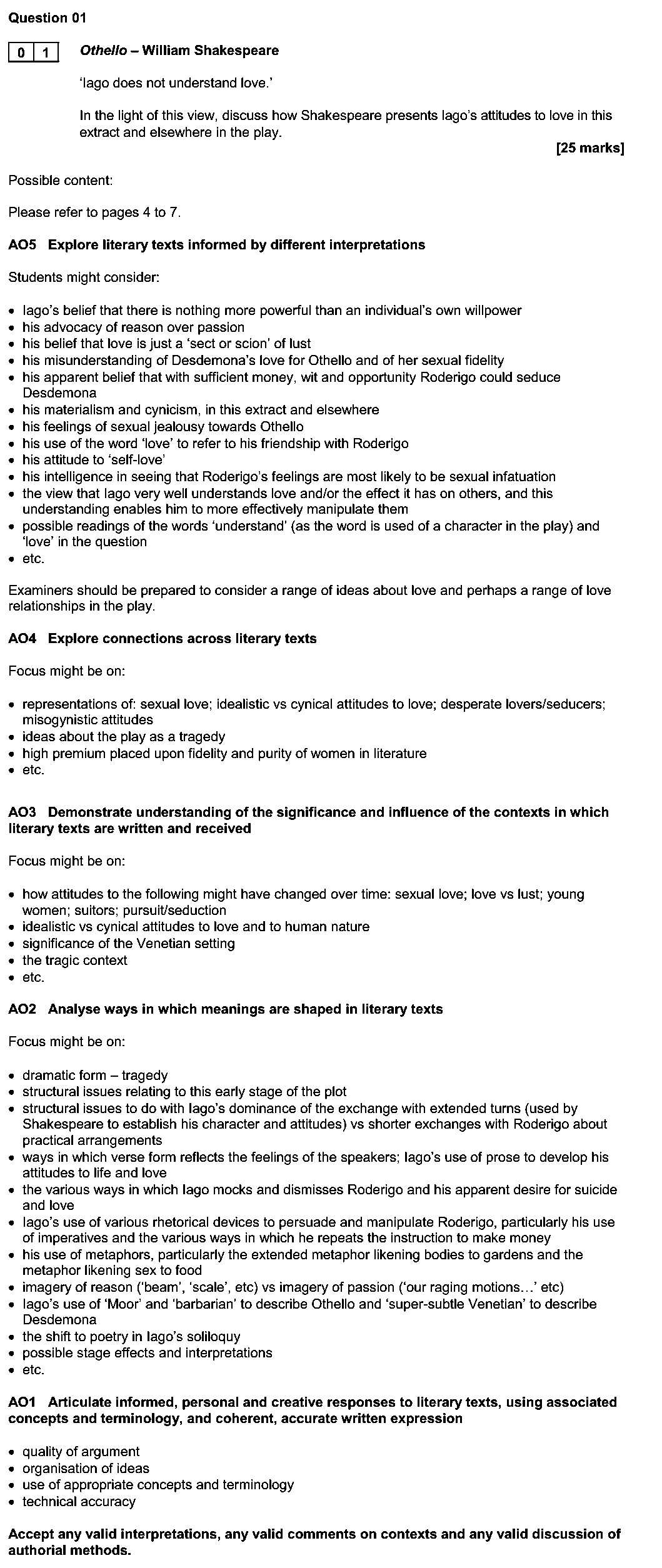
November 2020Paper 1125Othello – William Shakespeare ‘Iago does not understand love.’ In the light of this view, discuss how Shakespeare presents Iago’s attitudes to love in this extract and elsewhere in the play. RODERIGO I will incontinently drown myself. IAGO If thou dost, I shal
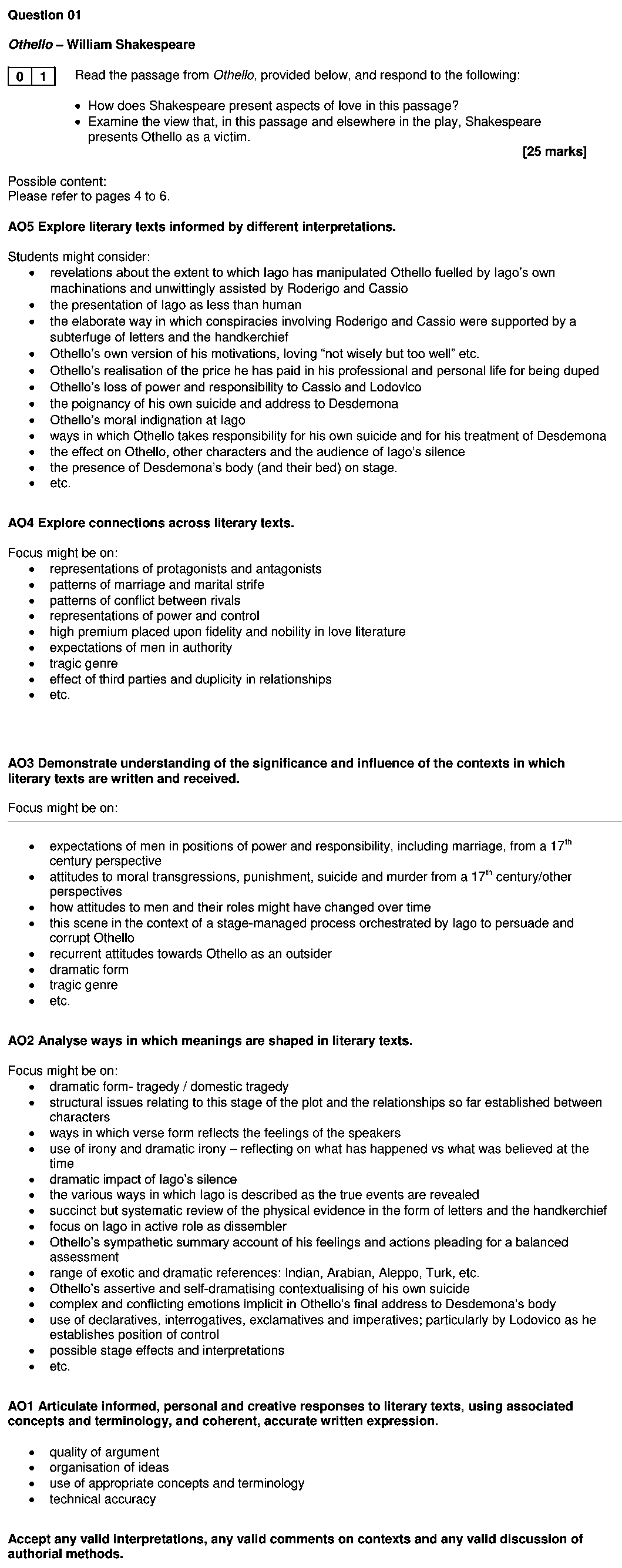
June 2019AS Paper 1125Othello – William Shakespeare Read the passage from Othello, provided below, and respond to the following: • How does Shakespeare present aspects of love in this passage? • Examine the view that, in this passage and elsewhere in the play, Shakespeare presents
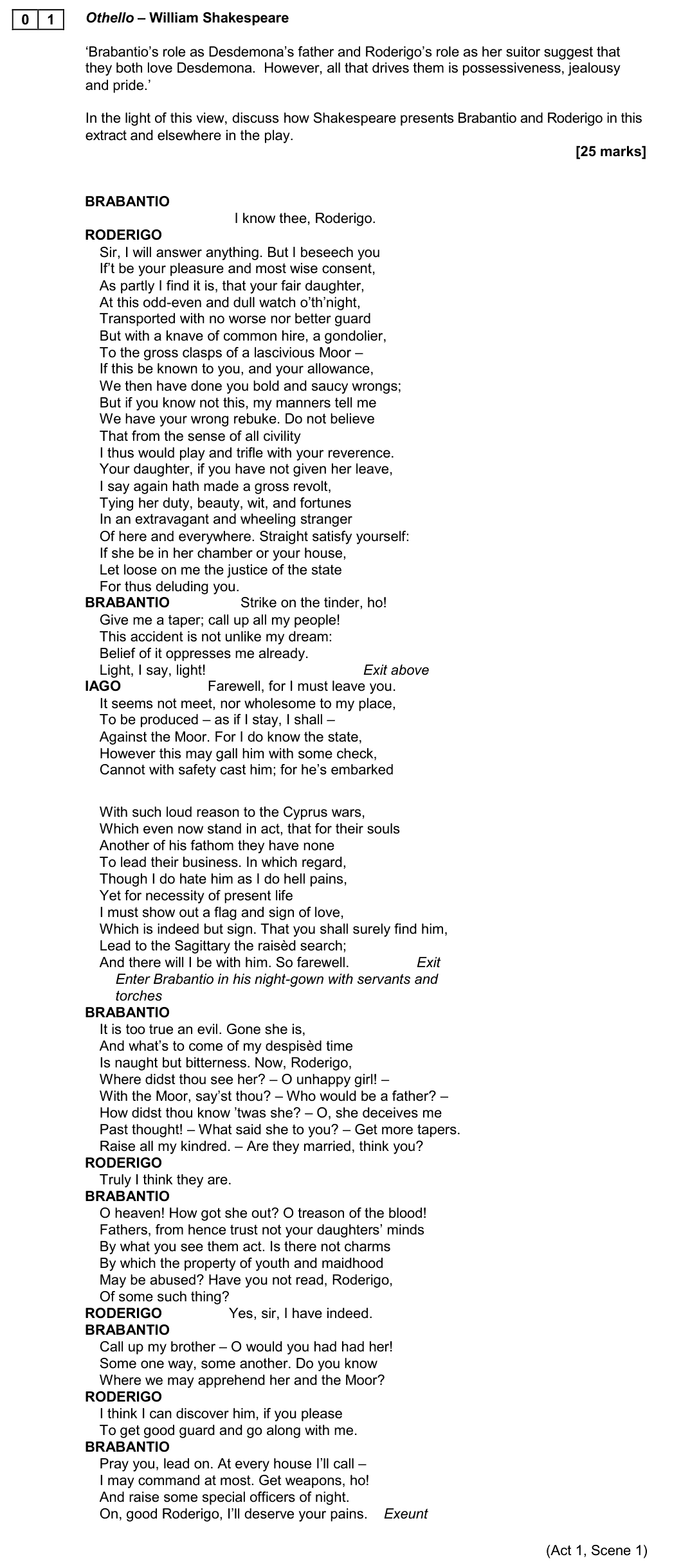
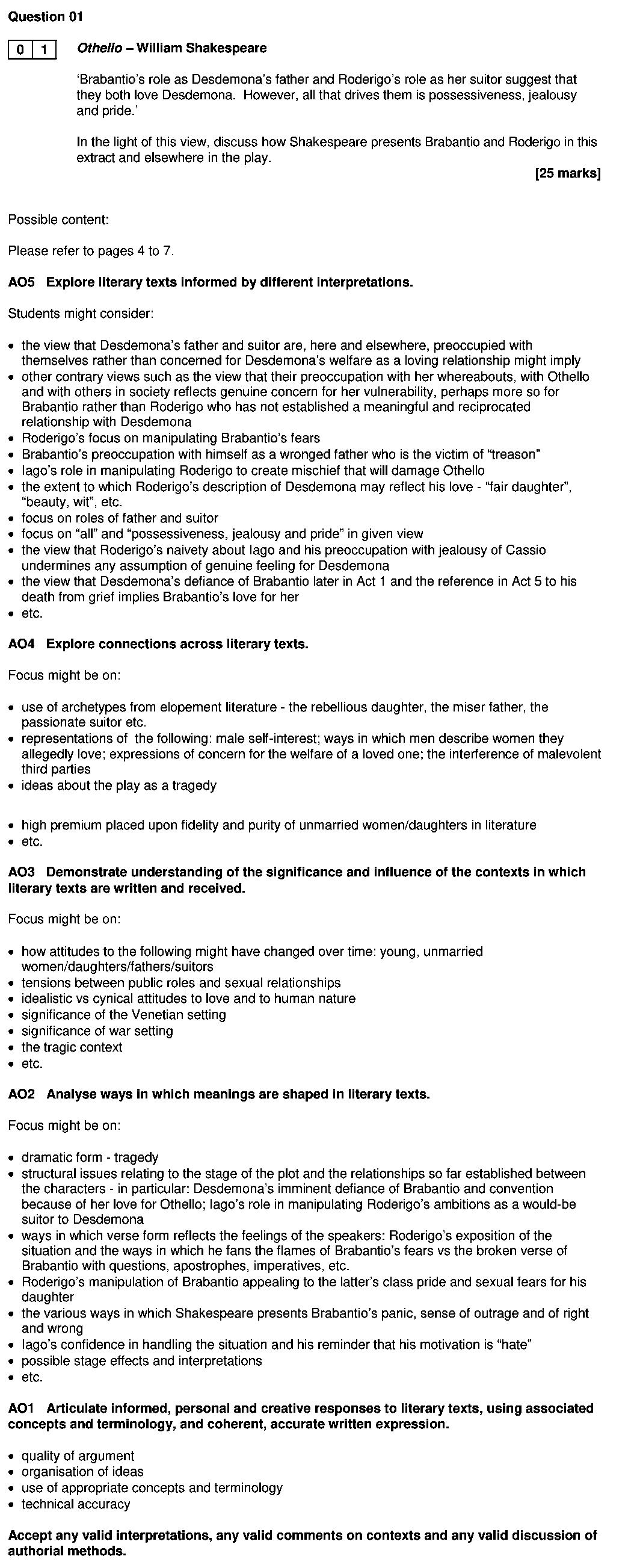
June 2019Paper 1125Othello – William Shakespeare ‘Brabantio’s role as Desdemona’s father and Roderigo’s role as her suitor suggest that they both love Desdemona. However, all that drives them is possessiveness, jealousy and pride.’ In the light of this view, discuss how Shakespe
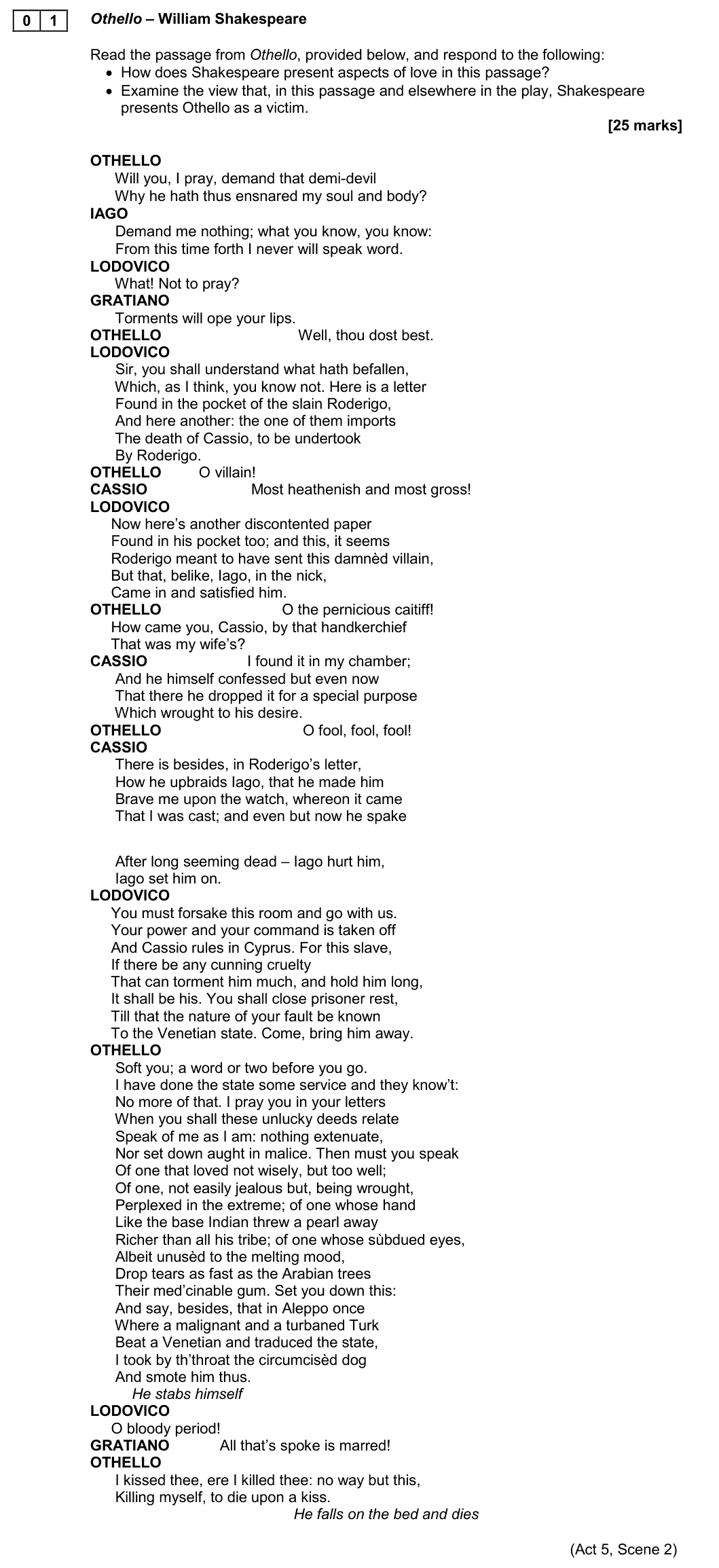
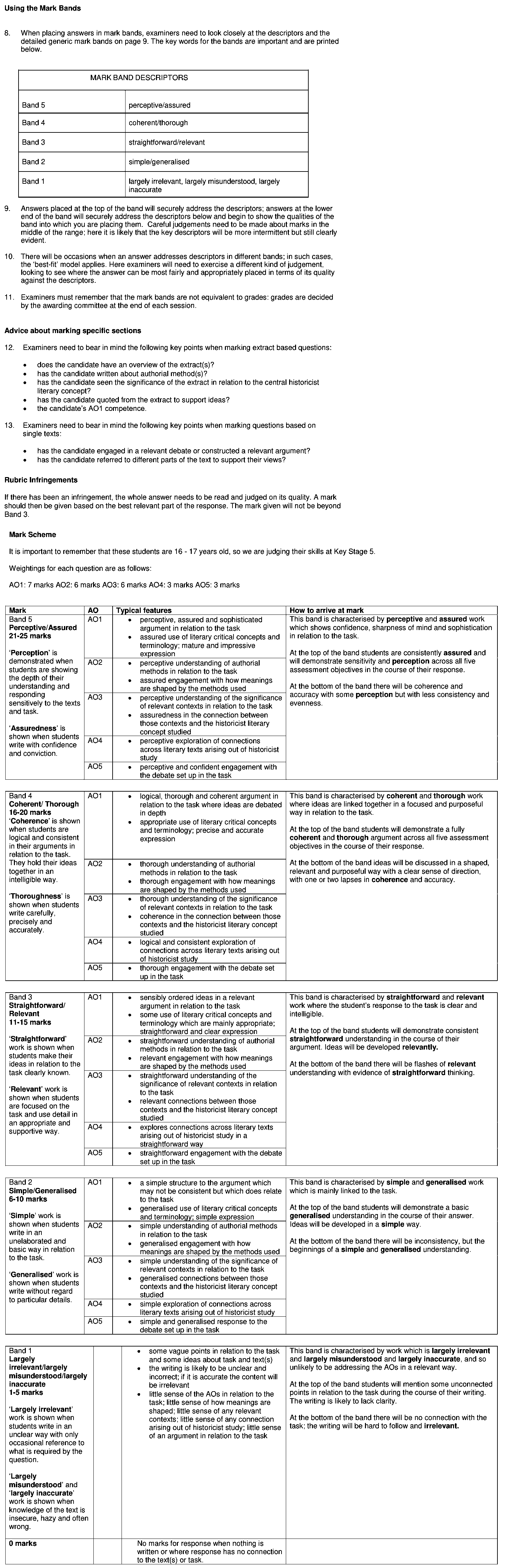
June 2018AS Paper 1125Othello – William Shakespeare Read the passage from Othello, provided below, and respond to the following: • How does Shakespeare present aspects of love in this passage? • Examine the view that, in this passage and elsewhere in the play, Shakespeare presents
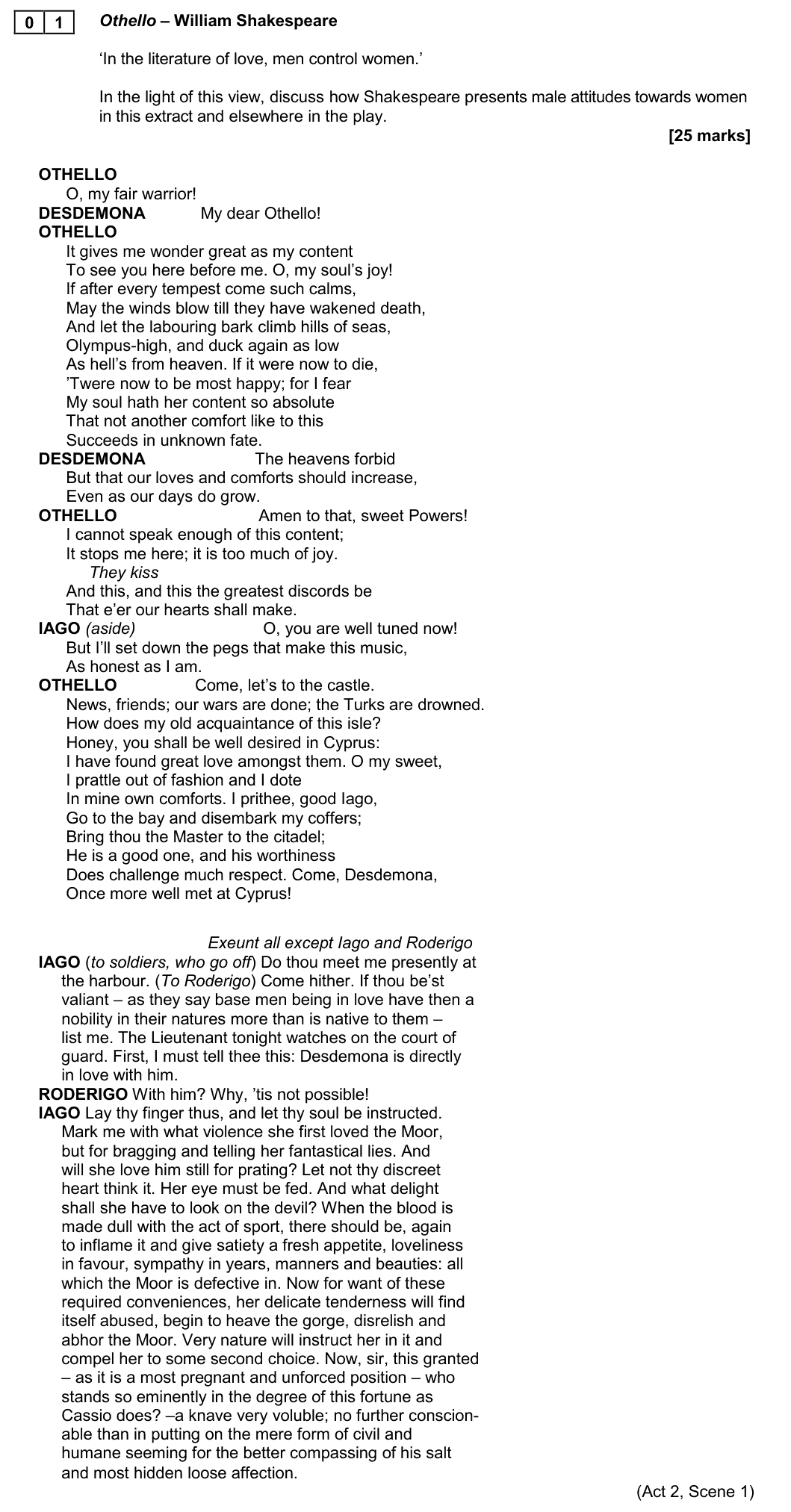
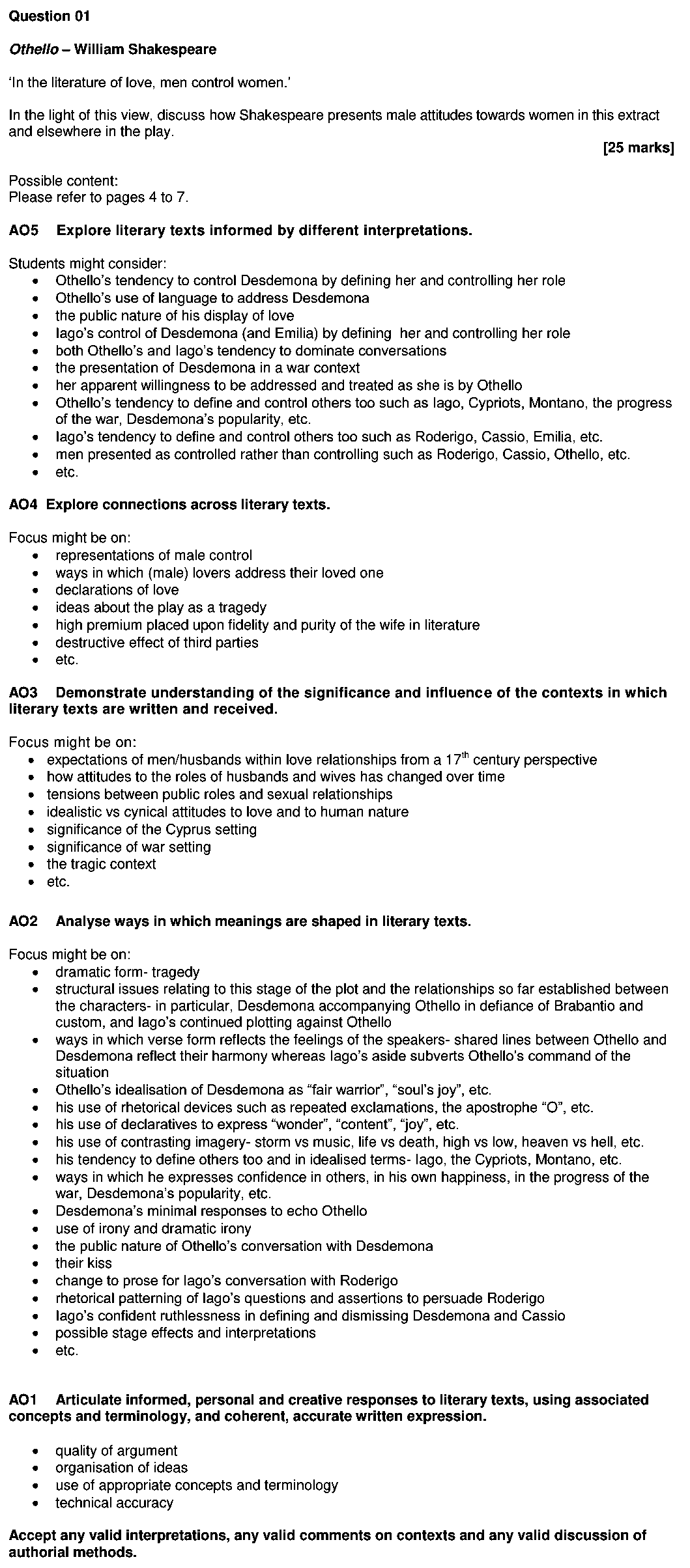
June 2018Paper 1125Othello – William Shakespeare ‘In the literature of love, men control women.’ In the light of this view, discuss how Shakespeare presents male attitudes towards women in this extract and elsewhere in the play. OTHELLO O, my fair warrior! DESDEMONA My dear Othe
June 2017AS Paper 11250 1 Othello – William Shakespeare Read the passage from Othello, provided below, and respond to the following: • How does Shakespeare present aspects of love in this passage? • Examine the view that, in this passage and elsewhere in the play, Shakespeare prese
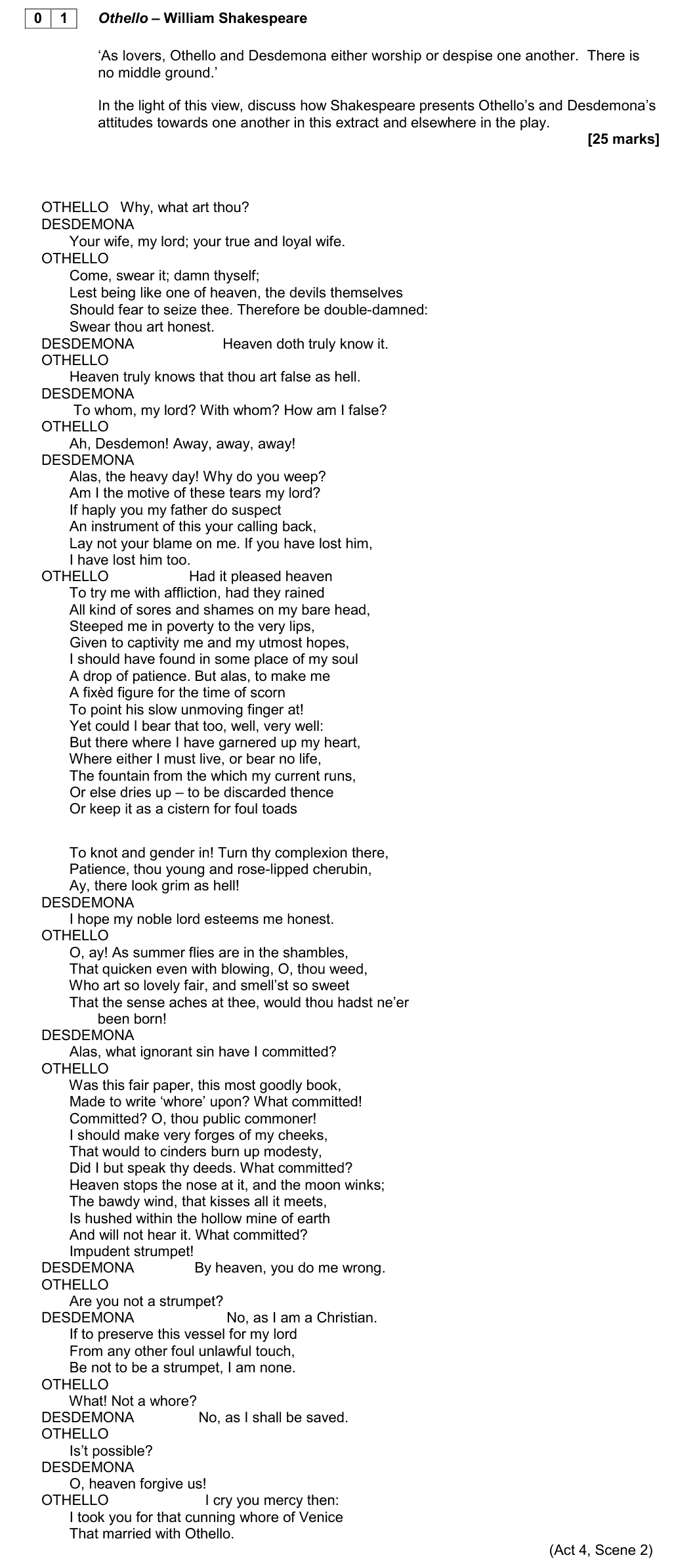
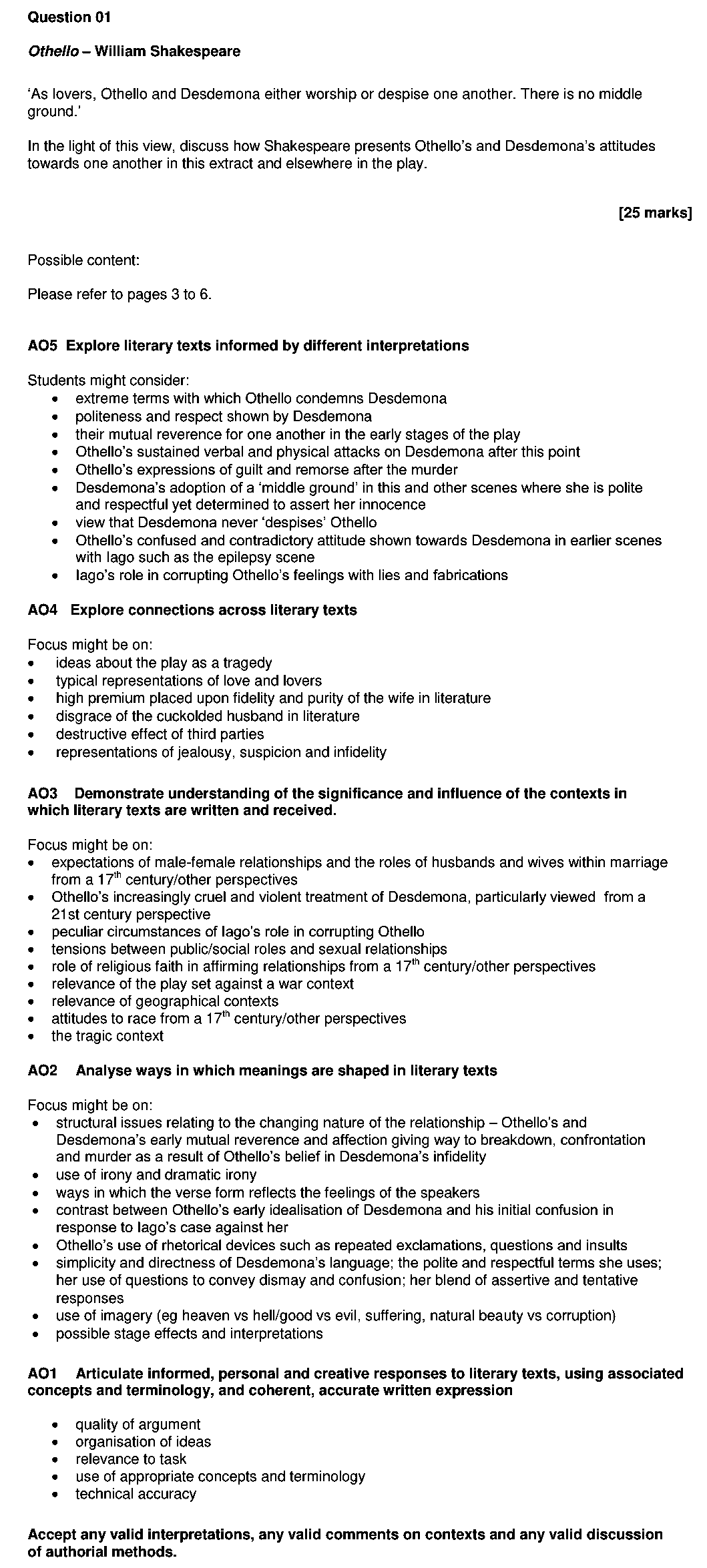
June 2017Paper 11250 1 Othello – William Shakespeare ‘As lovers, Othello and Desdemona either worship or despise one another. There is no middle ground.’ In the light of this view, discuss how Shakespeare presents Othello’s and Desdemona’s attitudes towards one another in this e
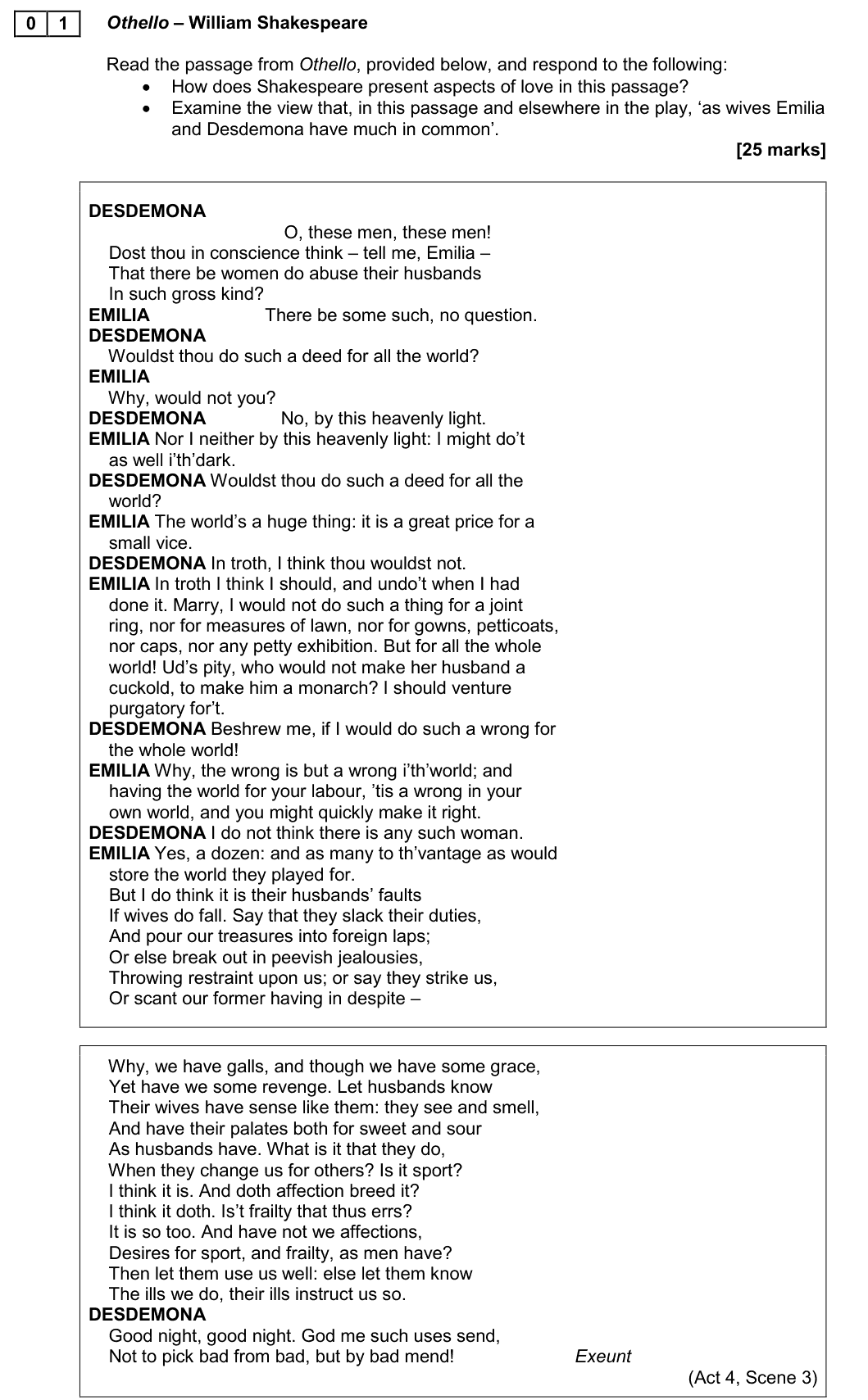
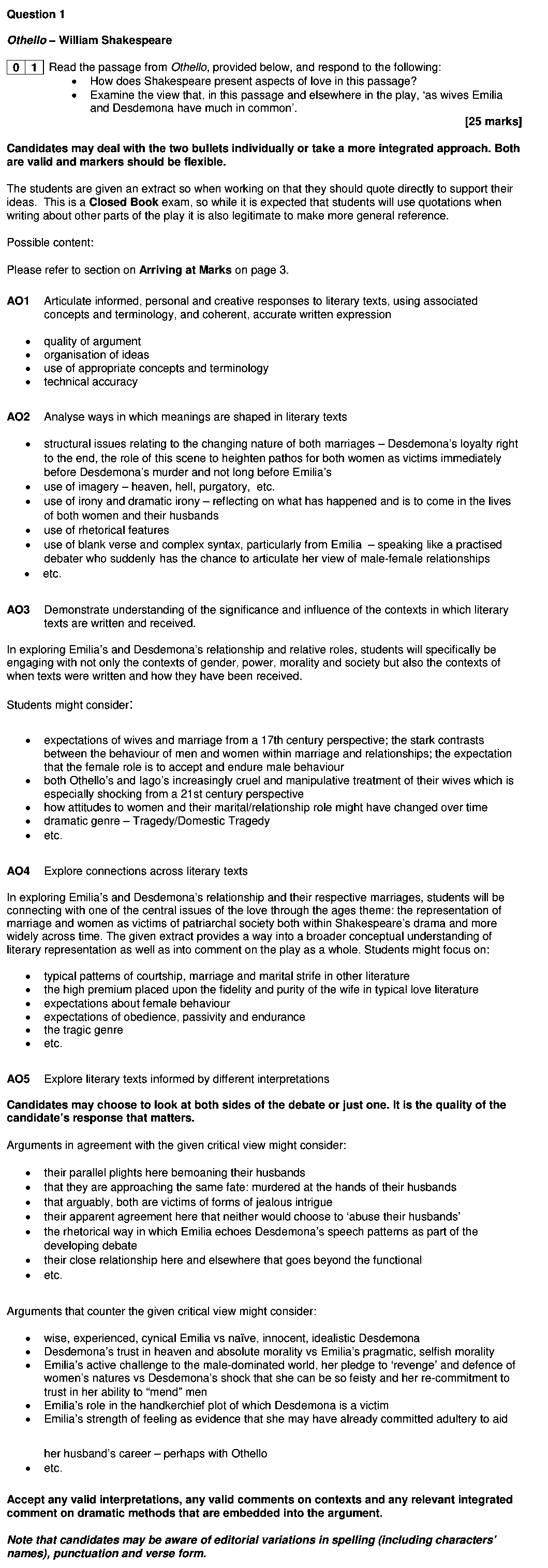
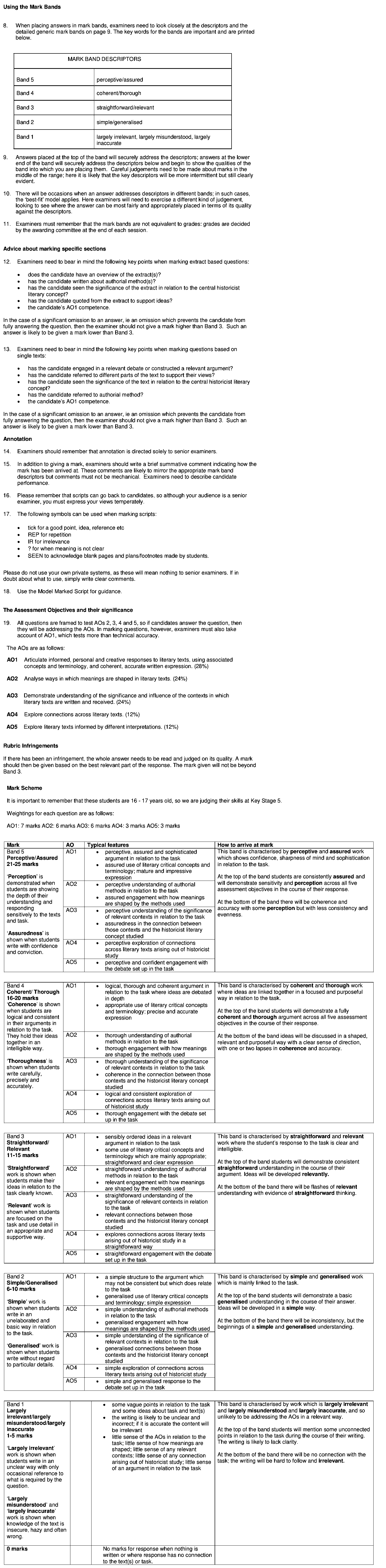
June 2016AS Paper 1125Othello – William Shakespeare Read the passage from Othello, provided below, and respond to the following: • How does Shakespeare present aspects of love in this passage? • Examine the view that, in this passage and elsewhere in the play, ‘as wives Emilia and

Past-paper questions

Print this topic as a pack

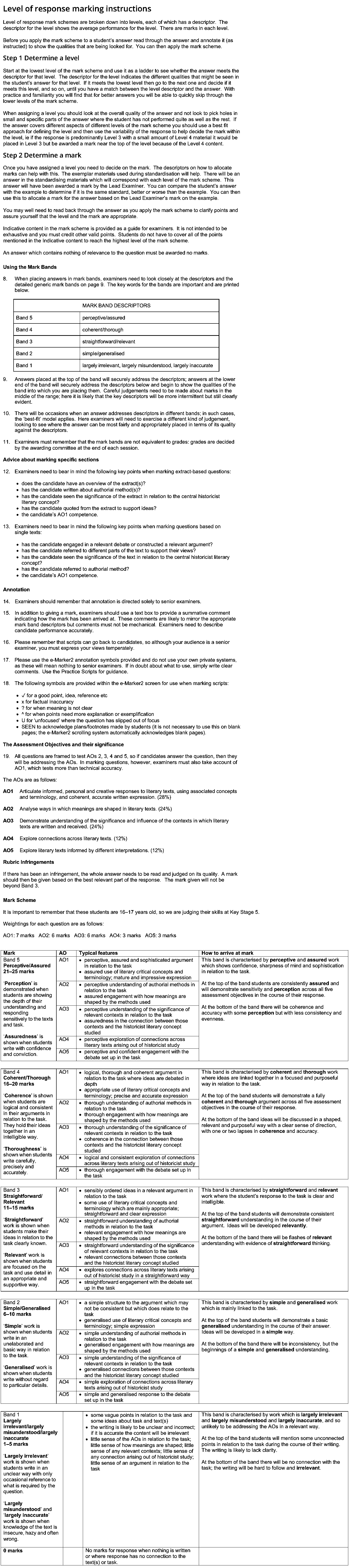
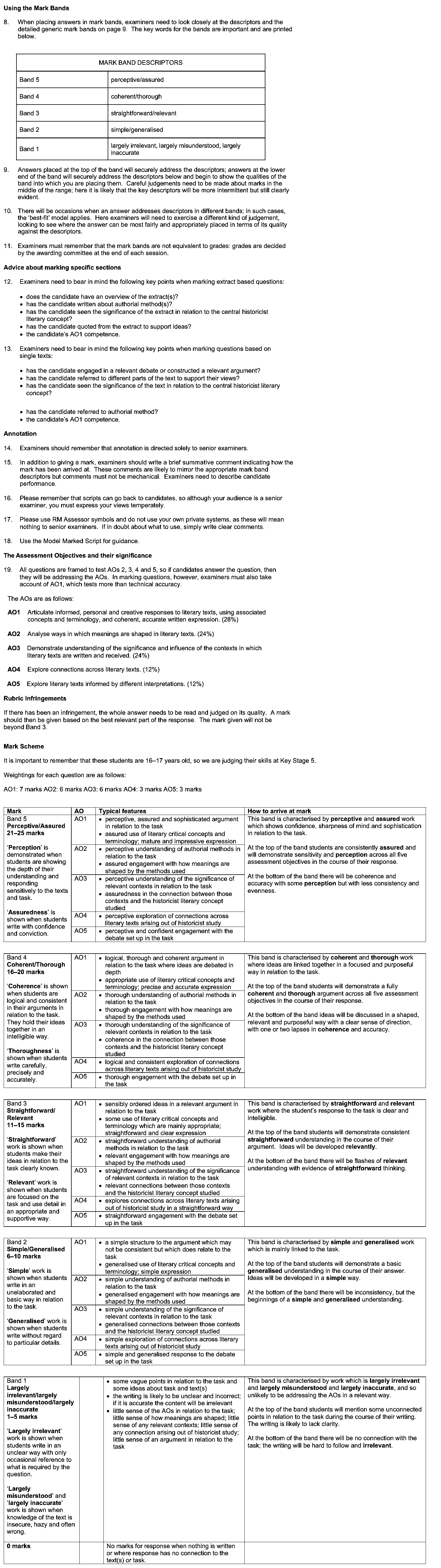
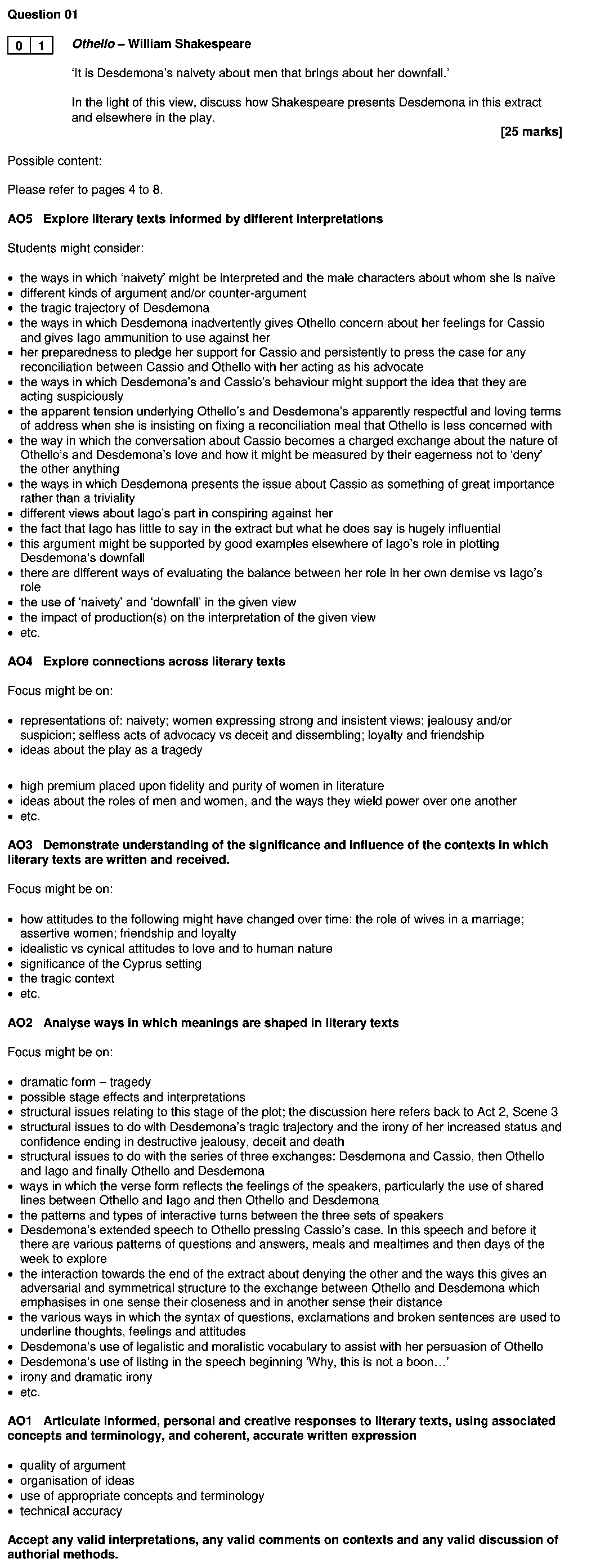
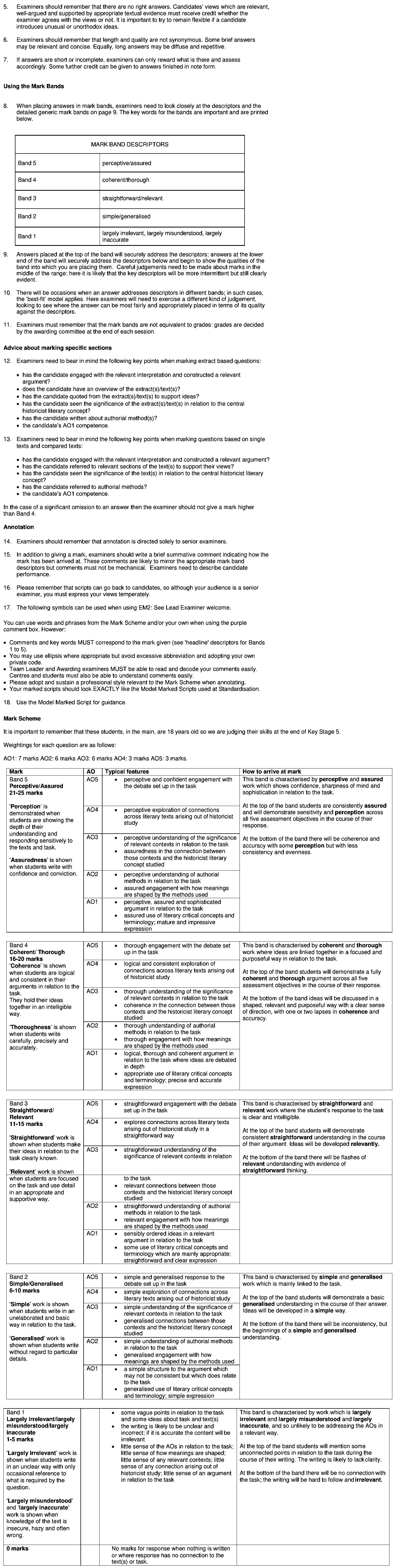
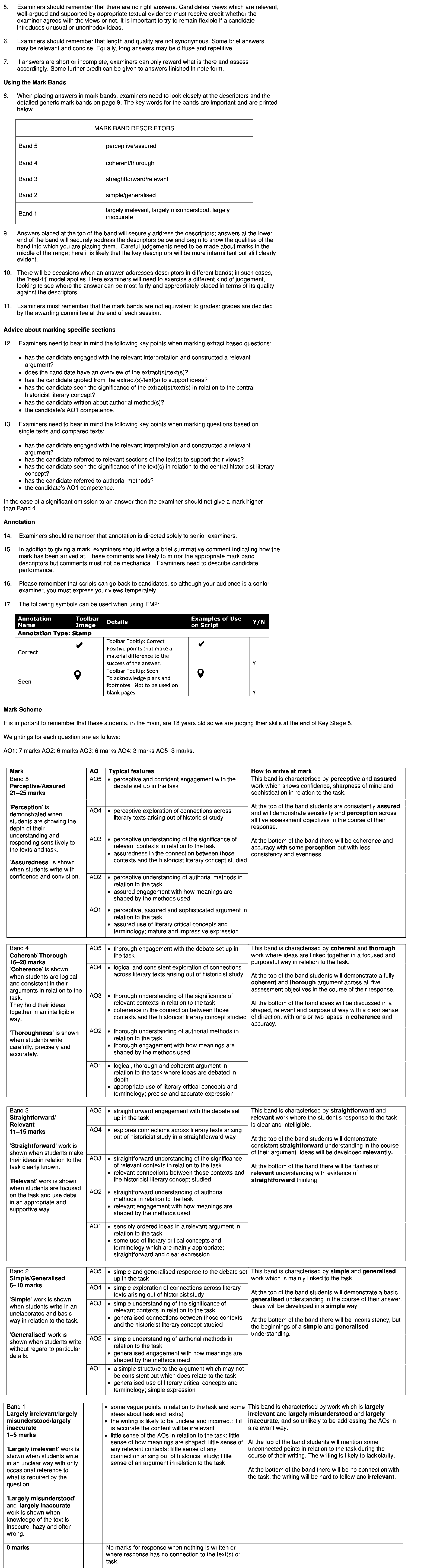
Tap a question to zoom it. The texts and extracts open above it; the mark scheme (with its levels and indicative content) and the examiner's comment open underneath.
June 2025 · AS Paper 1 · Q1 25 marks Shakespeare extract
Othello – William Shakespeare
Read the extract from Othello, provided below, and respond to the following:
• How does Shakespeare present aspects of love in this extract?
• Examine the view that, in this extract and elsewhere in the play, this is a play more
about hate than love.
[25 marks]
IAGO
I say, put
money in thy purse. It cannot be that Desdemona should
long continue her love to the Moor – put money in thy
purse – nor he his to her. It was a violent commence-
ment, and thou shalt see an answerable sequestration –
put but money in thy purse. These Moors are change-
able in their wills – fill thy purse with money. The food
that to him now is as luscious as locusts shall be to him
shortly as acerbe as the coloquintida. She must change
for youth: when she is sated with his body she will find
the error of her choice. Therefore put money in thy
purse. If thou wilt needs damn thyself, do it a more
delicate way than drowning. Make all the money thou
canst. If sanctimony and a frail vow betwixt an erring
barbarian and a super-subtle Venetian be not too hard
for my wits and all the tribe of hell, thou shalt enjoy
her – therefore make money. A pox of drowning thyself!
It is clean out of the way. Seek thou rather to be hanged
in compassing thy joy than to be drowned and go with-
out her.
RODERIGO Wilt thou be fast to my hopes, if I depend on
the issue?
IAGO Thou art sure of me. Go make money. I have told
thee often, and I re-tell thee again and again, I hate
the Moor. My cause is hearted: thine hath no less
reason. Let us be conjunctive in our revenge against
him. If thou canst cuckold him, thou dost thyself a
pleasure, me a sport. There are many events in the
womb of time, which will be delivered. Traverse! Go,
provide thy money. We will have more of this tomorrow.
Adieu.
RODERIGO Where shall we meet i’th’morning?
IAGO At my lodging.
RODERIGO I’ll be with thee betimes.
IAGO Go to; farewell. Do you hear, Roderigo?
RODERIGO What say you?
IAGO No more of drowning, do you hear?
RODERIGO I am changed.
IAGO Go to; farewell. Put money enough in your purse.
RODERIGO I’ll sell all my land.
Exit
IAGO
Thus do I ever make my fool my purse:
For I mine own gained knowledge should profane
If I would time expend with such a snipe
But for my sport and profit. I hate the Moor,
And it is thought abroad that ’twixt my sheets
He’s done my office. I know not if’t be true
But I, for mere suspicion in that kind,
Will do as if for surety. He holds me well:
The better shall my purpose work on him.
Cassio’s a proper man: let me see now;
To get his place and to plume up my will
In double knavery. How? How? Let’s see.
After some time, to abuse Othello’s ear
That he is too familiar with his wife;
He hath a person and a smooth dispose
To be suspected, framed to make women false.
The Moor is of a free and open nature,
That thinks men honest that but seem to be so,
And will as tenderly be led by th’nose
As asses are.
I have’t. It is engendered. Hell and night
Must bring this monstrous birth to the world’s light.
Exit
(Act 1, Scene 3)
June 2025 · Paper 1 · Q1 25 marks Shakespeare extract
Othello – William Shakespeare
‘Audiences are more likely to sympathise with Othello as a victim than to condemn him
for his jealous suspicions towards his wife.’
In the light of this view, discuss how Shakespeare presents Othello in this extract and
elsewhere in the play.
[25 marks]
Enter Othello and Iago
IAGO
Will you think so?
OTHELLO
Think so, Iago?
IAGO
What!
To kiss in private?
OTHELLO
An unauthorized kiss.
IAGO
Or to be naked with her friend in bed
An hour or more, not meaning any harm?
OTHELLO
Naked in bed, Iago, and not mean harm?
It is hypocrisy against the devil.
They that mean virtuously and yet do so,
The devil their virtue tempts, and they tempt heaven.
IAGO
So they do nothing, ’tis a venial slip.
But if I give my wife a handkerchief –
OTHELLO
What then?
IAGO
Why, then, ’tis hers, my lord, and being hers,
She may, I think, bestow’t on any man.
OTHELLO
She is protectress of her honour too.
May she give that?
IAGO
Her honour is an essence that’s not seen:
They have it very oft that have it not.
But for the handkerchief –
OTHELLO
By heaven, I would most gladly have forgot it!
Thou said’st – O, it comes o’er my memory
As doth the raven o’er the infected house,
Boding to all! – he had my handkerchief.
IAGO
Ay, what of that?
OTHELLO
That’s not so good now.
IAGO
What
If I had said, I had seen him do you wrong,
Or heard him say – as knaves be such abroad,
Who having by their own importunate suit
Or voluntary dotage of some mistress
Convincèd or supplied them, cannot choose
But they must blab –
OTHELLO
Hath he said anything?
IAGO
He hath, my lord; but be you well assured,
No more than he’ll unswear.
OTHELLO
What hath he said?
IAGO
Faith, that he did – I know not what he did.
OTHELLO
What? What?
IAGO
Lie –
OTHELLO With her?
IAGO
With her, on her, what you will.
OTHELLO Lie with her? Lie on her? We say lie on her
when they belie her. Lie with her! Zounds, that’s ful-
some! Handkerchief – confession – handkerchief! To
confess and be hanged for his labour. First to be hanged
and then to confess! I tremble at it. Nature would not
invest herself in such shadowing passion without some
instruction. It is not words that shakes me thus! Pish!
Noses, ears, and lips! Is’t possible? – Confess? Handker-
chief! O devil!
He falls
IAGO
Work on,
My medicine, work! Thus credulous fools are caught,
And many worthy and chaste dames even thus,
All guiltless, meet reproach. What ho, my lord!
My lord, I say! Othello!
(Act 4, Scene 1)
June 2024 · AS Paper 1 · Q1 25 marks Shakespeare extract
Othello – William Shakespeare
Read the extract from Othello, provided below, and respond to the following:
• How does Shakespeare present aspects of love in this extract?
• Examine the view that, in this extract and elsewhere in the play, lago easily turns
Othello from a loving husband into a suspicious fool.
[25 marks]
OTHELLO By heaven, I’ll know thy thoughts.
IAGO
You cannot, if my heart were in your hand,
Nor shall not, whilst ’tis in my custody.
OTHELLO
Ha!
IAGO O, beware, my lord, of jealousy!
It is the green-eyed monster, which doth mock
The meat it feeds on. That cuckold lives in bliss
Who certain of his fate loves not his wronger,
But O, what damnèd minutes tells he o’er,
Who dotes yet doubts, suspects yet fondly loves!
OTHELLO
O misery!
IAGO
Poor and content is rich, and rich enough;
But riches fineless is as poor as winter,
To him that ever fears he shall be poor.
Good God, the souls of all my tribe defend
From jealousy!
OTHELLO Why, why is this?
Think’st thou I’d make a life of jealousy,
To follow still the changes of the moon
With fresh suspicions? No, to be once in doubt
Is once to be resolved. Exchange me for a goat,
When I shall turn the business of my soul
To such exsufflicate and blown surmises,
Matching thy inference. ’Tis not to make me jealous
To say my wife is fair, loves company,
Is free of speech, sings, plays, and dances well:
Where virtue is, these are more virtuous.
Nor from mine own weak merits will I draw
The smallest fear or doubt of her revolt,
For she had eyes and chose me. No, Iago,
I’ll see before I doubt; when I doubt, prove;
And on the proof, there is no more but this:
Away at once with love or jealousy!
IAGO
I am glad of this: for now I shall have reason
To show the love and duty that I bear you
With franker spirit. Therefore, as I am bound,
Receive it from me. I speak not yet of proof.
Look to your wife; observe her well with Cassio.
Wear your eye thus: not jealous, nor secure.
I would not have your free and noble nature,
Out of self-bounty, be abused. Look to’t.
I know our country disposition well:
In Venice they do let God see the pranks
They dare not show their husbands; their best conscience
Is not to leave’t undone, but keep’t unknown.
OTHELLO
Dost thou say so?
IAGO
She did deceive her father, marrying you,
And when she seemed to shake, and fear your looks,
She loved them most.
OTHELLO And so she did.
IAGO Why, go to, then!
She that so young could give out such a seeming,
To seel her father’s eyes up close as oak –
He thought ’twas witchcraft. – But I am much to blame,
I humbly do beseech you of your pardon
For too much loving you.
OTHELLO I am bound to thee for ever.
IAGO
I see this hath a little dashed your spirits.
OTHELLO
Not a jot, not a jot.
IAGO In faith, I fear it has.
I hope you will consider what is spoke
Comes from my love. But I do see you’re moved.
I am to pray you, not to strain my speech
To grosser issues, nor to larger reach
Than to suspicion.
OTHELLO
I will not.
IAGO Should you do so, my lord,
My speech should fall into such vile success
Which my thoughts aimed not at. Cassio’s my worthy
friend.
My lord, I see you’re moved.
OTHELLO No, not much moved.
I do not think but Desdemona’s honest.
(Act 3, Scene 3)
June 2024 · Paper 1 · Q1 25 marks Shakespeare extract
Othello – William Shakespeare
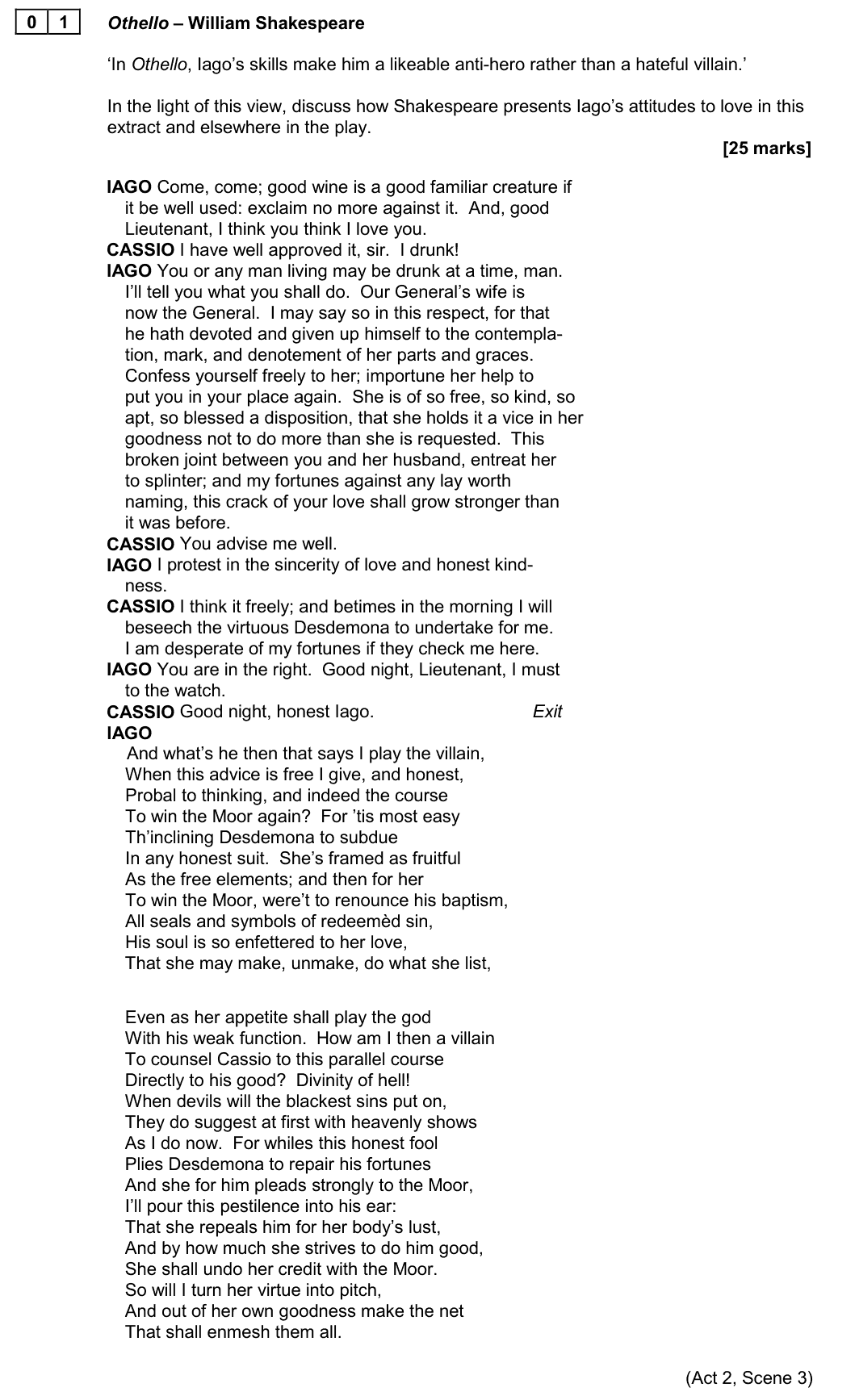
‘In Othello, Iago’s skills make him a likeable anti-hero rather than a hateful villain.’
In the light of this view, discuss how Shakespeare presents Iago’s attitudes to love in this
extract and elsewhere in the play.
[25 marks]
IAGO Come, come; good wine is a good familiar creature if
it be well used: exclaim no more against it. And, good
Lieutenant, I think you think I love you.
CASSIO I have well approved it, sir. I drunk!
IAGO You or any man living may be drunk at a time, man.
I’ll tell you what you shall do. Our General’s wife is
now the General. I may say so in this respect, for that
he hath devoted and given up himself to the contempla-
tion, mark, and denotement of her parts and graces.
Confess yourself freely to her; importune her help to
put you in your place again. She is of so free, so kind, so
apt, so blessed a disposition, that she holds it a vice in her
goodness not to do more than she is requested. This
broken joint between you and her husband, entreat her
to splinter; and my fortunes against any lay worth
naming, this crack of your love shall grow stronger than
it was before.
CASSIO You advise me well.
IAGO I protest in the sincerity of love and honest kind-
ness.
CASSIO I think it freely; and betimes in the morning I will
beseech the virtuous Desdemona to undertake for me.
I am desperate of my fortunes if they check me here.
IAGO You are in the right. Good night, Lieutenant, I must
to the watch.
CASSIO Good night, honest Iago. Exit
IAGO
And what’s he then that says I play the villain,
When this advice is free I give, and honest,
Probal to thinking, and indeed the course
To win the Moor again? For ’tis most easy
Th’inclining Desdemona to subdue
In any honest suit. She’s framed as fruitful
As the free elements; and then for her
To win the Moor, were’t to renounce his baptism,
All seals and symbols of redeemèd sin,
His soul is so enfettered to her love,
That she may make, unmake, do what she list,
Even as her appetite shall play the god
With his weak function. How am I then a villain
To counsel Cassio to this parallel course
Directly to his good? Divinity of hell!
When devils will the blackest sins put on,
They do suggest at first with heavenly shows
As I do now. For whiles this honest fool
Plies Desdemona to repair his fortunes
And she for him pleads strongly to the Moor,
I’ll pour this pestilence into his ear:
That she repeals him for her body’s lust,
And by how much she strives to do him good,
She shall undo her credit with the Moor.
So will I turn her virtue into pitch,
And out of her own goodness make the net
That shall enmesh them all.
(Act 2, Scene 3)
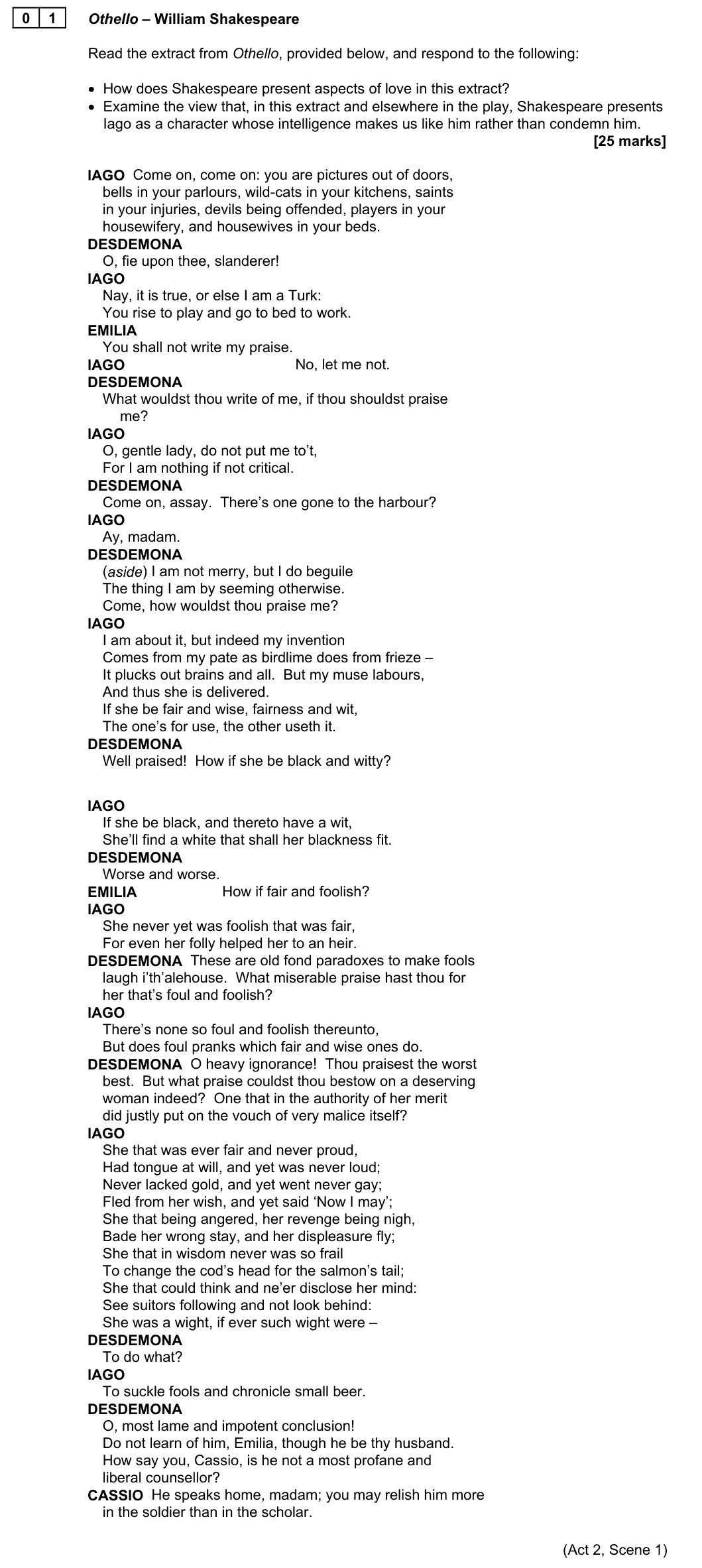
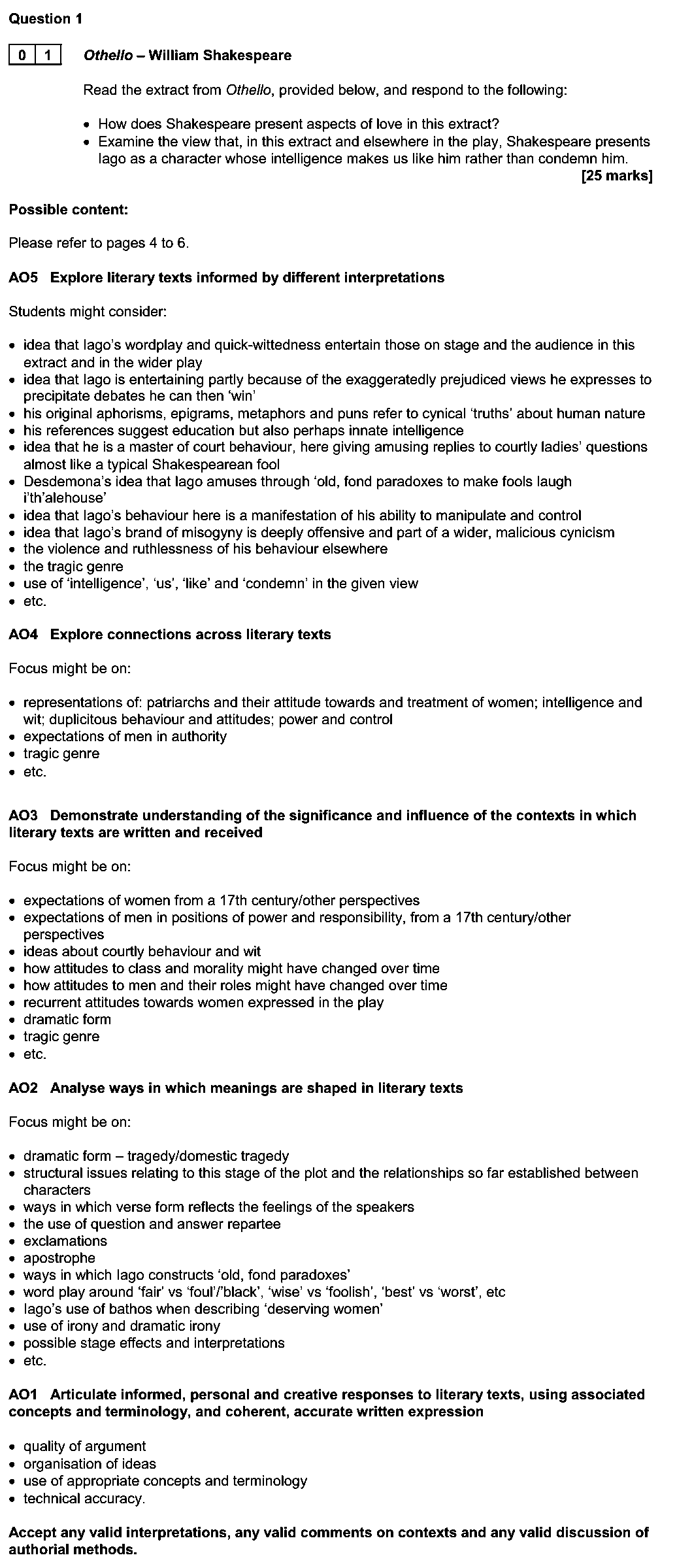
June 2023 · AS Paper 1 · Q1 25 marks Shakespeare extract
Othello – William Shakespeare
Read the extract from Othello, provided below, and respond to the following:
• How does Shakespeare present aspects of love in this extract?
• Examine the view that, in this extract and elsewhere in the play, Shakespeare presents
Iago as a character whose intelligence makes us like him rather than condemn him.
[25 marks]
IAGO Come on, come on: you are pictures out of doors,
bells in your parlours, wild-cats in your kitchens, saints
in your injuries, devils being offended, players in your
housewifery, and housewives in your beds.
DESDEMONA
O, fie upon thee, slanderer!
IAGO
Nay, it is true, or else I am a Turk:
You rise to play and go to bed to work.
EMILIA
You shall not write my praise.
IAGO No, let me not.
DESDEMONA
What wouldst thou write of me, if thou shouldst praise
me?
IAGO
O, gentle lady, do not put me to’t,
For I am nothing if not critical.
DESDEMONA
Come on, assay. There’s one gone to the harbour?
IAGO
Ay, madam.
DESDEMONA
(aside) I am not merry, but I do beguile
The thing I am by seeming otherwise.
Come, how wouldst thou praise me?
IAGO
I am about it, but indeed my invention
Comes from my pate as birdlime does from frieze –
It plucks out brains and all. But my muse labours,
And thus she is delivered.
If she be fair and wise, fairness and wit,
The one’s for use, the other useth it.
DESDEMONA
Well praised! How if she be black and witty?
IAGO
If she be black, and thereto have a wit,
She’ll find a white that shall her blackness fit.
DESDEMONA
Worse and worse.
EMILIA How if fair and foolish?
IAGO
She never yet was foolish that was fair,
For even her folly helped her to an heir.
DESDEMONA These are old fond paradoxes to make fools
laugh i’th’alehouse. What miserable praise hast thou for
her that’s foul and foolish?
IAGO
There’s none so foul and foolish thereunto,
But does foul pranks which fair and wise ones do.
DESDEMONA O heavy ignorance! Thou praisest the worst
best. But what praise couldst thou bestow on a deserving
woman indeed? One that in the authority of her merit
did justly put on the vouch of very malice itself?
IAGO
She that was ever fair and never proud,
Had tongue at will, and yet was never loud;
Never lacked gold, and yet went never gay;
Fled from her wish, and yet said ‘Now I may’;
She that being angered, her revenge being nigh,
Bade her wrong stay, and her displeasure fly;
She that in wisdom never was so frail
To change the cod’s head for the salmon’s tail;
She that could think and ne’er disclose her mind:
See suitors following and not look behind:
She was a wight, if ever such wight were –
DESDEMONA
To do what?
IAGO
To suckle fools and chronicle small beer.
DESDEMONA
O, most lame and impotent conclusion!
Do not learn of him, Emilia, though he be thy husband.
How say you, Cassio, is he not a most profane and
liberal counsellor?
CASSIO He speaks home, madam; you may relish him more
in the soldier than in the scholar.
(Act 2, Scene 1)
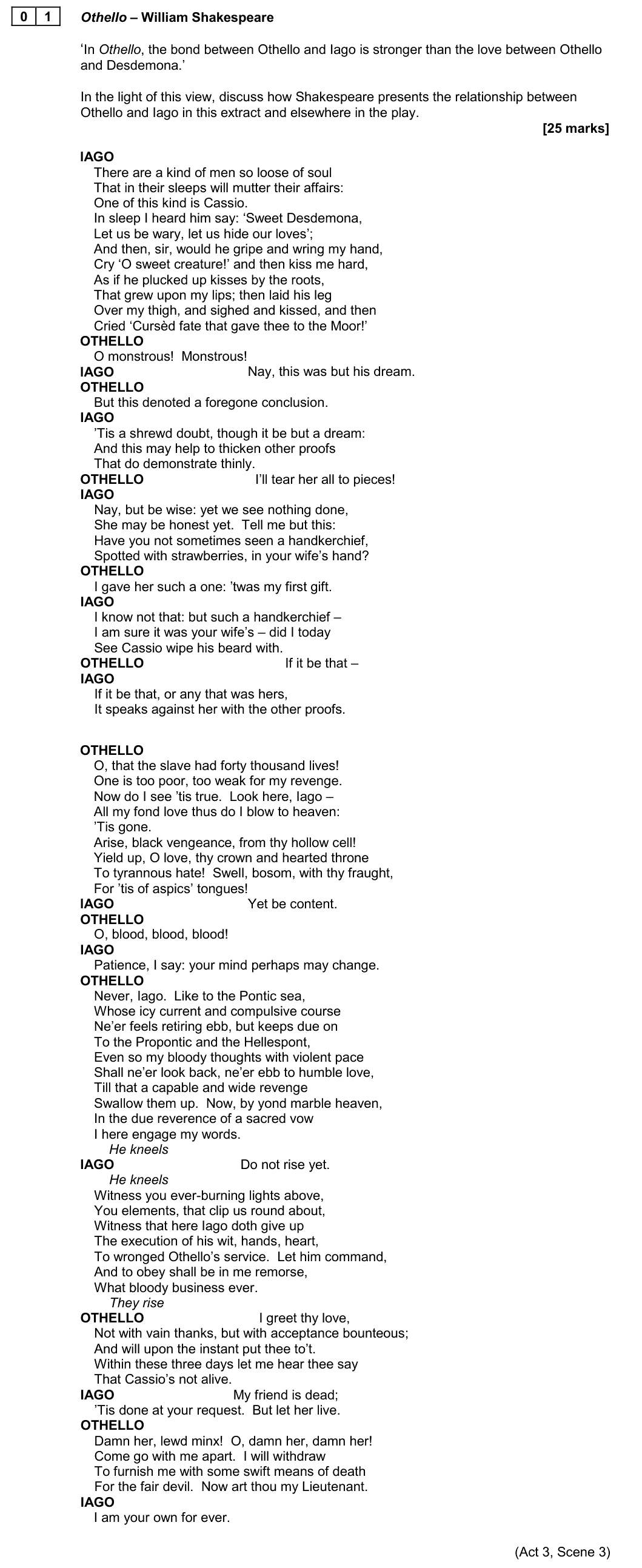
June 2023 · Paper 1 · Q1 25 marks Shakespeare extract
Othello – William Shakespeare
‘In Othello, the bond between Othello and Iago is stronger than the love between Othello
and Desdemona.’
In the light of this view, discuss how Shakespeare presents the relationship between
Othello and Iago in this extract and elsewhere in the play.
[25 marks]
IAGO
There are a kind of men so loose of soul
That in their sleeps will mutter their affairs:
One of this kind is Cassio.
In sleep I heard him say: ‘Sweet Desdemona,
Let us be wary, let us hide our loves’;
And then, sir, would he gripe and wring my hand,
Cry ‘O sweet creature!’ and then kiss me hard,
As if he plucked up kisses by the roots,
That grew upon my lips; then laid his leg
Over my thigh, and sighed and kissed, and then
Cried ‘Cursèd fate that gave thee to the Moor!’
OTHELLO
O monstrous! Monstrous!
IAGO Nay, this was but his dream.
OTHELLO
But this denoted a foregone conclusion.
IAGO
’Tis a shrewd doubt, though it be but a dream:
And this may help to thicken other proofs
That do demonstrate thinly.
OTHELLO I’ll tear her all to pieces!
IAGO
Nay, but be wise: yet we see nothing done,
She may be honest yet. Tell me but this:
Have you not sometimes seen a handkerchief,
Spotted with strawberries, in your wife’s hand?
OTHELLO
I gave her such a one: ’twas my first gift.
IAGO
I know not that: but such a handkerchief –
I am sure it was your wife’s – did I today
See Cassio wipe his beard with.
OTHELLO If it be that –
IAGO
If it be that, or any that was hers,
It speaks against her with the other proofs.
OTHELLO
O, that the slave had forty thousand lives!
One is too poor, too weak for my revenge.
Now do I see ’tis true. Look here, Iago –
All my fond love thus do I blow to heaven:
’Tis gone.
Arise, black vengeance, from thy hollow cell!
Yield up, O love, thy crown and hearted throne
To tyrannous hate! Swell, bosom, with thy fraught,
For ’tis of aspics’ tongues!
IAGO Yet be content.
OTHELLO
O, blood, blood, blood!
IAGO
Patience, I say: your mind perhaps may change.
OTHELLO
Never, Iago. Like to the Pontic sea,
Whose icy current and compulsive course
Ne’er feels retiring ebb, but keeps due on
To the Propontic and the Hellespont,
Even so my bloody thoughts with violent pace
Shall ne’er look back, ne’er ebb to humble love,
Till that a capable and wide revenge
Swallow them up. Now, by yond marble heaven,
In the due reverence of a sacred vow
I here engage my words.
He kneels
IAGO Do not rise yet.
He kneels
Witness you ever-burning lights above,
You elements, that clip us round about,
Witness that here Iago doth give up
The execution of his wit, hands, heart,
To wronged Othello’s service. Let him command,
And to obey shall be in me remorse,
What bloody business ever.
They rise
OTHELLO I greet thy love,
Not with vain thanks, but with acceptance bounteous;
And will upon the instant put thee to’t.
Within these three days let me hear thee say
That Cassio’s not alive.
IAGO My friend is dead;
’Tis done at your request. But let her live.
OTHELLO
Damn her, lewd minx! O, damn her, damn her!
Come go with me apart. I will withdraw
To furnish me with some swift means of death
For the fair devil. Now art thou my Lieutenant.
IAGO
I am your own for ever.
(Act 3, Scene 3)
June 2022 · AS Paper 1 · Q1 25 marks Shakespeare extract
Othello – William Shakespeare
Read the extract from Othello, provided below, and respond to the following:
• How does Shakespeare present aspects of love in this extract?
• Examine the view that, in this extract and elsewhere in the play, women are passive
victims of men.
[25 marks]
DESDEMONA
Am I that name, Iago?
IAGO What name, fair lady?
DESDEMONA
Such as she said my lord did say I was.
EMILIA
He called her whore: a beggar in his drink
Could not have laid such terms upon his callet.
IAGO
Why did he so?
DESDEMONA
I do not know: I am sure I am none such.
IAGO
Do not weep, do not weep. Alas the day!
EMILIA
Hath she forsook so many noble matches,
Her father, and her country, all her friends,
To be called whore? Would it not make one weep?
DESDEMONA
It is my wretched fortune.
IAGO Beshrew him for’t!
How comes this trick upon him?
DESDEMONA Nay, heaven doth know.
EMILIA
I will be hanged if some eternal villain,
Some busy and insinuating rogue,
Some cogging, cozening slave, to get some office,
Have not devised this slander; I’ll be hanged else.
IAGO
Fie, there is no such man! It is impossible.
DESDEMONA
If any such there be, heaven pardon him.
EMILIA
A halter pardon him and hell gnaw his bones!
Why should he call her whore? Who keeps her company?
What place, what time, what form, what likelihood?
The Moor’s abused by some most villainous knave,
Some base notorious knave, some scurvy fellow.
O heaven, that such companions thou’dst unfold,
And put in every honest hand a whip
To lash the rascals naked through the world,
Even from the east to th’west!
IAGO Speak within door.
EMILIA
O fie upon them! Some such squire he was
That turned your wit the seamy side without
And made you to suspect me with the Moor.
IAGO
You are a fool, go to.
DESDEMONA O good Iago,
What shall I do to win my lord again?
Good friend, go to him; for, by this light of heaven,
I know not how I lost him. Here I kneel:
If e’er my will did trespass ’gainst his love,
Either in discourse of thought or actual deed;
Or that mine eyes, mine ears, or any sense
Delighted them in any other form;
Or that I do not yet, and ever did,
And ever will – though he do shake me off
To beggarly divorcement – love him dearly,
Comfort forswear me! Unkindness may do much,
And his unkindness may defeat my life,
But never taint my love. I cannot say ‘whore’:
It does abhor me now I speak the word;
To do the act that might the addition earn
Not the world’s mass of vanity could make me.
IAGO
I pray you, be content: ’tis but his humour;
The business of the state does him offence,
And he does chide with you.
DESDEMONA
If ’twere no other –
IAGO It is so, I warrant.
Hark how these instruments summon to supper!
The messengers of Venice stay the meat.
Go in, and weep not; all things shall be well.
(Act 4, Scene 2)
June 2022 · Paper 1 · Q1 25 marks Shakespeare extract
Othello – William Shakespeare
‘It is Desdemona’s naivety about men that brings about her downfall.’
In the light of this view, discuss how Shakespeare presents Desdemona in this extract
and elsewhere in the play.
[25 marks]
DESDEMONA
My lord shall never rest.
I’ll watch him tame and talk him out of patience;
His bed shall seem a school, his board a shrift;
I’ll intermingle everything he does
With Cassio’s suit. Therefore be merry, Cassio,
For thy solicitor shall rather die
Than give thy cause away.
Enter Othello and Iago
EMILIA
Madam, here comes my lord.
CASSIO
Madam, I’ll take my leave.
DESDEMONA
Why, stay and hear me speak.
CASSIO
Madam, not now: I am very ill at ease,
Unfit for mine own purposes.
DESDEMONA
Well, do your discretion. Exit Cassio
IAGO
Ha! I like not that.
OTHELLO What dost thou say?
IAGO
Nothing, my lord; or if – I know not what.
OTHELLO
Was not that Cassio parted from my wife?
IAGO
Cassio, my lord? No, sure, I cannot think it
That he would sneak away so guilty-like,
Seeing you coming.
OTHELLO I do believe ’twas he.
DESDEMONA
How now, my lord?
I have been talking with a suitor here,
A man that languishes in your displeasure.
OTHELLO
Who is’t you mean?
DESDEMONA
Why, your Lieutenant, Cassio. Good my lord,
If I have any grace or power to move you,
His present reconciliation take.
For if he be not one that truly loves you,
That errs in ignorance, and not in cunning,
I have no judgement in an honest face.
I prithee call him back.
OTHELLO Went he hence now?
DESDEMONA
Yes, faith; so humbled
That he hath left part of his grief with me
To suffer with him. Good love, call him back.
OTHELLO
Not now, sweet Desdemon; some other time.
DESDEMONA
But shall’t be shortly?
OTHELLO The sooner, sweet, for you.
DESDEMONA
Shall’t be tonight, at supper?
OTHELLO No, not tonight.
DESDEMONA
Tomorrow dinner then?
OTHELLO I shall not dine at home.
I meet the captains at the citadel.
DESDEMONA
Why, then, tomorrow night, or Tuesday morn,
On Tuesday noon, or night; on Wednesday morn.
I prithee name the time, but let it not
Exceed three days. In faith, he’s penitent:
And yet his trespass in our common reason –
Save that, they say, the wars must make example
Out of their best – is not almost a fault
T’incur a private check. When shall he come?
Tell me, Othello. I wonder in my soul
What you would ask me that I should deny,
Or stand so mammering on? What! Michael Cassio,
That came a-wooing with you? And so many a time –
When I have spoke of you dispraisingly –
Hath ta’en your part, to have so much to do
To bring him in? By’r Lady, I could do much.
OTHELLO
Prithee, no more: let him come when he will;
I will deny thee nothing.
DESDEMONA Why, this is not a boon:
’Tis as I should entreat you wear your gloves
Or feed on nourishing dishes, or keep you warm,
Or sue to you to do a peculiar profit
To your own person. Nay, when I have a suit
Wherein I mean to touch your love indeed
It shall be full of poise and difficult weight,
And fearful to be granted.
OTHELLO I will deny thee nothing.
(Act 3, Scene 3)
November 2021 · Paper 1 · Q1 25 marks Shakespeare extract
Othello – William Shakespeare
‘By the end of the play, love and loyalty have been completely destroyed.’
In the light of this view, discuss how Shakespeare presents ideas about love and loyalty
in this extract and elsewhere in the play.
[25 marks]
DESDEMONA
O, falsely, falsely murdered!
EMILIA O Lord! What cry is that?
OTHELLO
That? What?
EMILIA
Out and alas, that was my lady’s voice!
She draws back the curtains
Help, help, ho, help! O, lady, speak again!
Sweet Desdemona, O sweet mistress, speak!
DESDEMONA
A guiltless death I die.
EMILIA
O, who hath done this deed?
DESDEMONA
Nobody – I myself – farewell.
Commend me to my kind lord – O, farewell! She dies
OTHELLO
Why, how should she be murdered?
EMILIA
Alas, who knows?
OTHELLO
You heard her say herself it was not I.
EMILIA
She said so: I must needs report the truth.
OTHELLO
She’s like a liar gone to burning hell:
’Twas I that killed her.
EMILIA
O, the more angel she,
And you the blacker devil!
OTHELLO
She turned to folly; and she was a whore.
EMILIA
Thou dost belie her, and thou art a devil.
OTHELLO
She was false as water.
EMILIA Thou art rash as fire to say
That she was false. O, she was heavenly true!
OTHELLO
Cassio did top her: ask thy husband else.
O, I were damned beneath all depth in hell
But that I did proceed upon just grounds
To this extremity. Thy husband knew it all.
EMILIA
My husband!
OTHELLO Thy husband.
EMILIA That she was false to wedlock?
OTHELLO
Ay, with Cassio. Nay, had she been true,
If heaven would make me such another world
Of one entire and perfect chrysolite,
l’d not have sold her for it.
EMILIA My husband!
OTHELLO
Ay, ’twas he that told me on her first.
An honest man he is, and hates the slime
That sticks on filthy deeds.
EMILIA My husband!
OTHELLO
What needs this iterance, woman? I say thy husband.
EMILIA
O mistress, villainy hath made mocks with love!
My husband say that she was false?
OTHELLO He, woman;
I say thy husband; dost understand the word?
My friend, thy husband, honest, honest Iago.
EMILIA
If he say so, may his pernicious soul
Rot half a grain a day! He lies to th’heart.
She was too fond of her most filthy bargain.
OTHELLO
Ha!
EMILIA
Do thy worst:
This deed of thine is no more worthy heaven
Than thou wast worthy her.
OTHELLO Peace, you were best.
EMILIA
Thou hast not half that power to do me harm
As I have to be hurt. O gull! O dolt!
As ignorant as dirt! Thou hast done a deed –
I care not for thy sword – I’ll make thee known,
Though I lost twenty lives. Help! Help, ho! Help!
The Moor hath killed my mistress! Murder! Murder!
(Act 5, Scene 2)
November 2020 · AS Paper 1 · Q1 25 marks Shakespeare extract
Othello – William Shakespeare
Read the passage from Othello, provided below, and respond to the following:
• How does Shakespeare present aspects of love in this passage?
• Examine the view that, in this passage and elsewhere in the play, Shakespeare
presents Bianca as a character who says little but plays an important part in the play as
a whole.
[25 marks]
Enter Bianca
BIANCA
What is the matter, ho? Who is’t that cried?
IAGO
Who is’t that cried?
BIANCA
O, my dear Cassio, my sweet Cassio,
O Cassio, Cassio, Cassio!
IAGO
O notable strumpet! Cassio, may you suspect
Who they should be that have thus mangled you?
CASSIO
No.
GRATIANO
I am sorry to find you thus: I have been to seek you.
IAGO
Lend me a garter: so. O, for a chair
To bear him easily hence!
BIANCA Alas, he faints!
O Cassio, Cassio, Cassio!
IAGO
Gentlemen all, I do suspect this trash
To be a party in this injury.
Patience awhile, good Cassio. Come, come,
Lend me a light. Know we this face or no?
Alas, my friend, and my dear countryman
Roderigo? No – yes, sure – O heaven, Roderigo!
GRATIANO
What! Of Venice?
IAGO
Even he, sir. Did you know him?
GRATIANO Know him? Ay.
IAGO
Signor Gratiano? I cry you gentle pardon.
These bloody accidents must excuse my manners
That so neglected you.
GRATIANO I am glad to see you.
IAGO
How do you, Cassio? O, a chair, a chair!
GRATIANO
Roderigo!
IAGO
He, he, ’tis he.
Enter attendants with chair
O, that’s well said, the chair!
Some good man bear him carefully from hence.
I’ll fetch the General’s surgeon. For you, mistress,
Save you your labour. He that lies slain here, Cassio,
Was my dear friend. What malice was between you?
CASSIO
None in the world, nor do I know the man.
IAGO
(to Bianca) What, look you pale? O, bear him out
o’th’air.
Cassio is borne in. Roderigo’s body is removed
Stay you, good gentlemen. Look you pale, mistress?
Do you perceive the gastness of her eye?
Nay, if you stare, we shall hear more anon.
Behold her well; I pray you look upon her.
Do you see, gentlemen? Nay, guiltiness will speak
Though tongues were out of use.
Enter Emilia
EMILIA
’Las, what’s the matter? What’s the matter, husband?
IAGO
Cassio hath here been set on in the dark
By Roderigo and fellows that are scaped:
He’s almost slain and Roderigo quite.
EMILIA
Alas, good gentleman! Alas, good Cassio!
IAGO
This is the fruit of whoring. Prithee, Emilia,
Go know of Cassio where he supped tonight.
What, do you shake at that?
BIANCA
He supped at my house, but I therefore shake not.
IAGO
O, did he so? I charge you go with me.
EMILIA
O, fie upon thee, strumpet!
BIANCA
I am no strumpet, but of life as honest
As you that thus abuse me.
EMILIA As I? Foh! Fie upon thee!
IAGO
Kind gentlemen, let’s see poor Cassio dressed.
Come, mistress, you must tell’s another tale.
Emilia, run you to the citadel,
And tell my lord and lady what hath happed.
Will you go on afore? (Aside) This is the night
That either makes me, or fordoes me quite. Exeunt
(Act 5, Scene 1)
November 2020 · Paper 1 · Q1 25 marks Shakespeare extract
Othello – William Shakespeare
‘Iago does not understand love.’
In the light of this view, discuss how Shakespeare presents Iago’s attitudes to love in this
extract and elsewhere in the play.
[25 marks]
RODERIGO I will incontinently drown myself.
IAGO If thou dost, I shall never love thee after. Why, thou
silly gentleman!
RODERIGO It is silliness to live, when to live is torment:
and then we have a prescription to die, when death is
our physician.
IAGO O, villainous! I have looked upon the world for four
times seven years, and since I could distinguish betwixt
a benefit and an injury, I never found a man that knew
how to love himself. Ere I would say I would drown
myself for the love of a guinea-hen, I would change my
humanity with a baboon.
RODERIGO What should I do? I confess it is my shame to
be so fond, but it is not in my virtue to amend it.
IAGO Virtue? A fig! ’Tis in ourselves that we are thus, or
thus. Our bodies are our gardens, to the which our wills
are gardeners. So that if we will plant nettles or sow
lettuce, set hyssop and weed up thyme, supply it with
one gender of herbs or distract it with many, either to
have it sterile with idleness or manured with industry,
why the power and corrigible authority of this lies
in our wills. If the beam of our lives had not one scale
of reason to poise another of sensuality, the blood and
baseness of our natures would conduct us to most
preposterous conclusions. But we have reason to cool
our raging motions, our carnal stings, our unbitted lusts:
whereof I take this, that you call love, to be a sect or
scion.
RODERIGO It cannot be.
IAGO It is merely a lust of the blood and a permission of
the will. Come, be a man. Drown thyself? Drown cats
and blind puppies. I have professed me thy friend, and
I confess me knit to thy deserving with cables of per-
durable toughness. I could never better stead thee than
now. Put money in thy purse. Follow thou these wars;
defeat thy favour with an usurped beard. I say, put
money in thy purse. It cannot be that Desdemona should
long continue her love to the Moor – put money in thy
purse – nor he his to her. It was a violent commence-
ment, and thou shalt see an answerable sequestration –
put but money in thy purse. These Moors are change-
able in their wills – fill thy purse with money. The food
that to him now is as luscious as locusts shall be to him
shortly as acerbe as the coloquintida. She must change
for youth: when she is sated with his body she will find
the error of her choice. Therefore put money in thy
purse. If thou wilt needs damn thyself, do it a more
delicate way than drowning. Make all the money thou
canst. If sanctimony and a frail vow betwixt an erring
barbarian and a super-subtle Venetian be not too hard
for my wits and all the tribe of hell, thou shalt enjoy
her – therefore make money. A pox of drowning thyself!
It is clean out of the way. Seek thou rather to be hanged
in compassing thy joy than to be drowned and go with-
out her.
RODERIGO Wilt thou be fast to my hopes, if I depend on
the issue?
IAGO Thou art sure of me. Go make money. I have told
thee often, and I re-tell thee again and again, I hate
the Moor. My cause is hearted: thine hath no less
reason. Let us be conjunctive in our revenge against
him. If thou canst cuckold him, thou dost thyself a
pleasure, me a sport. There are many events in the
womb of time, which will be delivered. Traverse! Go,
provide thy money. We will have more of this tomorrow.
Adieu.
RODERIGO Where shall we meet i’th’morning?
IAGO At my lodging.
RODERIGO I’ll be with thee betimes.
IAGO Go to; farewell. Do you hear, Roderigo?
RODERIGO What say you?
IAGO No more of drowning, do you hear?
RODERIGO I am changed.
IAGO Go to; farewell. Put money enough in your purse.
RODERIGO I’ll sell all my land. Exit
IAGO
Thus do I ever make my fool my purse:
For I mine own gained knowledge should profane
If I would time expend with such a snipe
But for my sport and profit. I hate the Moor,
And it is thought abroad that ’twixt my sheets
He’s done my office. I know not if’t be true
But I, for mere suspicion in that kind,
Will do as if for surety. He holds me well:
The better shall my purpose work on him.
(Act 1 Scene 3)
June 2019 · AS Paper 1 · Q1 25 marks Shakespeare extract
Othello – William Shakespeare
Read the passage from Othello, provided below, and respond to the following:
• How does Shakespeare present aspects of love in this passage?
• Examine the view that, in this passage and elsewhere in the play, Shakespeare
presents desire as dangerous.
[25 marks]
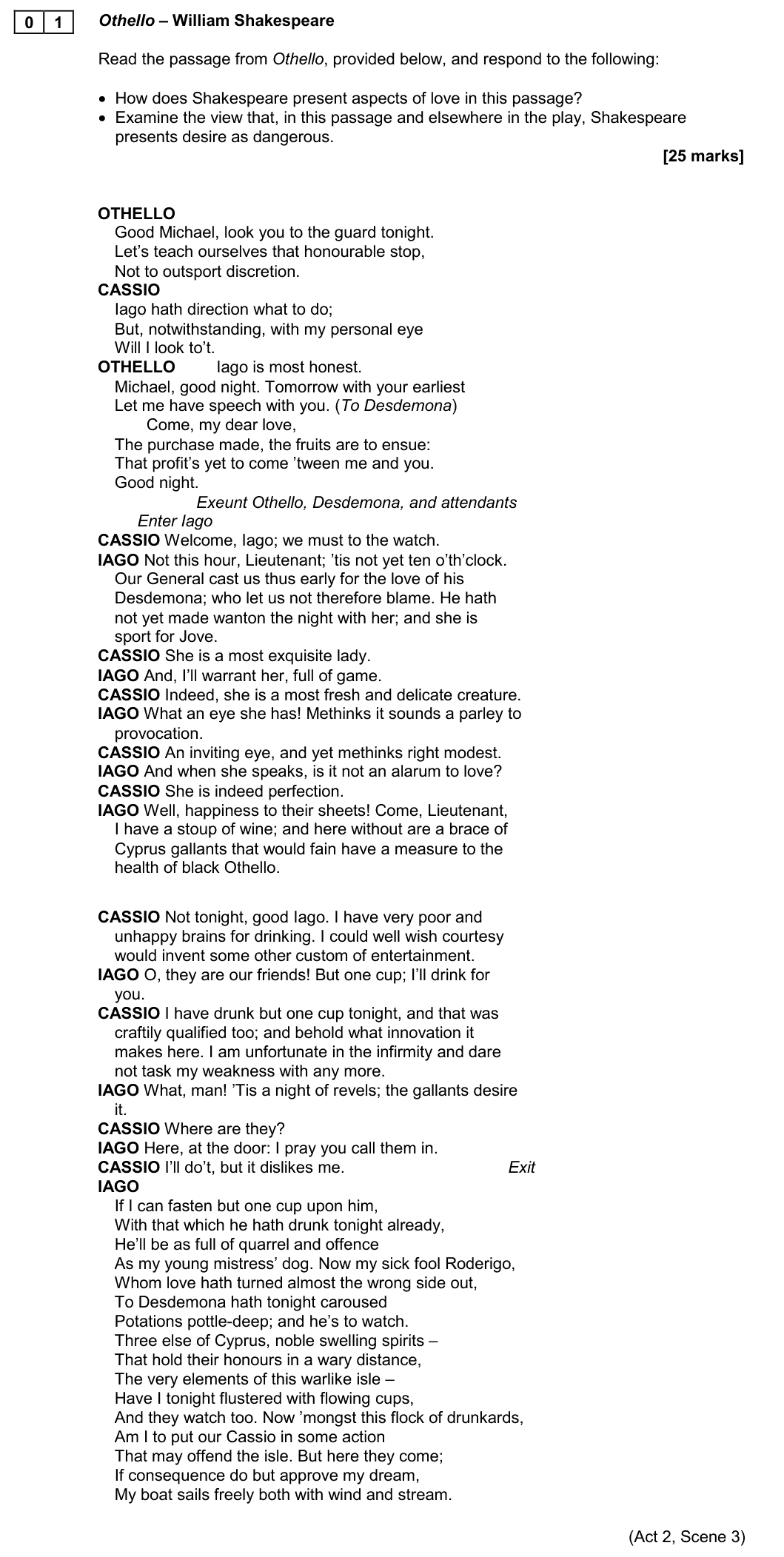
OTHELLO
Good Michael, look you to the guard tonight.
Let’s teach ourselves that honourable stop,
Not to outsport discretion.
CASSIO
Iago hath direction what to do;
But, notwithstanding, with my personal eye
Will I look to’t.
OTHELLO Iago is most honest.
Michael, good night. Tomorrow with your earliest
Let me have speech with you. (To Desdemona)
Come, my dear love,
The purchase made, the fruits are to ensue:
That profit’s yet to come ’tween me and you.
Good night.
Exeunt Othello, Desdemona, and attendants
Enter Iago
CASSIO Welcome, Iago; we must to the watch.
IAGO Not this hour, Lieutenant; ’tis not yet ten o’th’clock.
Our General cast us thus early for the love of his
Desdemona; who let us not therefore blame. He hath
not yet made wanton the night with her; and she is
sport for Jove.
CASSIO She is a most exquisite lady.
IAGO And, I’ll warrant her, full of game.
CASSIO Indeed, she is a most fresh and delicate creature.
IAGO What an eye she has! Methinks it sounds a parley to
provocation.
CASSIO An inviting eye, and yet methinks right modest.
IAGO And when she speaks, is it not an alarum to love?
CASSIO She is indeed perfection.
IAGO Well, happiness to their sheets! Come, Lieutenant,
I have a stoup of wine; and here without are a brace of
Cyprus gallants that would fain have a measure to the
health of black Othello.
CASSIO Not tonight, good Iago. I have very poor and
unhappy brains for drinking. I could well wish courtesy
would invent some other custom of entertainment.
IAGO O, they are our friends! But one cup; I’ll drink for
you.
CASSIO I have drunk but one cup tonight, and that was
craftily qualified too; and behold what innovation it
makes here. I am unfortunate in the infirmity and dare
not task my weakness with any more.
IAGO What, man! ’Tis a night of revels; the gallants desire
it.
CASSIO Where are they?
IAGO Here, at the door: I pray you call them in.
CASSIO I’ll do’t, but it dislikes me. Exit
IAGO
If I can fasten but one cup upon him,
With that which he hath drunk tonight already,
He’ll be as full of quarrel and offence
As my young mistress’ dog. Now my sick fool Roderigo,
Whom love hath turned almost the wrong side out,
To Desdemona hath tonight caroused
Potations pottle-deep; and he’s to watch.
Three else of Cyprus, noble swelling spirits –
That hold their honours in a wary distance,
The very elements of this warlike isle –
Have I tonight flustered with flowing cups,
And they watch too. Now ’mongst this flock of drunkards,
Am I to put our Cassio in some action
That may offend the isle. But here they come;
If consequence do but approve my dream,
My boat sails freely both with wind and stream.
(Act 2, Scene 3)
June 2019 · Paper 1 · Q1 25 marks Shakespeare extract
Othello – William Shakespeare
‘Brabantio’s role as Desdemona’s father and Roderigo’s role as her suitor suggest that
they both love Desdemona. However, all that drives them is possessiveness, jealousy
and pride.’
In the light of this view, discuss how Shakespeare presents Brabantio and Roderigo in this
extract and elsewhere in the play.
[25 marks]
BRABANTIO
I know thee, Roderigo.
RODERIGO
Sir, I will answer anything. But I beseech you
If’t be your pleasure and most wise consent,
As partly I find it is, that your fair daughter,
At this odd-even and dull watch o’th’night,
Transported with no worse nor better guard
But with a knave of common hire, a gondolier,
To the gross clasps of a lascivious Moor –
If this be known to you, and your allowance,
We then have done you bold and saucy wrongs;
But if you know not this, my manners tell me
We have your wrong rebuke. Do not believe
That from the sense of all civility
I thus would play and trifle with your reverence.
Your daughter, if you have not given her leave,
I say again hath made a gross revolt,
Tying her duty, beauty, wit, and fortunes
In an extravagant and wheeling stranger
Of here and everywhere. Straight satisfy yourself:
If she be in her chamber or your house,
Let loose on me the justice of the state
For thus deluding you.
BRABANTIO Strike on the tinder, ho!
Give me a taper; call up all my people!
This accident is not unlike my dream:
Belief of it oppresses me already.
Light, I say, light! Exit above
IAGO Farewell, for I must leave you.
It seems not meet, nor wholesome to my place,
To be produced – as if I stay, I shall –
Against the Moor. For I do know the state,
However this may gall him with some check,
Cannot with safety cast him; for he’s embarked
With such loud reason to the Cyprus wars,
Which even now stand in act, that for their souls
Another of his fathom they have none
To lead their business. In which regard,
Though I do hate him as I do hell pains,
Yet for necessity of present life
I must show out a flag and sign of love,
Which is indeed but sign. That you shall surely find him,
Lead to the Sagittary the raisèd search;
And there will I be with him. So farewell. Exit
Enter Brabantio in his night-gown with servants and
torches
BRABANTIO
It is too true an evil. Gone she is,
And what’s to come of my despisèd time
Is naught but bitterness. Now, Roderigo,
Where didst thou see her? – O unhappy girl! –
With the Moor, say’st thou? – Who would be a father? –
How didst thou know ’twas she? – O, she deceives me
Past thought! – What said she to you? – Get more tapers.
Raise all my kindred. – Are they married, think you?
RODERIGO
Truly I think they are.
BRABANTIO
O heaven! How got she out? O treason of the blood!
Fathers, from hence trust not your daughters’ minds
By what you see them act. Is there not charms
By which the property of youth and maidhood
May be abused? Have you not read, Roderigo,
Of some such thing?
RODERIGO Yes, sir, I have indeed.
BRABANTIO
Call up my brother – O would you had had her!
Some one way, some another. Do you know
Where we may apprehend her and the Moor?
RODERIGO
I think I can discover him, if you please
To get good guard and go along with me.
BRABANTIO
Pray you, lead on. At every house I’ll call –
I may command at most. Get weapons, ho!
And raise some special officers of night.
On, good Roderigo, I’ll deserve your pains. Exeunt
(Act 1, Scene 1)
June 2018 · AS Paper 1 · Q1 25 marks Shakespeare extract
Othello – William Shakespeare
Read the passage from Othello, provided below, and respond to the following:
• How does Shakespeare present aspects of love in this passage?
• Examine the view that, in this passage and elsewhere in the play, Shakespeare
presents Othello as a victim.
[25 marks]
OTHELLO
Will you, I pray, demand that demi-devil
Why he hath thus ensnared my soul and body?
IAGO
Demand me nothing; what you know, you know:
From this time forth I never will speak word.
LODOVICO
What! Not to pray?
GRATIANO
Torments will ope your lips.
OTHELLO Well, thou dost best.
LODOVICO
Sir, you shall understand what hath befallen,
Which, as I think, you know not. Here is a letter
Found in the pocket of the slain Roderigo,
And here another: the one of them imports
The death of Cassio, to be undertook
By Roderigo.
OTHELLO O villain!
CASSIO Most heathenish and most gross!
LODOVICO
Now here’s another discontented paper
Found in his pocket too; and this, it seems
Roderigo meant to have sent this damnèd villain,
But that, belike, Iago, in the nick,
Came in and satisfied him.
OTHELLO O the pernicious caitiff!
How came you, Cassio, by that handkerchief
That was my wife’s?
CASSIO I found it in my chamber;
And he himself confessed but even now
That there he dropped it for a special purpose
Which wrought to his desire.
OTHELLO O fool, fool, fool!
CASSIO
There is besides, in Roderigo’s letter,
How he upbraids Iago, that he made him
Brave me upon the watch, whereon it came
That I was cast; and even but now he spake
After long seeming dead – Iago hurt him,
Iago set him on.
LODOVICO
You must forsake this room and go with us.
Your power and your command is taken off
And Cassio rules in Cyprus. For this slave,
If there be any cunning cruelty
That can torment him much, and hold him long,
It shall be his. You shall close prisoner rest,
Till that the nature of your fault be known
To the Venetian state. Come, bring him away.
OTHELLO
Soft you; a word or two before you go.
I have done the state some service and they know’t:
No more of that. I pray you in your letters
When you shall these unlucky deeds relate
Speak of me as I am: nothing extenuate,
Nor set down aught in malice. Then must you speak
Of one that loved not wisely, but too well;
Of one, not easily jealous but, being wrought,
Perplexed in the extreme; of one whose hand
Like the base Indian threw a pearl away
Richer than all his tribe; of one whose sùbdued eyes,
Albeit unusèd to the melting mood,
Drop tears as fast as the Arabian trees
Their med’cinable gum. Set you down this:
And say, besides, that in Aleppo once
Where a malignant and a turbaned Turk
Beat a Venetian and traduced the state,
I took by th’throat the circumcisèd dog
And smote him thus.
He stabs himself
LODOVICO
O bloody period!
GRATIANO All that’s spoke is marred!
OTHELLO
I kissed thee, ere I killed thee: no way but this,
Killing myself, to die upon a kiss.
He falls on the bed and dies
(Act 5, Scene 2)
June 2018 · Paper 1 · Q1 25 marks Shakespeare extract
Othello – William Shakespeare
‘In the literature of love, men control women.’
In the light of this view, discuss how Shakespeare presents male attitudes towards women
in this extract and elsewhere in the play.
[25 marks]
OTHELLO
O, my fair warrior!
DESDEMONA My dear Othello!
OTHELLO
It gives me wonder great as my content
To see you here before me. O, my soul’s joy!
If after every tempest come such calms,
May the winds blow till they have wakened death,
And let the labouring bark climb hills of seas,
Olympus-high, and duck again as low
As hell’s from heaven. If it were now to die,
’Twere now to be most happy; for I fear
My soul hath her content so absolute
That not another comfort like to this
Succeeds in unknown fate.
DESDEMONA The heavens forbid
But that our loves and comforts should increase,
Even as our days do grow.
OTHELLO Amen to that, sweet Powers!
I cannot speak enough of this content;
It stops me here; it is too much of joy.
They kiss
And this, and this the greatest discords be
That e’er our hearts shall make.
IAGO (aside) O, you are well tuned now!
But I’ll set down the pegs that make this music,
As honest as I am.
OTHELLO Come, let’s to the castle.
News, friends; our wars are done; the Turks are drowned.
How does my old acquaintance of this isle?
Honey, you shall be well desired in Cyprus:
I have found great love amongst them. O my sweet,
I prattle out of fashion and I dote
In mine own comforts. I prithee, good Iago,
Go to the bay and disembark my coffers;
Bring thou the Master to the citadel;
He is a good one, and his worthiness
Does challenge much respect. Come, Desdemona,
Once more well met at Cyprus!
Exeunt all except Iago and Roderigo
IAGO (to soldiers, who go off) Do thou meet me presently at
the harbour. (To Roderigo) Come hither. If thou be’st
valiant – as they say base men being in love have then a
nobility in their natures more than is native to them –
list me. The Lieutenant tonight watches on the court of
guard. First, I must tell thee this: Desdemona is directly
in love with him.
RODERIGO With him? Why, ’tis not possible!
IAGO Lay thy finger thus, and let thy soul be instructed.
Mark me with what violence she first loved the Moor,
but for bragging and telling her fantastical lies. And
will she love him still for prating? Let not thy discreet
heart think it. Her eye must be fed. And what delight
shall she have to look on the devil? When the blood is
made dull with the act of sport, there should be, again
to inflame it and give satiety a fresh appetite, loveliness
in favour, sympathy in years, manners and beauties: all
which the Moor is defective in. Now for want of these
required conveniences, her delicate tenderness will find
itself abused, begin to heave the gorge, disrelish and
abhor the Moor. Very nature will instruct her in it and
compel her to some second choice. Now, sir, this granted
– as it is a most pregnant and unforced position – who
stands so eminently in the degree of this fortune as
Cassio does? –a knave very voluble; no further conscion-
able than in putting on the mere form of civil and
humane seeming for the better compassing of his salt
and most hidden loose affection.
(Act 2, Scene 1)
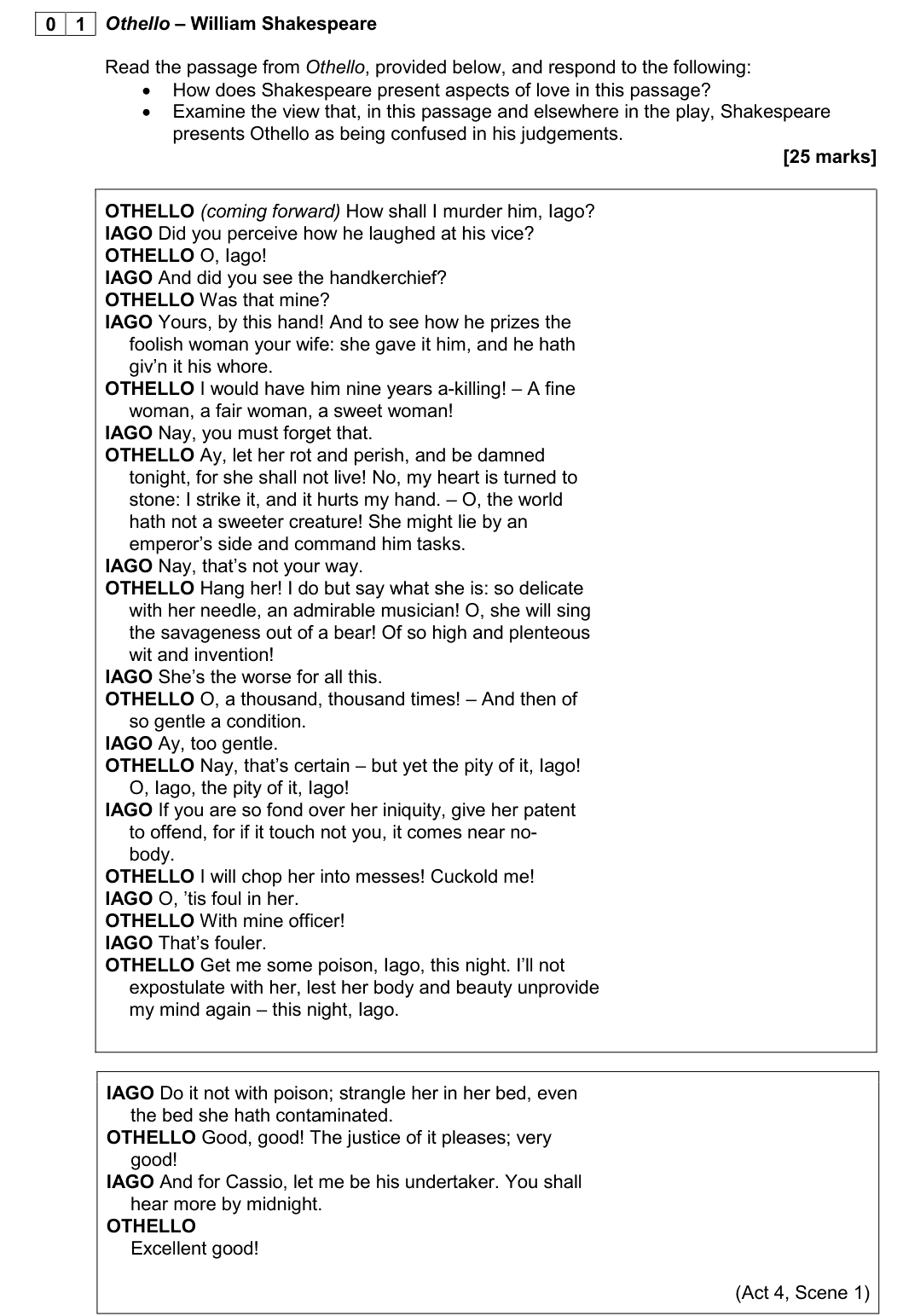
June 2017 · AS Paper 1 · Q1 25 marks Shakespeare extract
0 1 Othello – William Shakespeare
Read the passage from Othello, provided below, and respond to the following:
•
How does Shakespeare present aspects of love in this passage?
•
Examine the view that, in this passage and elsewhere in the play, Shakespeare
presents Othello as being confused in his judgements.
[25 marks]
OTHELLO (coming forward) How shall I murder him, Iago?
IAGO Did you perceive how he laughed at his vice?
OTHELLO O, Iago!
IAGO And did you see the handkerchief?
OTHELLO Was that mine?
IAGO Yours, by this hand! And to see how he prizes the
foolish woman your wife: she gave it him, and he hath
giv’n it his whore.
OTHELLO I would have him nine years a-killing! – A fine
woman, a fair woman, a sweet woman!
IAGO Nay, you must forget that.
OTHELLO Ay, let her rot and perish, and be damned
tonight, for she shall not live! No, my heart is turned to
stone: I strike it, and it hurts my hand. – O, the world
hath not a sweeter creature! She might lie by an
emperor’s side and command him tasks.
IAGO Nay, that’s not your way.
OTHELLO Hang her! I do but say what she is: so delicate
with her needle, an admirable musician! O, she will sing
the savageness out of a bear! Of so high and plenteous
wit and invention!
IAGO She’s the worse for all this.
OTHELLO O, a thousand, thousand times! – And then of
so gentle a condition.
IAGO Ay, too gentle.
OTHELLO Nay, that’s certain – but yet the pity of it, Iago!
O, Iago, the pity of it, Iago!
IAGO If you are so fond over her iniquity, give her patent
to offend, for if it touch not you, it comes near no-
body.
OTHELLO I will chop her into messes! Cuckold me!
IAGO O, ’tis foul in her.
OTHELLO With mine officer!
IAGO That’s fouler.
OTHELLO Get me some poison, Iago, this night. I’ll not
expostulate with her, lest her body and beauty unprovide
my mind again – this night, Iago.
IAGO Do it not with poison; strangle her in her bed, even
the bed she hath contaminated.
OTHELLO Good, good! The justice of it pleases; very
good!
IAGO And for Cassio, let me be his undertaker. You shall
hear more by midnight.
OTHELLO
Excellent good!
(Act 4, Scene 1)
June 2017 · Paper 1 · Q1 25 marks Shakespeare extract
0 1
Othello – William Shakespeare
‘As lovers, Othello and Desdemona either worship or despise one another. There is
no middle ground.’
In the light of this view, discuss how Shakespeare presents Othello’s and Desdemona’s
attitudes towards one another in this extract and elsewhere in the play.
[25 marks]
OTHELLO Why, what art thou?
DESDEMONA
Your wife, my lord; your true and loyal wife.
OTHELLO
Come, swear it; damn thyself;
Lest being like one of heaven, the devils themselves
Should fear to seize thee. Therefore be double-damned:
Swear thou art honest.
DESDEMONA Heaven doth truly know it.
OTHELLO
Heaven truly knows that thou art false as hell.
DESDEMONA
To whom, my lord? With whom? How am I false?
OTHELLO
Ah, Desdemon! Away, away, away!
DESDEMONA
Alas, the heavy day! Why do you weep?
Am I the motive of these tears my lord?
If haply you my father do suspect
An instrument of this your calling back,
Lay not your blame on me. If you have lost him,
I have lost him too.
OTHELLO Had it pleased heaven
To try me with affliction, had they rained
All kind of sores and shames on my bare head,
Steeped me in poverty to the very lips,
Given to captivity me and my utmost hopes,
I should have found in some place of my soul
A drop of patience. But alas, to make me
A fixèd figure for the time of scorn
To point his slow unmoving finger at!
Yet could I bear that too, well, very well:
But there where I have garnered up my heart,
Where either I must live, or bear no life,
The fountain from the which my current runs,
Or else dries up – to be discarded thence
Or keep it as a cistern for foul toads
To knot and gender in! Turn thy complexion there,
Patience, thou young and rose-lipped cherubin,
Ay, there look grim as hell!
DESDEMONA
I hope my noble lord esteems me honest.
OTHELLO
O, ay! As summer flies are in the shambles,
That quicken even with blowing, O, thou weed,
Who art so lovely fair, and smell’st so sweet
That the sense aches at thee, would thou hadst ne’er
been born!
DESDEMONA
Alas, what ignorant sin have I committed?
OTHELLO
Was this fair paper, this most goodly book,
Made to write ‘whore’ upon? What committed!
Committed? O, thou public commoner!
I should make very forges of my cheeks,
That would to cinders burn up modesty,
Did I but speak thy deeds. What committed?
Heaven stops the nose at it, and the moon winks;
The bawdy wind, that kisses all it meets,
Is hushed within the hollow mine of earth
And will not hear it. What committed?
Impudent strumpet!
DESDEMONA By heaven, you do me wrong.
OTHELLO
Are you not a strumpet?
DESDEMONA No, as I am a Christian.
If to preserve this vessel for my lord
From any other foul unlawful touch,
Be not to be a strumpet, I am none.
OTHELLO
What! Not a whore?
DESDEMONA No, as I shall be saved.
OTHELLO
Is’t possible?
DESDEMONA
O, heaven forgive us!
OTHELLO I cry you mercy then:
I took you for that cunning whore of Venice
That married with Othello.
(Act 4, Scene 2)
June 2016 · AS Paper 1 · Q1 25 marks Shakespeare extract
Othello – William Shakespeare
Read the passage from Othello, provided below, and respond to the following:
•
How does Shakespeare present aspects of love in this passage?
•
Examine the view that, in this passage and elsewhere in the play, ‘as wives Emilia
and Desdemona have much in common’.
[25 marks]
DESDEMONA
O, these men, these men!
Dost thou in conscience think – tell me, Emilia –
That there be women do abuse their husbands
In such gross kind?
EMILIA There be some such, no question.
DESDEMONA
Wouldst thou do such a deed for all the world?
EMILIA
Why, would not you?
DESDEMONA No, by this heavenly light.
EMILIA Nor I neither by this heavenly light: I might do’t
as well i’th’dark.
DESDEMONA Wouldst thou do such a deed for all the
world?
EMILIA The world’s a huge thing: it is a great price for a
small vice.
DESDEMONA In troth, I think thou wouldst not.
EMILIA In troth I think I should, and undo’t when I had
done it. Marry, I would not do such a thing for a joint
ring, nor for measures of lawn, nor for gowns, petticoats,
nor caps, nor any petty exhibition. But for all the whole
world! Ud’s pity, who would not make her husband a
cuckold, to make him a monarch? I should venture
purgatory for’t.
DESDEMONA Beshrew me, if I would do such a wrong for
the whole world!
EMILIA Why, the wrong is but a wrong i’th’world; and
having the world for your labour, ’tis a wrong in your
own world, and you might quickly make it right.
DESDEMONA I do not think there is any such woman.
EMILIA Yes, a dozen: and as many to th’vantage as would
store the world they played for.
But I do think it is their husbands’ faults
If wives do fall. Say that they slack their duties,
And pour our treasures into foreign laps;
Or else break out in peevish jealousies,
Throwing restraint upon us; or say they strike us,
Or scant our former having in despite –
Why, we have galls, and though we have some grace,
Yet have we some revenge. Let husbands know
Their wives have sense like them: they see and smell,
And have their palates both for sweet and sour
As husbands have. What is it that they do,
When they change us for others? Is it sport?
I think it is. And doth affection breed it?
I think it doth. Is’t frailty that thus errs?
It is so too. And have not we affections,
Desires for sport, and frailty, as men have?
Then let them use us well: else let them know
The ills we do, their ills instruct us so.
DESDEMONA
Good night, good night. God me such uses send,
Not to pick bad from bad, but by bad mend! Exeunt
(Act 4, Scene 3)

Work with an AQA English Literature A tutor

Essays stuck in the middle bands, or not sure what the examiners want from an analysis? Book a trial lesson with a specialist AQA English Literature A tutor.

Prefer email? Send an enquiry

If you are under 18, please include a parent's contact details. Enquiries go to enquiries@alevelenglishtutor.com and are deleted once handled. All tutoring is online.