Regeneration – Pat Barker ‘If we cannot remember, we can never understand who we are.’ Examine the presentation of memory in Regeneration in the light of this view.
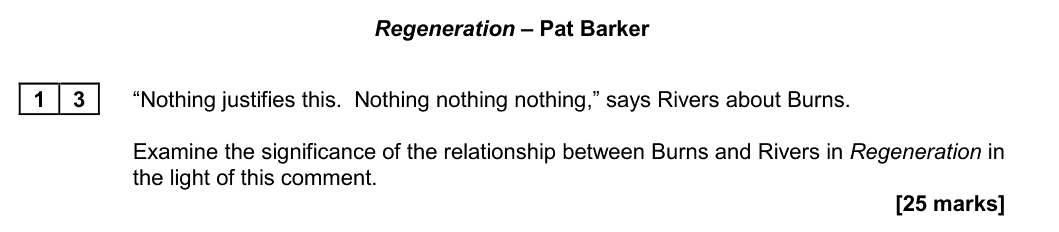
Regeneration – Pat Barker “Nothing justifies this. Nothing nothing nothing,” says Rivers about Burns. Examine the significance of the relationship between Burns and Rivers in Regeneration in the light of this comment.
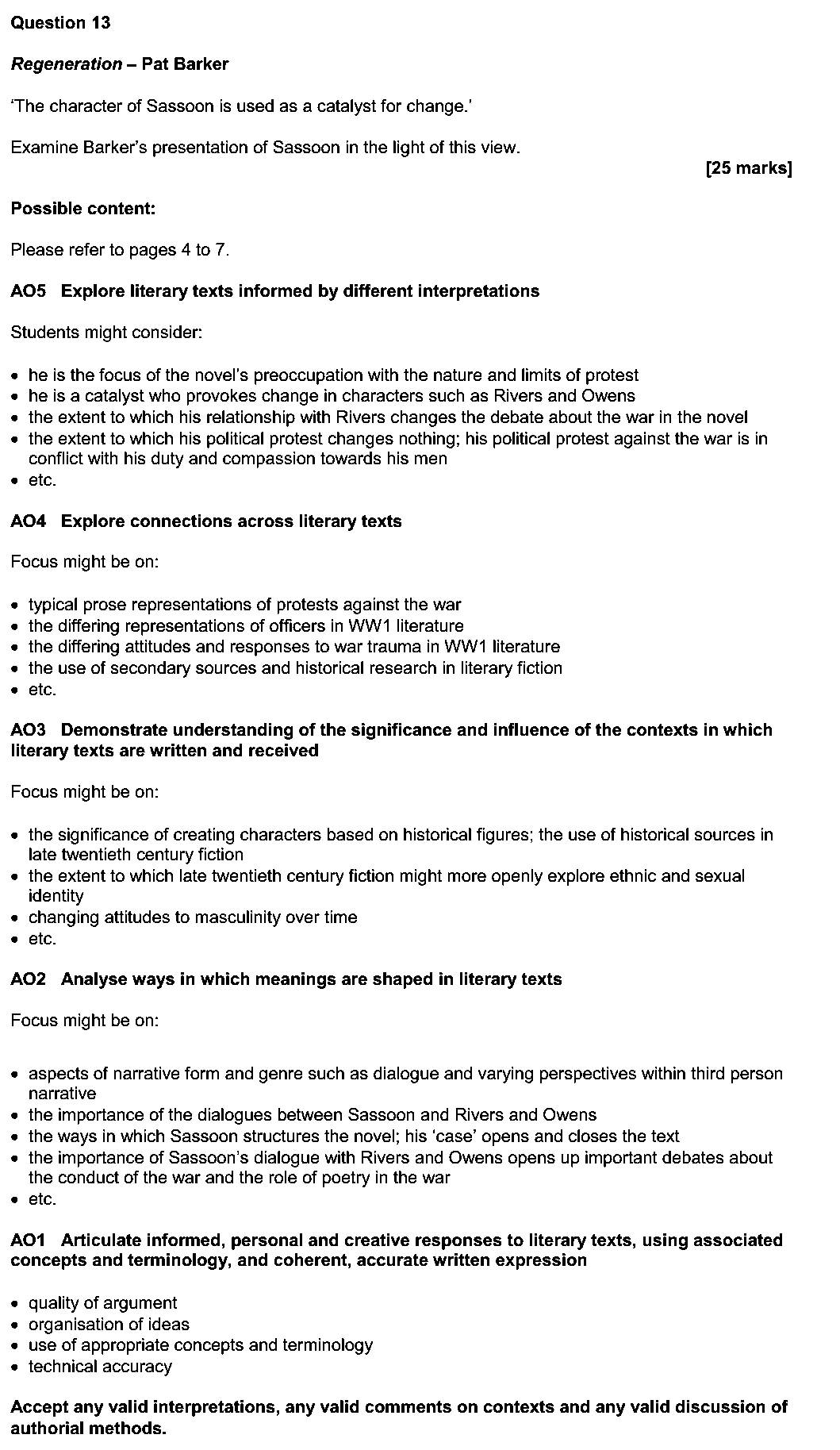
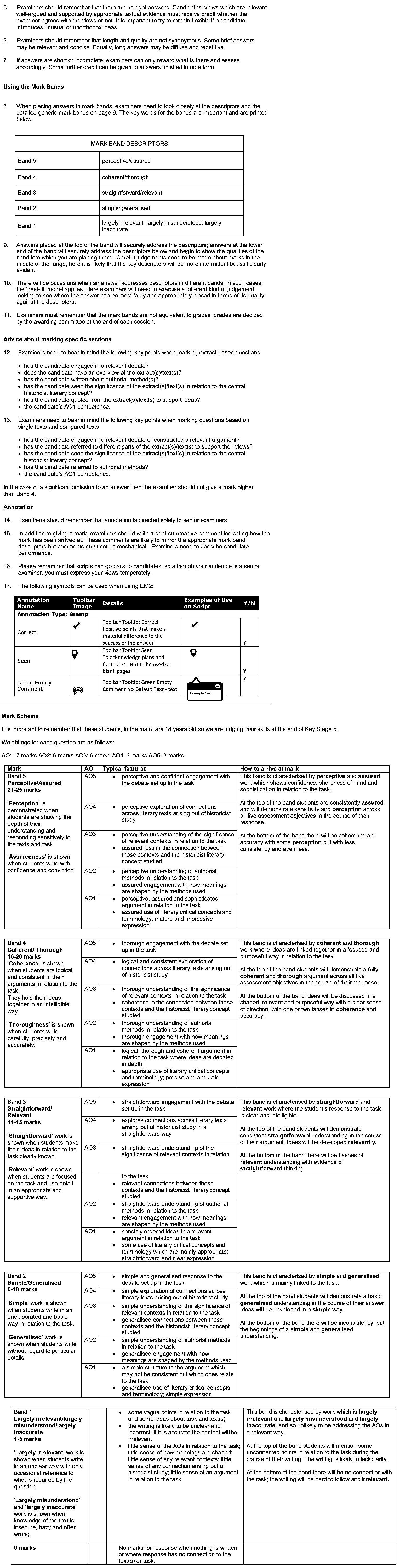
Regeneration – Pat Barker ‘The character of Sassoon is used as a catalyst for change.’ Examine Barker’s presentation of Sassoon in the light of this view.
Tap a question to zoom it. The texts and extracts open above it; the mark scheme (with its levels and indicative content) and the examiner's comment open underneath.
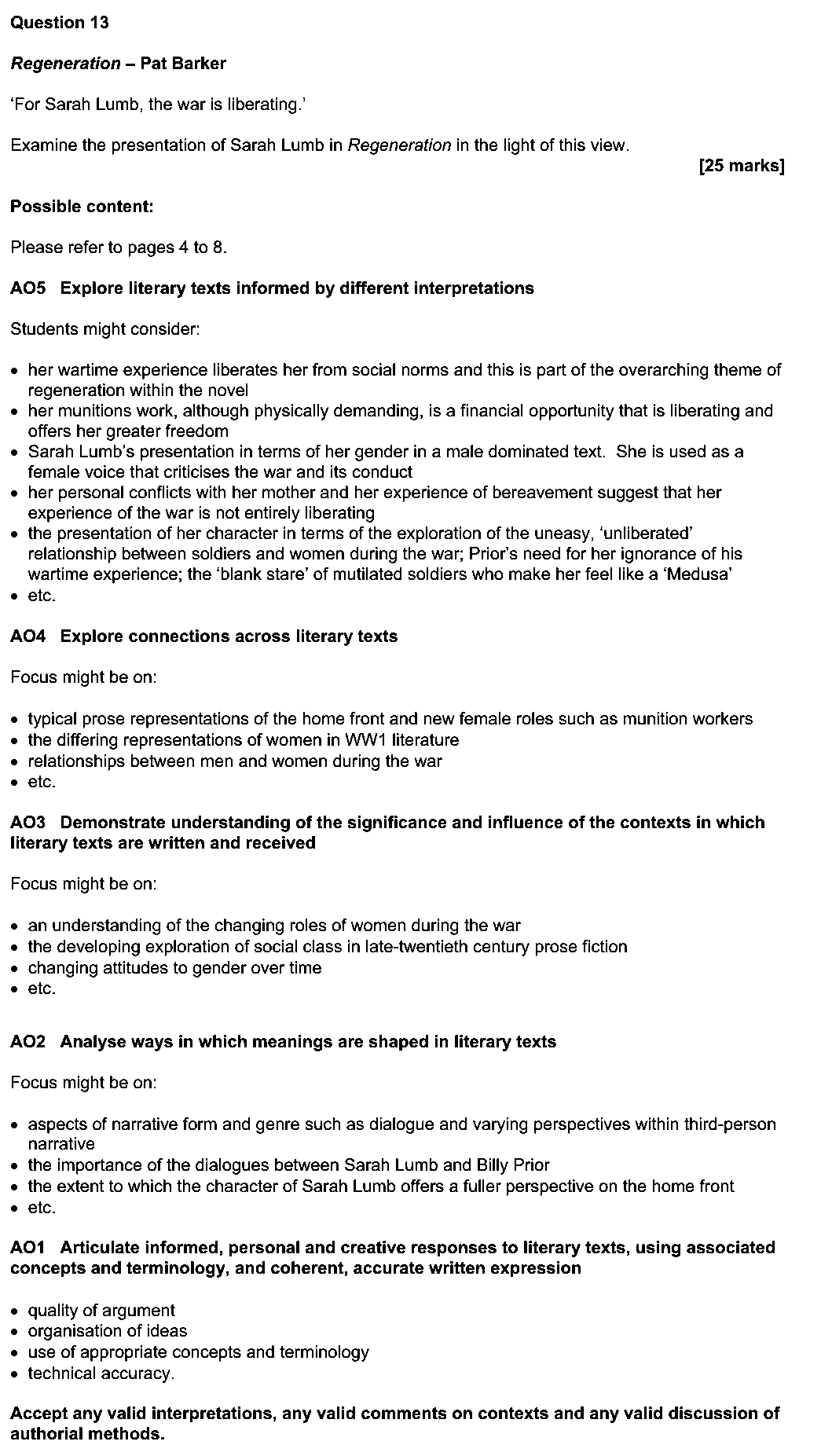
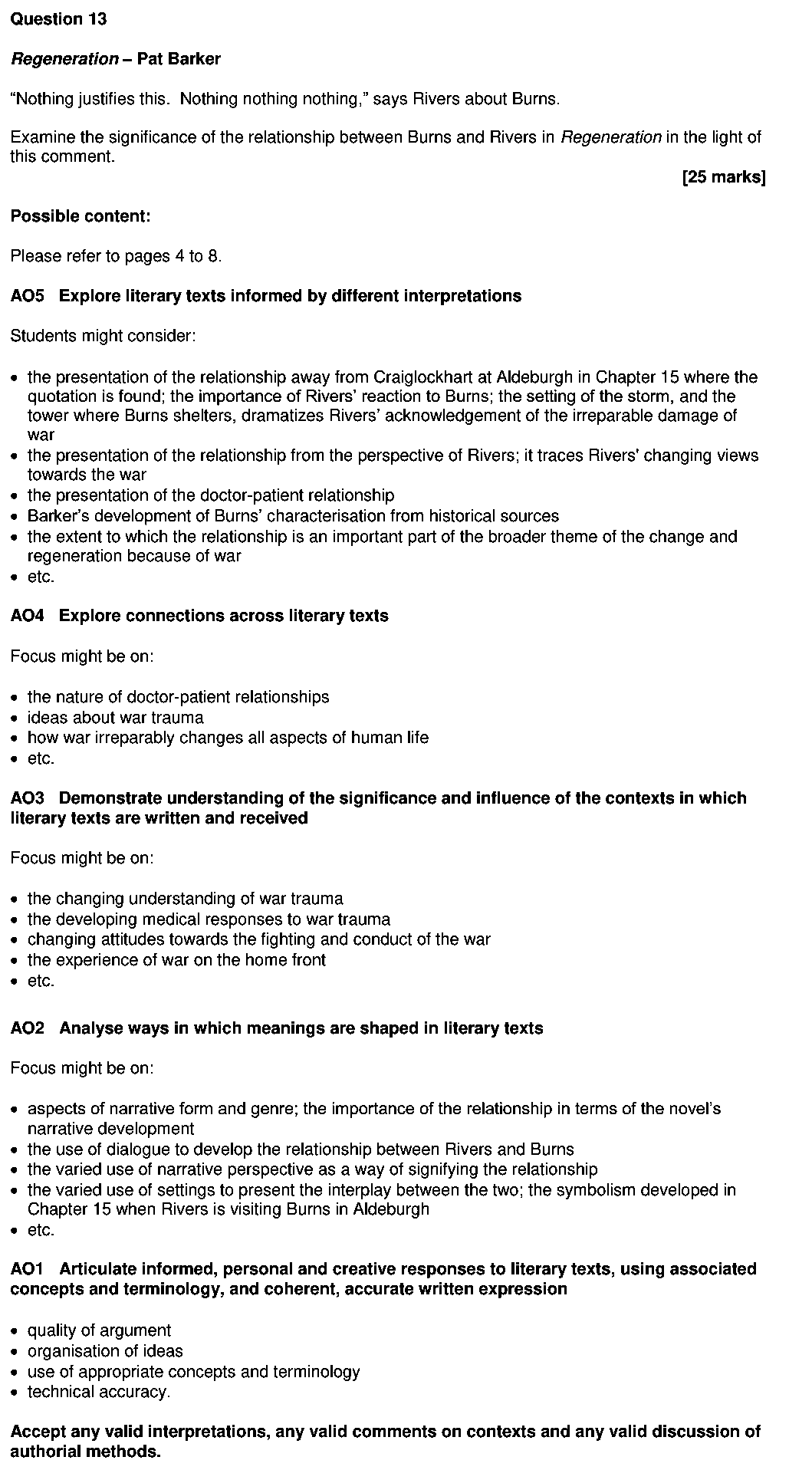
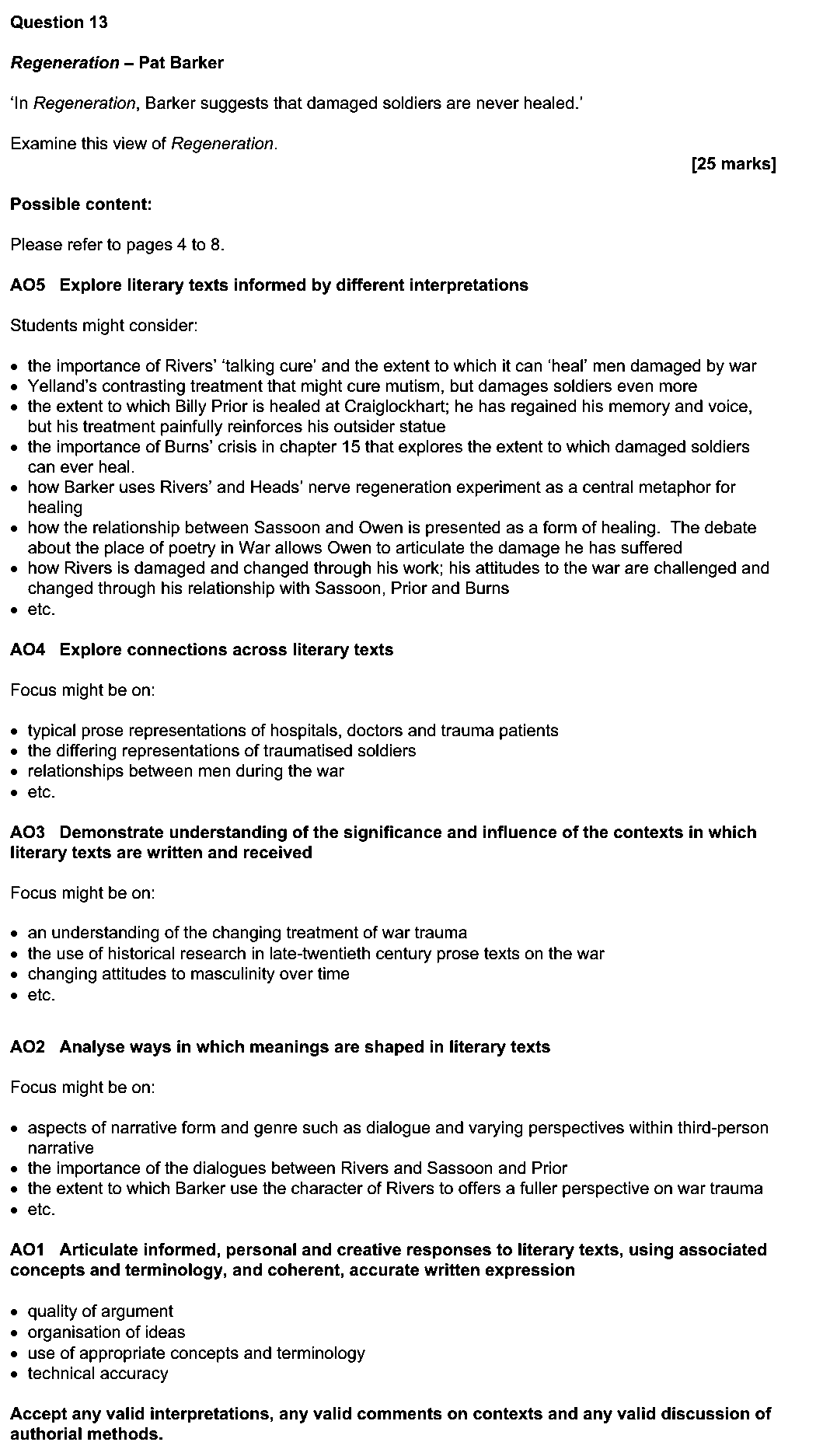
June 2025 · Paper 2A · Q1325 marksSet text essay
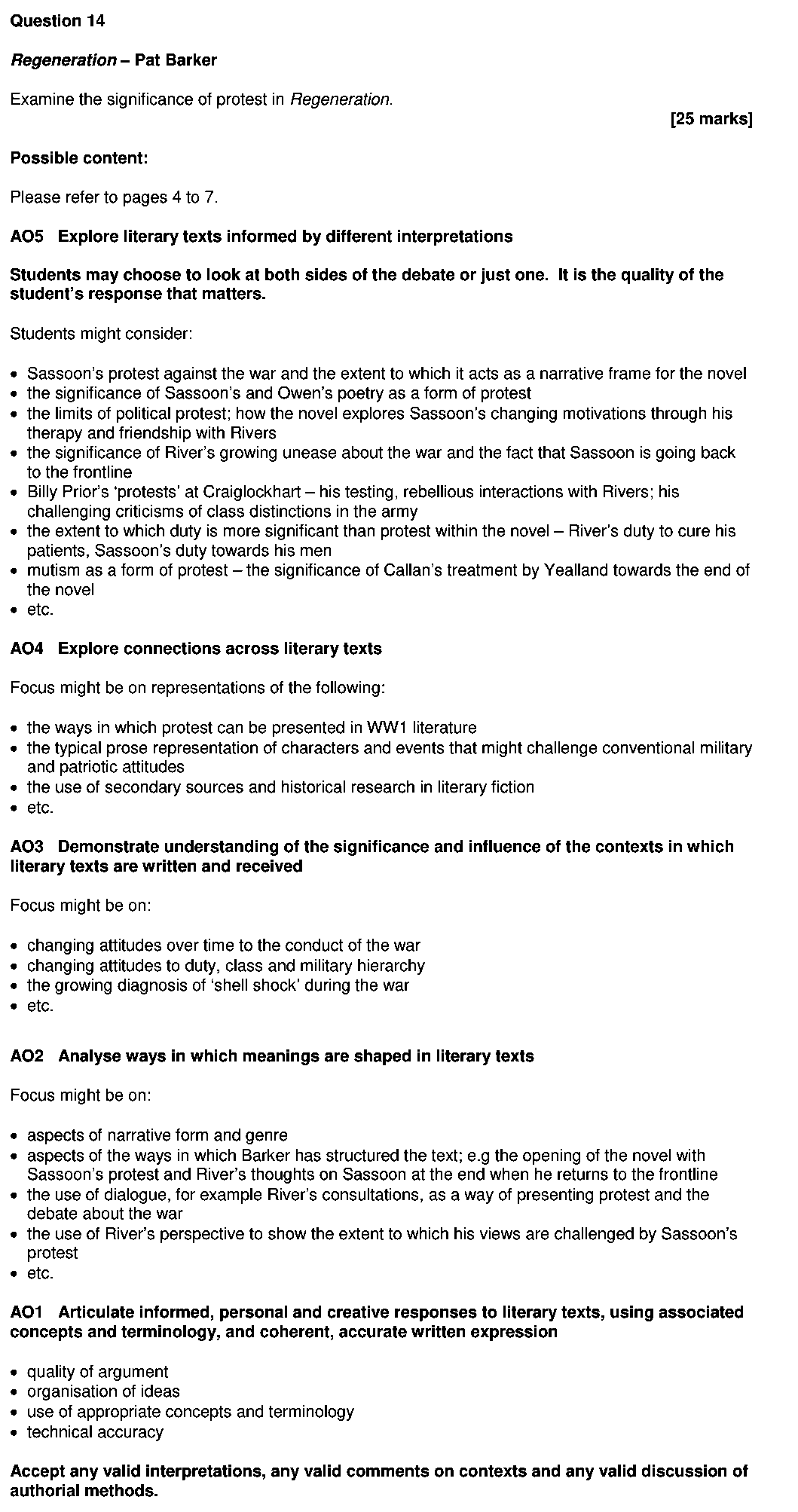
Mark scheme, including the levels and indicative content
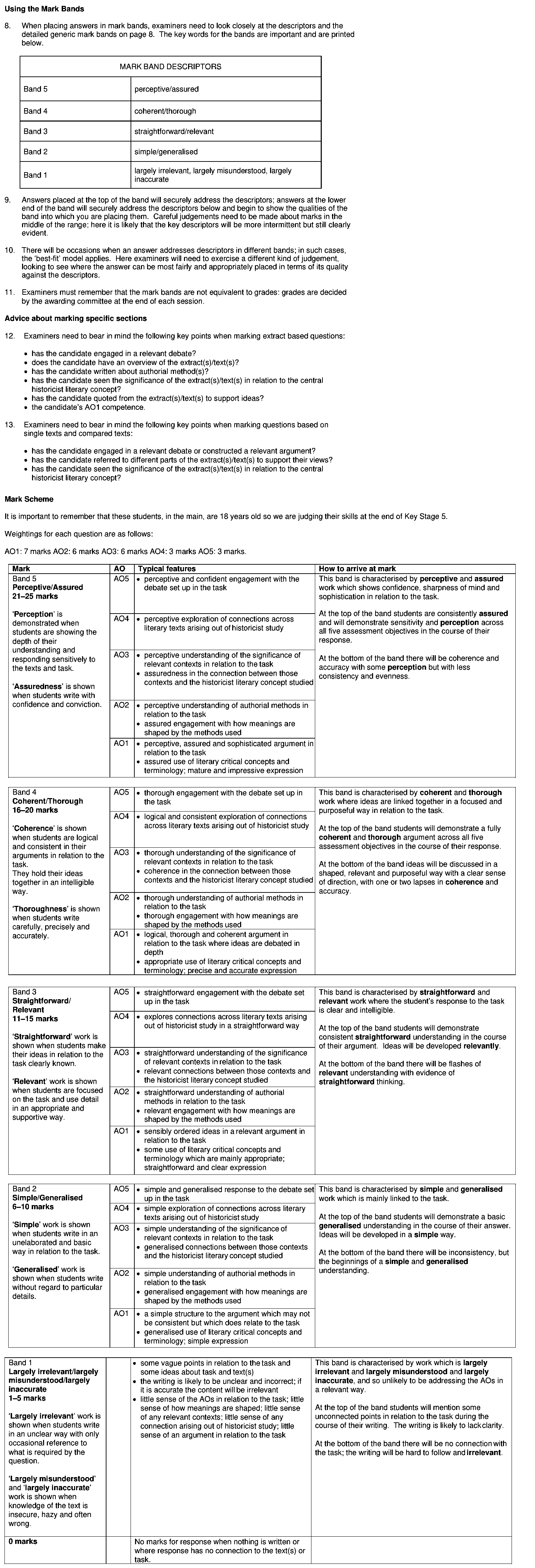
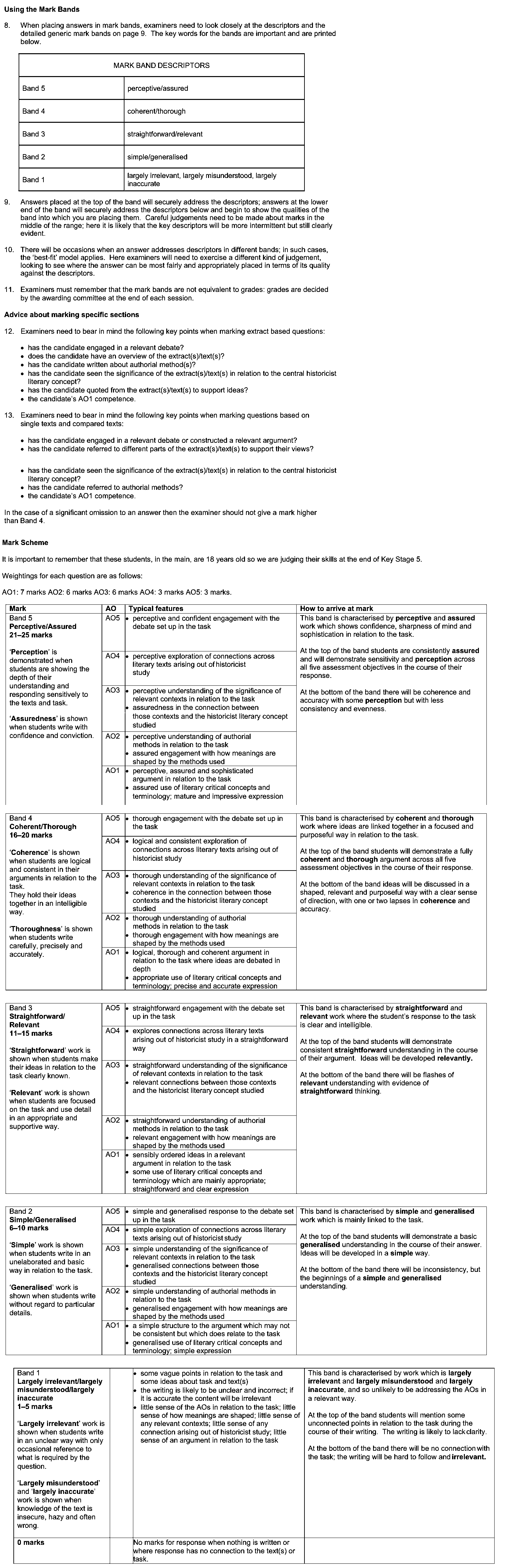
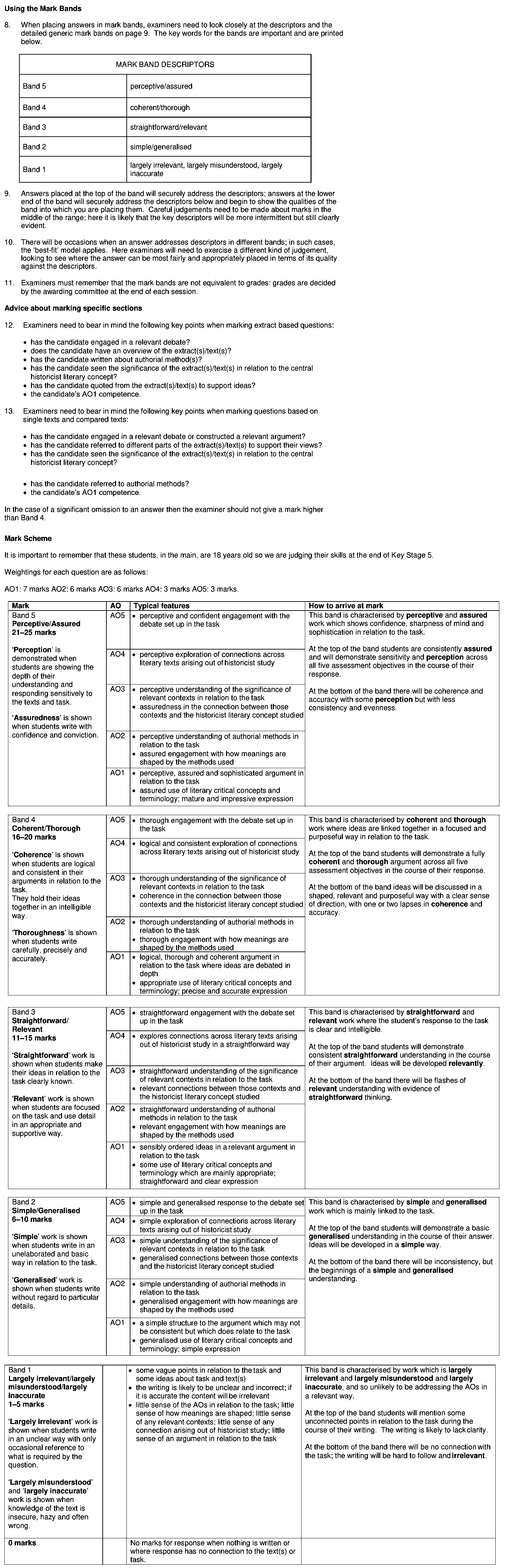
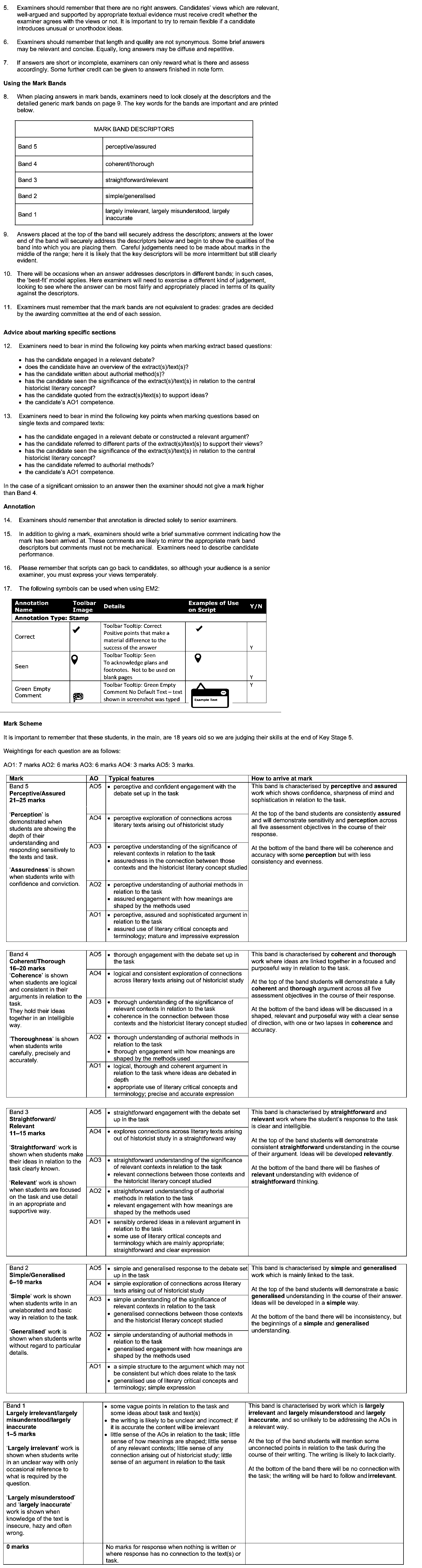
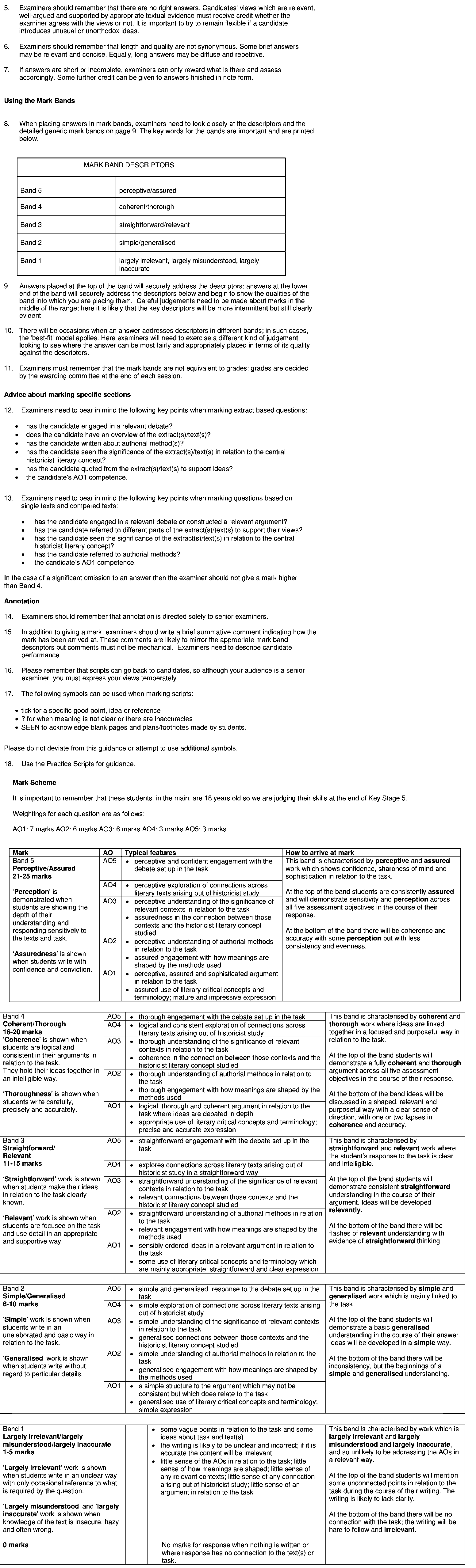
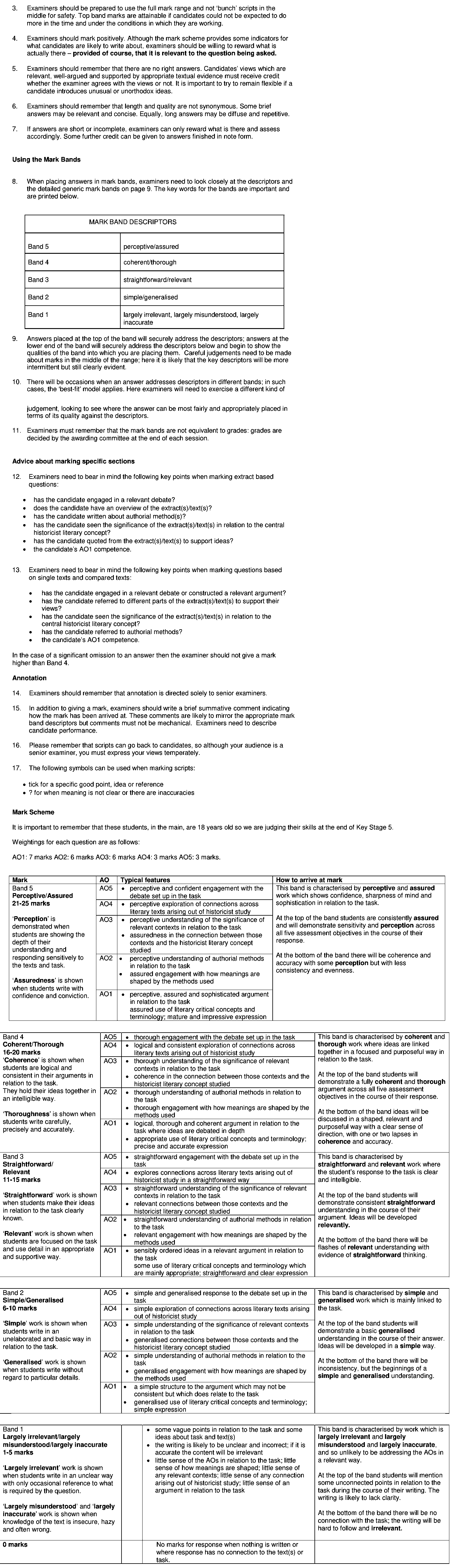
The general mark scheme (assessment objectives and bands)
Examiner's comment
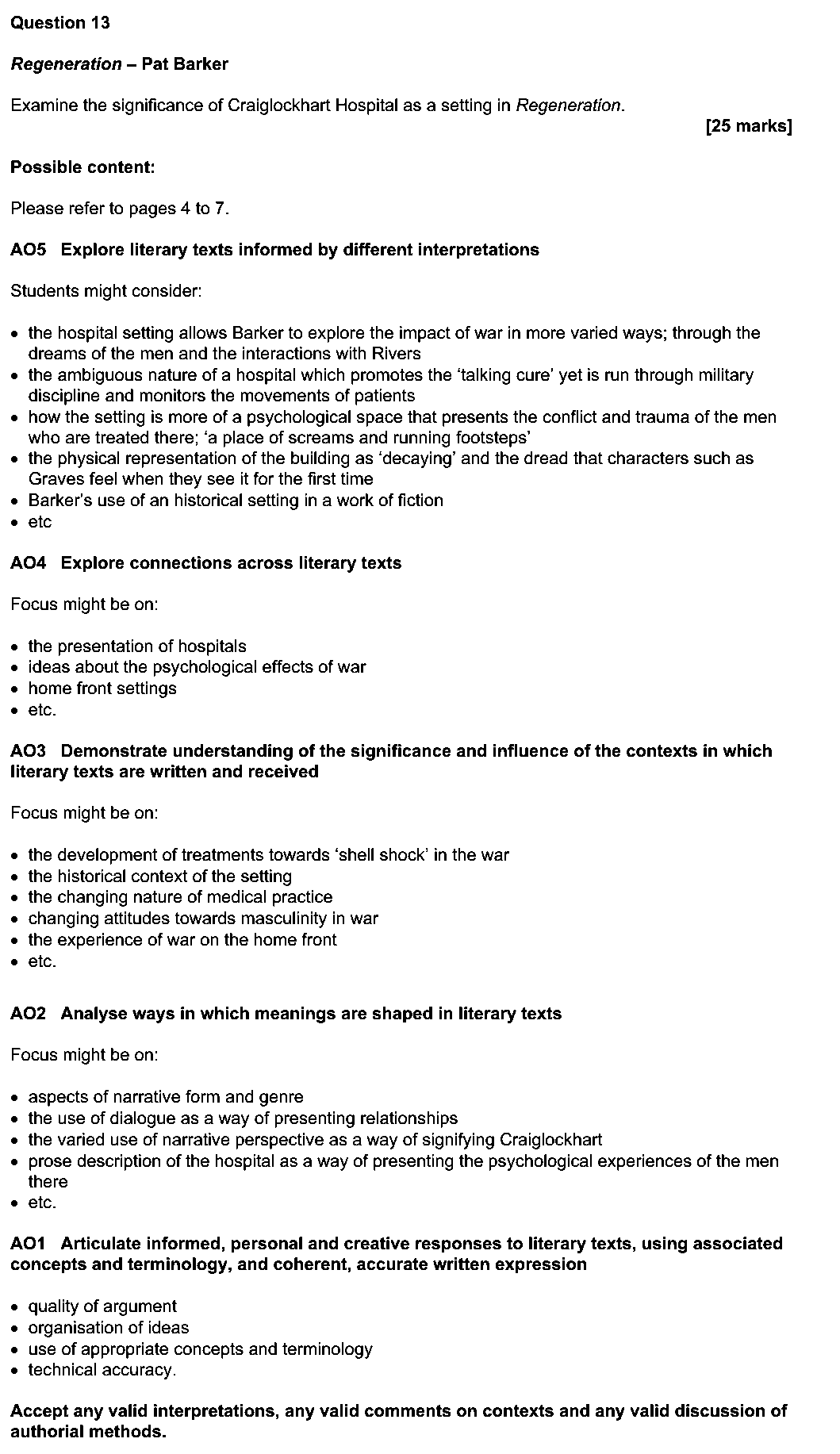
Better answers: • explored significance through considering setting in terms of the physical place, its role as an institution and its literary function in the novel as a whole • considered the use of an historical location to offer a fresh perspective on war experience and trauma away from the front line • were able to consider the physical presentation of Craiglockhart and how it is used to convey the claustrophobic nature of post-traumatic stress • could explore Craiglockhart’s function to present the conflict between military duty and discipline with the more empathetic talking cure employed by Rivers • set an agenda that drew together contextual knowledge of Craiglockhart and historical characters into discussions about the writer’s use of the setting. • demonstrated expert textual knowledge through well-chosen textual evidence supported by relevant analysis of prose methods. Less effective answers: • failed to set an agenda about the significance of the setting at the start of the response • offered a narrative paraphrase of Sassoon’s arrival at Craiglockhart at the start of the novel and then focused on character rather than setting • unloaded contextual knowledge of Craiglockhart, but failed to discuss its function as a literary setting • resorted to pre-planned material based on past questions that focused on characters rather than setting • resorted to narrative paraphrase • confused ‘significance’ with importance • failed to comment on prose methods.
Notes from the mark scheme and report
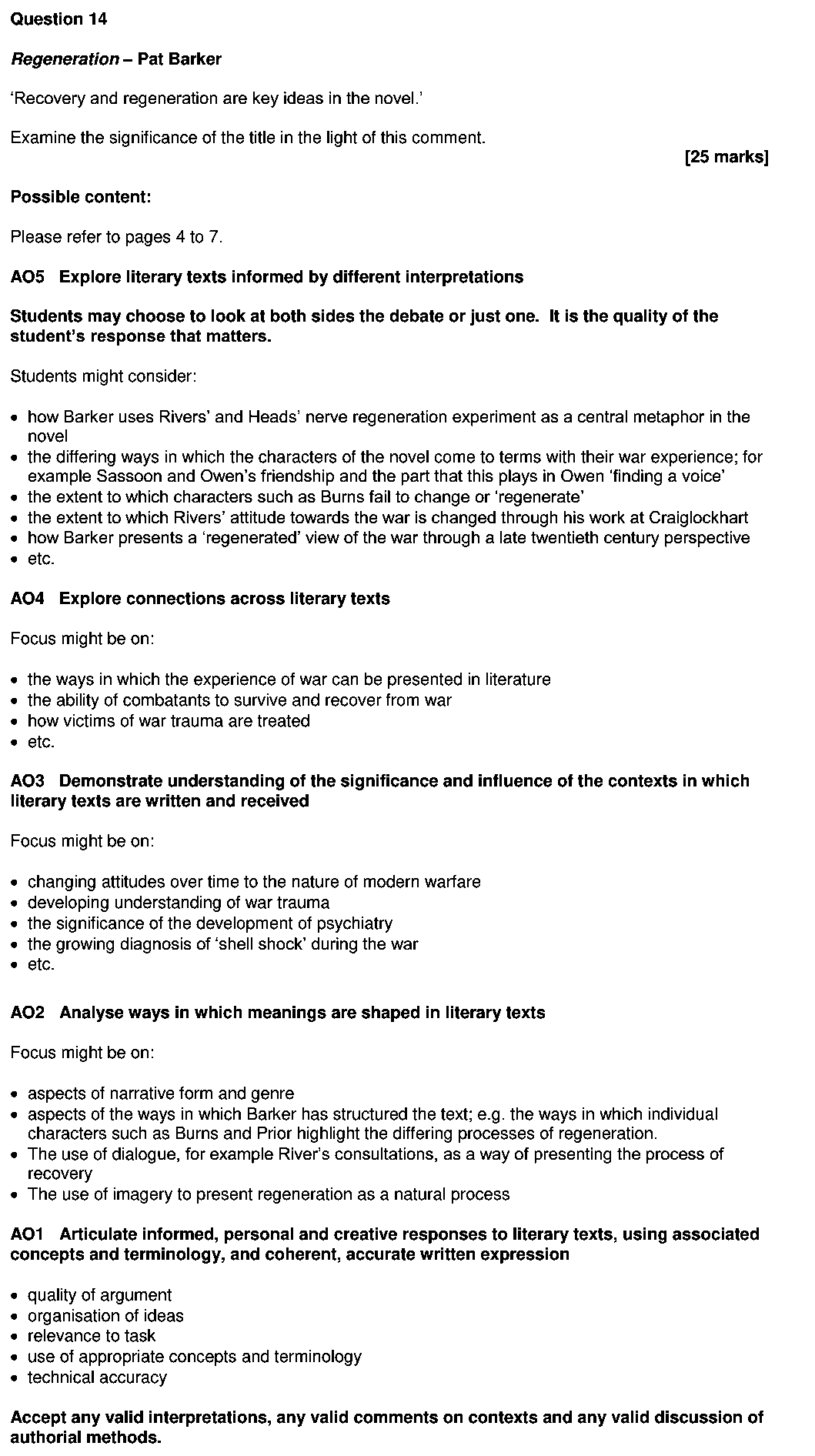
Focus: setting: Craiglockhart Hospital
Open book, no extract
setting as physical place, institution and literary device: 'decaying' building, 'a place of screams and running footsteps', talking cure vs military discipline, claustrophobia of trauma, historical setting in fiction
weaker answers narrated Sassoon's arrival then wrote on characters, unloaded context on Craiglockhart or read 'significance' as importance
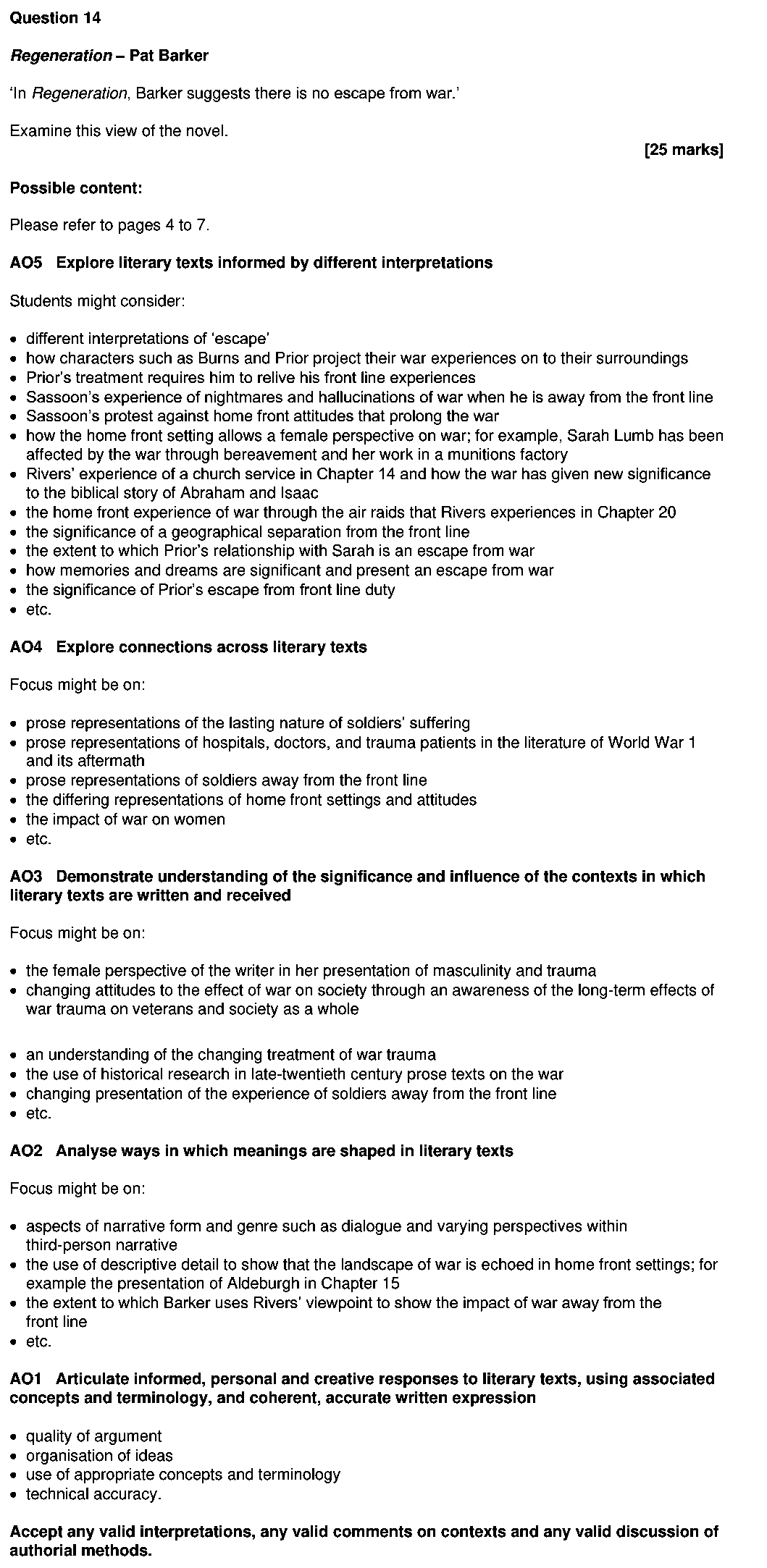
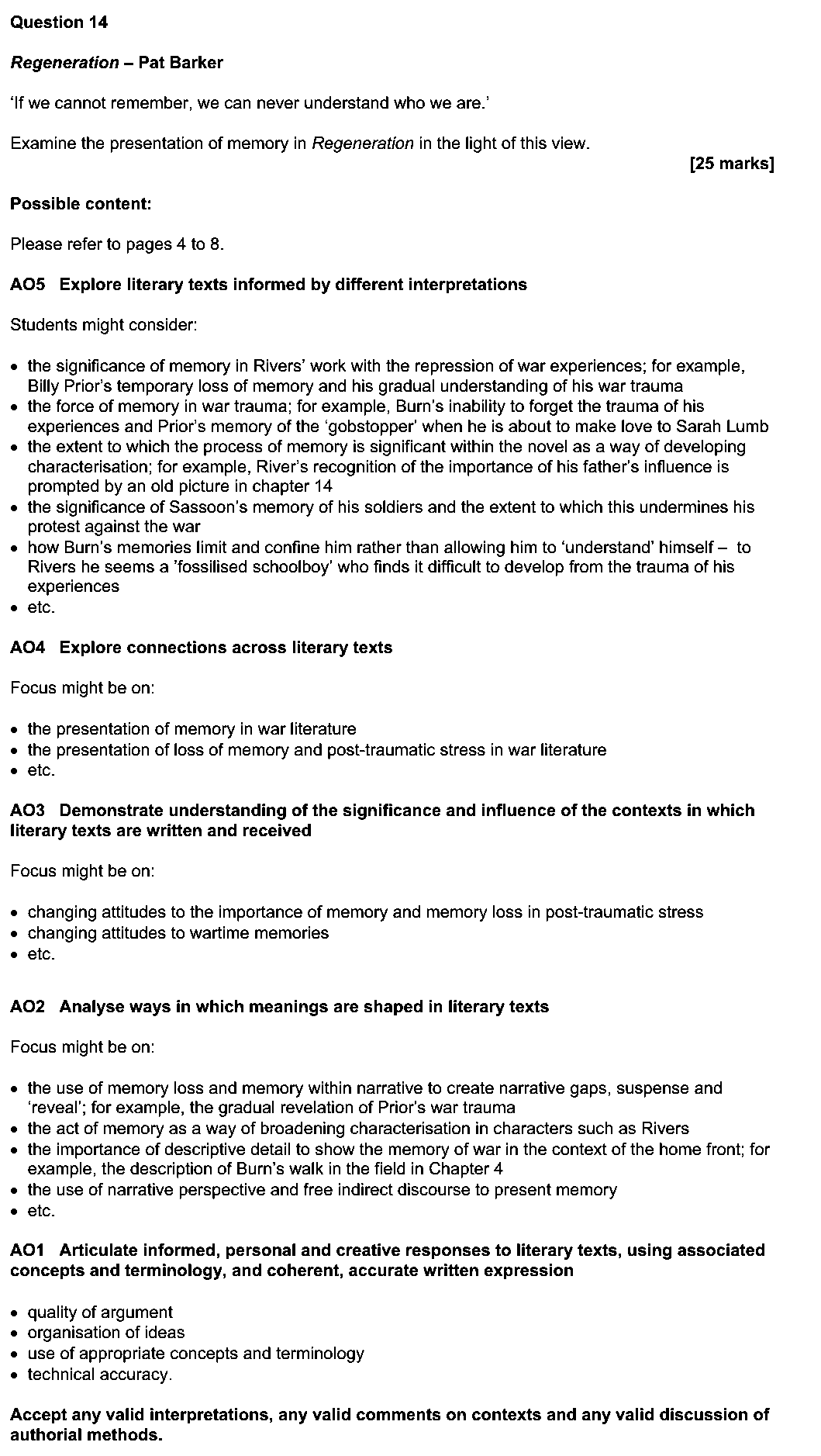
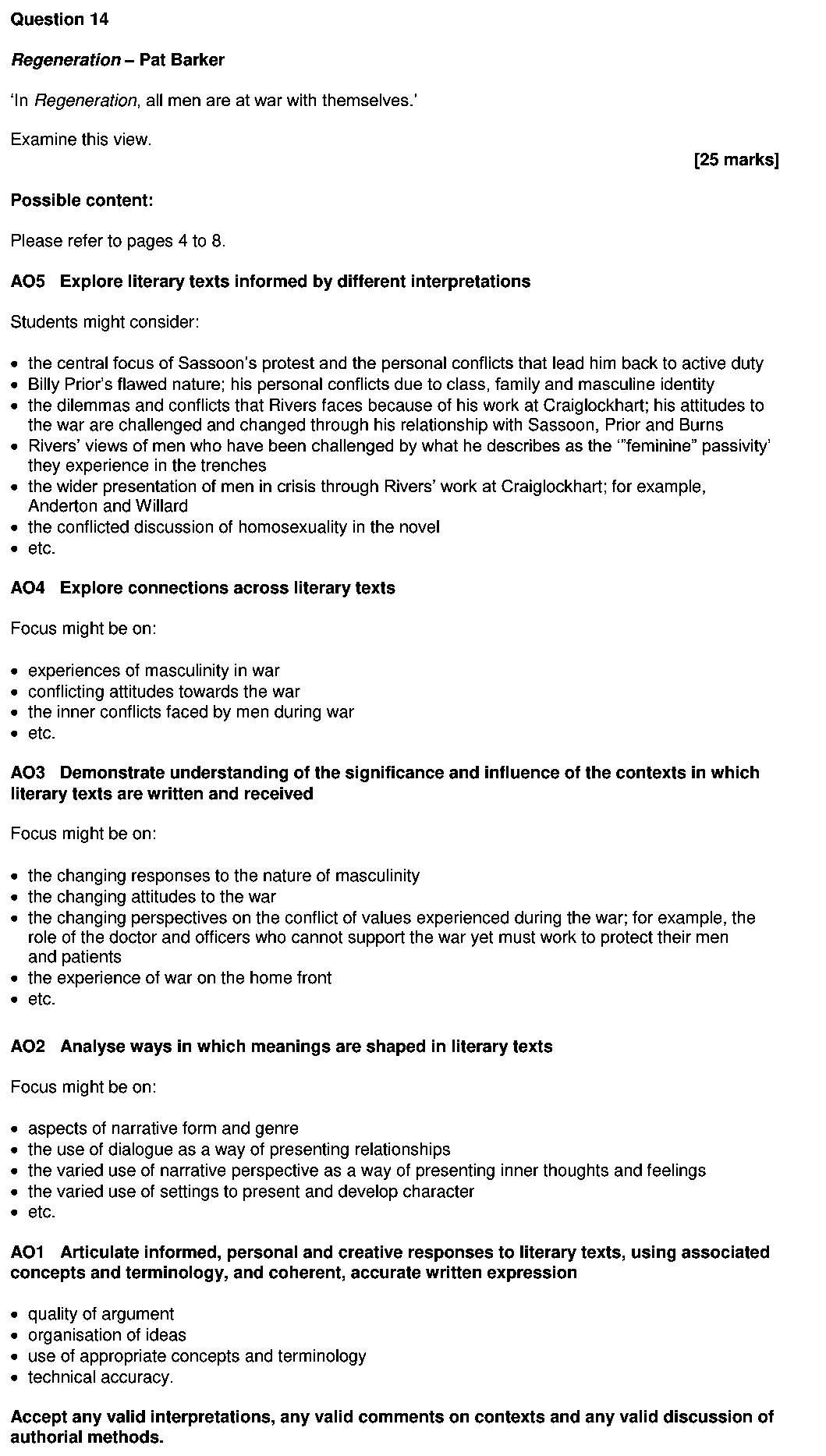
June 2025 · Paper 2A · Q1425 marksSet text essay
Mark scheme, including the levels and indicative content
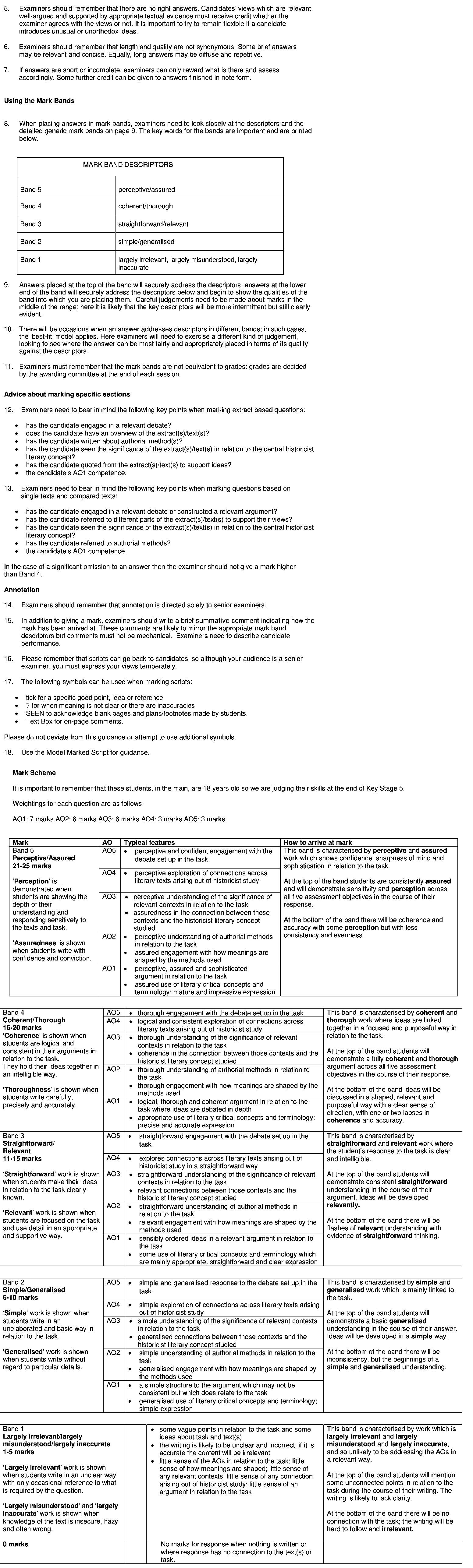
The general mark scheme (assessment objectives and bands)
Examiner's comment
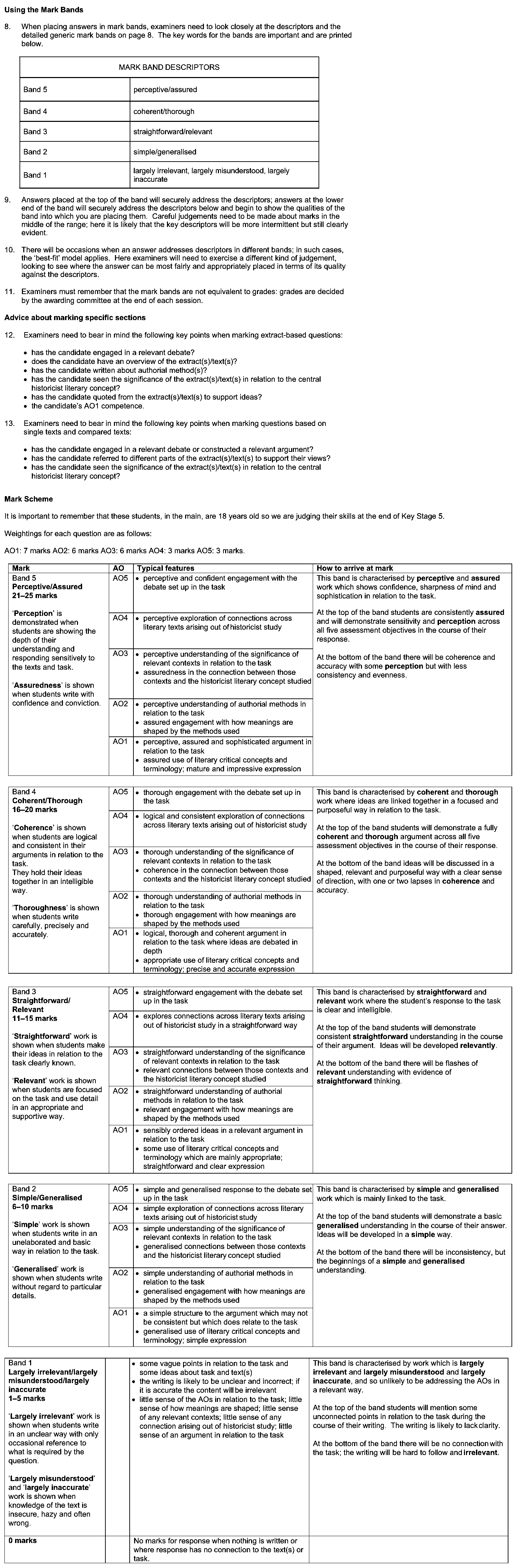
Better answers: • fully engaged with all keywords of the given view. • offered a subtle contextual overview of the extent to which traditional masculine values could reinforce trauma or inhibit its treatment • could purposefully debate the difference between ‘cured’ and ‘overcome’ through comparing Yealland and Rivers’ varying treatments • confidently considered the presentation of war trauma through comparing the differing experiences of characters such as Burns and Prior • confidently selected textual material to show that trauma could not be escaped and could still be experienced away from the frontline • thoughtfully explored the imagery of possible recovery from trauma and made good use of the pivotal Chapter 15 • confidently considered Barker’s intentions as a writer and her female perspective on the male experience of trauma. Less effective answers: • produced list-like responses that paraphrased the traumatic experiences of the characters without engaging with all the keywords of the given view • developed less relevant responses based on past question material • unloaded contextual references to ‘shell shock’ without integrating this into a more literary response • failed to structure the response through clear introductions or conclusions and failed to signpost ideas through appropriate topic sentences and discourse markers.
Notes from the mark scheme and report
Focus: theme: trauma never cured or overcome
Open book, no extract
distinguish 'cured' from 'overcome' (Yealland vs Rivers)
masculine values reinforcing trauma, Burns and Prior compared, Prior's recovered 'eyeball' memory, Sassoon's dreams, trauma away from the front, Chapter 15, Barker's female perspective
weaker answers paraphrased traumatic experiences, reused past material or bolted on shell-shock context
June 2024 · Paper 2A · Q1325 marksSet text essay
Mark scheme, including the levels and indicative content
The general mark scheme (assessment objectives and bands)
Examiner's comment
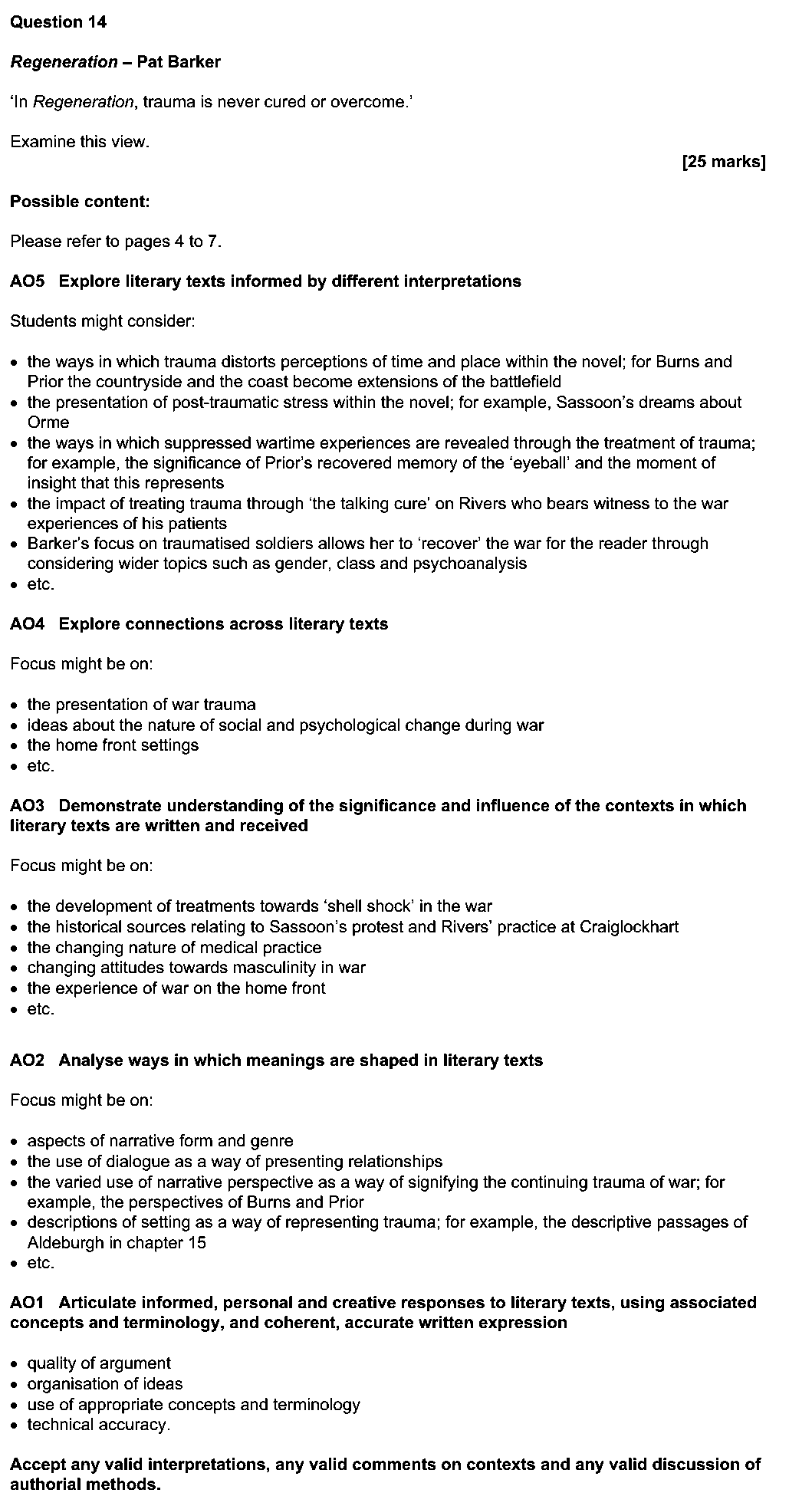
Better answers: • confidently considered the relationship between Rivers and Sassoon as an important part of the novel’s structure • explored ‘significance’ through considering doctor/patient and father/son relationships as well as considering class and sexuality • fully understood ‘significance’ through considering how the relationship presents the wider themes of change and regeneration • always considered the characters and their relationship as constructs of the writer • integrated contextual knowledge of the historical characters into a thoughtful discussion of their presentation as fictional constructs within the novel • fully considered prose methods such a dialogue and narrative perspective. Less effective answers: • could only offer a narrative paraphrase of the relationship between Rivers and Sassoon supported by some textual evidence • blurred the historical source material with Barker’s fictional characters and treated Rivers and Sassoon as ‘real people’ • tended to focus on the presentation of the individual characters rather than the significance of their relationship • imposed contextual knowledge of historical source material and moved away from the novel itself • failed to comment on prose methods.
Notes from the mark scheme and report
Focus: relationship: Rivers and Sassoon
Open book, no extract
relationship as structure (ending each of the four parts), doctor/patient and father/son, class and sexuality, Rivers' changing views, protest debate, change and regeneration
treat them as Barker's constructs and consider dialogue and narrative perspective
weaker answers paraphrased, treated them as real people or wrote on each character separately
June 2024 · Paper 2A · Q1425 marksSet text essay
Mark scheme, including the levels and indicative content
The general mark scheme (assessment objectives and bands)
Examiner's comment
Better answers: • were supported by expert textual knowledge that allowed for wide ranging responses that both considered the setting of Craiglockhart and the wider home front experience of the war • confidently considered the presentation of war trauma through considering characters such as Burns who are locked into their experience of war • considered Barker’s prose methods through analysing the ways in which she imposed the experience of war onto home front settings • produced more conceptual thinking that argued that Rivers’ duty to rehabilitate his patients so they would be fit for duty was an aspect of the inescapability of war. Less effective answers: • produced list-like responses that picked out relevant textual detail without building a more coherent argument framed by introductions and conclusions and guided by clear topic sentences • tended to develop less relevant responses that were echoes of past questions • relied on narrative paraphrase.
Notes from the mark scheme and report
Focus: theme: no escape from war
Open book, no extract
interpret 'escape': Burns and Prior locked in their war, Sassoon's nightmares, Sarah Lumb's home front, Rivers' Abraham and Isaac sermon and the air raid, Rivers' duty to make men fit for return
weaker answers listed details without an argument, echoed past questions or paraphrased
June 2023 · Paper 2A · Q1325 marksSet text essay
Mark scheme, including the levels and indicative content
The general mark scheme (assessment objectives and bands)
Examiner's comment
More effective answers: • explored the given view as a way of offering a more complex view of Sarah Lumb • Integrated contextual knowledge of women’s war work and changing gender roles into a literary examination of Sarah Lumb’s presentation within the novel • focused on ‘war is liberating’ through exploring Sarah Lumb’s actions, attitudes, and speech through focused analysis of well selected textual detail • made explicit reference to the writer’s intentions and Sarah Lumb’s function within the novel as a whole • considered Billy Prior’s perspective on Sarah Lumb and the part it plays in her presentation. Less effective answers: • adopted an imposed contextual framework which could only consider Sarah Lumb as an illustration of changing gender attitudes and of the increased employment opportunities offered to women in the war • often used narrative paraphrase to support ideas • only referred to a narrow range of text that largely focused on her relationship with Billy Prior and did not consider, for example, the significance of her visit to the hospital in chapter 14.
Notes from the mark scheme and report
Focus: character: Sarah Lumb
Open book, no extract
complicate the view: munitions work as financial freedom vs bereavement and conflict with her mother, female voice critical of the war, Prior's perspective on her, the hospital visit in Chapter 14 ('Medusa')
weaker answers imposed a context frame of changing gender roles, paraphrased or focused only on her relationship with Prior
June 2023 · Paper 2A · Q1425 marksSet text essay
Mark scheme, including the levels and indicative content
The general mark scheme (assessment objectives and bands)
Examiner's comment
More effective answers: • showed an overarching understanding of trauma and the significance of memory • used contextual knowledge of developing psychiatric practices as way of exploring the interactions between doctors and patients • were able to offer a balanced debate on the presentation of memory through comparing the experiences of Prior and Burns • purposefully considered River’s memories and the extent to which they highlight his changing attitudes towards the war • fully explored the given view particularly when considering the presentation of Billy Prior’s memories. Less effective answers: • offered generalised assertions and narrative paraphrase about the treatment of mental trauma without any literary analysis • ignored the given view and listed examples of memory loss and recall without a broader understanding of the importance of memory within the novel as a whole • used digressive contextual description of mental trauma and shell shock without integrating this into a literary approach to the question.
Notes from the mark scheme and report
Focus: theme: memory
Open book, no extract
trauma and memory: Prior's memory loss and recovery, Burns unable to forget, Rivers' own memories and changing attitude to the war, Sassoon's memory of his men
balanced debate comparing Prior and Burns
weaker answers paraphrased about treatment, listed examples of memory loss or gave digressive shell-shock context
June 2022 · Paper 2A · Q1325 marksSet text essay
Mark scheme, including the levels and indicative content
The general mark scheme (assessment objectives and bands)
Examiner's comment
The ability to fully focus on all aspects of the given view was a key discriminator in the responses to this question. Many students quickly discussed the significance of Rivers and Burns as individuals but often failed to explore the presentation of their relationship. Stronger responses were fully focused on relationship; perceptive students were able to consider the relationship as a key aspect of the novel’s structure and could explore the climactic nature of chapter 15 with assurance.
Notes from the mark scheme and report
Focus: relationship: Rivers and Burns
Open book, no extract
focus on the relationship, not Rivers and Burns separately
credited: Chapter 15 at Aldeburgh (storm, tower) as climax and Rivers' acknowledgement of irreparable damage, doctor-patient relationship, Rivers' changing views of the war, the relationship in the novel's structure
June 2022 · Paper 2A · Q1425 marksSet text essay
Mark scheme, including the levels and indicative content
The general mark scheme (assessment objectives and bands)
Examiner's comment
This popular question allowed students to respond in varying ways. Many largely supported the given view and looked at a range of conflicted male characters. More developed answers were able to look at the presentation of character through the broader contextual framework of attitudes to masculinity during the war and from the perspective of the writer and her time. Successful responses were able to discriminate between different forms of conflict through considering protest, medical ethics, class, male identity and trauma. Less successful responses focused on a list of simple character sketches without any overview.
Notes from the mark scheme and report
Focus: theme: men at war with themselves
Open book, no extract
popular
distinguish forms of inner conflict: Sassoon's protest and return, Prior's class and masculine identity, Rivers' medical ethics, homosexuality, trauma
set within wartime attitudes to masculinity and Barker's own time
weaker answers gave a list of character sketches with no overview
November 2021 · Paper 2A · Q1325 marksSet text essay
Mark scheme, including the levels and indicative content
The general mark scheme (assessment objectives and bands)
Notes from the mark scheme and report
Focus: theme: healing damaged soldiers
Open book, no extract
view: damaged soldiers are never healed
no examiner report (November series)
MS: Rivers' talking cure vs Yealland's damaging treatment, Prior regains voice but remains an outsider, Burns' crisis (ch 15), nerve-regeneration metaphor, Sassoon and Owen's healing friendship, Rivers himself changed
November 2021 · Paper 2A · Q1425 marksSet text essay
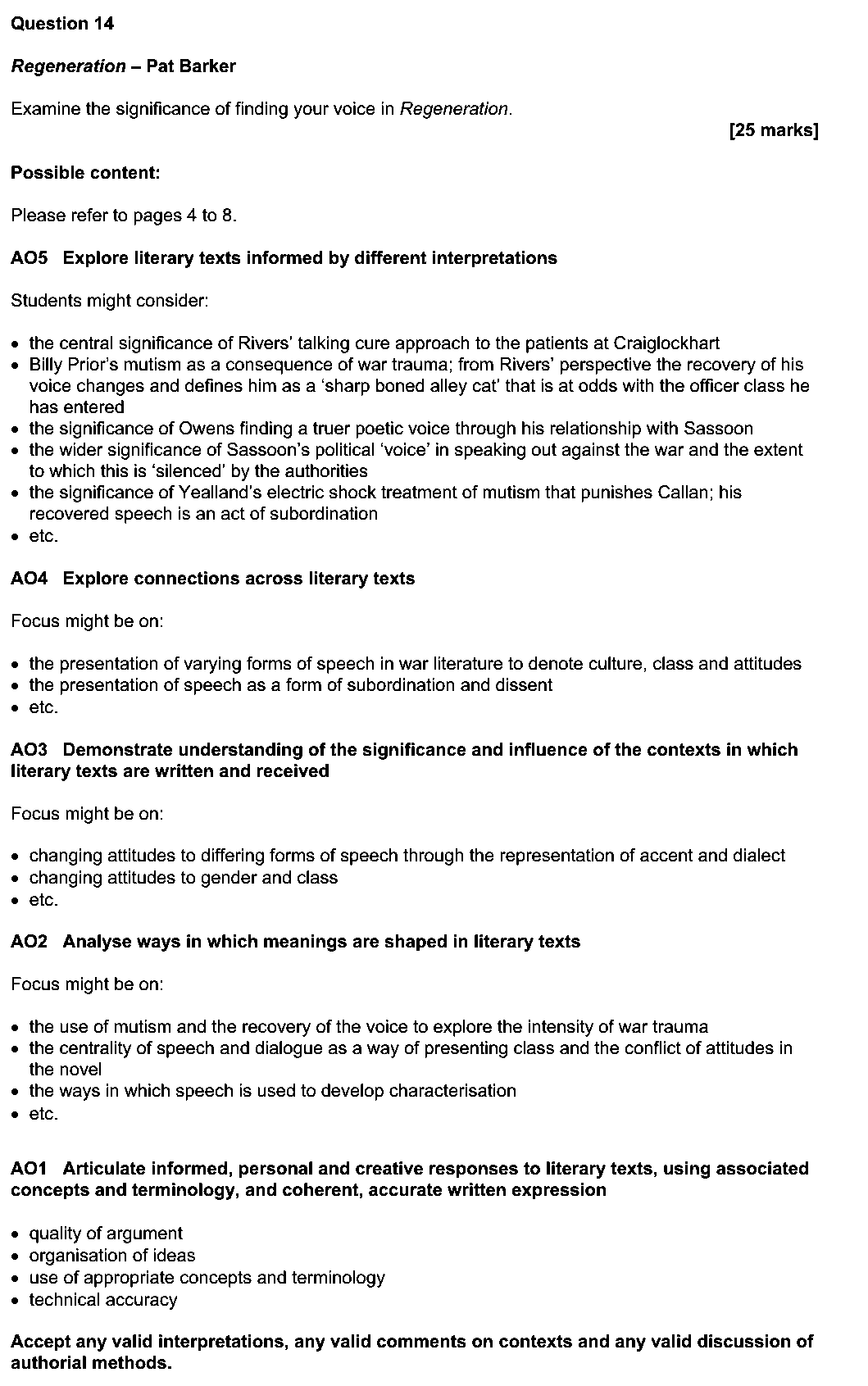
Mark scheme, including the levels and indicative content
The general mark scheme (assessment objectives and bands)
Notes from the mark scheme and report
Focus: theme: finding your voice
Open book, no extract
no examiner report (November series)
MS: talking cure, Prior's mutism and recovered voice ('sharp-boned alley cat'), Owen finding his poetic voice through Sassoon, Sassoon's political voice silenced, Yealland's treatment of Callan as enforced subordination
November 2020 · Paper 2A · Q1325 marksSet text essay
Mark scheme, including the levels and indicative content
The general mark scheme (assessment objectives and bands)
Notes from the mark scheme and report
Focus: character: Sassoon
Open book, no extract
view: Sassoon as catalyst for change
no examiner report (November series)
MS: focus of the novel's interest in protest and its limits, changes Rivers and Owen, his protest achieves nothing and conflicts with duty to his men
November 2020 · Paper 2A · Q1425 marksSet text essay
Mark scheme, including the levels and indicative content
The general mark scheme (assessment objectives and bands)
Notes from the mark scheme and report
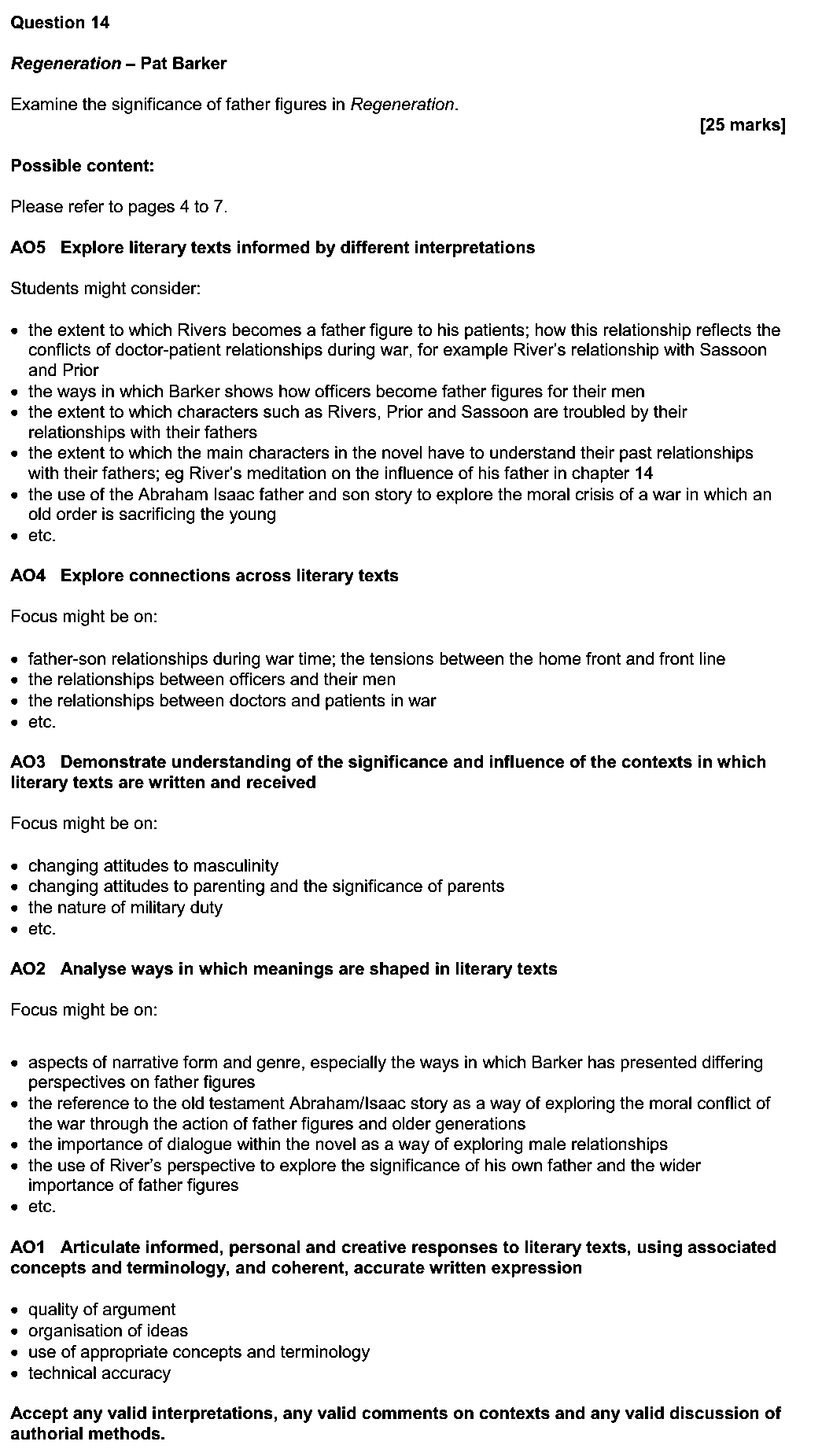
Focus: theme: father figures
Open book, no extract
no examiner report (November series)
MS: Rivers as father figure to patients (Sassoon, Prior), officers as fathers to men, characters troubled by their fathers, Rivers' memory of his father (ch 14), Abraham and Isaac as old order sacrificing the young
June 2019 · Paper 2A · Q1325 marksSet text essay
Mark scheme, including the levels and indicative content
The general mark scheme (assessment objectives and bands)
Examiner's comment
Regeneration was the more popular prose set text and a majority of students attempted this question. Examiners were pleased with the ways in which most students engaged with the debate through focusing on the key words of the offered view. The majority of responses were able to explore Prior as a construct of the writer and there was some productive discussion of his role as a catalyst particularly in the presentation of his relationship with Rivers. Unfortunately, discussion of class was often more generalised and frequently led to some assertive discussion that moved away from a literary focus. Such responses used context as a digression rather than as a literary tool to develop more thorough understanding. There was a great deal of material available, so responses had to be selective. Some responses spent too long on class issues and missed out on other important ideas such as the importance of Prior’s relationship with Sarah.
Notes from the mark scheme and report
Focus: character: Prior
Open book, no extract
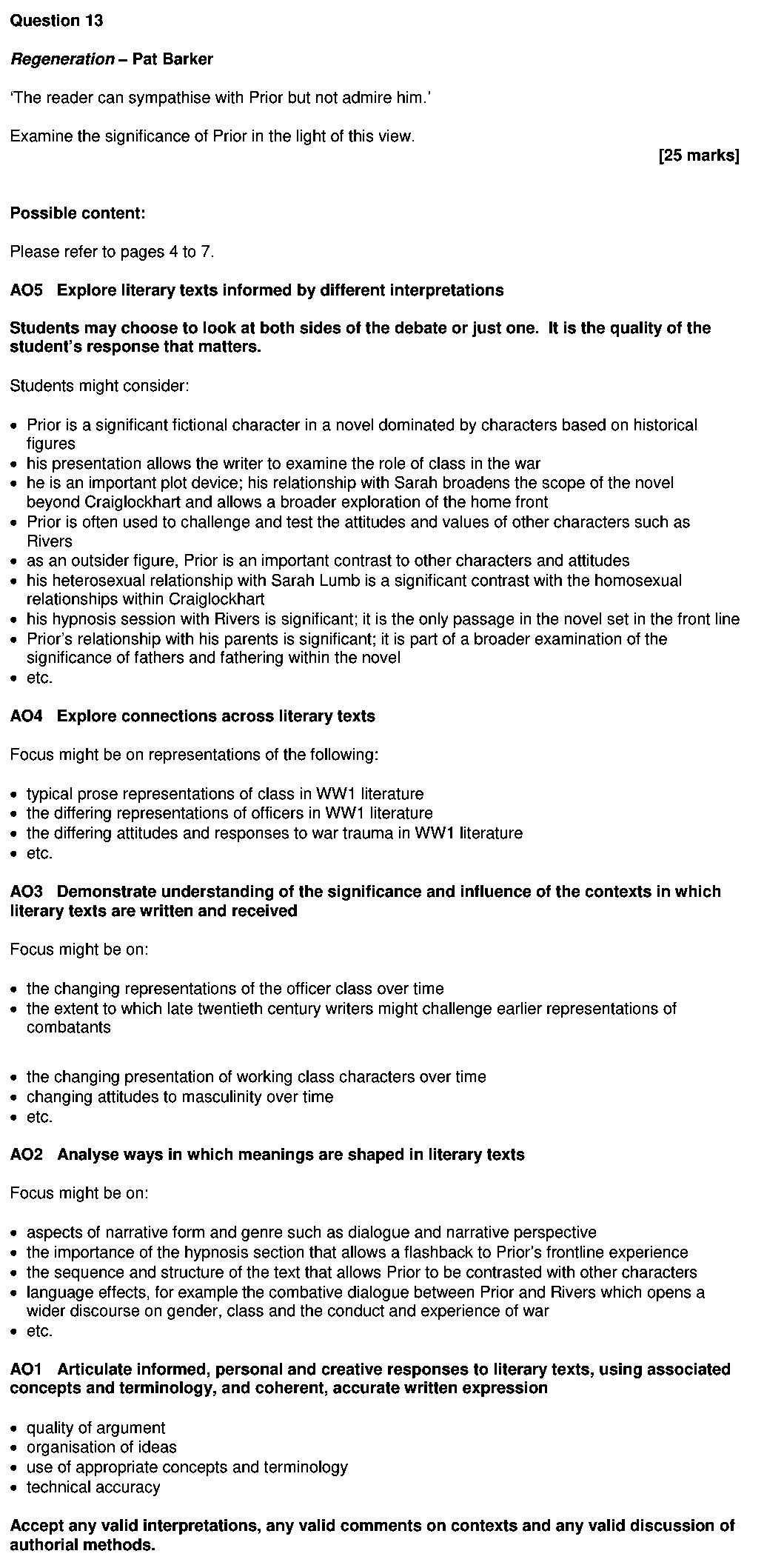
view: sympathise with Prior but not admire him
MS: fictional among historical figures, class, Sarah and home front, challenges Rivers, outsider, hypnosis as only front-line passage, fathers
ER: most treated Prior as a construct and catalyst with Rivers
class discussion often generalised and digressive
some neglected Sarah
June 2019 · Paper 2A · Q1425 marksSet text essay
Mark scheme, including the levels and indicative content
The general mark scheme (assessment objectives and bands)
Examiner's comment
The students who chose this question were all aware of the significance of Sassoon’s declaration, but many were unable to explore how Barker uses this historical source material to investigate the nature of protest. More effective responses clearly considered Sassoon’s declaration as a narrative frame for the whole text and purposefully explored how Barker uses his arrival and his departure at the end of the novel as an important structural device. The most successful responses discussed how Barker shows how Rivers comes to challenge his own assumptions about his duty, and therefore the conduct of the war. This question elicited some adventurous responses that explored and compared the ‘physical’ protest of mutism compared to Sassoon’s ‘voiced’ protest.
Notes from the mark scheme and report
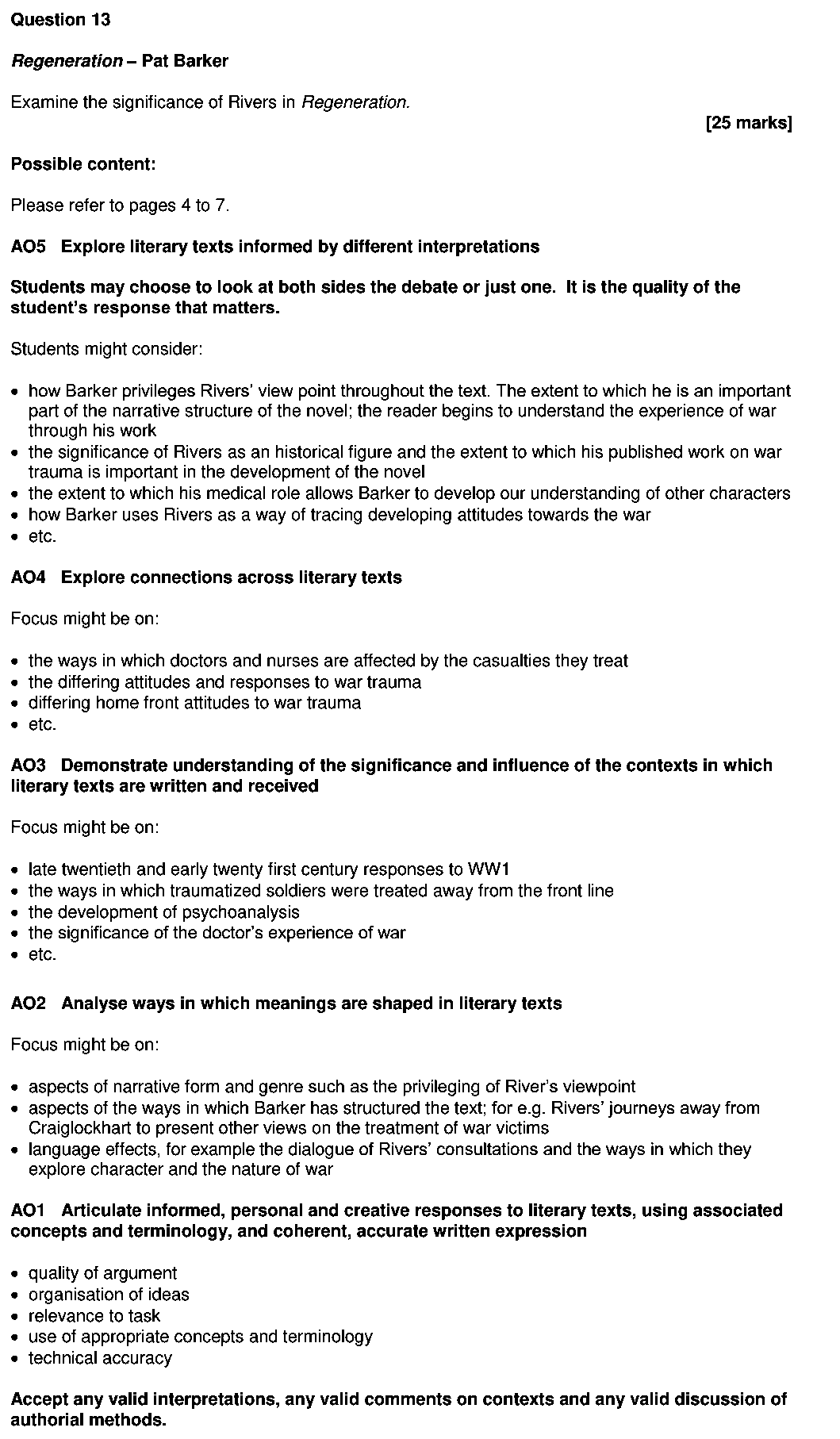
Focus: theme: protest
Open book, no extract
MS: Sassoon's declaration as narrative frame, Sassoon and Owen's poetry, Rivers' growing unease, Prior's rebellion, duty vs protest, mutism and Callan's treatment by Yealland
ER: many could not show how Barker uses the source
better treated the declaration as structural frame and Rivers challenging his own duty
some compared mutism with Sassoon's voiced protest
June 2018 · Paper 2A · Q1325 marksSet text essay
Mark scheme, including the levels and indicative content
The general mark scheme (assessment objectives and bands)
Examiner's comment
The two questions on Regeneration attracted equal attention. Examiners were impressed by the extent to which the majority of students attempting this question were clearly able to discuss Rivers as a construct of the writer; relatively few responses just offered a limited character study without considering the text as a whole. Many were able to discuss Rivers’ significance in a variety of ways and there was thoughtful discussion on areas such as medical development, masculinity and duty. It was clear that many students had a broad understanding of over-arching themes within the novel. More straightforward answers used Rivers as a way of discussing these themes, but were often unable to support and develop their debate through enough close textual analysis. Stronger responses had a more thorough literary focus and were able to discuss Rivers’ significance through considering narrative perspective and Barker’s use of dialogue and free indirect speech.
Notes from the mark scheme and report
Focus: character: Rivers
Open book, no extract
MS: Rivers' privileged viewpoint and role in structure, historical figure and published work, medical role reveals others, developing attitudes to war
ER: most treated Rivers as a construct
straightforward answers used him only to discuss themes without close analysis
stronger discussed narrative perspective, dialogue and free indirect speech
June 2018 · Paper 2A · Q1425 marksSet text essay
Mark scheme, including the levels and indicative content
The general mark scheme (assessment objectives and bands)
Examiner's comment
Many examiners were impressed by the quality of responses to this question. The critical view was a useful prompt for many students who were able to explore the nuances of recovery and regeneration. More straightforward responses often relied too much on contextual knowledge, however, and were too quick to offer information on shell shock and changing social attitudes as a way of discussing the significance of regeneration. It is important for students to realise that contextual knowledge should not be unloaded, but used as a literary tool to develop a reading of the text. Stronger answers clearly integrated context into a stronger literary focus that considered the way regeneration is mirrored in the structure of the novel that begins and ends with the changing relationship between Rivers and Sassoon, for example, or considered the imagery used to represent the painful process of regeneration.
Notes from the mark scheme and report
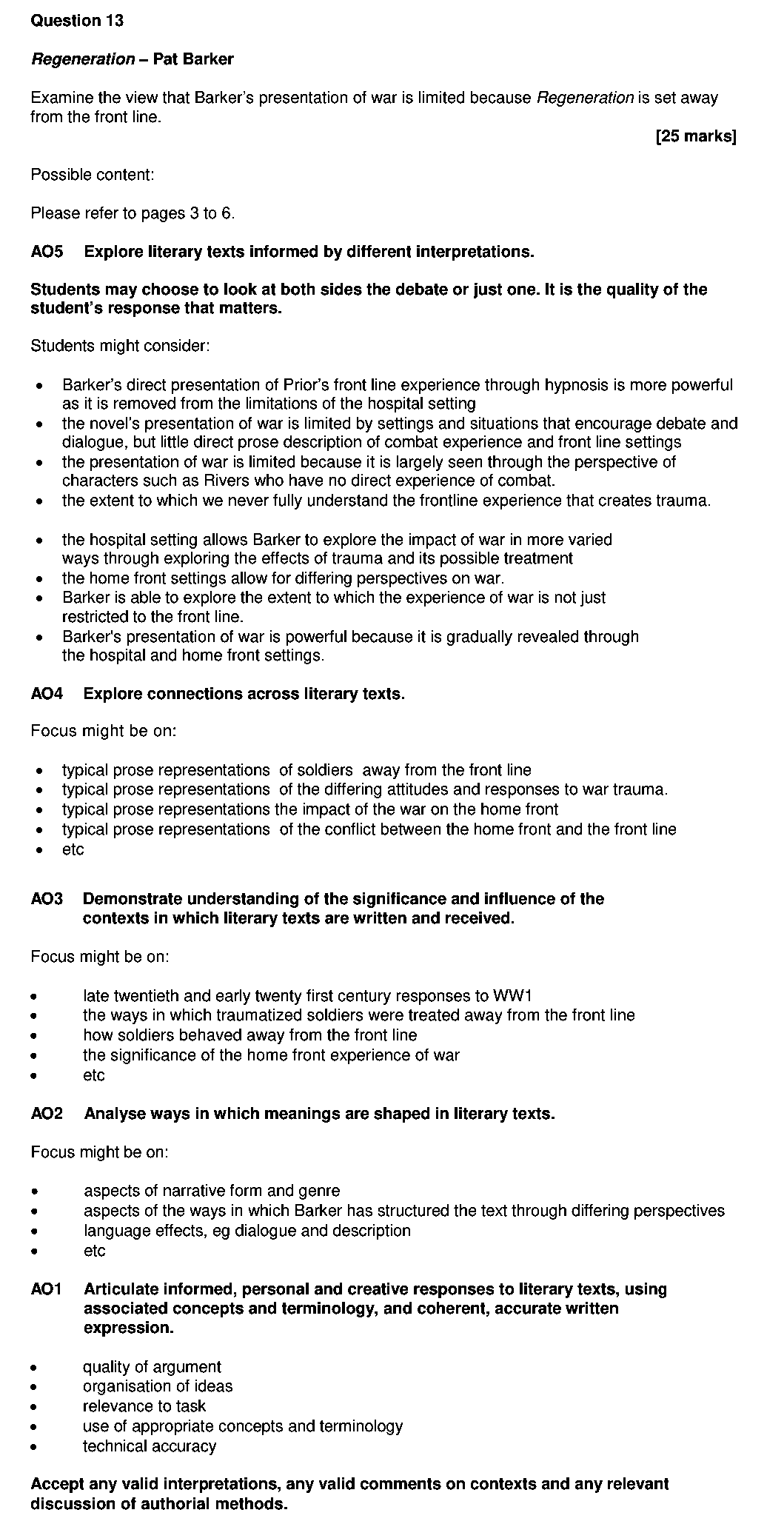
Focus: title: recovery and regeneration
Open book, no extract
view: recovery and regeneration as key ideas
title
MS: Head and Rivers' nerve-regeneration experiment as metaphor, Sassoon and Owen, Burns not regenerating, Rivers changed, late-20th-century regenerated view
ER: weaker unloaded shell-shock context
stronger used structure (Rivers and Sassoon framing) and imagery of painful regeneration
June 2017 · Paper 2A · Q1325 marksSet text essay
Mark scheme, including the levels and indicative content
The general mark scheme (assessment objectives and bands)
Examiner's comment
This was a popular question choice and examiners were impressed by the quality of the responses. Students were able to engage in the debate in a variety of ways; contextual knowledge was applied successfully and allowed students to explore the significance of the home front settings as well as the perspectives on war offered by characters such as Sarah Lumb. More developed answers were well supported by discussion of textual detail particularly when there was focus on how Barker presents the continuing trauma of the front line through male characters such as Burns and Prior. At times context was clumsily considered when some students debated that the presentation of war was limited because of the age and gender of the writer. Better answers considered Barker’s use of historical characters and source material; some of the best responses considered the extent to which Rivers represented the reader through his distanced, analytic experience of the war.
Notes from the mark scheme and report
Focus: setting: away from the front line
Open book, no extract
debate 'limited' by hospital setting
MS: Prior's hypnosis, Rivers as non-combatant perspective, home front settings, trauma revealed gradually
ER: popular and strong
good answers used Sarah Lumb, Burns and Prior, Barker's historical sources, Rivers as the reader's distanced viewpoint
weak context claimed limitation from Barker's age and gender
June 2017 · Paper 2A · Q1425 marksSet text essay
Mark scheme, including the levels and indicative content
The general mark scheme (assessment objectives and bands)
Examiner's comment
Many examiners were impressed by the quality of responses to this question, feeling that the majority of students were able absorb the 'signification' of the character of Burns by developing responses that were explicit about his varying functions within the text. Relatively few students resorted to offering simple character studies, but saw Burns as a ‘construct’ and debated what he ‘meant’. More straightforward responses largely focused on his war experience to argue that he represented the trauma of war; better work explored his connection with the theme of regeneration and the extent to which he acts as a catalyst to Rivers’ changing attitudes to the war.
Notes from the mark scheme and report
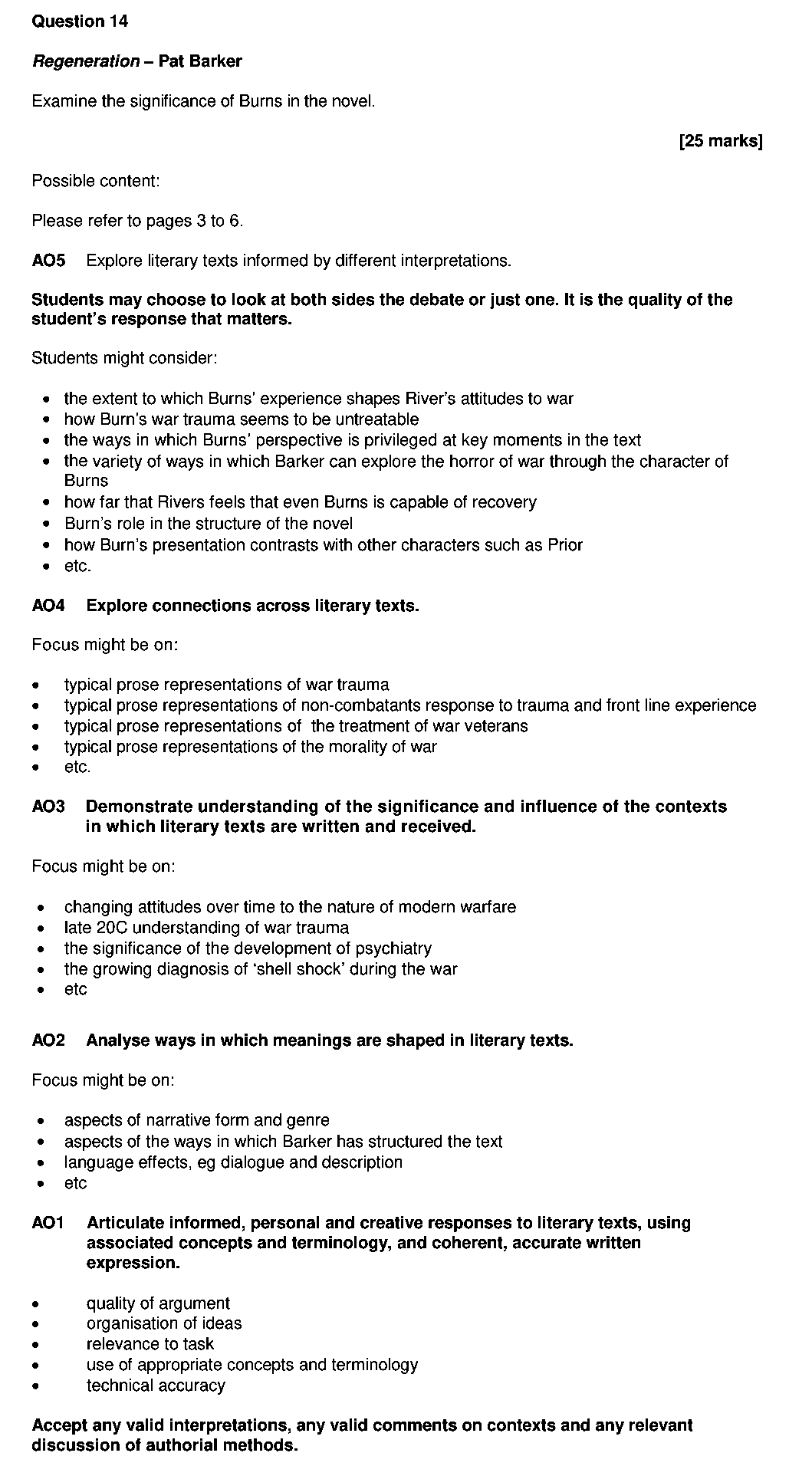
Focus: character: Burns
Open book, no extract
MS: Burns shapes Rivers' attitude, untreatable trauma, his place in structure, contrast with Prior
ER: most treated Burns as a construct with varied functions
straightforward answers made him represent trauma
better linked him to regeneration and Rivers' changing attitude
Work with an AQA English Literature A tutor
Essays stuck in the middle bands, or not sure what the examiners want from an analysis? Book a trial lesson with a specialist AQA English Literature A tutor.