The Taming of the Shrew SH

Part of
Shakespeare
Where it is examined
A-level Paper 1 Section A and AS Paper 1 Section A: an extract-based question on your play
Level
AS and A level
Specification
4.1.1, 1 set text
Since 2016
18 questions

Specification

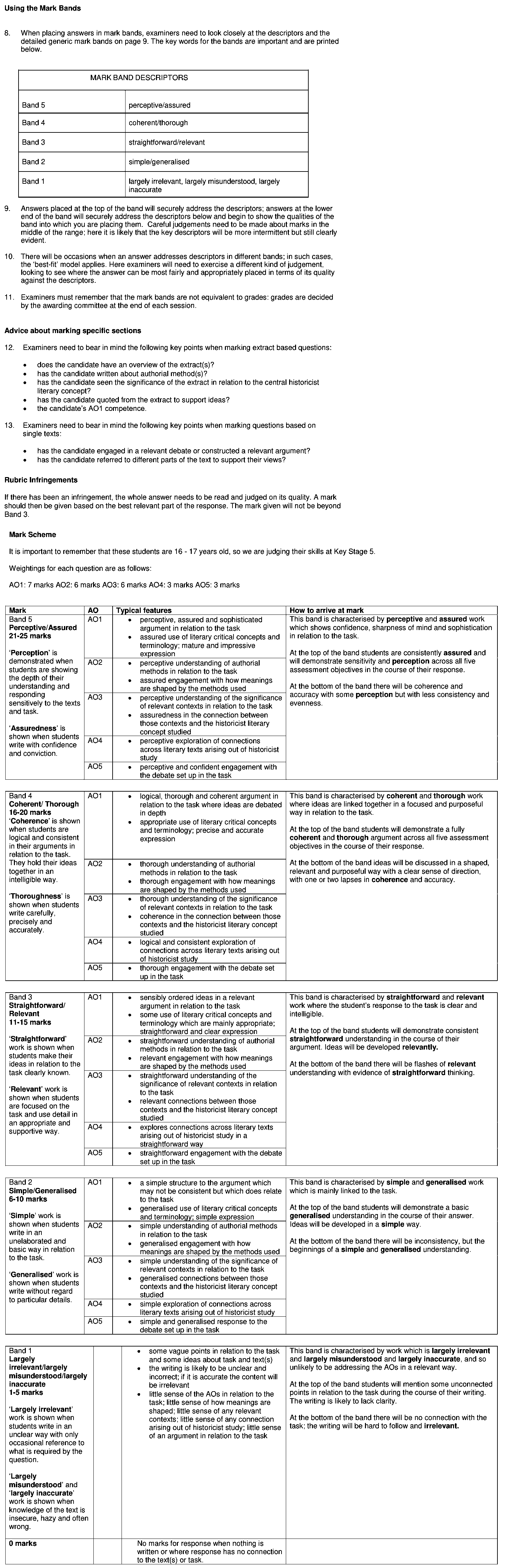
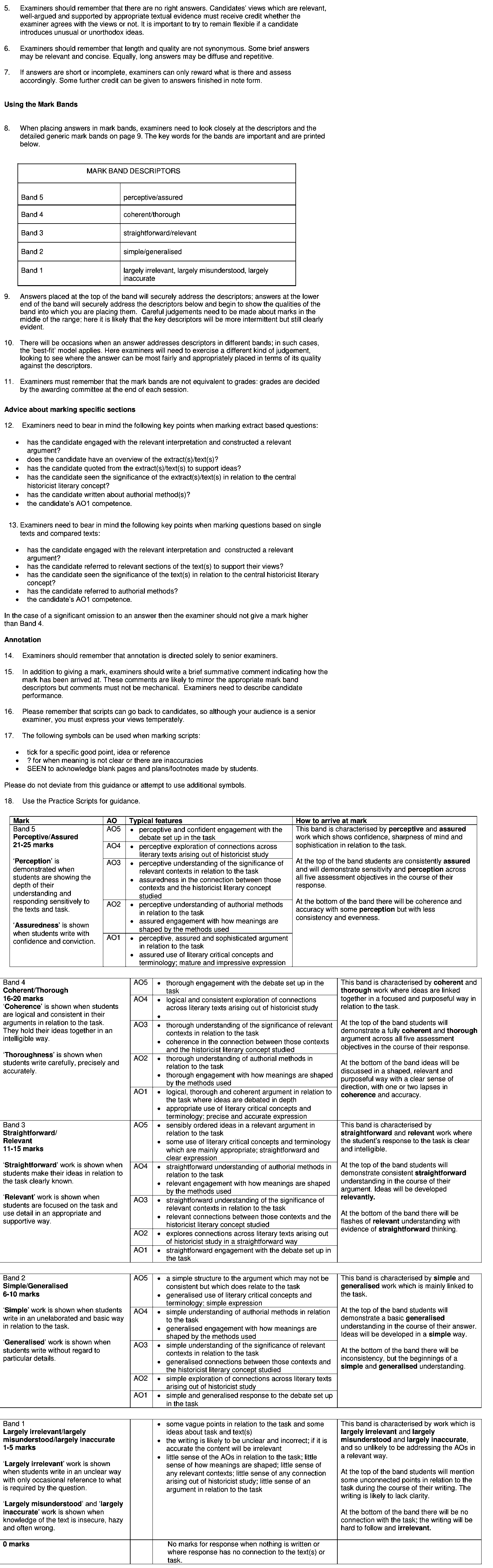
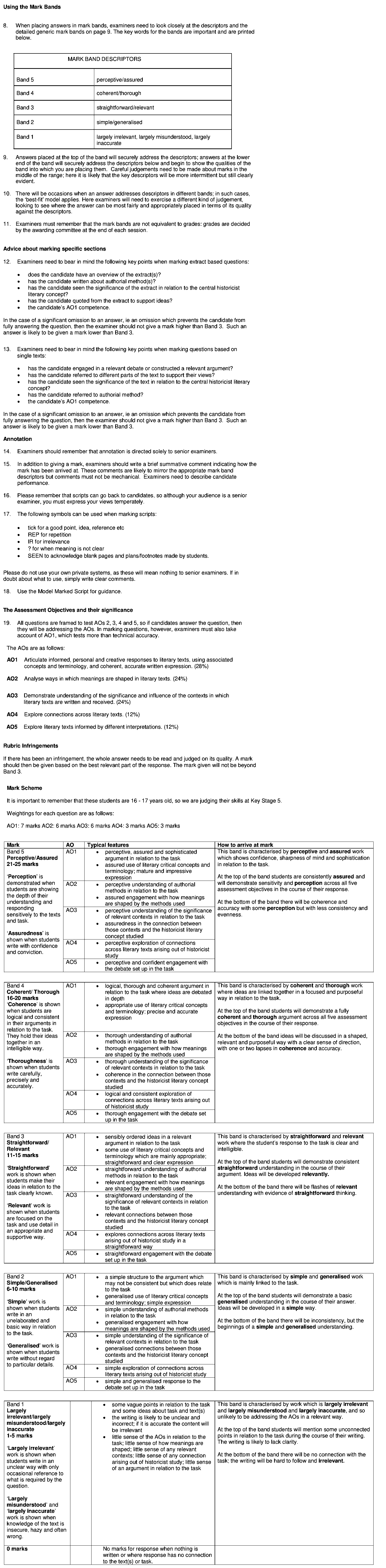
In the board's own words. Tick these off on the checklist.

Every question set on this text

SeriesPaperQMarksTitle
June 2025AS Paper 1225The Taming of the Shrew – William Shakespeare Read the extract from The Taming of the Shrew, provided below, and respond to the following: • How does Shakespeare present aspects of love in this extract? • Examine the view that, in this extract and elsewhere in
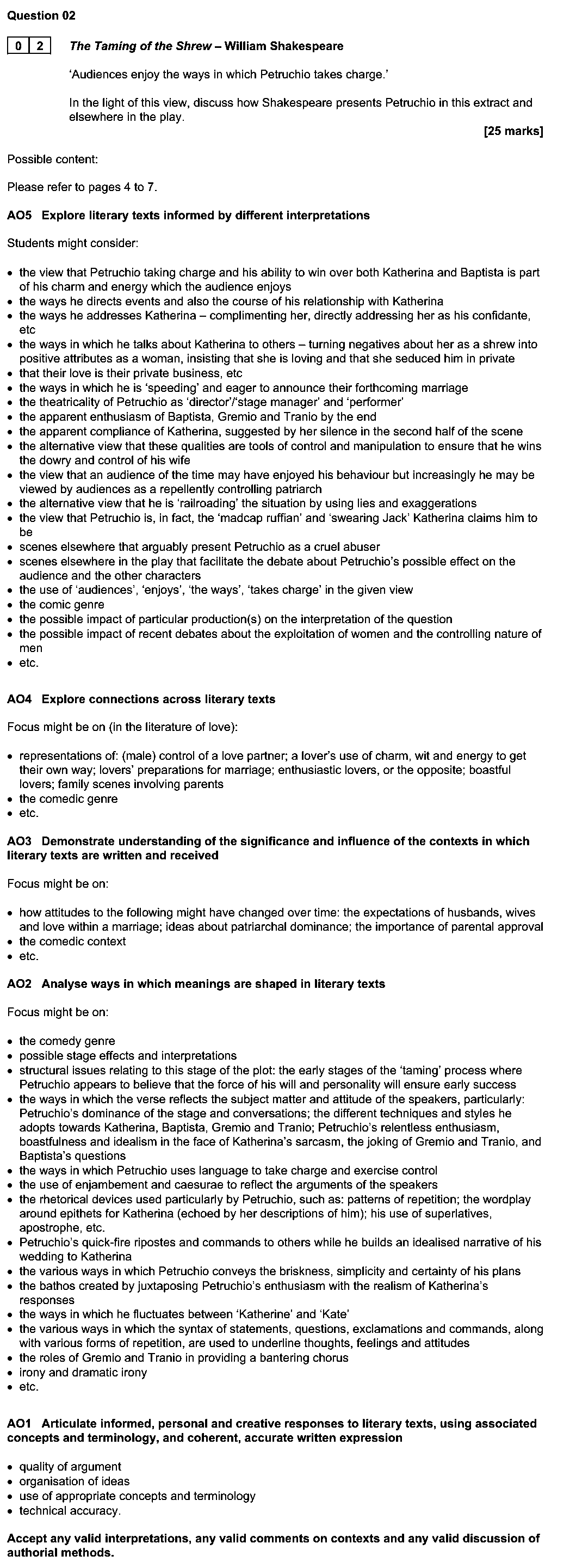
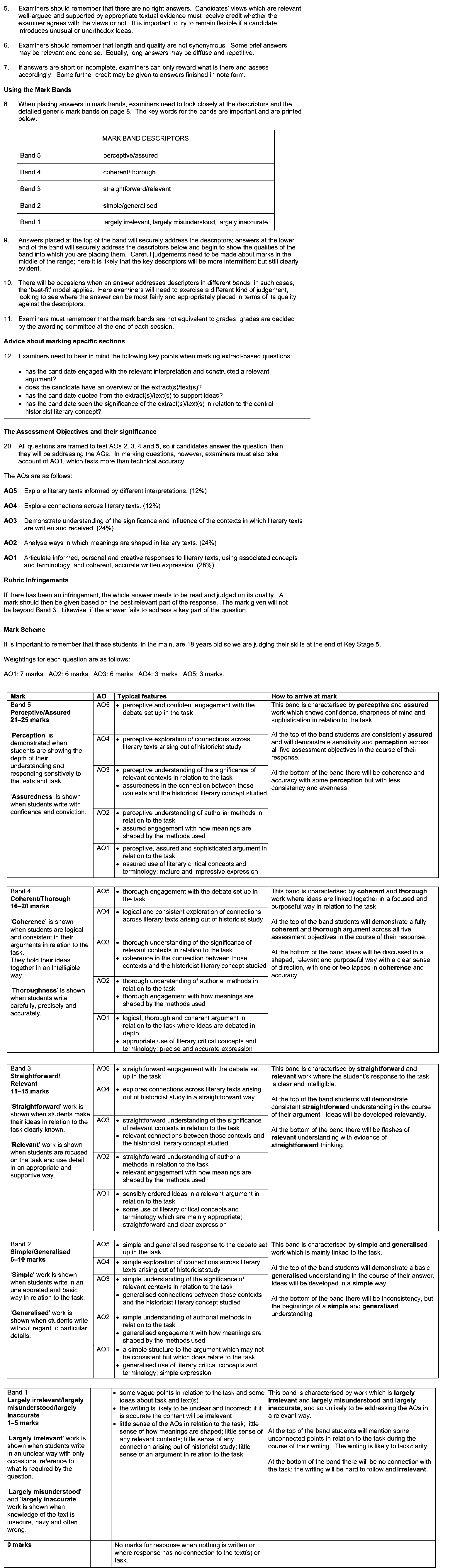
June 2025Paper 1225The Taming of the Shrew – William Shakespeare ‘Audiences enjoy the ways in which Petruchio takes charge.’ In the light of this view, discuss how Shakespeare presents Petruchio in this extract and elsewhere in the play. PETRUCHIO Now, Kate, I am a husband for y
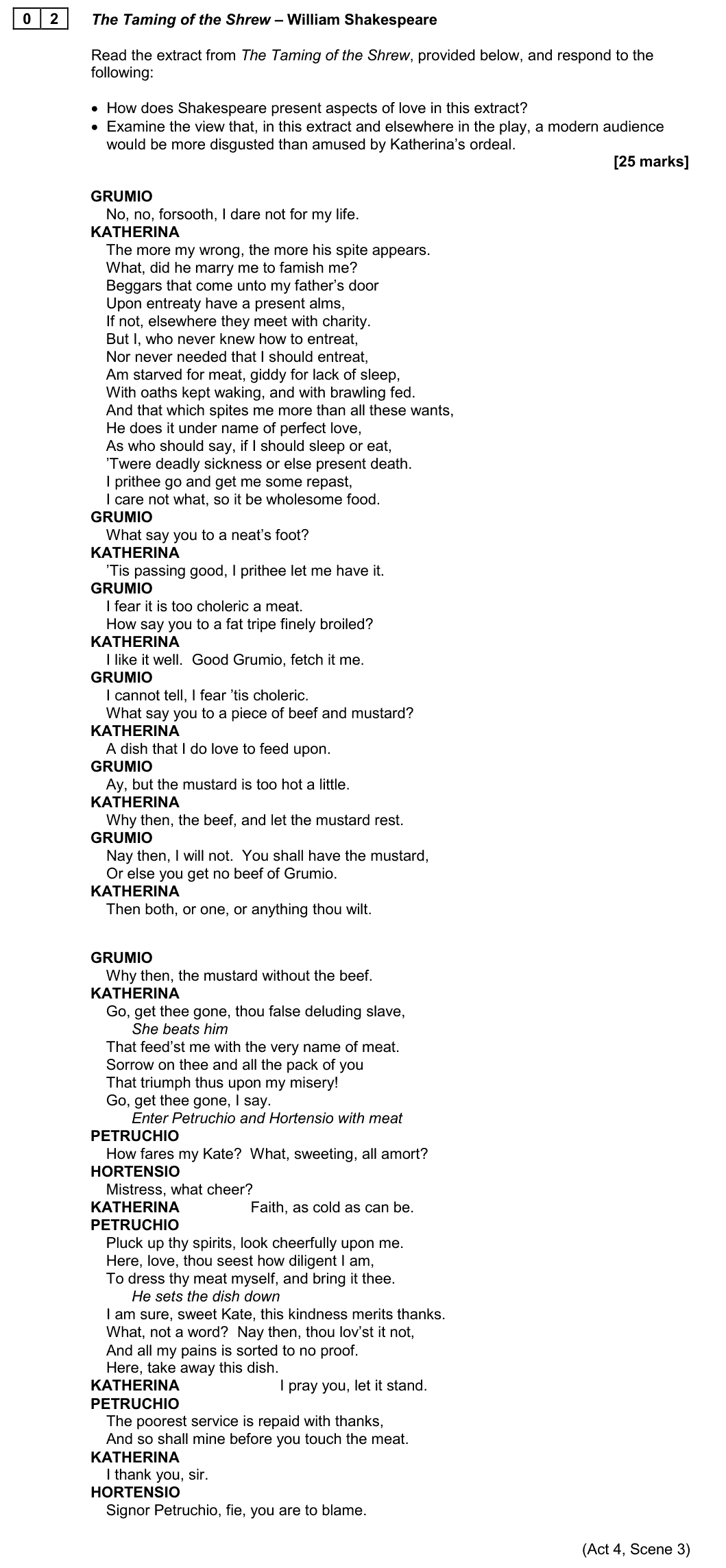
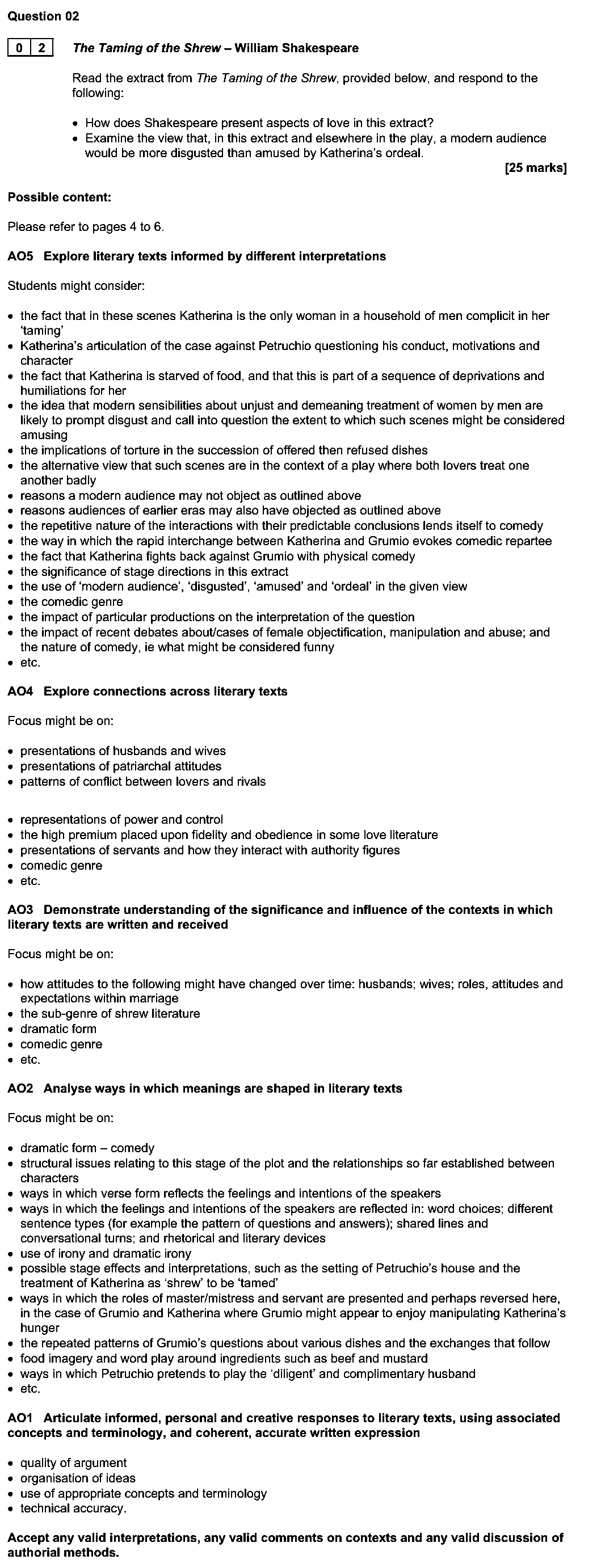
June 2024AS Paper 1225The Taming of the Shrew – William Shakespeare Read the extract from The Taming of the Shrew, provided below, and respond to the following: • How does Shakespeare present aspects of love in this extract? • Examine the view that, in this extract and elsewhere in
June 2024Paper 1225The Taming of the Shrew – William Shakespeare ‘Grumio and other servants are crucial to the development of the love stories in The Taming of the Shrew.’ In the light of this view, discuss how Shakespeare presents Grumio and other servants in this extract and e
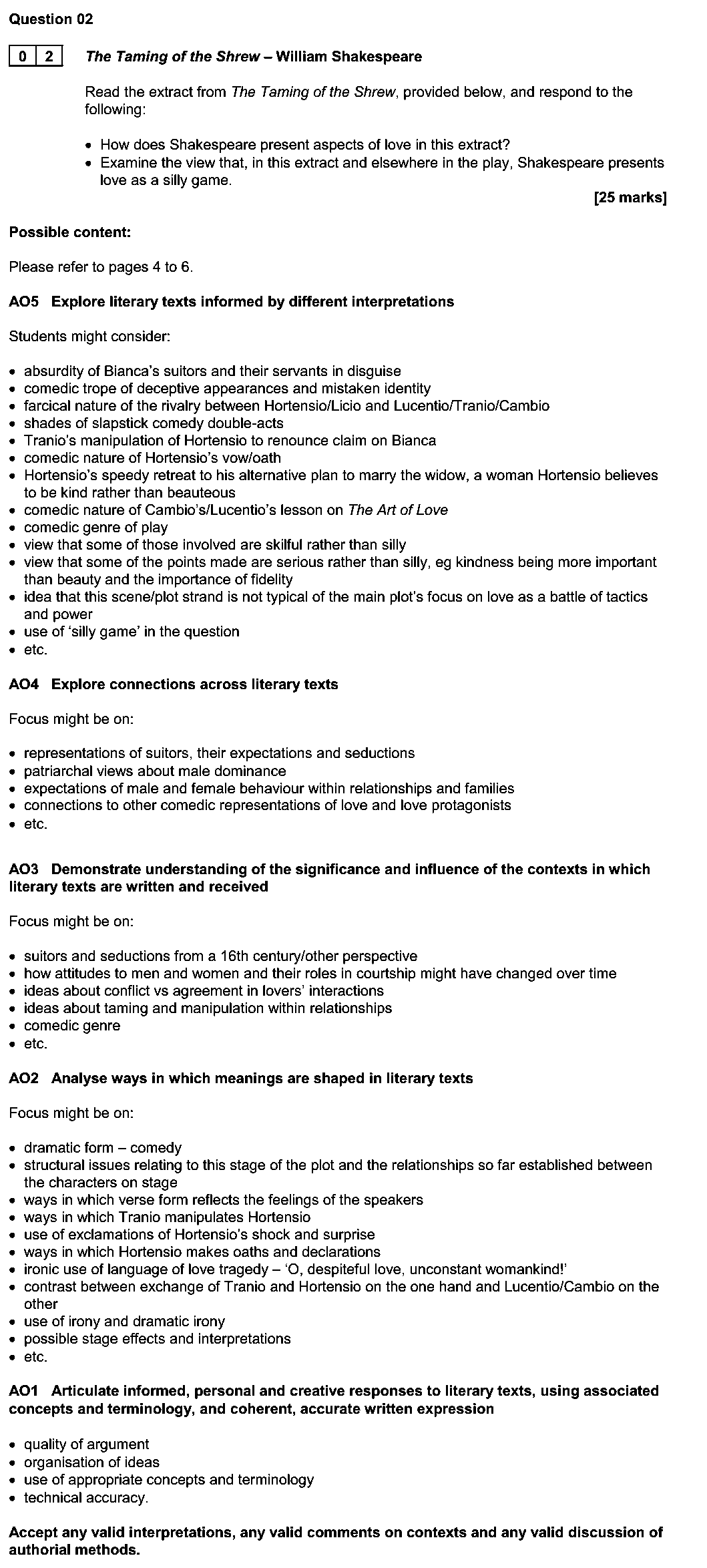
June 2023AS Paper 1225The Taming of the Shrew – William Shakespeare Read the extract from The Taming of the Shrew, provided below, and respond to the following: • How does Shakespeare present aspects of love in this extract? • Examine the view that, in this extract and elsewhere in
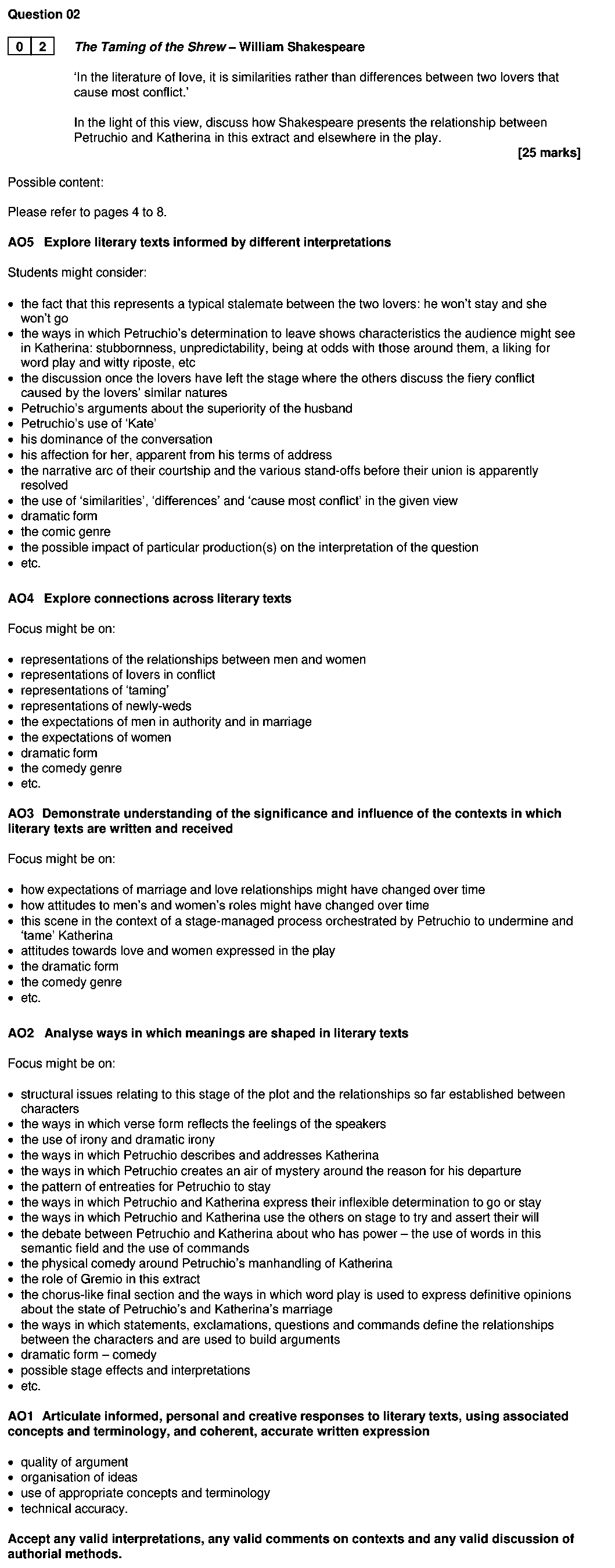
June 2023Paper 1225The Taming of the Shrew – William Shakespeare ‘In the literature of love, it is similarities rather than differences between two lovers that cause most conflict.’ In the light of this view, discuss how Shakespeare presents the relationship between Petruchio an
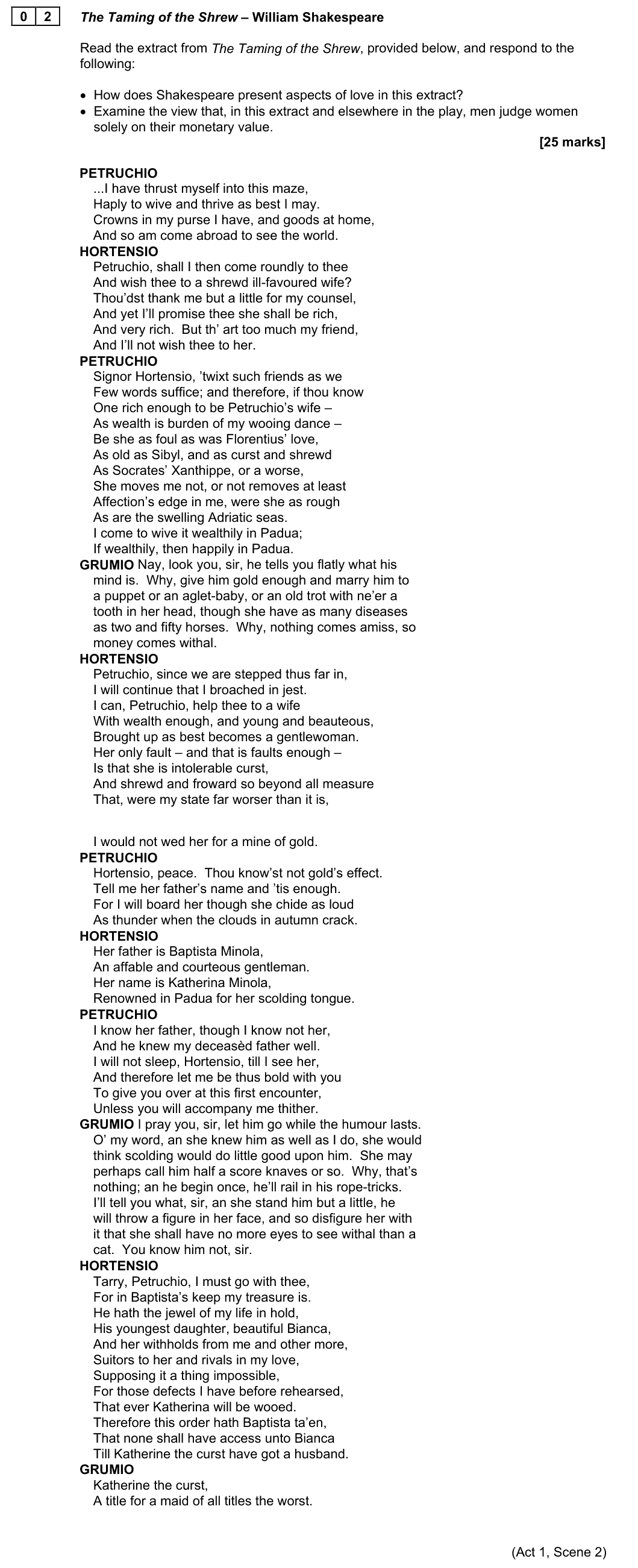
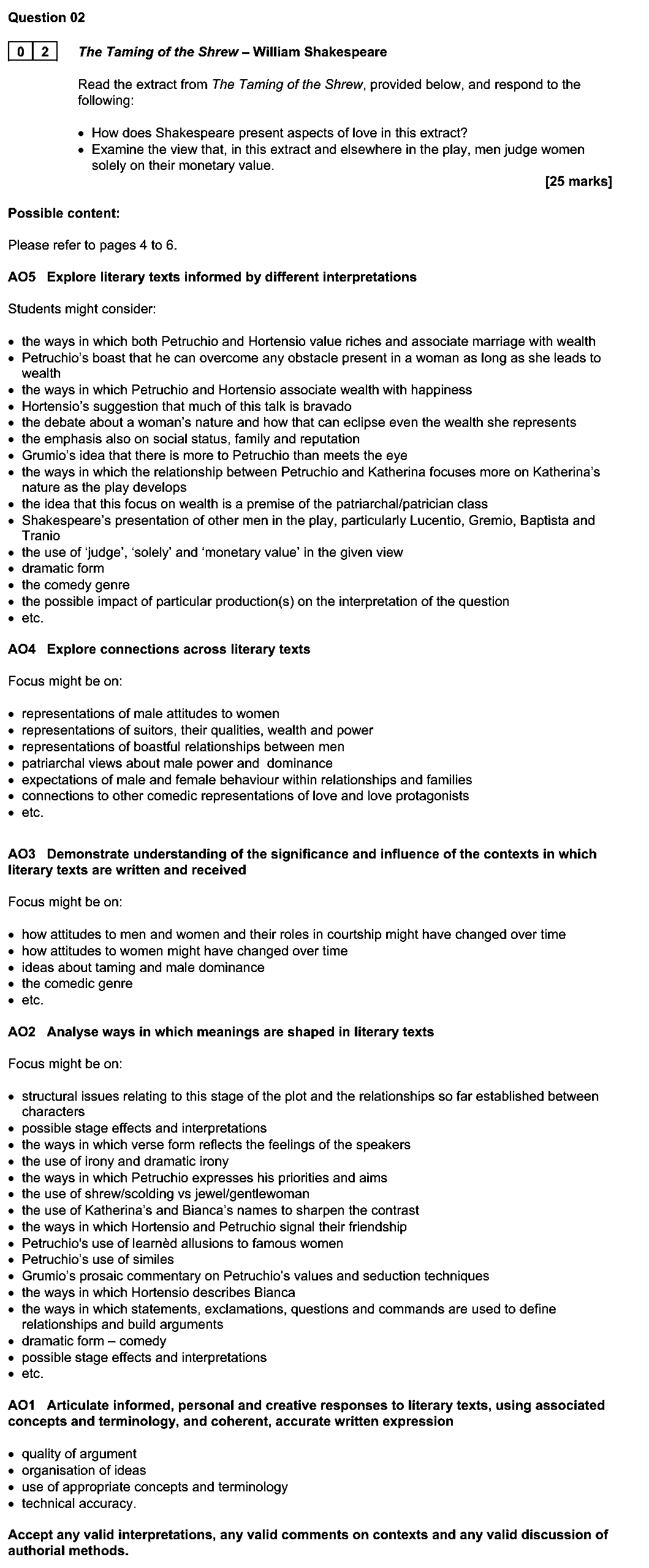
June 2022AS Paper 1225The Taming of the Shrew – William Shakespeare Read the extract from The Taming of the Shrew, provided below, and respond to the following: • How does Shakespeare present aspects of love in this extract? • Examine the view that, in this extract and elsewhere in
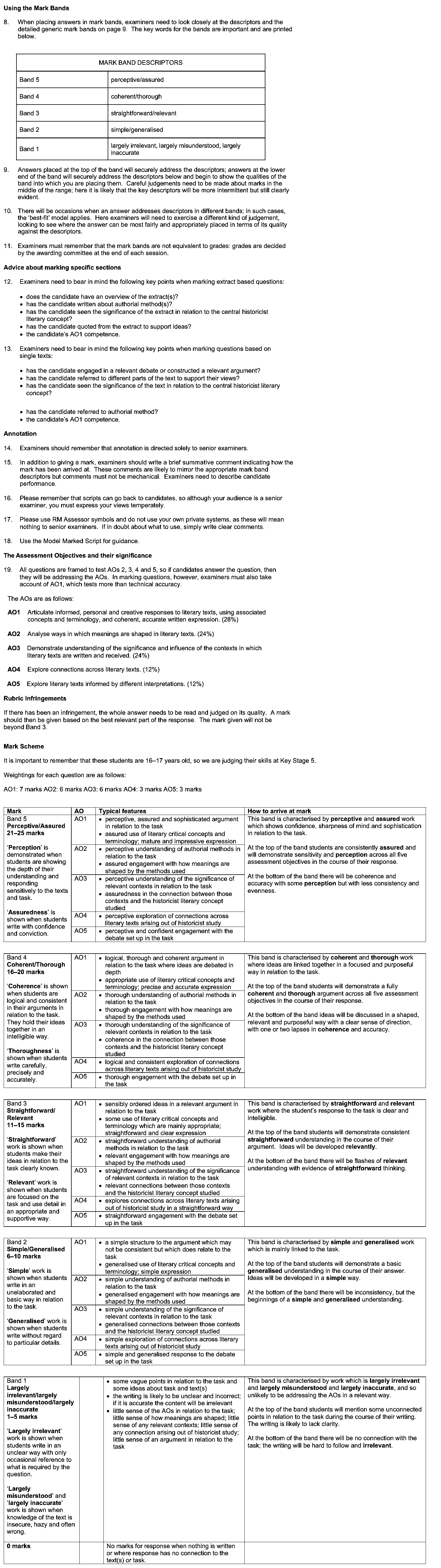
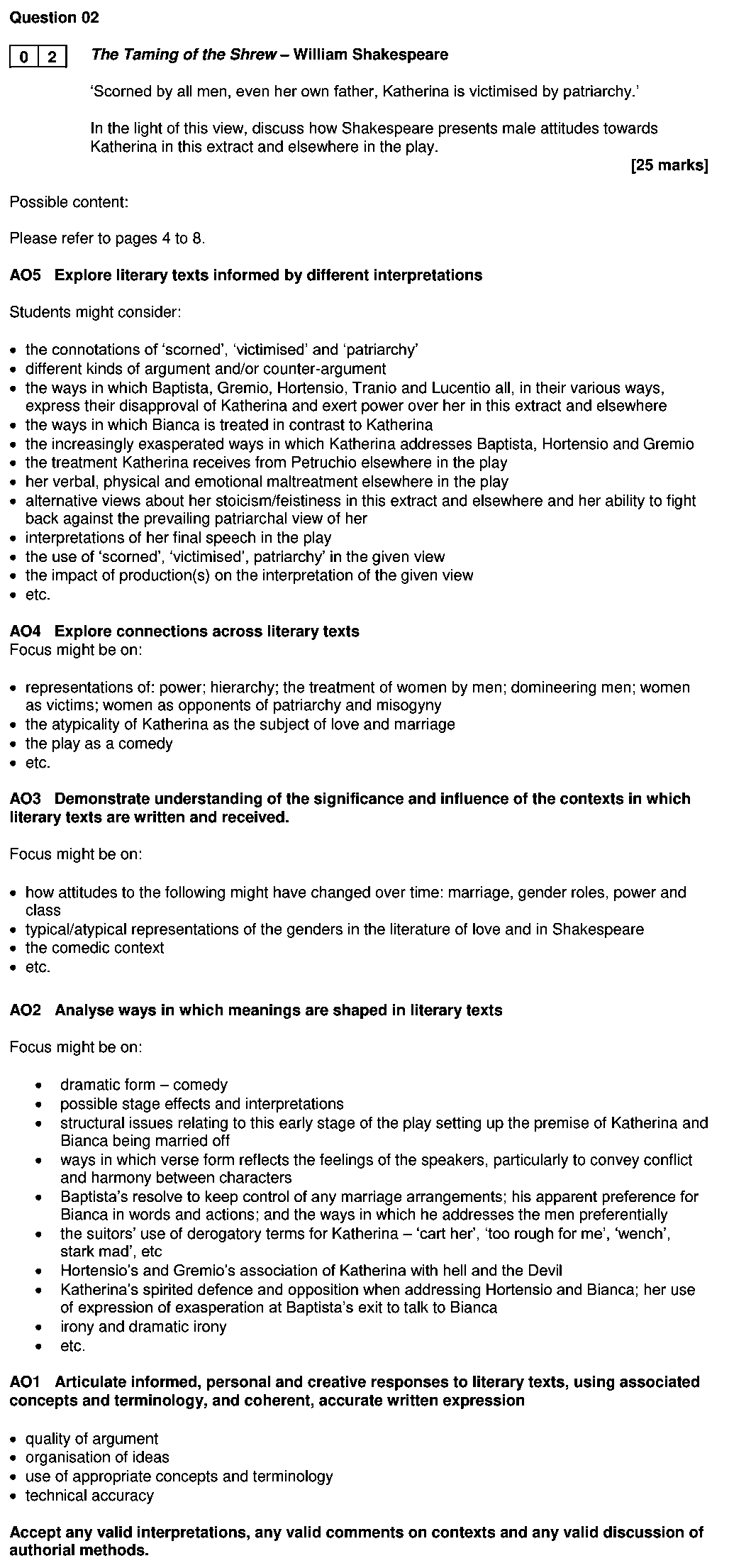
June 2022Paper 1225The Taming of the Shrew – William Shakespeare ‘Scorned by all men, even her own father, Katherina is victimised by patriarchy.’ In the light of this view, discuss how Shakespeare presents male attitudes towards Katherina in this extract and elsewhere in the pl
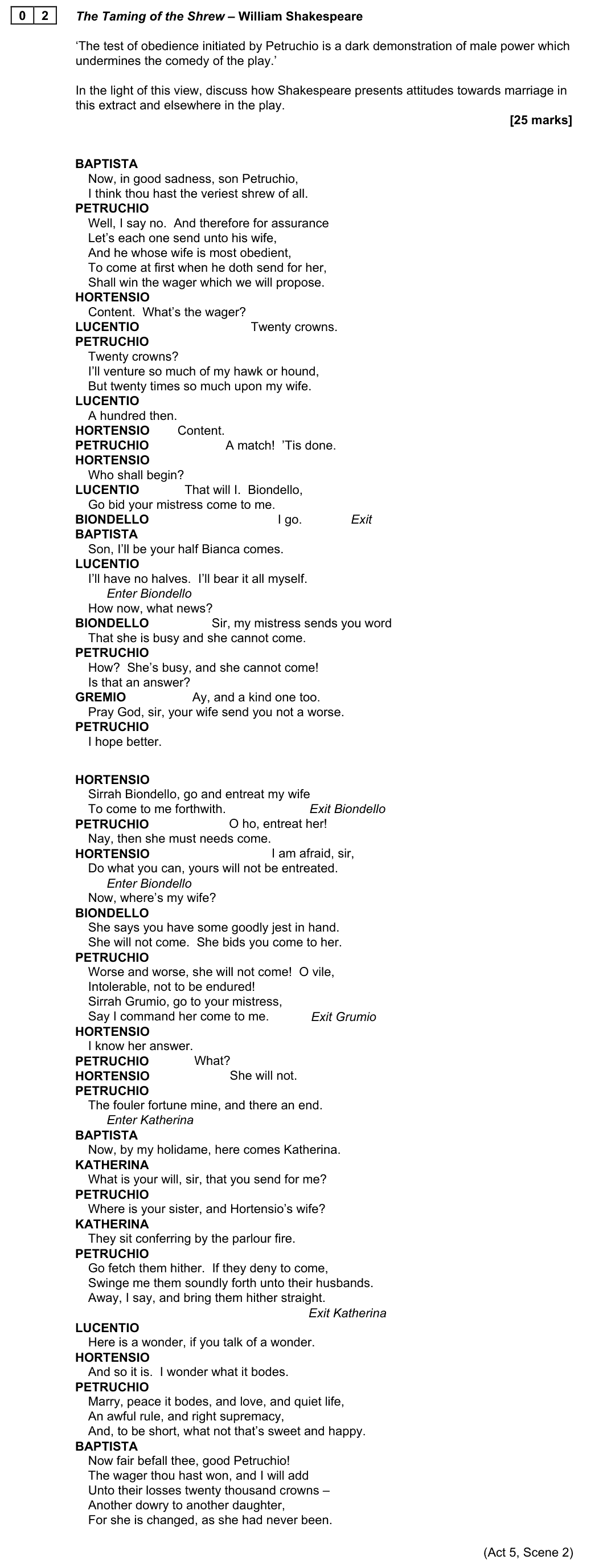
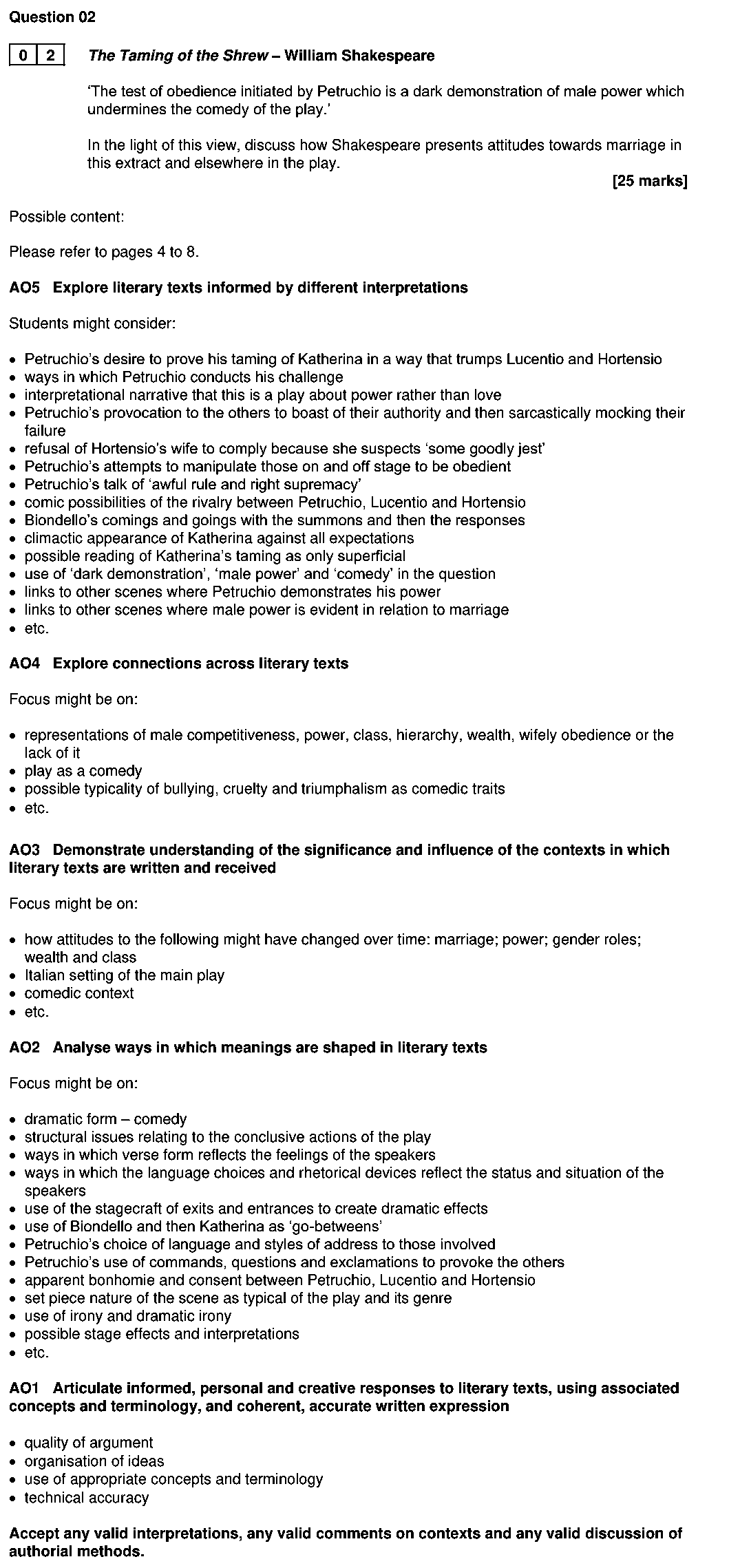
November 2021Paper 1225The Taming of the Shrew – William Shakespeare ‘The test of obedience initiated by Petruchio is a dark demonstration of male power which undermines the comedy of the play.’ In the light of this view, discuss how Shakespeare presents attitudes towards marriage i
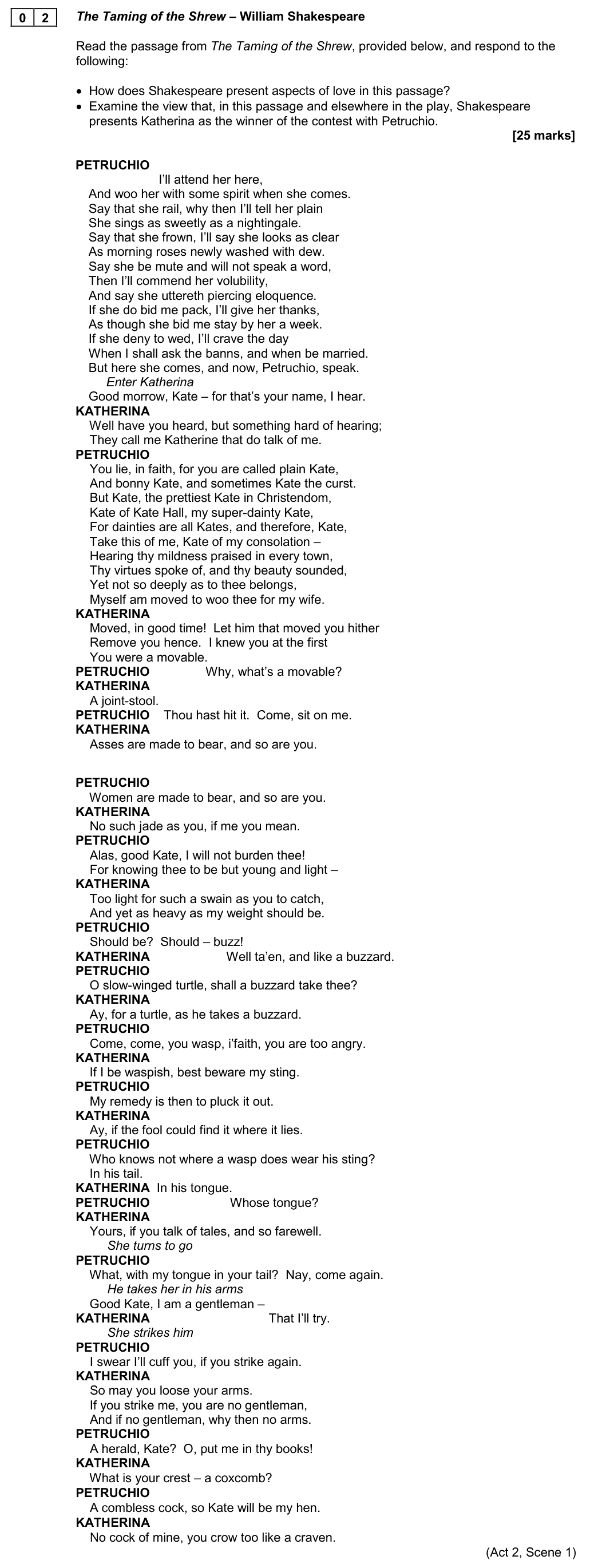
November 2020AS Paper 1225The Taming of the Shrew – William Shakespeare Read the passage from The Taming of the Shrew, provided below, and respond to the following: • How does Shakespeare present aspects of love in this passage? • Examine the view that, in this passage and elsewhere in
November 2020Paper 1225The Taming of the Shrew – William Shakespeare ‘The Induction is an essential part of The Taming of the Shrew, crucial to understanding important ideas about love in the play.’ In the light of this view, discuss how Shakespeare presents ideas about love in this
June 2019AS Paper 1225The Taming of the Shrew – William Shakespeare Read the passage from The Taming of the Shrew, provided below, and respond to the following: • How does Shakespeare present aspects of love in this passage? • Examine the view that, in this passage and elsewhere in
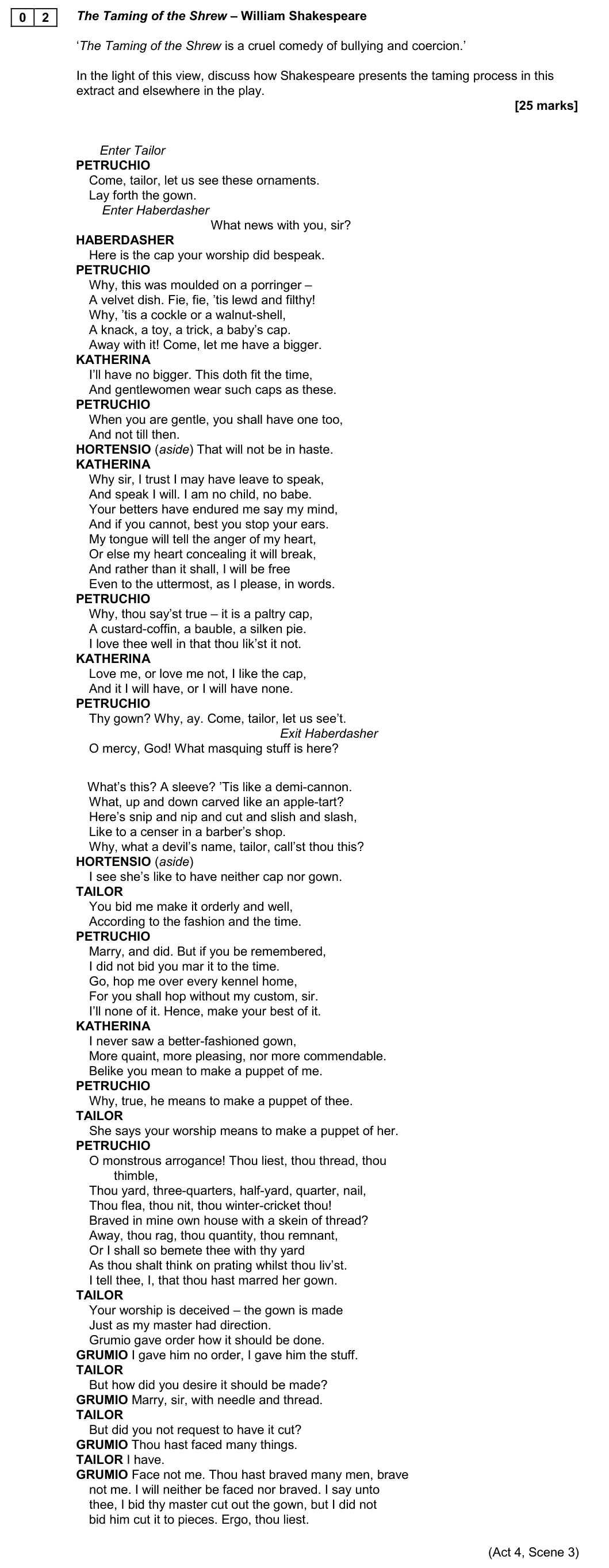
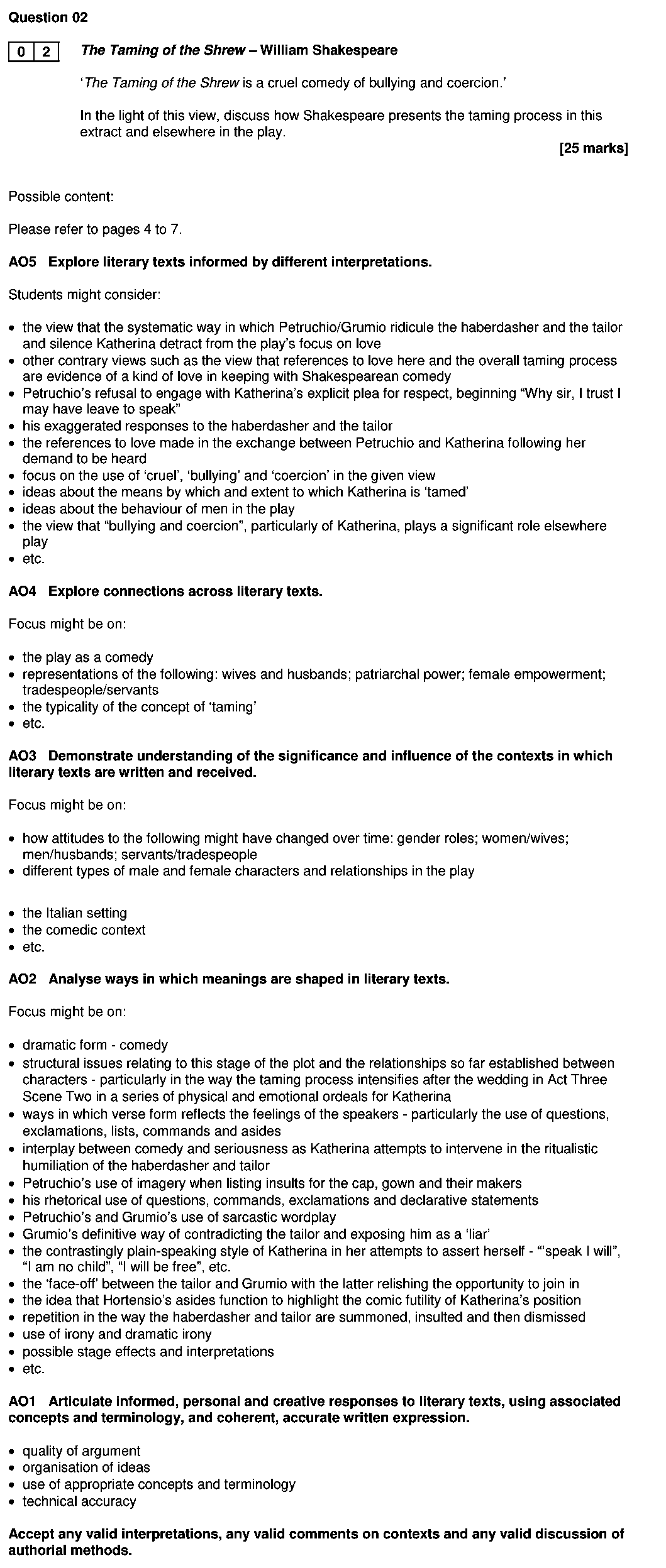
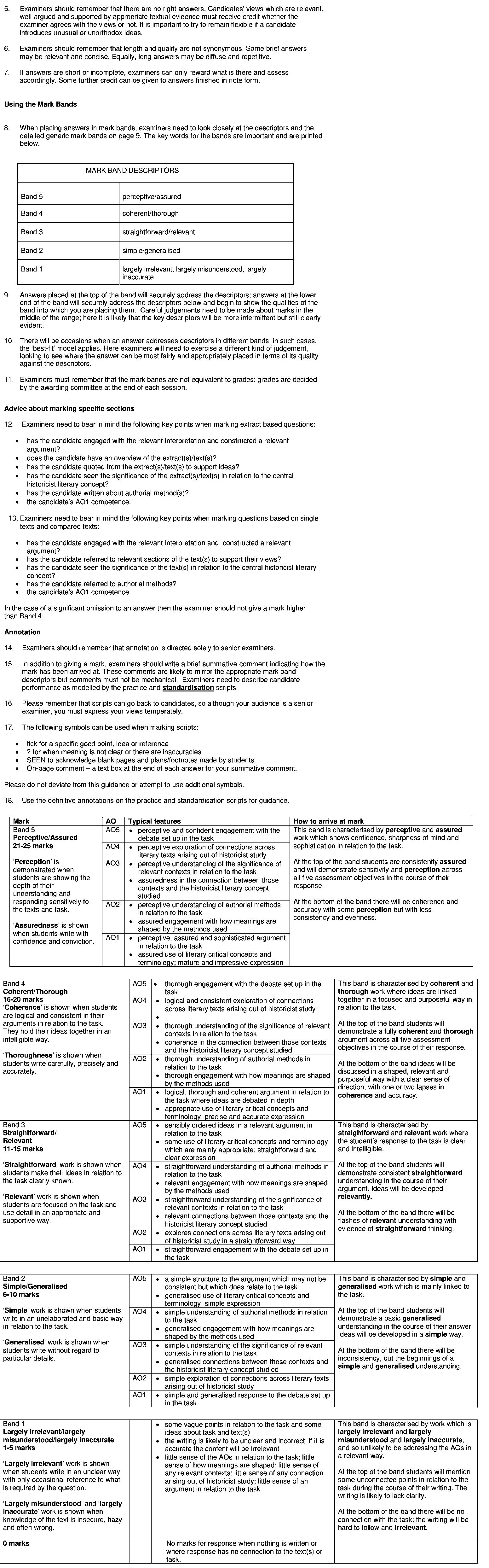
June 2019Paper 1225The Taming of the Shrew – William Shakespeare ‘The Taming of the Shrew is a cruel comedy of bullying and coercion.’ In the light of this view, discuss how Shakespeare presents the taming process in this extract and elsewhere in the play. Enter Tailor PETRUCHIO
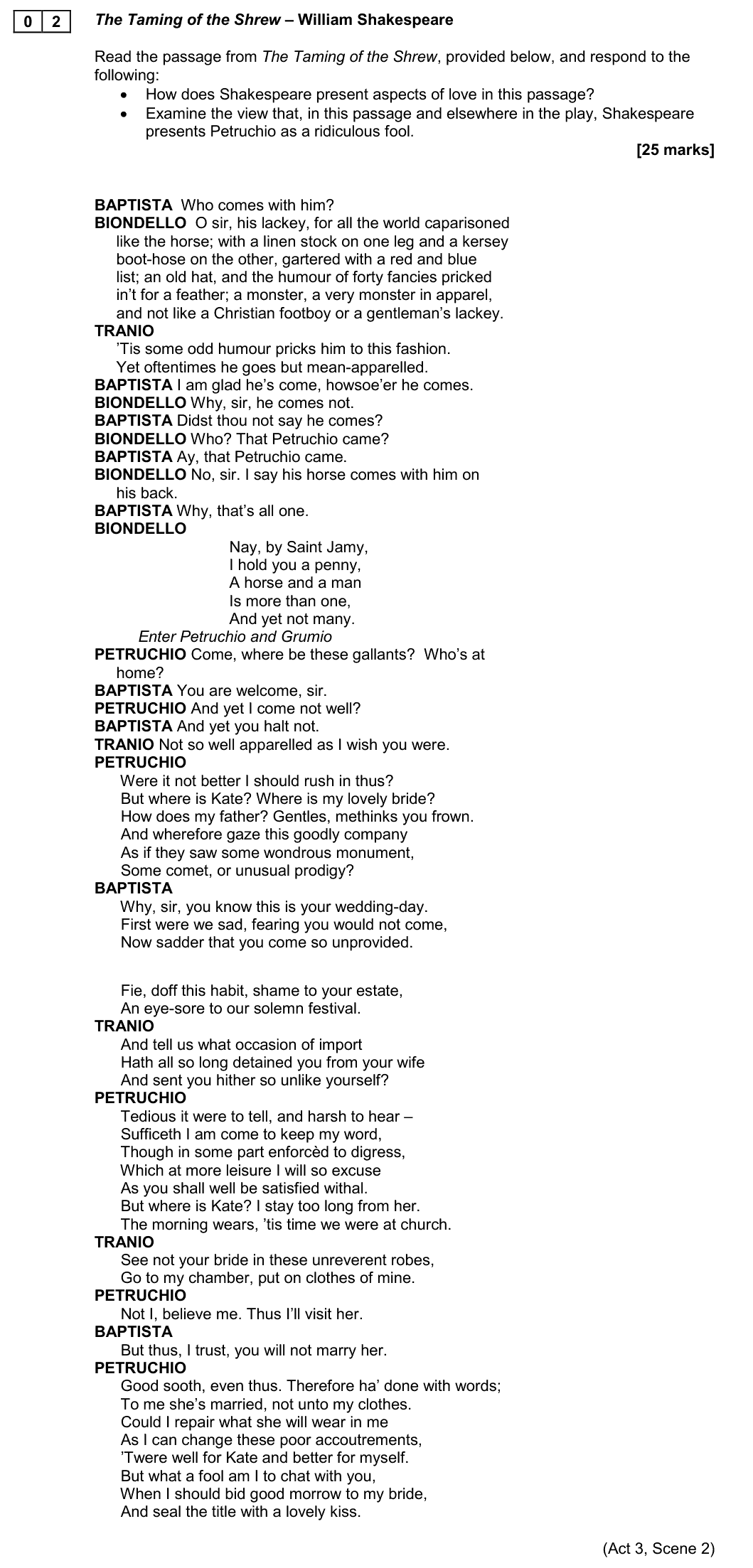
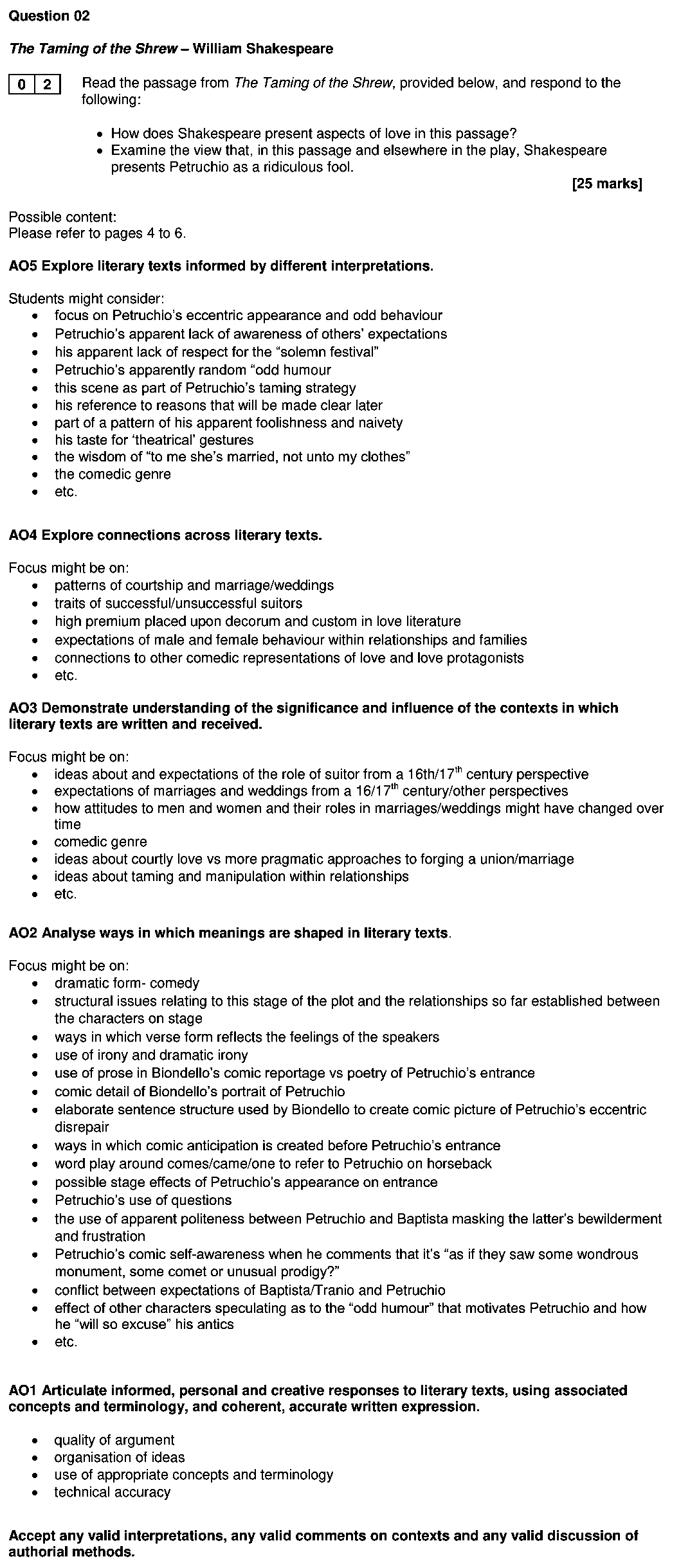
June 2018AS Paper 1225The Taming of the Shrew – William Shakespeare Read the passage from The Taming of the Shrew, provided below, and respond to the following: • How does Shakespeare present aspects of love in this passage? • Examine the view that, in this passage and elsewhere in
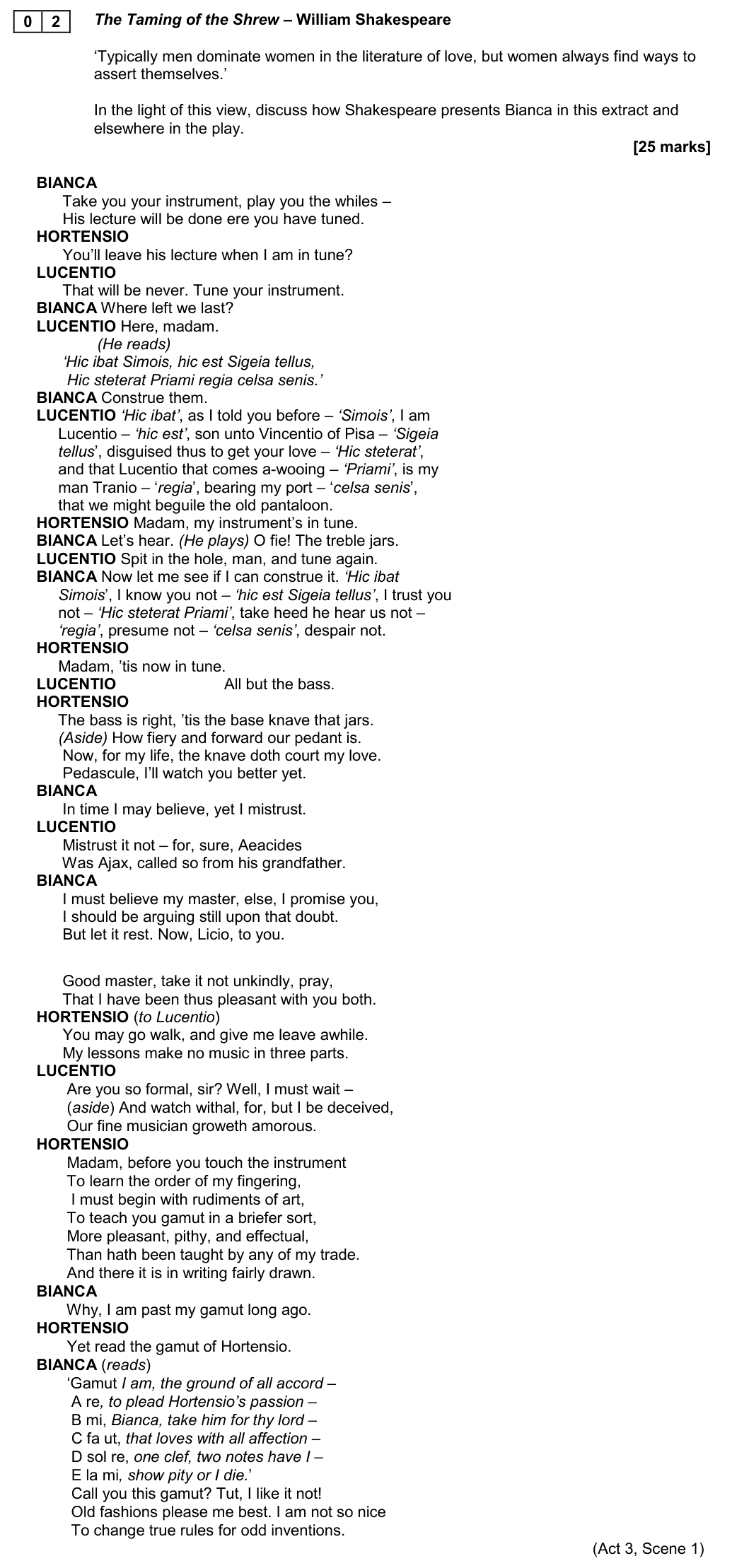
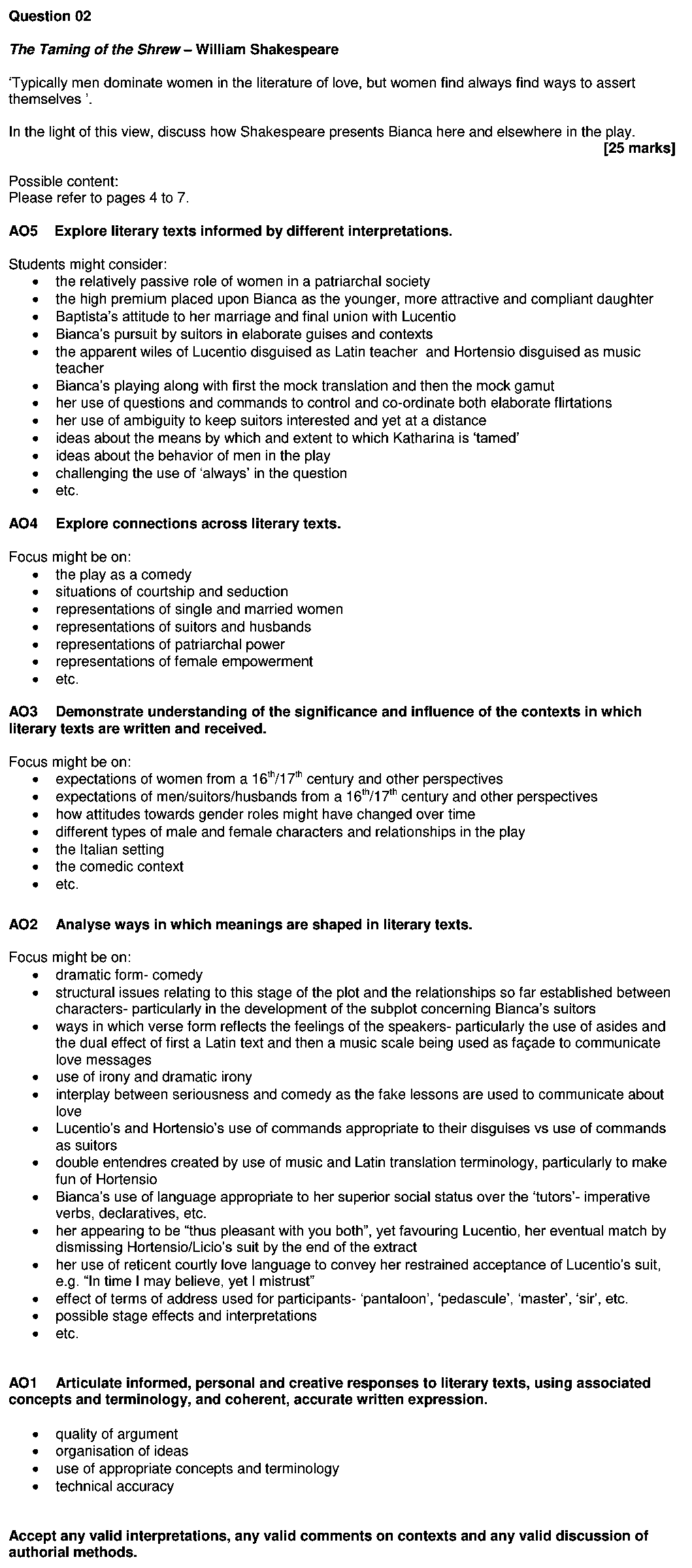
June 2018Paper 1225The Taming of the Shrew – William Shakespeare ‘Typically men dominate women in the literature of love, but women always find ways to assert themselves.’ In the light of this view, discuss how Shakespeare presents Bianca in this extract and elsewhere in the pla
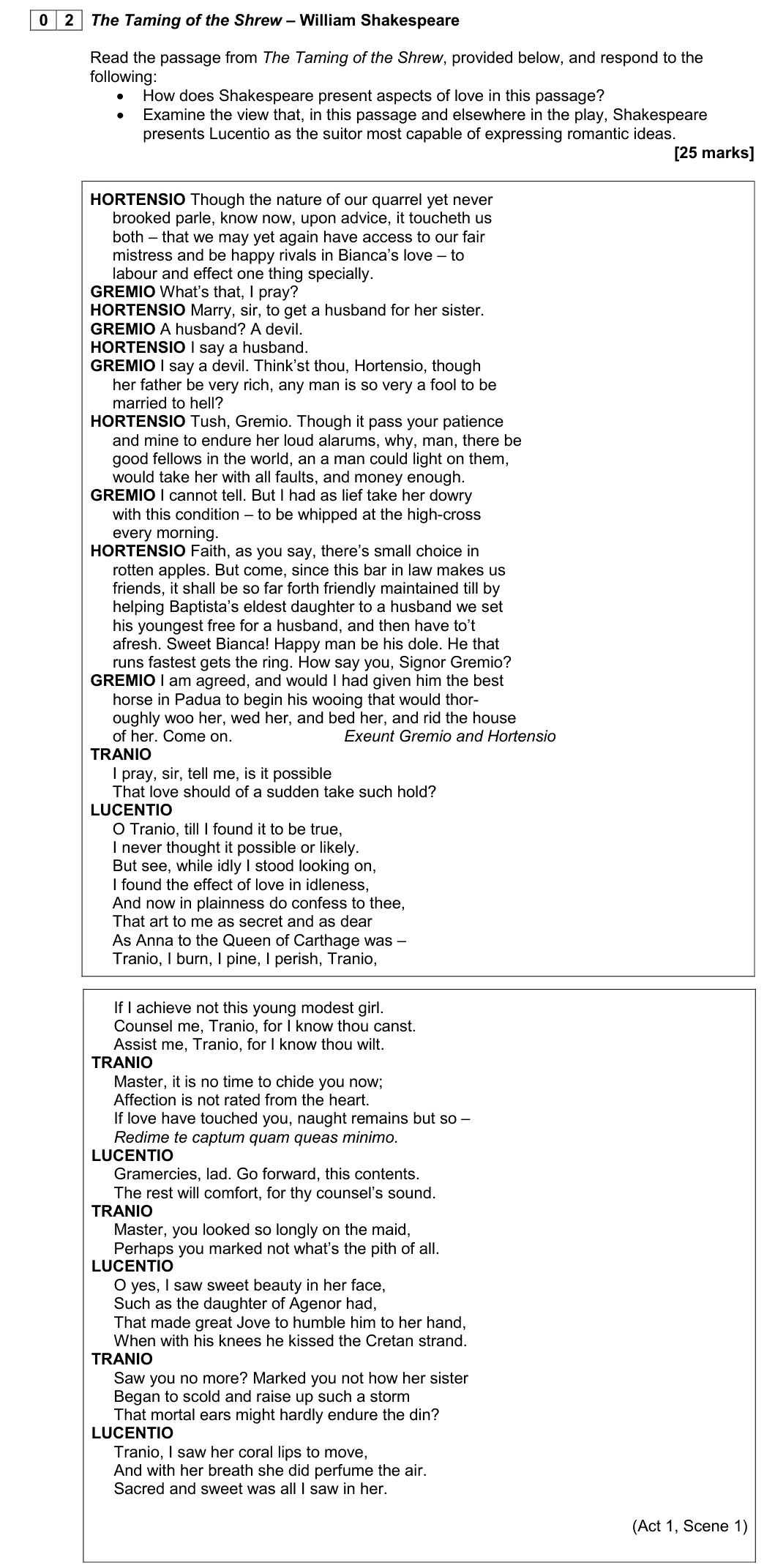
June 2017AS Paper 12250 2 The Taming of the Shrew – William Shakespeare Read the passage from The Taming of the Shrew, provided below, and respond to the following: • How does Shakespeare present aspects of love in this passage? • Examine the view that, in this passage and elsewher
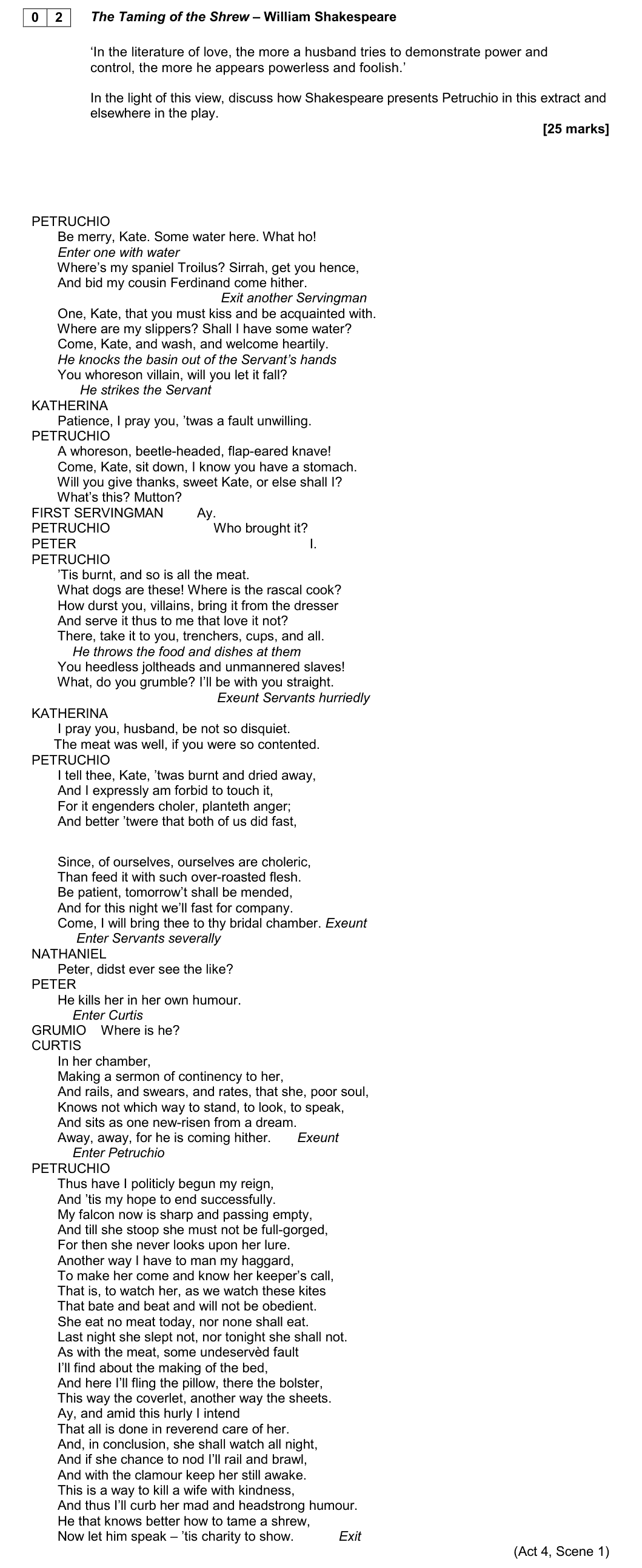
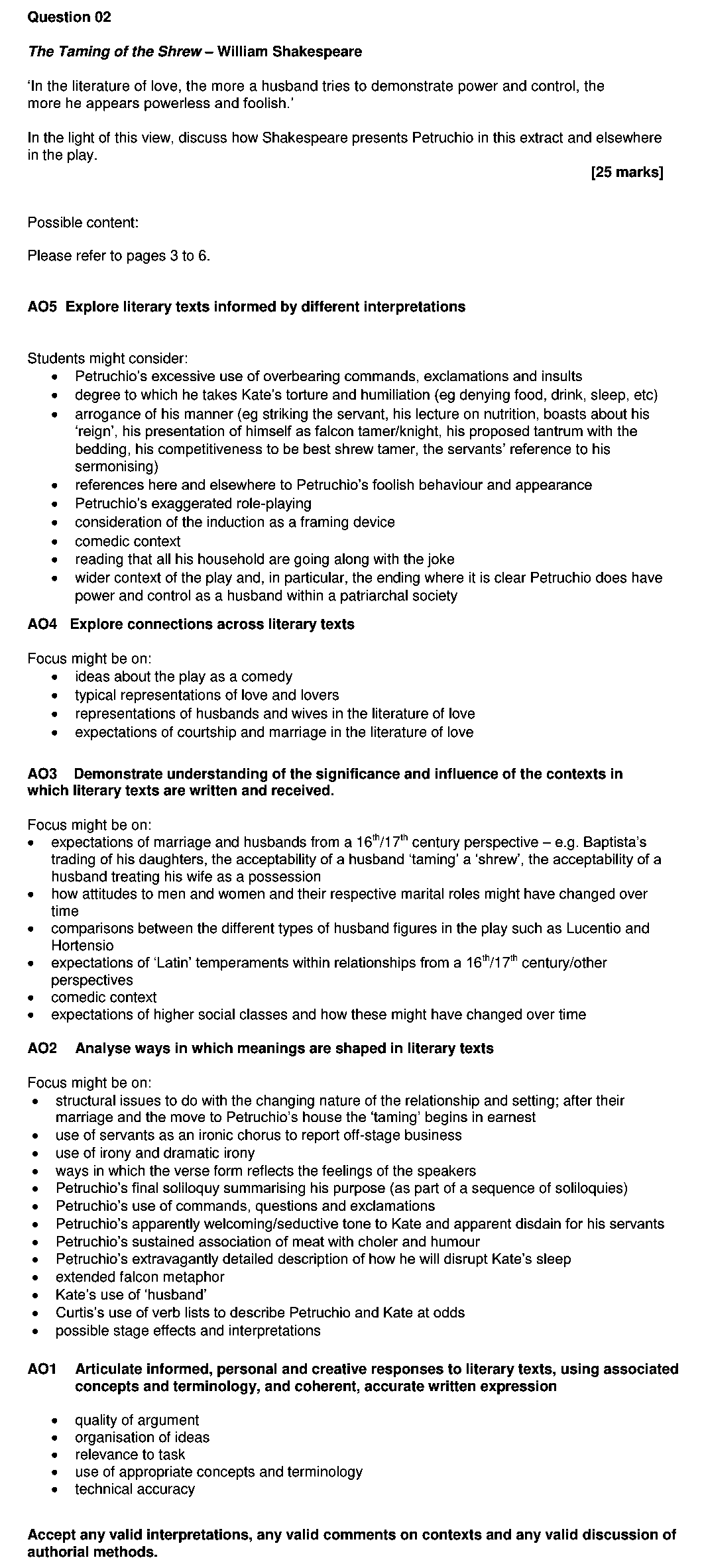
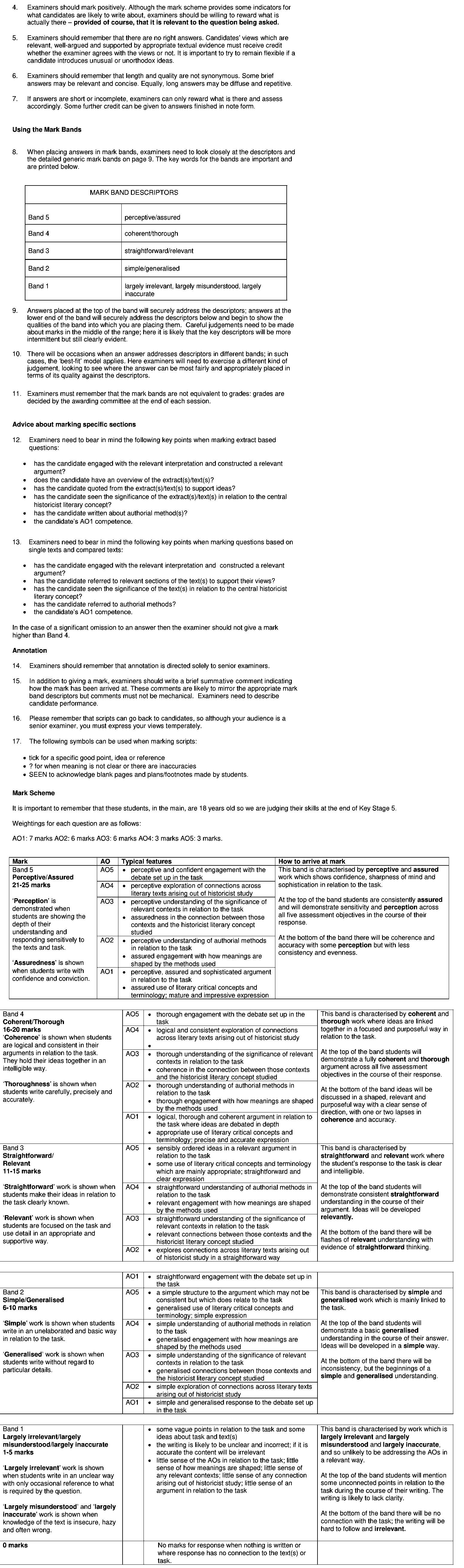
June 2017Paper 12250 2 The Taming of the Shrew – William Shakespeare ‘In the literature of love, the more a husband tries to demonstrate power and control, the more he appears powerless and foolish.’ In the light of this view, discuss how Shakespeare presents Petruchio in this e
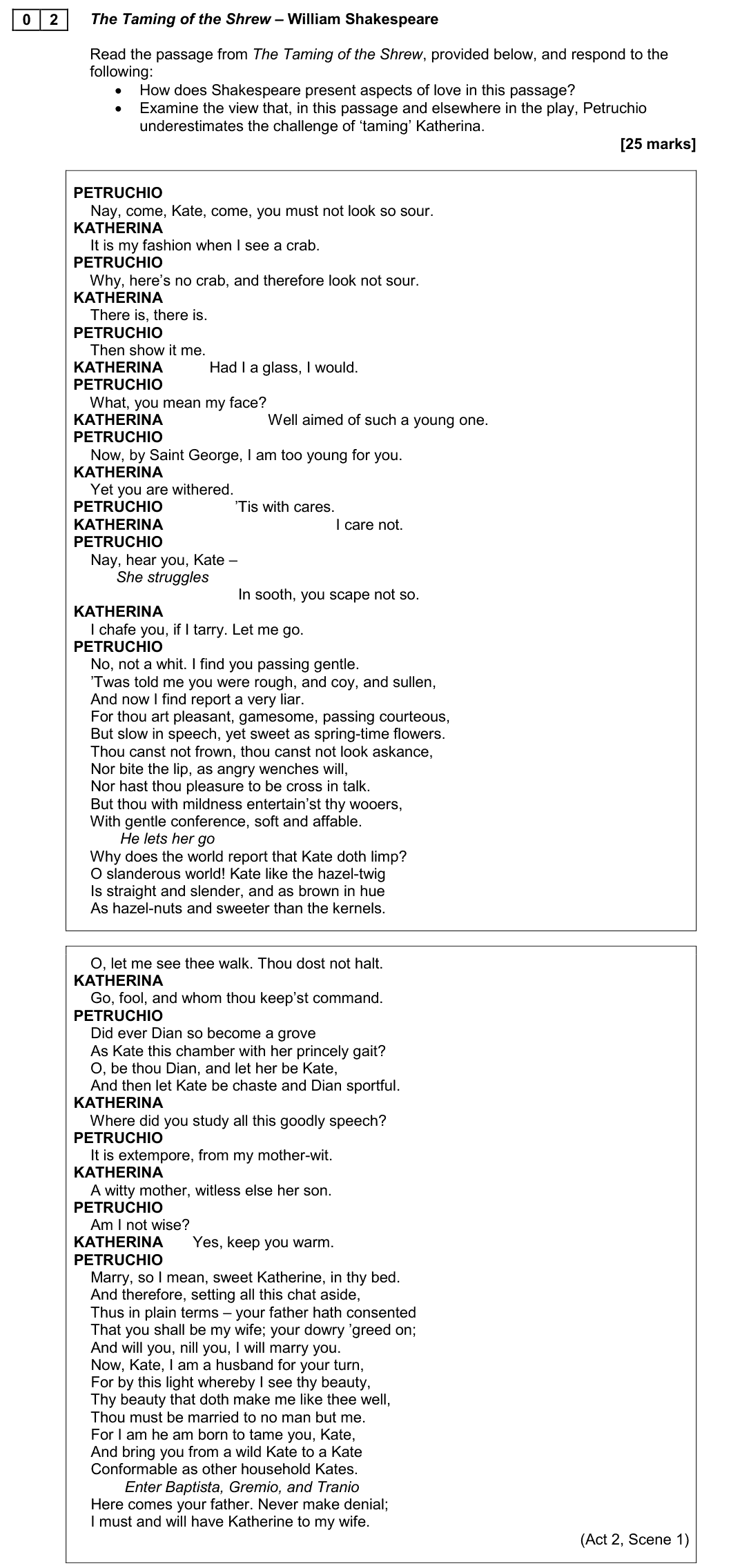
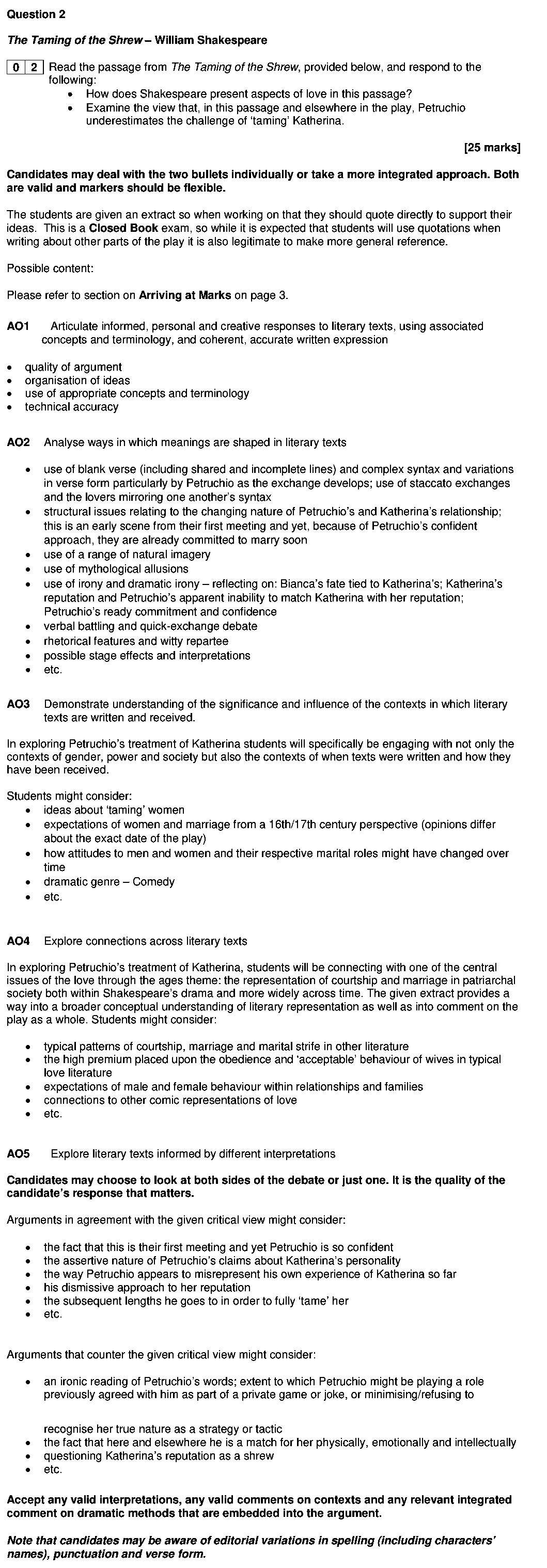
June 2016AS Paper 1225The Taming of the Shrew – William Shakespeare Read the passage from The Taming of the Shrew, provided below, and respond to the following: • How does Shakespeare present aspects of love in this passage? • Examine the view that, in this passage and elsewhere in

Past-paper questions

Print this topic as a pack

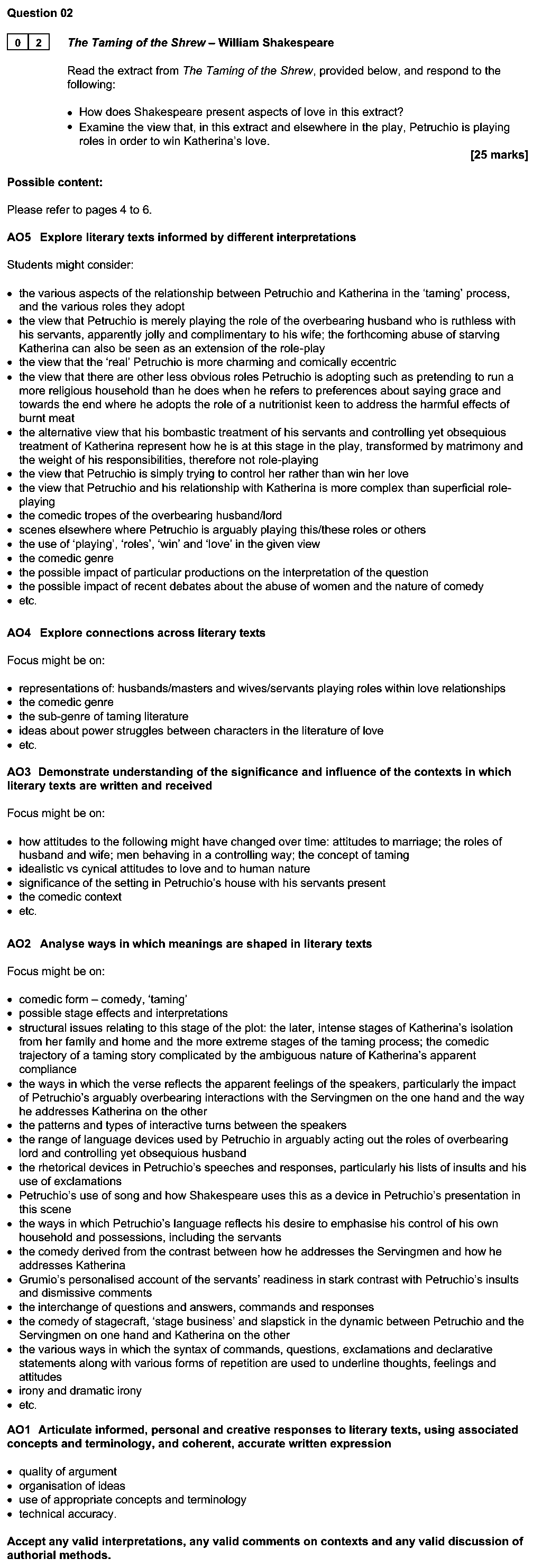
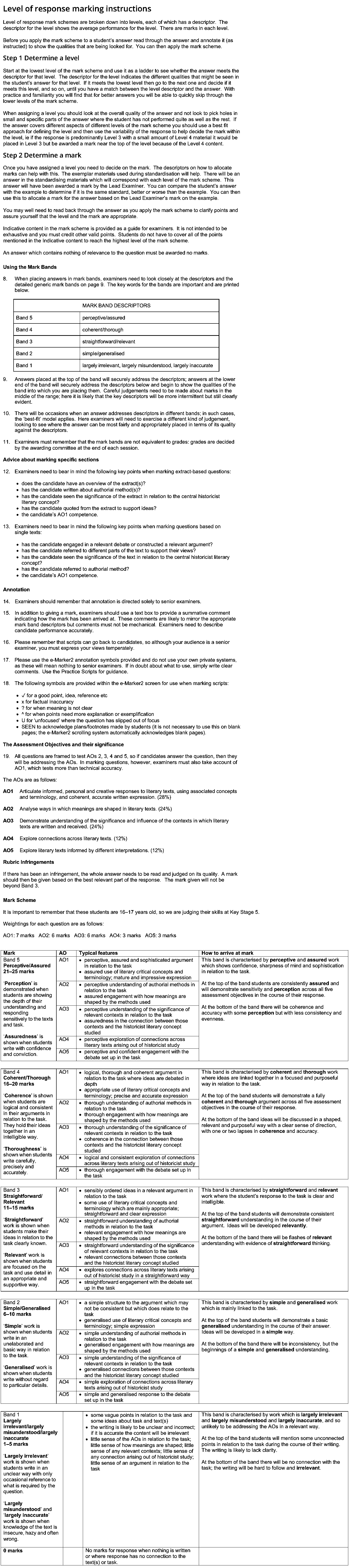
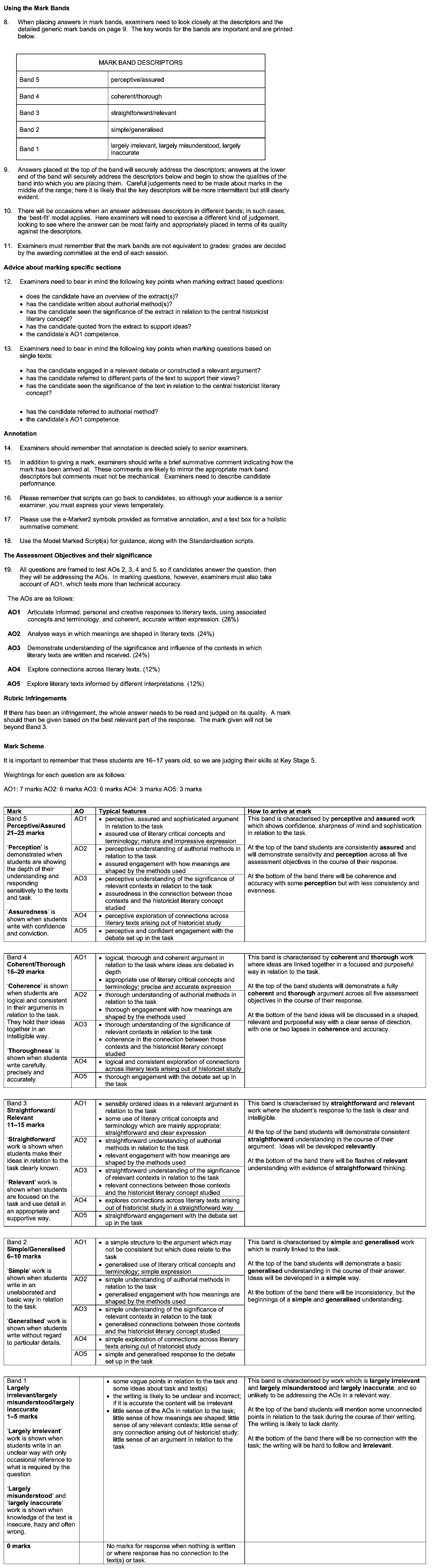
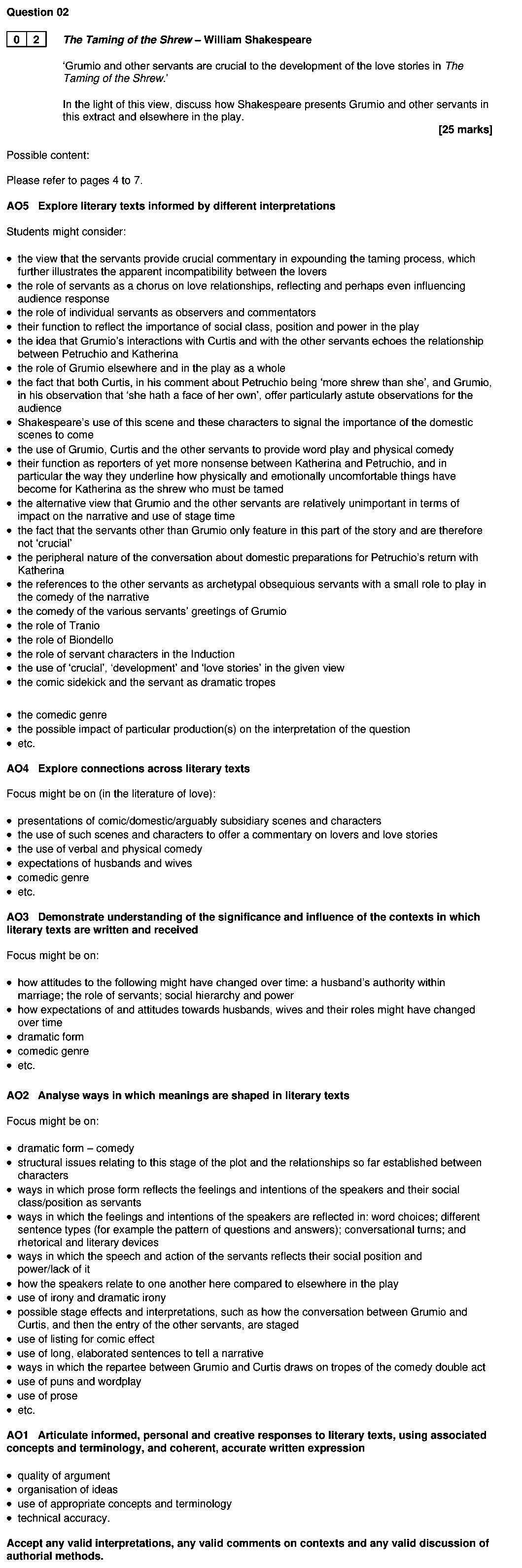
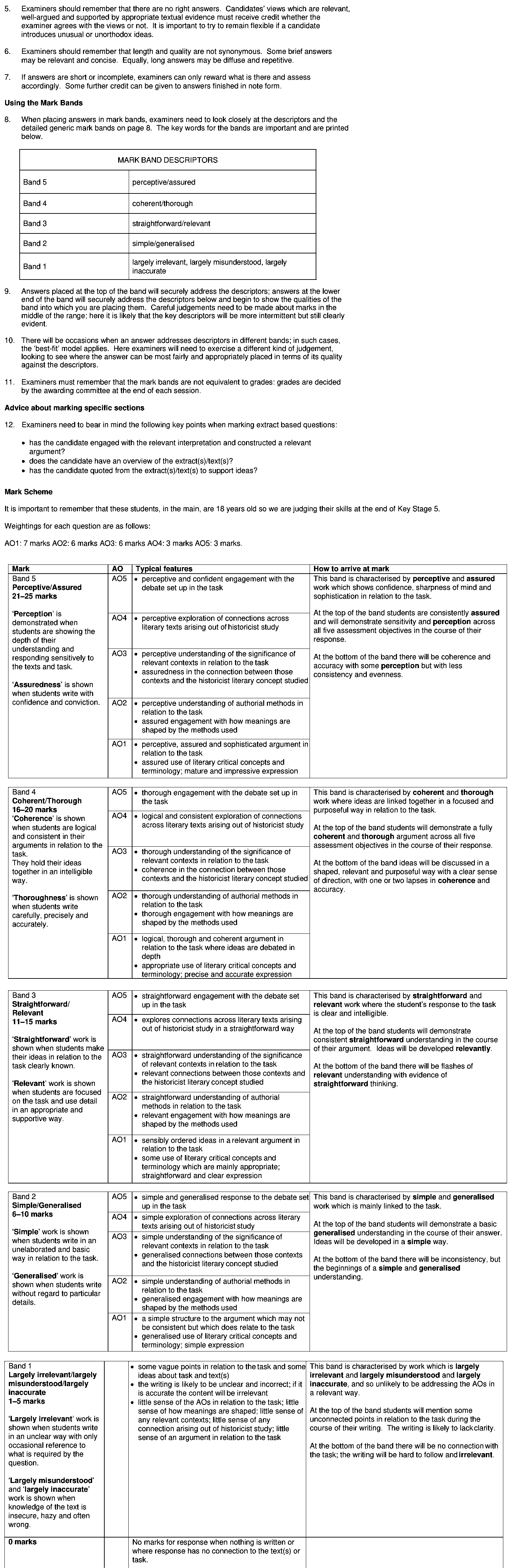
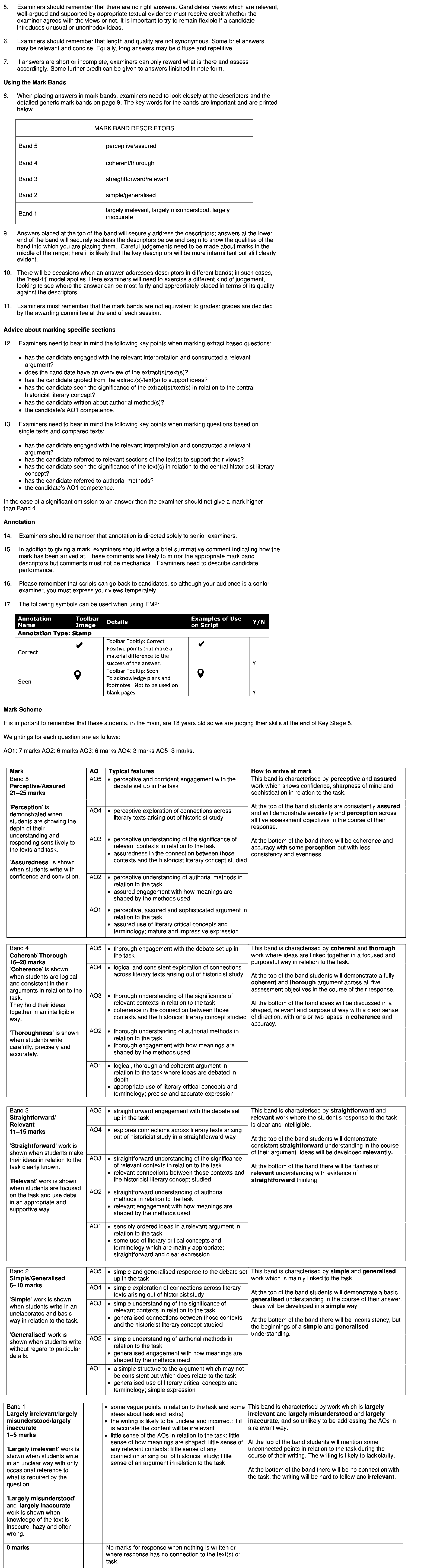
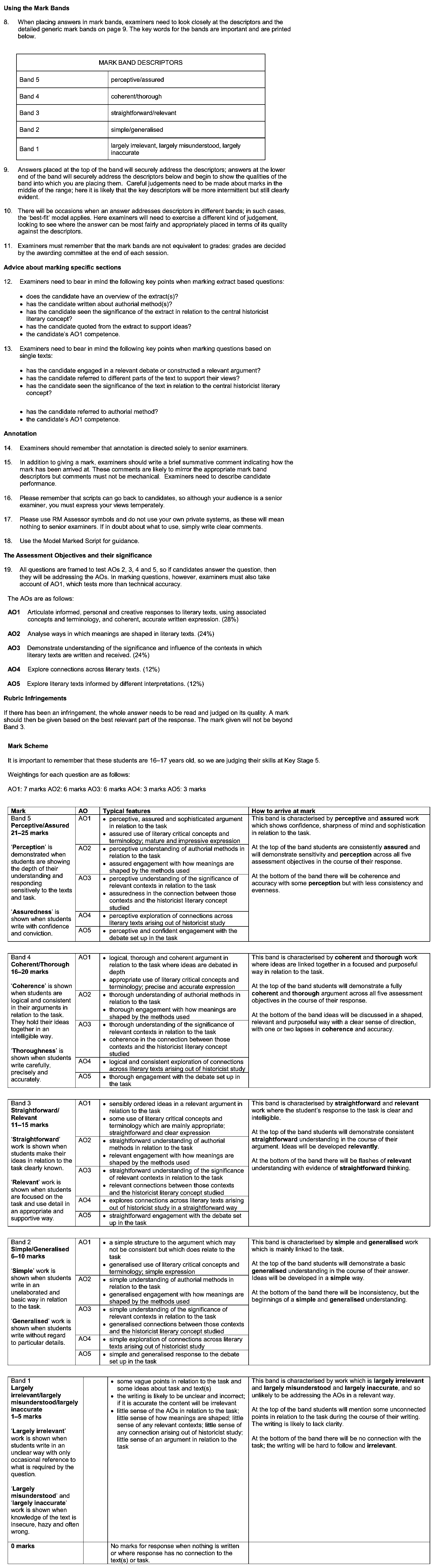
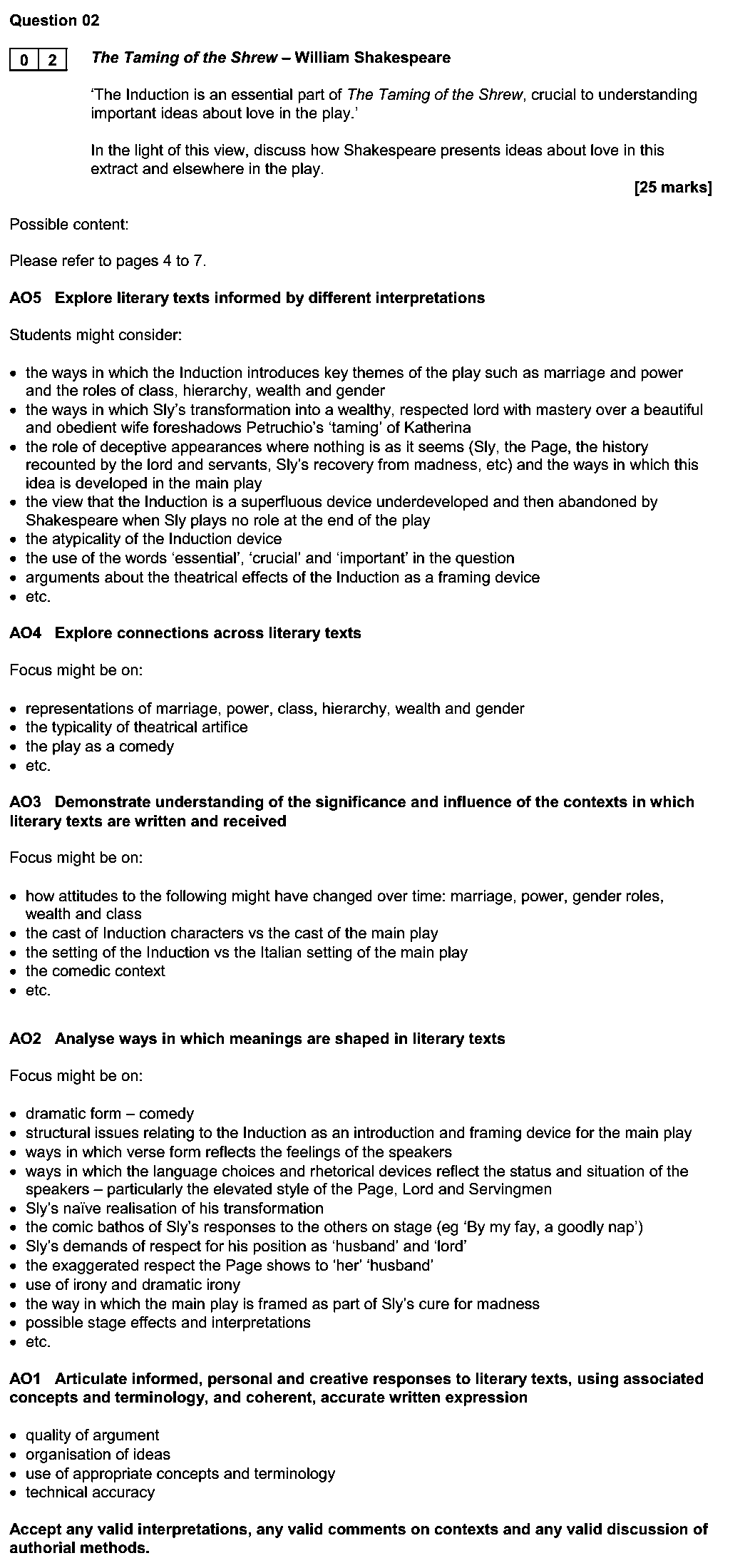
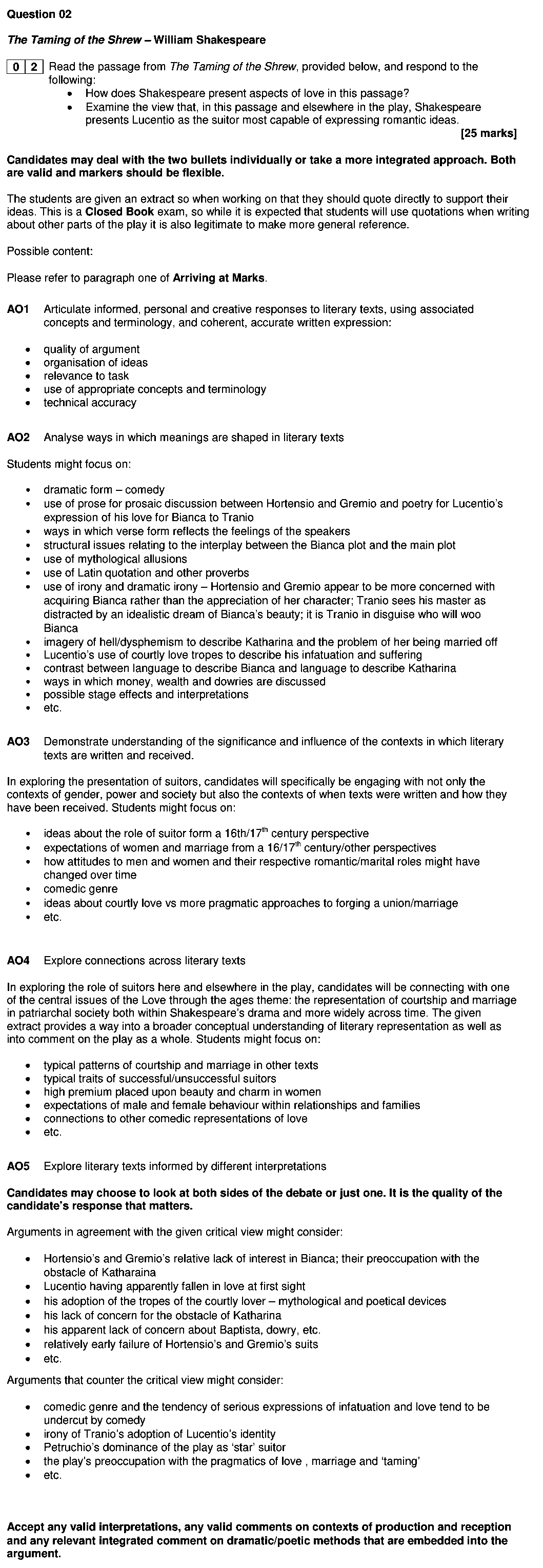
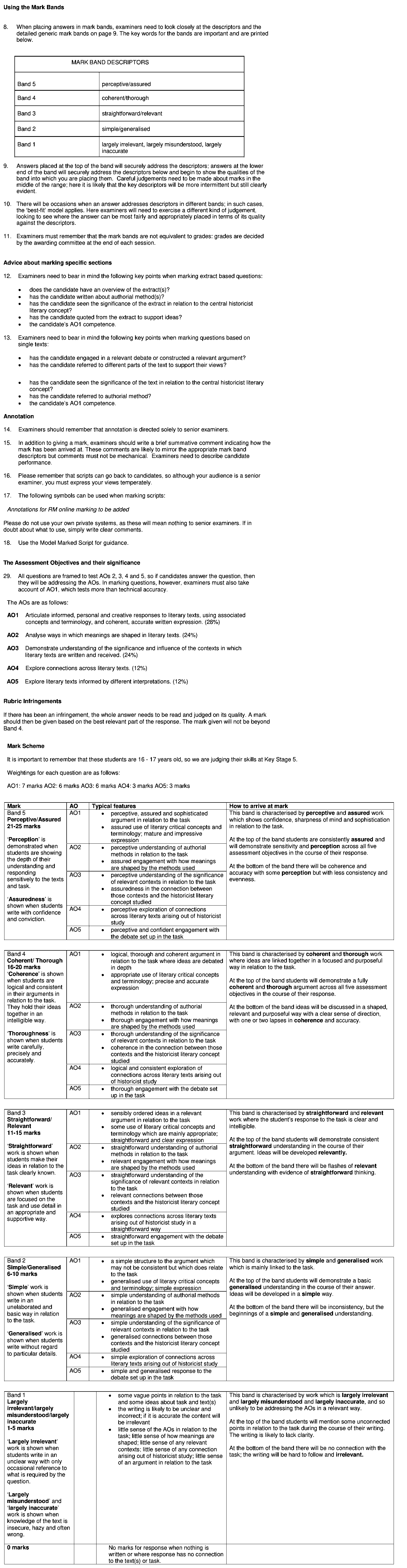
Tap a question to zoom it. The texts and extracts open above it; the mark scheme (with its levels and indicative content) and the examiner's comment open underneath.
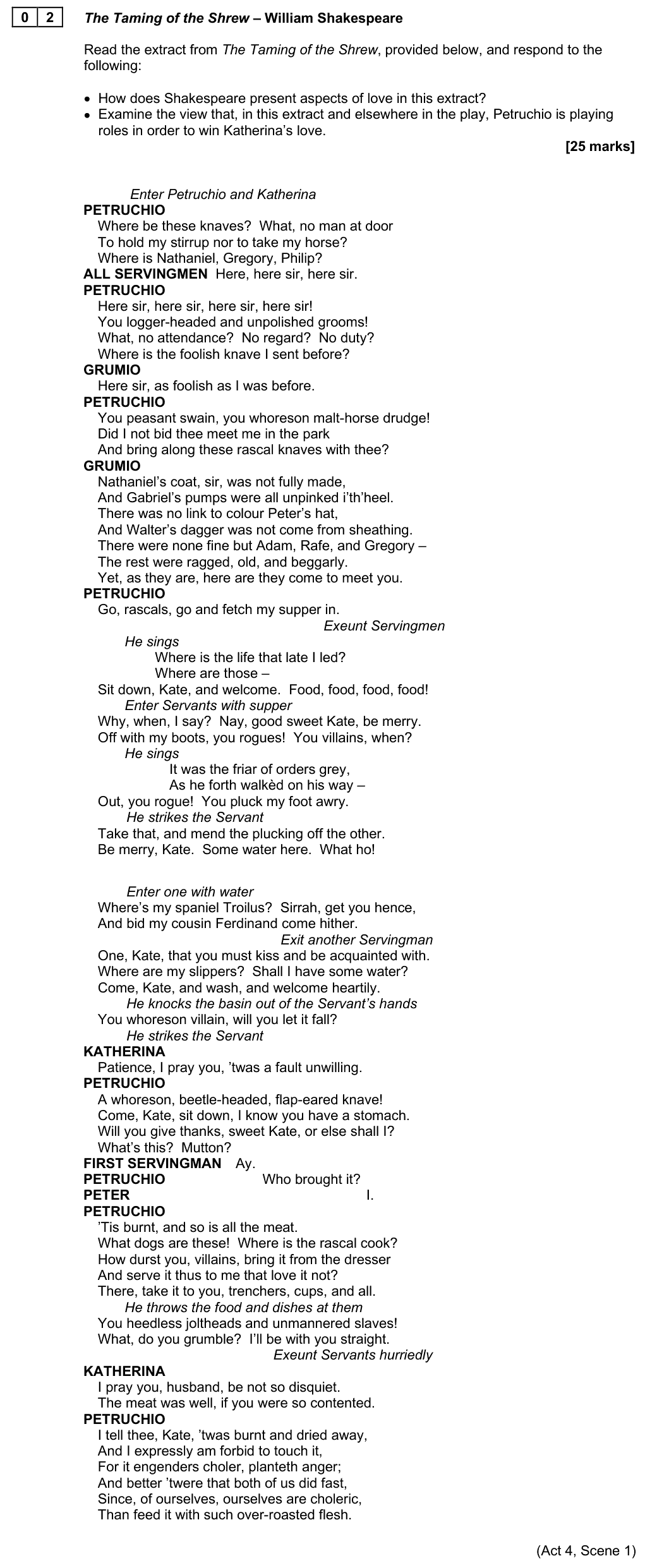
June 2025 · AS Paper 1 · Q2 25 marks Shakespeare extract
The Taming of the Shrew – William Shakespeare
Read the extract from The Taming of the Shrew, provided below, and respond to the
following:
• How does Shakespeare present aspects of love in this extract?
• Examine the view that, in this extract and elsewhere in the play, Petruchio is playing
roles in order to win Katherina’s love.
[25 marks]
Enter Petruchio and Katherina
PETRUCHIO
Where be these knaves? What, no man at door
To hold my stirrup nor to take my horse?
Where is Nathaniel, Gregory, Philip?
ALL SERVINGMEN Here, here sir, here sir.
PETRUCHIO
Here sir, here sir, here sir, here sir!
You logger-headed and unpolished grooms!
What, no attendance? No regard? No duty?
Where is the foolish knave I sent before?
GRUMIO
Here sir, as foolish as I was before.
PETRUCHIO
You peasant swain, you whoreson malt-horse drudge!
Did I not bid thee meet me in the park
And bring along these rascal knaves with thee?
GRUMIO
Nathaniel’s coat, sir, was not fully made,
And Gabriel’s pumps were all unpinked i’th’heel.
There was no link to colour Peter’s hat,
And Walter’s dagger was not come from sheathing.
There were none fine but Adam, Rafe, and Gregory –
The rest were ragged, old, and beggarly.
Yet, as they are, here are they come to meet you.
PETRUCHIO
Go, rascals, go and fetch my supper in.
Exeunt Servingmen
He sings
Where is the life that late I led?
Where are those –
Sit down, Kate, and welcome. Food, food, food, food!
Enter Servants with supper
Why, when, I say? Nay, good sweet Kate, be merry.
Off with my boots, you rogues! You villains, when?
He sings
It was the friar of orders grey,
As he forth walkèd on his way –
Out, you rogue! You pluck my foot awry.
He strikes the Servant
Take that, and mend the plucking off the other.
Be merry, Kate. Some water here. What ho!
Enter one with water
Where’s my spaniel Troilus? Sirrah, get you hence,
And bid my cousin Ferdinand come hither.
Exit another Servingman
One, Kate, that you must kiss and be acquainted with.
Where are my slippers? Shall I have some water?
Come, Kate, and wash, and welcome heartily.
He knocks the basin out of the Servant’s hands
You whoreson villain, will you let it fall?
He strikes the Servant
KATHERINA
Patience, I pray you, ’twas a fault unwilling.
PETRUCHIO
A whoreson, beetle-headed, flap-eared knave!
Come, Kate, sit down, I know you have a stomach.
Will you give thanks, sweet Kate, or else shall I?
What’s this? Mutton?
FIRST SERVINGMAN Ay.
PETRUCHIO
Who brought it?
PETER
I.
PETRUCHIO
’Tis burnt, and so is all the meat.
What dogs are these! Where is the rascal cook?
How durst you, villains, bring it from the dresser
And serve it thus to me that love it not?
There, take it to you, trenchers, cups, and all.
He throws the food and dishes at them
You heedless joltheads and unmannered slaves!
What, do you grumble? I’ll be with you straight.
Exeunt Servants hurriedly
KATHERINA
I pray you, husband, be not so disquiet.
The meat was well, if you were so contented.
PETRUCHIO
I tell thee, Kate, ’twas burnt and dried away,
And I expressly am forbid to touch it,
For it engenders choler, planteth anger;
And better ’twere that both of us did fast,
Since, of ourselves, ourselves are choleric,
Than feed it with such over-roasted flesh.
(Act 4, Scene 1)
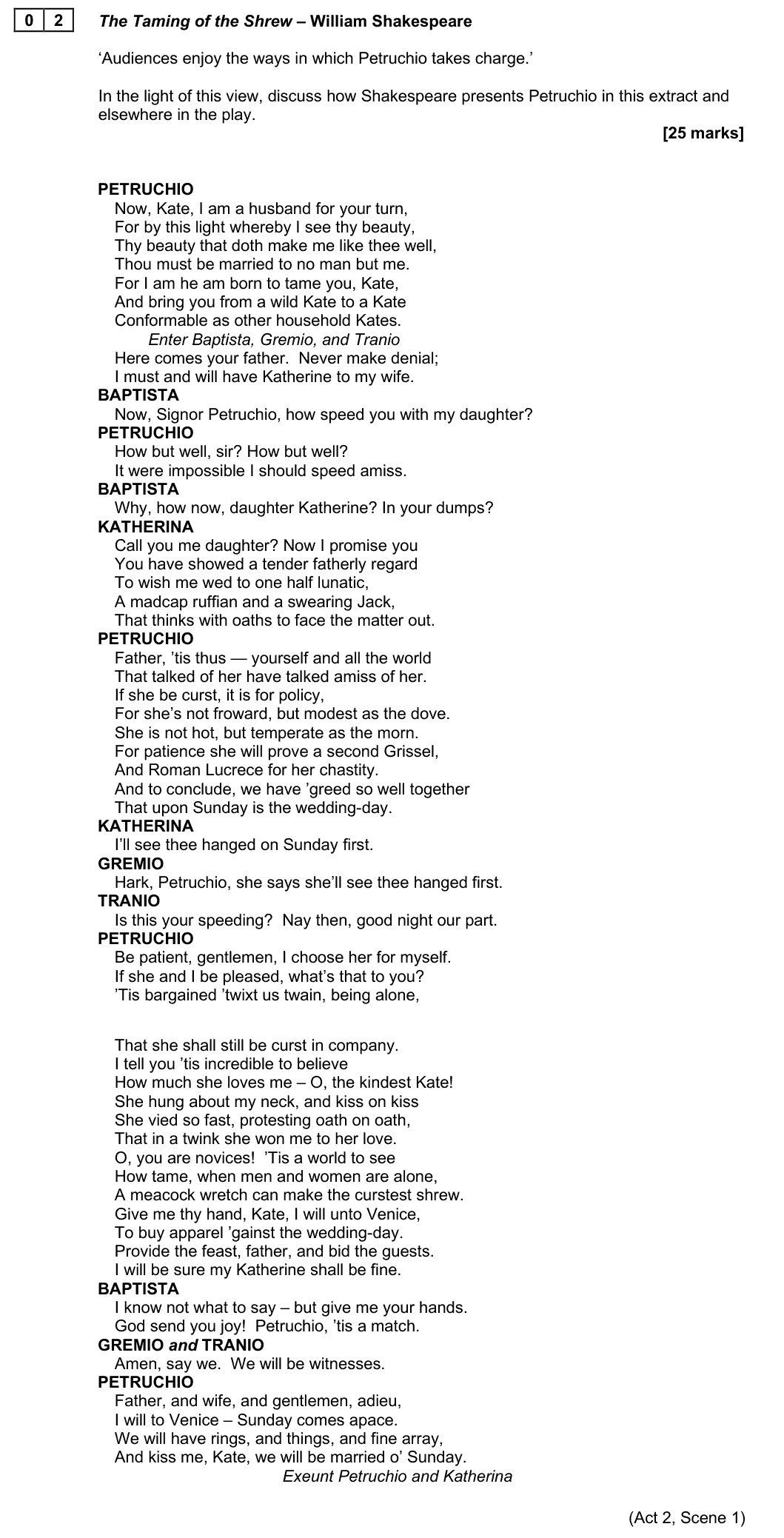
June 2025 · Paper 1 · Q2 25 marks Shakespeare extract
The Taming of the Shrew – William Shakespeare
‘Audiences enjoy the ways in which Petruchio takes charge.’
In the light of this view, discuss how Shakespeare presents Petruchio in this extract and
elsewhere in the play.
[25 marks]
PETRUCHIO
Now, Kate, I am a husband for your turn,
For by this light whereby I see thy beauty,
Thy beauty that doth make me like thee well,
Thou must be married to no man but me.
For I am he am born to tame you, Kate,
And bring you from a wild Kate to a Kate
Conformable as other household Kates.
Enter Baptista, Gremio, and Tranio
Here comes your father. Never make denial;
I must and will have Katherine to my wife.
BAPTISTA
Now, Signor Petruchio, how speed you with my daughter?
PETRUCHIO
How but well, sir? How but well?
It were impossible I should speed amiss.
BAPTISTA
Why, how now, daughter Katherine? In your dumps?
KATHERINA
Call you me daughter? Now I promise you
You have showed a tender fatherly regard
To wish me wed to one half lunatic,
A madcap ruffian and a swearing Jack,
That thinks with oaths to face the matter out.
PETRUCHIO
Father, ’tis thus — yourself and all the world
That talked of her have talked amiss of her.
If she be curst, it is for policy,
For she’s not froward, but modest as the dove.
She is not hot, but temperate as the morn.
For patience she will prove a second Grissel,
And Roman Lucrece for her chastity.
And to conclude, we have ’greed so well together
That upon Sunday is the wedding-day.
KATHERINA
I’ll see thee hanged on Sunday first.
GREMIO
Hark, Petruchio, she says she’ll see thee hanged first.
TRANIO
Is this your speeding? Nay then, good night our part.
PETRUCHIO
Be patient, gentlemen, I choose her for myself.
If she and I be pleased, what’s that to you?
’Tis bargained ’twixt us twain, being alone,
That she shall still be curst in company.
I tell you ’tis incredible to believe
How much she loves me – O, the kindest Kate!
She hung about my neck, and kiss on kiss
She vied so fast, protesting oath on oath,
That in a twink she won me to her love.
O, you are novices! ’Tis a world to see
How tame, when men and women are alone,
A meacock wretch can make the curstest shrew.
Give me thy hand, Kate, I will unto Venice,
To buy apparel ’gainst the wedding-day.
Provide the feast, father, and bid the guests.
I will be sure my Katherine shall be fine.
BAPTISTA
I know not what to say – but give me your hands.
God send you joy! Petruchio, ’tis a match.
GREMIO and TRANIO
Amen, say we. We will be witnesses.
PETRUCHIO
Father, and wife, and gentlemen, adieu,
I will to Venice – Sunday comes apace.
We will have rings, and things, and fine array,
And kiss me, Kate, we will be married o’ Sunday.
Exeunt Petruchio and Katherina
(Act 2, Scene 1)
June 2024 · AS Paper 1 · Q2 25 marks Shakespeare extract
The Taming of the Shrew – William Shakespeare
Read the extract from The Taming of the Shrew, provided below, and respond to the
following:
• How does Shakespeare present aspects of love in this extract?
• Examine the view that, in this extract and elsewhere in the play, a modern audience
would be more disgusted than amused by Katherina’s ordeal.
[25 marks]
GRUMIO
No, no, forsooth, I dare not for my life.
KATHERINA
The more my wrong, the more his spite appears.
What, did he marry me to famish me?
Beggars that come unto my father’s door
Upon entreaty have a present alms,
If not, elsewhere they meet with charity.
But I, who never knew how to entreat,
Nor never needed that I should entreat,
Am starved for meat, giddy for lack of sleep,
With oaths kept waking, and with brawling fed.
And that which spites me more than all these wants,
He does it under name of perfect love,
As who should say, if I should sleep or eat,
’Twere deadly sickness or else present death.
I prithee go and get me some repast,
I care not what, so it be wholesome food.
GRUMIO
What say you to a neat’s foot?
KATHERINA
’Tis passing good, I prithee let me have it.
GRUMIO
I fear it is too choleric a meat.
How say you to a fat tripe finely broiled?
KATHERINA
I like it well. Good Grumio, fetch it me.
GRUMIO
I cannot tell, I fear ’tis choleric.
What say you to a piece of beef and mustard?
KATHERINA
A dish that I do love to feed upon.
GRUMIO
Ay, but the mustard is too hot a little.
KATHERINA
Why then, the beef, and let the mustard rest.
GRUMIO
Nay then, I will not. You shall have the mustard,
Or else you get no beef of Grumio.
KATHERINA
Then both, or one, or anything thou wilt.
GRUMIO
Why then, the mustard without the beef.
KATHERINA
Go, get thee gone, thou false deluding slave,
She beats him
That feed’st me with the very name of meat.
Sorrow on thee and all the pack of you
That triumph thus upon my misery!
Go, get thee gone, I say.
Enter Petruchio and Hortensio with meat
PETRUCHIO
How fares my Kate? What, sweeting, all amort?
HORTENSIO
Mistress, what cheer?
KATHERINA Faith, as cold as can be.
PETRUCHIO
Pluck up thy spirits, look cheerfully upon me.
Here, love, thou seest how diligent I am,
To dress thy meat myself, and bring it thee.
He sets the dish down
I am sure, sweet Kate, this kindness merits thanks.
What, not a word? Nay then, thou lov’st it not,
And all my pains is sorted to no proof.
Here, take away this dish.
KATHERINA I pray you, let it stand.
PETRUCHIO
The poorest service is repaid with thanks,
And so shall mine before you touch the meat.
KATHERINA
I thank you, sir.
HORTENSIO
Signor Petruchio, fie, you are to blame.
(Act 4, Scene 3)
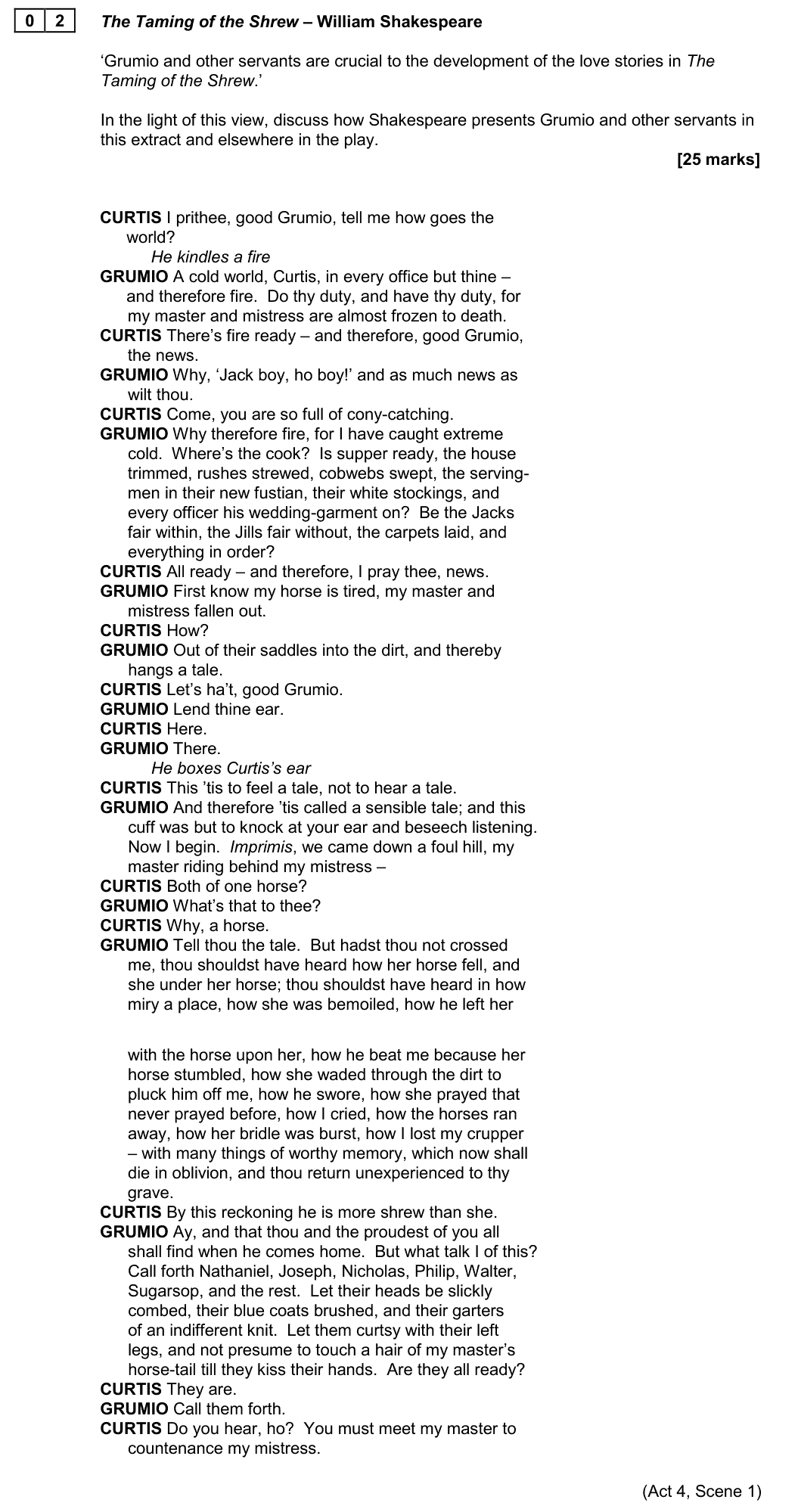
June 2024 · Paper 1 · Q2 25 marks Shakespeare extract
The Taming of the Shrew – William Shakespeare
‘Grumio and other servants are crucial to the development of the love stories in The
Taming of the Shrew.’
In the light of this view, discuss how Shakespeare presents Grumio and other servants in
this extract and elsewhere in the play.
[25 marks]
CURTIS I prithee, good Grumio, tell me how goes the
world?
He kindles a fire
GRUMIO A cold world, Curtis, in every office but thine –
and therefore fire. Do thy duty, and have thy duty, for
my master and mistress are almost frozen to death.
CURTIS There’s fire ready – and therefore, good Grumio,
the news.
GRUMIO Why, ‘Jack boy, ho boy!’ and as much news as
wilt thou.
CURTIS Come, you are so full of cony-catching.
GRUMIO Why therefore fire, for I have caught extreme
cold. Where’s the cook? Is supper ready, the house
trimmed, rushes strewed, cobwebs swept, the serving-
men in their new fustian, their white stockings, and
every officer his wedding-garment on? Be the Jacks
fair within, the Jills fair without, the carpets laid, and
everything in order?
CURTIS All ready – and therefore, I pray thee, news.
GRUMIO First know my horse is tired, my master and
mistress fallen out.
CURTIS How?
GRUMIO Out of their saddles into the dirt, and thereby
hangs a tale.
CURTIS Let’s ha’t, good Grumio.
GRUMIO Lend thine ear.
CURTIS Here.
GRUMIO There.
He boxes Curtis’s ear
CURTIS This ’tis to feel a tale, not to hear a tale.
GRUMIO And therefore ’tis called a sensible tale; and this
cuff was but to knock at your ear and beseech listening.
Now I begin. Imprimis, we came down a foul hill, my
master riding behind my mistress –
CURTIS Both of one horse?
GRUMIO What’s that to thee?
CURTIS Why, a horse.
GRUMIO Tell thou the tale. But hadst thou not crossed
me, thou shouldst have heard how her horse fell, and
she under her horse; thou shouldst have heard in how
miry a place, how she was bemoiled, how he left her
with the horse upon her, how he beat me because her
horse stumbled, how she waded through the dirt to
pluck him off me, how he swore, how she prayed that
never prayed before, how I cried, how the horses ran
away, how her bridle was burst, how I lost my crupper
– with many things of worthy memory, which now shall
die in oblivion, and thou return unexperienced to thy
grave.
CURTIS By this reckoning he is more shrew than she.
GRUMIO Ay, and that thou and the proudest of you all
shall find when he comes home. But what talk I of this?
Call forth Nathaniel, Joseph, Nicholas, Philip, Walter,
Sugarsop, and the rest. Let their heads be slickly
combed, their blue coats brushed, and their garters
of an indifferent knit. Let them curtsy with their left
legs, and not presume to touch a hair of my master’s
horse-tail till they kiss their hands. Are they all ready?
CURTIS They are.
GRUMIO Call them forth.
CURTIS Do you hear, ho? You must meet my master to
countenance my mistress.
(Act 4, Scene 1)
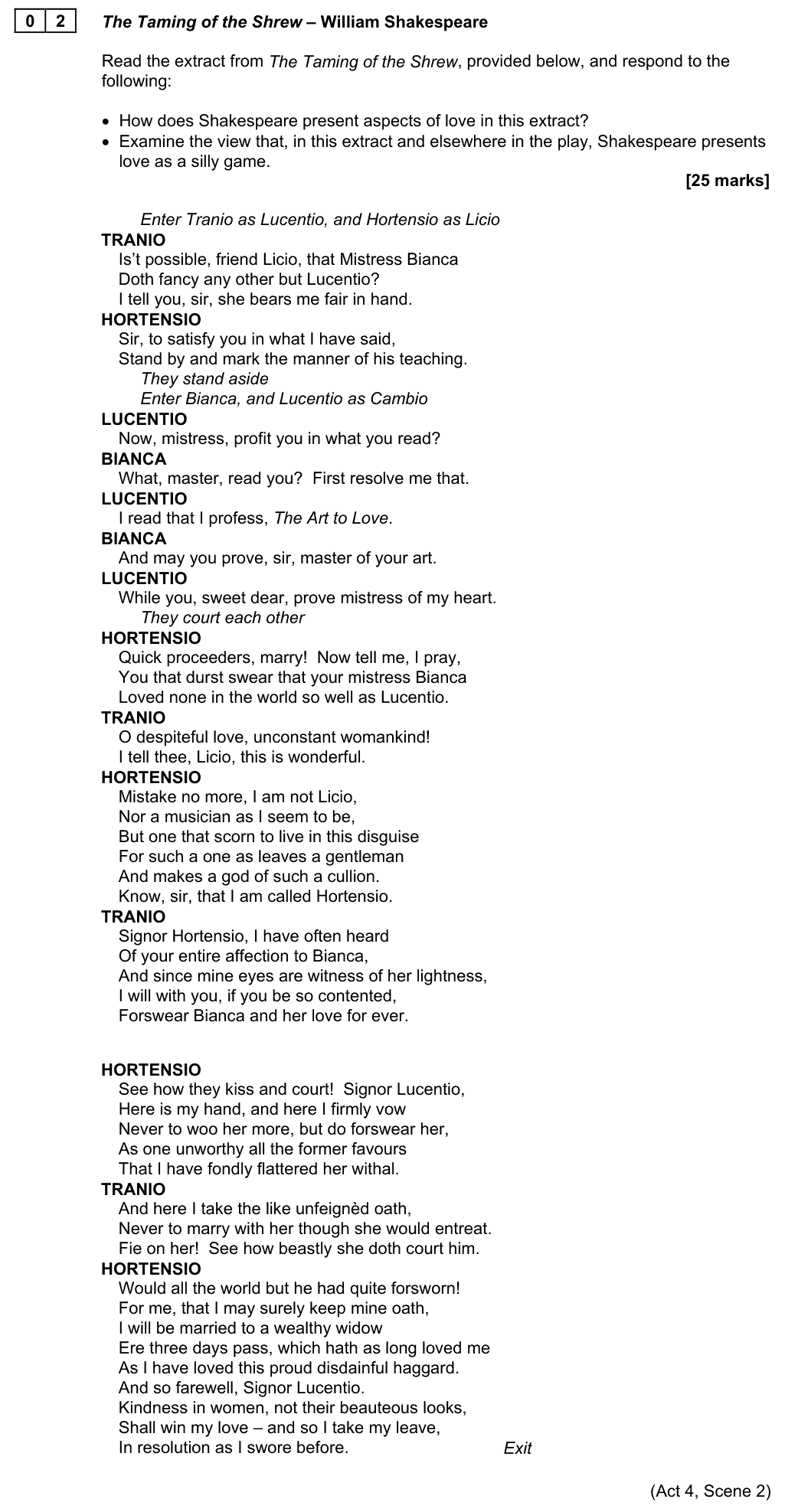
June 2023 · AS Paper 1 · Q2 25 marks Shakespeare extract
The Taming of the Shrew – William Shakespeare
Read the extract from The Taming of the Shrew, provided below, and respond to the
following:
• How does Shakespeare present aspects of love in this extract?
• Examine the view that, in this extract and elsewhere in the play, Shakespeare presents
love as a silly game.
[25 marks]
Enter Tranio as Lucentio, and Hortensio as Licio
TRANIO
Is’t possible, friend Licio, that Mistress Bianca
Doth fancy any other but Lucentio?
I tell you, sir, she bears me fair in hand.
HORTENSIO
Sir, to satisfy you in what I have said,
Stand by and mark the manner of his teaching.
They stand aside
Enter Bianca, and Lucentio as Cambio
LUCENTIO
Now, mistress, profit you in what you read?
BIANCA
What, master, read you? First resolve me that.
LUCENTIO
I read that I profess, The Art to Love.
BIANCA
And may you prove, sir, master of your art.
LUCENTIO
While you, sweet dear, prove mistress of my heart.
They court each other
HORTENSIO
Quick proceeders, marry! Now tell me, I pray,
You that durst swear that your mistress Bianca
Loved none in the world so well as Lucentio.
TRANIO
O despiteful love, unconstant womankind!
I tell thee, Licio, this is wonderful.
HORTENSIO
Mistake no more, I am not Licio,
Nor a musician as I seem to be,
But one that scorn to live in this disguise
For such a one as leaves a gentleman
And makes a god of such a cullion.
Know, sir, that I am called Hortensio.
TRANIO
Signor Hortensio, I have often heard
Of your entire affection to Bianca,
And since mine eyes are witness of her lightness,
I will with you, if you be so contented,
Forswear Bianca and her love for ever.
HORTENSIO
See how they kiss and court! Signor Lucentio,
Here is my hand, and here I firmly vow
Never to woo her more, but do forswear her,
As one unworthy all the former favours
That I have fondly flattered her withal.
TRANIO
And here I take the like unfeignèd oath,
Never to marry with her though she would entreat.
Fie on her! See how beastly she doth court him.
HORTENSIO
Would all the world but he had quite forsworn!
For me, that I may surely keep mine oath,
I will be married to a wealthy widow
Ere three days pass, which hath as long loved me
As I have loved this proud disdainful haggard.
And so farewell, Signor Lucentio.
Kindness in women, not their beauteous looks,
Shall win my love – and so I take my leave,
In resolution as I swore before. Exit
(Act 4, Scene 2)
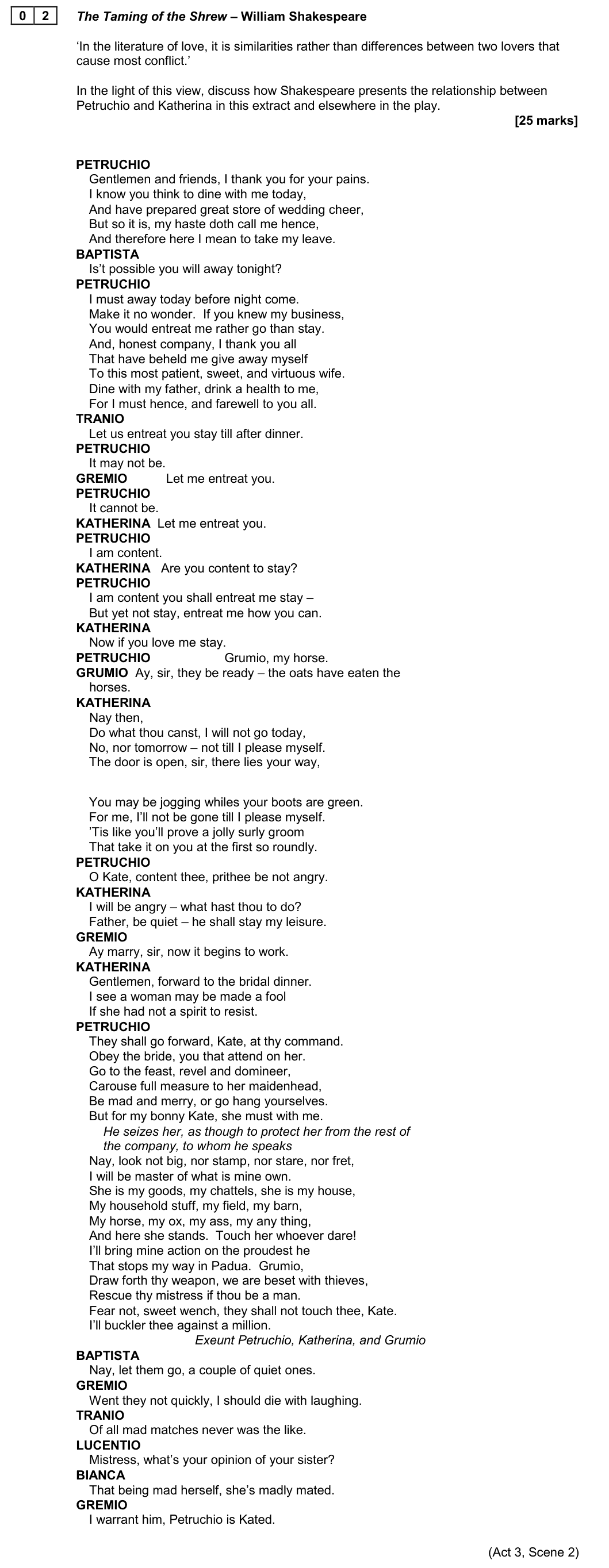
June 2023 · Paper 1 · Q2 25 marks Shakespeare extract
The Taming of the Shrew – William Shakespeare
‘In the literature of love, it is similarities rather than differences between two lovers that
cause most conflict.’
In the light of this view, discuss how Shakespeare presents the relationship between
Petruchio and Katherina in this extract and elsewhere in the play.
[25 marks]
PETRUCHIO
Gentlemen and friends, I thank you for your pains.
I know you think to dine with me today,
And have prepared great store of wedding cheer,
But so it is, my haste doth call me hence,
And therefore here I mean to take my leave.
BAPTISTA
Is’t possible you will away tonight?
PETRUCHIO
I must away today before night come.
Make it no wonder. If you knew my business,
You would entreat me rather go than stay.
And, honest company, I thank you all
That have beheld me give away myself
To this most patient, sweet, and virtuous wife.
Dine with my father, drink a health to me,
For I must hence, and farewell to you all.
TRANIO
Let us entreat you stay till after dinner.
PETRUCHIO
It may not be.
GREMIO Let me entreat you.
PETRUCHIO
It cannot be.
KATHERINA Let me entreat you.
PETRUCHIO
I am content.
KATHERINA Are you content to stay?
PETRUCHIO
I am content you shall entreat me stay –
But yet not stay, entreat me how you can.
KATHERINA
Now if you love me stay.
PETRUCHIO Grumio, my horse.
GRUMIO Ay, sir, they be ready – the oats have eaten the
horses.
KATHERINA
Nay then,
Do what thou canst, I will not go today,
No, nor tomorrow – not till I please myself.
The door is open, sir, there lies your way,
You may be jogging whiles your boots are green.
For me, I’ll not be gone till I please myself.
’Tis like you’ll prove a jolly surly groom
That take it on you at the first so roundly.
PETRUCHIO
O Kate, content thee, prithee be not angry.
KATHERINA
I will be angry – what hast thou to do?
Father, be quiet – he shall stay my leisure.
GREMIO
Ay marry, sir, now it begins to work.
KATHERINA
Gentlemen, forward to the bridal dinner.
I see a woman may be made a fool
If she had not a spirit to resist.
PETRUCHIO
They shall go forward, Kate, at thy command.
Obey the bride, you that attend on her.
Go to the feast, revel and domineer,
Carouse full measure to her maidenhead,
Be mad and merry, or go hang yourselves.
But for my bonny Kate, she must with me.
He seizes her, as though to protect her from the rest of
the company, to whom he speaks
Nay, look not big, nor stamp, nor stare, nor fret,
I will be master of what is mine own.
She is my goods, my chattels, she is my house,
My household stuff, my field, my barn,
My horse, my ox, my ass, my any thing,
And here she stands. Touch her whoever dare!
I’ll bring mine action on the proudest he
That stops my way in Padua. Grumio,
Draw forth thy weapon, we are beset with thieves,
Rescue thy mistress if thou be a man.
Fear not, sweet wench, they shall not touch thee, Kate.
I’ll buckler thee against a million.
Exeunt Petruchio, Katherina, and Grumio
BAPTISTA
Nay, let them go, a couple of quiet ones.
GREMIO
Went they not quickly, I should die with laughing.
TRANIO
Of all mad matches never was the like.
LUCENTIO
Mistress, what’s your opinion of your sister?
BIANCA
That being mad herself, she’s madly mated.
GREMIO
I warrant him, Petruchio is Kated.
(Act 3, Scene 2)
June 2022 · AS Paper 1 · Q2 25 marks Shakespeare extract
The Taming of the Shrew – William Shakespeare
Read the extract from The Taming of the Shrew, provided below, and respond to the
following:
• How does Shakespeare present aspects of love in this extract?
• Examine the view that, in this extract and elsewhere in the play, men judge women
solely on their monetary value.
[25 marks]
PETRUCHIO
...I have thrust myself into this maze,
Haply to wive and thrive as best I may.
Crowns in my purse I have, and goods at home,
And so am come abroad to see the world.
HORTENSIO
Petruchio, shall I then come roundly to thee
And wish thee to a shrewd ill-favoured wife?
Thou’dst thank me but a little for my counsel,
And yet I’ll promise thee she shall be rich,
And very rich. But th’ art too much my friend,
And I’ll not wish thee to her.
PETRUCHIO
Signor Hortensio, ’twixt such friends as we
Few words suffice; and therefore, if thou know
One rich enough to be Petruchio’s wife –
As wealth is burden of my wooing dance –
Be she as foul as was Florentius’ love,
As old as Sibyl, and as curst and shrewd
As Socrates’ Xanthippe, or a worse,
She moves me not, or not removes at least
Affection’s edge in me, were she as rough
As are the swelling Adriatic seas.
I come to wive it wealthily in Padua;
If wealthily, then happily in Padua.
GRUMIO Nay, look you, sir, he tells you flatly what his
mind is. Why, give him gold enough and marry him to
a puppet or an aglet-baby, or an old trot with ne’er a
tooth in her head, though she have as many diseases
as two and fifty horses. Why, nothing comes amiss, so
money comes withal.
HORTENSIO
Petruchio, since we are stepped thus far in,
I will continue that I broached in jest.
I can, Petruchio, help thee to a wife
With wealth enough, and young and beauteous,
Brought up as best becomes a gentlewoman.
Her only fault – and that is faults enough –
Is that she is intolerable curst,
And shrewd and froward so beyond all measure
That, were my state far worser than it is,
I would not wed her for a mine of gold.
PETRUCHIO
Hortensio, peace. Thou know’st not gold’s effect.
Tell me her father’s name and ’tis enough.
For I will board her though she chide as loud
As thunder when the clouds in autumn crack.
HORTENSIO
Her father is Baptista Minola,
An affable and courteous gentleman.
Her name is Katherina Minola,
Renowned in Padua for her scolding tongue.
PETRUCHIO
I know her father, though I know not her,
And he knew my deceasèd father well.
I will not sleep, Hortensio, till I see her,
And therefore let me be thus bold with you
To give you over at this first encounter,
Unless you will accompany me thither.
GRUMIO I pray you, sir, let him go while the humour lasts.
O’ my word, an she knew him as well as I do, she would
think scolding would do little good upon him. She may
perhaps call him half a score knaves or so. Why, that’s
nothing; an he begin once, he’ll rail in his rope-tricks.
I’ll tell you what, sir, an she stand him but a little, he
will throw a figure in her face, and so disfigure her with
it that she shall have no more eyes to see withal than a
cat. You know him not, sir.
HORTENSIO
Tarry, Petruchio, I must go with thee,
For in Baptista’s keep my treasure is.
He hath the jewel of my life in hold,
His youngest daughter, beautiful Bianca,
And her withholds from me and other more,
Suitors to her and rivals in my love,
Supposing it a thing impossible,
For those defects I have before rehearsed,
That ever Katherina will be wooed.
Therefore this order hath Baptista ta’en,
That none shall have access unto Bianca
Till Katherine the curst have got a husband.
GRUMIO
Katherine the curst,
A title for a maid of all titles the worst.
(Act 1, Scene 2)
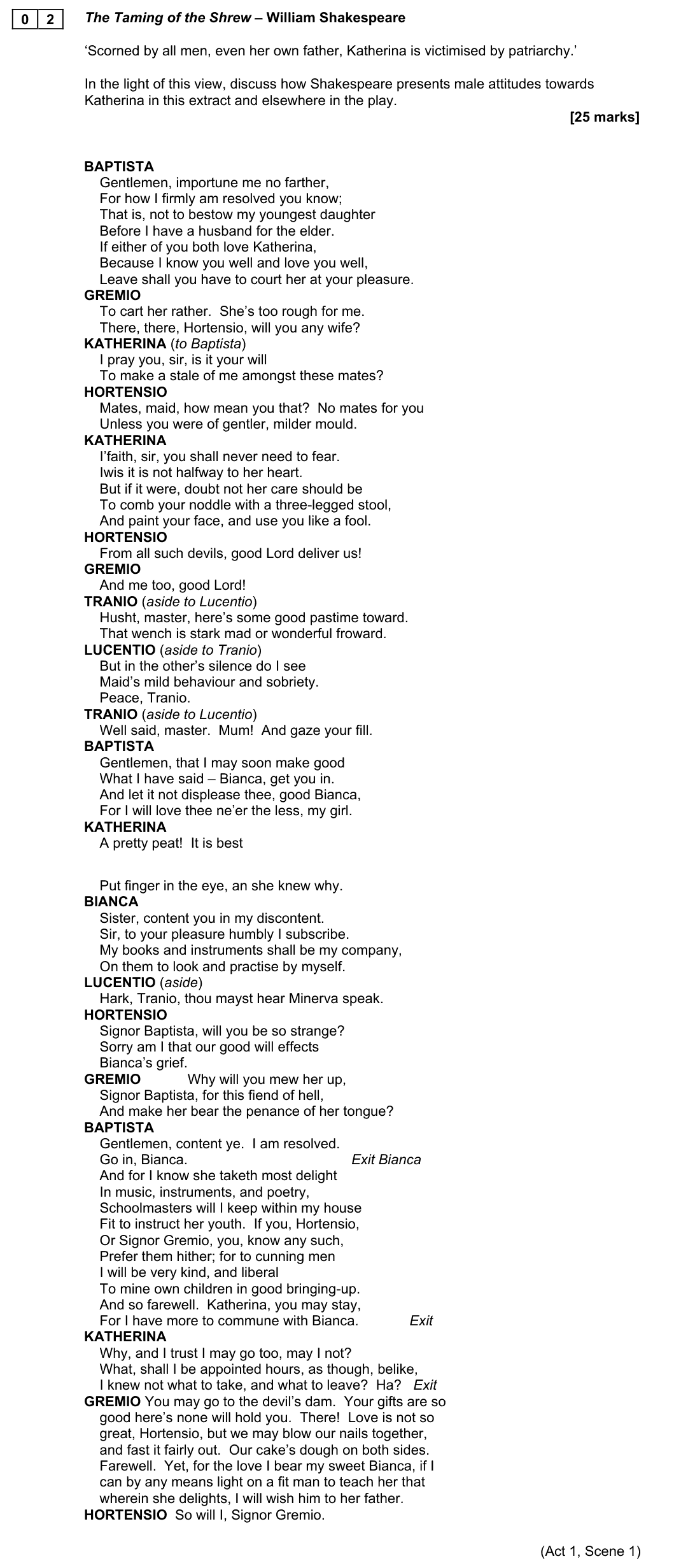
June 2022 · Paper 1 · Q2 25 marks Shakespeare extract
The Taming of the Shrew – William Shakespeare
‘Scorned by all men, even her own father, Katherina is victimised by patriarchy.’
In the light of this view, discuss how Shakespeare presents male attitudes towards
Katherina in this extract and elsewhere in the play.
[25 marks]
BAPTISTA
Gentlemen, importune me no farther,
For how I firmly am resolved you know;
That is, not to bestow my youngest daughter
Before I have a husband for the elder.
If either of you both love Katherina,
Because I know you well and love you well,
Leave shall you have to court her at your pleasure.
GREMIO
To cart her rather. She’s too rough for me.
There, there, Hortensio, will you any wife?
KATHERINA (to Baptista)
I pray you, sir, is it your will
To make a stale of me amongst these mates?
HORTENSIO
Mates, maid, how mean you that? No mates for you
Unless you were of gentler, milder mould.
KATHERINA
I’faith, sir, you shall never need to fear.
Iwis it is not halfway to her heart.
But if it were, doubt not her care should be
To comb your noddle with a three-legged stool,
And paint your face, and use you like a fool.
HORTENSIO
From all such devils, good Lord deliver us!
GREMIO
And me too, good Lord!
TRANIO (aside to Lucentio)
Husht, master, here’s some good pastime toward.
That wench is stark mad or wonderful froward.
LUCENTIO (aside to Tranio)
But in the other’s silence do I see
Maid’s mild behaviour and sobriety.
Peace, Tranio.
TRANIO (aside to Lucentio)
Well said, master. Mum! And gaze your fill.
BAPTISTA
Gentlemen, that I may soon make good
What I have said – Bianca, get you in.
And let it not displease thee, good Bianca,
For I will love thee ne’er the less, my girl.
KATHERINA
A pretty peat! It is best
Put finger in the eye, an she knew why.
BIANCA
Sister, content you in my discontent.
Sir, to your pleasure humbly I subscribe.
My books and instruments shall be my company,
On them to look and practise by myself.
LUCENTIO (aside)
Hark, Tranio, thou mayst hear Minerva speak.
HORTENSIO
Signor Baptista, will you be so strange?
Sorry am I that our good will effects
Bianca’s grief.
GREMIO Why will you mew her up,
Signor Baptista, for this fiend of hell,
And make her bear the penance of her tongue?
BAPTISTA
Gentlemen, content ye. I am resolved.
Go in, Bianca. Exit Bianca
And for I know she taketh most delight
In music, instruments, and poetry,
Schoolmasters will I keep within my house
Fit to instruct her youth. If you, Hortensio,
Or Signor Gremio, you, know any such,
Prefer them hither; for to cunning men
I will be very kind, and liberal
To mine own children in good bringing-up.
And so farewell. Katherina, you may stay,
For I have more to commune with Bianca. Exit
KATHERINA
Why, and I trust I may go too, may I not?
What, shall I be appointed hours, as though, belike,
I knew not what to take, and what to leave? Ha? Exit
GREMIO You may go to the devil’s dam. Your gifts are so
good here’s none will hold you. There! Love is not so
great, Hortensio, but we may blow our nails together,
and fast it fairly out. Our cake’s dough on both sides.
Farewell. Yet, for the love I bear my sweet Bianca, if I
can by any means light on a fit man to teach her that
wherein she delights, I will wish him to her father.
HORTENSIO So will I, Signor Gremio.
(Act 1, Scene 1)
November 2021 · Paper 1 · Q2 25 marks Shakespeare extract
The Taming of the Shrew – William Shakespeare
‘The test of obedience initiated by Petruchio is a dark demonstration of male power which
undermines the comedy of the play.’
In the light of this view, discuss how Shakespeare presents attitudes towards marriage in
this extract and elsewhere in the play.
[25 marks]
BAPTISTA
Now, in good sadness, son Petruchio,
I think thou hast the veriest shrew of all.
PETRUCHIO
Well, I say no. And therefore for assurance
Let’s each one send unto his wife,
And he whose wife is most obedient,
To come at first when he doth send for her,
Shall win the wager which we will propose.
HORTENSIO
Content. What’s the wager?
LUCENTIO Twenty crowns.
PETRUCHIO
Twenty crowns?
I’ll venture so much of my hawk or hound,
But twenty times so much upon my wife.
LUCENTIO
A hundred then.
HORTENSIO Content.
PETRUCHIO A match! ’Tis done.
HORTENSIO
Who shall begin?
LUCENTIO That will I. Biondello,
Go bid your mistress come to me.
BIONDELLO I go. Exit
BAPTISTA
Son, I’ll be your half Bianca comes.
LUCENTIO
I’ll have no halves. I’ll bear it all myself.
Enter Biondello
How now, what news?
BIONDELLO Sir, my mistress sends you word
That she is busy and she cannot come.
PETRUCHIO
How? She’s busy, and she cannot come!
Is that an answer?
GREMIO Ay, and a kind one too.
Pray God, sir, your wife send you not a worse.
PETRUCHIO
I hope better.
HORTENSIO
Sirrah Biondello, go and entreat my wife
To come to me forthwith. Exit Biondello
PETRUCHIO O ho, entreat her!
Nay, then she must needs come.
HORTENSIO I am afraid, sir,
Do what you can, yours will not be entreated.
Enter Biondello
Now, where’s my wife?
BIONDELLO
She says you have some goodly jest in hand.
She will not come. She bids you come to her.
PETRUCHIO
Worse and worse, she will not come! O vile,
Intolerable, not to be endured!
Sirrah Grumio, go to your mistress,
Say I command her come to me. Exit Grumio
HORTENSIO
I know her answer.
PETRUCHIO What?
HORTENSIO She will not.
PETRUCHIO
The fouler fortune mine, and there an end.
Enter Katherina
BAPTISTA
Now, by my holidame, here comes Katherina.
KATHERINA
What is your will, sir, that you send for me?
PETRUCHIO
Where is your sister, and Hortensio’s wife?
KATHERINA
They sit conferring by the parlour fire.
PETRUCHIO
Go fetch them hither. If they deny to come,
Swinge me them soundly forth unto their husbands.
Away, I say, and bring them hither straight.
Exit Katherina
LUCENTIO
Here is a wonder, if you talk of a wonder.
HORTENSIO
And so it is. I wonder what it bodes.
PETRUCHIO
Marry, peace it bodes, and love, and quiet life,
An awful rule, and right supremacy,
And, to be short, what not that’s sweet and happy.
BAPTISTA
Now fair befall thee, good Petruchio!
The wager thou hast won, and I will add
Unto their losses twenty thousand crowns –
Another dowry to another daughter,
For she is changed, as she had never been.
(Act 5, Scene 2)
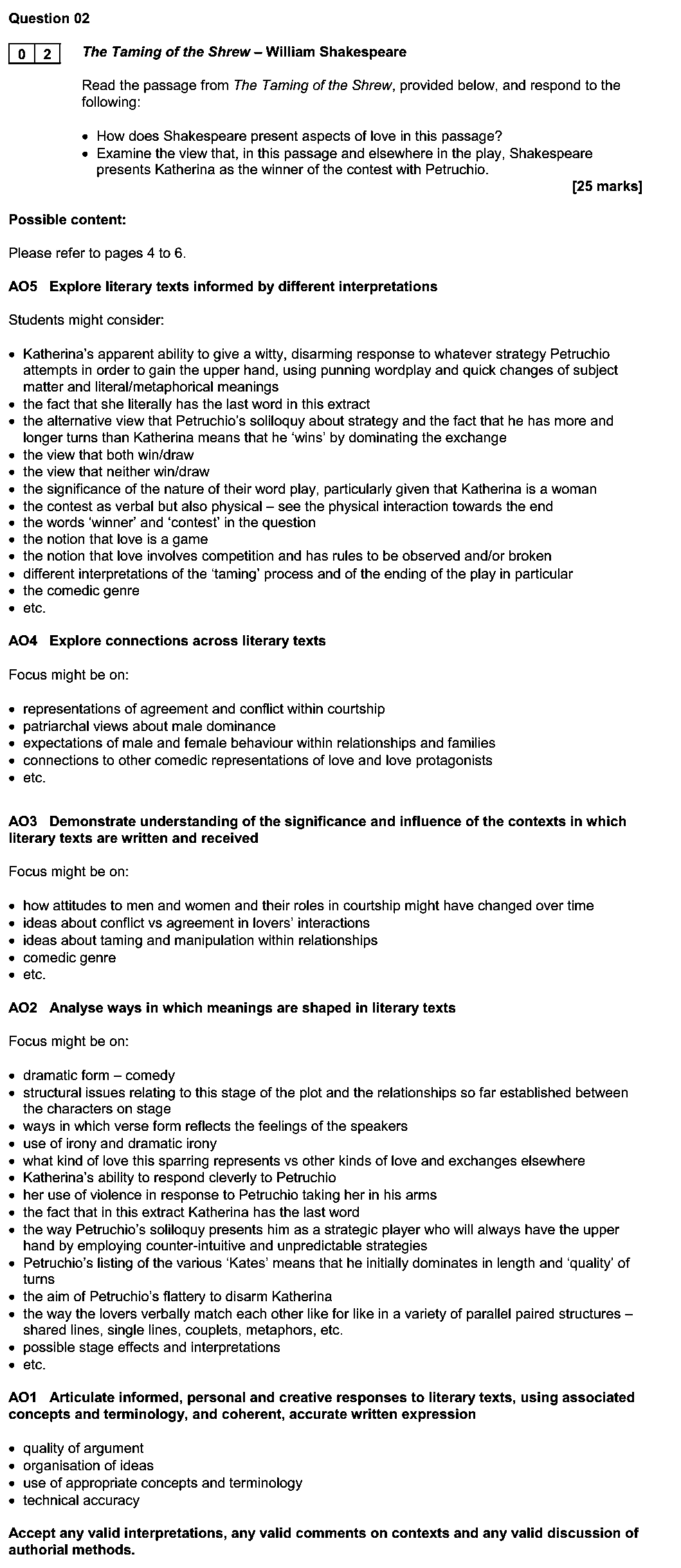
November 2020 · AS Paper 1 · Q2 25 marks Shakespeare extract
The Taming of the Shrew – William Shakespeare
Read the passage from The Taming of the Shrew, provided below, and respond to the
following:
• How does Shakespeare present aspects of love in this passage?
• Examine the view that, in this passage and elsewhere in the play, Shakespeare
presents Katherina as the winner of the contest with Petruchio.
[25 marks]
PETRUCHIO
I’ll attend her here,
And woo her with some spirit when she comes.
Say that she rail, why then I’ll tell her plain
She sings as sweetly as a nightingale.
Say that she frown, I’ll say she looks as clear
As morning roses newly washed with dew.
Say she be mute and will not speak a word,
Then I’ll commend her volubility,
And say she uttereth piercing eloquence.
If she do bid me pack, I’ll give her thanks,
As though she bid me stay by her a week.
If she deny to wed, I’ll crave the day
When I shall ask the banns, and when be married.
But here she comes, and now, Petruchio, speak.
Enter Katherina
Good morrow, Kate – for that’s your name, I hear.
KATHERINA
Well have you heard, but something hard of hearing;
They call me Katherine that do talk of me.
PETRUCHIO
You lie, in faith, for you are called plain Kate,
And bonny Kate, and sometimes Kate the curst.
But Kate, the prettiest Kate in Christendom,
Kate of Kate Hall, my super-dainty Kate,
For dainties are all Kates, and therefore, Kate,
Take this of me, Kate of my consolation –
Hearing thy mildness praised in every town,
Thy virtues spoke of, and thy beauty sounded,
Yet not so deeply as to thee belongs,
Myself am moved to woo thee for my wife.
KATHERINA
Moved, in good time! Let him that moved you hither
Remove you hence. I knew you at the first
You were a movable.
PETRUCHIO Why, what’s a movable?
KATHERINA
A joint-stool.
PETRUCHIO Thou hast hit it. Come, sit on me.
KATHERINA
Asses are made to bear, and so are you.
PETRUCHIO
Women are made to bear, and so are you.
KATHERINA
No such jade as you, if me you mean.
PETRUCHIO
Alas, good Kate, I will not burden thee!
For knowing thee to be but young and light –
KATHERINA
Too light for such a swain as you to catch,
And yet as heavy as my weight should be.
PETRUCHIO
Should be? Should – buzz!
KATHERINA Well ta’en, and like a buzzard.
PETRUCHIO
O slow-winged turtle, shall a buzzard take thee?
KATHERINA
Ay, for a turtle, as he takes a buzzard.
PETRUCHIO
Come, come, you wasp, i’faith, you are too angry.
KATHERINA
If I be waspish, best beware my sting.
PETRUCHIO
My remedy is then to pluck it out.
KATHERINA
Ay, if the fool could find it where it lies.
PETRUCHIO
Who knows not where a wasp does wear his sting?
In his tail.
KATHERINA In his tongue.
PETRUCHIO Whose tongue?
KATHERINA
Yours, if you talk of tales, and so farewell.
She turns to go
PETRUCHIO
What, with my tongue in your tail? Nay, come again.
He takes her in his arms
Good Kate, I am a gentleman –
KATHERINA That I’ll try.
She strikes him
PETRUCHIO
I swear I’ll cuff you, if you strike again.
KATHERINA
So may you loose your arms.
If you strike me, you are no gentleman,
And if no gentleman, why then no arms.
PETRUCHIO
A herald, Kate? O, put me in thy books!
KATHERINA
What is your crest – a coxcomb?
PETRUCHIO
A combless cock, so Kate will be my hen.
KATHERINA
No cock of mine, you crow too like a craven.
(Act 2, Scene 1)
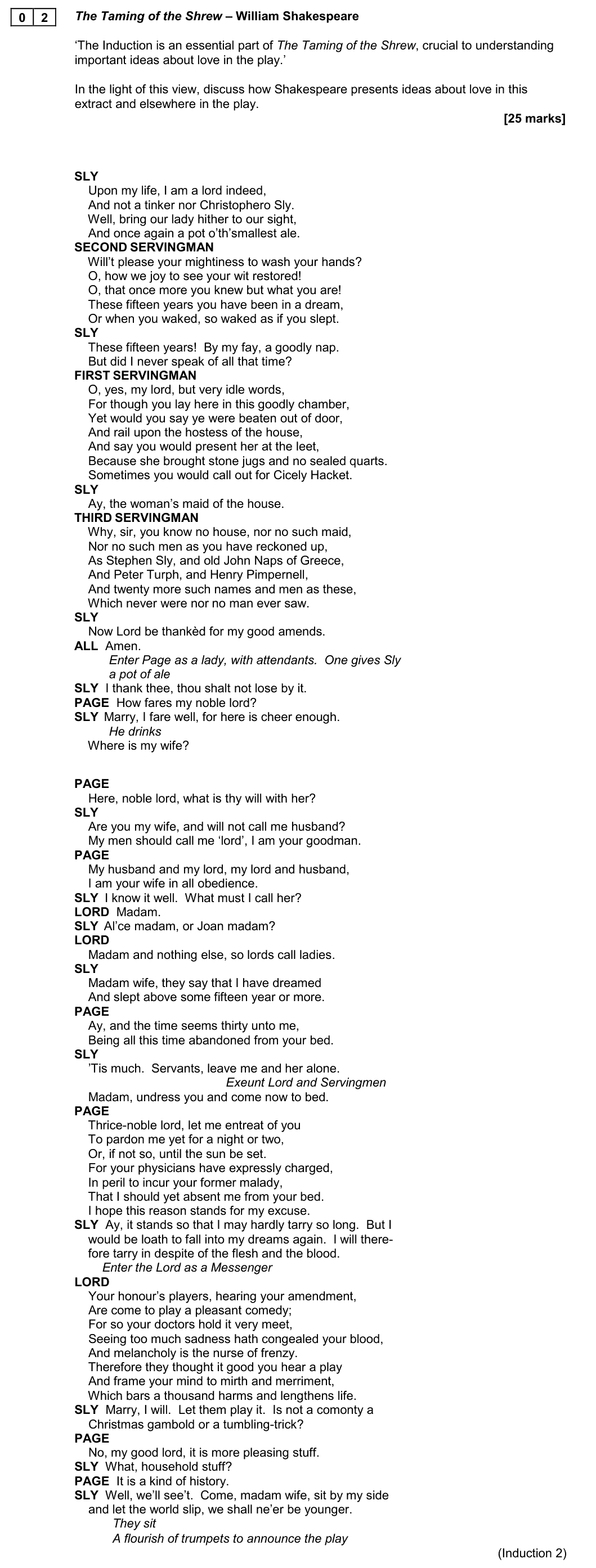
November 2020 · Paper 1 · Q2 25 marks Shakespeare extract
The Taming of the Shrew – William Shakespeare
‘The Induction is an essential part of The Taming of the Shrew, crucial to understanding
important ideas about love in the play.’
In the light of this view, discuss how Shakespeare presents ideas about love in this
extract and elsewhere in the play.
[25 marks]
SLY
Upon my life, I am a lord indeed,
And not a tinker nor Christophero Sly.
Well, bring our lady hither to our sight,
And once again a pot o’th’smallest ale.
SECOND SERVINGMAN
Will’t please your mightiness to wash your hands?
O, how we joy to see your wit restored!
O, that once more you knew but what you are!
These fifteen years you have been in a dream,
Or when you waked, so waked as if you slept.
SLY
These fifteen years! By my fay, a goodly nap.
But did I never speak of all that time?
FIRST SERVINGMAN
O, yes, my lord, but very idle words,
For though you lay here in this goodly chamber,
Yet would you say ye were beaten out of door,
And rail upon the hostess of the house,
And say you would present her at the leet,
Because she brought stone jugs and no sealed quarts.
Sometimes you would call out for Cicely Hacket.
SLY
Ay, the woman’s maid of the house.
THIRD SERVINGMAN
Why, sir, you know no house, nor no such maid,
Nor no such men as you have reckoned up,
As Stephen Sly, and old John Naps of Greece,
And Peter Turph, and Henry Pimpernell,
And twenty more such names and men as these,
Which never were nor no man ever saw.
SLY
Now Lord be thankèd for my good amends.
ALL Amen.
Enter Page as a lady, with attendants. One gives Sly
a pot of ale
SLY I thank thee, thou shalt not lose by it.
PAGE How fares my noble lord?
SLY Marry, I fare well, for here is cheer enough.
He drinks
Where is my wife?
PAGE
Here, noble lord, what is thy will with her?
SLY
Are you my wife, and will not call me husband?
My men should call me ‘lord’, I am your goodman.
PAGE
My husband and my lord, my lord and husband,
I am your wife in all obedience.
SLY I know it well. What must I call her?
LORD Madam.
SLY Al’ce madam, or Joan madam?
LORD
Madam and nothing else, so lords call ladies.
SLY
Madam wife, they say that I have dreamed
And slept above some fifteen year or more.
PAGE
Ay, and the time seems thirty unto me,
Being all this time abandoned from your bed.
SLY
’Tis much. Servants, leave me and her alone.
Exeunt Lord and Servingmen
Madam, undress you and come now to bed.
PAGE
Thrice-noble lord, let me entreat of you
To pardon me yet for a night or two,
Or, if not so, until the sun be set.
For your physicians have expressly charged,
In peril to incur your former malady,
That I should yet absent me from your bed.
I hope this reason stands for my excuse.
SLY Ay, it stands so that I may hardly tarry so long. But I
would be loath to fall into my dreams again. I will there-
fore tarry in despite of the flesh and the blood.
Enter the Lord as a Messenger
LORD
Your honour’s players, hearing your amendment,
Are come to play a pleasant comedy;
For so your doctors hold it very meet,
Seeing too much sadness hath congealed your blood,
And melancholy is the nurse of frenzy.
Therefore they thought it good you hear a play
And frame your mind to mirth and merriment,
Which bars a thousand harms and lengthens life.
SLY Marry, I will. Let them play it. Is not a comonty a
Christmas gambold or a tumbling-trick?
PAGE
No, my good lord, it is more pleasing stuff.
SLY What, household stuff?
PAGE It is a kind of history.
SLY Well, we’ll see’t. Come, madam wife, sit by my side
and let the world slip, we shall ne’er be younger.
They sit
A flourish of trumpets to announce the play
(Induction 2)
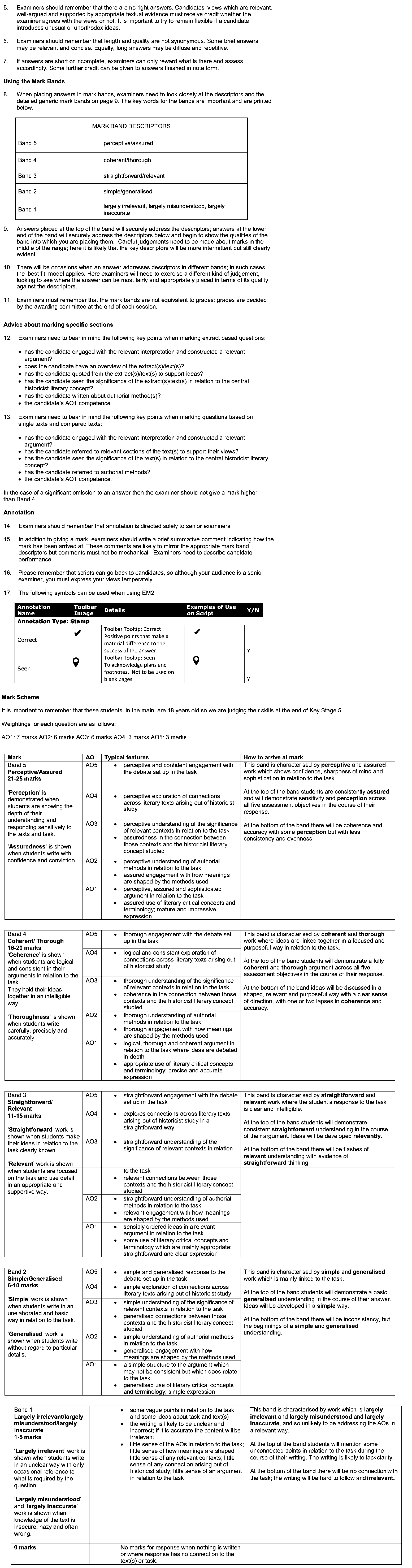
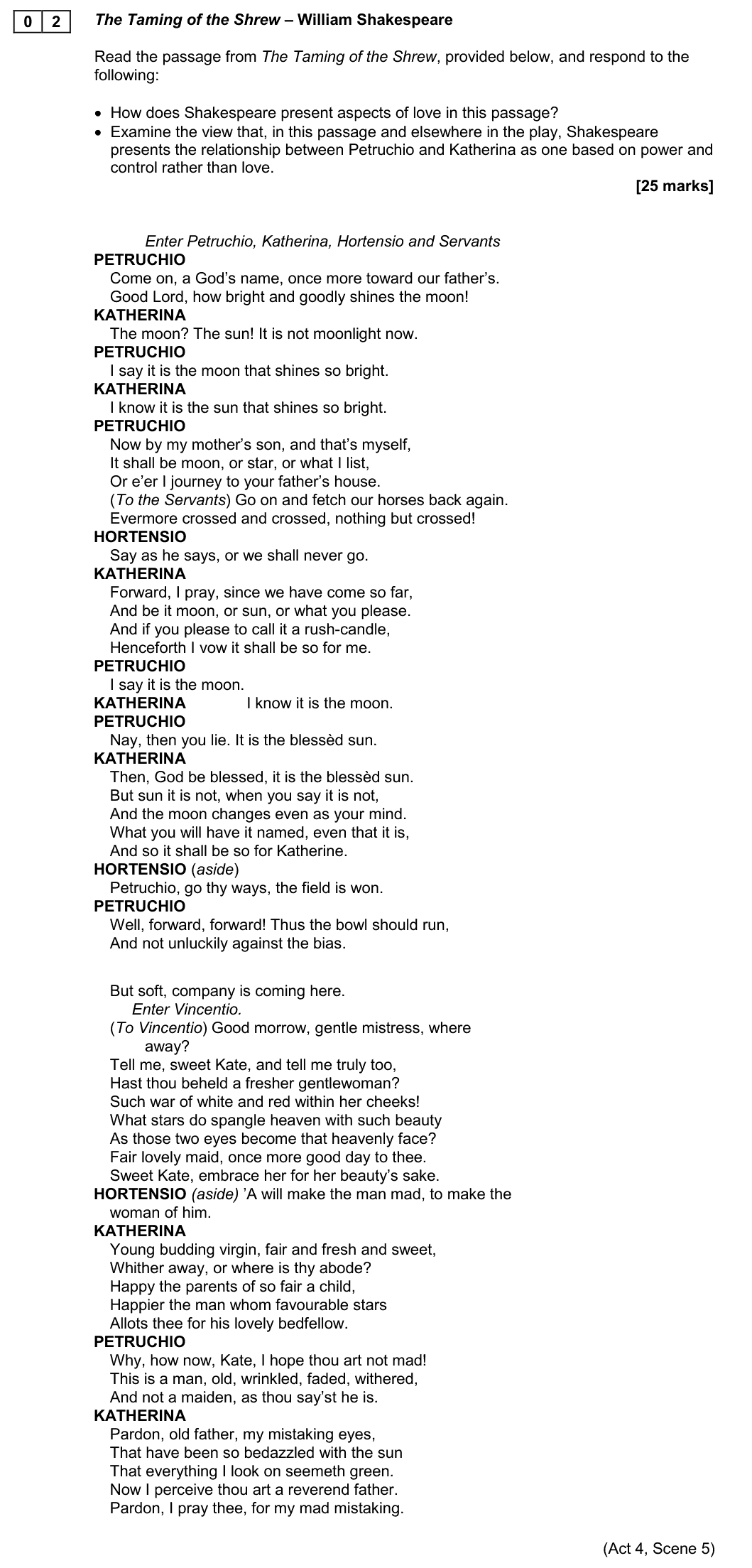
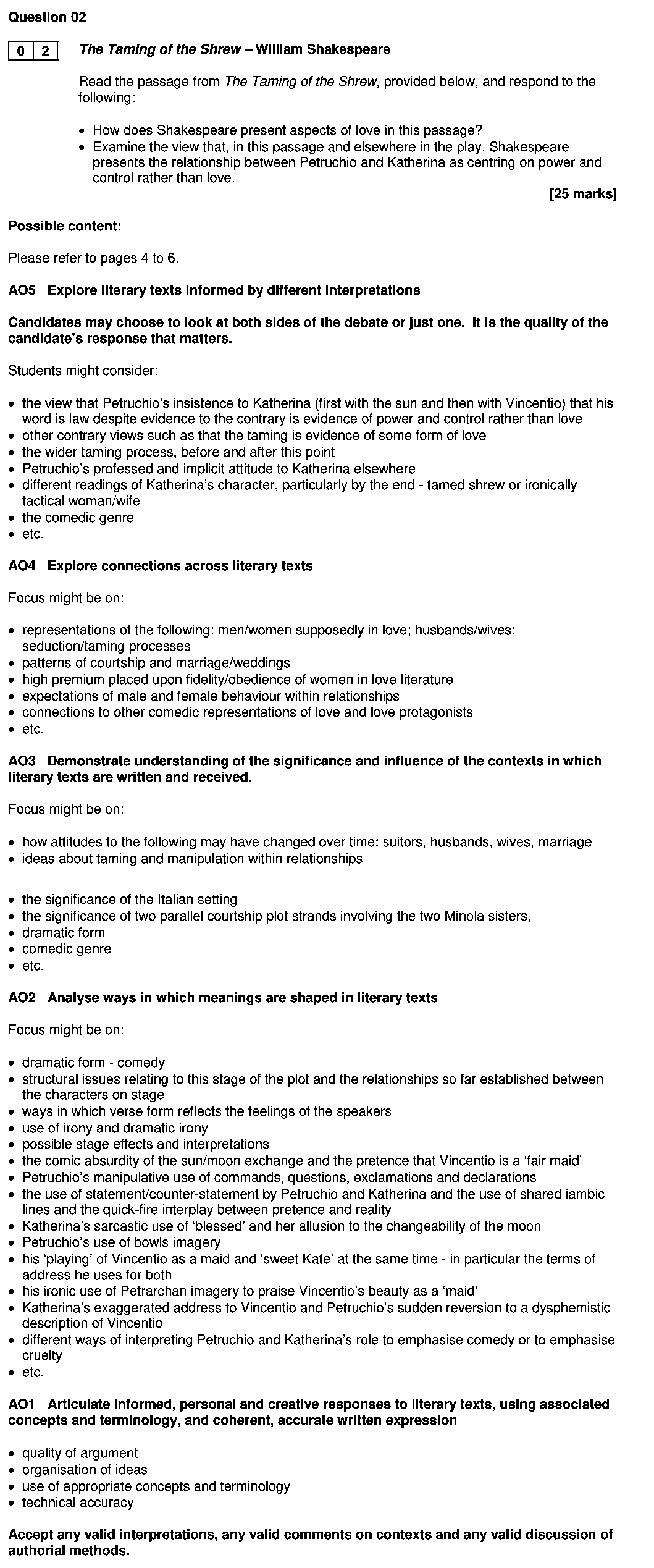
June 2019 · AS Paper 1 · Q2 25 marks Shakespeare extract
The Taming of the Shrew – William Shakespeare
Read the passage from The Taming of the Shrew, provided below, and respond to the
following:
• How does Shakespeare present aspects of love in this passage?
• Examine the view that, in this passage and elsewhere in the play, Shakespeare
presents the relationship between Petruchio and Katherina as one based on power and
control rather than love.
[25 marks]
Enter Petruchio, Katherina, Hortensio and Servants
PETRUCHIO
Come on, a God’s name, once more toward our father’s.
Good Lord, how bright and goodly shines the moon!
KATHERINA
The moon? The sun! It is not moonlight now.
PETRUCHIO
I say it is the moon that shines so bright.
KATHERINA
I know it is the sun that shines so bright.
PETRUCHIO
Now by my mother’s son, and that’s myself,
It shall be moon, or star, or what I list,
Or e’er I journey to your father’s house.
(To the Servants) Go on and fetch our horses back again.
Evermore crossed and crossed, nothing but crossed!
HORTENSIO
Say as he says, or we shall never go.
KATHERINA
Forward, I pray, since we have come so far,
And be it moon, or sun, or what you please.
And if you please to call it a rush-candle,
Henceforth I vow it shall be so for me.
PETRUCHIO
I say it is the moon.
KATHERINA I know it is the moon.
PETRUCHIO
Nay, then you lie. It is the blessèd sun.
KATHERINA
Then, God be blessed, it is the blessèd sun.
But sun it is not, when you say it is not,
And the moon changes even as your mind.
What you will have it named, even that it is,
And so it shall be so for Katherine.
HORTENSIO (aside)
Petruchio, go thy ways, the field is won.
PETRUCHIO
Well, forward, forward! Thus the bowl should run,
And not unluckily against the bias.
But soft, company is coming here.
Enter Vincentio.
(To Vincentio) Good morrow, gentle mistress, where
away?
Tell me, sweet Kate, and tell me truly too,
Hast thou beheld a fresher gentlewoman?
Such war of white and red within her cheeks!
What stars do spangle heaven with such beauty
As those two eyes become that heavenly face?
Fair lovely maid, once more good day to thee.
Sweet Kate, embrace her for her beauty’s sake.
HORTENSIO (aside) ’A will make the man mad, to make the
woman of him.
KATHERINA
Young budding virgin, fair and fresh and sweet,
Whither away, or where is thy abode?
Happy the parents of so fair a child,
Happier the man whom favourable stars
Allots thee for his lovely bedfellow.
PETRUCHIO
Why, how now, Kate, I hope thou art not mad!
This is a man, old, wrinkled, faded, withered,
And not a maiden, as thou say’st he is.
KATHERINA
Pardon, old father, my mistaking eyes,
That have been so bedazzled with the sun
That everything I look on seemeth green.
Now I perceive thou art a reverend father.
Pardon, I pray thee, for my mad mistaking.
(Act 4, Scene 5)
June 2019 · Paper 1 · Q2 25 marks Shakespeare extract
The Taming of the Shrew – William Shakespeare
‘The Taming of the Shrew is a cruel comedy of bullying and coercion.’
In the light of this view, discuss how Shakespeare presents the taming process in this
extract and elsewhere in the play.
[25 marks]
Enter Tailor
PETRUCHIO
Come, tailor, let us see these ornaments.
Lay forth the gown.
Enter Haberdasher
What news with you, sir?
HABERDASHER
Here is the cap your worship did bespeak.
PETRUCHIO
Why, this was moulded on a porringer –
A velvet dish. Fie, fie, ’tis lewd and filthy!
Why, ’tis a cockle or a walnut-shell,
A knack, a toy, a trick, a baby’s cap.
Away with it! Come, let me have a bigger.
KATHERINA
I’ll have no bigger. This doth fit the time,
And gentlewomen wear such caps as these.
PETRUCHIO
When you are gentle, you shall have one too,
And not till then.
HORTENSIO (aside) That will not be in haste.
KATHERINA
Why sir, I trust I may have leave to speak,
And speak I will. I am no child, no babe.
Your betters have endured me say my mind,
And if you cannot, best you stop your ears.
My tongue will tell the anger of my heart,
Or else my heart concealing it will break,
And rather than it shall, I will be free
Even to the uttermost, as I please, in words.
PETRUCHIO
Why, thou say’st true – it is a paltry cap,
A custard-coffin, a bauble, a silken pie.
I love thee well in that thou lik’st it not.
KATHERINA
Love me, or love me not, I like the cap,
And it I will have, or I will have none.
PETRUCHIO
Thy gown? Why, ay. Come, tailor, let us see’t.
Exit Haberdasher
O mercy, God! What masquing stuff is here?
What’s this? A sleeve? ’Tis like a demi-cannon.
What, up and down carved like an apple-tart?
Here’s snip and nip and cut and slish and slash,
Like to a censer in a barber’s shop.
Why, what a devil’s name, tailor, call’st thou this?
HORTENSIO (aside)
I see she’s like to have neither cap nor gown.
TAILOR
You bid me make it orderly and well,
According to the fashion and the time.
PETRUCHIO
Marry, and did. But if you be remembered,
I did not bid you mar it to the time.
Go, hop me over every kennel home,
For you shall hop without my custom, sir.
I’ll none of it. Hence, make your best of it.
KATHERINA
I never saw a better-fashioned gown,
More quaint, more pleasing, nor more commendable.
Belike you mean to make a puppet of me.
PETRUCHIO
Why, true, he means to make a puppet of thee.
TAILOR
She says your worship means to make a puppet of her.
PETRUCHIO
O monstrous arrogance! Thou liest, thou thread, thou
thimble,
Thou yard, three-quarters, half-yard, quarter, nail,
Thou flea, thou nit, thou winter-cricket thou!
Braved in mine own house with a skein of thread?
Away, thou rag, thou quantity, thou remnant,
Or I shall so bemete thee with thy yard
As thou shalt think on prating whilst thou liv’st.
I tell thee, I, that thou hast marred her gown.
TAILOR
Your worship is deceived – the gown is made
Just as my master had direction.
Grumio gave order how it should be done.
GRUMIO I gave him no order, I gave him the stuff.
TAILOR
But how did you desire it should be made?
GRUMIO Marry, sir, with needle and thread.
TAILOR
But did you not request to have it cut?
GRUMIO Thou hast faced many things.
TAILOR I have.
GRUMIO Face not me. Thou hast braved many men, brave
not me. I will neither be faced nor braved. I say unto
thee, I bid thy master cut out the gown, but I did not
bid him cut it to pieces. Ergo, thou liest.
(Act 4, Scene 3)
June 2018 · AS Paper 1 · Q2 25 marks Shakespeare extract
The Taming of the Shrew – William Shakespeare
Read the passage from The Taming of the Shrew, provided below, and respond to the
following:
•
How does Shakespeare present aspects of love in this passage?
•
Examine the view that, in this passage and elsewhere in the play, Shakespeare
presents Petruchio as a ridiculous fool.
[25 marks]
BAPTISTA Who comes with him?
BIONDELLO O sir, his lackey, for all the world caparisoned
like the horse; with a linen stock on one leg and a kersey
boot-hose on the other, gartered with a red and blue
list; an old hat, and the humour of forty fancies pricked
in’t for a feather; a monster, a very monster in apparel,
and not like a Christian footboy or a gentleman’s lackey.
TRANIO
’Tis some odd humour pricks him to this fashion.
Yet oftentimes he goes but mean-apparelled.
BAPTISTA I am glad he’s come, howsoe’er he comes.
BIONDELLO Why, sir, he comes not.
BAPTISTA Didst thou not say he comes?
BIONDELLO Who? That Petruchio came?
BAPTISTA Ay, that Petruchio came.
BIONDELLO No, sir. I say his horse comes with him on
his back.
BAPTISTA Why, that’s all one.
BIONDELLO
Nay, by Saint Jamy,
I hold you a penny,
A horse and a man
Is more than one,
And yet not many.
Enter Petruchio and Grumio
PETRUCHIO Come, where be these gallants? Who’s at
home?
BAPTISTA You are welcome, sir.
PETRUCHIO And yet I come not well?
BAPTISTA And yet you halt not.
TRANIO Not so well apparelled as I wish you were.
PETRUCHIO
Were it not better I should rush in thus?
But where is Kate? Where is my lovely bride?
How does my father? Gentles, methinks you frown.
And wherefore gaze this goodly company
As if they saw some wondrous monument,
Some comet, or unusual prodigy?
BAPTISTA
Why, sir, you know this is your wedding-day.
First were we sad, fearing you would not come,
Now sadder that you come so unprovided.
Fie, doff this habit, shame to your estate,
An eye-sore to our solemn festival.
TRANIO
And tell us what occasion of import
Hath all so long detained you from your wife
And sent you hither so unlike yourself?
PETRUCHIO
Tedious it were to tell, and harsh to hear –
Sufficeth I am come to keep my word,
Though in some part enforcèd to digress,
Which at more leisure I will so excuse
As you shall well be satisfied withal.
But where is Kate? I stay too long from her.
The morning wears, ’tis time we were at church.
TRANIO
See not your bride in these unreverent robes,
Go to my chamber, put on clothes of mine.
PETRUCHIO
Not I, believe me. Thus I’ll visit her.
BAPTISTA
But thus, I trust, you will not marry her.
PETRUCHIO
Good sooth, even thus. Therefore ha’ done with words;
To me she’s married, not unto my clothes.
Could I repair what she will wear in me
As I can change these poor accoutrements,
’Twere well for Kate and better for myself.
But what a fool am I to chat with you,
When I should bid good morrow to my bride,
And seal the title with a lovely kiss.
(Act 3, Scene 2)
June 2018 · Paper 1 · Q2 25 marks Shakespeare extract
The Taming of the Shrew – William Shakespeare
‘Typically men dominate women in the literature of love, but women always find ways to
assert themselves.’
In the light of this view, discuss how Shakespeare presents Bianca in this extract and
elsewhere in the play.
[25 marks]
BIANCA
Take you your instrument, play you the whiles –
His lecture will be done ere you have tuned.
HORTENSIO
You’ll leave his lecture when I am in tune?
LUCENTIO
That will be never. Tune your instrument.
BIANCA Where left we last?
LUCENTIO Here, madam.
(He reads)
‘Hic ibat Simois, hic est Sigeia tellus,
Hic steterat Priami regia celsa senis.’
BIANCA Construe them.
LUCENTIO ‘Hic ibat’, as I told you before – ‘Simois’, I am
Lucentio – ‘hic est’, son unto Vincentio of Pisa – ‘Sigeia
tellus’, disguised thus to get your love – ‘Hic steterat’,
and that Lucentio that comes a-wooing – ‘Priami’, is my
man Tranio – ‘regia’, bearing my port – ‘celsa senis’,
that we might beguile the old pantaloon.
HORTENSIO Madam, my instrument’s in tune.
BIANCA Let’s hear. (He plays) O fie! The treble jars.
LUCENTIO Spit in the hole, man, and tune again.
BIANCA Now let me see if I can construe it. ‘Hic ibat
Simois’, I know you not – ‘hic est Sigeia tellus’, I trust you
not – ‘Hic steterat Priami’, take heed he hear us not –
‘regia’, presume not – ‘celsa senis’, despair not.
HORTENSIO
Madam, ’tis now in tune.
LUCENTIO All but the bass.
HORTENSIO
The bass is right, ’tis the base knave that jars.
(Aside) How fiery and forward our pedant is.
Now, for my life, the knave doth court my love.
Pedascule, I’ll watch you better yet.
BIANCA
In time I may believe, yet I mistrust.
LUCENTIO
Mistrust it not – for, sure, Aeacides
Was Ajax, called so from his grandfather.
BIANCA
I must believe my master, else, I promise you,
I should be arguing still upon that doubt.
But let it rest. Now, Licio, to you.
Good master, take it not unkindly, pray,
That I have been thus pleasant with you both.
HORTENSIO (to Lucentio)
You may go walk, and give me leave awhile.
My lessons make no music in three parts.
LUCENTIO
Are you so formal, sir? Well, I must wait –
(aside) And watch withal, for, but I be deceived,
Our fine musician groweth amorous.
HORTENSIO
Madam, before you touch the instrument
To learn the order of my fingering,
I must begin with rudiments of art,
To teach you gamut in a briefer sort,
More pleasant, pithy, and effectual,
Than hath been taught by any of my trade.
And there it is in writing fairly drawn.
BIANCA
Why, I am past my gamut long ago.
HORTENSIO
Yet read the gamut of Hortensio.
BIANCA (reads)
‘Gamut I am, the ground of all accord –
A re, to plead Hortensio’s passion –
B mi, Bianca, take him for thy lord –
C fa ut, that loves with all affection –
D sol re, one clef, two notes have I –
E la mi, show pity or I die.’
Call you this gamut? Tut, I like it not!
Old fashions please me best. I am not so nice
To change true rules for odd inventions.
(Act 3, Scene 1)
June 2017 · AS Paper 1 · Q2 25 marks Shakespeare extract
0 2 The Taming of the Shrew – William Shakespeare
Read the passage from The Taming of the Shrew, provided below, and respond to the
following:
•
How does Shakespeare present aspects of love in this passage?
•
Examine the view that, in this passage and elsewhere in the play, Shakespeare
presents Lucentio as the suitor most capable of expressing romantic ideas.
[25 marks]
HORTENSIO Though the nature of our quarrel yet never
brooked parle, know now, upon advice, it toucheth us
both – that we may yet again have access to our fair
mistress and be happy rivals in Bianca’s love – to
labour and effect one thing specially.
GREMIO What’s that, I pray?
HORTENSIO Marry, sir, to get a husband for her sister.
GREMIO A husband? A devil.
HORTENSIO I say a husband.
GREMIO I say a devil. Think’st thou, Hortensio, though
her father be very rich, any man is so very a fool to be
married to hell?
HORTENSIO Tush, Gremio. Though it pass your patience
and mine to endure her loud alarums, why, man, there be
good fellows in the world, an a man could light on them,
would take her with all faults, and money enough.
GREMIO I cannot tell. But I had as lief take her dowry
with this condition – to be whipped at the high-cross
every morning.
HORTENSIO Faith, as you say, there’s small choice in
rotten apples. But come, since this bar in law makes us
friends, it shall be so far forth friendly maintained till by
helping Baptista’s eldest daughter to a husband we set
his youngest free for a husband, and then have to’t
afresh. Sweet Bianca! Happy man be his dole. He that
runs fastest gets the ring. How say you, Signor Gremio?
GREMIO I am agreed, and would I had given him the best
horse in Padua to begin his wooing that would thor-
oughly woo her, wed her, and bed her, and rid the house
of her. Come on.
Exeunt Gremio and Hortensio
TRANIO
I pray, sir, tell me, is it possible
That love should of a sudden take such hold?
LUCENTIO
O Tranio, till I found it to be true,
I never thought it possible or likely.
But see, while idly I stood looking on,
I found the effect of love in idleness,
And now in plainness do confess to thee,
That art to me as secret and as dear
As Anna to the Queen of Carthage was –
Tranio, I burn, I pine, I perish, Tranio,
If I achieve not this young modest girl.
Counsel me, Tranio, for I know thou canst.
Assist me, Tranio, for I know thou wilt.
TRANIO
Master, it is no time to chide you now;
Affection is not rated from the heart.
If love have touched you, naught remains but so –
Redime te captum quam queas minimo.
LUCENTIO
Gramercies, lad. Go forward, this contents.
The rest will comfort, for thy counsel’s sound.
TRANIO
Master, you looked so longly on the maid,
Perhaps you marked not what’s the pith of all.
LUCENTIO
O yes, I saw sweet beauty in her face,
Such as the daughter of Agenor had,
That made great Jove to humble him to her hand,
When with his knees he kissed the Cretan strand.
TRANIO
Saw you no more? Marked you not how her sister
Began to scold and raise up such a storm
That mortal ears might hardly endure the din?
LUCENTIO
Tranio, I saw her coral lips to move,
And with her breath she did perfume the air.
Sacred and sweet was all I saw in her.
(Act 1, Scene 1)
June 2017 · Paper 1 · Q2 25 marks Shakespeare extract
0 2
The Taming of the Shrew – William Shakespeare
‘In the literature of love, the more a husband tries to demonstrate power and
control, the more he appears powerless and foolish.’
In the light of this view, discuss how Shakespeare presents Petruchio in this extract and
elsewhere in the play.
[25 marks]
PETRUCHIO
Be merry, Kate. Some water here. What ho!
Enter one with water
Where’s my spaniel Troilus? Sirrah, get you hence,
And bid my cousin Ferdinand come hither.
Exit another Servingman
One, Kate, that you must kiss and be acquainted with.
Where are my slippers? Shall I have some water?
Come, Kate, and wash, and welcome heartily.
He knocks the basin out of the Servant’s hands
You whoreson villain, will you let it fall?
He strikes the Servant
KATHERINA
Patience, I pray you, ’twas a fault unwilling.
PETRUCHIO
A whoreson, beetle-headed, flap-eared knave!
Come, Kate, sit down, I know you have a stomach.
Will you give thanks, sweet Kate, or else shall I?
What’s this? Mutton?
FIRST SERVINGMAN Ay.
PETRUCHIO Who brought it?
PETER I.
PETRUCHIO
’Tis burnt, and so is all the meat.
What dogs are these! Where is the rascal cook?
How durst you, villains, bring it from the dresser
And serve it thus to me that love it not?
There, take it to you, trenchers, cups, and all.
He throws the food and dishes at them
You heedless joltheads and unmannered slaves!
What, do you grumble? I’ll be with you straight.
Exeunt Servants hurriedly
KATHERINA
I pray you, husband, be not so disquiet.
The meat was well, if you were so contented.
PETRUCHIO
I tell thee, Kate, ’twas burnt and dried away,
And I expressly am forbid to touch it,
For it engenders choler, planteth anger;
And better ’twere that both of us did fast,
Since, of ourselves, ourselves are choleric,
Than feed it with such over-roasted flesh.
Be patient, tomorrow’t shall be mended,
And for this night we’ll fast for company.
Come, I will bring thee to thy bridal chamber. Exeunt
Enter Servants severally
NATHANIEL
Peter, didst ever see the like?
PETER
He kills her in her own humour.
Enter Curtis
GRUMIO Where is he?
CURTIS
In her chamber,
Making a sermon of continency to her,
And rails, and swears, and rates, that she, poor soul,
Knows not which way to stand, to look, to speak,
And sits as one new-risen from a dream.
Away, away, for he is coming hither. Exeunt
Enter Petruchio
PETRUCHIO
Thus have I politicly begun my reign,
And ’tis my hope to end successfully.
My falcon now is sharp and passing empty,
And till she stoop she must not be full-gorged,
For then she never looks upon her lure.
Another way I have to man my haggard,
To make her come and know her keeper’s call,
That is, to watch her, as we watch these kites
That bate and beat and will not be obedient.
She eat no meat today, nor none shall eat.
Last night she slept not, nor tonight she shall not.
As with the meat, some undeservèd fault
I’ll find about the making of the bed,
And here I’ll fling the pillow, there the bolster,
This way the coverlet, another way the sheets.
Ay, and amid this hurly I intend
That all is done in reverend care of her.
And, in conclusion, she shall watch all night,
And if she chance to nod I’ll rail and brawl,
And with the clamour keep her still awake.
This is a way to kill a wife with kindness,
And thus I’ll curb her mad and headstrong humour.
He that knows better how to tame a shrew,
Now let him speak – ’tis charity to show. Exit
(Act 4, Scene 1)
June 2016 · AS Paper 1 · Q2 25 marks Shakespeare extract
The Taming of the Shrew – William Shakespeare
Read the passage from The Taming of the Shrew, provided below, and respond to the
following:
•
How does Shakespeare present aspects of love in this passage?
•
Examine the view that, in this passage and elsewhere in the play, Petruchio
underestimates the challenge of ‘taming’ Katherina.
[25 marks]
PETRUCHIO
Nay, come, Kate, come, you must not look so sour.
KATHERINA
It is my fashion when I see a crab.
PETRUCHIO
Why, here’s no crab, and therefore look not sour.
KATHERINA
There is, there is.
PETRUCHIO
Then show it me.
KATHERINA Had I a glass, I would.
PETRUCHIO
What, you mean my face?
KATHERINA Well aimed of such a young one.
PETRUCHIO
Now, by Saint George, I am too young for you.
KATHERINA
Yet you are withered.
PETRUCHIO ’Tis with cares.
KATHERINA I care not.
PETRUCHIO
Nay, hear you, Kate –
She struggles
In sooth, you scape not so.
KATHERINA
I chafe you, if I tarry. Let me go.
PETRUCHIO
No, not a whit. I find you passing gentle.
’Twas told me you were rough, and coy, and sullen,
And now I find report a very liar.
For thou art pleasant, gamesome, passing courteous,
But slow in speech, yet sweet as spring-time flowers.
Thou canst not frown, thou canst not look askance,
Nor bite the lip, as angry wenches will,
Nor hast thou pleasure to be cross in talk.
But thou with mildness entertain’st thy wooers,
With gentle conference, soft and affable.
He lets her go
Why does the world report that Kate doth limp?
O slanderous world! Kate like the hazel-twig
Is straight and slender, and as brown in hue
As hazel-nuts and sweeter than the kernels.
O, let me see thee walk. Thou dost not halt.
KATHERINA
Go, fool, and whom thou keep’st command.
PETRUCHIO
Did ever Dian so become a grove
As Kate this chamber with her princely gait?
O, be thou Dian, and let her be Kate,
And then let Kate be chaste and Dian sportful.
KATHERINA
Where did you study all this goodly speech?
PETRUCHIO
It is extempore, from my mother-wit.
KATHERINA
A witty mother, witless else her son.
PETRUCHIO
Am I not wise?
KATHERINA Yes, keep you warm.
PETRUCHIO
Marry, so I mean, sweet Katherine, in thy bed.
And therefore, setting all this chat aside,
Thus in plain terms – your father hath consented
That you shall be my wife; your dowry ’greed on;
And will you, nill you, I will marry you.
Now, Kate, I am a husband for your turn,
For by this light whereby I see thy beauty,
Thy beauty that doth make me like thee well,
Thou must be married to no man but me.
For I am he am born to tame you, Kate,
And bring you from a wild Kate to a Kate
Conformable as other household Kates.
Enter Baptista, Gremio, and Tranio
Here comes your father. Never make denial;
I must and will have Katherine to my wife.
(Act 2, Scene 1)

Work with an AQA English Literature A tutor

Essays stuck in the middle bands, or not sure what the examiners want from an analysis? Book a trial lesson with a specialist AQA English Literature A tutor.

Prefer email? Send an enquiry

If you are under 18, please include a parent's contact details. Enquiries go to enquiries@alevelenglishtutor.com and are deleted once handled. All tutoring is online.