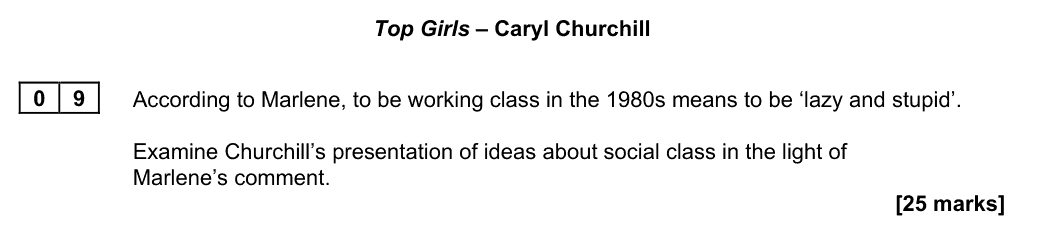
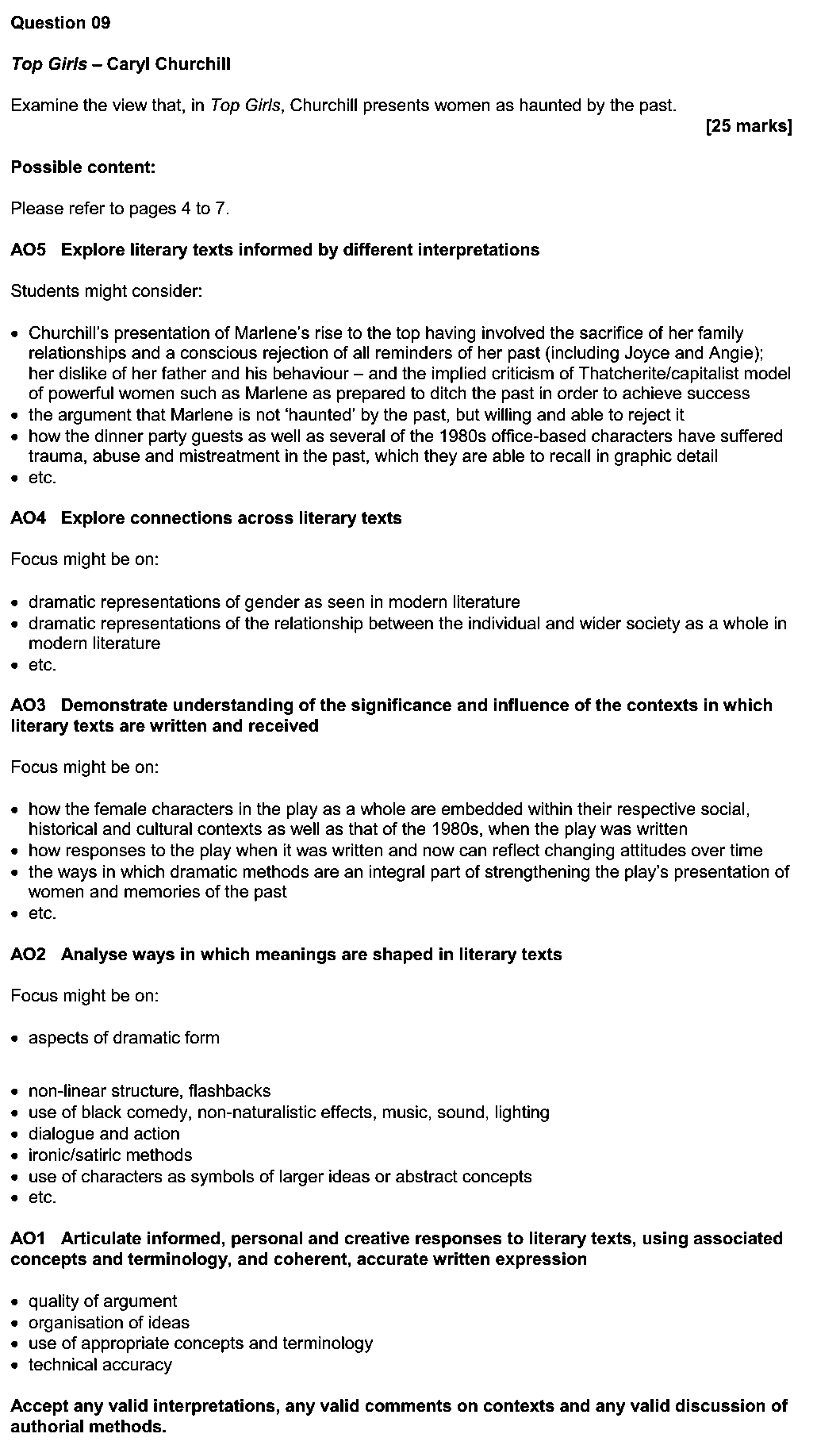
Top Girls – Caryl Churchill According to Marlene, to be working class in the 1980s means to be ‘lazy and stupid’. Examine Churchill’s presentation of ideas about social class in the light of Marlene’s comment.
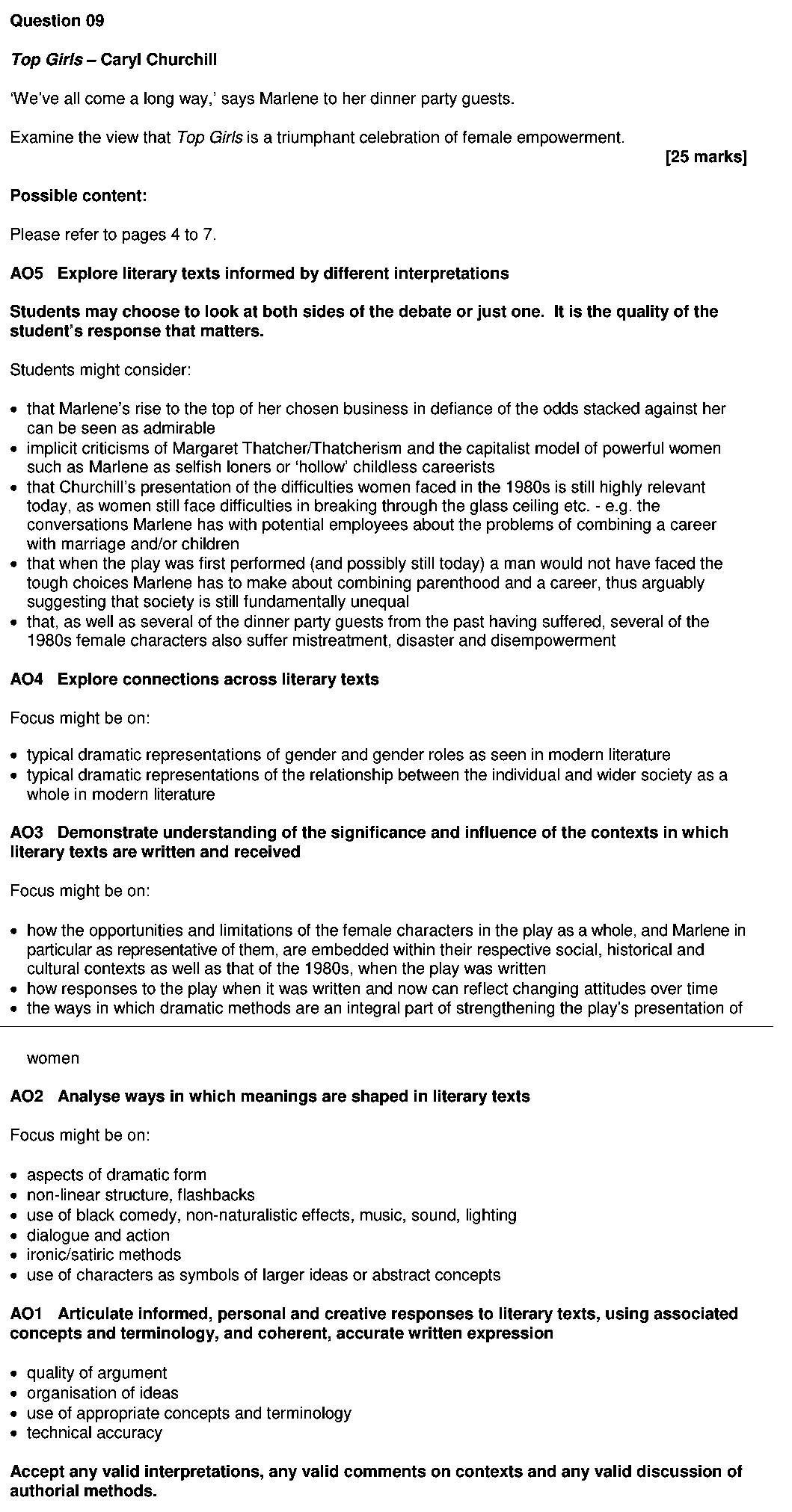
Top Girls – Caryl Churchill ‘We’ve all come a long way,’ says Marlene to her dinner party guests. Examine the view that Top Girls is a triumphant celebration of female empowerment.
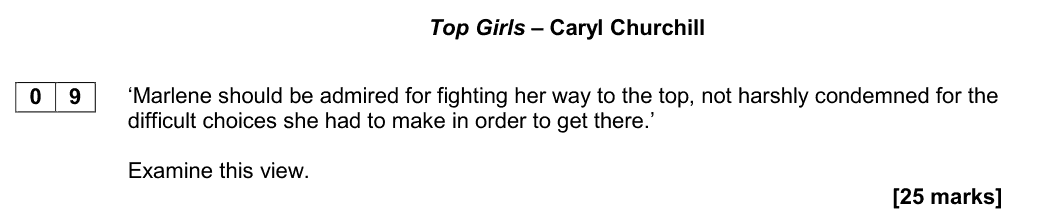
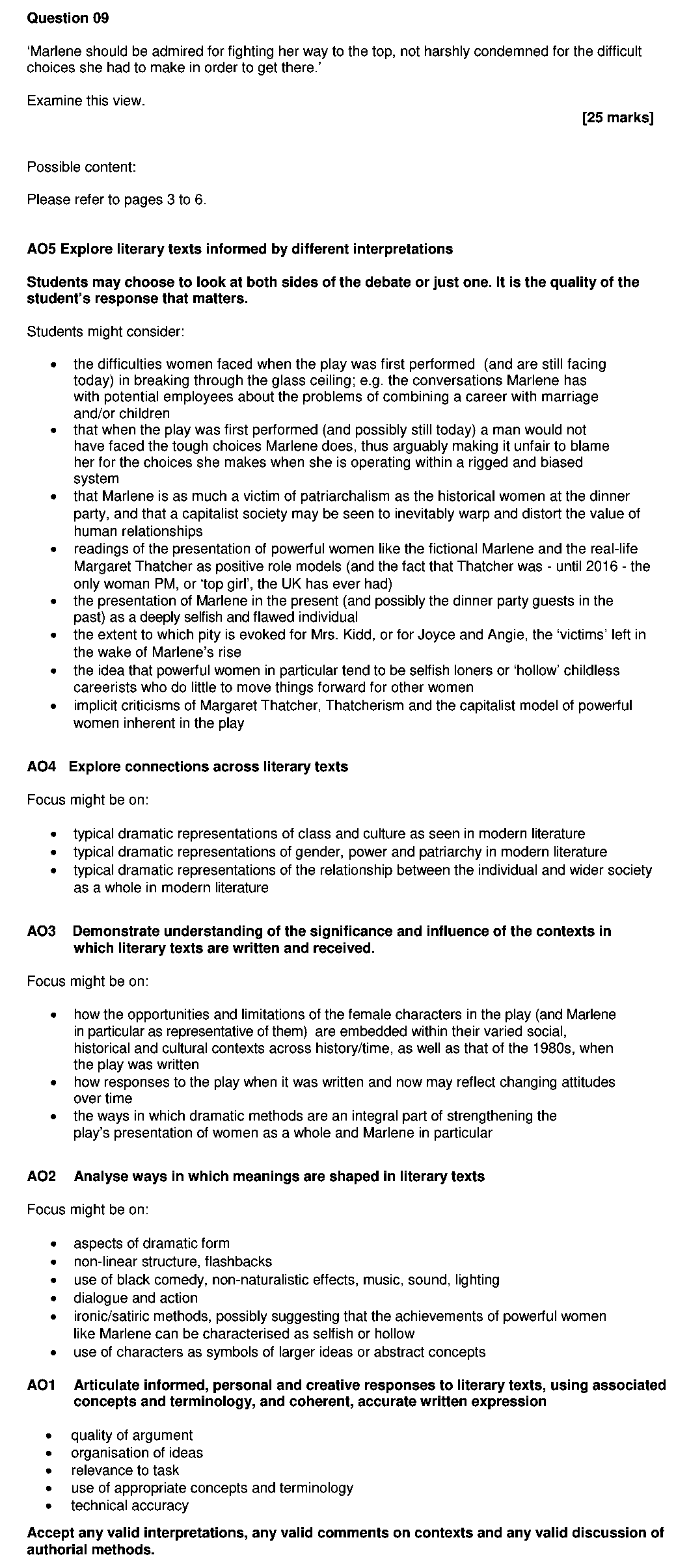
Top Girls – Caryl Churchill ‘Marlene should be admired for fighting her way to the top, not harshly condemned for the difficult choices she had to make in order to get there.’ Examine this view.
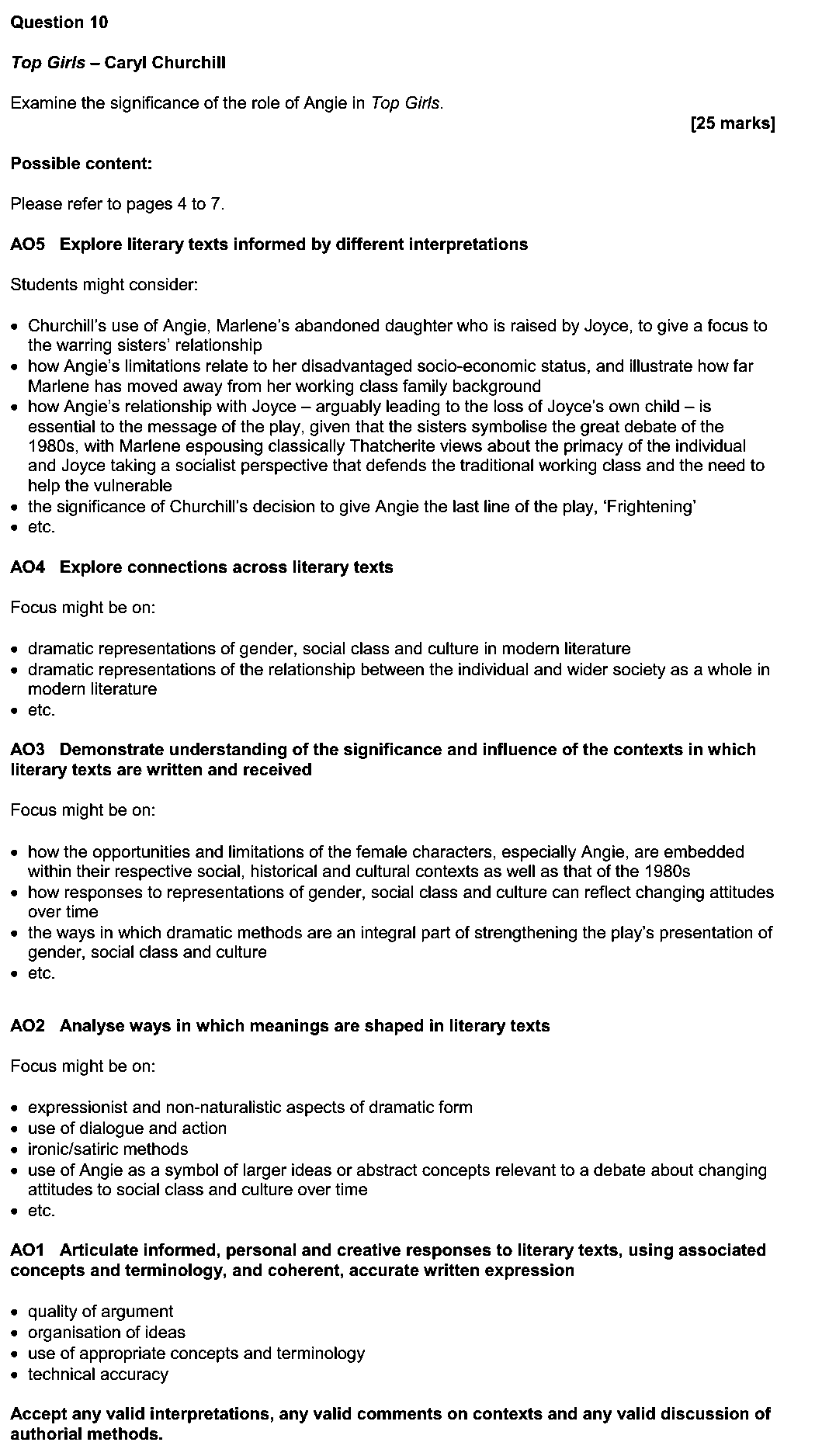
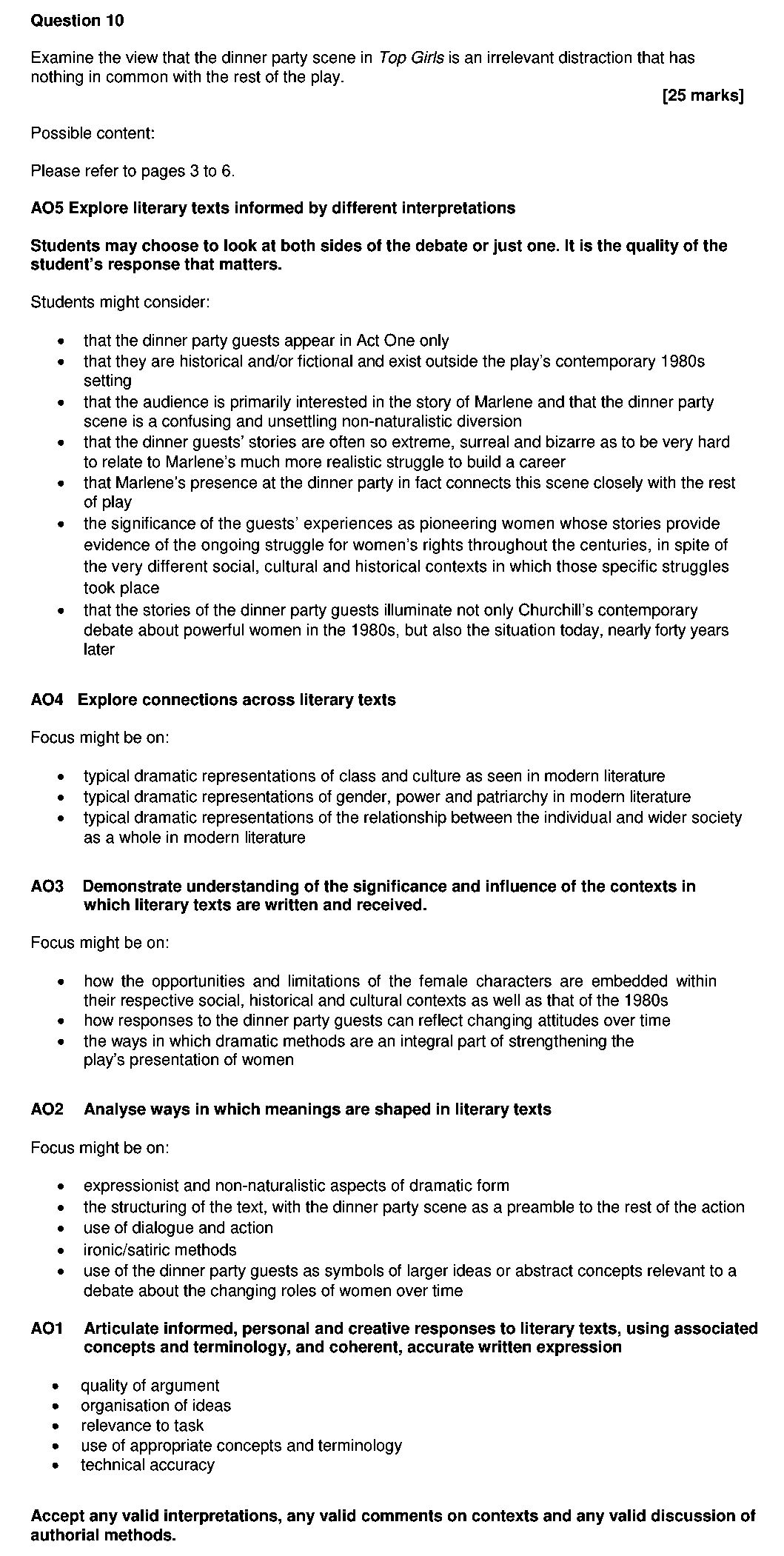
Top Girls – Caryl Churchill Examine the view that the dinner party scene in Top Girls is an irrelevant distraction that has nothing in common with the rest of the play.
Tap a question to zoom it. The texts and extracts open above it; the mark scheme (with its levels and indicative content) and the examiner's comment open underneath.
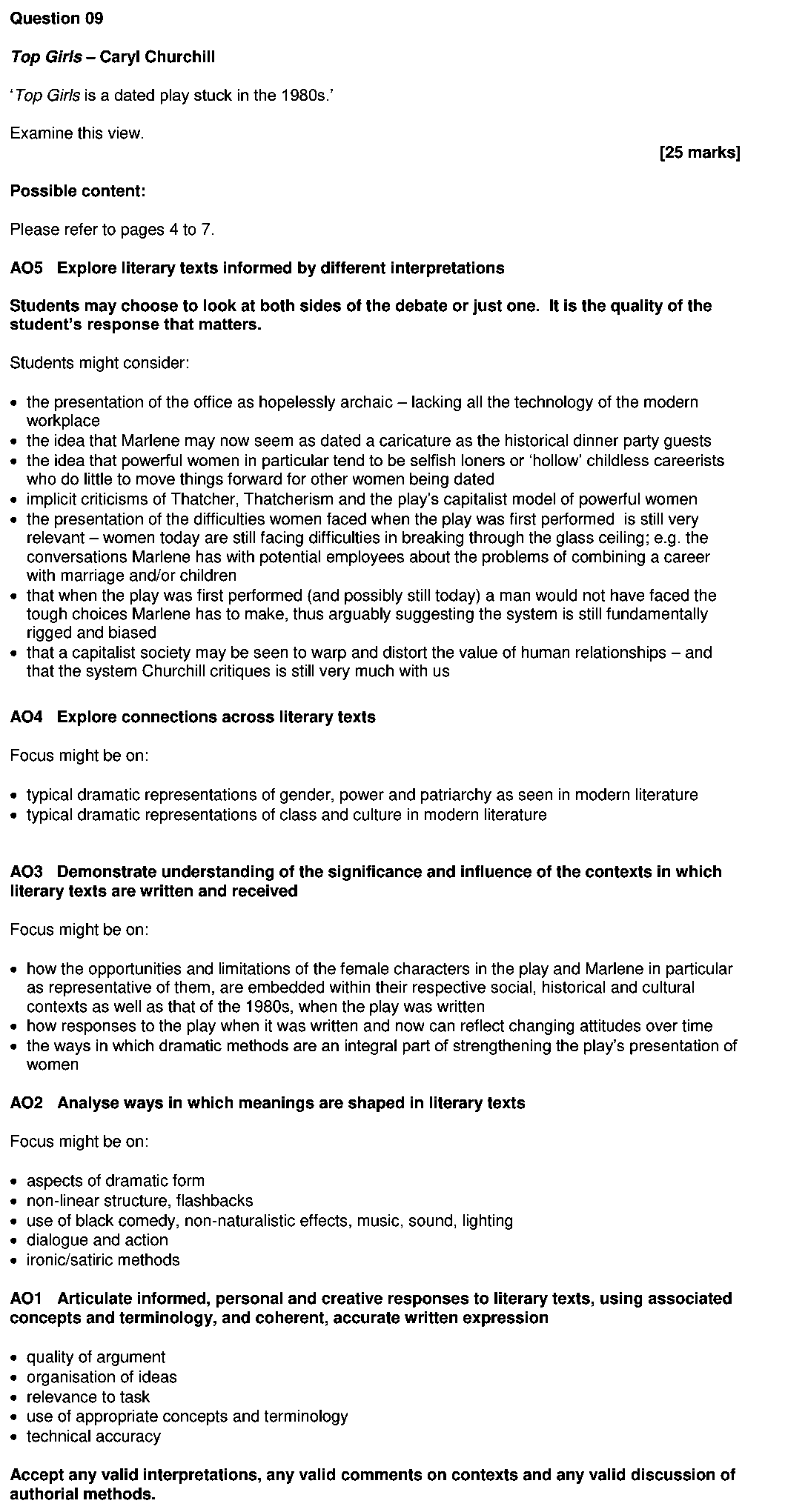
June 2025 · Paper 2B · Q925 marksSet text essay
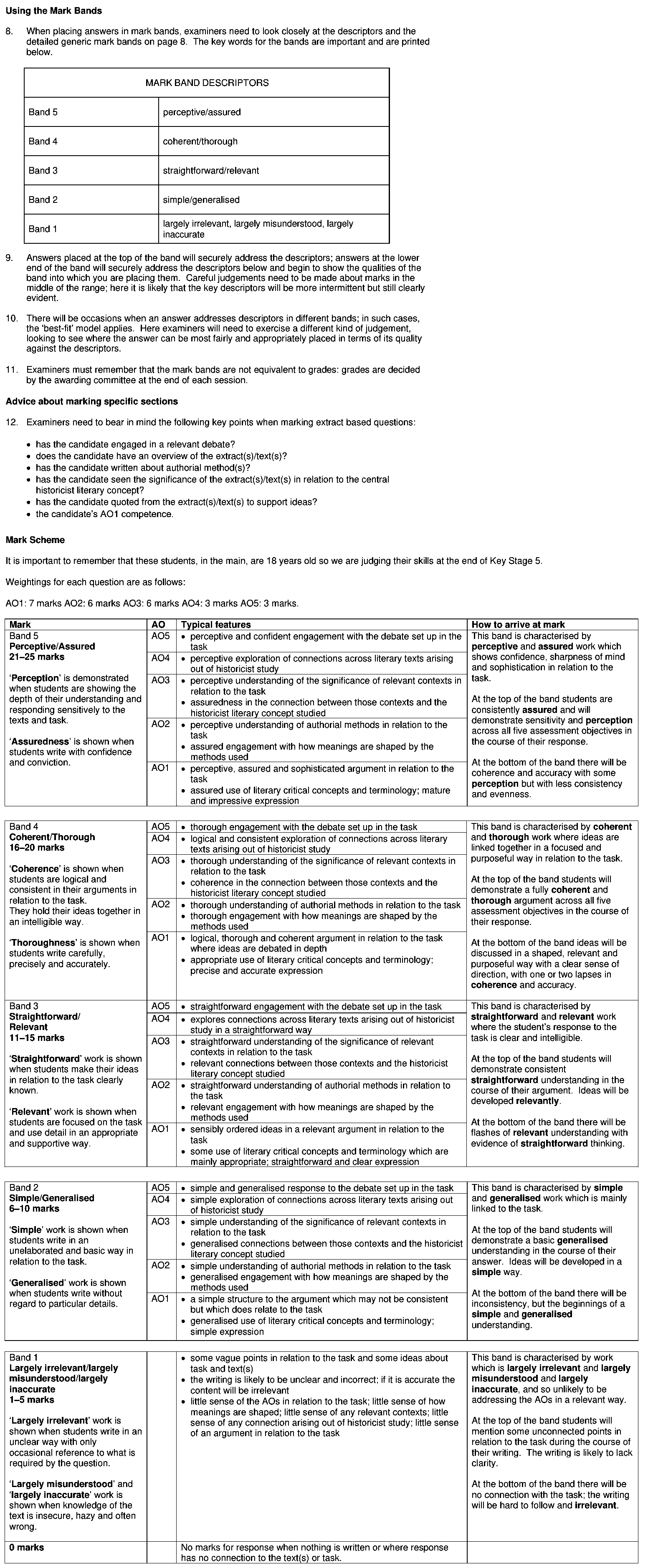
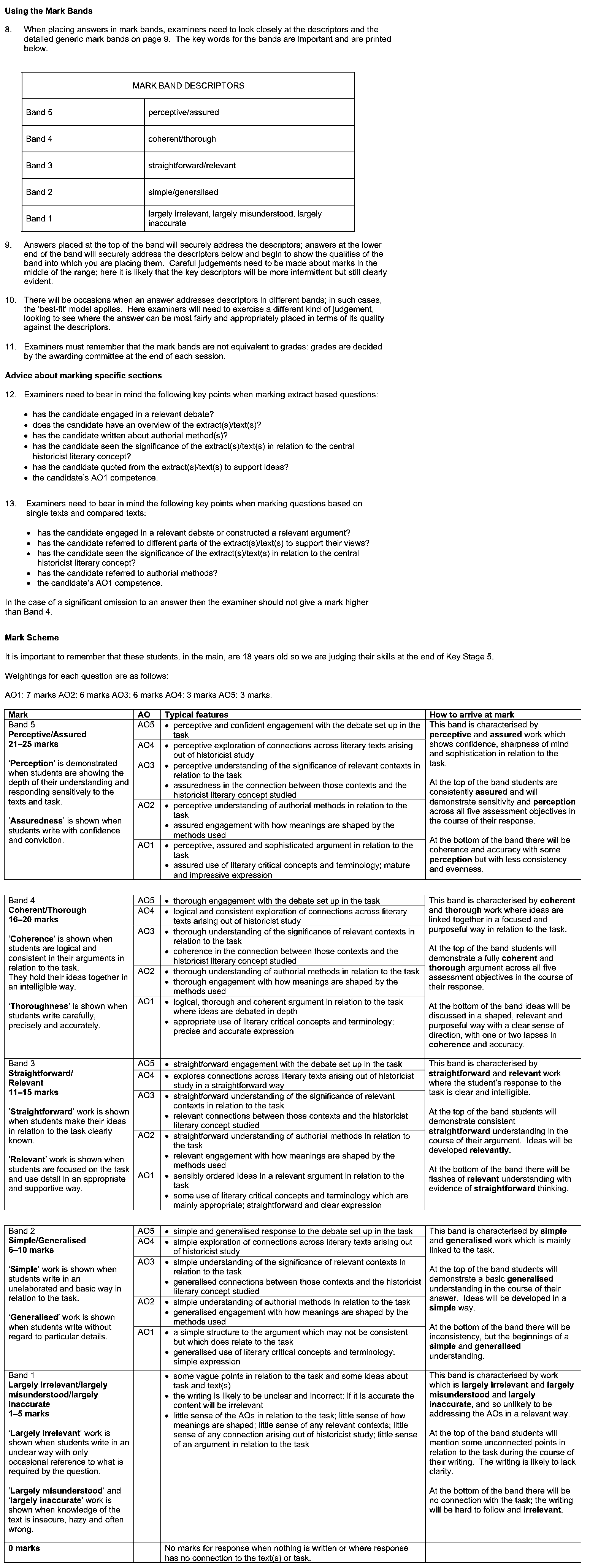
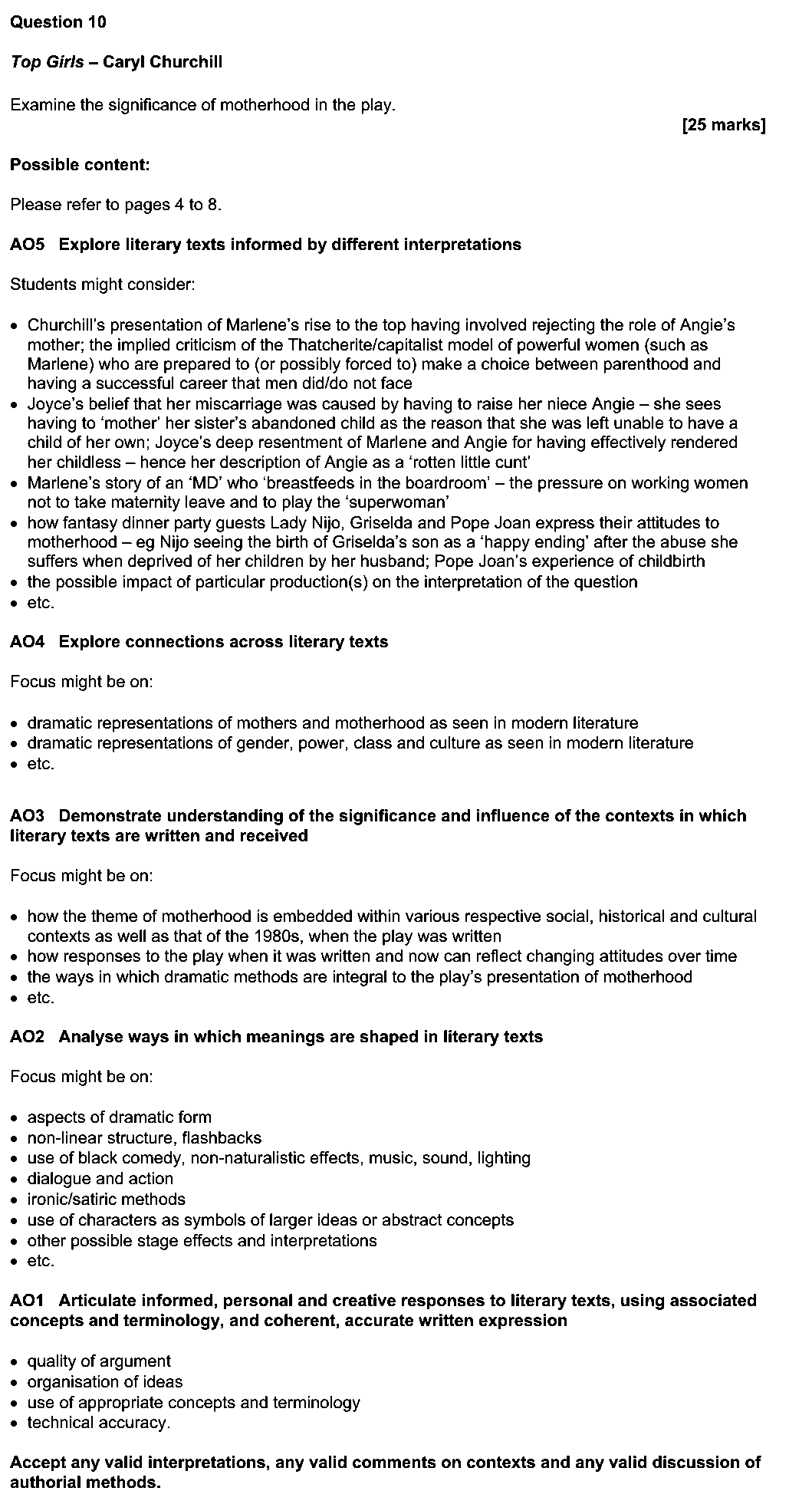
Mark scheme, including the levels and indicative content
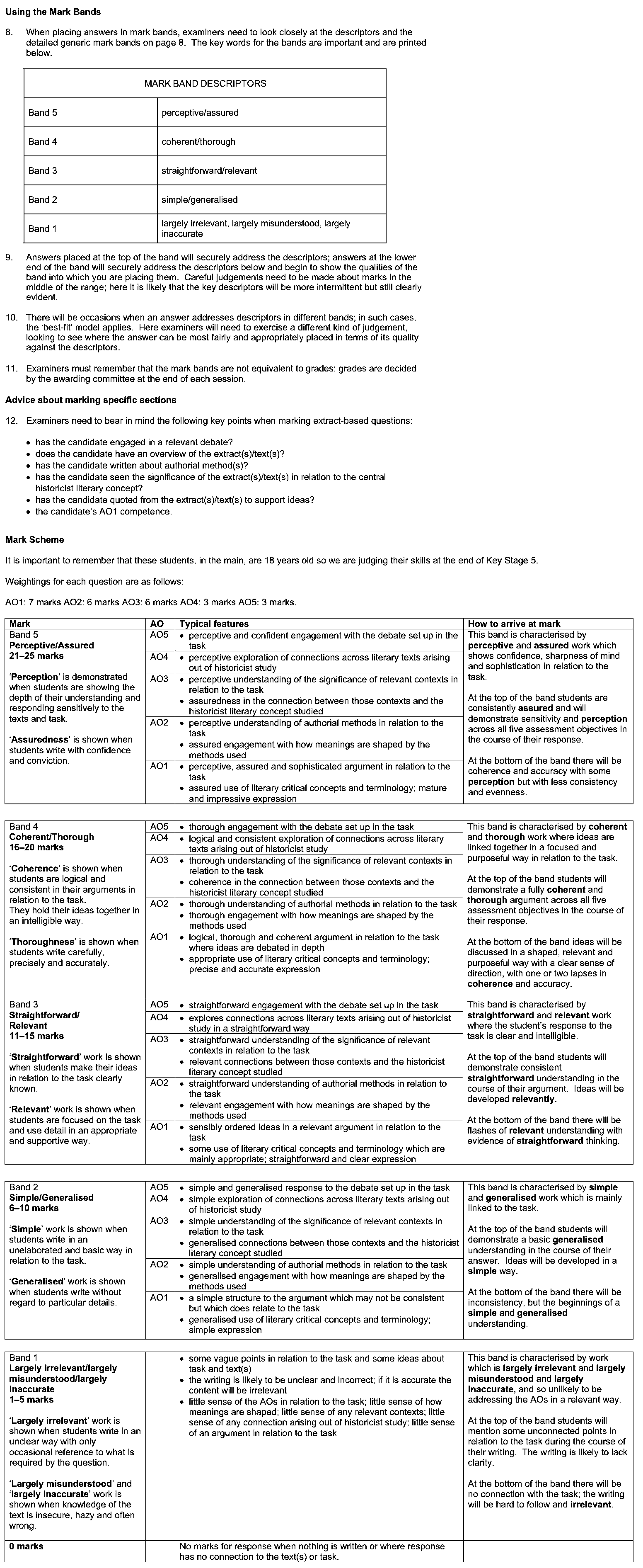
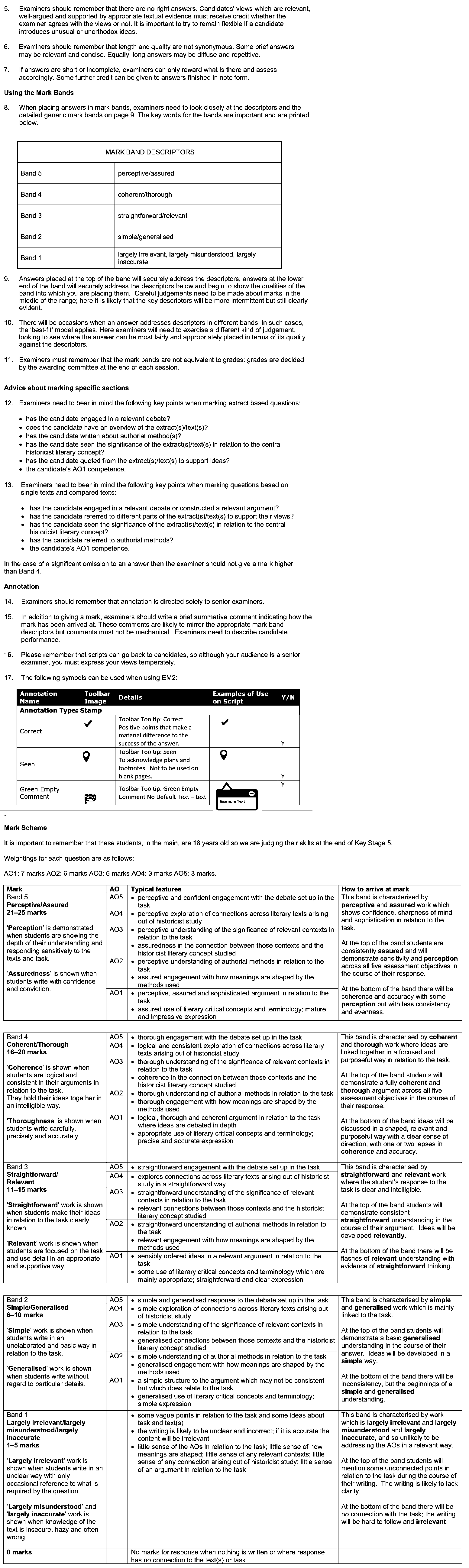
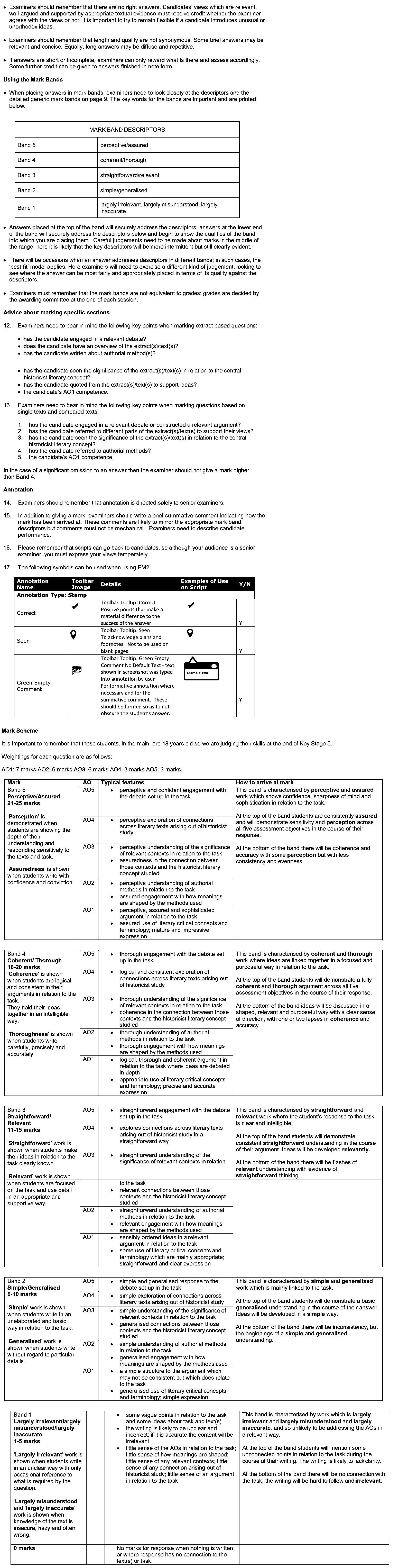
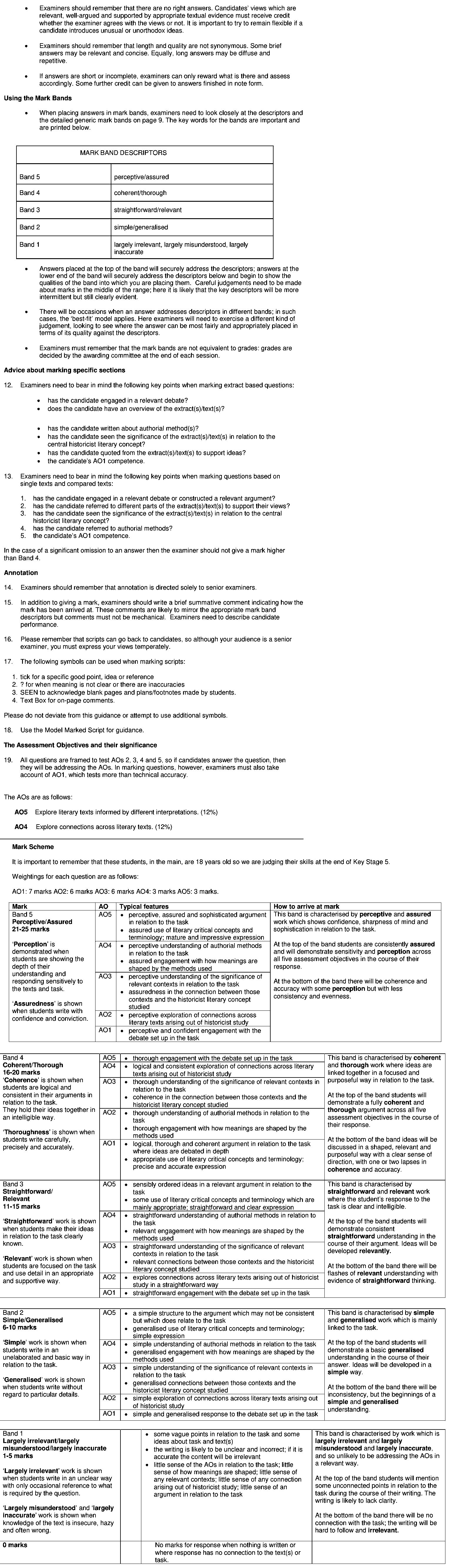
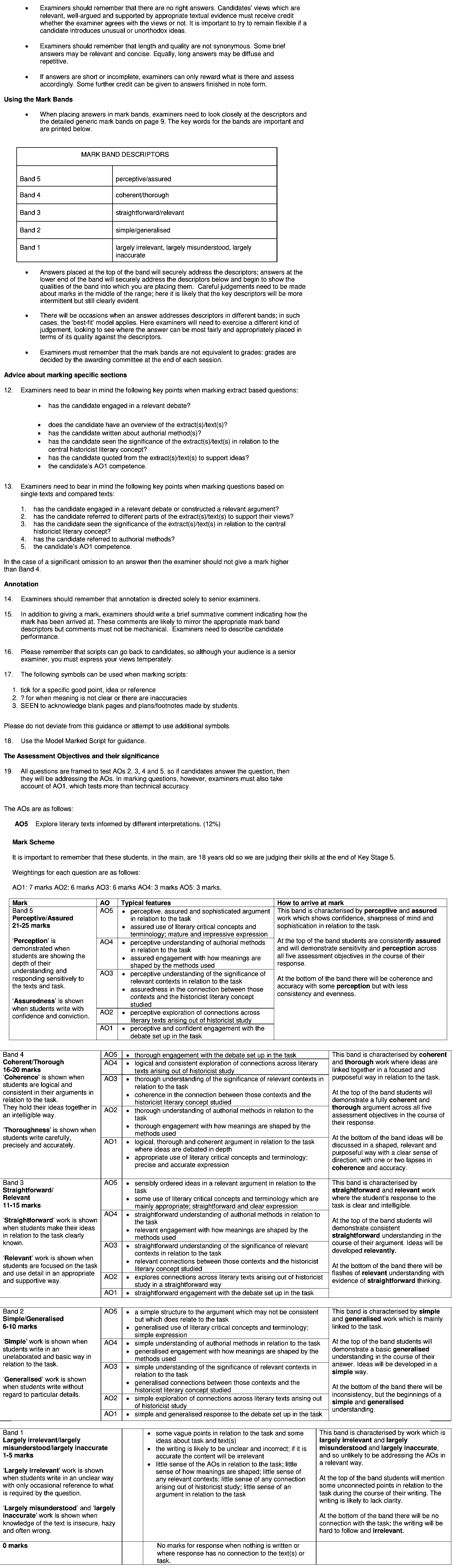
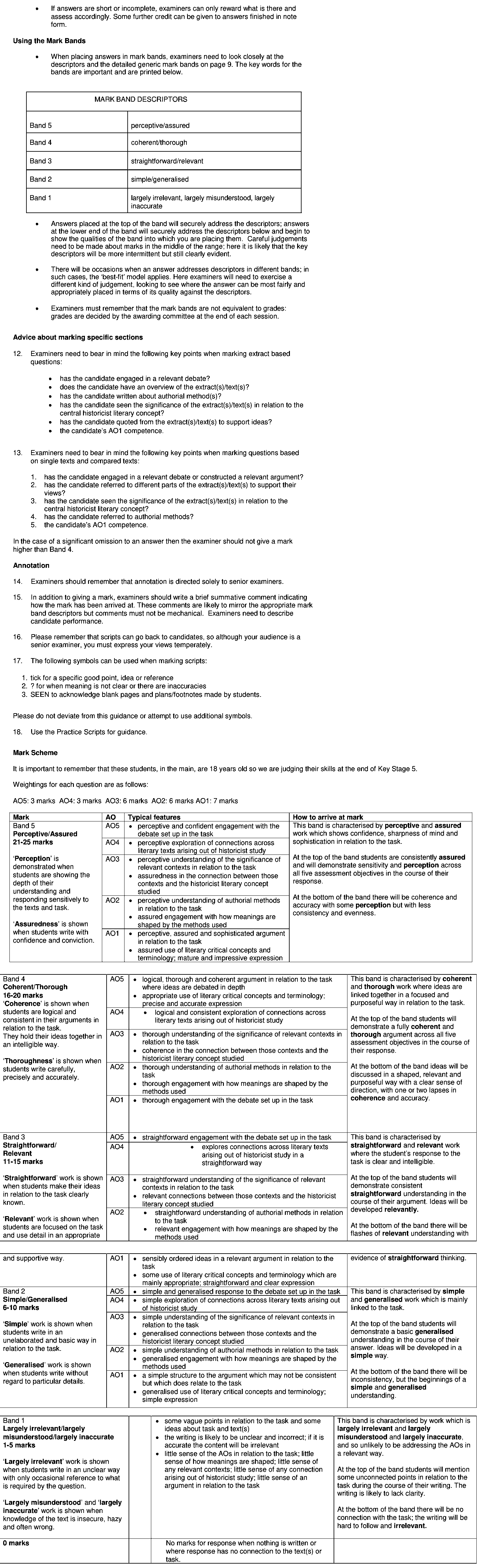
The general mark scheme (assessment objectives and bands)
Examiner's comment
● These questions were answered by a very small minority of students, so detailed feedback cannot be given.
Notes from the mark scheme and report
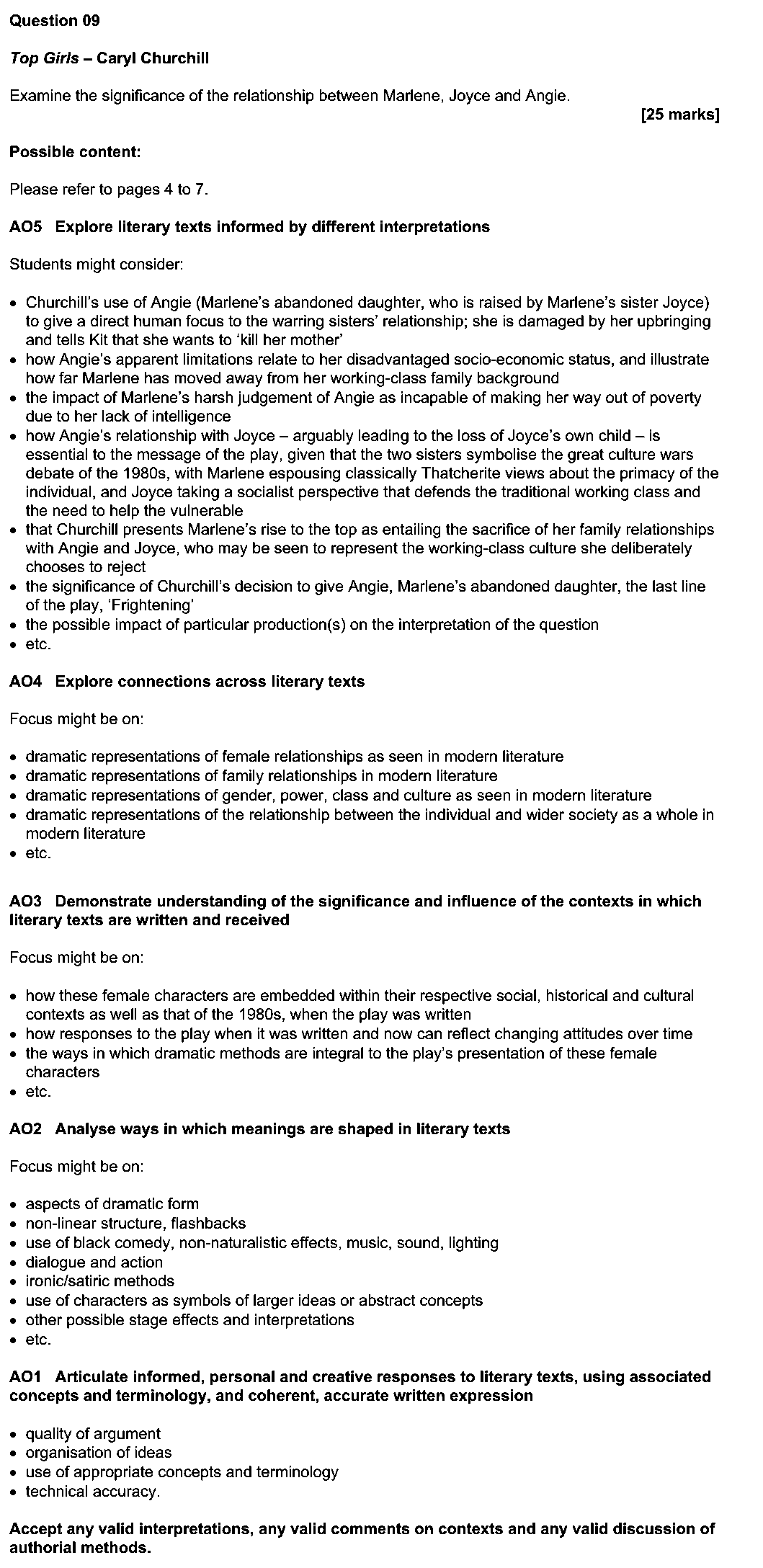
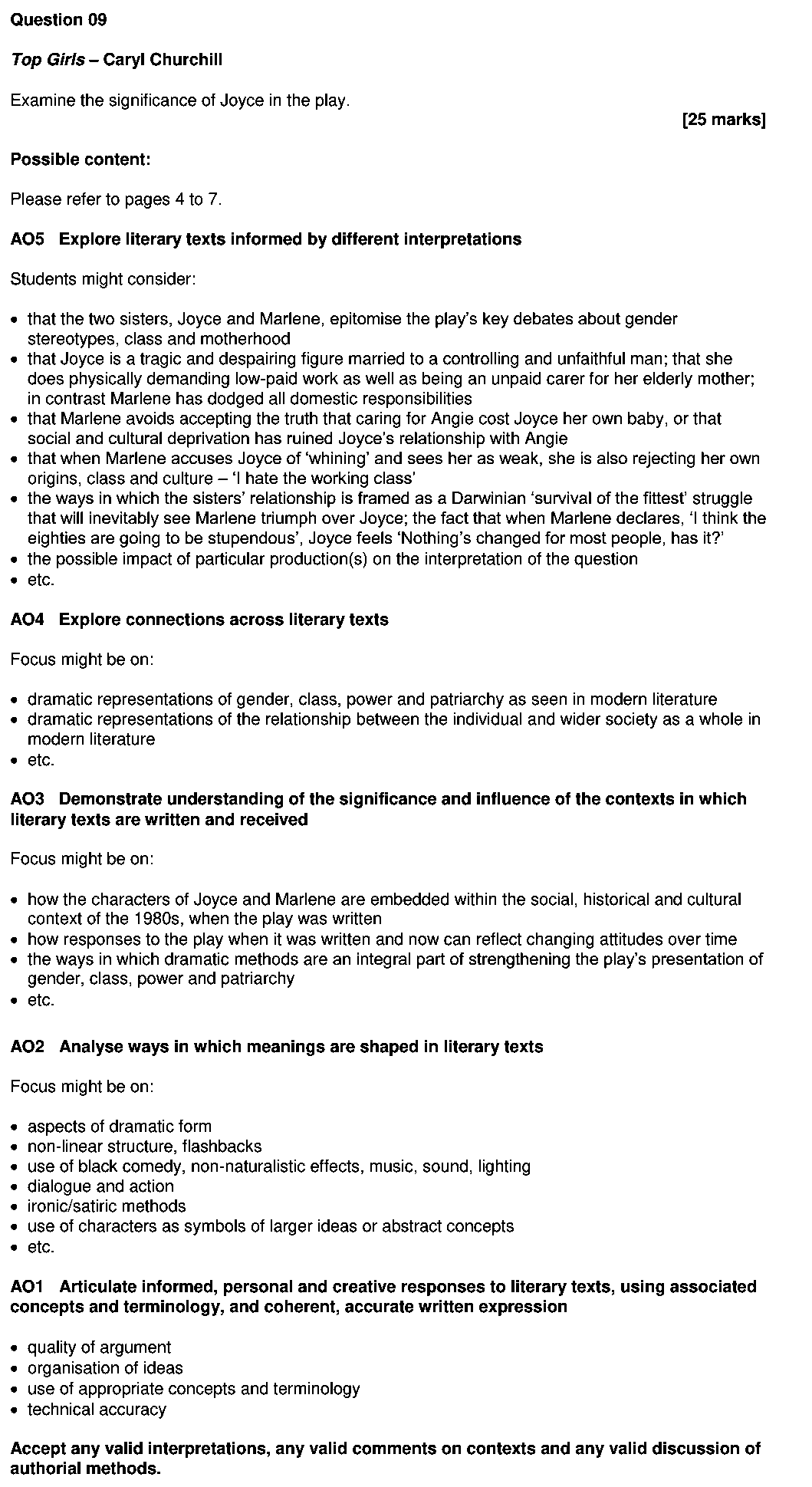
Focus: relationship: Marlene, Joyce and Angie
Open book, no extract
credited: Angie as human focus of the sisters' conflict ('kill her mother'), Angie's disadvantage and Marlene's harsh judgement, Joyce's sacrifice of her own child, Marlene as Thatcherite individualist vs Joyce as socialist, Marlene's rise costing her family
report: too few answers for feedback
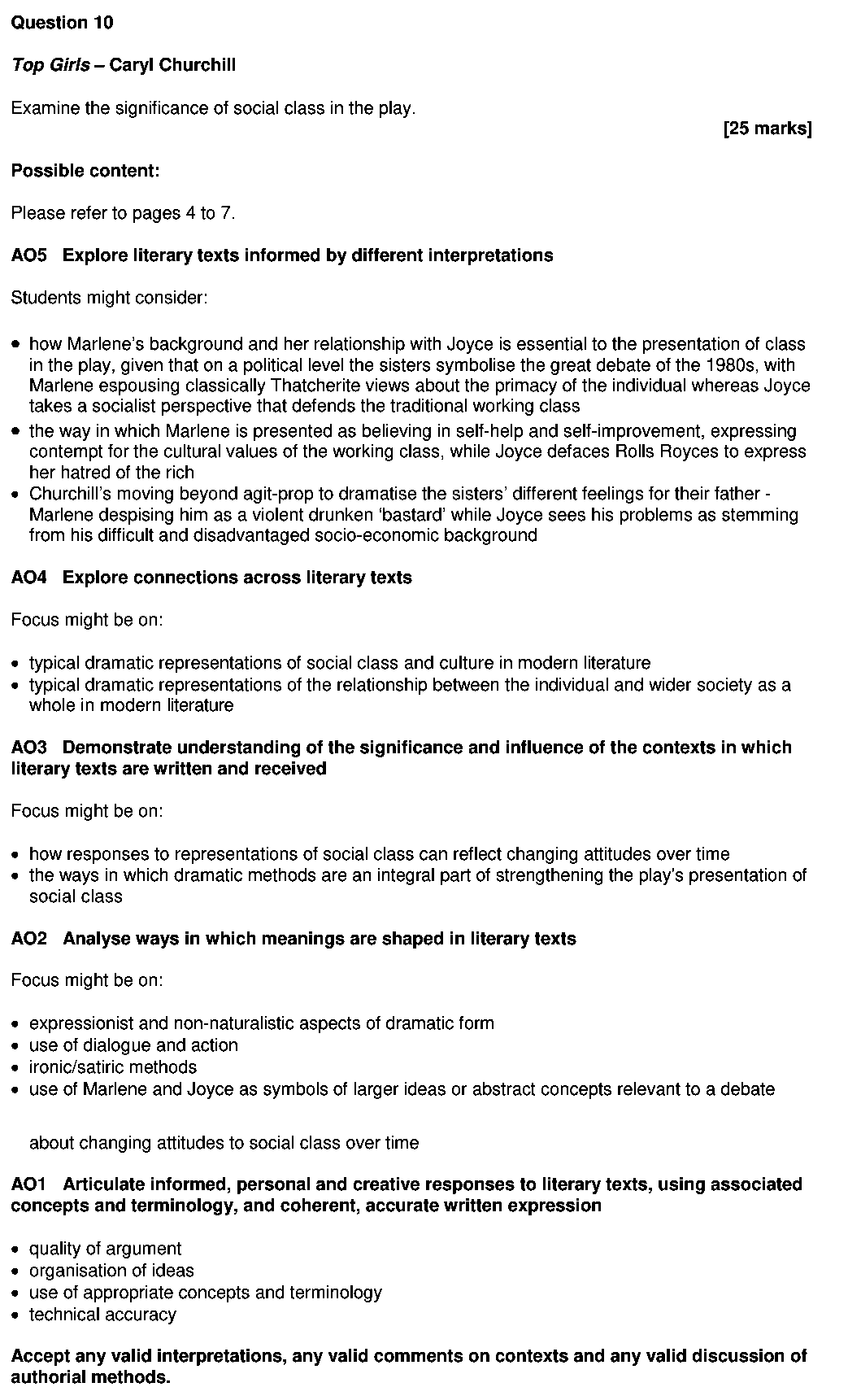
June 2025 · Paper 2B · Q1025 marksSet text essay
Mark scheme, including the levels and indicative content
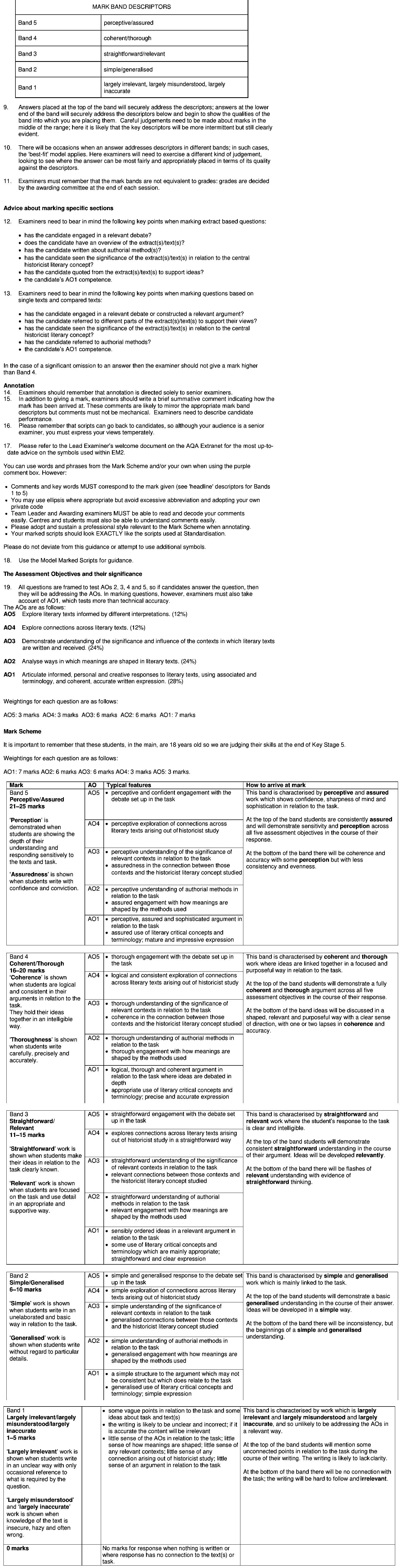
The general mark scheme (assessment objectives and bands)
Examiner's comment
● These questions were answered by a very small minority of students, so detailed feedback cannot be given.
Notes from the mark scheme and report
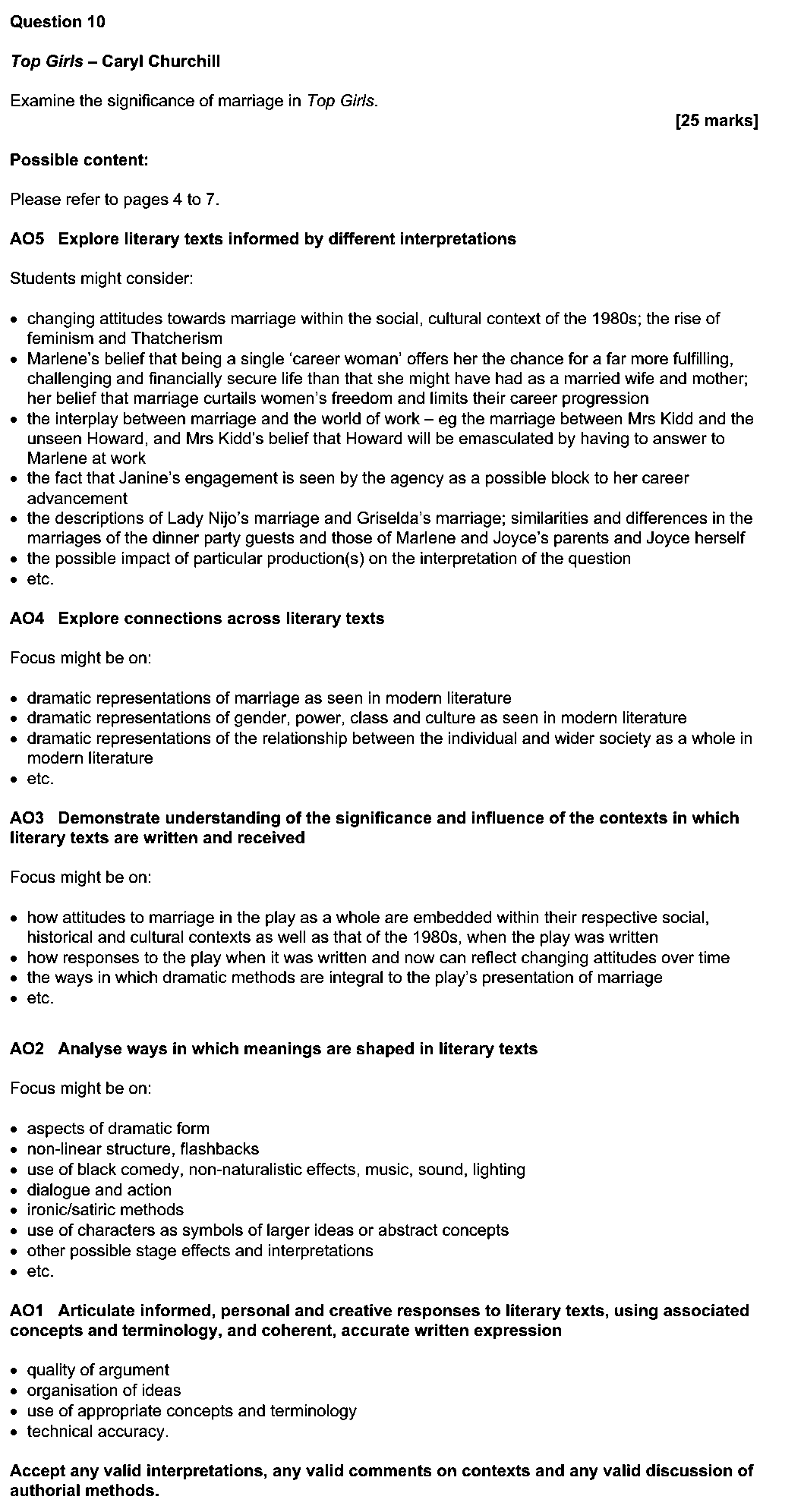
Focus: theme: marriage
Open book, no extract
credited: changing 1980s attitudes to marriage amid feminism and Thatcherism, Marlene's single career-woman life, Mrs Kidd and Howard, Jeanine's engagement as a career block, marriages of Nijo and Griselda, Joyce's marriage and her parents'
report: too few answers for feedback
June 2024 · Paper 2B · Q925 marksSet text essay
Mark scheme, including the levels and indicative content
The general mark scheme (assessment objectives and bands)
Examiner's comment
Better answers: ● showed clear understanding of power and powerlessness within the play ● wrote sharply and effectively about Churchill’s implicit criticisms of Thatcher and Thatcherism ● wrote well about the play in performance, eg the doubling of parts, the transhistorical elements and the non-linear structure. Less effective answers: ● were hazy about the key concepts in the given view ● wrote very generally about context, but failed to consider Churchill’s dramaturgy closely enough ● failed to write about elements of genre and performance.
Notes from the mark scheme and report
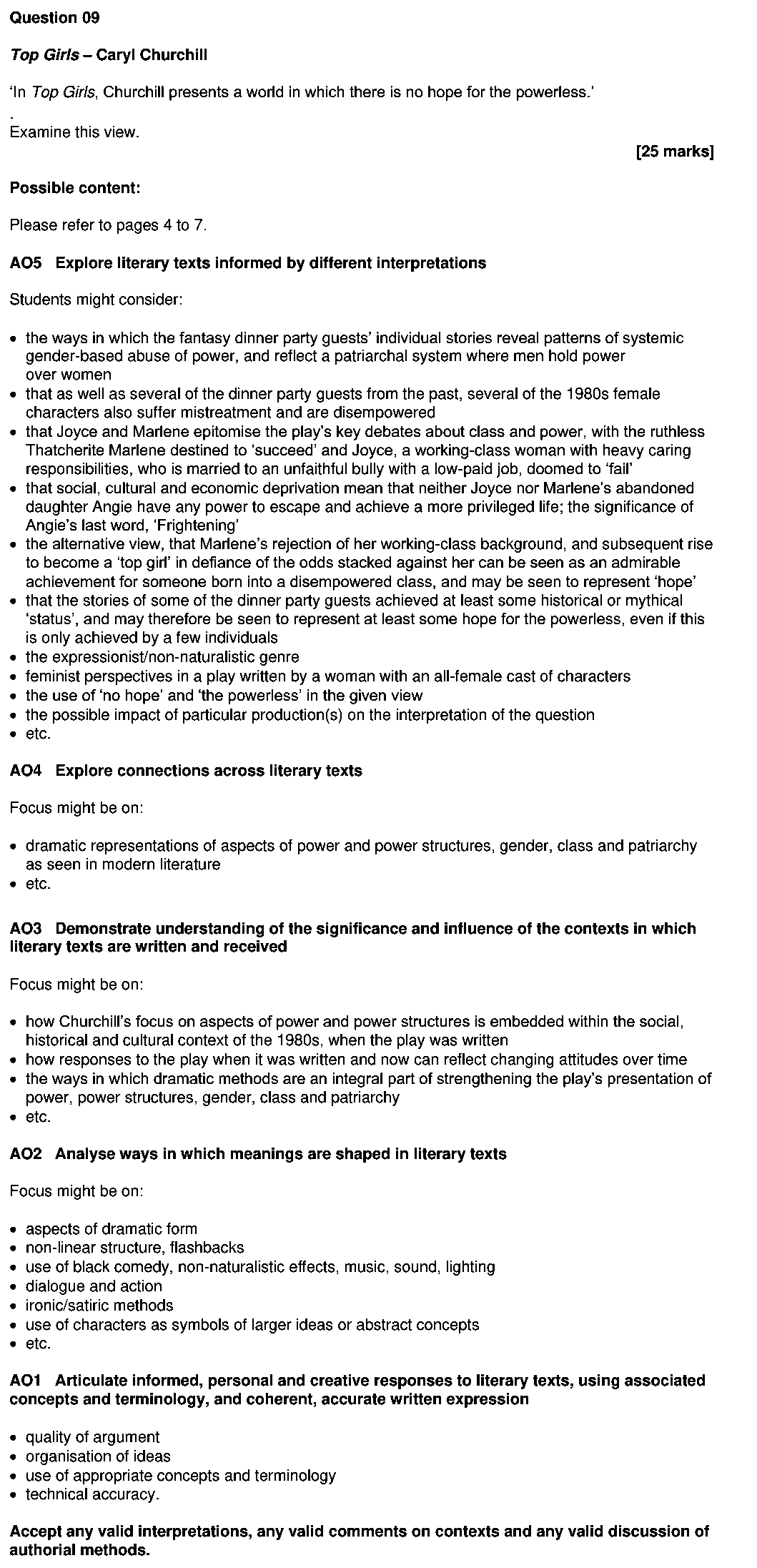
Focus: theme: power and powerlessness
Open book, no extract
debate 'no hope': dinner guests' stories of patriarchal abuse, 1980s women disempowered, Joyce and Angie trapped by deprivation ('Frightening') vs Marlene's rise as possible hope
credited criticism of Thatcherism, doubling and non-linear structure
weaker answers wrote generally about context without Churchill's dramaturgy
June 2024 · Paper 2B · Q1025 marksSet text essay
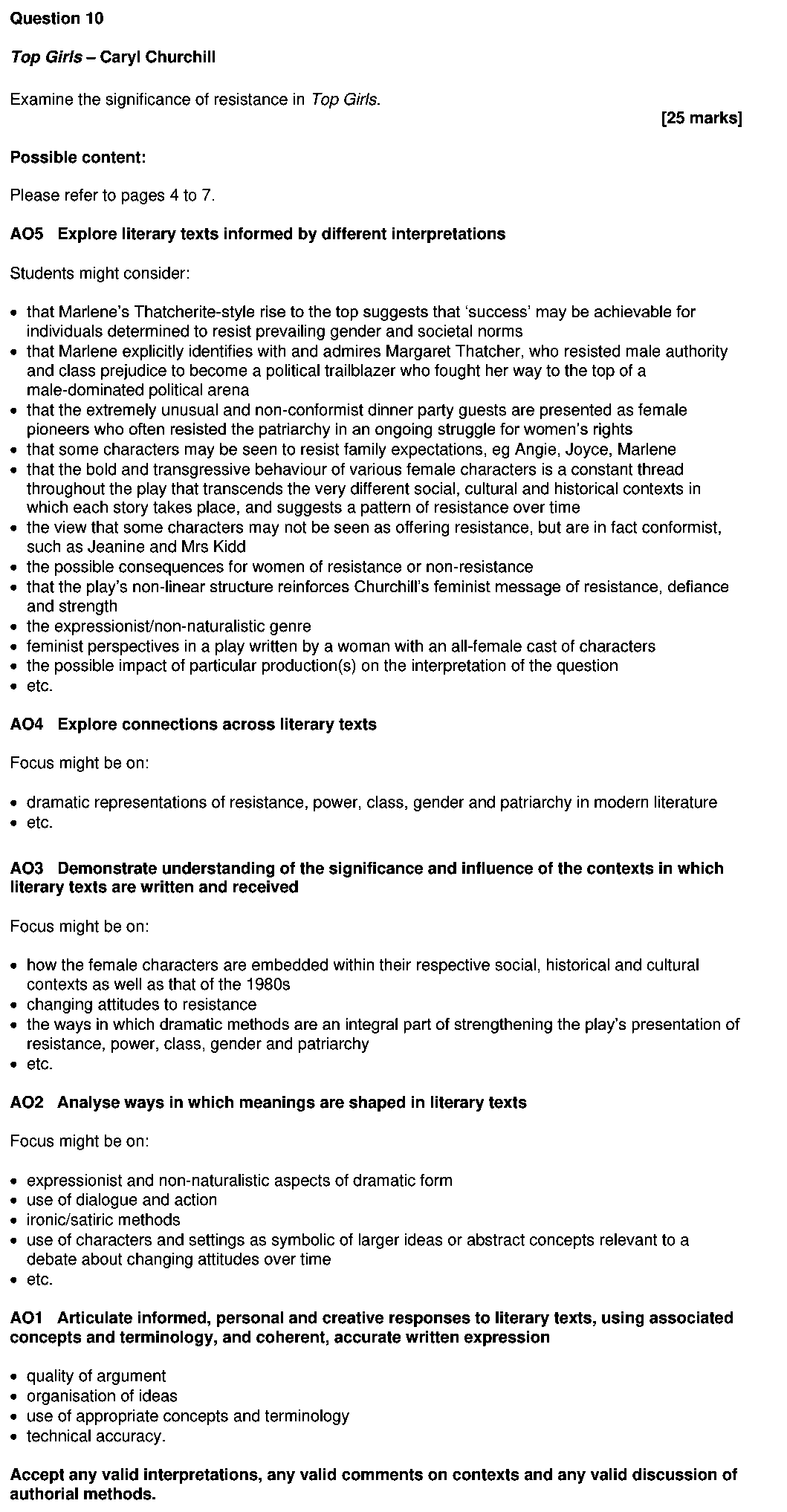
Mark scheme, including the levels and indicative content
The general mark scheme (assessment objectives and bands)
Notes from the mark scheme and report
Focus: theme: resistance
Open book, no extract
credited: Marlene's Thatcherite resistance to gender norms, dinner guests as pioneers resisting patriarchy, Angie, Joyce and Marlene resisting family expectations, conformists such as Jeanine and Mrs Kidd, consequences of resistance, non-linear structure showing resistance across time
the report's Question 10 comments are about motherhood (repeated from 2023) and do not match this question, so no report text is linked
June 2023 · Paper 2B · Q925 marksSet text essay
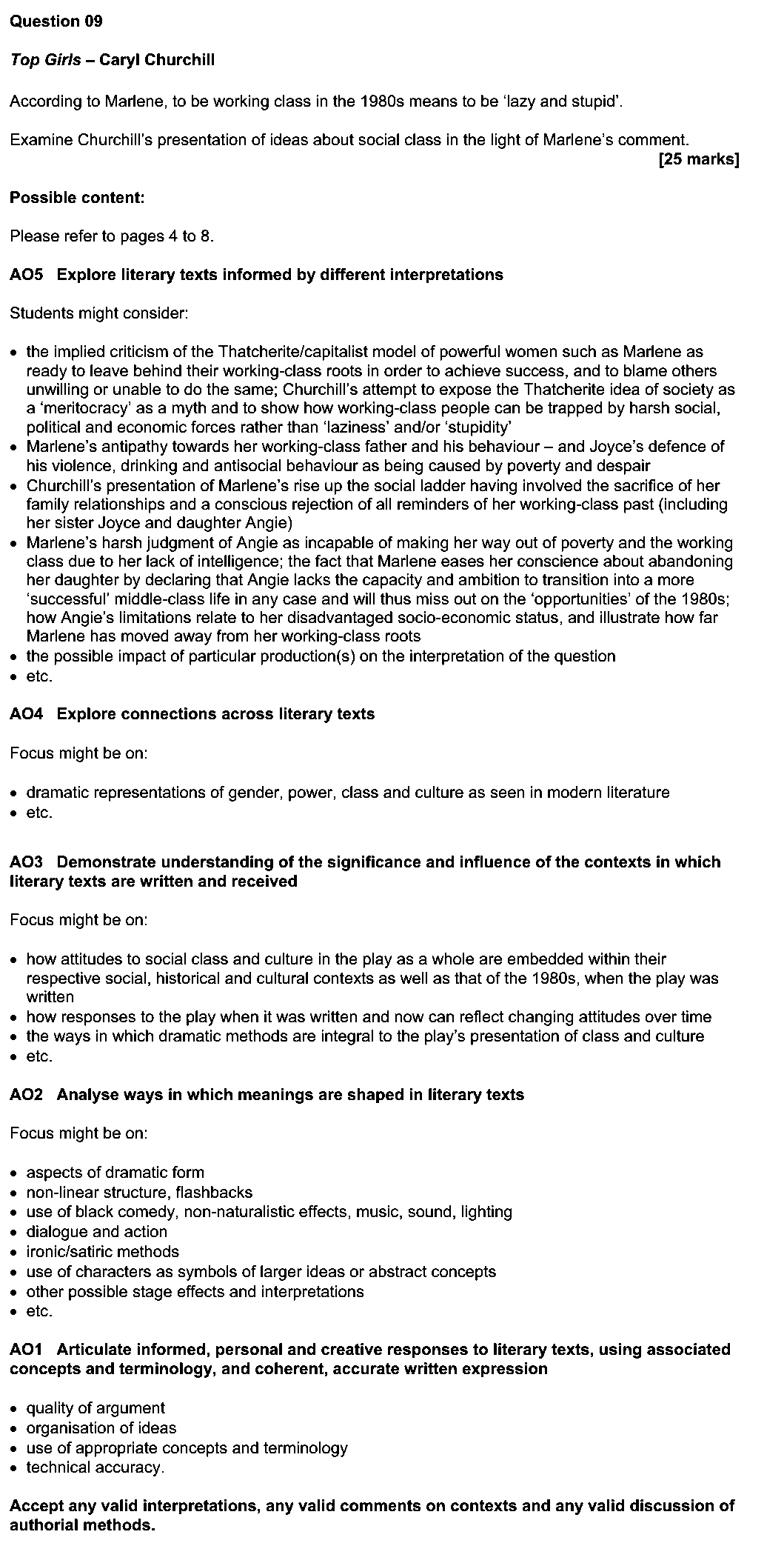
Mark scheme, including the levels and indicative content
The general mark scheme (assessment objectives and bands)
Examiner's comment
Better answers: • showed clear understanding of Marlene’s contemptuous view of the working class, and wrote well about the play’s implicit criticisms of Thatcher and Thatcherism • wrote well about the play in performance, eg the doubling of parts, the transhistorical elements and the non-linear structure. Less effective answers: • were hazy about the key concepts in the given view • wrote very generally about context, but failed to consider Churchill’s dramaturgy closely enough • failed to write about elements of genre and performance.
Notes from the mark scheme and report
Focus: theme: social class
Open book, no extract
credited: Churchill's critique of Thatcherite meritocracy, Marlene's contempt for her working-class father, Joyce, and Angie, Joyce's defence of the working class, doubling and non-linear structure
weaker answers were hazy on the view or wrote about context without Churchill's dramaturgy
June 2023 · Paper 2B · Q1025 marksSet text essay
Mark scheme, including the levels and indicative content
The general mark scheme (assessment objectives and bands)
Examiner's comment
Better answers: • showed clear understanding of the significance of motherhood in terms of how it helps to symbolises the either/or nature of the issue within the 1980s context, the transhistorical context, and today • examined how various characters discuss the issue of motherhood and their own experiences as mothers to illuminate a strong debate • analysed the play’s implicit socio-political criticisms around gender and power • wrote well about the play in performance, eg the doubling of parts, the transhistorical elements and the non-linear structure. Less effective answers: • were hazy about the significance of motherhood and struggled to write about it in depth • wrote in a descriptive way about what happens to various female characters as if they were real people rather than fictional constructs • failed to write about elements of genre and performance.
Notes from the mark scheme and report
Focus: theme: motherhood
Open book, no extract
credited: Marlene's rejection of Angie, Joyce's miscarriage and resentment, the 'MD who breastfeeds in the boardroom', the dinner guests' (Nijo, Griselda, Joan) experiences of motherhood, motherhood as either/or choice in the 1980s and across time
doubling and structure
weaker answers struggled to discuss motherhood in depth or treated characters as real
June 2022 · Paper 2B · Q925 marksSet text essay
Mark scheme, including the levels and indicative content
The general mark scheme (assessment objectives and bands)
Examiner's comment
More effective answers: • showed clear understanding of the significance of the role of Joyce in terms of how she helps to symbolise the great political and cultural debate of the 1980s • examined how while her sister Marlene espouses classically Thatcherite views about the primacy of the individual, Joyce takes a socialist perspective, defending the traditional working class • analysed the play’s implicit criticisms of Thatcher and Thatcherism • wrote well about the play in performance, eg the doubling of parts, the transhistorical elements and the non-linear structure. Less effective answers: • were hazy about the role of Joyce and struggled to write about her in depth • wrote in a descriptive way about what happens to Joyce as if she were a real person rather than a fictional construct • failed to write about elements of genre and performance.
Notes from the mark scheme and report
Focus: character: Joyce
Open book, no extract
credited: Joyce and Marlene embodying debates about class, gender and motherhood, Joyce's unpaid care and lost baby, Marlene's 'I hate the working class', Joyce's socialist view vs Marlene's Thatcherism, 'Nothing's changed for most people'
doubling, non-linear structure
weaker answers struggled to discuss Joyce in depth or treated her as a real person
report prints this as Question 10
June 2022 · Paper 2B · Q1025 marksSet text essay
Mark scheme, including the levels and indicative content
The general mark scheme (assessment objectives and bands)
Examiner's comment
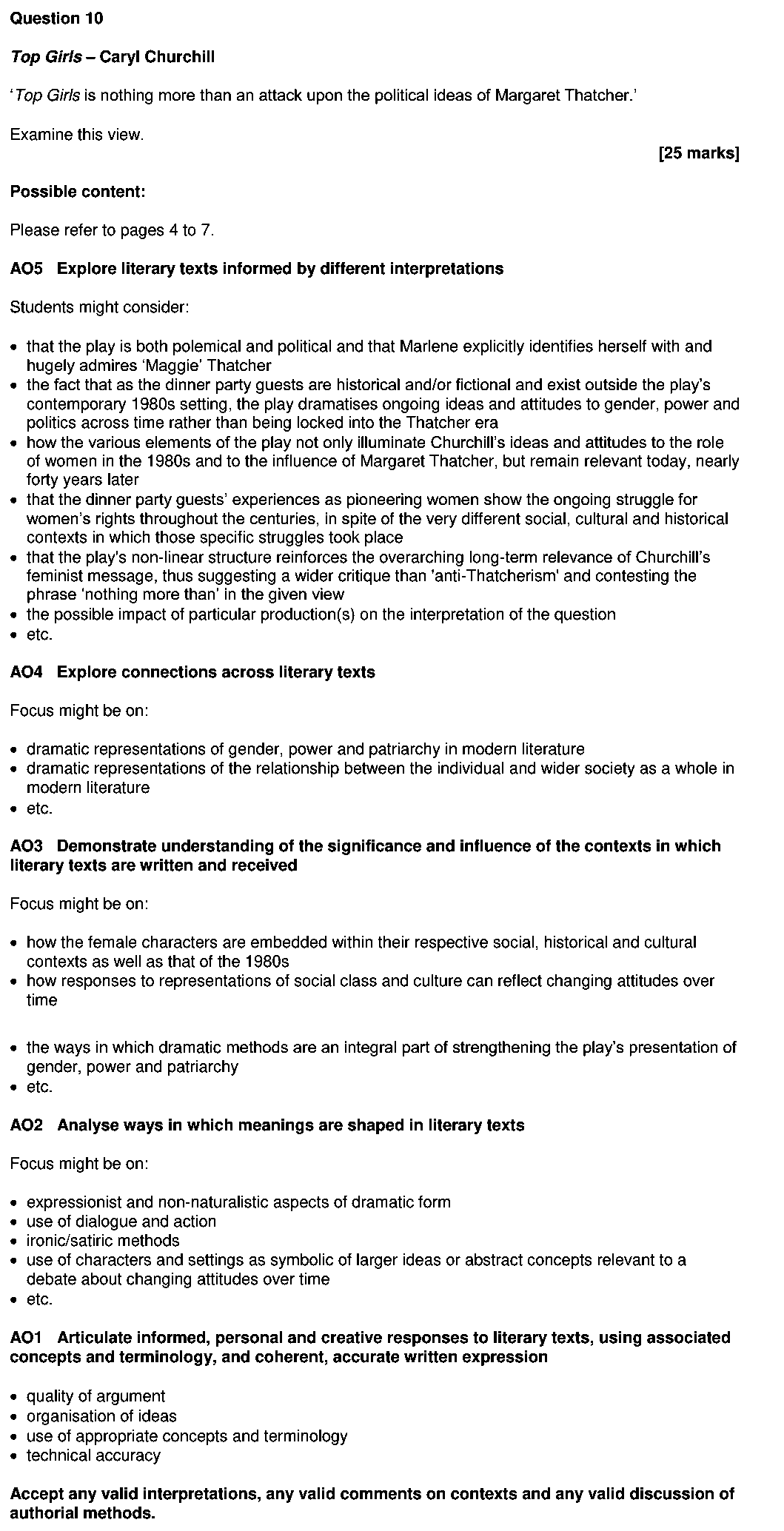
More effective answers: • showed clear understanding of the given view of the play as ‘nothing more than an attack upon the political ideals of Margaret Thatcher’ and wrote well about the play’s implicit criticisms of Thatcher and Thatcherism • challenged the given view by analysing the experiences of the dinner party guests, tracing connections between the women from the past and those located within the 1980s context • wrote well about the play in performance, eg the doubling of parts, the transhistorical elements and the non-linear structure. Less effective answers: • were hazy about the key concepts in the given view • made little of the implied debate in the given view, which was highlighted by the words ‘nothing more than’ • failed to write about elements of genre and performance.
Notes from the mark scheme and report
Focus: theme: politics and Thatcherism
Open book, no extract
debate 'nothing more than': Marlene's admiration of Thatcher vs the transhistorical dinner guests and non-linear structure showing a wider feminist critique still relevant today
credited doubling of parts and performance
weaker answers were hazy on the view and ignored genre and performance
report prints this as Question 9
November 2021 · Paper 2B · Q925 marksSet text essay
Mark scheme, including the levels and indicative content
The general mark scheme (assessment objectives and bands)
Notes from the mark scheme and report
Focus: setting: the office scenes
Open book, no extract
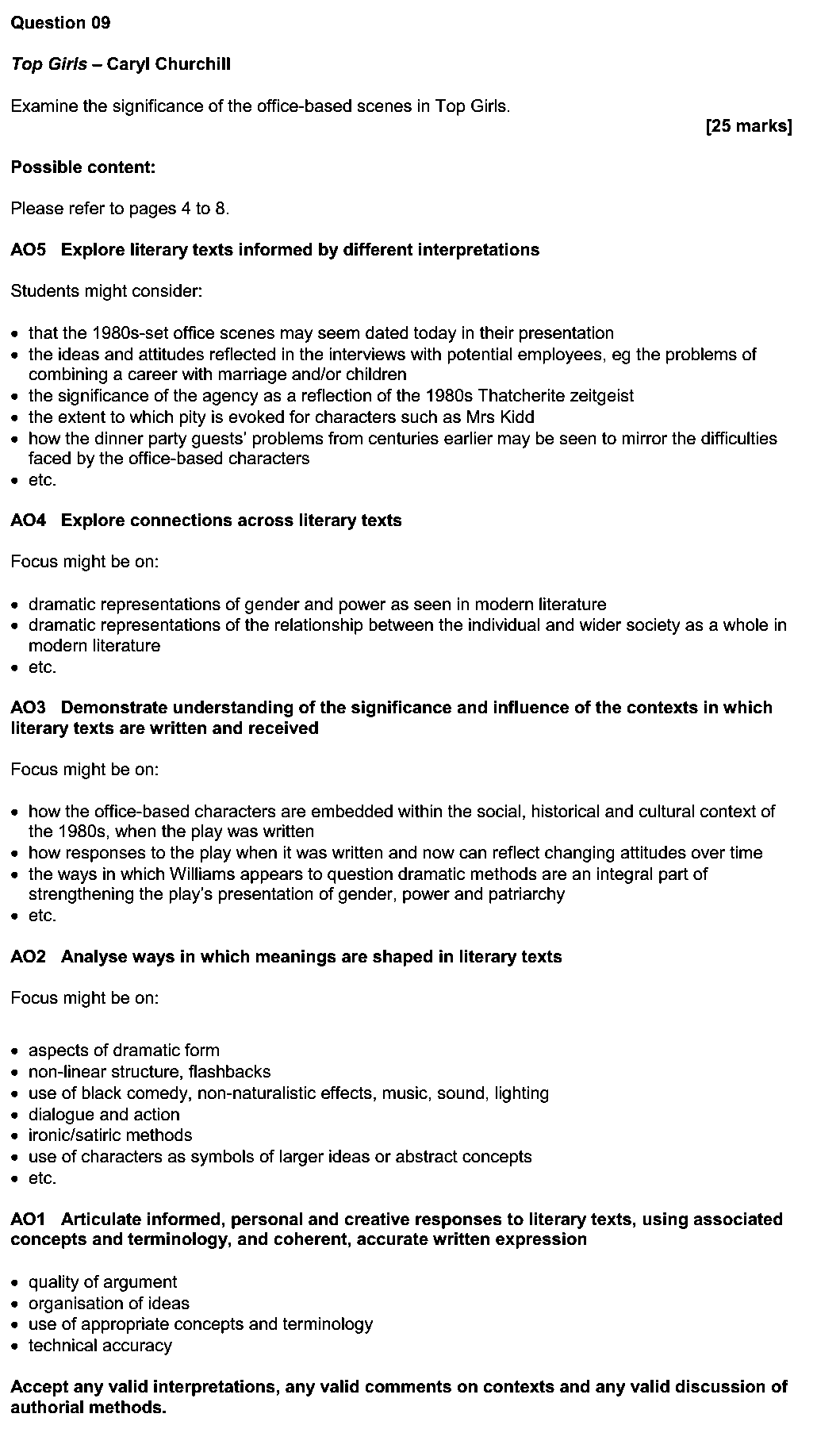
significance of the office-based scenes
MS credits: possibly dated 1980s presentation, interviews revealing career vs marriage and children dilemmas, the agency as reflection of the Thatcherite zeitgeist, pity for characters like Mrs Kidd, dinner guests' problems mirroring the office women's
papers dated June 2021
no examiners' report
November 2021 · Paper 2B · Q1025 marksSet text essay
Mark scheme, including the levels and indicative content
The general mark scheme (assessment objectives and bands)
Notes from the mark scheme and report
Focus: structure: coherence of the play
Open book, no extract
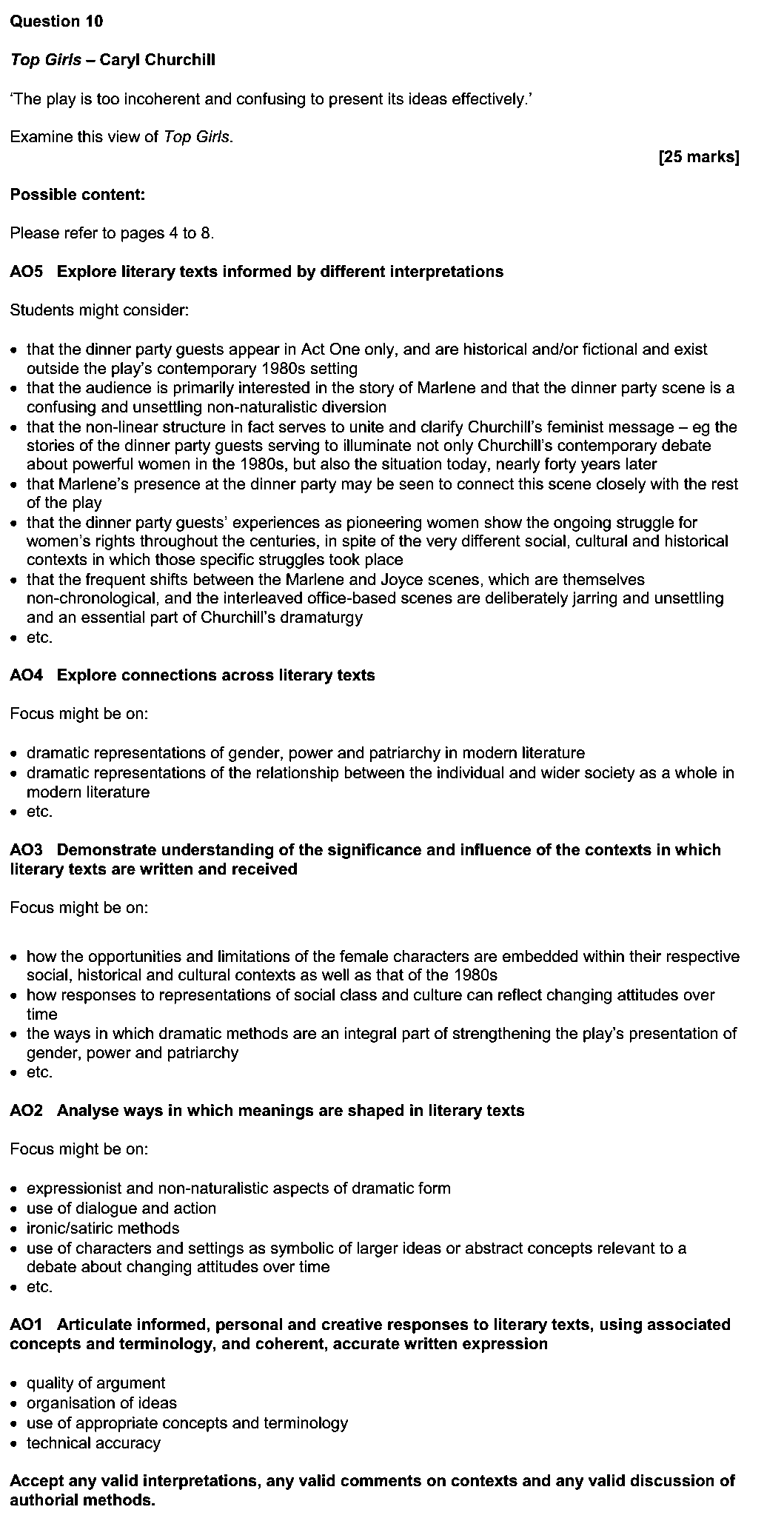
view that the play is too incoherent and confusing to present its ideas
MS credits: Act One dinner guests and non-naturalistic diversion vs non-linear structure clarifying the feminist message, Marlene's presence connecting the scenes, guests showing women's ongoing struggle, shifts between Marlene and Joyce scenes
papers dated June 2021
no examiners' report
November 2020 · Paper 2B · Q925 marksSet text essay
Mark scheme, including the levels and indicative content
The general mark scheme (assessment objectives and bands)
Notes from the mark scheme and report
Focus: theme: the past
Open book, no extract
view that women are haunted by the past
MS credits: Marlene's rejection of her past (Joyce, Angie, her father) as implied critique of Thatcherite success, counter-argument that she is not haunted but able to reject it, dinner guests and office women recalling past trauma and mistreatment in graphic detail
no examiners' report for this series
November 2020 · Paper 2B · Q1025 marksSet text essay
Mark scheme, including the levels and indicative content
The general mark scheme (assessment objectives and bands)
Notes from the mark scheme and report
Focus: character: Angie
Open book, no extract
significance of Angie
MS credits: Marlene's abandoned daughter raised by Joyce as focus of the sisters' conflict, her limitations tied to disadvantaged class showing how far Marlene has moved away, Thatcherite vs socialist debate and helping the vulnerable, Angie given the last word 'Frightening'
no examiners' report for this series
June 2019 · Paper 2B · Q925 marksSet text essay
Mark scheme, including the levels and indicative content
The general mark scheme (assessment objectives and bands)
Examiner's comment
Most students who wrote about Top Girls chose this question and tended to write very well about the play’s implicit criticisms of Thatcher and Thatcherism. Excellent work was seen that acknowledged Churchill’s presentation of the difficulties women faced when the play was first performed. Students saw these difficulties as still very relevant today. Some students wrote with real insight about Marlene’s admirable rise to the top of her chosen business in defiance of the odds stacked against her. They also discussed Churchill’s implied criticisms of Margaret Thatcher and the capitalist model of powerful women as selfish loners or ‘hollow’ careerists. Others wrote about the conversations Marlene has with potential employees about the problems of combining a career with marriage and children. They noted that when the play was first performed, and possibly to this day, a man would not have faced the same tough choices as Marlene about combining parenthood and a career. Many effective responses analysed the experiences of the dinner party guests, tracing connections between the women from the past and those located within the 1980s context who also suffer mistreatment, disaster and disempowerment. The most effective responses, of course, never lost sight of the text as drama.
Notes from the mark scheme and report
Focus: theme: female empowerment
Open book, no extract
view that the play is a triumphant celebration of female empowerment ('We've all come a long way')
most Top Girls candidates chose it
credited: Marlene's admirable rise vs critique of Thatcher and capitalist powerful women as 'hollow' careerists, career and children dilemma a man would not face, dinner guests' mistreatment connected to 1980s women
best answers kept sight of the text as drama
June 2019 · Paper 2B · Q1025 marksSet text essay
Mark scheme, including the levels and indicative content
The general mark scheme (assessment objectives and bands)
Examiner's comment
This was very much a marginal question choice, but the responses seen tended to be very effective. More effective responses often discussed how Marlene and Joyce are used to symbolise the great political and cultural debate of the 1980s. They saw Marlene as espousing classically Thatcherite views about the primacy of the individual and Joyce taking a socialist perspective, defending the traditional working class. Strong writing was seen that unpicked the way in which Marlene is presented as believing in self-help and self-improvement, expressing contempt for the cultural values of the working class. Meanwhile, Joyce defaces Rolls Royces to express her hatred of the rich. Effective points were made about Churchill’s dramatisation of the sisters’ different feelings for their father. Marlene was seen as despising him as a violent drunken ‘bastard’ while Joyce views his problems as stemming from his difficult and disadvantaged socio-economic background.
Notes from the mark scheme and report
Focus: theme: social class
Open book, no extract
significance of social class
marginal choice but effective answers
credited: Marlene and Joyce symbolising the 1980s debate (Thatcherite individualism vs socialist defence of the working class), Marlene's contempt for working-class culture vs Joyce defacing Rolls Royces, their different views of their father
June 2018 · Paper 2B · Q925 marksSet text essay
Mark scheme, including the levels and indicative content
The general mark scheme (assessment objectives and bands)
Examiner's comment
Very few students who wrote about Top Girls chose this question. Those who did tended to write well about the play’s implicit criticisms of Thatcher, Thatcherism and the capitalist model of powerful women and saw Churchill’s presentation of the difficulties women faced when the play was first performed as still very relevant today, given the apparent enduring robustness of the proverbial glass ceiling. The best answers, of course, never lost sight of the text as drama, not mere polemic.
Notes from the mark scheme and report
Focus: theme: relevance beyond the 1980s
Open book, no extract
view that the play is dated and stuck in the 1980s
very few chose it
credited: archaic office, Marlene as caricature, critique of Thatcher and Thatcherism vs enduring glass ceiling and difficulty of combining career and children, capitalism distorting relationships
best answers kept sight of the text as drama, not polemic
June 2018 · Paper 2B · Q1025 marksSet text essay
Mark scheme, including the levels and indicative content
The general mark scheme (assessment objectives and bands)
Examiner's comment
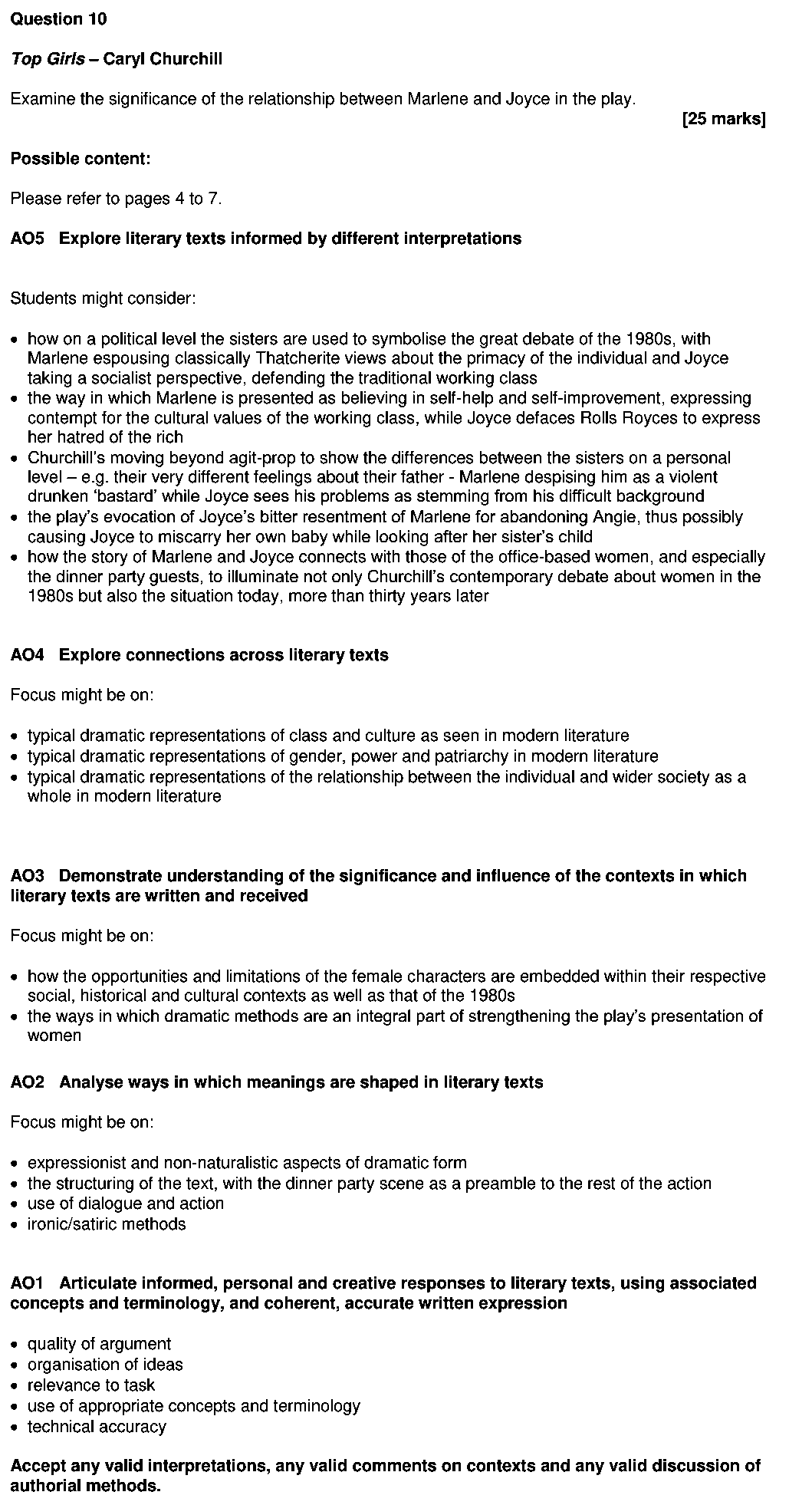
This was the more popular Top Girls question, and the answers seen tended to be very effective. Better responses often discussed how Marlene and Joyce are used to symbolise the great political and cultural debate of the 1980s, with Marlene espousing classically Thatcherite views about the primacy of the individual and Joyce taking a socialist perspective, defending the traditional working class. Some particularly strong writing was seen about the ways in which the sisters’ personal story connects with those of the office-based women and the dinner party guests.
Notes from the mark scheme and report
Focus: relationship: Marlene and Joyce
Open book, no extract
significance of the sisters' relationship
the more popular Top Girls question
credited: Marlene's Thatcherite individualism vs Joyce's socialist defence of the working class, their different views of their father, Joyce's resentment over Angie, connections with the office women and dinner guests
June 2017 · Paper 2B · Q925 marksSet text essay
Mark scheme, including the levels and indicative content
The general mark scheme (assessment objectives and bands)
Examiner's comment
This was the more popular question on Top Girls and produced some very successful answers. Students seemed to relish debating the difficulties women faced when the play was first performed (and are still facing today) in breaking through the glass ceiling and often argued that since both then and now a man would not have faced the tough choices Marlene does, it seems unfair to blame her for the choices she makes within a biased system. Others worked well with readings of the presentation of powerful women like the fictional Marlene and the real-life Margaret Thatcher as positive role models – or, conversely, as deeply selfish and flawed individualists. Much effective writing was seen relating to Joyce and Angie, the ‘victims’ left in the wake of Marlene’s rise, sometimes allied to an argument about the extent to which powerful women can be criticised as selfish careerists who do little to help other women. Some impressive answers dealt cogently with Churchill’s socialist critique of Margaret Thatcher, Thatcherism and the capitalist model while never losing sight of the text as drama, not mere polemic.
Notes from the mark scheme and report
Focus: character: Marlene
Open book, no extract
admire or condemn Marlene
credited: glass ceiling then and now, a man would not face her choices, Marlene as victim of patriarchy and capitalism, Marlene and Thatcher as role models or selfish individualists, Joyce and Angie as victims of her rise, Churchill's socialist critique of Thatcherism while treating the text as drama not polemic
June 2017 · Paper 2B · Q1025 marksSet text essay
Mark scheme, including the levels and indicative content
The general mark scheme (assessment objectives and bands)
Examiner's comment
Very few answers came in response to this question, but those seen tended to be very effective. Students looked at the fact that while the guests appear in Act One only and exist outside the play’s contemporary 1980s setting, the presence of Marlene connects the dinner party scene closely with the rest of the action. Some very interesting responses reviewed the significance of the guests’ stories as evidence of the ongoing struggle for women’s rights in a variety of social, cultural and historical contexts and saw their struggles as central to Churchill’s socialist and feminist dramatic concerns as expressed elsewhere in the play.
Notes from the mark scheme and report
Focus: structure: the dinner party scene
Open book, no extract
view that the dinner party scene is an irrelevant distraction
credited: guests appear in Act One only and outside the 1980s setting, non-naturalistic and surreal stories, Marlene's presence connecting the scene to the rest, guests' stories as evidence of women's ongoing struggle central to Churchill's socialist and feminist concerns
few answers but these were effective
Work with an AQA English Literature A tutor
Essays stuck in the middle bands, or not sure what the examiners want from an analysis? Book a trial lesson with a specialist AQA English Literature A tutor.