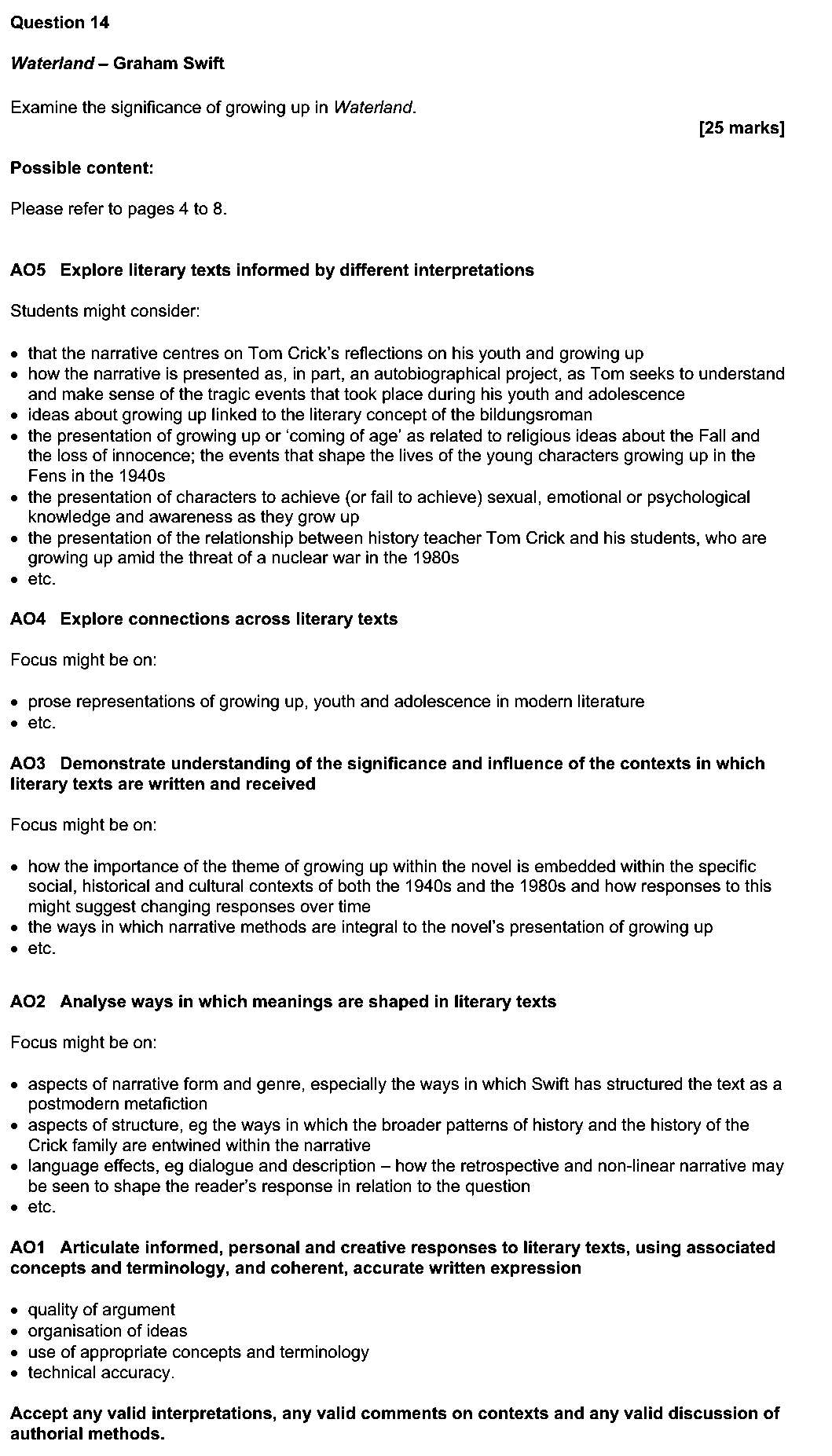
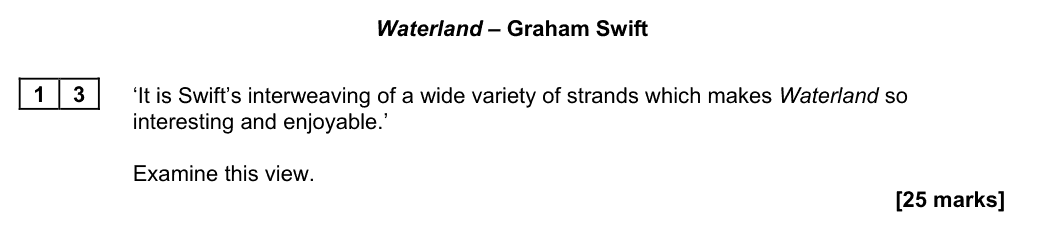
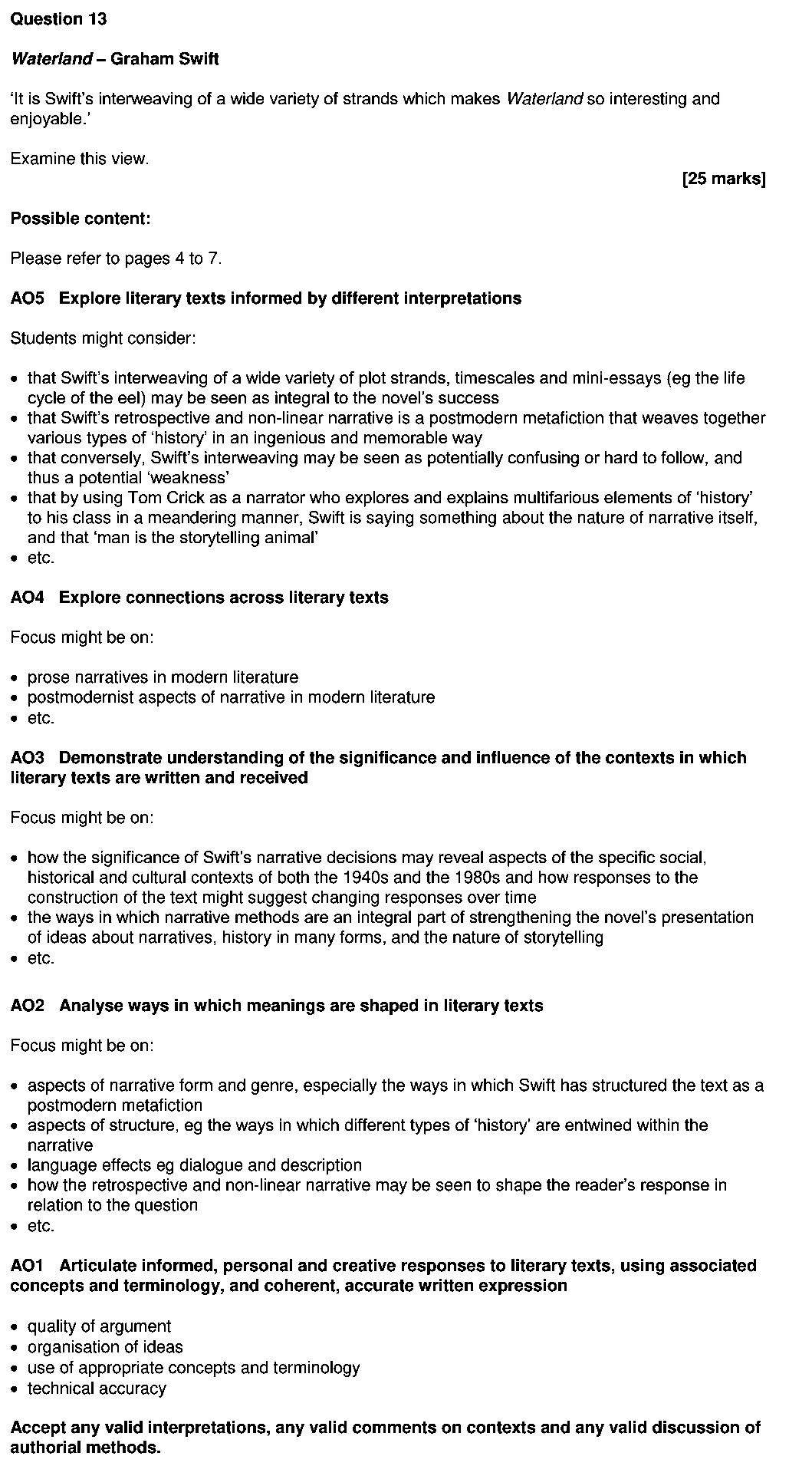
Waterland – Graham Swift ‘It is Swift’s interweaving of a wide variety of strands which makes Waterland so interesting and enjoyable.’ Examine this view.
Waterland – Graham Swift “Man is the storytelling animal,” says Tom Crick. Examine the view that Waterland is, above all, a novel about telling stories.
Tap a question to zoom it. The texts and extracts open above it; the mark scheme (with its levels and indicative content) and the examiner's comment open underneath.
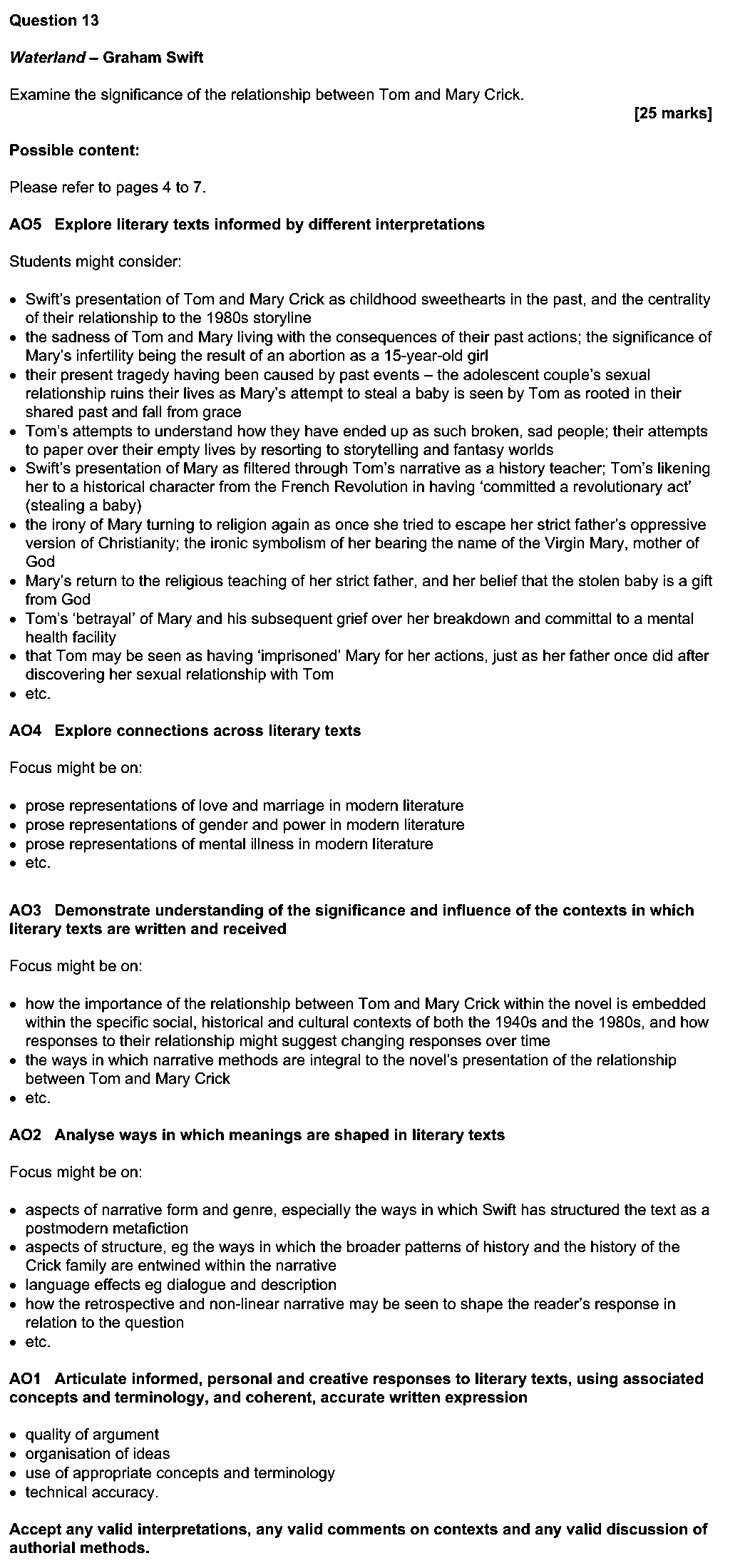
June 2025 · Paper 2B · Q1325 marksSet text essay
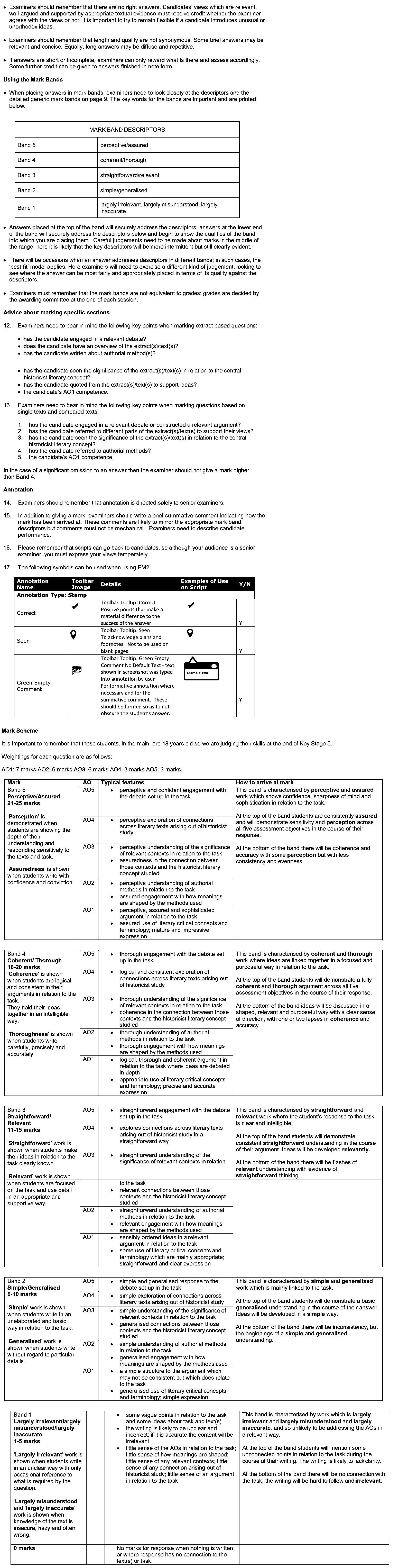
Mark scheme, including the levels and indicative content
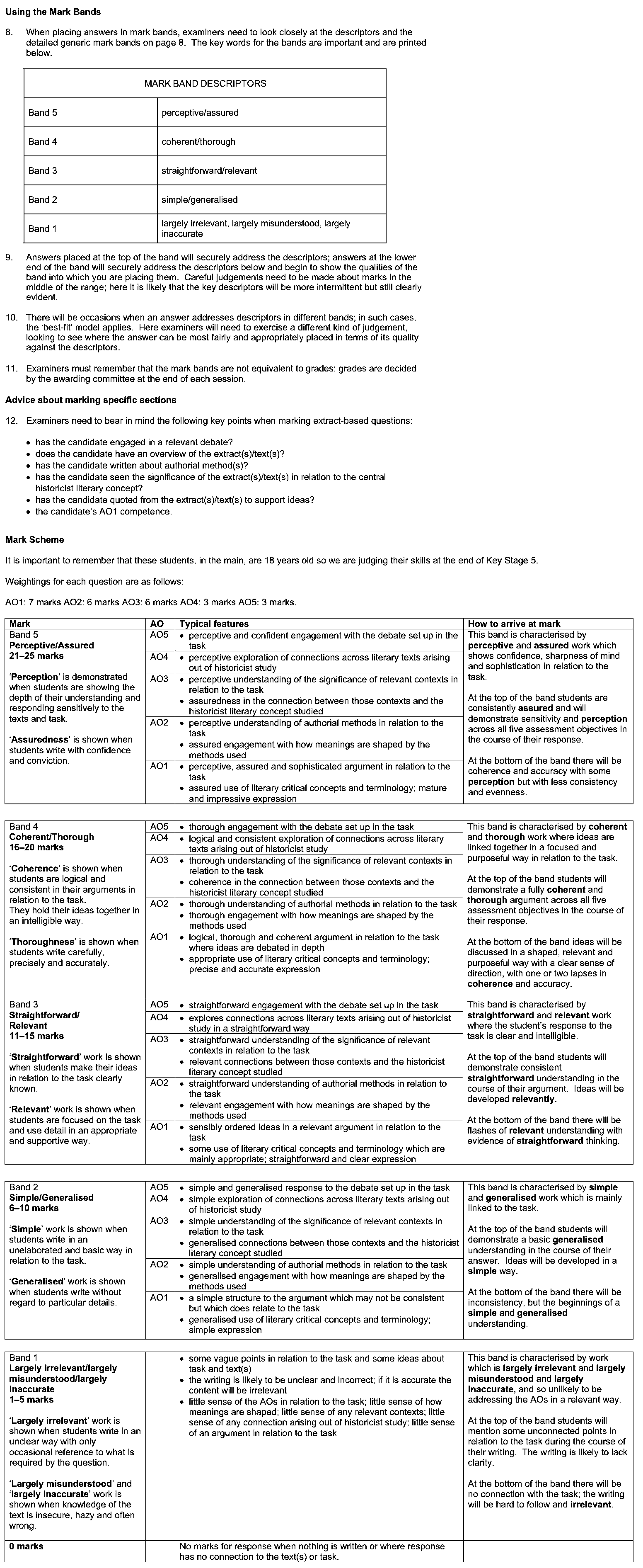
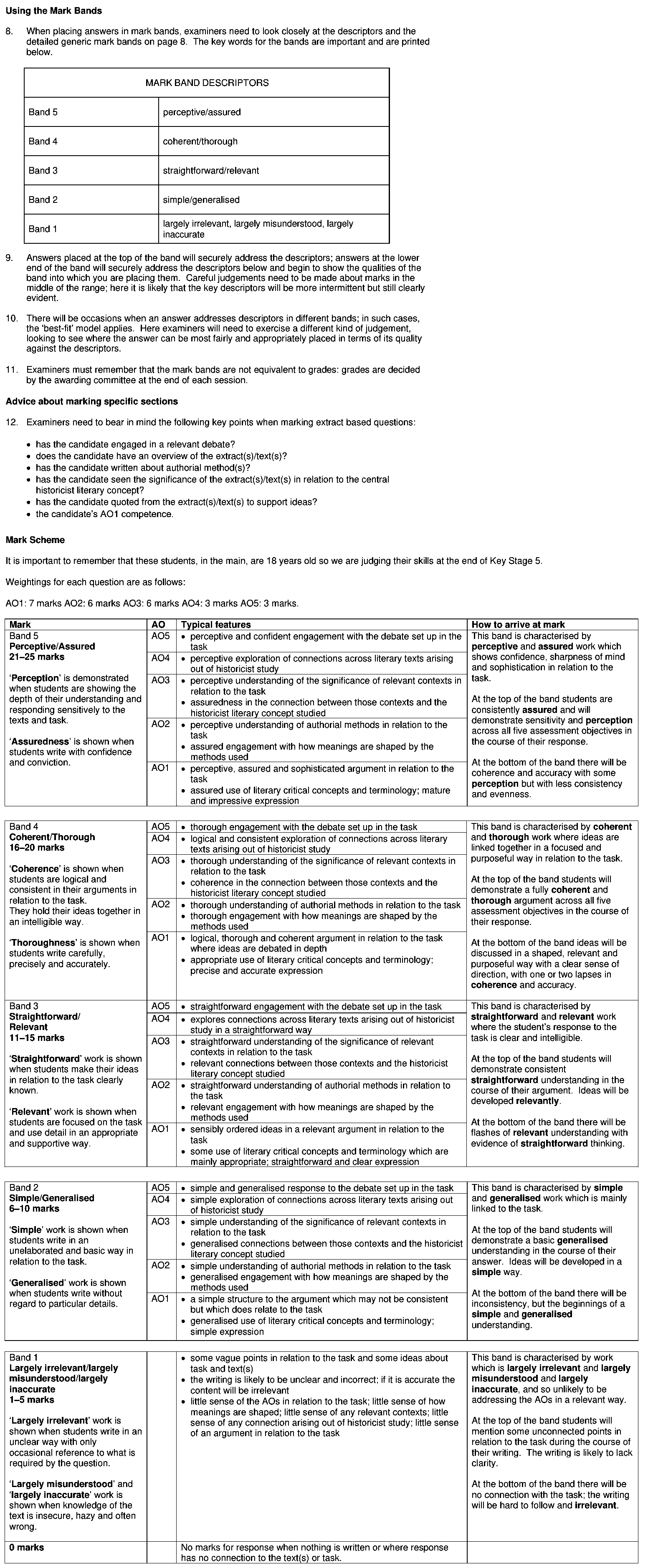
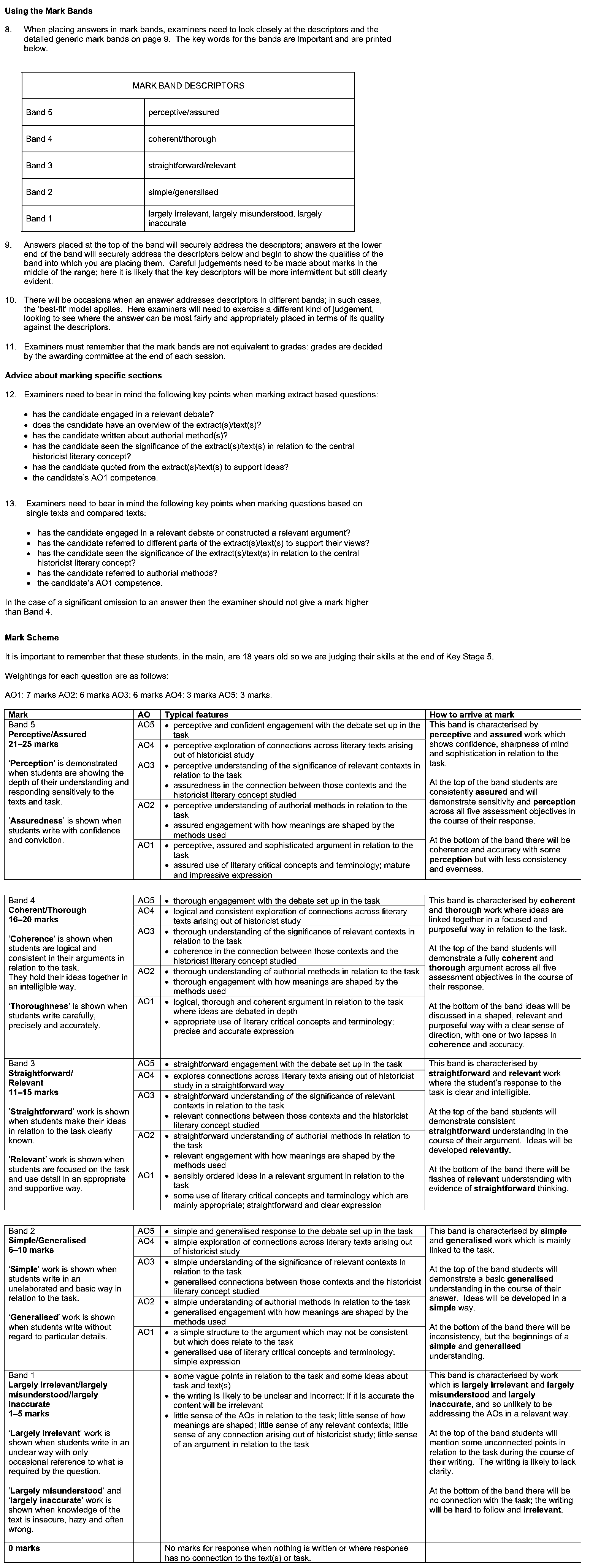
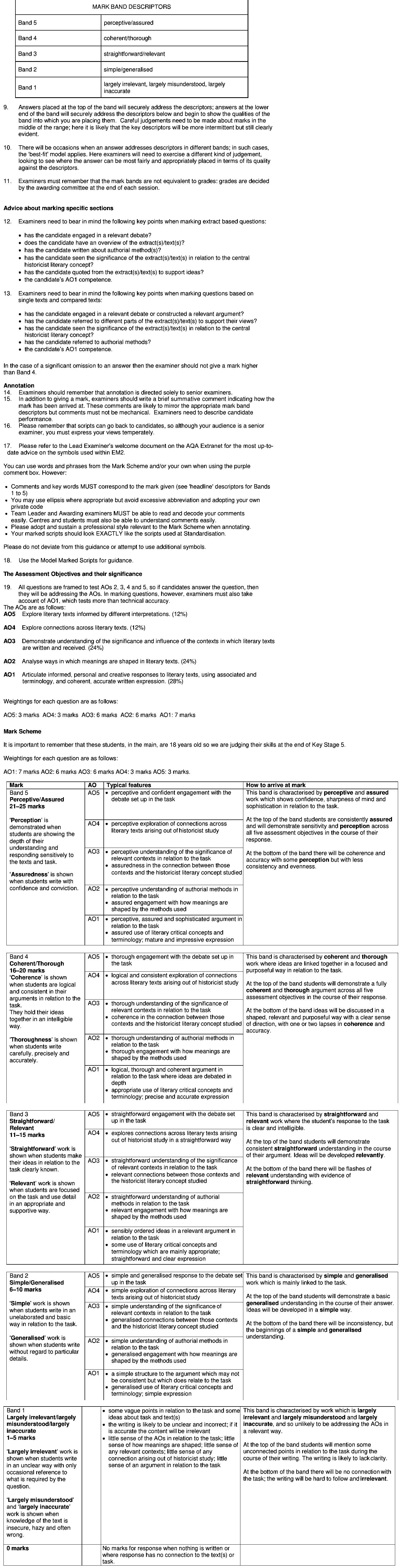
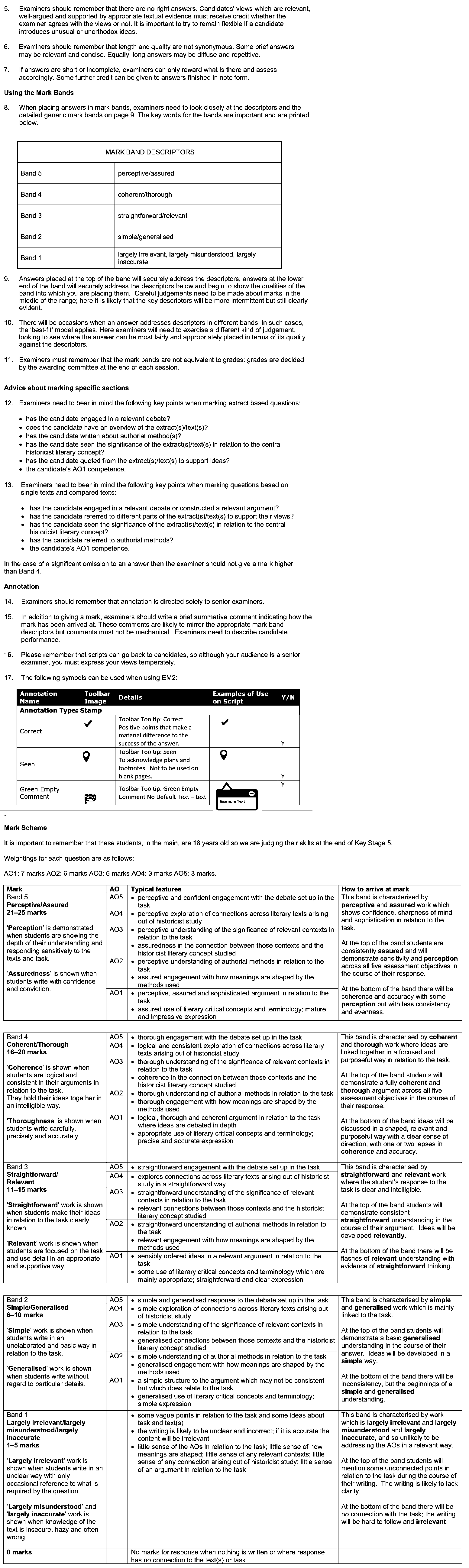
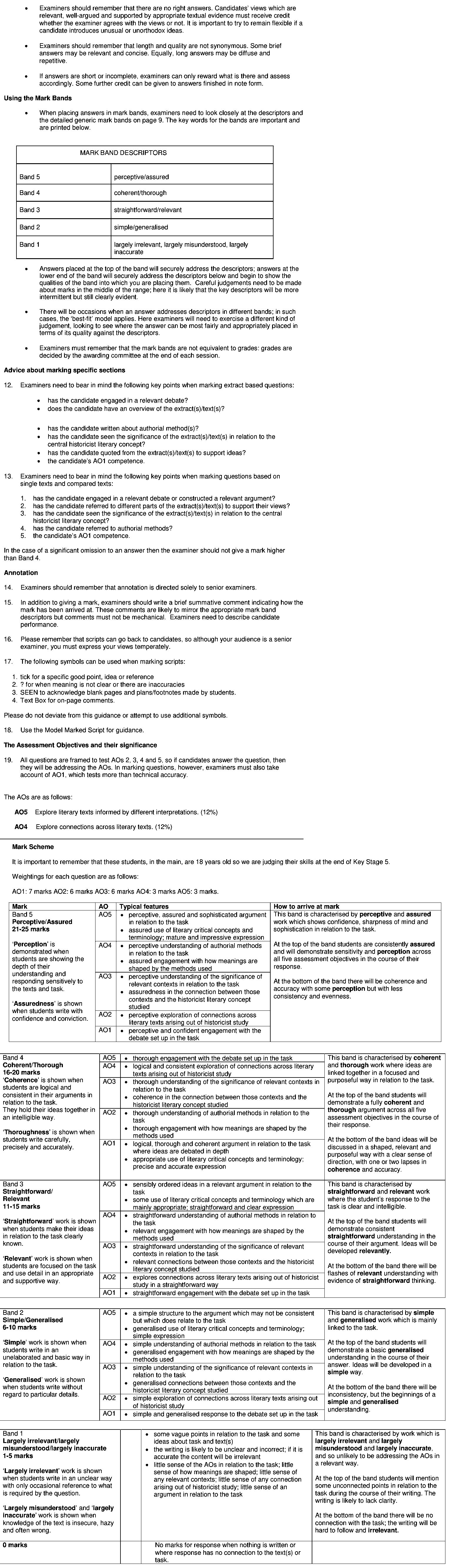
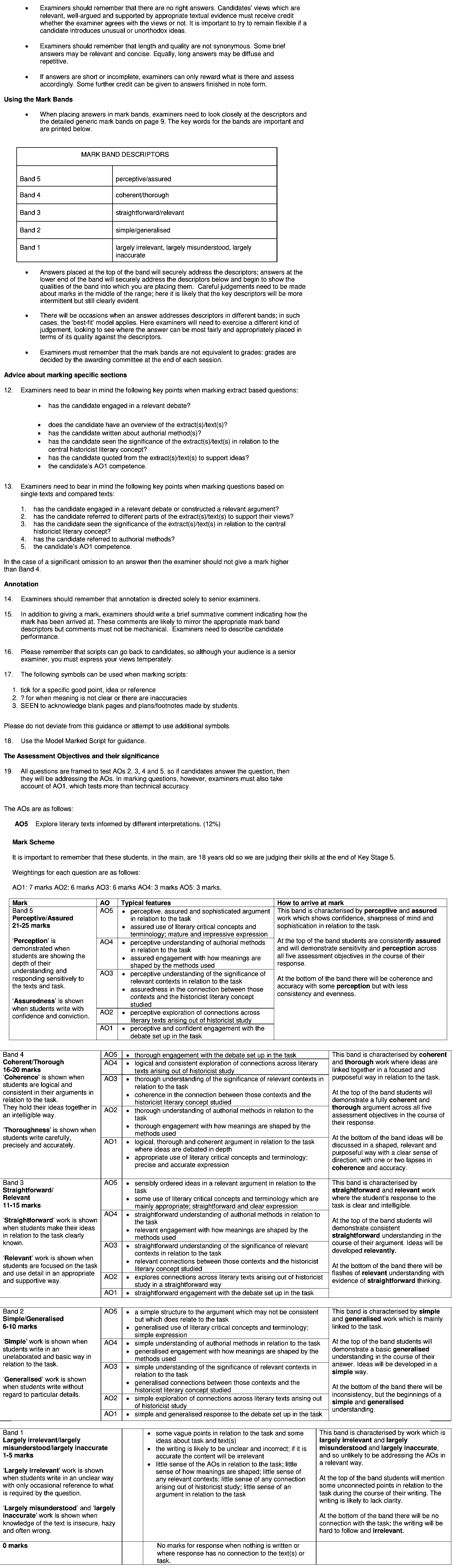
The general mark scheme (assessment objectives and bands)
Examiner's comment
• These questions were answered by a very small minority of students, so detailed feedback cannot be given.
Notes from the mark scheme and report
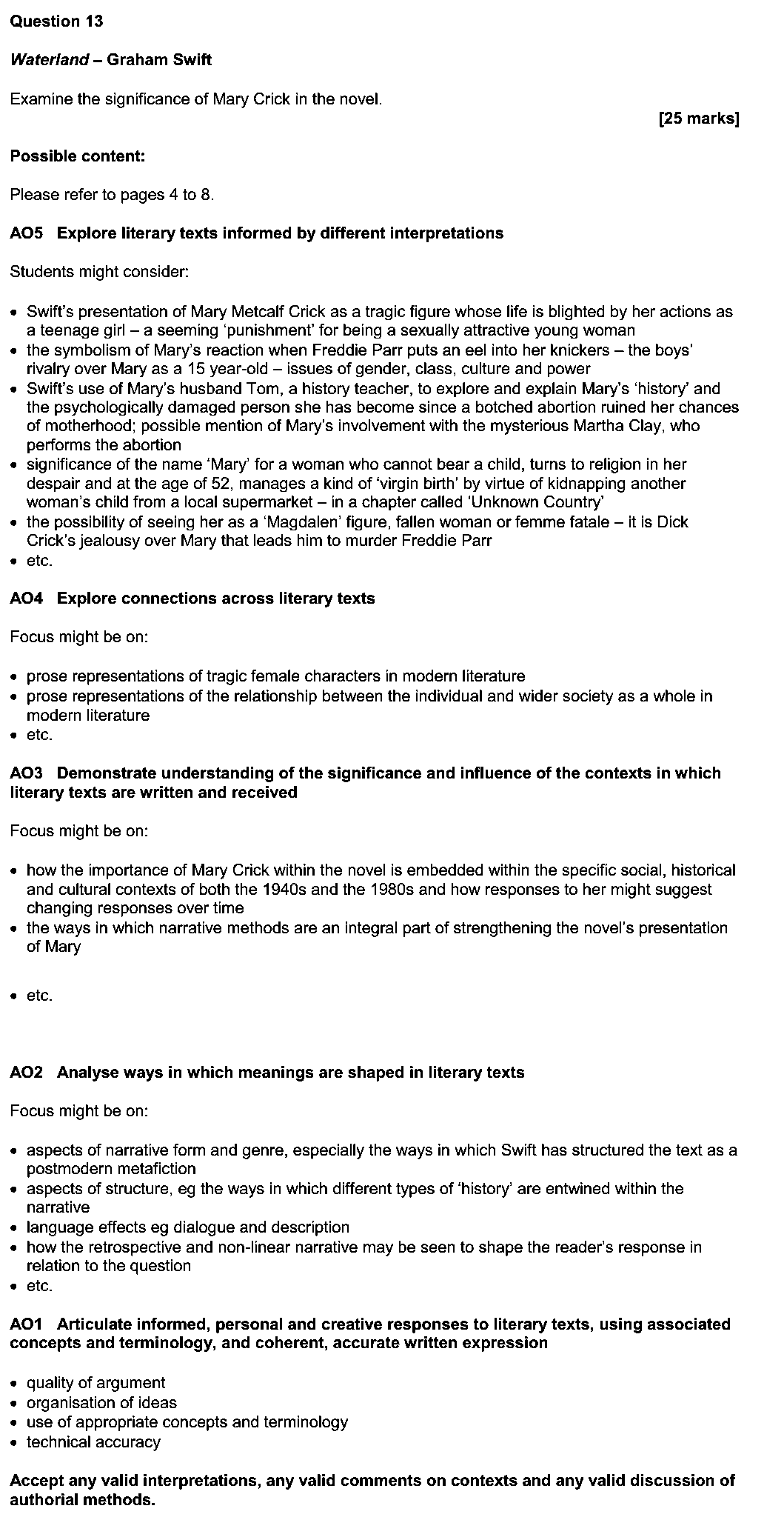
Focus: relationship: Tom and Mary Crick
Open book, no extract
credited: Tom and Mary as childhood sweethearts, Mary's infertility after her teenage abortion, the baby theft rooted in their shared past and fall from grace, storytelling as escape, Mary filtered through Tom's history-teacher narrative ('revolutionary act'), Mary's return to religion
report: too few answers for feedback
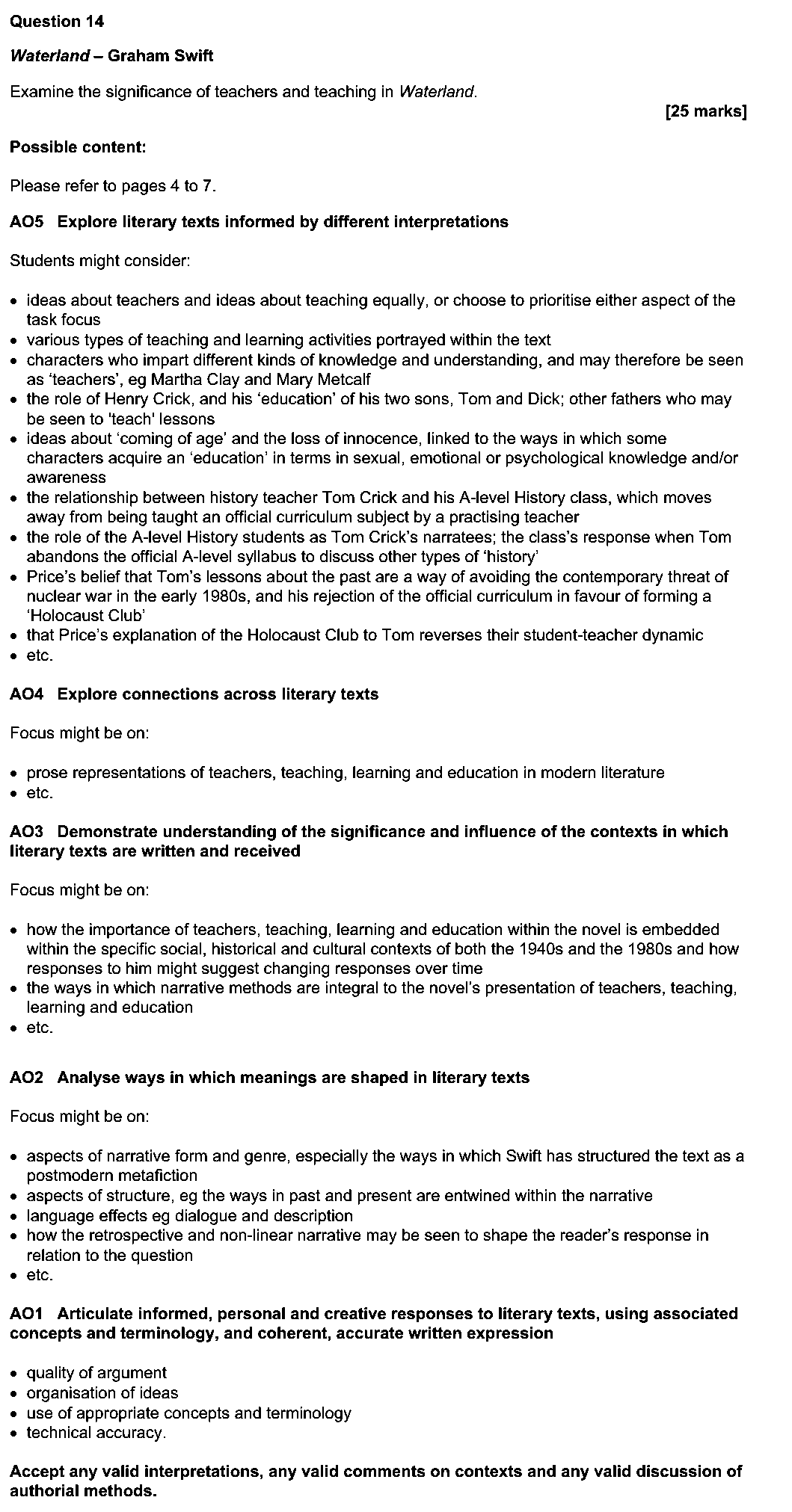
June 2025 · Paper 2B · Q1425 marksSet text essay
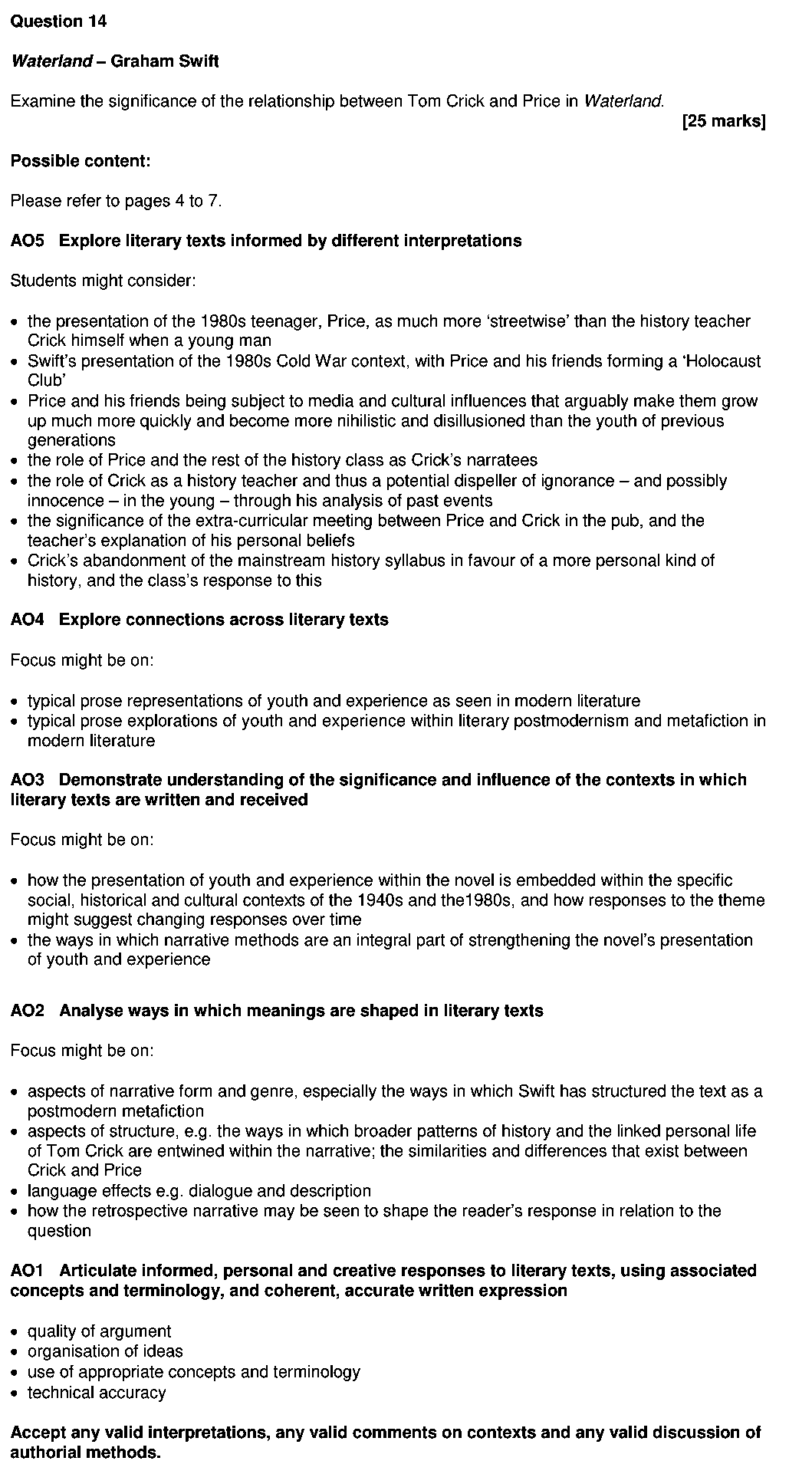
Mark scheme, including the levels and indicative content
The general mark scheme (assessment objectives and bands)
Examiner's comment
• These questions were answered by a very small minority of students, so detailed feedback cannot be given.
Notes from the mark scheme and report
Focus: theme: teachers and teaching
Open book, no extract
teachers and teaching may be weighted equally or one prioritised
credited: Tom Crick and his A-level class as narratees, abandoning the syllabus for other 'histories', Price's challenge about nuclear threat, other 'teachers' (Henry Crick, Martha Clay), education as coming of age and loss of innocence
report: too few answers for feedback
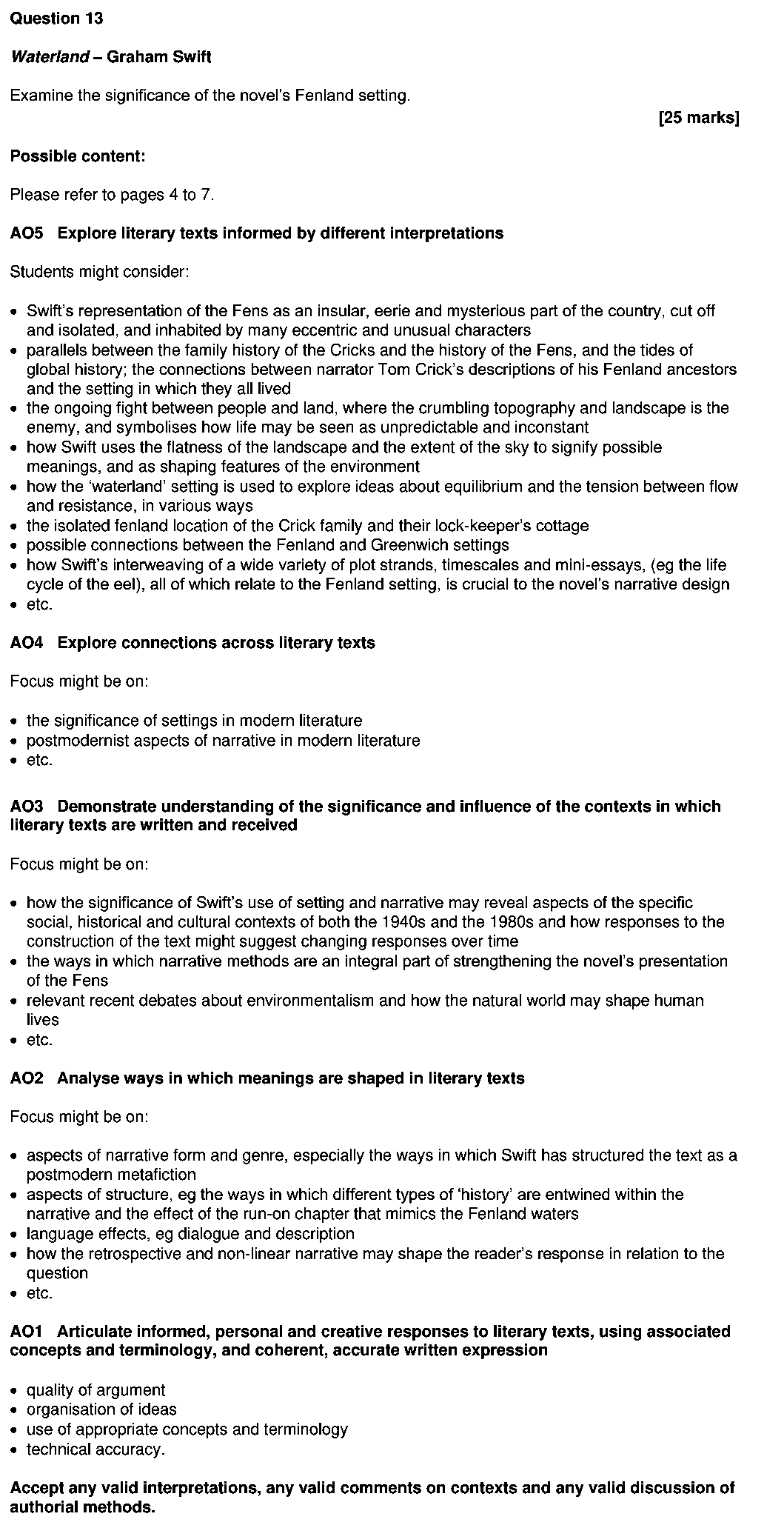
June 2024 · Paper 2B · Q1325 marksSet text essay
Mark scheme, including the levels and indicative content
The general mark scheme (assessment objectives and bands)
Examiner's comment
These questions were answered by a very small minority of students, so detailed feedback cannot be given.
Notes from the mark scheme and report
Focus: setting: the Fens
Open book, no extract
credited: the Fens as insular and eerie, parallels between Crick family history, Fenland history and world history, struggle of people against land and water, flatness and sky, equilibrium of flow and resistance, the lock-keeper's cottage, Fenland vs Greenwich
report: too few answers for feedback
June 2024 · Paper 2B · Q1425 marksSet text essay
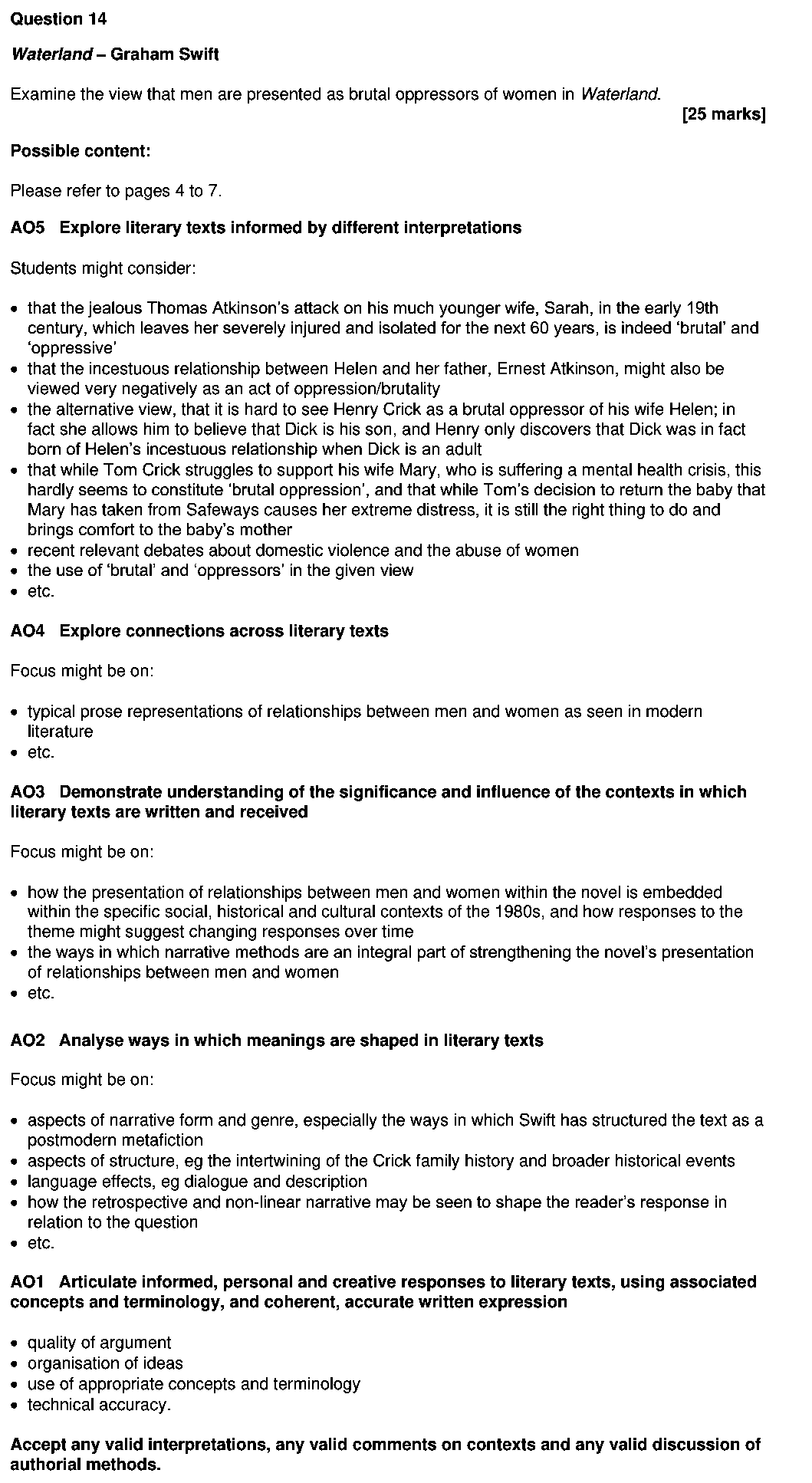
Mark scheme, including the levels and indicative content
The general mark scheme (assessment objectives and bands)
Examiner's comment
These questions were answered by a very small minority of students, so detailed feedback cannot be given.
Notes from the mark scheme and report
Focus: theme: men as oppressors of women
Open book, no extract
debate 'brutal oppressors': Thomas Atkinson's attack on Sarah and Ernest's incest with Helen vs Henry Crick and Tom Crick as hardly brutal (Tom returning the stolen baby)
attend to 'brutal' and 'oppressors'
report: too few answers for feedback
June 2023 · Paper 2B · Q1325 marksSet text essay
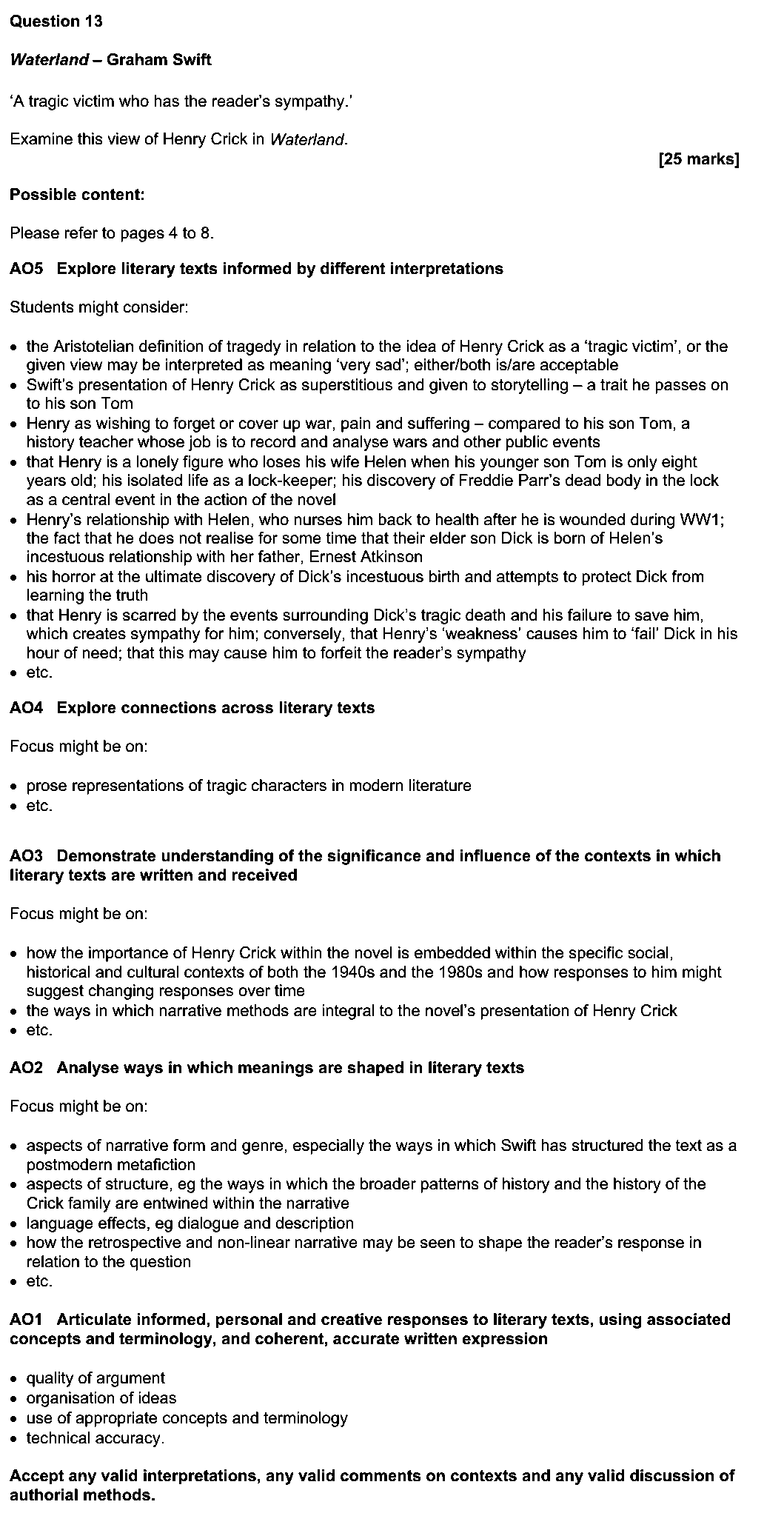
Mark scheme, including the levels and indicative content
The general mark scheme (assessment objectives and bands)
Examiner's comment
These questions were answered by a tiny minority of students, so detailed feedback cannot be given.
Notes from the mark scheme and report
Focus: character: Henry Crick as tragic victim
Open book, no extract
'tragic' may be Aristotelian or simply 'very sad'
credited: Henry's superstition and storytelling, wish to forget the war, loneliness after Helen's death, finding Freddie Parr's body, horror at Dick's incestuous birth, failure to save Dick (sympathy vs weakness)
report: too few answers for feedback
June 2023 · Paper 2B · Q1425 marksSet text essay
Mark scheme, including the levels and indicative content
The general mark scheme (assessment objectives and bands)
Examiner's comment
These questions were answered by a tiny minority of students, so detailed feedback cannot be given.
Notes from the mark scheme and report
Focus: theme: growing up
Open book, no extract
credited: Tom Crick's reflections on his youth as autobiographical project, bildungsroman, growing up as the Fall and loss of innocence in the 1940s Fens, sexual and emotional awareness, Tom's students growing up under nuclear threat in the 1980s
report: too few answers for feedback
June 2022 · Paper 2B · Q1325 marksSet text essay
Mark scheme, including the levels and indicative content
The general mark scheme (assessment objectives and bands)
Examiner's comment
The entry was very small for this question, making it difficult to provide a meaningful report.
Notes from the mark scheme and report
Focus: structure: interweaving narrative strands
Open book, no extract
credited: interweaving of plot strands, timescales and mini-essays (the eel) as the novel's success, retrospective non-linear metafiction weaving types of history, possible counter-view that it is confusing, Tom Crick as storyteller ('man is the storytelling animal')
report: entry too small to comment
June 2022 · Paper 2B · Q1425 marksSet text essay
Mark scheme, including the levels and indicative content
The general mark scheme (assessment objectives and bands)
Examiner's comment
The entry was very small for this question, making it difficult to provide a meaningful report.
Notes from the mark scheme and report
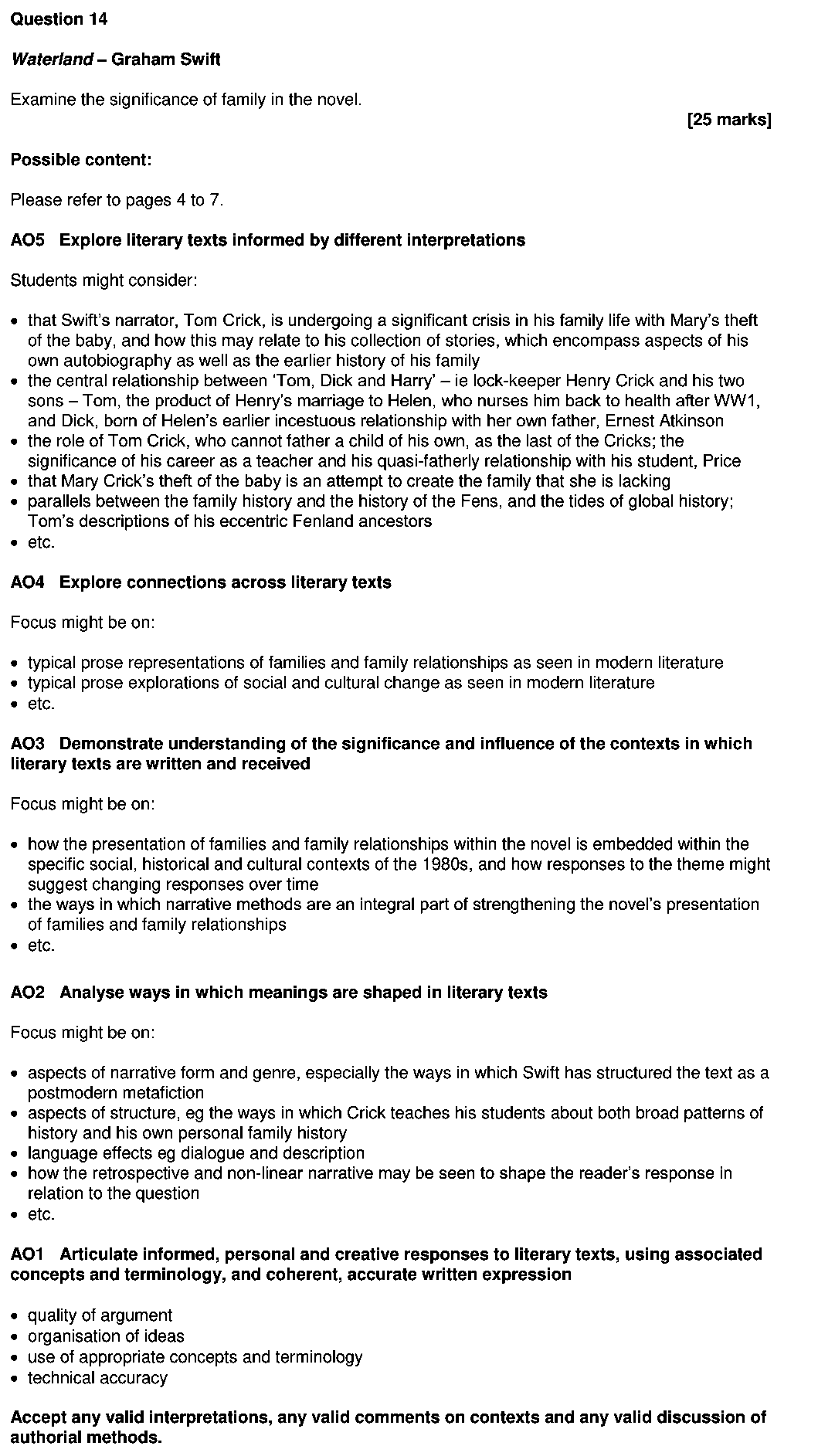
Focus: theme: family
Open book, no extract
credited: Tom Crick's family crisis and Mary's theft of the baby, Henry, Tom and Dick and Dick's incestuous origin, Tom as last of the Cricks, parallels between family history, Fens and global history
report: entry too small to comment
November 2021 · Paper 2B · Q1325 marksSet text essay
Mark scheme, including the levels and indicative content
The general mark scheme (assessment objectives and bands)
Notes from the mark scheme and report
Focus: character: Mary Crick
Open book, no extract
significance of Mary Crick
MS credits: tragic figure blighted by her teenage actions, Freddie Parr's eel and the boys' rivalry (gender, class, power), Tom explaining her 'history' and damage after the abortion by Martha Clay, irony of the name Mary, turn to religion and kidnapping a baby ('Unknown Country'), Magdalen or femme fatale reading, Dick's jealousy
papers dated June 2021
no examiners' report
November 2021 · Paper 2B · Q1425 marksSet text essay
Mark scheme, including the levels and indicative content
The general mark scheme (assessment objectives and bands)
Notes from the mark scheme and report
Focus: character: fathers
Open book, no extract
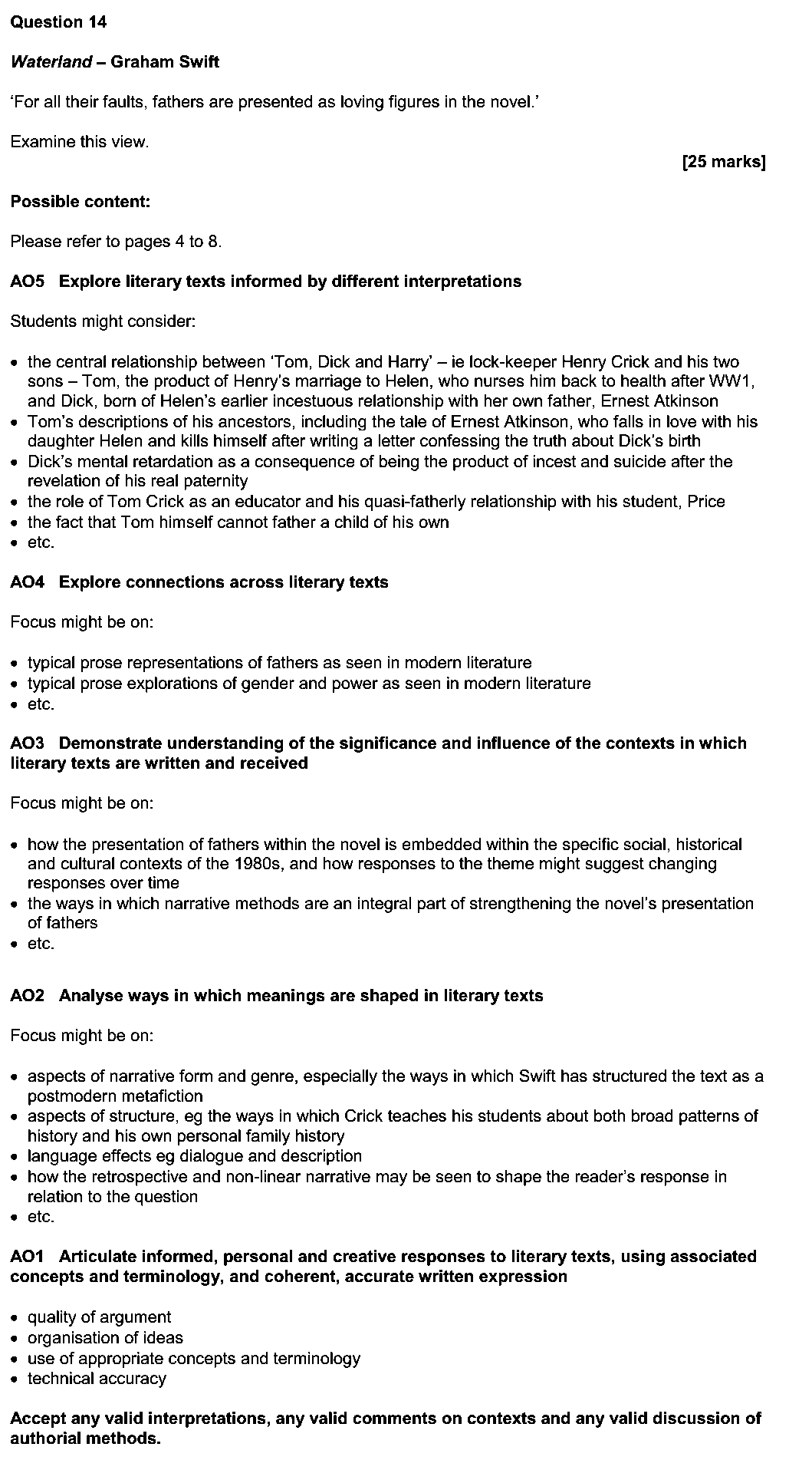
view that fathers, for all their faults, are loving
MS credits: Henry Crick and his sons Tom and Dick, Ernest Atkinson's incestuous love for Helen and suicide letter revealing Dick's paternity, Dick's suicide, Tom's quasi-fatherly relationship with Price, Tom's inability to father a child
papers dated June 2021
no examiners' report
November 2020 · Paper 2B · Q1325 marksSet text essay
Mark scheme, including the levels and indicative content
The general mark scheme (assessment objectives and bands)
Notes from the mark scheme and report
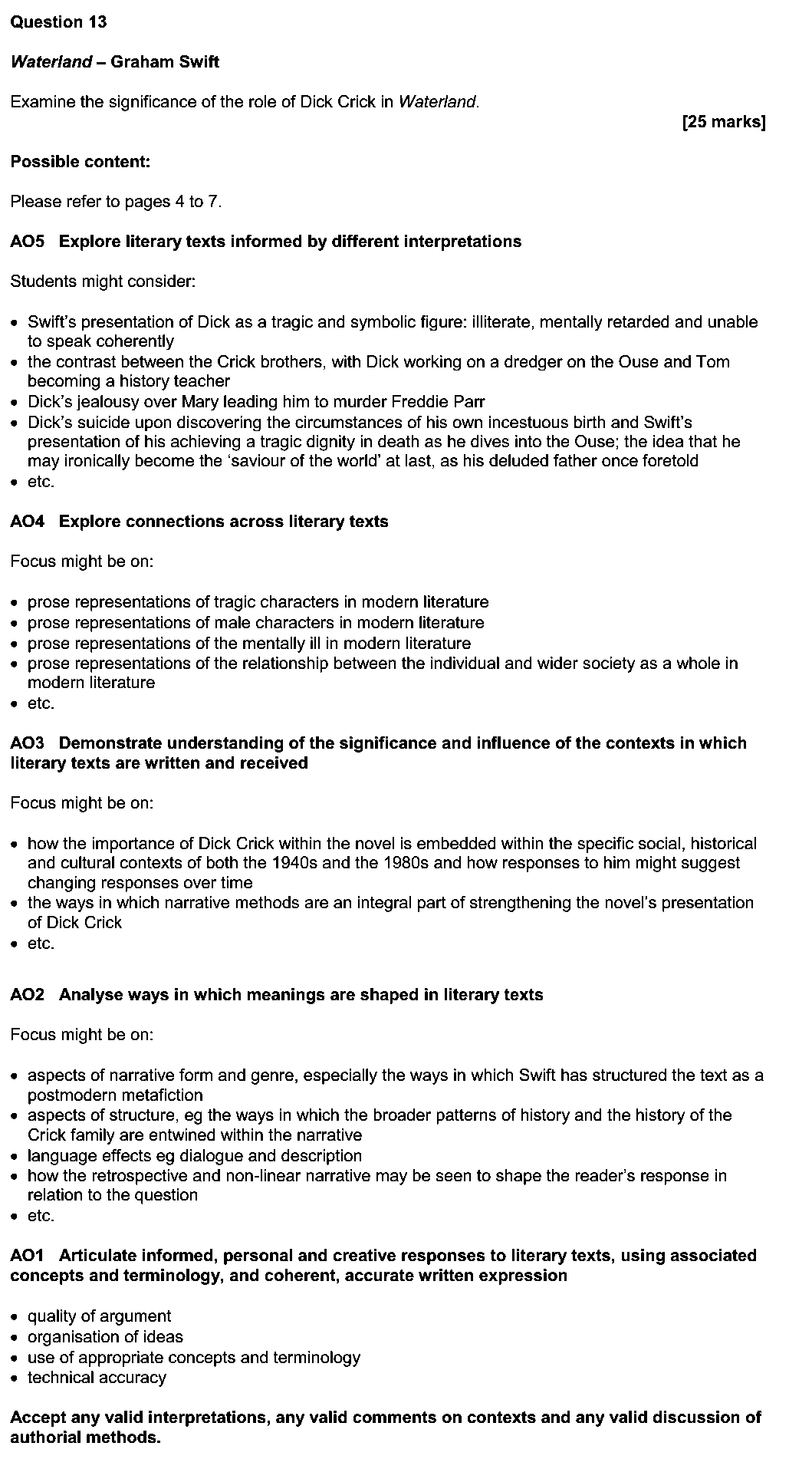
Focus: character: Dick Crick
Open book, no extract
significance of Dick Crick
MS credits: Dick as tragic and symbolic figure, inarticulate and with learning difficulties, contrast with Tom the history teacher, jealousy over Mary leading to Freddie Parr's murder, suicide on learning of his incestuous birth, tragic dignity diving into the Ouse, ironic 'saviour of the world'
no examiners' report for this series
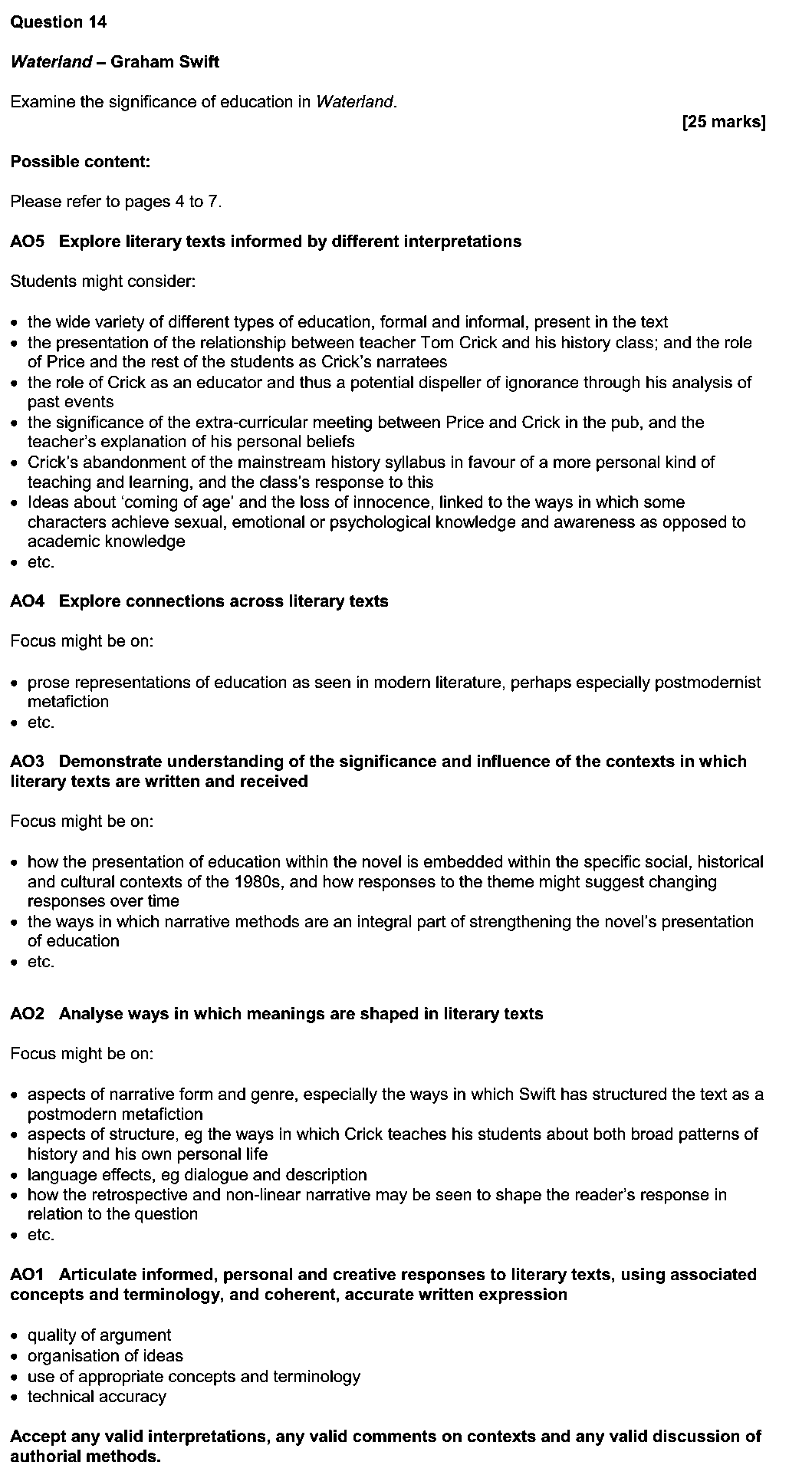
November 2020 · Paper 2B · Q1425 marksSet text essay
Mark scheme, including the levels and indicative content
The general mark scheme (assessment objectives and bands)
Notes from the mark scheme and report
Focus: theme: education
Open book, no extract
significance of education
MS credits: formal and informal education, Crick and his history class as narratees, Price and the pub meeting, Crick abandoning the syllabus for personal history, teacher as dispeller of ignorance, coming of age and loss of innocence through sexual and emotional knowledge
no examiners' report for this series
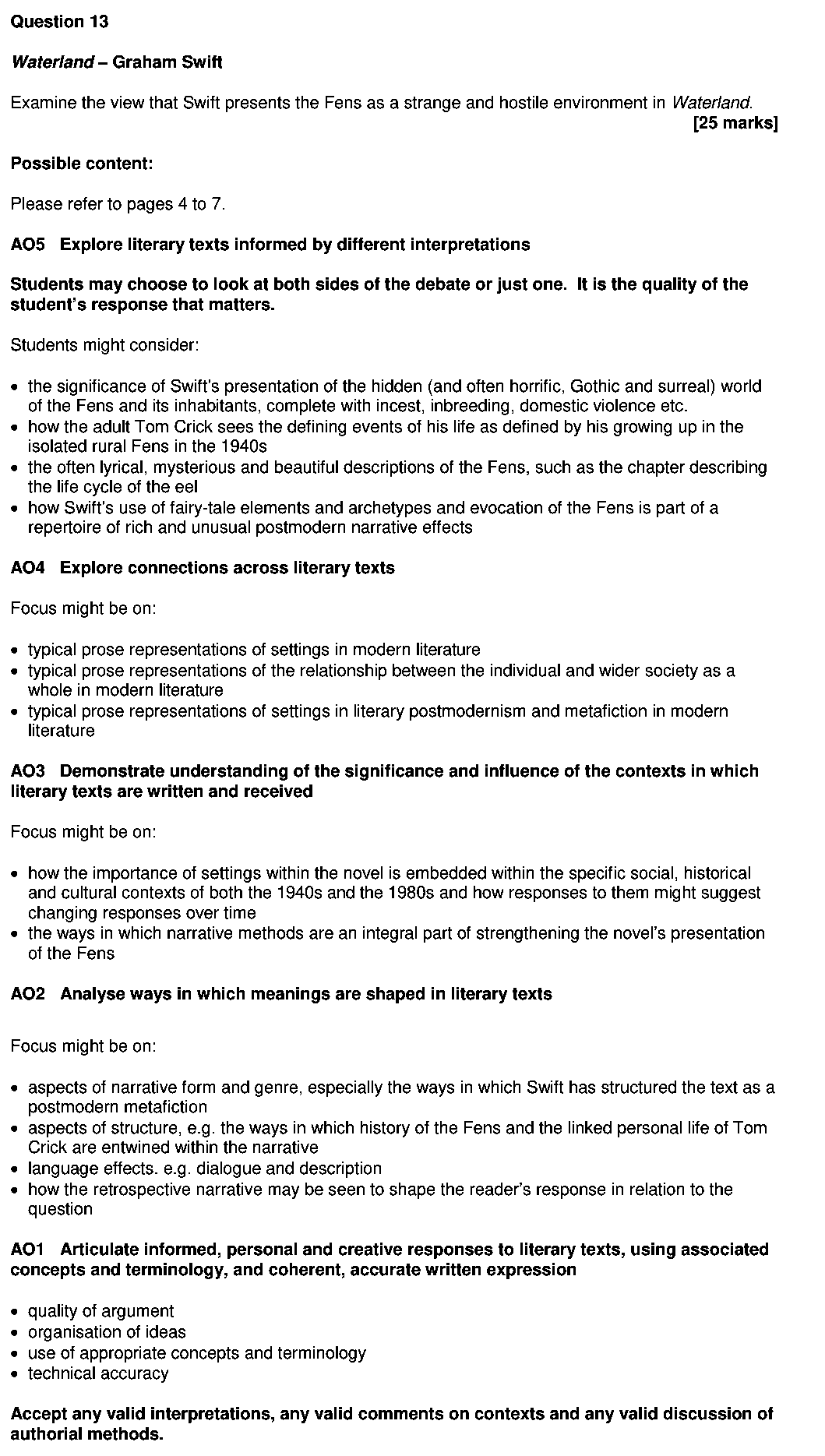
June 2019 · Paper 2B · Q1325 marksSet text essay
Mark scheme, including the levels and indicative content
The general mark scheme (assessment objectives and bands)
Examiner's comment
Of the small number of responses seen to this text, the general level was impressive. More successful responses wrote effectively about the significance of Swift’s presentation of the hidden (and often horrific, Gothic and surreal) world of the Fens and its inhabitants, complete with incest, inbreeding and domestic violence. They discussed how narrator Tom Crick sees the key events of his life as defined by his growing up in the isolated rural Fens in the 1940s. As so often with this text, Swift’s development of Crick’s narrative voice, and the text’s subtle interleaving of past and present, were analysed with insight and interest.
Notes from the mark scheme and report
Focus: setting: the Fens
Open book, no extract
view of the Fens as strange and hostile
few answers but impressive
credited: hidden Gothic and surreal world of incest, inbreeding and domestic violence, Crick's life defined by growing up in the isolated 1940s Fens, vs lyrical and beautiful descriptions (eel chapter), fairy-tale elements as postmodern effects, narrative voice interleaving past and present
June 2019 · Paper 2B · Q1425 marksSet text essay
Mark scheme, including the levels and indicative content
The general mark scheme (assessment objectives and bands)
Examiner's comment
This question, which attracted a small number of responses, invited students to write about the relationship between the streetwise 1980s teenager, Price, and his teacher, Tom Crick. Relevant aspects of the text included the role of Price and the rest of the history class and Crick as a dispeller of ignorance, and possibly innocence, in the young through his analysis of past events. Students covered some areas effectively, such as the significance of the extra-curricular meeting between Price and Crick in the pub, and the teacher’s explanation of his personal beliefs. In addition, Crick’s ultimate abandonment of the mainstream history syllabus in favour of a more personal kind of history was also covered effectively. Once again, those who wrote about this text tended to analyse Swift’s post-modern narrative with insight and flair.
Notes from the mark scheme and report
Focus: relationship: Tom Crick and Price
Open book, no extract
significance of the teacher-pupil relationship
few answers
credited: streetwise 1980s teenager Price and Cold War 'Holocaust Club', the class as Crick's narratees, Crick as dispeller of ignorance and innocence, their meeting in the pub, Crick abandoning the syllabus for personal history, postmodern narrative
June 2018 · Paper 2B · Q1325 marksSet text essay
Mark scheme, including the levels and indicative content
The general mark scheme (assessment objectives and bands)
Examiner's comment
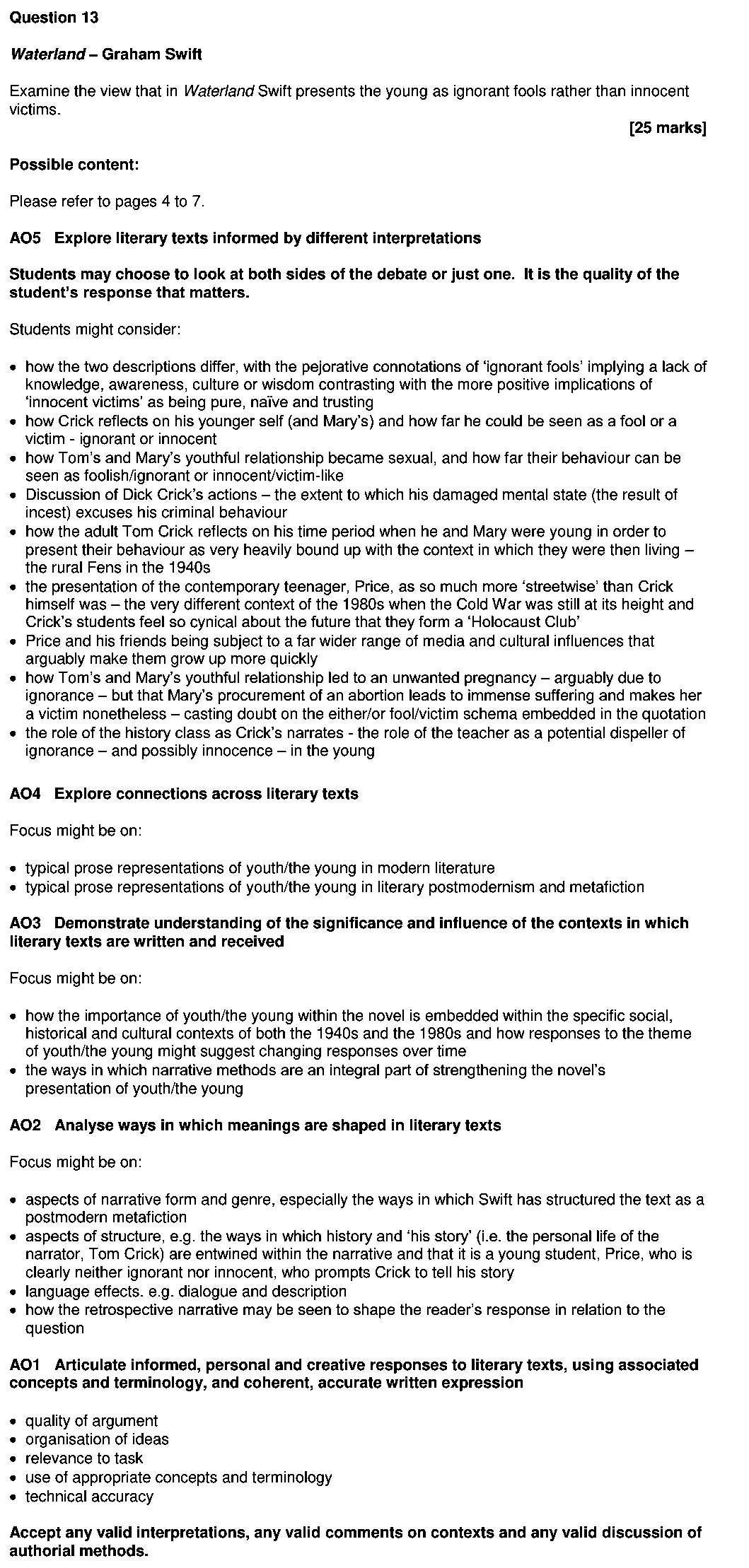
Once again Waterland lost out to The Handmaid’s Tale, appearing far more frequently within the Section B comparative question than as a stand-alone text. Of the small number of answers seen in response to this question, the general level was impressive. Better students wrote effectively about how Tom’s and Mary’s youthful relationship became sexual, and how their behaviour can be interpreted. Some mentioned Tom Crick’s student, Price, so cynical about the future that he has formed a ‘Holocaust Club’, and noted how he seems to have grown up far more quickly than Crick did forty years before. As so often with this text, Swift’s development of Crick’s narrative voice, and the text’s subtle interleaving of past and present, were analysed with real skill and verve.
Notes from the mark scheme and report
Focus: theme: youth
Open book, no extract
the young as 'ignorant fools' or 'innocent victims'
few answers but impressive
credited: weighing the two terms, Tom and Mary's youthful sexual relationship, Dick's damaged mental state, 1940s Fens context, Price and his 'Holocaust Club' as more streetwise 1980s teenager, Crick's narrative voice interleaving past and present
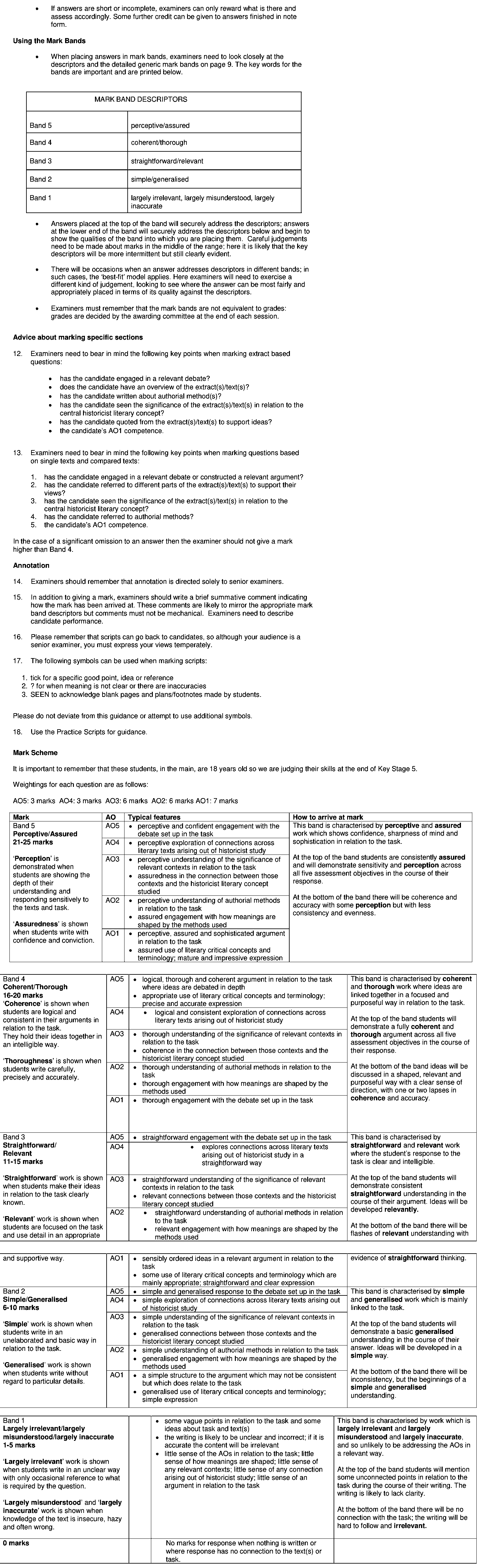
June 2018 · Paper 2B · Q1425 marksSet text essay
Mark scheme, including the levels and indicative content
The general mark scheme (assessment objectives and bands)
Examiner's comment
This question invited students to write about the presentation of suffering and horror within a text that contains many lyrical and beautiful descriptions and a range of rich and unusual narrative effects that may be seen to contrast with much of the gothic nightmares that feature elsewhere in the text. Again, most students who chose to write about this text tended to analyse Swift’s narrative methods very effectively.
Notes from the mark scheme and report
Focus: theme: suffering and horror
Open book, no extract
view of the novel as a disturbing story dominated by suffering and horror
credited: Gothic and surreal world of the Fens, tragedy of Mary's life, incest and family secrets, set against lyrical beauty, fairy-tale elements and passages like the eel chapter, postmodern narrative effects
most analysed narrative methods effectively
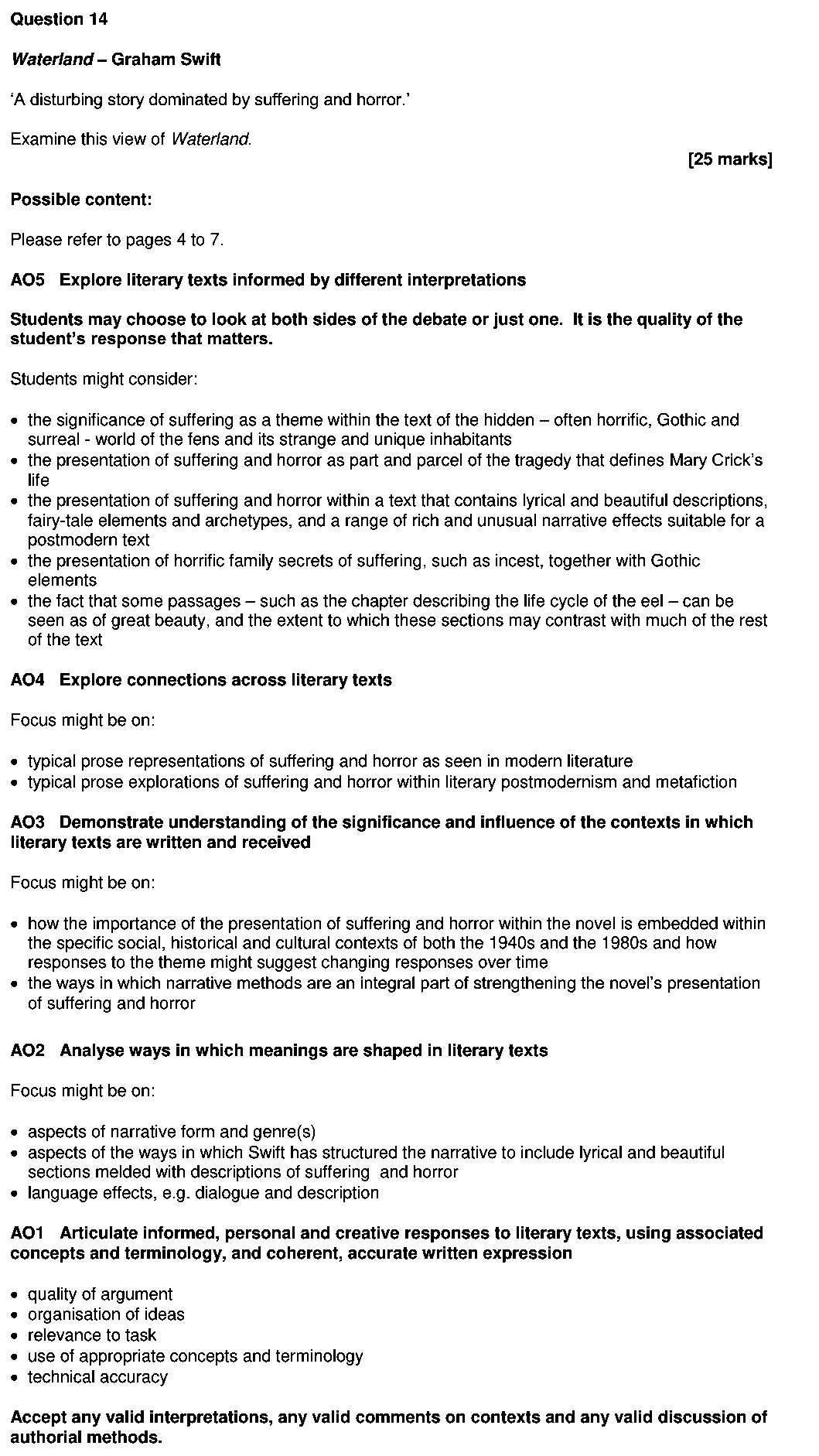
June 2017 · Paper 2B · Q1325 marksSet text essay
Mark scheme, including the levels and indicative content
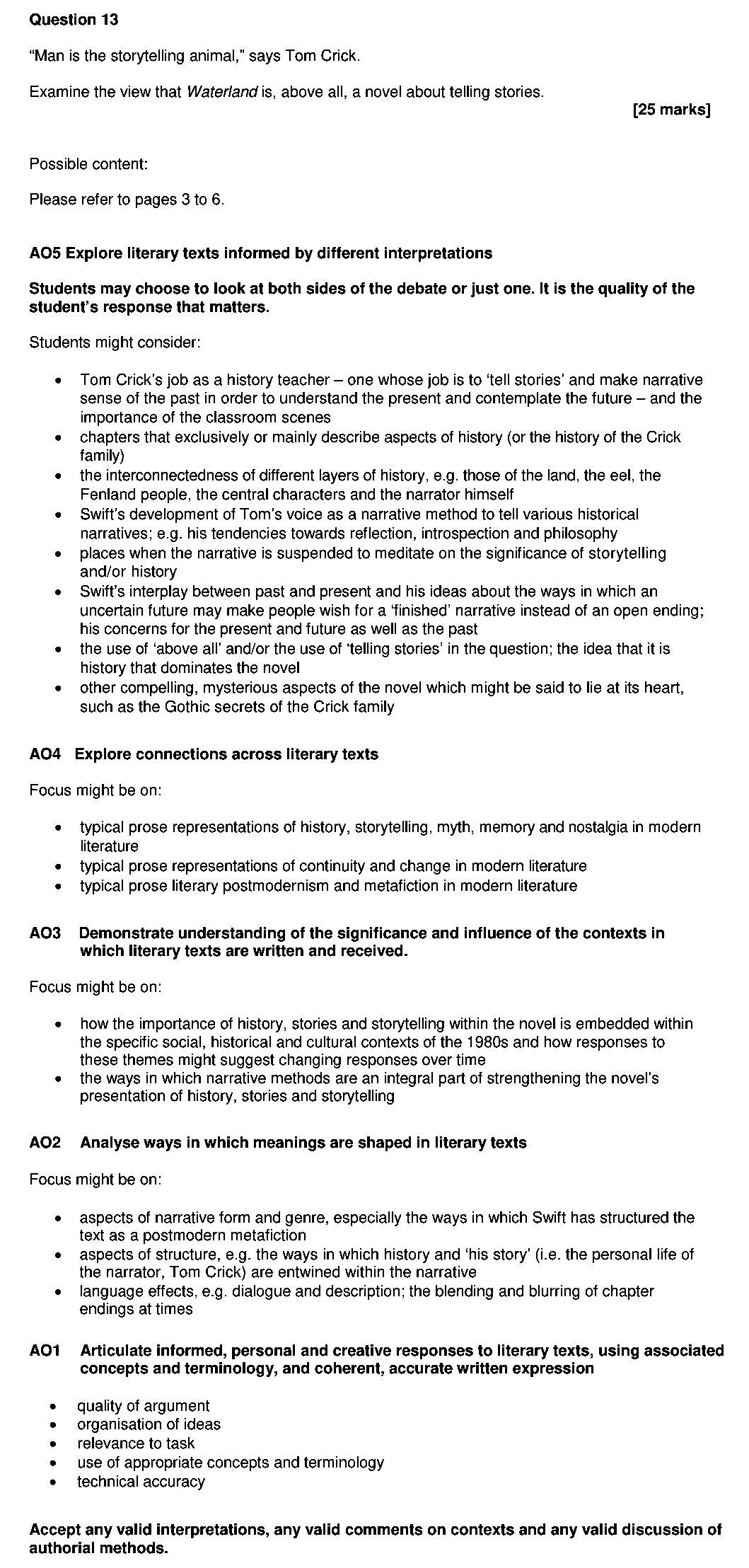
The general mark scheme (assessment objectives and bands)
Examiner's comment
Waterland lost out hugely in the prose popularity stakes to The Handmaid’s Tale, but the general level of the responses seen was very impressive. In looking at this text as about ‘telling stories’, very few students failed to engage with Swift’s fascinating narrative methods – some in astonishing depth and detail. Tom Crick’s job as a history teacher – one whose job is to ‘tell stories’ and make narrative sense of the past in order to understand the present and contemplate the future – was seen as of central importance by the vast majority of students and Swift’s development of Tom’s voice, and the text’s subtle interleaving of past and present, were usually analysed with real skill and verve.
Notes from the mark scheme and report
Focus: theme: storytelling and history
Open book, no extract
view that the novel is above all about telling stories ('Man is the storytelling animal')
credited: Tom Crick as history teacher making narrative sense of the past, classroom scenes, layers of history (land, eel, Fens, Crick family), Tom's reflective narrative voice, interleaving of past and present, suspended narrative to meditate on storytelling
responses generally very impressive
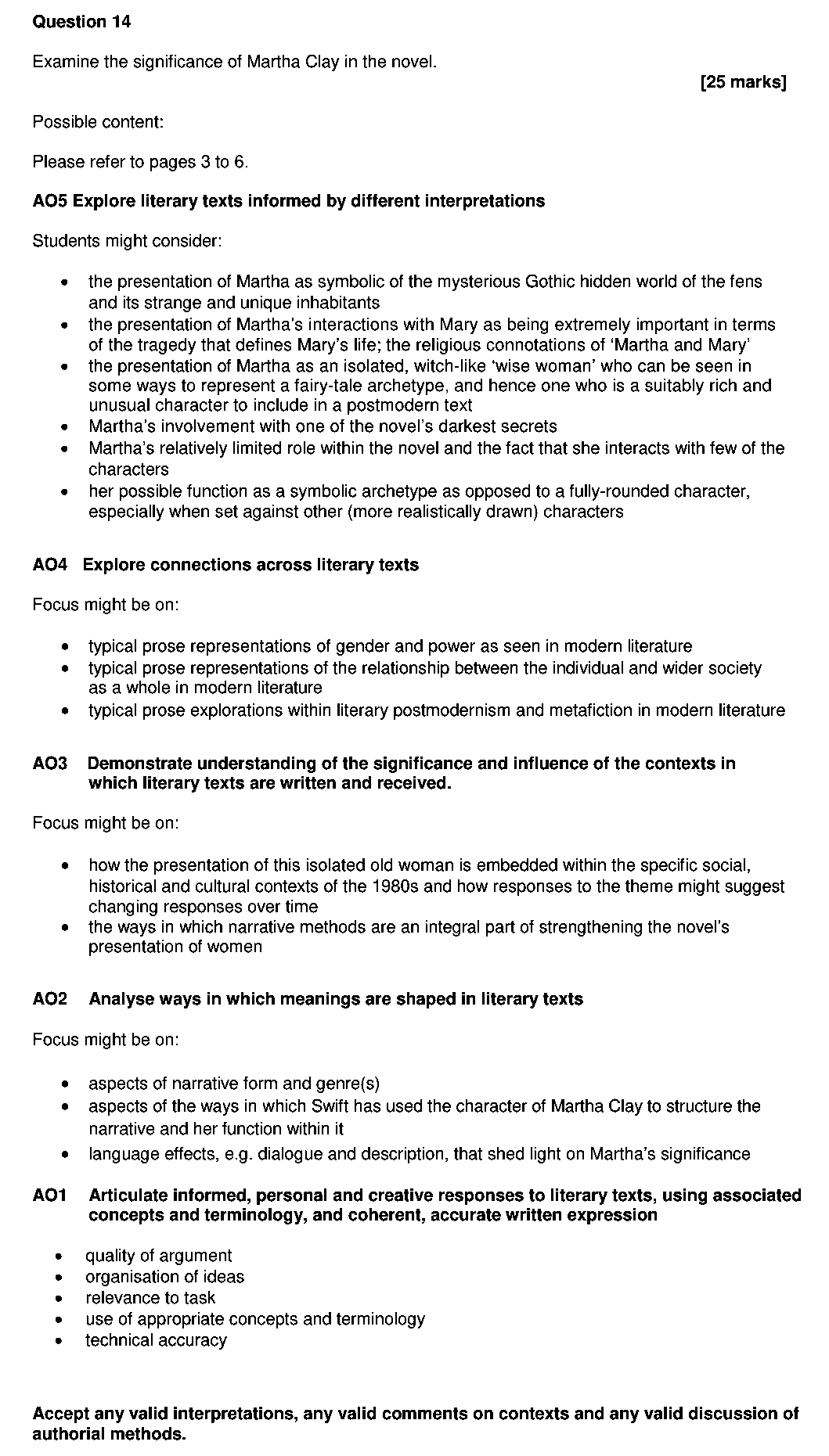
June 2017 · Paper 2B · Q1425 marksSet text essay
Mark scheme, including the levels and indicative content
The general mark scheme (assessment objectives and bands)
Examiner's comment
This question, on the strange and unique figure of Martha Clay, was the least popular across the whole paper. Students might have chosen to focus upon Swift’s presentation of Martha as an isolated, witch-like ‘wise woman’ who can be seen in some ways to represent a fairy-tale archetype, and hence one who is a suitably rich and unusual character to include in a postmodern text and her involvement with one of the novel’s darkest secrets, or her possible function as a symbolic archetype, especially when set against other (more realistically drawn) characters.
Notes from the mark scheme and report
Focus: character: Martha Clay
Open book, no extract
significance of a minor character
least popular question on the paper
credited: Martha as symbol of the Gothic hidden world of the Fens, witch-like 'wise woman' and fairy-tale archetype suited to a postmodern text, her involvement in one of the novel's darkest secrets, interactions with Mary, religious echo of Martha and Mary, limited role and symbolic rather than rounded character
Work with an AQA English Literature A tutor
Essays stuck in the middle bands, or not sure what the examiners want from an analysis? Book a trial lesson with a specialist AQA English Literature A tutor.