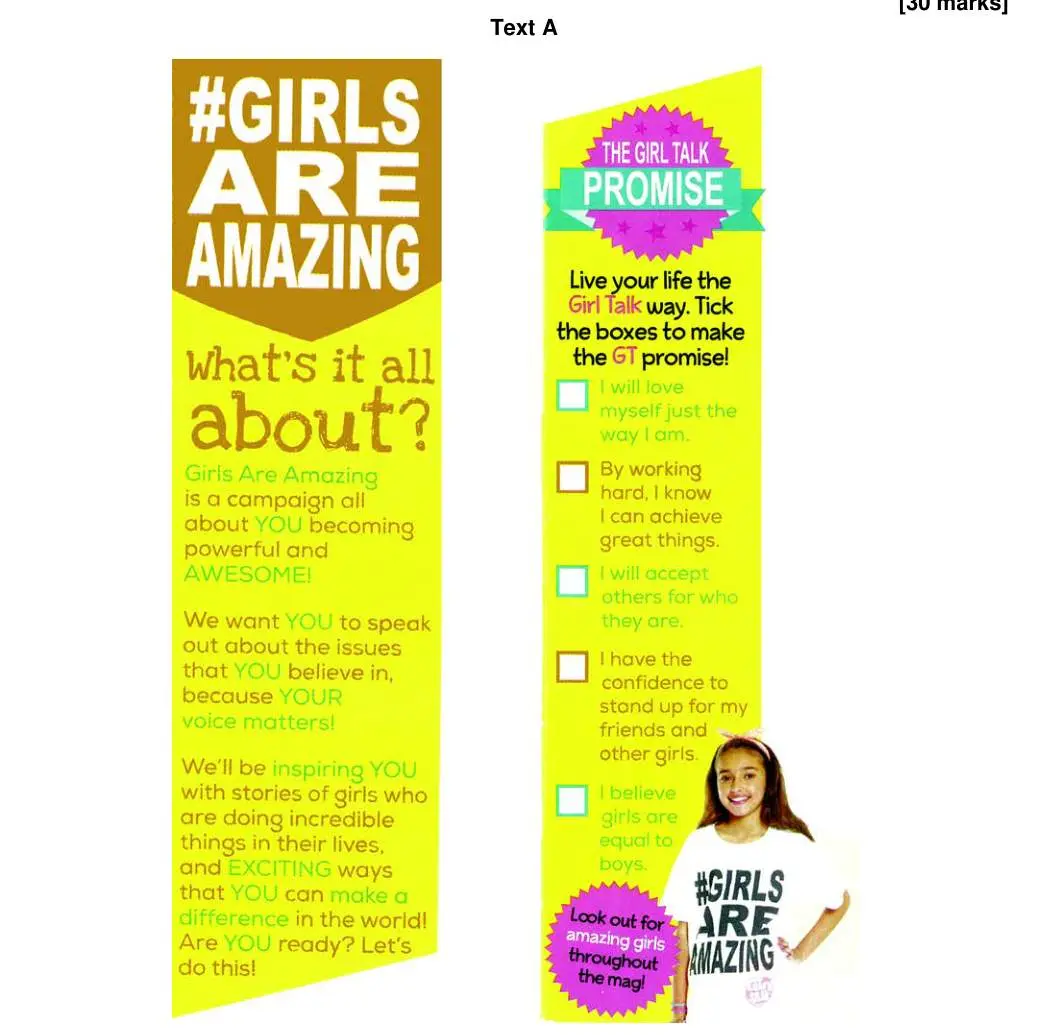
Text A (insert)
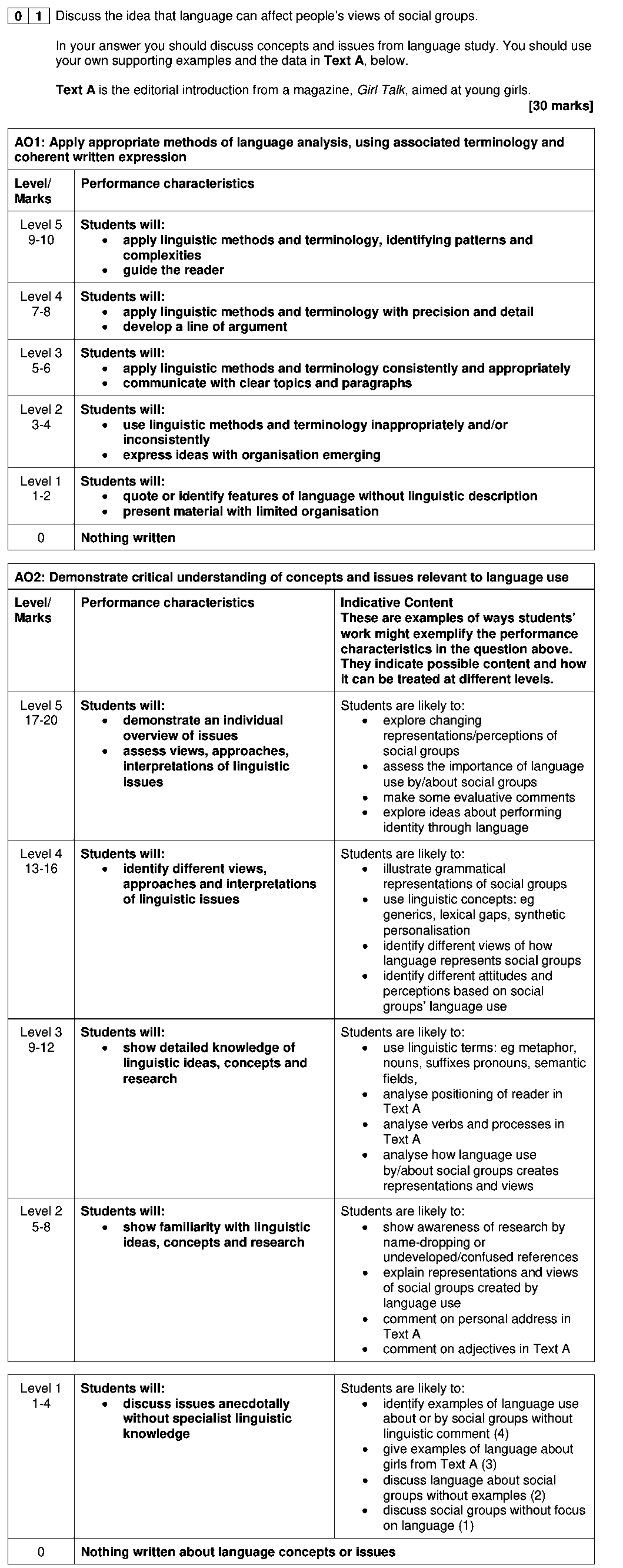
Mark scheme, including the levels and indicative content
Examiner's comment
Assessment objectives for Question 1: AO1: Apply appropriate methods of language analysis, using associated terminology and coherent written expression (10 marks) AO2: Demonstrate critical understanding of concepts and issues relevant to language use (20 marks) asked students to "discuss the idea that language can affect people's view of social groups" and provided Text A which was an editorial introduction to Girl Talk magazine, aimed at young girls. Students responded in a variety of useful ways to this task. Some looked at a representation angle and considered the ways in which language shapes perceptions of groups, drawing on the data to discuss how young girls were being represented in the text before moving on to other social groups. Others concentrated on the language used by different social groups and how perceptions of those groups might be affected by their language use. There was also some really interesting and well-supported discussion of youth sociolect, the in-group language of online gaming and musical subcultures, occupational groups and the language used to express group identity. Some students were less successful in their approach to this question and saw the gender element of the Girl Talk text as a chance to offload everything they had revised about gender and interaction. Where this was relevant to how language affected people's views of female or male groups, this was credited, but in many cases such an approach led students into unproductive territory. Successful answers: • Addressed the task and defined 'social groups' in a way that allowed them to open up different areas for discussion • Considered how language is important in creating and shaping perceptions of individuals and groups • Considered how the language used by different groups often shapes perceptions of those groups • Saw the potential in Text A to address issues of social group-related language use (young girls, pre-teens/teenagers, young feminists, social media users as social groups, for example) • Drew on studies about attitudes to language use, such as matched guise experiments • Referred to research such as William Labov's Martha's Vineyard study which examined how language use expresses different aspects of identity and choices over group allegiances and solidarity • Considered aspects of social class and background • Understood social stereotypes and challenged them • Discussed how language can be used to express allegiance to, or distance from, social groups • Explored performance and choices in language styles, referring to style-shifting and/or code-switching • Made reference to examples from the text (or their own examples) where language was used to address a particular group and identify with members of it (eg an abbreviation such as GT, or the prominent use of the hashtag in Text A) • Used linguistic terms such as direct address, pronouns, adjectives, synthetic personalisation, accommodation, sociolect, convergence and divergence to describe language use • Understood the voice being created in Text A and how it was designed to empower a social group. Less successful answers: • Analysed Text A as if it were a Paper 1 text, with no reference to the "Discuss..." task • Described the graphology of Text A without reference to details of language • Struggled to define what they meant by 'social groups' • Treated the question as an opportunity to discuss gender and interaction without reference to the wider task • Made non-linguistic references to 'chavs' or 'road men' and the perceived deficiencies of these groups' language use • Recycled popular stereotypes about language use without linguistic comment • Applied a deficit model to the language of different social groups, describing such varieties as 'incorrect', 'improper' or 'wrong'.
Notes from the mark scheme and report
- AO1 10 + AO2 20
- top band explores changing representations and perceptions of social groups, language used by and about groups and performing identity
- credited: defining 'social groups' broadly, synthetic personalisation, matched guise, Labov's Martha's Vineyard, style-shifting, youth and online sociolects
- weaker answers analysed Text A as a Paper 1 text, offloaded gender and interaction revision, or applied a deficit model ('chavs', 'incorrect')
- Texts/data: Text A: editorial introduction from Girl Talk magazine (Girls Are Amazing campaign) aimed at young girls