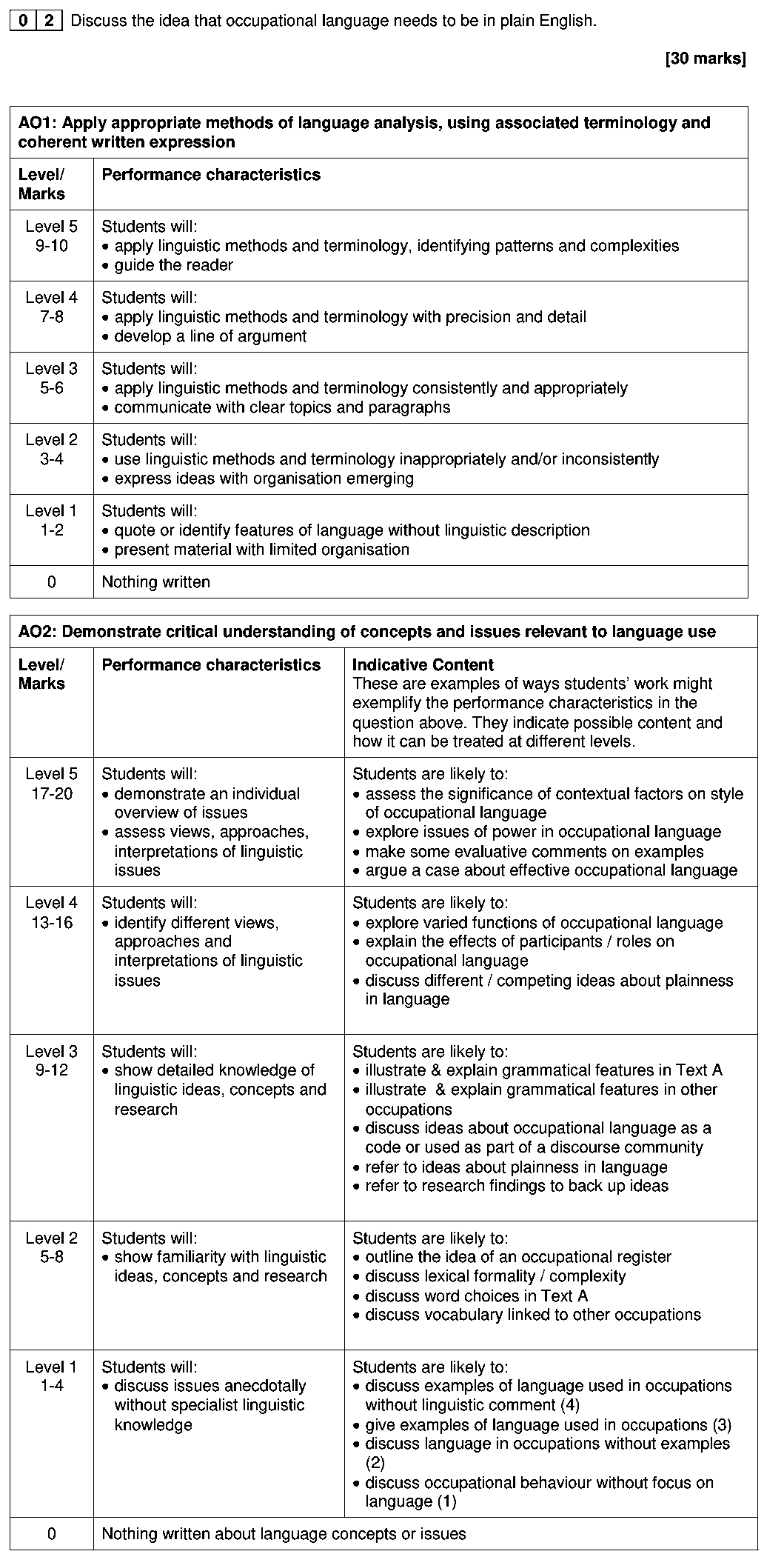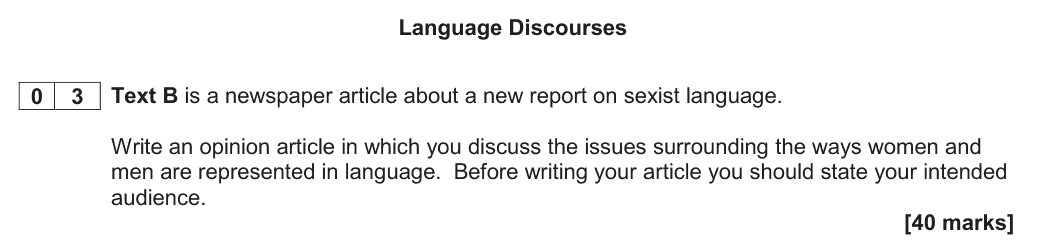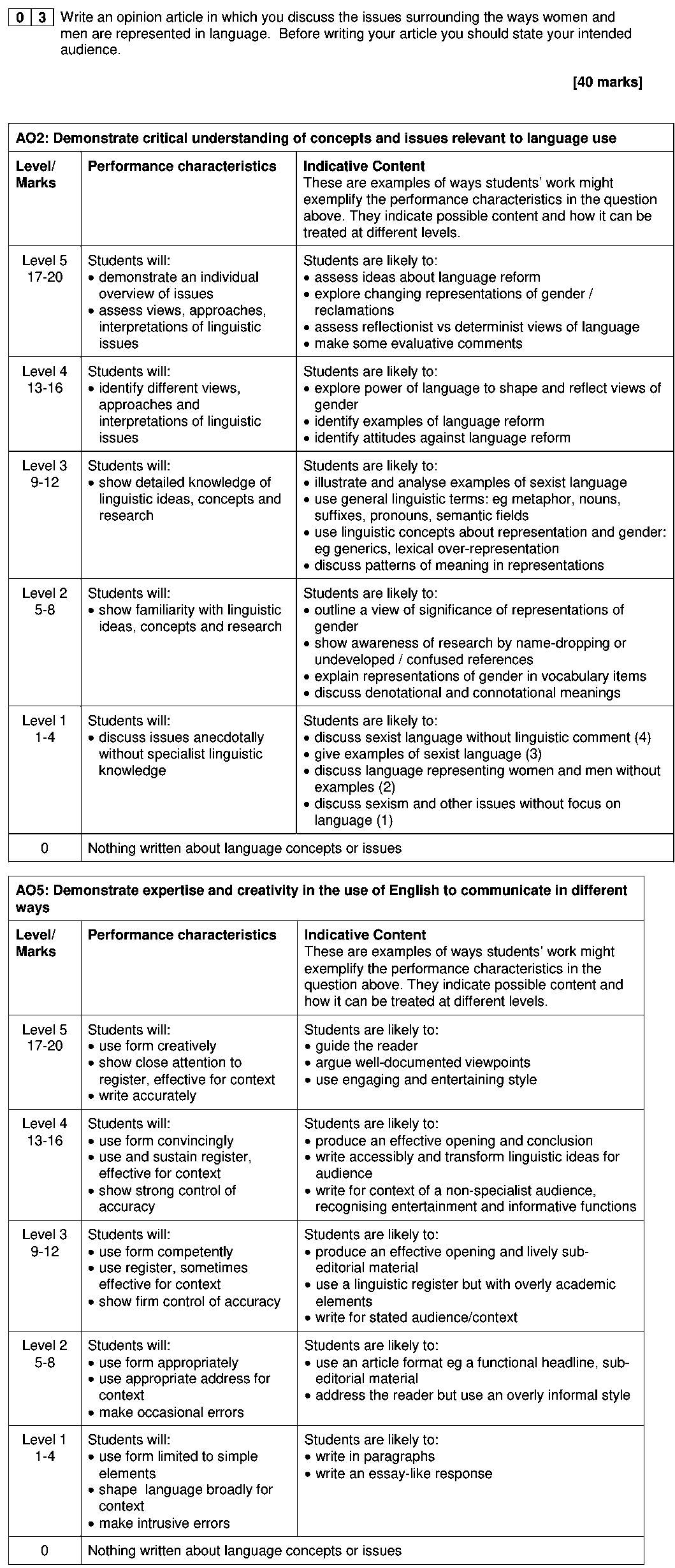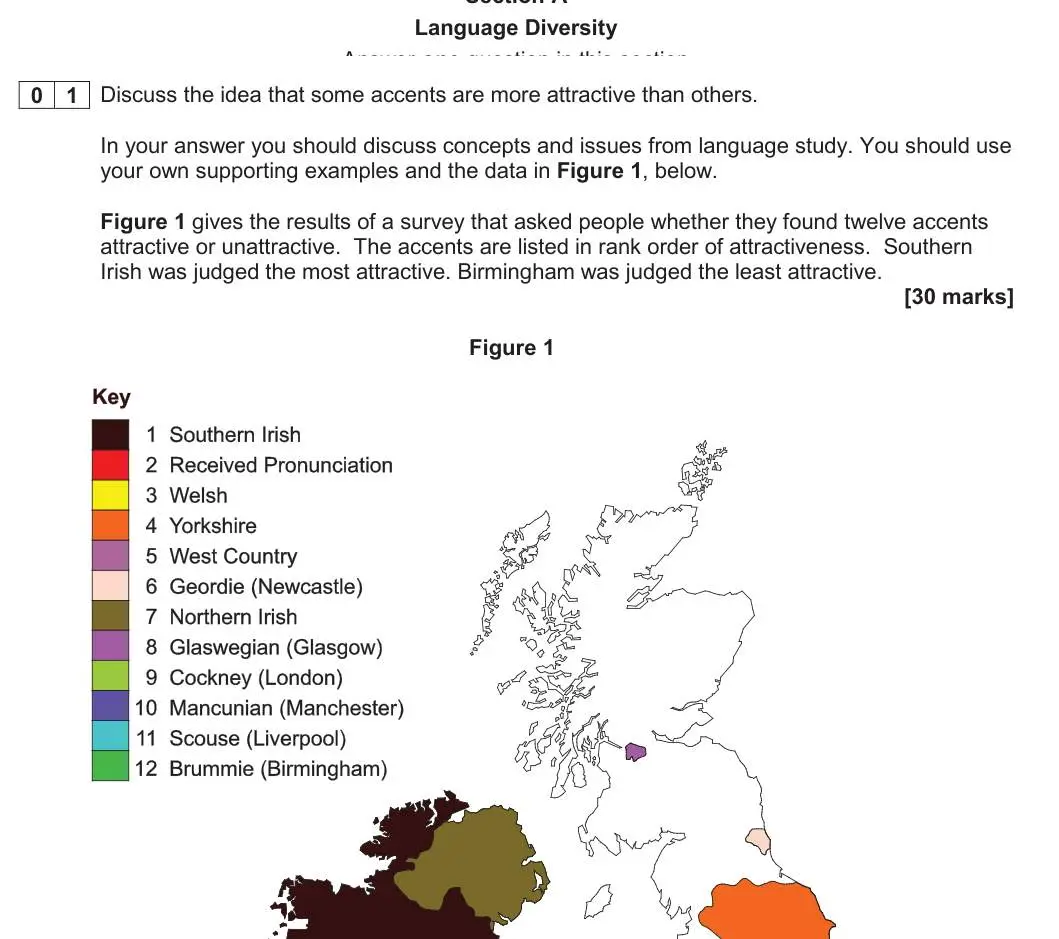
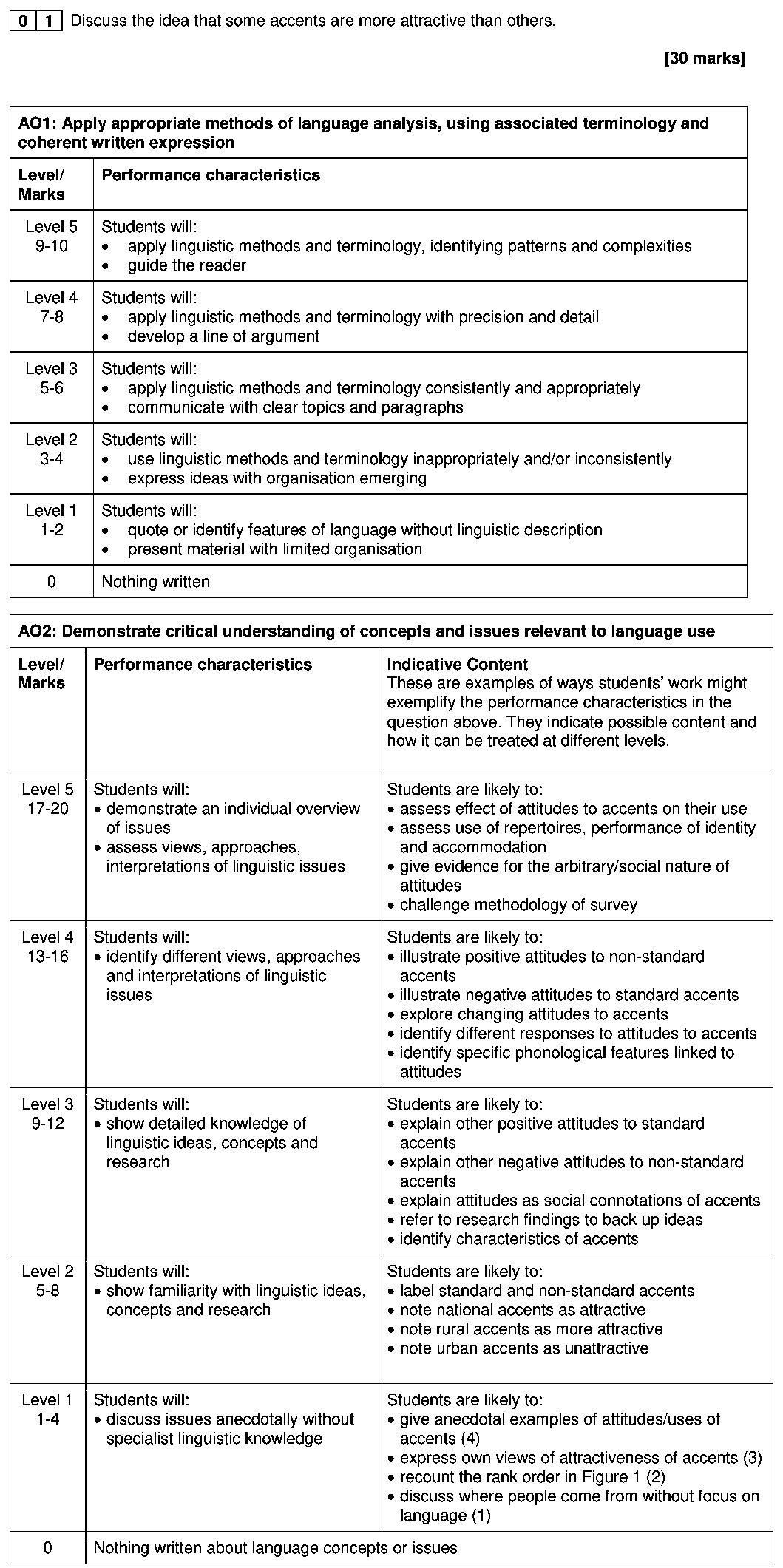
Mark scheme, including the levels and indicative content
Examiner's comment
This question asked students to "Discuss the idea that some accents are more attractive than others" and provided data in the form of survey results about UK and Irish accents. Students answering this question appeared well prepared, often using the data as a springboard into wider discussion of other surveys, social stereotypes around accents and studies into accent use, social prestige and status. For AO2, the different levels of the mark scheme were used to differentiate between those students at the lower end who could understand the rank order of accents and offer some basic comment on why some of them might be perceived in certain ways, and those at the higher end who could engage more closely with ideas around the choices people make to express identity with accents. Relevant studies were credited and examiners reported a range of useful references to Howard Giles, William Labov, Dixon, Mahoney and Cocks, Peter Trudgill and Malcolm Petyt, along with some interesting reports on accent prejudice in the media including ones by Rob Drummond and Paul Kerswill. More successful answers: • addressed the idea in the question and interrogated the idea of "attractive" as a description. • looked at how judgements are often made about speakers rather than purely about their speech. • examined social stereotypes in a way that did not recycle the stereotypes too crudely. • considered the differences in rank order from previous or similar studies. • explored the different attitudes that can exist towards the same accent and how those attitudes can change. • showed awareness of how individuals can change their accents - converging or diverging - depending on the situation they are in and the perceptions they might wish to create. • used the data to consider how certain areas might score better or worse because of the number of users of that accent. • considered how those with particular accents might change the ways they use language to avoid stigma. • referred accurately to relevant studies - either from similar surveys, from linguistic research or their own class work - related to attitudes to accents. • understood and described some of the phonological features of accents that might have been either stigmatised or given a higher status in some situations. • understood the arbitrary nature of some judgements about accents (e.g. the post-vocalic 'r' being seen as prestigious in the USA but often stigmatised as a rural feature in UK accents, or the glottal stop being viewed as 'lazy' by some listeners and 'relaxed' by others). • showed knowledge of other accents than those in the data (e.g. phonological features of Multicultural London English (MLE), Multicultural Urban British English (MUBE) or Estuary English). • considered the role of the media in shaping perceptions of certain accents (The Only Way Is Essex, Geordie Shore and Made in Chelsea being popular examples). • understood that accent and dialect are not the same thing. Less successful answers: • confused accent and dialect. • recycled offensive stereotypes about regional accents, without any sense of challenge. • assumed that large areas on the map automatically led to large numbers of speakers of that particular accent. • put forward deficit models about accents, referring to some accents "not sounding out all the letters in a word" or "not speaking properly". • ranged beyond accent into discussion of slang and/or dialect, without understanding that accent is about sounds and not words. • made generalised comments about individuals with accents and how physically attractive they might (or might not) be. • recounted the rank order in the data without linguistic comment. • referred solely to the data and did not engage with the 'idea' in the question. • misspelt basic words, including those provided in the task or data (e.g. Received Pronunciation).
Notes from the mark scheme and report
- AO1 10 + AO2 20
- top band assesses the effect of attitudes on accent use, repertoires, accommodation and performance of identity, the arbitrary social nature of judgements and challenges the survey's methodology
- credited: Giles, Labov, Trudgill, Petyt, Dixon Mahoney and Cocks, MLE, Estuary English, media portrayals
- weaker answers confused accent and dialect, recycled stereotypes or deficit views ('not speaking properly') or simply recounted the rank order
- Texts/data: Figure 1: map of a survey ranking twelve UK and Irish accents by attractiveness (Southern Irish to Birmingham)