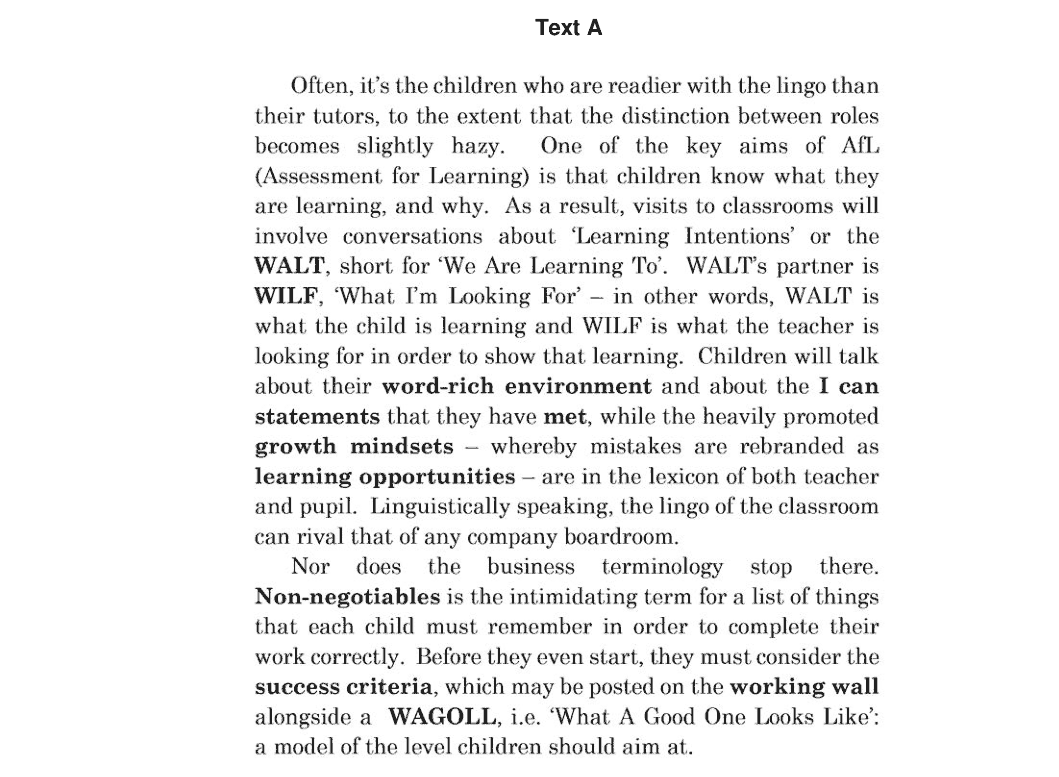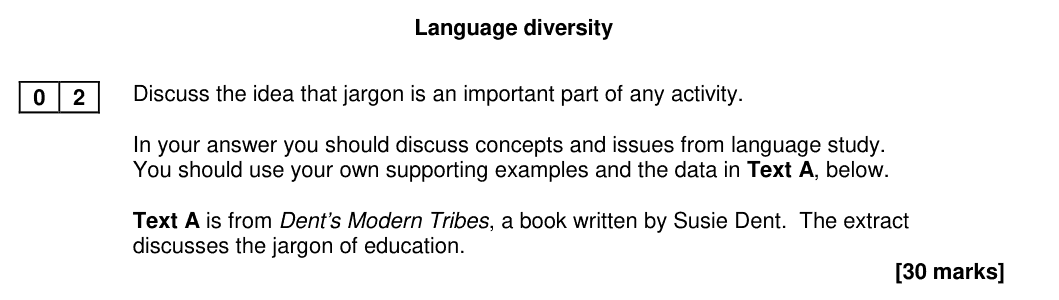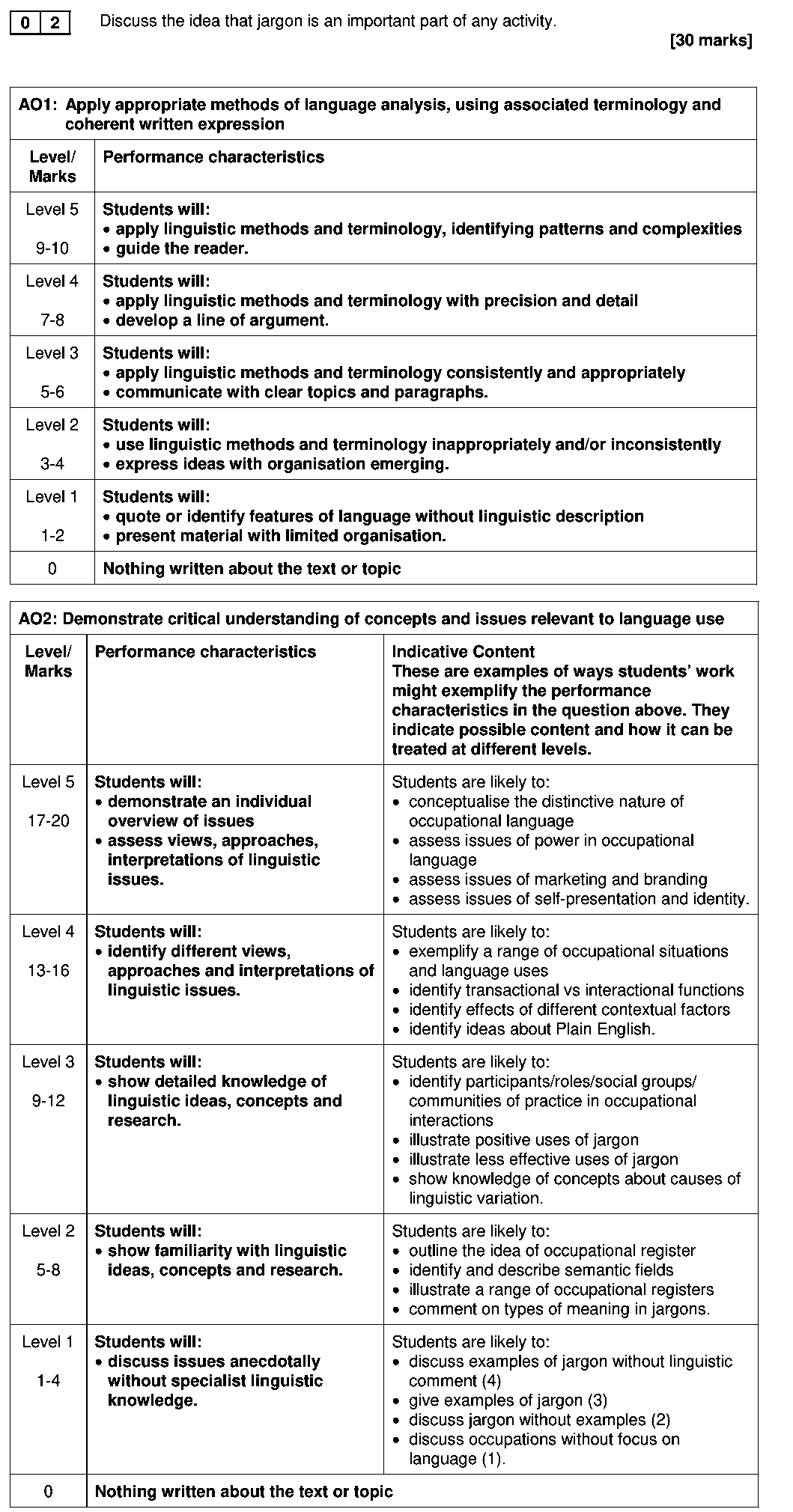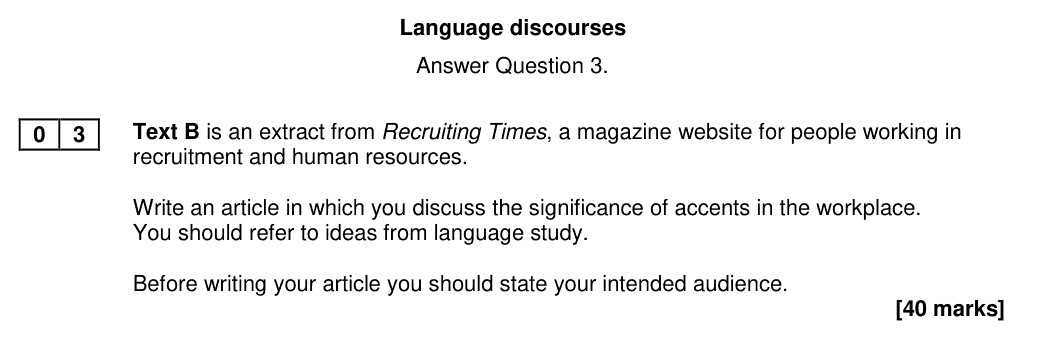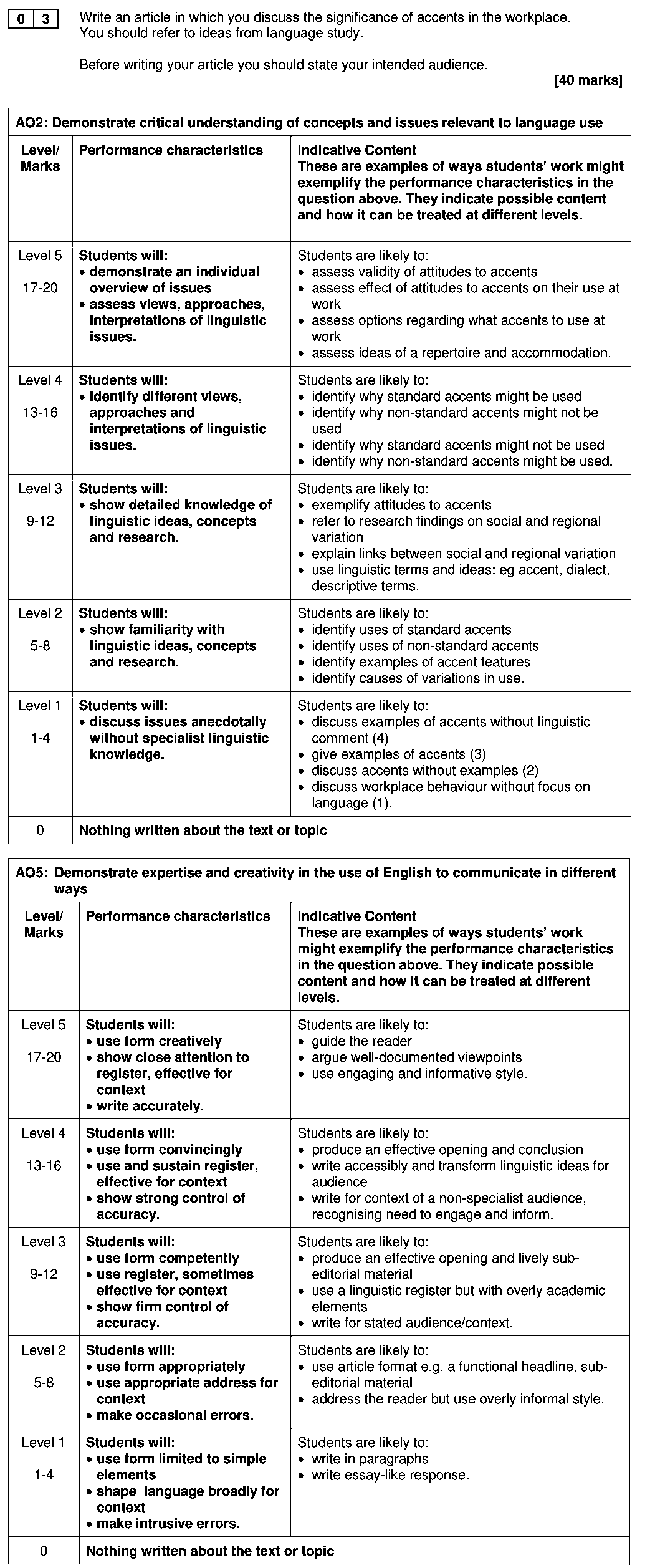
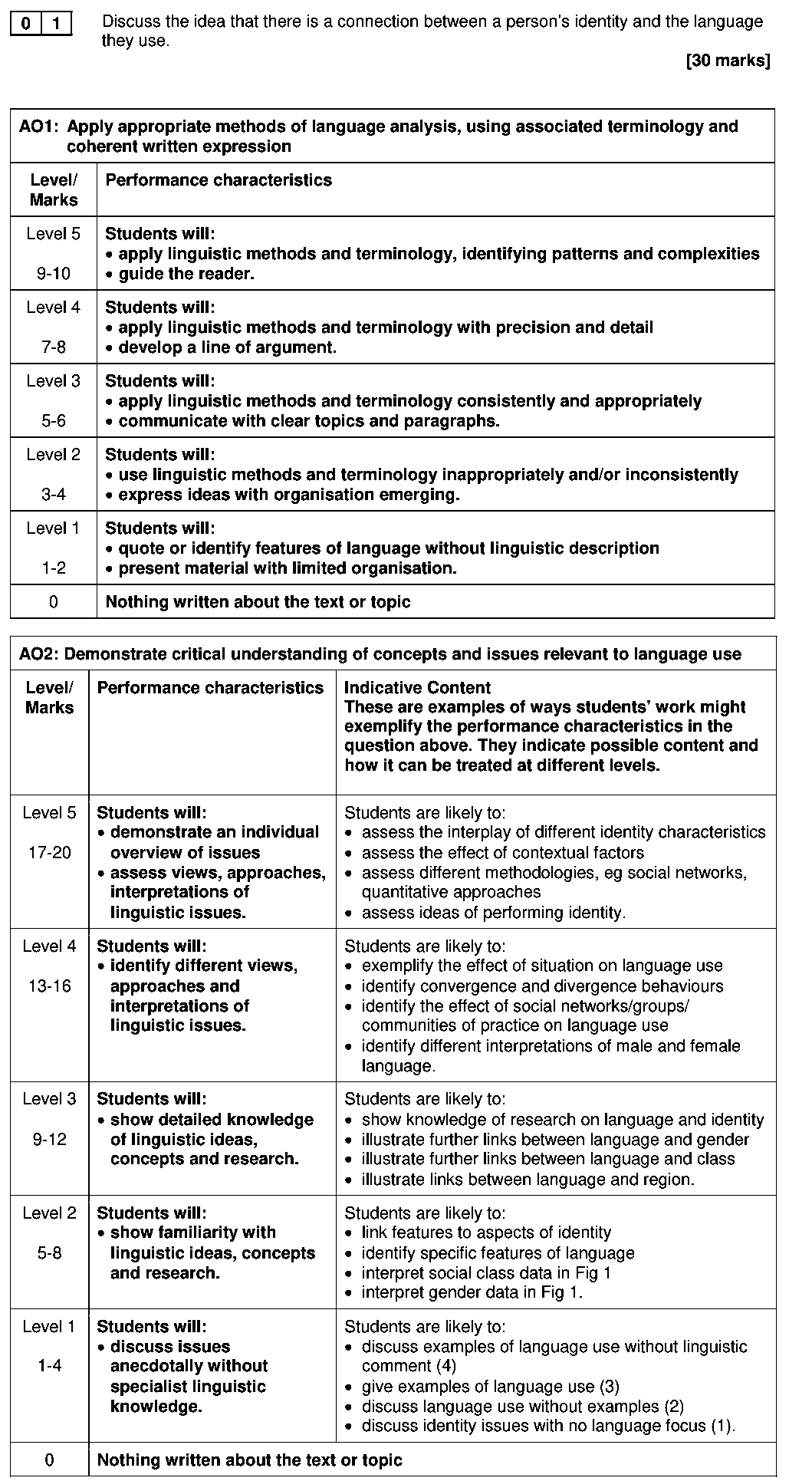
Mark scheme, including the levels and indicative content
Examiner's comment
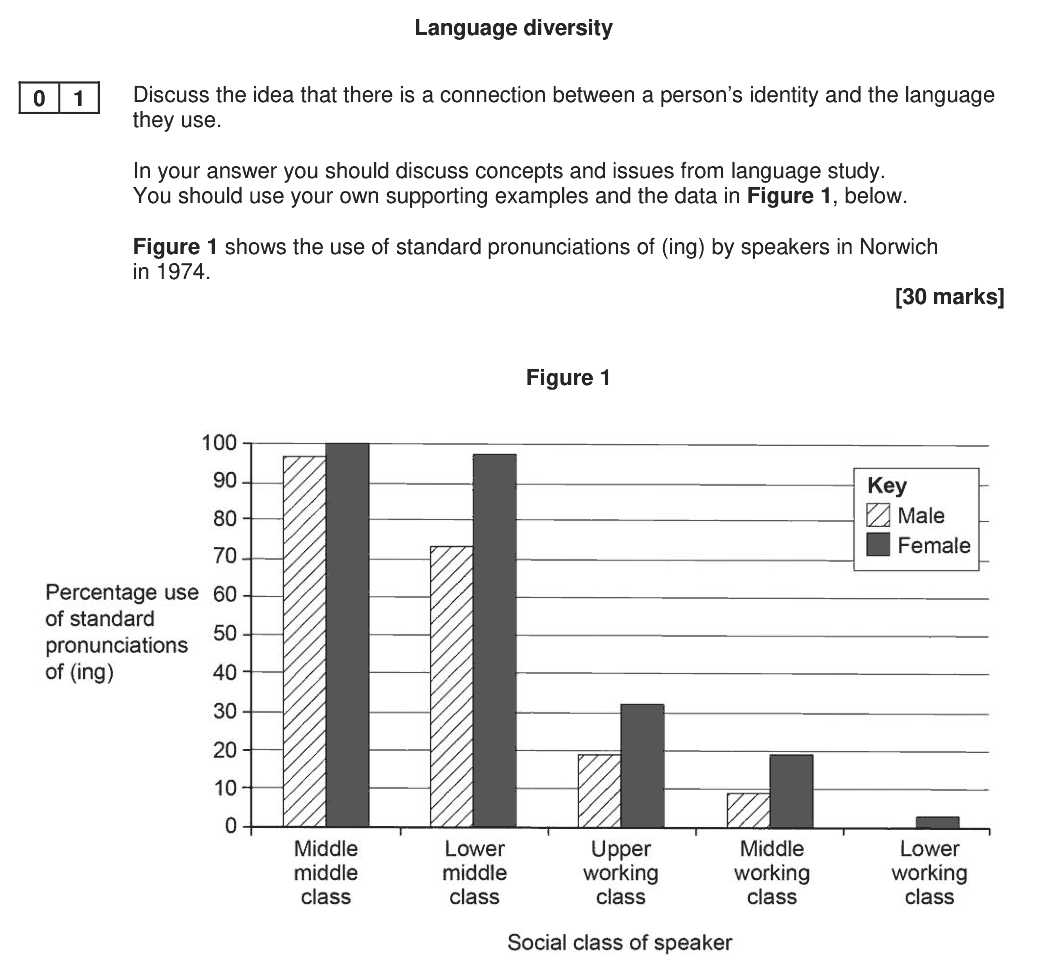
In this series, question 1 asked students to ‘discuss the idea that there is a connection between a person’s identity and the language they use.’ Students were provided with quantitative data relating to social class, gender and the use of non-standard pronunciation as a stimulus. Many students identified this as originating from Trudgill’s research in Norwich, and were able to explain it with confidence. While many students simply outlined its findings, more effective responses interrogated the data, considering both of the two variables given, social class and gender. They also drew on their own deeper knowledge of Trudgill’s research, and considered ideas of conscious or careful language use. In many cases, it was evident students had been taught this piece of research well. However, students should be wary of dismissing the research simply due to its age, as some did. Many students used the data as a springboard to explore similar studies of social class. Malcolm Petyt’s work in Bradford and Labov’s work in New York stores were the most frequently applied. While it was pleasing to see this research commented on in detail, students sometimes missed the complexities of these studies, and so did not fully engage with them. For example, very few considered the socially aspirational middle classes raised by Petyt, and few seemed to understand the nature of the accommodation occurring in New York (assuming, for example, that the sales assistants were of the classes targeted by the stores). While, again, many students attempted to critique these studies on the grounds of age, the significance of this was rarely engaged with. Centres are advised to encourage students to consider why a study’s age may impact its validity if students are to be seen to fully ‘evaluate.’ Similarly, where more contemporary research exists (as in Mather’s 2009 repeat of the New York Stores study), centres are advised to encourage their students to explore any significant similarities or differences arising from the variable of time. Another common approach taken by students was to consider the gender variable presented within the data. From this, students engaged well with ideas of covert and overt prestige (often supported with references to Kuiper, and further comments on Trudgill) and genderlect. As in previous series, students often developed well from dominance/deficit models into difference and, in the higher cases, diversity. These were often well supported with reference to relevant spoken language studies including Lakoff, Spender, Zimmerman and West, Tannen’s difference model, Holmes, Cameron and Hyde. Again, however, it is worth that noting more recent work, including Tannen’s work on managerial styles and floor holding, is not frequently being raised. Similarly, students are advised not to repeat learned essay structures, without tailoring these to the specific focus of the question. Some students considered ‘identity’ more broadly, and there were some highly successful responses focused around the language of teenagers. Here, ideas of accommodation and code- switching were well considered, with many of the students who used this angle able to successfully argue against the premise of the question. It was pleasing to see students here using contemporary research, including Drummond’s work in Manchester, Moore’s assessment of non- standard ‘were’ in Bolton, and Kortenhoven’s case study into code-switching by a US preacher. More successful answers: • accurately identified the trends presented by the data, before using these as a springboard into similar studies from other researchers • had a clear sense of how they were interpreting ‘identity’ (eg gender, social class, age) or clearly explained how different aspects of ‘identity’ can interplay • were able to consider variables in relation to one another, considering in detail how (for example) genderlect may be influenced by class (and vice versa) • considered learned knowledge in pairs, ie the direct correlation between Lakoff and O’Barr & Atkins, or Zimmerman & West and Beattie. This enabled them to challenge ideas confidently • clearly rooted their ideas in language features and linguistic issues. Less successful responses: • misinterpreted the data • made unhelpful references to stereotypes associated with men and women which weren’t rooted in language comment (ie behavioural ideas) • showed insecurity with details of research, or miscredited work (for example, aligning the ‘Difference’ model with Lakoff) • attempted to force their response into a pre-prepared structure with less relevance to the specific focus of this question • made little attempt to shape their response through the use of discourse markers to highlight their argument, or, in some cases, paragraphs.
Notes from the mark scheme and report
- AO1 10 + AO2 20
- top band assesses the interplay of identity characteristics (class, gender, region, age), contextual factors, methodologies (social networks vs quantitative) and performing identity
- data is Trudgill's Norwich (ing) study: interpret both class and gender, covert and overt prestige
- credited: Petyt, Labov and Mather's repeat, Kuiper, Drummond, Moore, code-switching
- dismissing studies only for their age is not evaluation
- weaker answers misread the data, used behavioural gender stereotypes or forced a pre-learned gender essay (report calls the data non-standard use
- Figure 1 plots standard forms)
- Texts/data: Figure 1: bar chart of standard (ing) pronunciation by social class and gender in Norwich, 1974