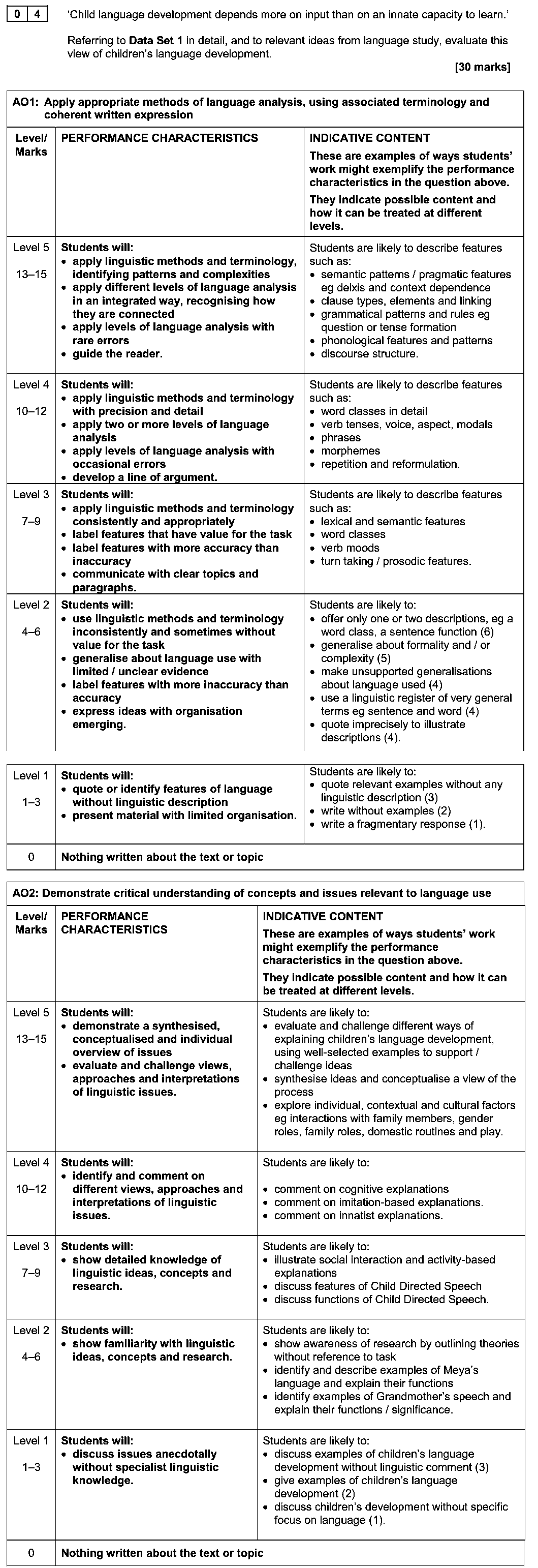
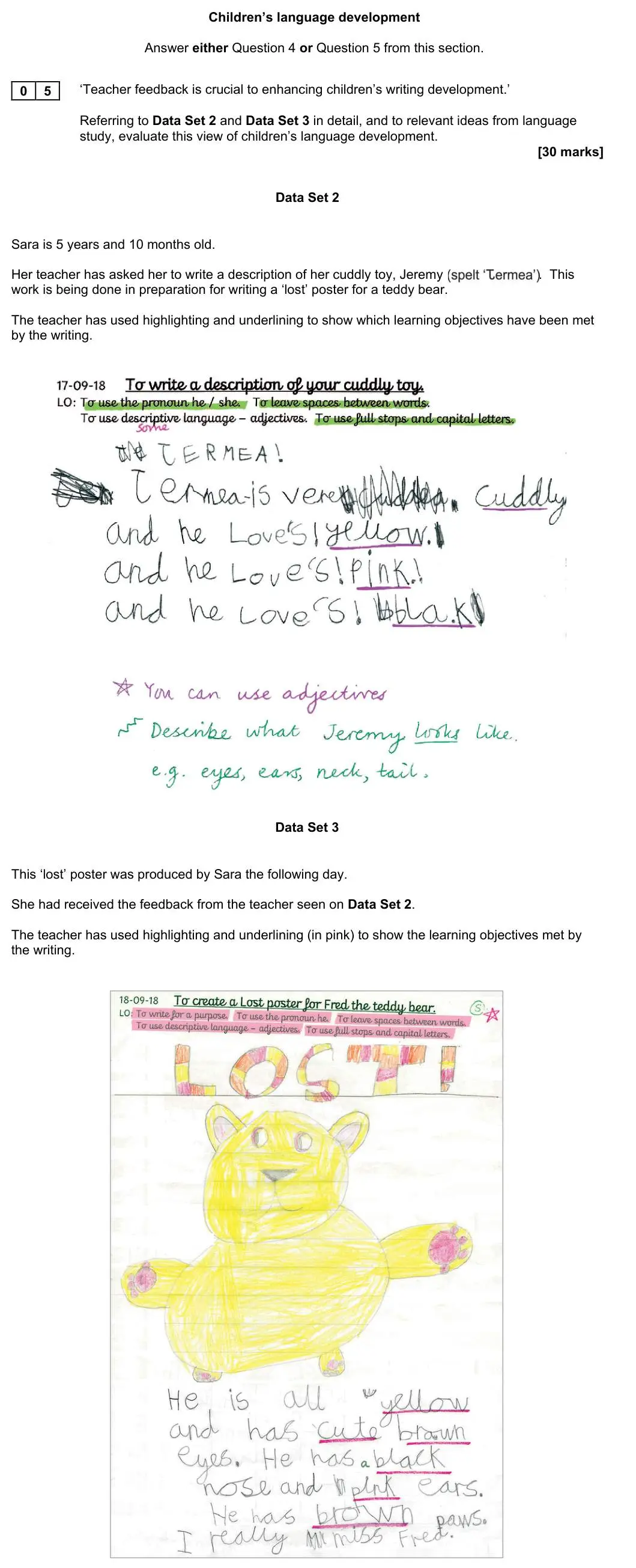
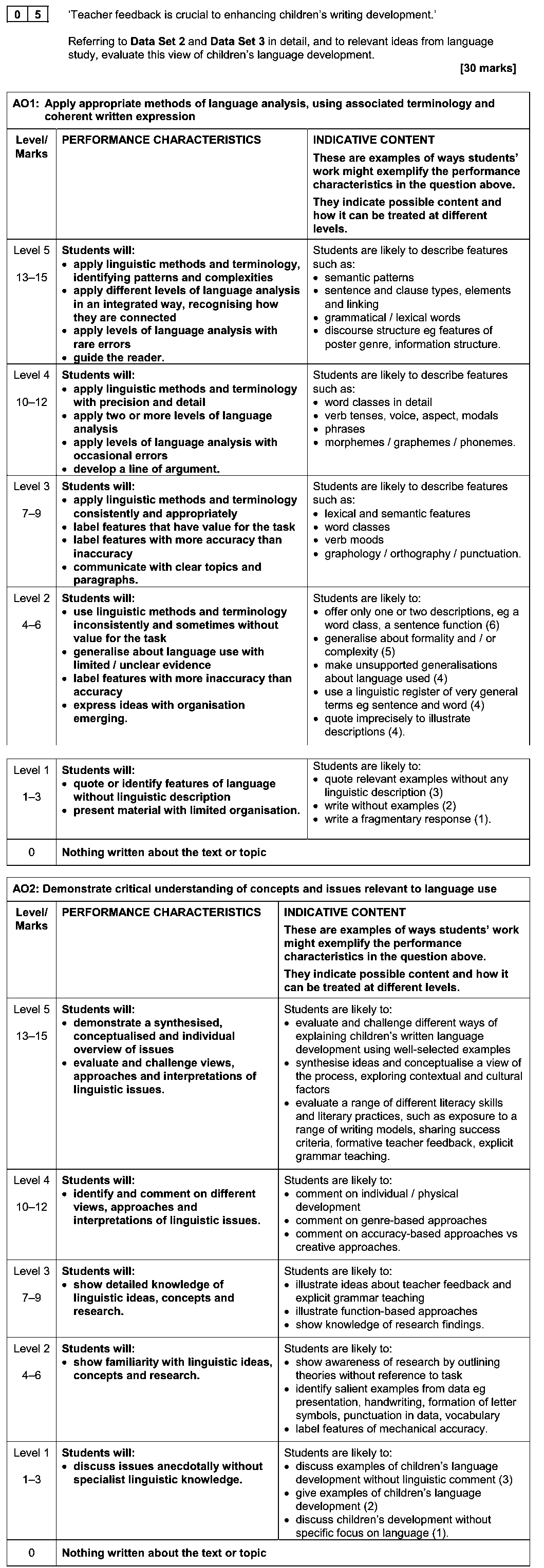
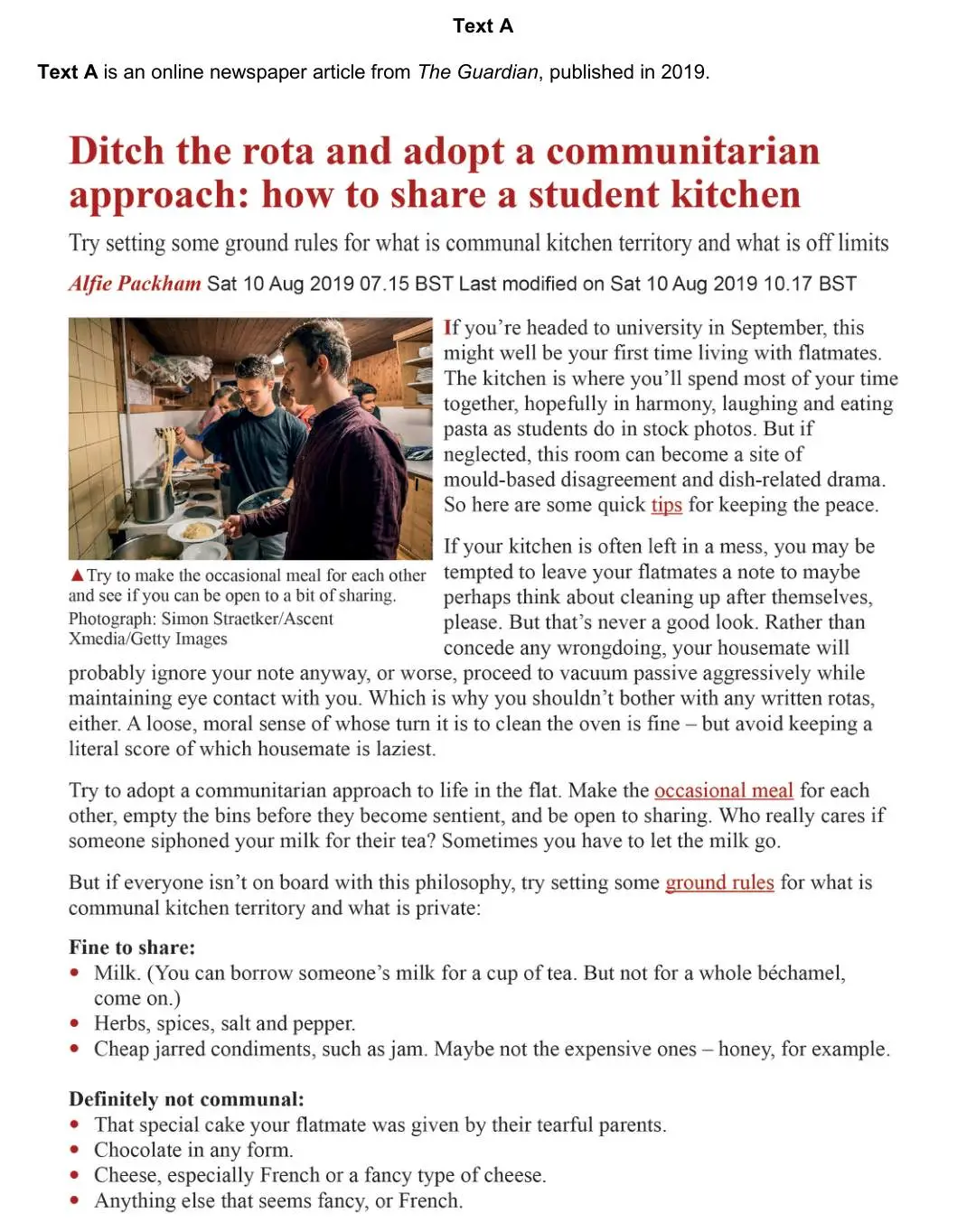
Text A (insert)
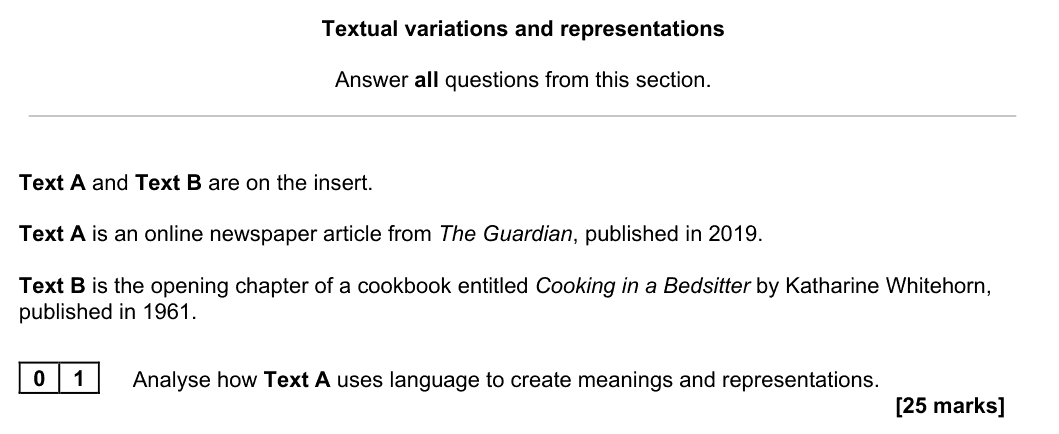
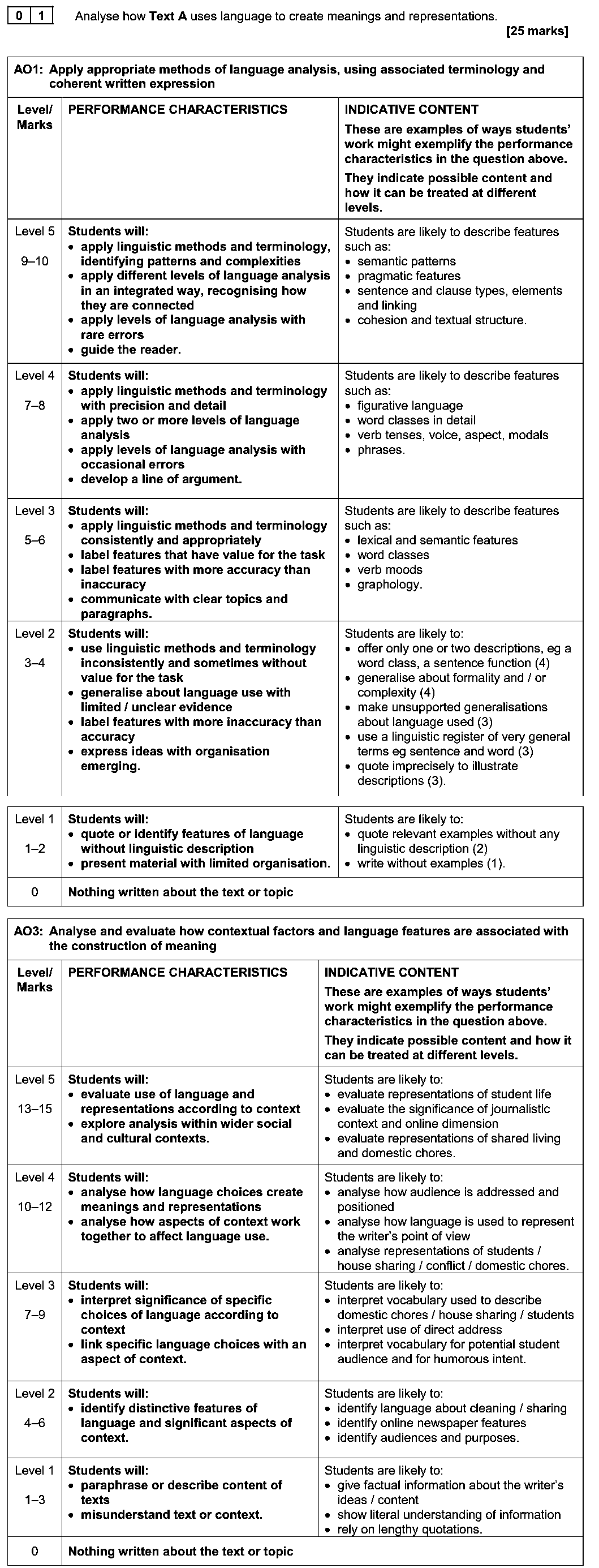
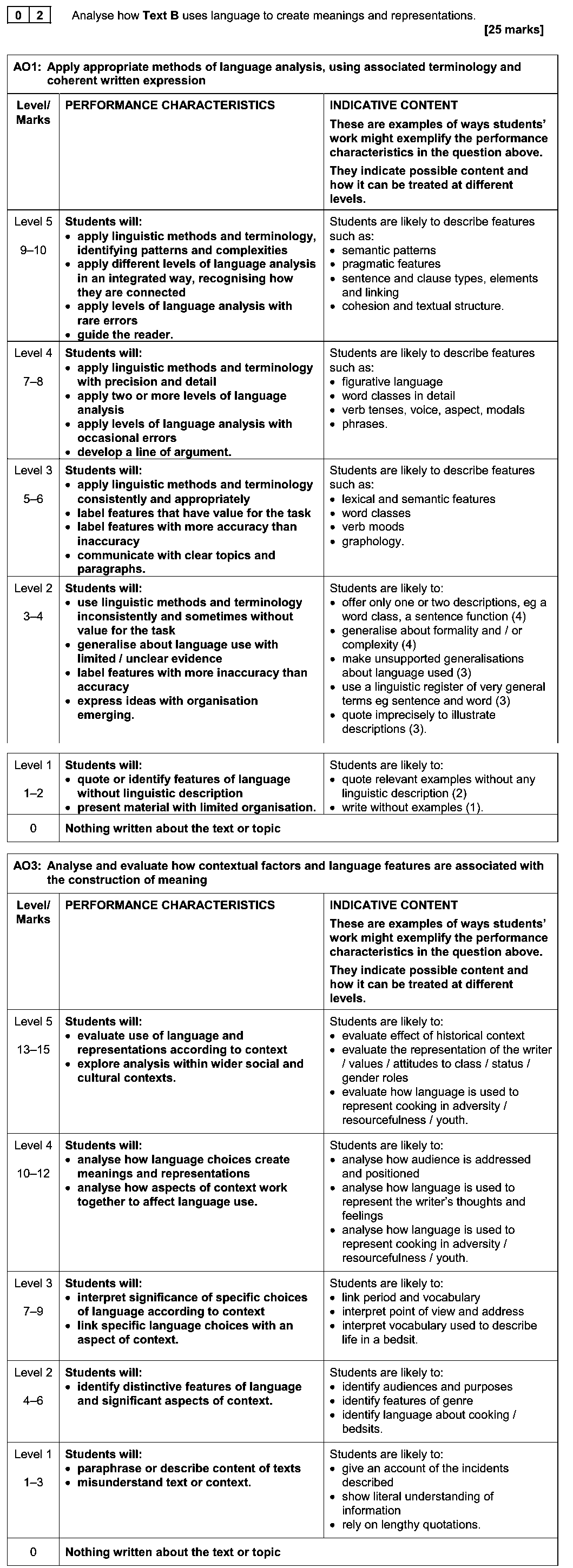
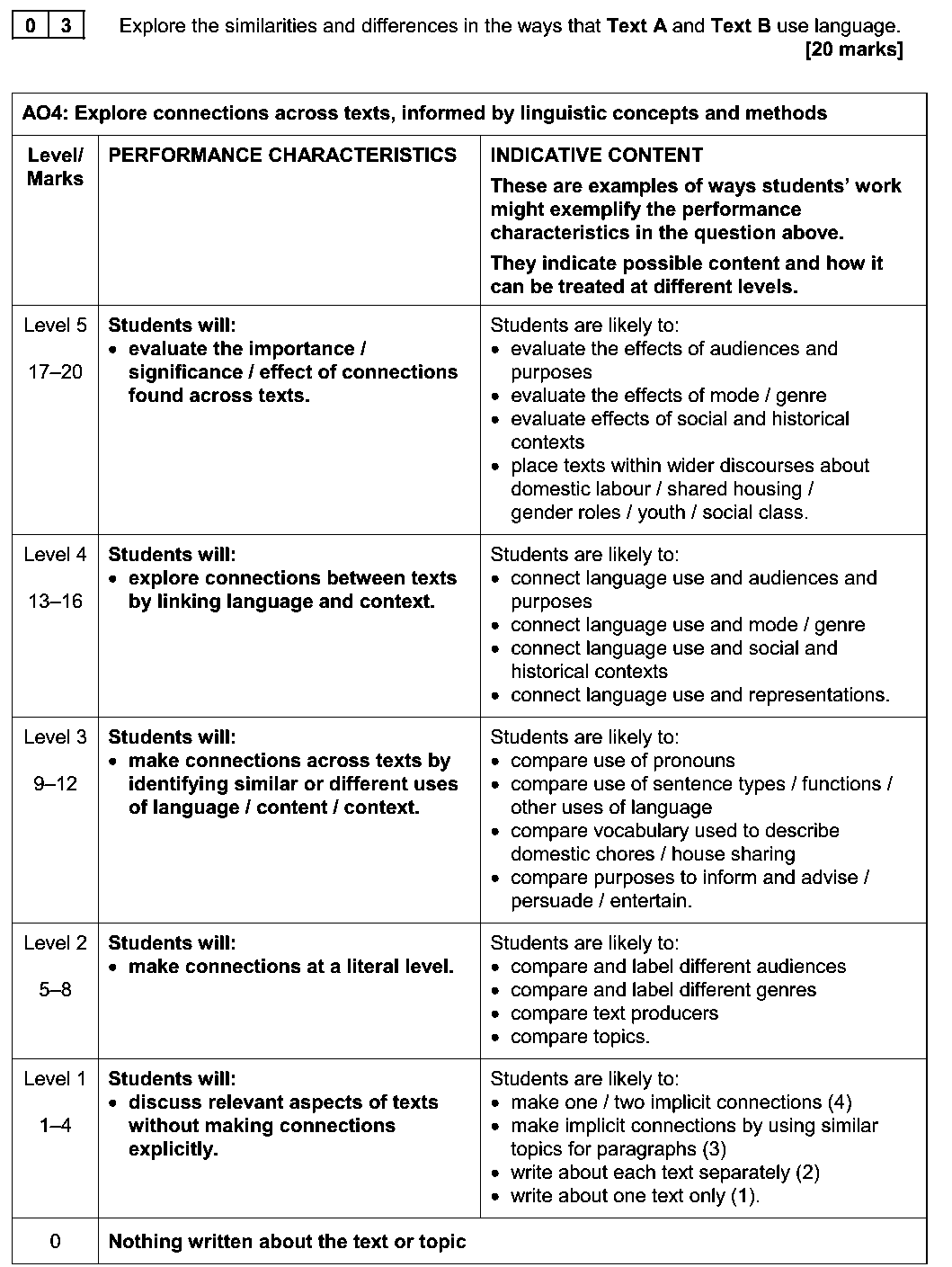
Mark scheme, including the levels and indicative content
Examiner's comment
Text A, ‘Ditch the rota’, was both engaging and relevant to students and the topic of sharing a student kitchen was very accessible. The text provided ample opportunity for students to respond across a range of performance levels for both AO1 and AO3. Students appeared confident in discussing the writer’s language choices, audience positioning and the wide range of representations present in the text (for example, parents, stereotypical students, student kitchens and the writer himself). Students had clearly been well taught and there was an impressive range of terminology used which was applied with some confidence and assurance. Given that this is the fourth standard examination series for this paper, it was clear that students had understood some of the key words which mark out higher performance. Many students clearly highlighted where they were focusing on ‘representations’ and referring to ‘wider social context’ or ‘patterns’ in the data, aware that these are indicators of level 4 and 5 performance. AO1 There were straightforward comments which could be made about the image and graphology as well as ample opportunity for lexical comments. Popular features identified in responses were the use of the second person pronoun ‘you’, use of verbs to create imperative sentences (‘ditch’, ‘adopt’, ‘avoid’), common nouns (for example in the list at the end of the article), the superlative adjective (‘laziest’) and use of modal auxiliary verbs (eg might). Most students showed familiarity with linguistic labels, referring to word classes precisely and often able to label clause elements accurately. There was a wide range of more challenging linguistic features in text A, allowing students to engage with clause elements, sentence types and patterning to allow for attainment in level 5. Occasionally, students led with a focus on grammatical comment and made extensive reference to sentence types and clause types, but with some errors. The grammatical focus of level 5 should not preclude students from commenting on other valuable language features within the data. Many students drew attention to the patterns of imperatives across the data or the conditional clauses which appear repeatedly throughout the text to cater for a range of different situations the reader might be in. At the lower end of performance, quite generalised labels were sometimes used or a more descriptive approach was taken with explanation of what the text was about rather than the language labels evident. This led to inevitably weaker performance for AO1. AO3 The topic within text A was one that was clearly relatable for students and they responded to the text in some depth. Students attempted to engage with a variety of meanings and representations: stereotypical representations of students, presentation of shared kitchens and the need for collaboration. Most students responded well to the humour where there was clear focus on specific features to mock students or present heightened exaggerated examples to illustrate the pitfalls in shared kitchens. There was occasional reference to the text being intended for parents worried about their child leaving home for university. Similarly, ideas about students approaching university after two years of pandemic related isolation, or facing financial hardship, were occasionally explored, but these representations were not frequently considered. Stronger responses engaged with writer authority and/or audience positioning as anxious and in need of guidance. Some students focused on the online dimension of Text A without engaging with the content, offering description of the webpage and navigation aspects without further discussion. On the whole, most students found some meanings to comment on and discuss, where even at the lower end, there was some understanding of purposes and intended audiences for both texts. More successful answers • identified the way in which humour was used to mitigate the imperatives and maintain a light hearted tone even though the article itself was actually providing quite serious guidance • recognised that the writer positioned the reader as a peace keeping student who had to negotiate with other, potentially less reasonable, students • explored the impact of patterning across the data to reinforce the key messages around going into flat shares with a positive and collaborative mindset • identified stereotypes about students but also recognised the realistic view that students were often unable to afford expensive food so pragmatically valued those things highly • considered the stereotypical representation of parents who dote on their children and send them off to university with cakes • identified semantic patterns across the text as a whole between positive and negative abstract nouns (eg harmony and peace versus disagreement and drama) to highlight the potential for student life to realise itself in either way • demonstrated a pragmatic awareness tied in to audience positioning; for example, some students identified how the simple sentence ‘Sometimes you have to let the milk go’ was presupposing that the reader might be irritated by someone using their milk but encouraging to be more relaxed about such things once at university. Areas for further development • Some students appeared to be adding a bracket after each word quoted to specify the word class. This type of labelling was less helpful and tended to distract from the actual analysis. • Arbitrary language labelling with no reference to the importance of those particular elements did little to support the coherent analysis of a text, particularly in relation to connected AO3 analysis. • Sometimes students laboured the grammatical focus to the detriment of other areas of language and there was occasional confusion over clauses and phrases. • While students often began each new paragraph by mentioning a different representation, the comments which then followed were often more straightforward. For example, ‘The writer represents himself as someone who wants to offer advice to new students’ is more typical of a level two response. It would benefit students to consider carefully what is actually meant by representation. • For level five performance, responses should ‘explore analysis within wider social and cultural contexts’. While this is a more modern and potentially accessible text, students seemed to offer less of this wider cultural comment. For example, recognition of the need to be thrifty as a student and the tension that this might cause was rarely explored.
Notes from the mark scheme and report
- AO1 10 + AO3 15
- top band evaluates representations of student life, shared living and chores and the journalistic online context
- credited: humour mitigating imperatives ('ditch', 'adopt', 'avoid'), repeated conditional clauses, reader positioned as peace-keeper, abstract-noun patterns (harmony/peace vs disagreement/drama), presupposition in 'Sometimes you have to let the milk go', stereotyped students and doting parents, student thrift
- weaker answers bracketed a word class after every quotation, laboured clause labels with errors, or named a 'representation' without analysing it
- Texts/data: Text A: Guardian online article (2019) 'Ditch the rota and adopt a communitarian approach: how to share a student kitchen'
 thank you (.) [adds
piece to puzzle] there (3.0) now where’s the mouse’s nose (1.0) LOOK Meya (.)
where’s the nose](/img/JUN22_77021/JUN22_77021_04.webp)