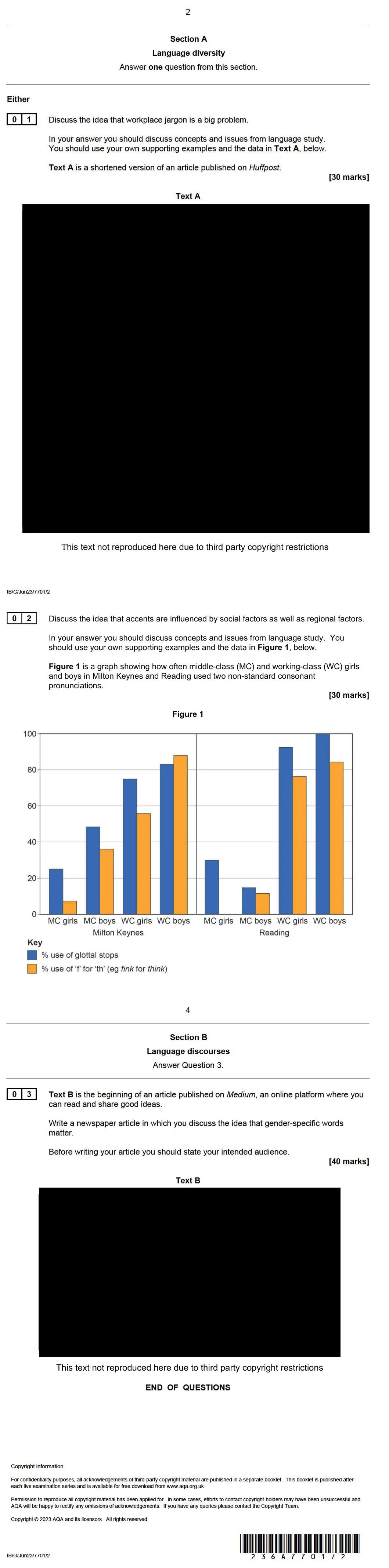
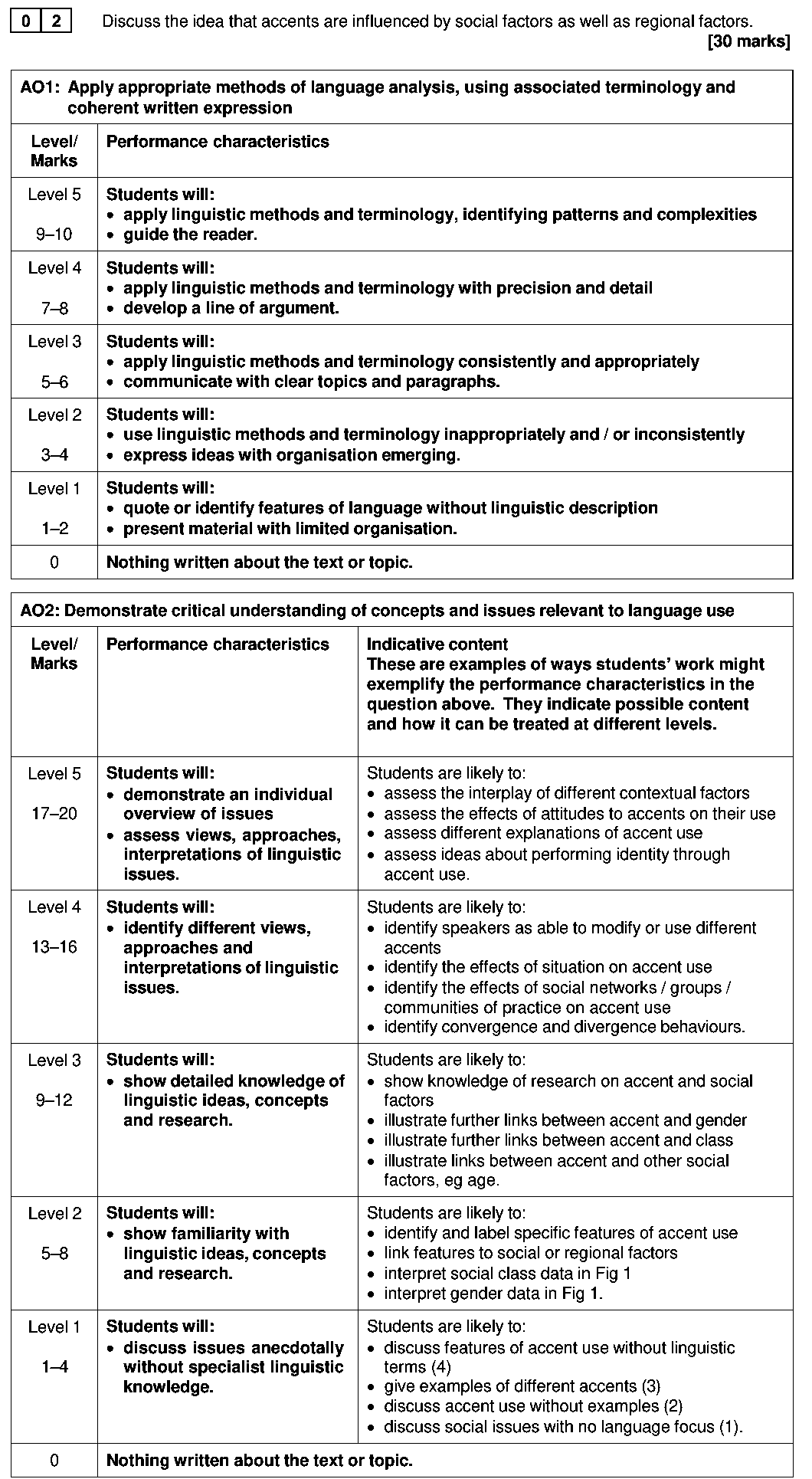
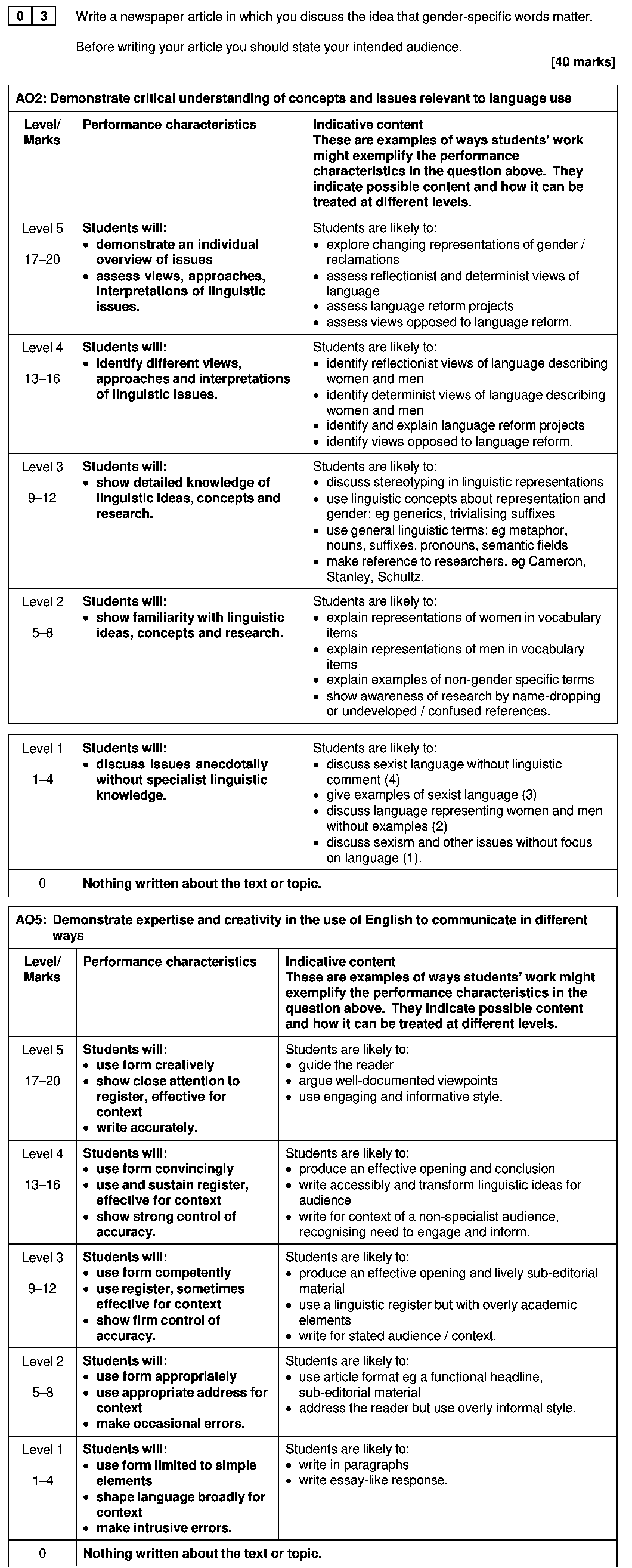
Mark scheme, including the levels and indicative content
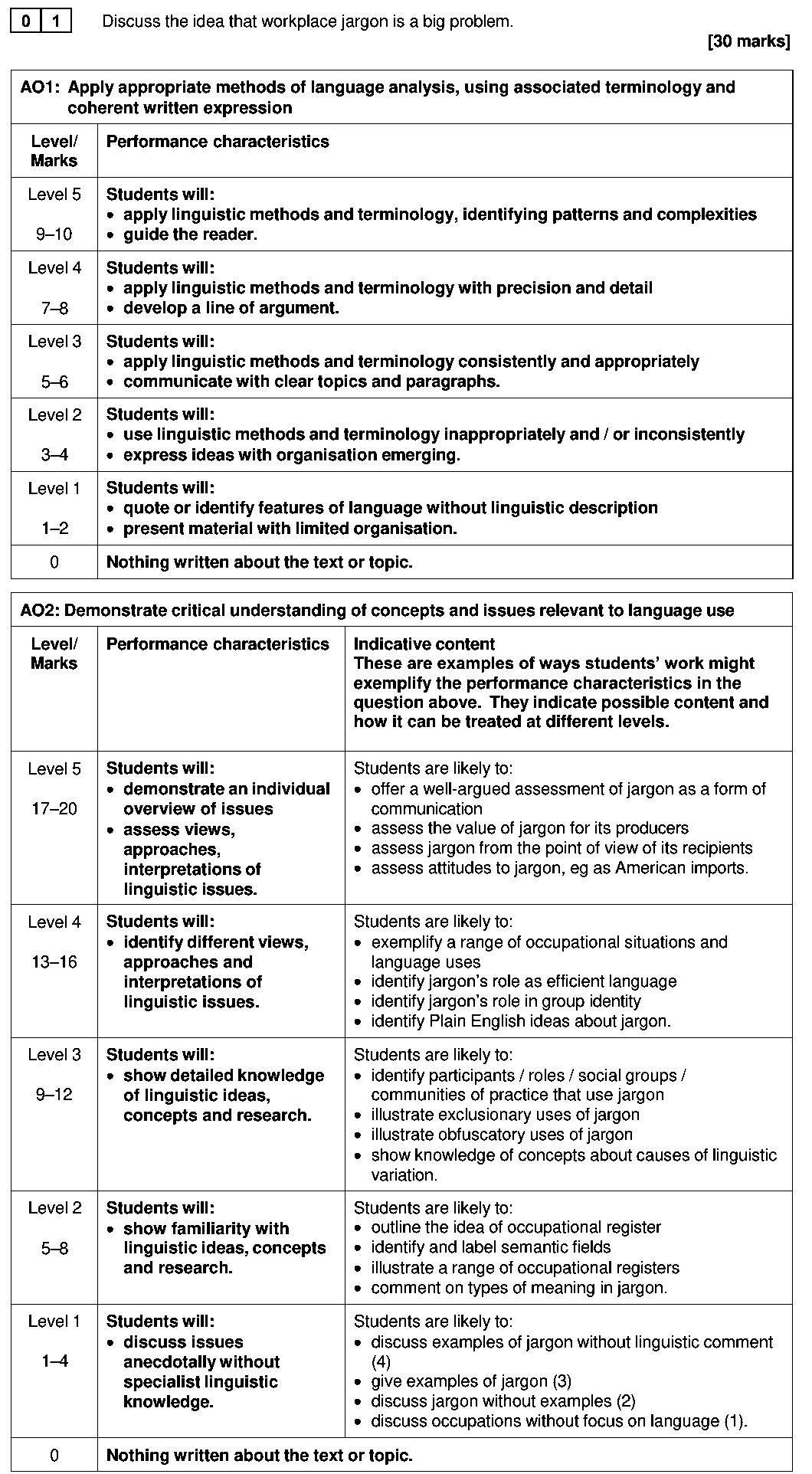
Examiner's comment
In this series, students were asked to ‘discuss the idea that workplace jargon is a big problem.’ The data provided was a shortened article from Huffpost, commenting on and offering examples of workplace jargon. The vast majority of students were able to move beyond the article to consider wider issues relating to occupational varieties of English, often supported by an impressive range of theories and concepts. The work of Drew & Heritage, Swales, Petyt and Koester were all very popular, but students were credited for reference to a host of occupation and/or jargon related theorists and case studies. Better answers considered ideas such as communities of practice and looked at both the positives and negatives of workplace related jargon. Some students struggled to find the balance between making a range of points and demonstrating a detailed understanding of ideas in this question. Little credit can be given for listing a series of theorists and better answers selected a smaller number of practitioners and covered their findings in more detail, linking back to the idea of distinctive varieties of English linked to occupation. At the highest level of the mark scheme, students were able to take a more conceptual approach and discuss ideas of performativity and group identity, seeing how a range of factors intermingled to create individual linguistic identities tied to occupational groups. More successful answers: • Used terminology accurately and illustrated their argument with specific examples from study or their own experience • Selected relevant theorists and showed detailed understanding of their work, linking concepts and ideas to arrive at a conclusion about how different occupational groups created a shared identity through language choices • Built and developed an argument, rather than treating the ideas and concepts covered as existing in isolation from each other • Moved beyond negative ideas about jargon to consider how it could be useful to create group identity, efficient communication etc Less successful answers: • Made vague references to language studies or miscredited findings (for example, Labov carried out extensive work into the occupational language of fishermen in New York) • Made little attempt to develop a clear and focused line of argument • Wrote briefly and sometimes inaccurately, with answers limited to the springboard data and with no development beyond this.
Notes from the mark scheme and report
- copyright removed: question taken from mark scheme
- Text A (shortened Huffpost article on workplace jargon) blacked out in AQA's published paper
- AO1 10 + AO2 20
- top band offers a well-argued assessment of jargon for producers and recipients and attitudes to it (eg as American imports)
- credited: Drew and Heritage, Swales, Koester, communities of practice, efficiency and group identity vs exclusion and obfuscation, Plain English
- listing theorists earns little
- weaker answers miscredited studies or stayed with the article
- Texts/data: Text A: shortened Huffpost article on workplace jargon (not reproduced)