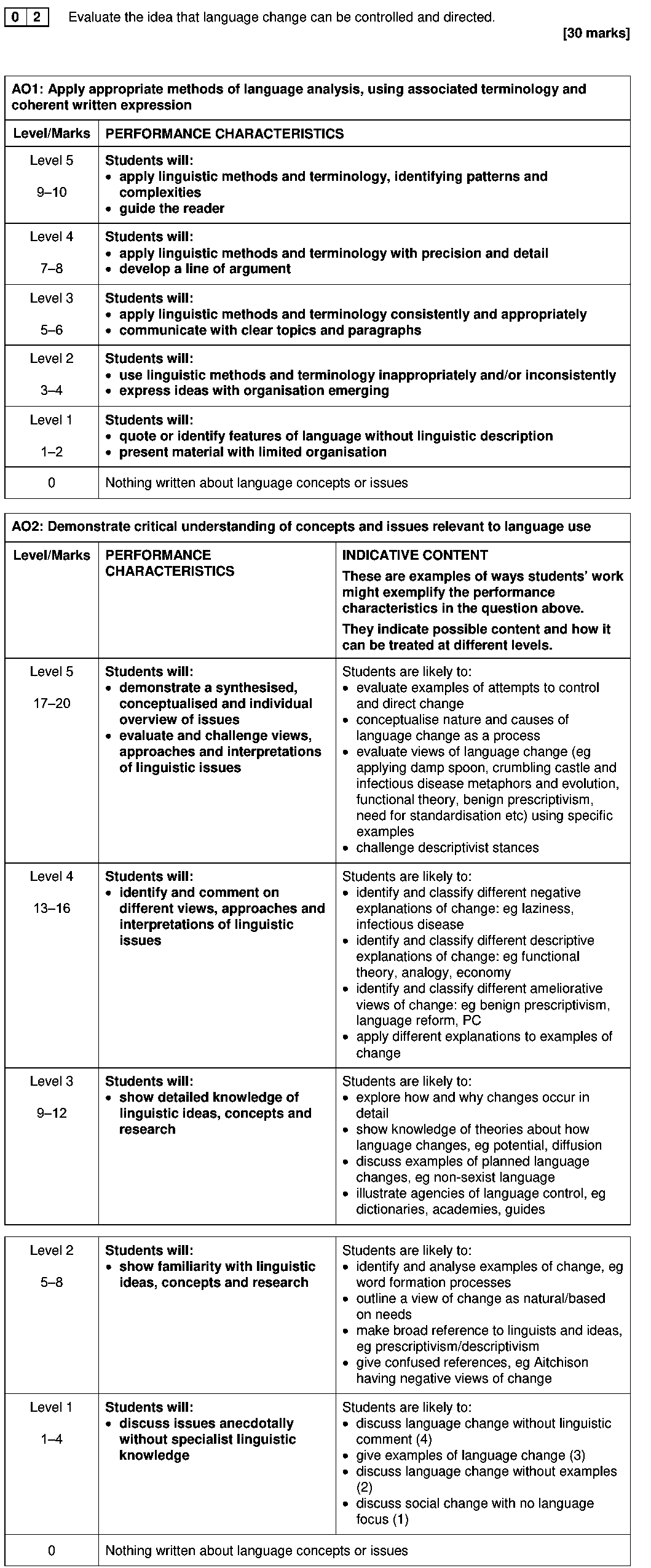
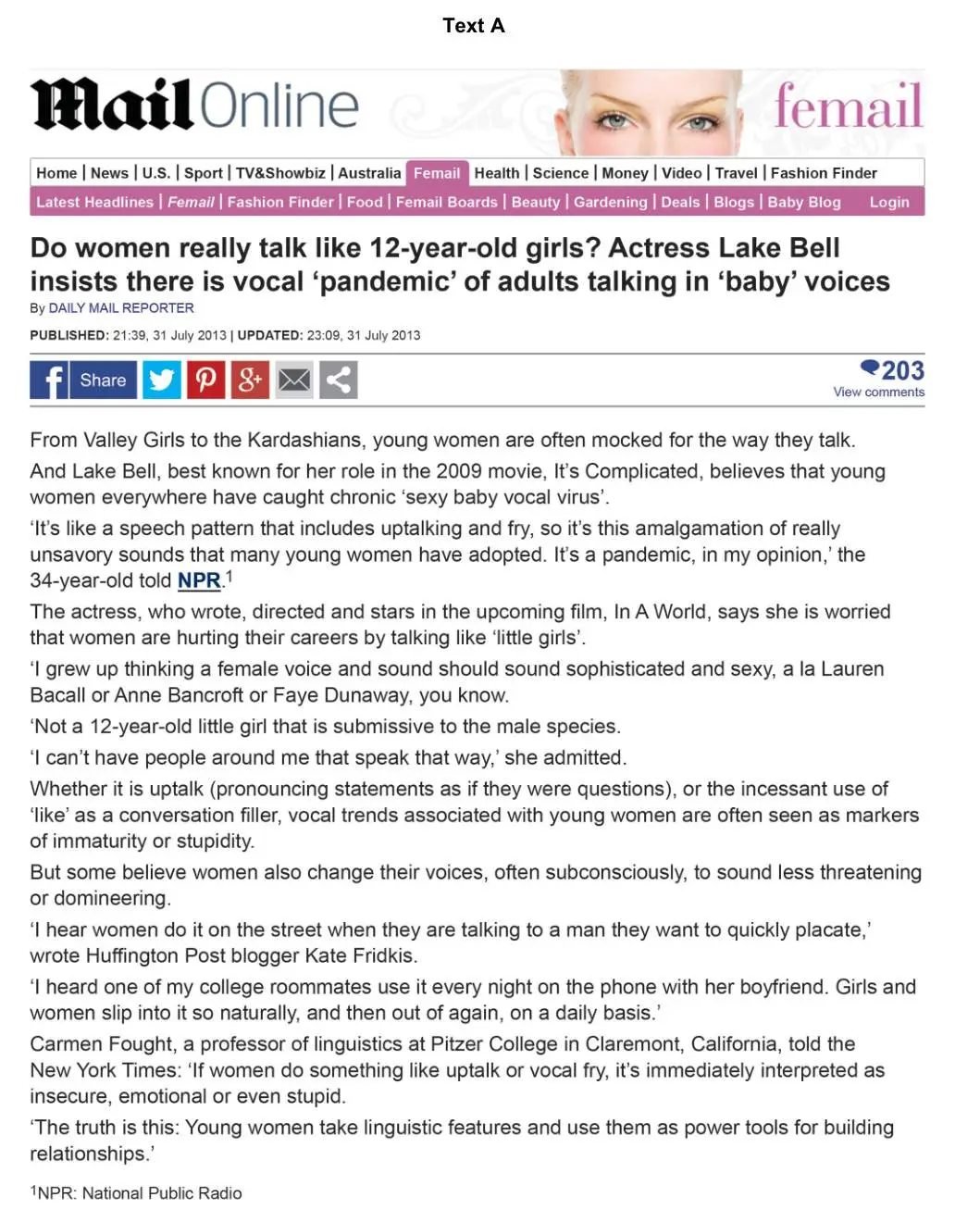
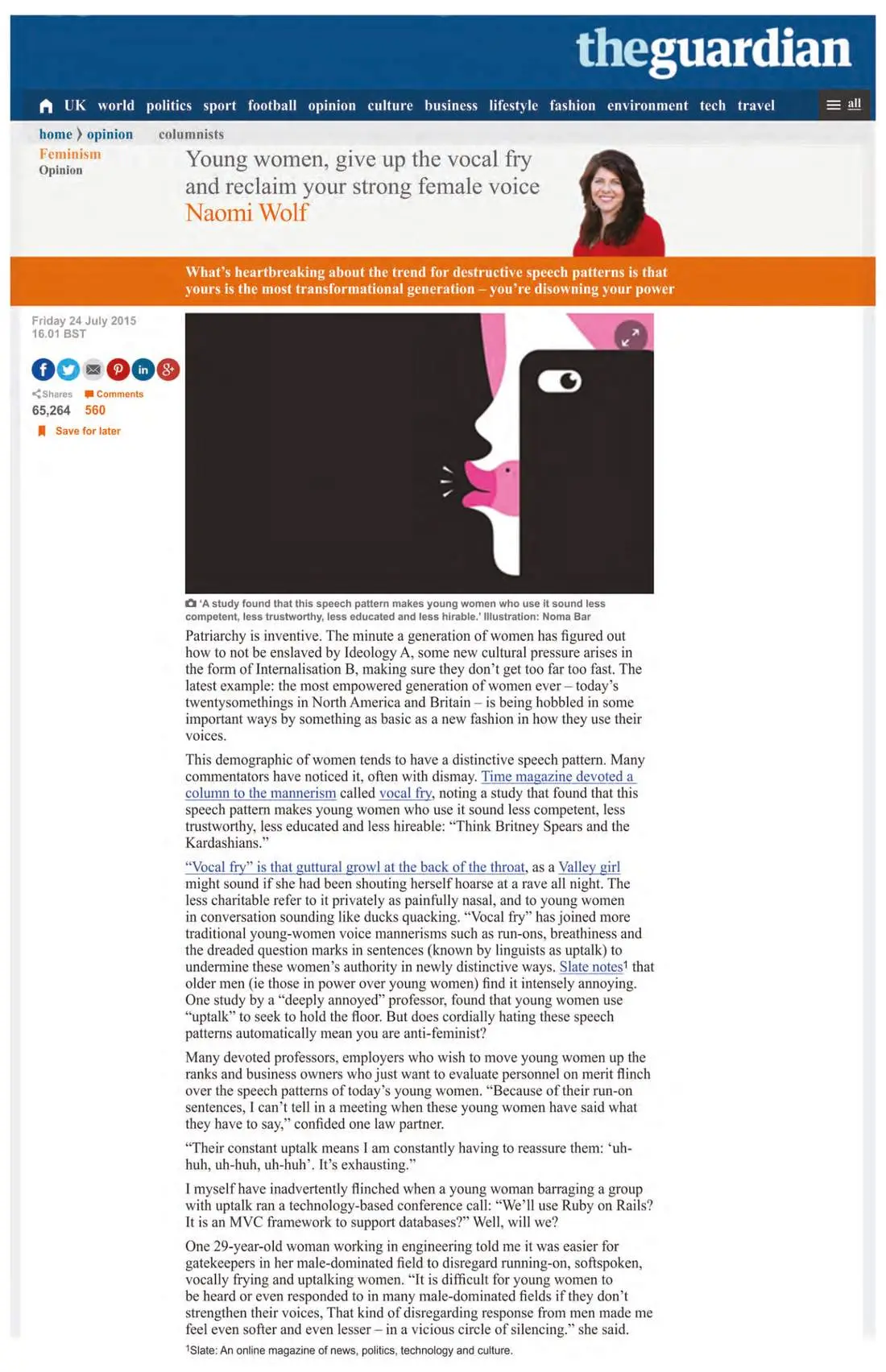
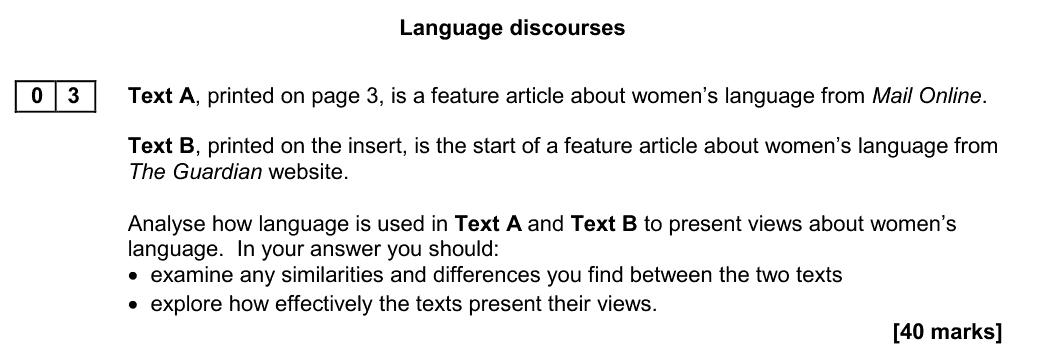
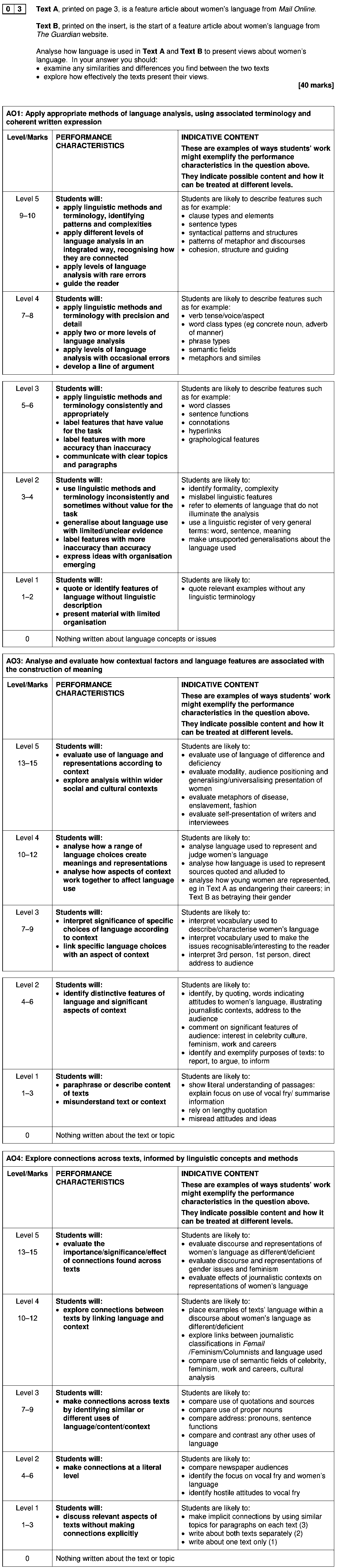
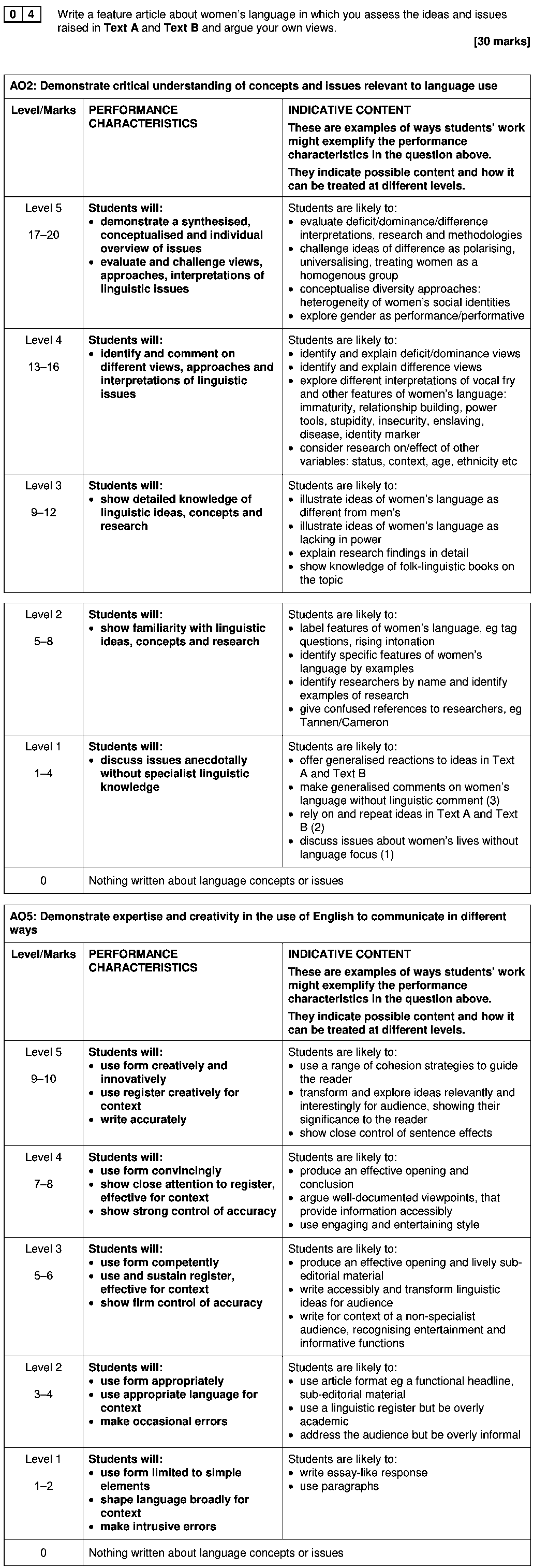
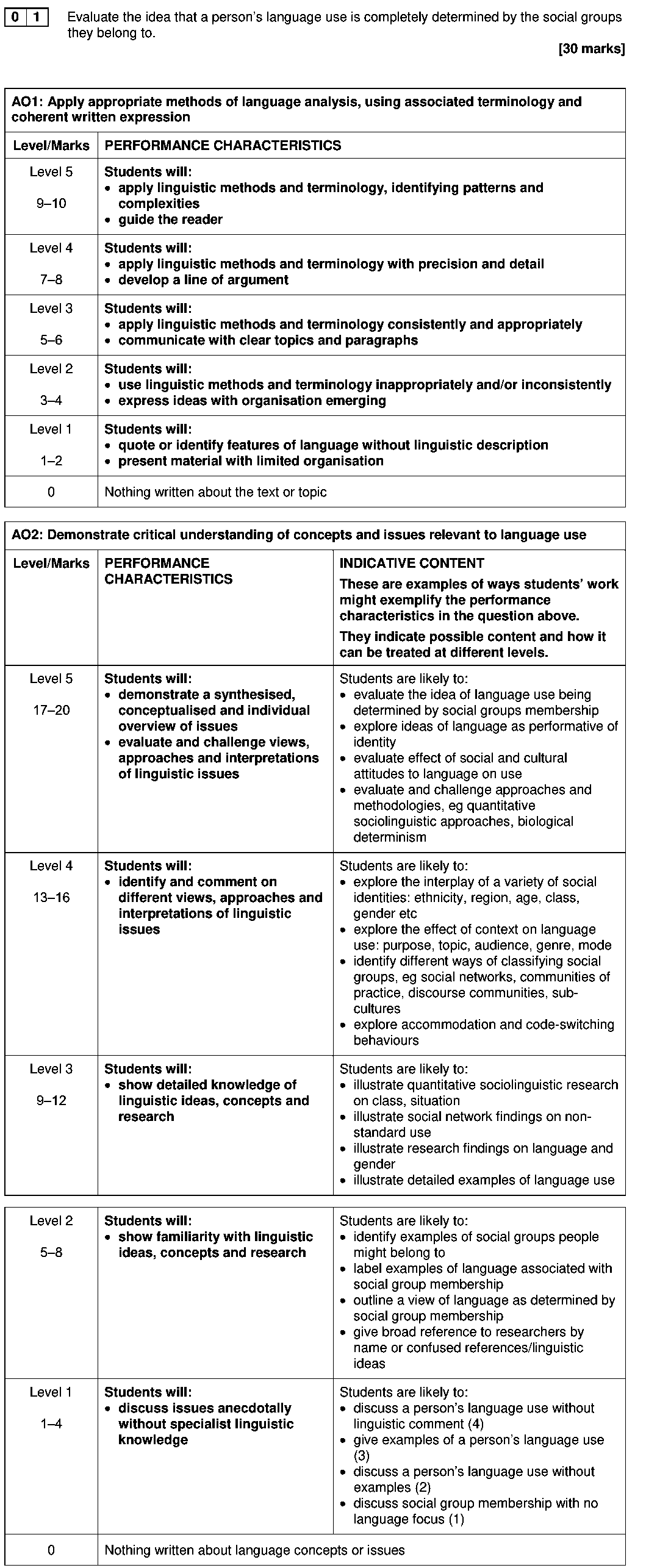
Mark scheme, including the levels and indicative content
Examiner's comment
Question 1 focussed on language diversity and in particular on language and group membership. Students were asked to evaluate the idea that membership of social groups completely determines people’s language use (AO2). They then had to express their views in a coherent argument using linguistic terminology (AO1). A key discriminator was a student’s ability to balance conveying knowledge of research and concepts with an analysis of how they demonstrated the effect or otherwise of group membership. Research studies were not always explained accurately or in sufficient detail to support the candidate’s argument. Less successful candidates tended to claim that all research suggested that the language of the group ‘completely’ determined that of the individual. Students had to begin by deciding what might be meant by a ‘social group’. Most identified groups such as friendship groups, groups based on age (almost always the young), occupation, shared hobbies and school or college memberships. Some opted for wider groups including class, gender or ethnicity. There was also discussion of social groups formed around sexual orientation. Some students defined social groups by using ideas of social networks and communities of practice. The best answers using these approaches explored how groups work as norm enforcing mechanisms and the pressure they exert on linguistic conformity. Some students showed very good knowledge of network strength measurements and the impact of different patterns on language use. Good answers also considered the links between language and group identity. The majority of students were able to cite some suitable research or case studies to support their views, such as Labov’s New York and Martha’s Vineyard studies, Trudgill’s Norwich studies, Milroy’s research in Belfast, Cheshire’s Reading study and Eckert’s study of groups in a Detroit high school. Some answers made used of Bernstein’s ideas about restricted and elaborated codes. These were often used to illustrate how social group membership affected language use. In the best uses of these ideas there was a critique of this deterministic view. Some of the most successful answers explored occupational language in some detail, giving precise examples of medical, legal and sports jargon. There was often discussion of occupational groups as communities of practice with close analysis of their development of linguistic practices. These were also the most successful in recognising that the use of jargon did not determine the individual’s language use in other situations, such as at home. Evidence of the effective evaluation of methods was rare. Those who did attempt to evaluate often questioned issues about the definition of social class and the treatment of genders as homogenous groups. There was some discussion of the lack of consideration of context and meanings in quantitative results. One of the most productive approaches to this question was a case study of Polari, which enabled students to apply theories of divergence, in-group language, and word formation, and to consider the social and historical contexts in which people’s language use is negotiated. Ideas about accommodation and the ability to code switch characterised the most successful answers, demonstrating the ability to ‘evaluate’ the idea posited by the question. Such answers explored how people were actively, at whatever level of conscious awareness, to modify their language use to suit a variety of situational needs and factors. The most successful answers ultimately challenged the premise of the idea that people’s language is determined by external factors. Sophisticated answers restored a degree of conscious or subconscious choice to people’s language use and considered how they might perform identities through language. More successful students: • addressed the key terms ‘evaluate’, ‘completely’ and ‘determined’ throughout their answer • identified a number of specific social groups an individual might belong to • gave specific examples of the language of particular social groups • identified and explained in detail relevant case studies and research to support or challenge the question’s idea • explored how a social group might function as a norm enforcing mechanism • examined how social networks could be identified and their strengths measured as a way of explaining language use • used the concept of convergence to explain why people’s language would become similar • rejected the idea that people’s language use is determined by external factors in simple, uniform ways • evaluated quantitative research findings on language and class and questioned whether people spoke in just one way because of their class • used the concept of a repertoire to challenge ideas of people being determined by one particular factor to use one kind of language • recognised that within quantitative findings not everyone from the same class used the same kind of language • recognised that an individual’s language is likely to vary according to context and audience • explored the interplay of a range of factors that influenced language use • discussed how accommodation might affect language use • explored how people might diverge in their language use to signal difference from a social group • explored how gender might affect language use • considered whether gender constituted a social group or was an example of biological determinism • explored the idea that people performed their identity through language. Less successful students: • were able to show knowledge of research that linked language and group membership • did not attend to ‘determined’ and ‘completely’ • seemed very uncertain what might be meant by ‘social groups’ • were happy to accept that an individual’s language might be completely determined by their membership of one social group • wrote general pre-prepared essays that answered the question with more or less precision • offered few specific examples of language, contenting themselves with ‘very formal’, ‘’slang’ or ‘incorrect’ language • confused convergence and divergence • confused Labov and Lakoff • wrote about language change or World Englishes without regard to the question • used paragraphs, but not to develop a line of argument, only offering a series of illustrations of different groups and their language • showed weak control of expression, punctuation and spelling.
Notes from the mark scheme and report
- AO1 10 + AO2 20
- top band evaluates whether social group membership determines language and challenges quantitative sociolinguistic methods and biological determinism, exploring language as performance of identity
- Level 4 explores interplay of identities, context, networks/communities of practice, accommodation and code-switching
- ER: best answers attacked 'completely' and 'determined' and used repertoire, accommodation and Polari case study
- weaker answers accepted determinism, confused Labov/Lakoff and convergence/divergence, wrote pre-prepared essays
- packet MS text is only the marking-instruction page
- Texts/data: Essay topic: whether social group membership completely determines a person's language use