Examiner's comment
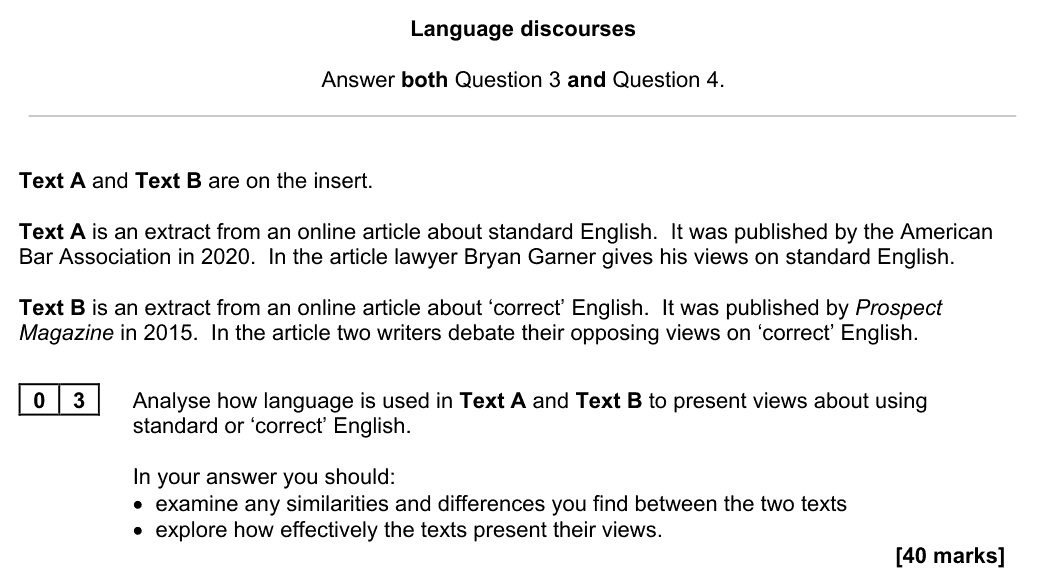
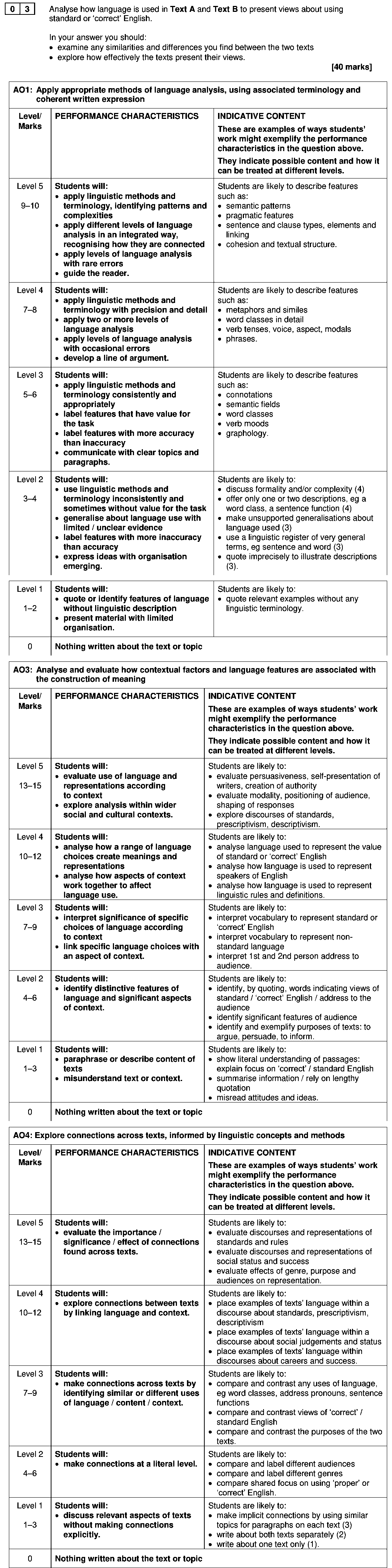
Question 3 focussed on discourses about standard or ‘correct’ English Students were expected to explore the two texts systematically by describing linguistic features (AO1) and analysing how they created meanings (AO3) in order to evaluate the ways the texts represented ideas about standard and ‘correct’ English, showing connections between the texts as parts of a wider discourse about status, class and prestige (AO4). Both Text A and B provided students across the ability range with accessible material that enabled them to demonstrate their skills in exploring how discourses work. AO1 The large majority of students understood that they were expected to describe the linguistic features in the texts which they were analysing. Some still only got marks of 3 or 4 for AO1 and did not seem to recognise the need to describe language features as part of their method of analysis. Generally, the features described were salient and significant for the construction of representations. In some responses linguistic features were identified every time a quotation was made but with little sense of how this feature was significant to the way representations and meanings were being created. Some answers demonstrated a language feature-led technique which was not helpful in achieving Level 4 on AO3 or AO4. Precise linguistic terminology was often in evidence with lots of references to verb types, with useful comments on mental and material processes. Modal verbs were frequently identified and well analysed. There was good exemplification of sentence and phrase types, though the identification of the precise extent of a clause was not always clear. Issues with pronoun person were still relatively frequent. Many students did not look at sentence and clause features. Of those who did, not all were able to use such descriptions to explore how the feature contributed to the way the texts were conveying meanings and representations. Some things students could profitably address are: • accurate labelling of word classes • identifying and showing the exact extent of a verb phrase • what counts as post-modification in phrase analysis • identifying which exact words constitute a clause • distinguishing subordinating and co-ordinating conjunctions from co-ordinate and subordinate clauses • clarifying what the word discourse means in the context of this question. AO3 and AO4 Students were generally clear about the purpose of the task and there were few general textual analyses. Almost all recognised the need to compare how the texts were part of a discourse about standard or ‘correct’ English. There were lots of strong responses which recognised that AO4 is at the heart of this task about discourses by looking at the repetition of ideas across texts and their construction of social identities and reader positions. The most successful answers addressed all the AOs in an integrated way. Most did this throughout their answer, though less successful students confined their comparison to a paragraph at the end or wrote separate paragraphs about similar aspects text by text. Almost all compared the shared focus on standard or ‘correct English.’ Many reached Level 3 on AO4 because they compared the use of sentence functions, pronouns and other features of language. The answers placed in Level 4 could link language with ideas about standard and ‘correct’ English. Often students recognised discourses about language and status, class and prestige. They also recognised discourses about correctness and superiority. Some also identified the way standard language was represented as a tool for levelling up and social equality. There was a clear increase in the number of students looking at how the producers of the text created self-representations which affected how the text’s ideas were received by a reader. There was also a lot of work on how the texts positioned a potential reader and used language to shape their views. Modality was frequently looked at. It was clear that students were familiar with past mark schemes and the conceptual framework of this task. However, many responses leapt to these analyses without actually engaging with what the texts had to say about standard or ‘correct’ English. They could identify, for example, that copular verbs in declarative simple sentence with parallel structures conveyed ideas with great certainty — but omitted to discuss what the actual ideas and views were. Some students had difficulties disentangling the different views within the texts. The best answers had a clear understanding of how Garner used Hodson’s views to further his own argument and considered how far the Heffer and Kamm contributions were treated as equal. More successful answers: • placed the texts within prescriptivist and descriptivist discourses • analysed discourses of correctness, status, communicability, social advancement and mobility, levelling up • identified and compared the different views of Garner and Hodson in Text A and Heffer and Kamm in Text B • compared the structures of the two texts: how Garner raises the argument about teaching standard English, looks at the counter-argument and then returns to his proposition; the dialogic duel between Heffer and Kamm. • compared and analysed Garner’s definition of standard English and Heffer’s definition of correct English • challenged Garner’s claim that ‘Most of us are born into some type of dialect’ and Heffer’s claim that correct English ‘is the English from which all other dialects and patois are derived’ for their implications about the nature of standard and non-standard Englishes • compared and analysed Garner’s and Heffer’s view that users of standard or correct English are advantaged over those who do not use them • compared Garner’s and Heffer’s desire to give everyone access to standard or correct English to provide professional opportunity and as a process of levelling up • compared Heffer’s representation of people who cannot use standard English as ‘inadequates’ and Garner’s view of some people being too lazy to care to learn it for their own benefit • analysed the metaphor of judgement and imprisonment in the description of people being ‘condemned’ to use non-standard English • explored how Garner presented Jane Hodson with respect and authority through the noun phrase in apposition with her name as part of his own self-presentation as fair and reasonable • examined closely the verbs attributed to her and how they represented her and her position: insists, claimed, acknowledged, argued, attacked • examined the semantic field of fighting (attacked, The Duel) that represented the conflict between views as dramatic and significant • compared the texts’ use of hypophora as a positioning device • explored Heffer’s definition of correct English by its users and functions • analysed Heffer’s use of present tense copular verbs and parallel sentence structures as a highly definite and confident statement of the existence and nature of correct English • explored Hodson’s and Kamm’s representation of linguistic rule. Less successful answers: • claimed that the description of Jane Hodson as a professor meant that her ideas were to be seen as trustworthy and to be believed • confused ‘correct’ English and politically correct English • paraphrased the passages’ content • quoted very rarely • did not use methods of language analysis • wrote at length about linguistic research rather than focussing on the passages.