Mark scheme, including the levels and indicative content
The general mark scheme (assessment objectives and bands)
Examiner's comment
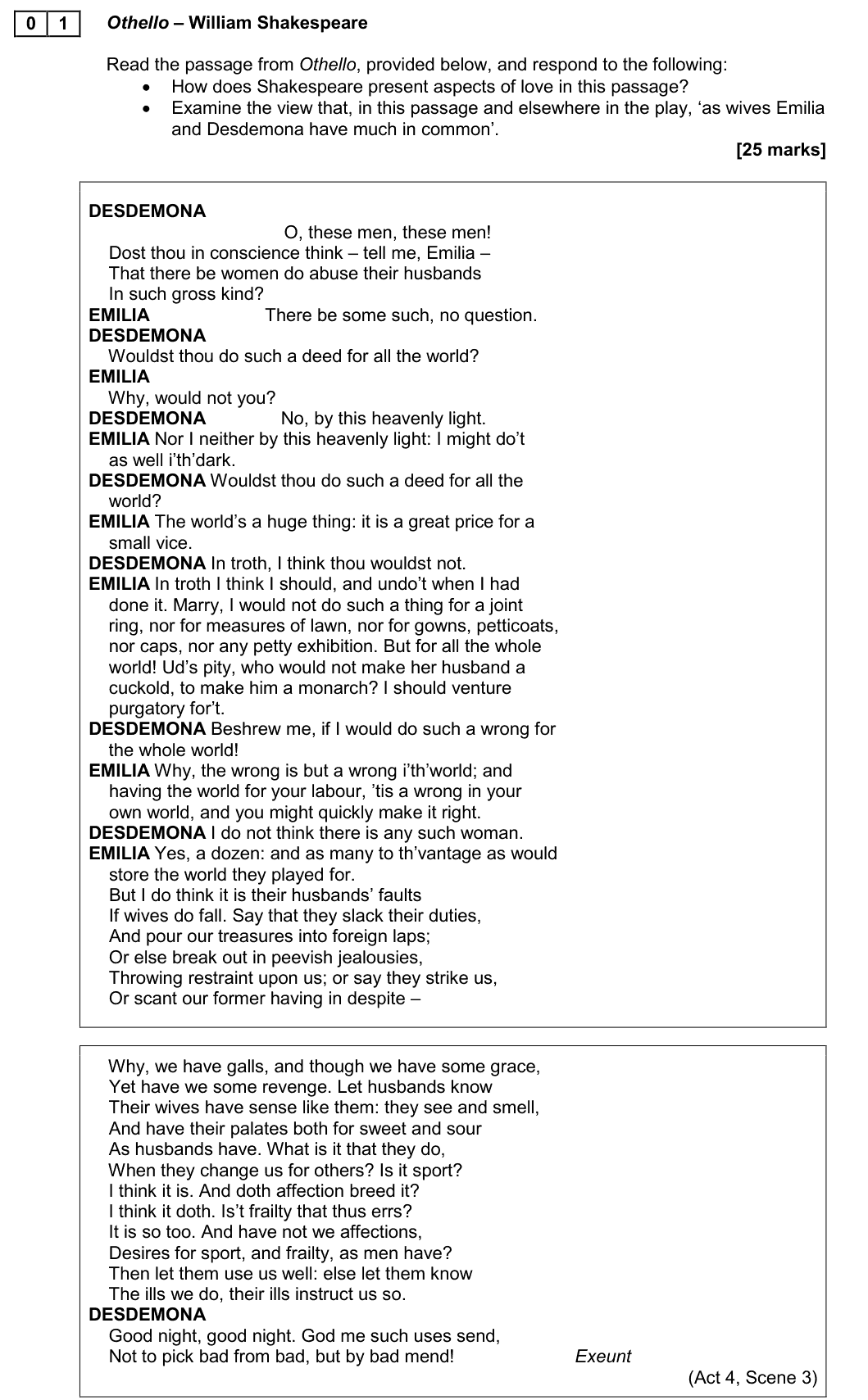
Othello Othello was by far the most popular text in this first AS series and there was a good deal of sympathy for how Shakespeare presents the plights of both Desdemona and Emilia. The interpretation foregrounded in the second bullet stresses Emilia and Desdemona ‘as wives’. The best answers recognised and sustained this focus rather than attempting a shapeless comparison of the two characters’ presentations. Much was made of Desdemona’s naivety as opposed to Emilia’s pragmatic cynicism. More confident answers went on to look at how Emilia’s rhetoric develops in this intimate setting and how it reflects her changing role in the play, through to her open conflict with Iago and her death. Similarly, astute students saw the conflict between Desdemona’s relative passivity here in the latter part of the play and her earlier confidence. Many were able to give detailed references to incidents where Emilia had been submissive and Desdemona more forthright. Despite the idea of both characters as outspoken heroines, many candidates ultimately saw them both as victims of patriarchy. The ability to sustain a close reading of the text is invariably a discriminator in extract questions and Shakespeare seems to prompt unforced errors from those candidates who need to take more time and care when analysing. It was relatively common for candidates to read Emilia’s use of ‘marry’ as reference to marriage (when the discussion is about married wives committing adultery) rather than as a discourse marker meaning something like ‘listen’ or ‘well’. This misreading led to considerable confusion for some. There was also a tendency to label any question as ‘rhetorical’ when Emilia’s penultimate speech involves a series of five questions all of which she answers. More successful answers recognised the class differences between the two women and this helped to avoid sweeping generalisations.
Notes from the mark scheme and report
- Focus: relationship: Emilia and Desdemona as wives
- Extract printed
- extract Act 4 Scene 3 (willow scene
- Desdemona and Emilia on adultery)
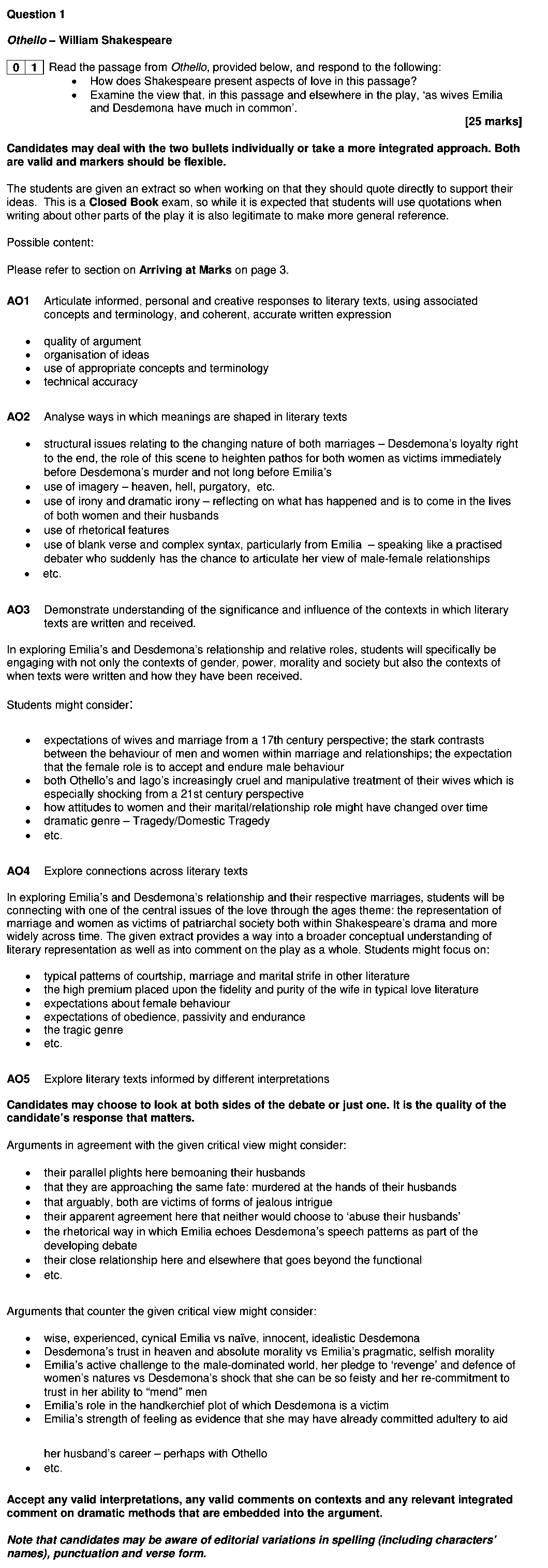
- two bullets: aspects of love in the passage + view 'as wives Emilia and Desdemona have much in common' (separate or integrated)
- MS credits Emilia's rhetoric and blank verse, heaven/hell imagery, dramatic irony before both murders, 17th-century expectations of wives
- counter-view: cynical Emilia vs naive Desdemona, Emilia's role in the handkerchief plot
- best answers kept the 'as wives' focus rather than a shapeless character comparison and noted class differences
- common errors: reading 'Marry' as marriage rather than a discourse marker, calling Emilia's self-answered questions rhetorical