June 2017: AS Paper 1, Shakespeare and poetry

50 marks · 6 questions (every option is included) · Paper, mark scheme and report on AQA's site · AQA no longer hosts this series; the questions are from a copy of AQA's original paper

Question by question

QTopicMarksAOType
1 Othello 25Shakespeare extract
2 The Taming of the Shrew 25Shakespeare extract
3 Measure for Measure 25Shakespeare extract
4 The Winter's Tale 25Shakespeare extract
5 AQA Anthology: love poetry pre-1900 25Anthology poetry
6 AQA Anthology: love poetry post-1900 25Anthology poetry

The questions

123456
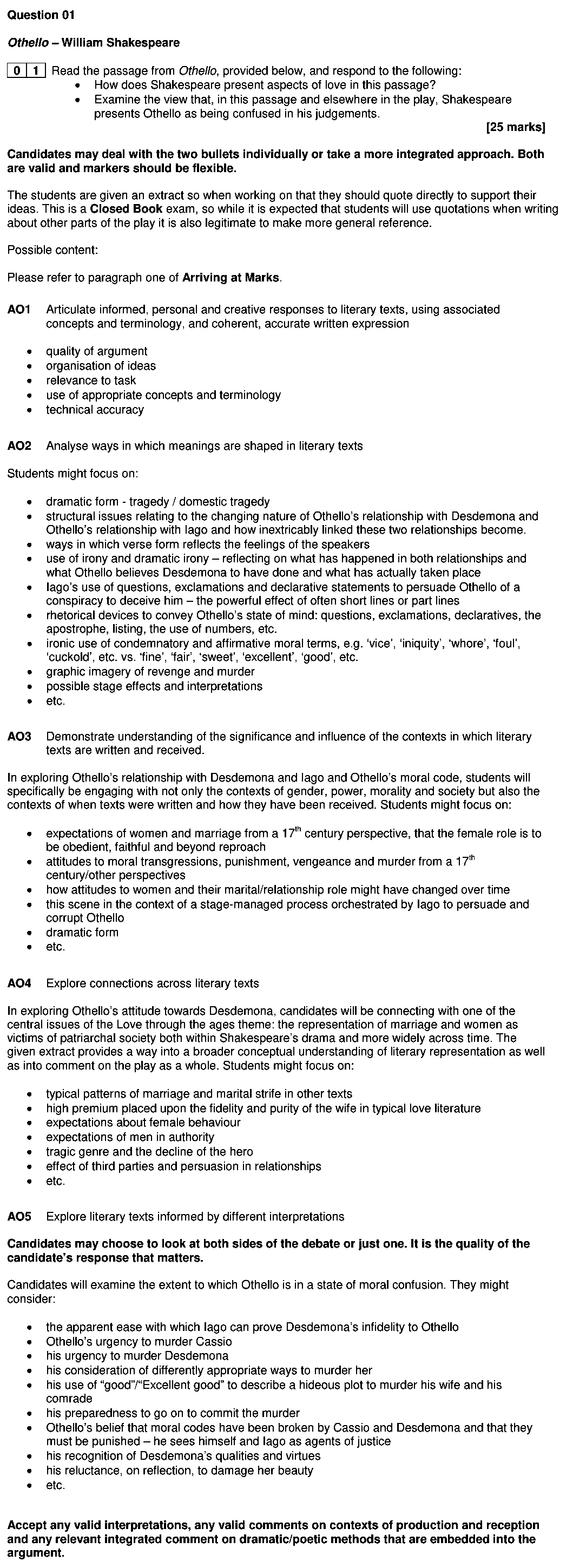
June 2017 · AS Paper 1 · Q1 25 marks Shakespeare extract othello
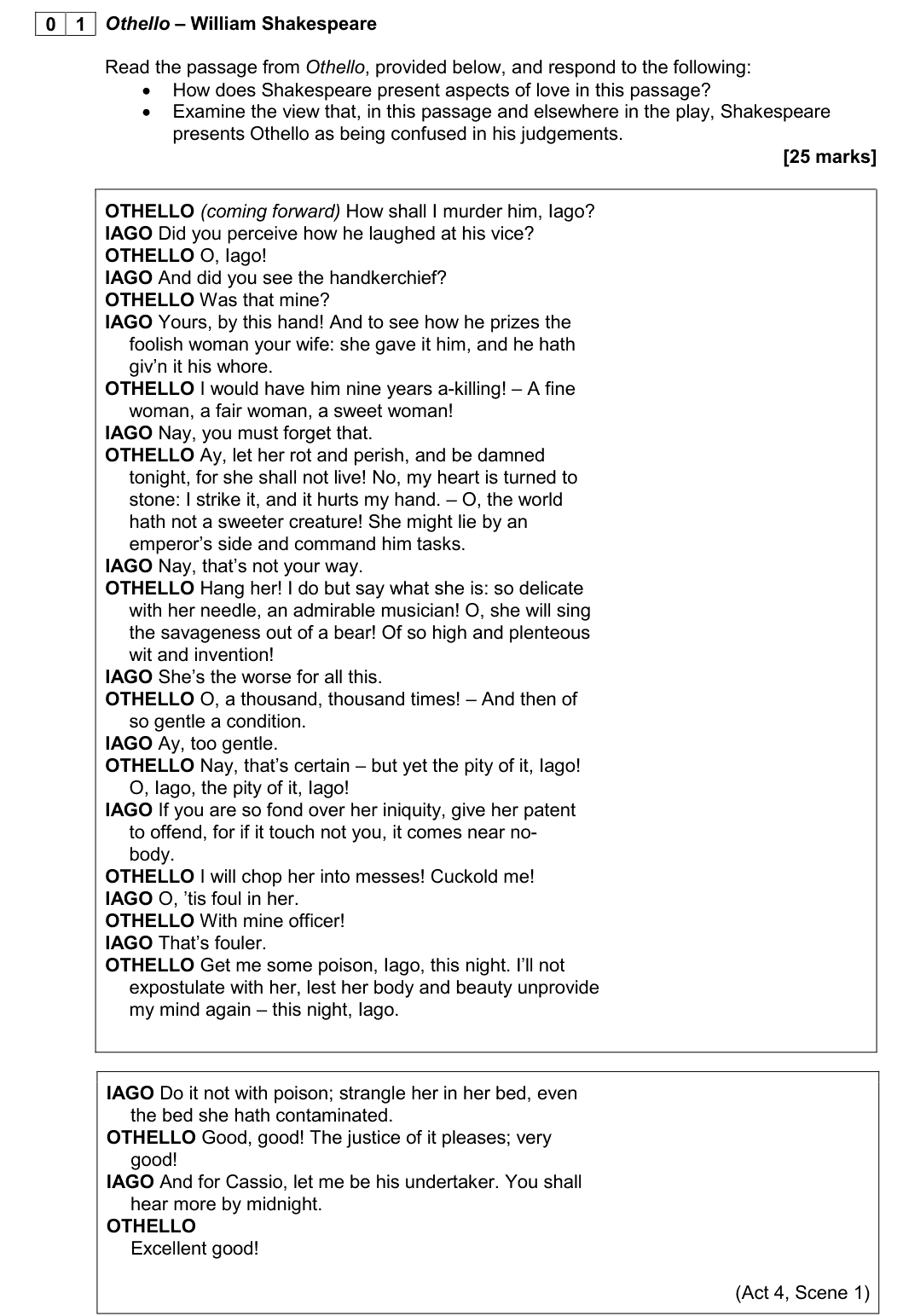
0 1 Othello – William Shakespeare
Read the passage from Othello, provided below, and respond to the following:
•
How does Shakespeare present aspects of love in this passage?
•
Examine the view that, in this passage and elsewhere in the play, Shakespeare
presents Othello as being confused in his judgements.
[25 marks]
OTHELLO (coming forward) How shall I murder him, Iago?
IAGO Did you perceive how he laughed at his vice?
OTHELLO O, Iago!
IAGO And did you see the handkerchief?
OTHELLO Was that mine?
IAGO Yours, by this hand! And to see how he prizes the
foolish woman your wife: she gave it him, and he hath
giv’n it his whore.
OTHELLO I would have him nine years a-killing! – A fine
woman, a fair woman, a sweet woman!
IAGO Nay, you must forget that.
OTHELLO Ay, let her rot and perish, and be damned
tonight, for she shall not live! No, my heart is turned to
stone: I strike it, and it hurts my hand. – O, the world
hath not a sweeter creature! She might lie by an
emperor’s side and command him tasks.
IAGO Nay, that’s not your way.
OTHELLO Hang her! I do but say what she is: so delicate
with her needle, an admirable musician! O, she will sing
the savageness out of a bear! Of so high and plenteous
wit and invention!
IAGO She’s the worse for all this.
OTHELLO O, a thousand, thousand times! – And then of
so gentle a condition.
IAGO Ay, too gentle.
OTHELLO Nay, that’s certain – but yet the pity of it, Iago!
O, Iago, the pity of it, Iago!
IAGO If you are so fond over her iniquity, give her patent
to offend, for if it touch not you, it comes near no-
body.
OTHELLO I will chop her into messes! Cuckold me!
IAGO O, ’tis foul in her.
OTHELLO With mine officer!
IAGO That’s fouler.
OTHELLO Get me some poison, Iago, this night. I’ll not
expostulate with her, lest her body and beauty unprovide
my mind again – this night, Iago.
IAGO Do it not with poison; strangle her in her bed, even
the bed she hath contaminated.
OTHELLO Good, good! The justice of it pleases; very
good!
IAGO And for Cassio, let me be his undertaker. You shall
hear more by midnight.
OTHELLO
Excellent good!
(Act 4, Scene 1)
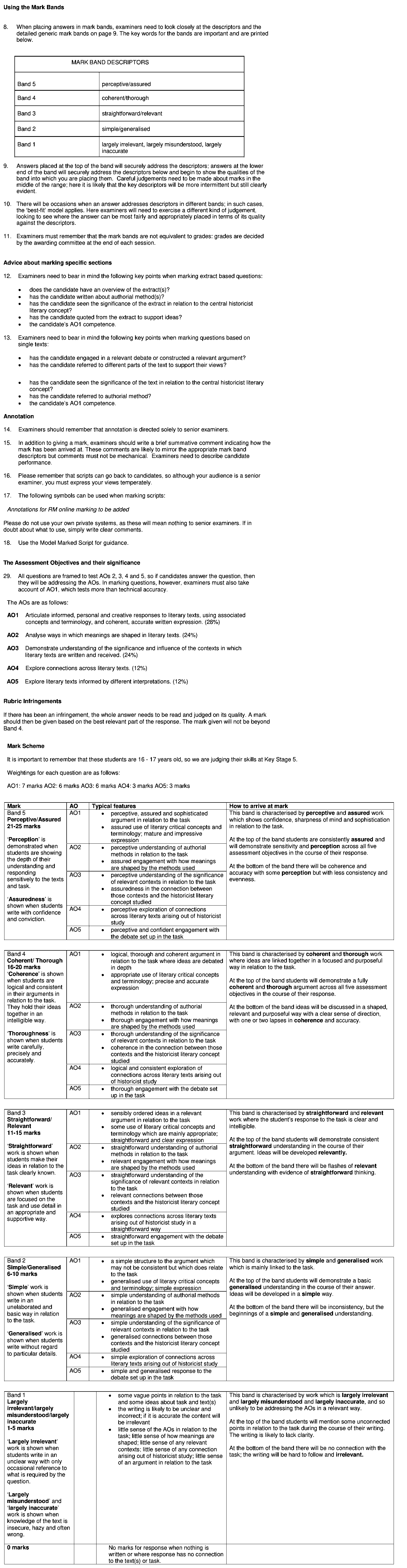
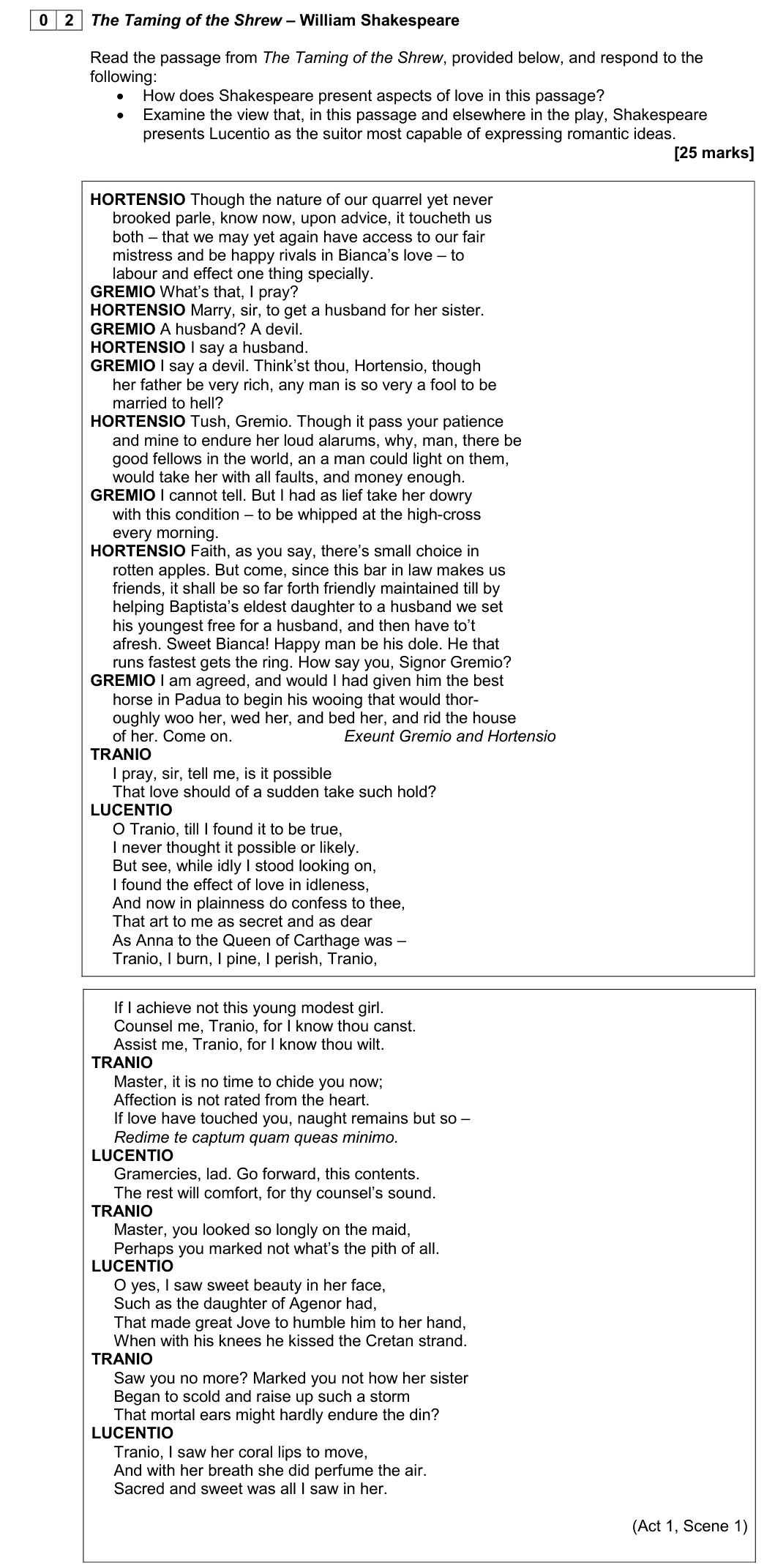
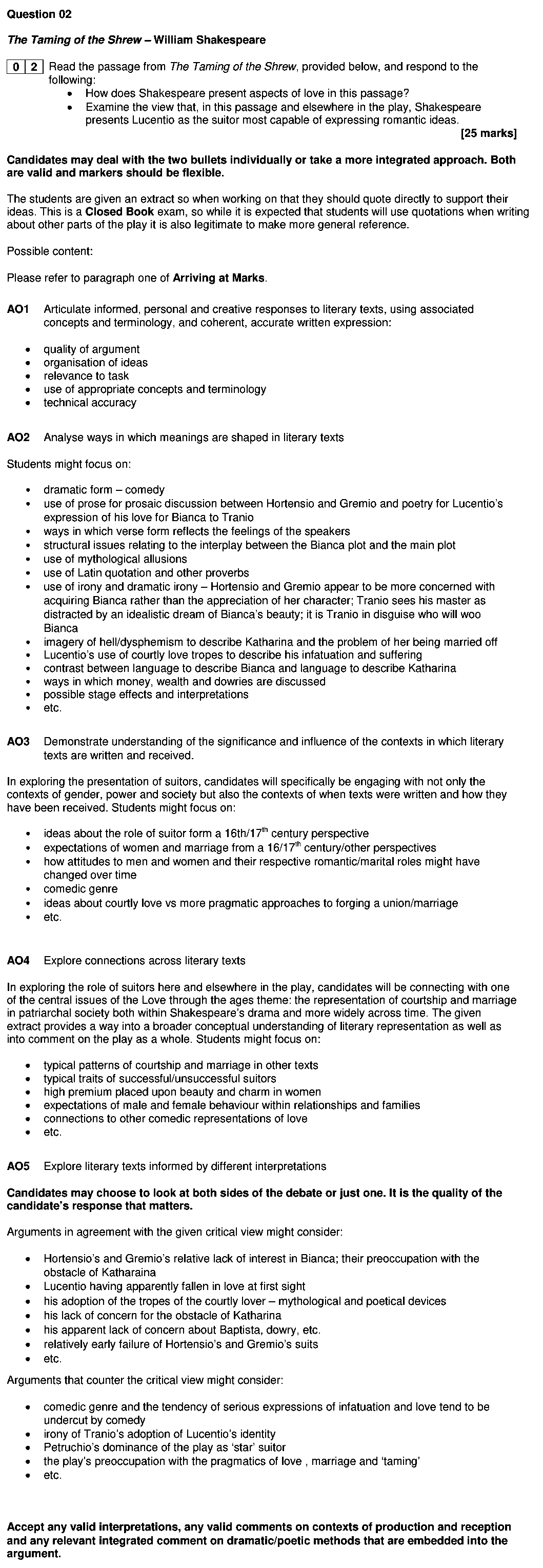
June 2017 · AS Paper 1 · Q2 25 marks Shakespeare extract taming of the shrew
0 2 The Taming of the Shrew – William Shakespeare
Read the passage from The Taming of the Shrew, provided below, and respond to the
following:
•
How does Shakespeare present aspects of love in this passage?
•
Examine the view that, in this passage and elsewhere in the play, Shakespeare
presents Lucentio as the suitor most capable of expressing romantic ideas.
[25 marks]
HORTENSIO Though the nature of our quarrel yet never
brooked parle, know now, upon advice, it toucheth us
both – that we may yet again have access to our fair
mistress and be happy rivals in Bianca’s love – to
labour and effect one thing specially.
GREMIO What’s that, I pray?
HORTENSIO Marry, sir, to get a husband for her sister.
GREMIO A husband? A devil.
HORTENSIO I say a husband.
GREMIO I say a devil. Think’st thou, Hortensio, though
her father be very rich, any man is so very a fool to be
married to hell?
HORTENSIO Tush, Gremio. Though it pass your patience
and mine to endure her loud alarums, why, man, there be
good fellows in the world, an a man could light on them,
would take her with all faults, and money enough.
GREMIO I cannot tell. But I had as lief take her dowry
with this condition – to be whipped at the high-cross
every morning.
HORTENSIO Faith, as you say, there’s small choice in
rotten apples. But come, since this bar in law makes us
friends, it shall be so far forth friendly maintained till by
helping Baptista’s eldest daughter to a husband we set
his youngest free for a husband, and then have to’t
afresh. Sweet Bianca! Happy man be his dole. He that
runs fastest gets the ring. How say you, Signor Gremio?
GREMIO I am agreed, and would I had given him the best
horse in Padua to begin his wooing that would thor-
oughly woo her, wed her, and bed her, and rid the house
of her. Come on.
Exeunt Gremio and Hortensio
TRANIO
I pray, sir, tell me, is it possible
That love should of a sudden take such hold?
LUCENTIO
O Tranio, till I found it to be true,
I never thought it possible or likely.
But see, while idly I stood looking on,
I found the effect of love in idleness,
And now in plainness do confess to thee,
That art to me as secret and as dear
As Anna to the Queen of Carthage was –
Tranio, I burn, I pine, I perish, Tranio,
If I achieve not this young modest girl.
Counsel me, Tranio, for I know thou canst.
Assist me, Tranio, for I know thou wilt.
TRANIO
Master, it is no time to chide you now;
Affection is not rated from the heart.
If love have touched you, naught remains but so –
Redime te captum quam queas minimo.
LUCENTIO
Gramercies, lad. Go forward, this contents.
The rest will comfort, for thy counsel’s sound.
TRANIO
Master, you looked so longly on the maid,
Perhaps you marked not what’s the pith of all.
LUCENTIO
O yes, I saw sweet beauty in her face,
Such as the daughter of Agenor had,
That made great Jove to humble him to her hand,
When with his knees he kissed the Cretan strand.
TRANIO
Saw you no more? Marked you not how her sister
Began to scold and raise up such a storm
That mortal ears might hardly endure the din?
LUCENTIO
Tranio, I saw her coral lips to move,
And with her breath she did perfume the air.
Sacred and sweet was all I saw in her.
(Act 1, Scene 1)
June 2017 · AS Paper 1 · Q3 25 marks Shakespeare extract measure for measure
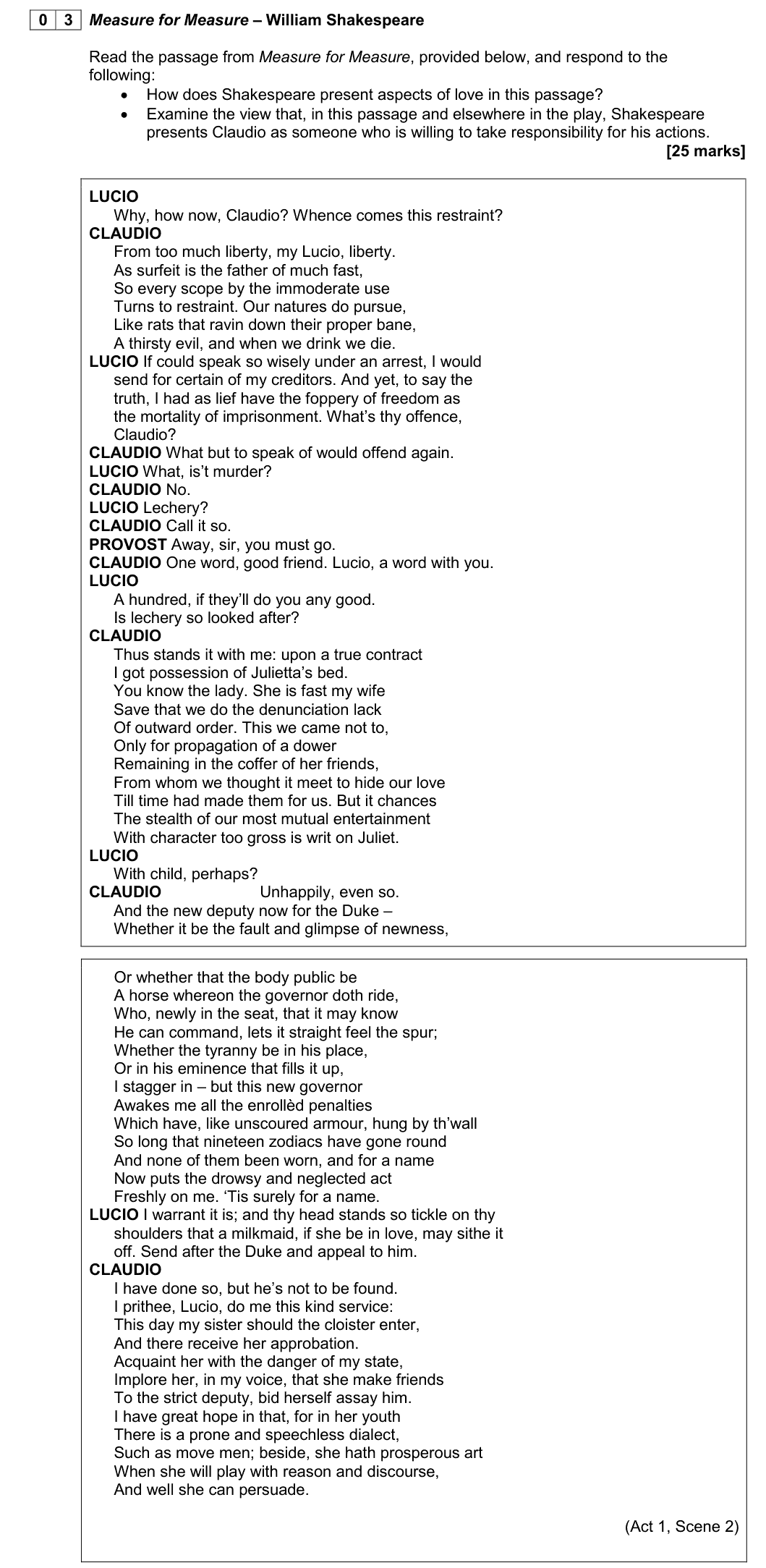
0 3 Measure for Measure – William Shakespeare
Read the passage from Measure for Measure, provided below, and respond to the
following:
•
How does Shakespeare present aspects of love in this passage?
•
Examine the view that, in this passage and elsewhere in the play, Shakespeare
presents Claudio as someone who is willing to take responsibility for his actions.
[25 marks]
LUCIO
Why, how now, Claudio? Whence comes this restraint?
CLAUDIO
From too much liberty, my Lucio, liberty.
As surfeit is the father of much fast,
So every scope by the immoderate use
Turns to restraint. Our natures do pursue,
Like rats that ravin down their proper bane,
A thirsty evil, and when we drink we die.
LUCIO If could speak so wisely under an arrest, I would
send for certain of my creditors. And yet, to say the
truth, I had as lief have the foppery of freedom as
the mortality of imprisonment. What’s thy offence,
Claudio?
CLAUDIO What but to speak of would offend again.
LUCIO What, is’t murder?
CLAUDIO No.
LUCIO Lechery?
CLAUDIO Call it so.
PROVOST Away, sir, you must go.
CLAUDIO One word, good friend. Lucio, a word with you.
LUCIO
A hundred, if they’ll do you any good.
Is lechery so looked after?
CLAUDIO
Thus stands it with me: upon a true contract
I got possession of Julietta’s bed.
You know the lady. She is fast my wife
Save that we do the denunciation lack
Of outward order. This we came not to,
Only for propagation of a dower
Remaining in the coffer of her friends,
From whom we thought it meet to hide our love
Till time had made them for us. But it chances
The stealth of our most mutual entertainment
With character too gross is writ on Juliet.
LUCIO
With child, perhaps?
CLAUDIO
Unhappily, even so.
And the new deputy now for the Duke –
Whether it be the fault and glimpse of newness,
Or whether that the body public be
A horse whereon the governor doth ride,
Who, newly in the seat, that it may know
He can command, lets it straight feel the spur;
Whether the tyranny be in his place,
Or in his eminence that fills it up,
I stagger in – but this new governor
Awakes me all the enrollèd penalties
Which have, like unscoured armour, hung by th’wall
So long that nineteen zodiacs have gone round
And none of them been worn, and for a name
Now puts the drowsy and neglected act
Freshly on me. ‘Tis surely for a name.
LUCIO I warrant it is; and thy head stands so tickle on thy
shoulders that a milkmaid, if she be in love, may sithe it
off. Send after the Duke and appeal to him.
CLAUDIO
I have done so, but he’s not to be found.
I prithee, Lucio, do me this kind service:
This day my sister should the cloister enter,
And there receive her approbation.
Acquaint her with the danger of my state,
Implore her, in my voice, that she make friends
To the strict deputy, bid herself assay him.
I have great hope in that, for in her youth
There is a prone and speechless dialect,
Such as move men; beside, she hath prosperous art
When she will play with reason and discourse,
And well she can persuade.
(Act 1, Scene 2)
June 2017 · AS Paper 1 · Q4 25 marks Shakespeare extract the winters tale
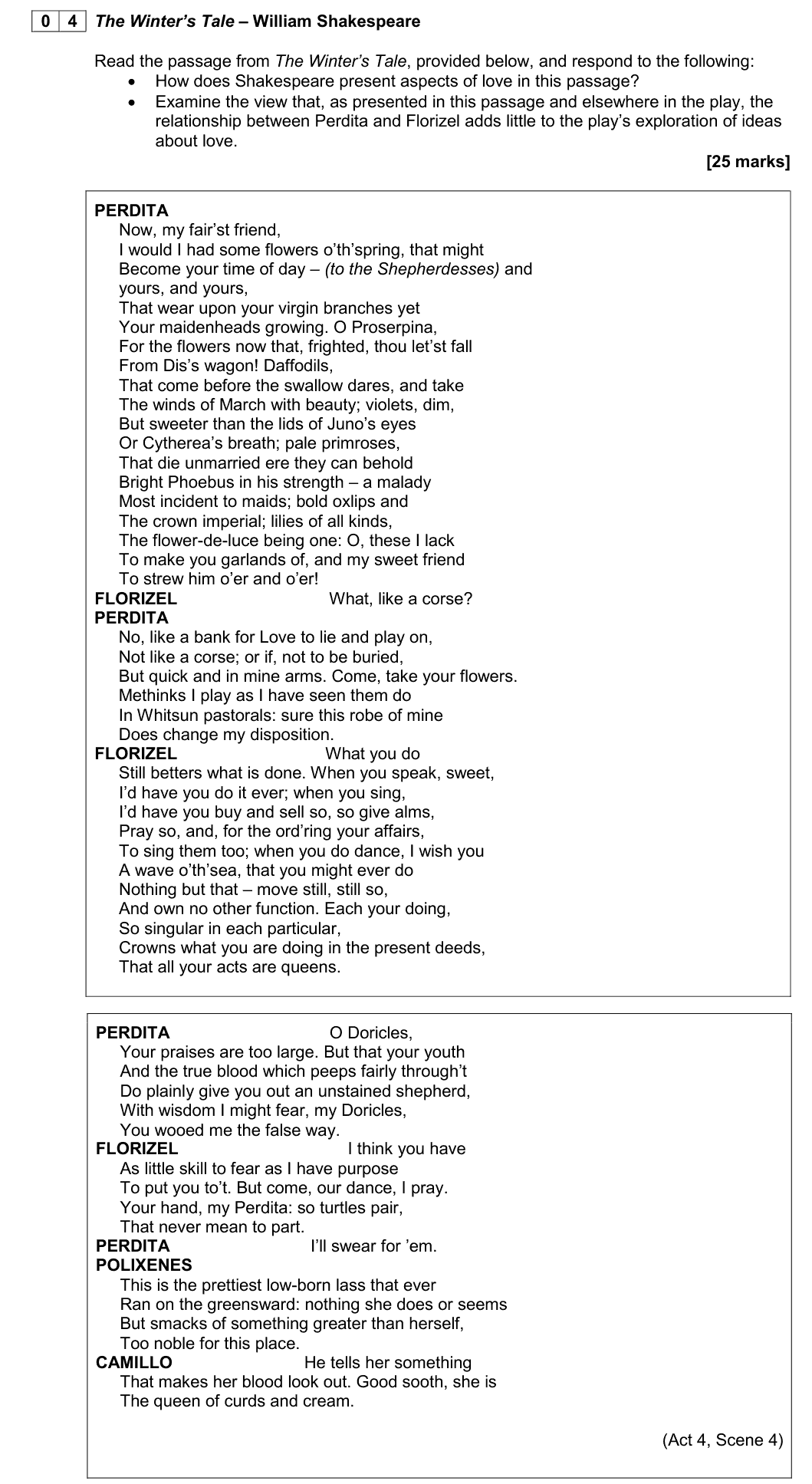
0 4 The Winter’s Tale – William Shakespeare
Read the passage from The Winter’s Tale, provided below, and respond to the following:
•
How does Shakespeare present aspects of love in this passage?
•
Examine the view that, as presented in this passage and elsewhere in the play, the
relationship between Perdita and Florizel adds little to the play’s exploration of ideas
about love.
[25 marks]
PERDITA
Now, my fair’st friend,
I would I had some flowers o’th’spring, that might
Become your time of day – (to the Shepherdesses) and
yours, and yours,
That wear upon your virgin branches yet
Your maidenheads growing. O Proserpina,
For the flowers now that, frighted, thou let’st fall
From Dis’s wagon! Daffodils,
That come before the swallow dares, and take
The winds of March with beauty; violets, dim,
But sweeter than the lids of Juno’s eyes
Or Cytherea’s breath; pale primroses,
That die unmarried ere they can behold
Bright Phoebus in his strength – a malady
Most incident to maids; bold oxlips and
The crown imperial; lilies of all kinds,
The flower-de-luce being one: O, these I lack
To make you garlands of, and my sweet friend
To strew him o’er and o’er!
FLORIZEL
What, like a corse?
PERDITA
No, like a bank for Love to lie and play on,
Not like a corse; or if, not to be buried,
But quick and in mine arms. Come, take your flowers.
Methinks I play as I have seen them do
In Whitsun pastorals: sure this robe of mine
Does change my disposition.
FLORIZEL
What you do
Still betters what is done. When you speak, sweet,
I’d have you do it ever; when you sing,
I’d have you buy and sell so, so give alms,
Pray so, and, for the ord’ring your affairs,
To sing them too; when you do dance, I wish you
A wave o’th’sea, that you might ever do
Nothing but that – move still, still so,
And own no other function. Each your doing,
So singular in each particular,
Crowns what you are doing in the present deeds,
That all your acts are queens.
PERDITA
O Doricles,
Your praises are too large. But that your youth
And the true blood which peeps fairly through’t
Do plainly give you out an unstained shepherd,
With wisdom I might fear, my Doricles,
You wooed me the false way.
FLORIZEL
I think you have
As little skill to fear as I have purpose
To put you to’t. But come, our dance, I pray.
Your hand, my Perdita: so turtles pair,
That never mean to part.
PERDITA
I’ll swear for ’em.
POLIXENES
This is the prettiest low-born lass that ever
Ran on the greensward: nothing she does or seems
But smacks of something greater than herself,
Too noble for this place.
CAMILLO
He tells her something
That makes her blood look out. Good sooth, she is
The queen of curds and cream.
(Act 4, Scene 4)
June 2017 · AS Paper 1 · Q5 25 marks Anthology poetry love poetry pre 1900
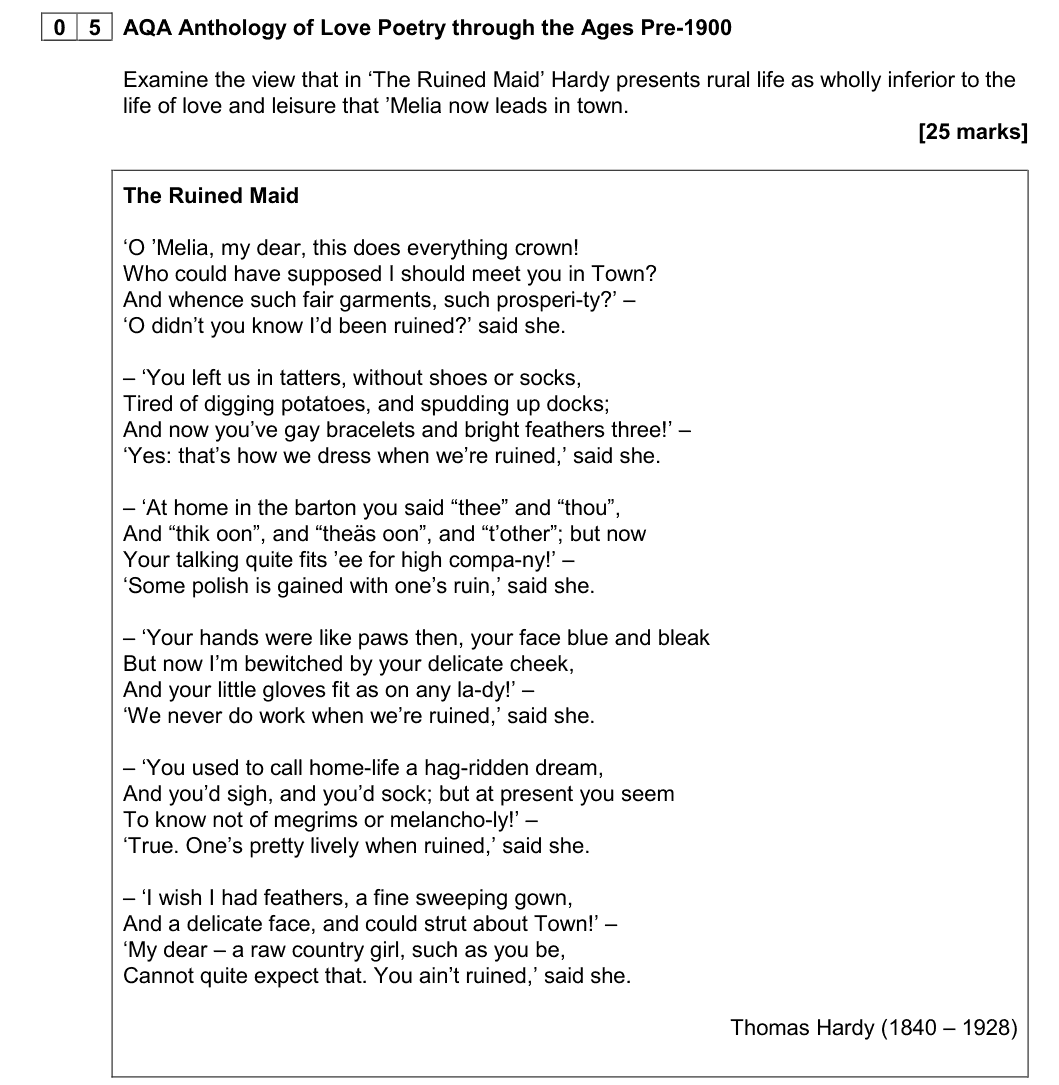
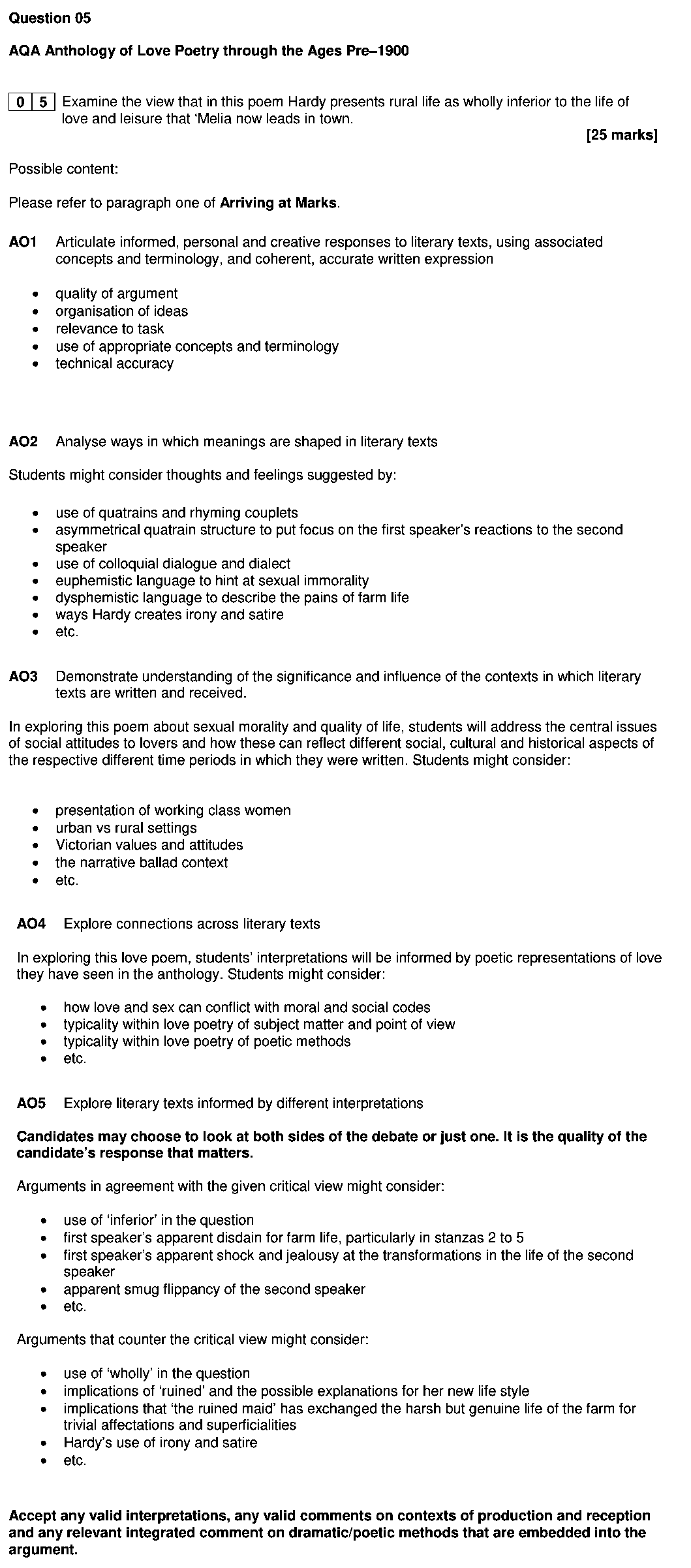
0 5 AQA Anthology of Love Poetry through the Ages Pre-1900
Examine the view that in ‘The Ruined Maid’ Hardy presents rural life as wholly inferior to the
life of love and leisure that ’Melia now leads in town.
[25 marks]
The Ruined Maid
‘O ’Melia, my dear, this does everything crown!
Who could have supposed I should meet you in Town?
And whence such fair garments, such prosperi-ty?’ –
‘O didn’t you know I’d been ruined?’ said she.
– ‘You left us in tatters, without shoes or socks,
Tired of digging potatoes, and spudding up docks;
And now you’ve gay bracelets and bright feathers three!’ –
‘Yes: that’s how we dress when we’re ruined,’ said she.
– ‘At home in the barton you said “thee” and “thou”,
And “thik oon”, and “theäs oon”, and “t’other”; but now
Your talking quite fits ’ee for high compa-ny!’ –
‘Some polish is gained with one’s ruin,’ said she.
– ‘Your hands were like paws then, your face blue and bleak
But now I’m bewitched by your delicate cheek,
And your little gloves fit as on any la-dy!’ –
‘We never do work when we’re ruined,’ said she.
– ‘You used to call home-life a hag-ridden dream,
And you’d sigh, and you’d sock; but at present you seem
To know not of megrims or melancho-ly!’ –
‘True. One’s pretty lively when ruined,’ said she.
– ‘I wish I had feathers, a fine sweeping gown,
And a delicate face, and could strut about Town!’ –
‘My dear – a raw country girl, such as you be,
Cannot quite expect that. You ain’t ruined,’ said she.
Thomas Hardy (1840 – 1928)
June 2017 · AS Paper 1 · Q6 25 marks Anthology poetry love poetry post 1900
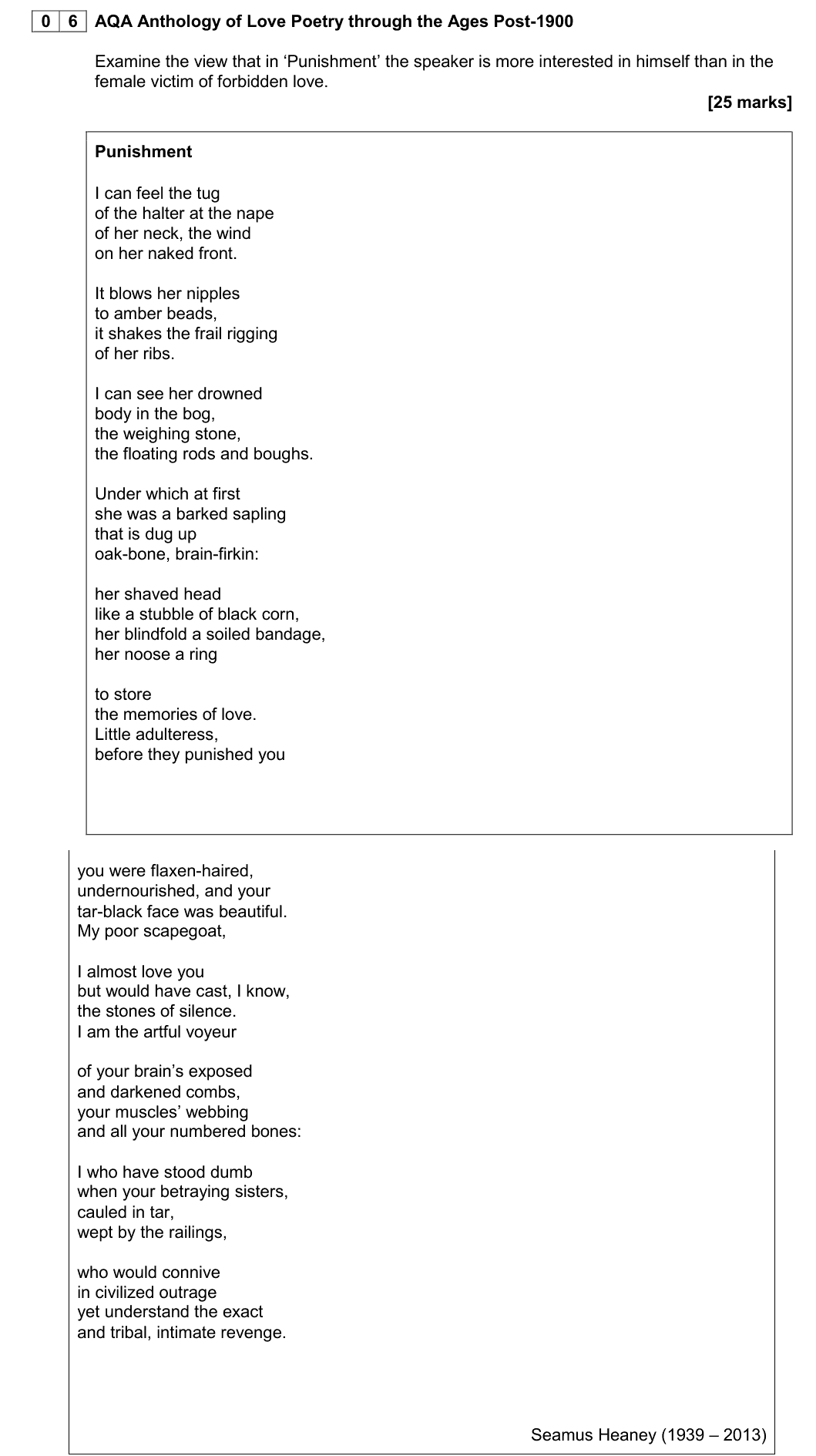
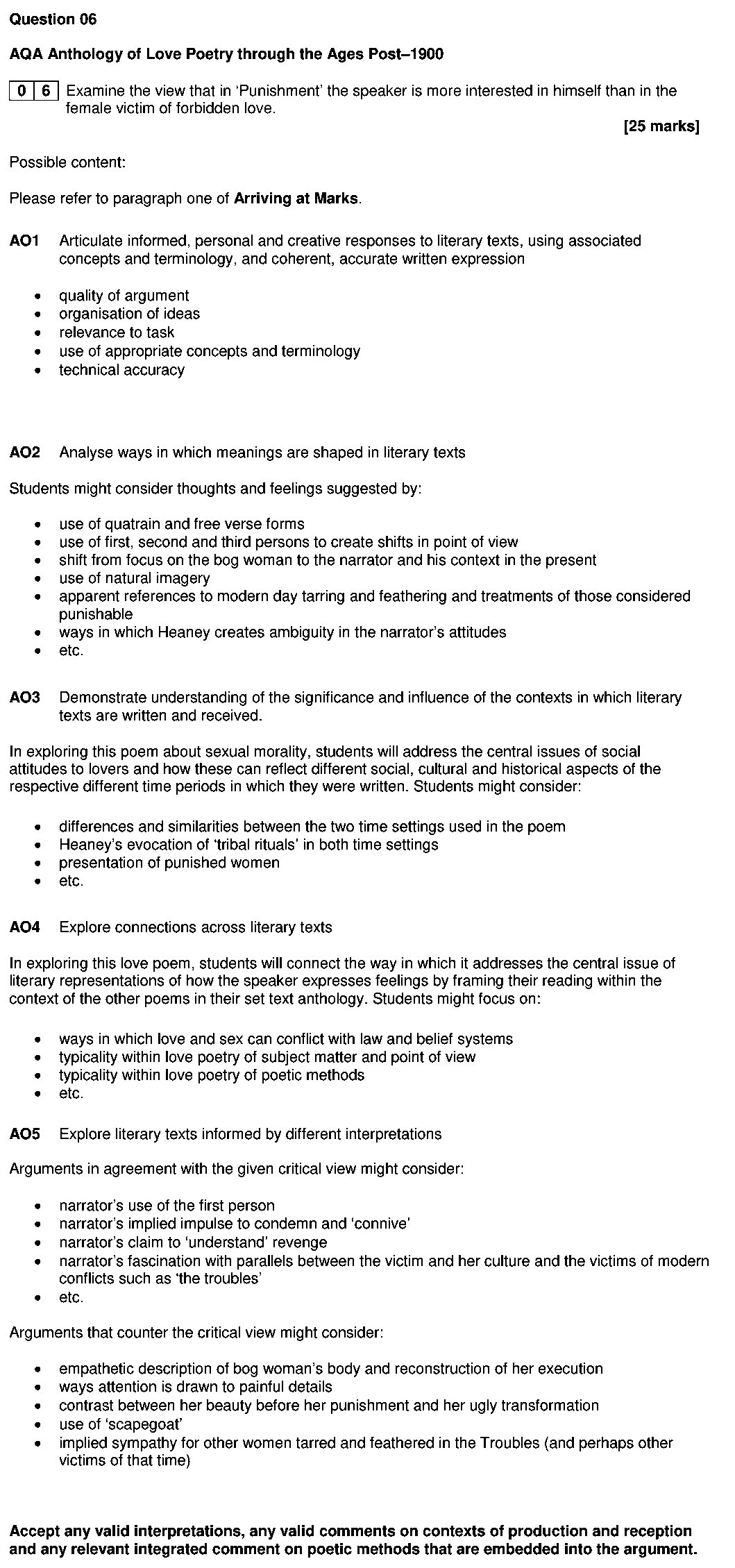
0 6 AQA Anthology of Love Poetry through the Ages Post-1900
Examine the view that in ‘Punishment’ the speaker is more interested in himself than in the
female victim of forbidden love.
[25 marks]
Punishment
I can feel the tug
of the halter at the nape
of her neck, the wind
on her naked front.
It blows her nipples
to amber beads,
it shakes the frail rigging
of her ribs.
I can see her drowned
body in the bog,
the weighing stone,
the floating rods and boughs.
Under which at first
she was a barked sapling
that is dug up
oak-bone, brain-firkin:
her shaved head
like a stubble of black corn,
her blindfold a soiled bandage,
her noose a ring
to store
the memories of love.
Little adulteress,
before they punished you
you were flaxen-haired,
undernourished, and your
tar-black face was beautiful.
My poor scapegoat,
I almost love you
but would have cast, I know,
the stones of silence.
I am the artful voyeur
of your brain’s exposed
and darkened combs,
your muscles’ webbing
and all your numbered bones:
I who have stood dumb
when your betraying sisters,
cauled in tar,
wept by the railings,
who would connive
in civilized outrage
yet understand the exact
and tribal, intimate revenge.
Seamus Heaney (1939 – 2013)

Work with an AQA English Literature A tutor

Want a paper marked and gone through with you? Message us.

Prefer email? Send an enquiry

If you are under 18, please include a parent's contact details. Enquiries go to enquiries@alevelenglishtutor.com and are deleted once handled. All tutoring is online.