June 2017: A-level Paper 1, Love through the ages

75 marks · 7 questions (every option is included) · Paper, mark scheme and report on AQA's site · AQA no longer hosts this series; the questions are from a copy of AQA's original paper

Question by question

QTopicMarksAOType
1 Othello 25Shakespeare extract
2 The Taming of the Shrew 25Shakespeare extract
3 Measure for Measure 25Shakespeare extract
4 The Winter's Tale 25Shakespeare extract
5 Unseen poetry comparison (love) 25Unseen poetry
6 AQA Anthology: love poetry pre-1900, AQA Anthology: love poetry post-1900, Comparing prose texts (love through the ages) 25Comparing texts
7 AQA Anthology: love poetry pre-1900, AQA Anthology: love poetry post-1900, Comparing prose texts (love through the ages) 25Comparing texts

The questions

1234567
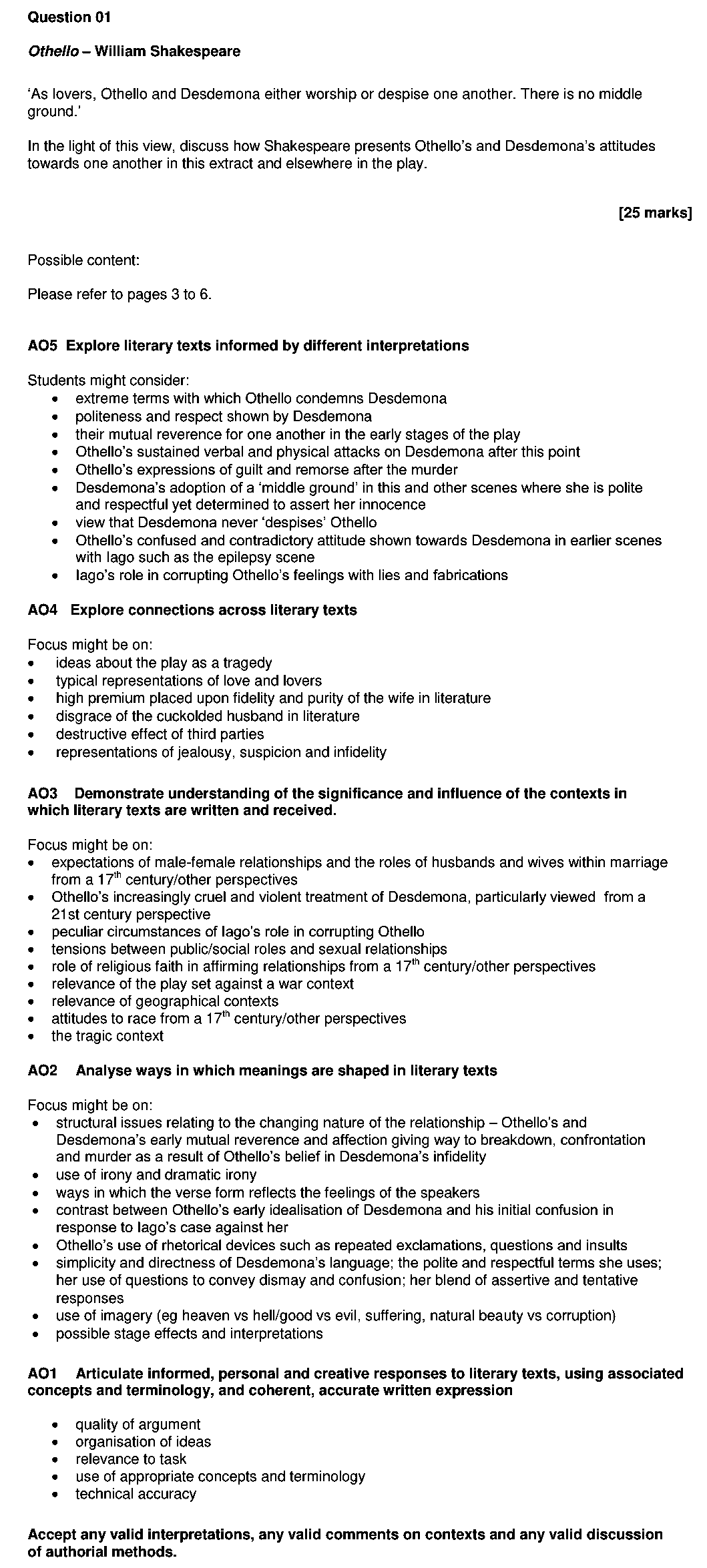
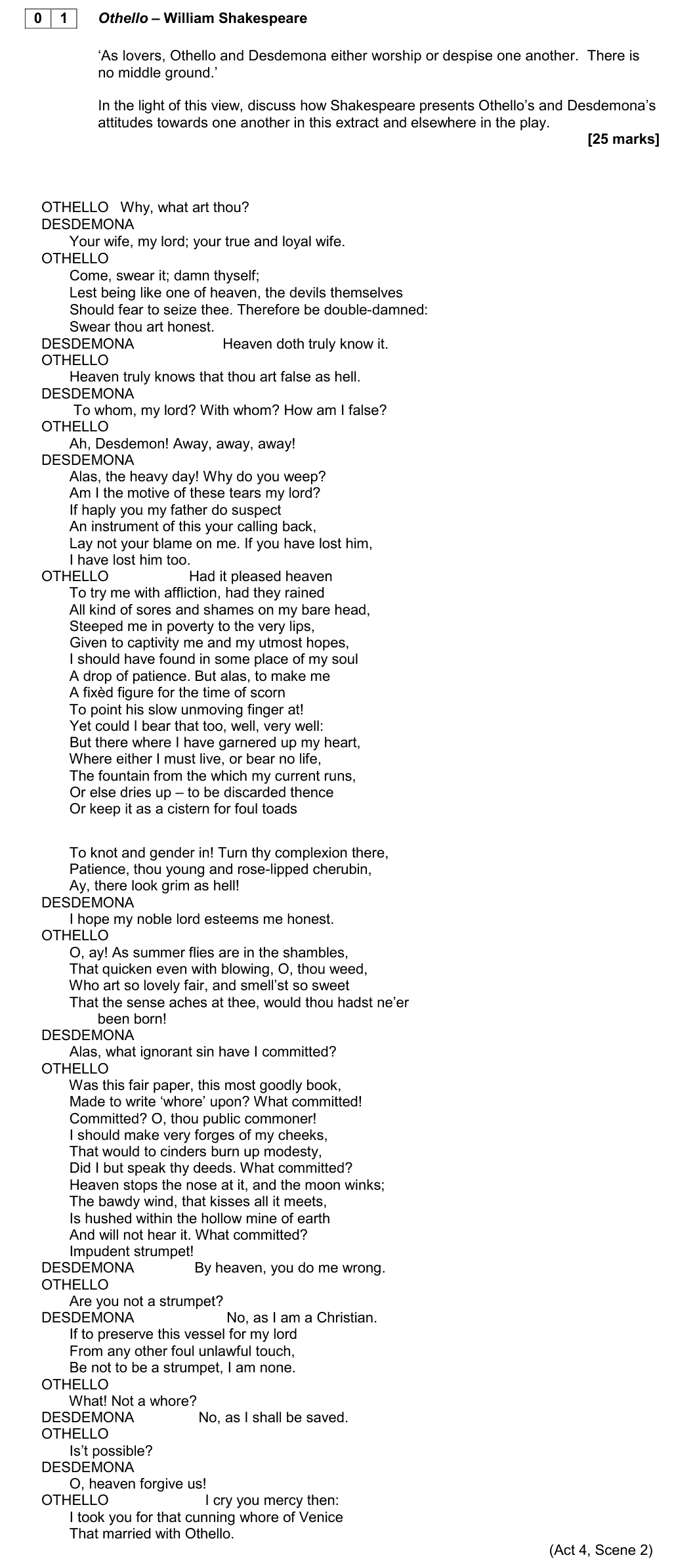
June 2017 · Paper 1 · Q1 25 marks Shakespeare extract othello
0 1
Othello – William Shakespeare
‘As lovers, Othello and Desdemona either worship or despise one another. There is
no middle ground.’
In the light of this view, discuss how Shakespeare presents Othello’s and Desdemona’s
attitudes towards one another in this extract and elsewhere in the play.
[25 marks]
OTHELLO Why, what art thou?
DESDEMONA
Your wife, my lord; your true and loyal wife.
OTHELLO
Come, swear it; damn thyself;
Lest being like one of heaven, the devils themselves
Should fear to seize thee. Therefore be double-damned:
Swear thou art honest.
DESDEMONA Heaven doth truly know it.
OTHELLO
Heaven truly knows that thou art false as hell.
DESDEMONA
To whom, my lord? With whom? How am I false?
OTHELLO
Ah, Desdemon! Away, away, away!
DESDEMONA
Alas, the heavy day! Why do you weep?
Am I the motive of these tears my lord?
If haply you my father do suspect
An instrument of this your calling back,
Lay not your blame on me. If you have lost him,
I have lost him too.
OTHELLO Had it pleased heaven
To try me with affliction, had they rained
All kind of sores and shames on my bare head,
Steeped me in poverty to the very lips,
Given to captivity me and my utmost hopes,
I should have found in some place of my soul
A drop of patience. But alas, to make me
A fixèd figure for the time of scorn
To point his slow unmoving finger at!
Yet could I bear that too, well, very well:
But there where I have garnered up my heart,
Where either I must live, or bear no life,
The fountain from the which my current runs,
Or else dries up – to be discarded thence
Or keep it as a cistern for foul toads
To knot and gender in! Turn thy complexion there,
Patience, thou young and rose-lipped cherubin,
Ay, there look grim as hell!
DESDEMONA
I hope my noble lord esteems me honest.
OTHELLO
O, ay! As summer flies are in the shambles,
That quicken even with blowing, O, thou weed,
Who art so lovely fair, and smell’st so sweet
That the sense aches at thee, would thou hadst ne’er
been born!
DESDEMONA
Alas, what ignorant sin have I committed?
OTHELLO
Was this fair paper, this most goodly book,
Made to write ‘whore’ upon? What committed!
Committed? O, thou public commoner!
I should make very forges of my cheeks,
That would to cinders burn up modesty,
Did I but speak thy deeds. What committed?
Heaven stops the nose at it, and the moon winks;
The bawdy wind, that kisses all it meets,
Is hushed within the hollow mine of earth
And will not hear it. What committed?
Impudent strumpet!
DESDEMONA By heaven, you do me wrong.
OTHELLO
Are you not a strumpet?
DESDEMONA No, as I am a Christian.
If to preserve this vessel for my lord
From any other foul unlawful touch,
Be not to be a strumpet, I am none.
OTHELLO
What! Not a whore?
DESDEMONA No, as I shall be saved.
OTHELLO
Is’t possible?
DESDEMONA
O, heaven forgive us!
OTHELLO I cry you mercy then:
I took you for that cunning whore of Venice
That married with Othello.
(Act 4, Scene 2)
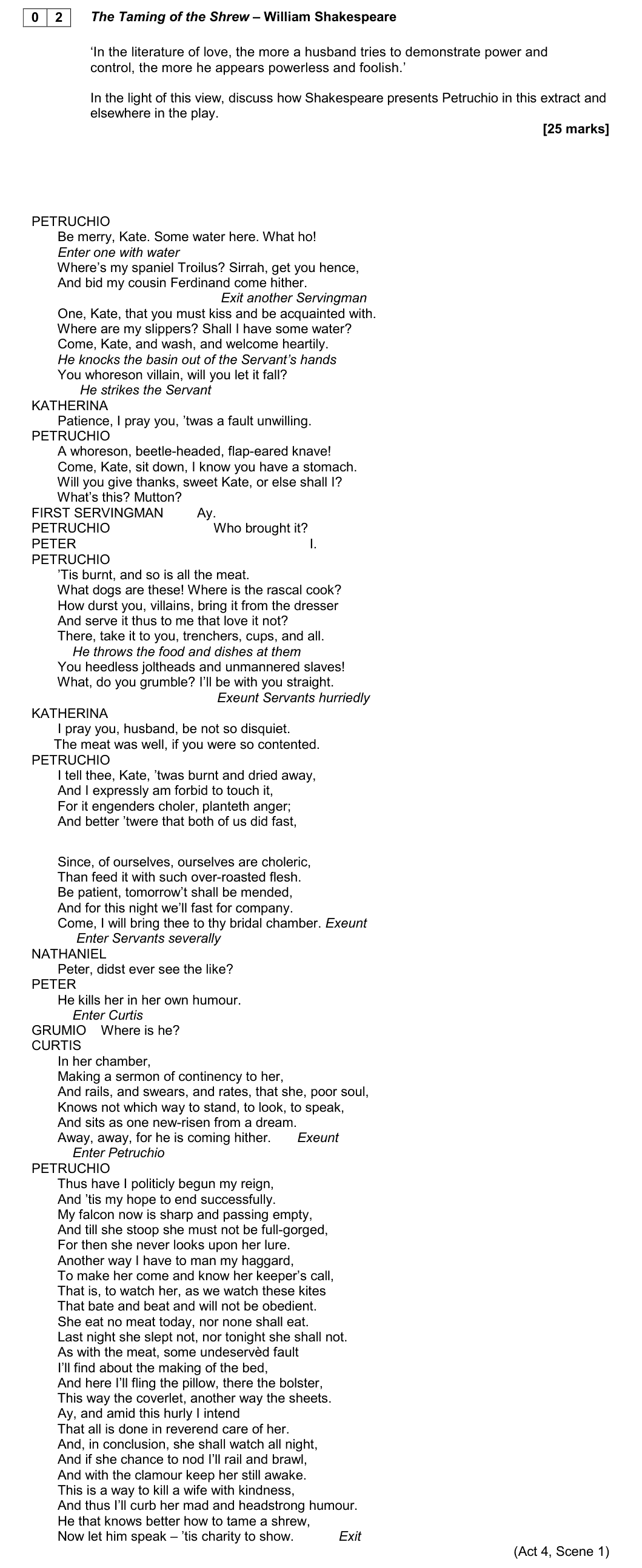
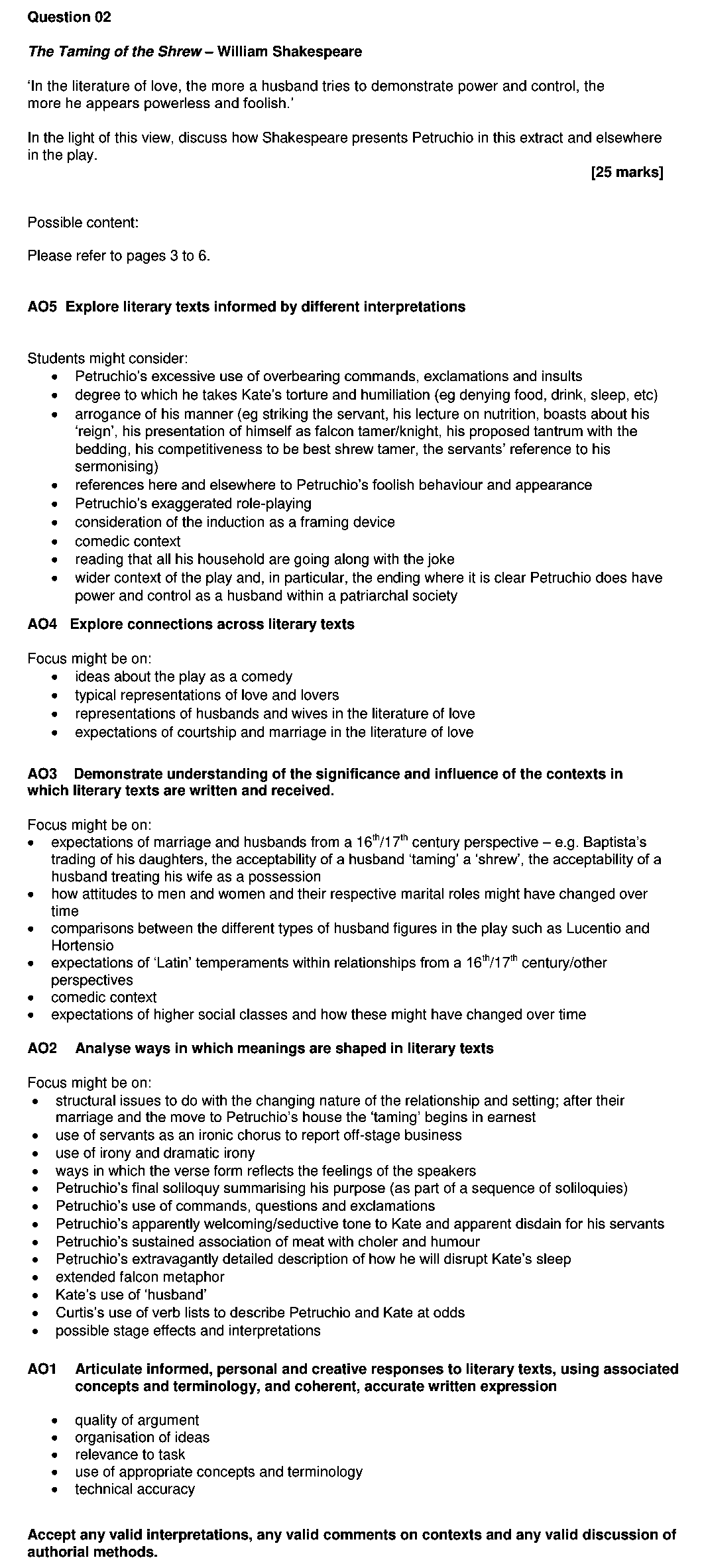
June 2017 · Paper 1 · Q2 25 marks Shakespeare extract taming of the shrew
0 2
The Taming of the Shrew – William Shakespeare
‘In the literature of love, the more a husband tries to demonstrate power and
control, the more he appears powerless and foolish.’
In the light of this view, discuss how Shakespeare presents Petruchio in this extract and
elsewhere in the play.
[25 marks]
PETRUCHIO
Be merry, Kate. Some water here. What ho!
Enter one with water
Where’s my spaniel Troilus? Sirrah, get you hence,
And bid my cousin Ferdinand come hither.
Exit another Servingman
One, Kate, that you must kiss and be acquainted with.
Where are my slippers? Shall I have some water?
Come, Kate, and wash, and welcome heartily.
He knocks the basin out of the Servant’s hands
You whoreson villain, will you let it fall?
He strikes the Servant
KATHERINA
Patience, I pray you, ’twas a fault unwilling.
PETRUCHIO
A whoreson, beetle-headed, flap-eared knave!
Come, Kate, sit down, I know you have a stomach.
Will you give thanks, sweet Kate, or else shall I?
What’s this? Mutton?
FIRST SERVINGMAN Ay.
PETRUCHIO Who brought it?
PETER I.
PETRUCHIO
’Tis burnt, and so is all the meat.
What dogs are these! Where is the rascal cook?
How durst you, villains, bring it from the dresser
And serve it thus to me that love it not?
There, take it to you, trenchers, cups, and all.
He throws the food and dishes at them
You heedless joltheads and unmannered slaves!
What, do you grumble? I’ll be with you straight.
Exeunt Servants hurriedly
KATHERINA
I pray you, husband, be not so disquiet.
The meat was well, if you were so contented.
PETRUCHIO
I tell thee, Kate, ’twas burnt and dried away,
And I expressly am forbid to touch it,
For it engenders choler, planteth anger;
And better ’twere that both of us did fast,
Since, of ourselves, ourselves are choleric,
Than feed it with such over-roasted flesh.
Be patient, tomorrow’t shall be mended,
And for this night we’ll fast for company.
Come, I will bring thee to thy bridal chamber. Exeunt
Enter Servants severally
NATHANIEL
Peter, didst ever see the like?
PETER
He kills her in her own humour.
Enter Curtis
GRUMIO Where is he?
CURTIS
In her chamber,
Making a sermon of continency to her,
And rails, and swears, and rates, that she, poor soul,
Knows not which way to stand, to look, to speak,
And sits as one new-risen from a dream.
Away, away, for he is coming hither. Exeunt
Enter Petruchio
PETRUCHIO
Thus have I politicly begun my reign,
And ’tis my hope to end successfully.
My falcon now is sharp and passing empty,
And till she stoop she must not be full-gorged,
For then she never looks upon her lure.
Another way I have to man my haggard,
To make her come and know her keeper’s call,
That is, to watch her, as we watch these kites
That bate and beat and will not be obedient.
She eat no meat today, nor none shall eat.
Last night she slept not, nor tonight she shall not.
As with the meat, some undeservèd fault
I’ll find about the making of the bed,
And here I’ll fling the pillow, there the bolster,
This way the coverlet, another way the sheets.
Ay, and amid this hurly I intend
That all is done in reverend care of her.
And, in conclusion, she shall watch all night,
And if she chance to nod I’ll rail and brawl,
And with the clamour keep her still awake.
This is a way to kill a wife with kindness,
And thus I’ll curb her mad and headstrong humour.
He that knows better how to tame a shrew,
Now let him speak – ’tis charity to show. Exit
(Act 4, Scene 1)
June 2017 · Paper 1 · Q3 25 marks Shakespeare extract measure for measure
0 3
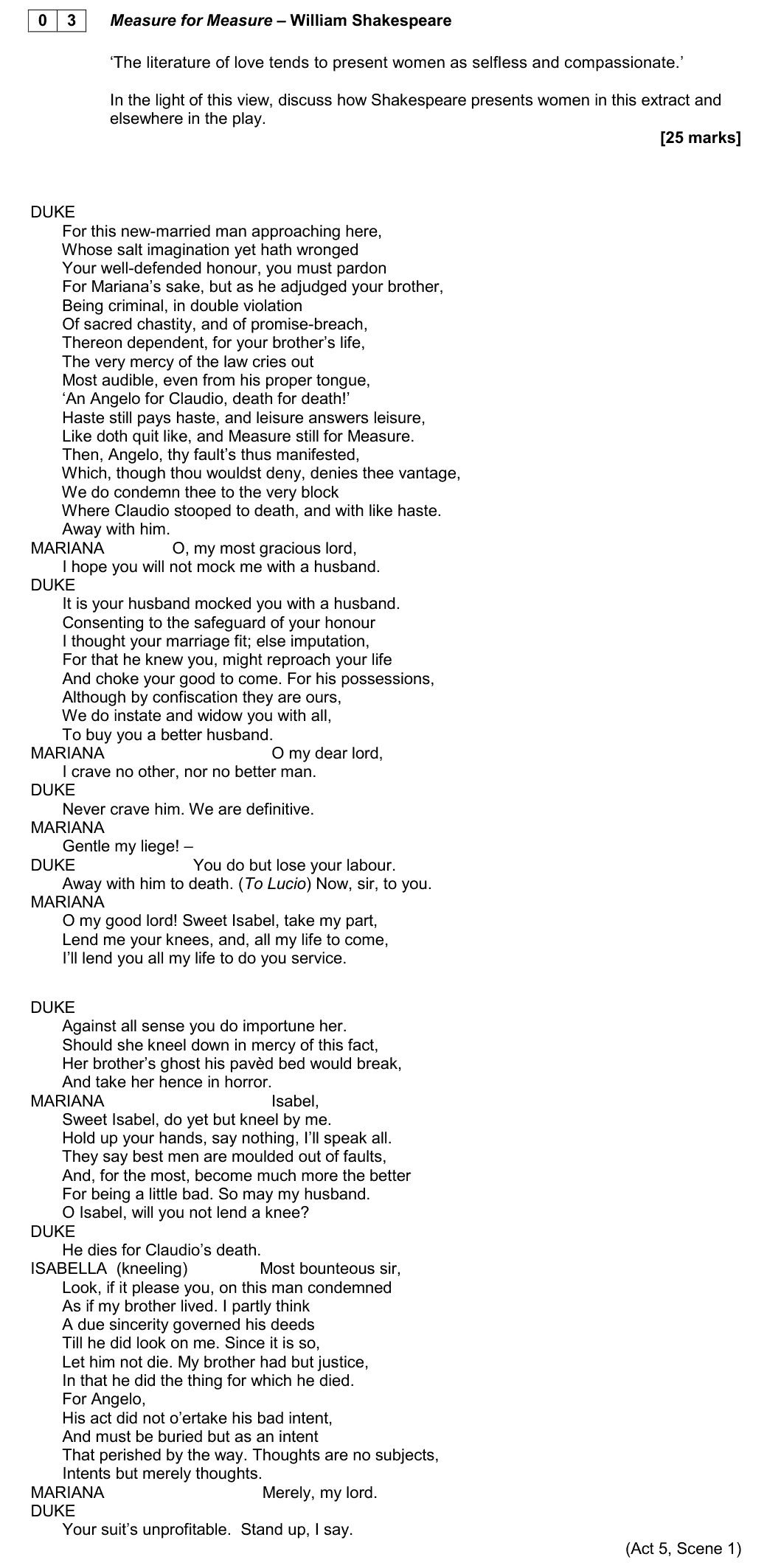
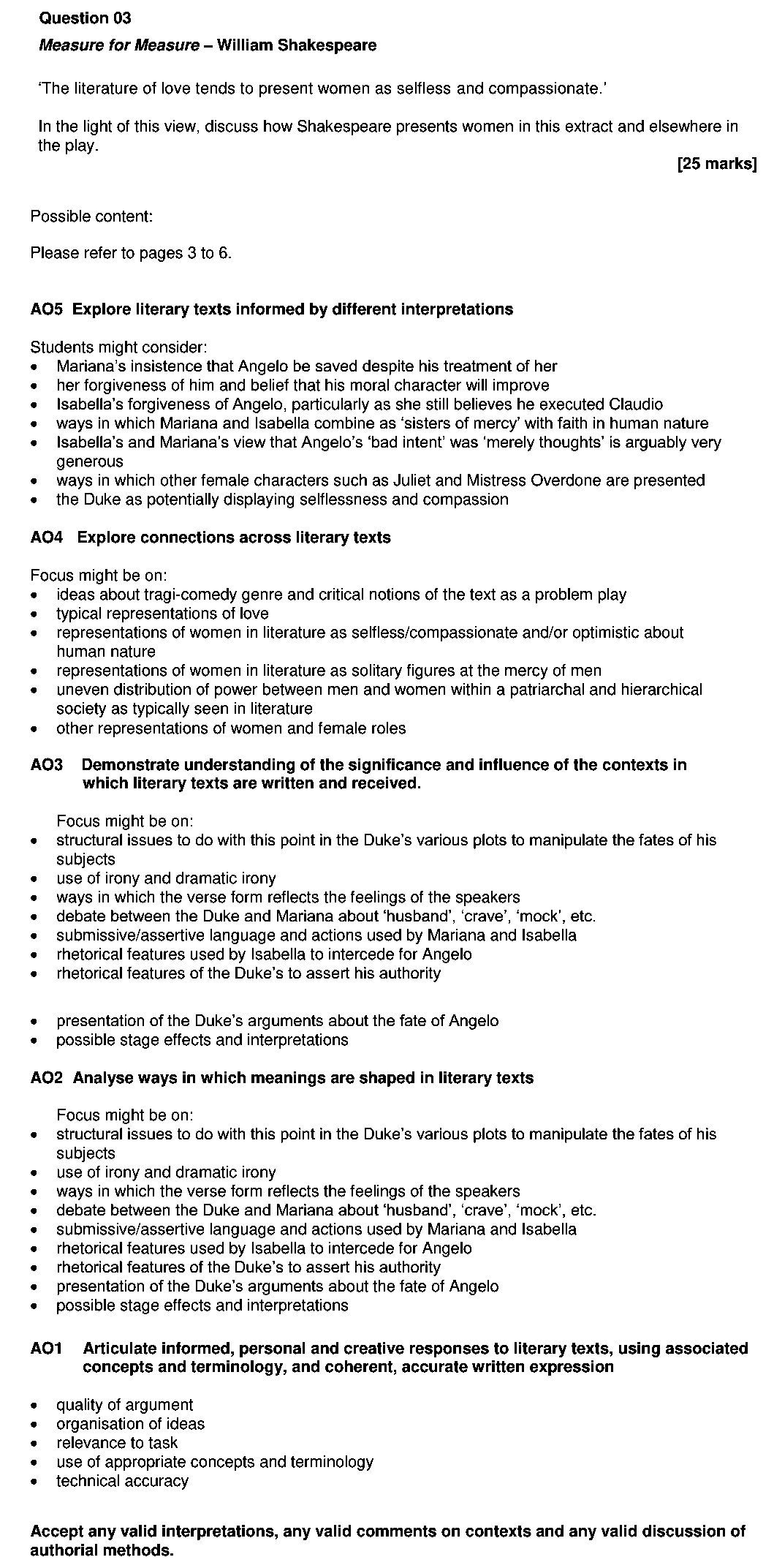
Measure for Measure – William Shakespeare
‘The literature of love tends to present women as selfless and compassionate.’
In the light of this view, discuss how Shakespeare presents women in this extract and
elsewhere in the play.
[25 marks]
DUKE
For this new-married man approaching here,
Whose salt imagination yet hath wronged
Your well-defended honour, you must pardon
For Mariana’s sake, but as he adjudged your brother,
Being criminal, in double violation
Of sacred chastity, and of promise-breach,
Thereon dependent, for your brother’s life,
The very mercy of the law cries out
Most audible, even from his proper tongue,
‘An Angelo for Claudio, death for death!’
Haste still pays haste, and leisure answers leisure,
Like doth quit like, and Measure still for Measure.
Then, Angelo, thy fault’s thus manifested,
Which, though thou wouldst deny, denies thee vantage,
We do condemn thee to the very block
Where Claudio stooped to death, and with like haste.
Away with him.
MARIANA O, my most gracious lord,
I hope you will not mock me with a husband.
DUKE
It is your husband mocked you with a husband.
Consenting to the safeguard of your honour
I thought your marriage fit; else imputation,
For that he knew you, might reproach your life
And choke your good to come. For his possessions,
Although by confiscation they are ours,
We do instate and widow you with all,
To buy you a better husband.
MARIANA O my dear lord,
I crave no other, nor no better man.
DUKE
Never crave him. We are definitive.
MARIANA
Gentle my liege! –
DUKE You do but lose your labour.
Away with him to death. (To Lucio) Now, sir, to you.
MARIANA
O my good lord! Sweet Isabel, take my part,
Lend me your knees, and, all my life to come,
I’ll lend you all my life to do you service.
DUKE
Against all sense you do importune her.
Should she kneel down in mercy of this fact,
Her brother’s ghost his pavèd bed would break,
And take her hence in horror.
MARIANA Isabel,
Sweet Isabel, do yet but kneel by me.
Hold up your hands, say nothing, I’ll speak all.
They say best men are moulded out of faults,
And, for the most, become much more the better
For being a little bad. So may my husband.
O Isabel, will you not lend a knee?
DUKE
He dies for Claudio’s death.
ISABELLA (kneeling) Most bounteous sir,
Look, if it please you, on this man condemned
As if my brother lived. I partly think
A due sincerity governed his deeds
Till he did look on me. Since it is so,
Let him not die. My brother had but justice,
In that he did the thing for which he died.
For Angelo,
His act did not o’ertake his bad intent,
And must be buried but as an intent
That perished by the way. Thoughts are no subjects,
Intents but merely thoughts.
MARIANA Merely, my lord.
DUKE
Your suit’s unprofitable. Stand up, I say.
(Act 5, Scene 1)
June 2017 · Paper 1 · Q4 25 marks Shakespeare extract the winters tale
0 4
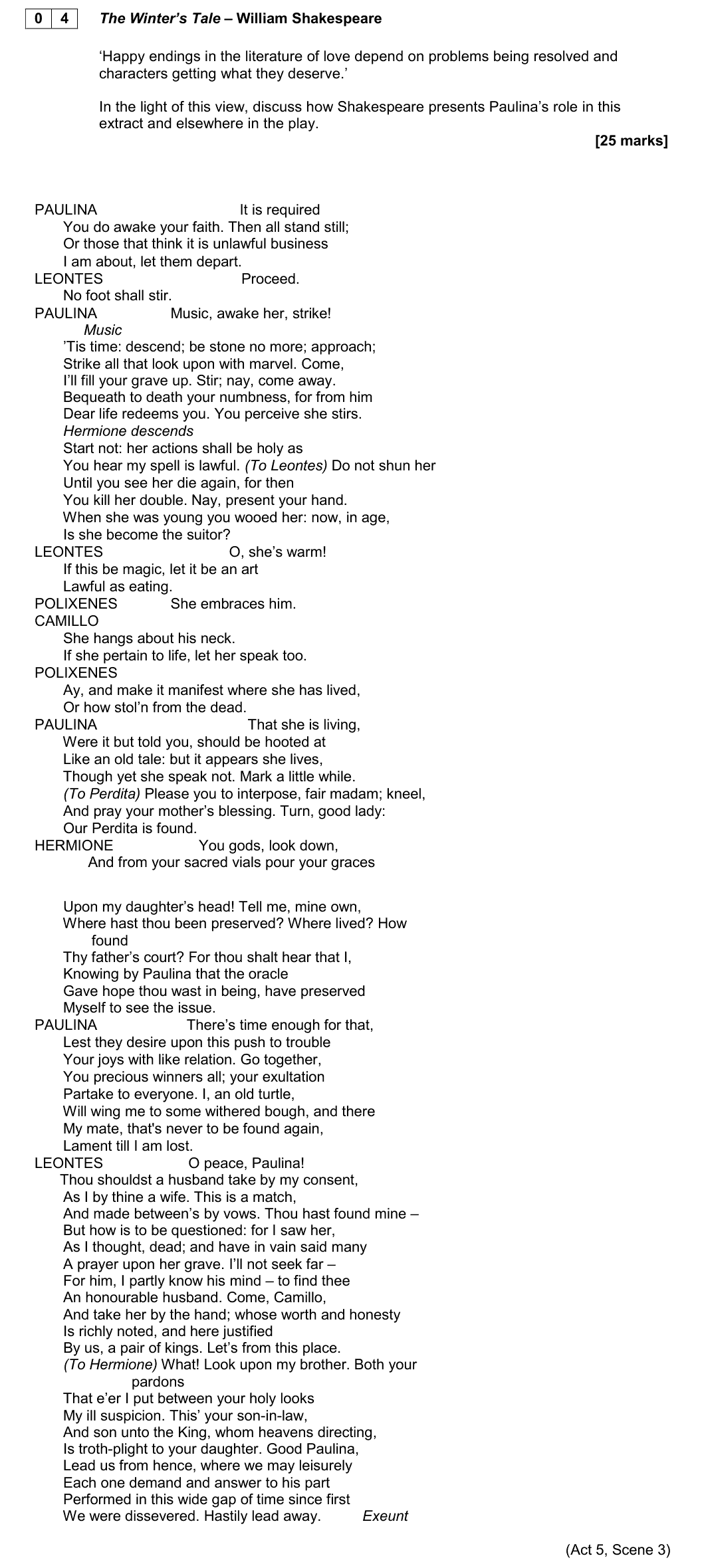
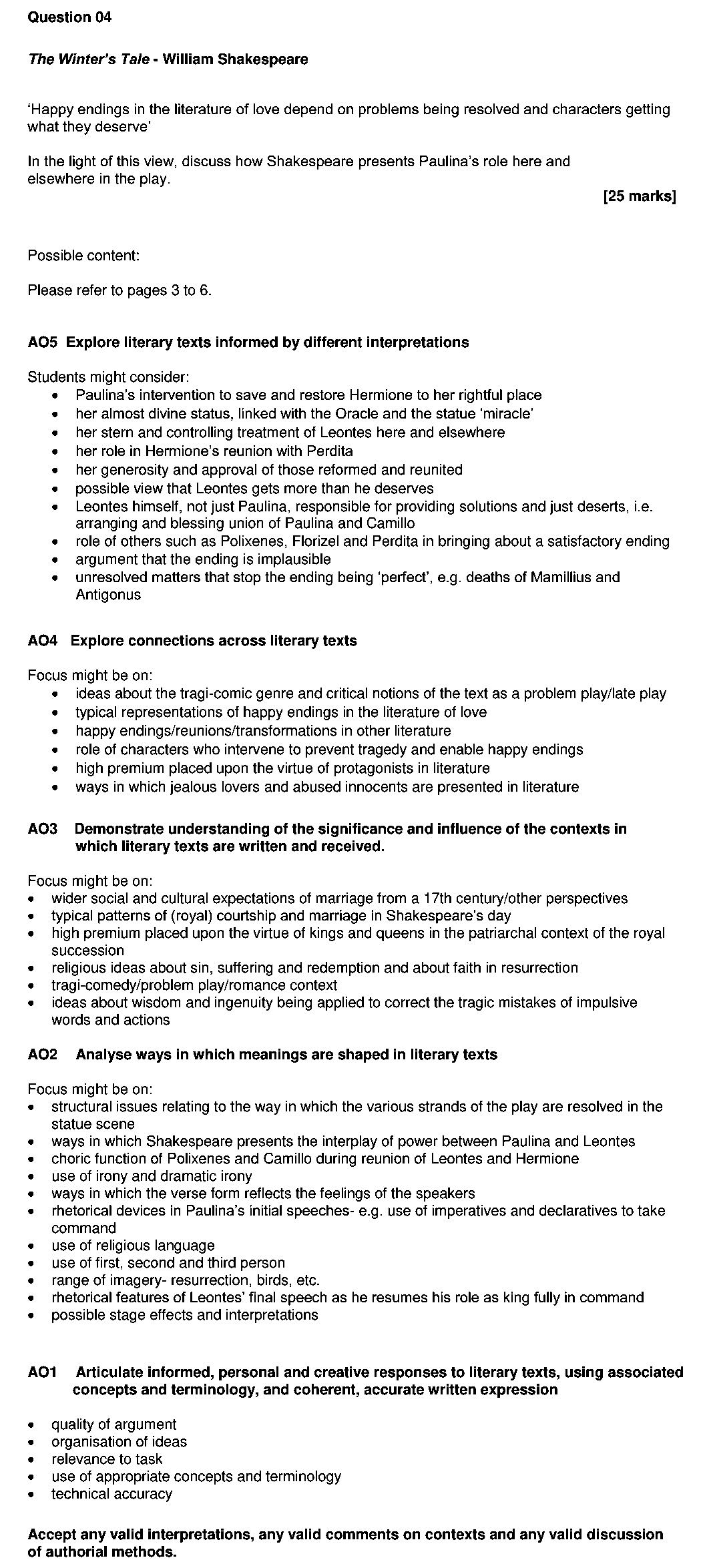
The Winter’s Tale – William Shakespeare
‘Happy endings in the literature of love depend on problems being resolved and
characters getting what they deserve.’
In the light of this view, discuss how Shakespeare presents Paulina’s role in this
extract and elsewhere in the play.
[25 marks]
PAULINA It is required
You do awake your faith. Then all stand still;
Or those that think it is unlawful business
I am about, let them depart.
LEONTES Proceed.
No foot shall stir.
PAULINA Music, awake her, strike!
Music
’Tis time: descend; be stone no more; approach;
Strike all that look upon with marvel. Come,
I’ll fill your grave up. Stir; nay, come away.
Bequeath to death your numbness, for from him
Dear life redeems you. You perceive she stirs.
Hermione descends
Start not: her actions shall be holy as
You hear my spell is lawful. (To Leontes) Do not shun her
Until you see her die again, for then
You kill her double. Nay, present your hand.
When she was young you wooed her: now, in age,
Is she become the suitor?
LEONTES O, she’s warm!
If this be magic, let it be an art
Lawful as eating.
POLIXENES She embraces him.
CAMILLO
She hangs about his neck.
If she pertain to life, let her speak too.
POLIXENES
Ay, and make it manifest where she has lived,
Or how stol’n from the dead.
PAULINA That she is living,
Were it but told you, should be hooted at
Like an old tale: but it appears she lives,
Though yet she speak not. Mark a little while.
(To Perdita) Please you to interpose, fair madam; kneel,
And pray your mother’s blessing. Turn, good lady:
Our Perdita is found.
HERMIONE You gods, look down,
And from your sacred vials pour your graces
Upon my daughter’s head! Tell me, mine own,
Where hast thou been preserved? Where lived? How
found
Thy father’s court? For thou shalt hear that I,
Knowing by Paulina that the oracle
Gave hope thou wast in being, have preserved
Myself to see the issue.
PAULINA There’s time enough for that,
Lest they desire upon this push to trouble
Your joys with like relation. Go together,
You precious winners all; your exultation
Partake to everyone. I, an old turtle,
Will wing me to some withered bough, and there
My mate, that's never to be found again,
Lament till I am lost.
LEONTES O peace, Paulina!
Thou shouldst a husband take by my consent,
As I by thine a wife. This is a match,
And made between’s by vows. Thou hast found mine –
But how is to be questioned: for I saw her,
As I thought, dead; and have in vain said many
A prayer upon her grave. I’ll not seek far –
For him, I partly know his mind – to find thee
An honourable husband. Come, Camillo,
And take her by the hand; whose worth and honesty
Is richly noted, and here justified
By us, a pair of kings. Let’s from this place.
(To Hermione) What! Look upon my brother. Both your
pardons
That e’er I put between your holy looks
My ill suspicion. This’ your son-in-law,
And son unto the King, whom heavens directing,
Is troth-plight to your daughter. Good Paulina,
Lead us from hence, where we may leisurely
Each one demand and answer to his part
Performed in this wide gap of time since first
We were dissevered. Hastily lead away. Exeunt
(Act 5, Scene 3)
June 2017 · Paper 1 · Q5 25 marks Unseen poetry unseen love poetry
Answer the following question.
0 5
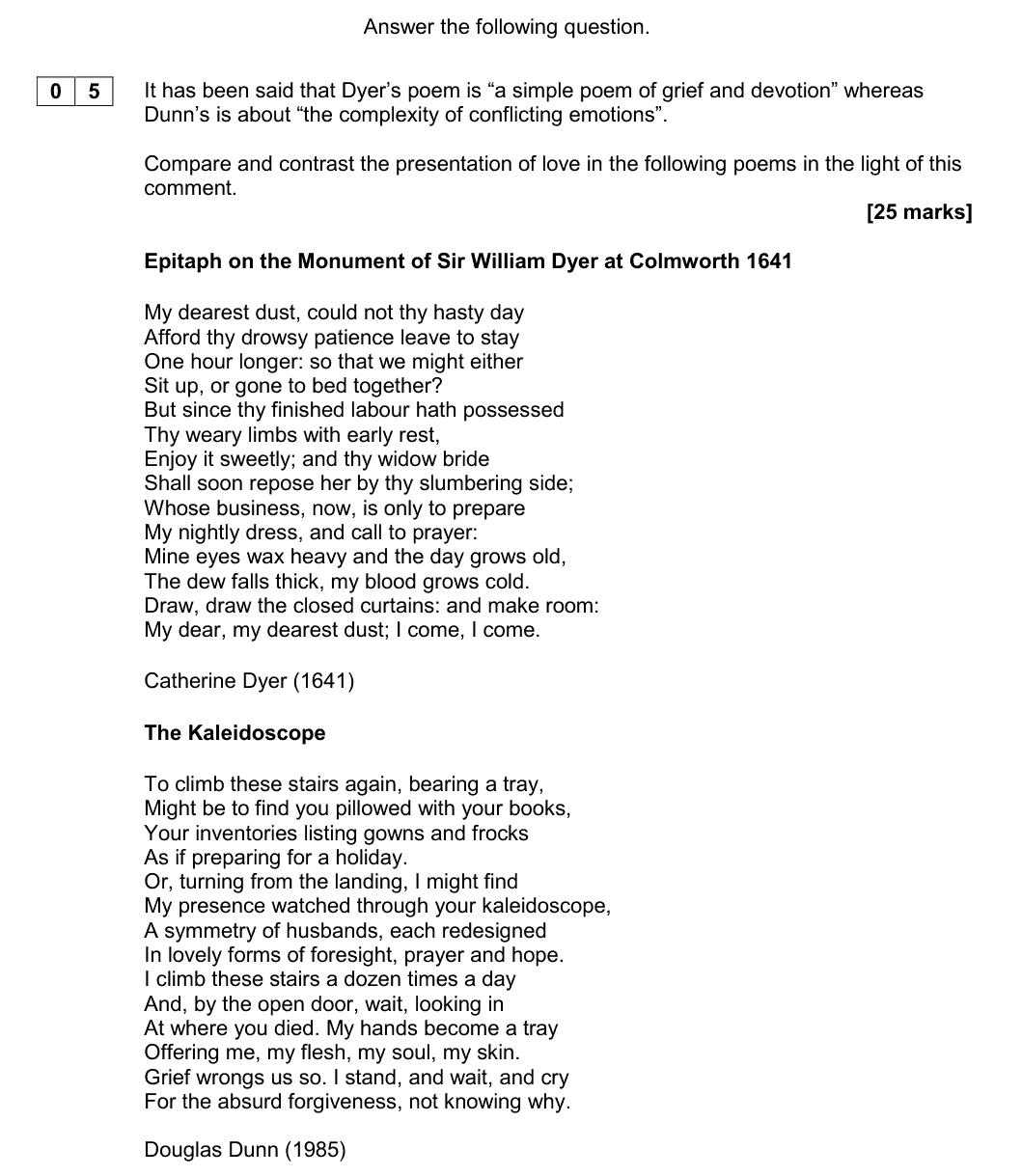
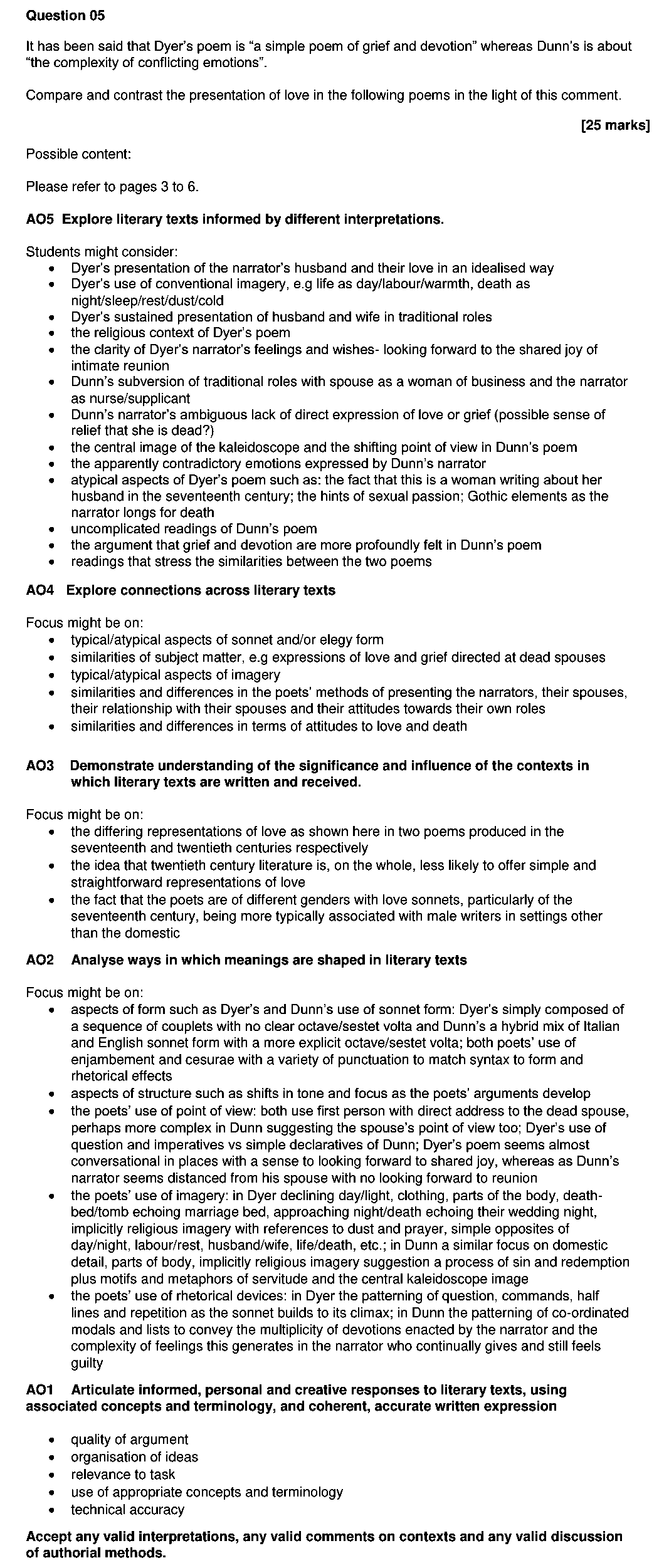
It has been said that Dyer’s poem is “a simple poem of grief and devotion” whereas
Dunn’s is about “the complexity of conflicting emotions”.
Compare and contrast the presentation of love in the following poems in the light of this
comment.
[25 marks]
Epitaph on the Monument of Sir William Dyer at Colmworth 1641
My dearest dust, could not thy hasty day
Afford thy drowsy patience leave to stay
One hour longer: so that we might either
Sit up, or gone to bed together?
But since thy finished labour hath possessed
Thy weary limbs with early rest,
Enjoy it sweetly; and thy widow bride
Shall soon repose her by thy slumbering side;
Whose business, now, is only to prepare
My nightly dress, and call to prayer:
Mine eyes wax heavy and the day grows old,
The dew falls thick, my blood grows cold.
Draw, draw the closed curtains: and make room:
My dear, my dearest dust; I come, I come.
Catherine Dyer (1641)
The Kaleidoscope
To climb these stairs again, bearing a tray,
Might be to find you pillowed with your books,
Your inventories listing gowns and frocks
As if preparing for a holiday.
Or, turning from the landing, I might find
My presence watched through your kaleidoscope,
A symmetry of husbands, each redesigned
In lovely forms of foresight, prayer and hope.
I climb these stairs a dozen times a day
And, by the open door, wait, looking in
At where you died. My hands become a tray
Offering me, my flesh, my soul, my skin.
Grief wrongs us so. I stand, and wait, and cry
For the absurd forgiveness, not knowing why.
Douglas Dunn (1985)
June 2017 · Paper 1 · Q6 25 marks Comparing texts love poetry pre 1900love poetry post 1900comparing prose love
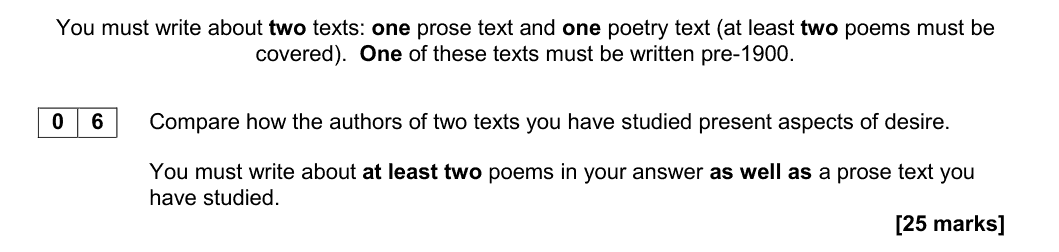
You must write about two texts: one prose text and one poetry text (at least two poems must be
covered). One of these texts must be written pre-1900.
0 6
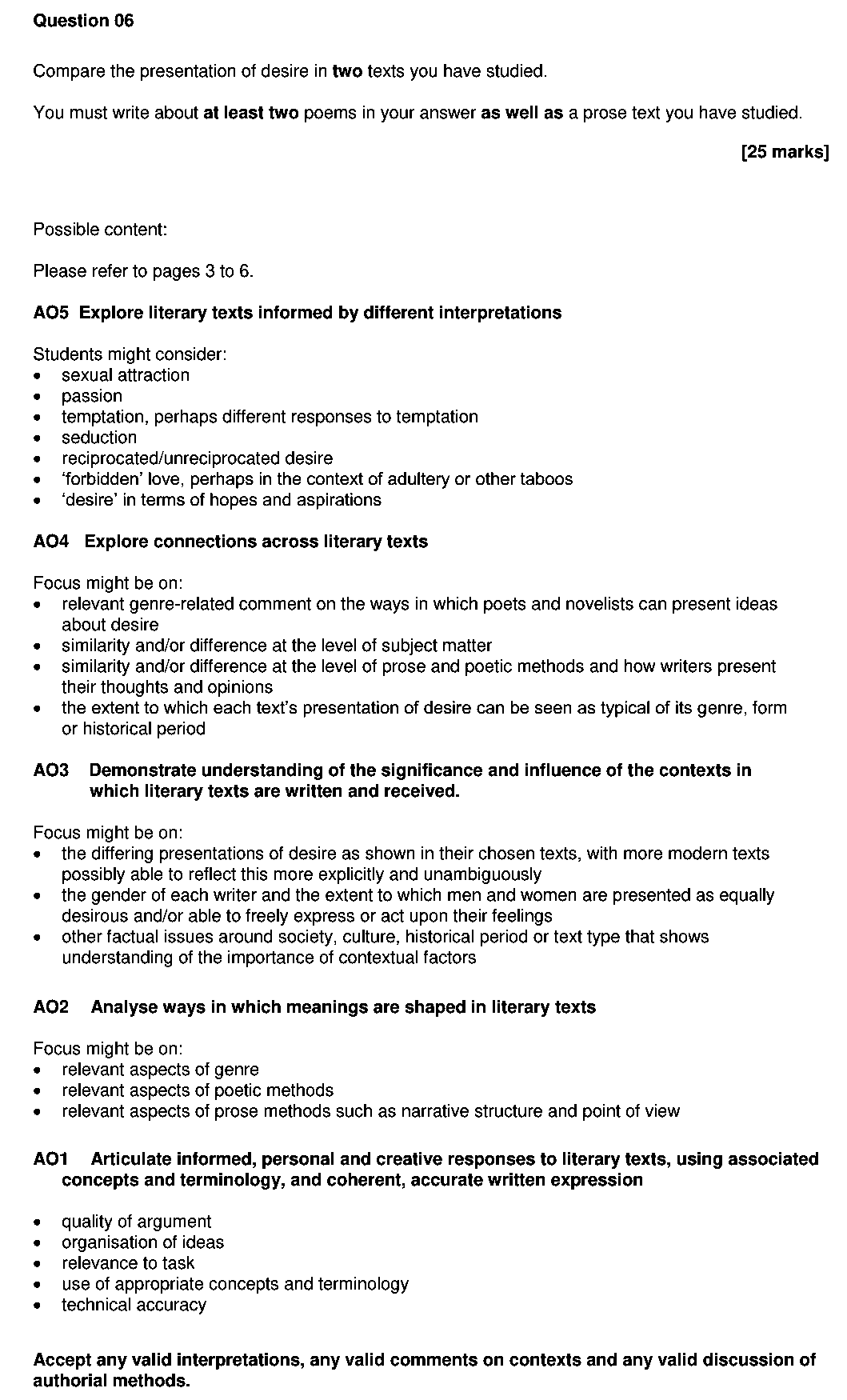
Compare how the authors of two texts you have studied present aspects of desire.
You must write about at least two poems in your answer as well as a prose text you
have studied.
[25 marks]
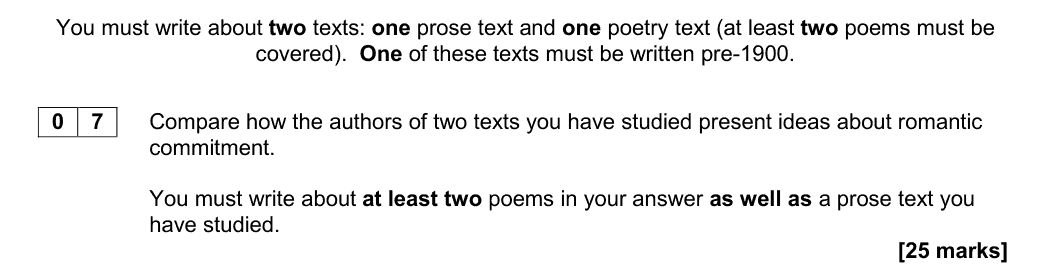
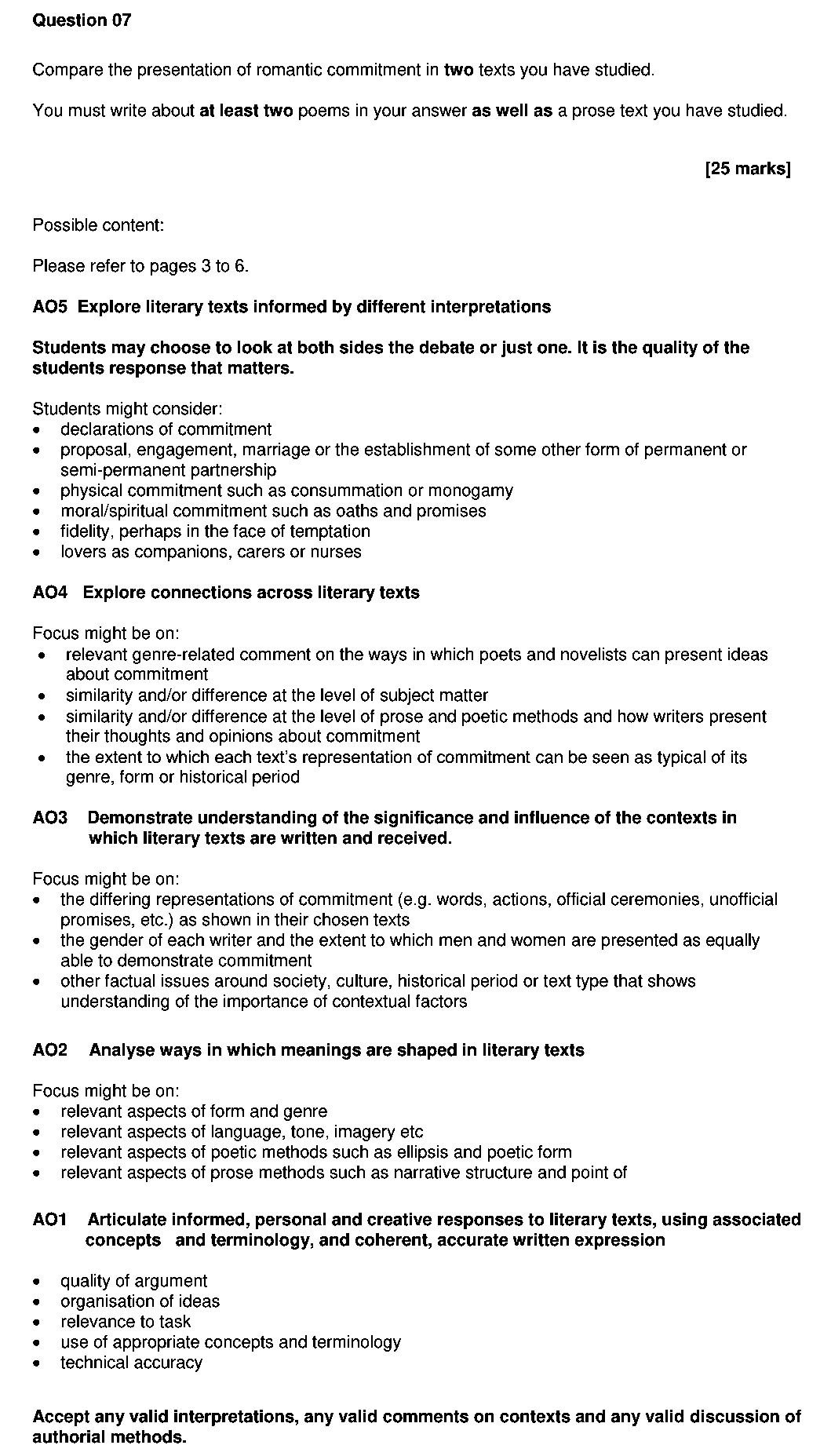
June 2017 · Paper 1 · Q7 25 marks Comparing texts love poetry pre 1900love poetry post 1900comparing prose love
You must write about two texts: one prose text and one poetry text (at least two poems must be
covered). One of these texts must be written pre-1900.
0 7
Compare how the authors of two texts you have studied present ideas about romantic
commitment.
You must write about at least two poems in your answer as well as a prose text you
have studied.
[25 marks]

Work with an AQA English Literature A tutor

Want a paper marked and gone through with you? Message us.

Prefer email? Send an enquiry

If you are under 18, please include a parent's contact details. Enquiries go to enquiries@alevelenglishtutor.com and are deleted once handled. All tutoring is online.