June 2018: AS Paper 1, Shakespeare and poetry

50 marks · 6 questions (every option is included) · Paper, mark scheme and report on AQA's site · AQA no longer hosts this series; the questions are from a copy of AQA's original paper

Question by question

QTopicMarksAOType
1 Othello 25Shakespeare extract
2 The Taming of the Shrew 25Shakespeare extract
3 Measure for Measure 25Shakespeare extract
4 The Winter's Tale 25Shakespeare extract
5 AQA Anthology: love poetry pre-1900 25Anthology poetry
6 AQA Anthology: love poetry post-1900 25Anthology poetry

The questions

123456
June 2018 · AS Paper 1 · Q1 25 marks Shakespeare extract othello
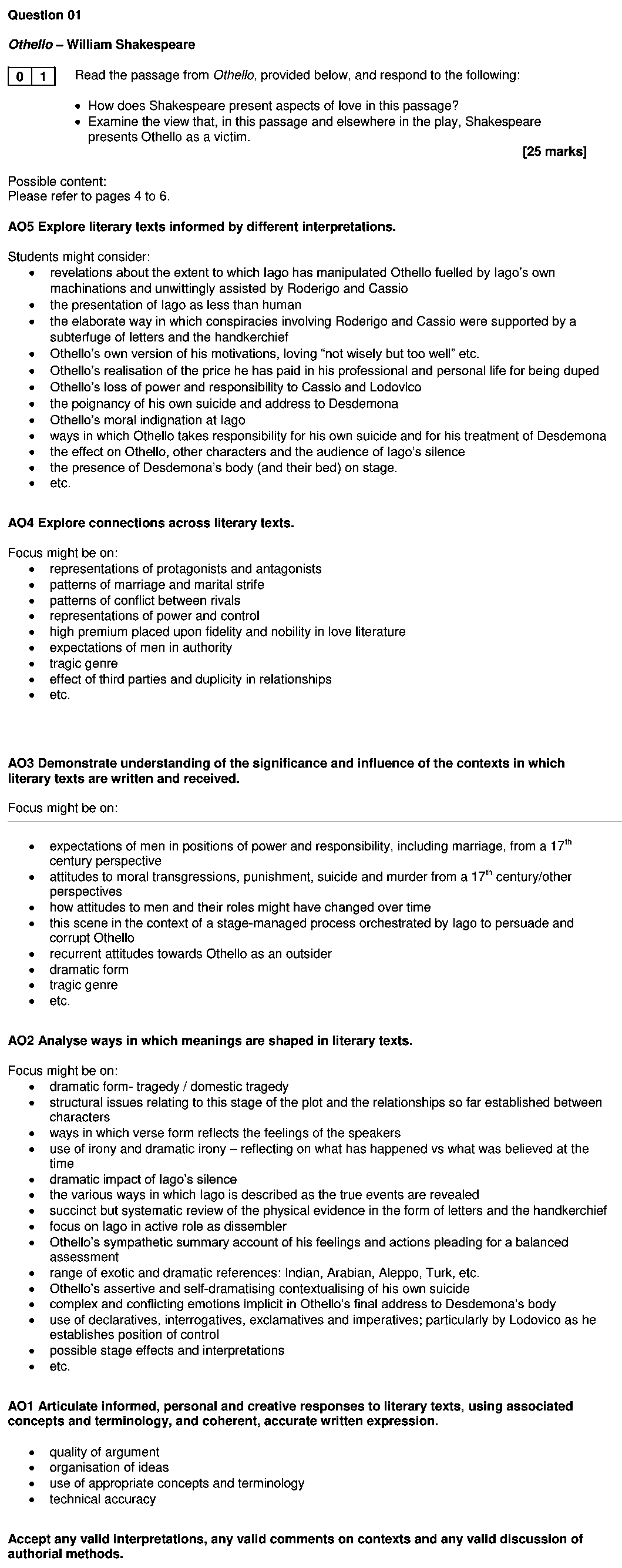
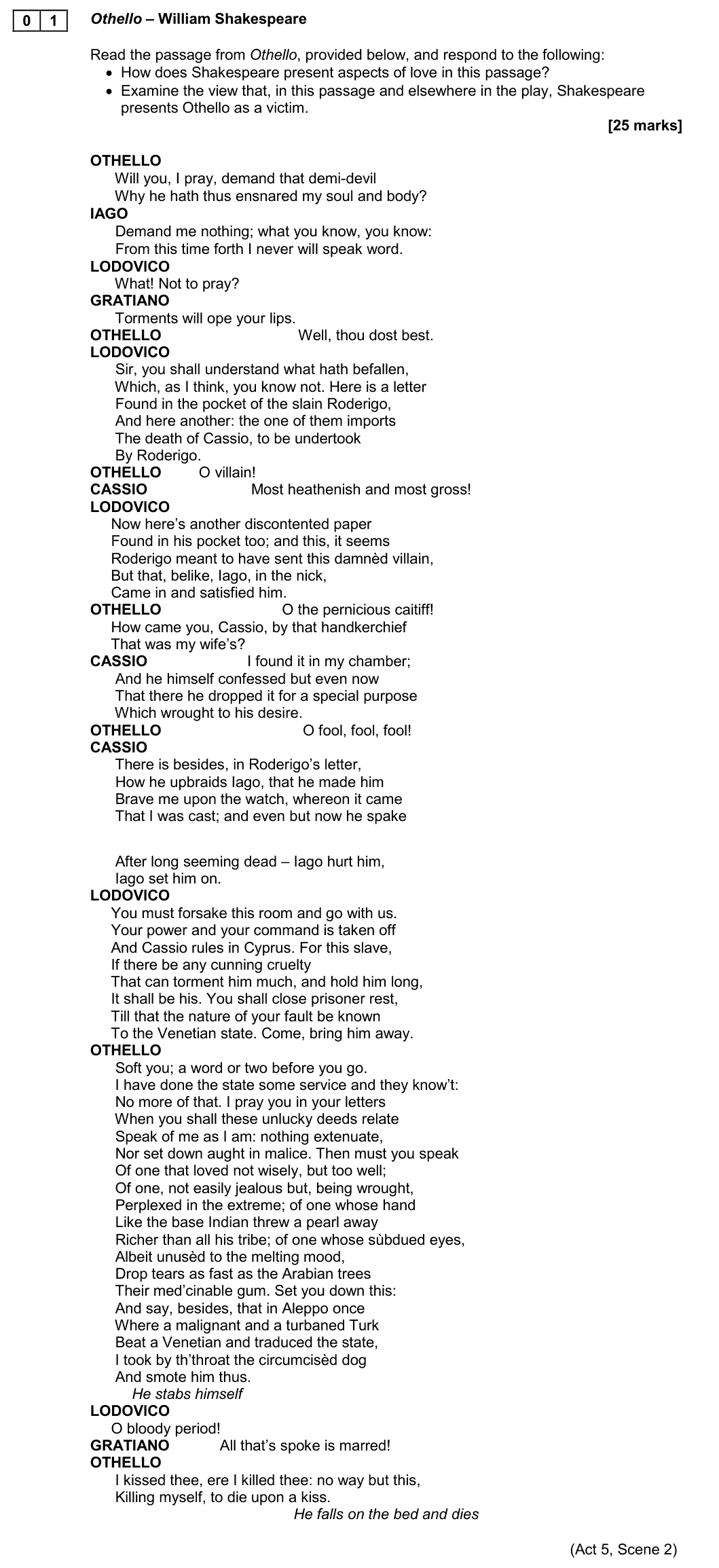
Othello – William Shakespeare
Read the passage from Othello, provided below, and respond to the following:
• How does Shakespeare present aspects of love in this passage?
• Examine the view that, in this passage and elsewhere in the play, Shakespeare
presents Othello as a victim.
[25 marks]
OTHELLO
Will you, I pray, demand that demi-devil
Why he hath thus ensnared my soul and body?
IAGO
Demand me nothing; what you know, you know:
From this time forth I never will speak word.
LODOVICO
What! Not to pray?
GRATIANO
Torments will ope your lips.
OTHELLO Well, thou dost best.
LODOVICO
Sir, you shall understand what hath befallen,
Which, as I think, you know not. Here is a letter
Found in the pocket of the slain Roderigo,
And here another: the one of them imports
The death of Cassio, to be undertook
By Roderigo.
OTHELLO O villain!
CASSIO Most heathenish and most gross!
LODOVICO
Now here’s another discontented paper
Found in his pocket too; and this, it seems
Roderigo meant to have sent this damnèd villain,
But that, belike, Iago, in the nick,
Came in and satisfied him.
OTHELLO O the pernicious caitiff!
How came you, Cassio, by that handkerchief
That was my wife’s?
CASSIO I found it in my chamber;
And he himself confessed but even now
That there he dropped it for a special purpose
Which wrought to his desire.
OTHELLO O fool, fool, fool!
CASSIO
There is besides, in Roderigo’s letter,
How he upbraids Iago, that he made him
Brave me upon the watch, whereon it came
That I was cast; and even but now he spake
After long seeming dead – Iago hurt him,
Iago set him on.
LODOVICO
You must forsake this room and go with us.
Your power and your command is taken off
And Cassio rules in Cyprus. For this slave,
If there be any cunning cruelty
That can torment him much, and hold him long,
It shall be his. You shall close prisoner rest,
Till that the nature of your fault be known
To the Venetian state. Come, bring him away.
OTHELLO
Soft you; a word or two before you go.
I have done the state some service and they know’t:
No more of that. I pray you in your letters
When you shall these unlucky deeds relate
Speak of me as I am: nothing extenuate,
Nor set down aught in malice. Then must you speak
Of one that loved not wisely, but too well;
Of one, not easily jealous but, being wrought,
Perplexed in the extreme; of one whose hand
Like the base Indian threw a pearl away
Richer than all his tribe; of one whose sùbdued eyes,
Albeit unusèd to the melting mood,
Drop tears as fast as the Arabian trees
Their med’cinable gum. Set you down this:
And say, besides, that in Aleppo once
Where a malignant and a turbaned Turk
Beat a Venetian and traduced the state,
I took by th’throat the circumcisèd dog
And smote him thus.
He stabs himself
LODOVICO
O bloody period!
GRATIANO All that’s spoke is marred!
OTHELLO
I kissed thee, ere I killed thee: no way but this,
Killing myself, to die upon a kiss.
He falls on the bed and dies
(Act 5, Scene 2)
June 2018 · AS Paper 1 · Q2 25 marks Shakespeare extract taming of the shrew
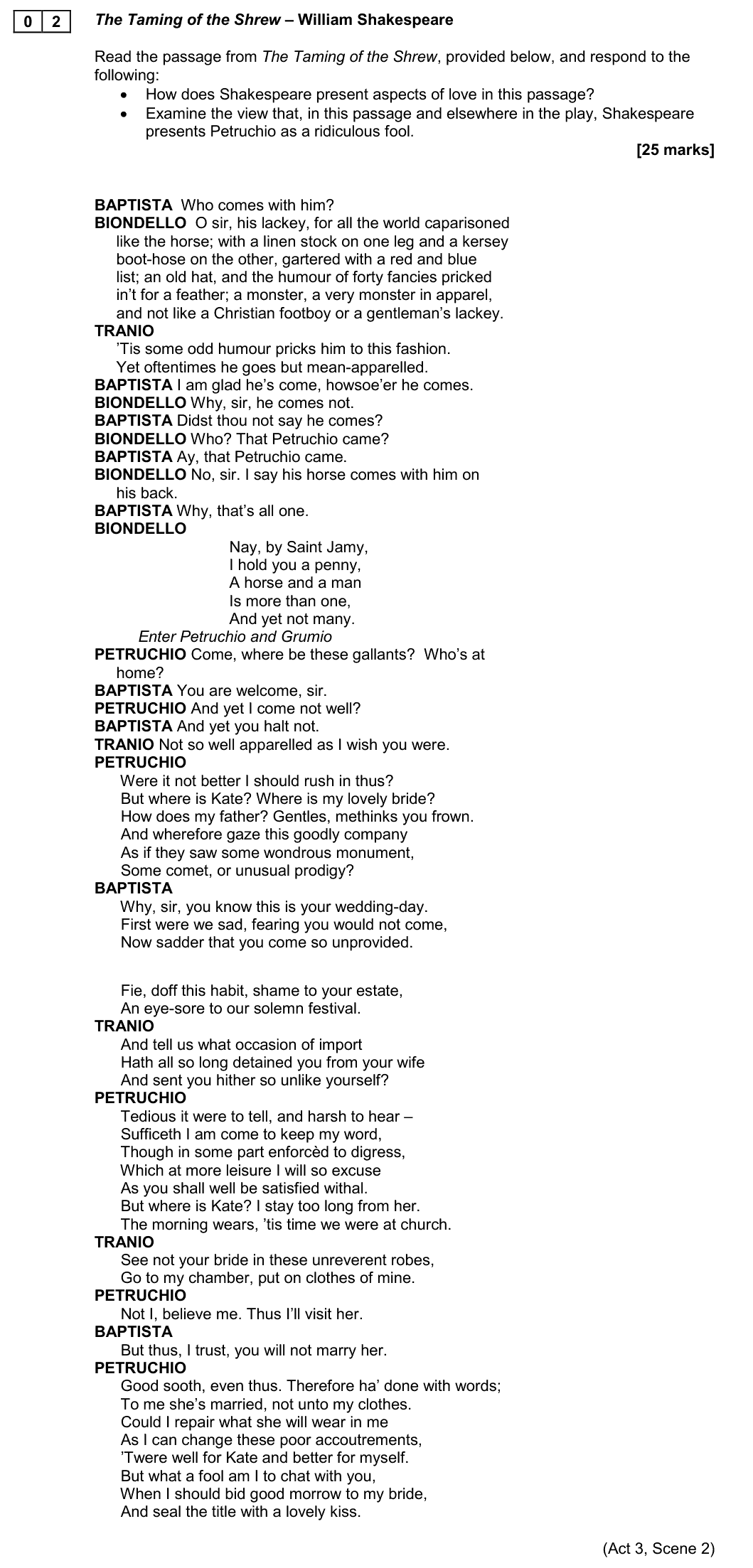
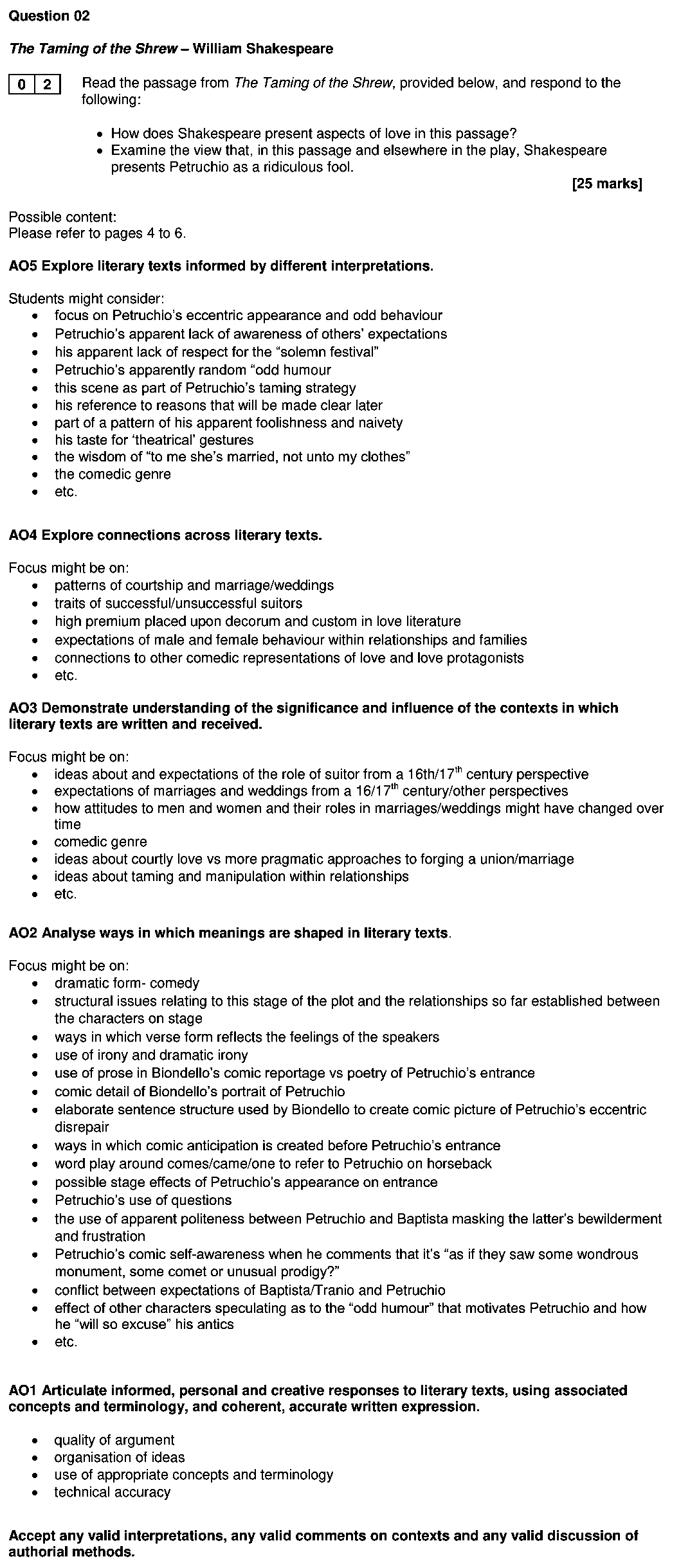
The Taming of the Shrew – William Shakespeare
Read the passage from The Taming of the Shrew, provided below, and respond to the
following:
•
How does Shakespeare present aspects of love in this passage?
•
Examine the view that, in this passage and elsewhere in the play, Shakespeare
presents Petruchio as a ridiculous fool.
[25 marks]
BAPTISTA Who comes with him?
BIONDELLO O sir, his lackey, for all the world caparisoned
like the horse; with a linen stock on one leg and a kersey
boot-hose on the other, gartered with a red and blue
list; an old hat, and the humour of forty fancies pricked
in’t for a feather; a monster, a very monster in apparel,
and not like a Christian footboy or a gentleman’s lackey.
TRANIO
’Tis some odd humour pricks him to this fashion.
Yet oftentimes he goes but mean-apparelled.
BAPTISTA I am glad he’s come, howsoe’er he comes.
BIONDELLO Why, sir, he comes not.
BAPTISTA Didst thou not say he comes?
BIONDELLO Who? That Petruchio came?
BAPTISTA Ay, that Petruchio came.
BIONDELLO No, sir. I say his horse comes with him on
his back.
BAPTISTA Why, that’s all one.
BIONDELLO
Nay, by Saint Jamy,
I hold you a penny,
A horse and a man
Is more than one,
And yet not many.
Enter Petruchio and Grumio
PETRUCHIO Come, where be these gallants? Who’s at
home?
BAPTISTA You are welcome, sir.
PETRUCHIO And yet I come not well?
BAPTISTA And yet you halt not.
TRANIO Not so well apparelled as I wish you were.
PETRUCHIO
Were it not better I should rush in thus?
But where is Kate? Where is my lovely bride?
How does my father? Gentles, methinks you frown.
And wherefore gaze this goodly company
As if they saw some wondrous monument,
Some comet, or unusual prodigy?
BAPTISTA
Why, sir, you know this is your wedding-day.
First were we sad, fearing you would not come,
Now sadder that you come so unprovided.
Fie, doff this habit, shame to your estate,
An eye-sore to our solemn festival.
TRANIO
And tell us what occasion of import
Hath all so long detained you from your wife
And sent you hither so unlike yourself?
PETRUCHIO
Tedious it were to tell, and harsh to hear –
Sufficeth I am come to keep my word,
Though in some part enforcèd to digress,
Which at more leisure I will so excuse
As you shall well be satisfied withal.
But where is Kate? I stay too long from her.
The morning wears, ’tis time we were at church.
TRANIO
See not your bride in these unreverent robes,
Go to my chamber, put on clothes of mine.
PETRUCHIO
Not I, believe me. Thus I’ll visit her.
BAPTISTA
But thus, I trust, you will not marry her.
PETRUCHIO
Good sooth, even thus. Therefore ha’ done with words;
To me she’s married, not unto my clothes.
Could I repair what she will wear in me
As I can change these poor accoutrements,
’Twere well for Kate and better for myself.
But what a fool am I to chat with you,
When I should bid good morrow to my bride,
And seal the title with a lovely kiss.
(Act 3, Scene 2)
June 2018 · AS Paper 1 · Q3 25 marks Shakespeare extract measure for measure
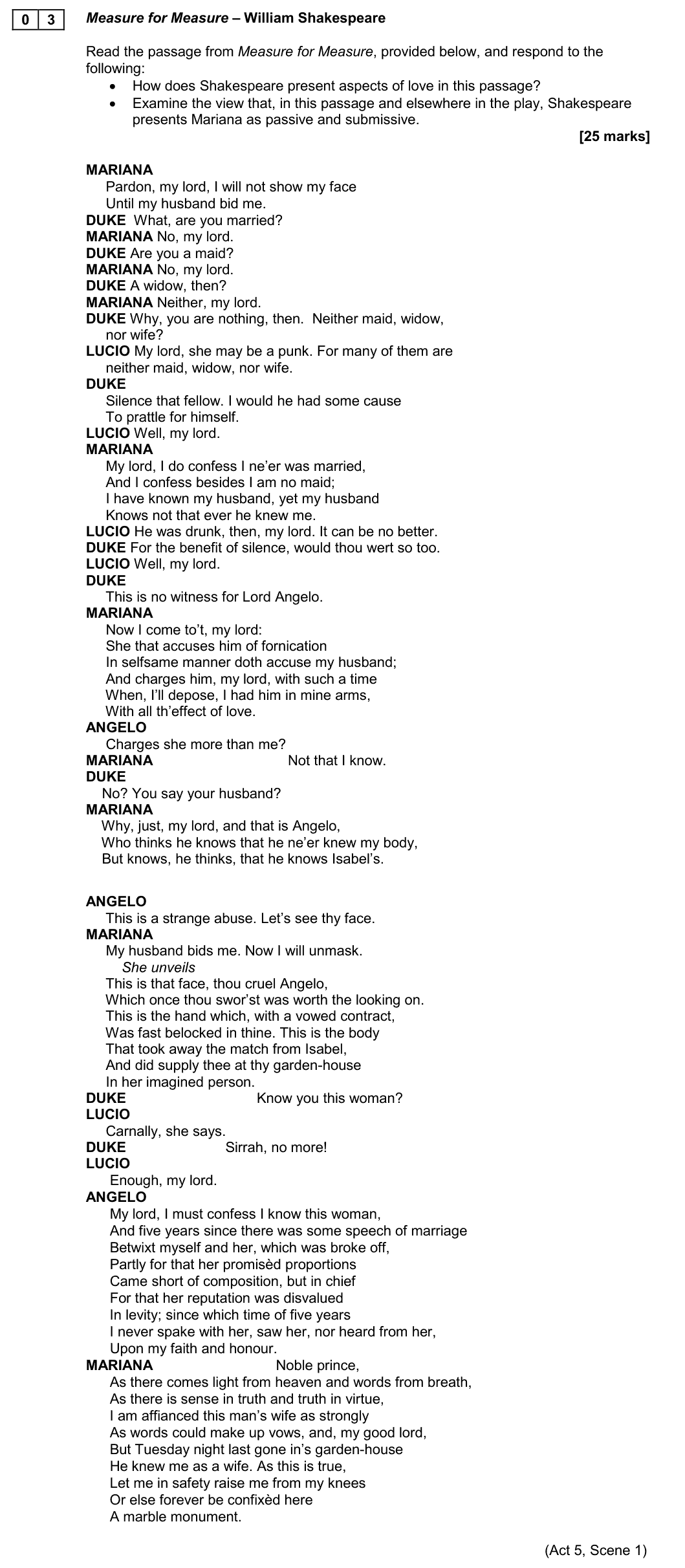
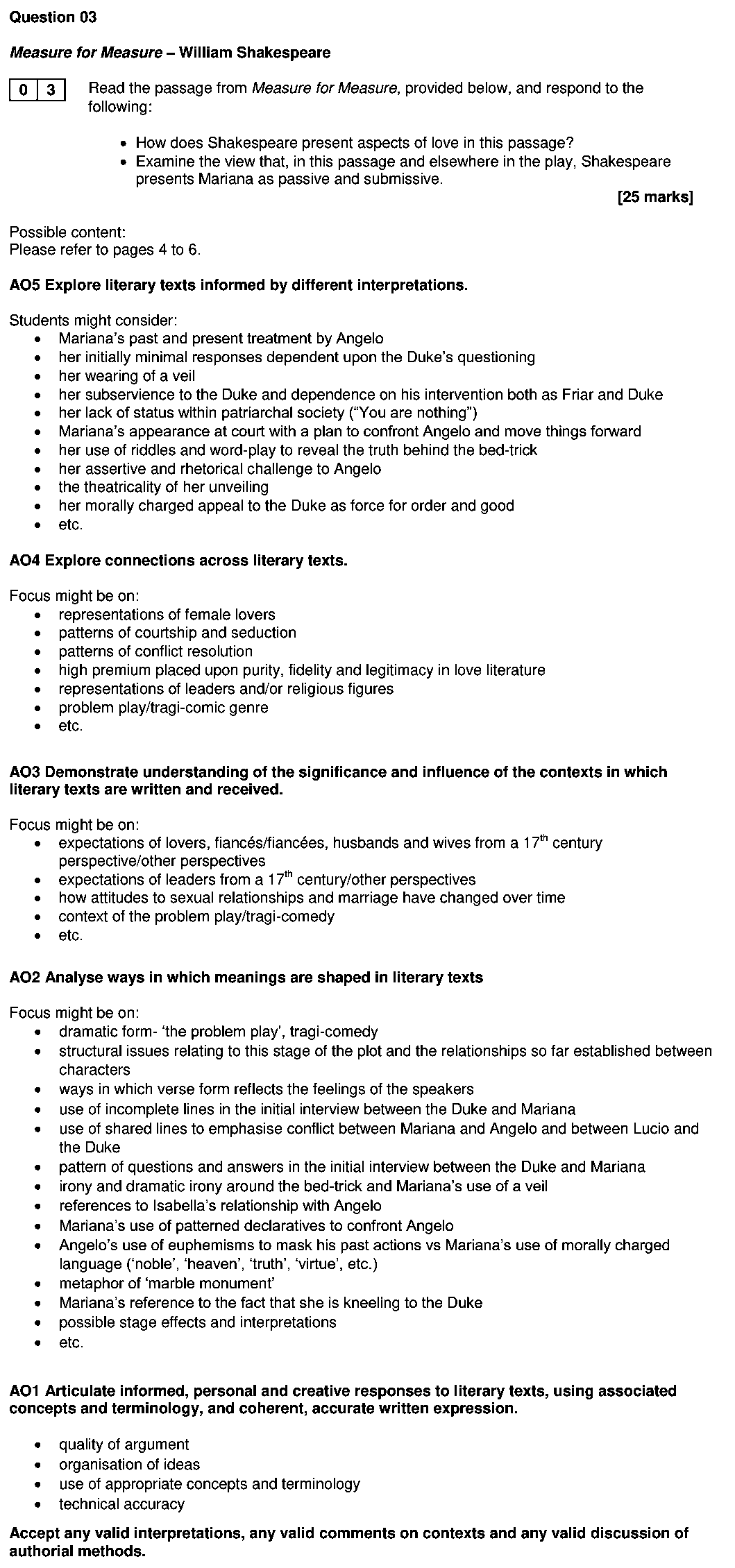
Measure for Measure – William Shakespeare
Read the passage from Measure for Measure, provided below, and respond to the
following:
•
How does Shakespeare present aspects of love in this passage?
•
Examine the view that, in this passage and elsewhere in the play, Shakespeare
presents Mariana as passive and submissive.
[25 marks]
MARIANA
Pardon, my lord, I will not show my face
Until my husband bid me.
DUKE What, are you married?
MARIANA No, my lord.
DUKE Are you a maid?
MARIANA No, my lord.
DUKE A widow, then?
MARIANA Neither, my lord.
DUKE Why, you are nothing, then. Neither maid, widow,
nor wife?
LUCIO My lord, she may be a punk. For many of them are
neither maid, widow, nor wife.
DUKE
Silence that fellow. I would he had some cause
To prattle for himself.
LUCIO Well, my lord.
MARIANA
My lord, I do confess I ne’er was married,
And I confess besides I am no maid;
I have known my husband, yet my husband
Knows not that ever he knew me.
LUCIO He was drunk, then, my lord. It can be no better.
DUKE For the benefit of silence, would thou wert so too.
LUCIO Well, my lord.
DUKE
This is no witness for Lord Angelo.
MARIANA
Now I come to’t, my lord:
She that accuses him of fornication
In selfsame manner doth accuse my husband;
And charges him, my lord, with such a time
When, I’ll depose, I had him in mine arms,
With all th’effect of love.
ANGELO
Charges she more than me?
MARIANA Not that I know.
DUKE
No? You say your husband?
MARIANA
Why, just, my lord, and that is Angelo,
Who thinks he knows that he ne’er knew my body,
But knows, he thinks, that he knows Isabel’s.
ANGELO
This is a strange abuse. Let’s see thy face.
MARIANA
My husband bids me. Now I will unmask.
She unveils
This is that face, thou cruel Angelo,
Which once thou swor’st was worth the looking on.
This is the hand which, with a vowed contract,
Was fast belocked in thine. This is the body
That took away the match from Isabel,
And did supply thee at thy garden-house
In her imagined person.
DUKE Know you this woman?
LUCIO
Carnally, she says.
DUKE Sirrah, no more!
LUCIO
Enough, my lord.
ANGELO
My lord, I must confess I know this woman,
And five years since there was some speech of marriage
Betwixt myself and her, which was broke off,
Partly for that her promisèd proportions
Came short of composition, but in chief
For that her reputation was disvalued
In levity; since which time of five years
I never spake with her, saw her, nor heard from her,
Upon my faith and honour.
MARIANA Noble prince,
As there comes light from heaven and words from breath,
As there is sense in truth and truth in virtue,
I am affianced this man’s wife as strongly
As words could make up vows, and, my good lord,
But Tuesday night last gone in’s garden-house
He knew me as a wife. As this is true,
Let me in safety raise me from my knees
Or else forever be confixèd here
A marble monument.
(Act 5, Scene 1)
June 2018 · AS Paper 1 · Q4 25 marks Shakespeare extract the winters tale
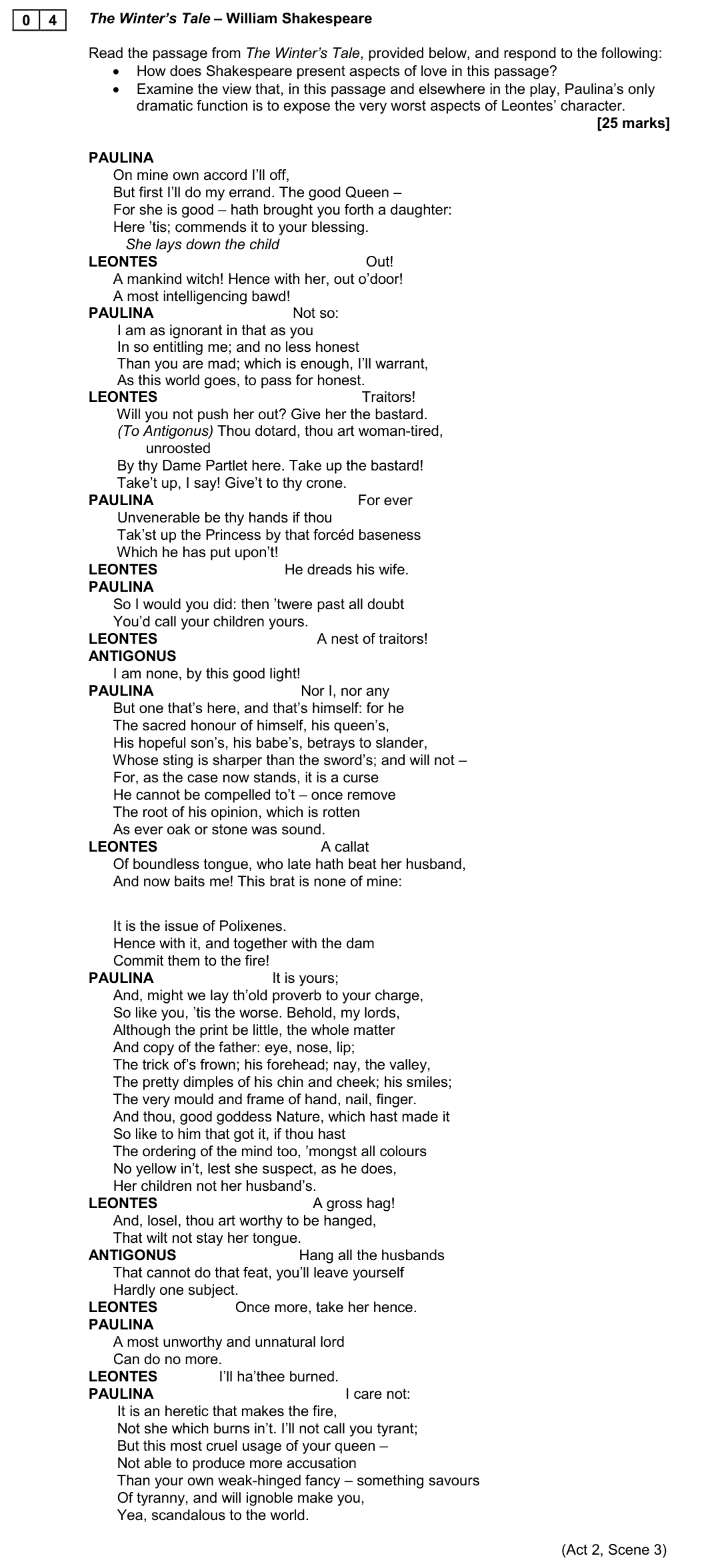
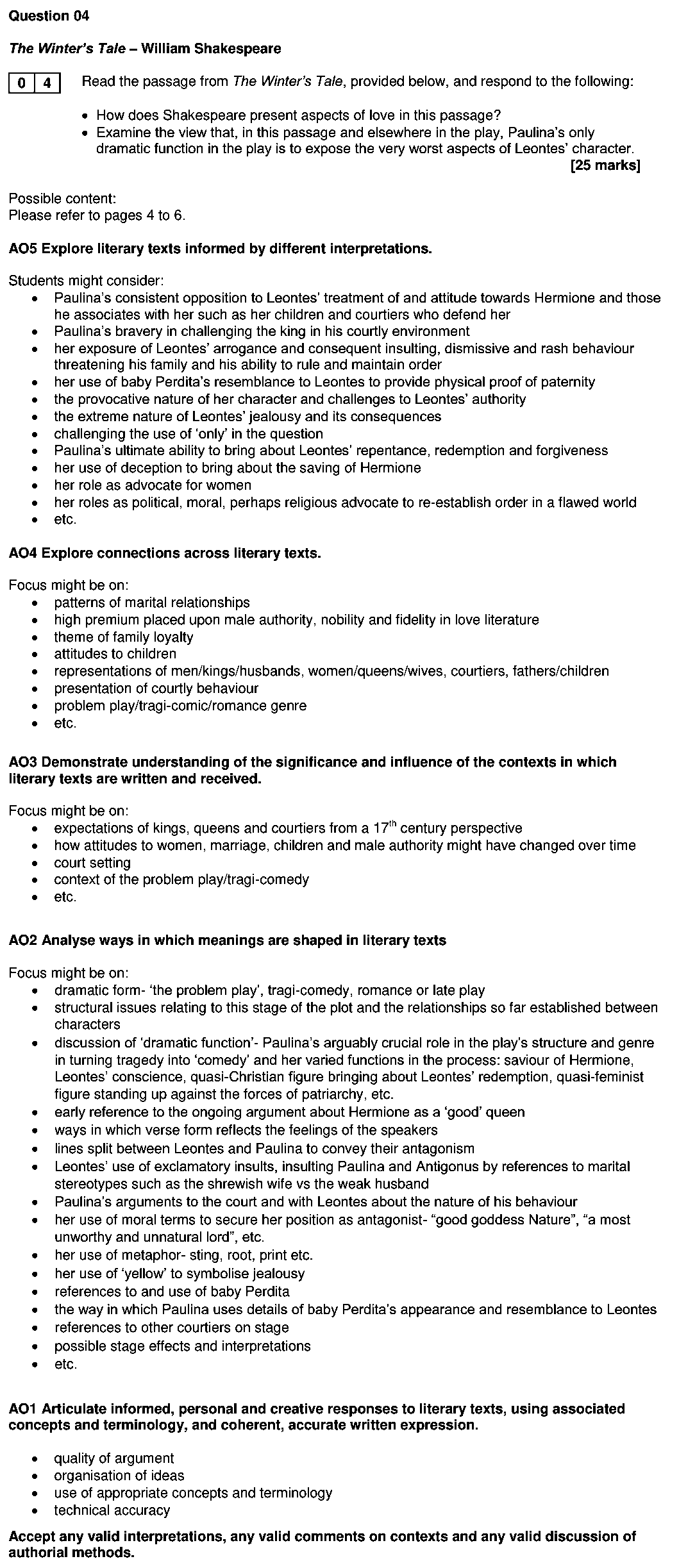
The Winter’s Tale – William Shakespeare
Read the passage from The Winter’s Tale, provided below, and respond to the following:
•
How does Shakespeare present aspects of love in this passage?
•
Examine the view that, in this passage and elsewhere in the play, Paulina’s only
dramatic function is to expose the very worst aspects of Leontes’ character.
[25 marks]
PAULINA
On mine own accord I’ll off,
But first I’ll do my errand. The good Queen –
For she is good – hath brought you forth a daughter:
Here ’tis; commends it to your blessing.
She lays down the child
LEONTES Out!
A mankind witch! Hence with her, out o’door!
A most intelligencing bawd!
PAULINA Not so:
I am as ignorant in that as you
In so entitling me; and no less honest
Than you are mad; which is enough, I’ll warrant,
As this world goes, to pass for honest.
LEONTES Traitors!
Will you not push her out? Give her the bastard.
(To Antigonus) Thou dotard, thou art woman-tired,
unroosted
By thy Dame Partlet here. Take up the bastard!
Take’t up, I say! Give’t to thy crone.
PAULINA For ever
Unvenerable be thy hands if thou
Tak’st up the Princess by that forcéd baseness
Which he has put upon’t!
LEONTES He dreads his wife.
PAULINA
So I would you did: then ’twere past all doubt
You’d call your children yours.
LEONTES A nest of traitors!
ANTIGONUS
I am none, by this good light!
PAULINA Nor I, nor any
But one that’s here, and that’s himself: for he
The sacred honour of himself, his queen’s,
His hopeful son’s, his babe’s, betrays to slander,
Whose sting is sharper than the sword’s; and will not –
For, as the case now stands, it is a curse
He cannot be compelled to’t – once remove
The root of his opinion, which is rotten
As ever oak or stone was sound.
LEONTES A callat
Of boundless tongue, who late hath beat her husband,
And now baits me! This brat is none of mine:
It is the issue of Polixenes.
Hence with it, and together with the dam
Commit them to the fire!
PAULINA It is yours;
And, might we lay th’old proverb to your charge,
So like you, ’tis the worse. Behold, my lords,
Although the print be little, the whole matter
And copy of the father: eye, nose, lip;
The trick of’s frown; his forehead; nay, the valley,
The pretty dimples of his chin and cheek; his smiles;
The very mould and frame of hand, nail, finger.
And thou, good goddess Nature, which hast made it
So like to him that got it, if thou hast
The ordering of the mind too, ’mongst all colours
No yellow in’t, lest she suspect, as he does,
Her children not her husband’s.
LEONTES A gross hag!
And, losel, thou art worthy to be hanged,
That wilt not stay her tongue.
ANTIGONUS Hang all the husbands
That cannot do that feat, you’ll leave yourself
Hardly one subject.
LEONTES Once more, take her hence.
PAULINA
A most unworthy and unnatural lord
Can do no more.
LEONTES I’ll ha’thee burned.
PAULINA I care not:
It is an heretic that makes the fire,
Not she which burns in’t. I’ll not call you tyrant;
But this most cruel usage of your queen –
Not able to produce more accusation
Than your own weak-hinged fancy – something savours
Of tyranny, and will ignoble make you,
Yea, scandalous to the world.
(Act 2, Scene 3)
June 2018 · AS Paper 1 · Q5 25 marks Anthology poetry love poetry pre 1900
AQA Anthology of Love Poetry through the ages pre-1900
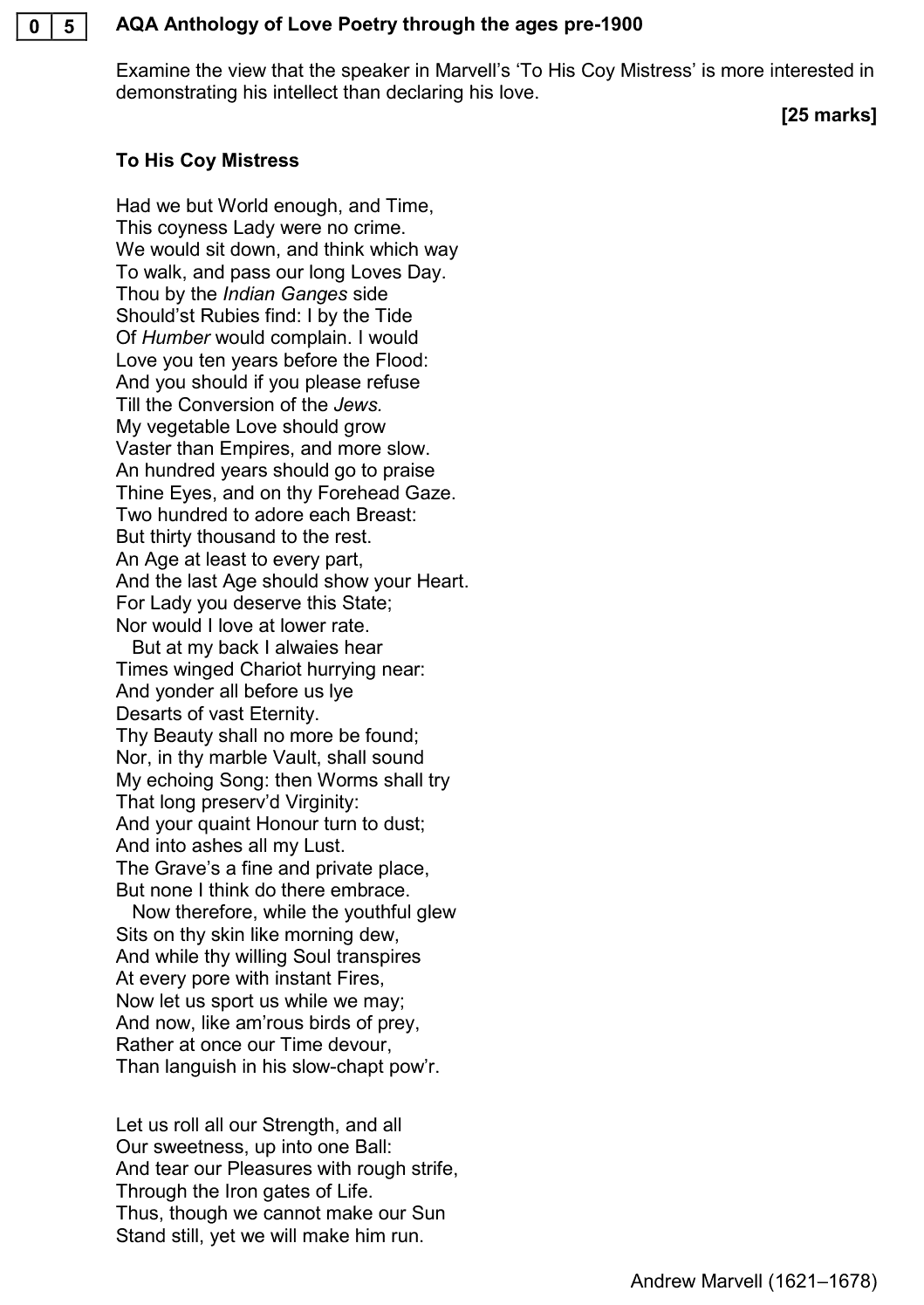
Examine the view that the speaker in Marvell’s ‘To His Coy Mistress’ is more interested in
demonstrating his intellect than declaring his love.
[25 marks]
To His Coy Mistress
Had we but World enough, and Time,
This coyness Lady were no crime.
We would sit down, and think which way
To walk, and pass our long Loves Day.
Thou by the Indian Ganges side
Should’st Rubies find: I by the Tide
Of Humber would complain. I would
Love you ten years before the Flood:
And you should if you please refuse
Till the Conversion of the Jews.
My vegetable Love should grow
Vaster than Empires, and more slow.
An hundred years should go to praise
Thine Eyes, and on thy Forehead Gaze.
Two hundred to adore each Breast:
But thirty thousand to the rest.
An Age at least to every part,
And the last Age should show your Heart.
For Lady you deserve this State;
Nor would I love at lower rate.
But at my back I alwaies hear
Times winged Chariot hurrying near:
And yonder all before us lye
Desarts of vast Eternity.
Thy Beauty shall no more be found;
Nor, in thy marble Vault, shall sound
My echoing Song: then Worms shall try
That long preserv’d Virginity:
And your quaint Honour turn to dust;
And into ashes all my Lust.
The Grave’s a fine and private place,
But none I think do there embrace.
Now therefore, while the youthful glew
Sits on thy skin like morning dew,
And while thy willing Soul transpires
At every pore with instant Fires,
Now let us sport us while we may;
And now, like am’rous birds of prey,
Rather at once our Time devour,
Than languish in his slow-chapt pow’r.
Let us roll all our Strength, and all
Our sweetness, up into one Ball:
And tear our Pleasures with rough strife,
Through the Iron gates of Life.
Thus, though we cannot make our Sun
Stand still, yet we will make him run.
Andrew Marvell (1621–1678)
June 2018 · AS Paper 1 · Q6 25 marks Anthology poetry love poetry post 1900
AQA Anthology of Love Poetry through the ages post-1900
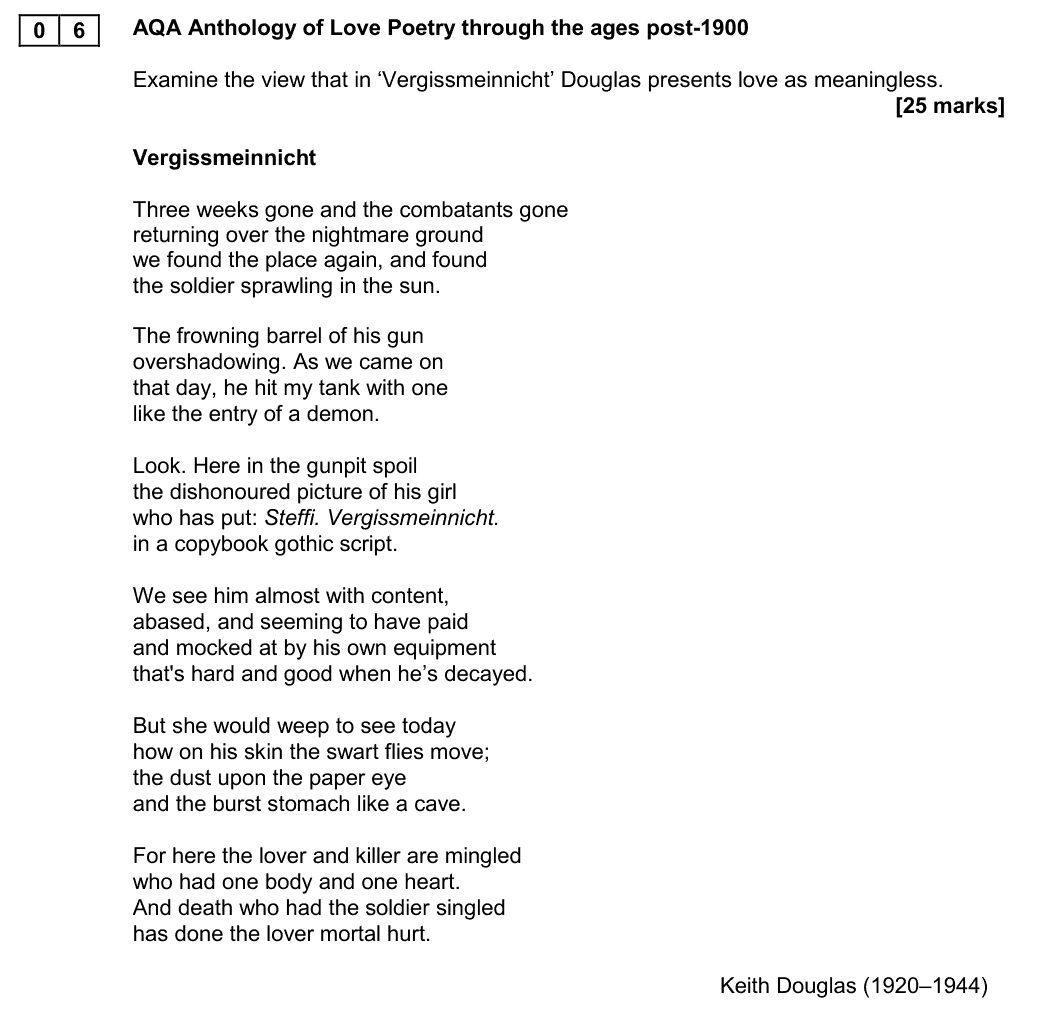
Examine the view that in ‘Vergissmeinnicht’ Douglas presents love as meaningless.
[25 marks]
Vergissmeinnicht
Three weeks gone and the combatants gone
returning over the nightmare ground
we found the place again, and found
the soldier sprawling in the sun.
The frowning barrel of his gun
overshadowing. As we came on
that day, he hit my tank with one
like the entry of a demon.
Look. Here in the gunpit spoil
the dishonoured picture of his girl
who has put: Steffi. Vergissmeinnicht.
in a copybook gothic script.
We see him almost with content,
abased, and seeming to have paid
and mocked at by his own equipment
that's hard and good when he’s decayed.
But she would weep to see today
how on his skin the swart flies move;
the dust upon the paper eye
and the burst stomach like a cave.
For here the lover and killer are mingled
who had one body and one heart.
And death who had the soldier singled
has done the lover mortal hurt.
Keith Douglas (1920–1944)

Work with an AQA English Literature A tutor

Want a paper marked and gone through with you? Message us.

Prefer email? Send an enquiry

If you are under 18, please include a parent's contact details. Enquiries go to enquiries@alevelenglishtutor.com and are deleted once handled. All tutoring is online.