June 2018: A-level Paper 1, Love through the ages

75 marks · 7 questions (every option is included) · Paper, mark scheme and report on AQA's site · AQA no longer hosts this series; the questions are from a copy of AQA's original paper

Question by question

QTopicMarksAOType
1 Othello 25Shakespeare extract
2 The Taming of the Shrew 25Shakespeare extract
3 Measure for Measure 25Shakespeare extract
4 The Winter's Tale 25Shakespeare extract
5 Unseen poetry comparison (love) 25Unseen poetry
6 AQA Anthology: love poetry pre-1900, AQA Anthology: love poetry post-1900, Comparing prose texts (love through the ages) 25Comparing texts
7 AQA Anthology: love poetry pre-1900, AQA Anthology: love poetry post-1900, Comparing prose texts (love through the ages) 25Comparing texts

The questions

1234567
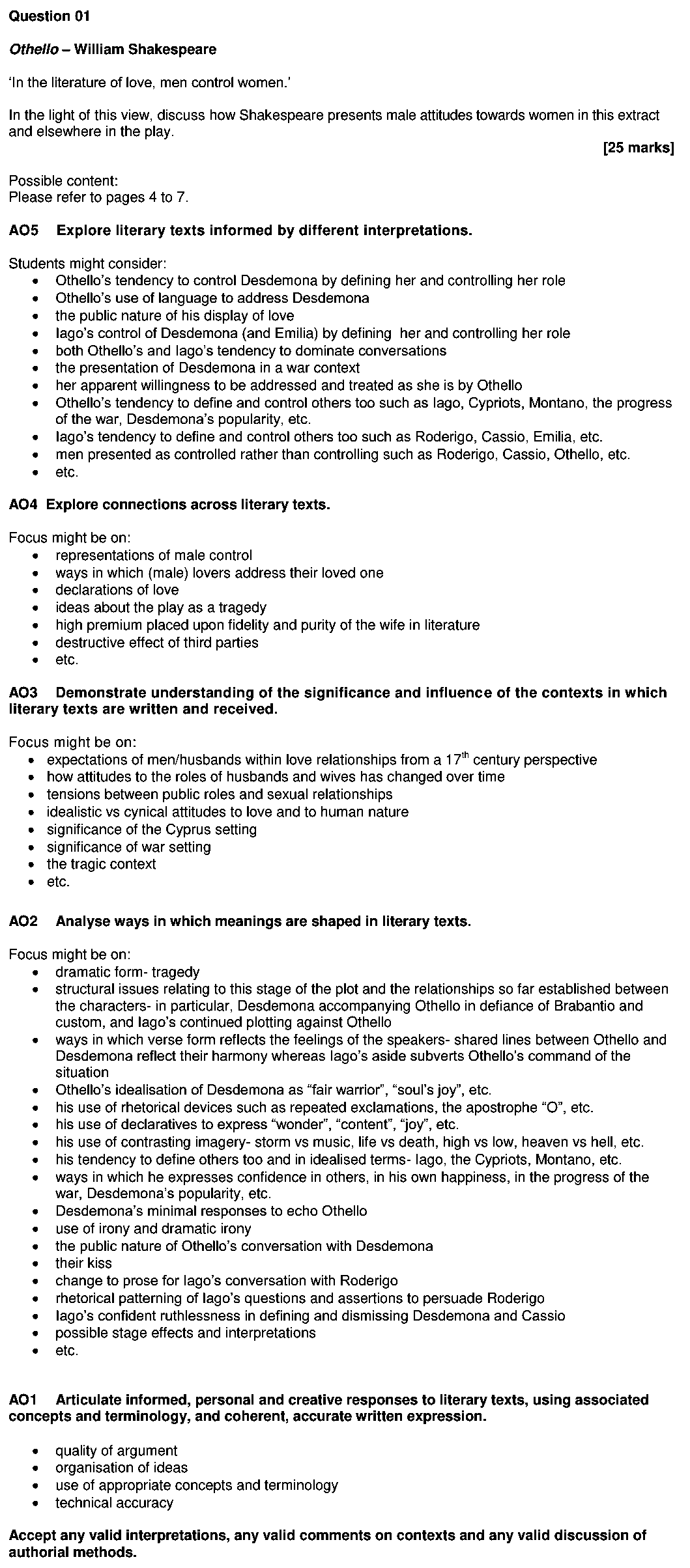
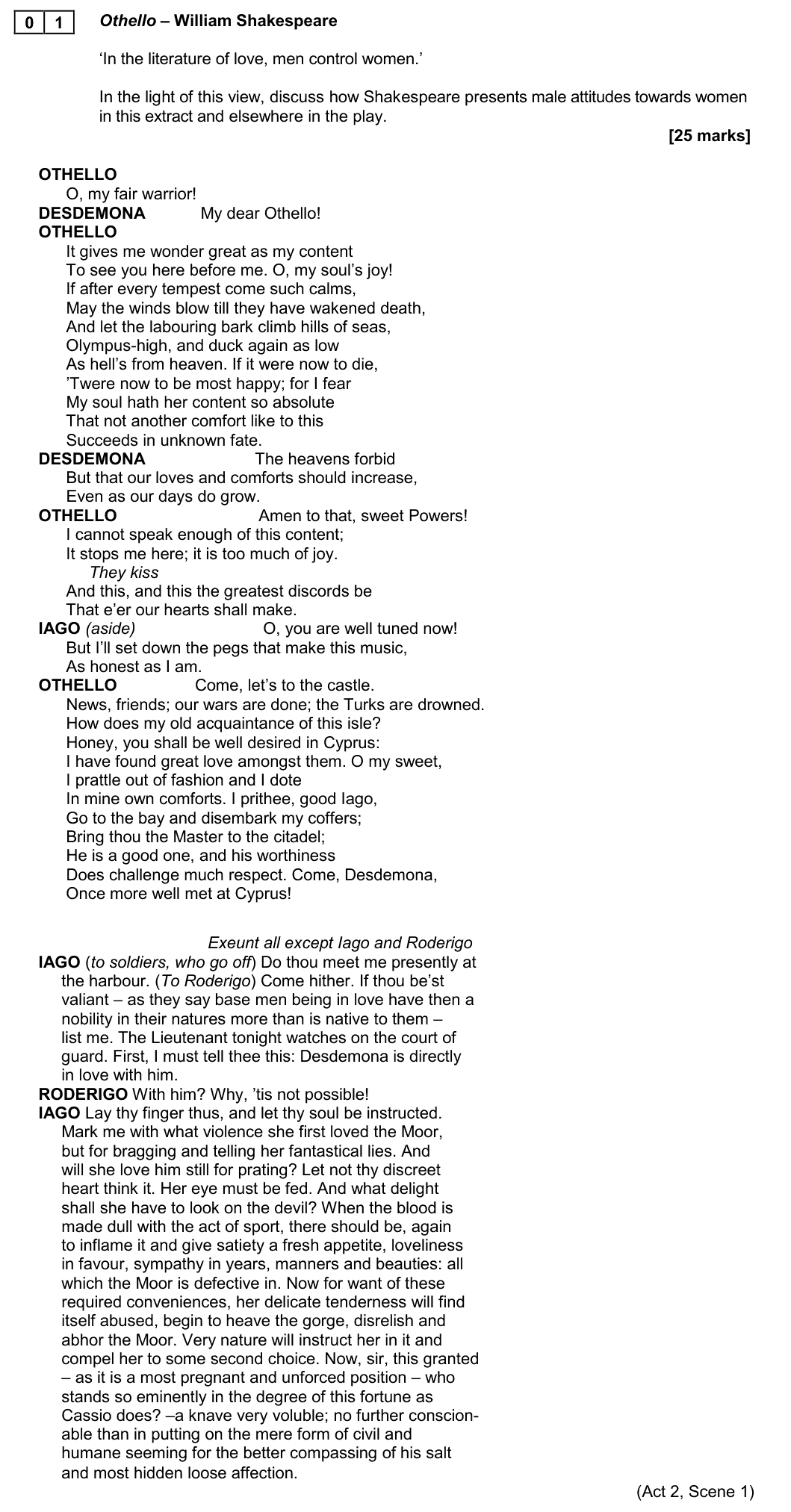
June 2018 · Paper 1 · Q1 25 marks Shakespeare extract othello
Othello – William Shakespeare
‘In the literature of love, men control women.’
In the light of this view, discuss how Shakespeare presents male attitudes towards women
in this extract and elsewhere in the play.
[25 marks]
OTHELLO
O, my fair warrior!
DESDEMONA My dear Othello!
OTHELLO
It gives me wonder great as my content
To see you here before me. O, my soul’s joy!
If after every tempest come such calms,
May the winds blow till they have wakened death,
And let the labouring bark climb hills of seas,
Olympus-high, and duck again as low
As hell’s from heaven. If it were now to die,
’Twere now to be most happy; for I fear
My soul hath her content so absolute
That not another comfort like to this
Succeeds in unknown fate.
DESDEMONA The heavens forbid
But that our loves and comforts should increase,
Even as our days do grow.
OTHELLO Amen to that, sweet Powers!
I cannot speak enough of this content;
It stops me here; it is too much of joy.
They kiss
And this, and this the greatest discords be
That e’er our hearts shall make.
IAGO (aside) O, you are well tuned now!
But I’ll set down the pegs that make this music,
As honest as I am.
OTHELLO Come, let’s to the castle.
News, friends; our wars are done; the Turks are drowned.
How does my old acquaintance of this isle?
Honey, you shall be well desired in Cyprus:
I have found great love amongst them. O my sweet,
I prattle out of fashion and I dote
In mine own comforts. I prithee, good Iago,
Go to the bay and disembark my coffers;
Bring thou the Master to the citadel;
He is a good one, and his worthiness
Does challenge much respect. Come, Desdemona,
Once more well met at Cyprus!
Exeunt all except Iago and Roderigo
IAGO (to soldiers, who go off) Do thou meet me presently at
the harbour. (To Roderigo) Come hither. If thou be’st
valiant – as they say base men being in love have then a
nobility in their natures more than is native to them –
list me. The Lieutenant tonight watches on the court of
guard. First, I must tell thee this: Desdemona is directly
in love with him.
RODERIGO With him? Why, ’tis not possible!
IAGO Lay thy finger thus, and let thy soul be instructed.
Mark me with what violence she first loved the Moor,
but for bragging and telling her fantastical lies. And
will she love him still for prating? Let not thy discreet
heart think it. Her eye must be fed. And what delight
shall she have to look on the devil? When the blood is
made dull with the act of sport, there should be, again
to inflame it and give satiety a fresh appetite, loveliness
in favour, sympathy in years, manners and beauties: all
which the Moor is defective in. Now for want of these
required conveniences, her delicate tenderness will find
itself abused, begin to heave the gorge, disrelish and
abhor the Moor. Very nature will instruct her in it and
compel her to some second choice. Now, sir, this granted
– as it is a most pregnant and unforced position – who
stands so eminently in the degree of this fortune as
Cassio does? –a knave very voluble; no further conscion-
able than in putting on the mere form of civil and
humane seeming for the better compassing of his salt
and most hidden loose affection.
(Act 2, Scene 1)
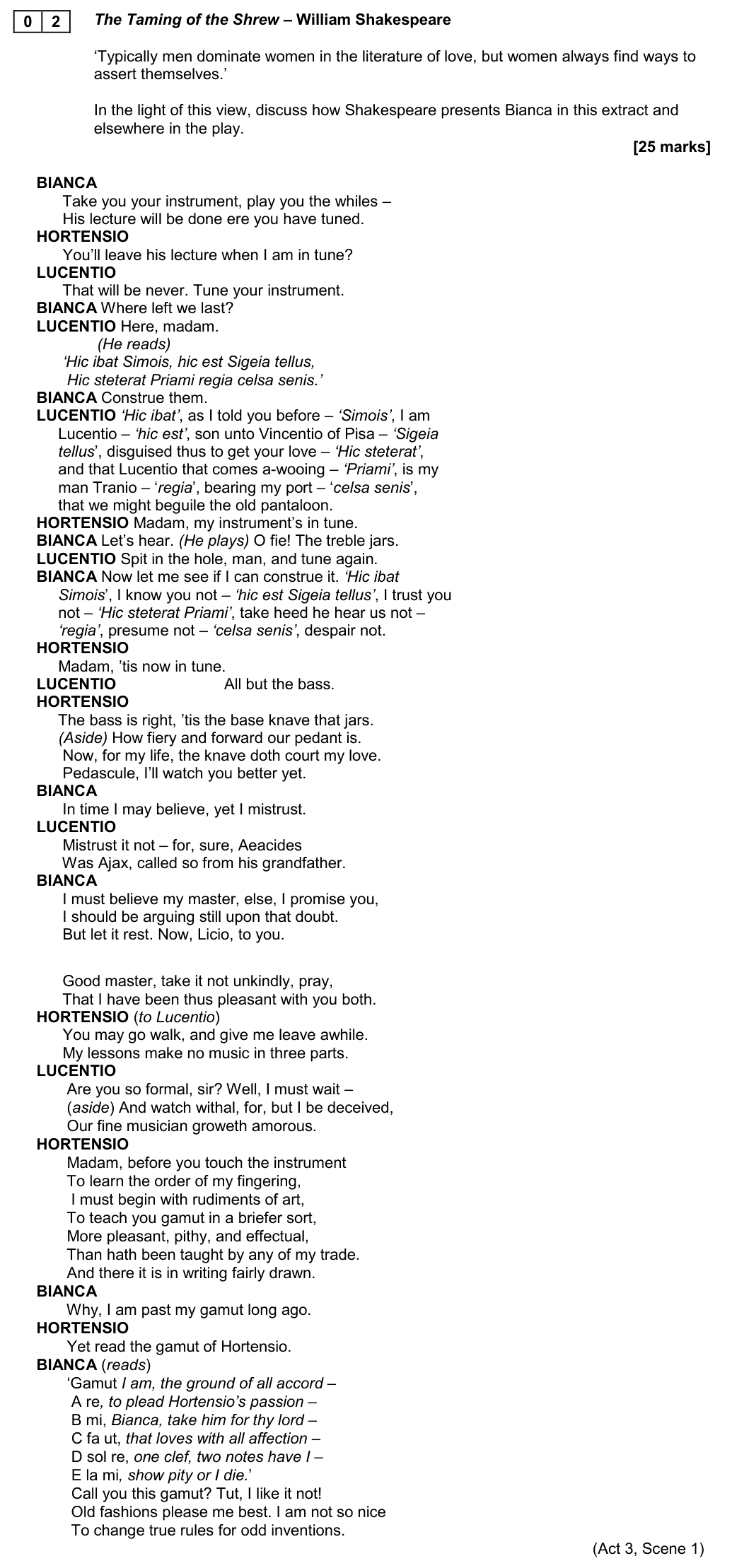
June 2018 · Paper 1 · Q2 25 marks Shakespeare extract taming of the shrew
The Taming of the Shrew – William Shakespeare
‘Typically men dominate women in the literature of love, but women always find ways to
assert themselves.’
In the light of this view, discuss how Shakespeare presents Bianca in this extract and
elsewhere in the play.
[25 marks]
BIANCA
Take you your instrument, play you the whiles –
His lecture will be done ere you have tuned.
HORTENSIO
You’ll leave his lecture when I am in tune?
LUCENTIO
That will be never. Tune your instrument.
BIANCA Where left we last?
LUCENTIO Here, madam.
(He reads)
‘Hic ibat Simois, hic est Sigeia tellus,
Hic steterat Priami regia celsa senis.’
BIANCA Construe them.
LUCENTIO ‘Hic ibat’, as I told you before – ‘Simois’, I am
Lucentio – ‘hic est’, son unto Vincentio of Pisa – ‘Sigeia
tellus’, disguised thus to get your love – ‘Hic steterat’,
and that Lucentio that comes a-wooing – ‘Priami’, is my
man Tranio – ‘regia’, bearing my port – ‘celsa senis’,
that we might beguile the old pantaloon.
HORTENSIO Madam, my instrument’s in tune.
BIANCA Let’s hear. (He plays) O fie! The treble jars.
LUCENTIO Spit in the hole, man, and tune again.
BIANCA Now let me see if I can construe it. ‘Hic ibat
Simois’, I know you not – ‘hic est Sigeia tellus’, I trust you
not – ‘Hic steterat Priami’, take heed he hear us not –
‘regia’, presume not – ‘celsa senis’, despair not.
HORTENSIO
Madam, ’tis now in tune.
LUCENTIO All but the bass.
HORTENSIO
The bass is right, ’tis the base knave that jars.
(Aside) How fiery and forward our pedant is.
Now, for my life, the knave doth court my love.
Pedascule, I’ll watch you better yet.
BIANCA
In time I may believe, yet I mistrust.
LUCENTIO
Mistrust it not – for, sure, Aeacides
Was Ajax, called so from his grandfather.
BIANCA
I must believe my master, else, I promise you,
I should be arguing still upon that doubt.
But let it rest. Now, Licio, to you.
Good master, take it not unkindly, pray,
That I have been thus pleasant with you both.
HORTENSIO (to Lucentio)
You may go walk, and give me leave awhile.
My lessons make no music in three parts.
LUCENTIO
Are you so formal, sir? Well, I must wait –
(aside) And watch withal, for, but I be deceived,
Our fine musician groweth amorous.
HORTENSIO
Madam, before you touch the instrument
To learn the order of my fingering,
I must begin with rudiments of art,
To teach you gamut in a briefer sort,
More pleasant, pithy, and effectual,
Than hath been taught by any of my trade.
And there it is in writing fairly drawn.
BIANCA
Why, I am past my gamut long ago.
HORTENSIO
Yet read the gamut of Hortensio.
BIANCA (reads)
‘Gamut I am, the ground of all accord –
A re, to plead Hortensio’s passion –
B mi, Bianca, take him for thy lord –
C fa ut, that loves with all affection –
D sol re, one clef, two notes have I –
E la mi, show pity or I die.’
Call you this gamut? Tut, I like it not!
Old fashions please me best. I am not so nice
To change true rules for odd inventions.
(Act 3, Scene 1)
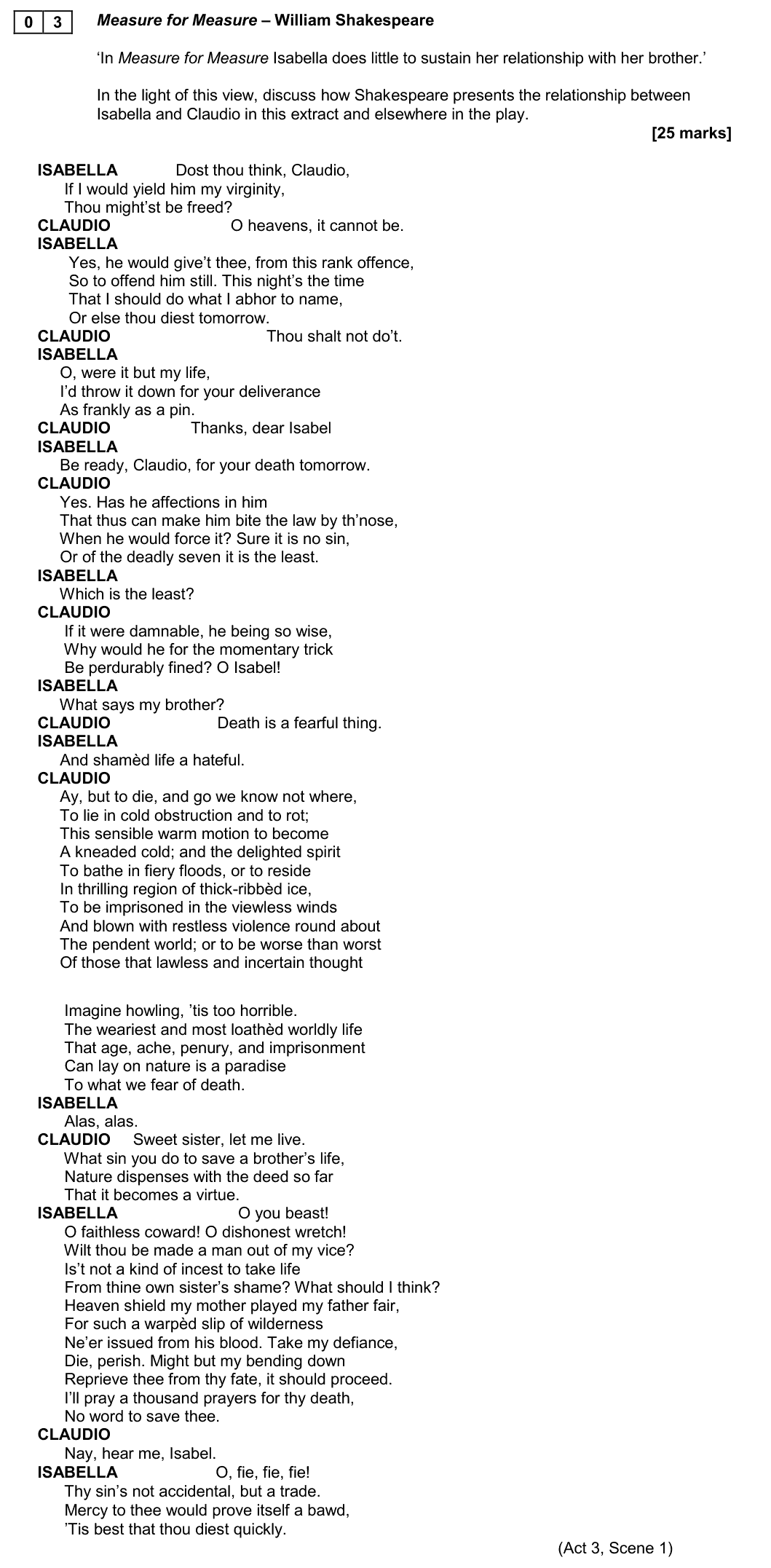
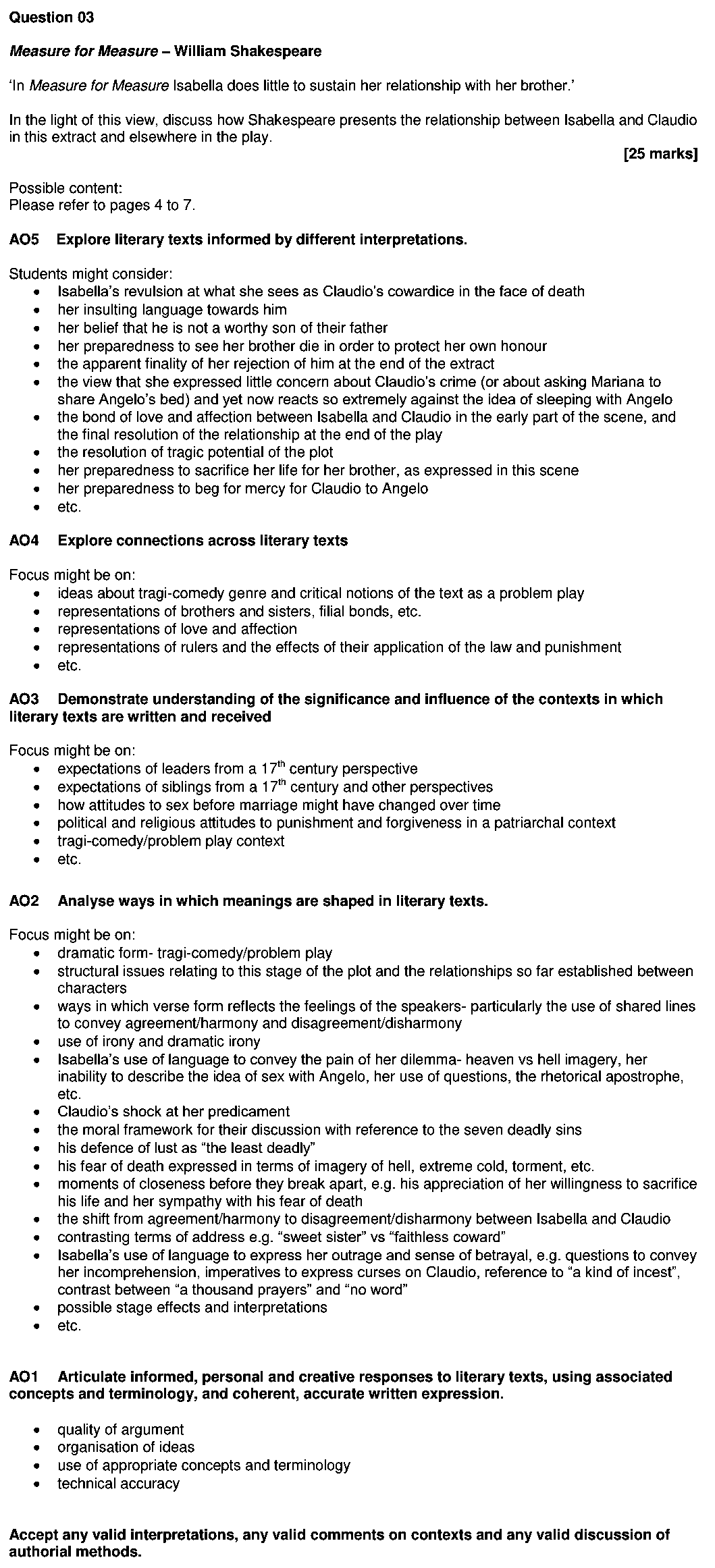
June 2018 · Paper 1 · Q3 25 marks Shakespeare extract measure for measure
Measure for Measure – William Shakespeare
‘In Measure for Measure Isabella does little to sustain her relationship with her brother.’
In the light of this view, discuss how Shakespeare presents the relationship between
Isabella and Claudio in this extract and elsewhere in the play.
[25 marks]
ISABELLA Dost thou think, Claudio,
If I would yield him my virginity,
Thou might’st be freed?
CLAUDIO O heavens, it cannot be.
ISABELLA
Yes, he would give’t thee, from this rank offence,
So to offend him still. This night’s the time
That I should do what I abhor to name,
Or else thou diest tomorrow.
CLAUDIO Thou shalt not do’t.
ISABELLA
O, were it but my life,
I’d throw it down for your deliverance
As frankly as a pin.
CLAUDIO Thanks, dear Isabel
ISABELLA
Be ready, Claudio, for your death tomorrow.
CLAUDIO
Yes. Has he affections in him
That thus can make him bite the law by th’nose,
When he would force it? Sure it is no sin,
Or of the deadly seven it is the least.
ISABELLA
Which is the least?
CLAUDIO
If it were damnable, he being so wise,
Why would he for the momentary trick
Be perdurably fined? O Isabel!
ISABELLA
What says my brother?
CLAUDIO Death is a fearful thing.
ISABELLA
And shamèd life a hateful.
CLAUDIO
Ay, but to die, and go we know not where,
To lie in cold obstruction and to rot;
This sensible warm motion to become
A kneaded cold; and the delighted spirit
To bathe in fiery floods, or to reside
In thrilling region of thick-ribbèd ice,
To be imprisoned in the viewless winds
And blown with restless violence round about
The pendent world; or to be worse than worst
Of those that lawless and incertain thought
Imagine howling, ’tis too horrible.
The weariest and most loathèd worldly life
That age, ache, penury, and imprisonment
Can lay on nature is a paradise
To what we fear of death.
ISABELLA
Alas, alas.
CLAUDIO Sweet sister, let me live.
What sin you do to save a brother’s life,
Nature dispenses with the deed so far
That it becomes a virtue.
ISABELLA O you beast!
O faithless coward! O dishonest wretch!
Wilt thou be made a man out of my vice?
Is’t not a kind of incest to take life
From thine own sister’s shame? What should I think?
Heaven shield my mother played my father fair,
For such a warpèd slip of wilderness
Ne’er issued from his blood. Take my defiance,
Die, perish. Might but my bending down
Reprieve thee from thy fate, it should proceed.
I’ll pray a thousand prayers for thy death,
No word to save thee.
CLAUDIO
Nay, hear me, Isabel.
ISABELLA O, fie, fie, fie!
Thy sin’s not accidental, but a trade.
Mercy to thee would prove itself a bawd,
’Tis best that thou diest quickly.
(Act 3, Scene 1)
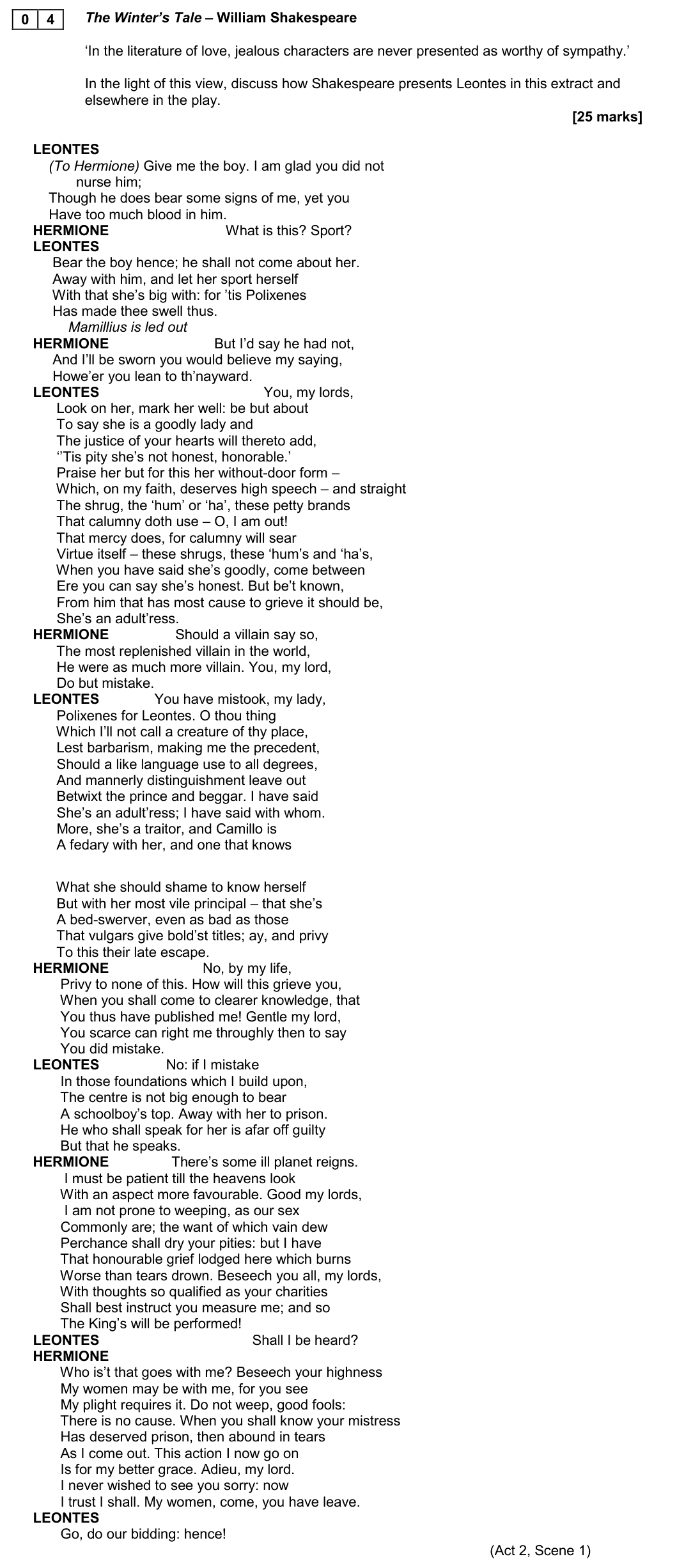
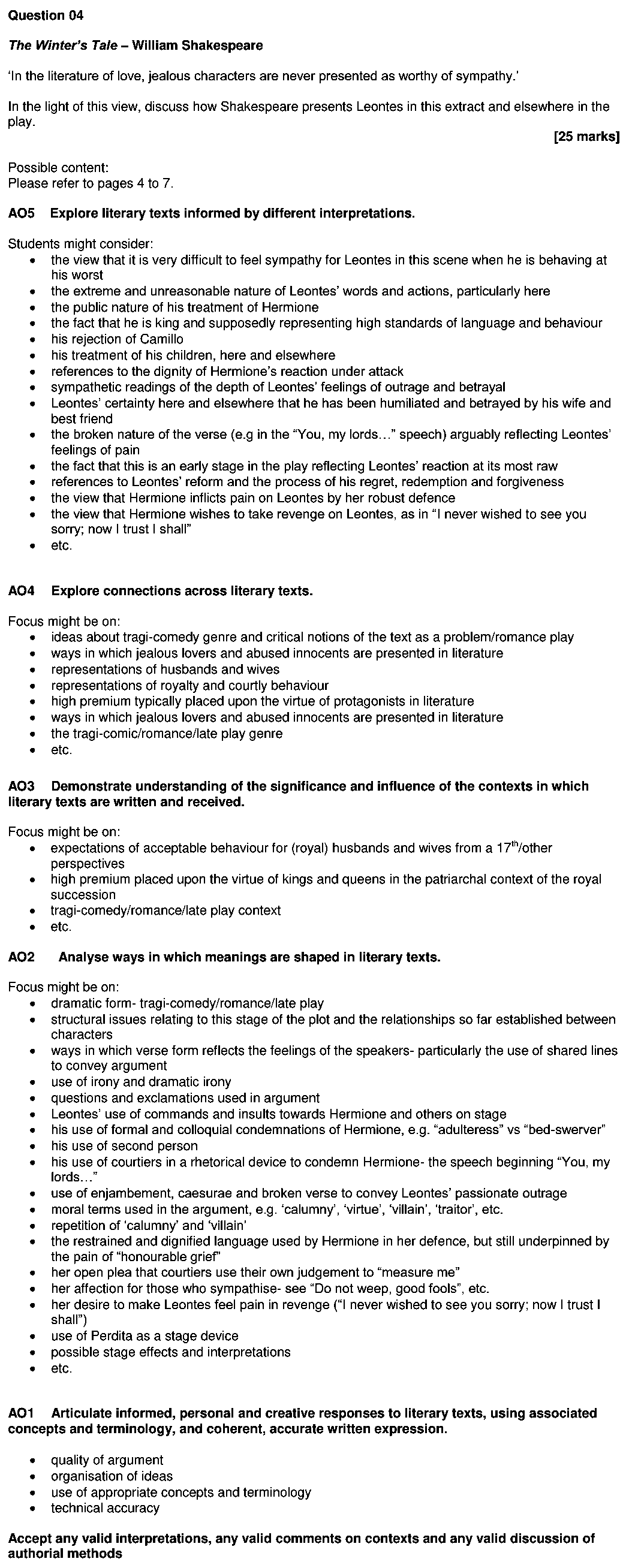
June 2018 · Paper 1 · Q4 25 marks Shakespeare extract the winters tale
The Winter’s Tale – William Shakespeare
‘In the literature of love, jealous characters are never presented as worthy of sympathy.’
In the light of this view, discuss how Shakespeare presents Leontes in this extract and
elsewhere in the play.
[25 marks]
LEONTES
(To Hermione) Give me the boy. I am glad you did not
nurse him;
Though he does bear some signs of me, yet you
Have too much blood in him.
HERMIONE What is this? Sport?
LEONTES
Bear the boy hence; he shall not come about her.
Away with him, and let her sport herself
With that she’s big with: for ’tis Polixenes
Has made thee swell thus.
Mamillius is led out
HERMIONE But I’d say he had not,
And I’ll be sworn you would believe my saying,
Howe’er you lean to th’nayward.
LEONTES You, my lords,
Look on her, mark her well: be but about
To say she is a goodly lady and
The justice of your hearts will thereto add,
‘’Tis pity she’s not honest, honorable.’
Praise her but for this her without-door form –
Which, on my faith, deserves high speech – and straight
The shrug, the ‘hum’ or ‘ha’, these petty brands
That calumny doth use – O, I am out!
That mercy does, for calumny will sear
Virtue itself – these shrugs, these ‘hum’s and ‘ha’s,
When you have said she’s goodly, come between
Ere you can say she’s honest. But be’t known,
From him that has most cause to grieve it should be,
She’s an adult’ress.
HERMIONE Should a villain say so,
The most replenished villain in the world,
He were as much more villain. You, my lord,
Do but mistake.
LEONTES You have mistook, my lady,
Polixenes for Leontes. O thou thing
Which I’ll not call a creature of thy place,
Lest barbarism, making me the precedent,
Should a like language use to all degrees,
And mannerly distinguishment leave out
Betwixt the prince and beggar. I have said
She’s an adult’ress; I have said with whom.
More, she’s a traitor, and Camillo is
A fedary with her, and one that knows
What she should shame to know herself
But with her most vile principal – that she’s
A bed-swerver, even as bad as those
That vulgars give bold’st titles; ay, and privy
To this their late escape.
HERMIONE No, by my life,
Privy to none of this. How will this grieve you,
When you shall come to clearer knowledge, that
You thus have published me! Gentle my lord,
You scarce can right me throughly then to say
You did mistake.
LEONTES No: if I mistake
In those foundations which I build upon,
The centre is not big enough to bear
A schoolboy’s top. Away with her to prison.
He who shall speak for her is afar off guilty
But that he speaks.
HERMIONE There’s some ill planet reigns.
I must be patient till the heavens look
With an aspect more favourable. Good my lords,
I am not prone to weeping, as our sex
Commonly are; the want of which vain dew
Perchance shall dry your pities: but I have
That honourable grief lodged here which burns
Worse than tears drown. Beseech you all, my lords,
With thoughts so qualified as your charities
Shall best instruct you measure me; and so
The King’s will be performed!
LEONTES Shall I be heard?
HERMIONE
Who is’t that goes with me? Beseech your highness
My women may be with me, for you see
My plight requires it. Do not weep, good fools:
There is no cause. When you shall know your mistress
Has deserved prison, then abound in tears
As I come out. This action I now go on
Is for my better grace. Adieu, my lord.
I never wished to see you sorry: now
I trust I shall. My women, come, you have leave.
LEONTES
Go, do our bidding: hence!
(Act 2, Scene 1)
June 2018 · Paper 1 · Q5 25 marks Unseen poetry unseen love poetry
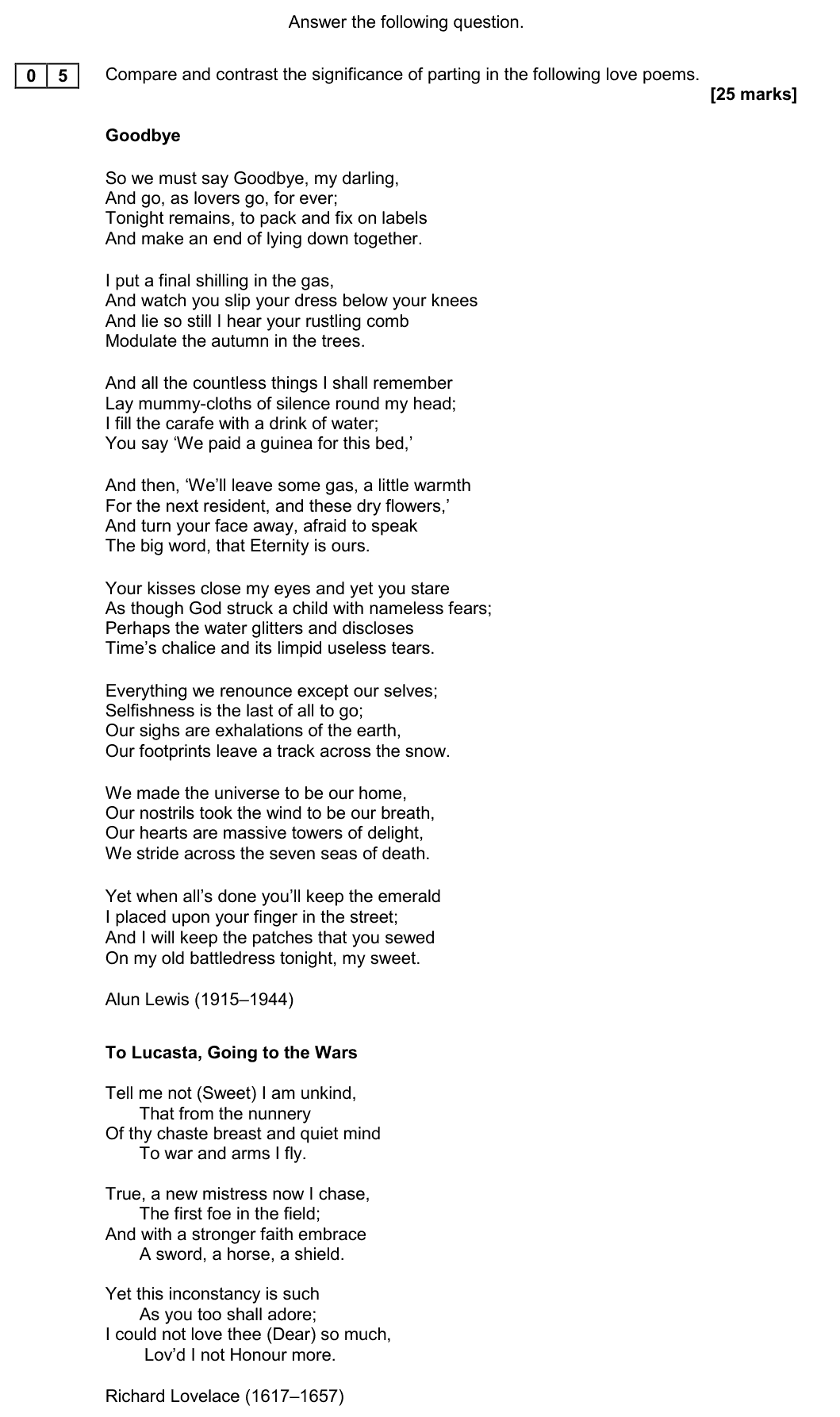
Answer the following question.
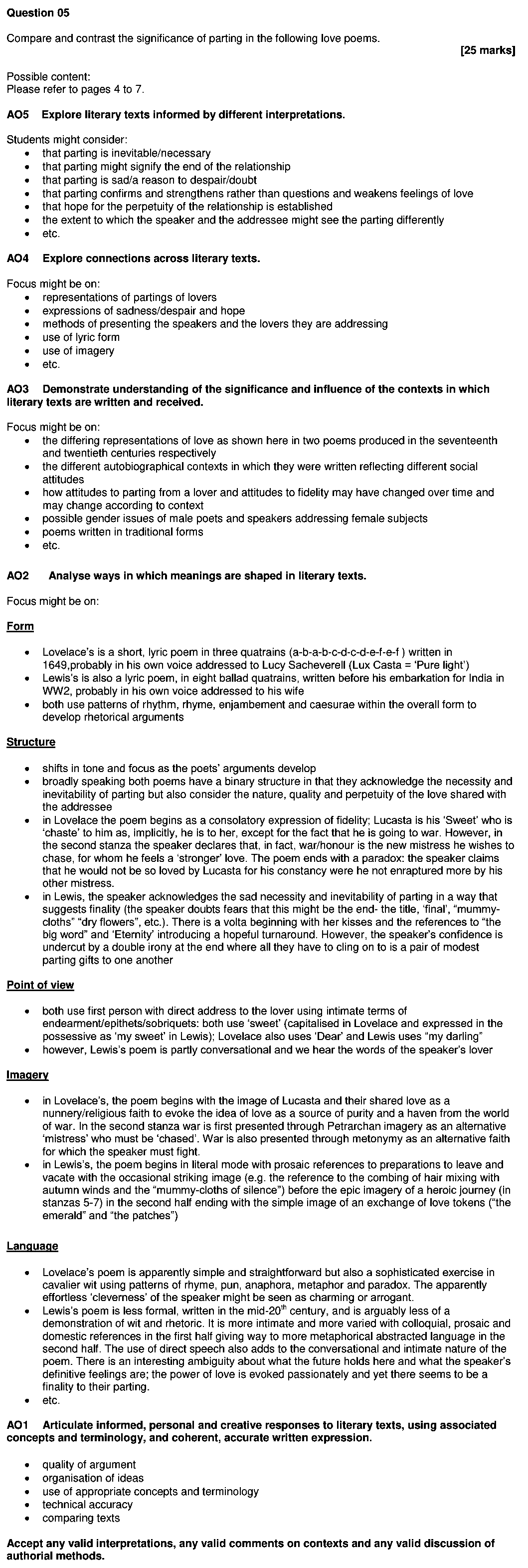
Compare and contrast the significance of parting in the following love poems.
[25 marks]
Goodbye
So we must say Goodbye, my darling,
And go, as lovers go, for ever;
Tonight remains, to pack and fix on labels
And make an end of lying down together.
I put a final shilling in the gas,
And watch you slip your dress below your knees
And lie so still I hear your rustling comb
Modulate the autumn in the trees.
And all the countless things I shall remember
Lay mummy-cloths of silence round my head;
I fill the carafe with a drink of water;
You say ‘We paid a guinea for this bed,’
And then, ‘We’ll leave some gas, a little warmth
For the next resident, and these dry flowers,’
And turn your face away, afraid to speak
The big word, that Eternity is ours.
Your kisses close my eyes and yet you stare
As though God struck a child with nameless fears;
Perhaps the water glitters and discloses
Time’s chalice and its limpid useless tears.
Everything we renounce except our selves;
Selfishness is the last of all to go;
Our sighs are exhalations of the earth,
Our footprints leave a track across the snow.
We made the universe to be our home,
Our nostrils took the wind to be our breath,
Our hearts are massive towers of delight,
We stride across the seven seas of death.
Yet when all’s done you’ll keep the emerald
I placed upon your finger in the street;
And I will keep the patches that you sewed
On my old battledress tonight, my sweet.
Alun Lewis (1915–1944)
To Lucasta, Going to the Wars
Tell me not (Sweet) I am unkind,
That from the nunnery
Of thy chaste breast and quiet mind
To war and arms I fly.
True, a new mistress now I chase,
The first foe in the field;
And with a stronger faith embrace
A sword, a horse, a shield.
Yet this inconstancy is such
As you too shall adore;
I could not love thee (Dear) so much,
Lov’d I not Honour more.
Richard Lovelace (1617–1657)
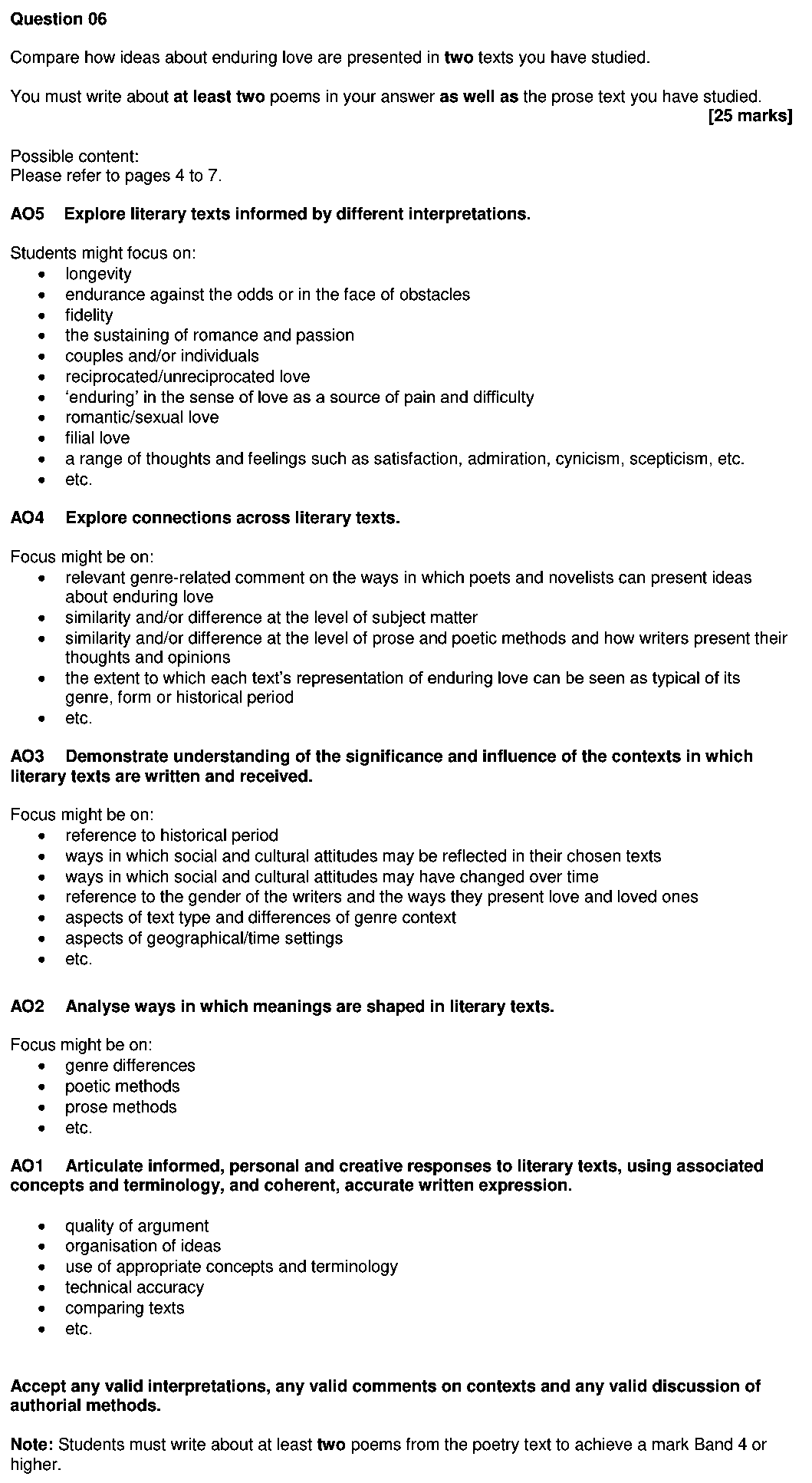
June 2018 · Paper 1 · Q6 25 marks Comparing texts love poetry pre 1900love poetry post 1900comparing prose love
Compare how ideas about enduring love are presented in two texts you have studied.
You must write about at least two poems in your answer as well as the prose text you
have studied.
[25 marks]
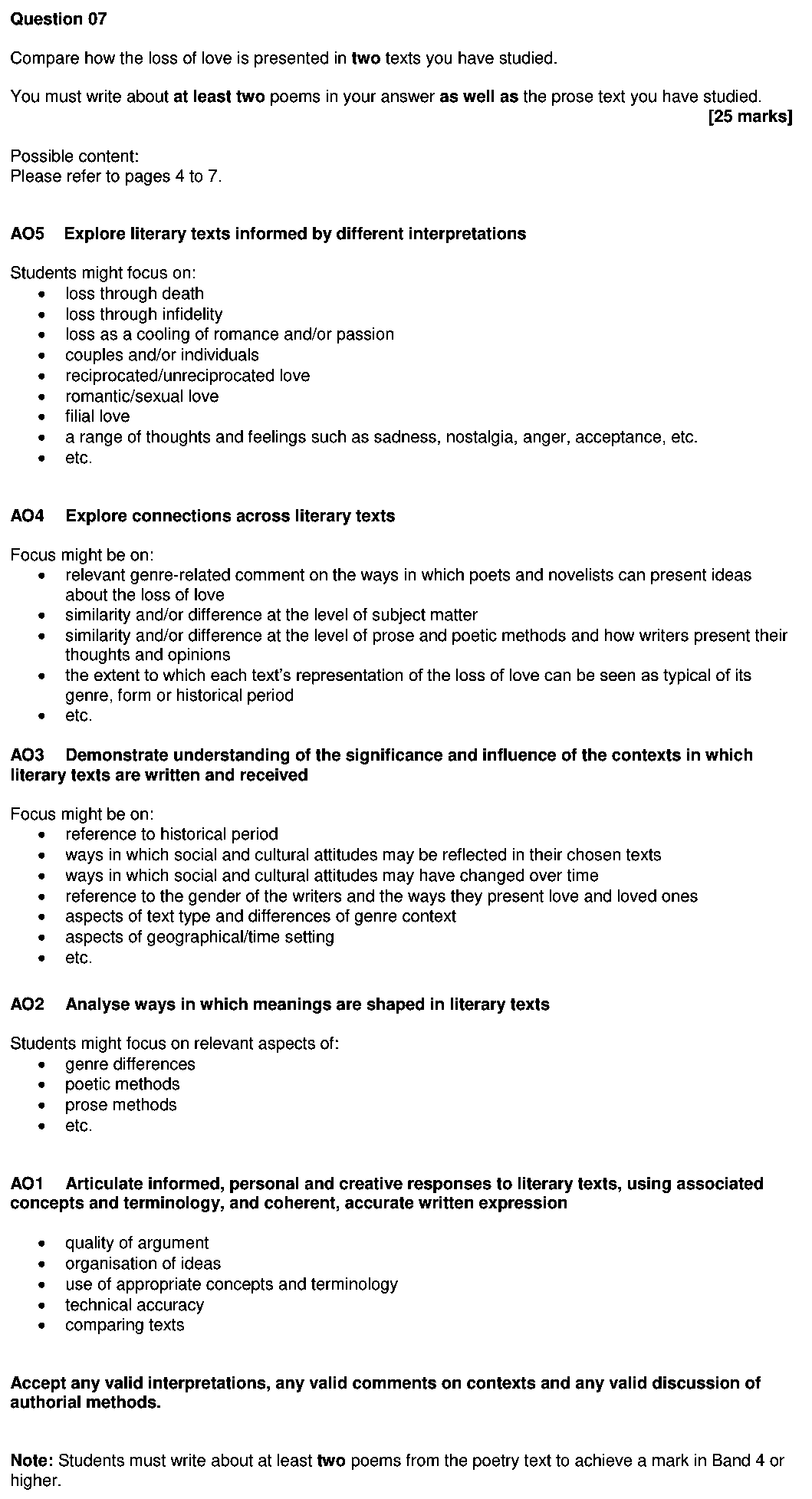
June 2018 · Paper 1 · Q7 25 marks Comparing texts love poetry pre 1900love poetry post 1900comparing prose love
Compare how the loss of love is presented in two texts you have studied.
You must write about at least two poems in your answer as well as the prose text you
have studied.
[25 marks]

Work with an AQA English Literature A tutor

Want a paper marked and gone through with you? Message us.

Prefer email? Send an enquiry

If you are under 18, please include a parent's contact details. Enquiries go to enquiries@alevelenglishtutor.com and are deleted once handled. All tutoring is online.