June 2019: AS Paper 1, Shakespeare and poetry

50 marks · 6 questions (every option is included) · Paper, mark scheme and report on AQA's site · AQA no longer hosts this series; the questions are from a copy of AQA's original paper

Question by question

QTopicMarksAOType
1 Othello 25Shakespeare extract
2 The Taming of the Shrew 25Shakespeare extract
3 Measure for Measure 25Shakespeare extract
4 The Winter's Tale 25Shakespeare extract
5 AQA Anthology: love poetry pre-1900 25Anthology poetry
6 AQA Anthology: love poetry post-1900 25Anthology poetry

The questions

123456
June 2019 · AS Paper 1 · Q1 25 marks Shakespeare extract othello
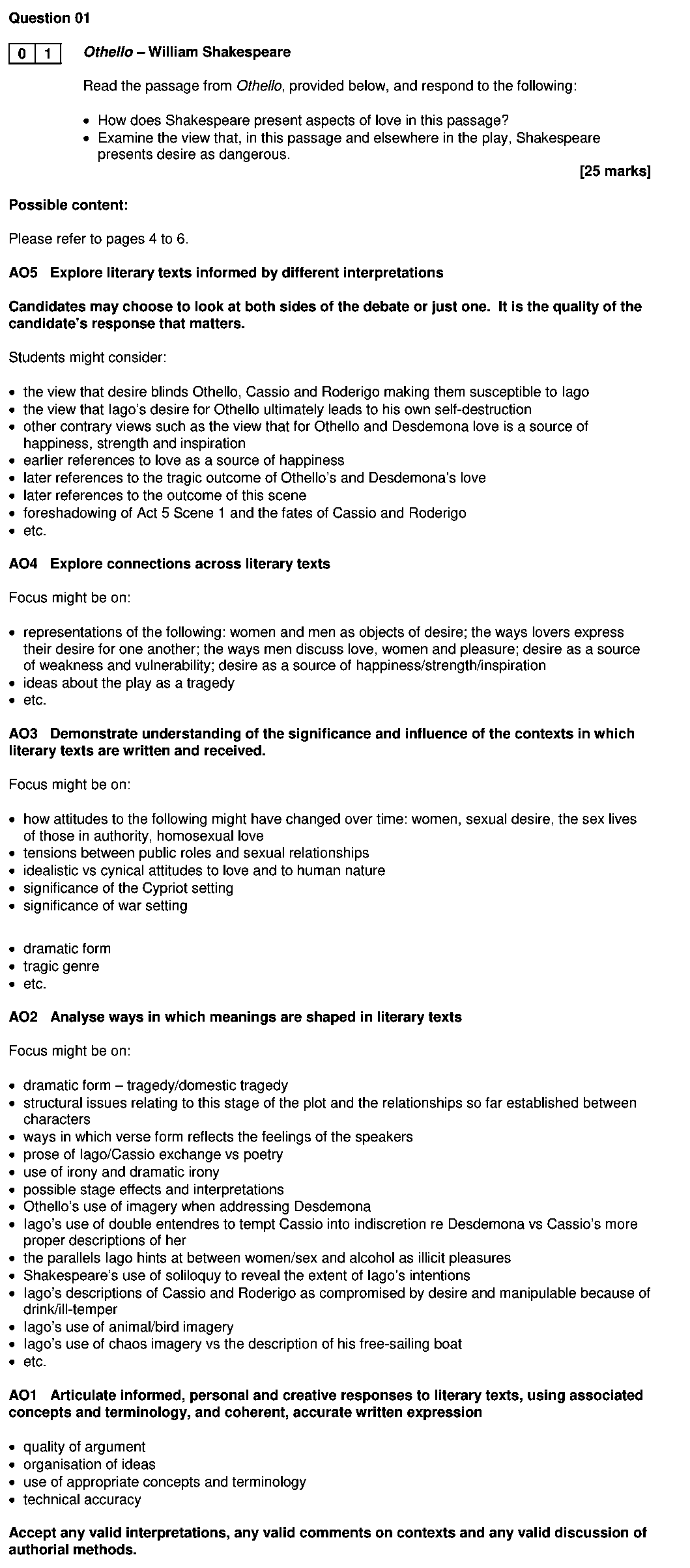
Othello – William Shakespeare
Read the passage from Othello, provided below, and respond to the following:
• How does Shakespeare present aspects of love in this passage?
• Examine the view that, in this passage and elsewhere in the play, Shakespeare
presents desire as dangerous.
[25 marks]
OTHELLO
Good Michael, look you to the guard tonight.
Let’s teach ourselves that honourable stop,
Not to outsport discretion.
CASSIO
Iago hath direction what to do;
But, notwithstanding, with my personal eye
Will I look to’t.
OTHELLO Iago is most honest.
Michael, good night. Tomorrow with your earliest
Let me have speech with you. (To Desdemona)
Come, my dear love,
The purchase made, the fruits are to ensue:
That profit’s yet to come ’tween me and you.
Good night.
Exeunt Othello, Desdemona, and attendants
Enter Iago
CASSIO Welcome, Iago; we must to the watch.
IAGO Not this hour, Lieutenant; ’tis not yet ten o’th’clock.
Our General cast us thus early for the love of his
Desdemona; who let us not therefore blame. He hath
not yet made wanton the night with her; and she is
sport for Jove.
CASSIO She is a most exquisite lady.
IAGO And, I’ll warrant her, full of game.
CASSIO Indeed, she is a most fresh and delicate creature.
IAGO What an eye she has! Methinks it sounds a parley to
provocation.
CASSIO An inviting eye, and yet methinks right modest.
IAGO And when she speaks, is it not an alarum to love?
CASSIO She is indeed perfection.
IAGO Well, happiness to their sheets! Come, Lieutenant,
I have a stoup of wine; and here without are a brace of
Cyprus gallants that would fain have a measure to the
health of black Othello.
CASSIO Not tonight, good Iago. I have very poor and
unhappy brains for drinking. I could well wish courtesy
would invent some other custom of entertainment.
IAGO O, they are our friends! But one cup; I’ll drink for
you.
CASSIO I have drunk but one cup tonight, and that was
craftily qualified too; and behold what innovation it
makes here. I am unfortunate in the infirmity and dare
not task my weakness with any more.
IAGO What, man! ’Tis a night of revels; the gallants desire
it.
CASSIO Where are they?
IAGO Here, at the door: I pray you call them in.
CASSIO I’ll do’t, but it dislikes me. Exit
IAGO
If I can fasten but one cup upon him,
With that which he hath drunk tonight already,
He’ll be as full of quarrel and offence
As my young mistress’ dog. Now my sick fool Roderigo,
Whom love hath turned almost the wrong side out,
To Desdemona hath tonight caroused
Potations pottle-deep; and he’s to watch.
Three else of Cyprus, noble swelling spirits –
That hold their honours in a wary distance,
The very elements of this warlike isle –
Have I tonight flustered with flowing cups,
And they watch too. Now ’mongst this flock of drunkards,
Am I to put our Cassio in some action
That may offend the isle. But here they come;
If consequence do but approve my dream,
My boat sails freely both with wind and stream.
(Act 2, Scene 3)
June 2019 · AS Paper 1 · Q2 25 marks Shakespeare extract taming of the shrew
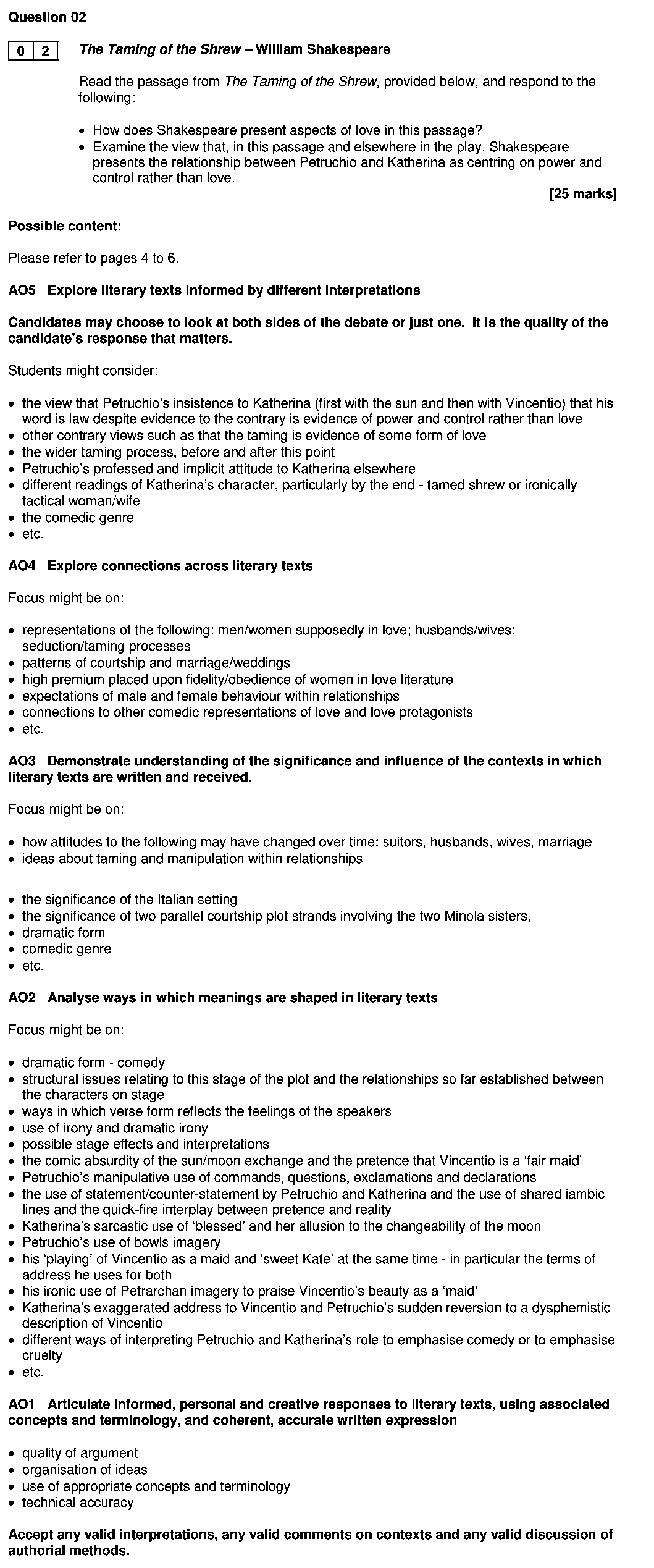
The Taming of the Shrew – William Shakespeare
Read the passage from The Taming of the Shrew, provided below, and respond to the
following:
• How does Shakespeare present aspects of love in this passage?
• Examine the view that, in this passage and elsewhere in the play, Shakespeare
presents the relationship between Petruchio and Katherina as one based on power and
control rather than love.
[25 marks]
Enter Petruchio, Katherina, Hortensio and Servants
PETRUCHIO
Come on, a God’s name, once more toward our father’s.
Good Lord, how bright and goodly shines the moon!
KATHERINA
The moon? The sun! It is not moonlight now.
PETRUCHIO
I say it is the moon that shines so bright.
KATHERINA
I know it is the sun that shines so bright.
PETRUCHIO
Now by my mother’s son, and that’s myself,
It shall be moon, or star, or what I list,
Or e’er I journey to your father’s house.
(To the Servants) Go on and fetch our horses back again.
Evermore crossed and crossed, nothing but crossed!
HORTENSIO
Say as he says, or we shall never go.
KATHERINA
Forward, I pray, since we have come so far,
And be it moon, or sun, or what you please.
And if you please to call it a rush-candle,
Henceforth I vow it shall be so for me.
PETRUCHIO
I say it is the moon.
KATHERINA I know it is the moon.
PETRUCHIO
Nay, then you lie. It is the blessèd sun.
KATHERINA
Then, God be blessed, it is the blessèd sun.
But sun it is not, when you say it is not,
And the moon changes even as your mind.
What you will have it named, even that it is,
And so it shall be so for Katherine.
HORTENSIO (aside)
Petruchio, go thy ways, the field is won.
PETRUCHIO
Well, forward, forward! Thus the bowl should run,
And not unluckily against the bias.
But soft, company is coming here.
Enter Vincentio.
(To Vincentio) Good morrow, gentle mistress, where
away?
Tell me, sweet Kate, and tell me truly too,
Hast thou beheld a fresher gentlewoman?
Such war of white and red within her cheeks!
What stars do spangle heaven with such beauty
As those two eyes become that heavenly face?
Fair lovely maid, once more good day to thee.
Sweet Kate, embrace her for her beauty’s sake.
HORTENSIO (aside) ’A will make the man mad, to make the
woman of him.
KATHERINA
Young budding virgin, fair and fresh and sweet,
Whither away, or where is thy abode?
Happy the parents of so fair a child,
Happier the man whom favourable stars
Allots thee for his lovely bedfellow.
PETRUCHIO
Why, how now, Kate, I hope thou art not mad!
This is a man, old, wrinkled, faded, withered,
And not a maiden, as thou say’st he is.
KATHERINA
Pardon, old father, my mistaking eyes,
That have been so bedazzled with the sun
That everything I look on seemeth green.
Now I perceive thou art a reverend father.
Pardon, I pray thee, for my mad mistaking.
(Act 4, Scene 5)
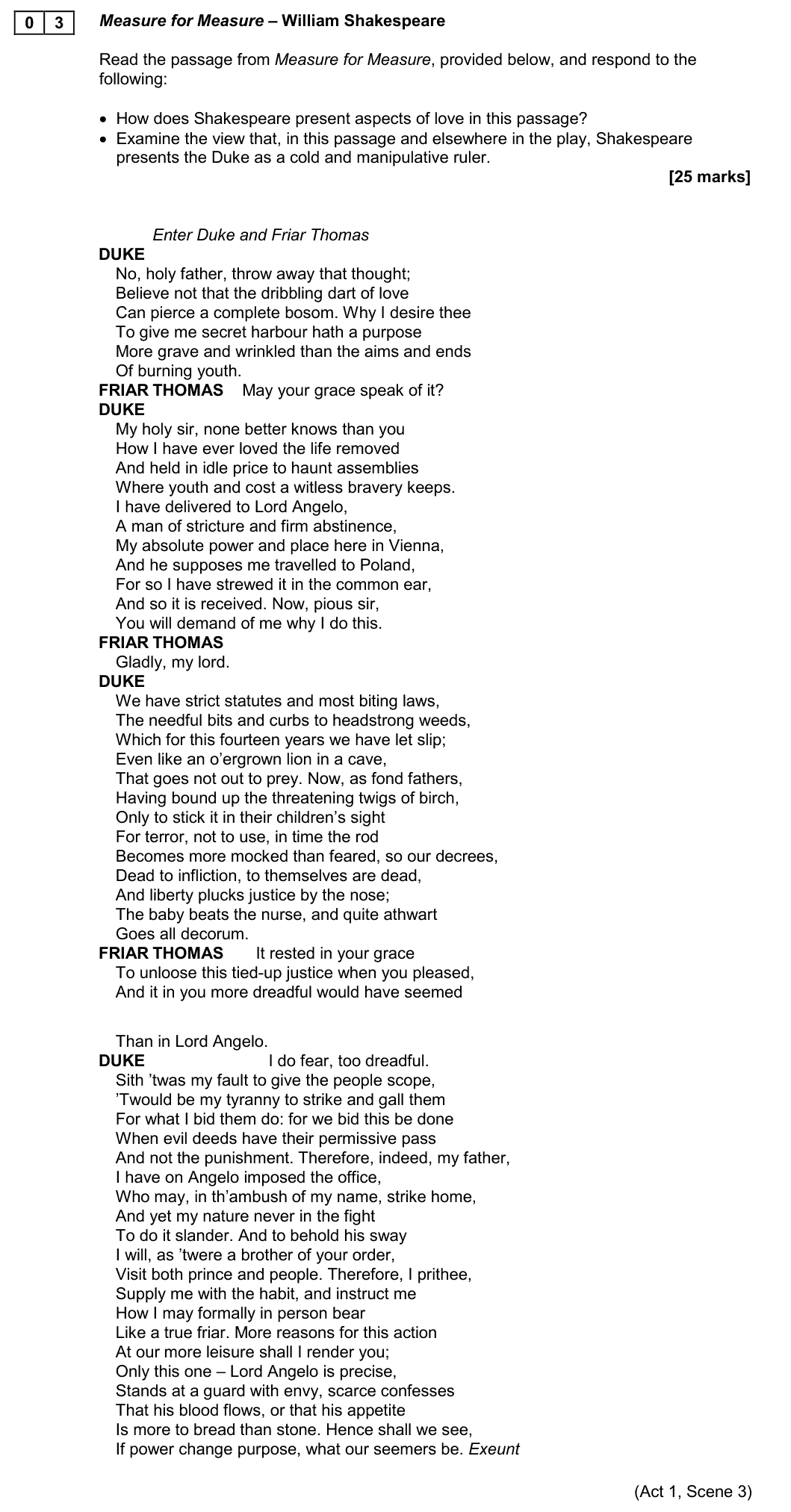
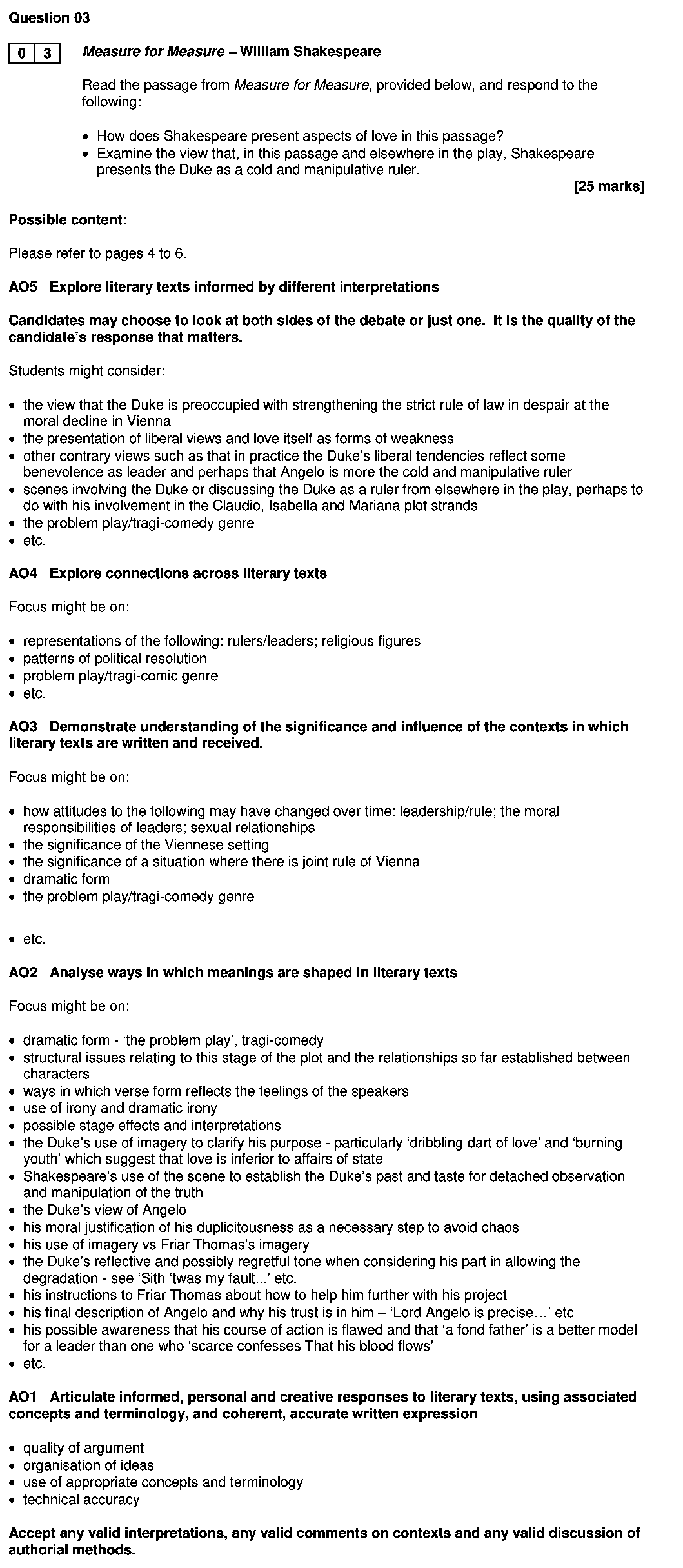
June 2019 · AS Paper 1 · Q3 25 marks Shakespeare extract measure for measure
Measure for Measure – William Shakespeare
Read the passage from Measure for Measure, provided below, and respond to the
following:
• How does Shakespeare present aspects of love in this passage?
• Examine the view that, in this passage and elsewhere in the play, Shakespeare
presents the Duke as a cold and manipulative ruler.
[25 marks]
Enter Duke and Friar Thomas
DUKE
No, holy father, throw away that thought;
Believe not that the dribbling dart of love
Can pierce a complete bosom. Why I desire thee
To give me secret harbour hath a purpose
More grave and wrinkled than the aims and ends
Of burning youth.
FRIAR THOMAS May your grace speak of it?
DUKE
My holy sir, none better knows than you
How I have ever loved the life removed
And held in idle price to haunt assemblies
Where youth and cost a witless bravery keeps.
I have delivered to Lord Angelo,
A man of stricture and firm abstinence,
My absolute power and place here in Vienna,
And he supposes me travelled to Poland,
For so I have strewed it in the common ear,
And so it is received. Now, pious sir,
You will demand of me why I do this.
FRIAR THOMAS
Gladly, my lord.
DUKE
We have strict statutes and most biting laws,
The needful bits and curbs to headstrong weeds,
Which for this fourteen years we have let slip;
Even like an o’ergrown lion in a cave,
That goes not out to prey. Now, as fond fathers,
Having bound up the threatening twigs of birch,
Only to stick it in their children’s sight
For terror, not to use, in time the rod
Becomes more mocked than feared, so our decrees,
Dead to infliction, to themselves are dead,
And liberty plucks justice by the nose;
The baby beats the nurse, and quite athwart
Goes all decorum.
FRIAR THOMAS It rested in your grace
To unloose this tied-up justice when you pleased,
And it in you more dreadful would have seemed
Than in Lord Angelo.
DUKE I do fear, too dreadful.
Sith ’twas my fault to give the people scope,
’Twould be my tyranny to strike and gall them
For what I bid them do: for we bid this be done
When evil deeds have their permissive pass
And not the punishment. Therefore, indeed, my father,
I have on Angelo imposed the office,
Who may, in th’ambush of my name, strike home,
And yet my nature never in the fight
To do it slander. And to behold his sway
I will, as ’twere a brother of your order,
Visit both prince and people. Therefore, I prithee,
Supply me with the habit, and instruct me
How I may formally in person bear
Like a true friar. More reasons for this action
At our more leisure shall I render you;
Only this one – Lord Angelo is precise,
Stands at a guard with envy, scarce confesses
That his blood flows, or that his appetite
Is more to bread than stone. Hence shall we see,
If power change purpose, what our seemers be. Exeunt
(Act 1, Scene 3)
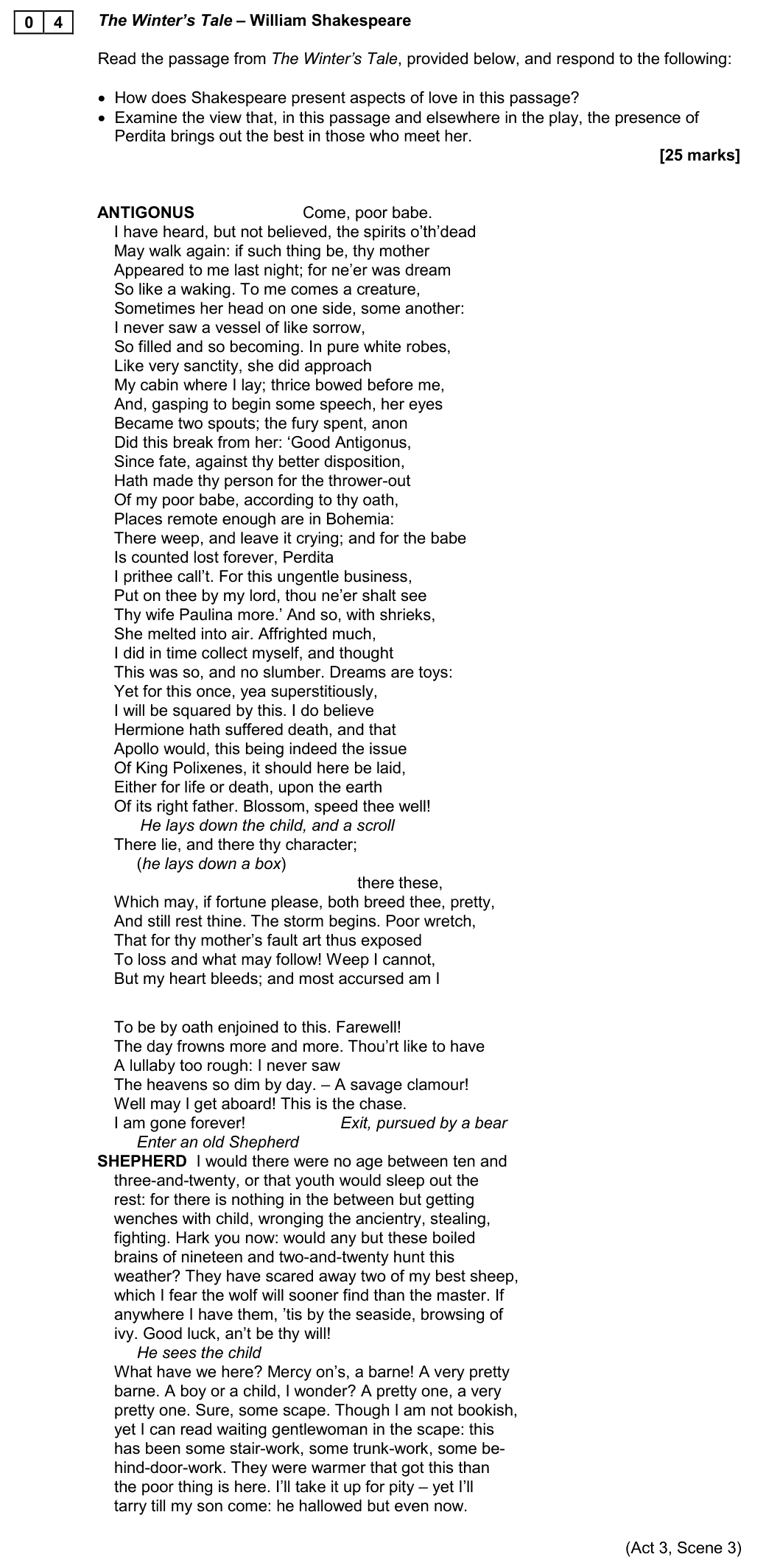
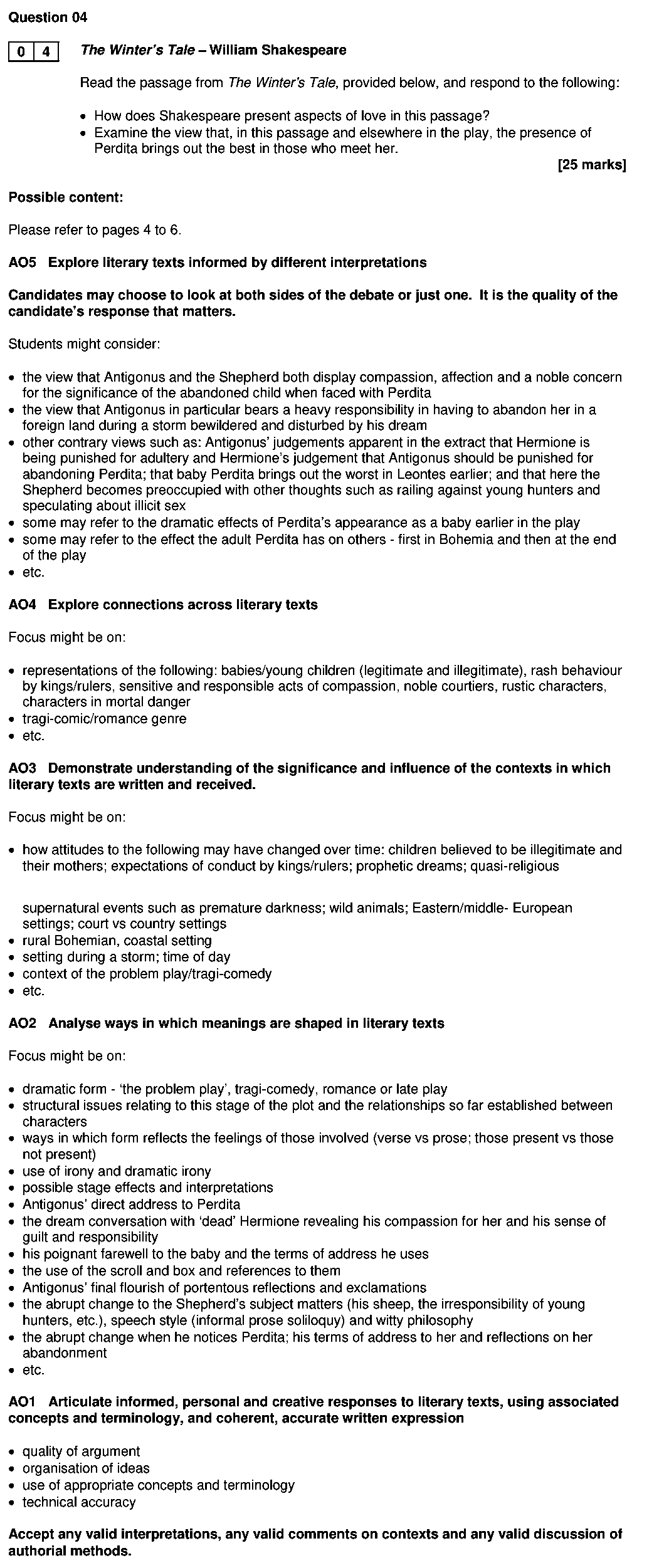
June 2019 · AS Paper 1 · Q4 25 marks Shakespeare extract the winters tale
The Winter’s Tale – William Shakespeare
Read the passage from The Winter’s Tale, provided below, and respond to the following:
• How does Shakespeare present aspects of love in this passage?
• Examine the view that, in this passage and elsewhere in the play, the presence of
Perdita brings out the best in those who meet her.
[25 marks]
ANTIGONUS Come, poor babe.
I have heard, but not believed, the spirits o’th’dead
May walk again: if such thing be, thy mother
Appeared to me last night; for ne’er was dream
So like a waking. To me comes a creature,
Sometimes her head on one side, some another:
I never saw a vessel of like sorrow,
So filled and so becoming. In pure white robes,
Like very sanctity, she did approach
My cabin where I lay; thrice bowed before me,
And, gasping to begin some speech, her eyes
Became two spouts; the fury spent, anon
Did this break from her: ‘Good Antigonus,
Since fate, against thy better disposition,
Hath made thy person for the thrower-out
Of my poor babe, according to thy oath,
Places remote enough are in Bohemia:
There weep, and leave it crying; and for the babe
Is counted lost forever, Perdita
I prithee call’t. For this ungentle business,
Put on thee by my lord, thou ne’er shalt see
Thy wife Paulina more.’ And so, with shrieks,
She melted into air. Affrighted much,
I did in time collect myself, and thought
This was so, and no slumber. Dreams are toys:
Yet for this once, yea superstitiously,
I will be squared by this. I do believe
Hermione hath suffered death, and that
Apollo would, this being indeed the issue
Of King Polixenes, it should here be laid,
Either for life or death, upon the earth
Of its right father. Blossom, speed thee well!
He lays down the child, and a scroll
There lie, and there thy character;
(he lays down a box)
there these,
Which may, if fortune please, both breed thee, pretty,
And still rest thine. The storm begins. Poor wretch,
That for thy mother’s fault art thus exposed
To loss and what may follow! Weep I cannot,
But my heart bleeds; and most accursed am I
To be by oath enjoined to this. Farewell!
The day frowns more and more. Thou’rt like to have
A lullaby too rough: I never saw
The heavens so dim by day. – A savage clamour!
Well may I get aboard! This is the chase.
I am gone forever! Exit, pursued by a bear
Enter an old Shepherd
SHEPHERD I would there were no age between ten and
three-and-twenty, or that youth would sleep out the
rest: for there is nothing in the between but getting
wenches with child, wronging the ancientry, stealing,
fighting. Hark you now: would any but these boiled
brains of nineteen and two-and-twenty hunt this
weather? They have scared away two of my best sheep,
which I fear the wolf will sooner find than the master. If
anywhere I have them, ’tis by the seaside, browsing of
ivy. Good luck, an’t be thy will!
He sees the child
What have we here? Mercy on’s, a barne! A very pretty
barne. A boy or a child, I wonder? A pretty one, a very
pretty one. Sure, some scape. Though I am not bookish,
yet I can read waiting gentlewoman in the scape: this
has been some stair-work, some trunk-work, some be-
hind-door-work. They were warmer that got this than
the poor thing is here. I’ll take it up for pity – yet I’ll
tarry till my son come: he hallowed but even now.
(Act 3, Scene 3)
June 2019 · AS Paper 1 · Q5 25 marks Anthology poetry love poetry pre 1900
AQA Anthology of Love Poetry through the Ages pre-1900
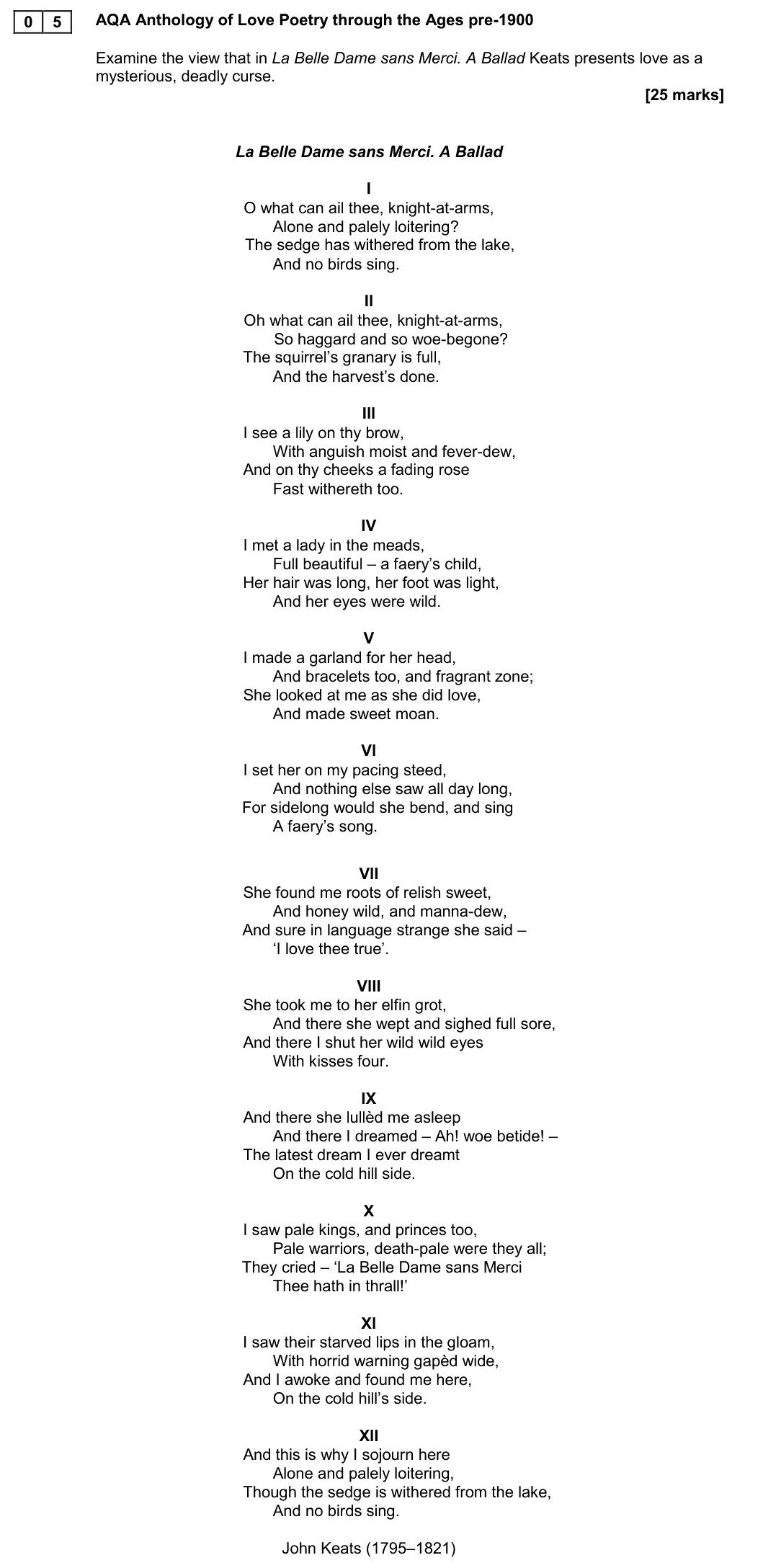
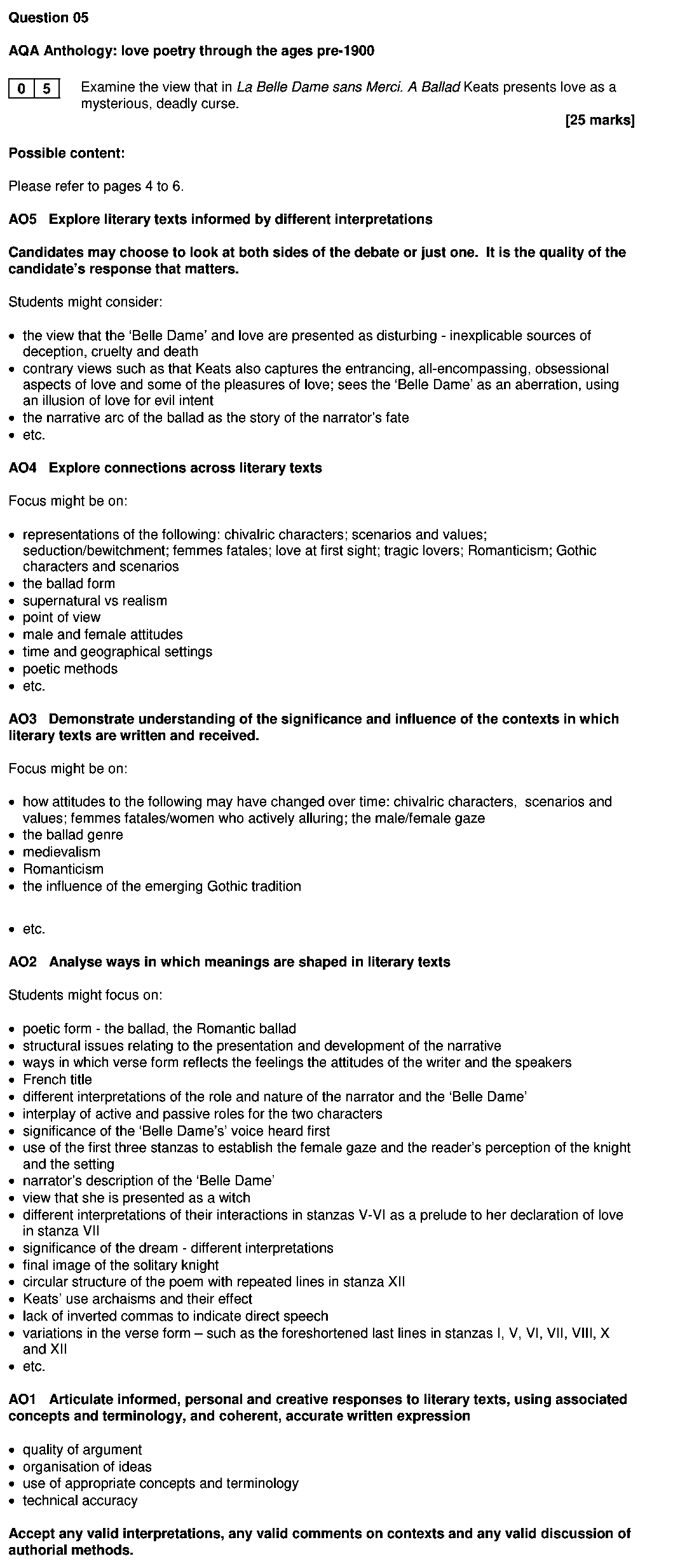
Examine the view that in La Belle Dame sans Merci. A Ballad Keats presents love as a
mysterious, deadly curse.
[25 marks]
La Belle Dame sans Merci. A Ballad
I
O what can ail thee, knight-at-arms,
Alone and palely loitering?
The sedge has withered from the lake,
And no birds sing.
II
Oh what can ail thee, knight-at-arms,
So haggard and so woe-begone?
The squirrel’s granary is full,
And the harvest’s done.
III
I see a lily on thy brow,
With anguish moist and fever-dew,
And on thy cheeks a fading rose
Fast withereth too.
IV
I met a lady in the meads,
Full beautiful – a faery’s child,
Her hair was long, her foot was light,
And her eyes were wild.
V
I made a garland for her head,
And bracelets too, and fragrant zone;
She looked at me as she did love,
And made sweet moan.
VI
I set her on my pacing steed,
And nothing else saw all day long,
For sidelong would she bend, and sing
A faery’s song.
VII
She found me roots of relish sweet,
And honey wild, and manna-dew,
And sure in language strange she said –
‘I love thee true’.
VIII
She took me to her elfin grot,
And there she wept and sighed full sore,
And there I shut her wild wild eyes
With kisses four.
IX
And there she lullèd me asleep
And there I dreamed – Ah! woe betide! –
The latest dream I ever dreamt
On the cold hill side.
X
I saw pale kings, and princes too,
Pale warriors, death-pale were they all;
They cried – ‘La Belle Dame sans Merci
Thee hath in thrall!’
XI
I saw their starved lips in the gloam,
With horrid warning gapèd wide,
And I awoke and found me here,
On the cold hill’s side.
XII
And this is why I sojourn here
Alone and palely loitering,
Though the sedge is withered from the lake,
And no birds sing.
John Keats (1795–1821)
June 2019 · AS Paper 1 · Q6 25 marks Anthology poetry love poetry post 1900
AQA Anthology of Love Poetry through the Ages post-1900
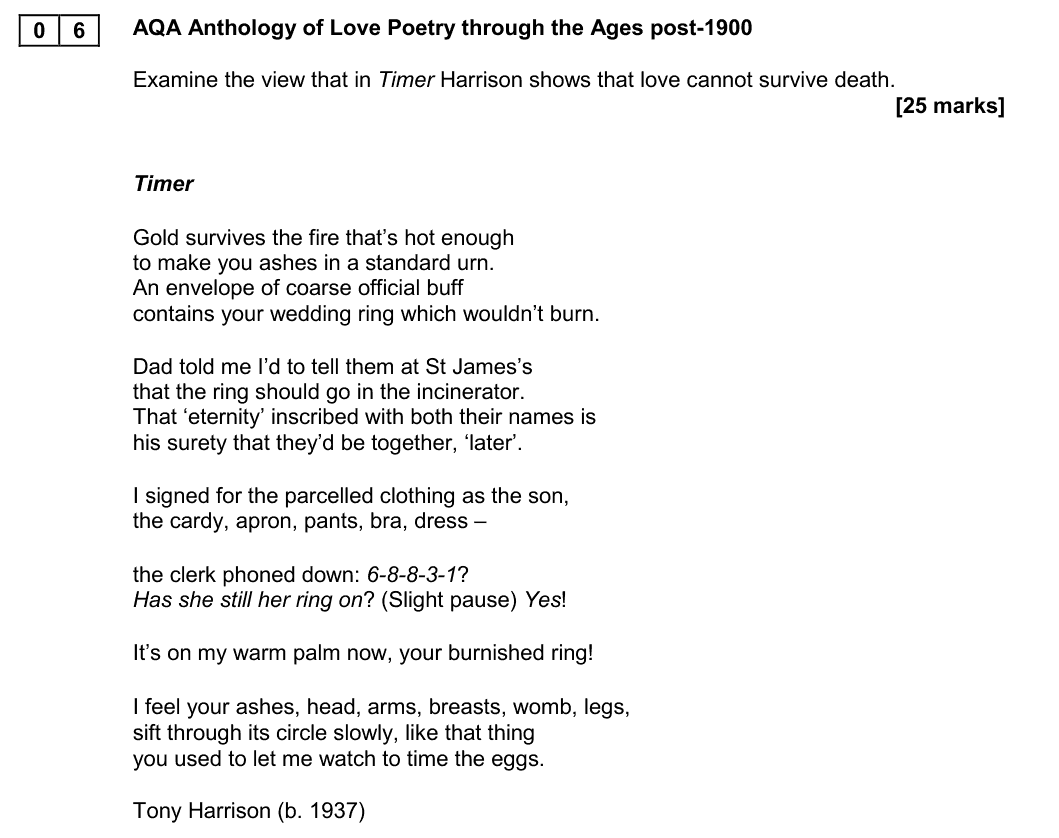
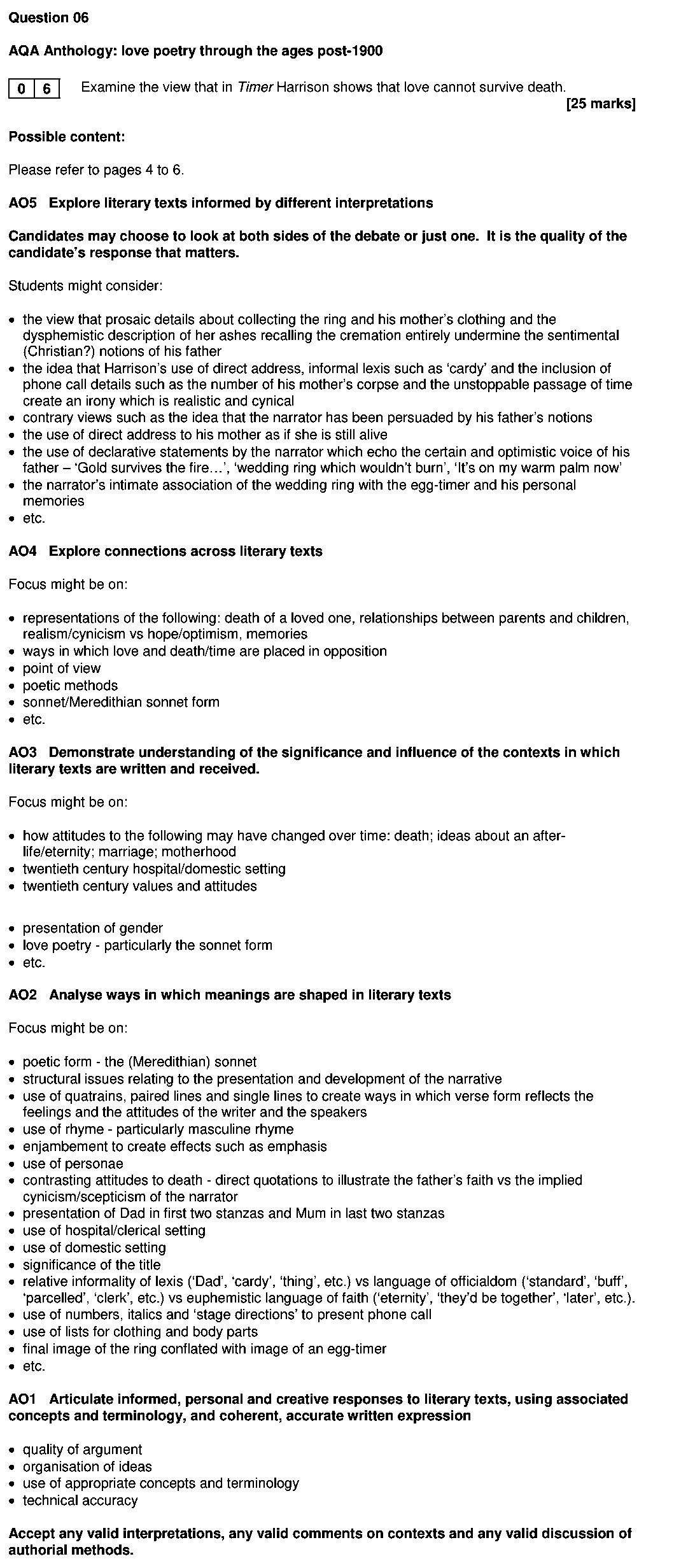
Examine the view that in Timer Harrison shows that love cannot survive death.
[25 marks]
Timer
Gold survives the fire that’s hot enough
to make you ashes in a standard urn.
An envelope of coarse official buff
contains your wedding ring which wouldn’t burn.
Dad told me I’d to tell them at St James’s
that the ring should go in the incinerator.
That ‘eternity’ inscribed with both their names is
his surety that they’d be together, ‘later’.
I signed for the parcelled clothing as the son,
the cardy, apron, pants, bra, dress –
the clerk phoned down: 6-8-8-3-1?
Has she still her ring on? (Slight pause) Yes!
It’s on my warm palm now, your burnished ring!
I feel your ashes, head, arms, breasts, womb, legs,
sift through its circle slowly, like that thing
you used to let me watch to time the eggs.
Tony Harrison (b. 1937)

Work with an AQA English Literature A tutor

Want a paper marked and gone through with you? Message us.

Prefer email? Send an enquiry

If you are under 18, please include a parent's contact details. Enquiries go to enquiries@alevelenglishtutor.com and are deleted once handled. All tutoring is online.