June 2019: A-level Paper 1, Love through the ages

75 marks · 7 questions (every option is included) · Paper, mark scheme and report on AQA's site · AQA no longer hosts this series; the questions are from a copy of AQA's original paper

Question by question

QTopicMarksAOType
1 Othello 25Shakespeare extract
2 The Taming of the Shrew 25Shakespeare extract
3 Measure for Measure 25Shakespeare extract
4 The Winter's Tale 25Shakespeare extract
5 Unseen poetry comparison (love) 25Unseen poetry
6 AQA Anthology: love poetry pre-1900, AQA Anthology: love poetry post-1900, Comparing prose texts (love through the ages) 25Comparing texts
7 AQA Anthology: love poetry pre-1900, AQA Anthology: love poetry post-1900, Comparing prose texts (love through the ages) 25Comparing texts

The questions

1234567
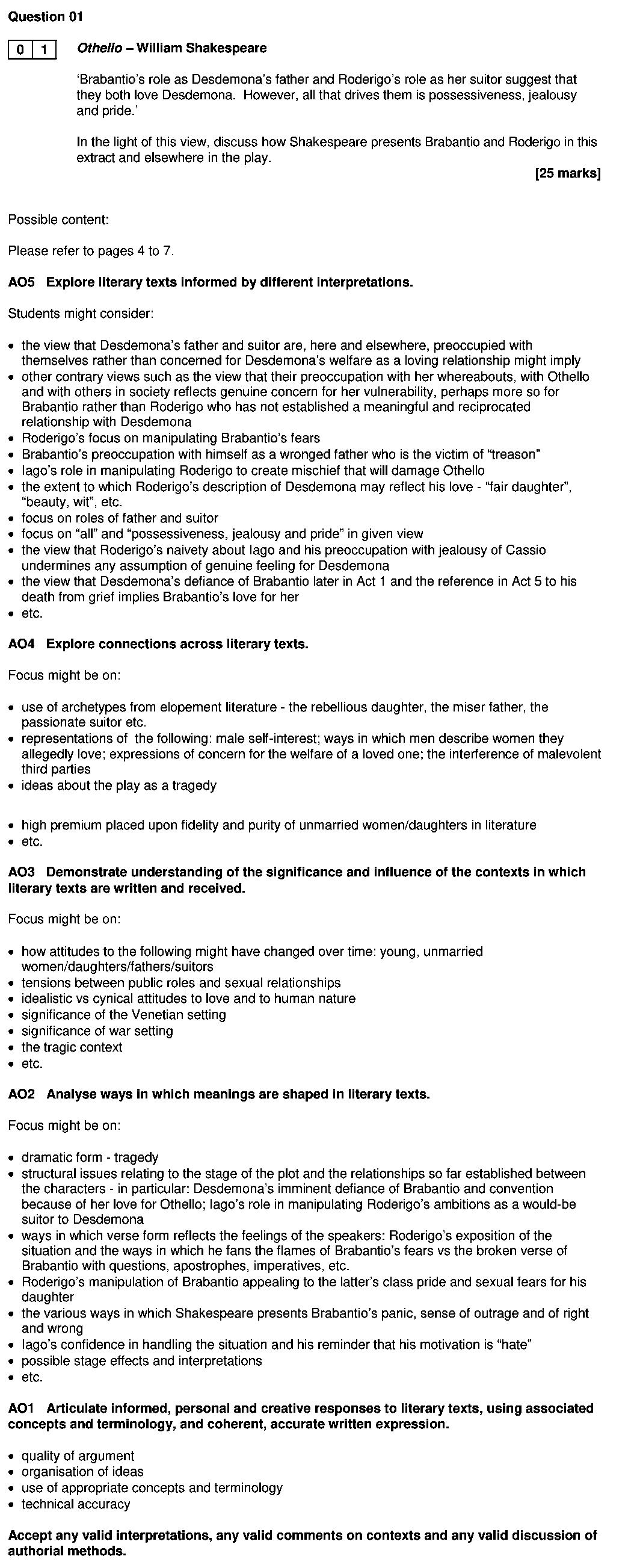
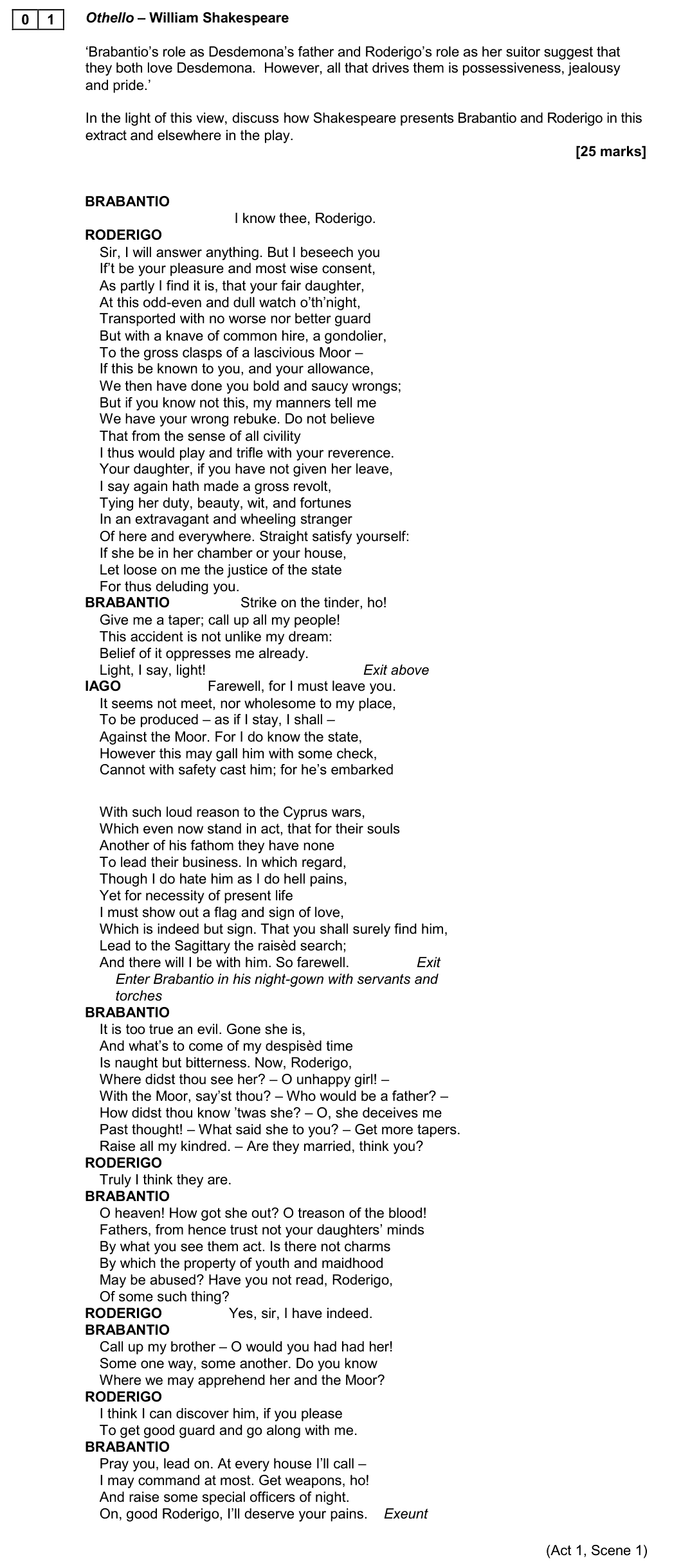
June 2019 · Paper 1 · Q1 25 marks Shakespeare extract othello
Othello – William Shakespeare
‘Brabantio’s role as Desdemona’s father and Roderigo’s role as her suitor suggest that
they both love Desdemona. However, all that drives them is possessiveness, jealousy
and pride.’
In the light of this view, discuss how Shakespeare presents Brabantio and Roderigo in this
extract and elsewhere in the play.
[25 marks]
BRABANTIO
I know thee, Roderigo.
RODERIGO
Sir, I will answer anything. But I beseech you
If’t be your pleasure and most wise consent,
As partly I find it is, that your fair daughter,
At this odd-even and dull watch o’th’night,
Transported with no worse nor better guard
But with a knave of common hire, a gondolier,
To the gross clasps of a lascivious Moor –
If this be known to you, and your allowance,
We then have done you bold and saucy wrongs;
But if you know not this, my manners tell me
We have your wrong rebuke. Do not believe
That from the sense of all civility
I thus would play and trifle with your reverence.
Your daughter, if you have not given her leave,
I say again hath made a gross revolt,
Tying her duty, beauty, wit, and fortunes
In an extravagant and wheeling stranger
Of here and everywhere. Straight satisfy yourself:
If she be in her chamber or your house,
Let loose on me the justice of the state
For thus deluding you.
BRABANTIO Strike on the tinder, ho!
Give me a taper; call up all my people!
This accident is not unlike my dream:
Belief of it oppresses me already.
Light, I say, light! Exit above
IAGO Farewell, for I must leave you.
It seems not meet, nor wholesome to my place,
To be produced – as if I stay, I shall –
Against the Moor. For I do know the state,
However this may gall him with some check,
Cannot with safety cast him; for he’s embarked
With such loud reason to the Cyprus wars,
Which even now stand in act, that for their souls
Another of his fathom they have none
To lead their business. In which regard,
Though I do hate him as I do hell pains,
Yet for necessity of present life
I must show out a flag and sign of love,
Which is indeed but sign. That you shall surely find him,
Lead to the Sagittary the raisèd search;
And there will I be with him. So farewell. Exit
Enter Brabantio in his night-gown with servants and
torches
BRABANTIO
It is too true an evil. Gone she is,
And what’s to come of my despisèd time
Is naught but bitterness. Now, Roderigo,
Where didst thou see her? – O unhappy girl! –
With the Moor, say’st thou? – Who would be a father? –
How didst thou know ’twas she? – O, she deceives me
Past thought! – What said she to you? – Get more tapers.
Raise all my kindred. – Are they married, think you?
RODERIGO
Truly I think they are.
BRABANTIO
O heaven! How got she out? O treason of the blood!
Fathers, from hence trust not your daughters’ minds
By what you see them act. Is there not charms
By which the property of youth and maidhood
May be abused? Have you not read, Roderigo,
Of some such thing?
RODERIGO Yes, sir, I have indeed.
BRABANTIO
Call up my brother – O would you had had her!
Some one way, some another. Do you know
Where we may apprehend her and the Moor?
RODERIGO
I think I can discover him, if you please
To get good guard and go along with me.
BRABANTIO
Pray you, lead on. At every house I’ll call –
I may command at most. Get weapons, ho!
And raise some special officers of night.
On, good Roderigo, I’ll deserve your pains. Exeunt
(Act 1, Scene 1)
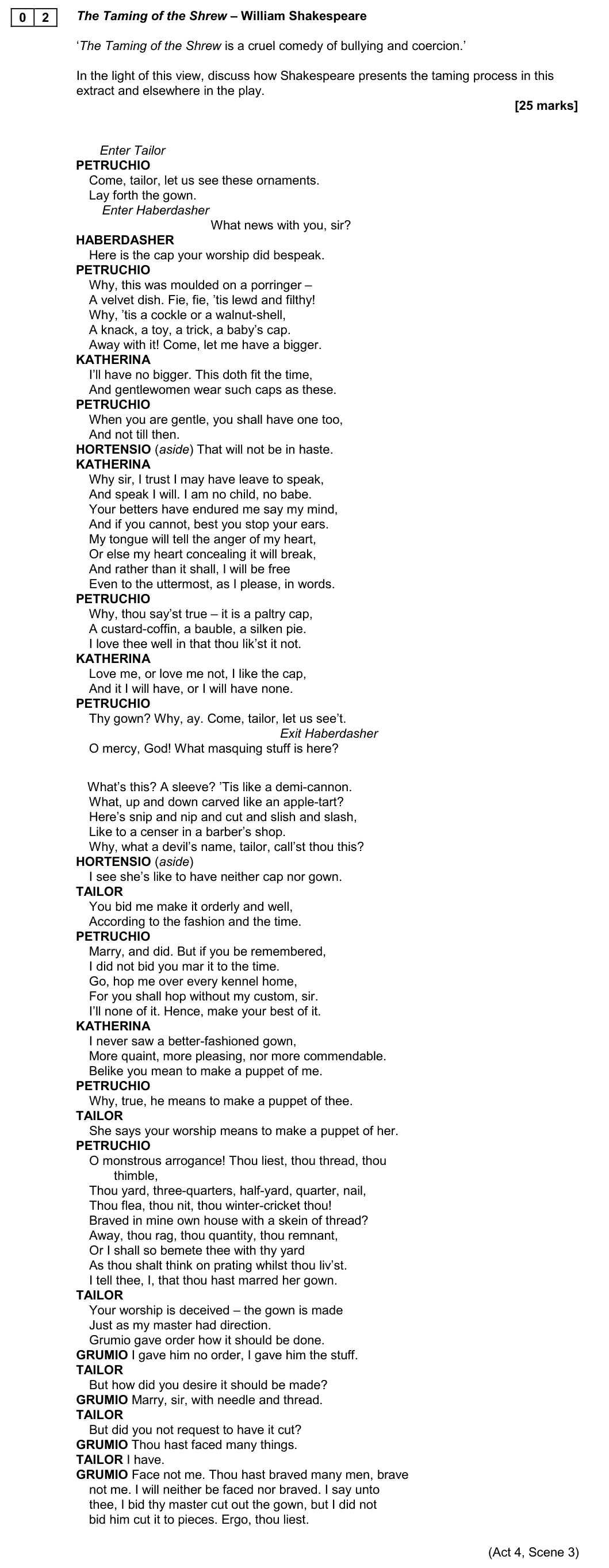
June 2019 · Paper 1 · Q2 25 marks Shakespeare extract taming of the shrew
The Taming of the Shrew – William Shakespeare
‘The Taming of the Shrew is a cruel comedy of bullying and coercion.’
In the light of this view, discuss how Shakespeare presents the taming process in this
extract and elsewhere in the play.
[25 marks]
Enter Tailor
PETRUCHIO
Come, tailor, let us see these ornaments.
Lay forth the gown.
Enter Haberdasher
What news with you, sir?
HABERDASHER
Here is the cap your worship did bespeak.
PETRUCHIO
Why, this was moulded on a porringer –
A velvet dish. Fie, fie, ’tis lewd and filthy!
Why, ’tis a cockle or a walnut-shell,
A knack, a toy, a trick, a baby’s cap.
Away with it! Come, let me have a bigger.
KATHERINA
I’ll have no bigger. This doth fit the time,
And gentlewomen wear such caps as these.
PETRUCHIO
When you are gentle, you shall have one too,
And not till then.
HORTENSIO (aside) That will not be in haste.
KATHERINA
Why sir, I trust I may have leave to speak,
And speak I will. I am no child, no babe.
Your betters have endured me say my mind,
And if you cannot, best you stop your ears.
My tongue will tell the anger of my heart,
Or else my heart concealing it will break,
And rather than it shall, I will be free
Even to the uttermost, as I please, in words.
PETRUCHIO
Why, thou say’st true – it is a paltry cap,
A custard-coffin, a bauble, a silken pie.
I love thee well in that thou lik’st it not.
KATHERINA
Love me, or love me not, I like the cap,
And it I will have, or I will have none.
PETRUCHIO
Thy gown? Why, ay. Come, tailor, let us see’t.
Exit Haberdasher
O mercy, God! What masquing stuff is here?
What’s this? A sleeve? ’Tis like a demi-cannon.
What, up and down carved like an apple-tart?
Here’s snip and nip and cut and slish and slash,
Like to a censer in a barber’s shop.
Why, what a devil’s name, tailor, call’st thou this?
HORTENSIO (aside)
I see she’s like to have neither cap nor gown.
TAILOR
You bid me make it orderly and well,
According to the fashion and the time.
PETRUCHIO
Marry, and did. But if you be remembered,
I did not bid you mar it to the time.
Go, hop me over every kennel home,
For you shall hop without my custom, sir.
I’ll none of it. Hence, make your best of it.
KATHERINA
I never saw a better-fashioned gown,
More quaint, more pleasing, nor more commendable.
Belike you mean to make a puppet of me.
PETRUCHIO
Why, true, he means to make a puppet of thee.
TAILOR
She says your worship means to make a puppet of her.
PETRUCHIO
O monstrous arrogance! Thou liest, thou thread, thou
thimble,
Thou yard, three-quarters, half-yard, quarter, nail,
Thou flea, thou nit, thou winter-cricket thou!
Braved in mine own house with a skein of thread?
Away, thou rag, thou quantity, thou remnant,
Or I shall so bemete thee with thy yard
As thou shalt think on prating whilst thou liv’st.
I tell thee, I, that thou hast marred her gown.
TAILOR
Your worship is deceived – the gown is made
Just as my master had direction.
Grumio gave order how it should be done.
GRUMIO I gave him no order, I gave him the stuff.
TAILOR
But how did you desire it should be made?
GRUMIO Marry, sir, with needle and thread.
TAILOR
But did you not request to have it cut?
GRUMIO Thou hast faced many things.
TAILOR I have.
GRUMIO Face not me. Thou hast braved many men, brave
not me. I will neither be faced nor braved. I say unto
thee, I bid thy master cut out the gown, but I did not
bid him cut it to pieces. Ergo, thou liest.
(Act 4, Scene 3)
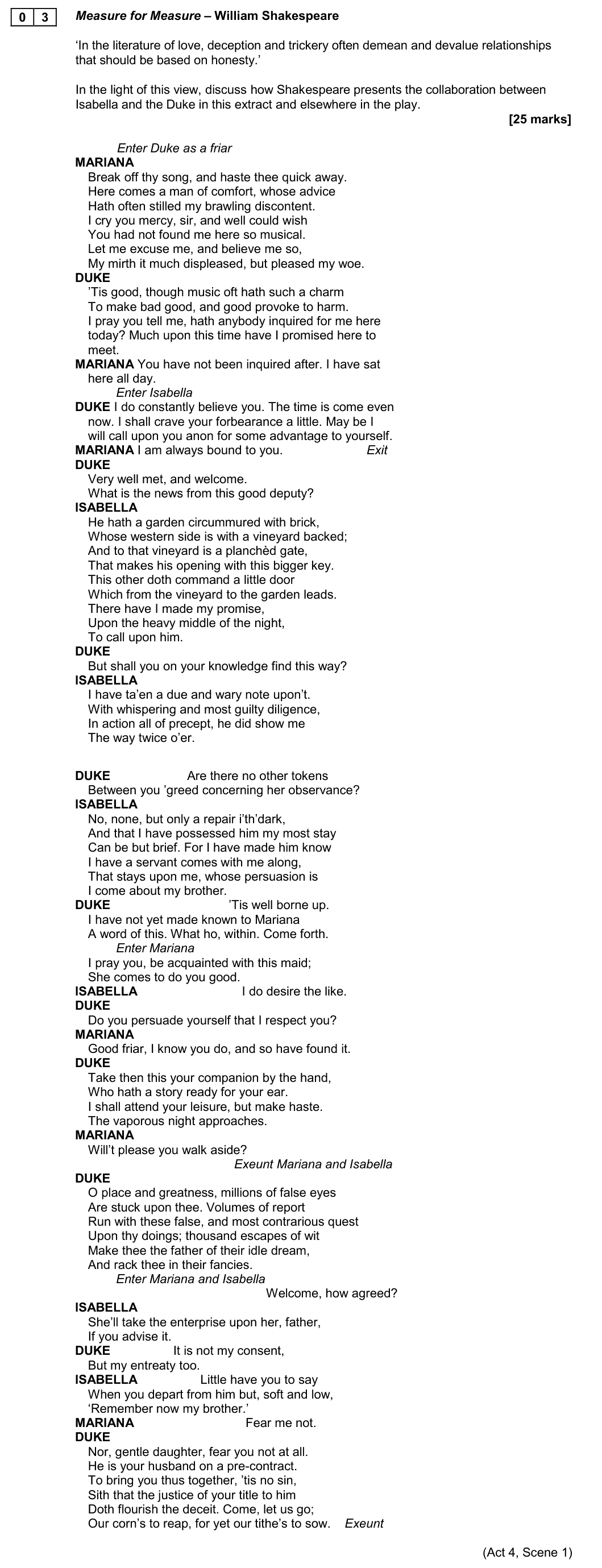
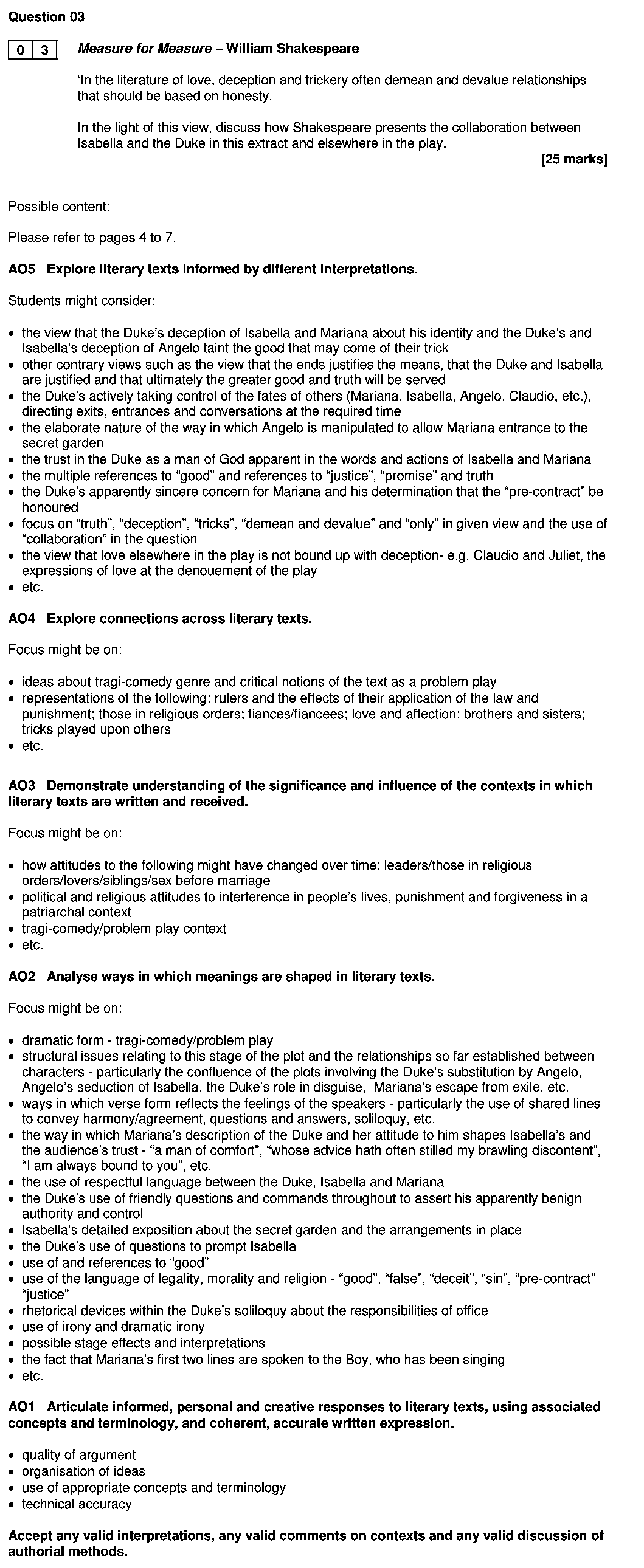
June 2019 · Paper 1 · Q3 25 marks Shakespeare extract measure for measure
Measure for Measure – William Shakespeare
‘In the literature of love, deception and trickery often demean and devalue relationships
that should be based on honesty.’
In the light of this view, discuss how Shakespeare presents the collaboration between
Isabella and the Duke in this extract and elsewhere in the play.
[25 marks]
Enter Duke as a friar
MARIANA
Break off thy song, and haste thee quick away.
Here comes a man of comfort, whose advice
Hath often stilled my brawling discontent.
I cry you mercy, sir, and well could wish
You had not found me here so musical.
Let me excuse me, and believe me so,
My mirth it much displeased, but pleased my woe.
DUKE
’Tis good, though music oft hath such a charm
To make bad good, and good provoke to harm.
I pray you tell me, hath anybody inquired for me here
today? Much upon this time have I promised here to
meet.
MARIANA You have not been inquired after. I have sat
here all day.
Enter Isabella
DUKE I do constantly believe you. The time is come even
now. I shall crave your forbearance a little. May be I
will call upon you anon for some advantage to yourself.
MARIANA I am always bound to you. Exit
DUKE
Very well met, and welcome.
What is the news from this good deputy?
ISABELLA
He hath a garden circummured with brick,
Whose western side is with a vineyard backed;
And to that vineyard is a planchèd gate,
That makes his opening with this bigger key.
This other doth command a little door
Which from the vineyard to the garden leads.
There have I made my promise,
Upon the heavy middle of the night,
To call upon him.
DUKE
But shall you on your knowledge find this way?
ISABELLA
I have ta’en a due and wary note upon’t.
With whispering and most guilty diligence,
In action all of precept, he did show me
The way twice o’er.
DUKE Are there no other tokens
Between you ’greed concerning her observance?
ISABELLA
No, none, but only a repair i’th’dark,
And that I have possessed him my most stay
Can be but brief. For I have made him know
I have a servant comes with me along,
That stays upon me, whose persuasion is
I come about my brother.
DUKE ’Tis well borne up.
I have not yet made known to Mariana
A word of this. What ho, within. Come forth.
Enter Mariana
I pray you, be acquainted with this maid;
She comes to do you good.
ISABELLA I do desire the like.
DUKE
Do you persuade yourself that I respect you?
MARIANA
Good friar, I know you do, and so have found it.
DUKE
Take then this your companion by the hand,
Who hath a story ready for your ear.
I shall attend your leisure, but make haste.
The vaporous night approaches.
MARIANA
Will’t please you walk aside?
Exeunt Mariana and Isabella
DUKE
O place and greatness, millions of false eyes
Are stuck upon thee. Volumes of report
Run with these false, and most contrarious quest
Upon thy doings; thousand escapes of wit
Make thee the father of their idle dream,
And rack thee in their fancies.
Enter Mariana and Isabella
Welcome, how agreed?
ISABELLA
She’ll take the enterprise upon her, father,
If you advise it.
DUKE It is not my consent,
But my entreaty too.
ISABELLA Little have you to say
When you depart from him but, soft and low,
‘Remember now my brother.’
MARIANA Fear me not.
DUKE
Nor, gentle daughter, fear you not at all.
He is your husband on a pre-contract.
To bring you thus together, ’tis no sin,
Sith that the justice of your title to him
Doth flourish the deceit. Come, let us go;
Our corn’s to reap, for yet our tithe’s to sow. Exeunt
(Act 4, Scene 1)
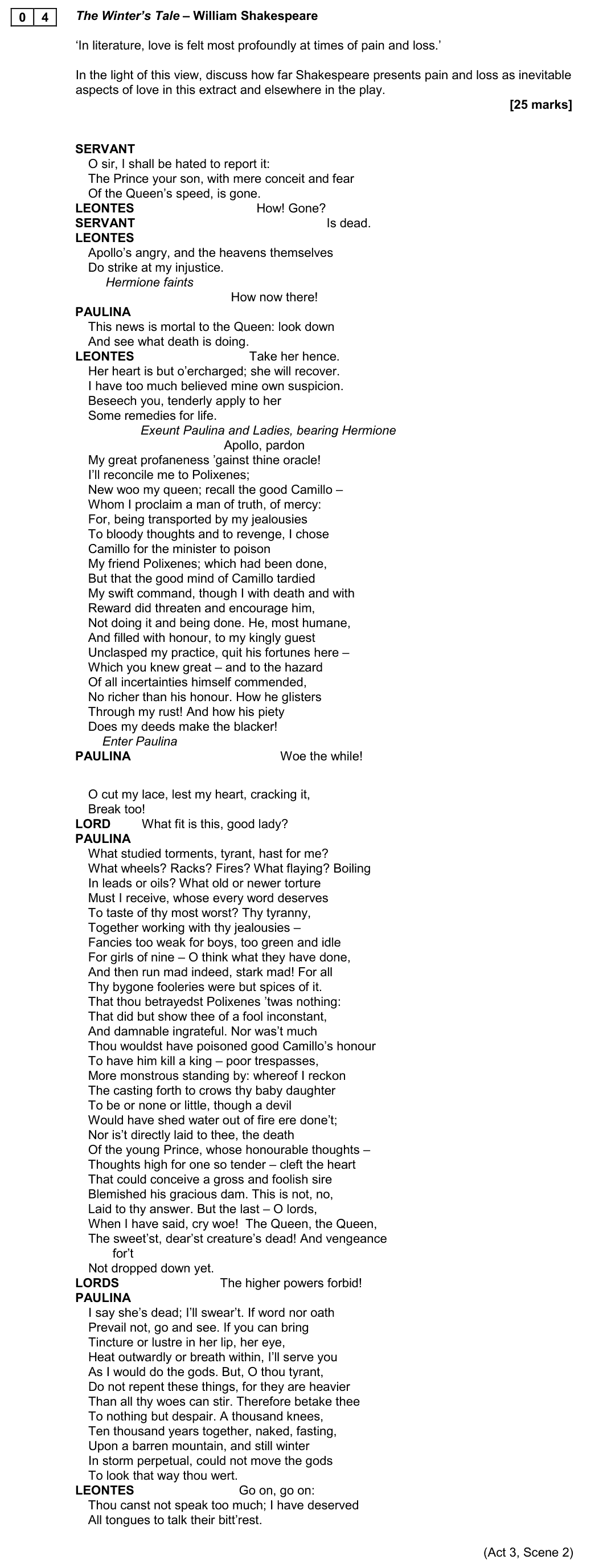
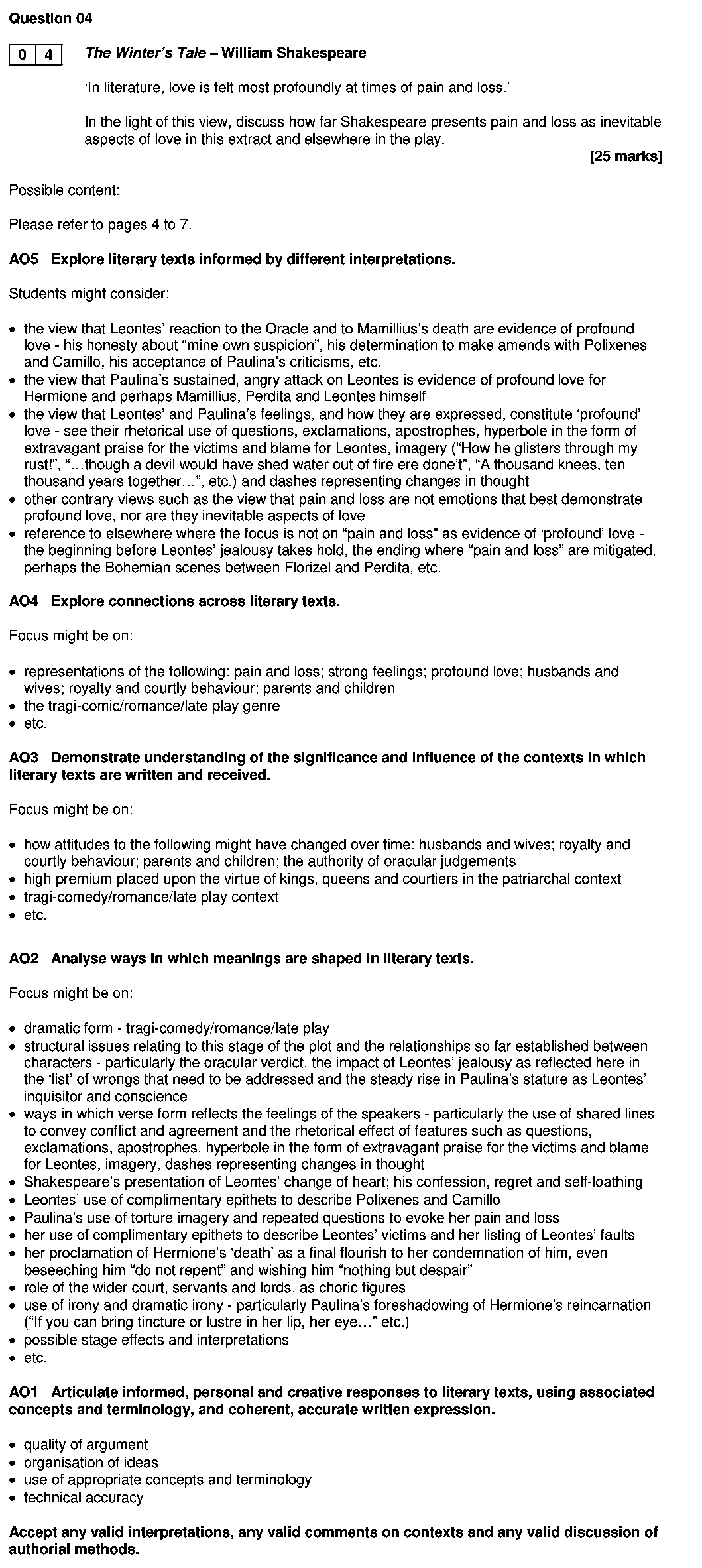
June 2019 · Paper 1 · Q4 25 marks Shakespeare extract the winters tale
The Winter’s Tale – William Shakespeare
‘In literature, love is felt most profoundly at times of pain and loss.’
In the light of this view, discuss how far Shakespeare presents pain and loss as inevitable
aspects of love in this extract and elsewhere in the play.
[25 marks]
SERVANT
O sir, I shall be hated to report it:
The Prince your son, with mere conceit and fear
Of the Queen’s speed, is gone.
LEONTES How! Gone?
SERVANT Is dead.
LEONTES
Apollo’s angry, and the heavens themselves
Do strike at my injustice.
Hermione faints
How now there!
PAULINA
This news is mortal to the Queen: look down
And see what death is doing.
LEONTES Take her hence.
Her heart is but o’ercharged; she will recover.
I have too much believed mine own suspicion.
Beseech you, tenderly apply to her
Some remedies for life.
Exeunt Paulina and Ladies, bearing Hermione
Apollo, pardon
My great profaneness ’gainst thine oracle!
I’ll reconcile me to Polixenes;
New woo my queen; recall the good Camillo –
Whom I proclaim a man of truth, of mercy:
For, being transported by my jealousies
To bloody thoughts and to revenge, I chose
Camillo for the minister to poison
My friend Polixenes; which had been done,
But that the good mind of Camillo tardied
My swift command, though I with death and with
Reward did threaten and encourage him,
Not doing it and being done. He, most humane,
And filled with honour, to my kingly guest
Unclasped my practice, quit his fortunes here –
Which you knew great – and to the hazard
Of all incertainties himself commended,
No richer than his honour. How he glisters
Through my rust! And how his piety
Does my deeds make the blacker!
Enter Paulina
PAULINA Woe the while!
O cut my lace, lest my heart, cracking it,
Break too!
LORD What fit is this, good lady?
PAULINA
What studied torments, tyrant, hast for me?
What wheels? Racks? Fires? What flaying? Boiling
In leads or oils? What old or newer torture
Must I receive, whose every word deserves
To taste of thy most worst? Thy tyranny,
Together working with thy jealousies –
Fancies too weak for boys, too green and idle
For girls of nine – O think what they have done,
And then run mad indeed, stark mad! For all
Thy bygone fooleries were but spices of it.
That thou betrayedst Polixenes ’twas nothing:
That did but show thee of a fool inconstant,
And damnable ingrateful. Nor was’t much
Thou wouldst have poisoned good Camillo’s honour
To have him kill a king – poor trespasses,
More monstrous standing by: whereof I reckon
The casting forth to crows thy baby daughter
To be or none or little, though a devil
Would have shed water out of fire ere done’t;
Nor is’t directly laid to thee, the death
Of the young Prince, whose honourable thoughts –
Thoughts high for one so tender – cleft the heart
That could conceive a gross and foolish sire
Blemished his gracious dam. This is not, no,
Laid to thy answer. But the last – O lords,
When I have said, cry woe! The Queen, the Queen,
The sweet’st, dear’st creature’s dead! And vengeance
for’t
Not dropped down yet.
LORDS The higher powers forbid!
PAULINA
I say she’s dead; I’ll swear’t. If word nor oath
Prevail not, go and see. If you can bring
Tincture or lustre in her lip, her eye,
Heat outwardly or breath within, I’ll serve you
As I would do the gods. But, O thou tyrant,
Do not repent these things, for they are heavier
Than all thy woes can stir. Therefore betake thee
To nothing but despair. A thousand knees,
Ten thousand years together, naked, fasting,
Upon a barren mountain, and still winter
In storm perpetual, could not move the gods
To look that way thou wert.
LEONTES Go on, go on:
Thou canst not speak too much; I have deserved
All tongues to talk their bitt’rest.
(Act 3, Scene 2)
June 2019 · Paper 1 · Q5 25 marks Unseen poetry unseen love poetry
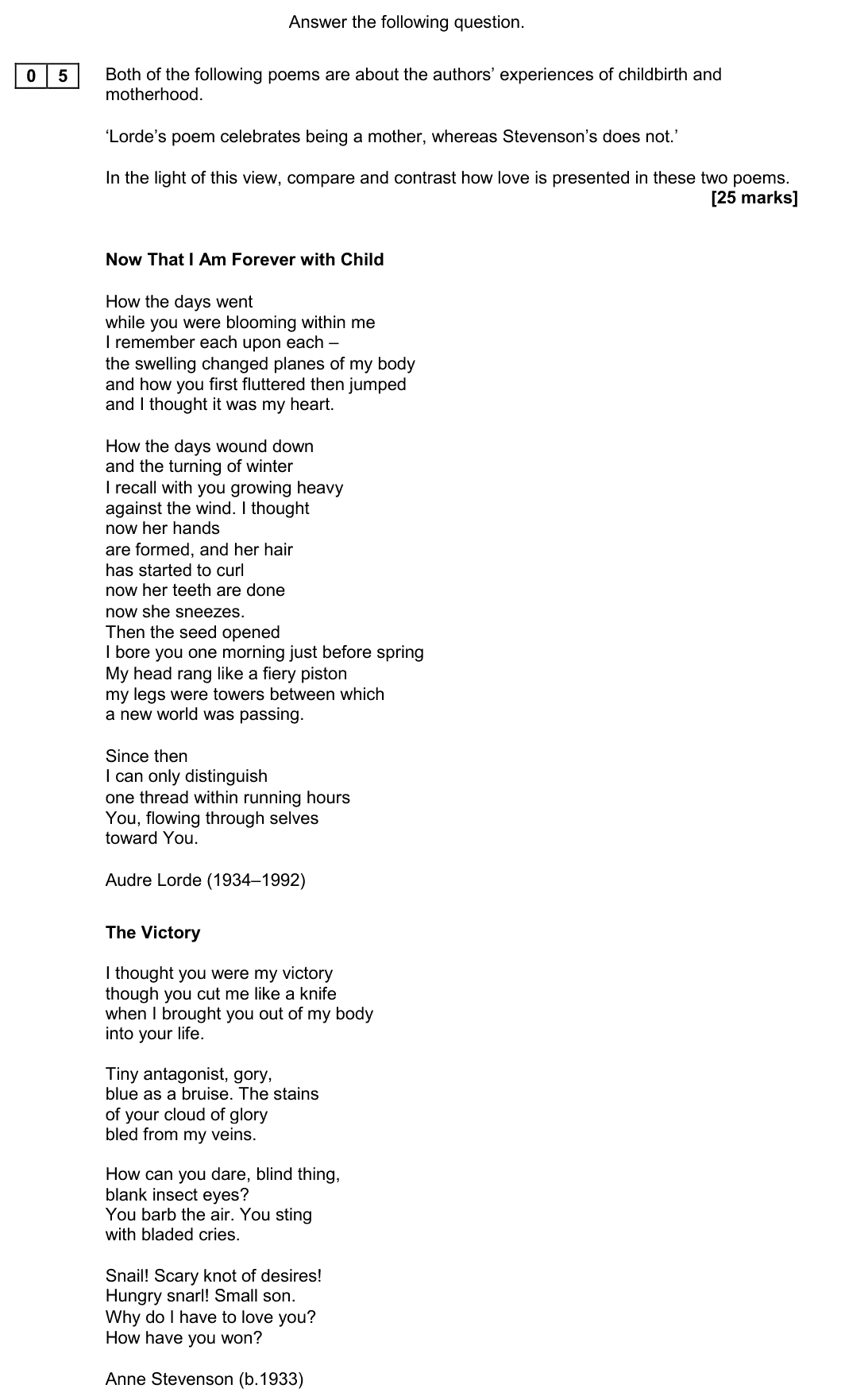
Answer the following question.
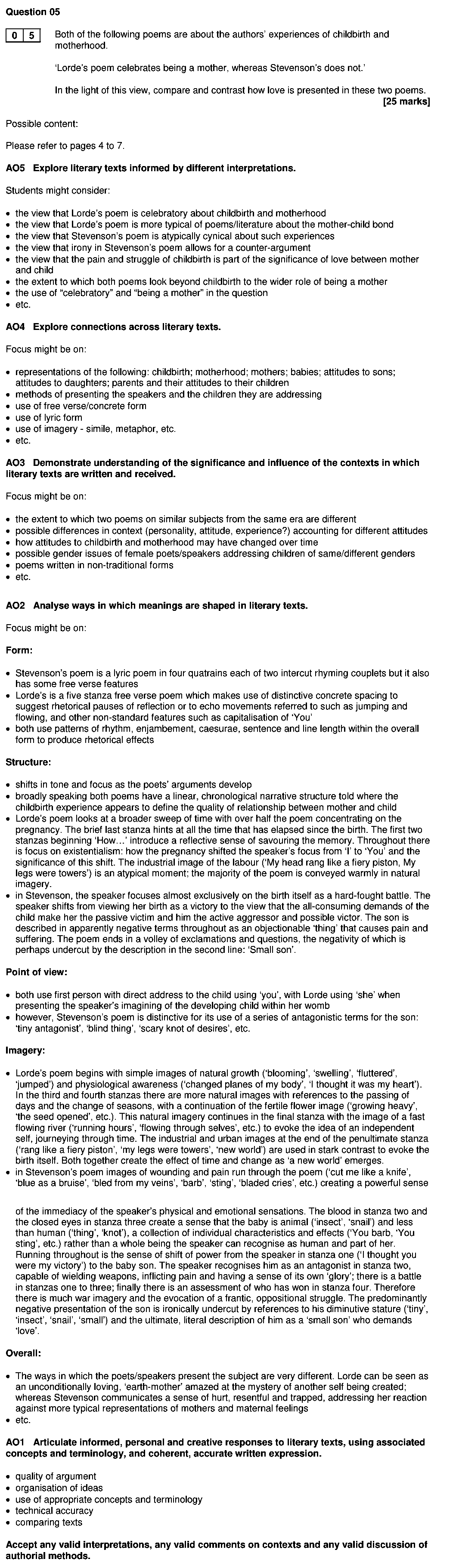
Both of the following poems are about the authors’ experiences of childbirth and
motherhood.
‘Lorde’s poem celebrates being a mother, whereas Stevenson’s does not.’
In the light of this view, compare and contrast how love is presented in these two poems.
[25 marks]
Now That I Am Forever with Child
How the days went
while you were blooming within me
I remember each upon each –
the swelling changed planes of my body
and how you first fluttered then jumped
and I thought it was my heart.
How the days wound down
and the turning of winter
I recall with you growing heavy
against the wind. I thought
now her hands
are formed, and her hair
has started to curl
now her teeth are done
now she sneezes.
Then the seed opened
I bore you one morning just before spring
My head rang like a fiery piston
my legs were towers between which
a new world was passing.
Since then
I can only distinguish
one thread within running hours
You, flowing through selves
toward You.
Audre Lorde (1934–1992)
The Victory
I thought you were my victory
though you cut me like a knife
when I brought you out of my body
into your life.
Tiny antagonist, gory,
blue as a bruise. The stains
of your cloud of glory
bled from my veins.
How can you dare, blind thing,
blank insect eyes?
You barb the air. You sting
with bladed cries.
Snail! Scary knot of desires!
Hungry snarl! Small son.
Why do I have to love you?
How have you won?
Anne Stevenson (b.1933)
June 2019 · Paper 1 · Q6 25 marks Comparing texts love poetry pre 1900love poetry post 1900comparing prose love
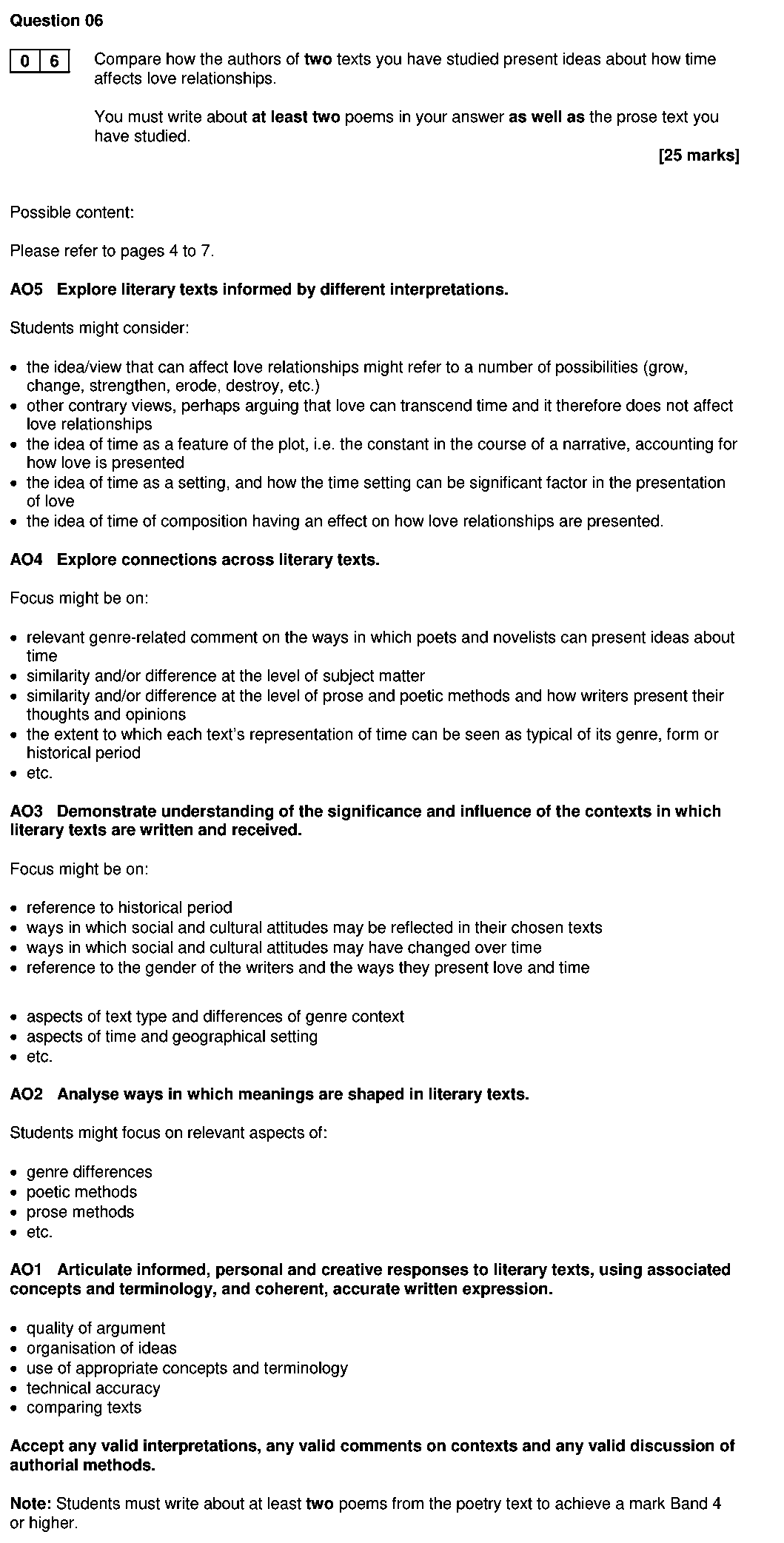
Compare how the authors of two texts you have studied present ideas about how time
affects love relationships.
You must write about at least two poems in your answer as well as the prose text you
have studied.
[25 marks]
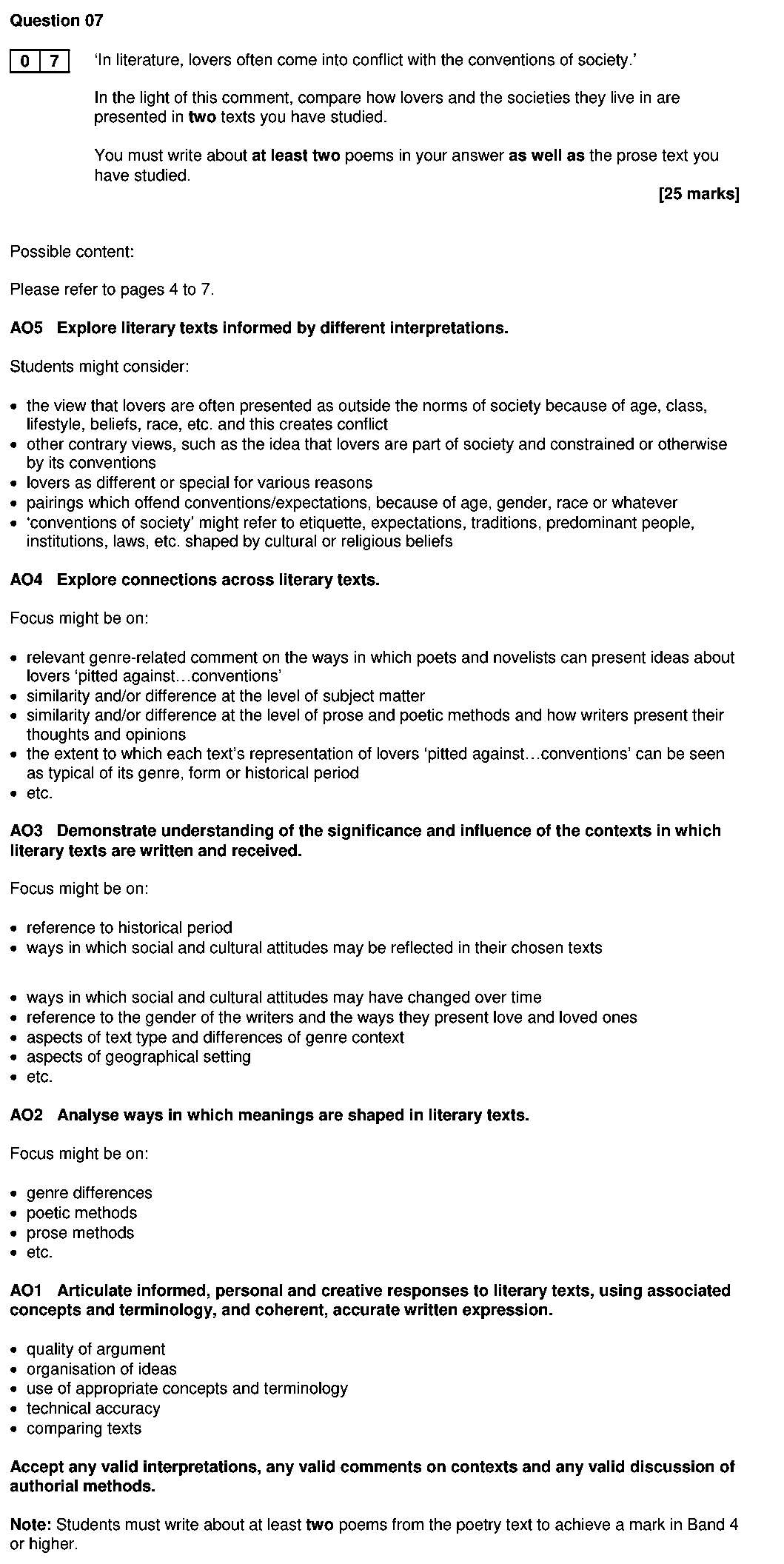
June 2019 · Paper 1 · Q7 25 marks Comparing texts love poetry pre 1900love poetry post 1900comparing prose love
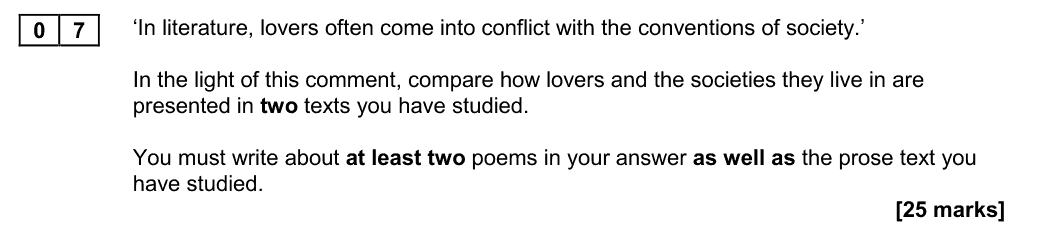
‘In literature, lovers often come into conflict with the conventions of society.’
In the light of this comment, compare how lovers and the societies they live in are
presented in two texts you have studied.
You must write about at least two poems in your answer as well as the prose text you
have studied.
[25 marks]

Work with an AQA English Literature A tutor

Want a paper marked and gone through with you? Message us.

Prefer email? Send an enquiry

If you are under 18, please include a parent's contact details. Enquiries go to enquiries@alevelenglishtutor.com and are deleted once handled. All tutoring is online.