June 2022: AS Paper 1, Shakespeare and poetry

50 marks · 6 questions (every option is included) · Paper, mark scheme and report on AQA's site

Question by question

QTopicMarksAOType
1 Othello 25Shakespeare extract
2 The Taming of the Shrew 25Shakespeare extract
3 Measure for Measure 25Shakespeare extract
4 The Winter's Tale 25Shakespeare extract
5 AQA Anthology: love poetry pre-1900 25Anthology poetry
6 AQA Anthology: love poetry post-1900 25Anthology poetry

The questions

123456
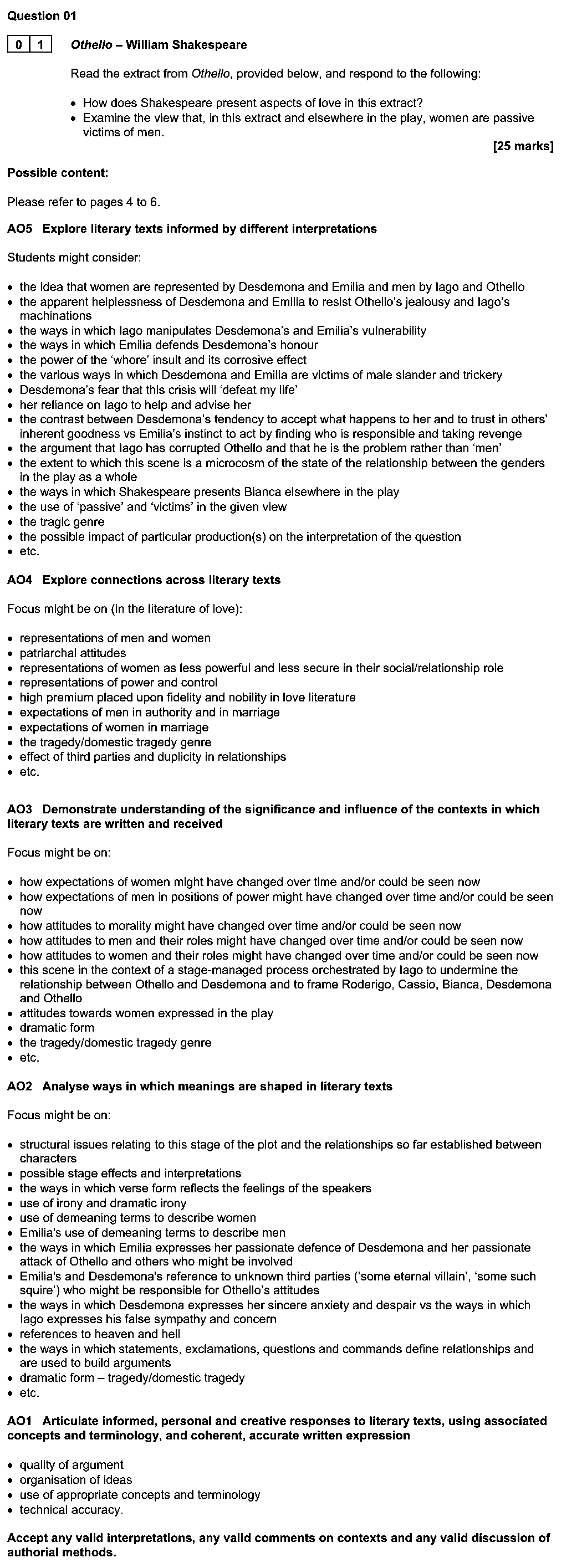
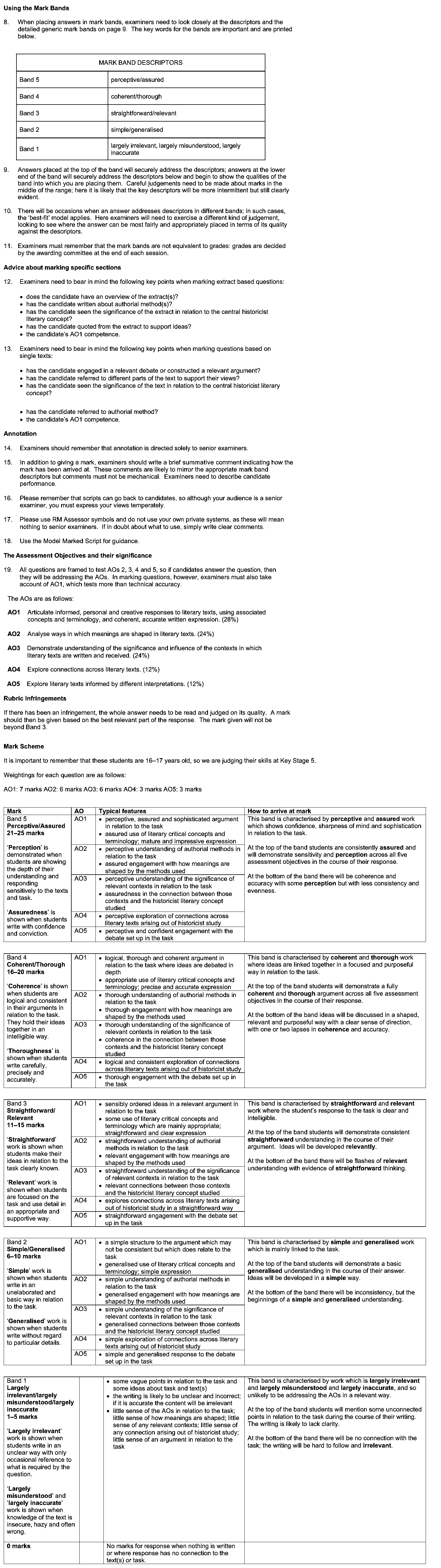
June 2022 · AS Paper 1 · Q1 25 marks Shakespeare extract othello
Othello – William Shakespeare
Read the extract from Othello, provided below, and respond to the following:
• How does Shakespeare present aspects of love in this extract?
• Examine the view that, in this extract and elsewhere in the play, women are passive
victims of men.
[25 marks]
DESDEMONA
Am I that name, Iago?
IAGO What name, fair lady?
DESDEMONA
Such as she said my lord did say I was.
EMILIA
He called her whore: a beggar in his drink
Could not have laid such terms upon his callet.
IAGO
Why did he so?
DESDEMONA
I do not know: I am sure I am none such.
IAGO
Do not weep, do not weep. Alas the day!
EMILIA
Hath she forsook so many noble matches,
Her father, and her country, all her friends,
To be called whore? Would it not make one weep?
DESDEMONA
It is my wretched fortune.
IAGO Beshrew him for’t!
How comes this trick upon him?
DESDEMONA Nay, heaven doth know.
EMILIA
I will be hanged if some eternal villain,
Some busy and insinuating rogue,
Some cogging, cozening slave, to get some office,
Have not devised this slander; I’ll be hanged else.
IAGO
Fie, there is no such man! It is impossible.
DESDEMONA
If any such there be, heaven pardon him.
EMILIA
A halter pardon him and hell gnaw his bones!
Why should he call her whore? Who keeps her company?
What place, what time, what form, what likelihood?
The Moor’s abused by some most villainous knave,
Some base notorious knave, some scurvy fellow.
O heaven, that such companions thou’dst unfold,
And put in every honest hand a whip
To lash the rascals naked through the world,
Even from the east to th’west!
IAGO Speak within door.
EMILIA
O fie upon them! Some such squire he was
That turned your wit the seamy side without
And made you to suspect me with the Moor.
IAGO
You are a fool, go to.
DESDEMONA O good Iago,
What shall I do to win my lord again?
Good friend, go to him; for, by this light of heaven,
I know not how I lost him. Here I kneel:
If e’er my will did trespass ’gainst his love,
Either in discourse of thought or actual deed;
Or that mine eyes, mine ears, or any sense
Delighted them in any other form;
Or that I do not yet, and ever did,
And ever will – though he do shake me off
To beggarly divorcement – love him dearly,
Comfort forswear me! Unkindness may do much,
And his unkindness may defeat my life,
But never taint my love. I cannot say ‘whore’:
It does abhor me now I speak the word;
To do the act that might the addition earn
Not the world’s mass of vanity could make me.
IAGO
I pray you, be content: ’tis but his humour;
The business of the state does him offence,
And he does chide with you.
DESDEMONA
If ’twere no other –
IAGO It is so, I warrant.
Hark how these instruments summon to supper!
The messengers of Venice stay the meat.
Go in, and weep not; all things shall be well.
(Act 4, Scene 2)
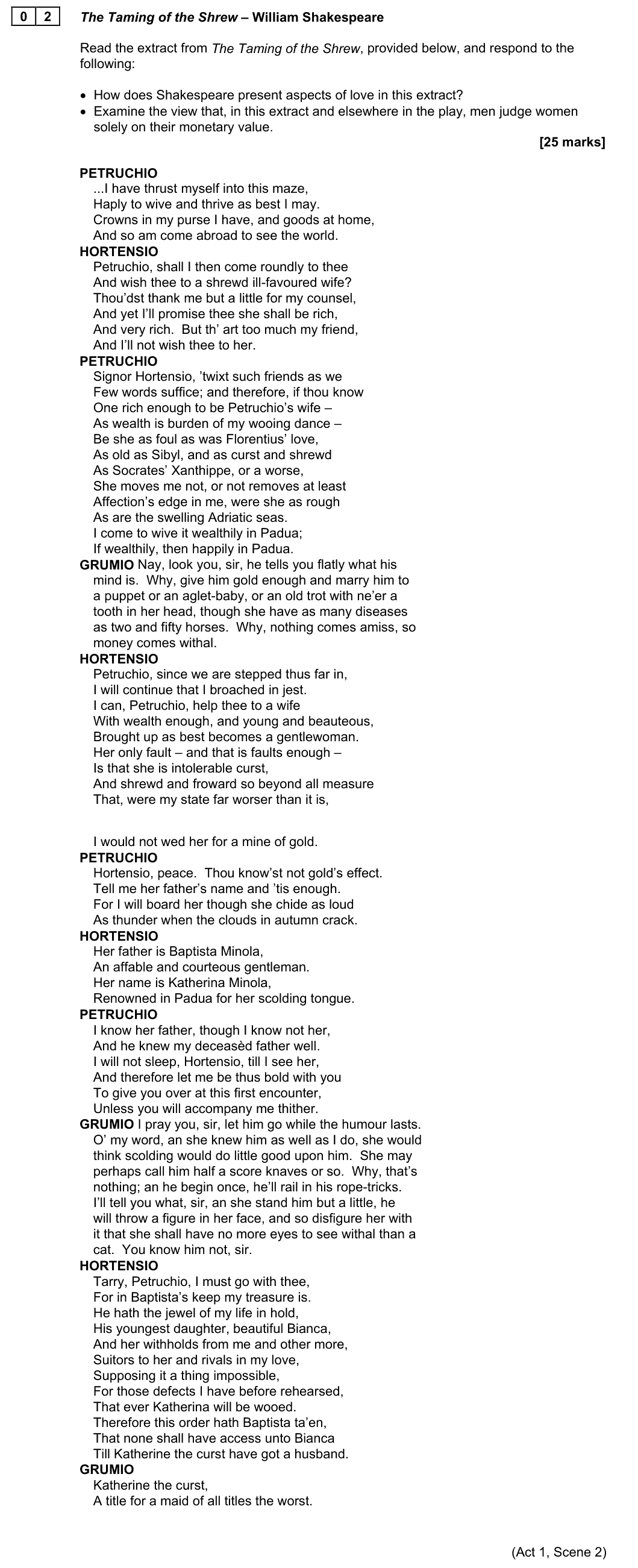
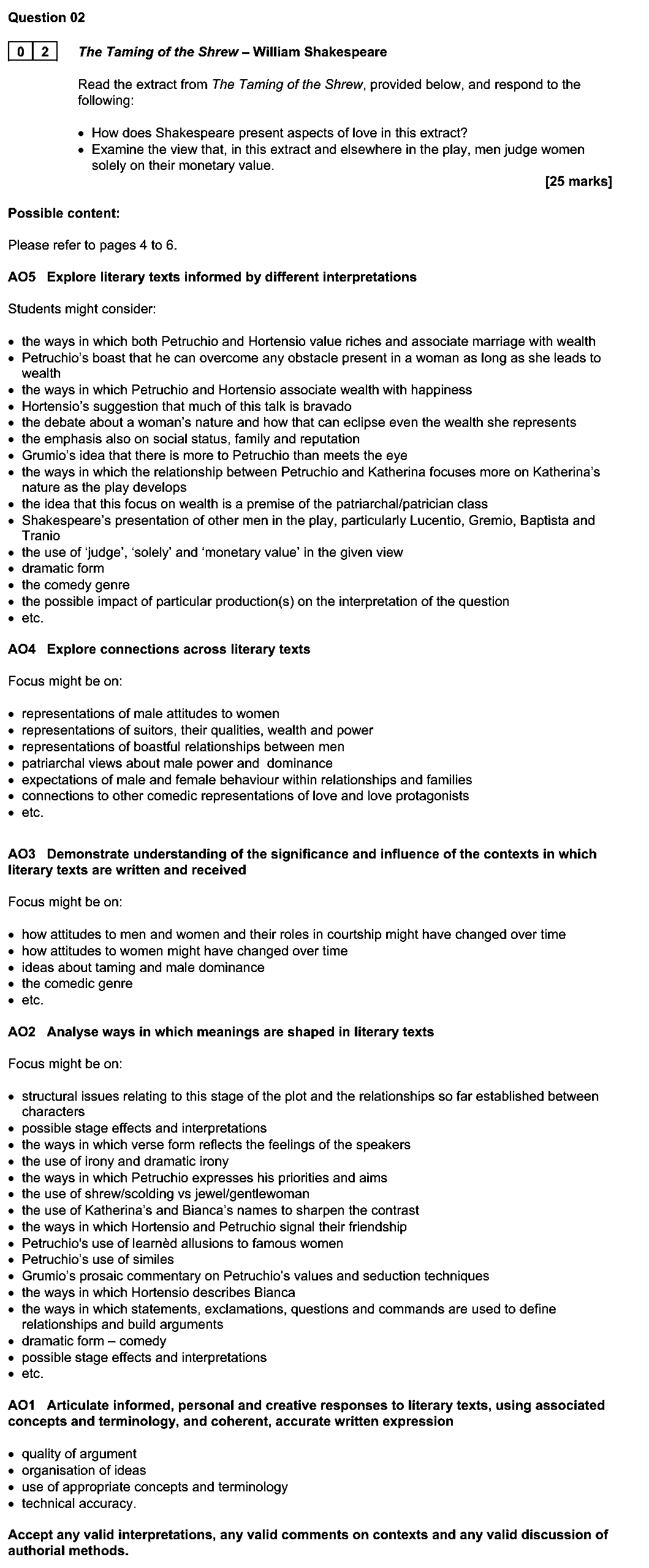
June 2022 · AS Paper 1 · Q2 25 marks Shakespeare extract taming of the shrew
The Taming of the Shrew – William Shakespeare
Read the extract from The Taming of the Shrew, provided below, and respond to the
following:
• How does Shakespeare present aspects of love in this extract?
• Examine the view that, in this extract and elsewhere in the play, men judge women
solely on their monetary value.
[25 marks]
PETRUCHIO
...I have thrust myself into this maze,
Haply to wive and thrive as best I may.
Crowns in my purse I have, and goods at home,
And so am come abroad to see the world.
HORTENSIO
Petruchio, shall I then come roundly to thee
And wish thee to a shrewd ill-favoured wife?
Thou’dst thank me but a little for my counsel,
And yet I’ll promise thee she shall be rich,
And very rich. But th’ art too much my friend,
And I’ll not wish thee to her.
PETRUCHIO
Signor Hortensio, ’twixt such friends as we
Few words suffice; and therefore, if thou know
One rich enough to be Petruchio’s wife –
As wealth is burden of my wooing dance –
Be she as foul as was Florentius’ love,
As old as Sibyl, and as curst and shrewd
As Socrates’ Xanthippe, or a worse,
She moves me not, or not removes at least
Affection’s edge in me, were she as rough
As are the swelling Adriatic seas.
I come to wive it wealthily in Padua;
If wealthily, then happily in Padua.
GRUMIO Nay, look you, sir, he tells you flatly what his
mind is. Why, give him gold enough and marry him to
a puppet or an aglet-baby, or an old trot with ne’er a
tooth in her head, though she have as many diseases
as two and fifty horses. Why, nothing comes amiss, so
money comes withal.
HORTENSIO
Petruchio, since we are stepped thus far in,
I will continue that I broached in jest.
I can, Petruchio, help thee to a wife
With wealth enough, and young and beauteous,
Brought up as best becomes a gentlewoman.
Her only fault – and that is faults enough –
Is that she is intolerable curst,
And shrewd and froward so beyond all measure
That, were my state far worser than it is,
I would not wed her for a mine of gold.
PETRUCHIO
Hortensio, peace. Thou know’st not gold’s effect.
Tell me her father’s name and ’tis enough.
For I will board her though she chide as loud
As thunder when the clouds in autumn crack.
HORTENSIO
Her father is Baptista Minola,
An affable and courteous gentleman.
Her name is Katherina Minola,
Renowned in Padua for her scolding tongue.
PETRUCHIO
I know her father, though I know not her,
And he knew my deceasèd father well.
I will not sleep, Hortensio, till I see her,
And therefore let me be thus bold with you
To give you over at this first encounter,
Unless you will accompany me thither.
GRUMIO I pray you, sir, let him go while the humour lasts.
O’ my word, an she knew him as well as I do, she would
think scolding would do little good upon him. She may
perhaps call him half a score knaves or so. Why, that’s
nothing; an he begin once, he’ll rail in his rope-tricks.
I’ll tell you what, sir, an she stand him but a little, he
will throw a figure in her face, and so disfigure her with
it that she shall have no more eyes to see withal than a
cat. You know him not, sir.
HORTENSIO
Tarry, Petruchio, I must go with thee,
For in Baptista’s keep my treasure is.
He hath the jewel of my life in hold,
His youngest daughter, beautiful Bianca,
And her withholds from me and other more,
Suitors to her and rivals in my love,
Supposing it a thing impossible,
For those defects I have before rehearsed,
That ever Katherina will be wooed.
Therefore this order hath Baptista ta’en,
That none shall have access unto Bianca
Till Katherine the curst have got a husband.
GRUMIO
Katherine the curst,
A title for a maid of all titles the worst.
(Act 1, Scene 2)
June 2022 · AS Paper 1 · Q3 25 marks Shakespeare extract measure for measure
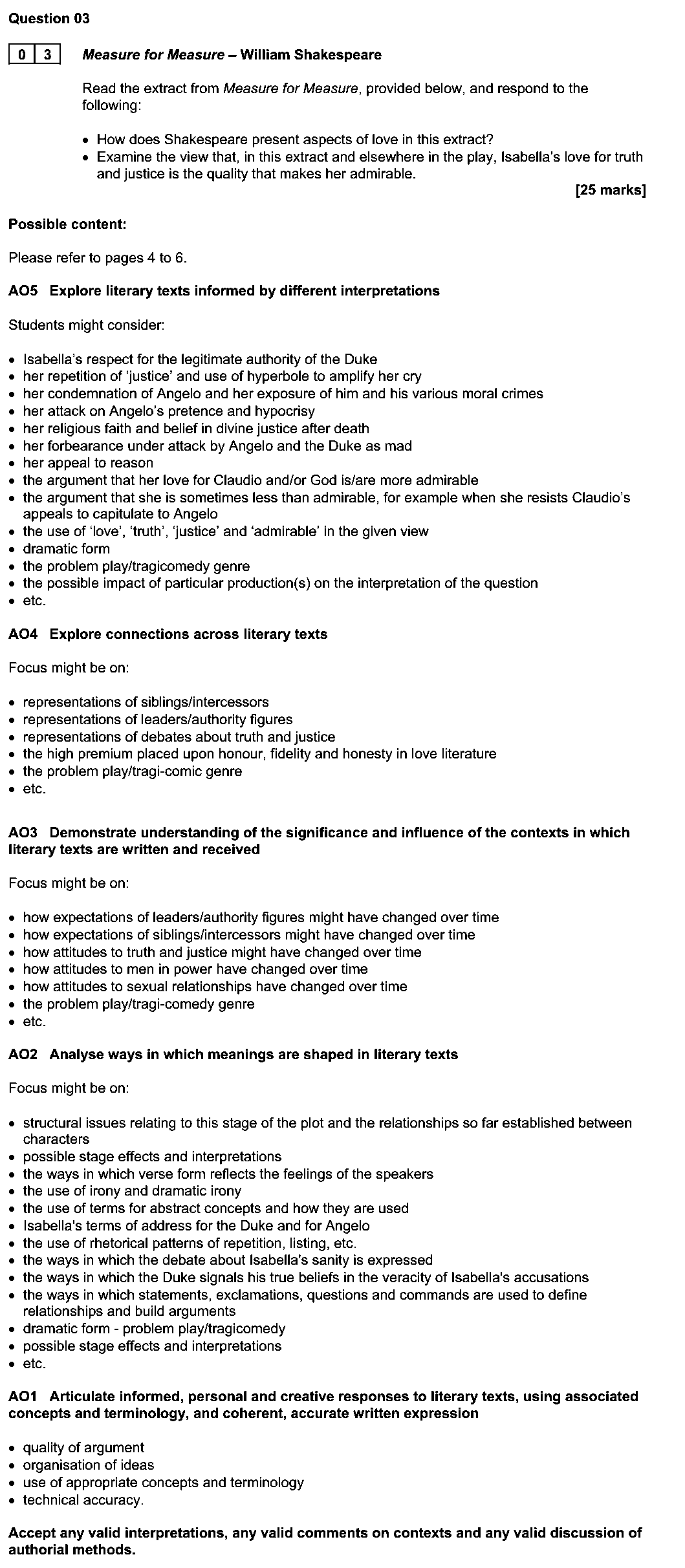
Measure for Measure – William Shakespeare
Read the extract from Measure for Measure, provided below, and respond to the
following:
• How does Shakespeare present aspects of love in this extract?
• Examine the view that, in this extract and elsewhere in the play, Isabella’s love for truth
and justice is the quality that makes her admirable.
[25 marks]
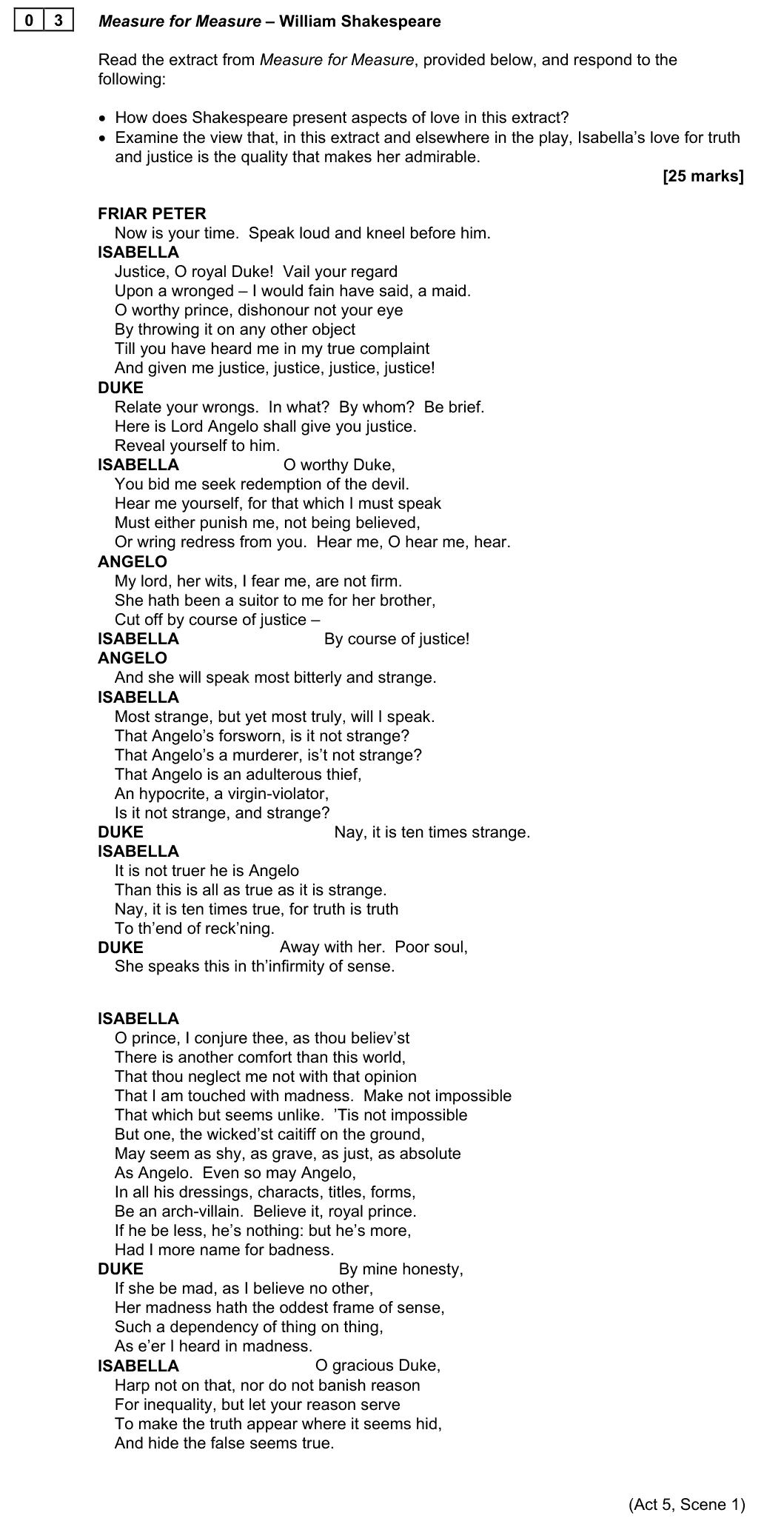
FRIAR PETER
Now is your time. Speak loud and kneel before him.
ISABELLA
Justice, O royal Duke! Vail your regard
Upon a wronged – I would fain have said, a maid.
O worthy prince, dishonour not your eye
By throwing it on any other object
Till you have heard me in my true complaint
And given me justice, justice, justice, justice!
DUKE
Relate your wrongs. In what? By whom? Be brief.
Here is Lord Angelo shall give you justice.
Reveal yourself to him.
ISABELLA O worthy Duke,
You bid me seek redemption of the devil.
Hear me yourself, for that which I must speak
Must either punish me, not being believed,
Or wring redress from you. Hear me, O hear me, hear.
ANGELO
My lord, her wits, I fear me, are not firm.
She hath been a suitor to me for her brother,
Cut off by course of justice –
ISABELLA By course of justice!
ANGELO
And she will speak most bitterly and strange.
ISABELLA
Most strange, but yet most truly, will I speak.
That Angelo’s forsworn, is it not strange?
That Angelo’s a murderer, is’t not strange?
That Angelo is an adulterous thief,
An hypocrite, a virgin-violator,
Is it not strange, and strange?
DUKE Nay, it is ten times strange.
ISABELLA
It is not truer he is Angelo
Than this is all as true as it is strange.
Nay, it is ten times true, for truth is truth
To th’end of reck’ning.
DUKE Away with her. Poor soul,
She speaks this in th’infirmity of sense.
ISABELLA
O prince, I conjure thee, as thou believ’st
There is another comfort than this world,
That thou neglect me not with that opinion
That I am touched with madness. Make not impossible
That which but seems unlike. ’Tis not impossible
But one, the wicked’st caitiff on the ground,
May seem as shy, as grave, as just, as absolute
As Angelo. Even so may Angelo,
In all his dressings, characts, titles, forms,
Be an arch-villain. Believe it, royal prince.
If he be less, he’s nothing: but he’s more,
Had I more name for badness.
DUKE By mine honesty,
If she be mad, as I believe no other,
Her madness hath the oddest frame of sense,
Such a dependency of thing on thing,
As e’er I heard in madness.
ISABELLA O gracious Duke,
Harp not on that, nor do not banish reason
For inequality, but let your reason serve
To make the truth appear where it seems hid,
And hide the false seems true.
(Act 5, Scene 1)
June 2022 · AS Paper 1 · Q4 25 marks Shakespeare extract the winters tale
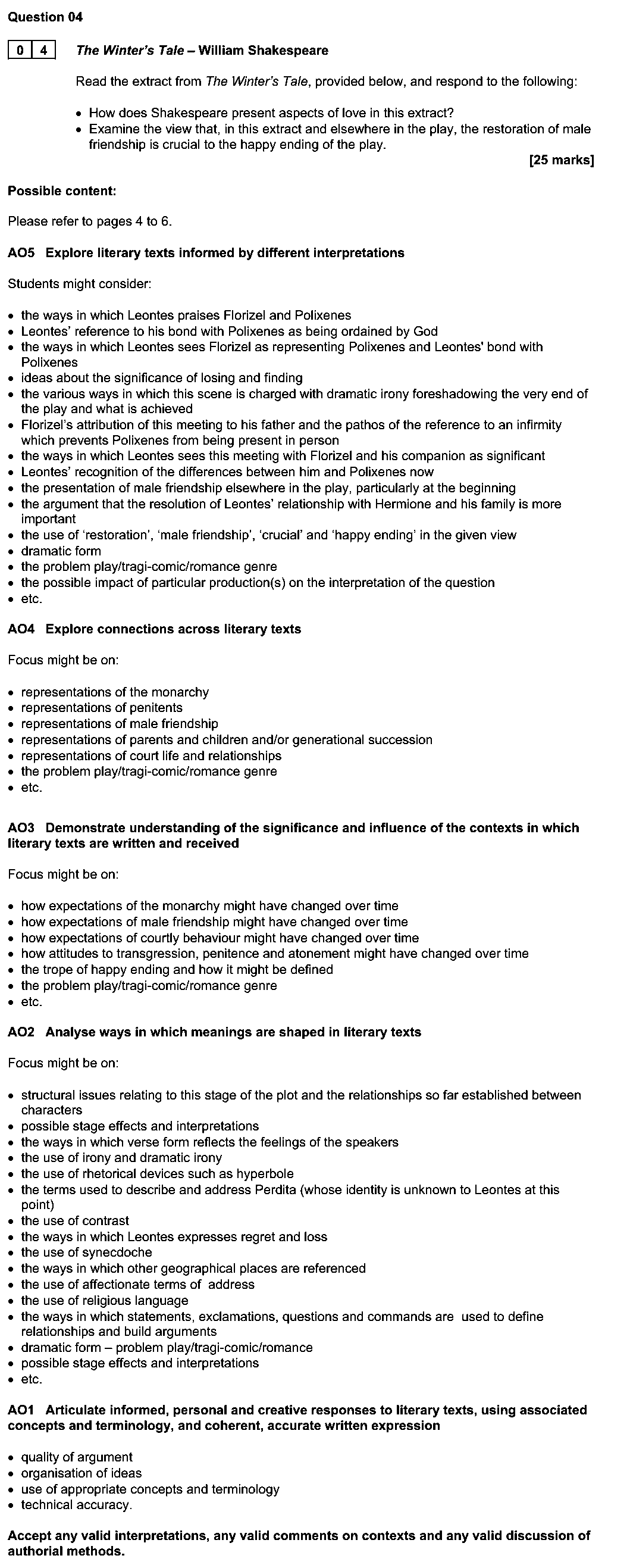
The Winter’s Tale – William Shakespeare
Read the extract from The Winter’s Tale, provided below, and respond to the following:
• How does Shakespeare present aspects of love in this extract?
• Examine the view that, in this extract and elsewhere in the play, the restoration of male
friendship is crucial to the happy ending of the play.
[25 marks]
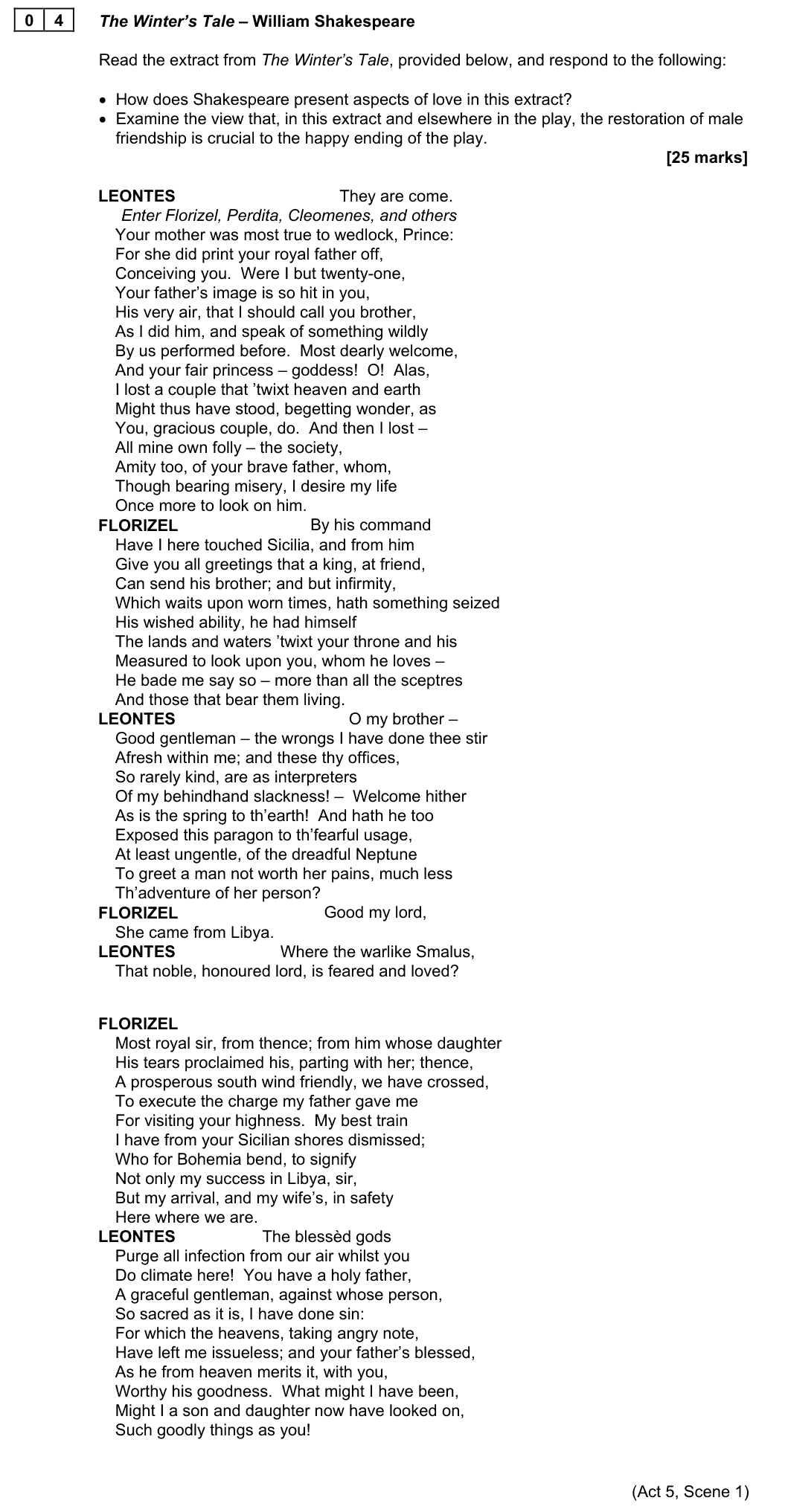
LEONTES They are come.
Enter Florizel, Perdita, Cleomenes, and others
Your mother was most true to wedlock, Prince:
For she did print your royal father off,
Conceiving you. Were I but twenty-one,
Your father’s image is so hit in you,
His very air, that I should call you brother,
As I did him, and speak of something wildly
By us performed before. Most dearly welcome,
And your fair princess – goddess! O! Alas,
I lost a couple that ’twixt heaven and earth
Might thus have stood, begetting wonder, as
You, gracious couple, do. And then I lost –
All mine own folly – the society,
Amity too, of your brave father, whom,
Though bearing misery, I desire my life
Once more to look on him.
FLORIZEL By his command
Have I here touched Sicilia, and from him
Give you all greetings that a king, at friend,
Can send his brother; and but infirmity,
Which waits upon worn times, hath something seized
His wished ability, he had himself
The lands and waters ’twixt your throne and his
Measured to look upon you, whom he loves –
He bade me say so – more than all the sceptres
And those that bear them living.
LEONTES O my brother –
Good gentleman – the wrongs I have done thee stir
Afresh within me; and these thy offices,
So rarely kind, are as interpreters
Of my behindhand slackness! – Welcome hither
As is the spring to th’earth! And hath he too
Exposed this paragon to th’fearful usage,
At least ungentle, of the dreadful Neptune
To greet a man not worth her pains, much less
Th’adventure of her person?
FLORIZEL Good my lord,
She came from Libya.
LEONTES Where the warlike Smalus,
That noble, honoured lord, is feared and loved?
FLORIZEL
Most royal sir, from thence; from him whose daughter
His tears proclaimed his, parting with her; thence,
A prosperous south wind friendly, we have crossed,
To execute the charge my father gave me
For visiting your highness. My best train
I have from your Sicilian shores dismissed;
Who for Bohemia bend, to signify
Not only my success in Libya, sir,
But my arrival, and my wife’s, in safety
Here where we are.
LEONTES The blessèd gods
Purge all infection from our air whilst you
Do climate here! You have a holy father,
A graceful gentleman, against whose person,
So sacred as it is, I have done sin:
For which the heavens, taking angry note,
Have left me issueless; and your father’s blessed,
As he from heaven merits it, with you,
Worthy his goodness. What might I have been,
Might I a son and daughter now have looked on,
Such goodly things as you!
(Act 5, Scene 1)
June 2022 · AS Paper 1 · Q5 25 marks Anthology poetry love poetry pre 1900
AQA Anthology of love poetry through the ages pre-1900
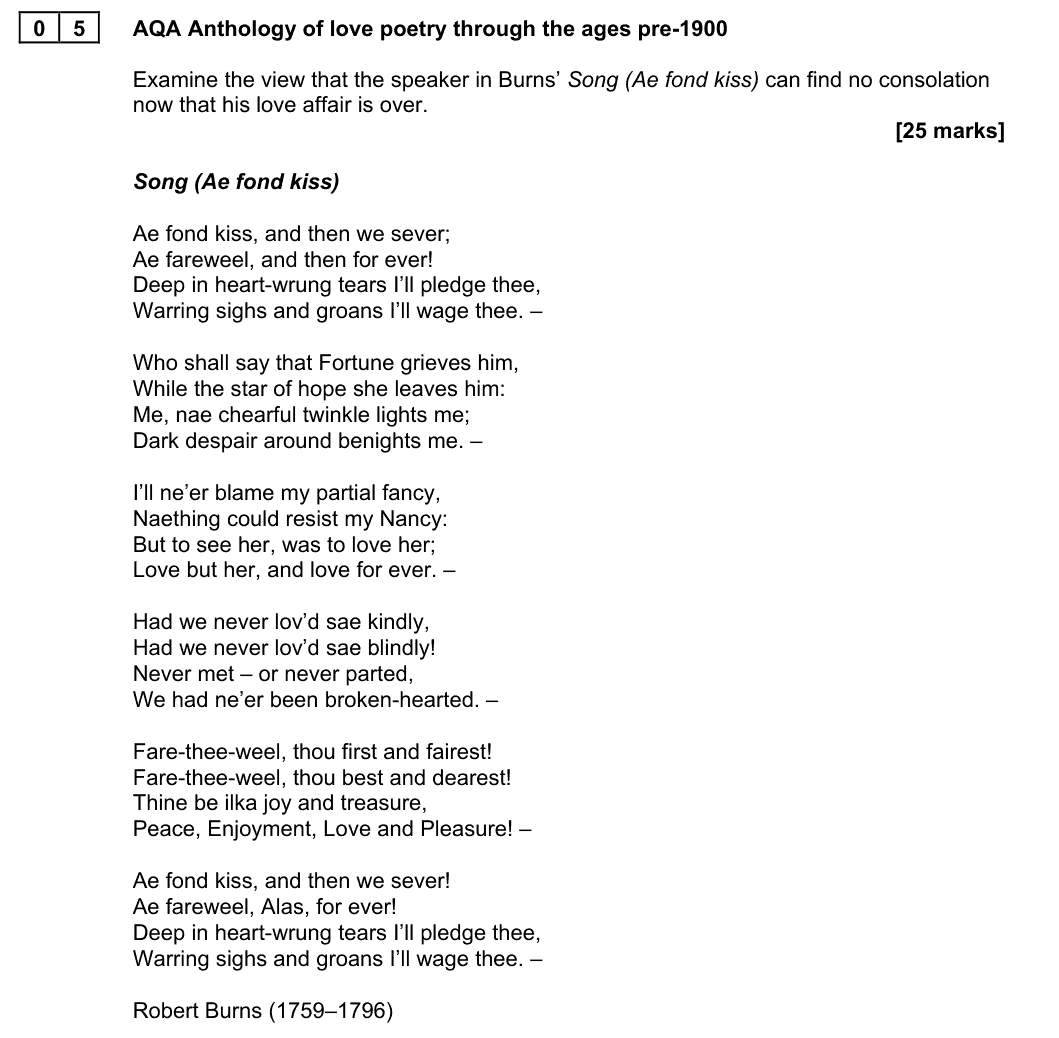
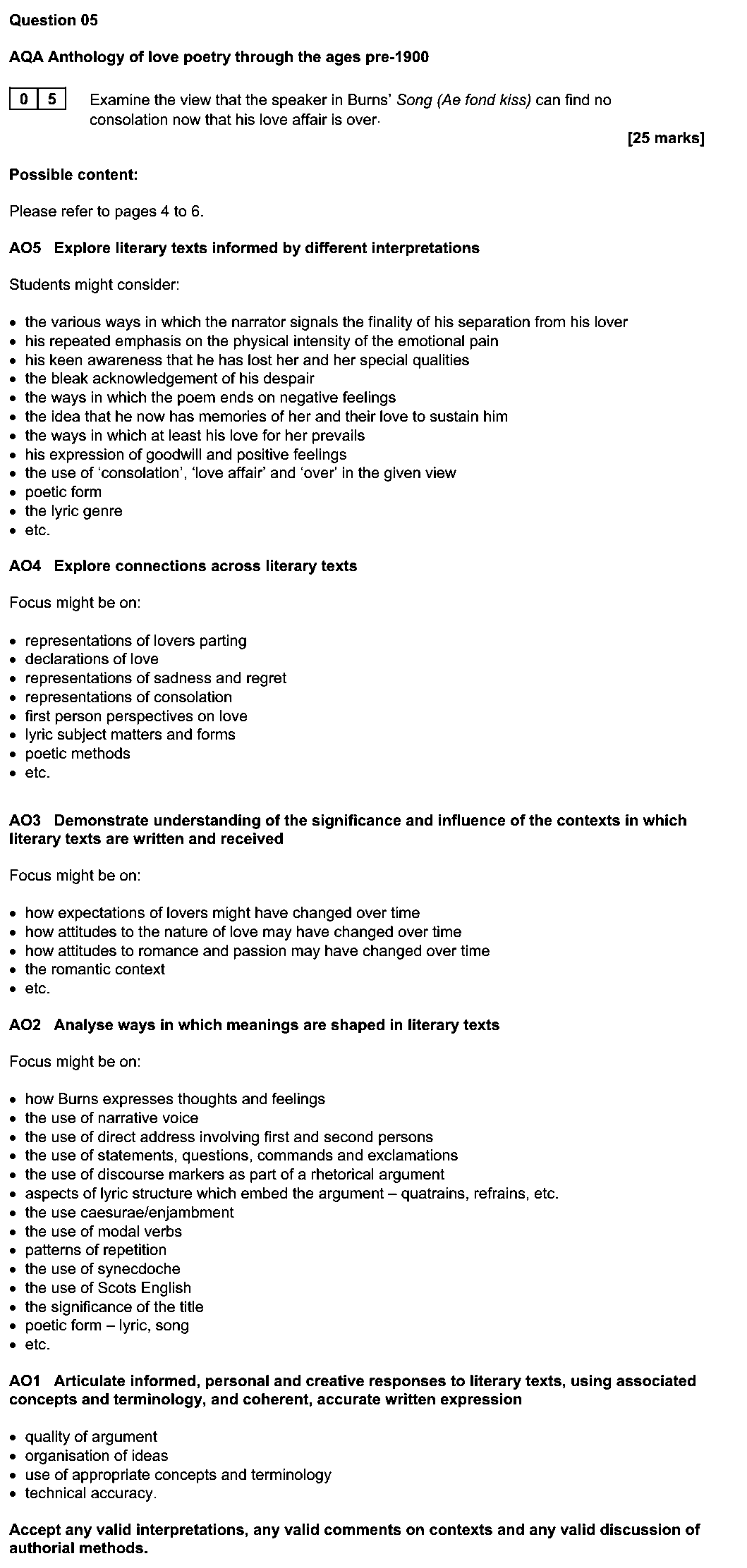
Examine the view that the speaker in Burns’ Song (Ae fond kiss) can find no consolation
now that his love affair is over.
[25 marks]
Song (Ae fond kiss)
Ae fond kiss, and then we sever;
Ae fareweel, and then for ever!
Deep in heart-wrung tears I’ll pledge thee,
Warring sighs and groans I’ll wage thee. –
Who shall say that Fortune grieves him,
While the star of hope she leaves him:
Me, nae chearful twinkle lights me;
Dark despair around benights me. –
I’ll ne’er blame my partial fancy,
Naething could resist my Nancy:
But to see her, was to love her;
Love but her, and love for ever. –
Had we never lov’d sae kindly,
Had we never lov’d sae blindly!
Never met – or never parted,
We had ne’er been broken-hearted. –
Fare-thee-weel, thou first and fairest!
Fare-thee-weel, thou best and dearest!
Thine be ilka joy and treasure,
Peace, Enjoyment, Love and Pleasure! –
Ae fond kiss, and then we sever!
Ae fareweel, Alas, for ever!
Deep in heart-wrung tears I’ll pledge thee,
Warring sighs and groans I’ll wage thee. –
Robert Burns (1759–1796)
June 2022 · AS Paper 1 · Q6 25 marks Anthology poetry love poetry post 1900
AQA Anthology of love poetry through the ages post-1900
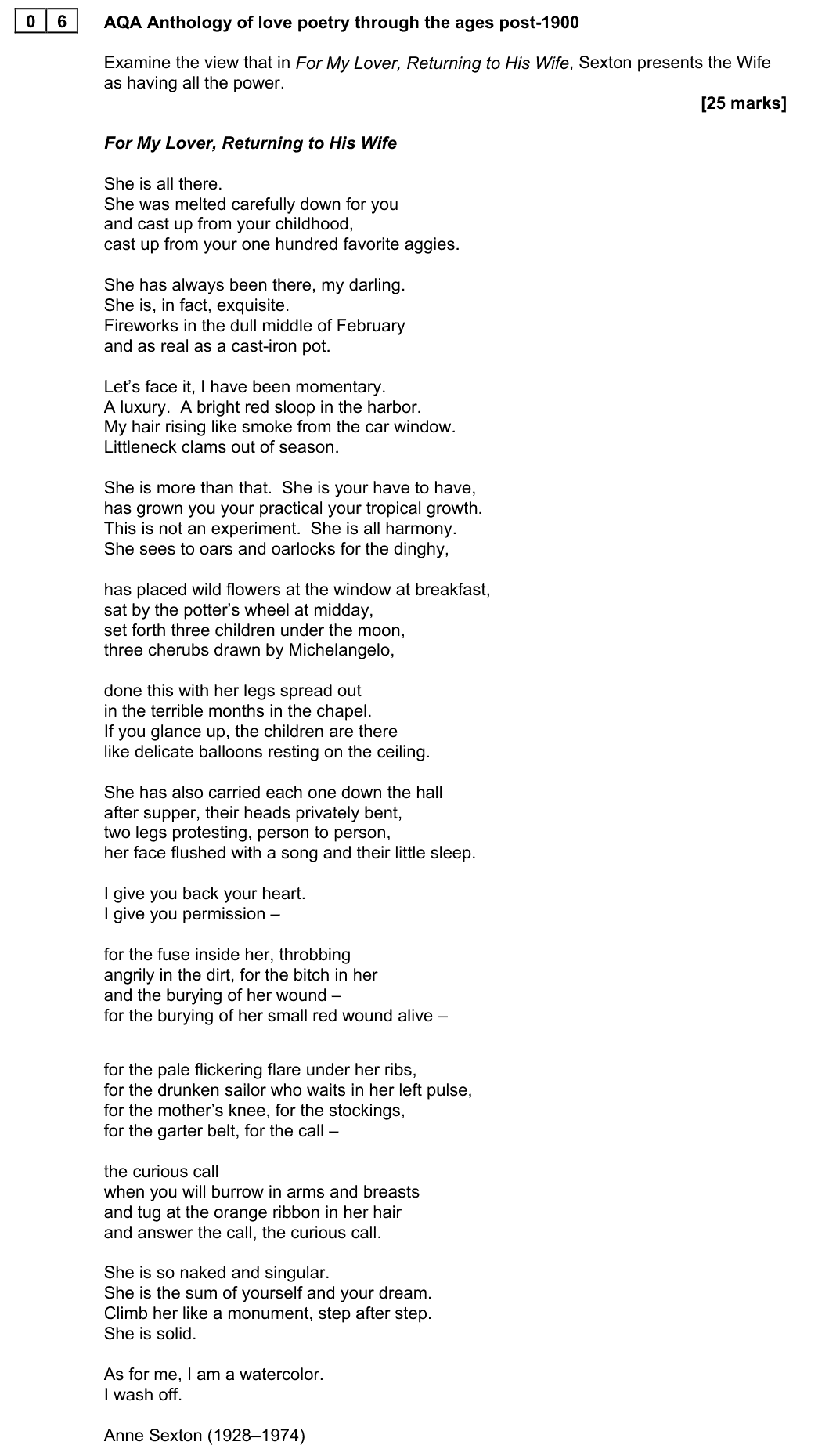
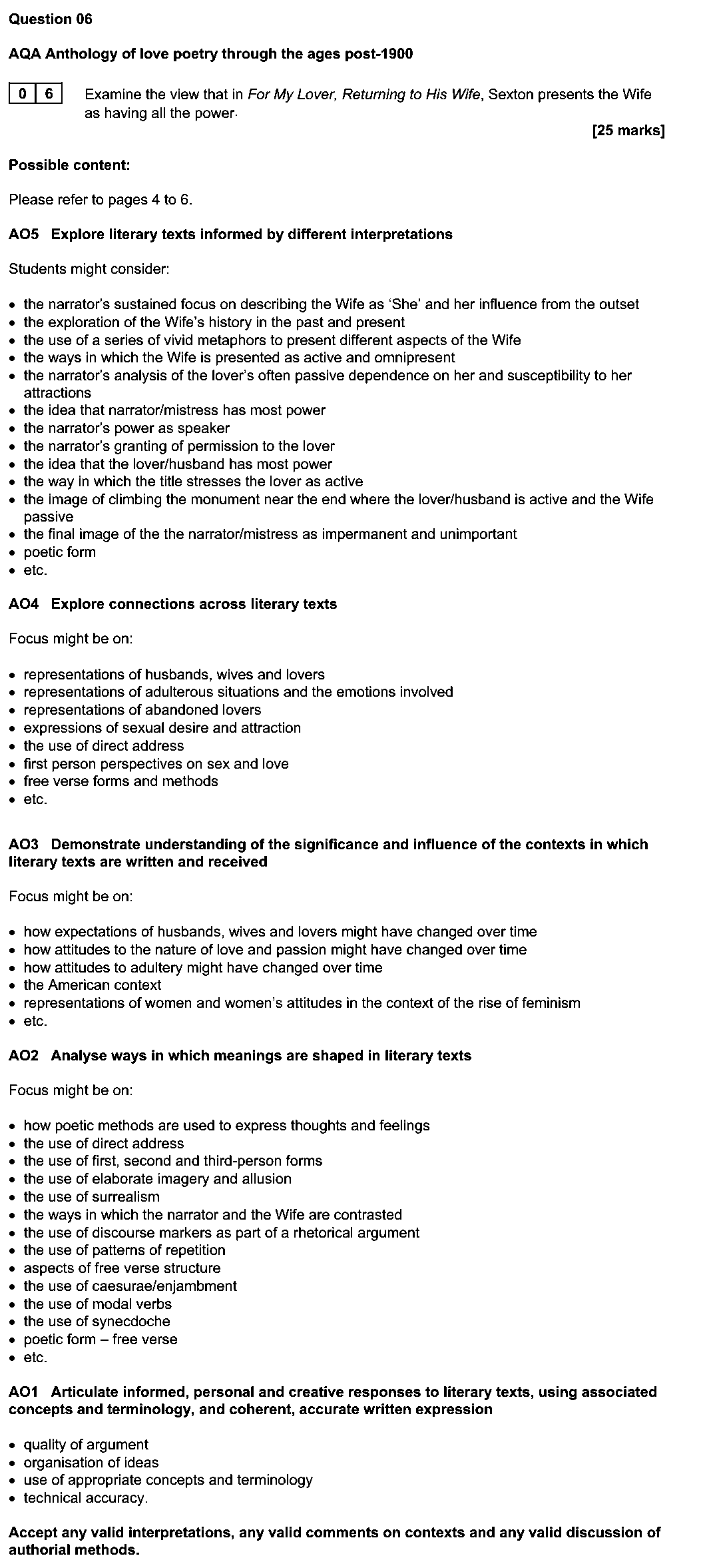
Examine the view that in For My Lover, Returning to His Wife, Sexton presents the Wife
as having all the power.
[25 marks]
For My Lover, Returning to His Wife
She is all there.
She was melted carefully down for you
and cast up from your childhood,
cast up from your one hundred favorite aggies.
She has always been there, my darling.
She is, in fact, exquisite.
Fireworks in the dull middle of February
and as real as a cast-iron pot.
Let’s face it, I have been momentary.
A luxury. A bright red sloop in the harbor.
My hair rising like smoke from the car window.
Littleneck clams out of season.
She is more than that. She is your have to have,
has grown you your practical your tropical growth.
This is not an experiment. She is all harmony.
She sees to oars and oarlocks for the dinghy,
has placed wild flowers at the window at breakfast,
sat by the potter’s wheel at midday,
set forth three children under the moon,
three cherubs drawn by Michelangelo,
done this with her legs spread out
in the terrible months in the chapel.
If you glance up, the children are there
like delicate balloons resting on the ceiling.
She has also carried each one down the hall
after supper, their heads privately bent,
two legs protesting, person to person,
her face flushed with a song and their little sleep.
I give you back your heart.
I give you permission –
for the fuse inside her, throbbing
angrily in the dirt, for the bitch in her
and the burying of her wound –
for the burying of her small red wound alive –
for the pale flickering flare under her ribs,
for the drunken sailor who waits in her left pulse,
for the mother’s knee, for the stockings,
for the garter belt, for the call –
the curious call
when you will burrow in arms and breasts
and tug at the orange ribbon in her hair
and answer the call, the curious call.
She is so naked and singular.
She is the sum of yourself and your dream.
Climb her like a monument, step after step.
She is solid.
As for me, I am a watercolor.
I wash off.
Anne Sexton (1928–1974)

Work with an AQA English Literature A tutor

Want a paper marked and gone through with you? Message us.

Prefer email? Send an enquiry

If you are under 18, please include a parent's contact details. Enquiries go to enquiries@alevelenglishtutor.com and are deleted once handled. All tutoring is online.