June 2022: A-level Paper 1, Love through the ages

75 marks · 7 questions (every option is included) · Paper, mark scheme and report on AQA's site

Question by question

QTopicMarksAOType
1 Othello 25Shakespeare extract
2 The Taming of the Shrew 25Shakespeare extract
3 Measure for Measure 25Shakespeare extract
4 The Winter's Tale 25Shakespeare extract
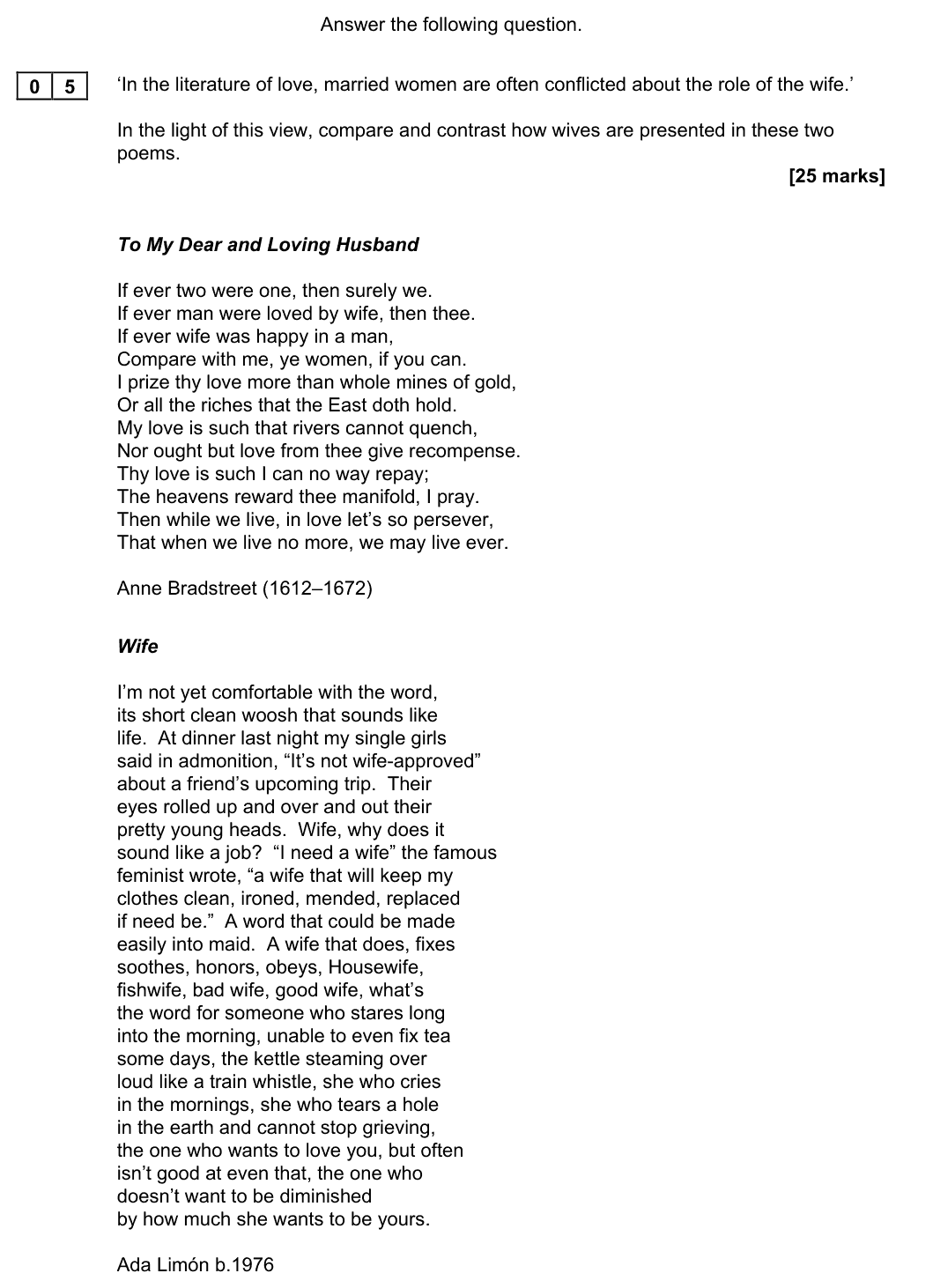
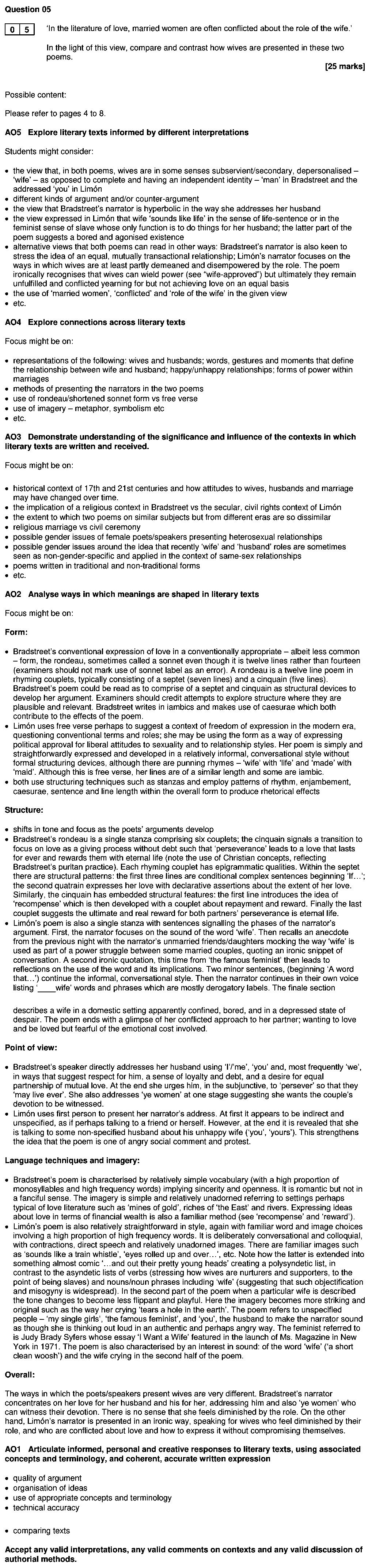
5 Unseen poetry comparison (love) 25Unseen poetry
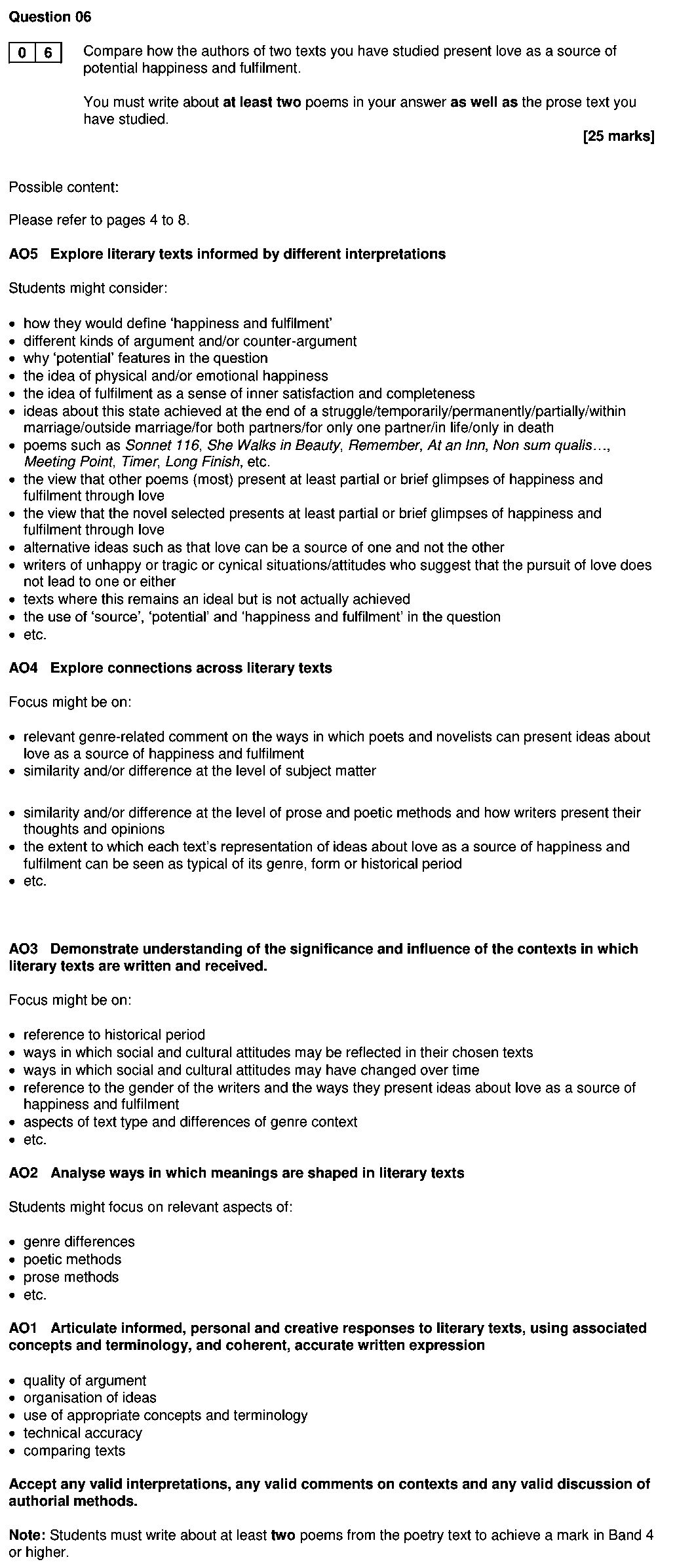
6 AQA Anthology: love poetry pre-1900, AQA Anthology: love poetry post-1900, Comparing prose texts (love through the ages) 25Comparing texts
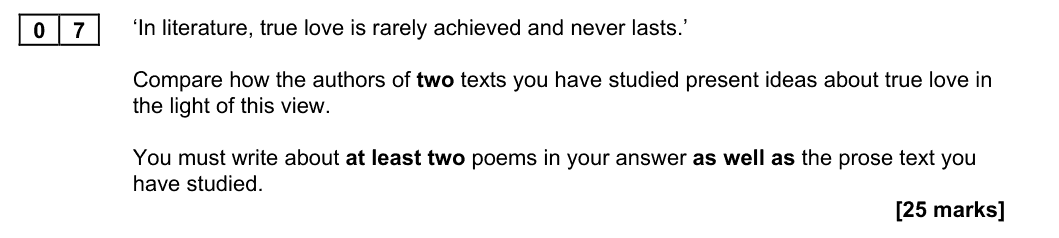
7 AQA Anthology: love poetry pre-1900, AQA Anthology: love poetry post-1900, Comparing prose texts (love through the ages) 25Comparing texts

The questions

1234567
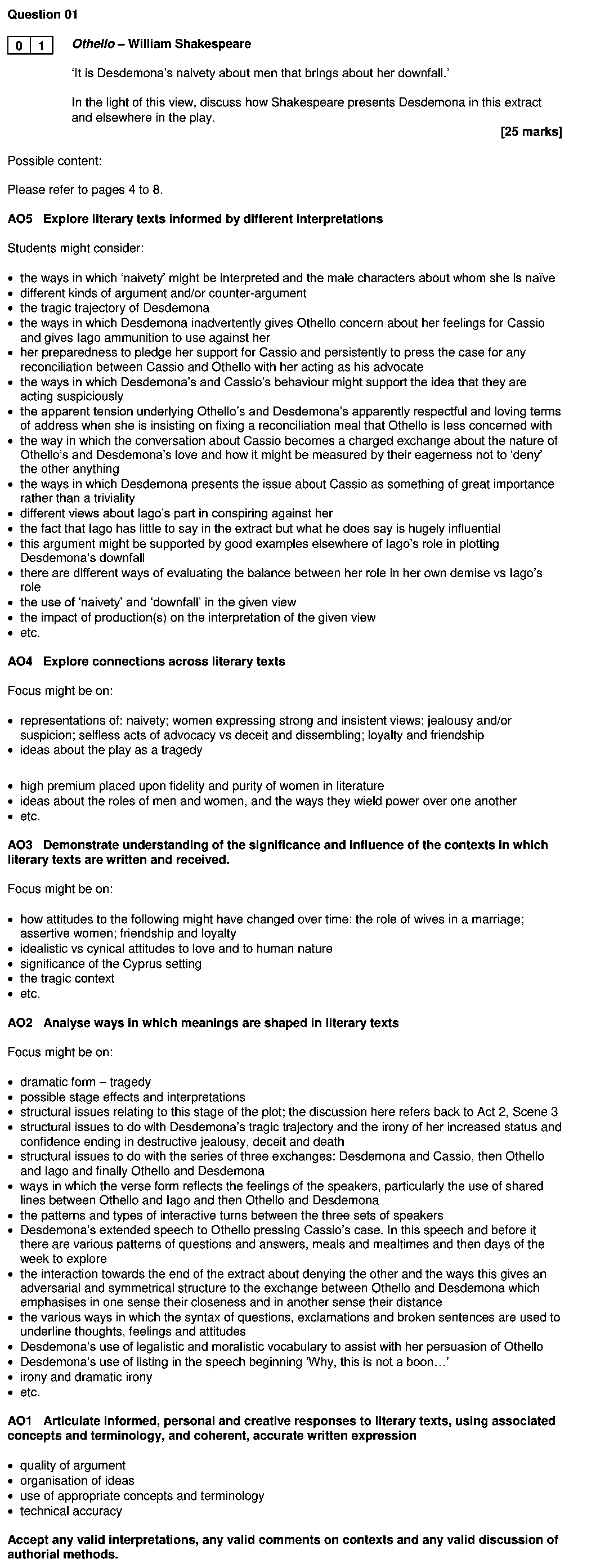
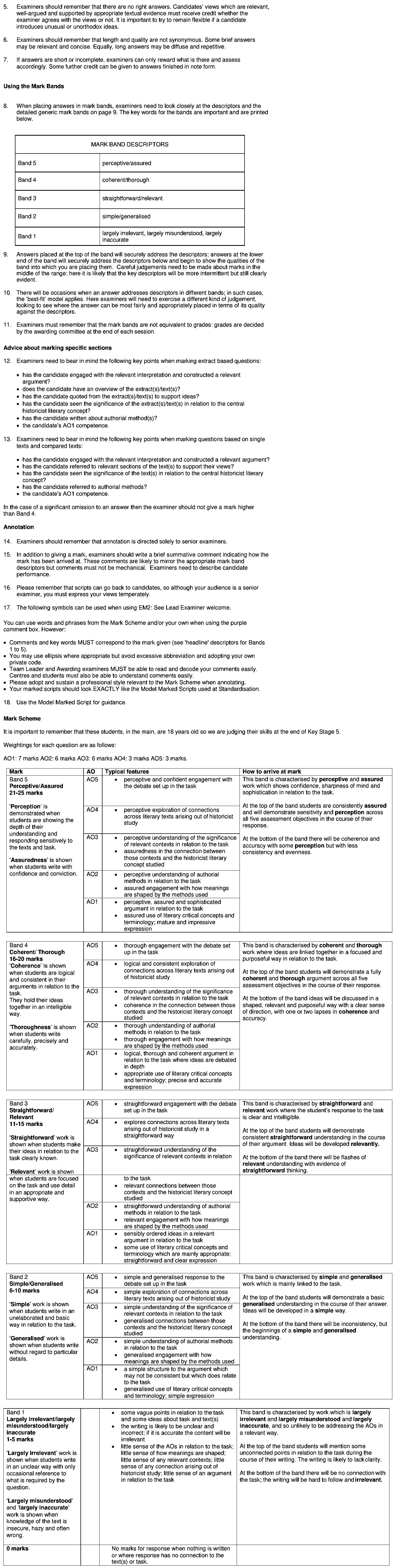
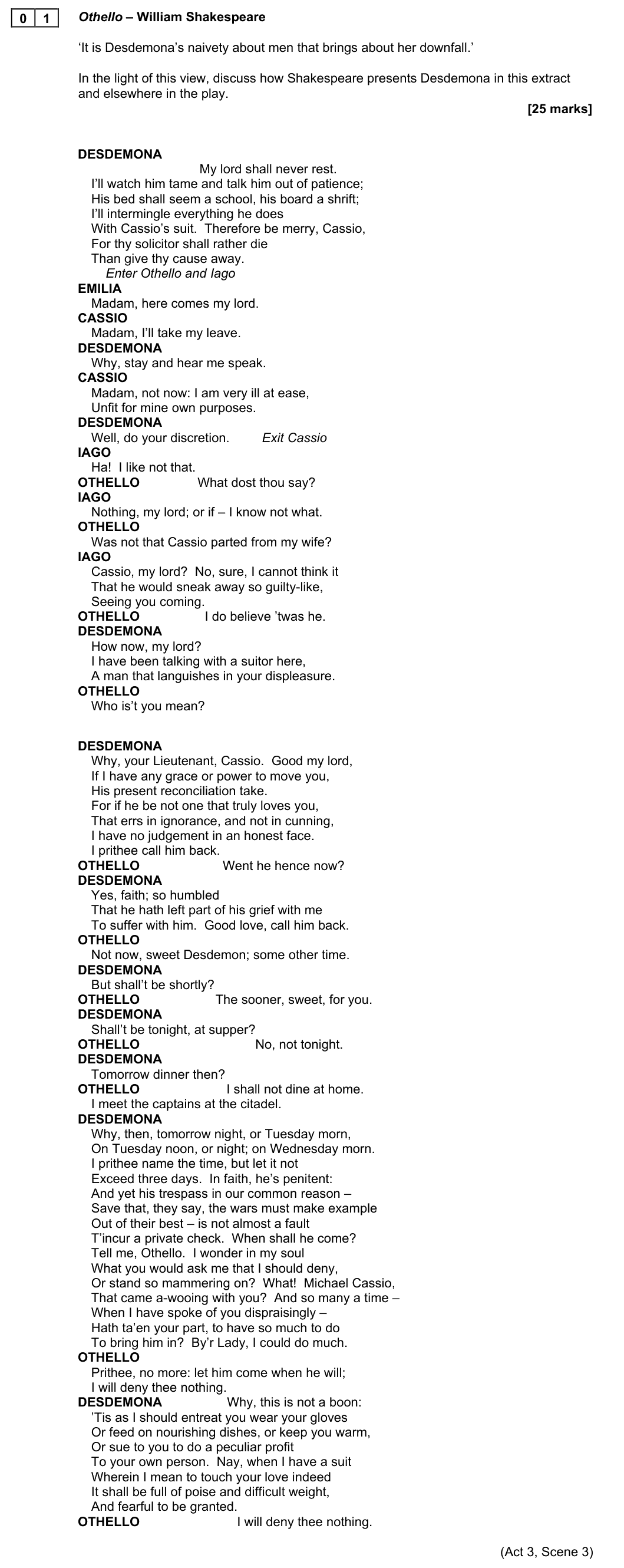
June 2022 · Paper 1 · Q1 25 marks Shakespeare extract othello
Othello – William Shakespeare
‘It is Desdemona’s naivety about men that brings about her downfall.’
In the light of this view, discuss how Shakespeare presents Desdemona in this extract
and elsewhere in the play.
[25 marks]
DESDEMONA
My lord shall never rest.
I’ll watch him tame and talk him out of patience;
His bed shall seem a school, his board a shrift;
I’ll intermingle everything he does
With Cassio’s suit. Therefore be merry, Cassio,
For thy solicitor shall rather die
Than give thy cause away.
Enter Othello and Iago
EMILIA
Madam, here comes my lord.
CASSIO
Madam, I’ll take my leave.
DESDEMONA
Why, stay and hear me speak.
CASSIO
Madam, not now: I am very ill at ease,
Unfit for mine own purposes.
DESDEMONA
Well, do your discretion. Exit Cassio
IAGO
Ha! I like not that.
OTHELLO What dost thou say?
IAGO
Nothing, my lord; or if – I know not what.
OTHELLO
Was not that Cassio parted from my wife?
IAGO
Cassio, my lord? No, sure, I cannot think it
That he would sneak away so guilty-like,
Seeing you coming.
OTHELLO I do believe ’twas he.
DESDEMONA
How now, my lord?
I have been talking with a suitor here,
A man that languishes in your displeasure.
OTHELLO
Who is’t you mean?
DESDEMONA
Why, your Lieutenant, Cassio. Good my lord,
If I have any grace or power to move you,
His present reconciliation take.
For if he be not one that truly loves you,
That errs in ignorance, and not in cunning,
I have no judgement in an honest face.
I prithee call him back.
OTHELLO Went he hence now?
DESDEMONA
Yes, faith; so humbled
That he hath left part of his grief with me
To suffer with him. Good love, call him back.
OTHELLO
Not now, sweet Desdemon; some other time.
DESDEMONA
But shall’t be shortly?
OTHELLO The sooner, sweet, for you.
DESDEMONA
Shall’t be tonight, at supper?
OTHELLO No, not tonight.
DESDEMONA
Tomorrow dinner then?
OTHELLO I shall not dine at home.
I meet the captains at the citadel.
DESDEMONA
Why, then, tomorrow night, or Tuesday morn,
On Tuesday noon, or night; on Wednesday morn.
I prithee name the time, but let it not
Exceed three days. In faith, he’s penitent:
And yet his trespass in our common reason –
Save that, they say, the wars must make example
Out of their best – is not almost a fault
T’incur a private check. When shall he come?
Tell me, Othello. I wonder in my soul
What you would ask me that I should deny,
Or stand so mammering on? What! Michael Cassio,
That came a-wooing with you? And so many a time –
When I have spoke of you dispraisingly –
Hath ta’en your part, to have so much to do
To bring him in? By’r Lady, I could do much.
OTHELLO
Prithee, no more: let him come when he will;
I will deny thee nothing.
DESDEMONA Why, this is not a boon:
’Tis as I should entreat you wear your gloves
Or feed on nourishing dishes, or keep you warm,
Or sue to you to do a peculiar profit
To your own person. Nay, when I have a suit
Wherein I mean to touch your love indeed
It shall be full of poise and difficult weight,
And fearful to be granted.
OTHELLO I will deny thee nothing.
(Act 3, Scene 3)
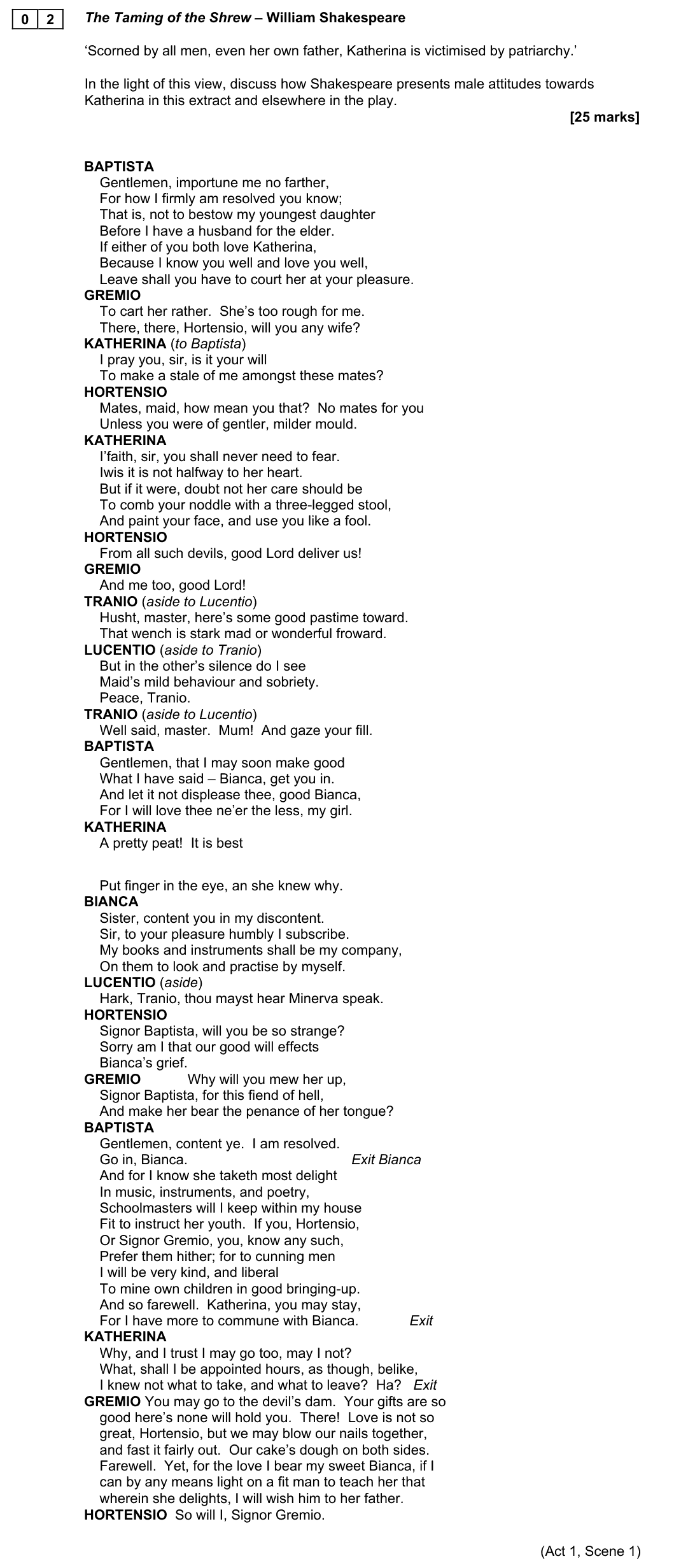
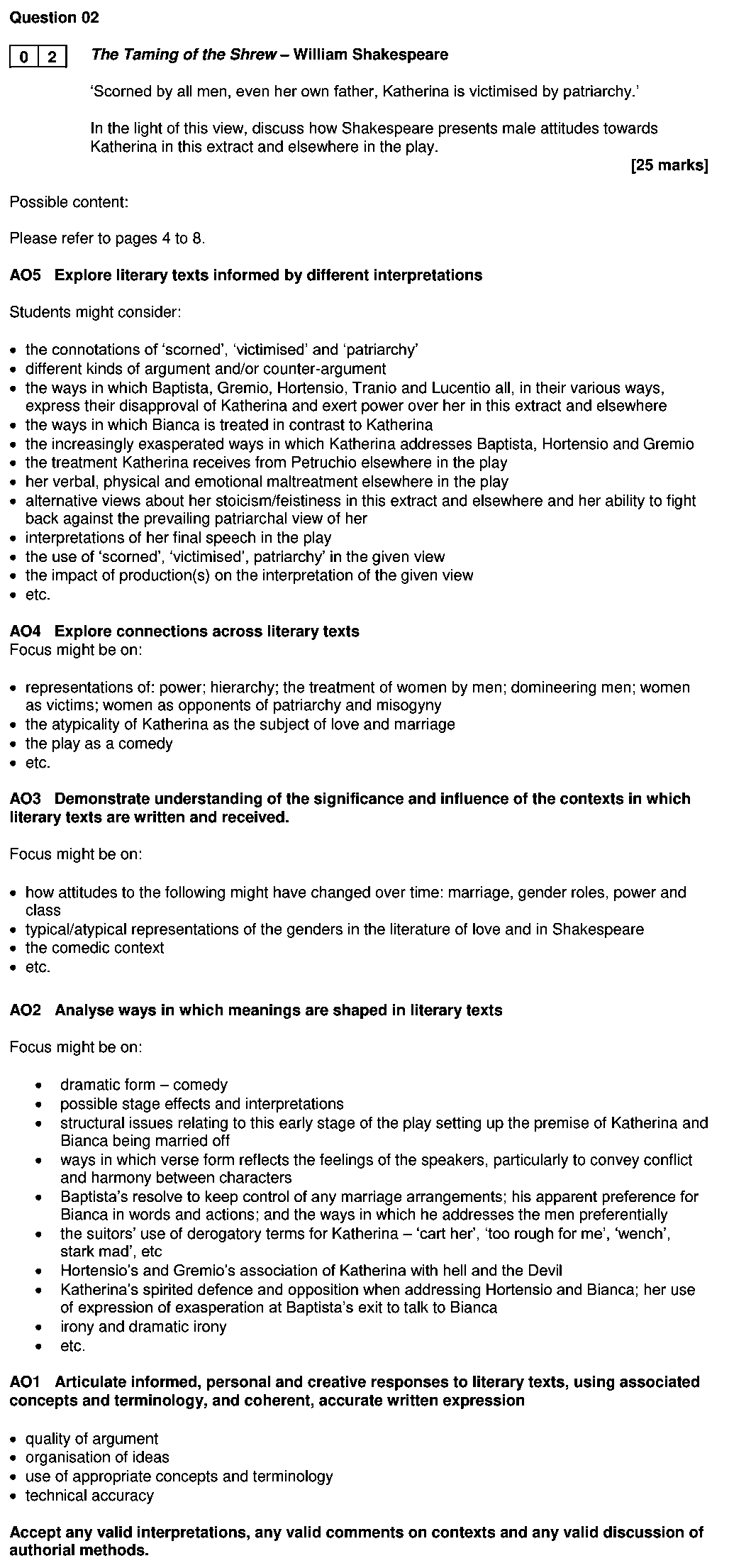
June 2022 · Paper 1 · Q2 25 marks Shakespeare extract taming of the shrew
The Taming of the Shrew – William Shakespeare
‘Scorned by all men, even her own father, Katherina is victimised by patriarchy.’
In the light of this view, discuss how Shakespeare presents male attitudes towards
Katherina in this extract and elsewhere in the play.
[25 marks]
BAPTISTA
Gentlemen, importune me no farther,
For how I firmly am resolved you know;
That is, not to bestow my youngest daughter
Before I have a husband for the elder.
If either of you both love Katherina,
Because I know you well and love you well,
Leave shall you have to court her at your pleasure.
GREMIO
To cart her rather. She’s too rough for me.
There, there, Hortensio, will you any wife?
KATHERINA (to Baptista)
I pray you, sir, is it your will
To make a stale of me amongst these mates?
HORTENSIO
Mates, maid, how mean you that? No mates for you
Unless you were of gentler, milder mould.
KATHERINA
I’faith, sir, you shall never need to fear.
Iwis it is not halfway to her heart.
But if it were, doubt not her care should be
To comb your noddle with a three-legged stool,
And paint your face, and use you like a fool.
HORTENSIO
From all such devils, good Lord deliver us!
GREMIO
And me too, good Lord!
TRANIO (aside to Lucentio)
Husht, master, here’s some good pastime toward.
That wench is stark mad or wonderful froward.
LUCENTIO (aside to Tranio)
But in the other’s silence do I see
Maid’s mild behaviour and sobriety.
Peace, Tranio.
TRANIO (aside to Lucentio)
Well said, master. Mum! And gaze your fill.
BAPTISTA
Gentlemen, that I may soon make good
What I have said – Bianca, get you in.
And let it not displease thee, good Bianca,
For I will love thee ne’er the less, my girl.
KATHERINA
A pretty peat! It is best
Put finger in the eye, an she knew why.
BIANCA
Sister, content you in my discontent.
Sir, to your pleasure humbly I subscribe.
My books and instruments shall be my company,
On them to look and practise by myself.
LUCENTIO (aside)
Hark, Tranio, thou mayst hear Minerva speak.
HORTENSIO
Signor Baptista, will you be so strange?
Sorry am I that our good will effects
Bianca’s grief.
GREMIO Why will you mew her up,
Signor Baptista, for this fiend of hell,
And make her bear the penance of her tongue?
BAPTISTA
Gentlemen, content ye. I am resolved.
Go in, Bianca. Exit Bianca
And for I know she taketh most delight
In music, instruments, and poetry,
Schoolmasters will I keep within my house
Fit to instruct her youth. If you, Hortensio,
Or Signor Gremio, you, know any such,
Prefer them hither; for to cunning men
I will be very kind, and liberal
To mine own children in good bringing-up.
And so farewell. Katherina, you may stay,
For I have more to commune with Bianca. Exit
KATHERINA
Why, and I trust I may go too, may I not?
What, shall I be appointed hours, as though, belike,
I knew not what to take, and what to leave? Ha? Exit
GREMIO You may go to the devil’s dam. Your gifts are so
good here’s none will hold you. There! Love is not so
great, Hortensio, but we may blow our nails together,
and fast it fairly out. Our cake’s dough on both sides.
Farewell. Yet, for the love I bear my sweet Bianca, if I
can by any means light on a fit man to teach her that
wherein she delights, I will wish him to her father.
HORTENSIO So will I, Signor Gremio.
(Act 1, Scene 1)
June 2022 · Paper 1 · Q3 25 marks Shakespeare extract measure for measure
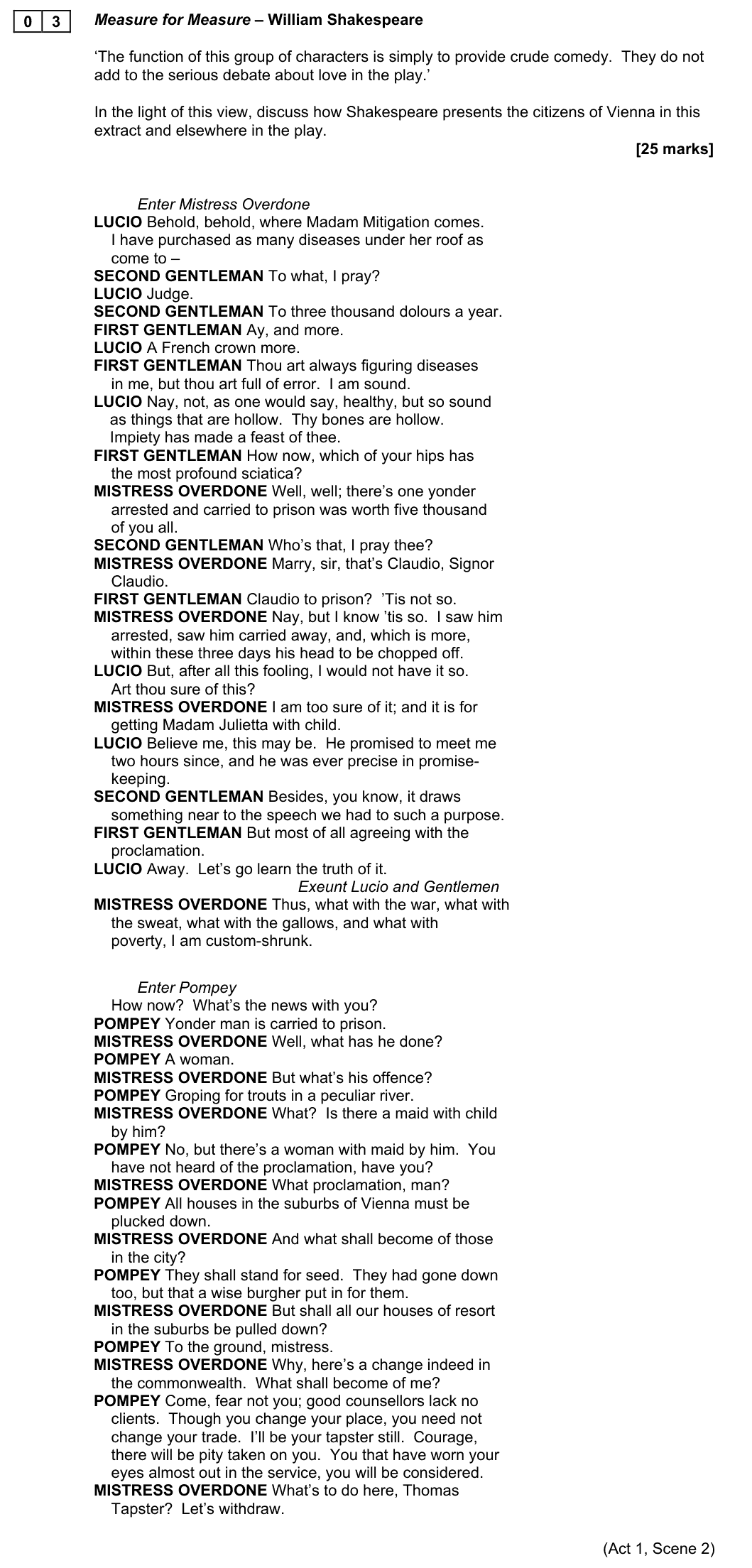
Measure for Measure – William Shakespeare
‘The function of this group of characters is simply to provide crude comedy. They do not
add to the serious debate about love in the play.’
In the light of this view, discuss how Shakespeare presents the citizens of Vienna in this
extract and elsewhere in the play.
[25 marks]
Enter Mistress Overdone
LUCIO Behold, behold, where Madam Mitigation comes.
I have purchased as many diseases under her roof as
come to –
SECOND GENTLEMAN To what, I pray?
LUCIO Judge.
SECOND GENTLEMAN To three thousand dolours a year.
FIRST GENTLEMAN Ay, and more.
LUCIO A French crown more.
FIRST GENTLEMAN Thou art always figuring diseases
in me, but thou art full of error. I am sound.
LUCIO Nay, not, as one would say, healthy, but so sound
as things that are hollow. Thy bones are hollow.
Impiety has made a feast of thee.
FIRST GENTLEMAN How now, which of your hips has
the most profound sciatica?
MISTRESS OVERDONE Well, well; there’s one yonder
arrested and carried to prison was worth five thousand
of you all.
SECOND GENTLEMAN Who’s that, I pray thee?
MISTRESS OVERDONE Marry, sir, that’s Claudio, Signor
Claudio.
FIRST GENTLEMAN Claudio to prison? ’Tis not so.
MISTRESS OVERDONE Nay, but I know ’tis so. I saw him
arrested, saw him carried away, and, which is more,
within these three days his head to be chopped off.
LUCIO But, after all this fooling, I would not have it so.
Art thou sure of this?
MISTRESS OVERDONE I am too sure of it; and it is for
getting Madam Julietta with child.
LUCIO Believe me, this may be. He promised to meet me
two hours since, and he was ever precise in promise-
keeping.
SECOND GENTLEMAN Besides, you know, it draws
something near to the speech we had to such a purpose.
FIRST GENTLEMAN But most of all agreeing with the
proclamation.
LUCIO Away. Let’s go learn the truth of it.
Exeunt Lucio and Gentlemen
MISTRESS OVERDONE Thus, what with the war, what with
the sweat, what with the gallows, and what with
poverty, I am custom-shrunk.
Enter Pompey
How now? What’s the news with you?
POMPEY Yonder man is carried to prison.
MISTRESS OVERDONE Well, what has he done?
POMPEY A woman.
MISTRESS OVERDONE But what’s his offence?
POMPEY Groping for trouts in a peculiar river.
MISTRESS OVERDONE What? Is there a maid with child
by him?
POMPEY No, but there’s a woman with maid by him. You
have not heard of the proclamation, have you?
MISTRESS OVERDONE What proclamation, man?
POMPEY All houses in the suburbs of Vienna must be
plucked down.
MISTRESS OVERDONE And what shall become of those
in the city?
POMPEY They shall stand for seed. They had gone down
too, but that a wise burgher put in for them.
MISTRESS OVERDONE But shall all our houses of resort
in the suburbs be pulled down?
POMPEY To the ground, mistress.
MISTRESS OVERDONE Why, here’s a change indeed in
the commonwealth. What shall become of me?
POMPEY Come, fear not you; good counsellors lack no
clients. Though you change your place, you need not
change your trade. I’ll be your tapster still. Courage,
there will be pity taken on you. You that have worn your
eyes almost out in the service, you will be considered.
MISTRESS OVERDONE What’s to do here, Thomas
Tapster? Let’s withdraw.
(Act 1, Scene 2)
June 2022 · Paper 1 · Q4 25 marks Shakespeare extract the winters tale
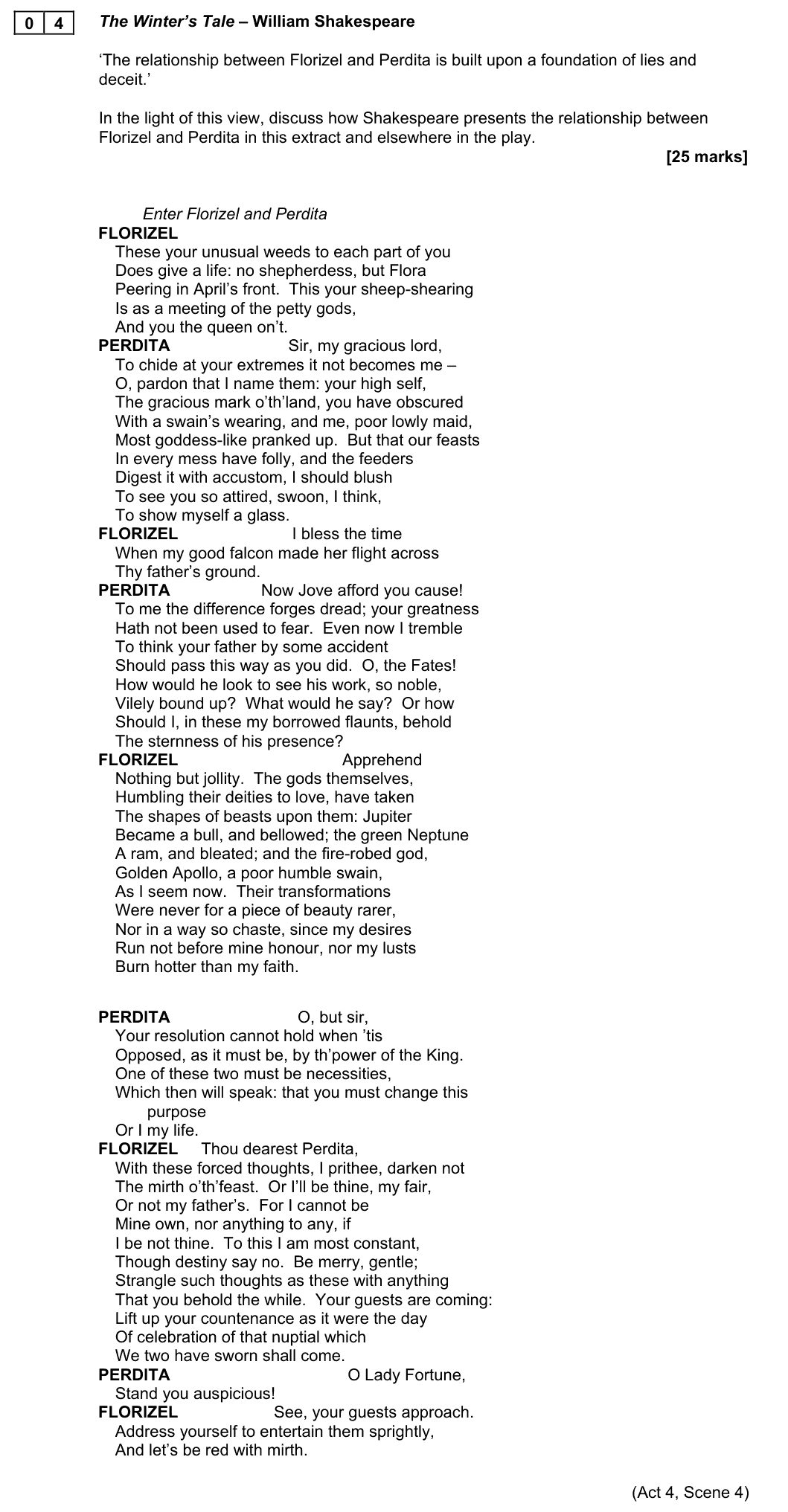
The Winter’s Tale – William Shakespeare
‘The relationship between Florizel and Perdita is built upon a foundation of lies and
deceit.’
In the light of this view, discuss how Shakespeare presents the relationship between
Florizel and Perdita in this extract and elsewhere in the play.
[25 marks]
Enter Florizel and Perdita
FLORIZEL
These your unusual weeds to each part of you
Does give a life: no shepherdess, but Flora
Peering in April’s front. This your sheep-shearing
Is as a meeting of the petty gods,
And you the queen on’t.
PERDITA Sir, my gracious lord,
To chide at your extremes it not becomes me –
O, pardon that I name them: your high self,
The gracious mark o’th’land, you have obscured
With a swain’s wearing, and me, poor lowly maid,
Most goddess-like pranked up. But that our feasts
In every mess have folly, and the feeders
Digest it with accustom, I should blush
To see you so attired, swoon, I think,
To show myself a glass.
FLORIZEL I bless the time
When my good falcon made her flight across
Thy father’s ground.
PERDITA Now Jove afford you cause!
To me the difference forges dread; your greatness
Hath not been used to fear. Even now I tremble
To think your father by some accident
Should pass this way as you did. O, the Fates!
How would he look to see his work, so noble,
Vilely bound up? What would he say? Or how
Should I, in these my borrowed flaunts, behold
The sternness of his presence?
FLORIZEL Apprehend
Nothing but jollity. The gods themselves,
Humbling their deities to love, have taken
The shapes of beasts upon them: Jupiter
Became a bull, and bellowed; the green Neptune
A ram, and bleated; and the fire-robed god,
Golden Apollo, a poor humble swain,
As I seem now. Their transformations
Were never for a piece of beauty rarer,
Nor in a way so chaste, since my desires
Run not before mine honour, nor my lusts
Burn hotter than my faith.
PERDITA O, but sir,
Your resolution cannot hold when ’tis
Opposed, as it must be, by th’power of the King.
One of these two must be necessities,
Which then will speak: that you must change this
purpose
Or I my life.
FLORIZEL Thou dearest Perdita,
With these forced thoughts, I prithee, darken not
The mirth o’th’feast. Or I’ll be thine, my fair,
Or not my father’s. For I cannot be
Mine own, nor anything to any, if
I be not thine. To this I am most constant,
Though destiny say no. Be merry, gentle;
Strangle such thoughts as these with anything
That you behold the while. Your guests are coming:
Lift up your countenance as it were the day
Of celebration of that nuptial which
We two have sworn shall come.
PERDITA O Lady Fortune,
Stand you auspicious!
FLORIZEL See, your guests approach.
Address yourself to entertain them sprightly,
And let’s be red with mirth.
(Act 4, Scene 4)
June 2022 · Paper 1 · Q5 25 marks Unseen poetry unseen love poetry
Answer the following question.
‘In the literature of love, married women are often conflicted about the role of the wife.’
In the light of this view, compare and contrast how wives are presented in these two
poems.
[25 marks]
To My Dear and Loving Husband
If ever two were one, then surely we.
If ever man were loved by wife, then thee.
If ever wife was happy in a man,
Compare with me, ye women, if you can.
I prize thy love more than whole mines of gold,
Or all the riches that the East doth hold.
My love is such that rivers cannot quench,
Nor ought but love from thee give recompense.
Thy love is such I can no way repay;
The heavens reward thee manifold, I pray.
Then while we live, in love let’s so persever,
That when we live no more, we may live ever.
Anne Bradstreet (1612–1672)
Wife
I’m not yet comfortable with the word,
its short clean woosh that sounds like
life. At dinner last night my single girls
said in admonition, “It’s not wife-approved”
about a friend’s upcoming trip. Their
eyes rolled up and over and out their
pretty young heads. Wife, why does it
sound like a job? “I need a wife” the famous
feminist wrote, “a wife that will keep my
clothes clean, ironed, mended, replaced
if need be.” A word that could be made
easily into maid. A wife that does, fixes
soothes, honors, obeys, Housewife,
fishwife, bad wife, good wife, what’s
the word for someone who stares long
into the morning, unable to even fix tea
some days, the kettle steaming over
loud like a train whistle, she who cries
in the mornings, she who tears a hole
in the earth and cannot stop grieving,
the one who wants to love you, but often
isn’t good at even that, the one who
doesn’t want to be diminished
by how much she wants to be yours.
Ada Limón b.1976
June 2022 · Paper 1 · Q6 25 marks Comparing texts love poetry pre 1900love poetry post 1900comparing prose love
Compare how the authors of two texts you have studied present love as a source of
potential happiness and fulfilment.
You must write about at least two poems in your answer as well as the prose text you
have studied.
[25 marks]
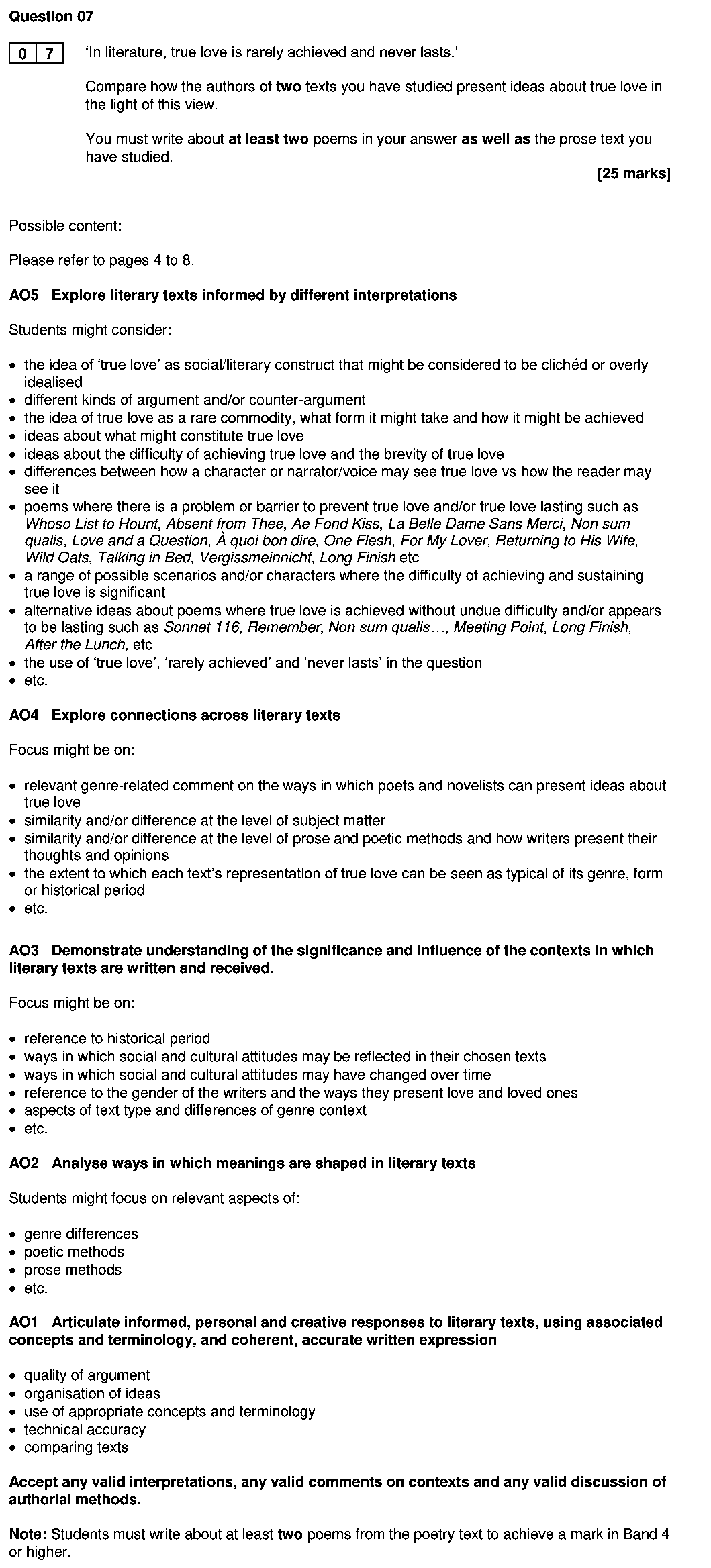
June 2022 · Paper 1 · Q7 25 marks Comparing texts love poetry pre 1900love poetry post 1900comparing prose love
‘In literature, true love is rarely achieved and never lasts.’
Compare how the authors of two texts you have studied present ideas about true love in
the light of this view.
You must write about at least two poems in your answer as well as the prose text you
have studied.
[25 marks]

Work with an AQA English Literature A tutor

Want a paper marked and gone through with you? Message us.

Prefer email? Send an enquiry

If you are under 18, please include a parent's contact details. Enquiries go to enquiries@alevelenglishtutor.com and are deleted once handled. All tutoring is online.