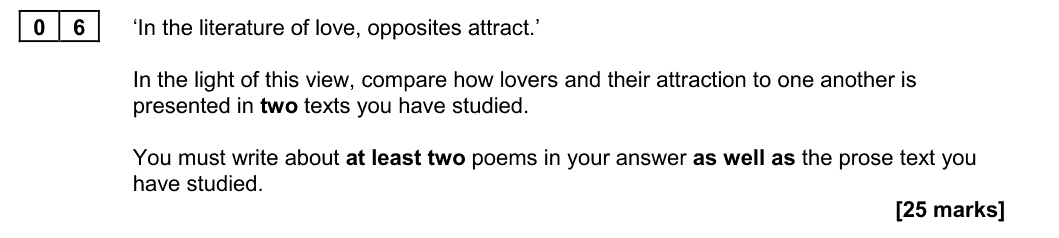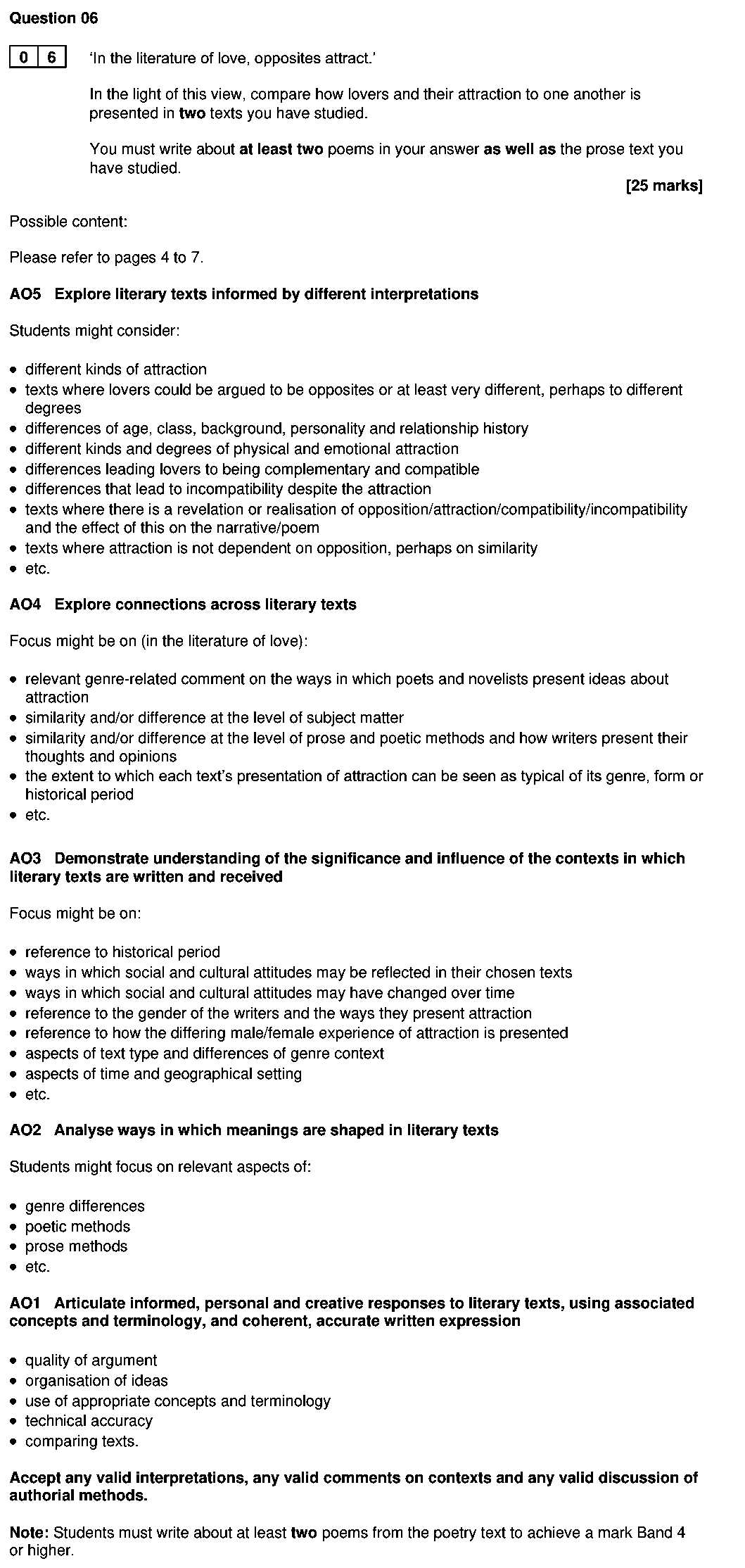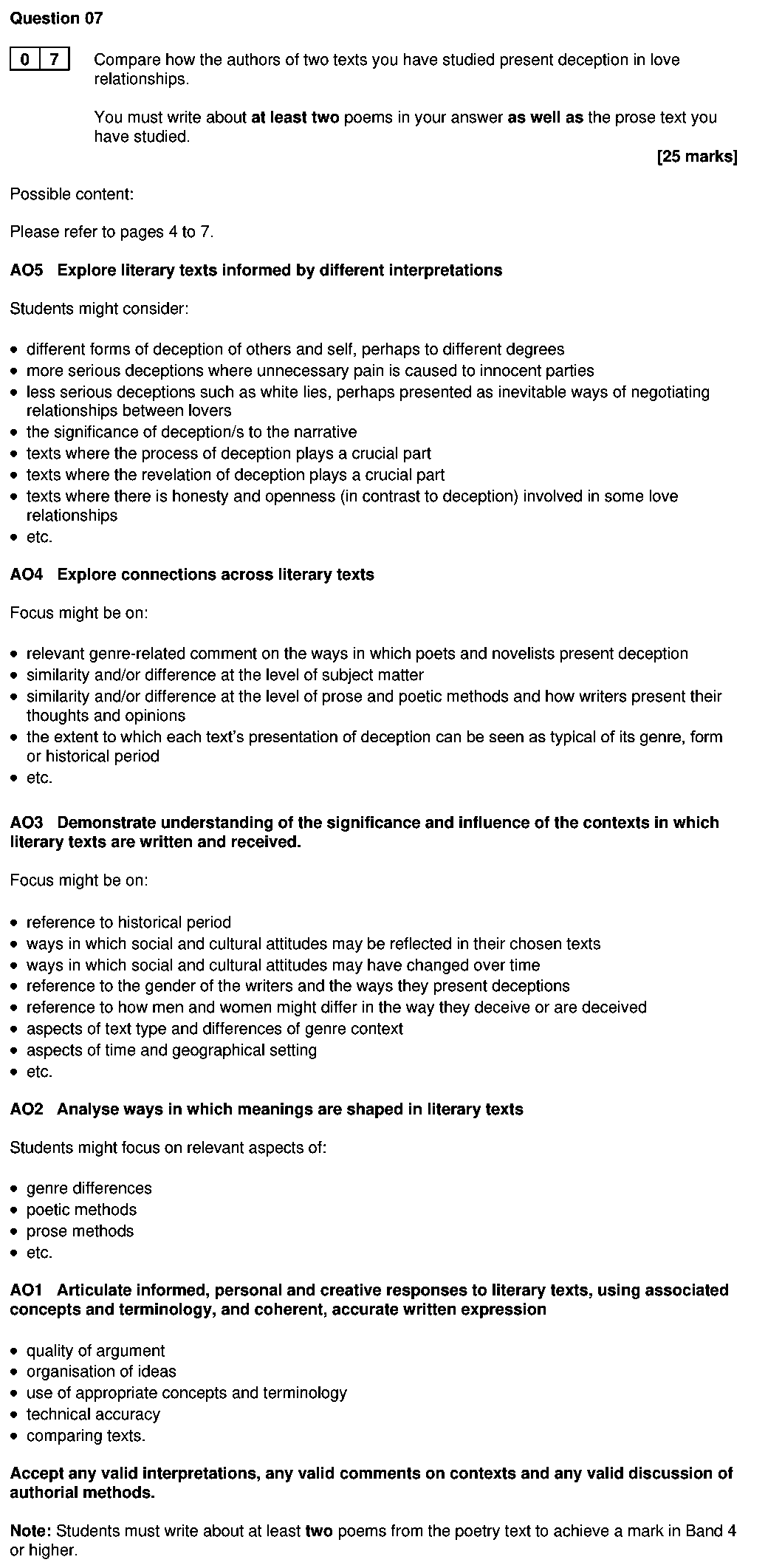
Mark scheme, including the levels and indicative content
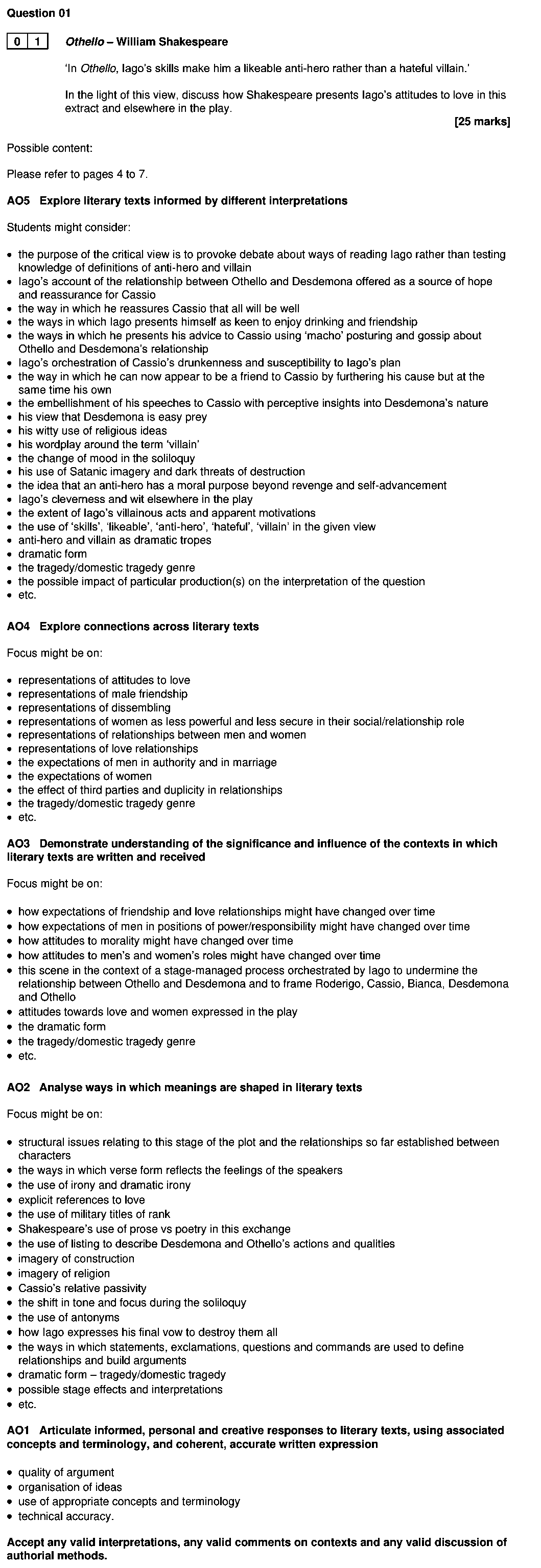
The general mark scheme (assessment objectives and bands)
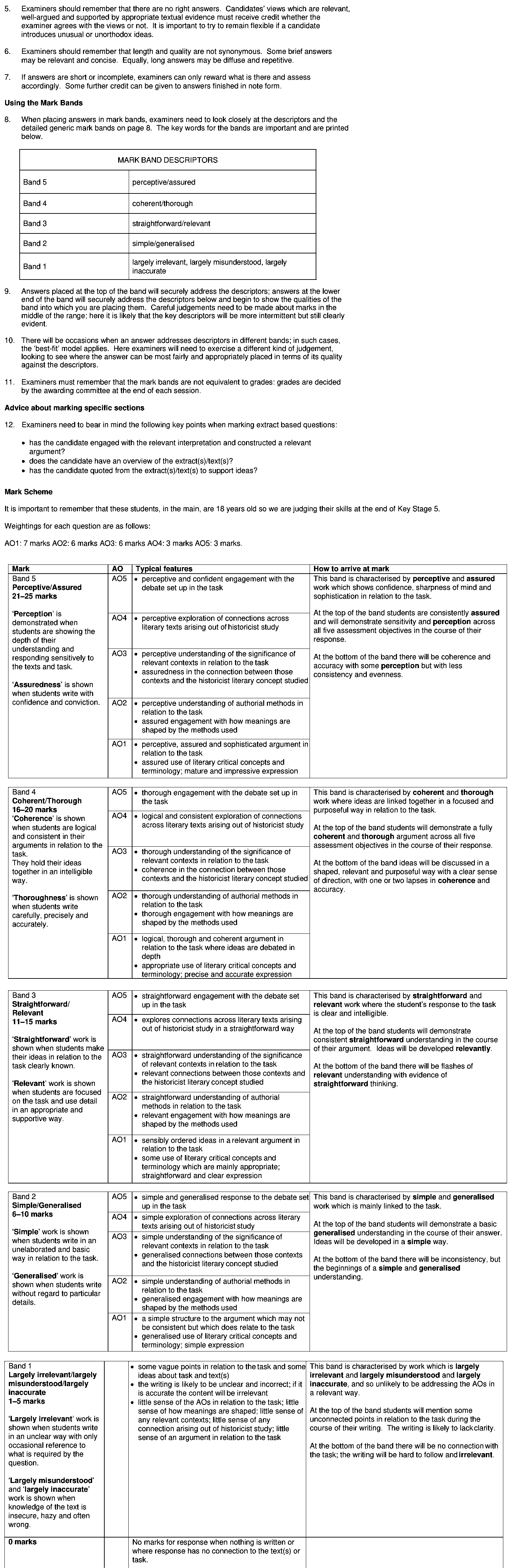
Examiner's comment
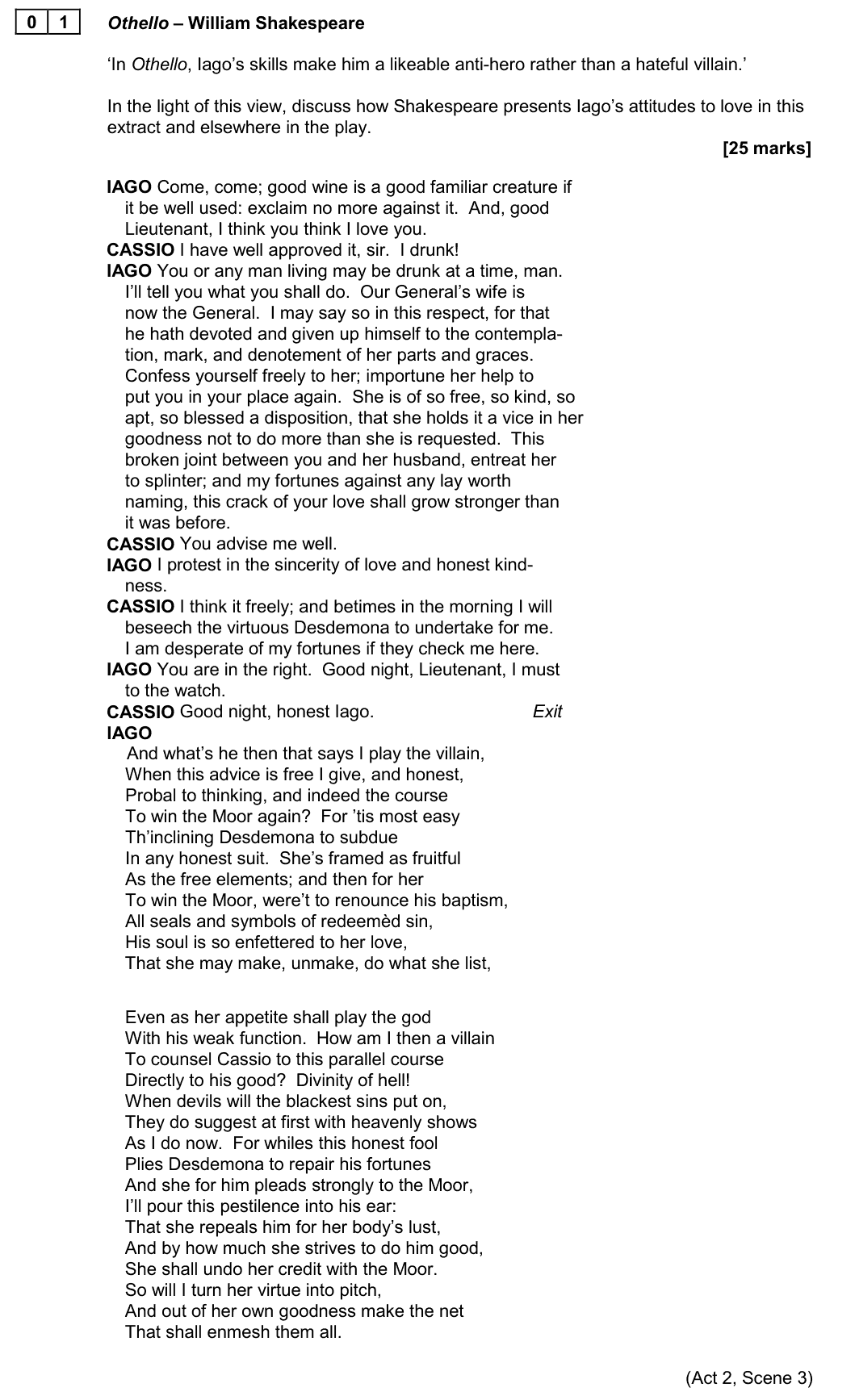
Othello ‘In Othello, Iago’s skills make him a likeable anti-hero rather than a hateful villain.’ In the light of this view, discuss how Shakespeare presents Iago’s attitudes to love in this extract and elsewhere in the play. More successful answers: • engaged readily with the constituent parts of the question: the extract; Iago’s skills and intellect; his attitude to love; the ‘hateful villain’ vs ‘likeable anti-hero’ debate • unpicked Iago’s view that love is a weakness and a way of manipulating others • understood the concept of anti-hero and the dramatic methods involved in making a character ‘likeable’ to an audience • could see that there is humour and much irony in the presentation of Iago, if one is to pursue the ‘likeable anti-hero’ view • looked closely at the extract and its structure • commented on the prose vs blank verse sections without resorting to simplistic generalisations about different poetic methods • explored the extent of his Iago’s villainy, apparent in the extract and wider play • integrated critical views about Iago in an accurate and relevant way • considered contemporaneous and modern audience responses to Iago’s racist and misogynistic attitudes • evaluated Iago’s response to the relationship between Othello and Desdemona in the light of Jacobean attitudes and the contemporaneous Venetian context • understood ideas about masculine insecurity around female sexuality • were aware of the debate about Iago’s motives • examined Iago as dramatic construct, as a plot device and catalyst with elements of the stock character villain. Less successful answers: • did not pay attention to the details of the extract • described Iago, often with no sustained reference to the question • took Iago’s words to Cassio literally and at face value • were confused about why Iago wants Cassio to approach Desdemona, some thought it was with love in mind • did not look at the narrative arc of the wider play and Iago’s role in it • struggled with ‘likeable anti-hero’ • did not considered the worst of Iago, defining him as a ‘hateful villain’ simply because he lied and manipulated • sometimes became too distracted by psychoanalytic theories and homoerotic readings that led away from the question and the given view • tried to cover too many character relationships.
Notes from the mark scheme and report
- Focus: character: Iago's attitudes to love; anti-hero or villain
- Extract printed
- extract Act 2 Scene 3 (Iago advises Cassio, then 'And what's he then that says I play the villain' soliloquy)
- the view is a prompt to debate ways of reading Iago, not to define anti-hero
- credited: love as weakness and a tool of manipulation, humour and irony, prose vs verse without generalising, racism and misogyny for Jacobean and modern audiences, masculine insecurity about female sexuality, Iago as plot device and stock villain
- weaker answers took his words to Cassio at face value, misread why Cassio should approach Desdemona, or drifted into psychoanalytic or homoerotic readings