June 2025: AS Paper 1, Shakespeare and poetry

50 marks · 6 questions (every option is included) · Paper, mark scheme and report on AQA's site

Question by question

QTopicMarksAOType
1 Othello 25Shakespeare extract
2 The Taming of the Shrew 25Shakespeare extract
3 Measure for Measure 25Shakespeare extract
4 The Winter's Tale 25Shakespeare extract
5 AQA Anthology: love poetry pre-1900 25Anthology poetry
6 AQA Anthology: love poetry post-1900 25Anthology poetry

The questions

123456
June 2025 · AS Paper 1 · Q1 25 marks Shakespeare extract othello
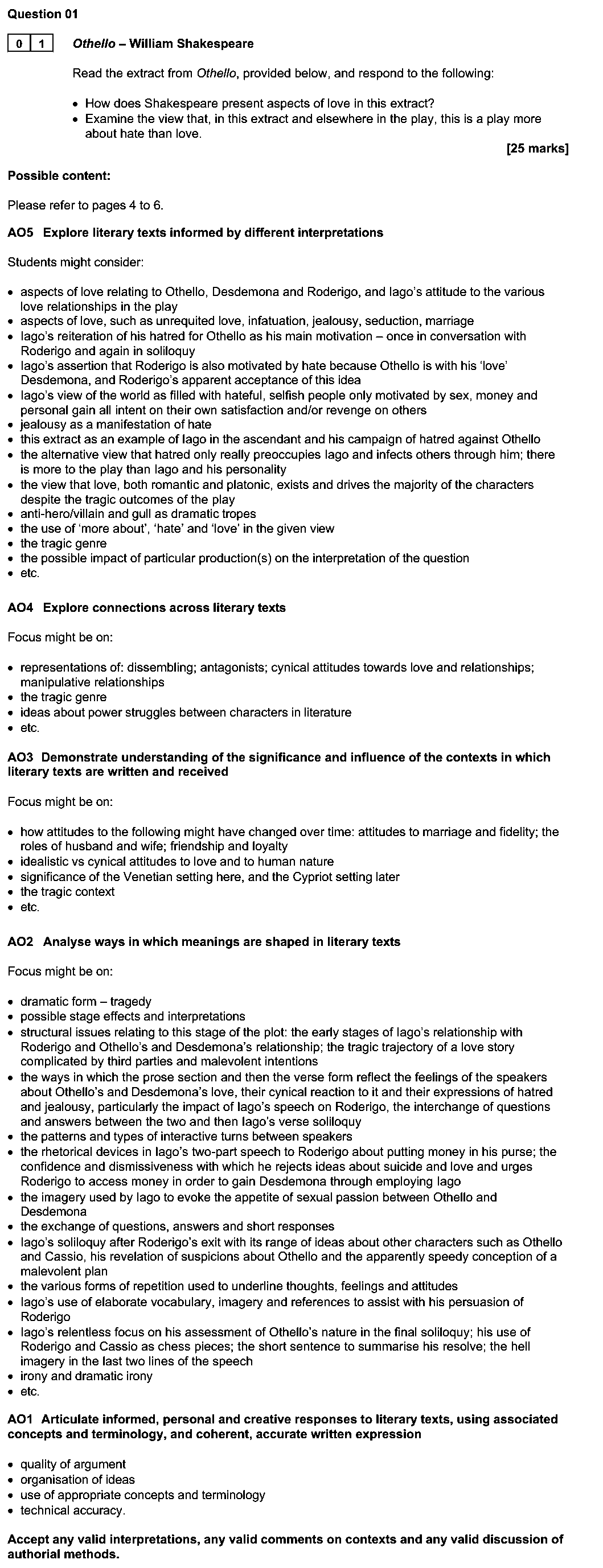
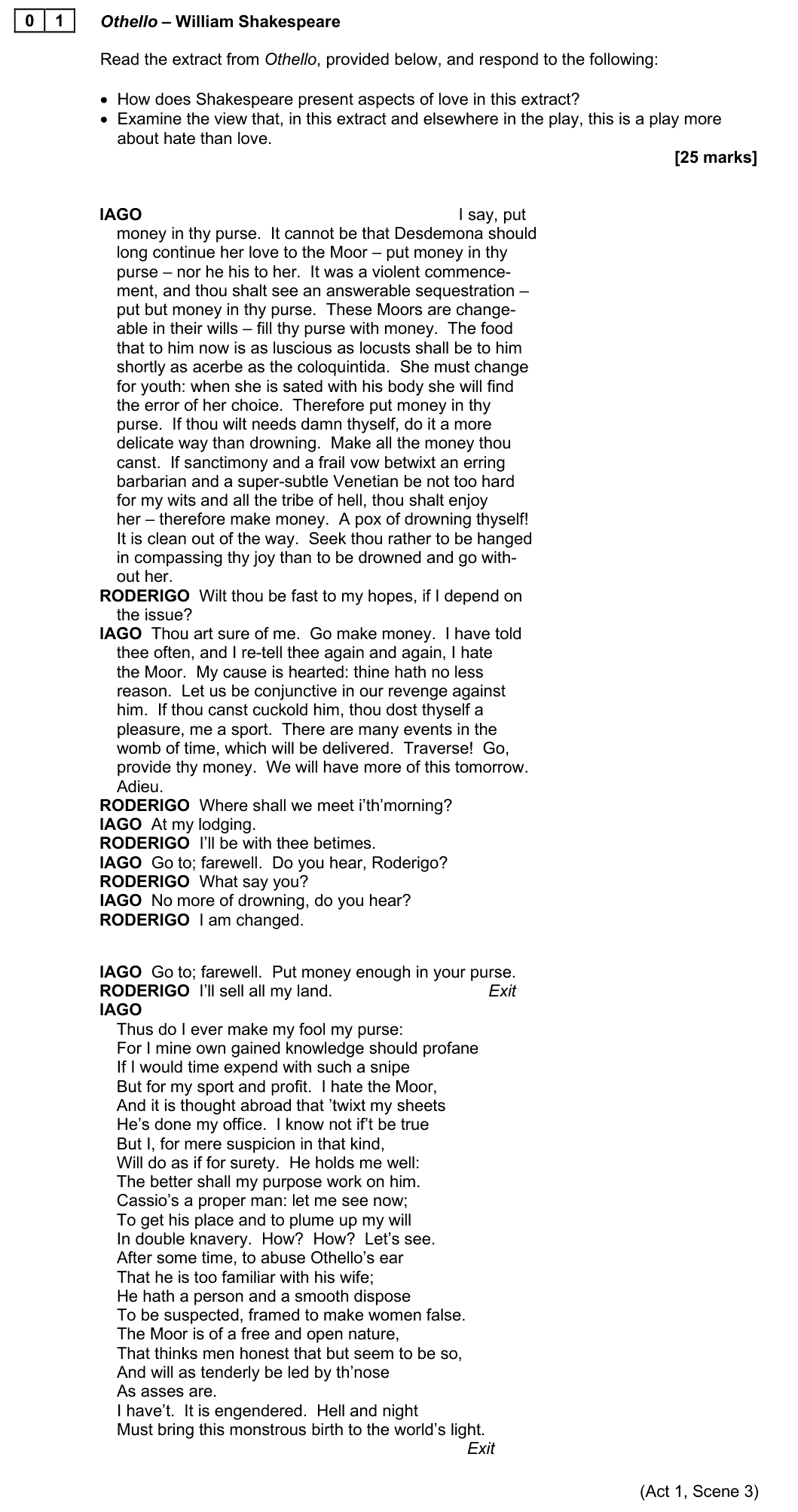
Othello – William Shakespeare
Read the extract from Othello, provided below, and respond to the following:
• How does Shakespeare present aspects of love in this extract?
• Examine the view that, in this extract and elsewhere in the play, this is a play more
about hate than love.
[25 marks]
IAGO
I say, put
money in thy purse. It cannot be that Desdemona should
long continue her love to the Moor – put money in thy
purse – nor he his to her. It was a violent commence-
ment, and thou shalt see an answerable sequestration –
put but money in thy purse. These Moors are change-
able in their wills – fill thy purse with money. The food
that to him now is as luscious as locusts shall be to him
shortly as acerbe as the coloquintida. She must change
for youth: when she is sated with his body she will find
the error of her choice. Therefore put money in thy
purse. If thou wilt needs damn thyself, do it a more
delicate way than drowning. Make all the money thou
canst. If sanctimony and a frail vow betwixt an erring
barbarian and a super-subtle Venetian be not too hard
for my wits and all the tribe of hell, thou shalt enjoy
her – therefore make money. A pox of drowning thyself!
It is clean out of the way. Seek thou rather to be hanged
in compassing thy joy than to be drowned and go with-
out her.
RODERIGO Wilt thou be fast to my hopes, if I depend on
the issue?
IAGO Thou art sure of me. Go make money. I have told
thee often, and I re-tell thee again and again, I hate
the Moor. My cause is hearted: thine hath no less
reason. Let us be conjunctive in our revenge against
him. If thou canst cuckold him, thou dost thyself a
pleasure, me a sport. There are many events in the
womb of time, which will be delivered. Traverse! Go,
provide thy money. We will have more of this tomorrow.
Adieu.
RODERIGO Where shall we meet i’th’morning?
IAGO At my lodging.
RODERIGO I’ll be with thee betimes.
IAGO Go to; farewell. Do you hear, Roderigo?
RODERIGO What say you?
IAGO No more of drowning, do you hear?
RODERIGO I am changed.
IAGO Go to; farewell. Put money enough in your purse.
RODERIGO I’ll sell all my land.
Exit
IAGO
Thus do I ever make my fool my purse:
For I mine own gained knowledge should profane
If I would time expend with such a snipe
But for my sport and profit. I hate the Moor,
And it is thought abroad that ’twixt my sheets
He’s done my office. I know not if’t be true
But I, for mere suspicion in that kind,
Will do as if for surety. He holds me well:
The better shall my purpose work on him.
Cassio’s a proper man: let me see now;
To get his place and to plume up my will
In double knavery. How? How? Let’s see.
After some time, to abuse Othello’s ear
That he is too familiar with his wife;
He hath a person and a smooth dispose
To be suspected, framed to make women false.
The Moor is of a free and open nature,
That thinks men honest that but seem to be so,
And will as tenderly be led by th’nose
As asses are.
I have’t. It is engendered. Hell and night
Must bring this monstrous birth to the world’s light.
Exit
(Act 1, Scene 3)
June 2025 · AS Paper 1 · Q2 25 marks Shakespeare extract taming of the shrew
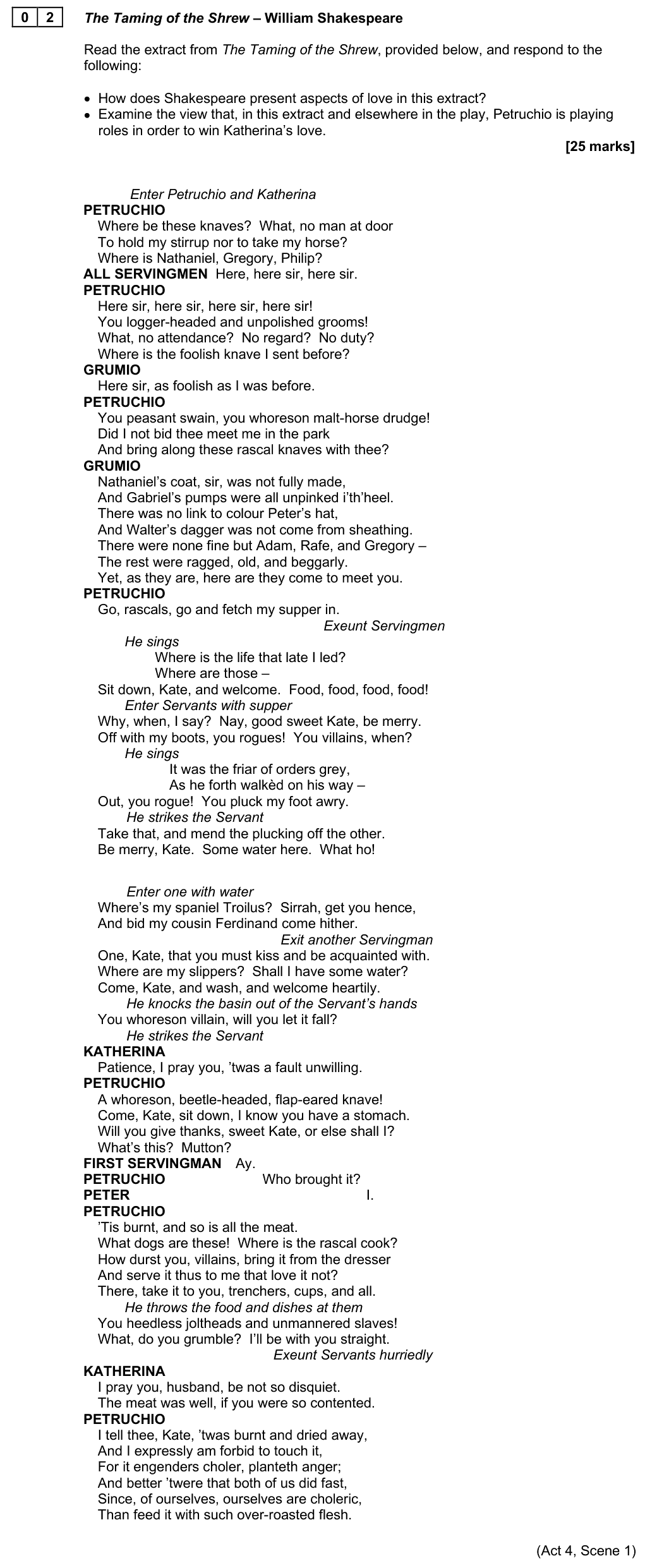
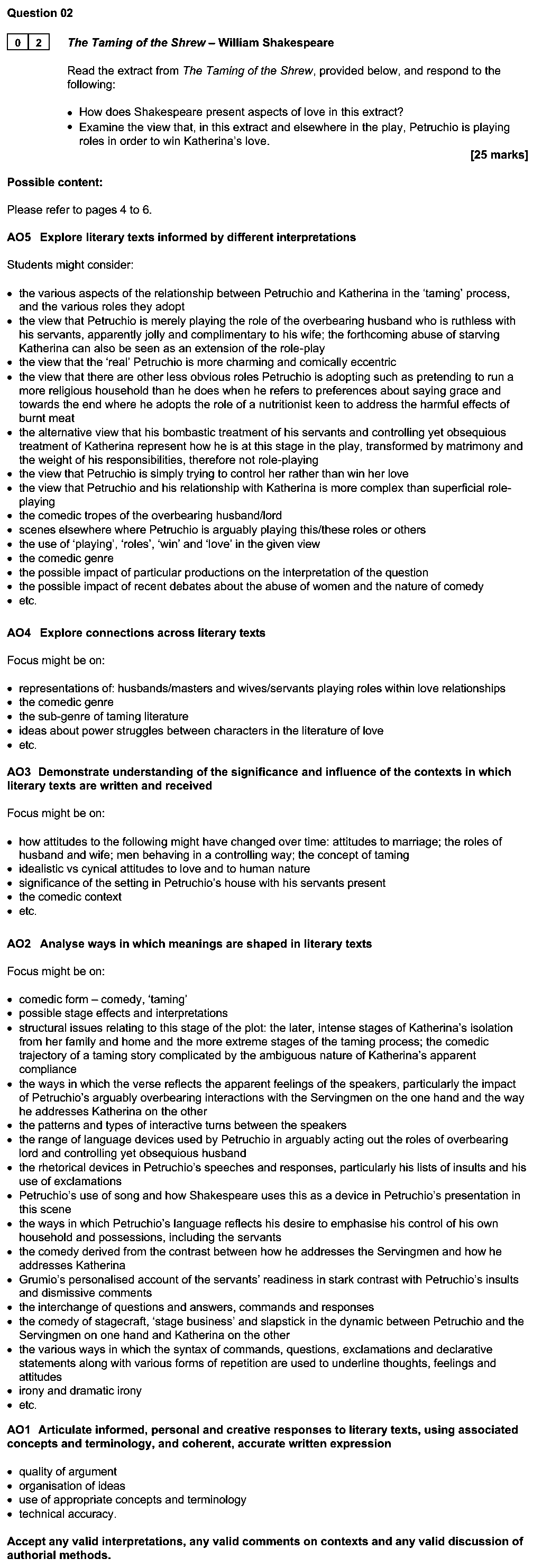
The Taming of the Shrew – William Shakespeare
Read the extract from The Taming of the Shrew, provided below, and respond to the
following:
• How does Shakespeare present aspects of love in this extract?
• Examine the view that, in this extract and elsewhere in the play, Petruchio is playing
roles in order to win Katherina’s love.
[25 marks]
Enter Petruchio and Katherina
PETRUCHIO
Where be these knaves? What, no man at door
To hold my stirrup nor to take my horse?
Where is Nathaniel, Gregory, Philip?
ALL SERVINGMEN Here, here sir, here sir.
PETRUCHIO
Here sir, here sir, here sir, here sir!
You logger-headed and unpolished grooms!
What, no attendance? No regard? No duty?
Where is the foolish knave I sent before?
GRUMIO
Here sir, as foolish as I was before.
PETRUCHIO
You peasant swain, you whoreson malt-horse drudge!
Did I not bid thee meet me in the park
And bring along these rascal knaves with thee?
GRUMIO
Nathaniel’s coat, sir, was not fully made,
And Gabriel’s pumps were all unpinked i’th’heel.
There was no link to colour Peter’s hat,
And Walter’s dagger was not come from sheathing.
There were none fine but Adam, Rafe, and Gregory –
The rest were ragged, old, and beggarly.
Yet, as they are, here are they come to meet you.
PETRUCHIO
Go, rascals, go and fetch my supper in.
Exeunt Servingmen
He sings
Where is the life that late I led?
Where are those –
Sit down, Kate, and welcome. Food, food, food, food!
Enter Servants with supper
Why, when, I say? Nay, good sweet Kate, be merry.
Off with my boots, you rogues! You villains, when?
He sings
It was the friar of orders grey,
As he forth walkèd on his way –
Out, you rogue! You pluck my foot awry.
He strikes the Servant
Take that, and mend the plucking off the other.
Be merry, Kate. Some water here. What ho!
Enter one with water
Where’s my spaniel Troilus? Sirrah, get you hence,
And bid my cousin Ferdinand come hither.
Exit another Servingman
One, Kate, that you must kiss and be acquainted with.
Where are my slippers? Shall I have some water?
Come, Kate, and wash, and welcome heartily.
He knocks the basin out of the Servant’s hands
You whoreson villain, will you let it fall?
He strikes the Servant
KATHERINA
Patience, I pray you, ’twas a fault unwilling.
PETRUCHIO
A whoreson, beetle-headed, flap-eared knave!
Come, Kate, sit down, I know you have a stomach.
Will you give thanks, sweet Kate, or else shall I?
What’s this? Mutton?
FIRST SERVINGMAN Ay.
PETRUCHIO
Who brought it?
PETER
I.
PETRUCHIO
’Tis burnt, and so is all the meat.
What dogs are these! Where is the rascal cook?
How durst you, villains, bring it from the dresser
And serve it thus to me that love it not?
There, take it to you, trenchers, cups, and all.
He throws the food and dishes at them
You heedless joltheads and unmannered slaves!
What, do you grumble? I’ll be with you straight.
Exeunt Servants hurriedly
KATHERINA
I pray you, husband, be not so disquiet.
The meat was well, if you were so contented.
PETRUCHIO
I tell thee, Kate, ’twas burnt and dried away,
And I expressly am forbid to touch it,
For it engenders choler, planteth anger;
And better ’twere that both of us did fast,
Since, of ourselves, ourselves are choleric,
Than feed it with such over-roasted flesh.
(Act 4, Scene 1)
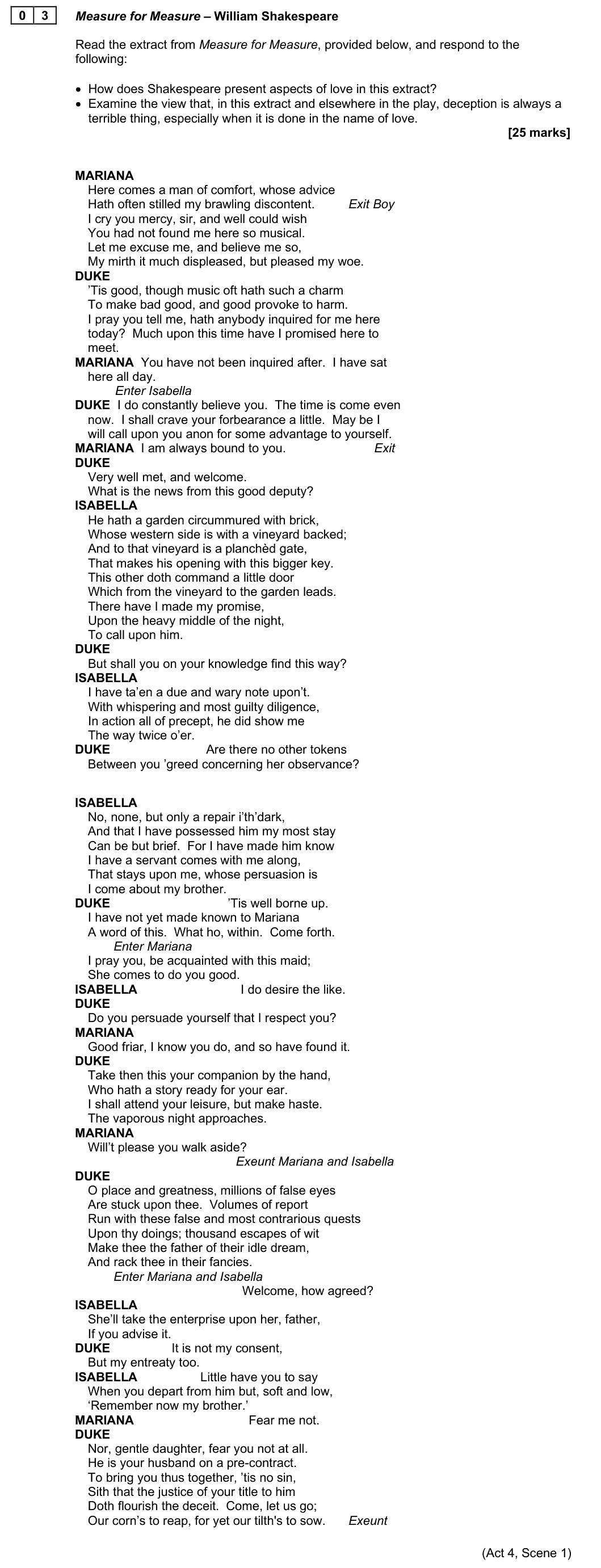
June 2025 · AS Paper 1 · Q3 25 marks Shakespeare extract measure for measure
Measure for Measure – William Shakespeare
Read the extract from Measure for Measure, provided below, and respond to the
following:
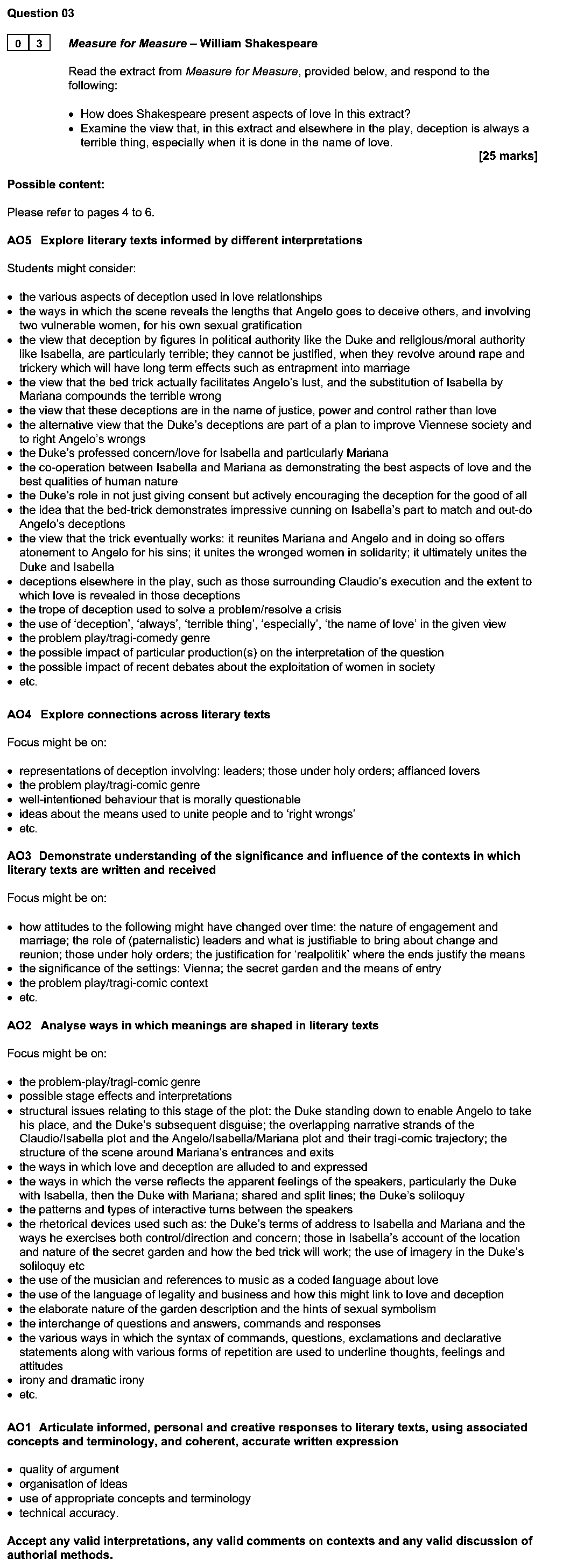
• How does Shakespeare present aspects of love in this extract?
• Examine the view that, in this extract and elsewhere in the play, deception is always a
terrible thing, especially when it is done in the name of love.
[25 marks]
MARIANA
Here comes a man of comfort, whose advice
Hath often stilled my brawling discontent.
Exit Boy
I cry you mercy, sir, and well could wish
You had not found me here so musical.
Let me excuse me, and believe me so,
My mirth it much displeased, but pleased my woe.
DUKE
’Tis good, though music oft hath such a charm
To make bad good, and good provoke to harm.
I pray you tell me, hath anybody inquired for me here
today? Much upon this time have I promised here to
meet.
MARIANA You have not been inquired after. I have sat
here all day.
Enter Isabella
DUKE I do constantly believe you. The time is come even
now. I shall crave your forbearance a little. May be I
will call upon you anon for some advantage to yourself.
MARIANA I am always bound to you.
Exit
DUKE
Very well met, and welcome.
What is the news from this good deputy?
ISABELLA
He hath a garden circummured with brick,
Whose western side is with a vineyard backed;
And to that vineyard is a planchèd gate,
That makes his opening with this bigger key.
This other doth command a little door
Which from the vineyard to the garden leads.
There have I made my promise,
Upon the heavy middle of the night,
To call upon him.
DUKE
But shall you on your knowledge find this way?
ISABELLA
I have ta’en a due and wary note upon’t.
With whispering and most guilty diligence,
In action all of precept, he did show me
The way twice o’er.
DUKE
Are there no other tokens
Between you ’greed concerning her observance?
ISABELLA
No, none, but only a repair i’th’dark,
And that I have possessed him my most stay
Can be but brief. For I have made him know
I have a servant comes with me along,
That stays upon me, whose persuasion is
I come about my brother.
DUKE
’Tis well borne up.
I have not yet made known to Mariana
A word of this. What ho, within. Come forth.
Enter Mariana
I pray you, be acquainted with this maid;
She comes to do you good.
ISABELLA
I do desire the like.
DUKE
Do you persuade yourself that I respect you?
MARIANA
Good friar, I know you do, and so have found it.
DUKE
Take then this your companion by the hand,
Who hath a story ready for your ear.
I shall attend your leisure, but make haste.
The vaporous night approaches.
MARIANA
Will’t please you walk aside?
Exeunt Mariana and Isabella
DUKE
O place and greatness, millions of false eyes
Are stuck upon thee. Volumes of report
Run with these false and most contrarious quests
Upon thy doings; thousand escapes of wit
Make thee the father of their idle dream,
And rack thee in their fancies.
Enter Mariana and Isabella
Welcome, how agreed?
ISABELLA
She’ll take the enterprise upon her, father,
If you advise it.
DUKE
It is not my consent,
But my entreaty too.
ISABELLA
Little have you to say
When you depart from him but, soft and low,
‘Remember now my brother.’
MARIANA
Fear me not.
DUKE
Nor, gentle daughter, fear you not at all.
He is your husband on a pre-contract.
To bring you thus together, ’tis no sin,
Sith that the justice of your title to him
Doth flourish the deceit. Come, let us go;
Our corn’s to reap, for yet our tilth's to sow.
Exeunt
(Act 4, Scene 1)
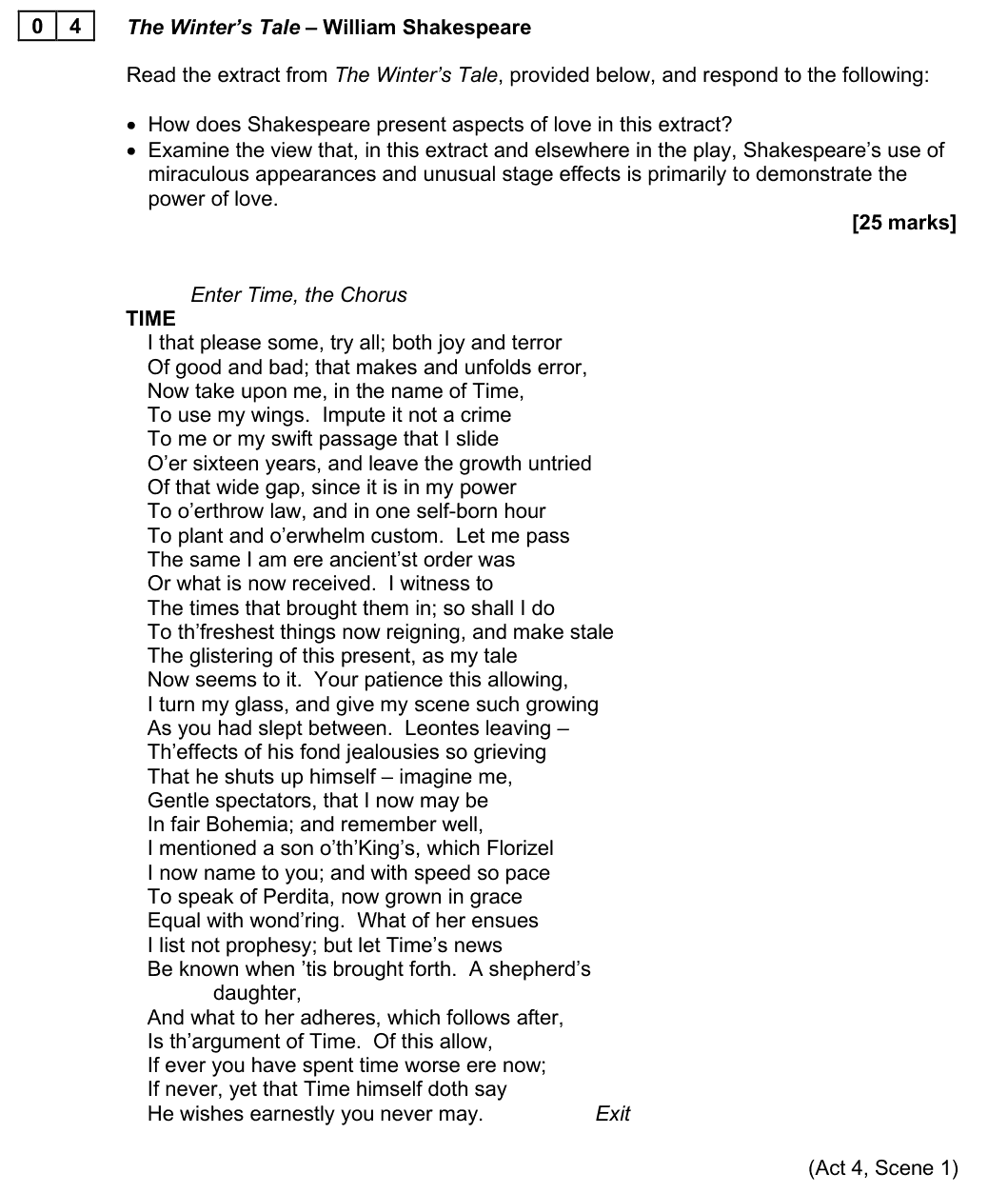
June 2025 · AS Paper 1 · Q4 25 marks Shakespeare extract the winters tale
The Winter’s Tale – William Shakespeare
Read the extract from The Winter’s Tale, provided below, and respond to the following:
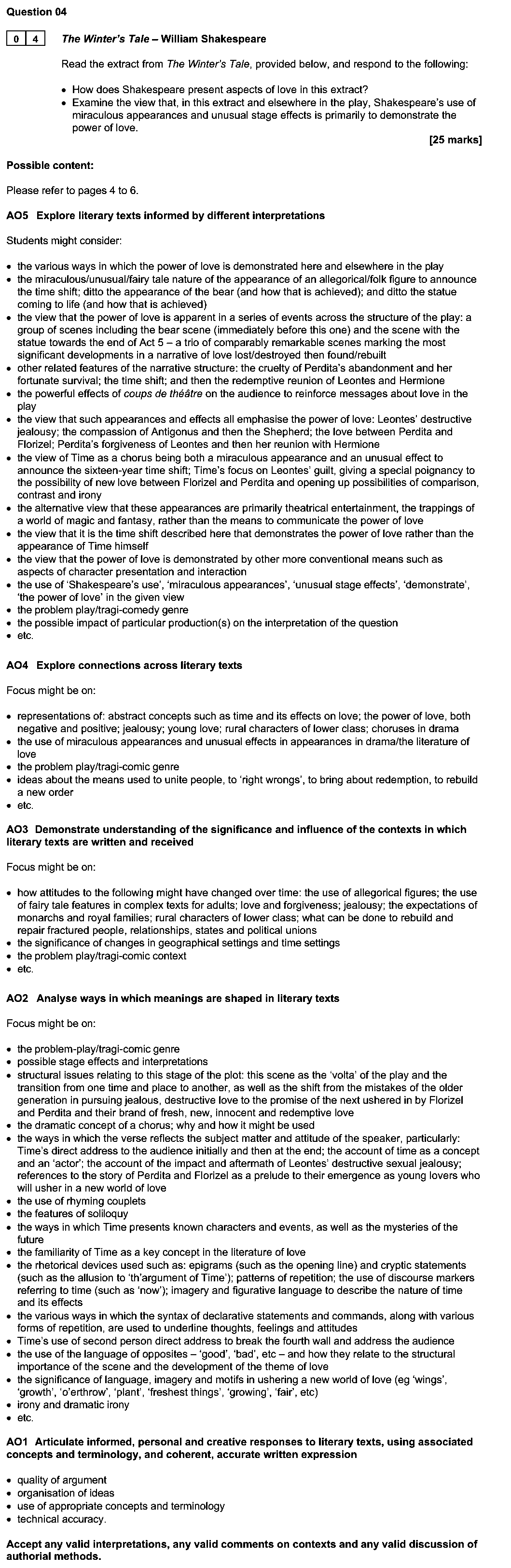
• How does Shakespeare present aspects of love in this extract?
• Examine the view that, in this extract and elsewhere in the play, Shakespeare’s use of
miraculous appearances and unusual stage effects is primarily to demonstrate the
power of love.
[25 marks]
Enter Time, the Chorus
TIME
I that please some, try all; both joy and terror
Of good and bad; that makes and unfolds error,
Now take upon me, in the name of Time,
To use my wings. Impute it not a crime
To me or my swift passage that I slide
O’er sixteen years, and leave the growth untried
Of that wide gap, since it is in my power
To o’erthrow law, and in one self-born hour
To plant and o’erwhelm custom. Let me pass
The same I am ere ancient’st order was
Or what is now received. I witness to
The times that brought them in; so shall I do
To th’freshest things now reigning, and make stale
The glistering of this present, as my tale
Now seems to it. Your patience this allowing,
I turn my glass, and give my scene such growing
As you had slept between. Leontes leaving –
Th’effects of his fond jealousies so grieving
That he shuts up himself – imagine me,
Gentle spectators, that I now may be
In fair Bohemia; and remember well,
I mentioned a son o’th’King’s, which Florizel
I now name to you; and with speed so pace
To speak of Perdita, now grown in grace
Equal with wond’ring. What of her ensues
I list not prophesy; but let Time’s news
Be known when ’tis brought forth. A shepherd’s
daughter,
And what to her adheres, which follows after,
Is th’argument of Time. Of this allow,
If ever you have spent time worse ere now;
If never, yet that Time himself doth say
He wishes earnestly you never may.
Exit
(Act 4, Scene 1)
June 2025 · AS Paper 1 · Q5 25 marks Anthology poetry love poetry pre 1900
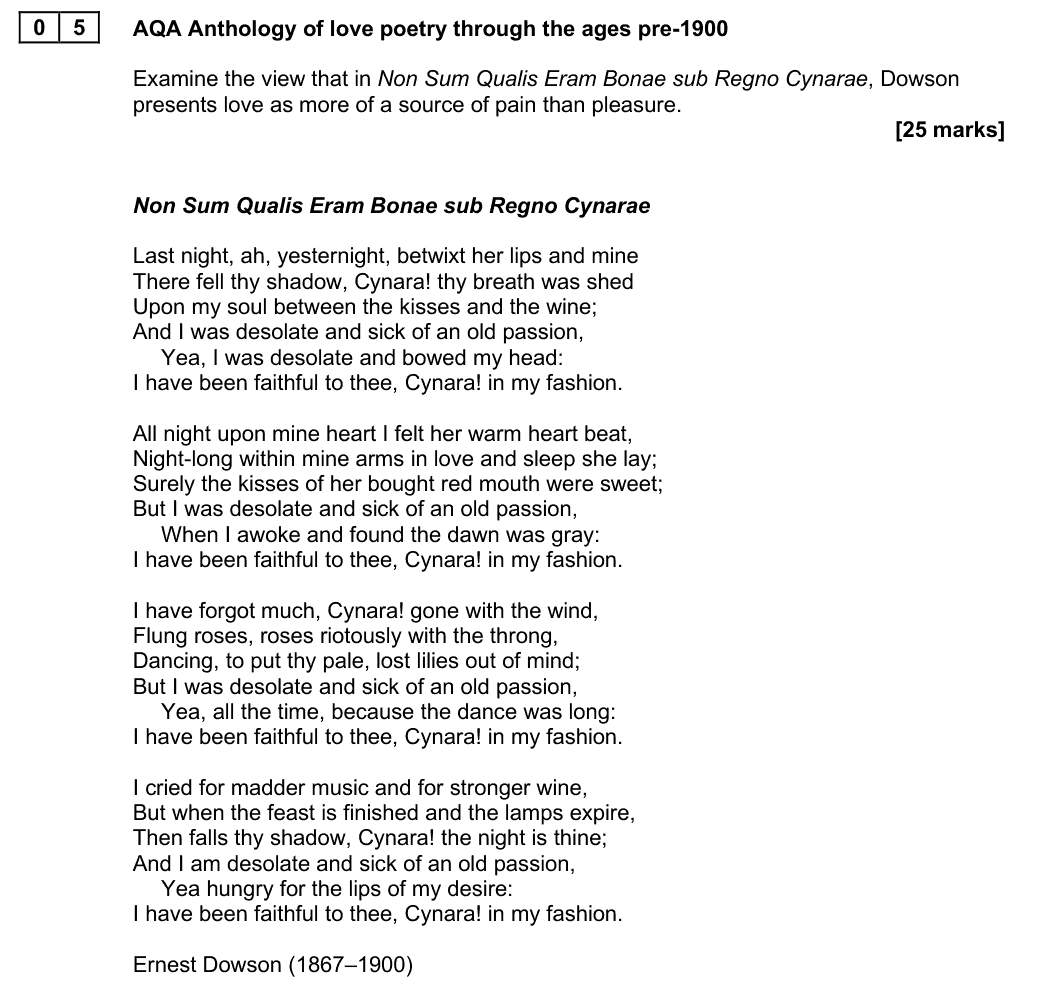
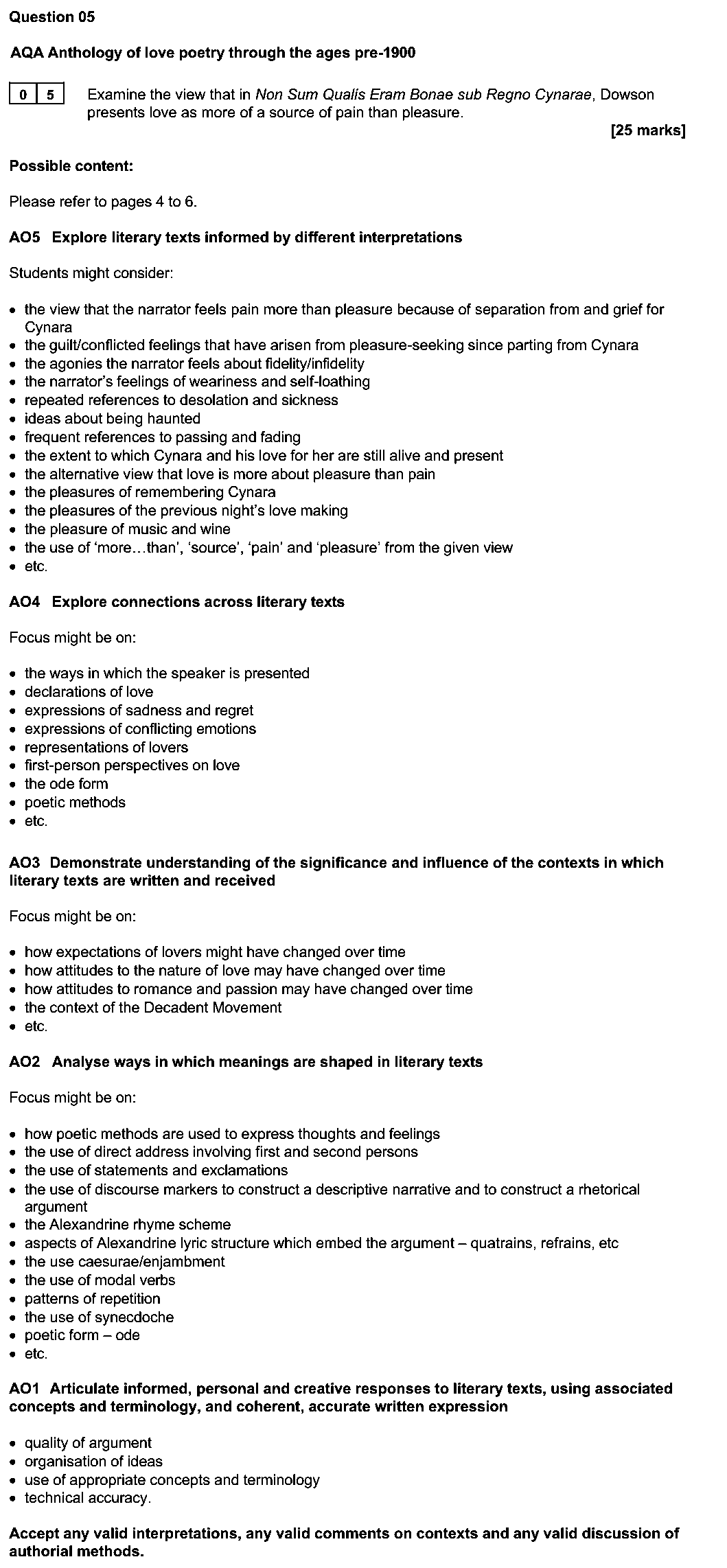
AQA Anthology of love poetry through the ages pre-1900
Examine the view that in Non Sum Qualis Eram Bonae sub Regno Cynarae, Dowson
presents love as more of a source of pain than pleasure.
[25 marks]
Non Sum Qualis Eram Bonae sub Regno Cynarae
Last night, ah, yesternight, betwixt her lips and mine
There fell thy shadow, Cynara! thy breath was shed
Upon my soul between the kisses and the wine;
And I was desolate and sick of an old passion,
Yea, I was desolate and bowed my head:
I have been faithful to thee, Cynara! in my fashion.
All night upon mine heart I felt her warm heart beat,
Night-long within mine arms in love and sleep she lay;
Surely the kisses of her bought red mouth were sweet;
But I was desolate and sick of an old passion,
When I awoke and found the dawn was gray:
I have been faithful to thee, Cynara! in my fashion.
I have forgot much, Cynara! gone with the wind,
Flung roses, roses riotously with the throng,
Dancing, to put thy pale, lost lilies out of mind;
But I was desolate and sick of an old passion,
Yea, all the time, because the dance was long:
I have been faithful to thee, Cynara! in my fashion.
I cried for madder music and for stronger wine,
But when the feast is finished and the lamps expire,
Then falls thy shadow, Cynara! the night is thine;
And I am desolate and sick of an old passion,
Yea hungry for the lips of my desire:
I have been faithful to thee, Cynara! in my fashion.
Ernest Dowson (1867–1900)
June 2025 · AS Paper 1 · Q6 25 marks Anthology poetry love poetry post 1900
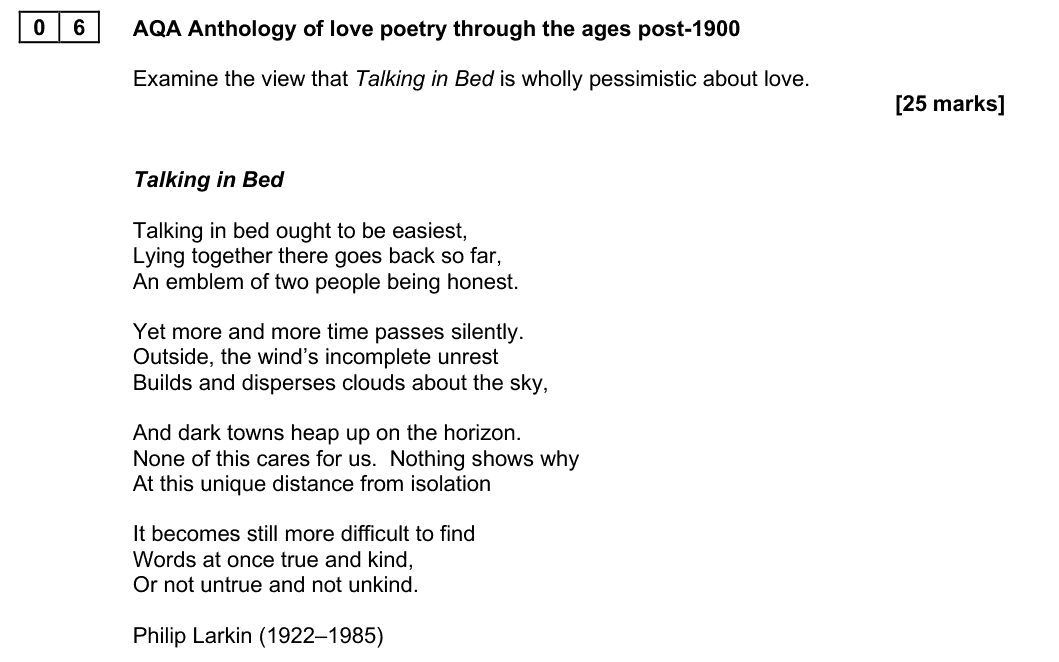
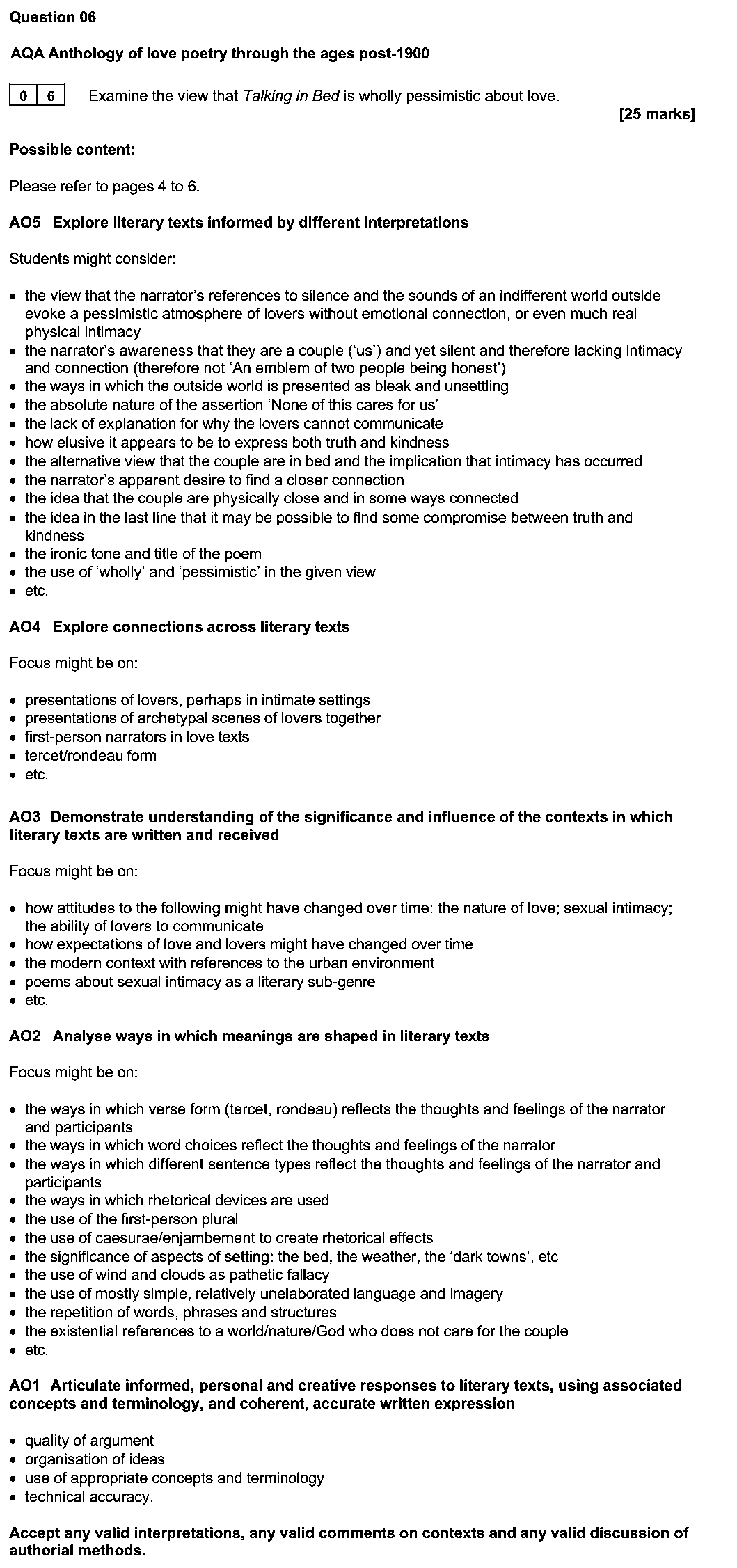
AQA Anthology of love poetry through the ages post-1900
Examine the view that Talking in Bed is wholly pessimistic about love.
[25 marks]
Talking in Bed
Talking in bed ought to be easiest,
Lying together there goes back so far,
An emblem of two people being honest.
Yet more and more time passes silently.
Outside, the wind’s incomplete unrest
Builds and disperses clouds about the sky,
And dark towns heap up on the horizon.
None of this cares for us. Nothing shows why
At this unique distance from isolation
It becomes still more difficult to find
Words at once true and kind,
Or not untrue and not unkind.
Philip Larkin (1922–1985)

Work with an AQA English Literature A tutor

Want a paper marked and gone through with you? Message us.

Prefer email? Send an enquiry

If you are under 18, please include a parent's contact details. Enquiries go to enquiries@alevelenglishtutor.com and are deleted once handled. All tutoring is online.