June 2025: A-level Paper 1, Love through the ages

75 marks · 7 questions (every option is included) · Paper, mark scheme and report on AQA's site

Question by question

QTopicMarksAOType
1 Othello 25Shakespeare extract
2 The Taming of the Shrew 25Shakespeare extract
3 Measure for Measure 25Shakespeare extract
4 The Winter's Tale 25Shakespeare extract
5 Unseen poetry comparison (love) 25Unseen poetry
6 AQA Anthology: love poetry pre-1900, AQA Anthology: love poetry post-1900, Comparing prose texts (love through the ages) 25Comparing texts
7 AQA Anthology: love poetry pre-1900, AQA Anthology: love poetry post-1900, Comparing prose texts (love through the ages) 25Comparing texts

The questions

1234567
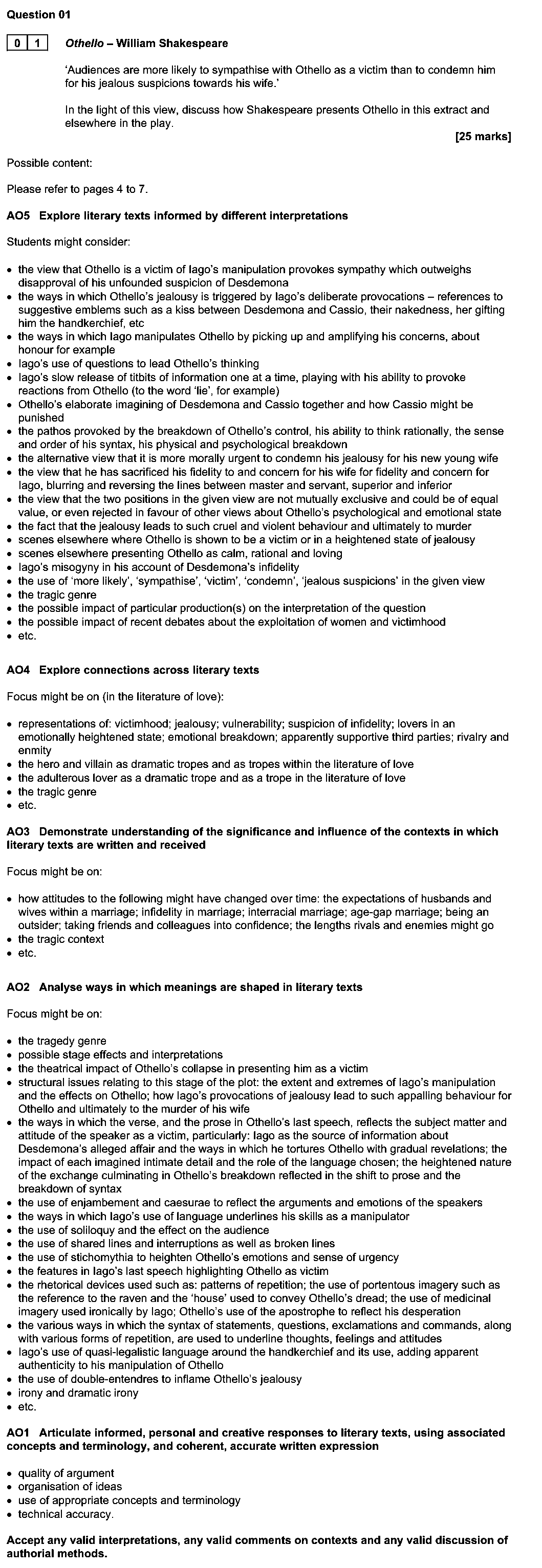
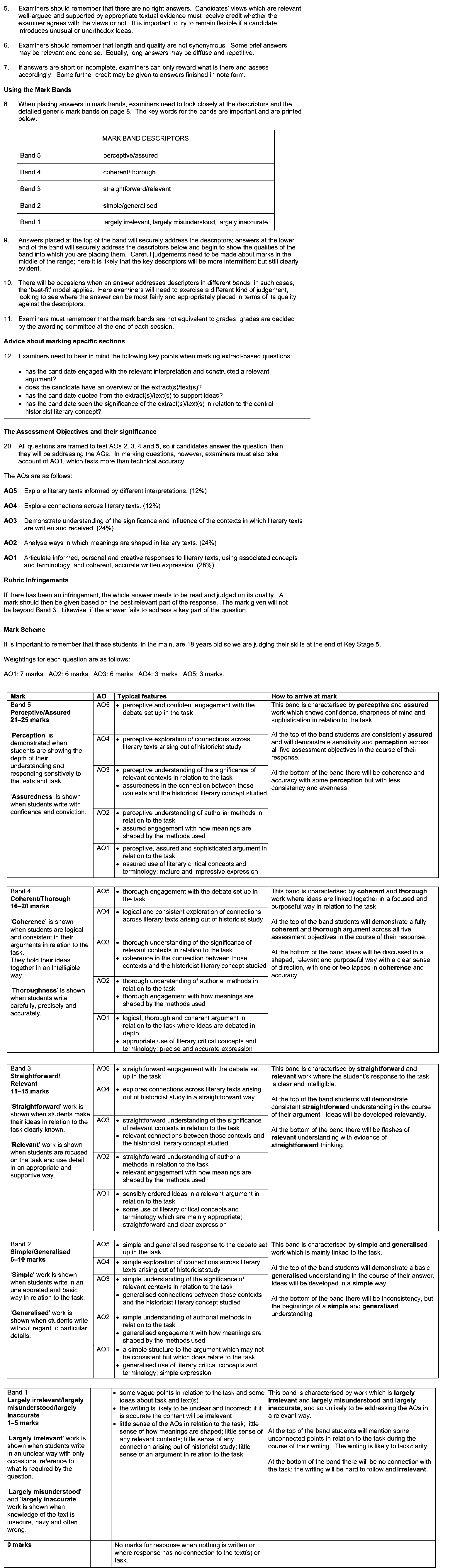
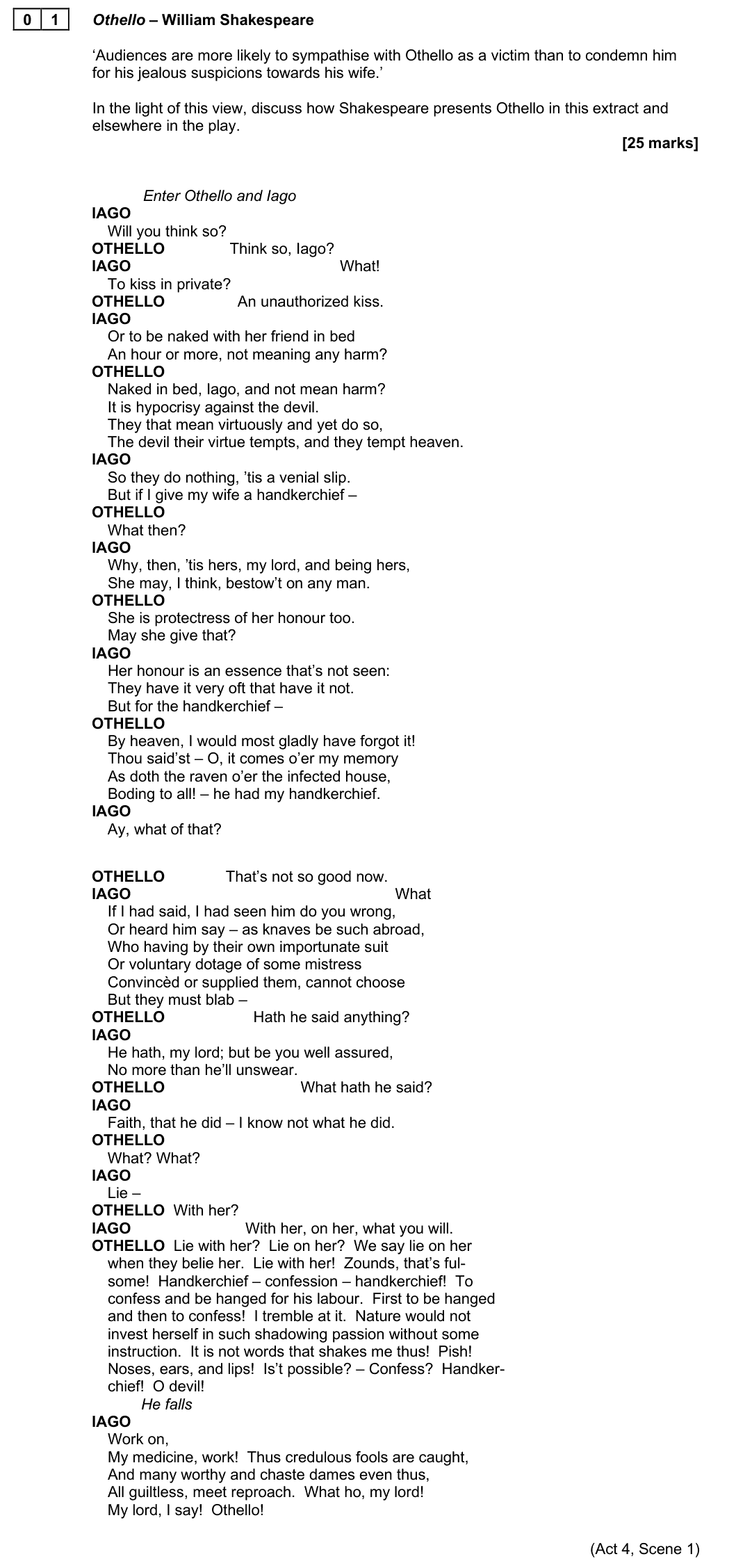
June 2025 · Paper 1 · Q1 25 marks Shakespeare extract othello
Othello – William Shakespeare
‘Audiences are more likely to sympathise with Othello as a victim than to condemn him
for his jealous suspicions towards his wife.’
In the light of this view, discuss how Shakespeare presents Othello in this extract and
elsewhere in the play.
[25 marks]
Enter Othello and Iago
IAGO
Will you think so?
OTHELLO
Think so, Iago?
IAGO
What!
To kiss in private?
OTHELLO
An unauthorized kiss.
IAGO
Or to be naked with her friend in bed
An hour or more, not meaning any harm?
OTHELLO
Naked in bed, Iago, and not mean harm?
It is hypocrisy against the devil.
They that mean virtuously and yet do so,
The devil their virtue tempts, and they tempt heaven.
IAGO
So they do nothing, ’tis a venial slip.
But if I give my wife a handkerchief –
OTHELLO
What then?
IAGO
Why, then, ’tis hers, my lord, and being hers,
She may, I think, bestow’t on any man.
OTHELLO
She is protectress of her honour too.
May she give that?
IAGO
Her honour is an essence that’s not seen:
They have it very oft that have it not.
But for the handkerchief –
OTHELLO
By heaven, I would most gladly have forgot it!
Thou said’st – O, it comes o’er my memory
As doth the raven o’er the infected house,
Boding to all! – he had my handkerchief.
IAGO
Ay, what of that?
OTHELLO
That’s not so good now.
IAGO
What
If I had said, I had seen him do you wrong,
Or heard him say – as knaves be such abroad,
Who having by their own importunate suit
Or voluntary dotage of some mistress
Convincèd or supplied them, cannot choose
But they must blab –
OTHELLO
Hath he said anything?
IAGO
He hath, my lord; but be you well assured,
No more than he’ll unswear.
OTHELLO
What hath he said?
IAGO
Faith, that he did – I know not what he did.
OTHELLO
What? What?
IAGO
Lie –
OTHELLO With her?
IAGO
With her, on her, what you will.
OTHELLO Lie with her? Lie on her? We say lie on her
when they belie her. Lie with her! Zounds, that’s ful-
some! Handkerchief – confession – handkerchief! To
confess and be hanged for his labour. First to be hanged
and then to confess! I tremble at it. Nature would not
invest herself in such shadowing passion without some
instruction. It is not words that shakes me thus! Pish!
Noses, ears, and lips! Is’t possible? – Confess? Handker-
chief! O devil!
He falls
IAGO
Work on,
My medicine, work! Thus credulous fools are caught,
And many worthy and chaste dames even thus,
All guiltless, meet reproach. What ho, my lord!
My lord, I say! Othello!
(Act 4, Scene 1)
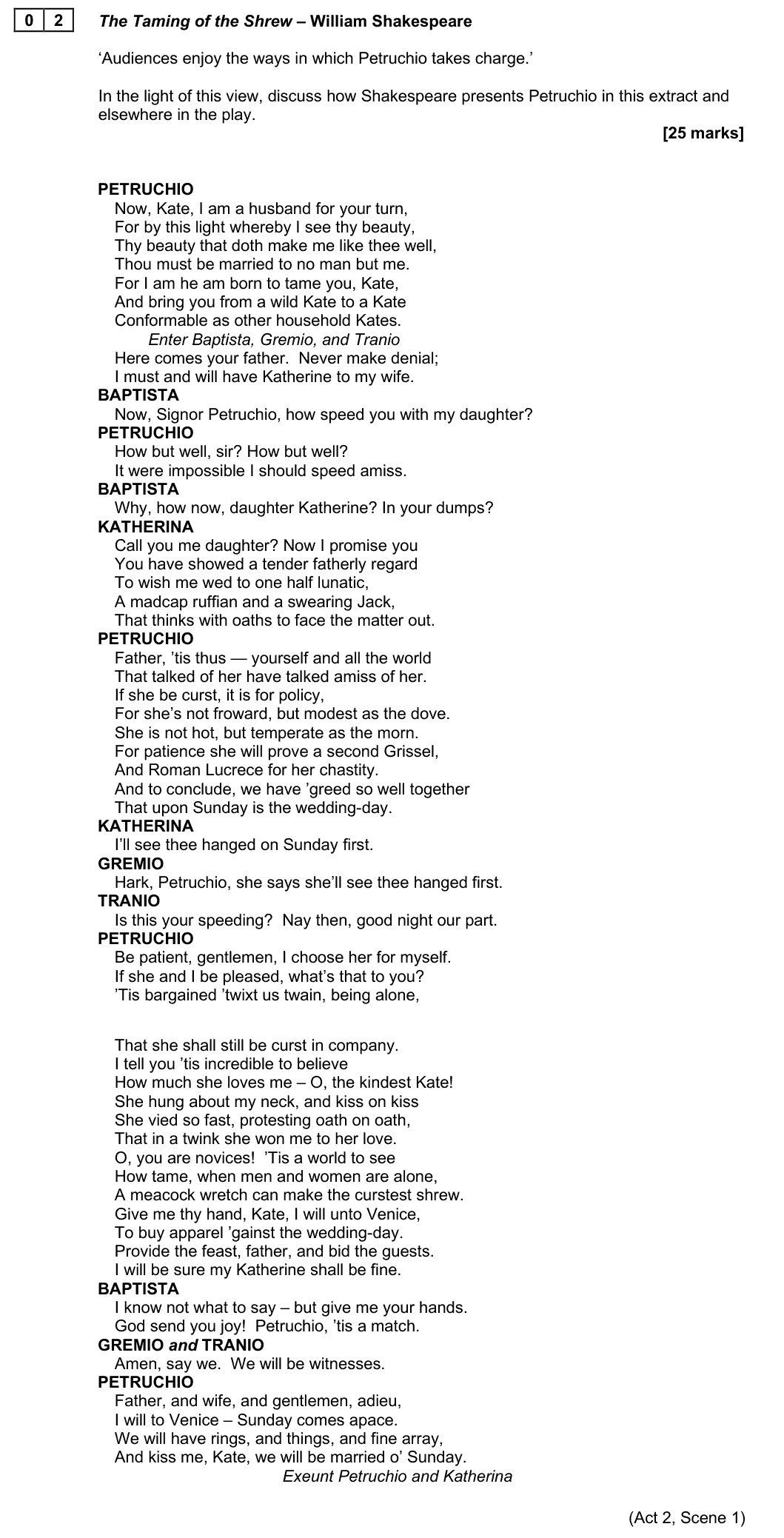
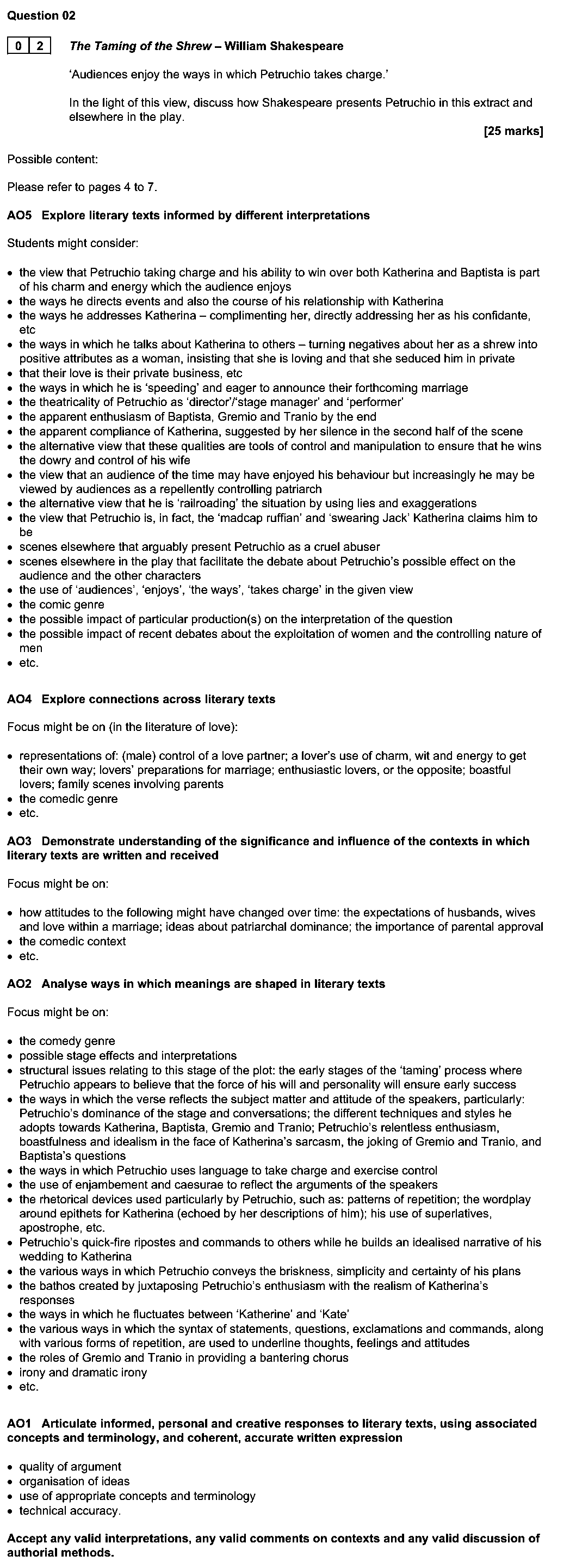
June 2025 · Paper 1 · Q2 25 marks Shakespeare extract taming of the shrew
The Taming of the Shrew – William Shakespeare
‘Audiences enjoy the ways in which Petruchio takes charge.’
In the light of this view, discuss how Shakespeare presents Petruchio in this extract and
elsewhere in the play.
[25 marks]
PETRUCHIO
Now, Kate, I am a husband for your turn,
For by this light whereby I see thy beauty,
Thy beauty that doth make me like thee well,
Thou must be married to no man but me.
For I am he am born to tame you, Kate,
And bring you from a wild Kate to a Kate
Conformable as other household Kates.
Enter Baptista, Gremio, and Tranio
Here comes your father. Never make denial;
I must and will have Katherine to my wife.
BAPTISTA
Now, Signor Petruchio, how speed you with my daughter?
PETRUCHIO
How but well, sir? How but well?
It were impossible I should speed amiss.
BAPTISTA
Why, how now, daughter Katherine? In your dumps?
KATHERINA
Call you me daughter? Now I promise you
You have showed a tender fatherly regard
To wish me wed to one half lunatic,
A madcap ruffian and a swearing Jack,
That thinks with oaths to face the matter out.
PETRUCHIO
Father, ’tis thus — yourself and all the world
That talked of her have talked amiss of her.
If she be curst, it is for policy,
For she’s not froward, but modest as the dove.
She is not hot, but temperate as the morn.
For patience she will prove a second Grissel,
And Roman Lucrece for her chastity.
And to conclude, we have ’greed so well together
That upon Sunday is the wedding-day.
KATHERINA
I’ll see thee hanged on Sunday first.
GREMIO
Hark, Petruchio, she says she’ll see thee hanged first.
TRANIO
Is this your speeding? Nay then, good night our part.
PETRUCHIO
Be patient, gentlemen, I choose her for myself.
If she and I be pleased, what’s that to you?
’Tis bargained ’twixt us twain, being alone,
That she shall still be curst in company.
I tell you ’tis incredible to believe
How much she loves me – O, the kindest Kate!
She hung about my neck, and kiss on kiss
She vied so fast, protesting oath on oath,
That in a twink she won me to her love.
O, you are novices! ’Tis a world to see
How tame, when men and women are alone,
A meacock wretch can make the curstest shrew.
Give me thy hand, Kate, I will unto Venice,
To buy apparel ’gainst the wedding-day.
Provide the feast, father, and bid the guests.
I will be sure my Katherine shall be fine.
BAPTISTA
I know not what to say – but give me your hands.
God send you joy! Petruchio, ’tis a match.
GREMIO and TRANIO
Amen, say we. We will be witnesses.
PETRUCHIO
Father, and wife, and gentlemen, adieu,
I will to Venice – Sunday comes apace.
We will have rings, and things, and fine array,
And kiss me, Kate, we will be married o’ Sunday.
Exeunt Petruchio and Katherina
(Act 2, Scene 1)
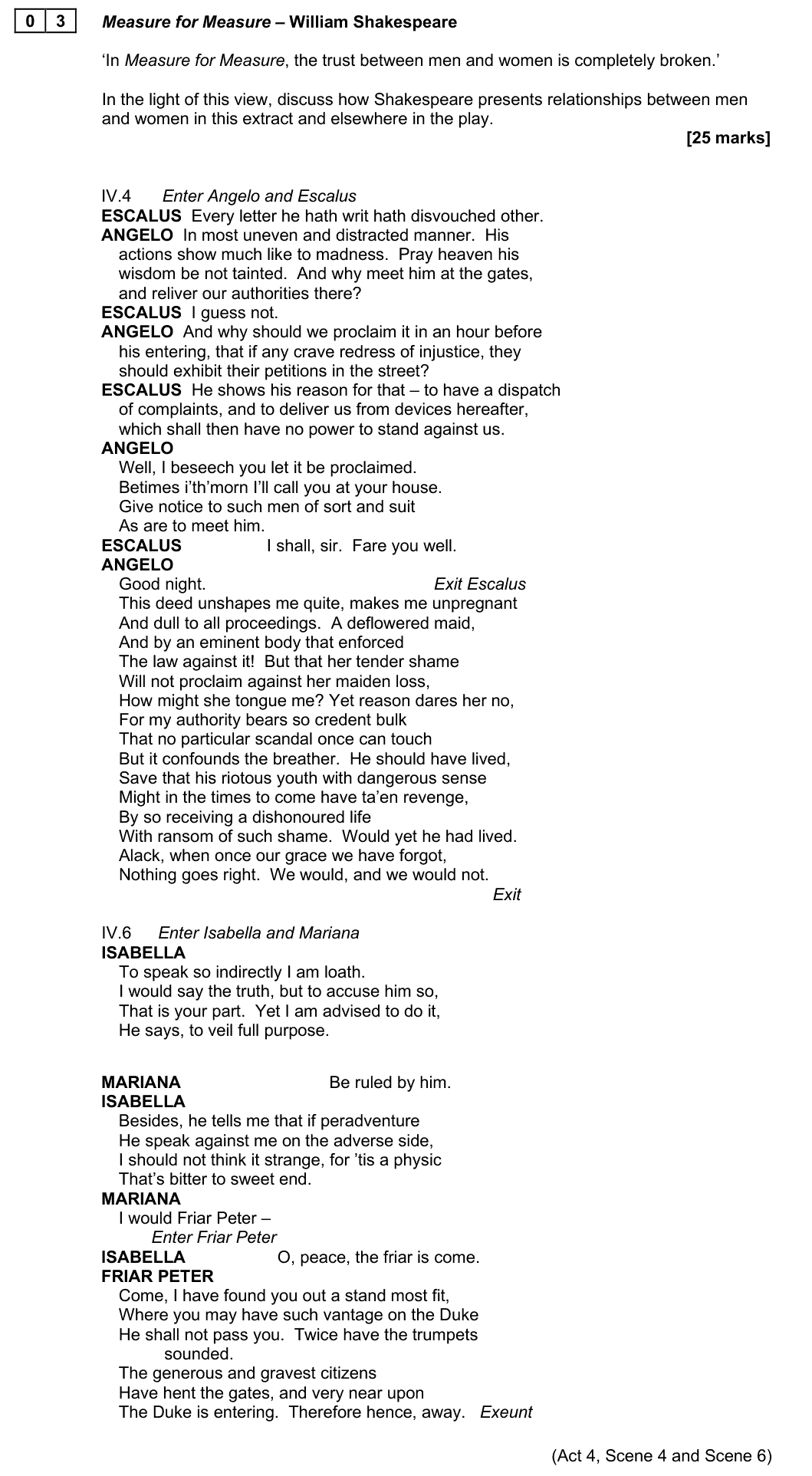
June 2025 · Paper 1 · Q3 25 marks Shakespeare extract measure for measure
Measure for Measure – William Shakespeare
‘In Measure for Measure, the trust between men and women is completely broken.’
In the light of this view, discuss how Shakespeare presents relationships between men
and women in this extract and elsewhere in the play.
[25 marks]
IV.4
Enter Angelo and Escalus
ESCALUS Every letter he hath writ hath disvouched other.
ANGELO In most uneven and distracted manner. His
actions show much like to madness. Pray heaven his
wisdom be not tainted. And why meet him at the gates,
and reliver our authorities there?
ESCALUS I guess not.
ANGELO And why should we proclaim it in an hour before
his entering, that if any crave redress of injustice, they
should exhibit their petitions in the street?
ESCALUS He shows his reason for that – to have a dispatch
of complaints, and to deliver us from devices hereafter,
which shall then have no power to stand against us.
ANGELO
Well, I beseech you let it be proclaimed.
Betimes i’th’morn I’ll call you at your house.
Give notice to such men of sort and suit
As are to meet him.
ESCALUS
I shall, sir. Fare you well.
ANGELO
Good night.
Exit Escalus
This deed unshapes me quite, makes me unpregnant
And dull to all proceedings. A deflowered maid,
And by an eminent body that enforced
The law against it! But that her tender shame
Will not proclaim against her maiden loss,
How might she tongue me? Yet reason dares her no,
For my authority bears so credent bulk
That no particular scandal once can touch
But it confounds the breather. He should have lived,
Save that his riotous youth with dangerous sense
Might in the times to come have ta’en revenge,
By so receiving a dishonoured life
With ransom of such shame. Would yet he had lived.
Alack, when once our grace we have forgot,
Nothing goes right. We would, and we would not.
Exit
IV.6
Enter Isabella and Mariana
ISABELLA
To speak so indirectly I am loath.
I would say the truth, but to accuse him so,
That is your part. Yet I am advised to do it,
He says, to veil full purpose.
MARIANA
Be ruled by him.
ISABELLA
Besides, he tells me that if peradventure
He speak against me on the adverse side,
I should not think it strange, for ’tis a physic
That’s bitter to sweet end.
MARIANA
I would Friar Peter –
Enter Friar Peter
ISABELLA
O, peace, the friar is come.
FRIAR PETER
Come, I have found you out a stand most fit,
Where you may have such vantage on the Duke
He shall not pass you. Twice have the trumpets
sounded.
The generous and gravest citizens
Have hent the gates, and very near upon
The Duke is entering. Therefore hence, away. Exeunt
(Act 4, Scene 4 and Scene 6)
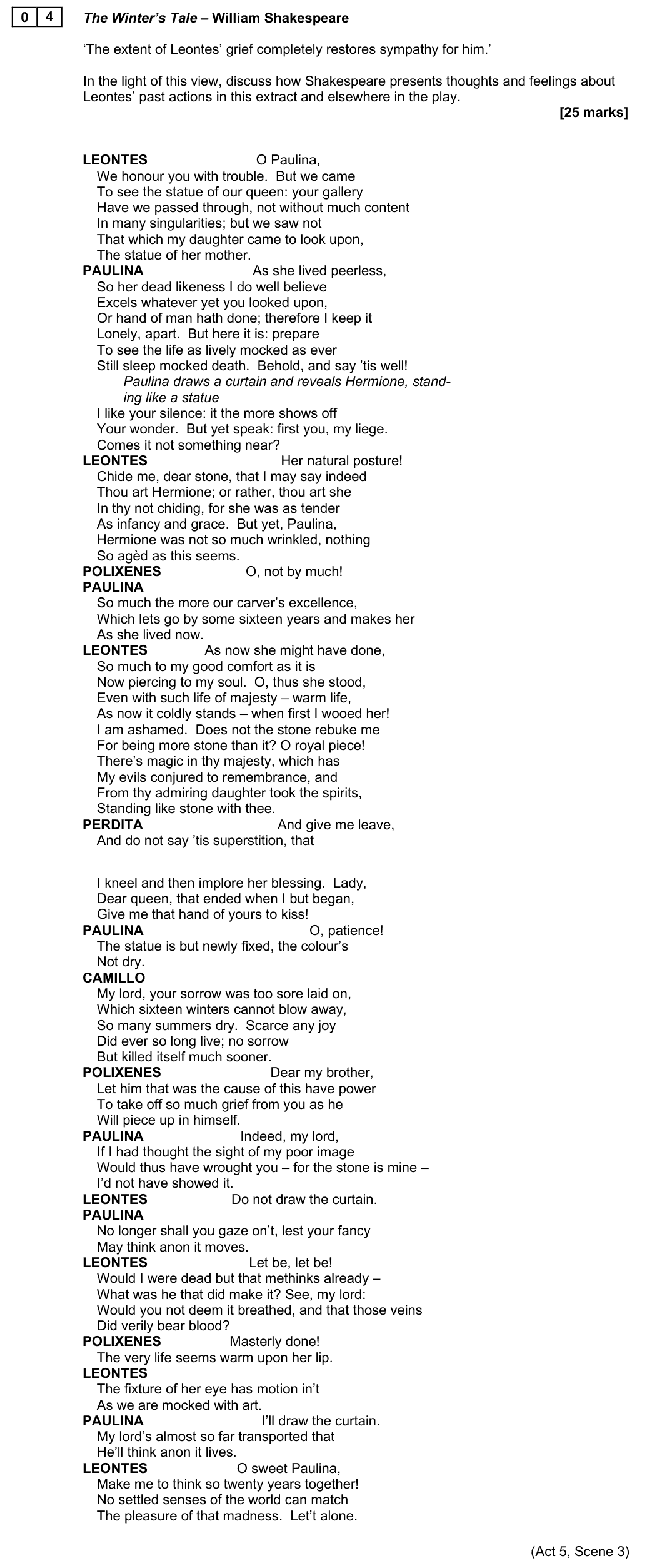
June 2025 · Paper 1 · Q4 25 marks Shakespeare extract the winters tale
The Winter’s Tale – William Shakespeare
‘The extent of Leontes’ grief completely restores sympathy for him.’
In the light of this view, discuss how Shakespeare presents thoughts and feelings about
Leontes’ past actions in this extract and elsewhere in the play.
[25 marks]
LEONTES
O Paulina,
We honour you with trouble. But we came
To see the statue of our queen: your gallery
Have we passed through, not without much content
In many singularities; but we saw not
That which my daughter came to look upon,
The statue of her mother.
PAULINA
As she lived peerless,
So her dead likeness I do well believe
Excels whatever yet you looked upon,
Or hand of man hath done; therefore I keep it
Lonely, apart. But here it is: prepare
To see the life as lively mocked as ever
Still sleep mocked death. Behold, and say ’tis well!
Paulina draws a curtain and reveals Hermione, stand-
ing like a statue
I like your silence: it the more shows off
Your wonder. But yet speak: first you, my liege.
Comes it not something near?
LEONTES
Her natural posture!
Chide me, dear stone, that I may say indeed
Thou art Hermione; or rather, thou art she
In thy not chiding, for she was as tender
As infancy and grace. But yet, Paulina,
Hermione was not so much wrinkled, nothing
So agèd as this seems.
POLIXENES
O, not by much!
PAULINA
So much the more our carver’s excellence,
Which lets go by some sixteen years and makes her
As she lived now.
LEONTES
As now she might have done,
So much to my good comfort as it is
Now piercing to my soul. O, thus she stood,
Even with such life of majesty – warm life,
As now it coldly stands – when first I wooed her!
I am ashamed. Does not the stone rebuke me
For being more stone than it? O royal piece!
There’s magic in thy majesty, which has
My evils conjured to remembrance, and
From thy admiring daughter took the spirits,
Standing like stone with thee.
PERDITA
And give me leave,
And do not say ’tis superstition, that
I kneel and then implore her blessing. Lady,
Dear queen, that ended when I but began,
Give me that hand of yours to kiss!
PAULINA
O, patience!
The statue is but newly fixed, the colour’s
Not dry.
CAMILLO
My lord, your sorrow was too sore laid on,
Which sixteen winters cannot blow away,
So many summers dry. Scarce any joy
Did ever so long live; no sorrow
But killed itself much sooner.
POLIXENES
Dear my brother,
Let him that was the cause of this have power
To take off so much grief from you as he
Will piece up in himself.
PAULINA
Indeed, my lord,
If I had thought the sight of my poor image
Would thus have wrought you – for the stone is mine –
I’d not have showed it.
LEONTES
Do not draw the curtain.
PAULINA
No longer shall you gaze on’t, lest your fancy
May think anon it moves.
LEONTES
Let be, let be!
Would I were dead but that methinks already –
What was he that did make it? See, my lord:
Would you not deem it breathed, and that those veins
Did verily bear blood?
POLIXENES
Masterly done!
The very life seems warm upon her lip.
LEONTES
The fixture of her eye has motion in’t
As we are mocked with art.
PAULINA
I’ll draw the curtain.
My lord’s almost so far transported that
He’ll think anon it lives.
LEONTES
O sweet Paulina,
Make me to think so twenty years together!
No settled senses of the world can match
The pleasure of that madness. Let’t alone.
(Act 5, Scene 3)
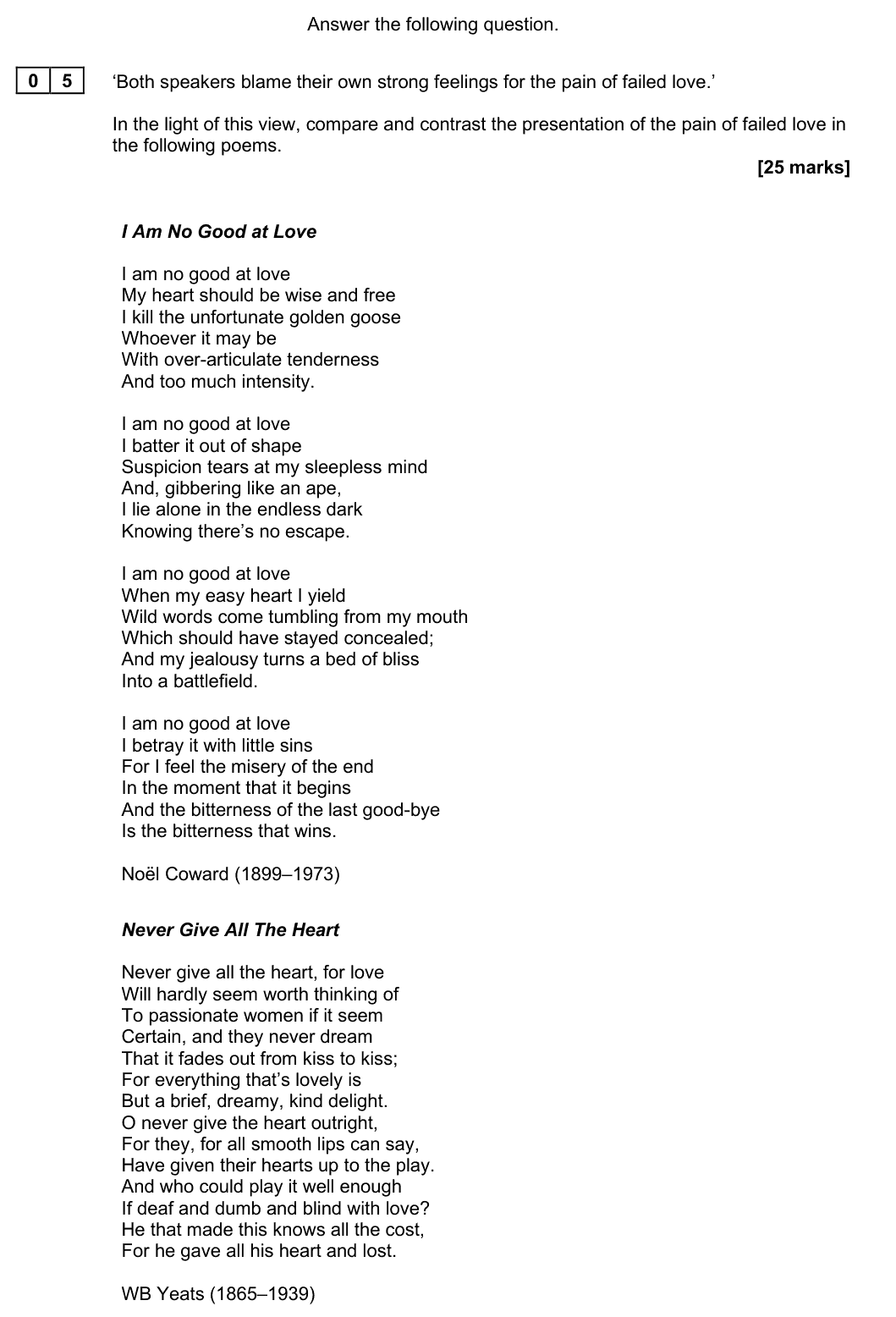
June 2025 · Paper 1 · Q5 25 marks Unseen poetry unseen love poetry
Answer the following question.
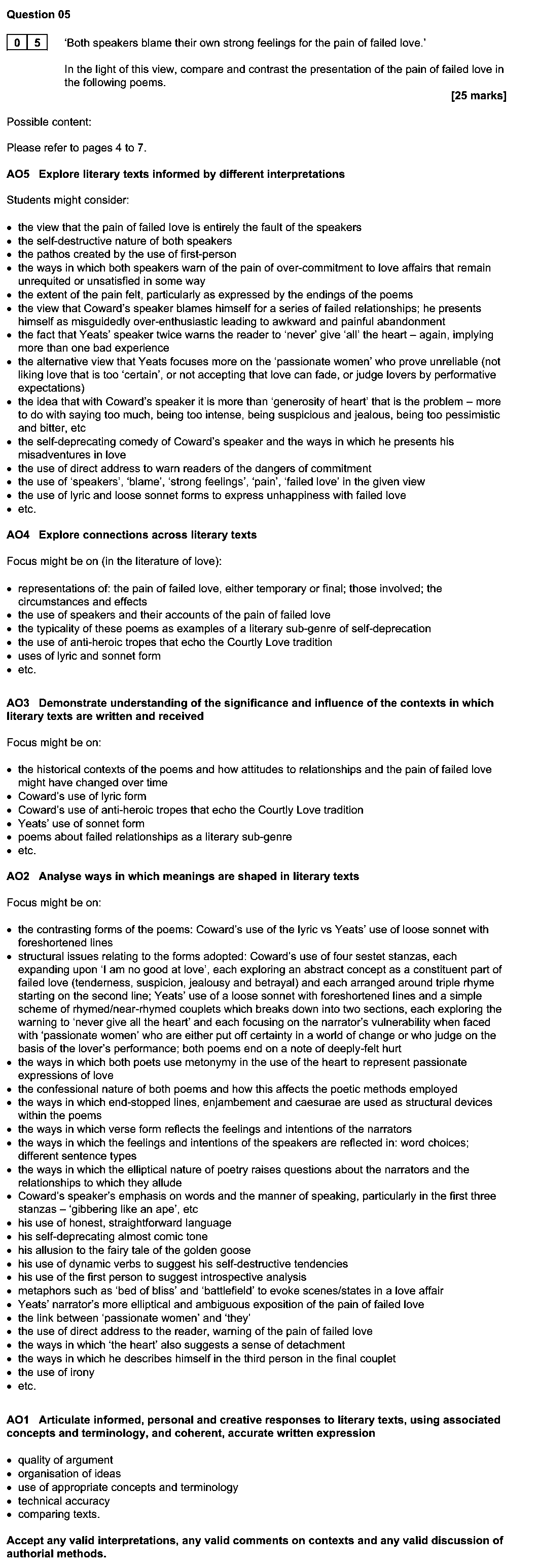
‘Both speakers blame their own strong feelings for the pain of failed love.’
In the light of this view, compare and contrast the presentation of the pain of failed love in
the following poems.
[25 marks]
I Am No Good at Love
I am no good at love
My heart should be wise and free
I kill the unfortunate golden goose
Whoever it may be
With over-articulate tenderness
And too much intensity.
I am no good at love
I batter it out of shape
Suspicion tears at my sleepless mind
And, gibbering like an ape,
I lie alone in the endless dark
Knowing there’s no escape.
I am no good at love
When my easy heart I yield
Wild words come tumbling from my mouth
Which should have stayed concealed;
And my jealousy turns a bed of bliss
Into a battlefield.
I am no good at love
I betray it with little sins
For I feel the misery of the end
In the moment that it begins
And the bitterness of the last good-bye
Is the bitterness that wins.
Noël Coward (1899–1973)
Never Give All The Heart
Never give all the heart, for love
Will hardly seem worth thinking of
To passionate women if it seem
Certain, and they never dream
That it fades out from kiss to kiss;
For everything that’s lovely is
But a brief, dreamy, kind delight.
O never give the heart outright,
For they, for all smooth lips can say,
Have given their hearts up to the play.
And who could play it well enough
If deaf and dumb and blind with love?
He that made this knows all the cost,
For he gave all his heart and lost.
WB Yeats (1865–1939)
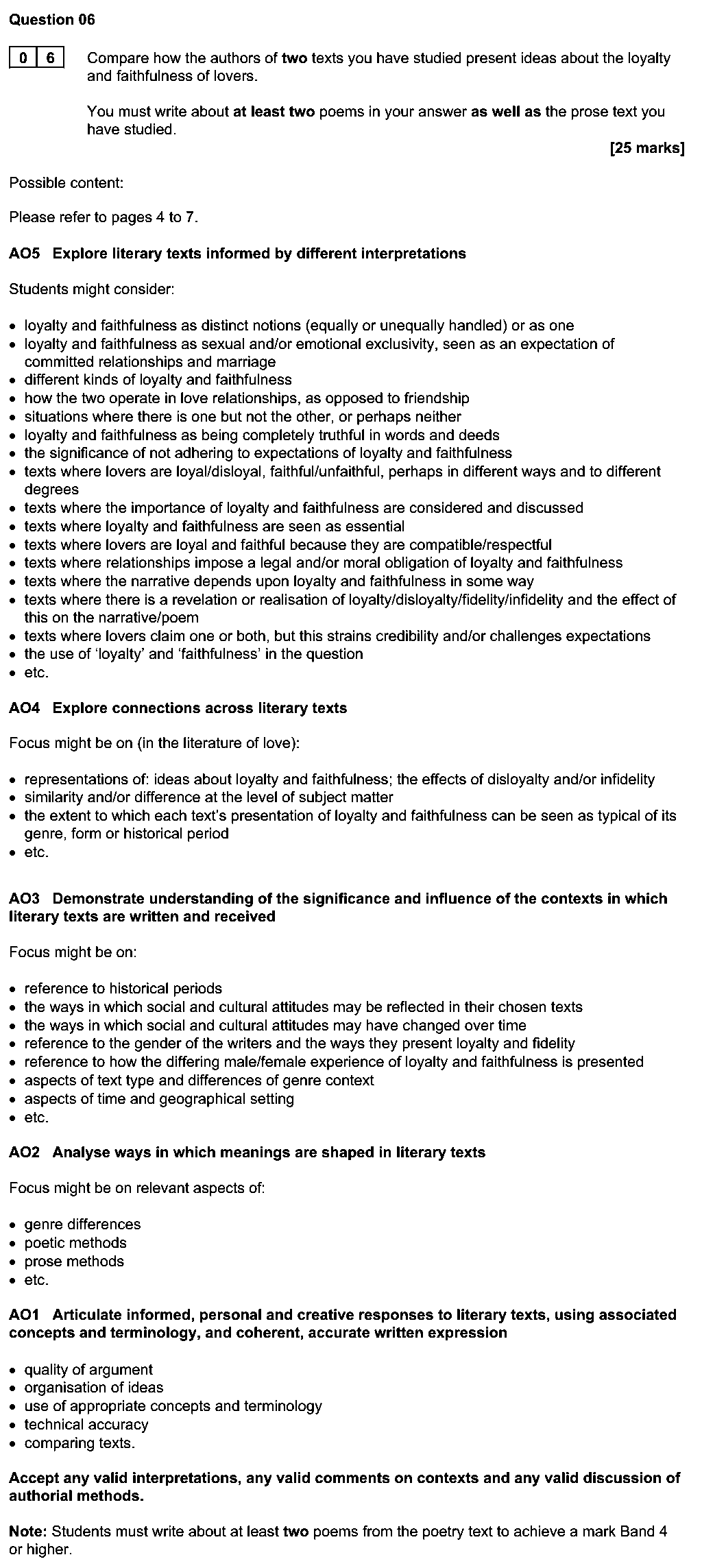
June 2025 · Paper 1 · Q6 25 marks Comparing texts love poetry pre 1900love poetry post 1900comparing prose love
Compare how the authors of two texts you have studied present ideas about the loyalty
and faithfulness of lovers.
You must write about at least two poems in your answer as well as the prose text you
have studied.
[25 marks]
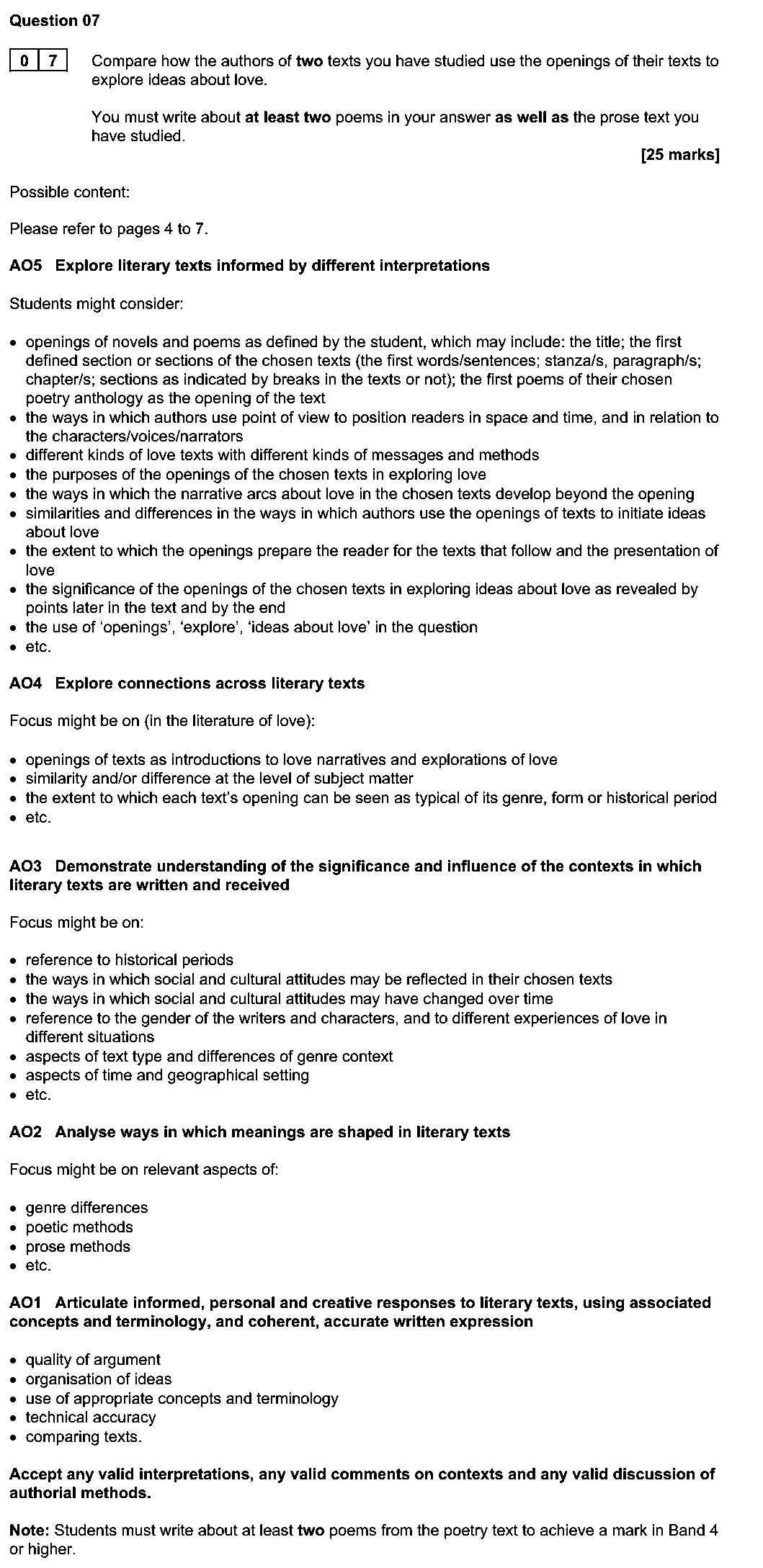
June 2025 · Paper 1 · Q7 25 marks Comparing texts love poetry pre 1900love poetry post 1900comparing prose love
Compare how the authors of two texts you have studied use the openings of their texts to
explore ideas about love.
You must write about at least two poems in your answer as well as the prose text you
have studied.
[25 marks]

Work with an AQA English Literature A tutor

Want a paper marked and gone through with you? Message us.

Prefer email? Send an enquiry

If you are under 18, please include a parent's contact details. Enquiries go to enquiries@alevelenglishtutor.com and are deleted once handled. All tutoring is online.