November 2020: AS Paper 1, Shakespeare and poetry

50 marks · 6 questions (every option is included) · Paper, mark scheme and report on AQA's site · Printed for the cancelled summer 2020 exams

Question by question

QTopicMarksAOType
1 Othello 25Shakespeare extract
2 The Taming of the Shrew 25Shakespeare extract
3 Measure for Measure 25Shakespeare extract
4 The Winter's Tale 25Shakespeare extract
5 AQA Anthology: love poetry pre-1900 25Anthology poetry
6 AQA Anthology: love poetry post-1900 25Anthology poetry

The questions

123456
November 2020 · AS Paper 1 · Q1 25 marks Shakespeare extract othello
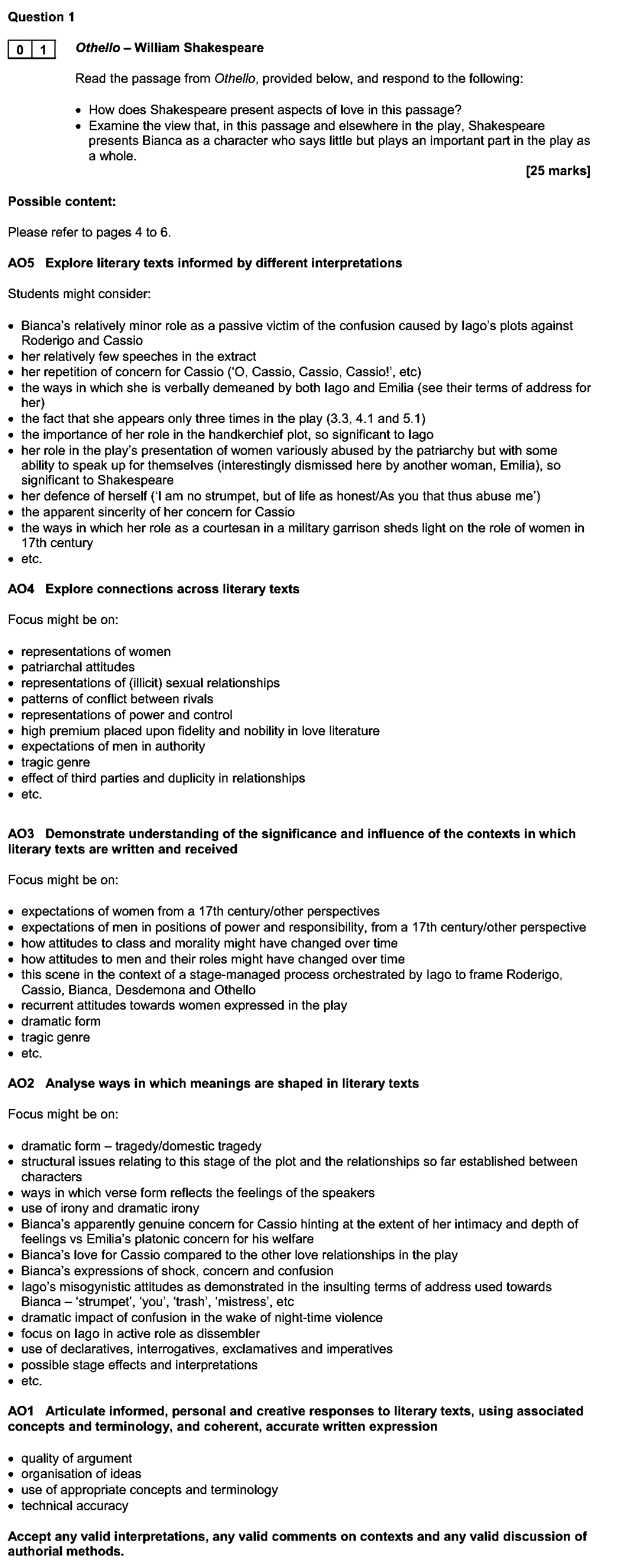
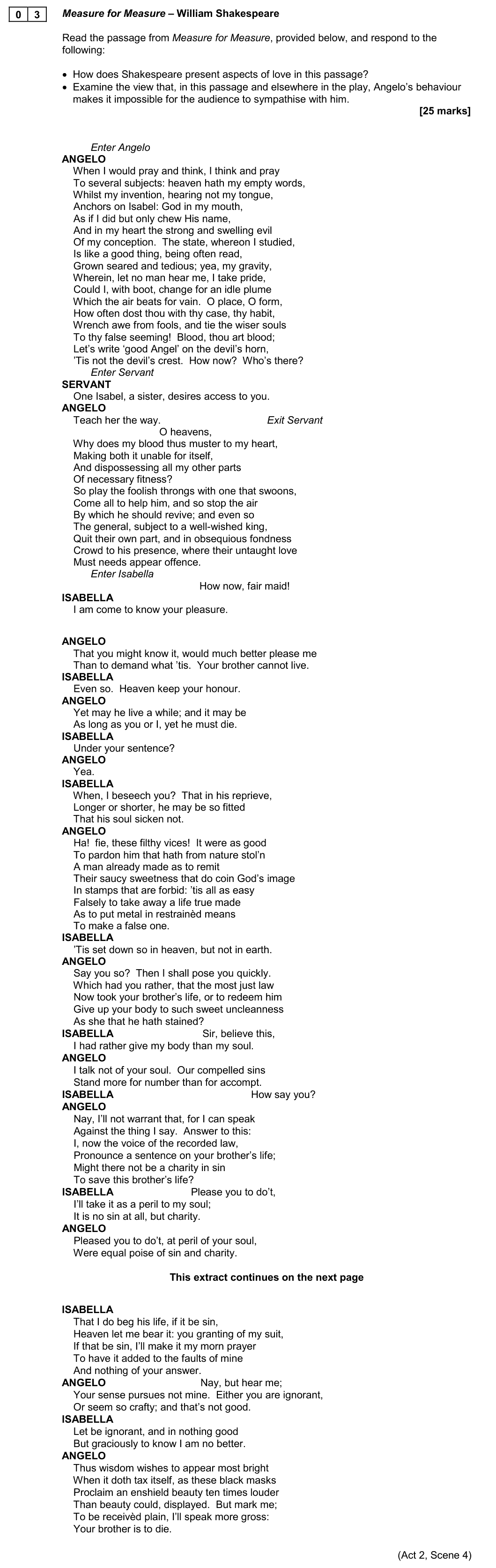
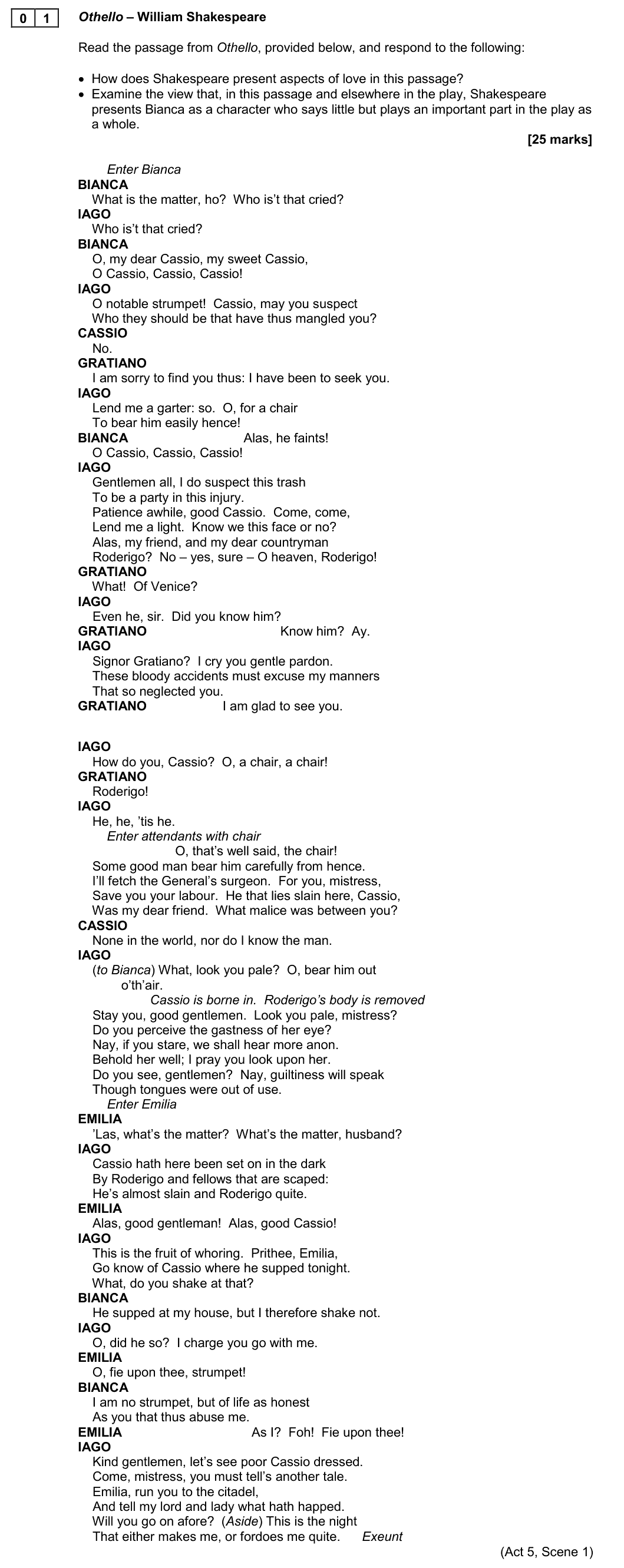
Othello – William Shakespeare
Read the passage from Othello, provided below, and respond to the following:
• How does Shakespeare present aspects of love in this passage?
• Examine the view that, in this passage and elsewhere in the play, Shakespeare
presents Bianca as a character who says little but plays an important part in the play as
a whole.
[25 marks]
Enter Bianca
BIANCA
What is the matter, ho? Who is’t that cried?
IAGO
Who is’t that cried?
BIANCA
O, my dear Cassio, my sweet Cassio,
O Cassio, Cassio, Cassio!
IAGO
O notable strumpet! Cassio, may you suspect
Who they should be that have thus mangled you?
CASSIO
No.
GRATIANO
I am sorry to find you thus: I have been to seek you.
IAGO
Lend me a garter: so. O, for a chair
To bear him easily hence!
BIANCA Alas, he faints!
O Cassio, Cassio, Cassio!
IAGO
Gentlemen all, I do suspect this trash
To be a party in this injury.
Patience awhile, good Cassio. Come, come,
Lend me a light. Know we this face or no?
Alas, my friend, and my dear countryman
Roderigo? No – yes, sure – O heaven, Roderigo!
GRATIANO
What! Of Venice?
IAGO
Even he, sir. Did you know him?
GRATIANO Know him? Ay.
IAGO
Signor Gratiano? I cry you gentle pardon.
These bloody accidents must excuse my manners
That so neglected you.
GRATIANO I am glad to see you.
IAGO
How do you, Cassio? O, a chair, a chair!
GRATIANO
Roderigo!
IAGO
He, he, ’tis he.
Enter attendants with chair
O, that’s well said, the chair!
Some good man bear him carefully from hence.
I’ll fetch the General’s surgeon. For you, mistress,
Save you your labour. He that lies slain here, Cassio,
Was my dear friend. What malice was between you?
CASSIO
None in the world, nor do I know the man.
IAGO
(to Bianca) What, look you pale? O, bear him out
o’th’air.
Cassio is borne in. Roderigo’s body is removed
Stay you, good gentlemen. Look you pale, mistress?
Do you perceive the gastness of her eye?
Nay, if you stare, we shall hear more anon.
Behold her well; I pray you look upon her.
Do you see, gentlemen? Nay, guiltiness will speak
Though tongues were out of use.
Enter Emilia
EMILIA
’Las, what’s the matter? What’s the matter, husband?
IAGO
Cassio hath here been set on in the dark
By Roderigo and fellows that are scaped:
He’s almost slain and Roderigo quite.
EMILIA
Alas, good gentleman! Alas, good Cassio!
IAGO
This is the fruit of whoring. Prithee, Emilia,
Go know of Cassio where he supped tonight.
What, do you shake at that?
BIANCA
He supped at my house, but I therefore shake not.
IAGO
O, did he so? I charge you go with me.
EMILIA
O, fie upon thee, strumpet!
BIANCA
I am no strumpet, but of life as honest
As you that thus abuse me.
EMILIA As I? Foh! Fie upon thee!
IAGO
Kind gentlemen, let’s see poor Cassio dressed.
Come, mistress, you must tell’s another tale.
Emilia, run you to the citadel,
And tell my lord and lady what hath happed.
Will you go on afore? (Aside) This is the night
That either makes me, or fordoes me quite. Exeunt
(Act 5, Scene 1)
November 2020 · AS Paper 1 · Q2 25 marks Shakespeare extract taming of the shrew
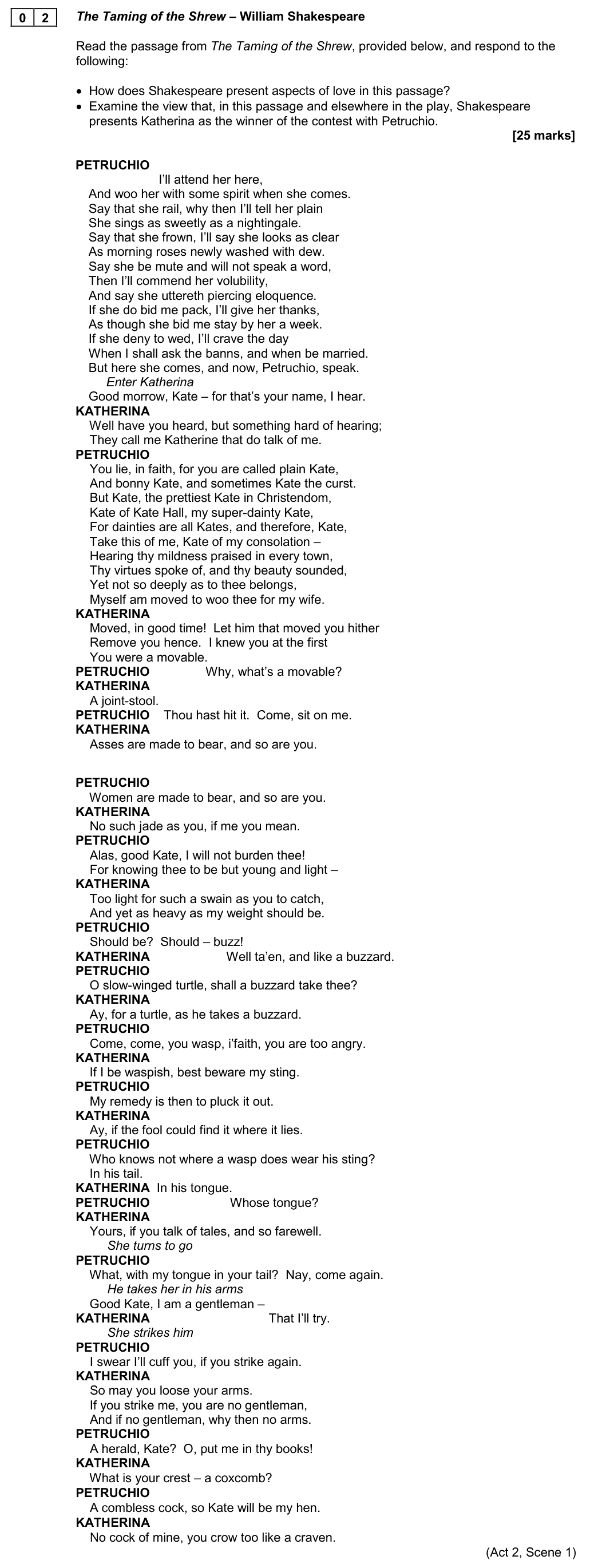
The Taming of the Shrew – William Shakespeare
Read the passage from The Taming of the Shrew, provided below, and respond to the
following:
• How does Shakespeare present aspects of love in this passage?
• Examine the view that, in this passage and elsewhere in the play, Shakespeare
presents Katherina as the winner of the contest with Petruchio.
[25 marks]
PETRUCHIO
I’ll attend her here,
And woo her with some spirit when she comes.
Say that she rail, why then I’ll tell her plain
She sings as sweetly as a nightingale.
Say that she frown, I’ll say she looks as clear
As morning roses newly washed with dew.
Say she be mute and will not speak a word,
Then I’ll commend her volubility,
And say she uttereth piercing eloquence.
If she do bid me pack, I’ll give her thanks,
As though she bid me stay by her a week.
If she deny to wed, I’ll crave the day
When I shall ask the banns, and when be married.
But here she comes, and now, Petruchio, speak.
Enter Katherina
Good morrow, Kate – for that’s your name, I hear.
KATHERINA
Well have you heard, but something hard of hearing;
They call me Katherine that do talk of me.
PETRUCHIO
You lie, in faith, for you are called plain Kate,
And bonny Kate, and sometimes Kate the curst.
But Kate, the prettiest Kate in Christendom,
Kate of Kate Hall, my super-dainty Kate,
For dainties are all Kates, and therefore, Kate,
Take this of me, Kate of my consolation –
Hearing thy mildness praised in every town,
Thy virtues spoke of, and thy beauty sounded,
Yet not so deeply as to thee belongs,
Myself am moved to woo thee for my wife.
KATHERINA
Moved, in good time! Let him that moved you hither
Remove you hence. I knew you at the first
You were a movable.
PETRUCHIO Why, what’s a movable?
KATHERINA
A joint-stool.
PETRUCHIO Thou hast hit it. Come, sit on me.
KATHERINA
Asses are made to bear, and so are you.
PETRUCHIO
Women are made to bear, and so are you.
KATHERINA
No such jade as you, if me you mean.
PETRUCHIO
Alas, good Kate, I will not burden thee!
For knowing thee to be but young and light –
KATHERINA
Too light for such a swain as you to catch,
And yet as heavy as my weight should be.
PETRUCHIO
Should be? Should – buzz!
KATHERINA Well ta’en, and like a buzzard.
PETRUCHIO
O slow-winged turtle, shall a buzzard take thee?
KATHERINA
Ay, for a turtle, as he takes a buzzard.
PETRUCHIO
Come, come, you wasp, i’faith, you are too angry.
KATHERINA
If I be waspish, best beware my sting.
PETRUCHIO
My remedy is then to pluck it out.
KATHERINA
Ay, if the fool could find it where it lies.
PETRUCHIO
Who knows not where a wasp does wear his sting?
In his tail.
KATHERINA In his tongue.
PETRUCHIO Whose tongue?
KATHERINA
Yours, if you talk of tales, and so farewell.
She turns to go
PETRUCHIO
What, with my tongue in your tail? Nay, come again.
He takes her in his arms
Good Kate, I am a gentleman –
KATHERINA That I’ll try.
She strikes him
PETRUCHIO
I swear I’ll cuff you, if you strike again.
KATHERINA
So may you loose your arms.
If you strike me, you are no gentleman,
And if no gentleman, why then no arms.
PETRUCHIO
A herald, Kate? O, put me in thy books!
KATHERINA
What is your crest – a coxcomb?
PETRUCHIO
A combless cock, so Kate will be my hen.
KATHERINA
No cock of mine, you crow too like a craven.
(Act 2, Scene 1)
November 2020 · AS Paper 1 · Q3 25 marks Shakespeare extract measure for measure
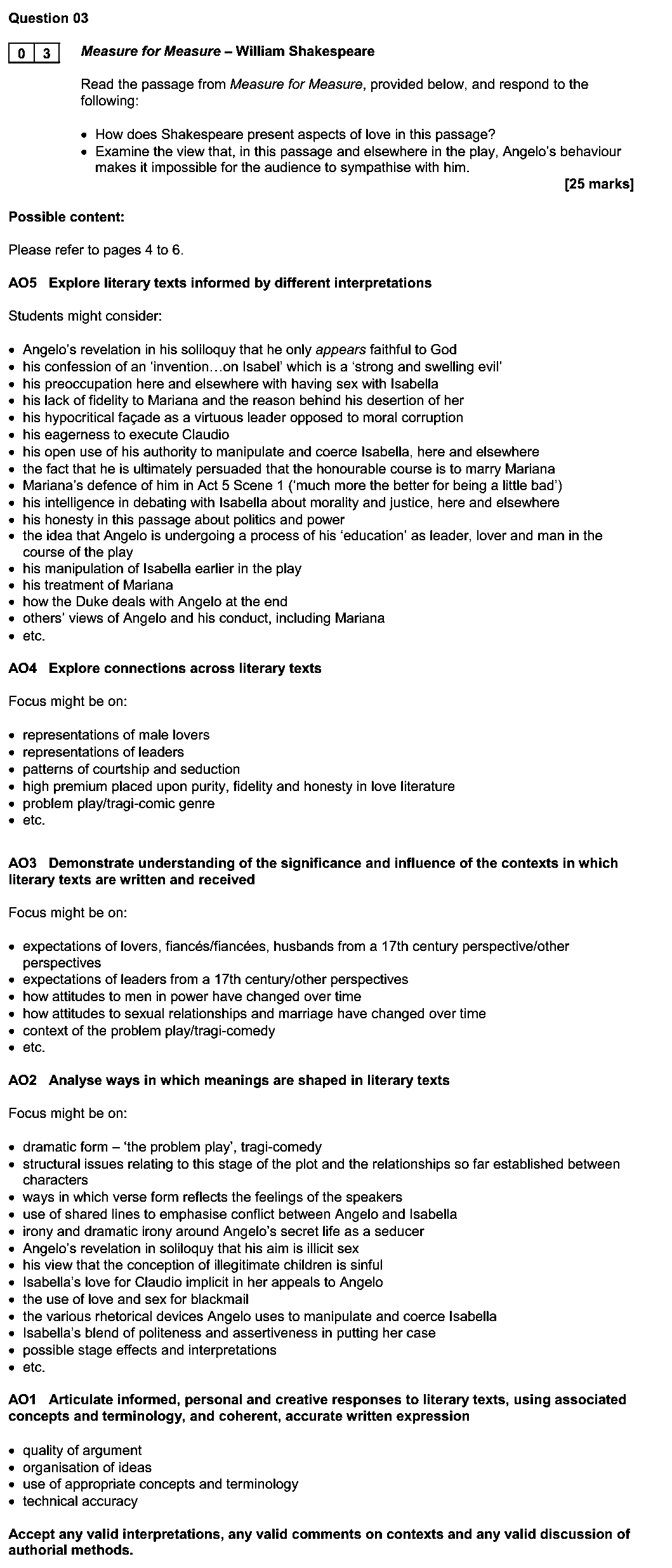
Measure for Measure – William Shakespeare
Read the passage from Measure for Measure, provided below, and respond to the
following:
• How does Shakespeare present aspects of love in this passage?
• Examine the view that, in this passage and elsewhere in the play, Angelo’s behaviour
makes it impossible for the audience to sympathise with him.
[25 marks]
Enter Angelo
ANGELO
When I would pray and think, I think and pray
To several subjects: heaven hath my empty words,
Whilst my invention, hearing not my tongue,
Anchors on Isabel: God in my mouth,
As if I did but only chew His name,
And in my heart the strong and swelling evil
Of my conception. The state, whereon I studied,
Is like a good thing, being often read,
Grown seared and tedious; yea, my gravity,
Wherein, let no man hear me, I take pride,
Could I, with boot, change for an idle plume
Which the air beats for vain. O place, O form,
How often dost thou with thy case, thy habit,
Wrench awe from fools, and tie the wiser souls
To thy false seeming! Blood, thou art blood;
Let’s write ‘good Angel’ on the devil’s horn,
’Tis not the devil’s crest. How now? Who’s there?
Enter Servant
SERVANT
One Isabel, a sister, desires access to you.
ANGELO
Teach her the way. Exit Servant
O heavens,
Why does my blood thus muster to my heart,
Making both it unable for itself,
And dispossessing all my other parts
Of necessary fitness?
So play the foolish throngs with one that swoons,
Come all to help him, and so stop the air
By which he should revive; and even so
The general, subject to a well-wished king,
Quit their own part, and in obsequious fondness
Crowd to his presence, where their untaught love
Must needs appear offence.
Enter Isabella
How now, fair maid!
ISABELLA
I am come to know your pleasure.
ANGELO
That you might know it, would much better please me
Than to demand what ’tis. Your brother cannot live.
ISABELLA
Even so. Heaven keep your honour.
ANGELO
Yet may he live a while; and it may be
As long as you or I, yet he must die.
ISABELLA
Under your sentence?
ANGELO
Yea.
ISABELLA
When, I beseech you? That in his reprieve,
Longer or shorter, he may be so fitted
That his soul sicken not.
ANGELO
Ha! fie, these filthy vices! It were as good
To pardon him that hath from nature stol’n
A man already made as to remit
Their saucy sweetness that do coin God’s image
In stamps that are forbid: ’tis all as easy
Falsely to take away a life true made
As to put metal in restrainèd means
To make a false one.
ISABELLA
’Tis set down so in heaven, but not in earth.
ANGELO
Say you so? Then I shall pose you quickly.
Which had you rather, that the most just law
Now took your brother’s life, or to redeem him
Give up your body to such sweet uncleanness
As she that he hath stained?
ISABELLA Sir, believe this,
I had rather give my body than my soul.
ANGELO
I talk not of your soul. Our compelled sins
Stand more for number than for accompt.
ISABELLA How say you?
ANGELO
Nay, I’ll not warrant that, for I can speak
Against the thing I say. Answer to this:
I, now the voice of the recorded law,
Pronounce a sentence on your brother’s life;
Might there not be a charity in sin
To save this brother’s life?
ISABELLA Please you to do’t,
I’ll take it as a peril to my soul;
It is no sin at all, but charity.
ANGELO
Pleased you to do’t, at peril of your soul,
Were equal poise of sin and charity.
This extract continues on the next page
ISABELLA
That I do beg his life, if it be sin,
Heaven let me bear it: you granting of my suit,
If that be sin, I’ll make it my morn prayer
To have it added to the faults of mine
And nothing of your answer.
ANGELO Nay, but hear me;
Your sense pursues not mine. Either you are ignorant,
Or seem so crafty; and that’s not good.
ISABELLA
Let be ignorant, and in nothing good
But graciously to know I am no better.
ANGELO
Thus wisdom wishes to appear most bright
When it doth tax itself, as these black masks
Proclaim an enshield beauty ten times louder
Than beauty could, displayed. But mark me;
To be receivèd plain, I’ll speak more gross:
Your brother is to die.
(Act 2, Scene 4)
November 2020 · AS Paper 1 · Q4 25 marks Shakespeare extract the winters tale
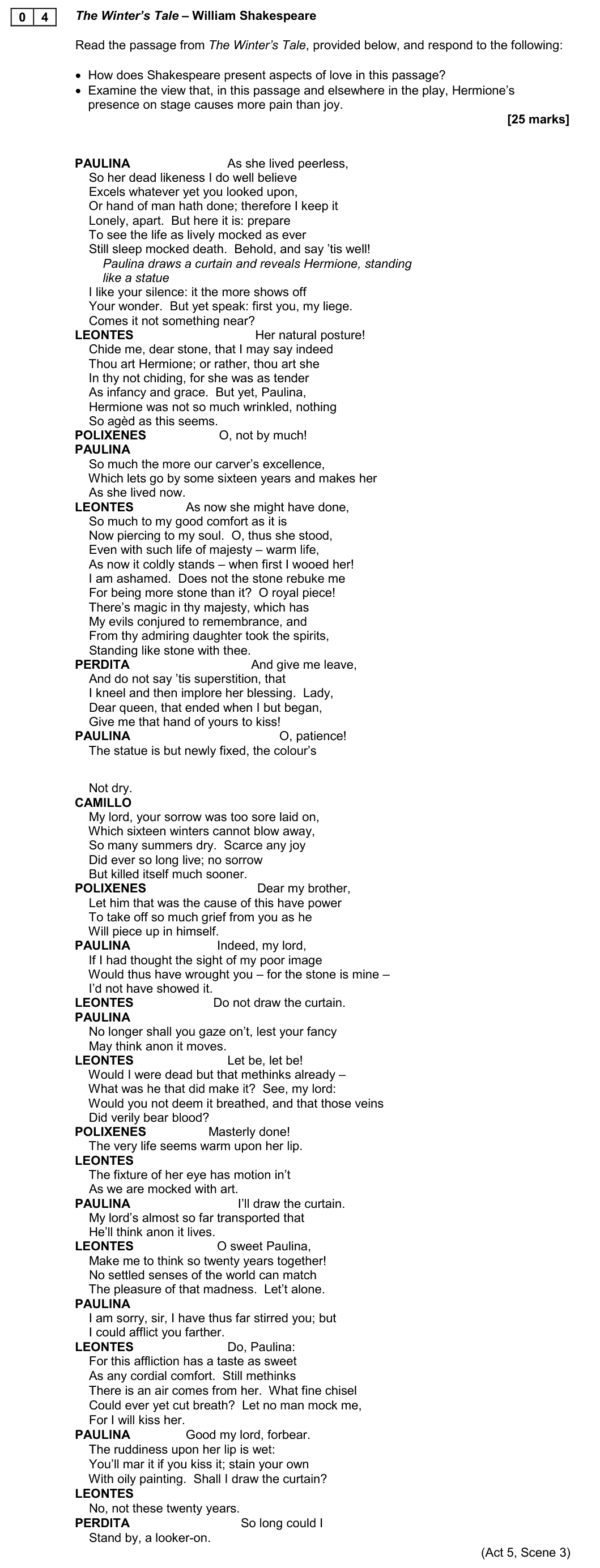
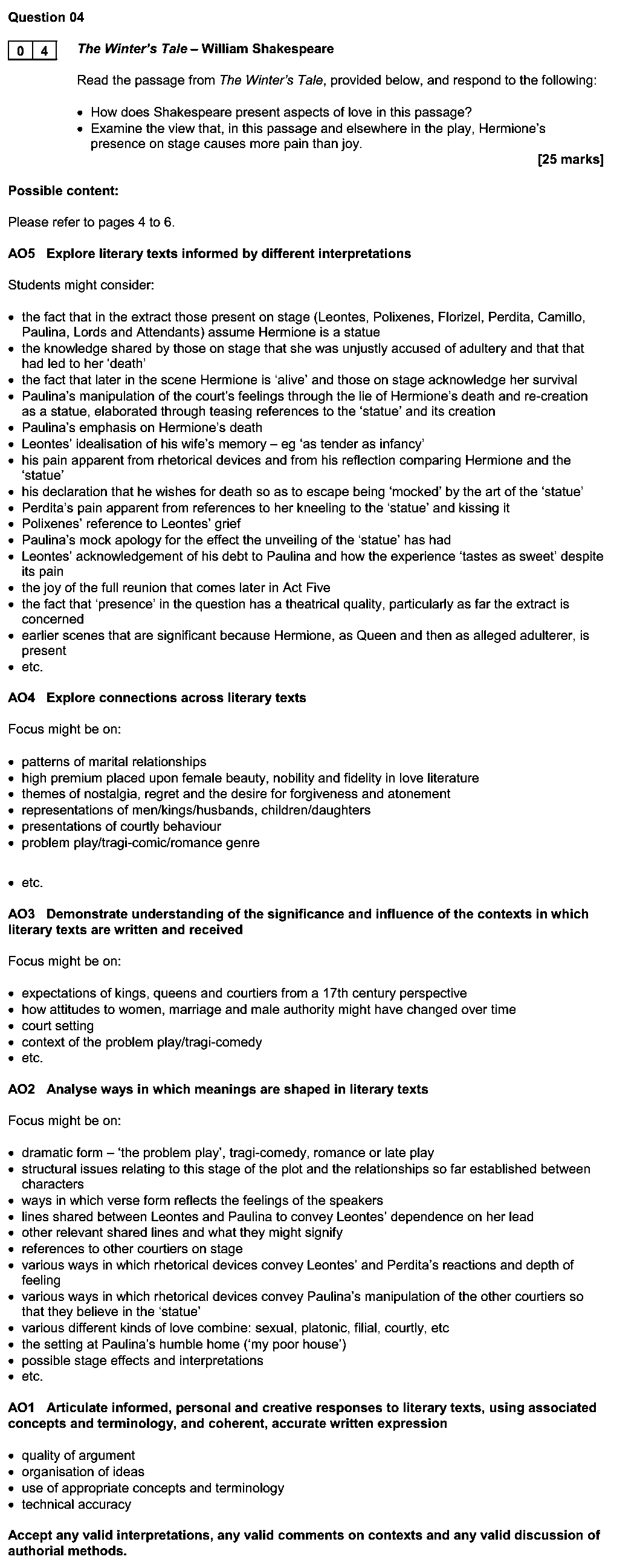
The Winter’s Tale – William Shakespeare
Read the passage from The Winter’s Tale, provided below, and respond to the following:
• How does Shakespeare present aspects of love in this passage?
• Examine the view that, in this passage and elsewhere in the play, Hermione’s
presence on stage causes more pain than joy.
[25 marks]
PAULINA As she lived peerless,
So her dead likeness I do well believe
Excels whatever yet you looked upon,
Or hand of man hath done; therefore I keep it
Lonely, apart. But here it is: prepare
To see the life as lively mocked as ever
Still sleep mocked death. Behold, and say ’tis well!
Paulina draws a curtain and reveals Hermione, standing
like a statue
I like your silence: it the more shows off
Your wonder. But yet speak: first you, my liege.
Comes it not something near?
LEONTES Her natural posture!
Chide me, dear stone, that I may say indeed
Thou art Hermione; or rather, thou art she
In thy not chiding, for she was as tender
As infancy and grace. But yet, Paulina,
Hermione was not so much wrinkled, nothing
So agèd as this seems.
POLIXENES O, not by much!
PAULINA
So much the more our carver’s excellence,
Which lets go by some sixteen years and makes her
As she lived now.
LEONTES As now she might have done,
So much to my good comfort as it is
Now piercing to my soul. O, thus she stood,
Even with such life of majesty – warm life,
As now it coldly stands – when first I wooed her!
I am ashamed. Does not the stone rebuke me
For being more stone than it? O royal piece!
There’s magic in thy majesty, which has
My evils conjured to remembrance, and
From thy admiring daughter took the spirits,
Standing like stone with thee.
PERDITA And give me leave,
And do not say ’tis superstition, that
I kneel and then implore her blessing. Lady,
Dear queen, that ended when I but began,
Give me that hand of yours to kiss!
PAULINA O, patience!
The statue is but newly fixed, the colour’s
Not dry.
CAMILLO
My lord, your sorrow was too sore laid on,
Which sixteen winters cannot blow away,
So many summers dry. Scarce any joy
Did ever so long live; no sorrow
But killed itself much sooner.
POLIXENES Dear my brother,
Let him that was the cause of this have power
To take off so much grief from you as he
Will piece up in himself.
PAULINA Indeed, my lord,
If I had thought the sight of my poor image
Would thus have wrought you – for the stone is mine –
I’d not have showed it.
LEONTES Do not draw the curtain.
PAULINA
No longer shall you gaze on’t, lest your fancy
May think anon it moves.
LEONTES Let be, let be!
Would I were dead but that methinks already –
What was he that did make it? See, my lord:
Would you not deem it breathed, and that those veins
Did verily bear blood?
POLIXENES Masterly done!
The very life seems warm upon her lip.
LEONTES
The fixture of her eye has motion in’t
As we are mocked with art.
PAULINA I’ll draw the curtain.
My lord’s almost so far transported that
He’ll think anon it lives.
LEONTES O sweet Paulina,
Make me to think so twenty years together!
No settled senses of the world can match
The pleasure of that madness. Let’t alone.
PAULINA
I am sorry, sir, I have thus far stirred you; but
I could afflict you farther.
LEONTES Do, Paulina:
For this affliction has a taste as sweet
As any cordial comfort. Still methinks
There is an air comes from her. What fine chisel
Could ever yet cut breath? Let no man mock me,
For I will kiss her.
PAULINA Good my lord, forbear.
The ruddiness upon her lip is wet:
You’ll mar it if you kiss it; stain your own
With oily painting. Shall I draw the curtain?
LEONTES
No, not these twenty years.
PERDITA So long could I
Stand by, a looker-on.
(Act 5, Scene 3)
November 2020 · AS Paper 1 · Q5 25 marks Anthology poetry love poetry pre 1900
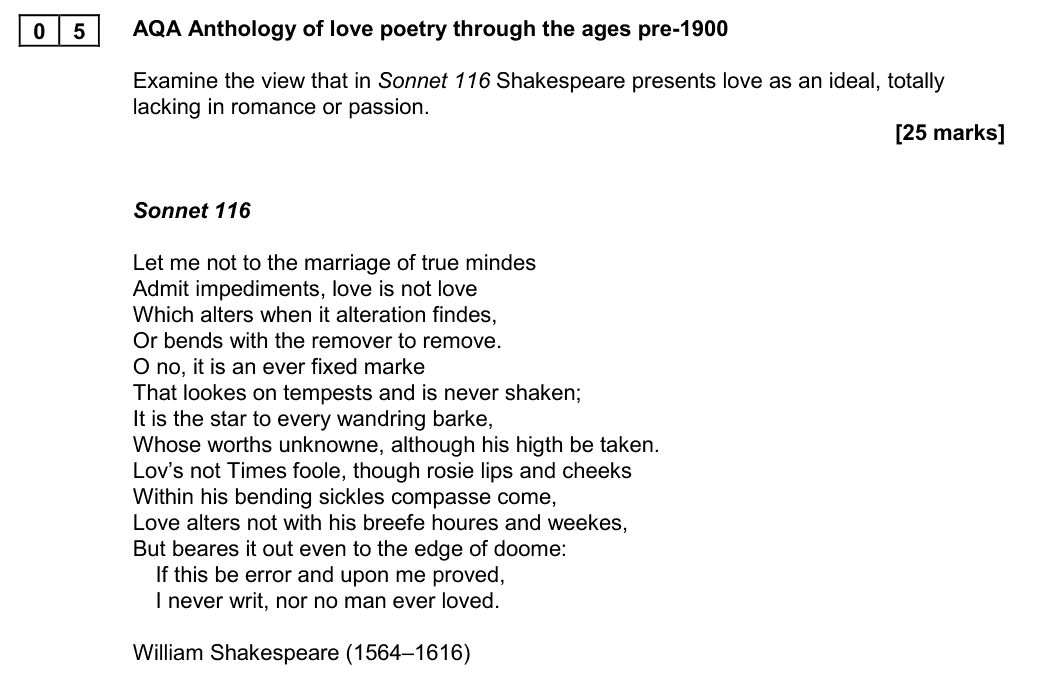
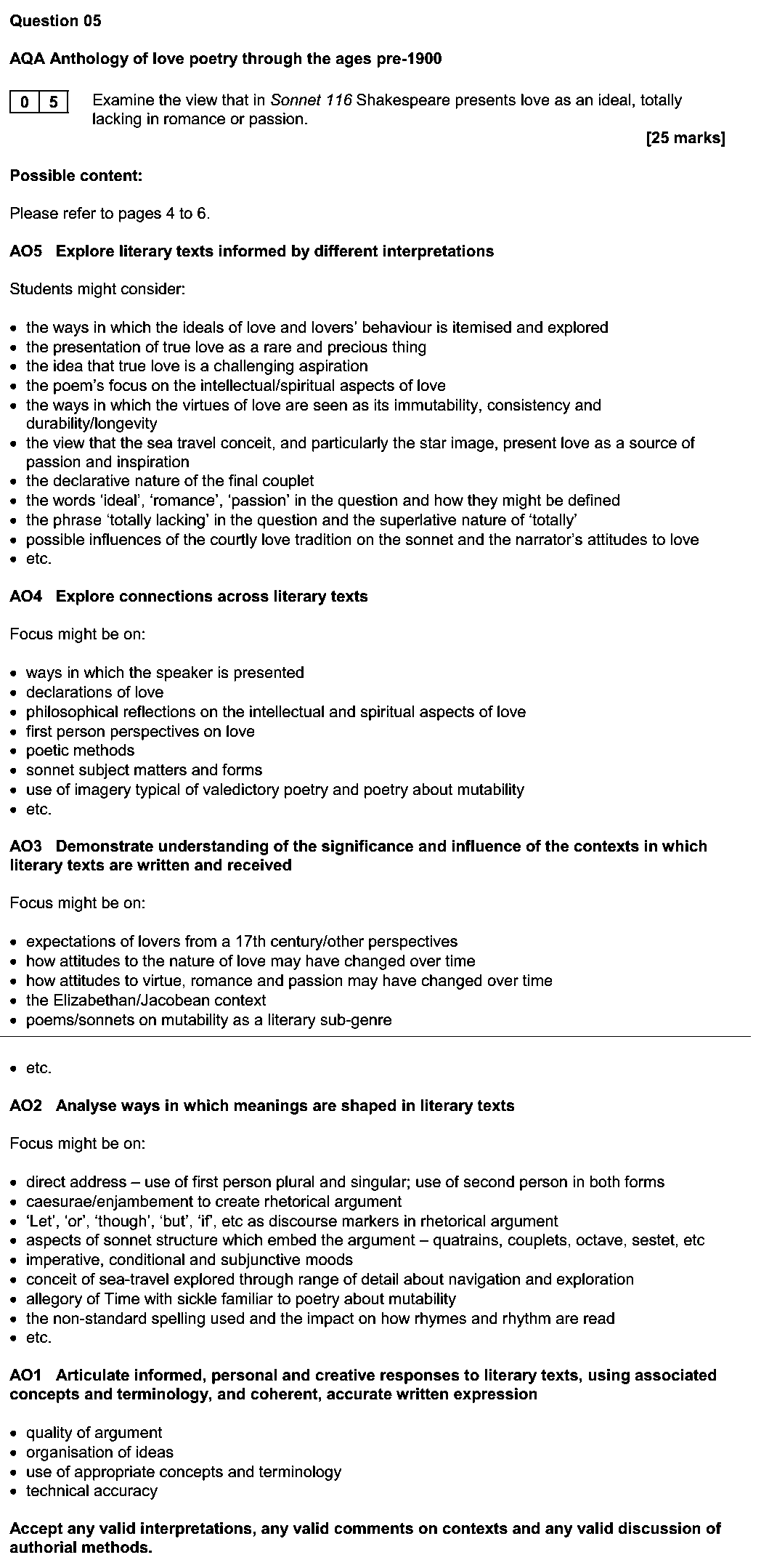
AQA Anthology of love poetry through the ages pre-1900
Examine the view that in Sonnet 116 Shakespeare presents love as an ideal, totally
lacking in romance or passion.
[25 marks]
Sonnet 116
Let me not to the marriage of true mindes
Admit impediments, love is not love
Which alters when it alteration findes,
Or bends with the remover to remove.
O no, it is an ever fixed marke
That lookes on tempests and is never shaken;
It is the star to every wandring barke,
Whose worths unknowne, although his higth be taken.
Lov’s not Times foole, though rosie lips and cheeks
Within his bending sickles compasse come,
Love alters not with his breefe houres and weekes,
But beares it out even to the edge of doome:
If this be error and upon me proved,
I never writ, nor no man ever loved.
William Shakespeare (1564–1616)
November 2020 · AS Paper 1 · Q6 25 marks Anthology poetry love poetry post 1900
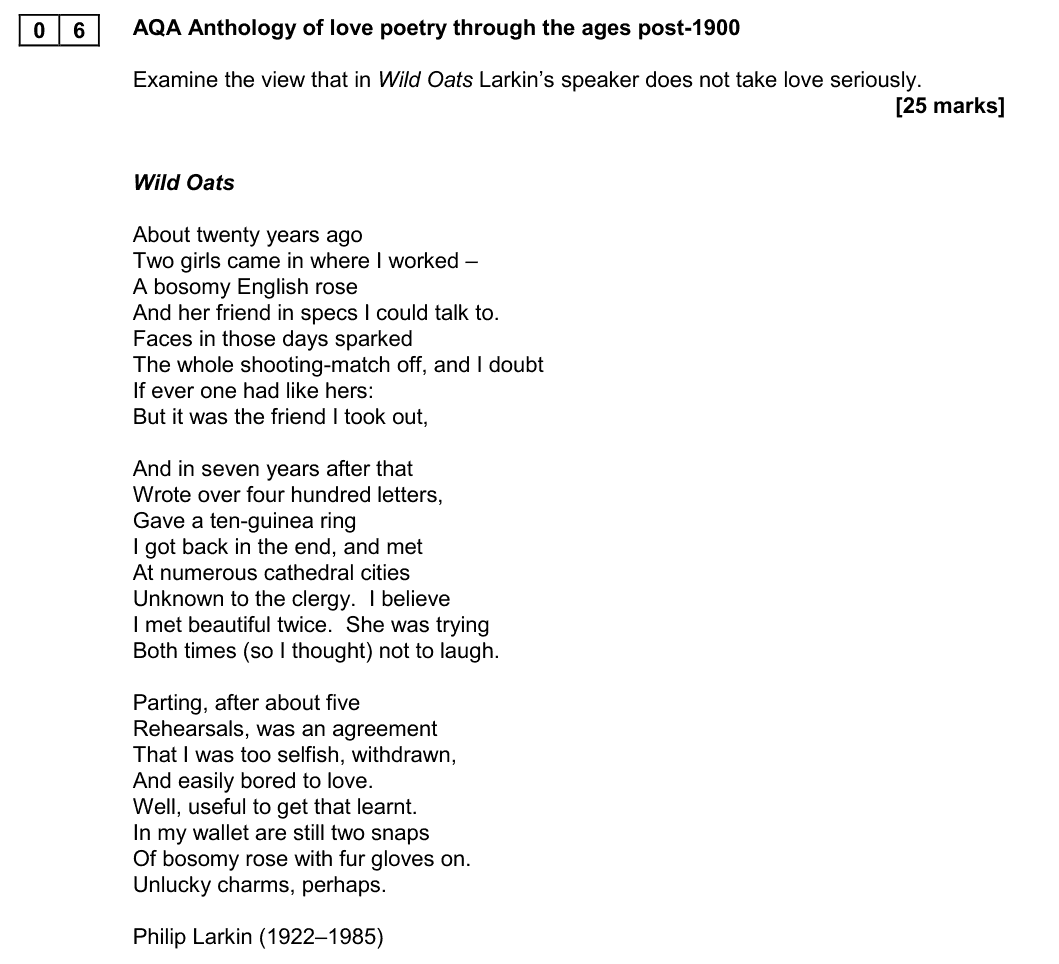
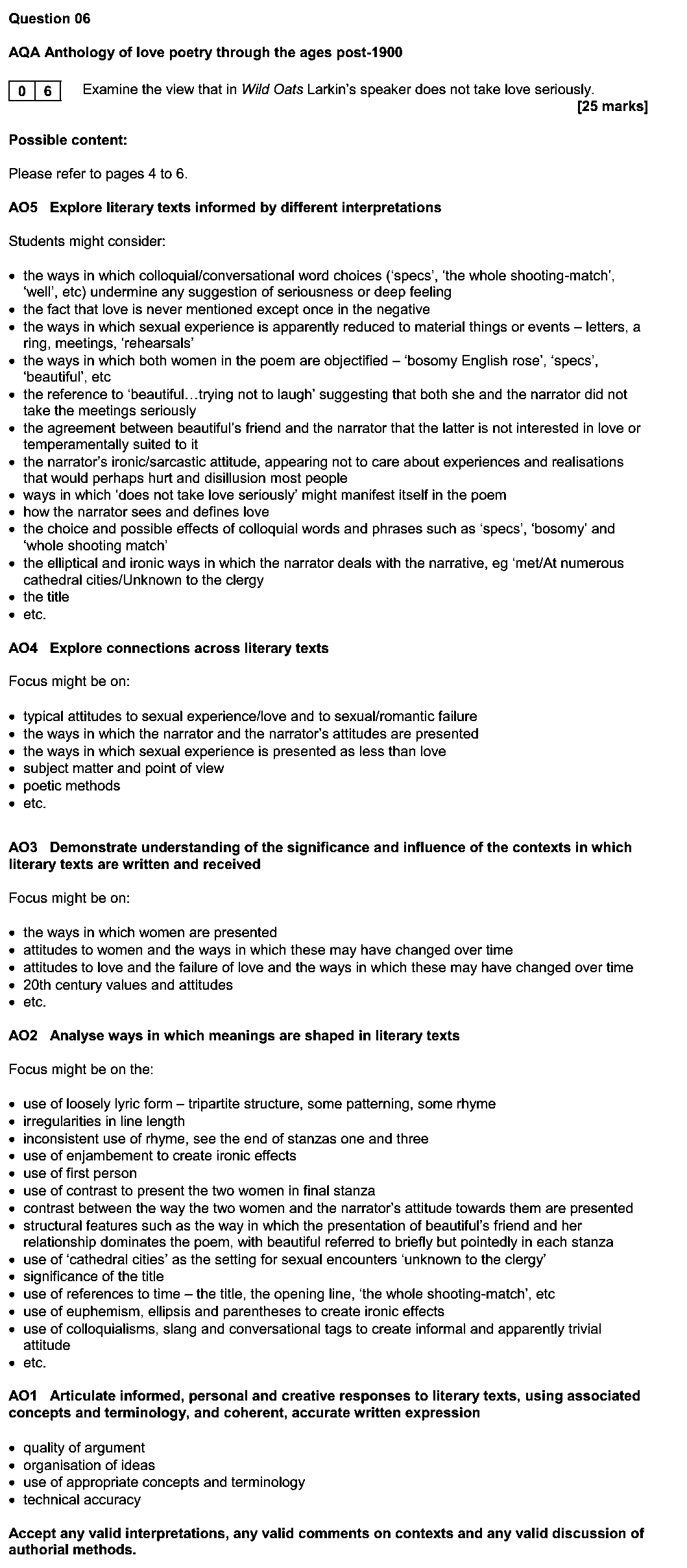
AQA Anthology of love poetry through the ages post-1900
Examine the view that in Wild Oats Larkin’s speaker does not take love seriously.
[25 marks]
Wild Oats
About twenty years ago
Two girls came in where I worked –
A bosomy English rose
And her friend in specs I could talk to.
Faces in those days sparked
The whole shooting-match off, and I doubt
If ever one had like hers:
But it was the friend I took out,
And in seven years after that
Wrote over four hundred letters,
Gave a ten-guinea ring
I got back in the end, and met
At numerous cathedral cities
Unknown to the clergy. I believe
I met beautiful twice. She was trying
Both times (so I thought) not to laugh.
Parting, after about five
Rehearsals, was an agreement
That I was too selfish, withdrawn,
And easily bored to love.
Well, useful to get that learnt.
In my wallet are still two snaps
Of bosomy rose with fur gloves on.
Unlucky charms, perhaps.
Philip Larkin (1922–1985)

Work with an AQA English Literature A tutor

Want a paper marked and gone through with you? Message us.

Prefer email? Send an enquiry

If you are under 18, please include a parent's contact details. Enquiries go to enquiries@alevelenglishtutor.com and are deleted once handled. All tutoring is online.