November 2020: A-level Paper 1, Love through the ages

75 marks · 7 questions (every option is included) · Paper, mark scheme and report on AQA's site · Printed for the cancelled summer 2020 exams

Question by question

QTopicMarksAOType
1 Othello 25Shakespeare extract
2 The Taming of the Shrew 25Shakespeare extract
3 Measure for Measure 25Shakespeare extract
4 The Winter's Tale 25Shakespeare extract
5 Unseen poetry comparison (love) 25Unseen poetry
6 AQA Anthology: love poetry pre-1900, AQA Anthology: love poetry post-1900, Comparing prose texts (love through the ages) 25Comparing texts
7 AQA Anthology: love poetry pre-1900, AQA Anthology: love poetry post-1900, Comparing prose texts (love through the ages) 25Comparing texts

The questions

1234567
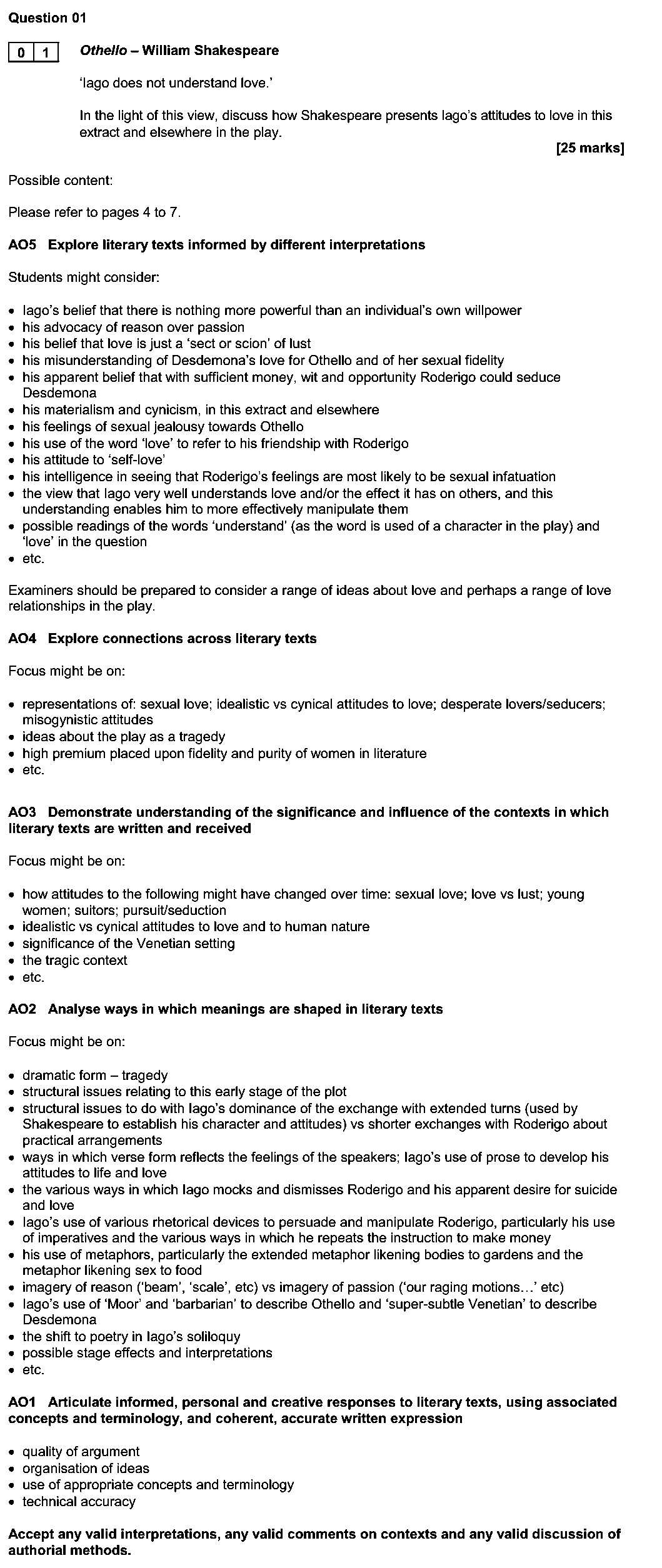
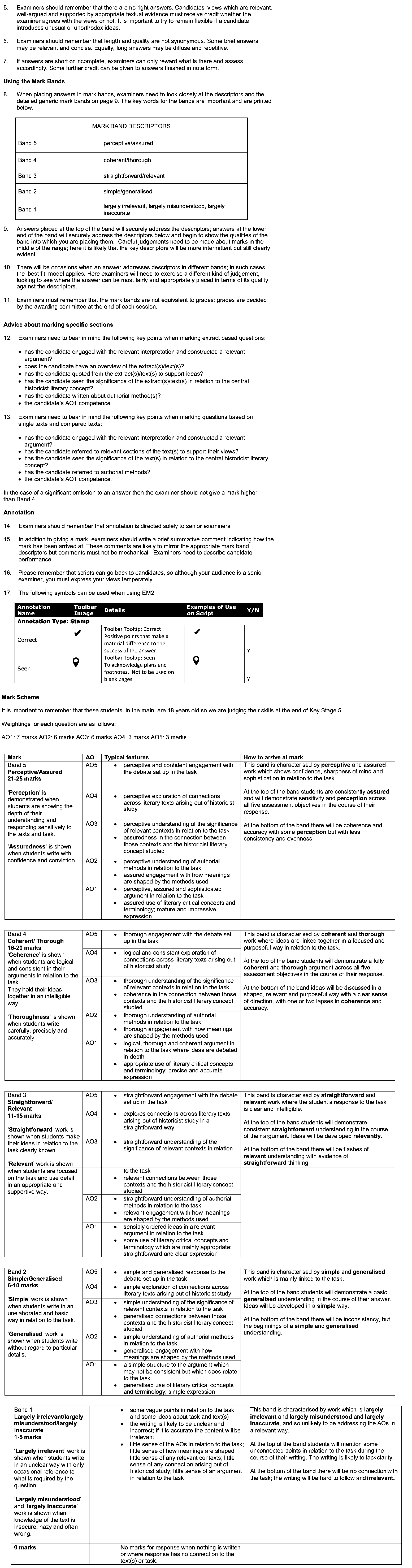
November 2020 · Paper 1 · Q1 25 marks Shakespeare extract othello
Othello – William Shakespeare
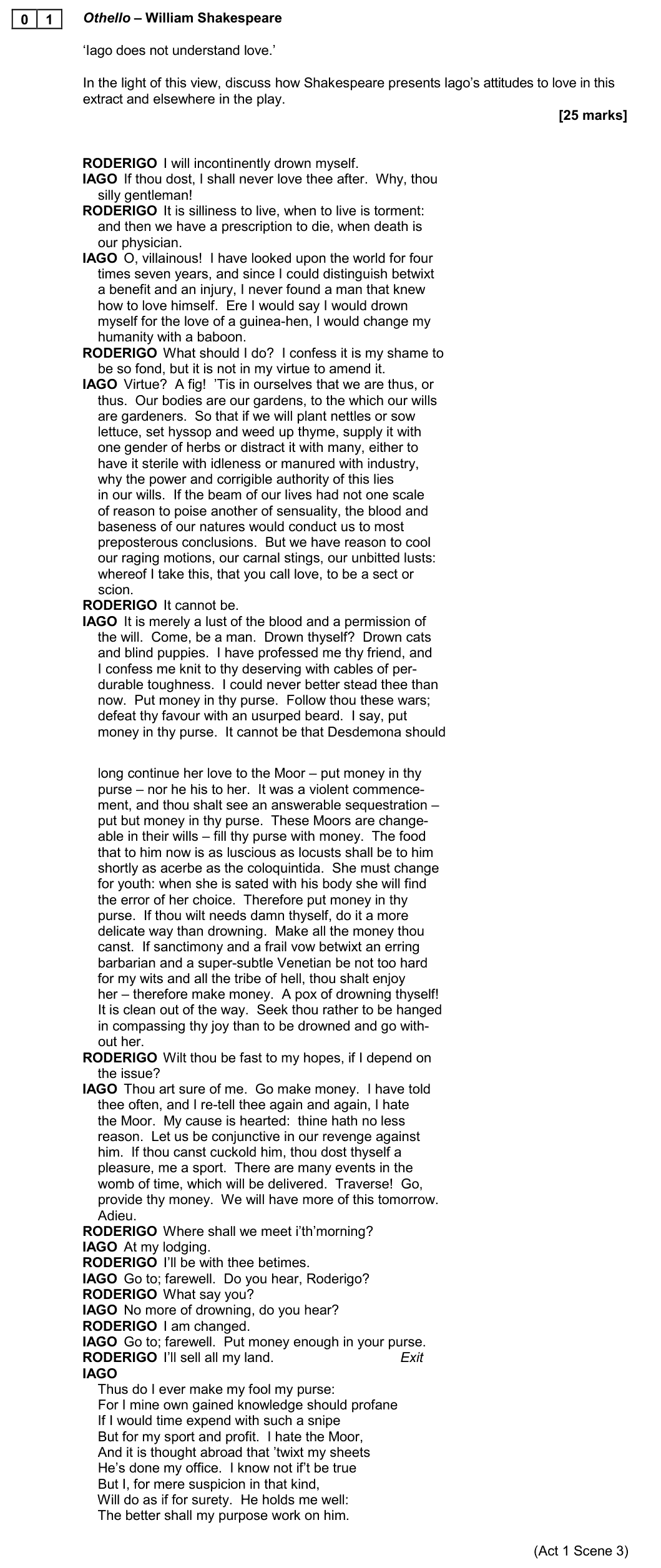
‘Iago does not understand love.’
In the light of this view, discuss how Shakespeare presents Iago’s attitudes to love in this
extract and elsewhere in the play.
[25 marks]
RODERIGO I will incontinently drown myself.
IAGO If thou dost, I shall never love thee after. Why, thou
silly gentleman!
RODERIGO It is silliness to live, when to live is torment:
and then we have a prescription to die, when death is
our physician.
IAGO O, villainous! I have looked upon the world for four
times seven years, and since I could distinguish betwixt
a benefit and an injury, I never found a man that knew
how to love himself. Ere I would say I would drown
myself for the love of a guinea-hen, I would change my
humanity with a baboon.
RODERIGO What should I do? I confess it is my shame to
be so fond, but it is not in my virtue to amend it.
IAGO Virtue? A fig! ’Tis in ourselves that we are thus, or
thus. Our bodies are our gardens, to the which our wills
are gardeners. So that if we will plant nettles or sow
lettuce, set hyssop and weed up thyme, supply it with
one gender of herbs or distract it with many, either to
have it sterile with idleness or manured with industry,
why the power and corrigible authority of this lies
in our wills. If the beam of our lives had not one scale
of reason to poise another of sensuality, the blood and
baseness of our natures would conduct us to most
preposterous conclusions. But we have reason to cool
our raging motions, our carnal stings, our unbitted lusts:
whereof I take this, that you call love, to be a sect or
scion.
RODERIGO It cannot be.
IAGO It is merely a lust of the blood and a permission of
the will. Come, be a man. Drown thyself? Drown cats
and blind puppies. I have professed me thy friend, and
I confess me knit to thy deserving with cables of per-
durable toughness. I could never better stead thee than
now. Put money in thy purse. Follow thou these wars;
defeat thy favour with an usurped beard. I say, put
money in thy purse. It cannot be that Desdemona should
long continue her love to the Moor – put money in thy
purse – nor he his to her. It was a violent commence-
ment, and thou shalt see an answerable sequestration –
put but money in thy purse. These Moors are change-
able in their wills – fill thy purse with money. The food
that to him now is as luscious as locusts shall be to him
shortly as acerbe as the coloquintida. She must change
for youth: when she is sated with his body she will find
the error of her choice. Therefore put money in thy
purse. If thou wilt needs damn thyself, do it a more
delicate way than drowning. Make all the money thou
canst. If sanctimony and a frail vow betwixt an erring
barbarian and a super-subtle Venetian be not too hard
for my wits and all the tribe of hell, thou shalt enjoy
her – therefore make money. A pox of drowning thyself!
It is clean out of the way. Seek thou rather to be hanged
in compassing thy joy than to be drowned and go with-
out her.
RODERIGO Wilt thou be fast to my hopes, if I depend on
the issue?
IAGO Thou art sure of me. Go make money. I have told
thee often, and I re-tell thee again and again, I hate
the Moor. My cause is hearted: thine hath no less
reason. Let us be conjunctive in our revenge against
him. If thou canst cuckold him, thou dost thyself a
pleasure, me a sport. There are many events in the
womb of time, which will be delivered. Traverse! Go,
provide thy money. We will have more of this tomorrow.
Adieu.
RODERIGO Where shall we meet i’th’morning?
IAGO At my lodging.
RODERIGO I’ll be with thee betimes.
IAGO Go to; farewell. Do you hear, Roderigo?
RODERIGO What say you?
IAGO No more of drowning, do you hear?
RODERIGO I am changed.
IAGO Go to; farewell. Put money enough in your purse.
RODERIGO I’ll sell all my land. Exit
IAGO
Thus do I ever make my fool my purse:
For I mine own gained knowledge should profane
If I would time expend with such a snipe
But for my sport and profit. I hate the Moor,
And it is thought abroad that ’twixt my sheets
He’s done my office. I know not if’t be true
But I, for mere suspicion in that kind,
Will do as if for surety. He holds me well:
The better shall my purpose work on him.
(Act 1 Scene 3)
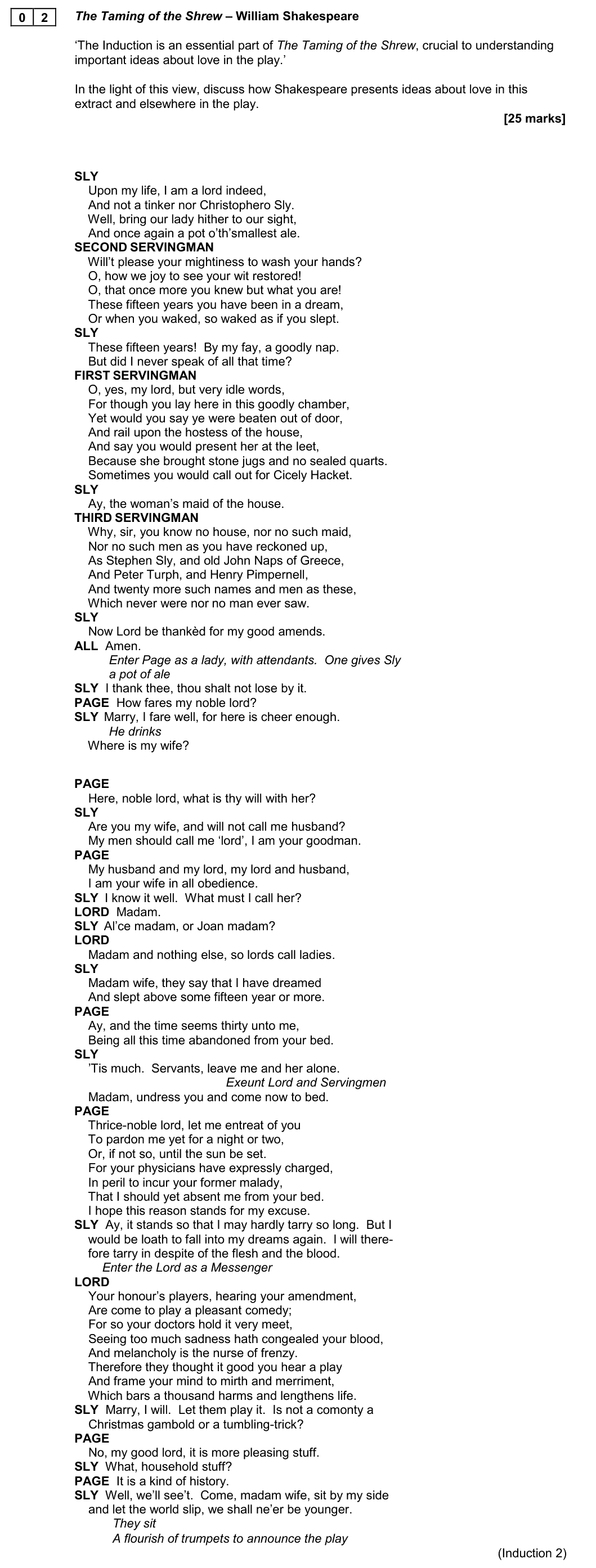
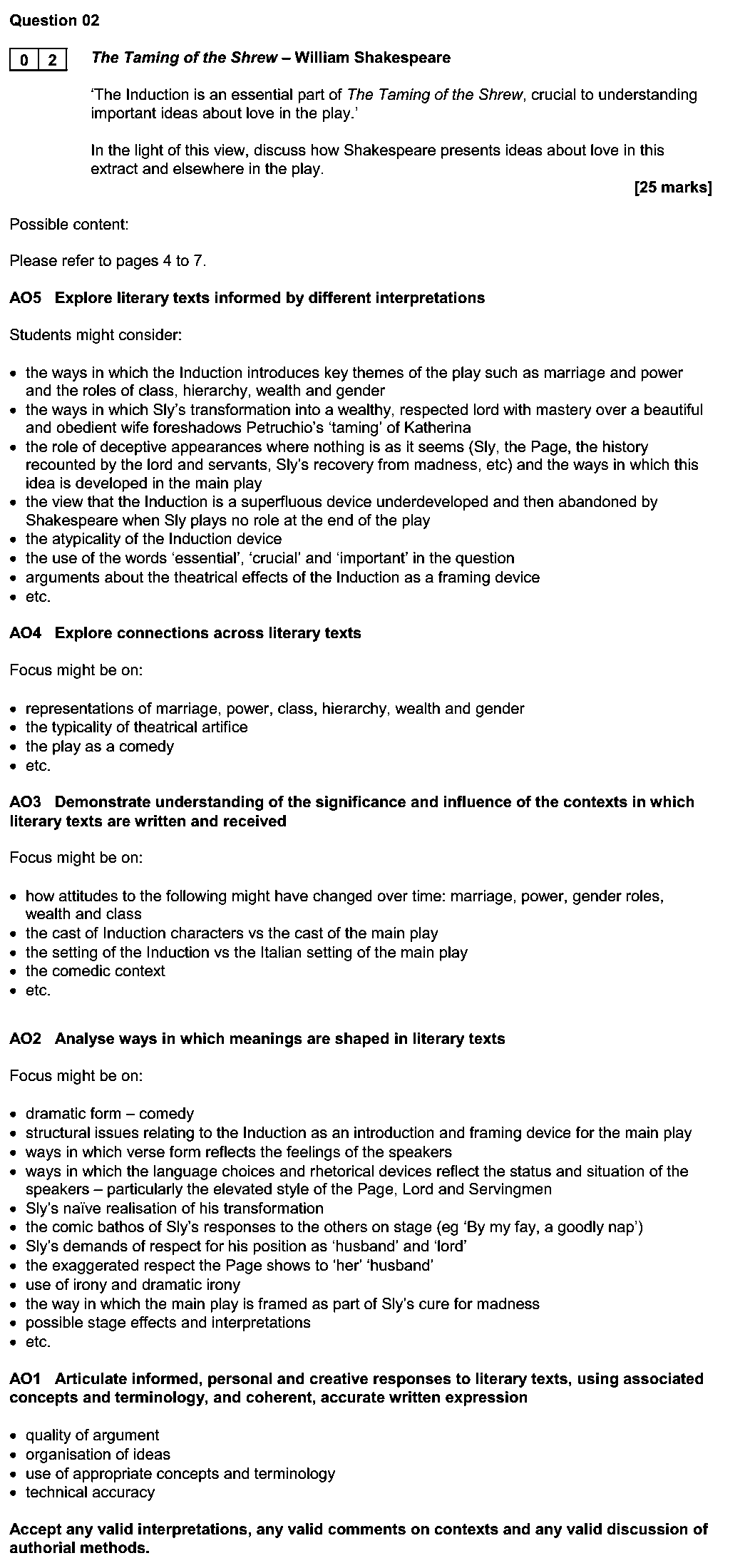
November 2020 · Paper 1 · Q2 25 marks Shakespeare extract taming of the shrew
The Taming of the Shrew – William Shakespeare
‘The Induction is an essential part of The Taming of the Shrew, crucial to understanding
important ideas about love in the play.’
In the light of this view, discuss how Shakespeare presents ideas about love in this
extract and elsewhere in the play.
[25 marks]
SLY
Upon my life, I am a lord indeed,
And not a tinker nor Christophero Sly.
Well, bring our lady hither to our sight,
And once again a pot o’th’smallest ale.
SECOND SERVINGMAN
Will’t please your mightiness to wash your hands?
O, how we joy to see your wit restored!
O, that once more you knew but what you are!
These fifteen years you have been in a dream,
Or when you waked, so waked as if you slept.
SLY
These fifteen years! By my fay, a goodly nap.
But did I never speak of all that time?
FIRST SERVINGMAN
O, yes, my lord, but very idle words,
For though you lay here in this goodly chamber,
Yet would you say ye were beaten out of door,
And rail upon the hostess of the house,
And say you would present her at the leet,
Because she brought stone jugs and no sealed quarts.
Sometimes you would call out for Cicely Hacket.
SLY
Ay, the woman’s maid of the house.
THIRD SERVINGMAN
Why, sir, you know no house, nor no such maid,
Nor no such men as you have reckoned up,
As Stephen Sly, and old John Naps of Greece,
And Peter Turph, and Henry Pimpernell,
And twenty more such names and men as these,
Which never were nor no man ever saw.
SLY
Now Lord be thankèd for my good amends.
ALL Amen.
Enter Page as a lady, with attendants. One gives Sly
a pot of ale
SLY I thank thee, thou shalt not lose by it.
PAGE How fares my noble lord?
SLY Marry, I fare well, for here is cheer enough.
He drinks
Where is my wife?
PAGE
Here, noble lord, what is thy will with her?
SLY
Are you my wife, and will not call me husband?
My men should call me ‘lord’, I am your goodman.
PAGE
My husband and my lord, my lord and husband,
I am your wife in all obedience.
SLY I know it well. What must I call her?
LORD Madam.
SLY Al’ce madam, or Joan madam?
LORD
Madam and nothing else, so lords call ladies.
SLY
Madam wife, they say that I have dreamed
And slept above some fifteen year or more.
PAGE
Ay, and the time seems thirty unto me,
Being all this time abandoned from your bed.
SLY
’Tis much. Servants, leave me and her alone.
Exeunt Lord and Servingmen
Madam, undress you and come now to bed.
PAGE
Thrice-noble lord, let me entreat of you
To pardon me yet for a night or two,
Or, if not so, until the sun be set.
For your physicians have expressly charged,
In peril to incur your former malady,
That I should yet absent me from your bed.
I hope this reason stands for my excuse.
SLY Ay, it stands so that I may hardly tarry so long. But I
would be loath to fall into my dreams again. I will there-
fore tarry in despite of the flesh and the blood.
Enter the Lord as a Messenger
LORD
Your honour’s players, hearing your amendment,
Are come to play a pleasant comedy;
For so your doctors hold it very meet,
Seeing too much sadness hath congealed your blood,
And melancholy is the nurse of frenzy.
Therefore they thought it good you hear a play
And frame your mind to mirth and merriment,
Which bars a thousand harms and lengthens life.
SLY Marry, I will. Let them play it. Is not a comonty a
Christmas gambold or a tumbling-trick?
PAGE
No, my good lord, it is more pleasing stuff.
SLY What, household stuff?
PAGE It is a kind of history.
SLY Well, we’ll see’t. Come, madam wife, sit by my side
and let the world slip, we shall ne’er be younger.
They sit
A flourish of trumpets to announce the play
(Induction 2)
November 2020 · Paper 1 · Q3 25 marks Shakespeare extract measure for measure
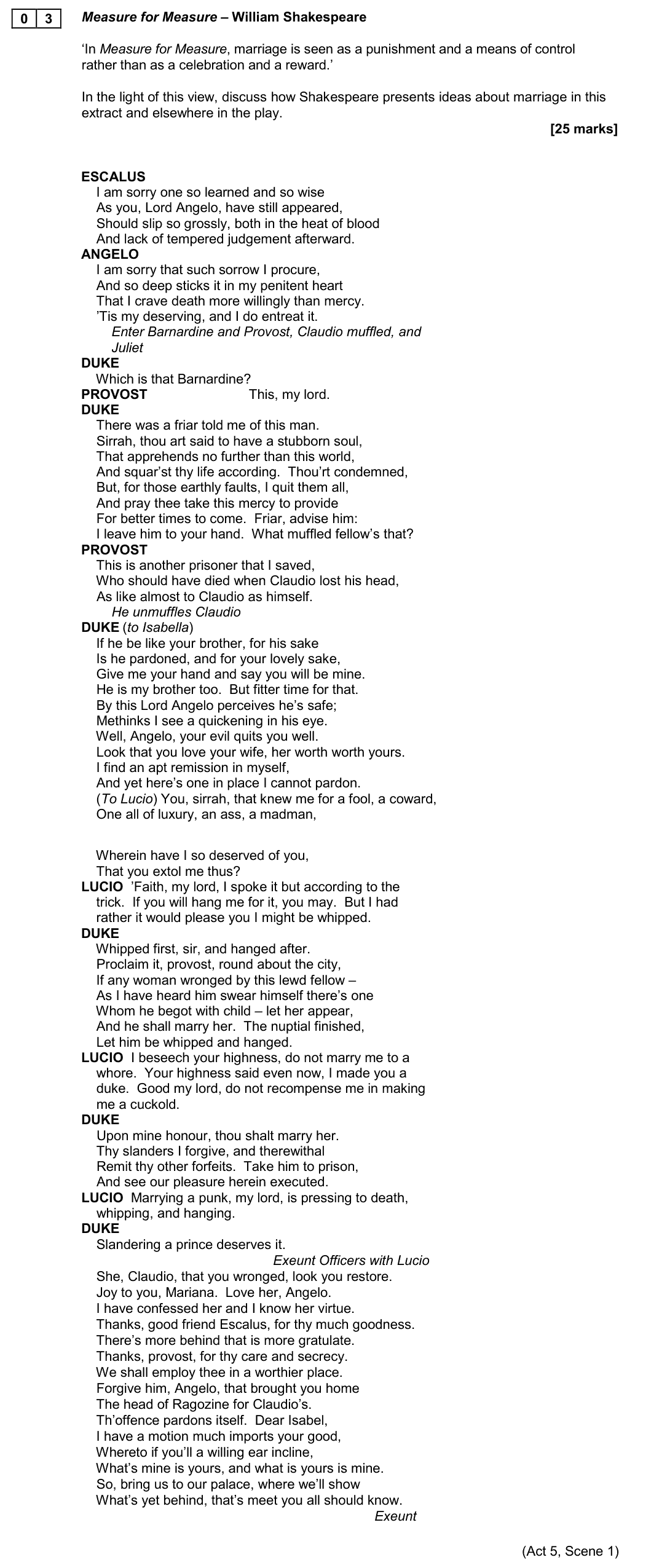
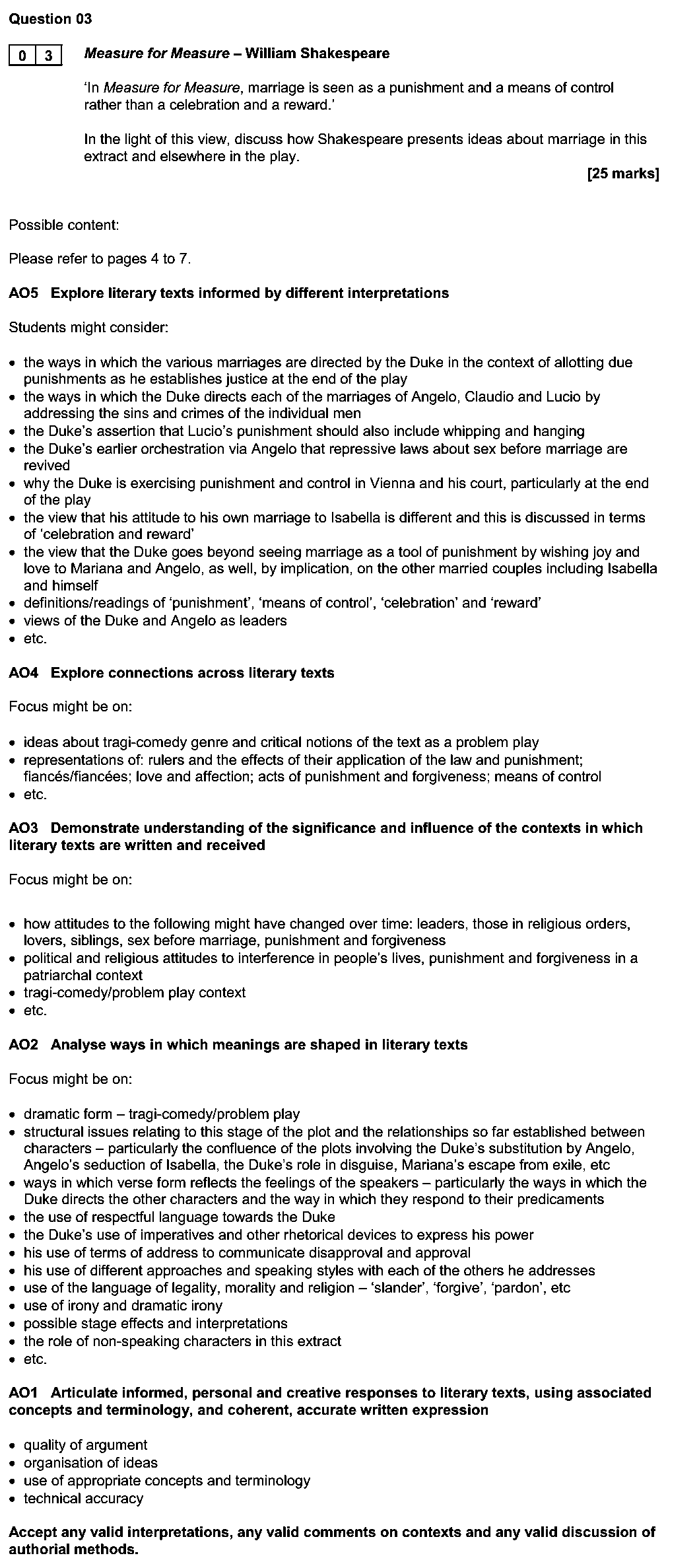
Measure for Measure – William Shakespeare
‘In Measure for Measure, marriage is seen as a punishment and a means of control
rather than as a celebration and a reward.’
In the light of this view, discuss how Shakespeare presents ideas about marriage in this
extract and elsewhere in the play.
[25 marks]
ESCALUS
I am sorry one so learned and so wise
As you, Lord Angelo, have still appeared,
Should slip so grossly, both in the heat of blood
And lack of tempered judgement afterward.
ANGELO
I am sorry that such sorrow I procure,
And so deep sticks it in my penitent heart
That I crave death more willingly than mercy.
’Tis my deserving, and I do entreat it.
Enter Barnardine and Provost, Claudio muffled, and
Juliet
DUKE
Which is that Barnardine?
PROVOST This, my lord.
DUKE
There was a friar told me of this man.
Sirrah, thou art said to have a stubborn soul,
That apprehends no further than this world,
And squar’st thy life according. Thou’rt condemned,
But, for those earthly faults, I quit them all,
And pray thee take this mercy to provide
For better times to come. Friar, advise him:
I leave him to your hand. What muffled fellow’s that?
PROVOST
This is another prisoner that I saved,
Who should have died when Claudio lost his head,
As like almost to Claudio as himself.
He unmuffles Claudio
DUKE (to Isabella)
If he be like your brother, for his sake
Is he pardoned, and for your lovely sake,
Give me your hand and say you will be mine.
He is my brother too. But fitter time for that.
By this Lord Angelo perceives he’s safe;
Methinks I see a quickening in his eye.
Well, Angelo, your evil quits you well.
Look that you love your wife, her worth worth yours.
I find an apt remission in myself,
And yet here’s one in place I cannot pardon.
(To Lucio) You, sirrah, that knew me for a fool, a coward,
One all of luxury, an ass, a madman,
Wherein have I so deserved of you,
That you extol me thus?
LUCIO ’Faith, my lord, I spoke it but according to the
trick. If you will hang me for it, you may. But I had
rather it would please you I might be whipped.
DUKE
Whipped first, sir, and hanged after.
Proclaim it, provost, round about the city,
If any woman wronged by this lewd fellow –
As I have heard him swear himself there’s one
Whom he begot with child – let her appear,
And he shall marry her. The nuptial finished,
Let him be whipped and hanged.
LUCIO I beseech your highness, do not marry me to a
whore. Your highness said even now, I made you a
duke. Good my lord, do not recompense me in making
me a cuckold.
DUKE
Upon mine honour, thou shalt marry her.
Thy slanders I forgive, and therewithal
Remit thy other forfeits. Take him to prison,
And see our pleasure herein executed.
LUCIO Marrying a punk, my lord, is pressing to death,
whipping, and hanging.
DUKE
Slandering a prince deserves it.
Exeunt Officers with Lucio
She, Claudio, that you wronged, look you restore.
Joy to you, Mariana. Love her, Angelo.
I have confessed her and I know her virtue.
Thanks, good friend Escalus, for thy much goodness.
There’s more behind that is more gratulate.
Thanks, provost, for thy care and secrecy.
We shall employ thee in a worthier place.
Forgive him, Angelo, that brought you home
The head of Ragozine for Claudio’s.
Th’offence pardons itself. Dear Isabel,
I have a motion much imports your good,
Whereto if you’ll a willing ear incline,
What’s mine is yours, and what is yours is mine.
So, bring us to our palace, where we’ll show
What’s yet behind, that’s meet you all should know.
Exeunt
(Act 5, Scene 1)
November 2020 · Paper 1 · Q4 25 marks Shakespeare extract the winters tale
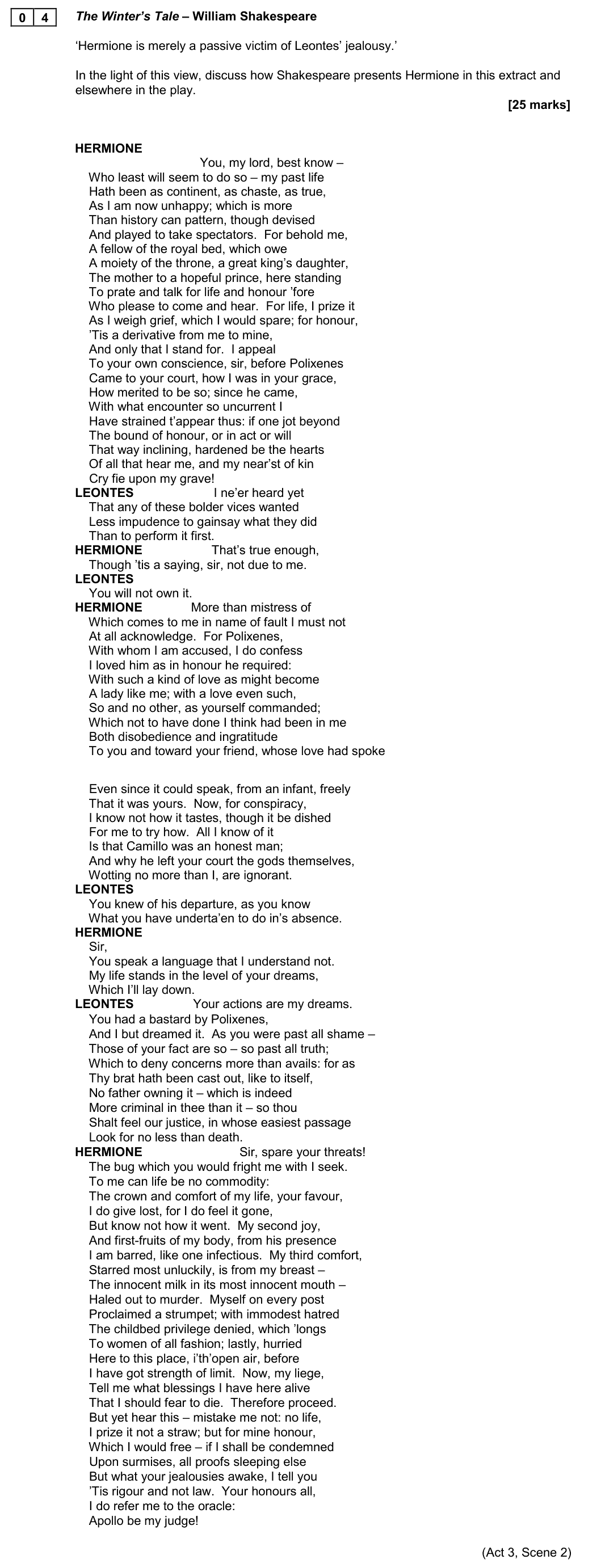
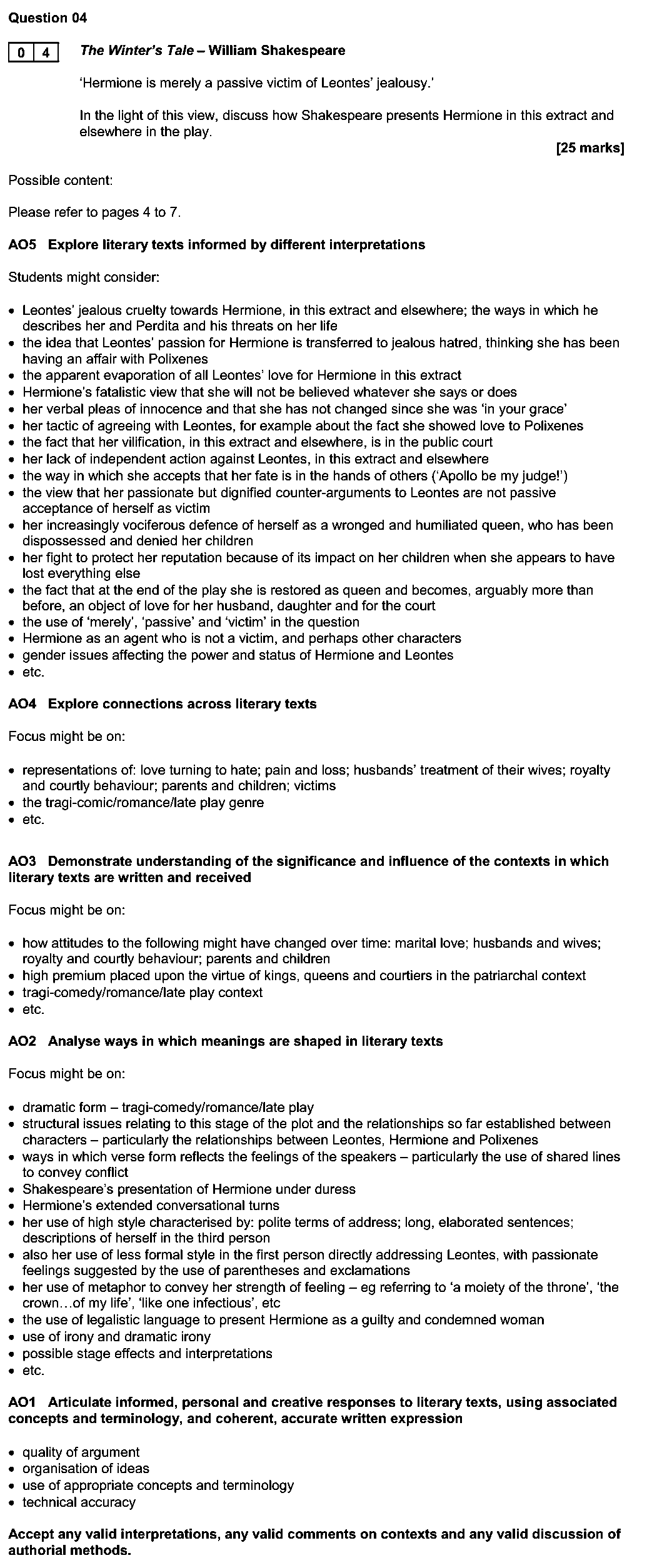
The Winter’s Tale – William Shakespeare
‘Hermione is merely a passive victim of Leontes’ jealousy.’
In the light of this view, discuss how Shakespeare presents Hermione in this extract and
elsewhere in the play.
[25 marks]
HERMIONE
You, my lord, best know –
Who least will seem to do so – my past life
Hath been as continent, as chaste, as true,
As I am now unhappy; which is more
Than history can pattern, though devised
And played to take spectators. For behold me,
A fellow of the royal bed, which owe
A moiety of the throne, a great king’s daughter,
The mother to a hopeful prince, here standing
To prate and talk for life and honour ’fore
Who please to come and hear. For life, I prize it
As I weigh grief, which I would spare; for honour,
’Tis a derivative from me to mine,
And only that I stand for. I appeal
To your own conscience, sir, before Polixenes
Came to your court, how I was in your grace,
How merited to be so; since he came,
With what encounter so uncurrent I
Have strained t’appear thus: if one jot beyond
The bound of honour, or in act or will
That way inclining, hardened be the hearts
Of all that hear me, and my near’st of kin
Cry fie upon my grave!
LEONTES I ne’er heard yet
That any of these bolder vices wanted
Less impudence to gainsay what they did
Than to perform it first.
HERMIONE That’s true enough,
Though ’tis a saying, sir, not due to me.
LEONTES
You will not own it.
HERMIONE More than mistress of
Which comes to me in name of fault I must not
At all acknowledge. For Polixenes,
With whom I am accused, I do confess
I loved him as in honour he required:
With such a kind of love as might become
A lady like me; with a love even such,
So and no other, as yourself commanded;
Which not to have done I think had been in me
Both disobedience and ingratitude
To you and toward your friend, whose love had spoke
Even since it could speak, from an infant, freely
That it was yours. Now, for conspiracy,
I know not how it tastes, though it be dished
For me to try how. All I know of it
Is that Camillo was an honest man;
And why he left your court the gods themselves,
Wotting no more than I, are ignorant.
LEONTES
You knew of his departure, as you know
What you have underta’en to do in’s absence.
HERMIONE
Sir,
You speak a language that I understand not.
My life stands in the level of your dreams,
Which I’ll lay down.
LEONTES Your actions are my dreams.
You had a bastard by Polixenes,
And I but dreamed it. As you were past all shame –
Those of your fact are so – so past all truth;
Which to deny concerns more than avails: for as
Thy brat hath been cast out, like to itself,
No father owning it – which is indeed
More criminal in thee than it – so thou
Shalt feel our justice, in whose easiest passage
Look for no less than death.
HERMIONE Sir, spare your threats!
The bug which you would fright me with I seek.
To me can life be no commodity:
The crown and comfort of my life, your favour,
I do give lost, for I do feel it gone,
But know not how it went. My second joy,
And first-fruits of my body, from his presence
I am barred, like one infectious. My third comfort,
Starred most unluckily, is from my breast –
The innocent milk in its most innocent mouth –
Haled out to murder. Myself on every post
Proclaimed a strumpet; with immodest hatred
The childbed privilege denied, which ’longs
To women of all fashion; lastly, hurried
Here to this place, i’th’open air, before
I have got strength of limit. Now, my liege,
Tell me what blessings I have here alive
That I should fear to die. Therefore proceed.
But yet hear this – mistake me not: no life,
I prize it not a straw; but for mine honour,
Which I would free – if I shall be condemned
Upon surmises, all proofs sleeping else
But what your jealousies awake, I tell you
’Tis rigour and not law. Your honours all,
I do refer me to the oracle:
Apollo be my judge!
(Act 3, Scene 2)
November 2020 · Paper 1 · Q5 25 marks Unseen poetry unseen love poetry
Answer the following question.
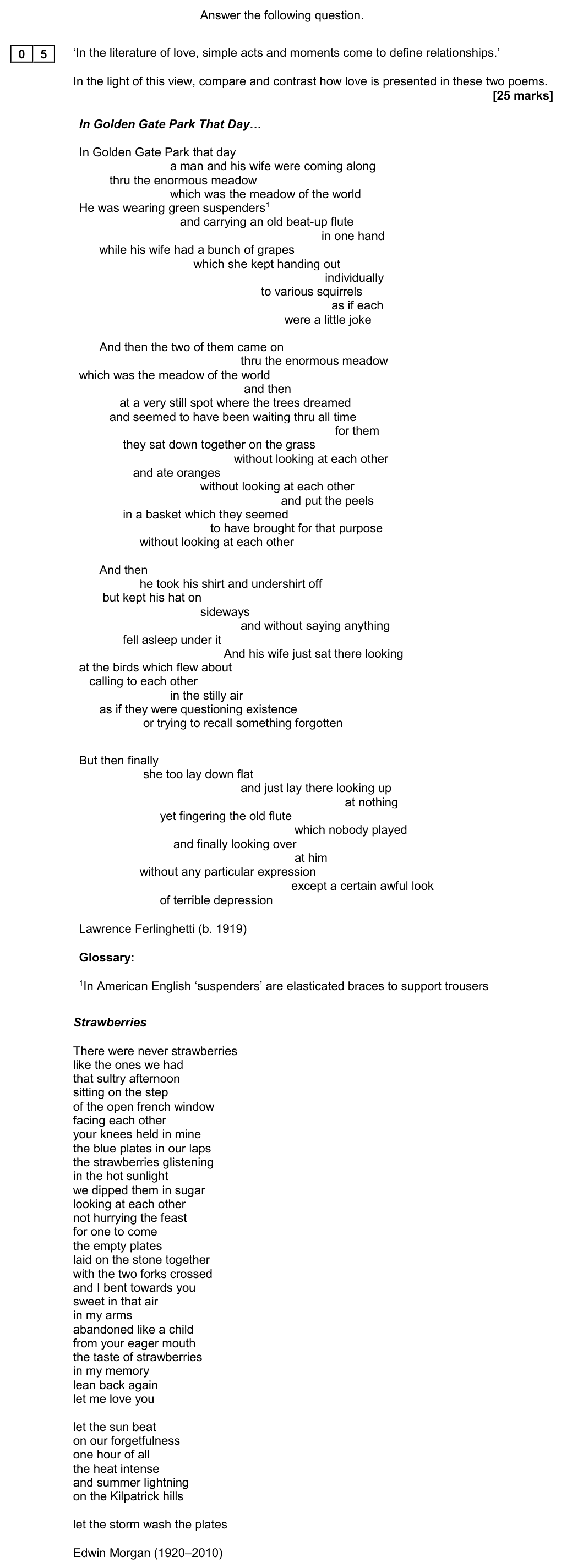
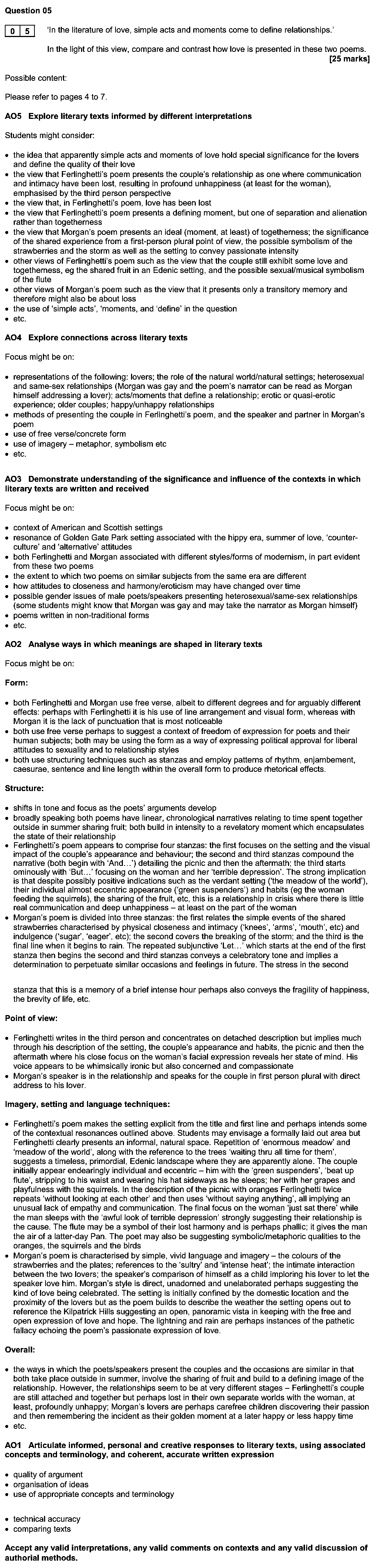
‘In the literature of love, simple acts and moments come to define relationships.’
In the light of this view, compare and contrast how love is presented in these two poems.
[25 marks]
In Golden Gate Park That Day…
In Golden Gate Park that day
a man and his wife were coming along
thru the enormous meadow
which was the meadow of the world
He was wearing green suspenders1
and carrying an old beat-up flute
in one hand
while his wife had a bunch of grapes
which she kept handing out
individually
to various squirrels
as if each
were a little joke
And then the two of them came on
thru the enormous meadow
which was the meadow of the world
and then
at a very still spot where the trees dreamed
and seemed to have been waiting thru all time
for them
they sat down together on the grass
without looking at each other
and ate oranges
without looking at each other
and put the peels
in a basket which they seemed
to have brought for that purpose
without looking at each other
And then
he took his shirt and undershirt off
but kept his hat on
sideways
and without saying anything
fell asleep under it
And his wife just sat there looking
at the birds which flew about
calling to each other
in the stilly air
as if they were questioning existence
or trying to recall something forgotten
But then finally
she too lay down flat
and just lay there looking up
at nothing
yet fingering the old flute
which nobody played
and finally looking over
at him
without any particular expression
except a certain awful look
of terrible depression
Lawrence Ferlinghetti (b. 1919)
Glossary:
1In American English ‘suspenders’ are elasticated braces to support trousers
Strawberries
There were never strawberries
like the ones we had
that sultry afternoon
sitting on the step
of the open french window
facing each other
your knees held in mine
the blue plates in our laps
the strawberries glistening
in the hot sunlight
we dipped them in sugar
looking at each other
not hurrying the feast
for one to come
the empty plates
laid on the stone together
with the two forks crossed
and I bent towards you
sweet in that air
in my arms
abandoned like a child
from your eager mouth
the taste of strawberries
in my memory
lean back again
let me love you
let the sun beat
on our forgetfulness
one hour of all
the heat intense
and summer lightning
on the Kilpatrick hills
let the storm wash the plates
Edwin Morgan (1920–2010)
November 2020 · Paper 1 · Q6 25 marks Comparing texts love poetry pre 1900love poetry post 1900comparing prose love
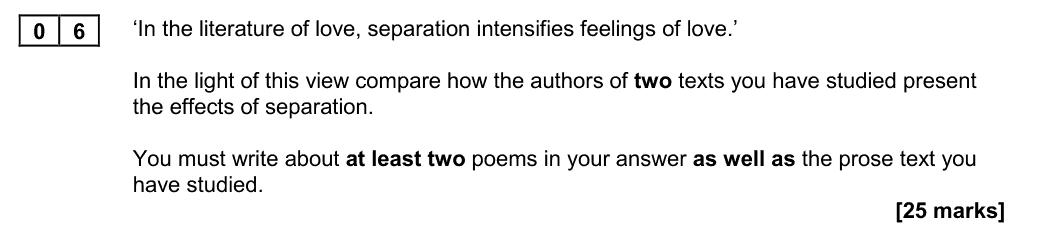
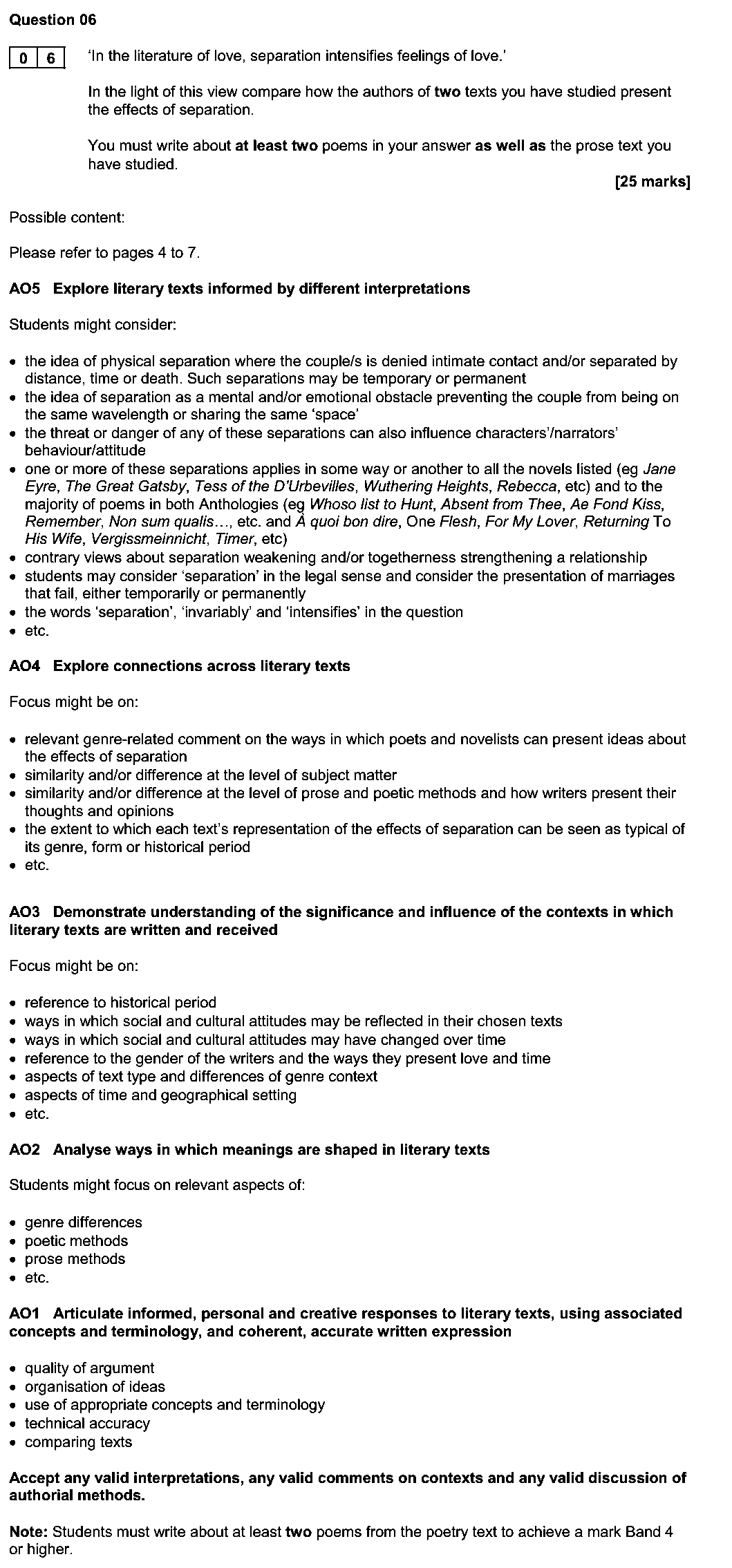
‘In the literature of love, separation intensifies feelings of love.’
In the light of this view compare how the authors of two texts you have studied present
the effects of separation.
You must write about at least two poems in your answer as well as the prose text you
have studied.
[25 marks]
November 2020 · Paper 1 · Q7 25 marks Comparing texts love poetry pre 1900love poetry post 1900comparing prose love
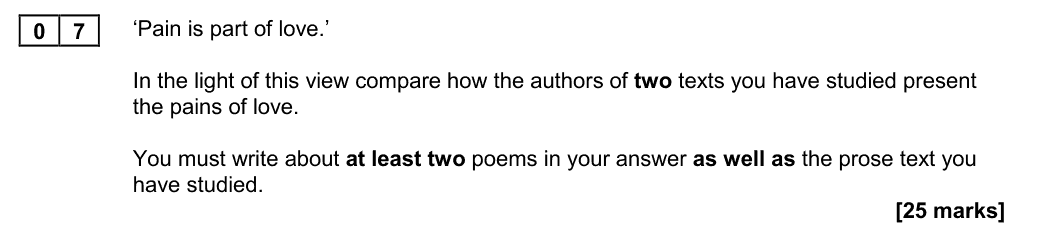
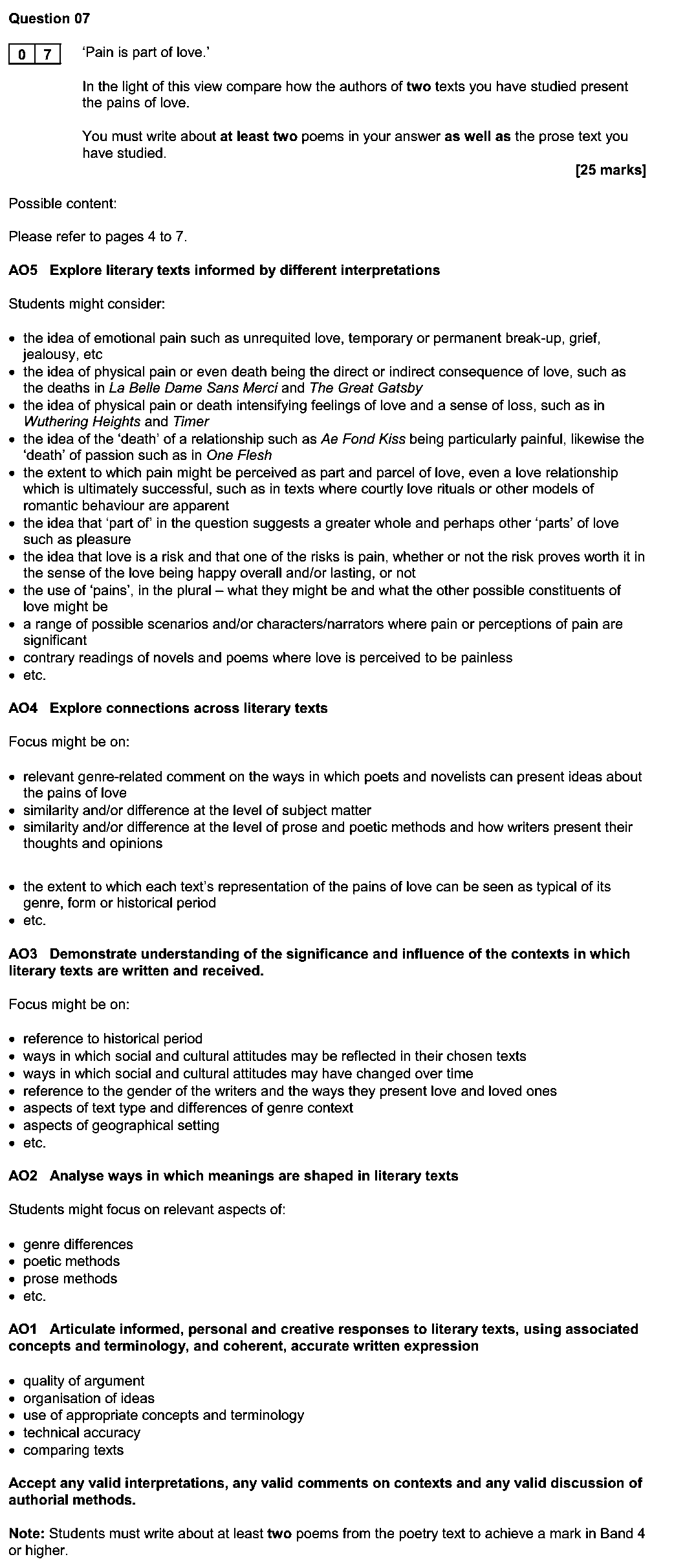
‘Pain is part of love.’
In the light of this view compare how the authors of two texts you have studied present
the pains of love.
You must write about at least two poems in your answer as well as the prose text you
have studied.
[25 marks]

Work with an AQA English Literature A tutor

Want a paper marked and gone through with you? Message us.

Prefer email? Send an enquiry

If you are under 18, please include a parent's contact details. Enquiries go to enquiries@alevelenglishtutor.com and are deleted once handled. All tutoring is online.