November 2021: A-level Paper 1, Love through the ages

75 marks · 7 questions (every option is included) · Paper, mark scheme and report on AQA's site · Printed for the cancelled summer 2021 exams

Question by question

QTopicMarksAOType
1 Othello 25Shakespeare extract
2 The Taming of the Shrew 25Shakespeare extract
3 Measure for Measure 25Shakespeare extract
4 The Winter's Tale 25Shakespeare extract
5 Unseen poetry comparison (love) 25Unseen poetry
6 AQA Anthology: love poetry pre-1900, AQA Anthology: love poetry post-1900, Comparing prose texts (love through the ages) 25Comparing texts
7 AQA Anthology: love poetry pre-1900, AQA Anthology: love poetry post-1900, Comparing prose texts (love through the ages) 25Comparing texts

The questions

1234567
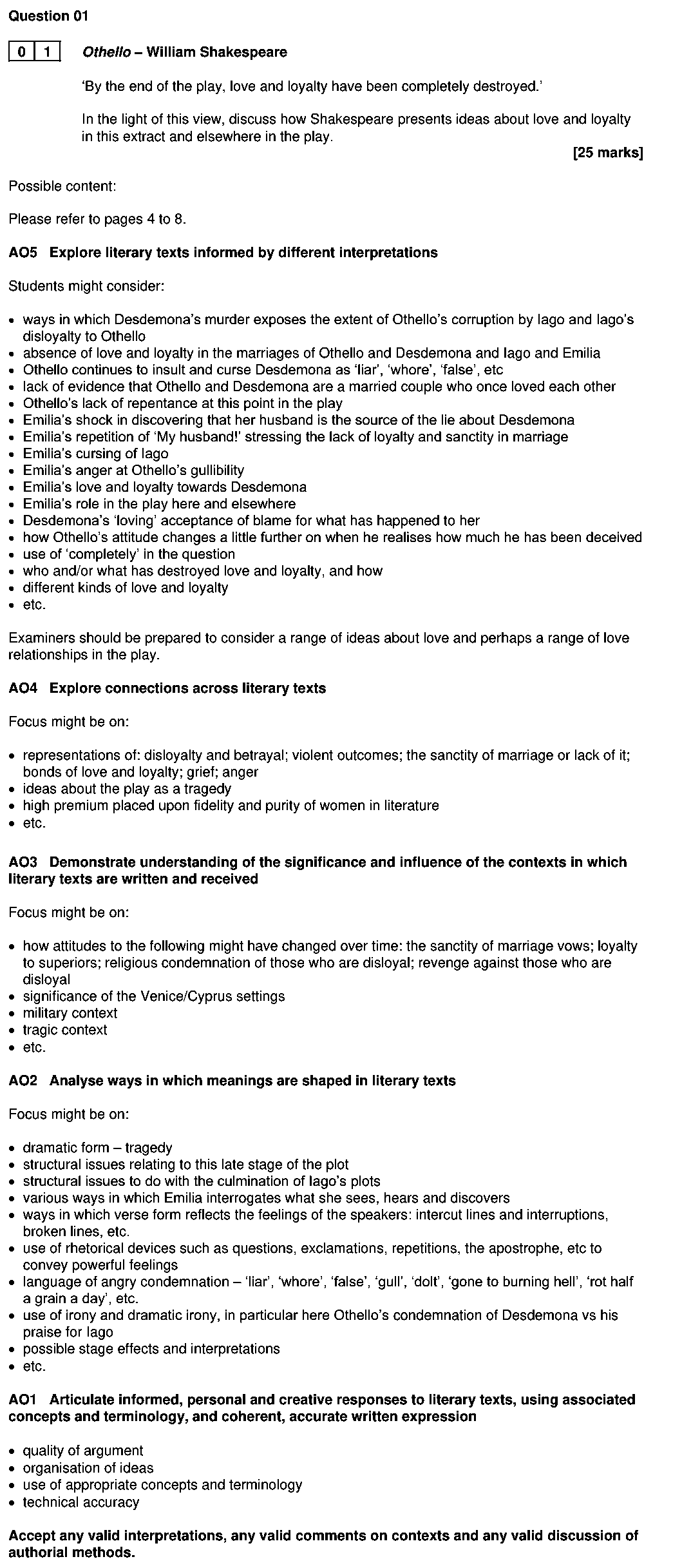
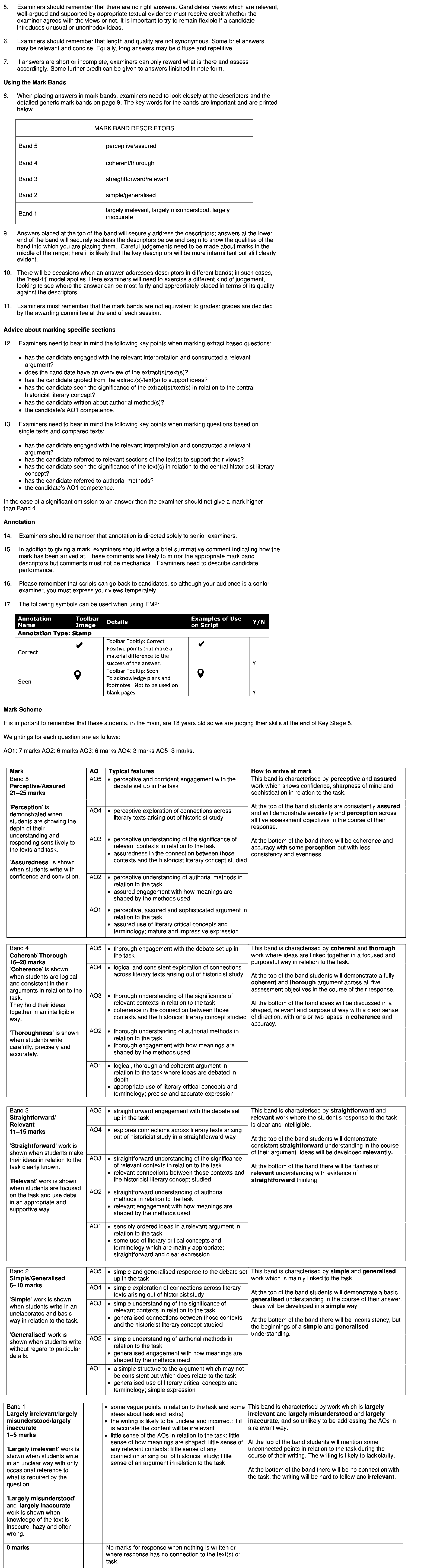
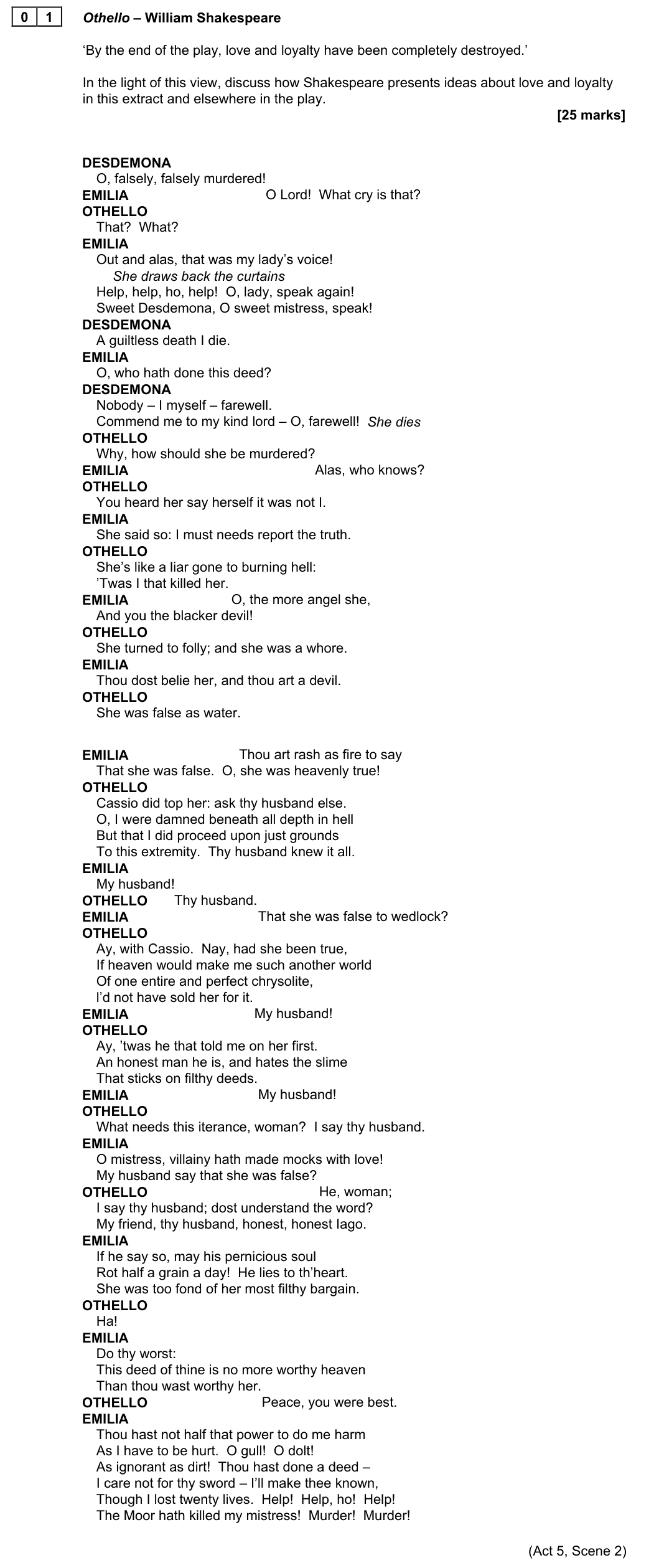
November 2021 · Paper 1 · Q1 25 marks Shakespeare extract othello
Othello – William Shakespeare
‘By the end of the play, love and loyalty have been completely destroyed.’
In the light of this view, discuss how Shakespeare presents ideas about love and loyalty
in this extract and elsewhere in the play.
[25 marks]
DESDEMONA
O, falsely, falsely murdered!
EMILIA O Lord! What cry is that?
OTHELLO
That? What?
EMILIA
Out and alas, that was my lady’s voice!
She draws back the curtains
Help, help, ho, help! O, lady, speak again!
Sweet Desdemona, O sweet mistress, speak!
DESDEMONA
A guiltless death I die.
EMILIA
O, who hath done this deed?
DESDEMONA
Nobody – I myself – farewell.
Commend me to my kind lord – O, farewell! She dies
OTHELLO
Why, how should she be murdered?
EMILIA
Alas, who knows?
OTHELLO
You heard her say herself it was not I.
EMILIA
She said so: I must needs report the truth.
OTHELLO
She’s like a liar gone to burning hell:
’Twas I that killed her.
EMILIA
O, the more angel she,
And you the blacker devil!
OTHELLO
She turned to folly; and she was a whore.
EMILIA
Thou dost belie her, and thou art a devil.
OTHELLO
She was false as water.
EMILIA Thou art rash as fire to say
That she was false. O, she was heavenly true!
OTHELLO
Cassio did top her: ask thy husband else.
O, I were damned beneath all depth in hell
But that I did proceed upon just grounds
To this extremity. Thy husband knew it all.
EMILIA
My husband!
OTHELLO Thy husband.
EMILIA That she was false to wedlock?
OTHELLO
Ay, with Cassio. Nay, had she been true,
If heaven would make me such another world
Of one entire and perfect chrysolite,
l’d not have sold her for it.
EMILIA My husband!
OTHELLO
Ay, ’twas he that told me on her first.
An honest man he is, and hates the slime
That sticks on filthy deeds.
EMILIA My husband!
OTHELLO
What needs this iterance, woman? I say thy husband.
EMILIA
O mistress, villainy hath made mocks with love!
My husband say that she was false?
OTHELLO He, woman;
I say thy husband; dost understand the word?
My friend, thy husband, honest, honest Iago.
EMILIA
If he say so, may his pernicious soul
Rot half a grain a day! He lies to th’heart.
She was too fond of her most filthy bargain.
OTHELLO
Ha!
EMILIA
Do thy worst:
This deed of thine is no more worthy heaven
Than thou wast worthy her.
OTHELLO Peace, you were best.
EMILIA
Thou hast not half that power to do me harm
As I have to be hurt. O gull! O dolt!
As ignorant as dirt! Thou hast done a deed –
I care not for thy sword – I’ll make thee known,
Though I lost twenty lives. Help! Help, ho! Help!
The Moor hath killed my mistress! Murder! Murder!
(Act 5, Scene 2)
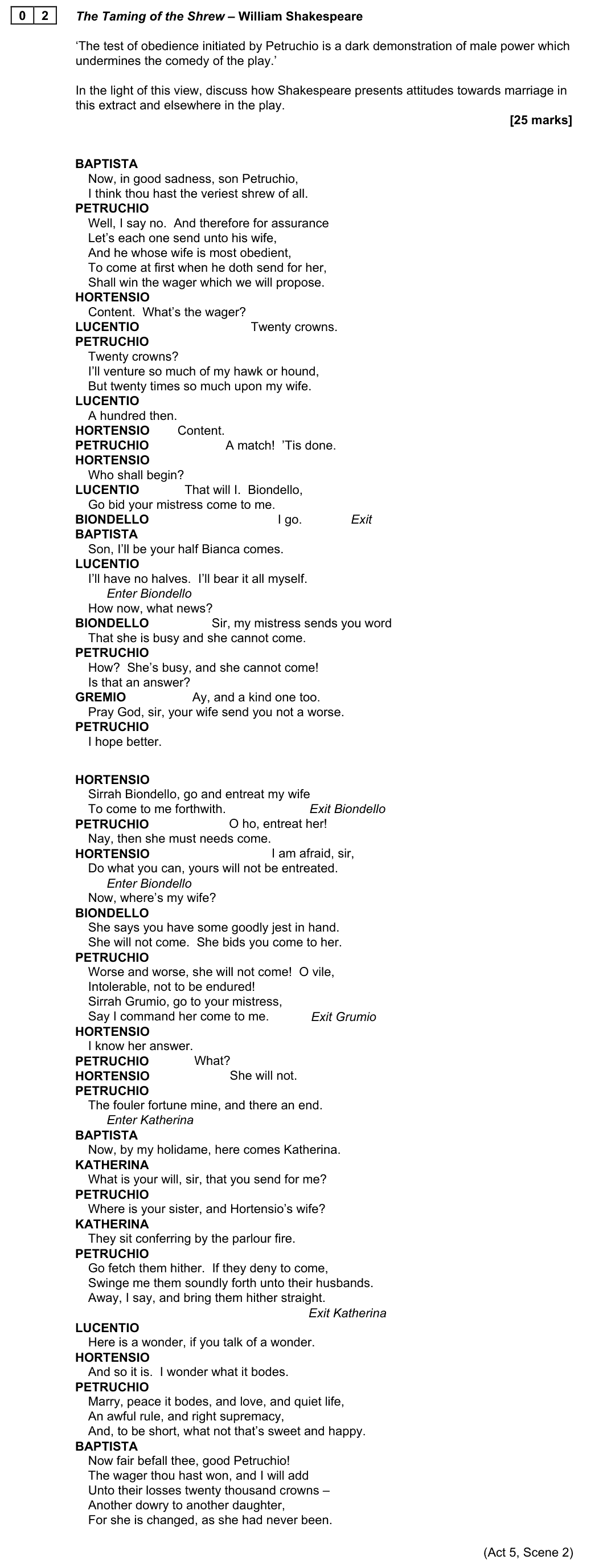
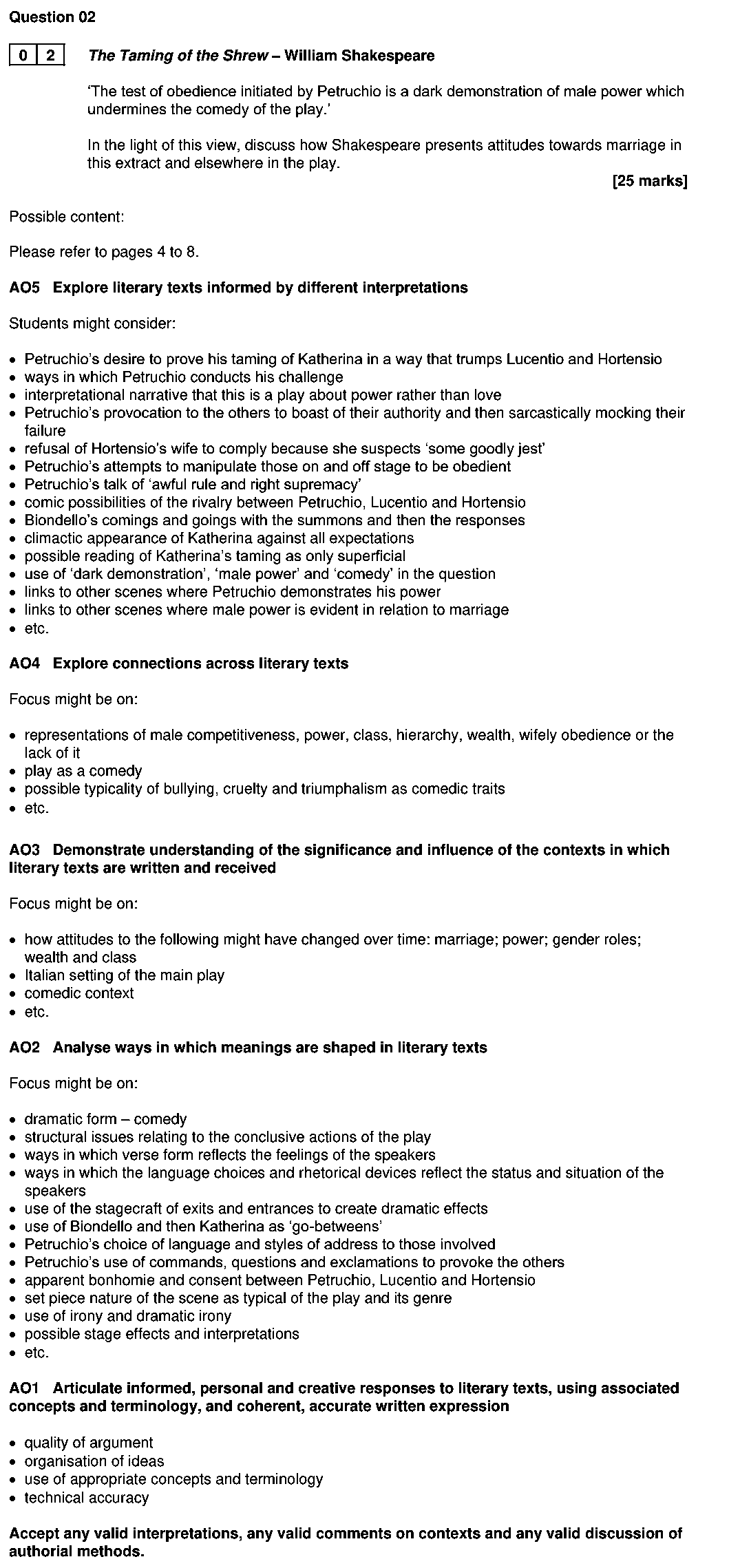
November 2021 · Paper 1 · Q2 25 marks Shakespeare extract taming of the shrew
The Taming of the Shrew – William Shakespeare
‘The test of obedience initiated by Petruchio is a dark demonstration of male power which
undermines the comedy of the play.’
In the light of this view, discuss how Shakespeare presents attitudes towards marriage in
this extract and elsewhere in the play.
[25 marks]
BAPTISTA
Now, in good sadness, son Petruchio,
I think thou hast the veriest shrew of all.
PETRUCHIO
Well, I say no. And therefore for assurance
Let’s each one send unto his wife,
And he whose wife is most obedient,
To come at first when he doth send for her,
Shall win the wager which we will propose.
HORTENSIO
Content. What’s the wager?
LUCENTIO Twenty crowns.
PETRUCHIO
Twenty crowns?
I’ll venture so much of my hawk or hound,
But twenty times so much upon my wife.
LUCENTIO
A hundred then.
HORTENSIO Content.
PETRUCHIO A match! ’Tis done.
HORTENSIO
Who shall begin?
LUCENTIO That will I. Biondello,
Go bid your mistress come to me.
BIONDELLO I go. Exit
BAPTISTA
Son, I’ll be your half Bianca comes.
LUCENTIO
I’ll have no halves. I’ll bear it all myself.
Enter Biondello
How now, what news?
BIONDELLO Sir, my mistress sends you word
That she is busy and she cannot come.
PETRUCHIO
How? She’s busy, and she cannot come!
Is that an answer?
GREMIO Ay, and a kind one too.
Pray God, sir, your wife send you not a worse.
PETRUCHIO
I hope better.
HORTENSIO
Sirrah Biondello, go and entreat my wife
To come to me forthwith. Exit Biondello
PETRUCHIO O ho, entreat her!
Nay, then she must needs come.
HORTENSIO I am afraid, sir,
Do what you can, yours will not be entreated.
Enter Biondello
Now, where’s my wife?
BIONDELLO
She says you have some goodly jest in hand.
She will not come. She bids you come to her.
PETRUCHIO
Worse and worse, she will not come! O vile,
Intolerable, not to be endured!
Sirrah Grumio, go to your mistress,
Say I command her come to me. Exit Grumio
HORTENSIO
I know her answer.
PETRUCHIO What?
HORTENSIO She will not.
PETRUCHIO
The fouler fortune mine, and there an end.
Enter Katherina
BAPTISTA
Now, by my holidame, here comes Katherina.
KATHERINA
What is your will, sir, that you send for me?
PETRUCHIO
Where is your sister, and Hortensio’s wife?
KATHERINA
They sit conferring by the parlour fire.
PETRUCHIO
Go fetch them hither. If they deny to come,
Swinge me them soundly forth unto their husbands.
Away, I say, and bring them hither straight.
Exit Katherina
LUCENTIO
Here is a wonder, if you talk of a wonder.
HORTENSIO
And so it is. I wonder what it bodes.
PETRUCHIO
Marry, peace it bodes, and love, and quiet life,
An awful rule, and right supremacy,
And, to be short, what not that’s sweet and happy.
BAPTISTA
Now fair befall thee, good Petruchio!
The wager thou hast won, and I will add
Unto their losses twenty thousand crowns –
Another dowry to another daughter,
For she is changed, as she had never been.
(Act 5, Scene 2)
November 2021 · Paper 1 · Q3 25 marks Shakespeare extract measure for measure
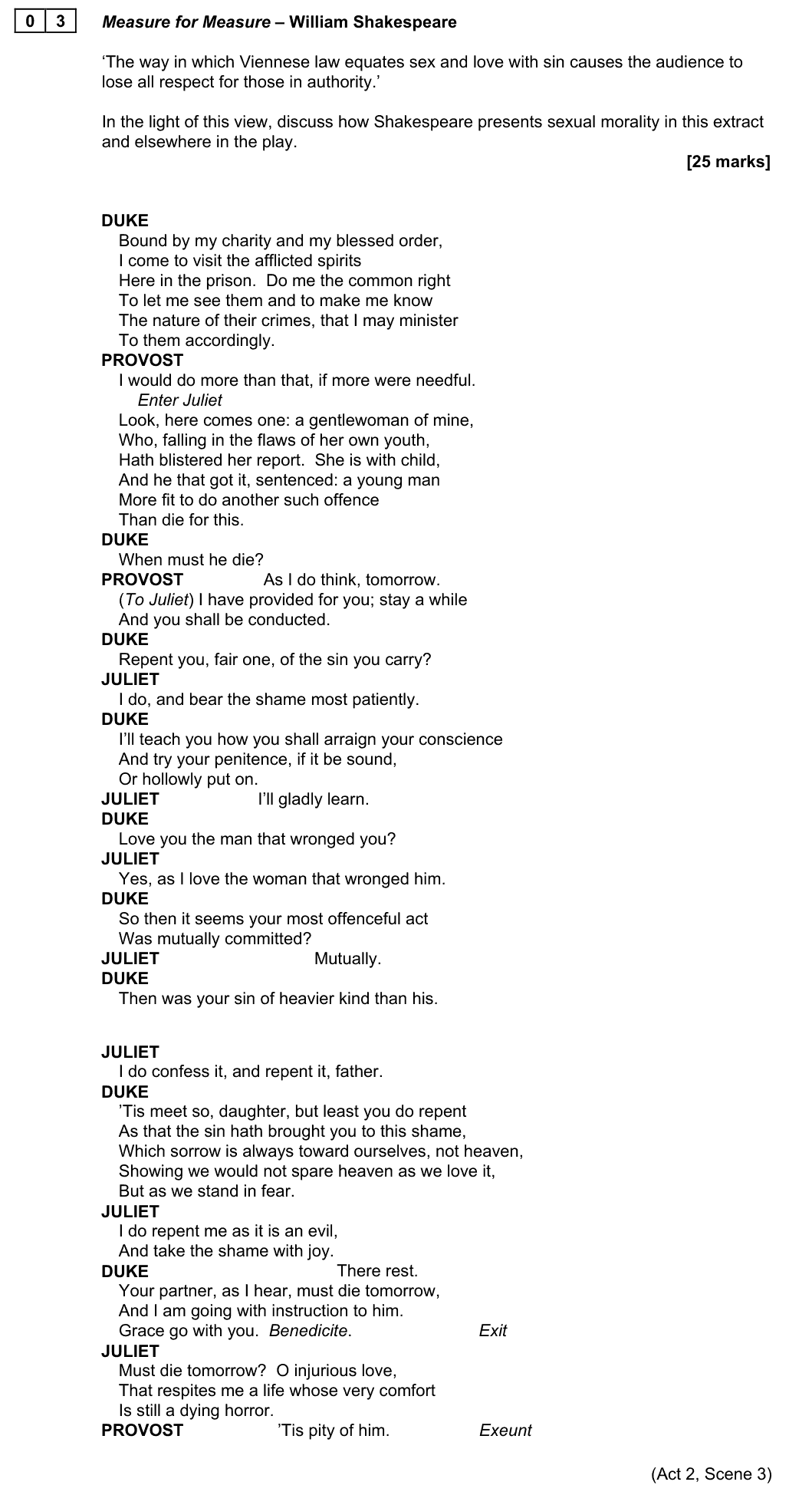
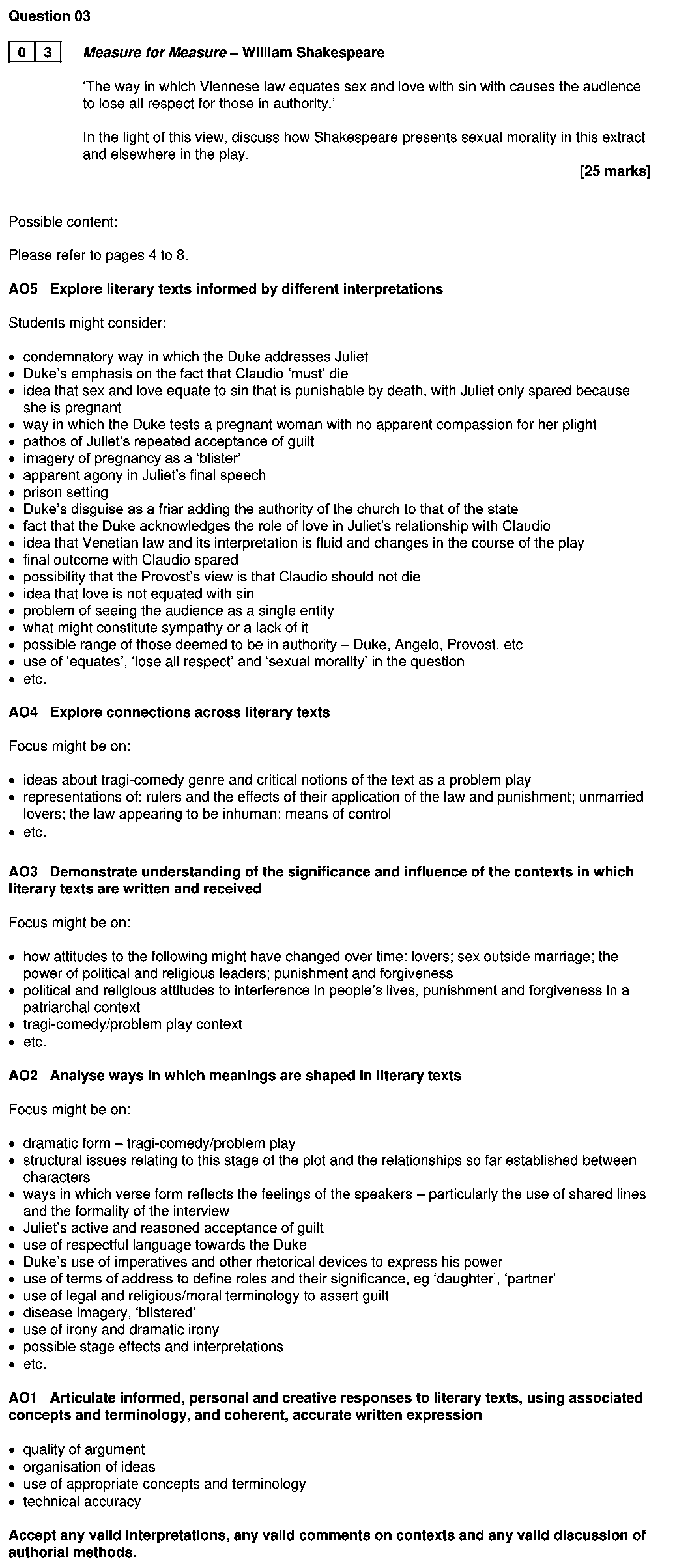
Measure for Measure – William Shakespeare
‘The way in which Viennese law equates sex and love with sin causes the audience to
lose all respect for those in authority.’
In the light of this view, discuss how Shakespeare presents sexual morality in this extract
and elsewhere in the play.
[25 marks]
DUKE
Bound by my charity and my blessed order,
I come to visit the afflicted spirits
Here in the prison. Do me the common right
To let me see them and to make me know
The nature of their crimes, that I may minister
To them accordingly.
PROVOST
I would do more than that, if more were needful.
Enter Juliet
Look, here comes one: a gentlewoman of mine,
Who, falling in the flaws of her own youth,
Hath blistered her report. She is with child,
And he that got it, sentenced: a young man
More fit to do another such offence
Than die for this.
DUKE
When must he die?
PROVOST As I do think, tomorrow.
(To Juliet) I have provided for you; stay a while
And you shall be conducted.
DUKE
Repent you, fair one, of the sin you carry?
JULIET
I do, and bear the shame most patiently.
DUKE
I’ll teach you how you shall arraign your conscience
And try your penitence, if it be sound,
Or hollowly put on.
JULIET I’ll gladly learn.
DUKE
Love you the man that wronged you?
JULIET
Yes, as I love the woman that wronged him.
DUKE
So then it seems your most offenceful act
Was mutually committed?
JULIET Mutually.
DUKE
Then was your sin of heavier kind than his.
JULIET
I do confess it, and repent it, father.
DUKE
’Tis meet so, daughter, but least you do repent
As that the sin hath brought you to this shame,
Which sorrow is always toward ourselves, not heaven,
Showing we would not spare heaven as we love it,
But as we stand in fear.
JULIET
I do repent me as it is an evil,
And take the shame with joy.
DUKE There rest.
Your partner, as I hear, must die tomorrow,
And I am going with instruction to him.
Grace go with you. Benedicite. Exit
JULIET
Must die tomorrow? O injurious love,
That respites me a life whose very comfort
Is still a dying horror.
PROVOST ’Tis pity of him. Exeunt
(Act 2, Scene 3)
November 2021 · Paper 1 · Q4 25 marks Shakespeare extract the winters tale
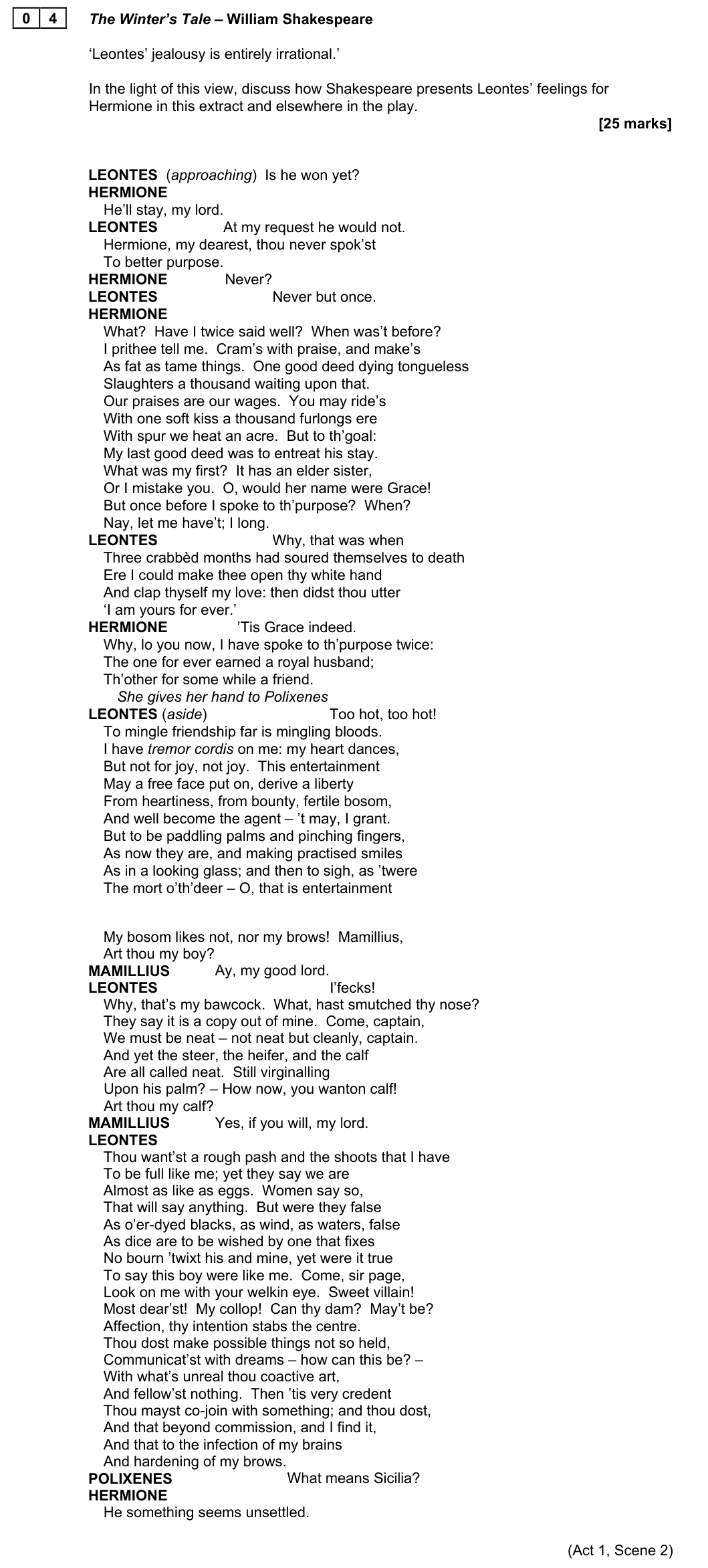
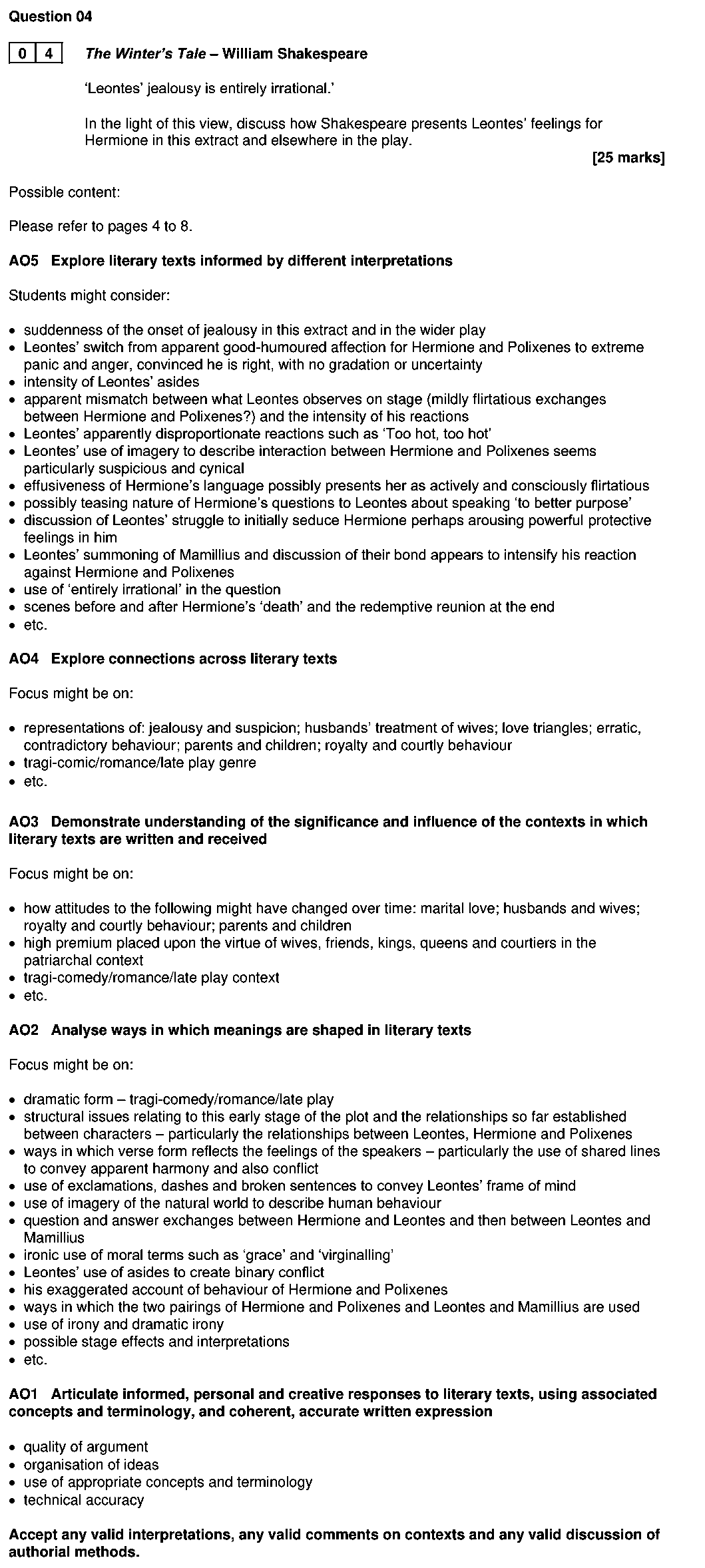
The Winter’s Tale – William Shakespeare
‘Leontes’ jealousy is entirely irrational.’
In the light of this view, discuss how Shakespeare presents Leontes’ feelings for
Hermione in this extract and elsewhere in the play.
[25 marks]
LEONTES (approaching) Is he won yet?
HERMIONE
He’ll stay, my lord.
LEONTES At my request he would not.
Hermione, my dearest, thou never spok’st
To better purpose.
HERMIONE Never?
LEONTES Never but once.
HERMIONE
What? Have I twice said well? When was’t before?
I prithee tell me. Cram’s with praise, and make’s
As fat as tame things. One good deed dying tongueless
Slaughters a thousand waiting upon that.
Our praises are our wages. You may ride’s
With one soft kiss a thousand furlongs ere
With spur we heat an acre. But to th’goal:
My last good deed was to entreat his stay.
What was my first? It has an elder sister,
Or I mistake you. O, would her name were Grace!
But once before I spoke to th’purpose? When?
Nay, let me have’t; I long.
LEONTES Why, that was when
Three crabbèd months had soured themselves to death
Ere I could make thee open thy white hand
And clap thyself my love: then didst thou utter
‘I am yours for ever.’
HERMIONE ’Tis Grace indeed.
Why, lo you now, I have spoke to th’purpose twice:
The one for ever earned a royal husband;
Th’other for some while a friend.
She gives her hand to Polixenes
LEONTES (aside) Too hot, too hot!
To mingle friendship far is mingling bloods.
I have tremor cordis on me: my heart dances,
But not for joy, not joy. This entertainment
May a free face put on, derive a liberty
From heartiness, from bounty, fertile bosom,
And well become the agent – ’t may, I grant.
But to be paddling palms and pinching fingers,
As now they are, and making practised smiles
As in a looking glass; and then to sigh, as ’twere
The mort o’th’deer – O, that is entertainment
My bosom likes not, nor my brows! Mamillius,
Art thou my boy?
MAMILLIUS Ay, my good lord.
LEONTES I’fecks!
Why, that’s my bawcock. What, hast smutched thy nose?
They say it is a copy out of mine. Come, captain,
We must be neat – not neat but cleanly, captain.
And yet the steer, the heifer, and the calf
Are all called neat. Still virginalling
Upon his palm? – How now, you wanton calf!
Art thou my calf?
MAMILLIUS Yes, if you will, my lord.
LEONTES
Thou want’st a rough pash and the shoots that I have
To be full like me; yet they say we are
Almost as like as eggs. Women say so,
That will say anything. But were they false
As o’er-dyed blacks, as wind, as waters, false
As dice are to be wished by one that fixes
No bourn ’twixt his and mine, yet were it true
To say this boy were like me. Come, sir page,
Look on me with your welkin eye. Sweet villain!
Most dear’st! My collop! Can thy dam? May’t be?
Affection, thy intention stabs the centre.
Thou dost make possible things not so held,
Communicat’st with dreams – how can this be? –
With what’s unreal thou coactive art,
And fellow’st nothing. Then ’tis very credent
Thou mayst co-join with something; and thou dost,
And that beyond commission, and I find it,
And that to the infection of my brains
And hardening of my brows.
POLIXENES What means Sicilia?
HERMIONE
He something seems unsettled.
(Act 1, Scene 2)
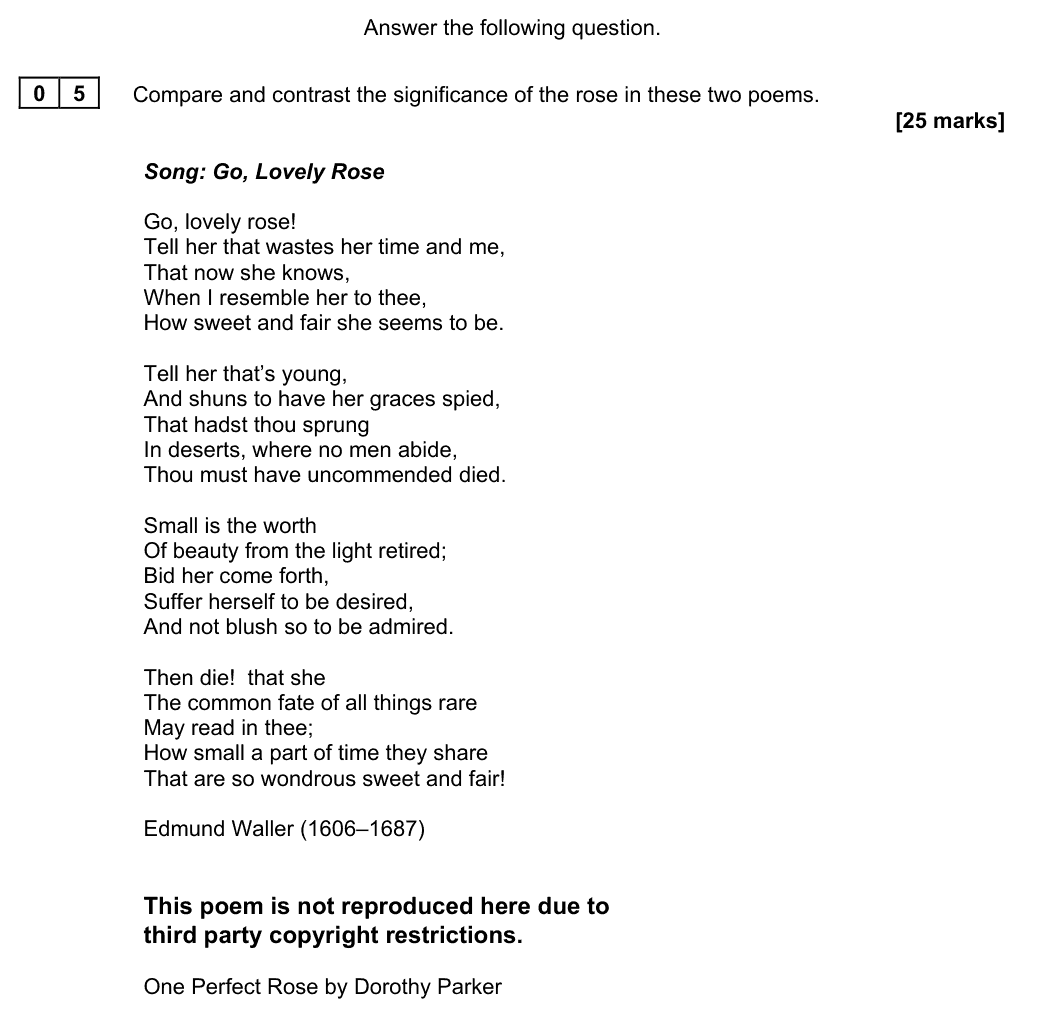
November 2021 · Paper 1 · Q5 25 marks Unseen poetry unseen love poetry
Answer the following question.
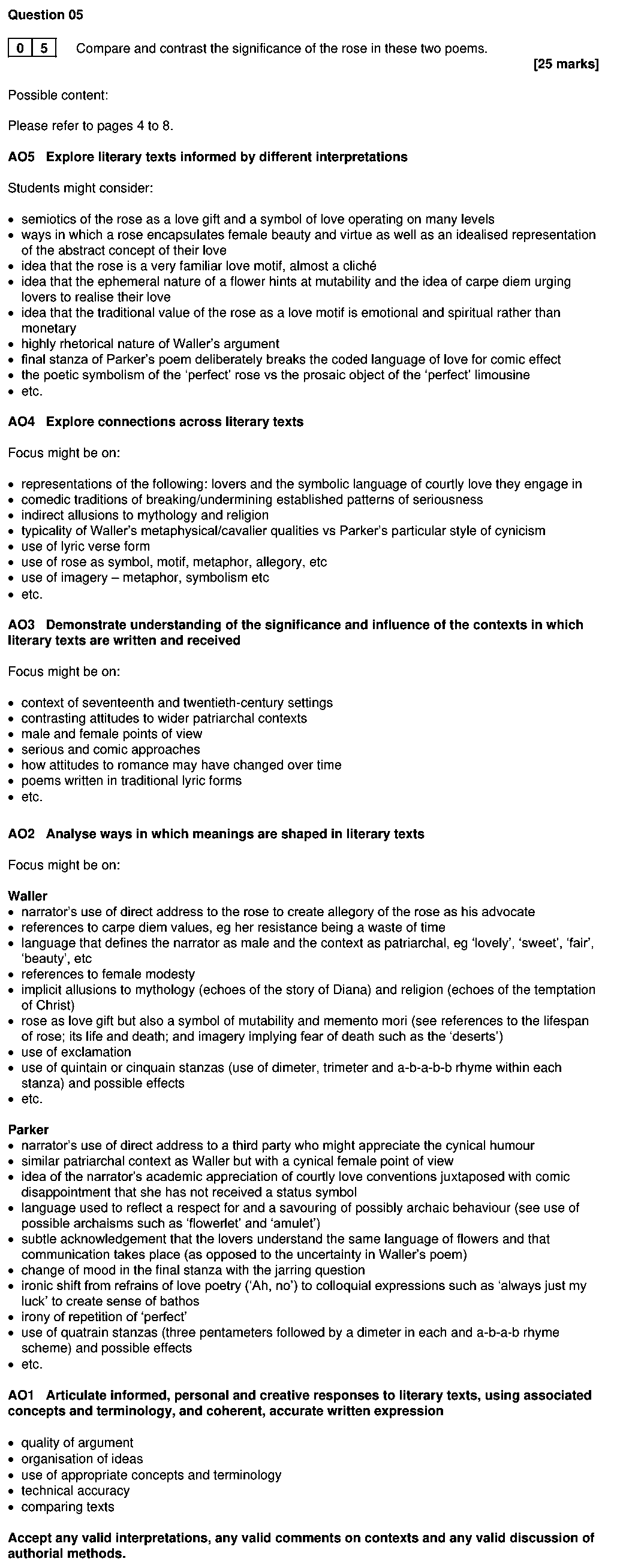
Compare and contrast the significance of the rose in these two poems.
[25 marks]
Song: Go, Lovely Rose
Go, lovely rose!
Tell her that wastes her time and me,
That now she knows,
When I resemble her to thee,
How sweet and fair she seems to be.
Tell her that’s young,
And shuns to have her graces spied,
That hadst thou sprung
In deserts, where no men abide,
Thou must have uncommended died.
Small is the worth
Of beauty from the light retired;
Bid her come forth,
Suffer herself to be desired,
And not blush so to be admired.
Then die! that she
The common fate of all things rare
May read in thee;
How small a part of time they share
That are so wondrous sweet and fair!
Edmund Waller (1606–1687)
This poem is not reproduced here due to
third party copyright restrictions.
One Perfect Rose by Dorothy Parker
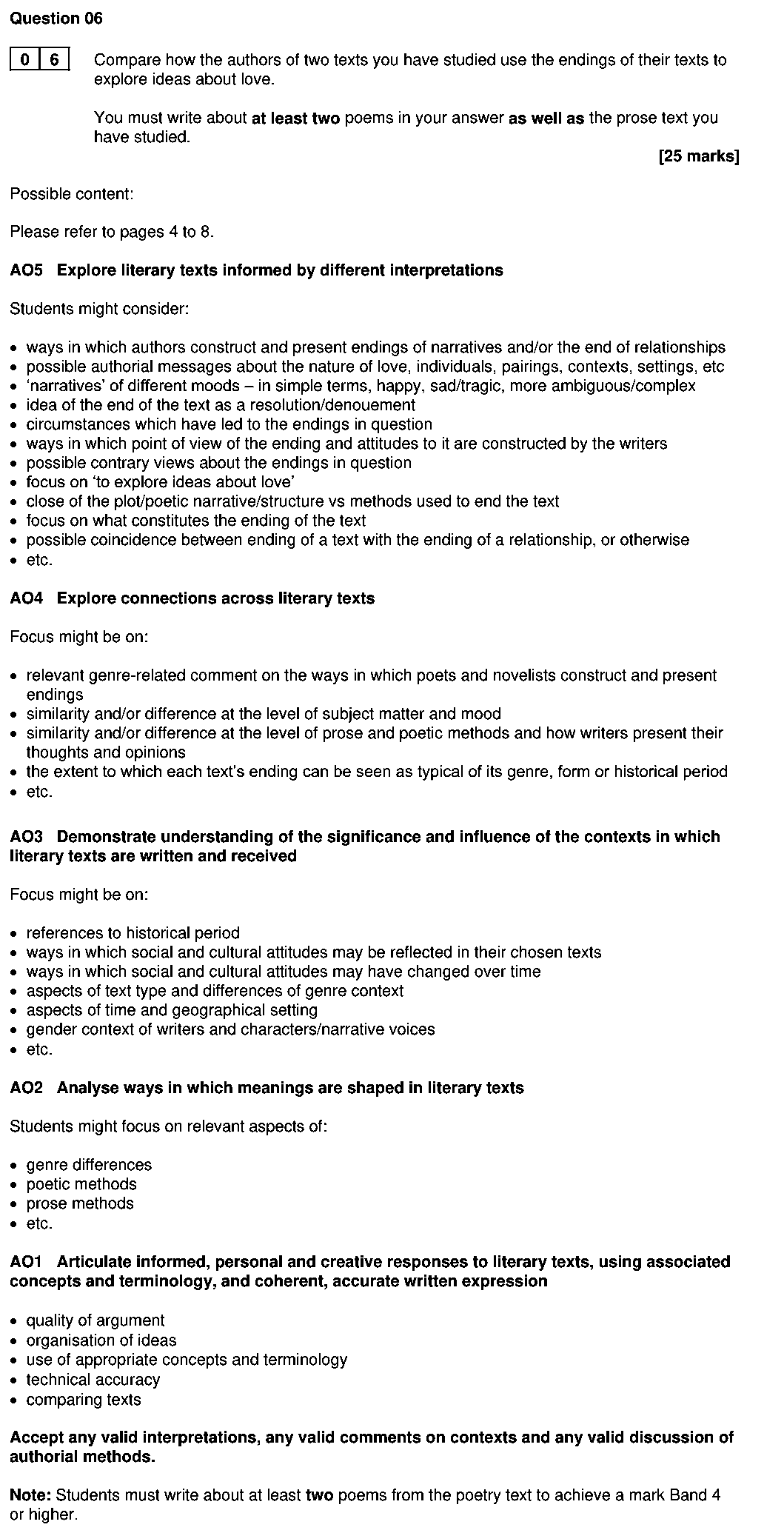
November 2021 · Paper 1 · Q6 25 marks Comparing texts love poetry pre 1900love poetry post 1900comparing prose love
Compare how the authors of two texts you have studied use the endings of their texts to
explore ideas about love.
You must write about at least two poems in your answer as well as the prose text you
have studied.
[25 marks]
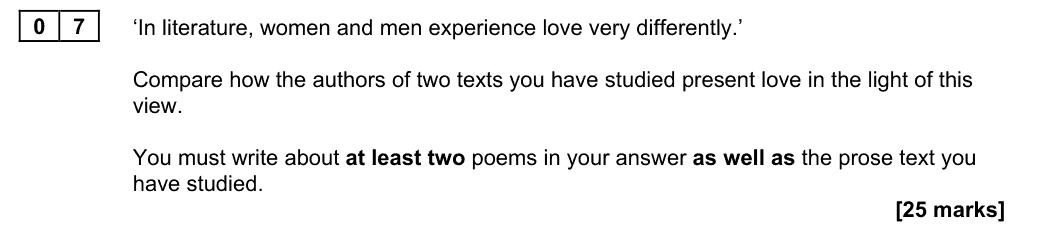
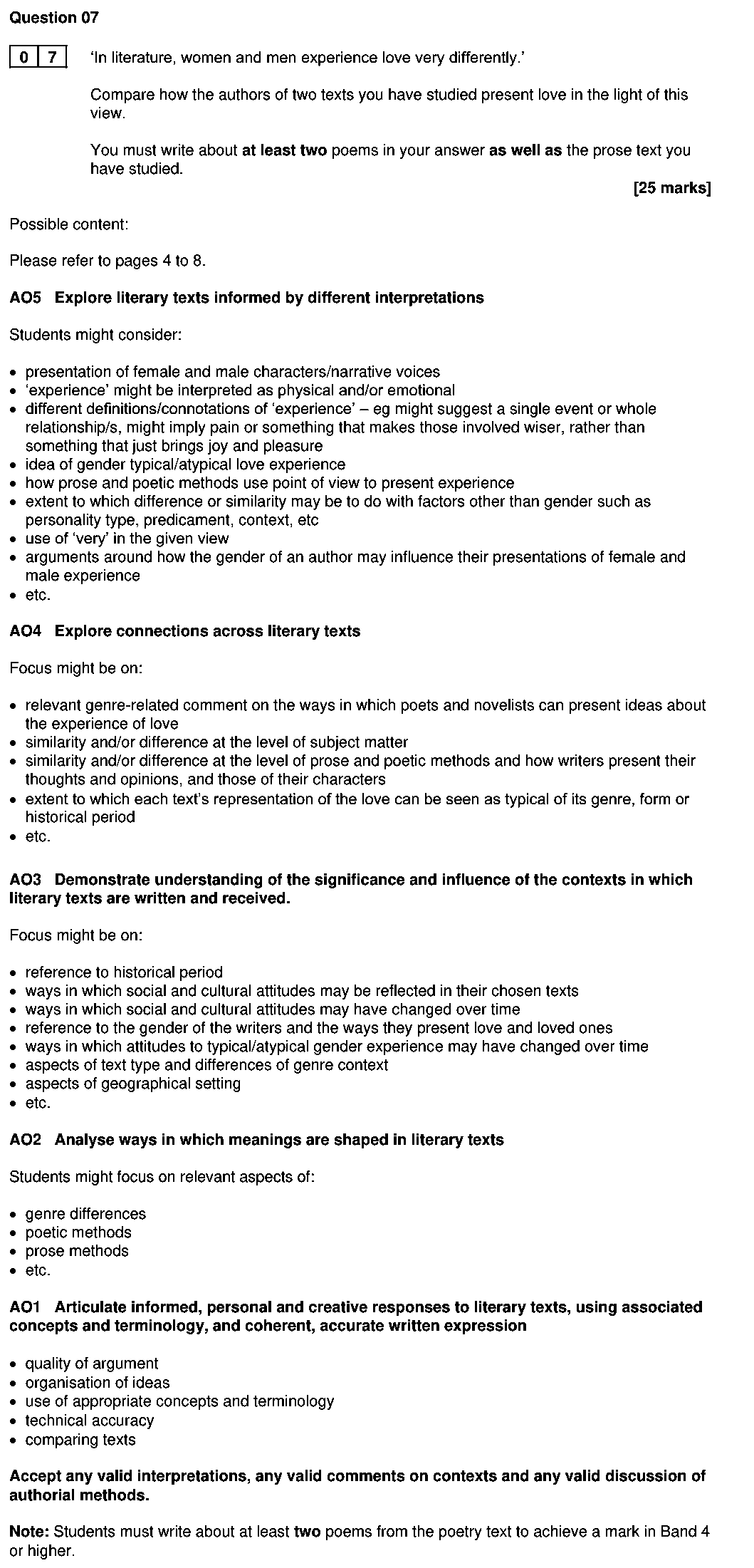
November 2021 · Paper 1 · Q7 25 marks Comparing texts love poetry pre 1900love poetry post 1900comparing prose love
‘In literature, women and men experience love very differently.’
Compare how the authors of two texts you have studied present love in the light of this
view.
You must write about at least two poems in your answer as well as the prose text you
have studied.
[25 marks]

Work with an AQA English Literature A tutor

Want a paper marked and gone through with you? Message us.

Prefer email? Send an enquiry

If you are under 18, please include a parent's contact details. Enquiries go to enquiries@alevelenglishtutor.com and are deleted once handled. All tutoring is online.