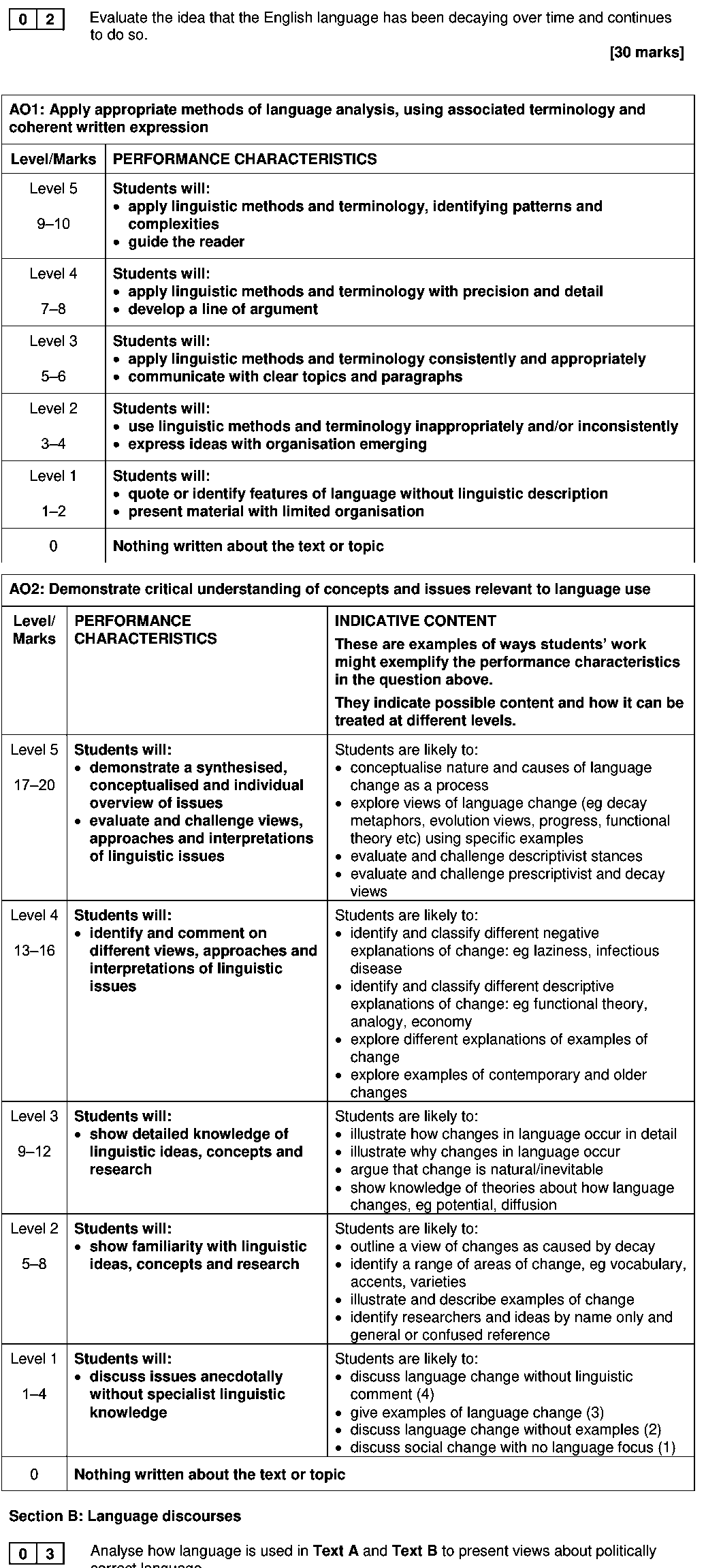
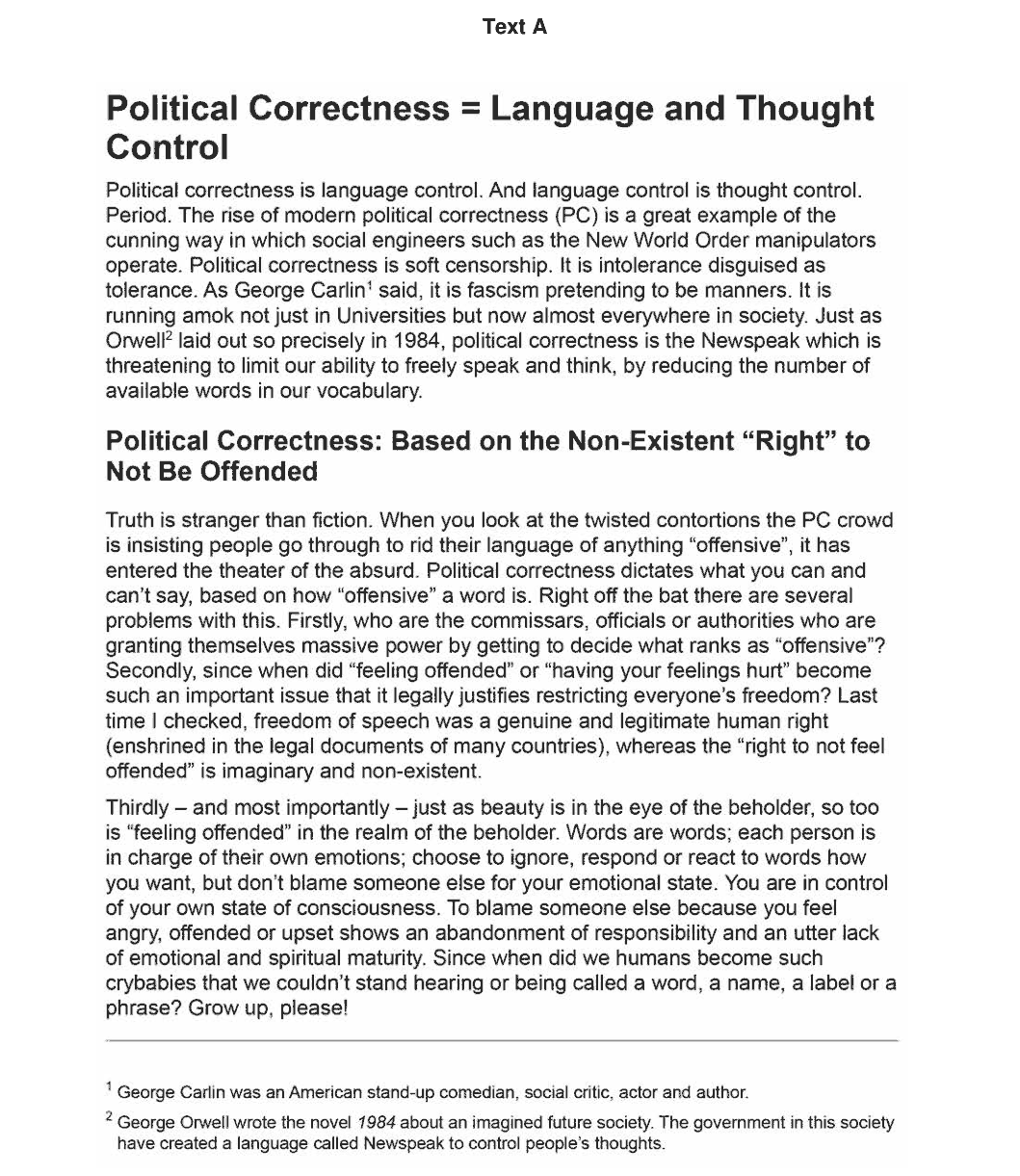
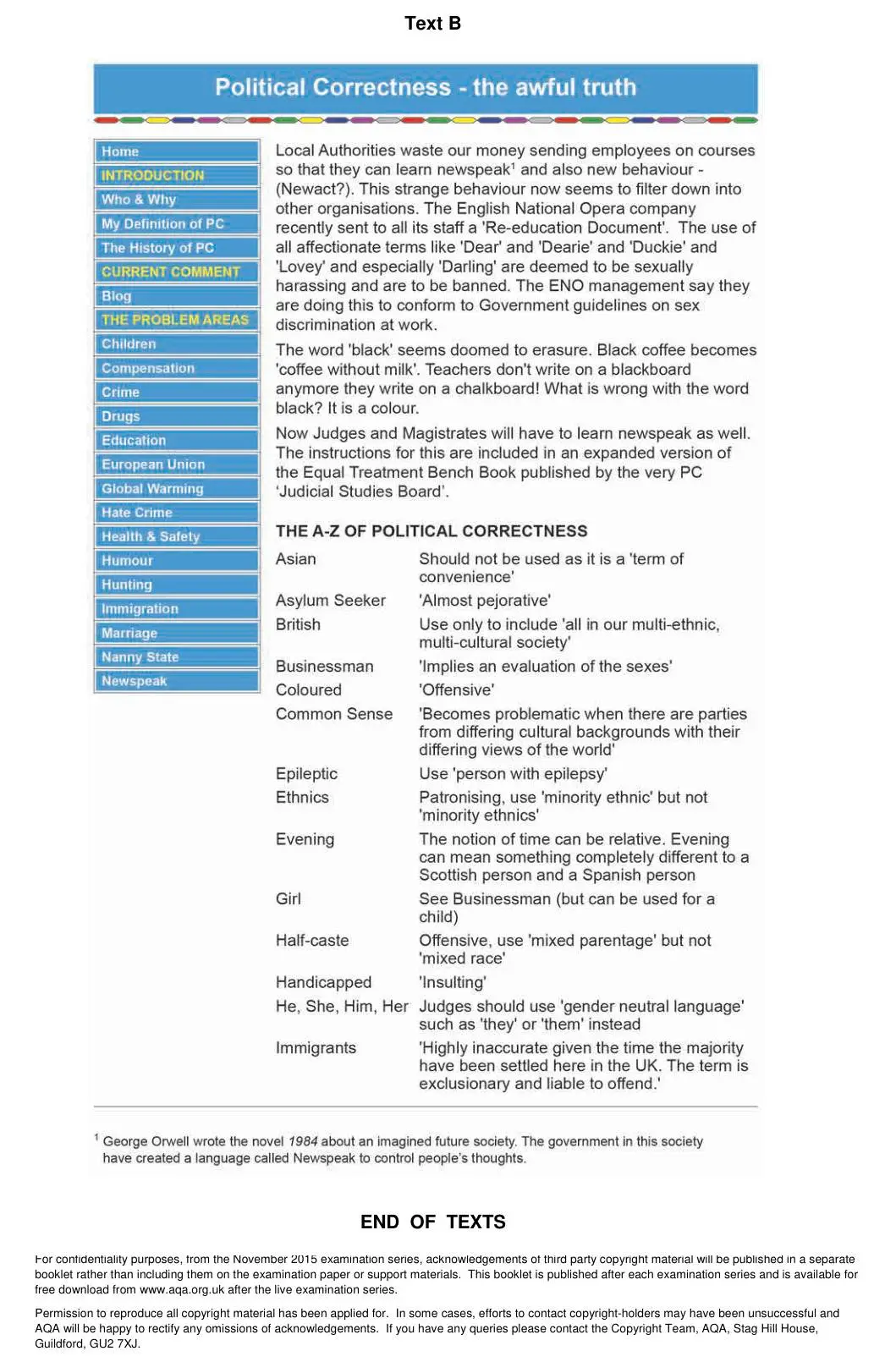
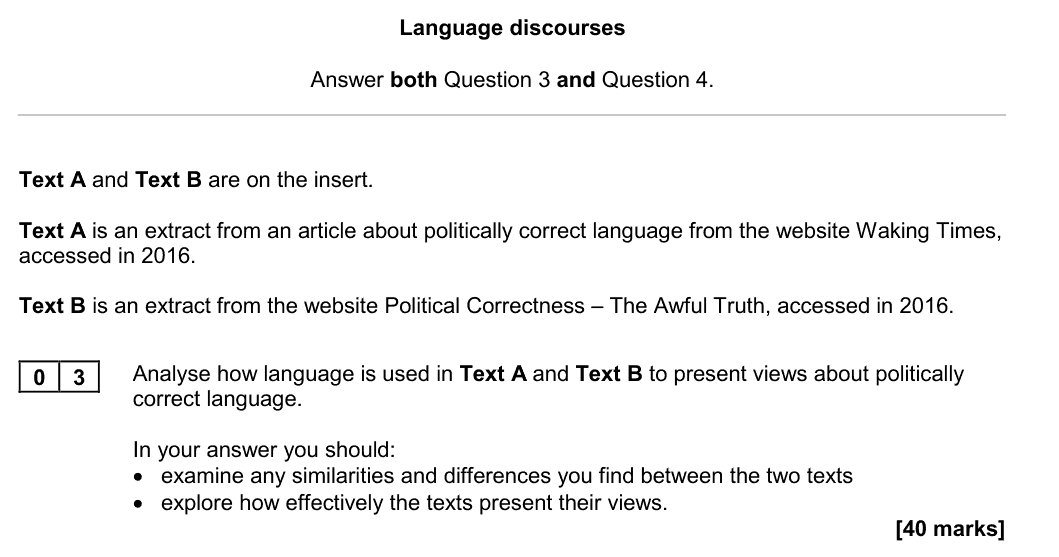
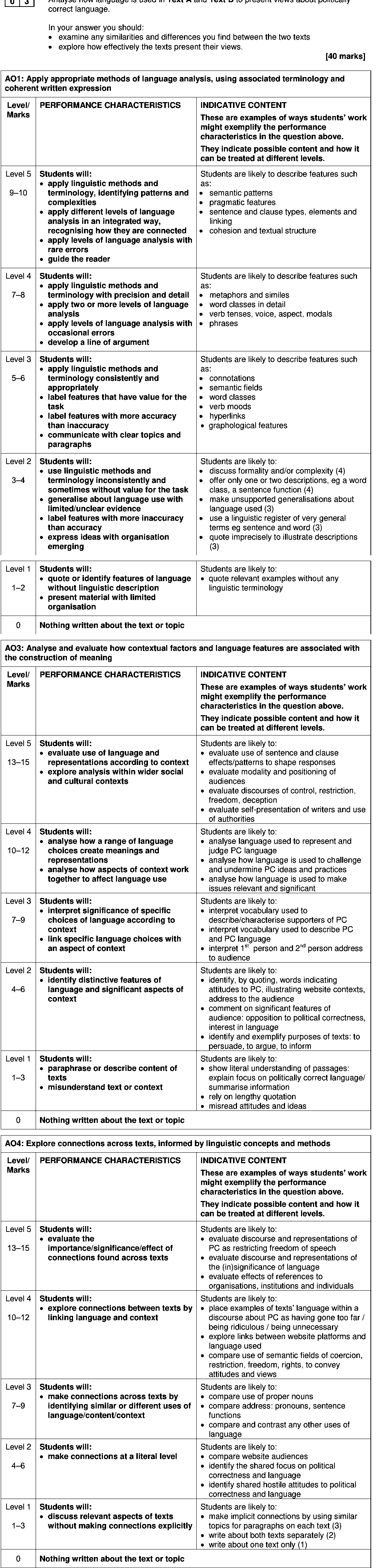
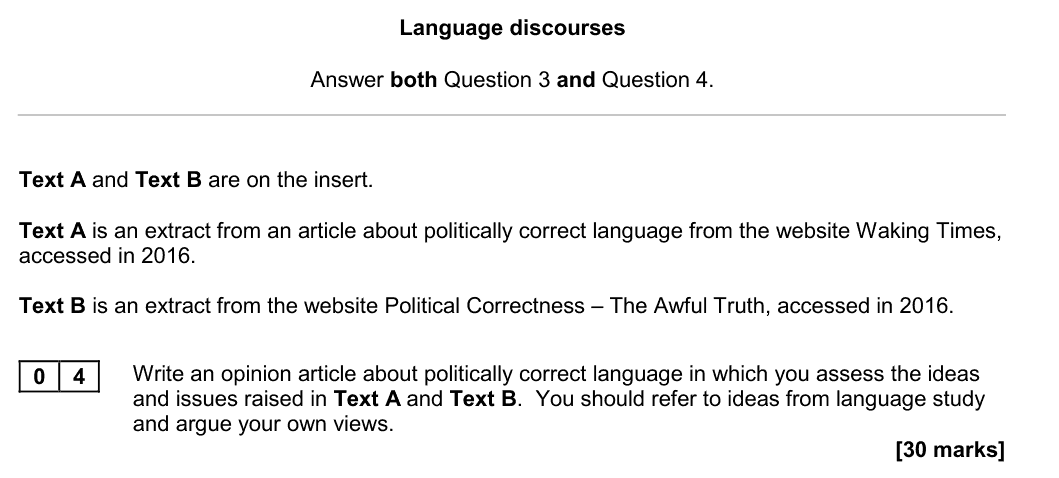
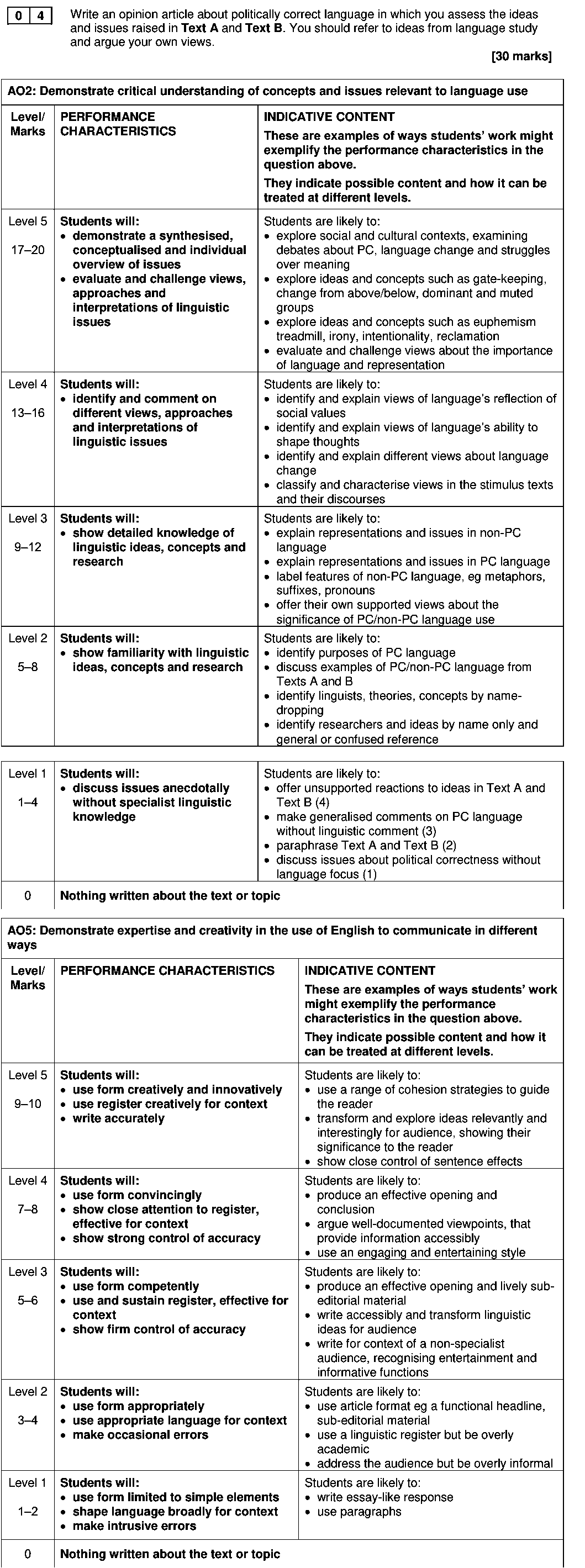
Mark scheme, including the levels and indicative content
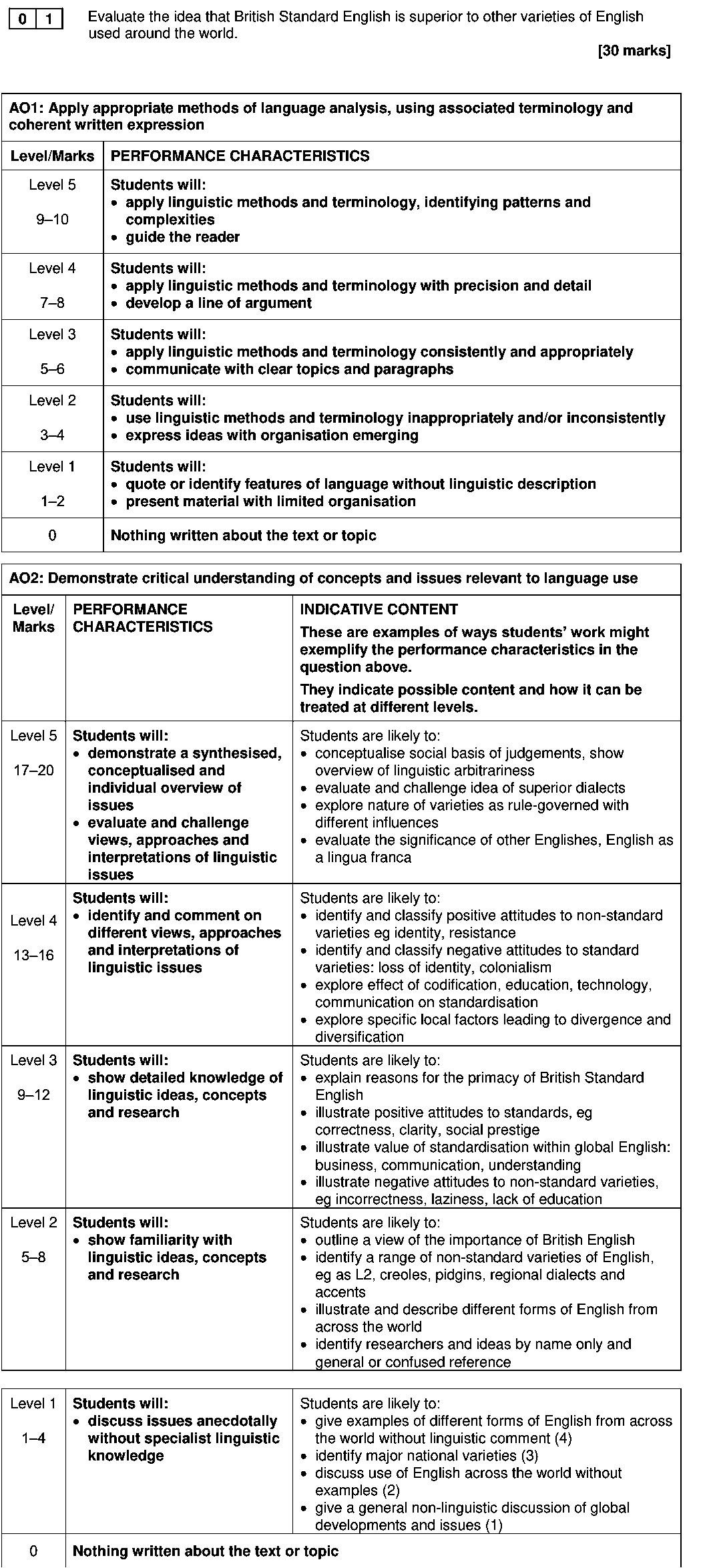
Examiner's comment
Question 1 focussed on language diversity, in particular on the nature and status of British Standard English. Students were asked to evaluate the idea that British Standard English is superior to other varieties of English around the world (AO2). They then had to express their views in a coherent argument using linguistic terminology (AO1). Key discriminators were whether students could explain and interrogate the idea of superiority and the precision of their understanding of what British Standard English referred to. The question asked students to evaluate the idea that British Standard English is superior to other varieties of English used around the world. While most students referred to some varieties of World English outside the UK, others focussed entirely on varieties of English within the UK, discussing varieties such as MLE and Estuary English, which was fine. Many, however, did not differentiate between accent and dialect, so spent a lot of time talking about RP, which was acceptable but required acknowledgement that it was a different variety. Others did not attend precisely to the focus on a British standard. Answers were often stronger when it was recognised that there are other Standard Englishes and that there are other supra-national varieties. Many answers showed knowledge of the historical emergence of BSE and ideas about the process of standardisation. Many students mentioned the effect of colonialism and imperialism and linked it successfully to the primacy of English, the status of English in colonised countries in education and government and the idea of resistance identities. Some students wanted to use the idea of resistance to the standard by discussing Labov’s Martha’s Vineyard study, without acknowledging that this related to American, rather than English Standard English. Many students explained Kachru’s circles; fewer explained or evaluated the model in relation to debates about the ‘superiority’ of BSE. Schneider’s Dynamic Model of Post-colonial Englishes was well used. The most successful students tended to equate views of ‘superiority’ with economic and political power but also recognised the significance of how many people in the world speak Englishes. The best answers argued for the linguistic equality of varieties and the social nature of the values ascribed to them. They also had a sophisticated sense of the social and historical forces that have shaped Englishes. More successful answers: • addressed the key terms ‘evaluate’ and ‘superior’ and ‘other varieties’ throughout their answer • focussed precisely on what is meant by British Standard English • clearly identified standard and non-standard varieties of English • distinguished between accent and dialect issues when discussing different varieties • had an over-arching argument that superiority was a product of social and historical forces rather than inherent linguistic qualities • identified and explained in detail how BSE achieved its prestige and status in the UK and elsewhere • explored how standardisation and the functions of BSE lead to perceptions of its superiority • cited research on attitudes that evidenced the positive response to standard varieties and the negative responses to non-standard varieties • explored how research found that non-standard varieties also received positive valuations • examined how non-standard varieties were associated with identity, community and sometime resistance to dominant cultures and social groups • explored how attitudes to standard accents were changing, eg in the variety of voices heard on the BBC • examined pidgins, creoles and different types of Englishes, drawing on a variety of classifications • explored how ideas about the superiority of BSE and resistance to it were the product of colonial and post-colonial contexts • described in detail not only the specific lexical and grammatical features of some varieties, but how these were influenced by the native language of the country • gave relevant examples of the usefulness of BSE in business, law and air traffic control • explained why some communities reject BSE • explored how the rise and influence of America/American English and the economic power of China/India/Russia might affect the status of BSE • offered examples and detailed description of MLE and Estuary English, and accounted for their rise in social status at the expense of BSE • showed good knowledge of research and debates on World Englishes, Kachru, Nerriere, Crystal, Schneider, Jenkins et al. • explored post-colonial contexts and the move from looking to external standards to the creation of new standards • made excellent use of case studies eg Singlish, New Zealand, Canadian, Ghanaian, Indian Englishes • examined ideas about Globish, English as a Lingua Franca and a possible world standard English • evaluated ELF as ‘superior’ because it was more practical than BSE in many situations • criticised deficit models and Anglo-centrism • could use detailed examples of lexical, semantic and grammatical features to explore the nature of different Englishes and the attitudes to them. Less successful answers: • used the terms ‘more superior’ or ‘most superior’, rather than ‘superior’ • conflated BSE and RP • described Kachru’s circles inaccurately • gave inaccurate figures about numbers of speakers • believed that BSE will continue to be superior because Britain is so important • wrote at length about the history of the English language • had very sketchy knowledge of the time and sequence of events in the story of English.
Notes from the mark scheme and report
- AO1 10 + AO2 20
- top band conceptualises the social basis of judgements and linguistic arbitrariness, challenges the idea of superior dialects, treats varieties as rule-governed and evaluates other Englishes and English as a lingua franca
- ER: key discriminators were interrogating 'superior' and being precise about what British Standard English is
- weaker answers confused accent and dialect (RP), used Martha's Vineyard as if it concerned BSE, named Kachru without evaluating
- best used Schneider, colonial/post-colonial contexts and case studies (Singlish, Indian English)
- packet MS text is only the marking-instruction page
- Texts/data: Essay topic: whether British Standard English is superior to other world varieties of English