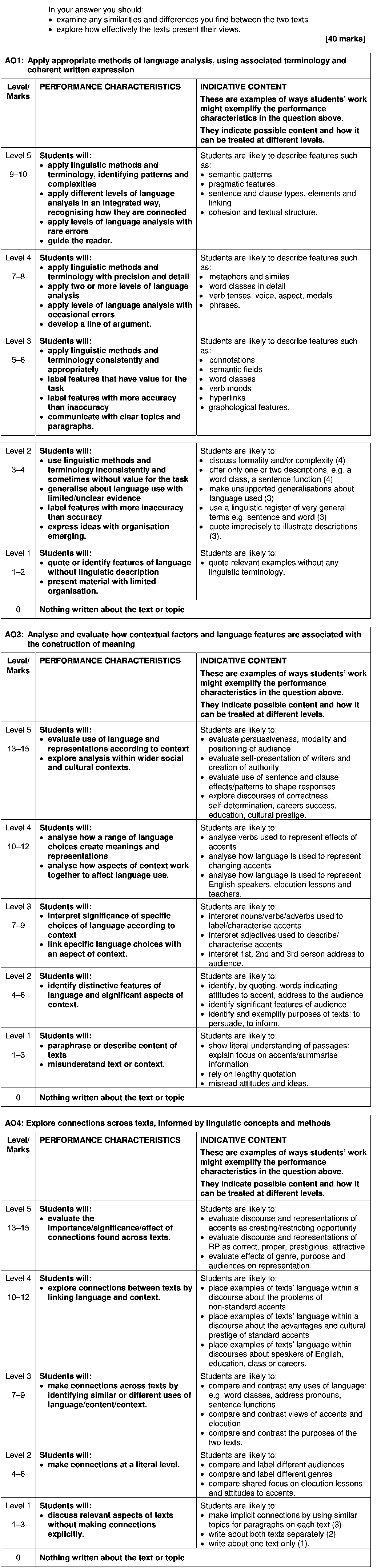
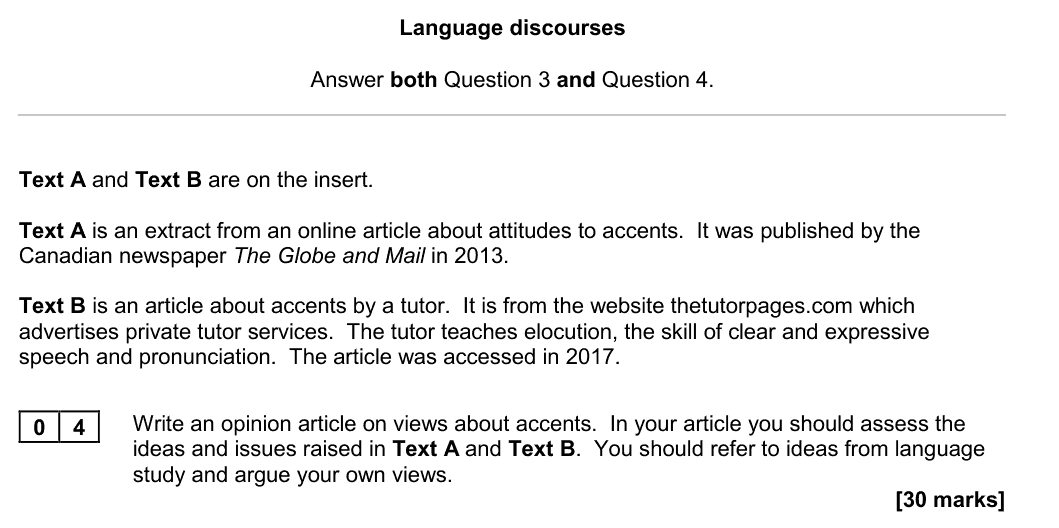
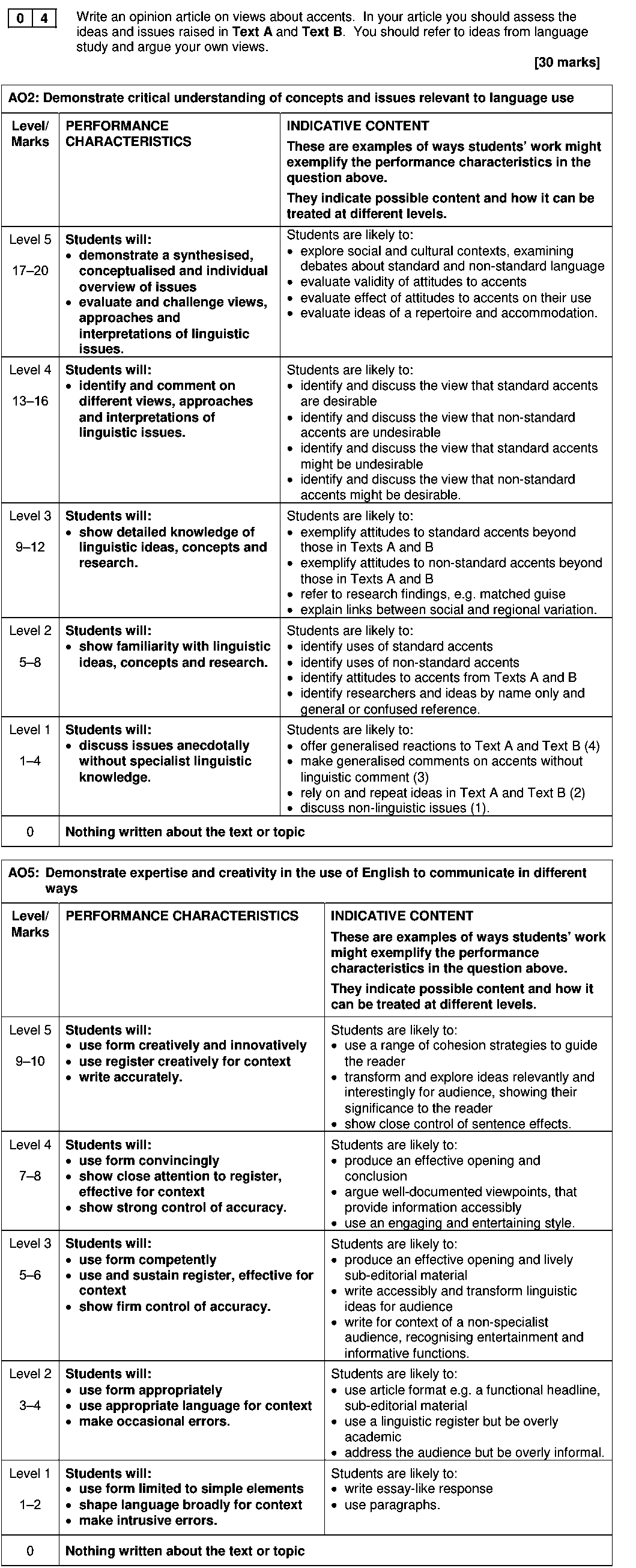
Mark scheme, including the levels and indicative content
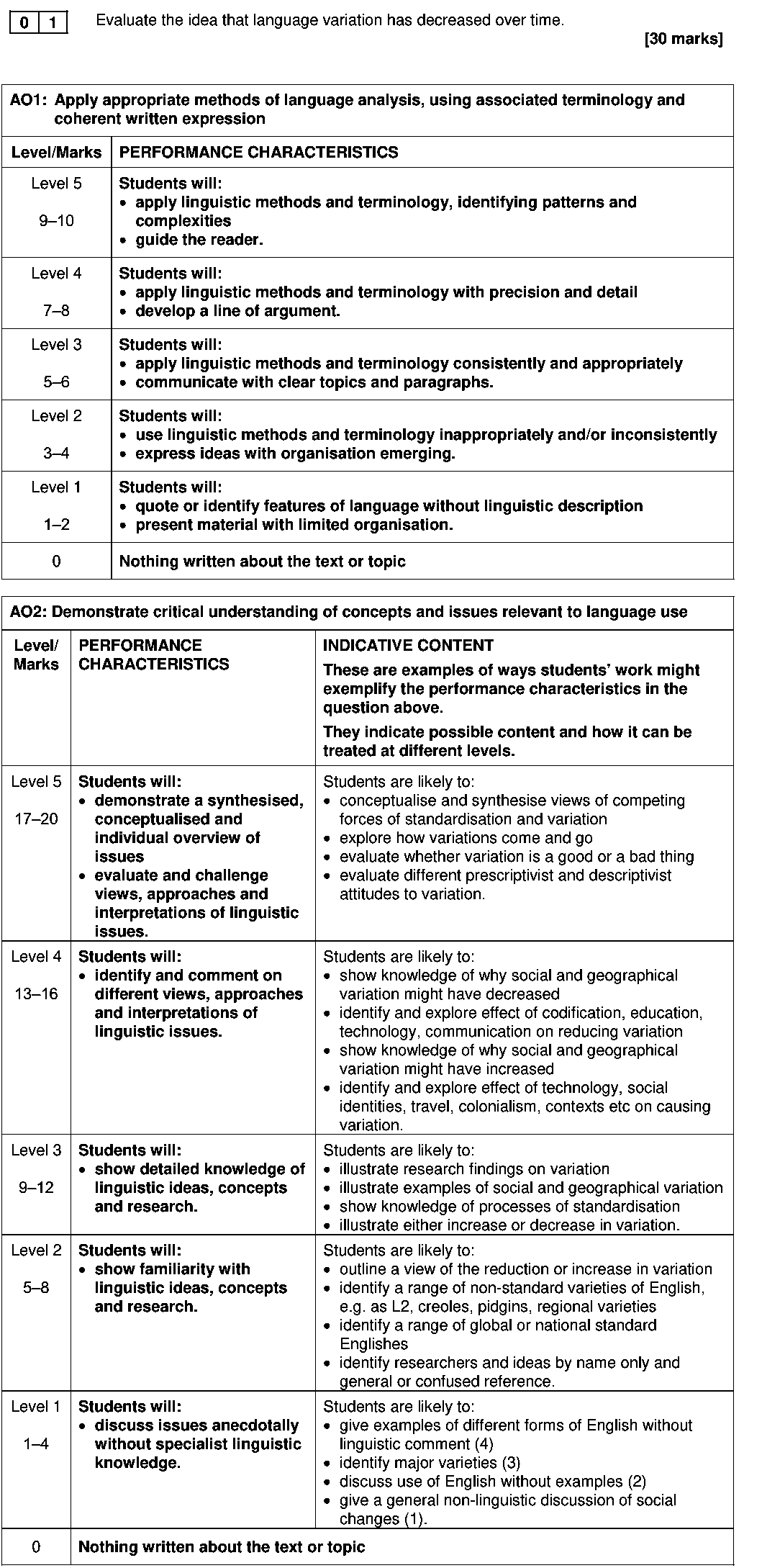
Examiner's comment
Question 1 focused on language diversity. Students were asked to evaluate the idea that language variation had decreased over time (AO2). They then had to express their views in a coherent argument using linguistic terminology (AO1). Key discriminators were whether students could illustrate variation and evaluate its increase or decrease. Not all students were certain what variation might mean. In some cases it was taken to mean any changes in the English language. A significant number of students brought in ideas from language and gender. Often they could cite ideas about variation in women’s and men’s language but could not address the issue of whether it had increased or decreased over time. Many students could illustrate varieties and variations but the more successful were those who could address the other key words in the question. More successful students: • considered variation in terms of varieties and the different ways an individual would look to use language • discussed the nature of standardisation and its effects on variation • had detailed knowledge of the processes of selection, acceptance, elaboration of function and codification • explored the emergence of world varieties and debates around standard and non-standard forms around the world, often exploring the situation in Singapore • explored processes of standardisation and variation in new Englishes, using Schneider’s model • explored dialect levelling and the social reasons for it • discussed whether dialect levelling in Milton Keynes had actually introduced a new variety • examined how Estuary English could be seen as removing some older social and regional distinction • gave some interesting insights into a less standardised world via online communication and the lack of gatekeepers for modern communication technologies • developed interesting arguments about identity and repertoires leading to increased variation even in the face of levelling elsewhere • discussed the repertoire analysis by Devyani Sharma of British born Asians • explored MLE and MUBE as case studies of the emergence of new varieties and variation, citing Rob Drummond’s UrBEn-ID project • examined technology’s role in spreading innovation and levelling (eg Americanisms, urban slang, online gamer jargon/slang growing beyond their base but also being used more widely and flattening out/killing more individual local forms) • discussed the emergence of Polari and its diminishing use as social conditions changed • explored the creation of pidgins as contact language and their disappearance when their need was no longer present • considered the very disparate nature of Old English and Middle English before the emergence of Standard English • examined classic variationist studies and questioned whether variables such as class and gender now saw different patterns of use • evaluated reasons for standardisation and variation: migration, globalisation, education, technology, identity politics • gave good examples of variation across different levels (eg phonological variants as markers for class and identity, dialect variation, sociolect and occupational jargon) • showed a subtle appreciation of the ebb and flow of variation • evaluated whether changes in variation were a good or a bad thing. Less successful students: • illustrated variation but without addressing the issue of increase or decrease • had detailed knowledge of case studies (Trudgill, Cheshire, Petyt, Labov et al) and what was found, but could not quite link it to the ideas of increase or decrease • were uncertain where to draw the line between change and variation and how to choose the right material to best answer the question set • were uncertain about what variation might mean • discussed changes in language as examples of variation • confused researchers’ names eg Labov versus Lakoff • confused Labov’s New York Department store study with his Martha’s Vineyard study • did not know how to use Kachru’s circles to explain an increase or decrease • forced gender and interaction into answers without linking the material into the question.
Notes from the mark scheme and report
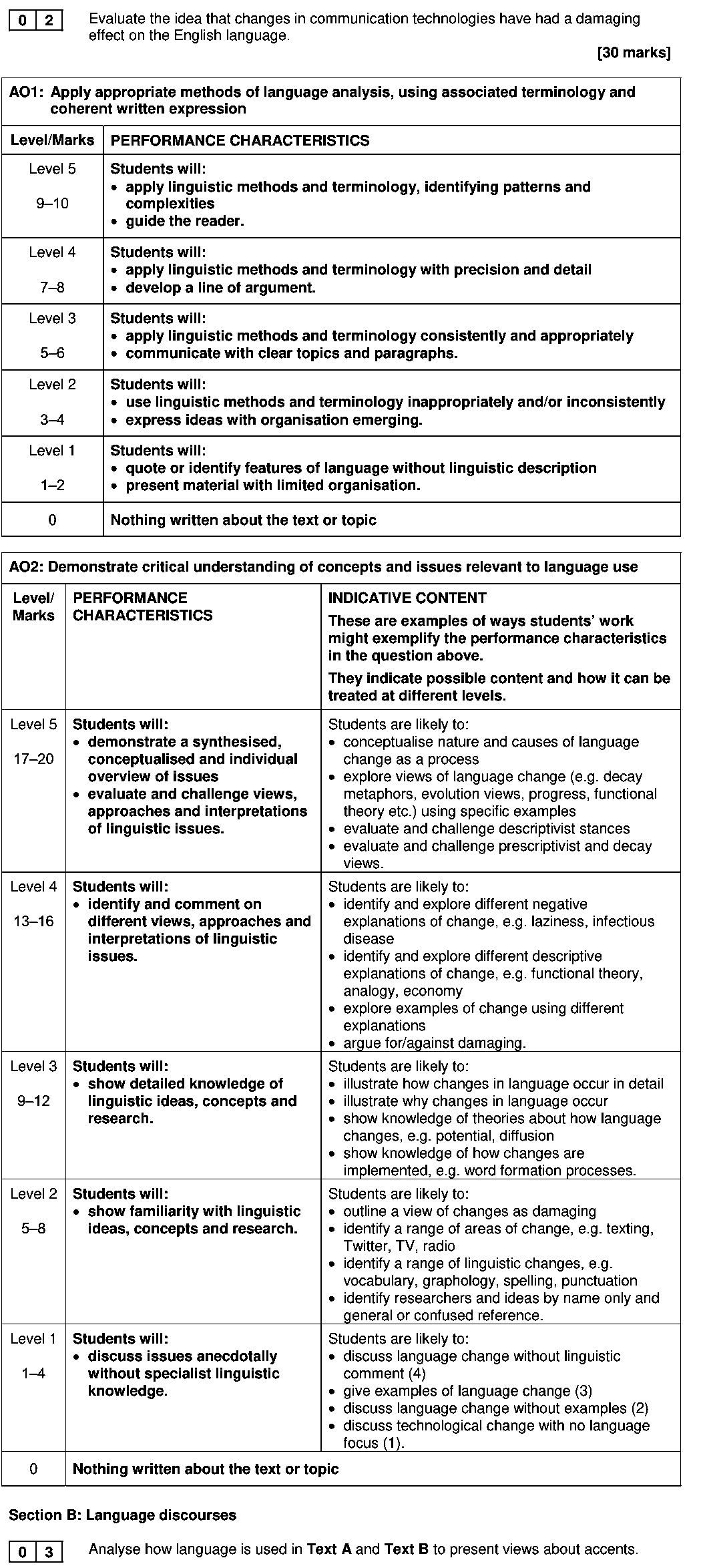
- AO1 10 + AO2 20
- top band synthesises competing forces of standardisation and variation, explores how variations come and go and evaluates prescriptivist and descriptivist attitudes to variation
- Level 4 explains why social and geographical variation may have decreased (codification, education, technology) or increased (identities, travel, colonialism)
- ER: some took variation to mean any change or wrote on gender without addressing increase/decrease
- credited dialect levelling (Milton Keynes), Estuary English, MLE/MUBE, Sharma's repertoires, Schneider and world Englishes
- AO split from AQA's standard grid for this question (not readable in this year's mark scheme)
- Texts/data: Essay topic: whether language variation has decreased over time