Examiner's comment
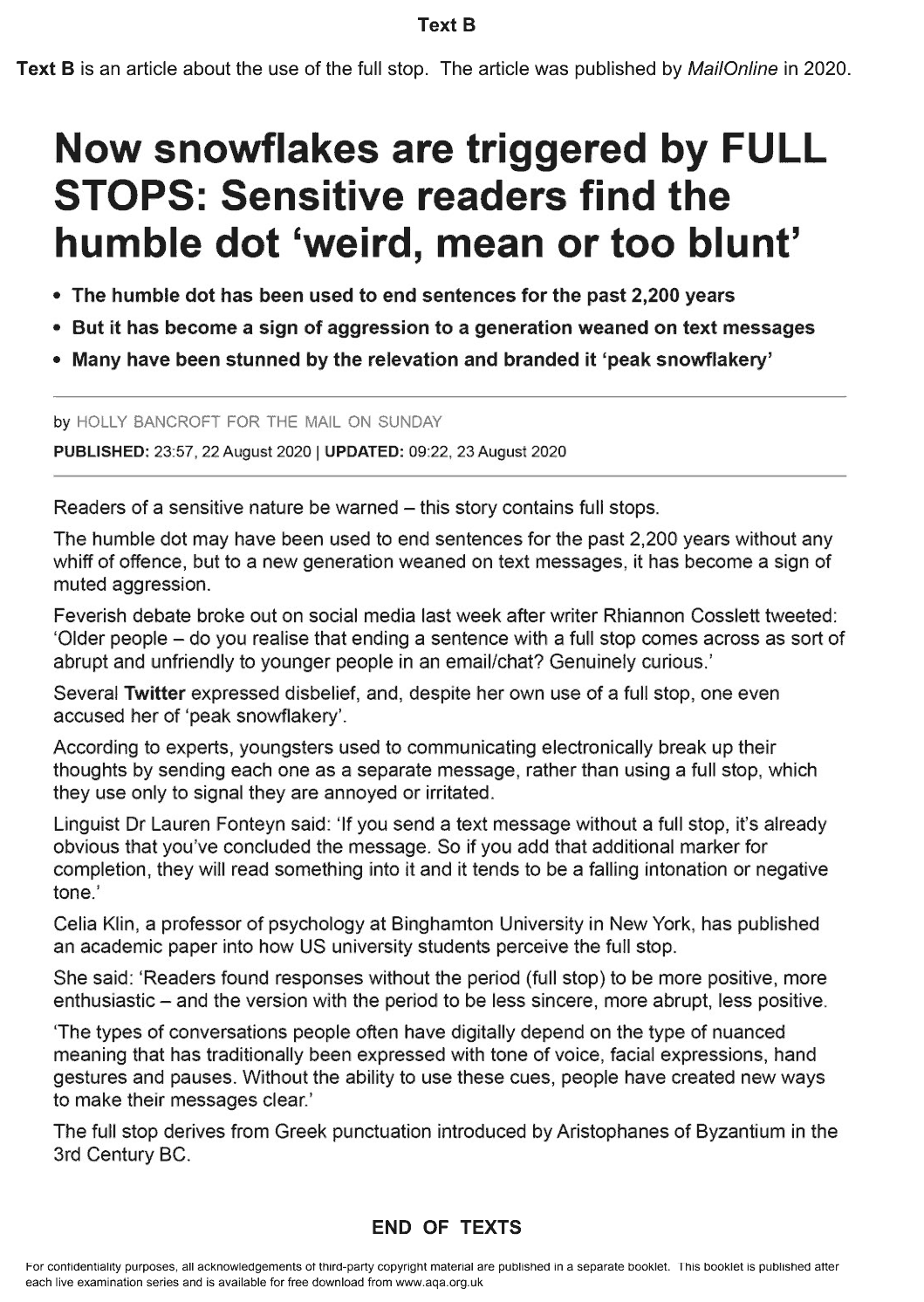
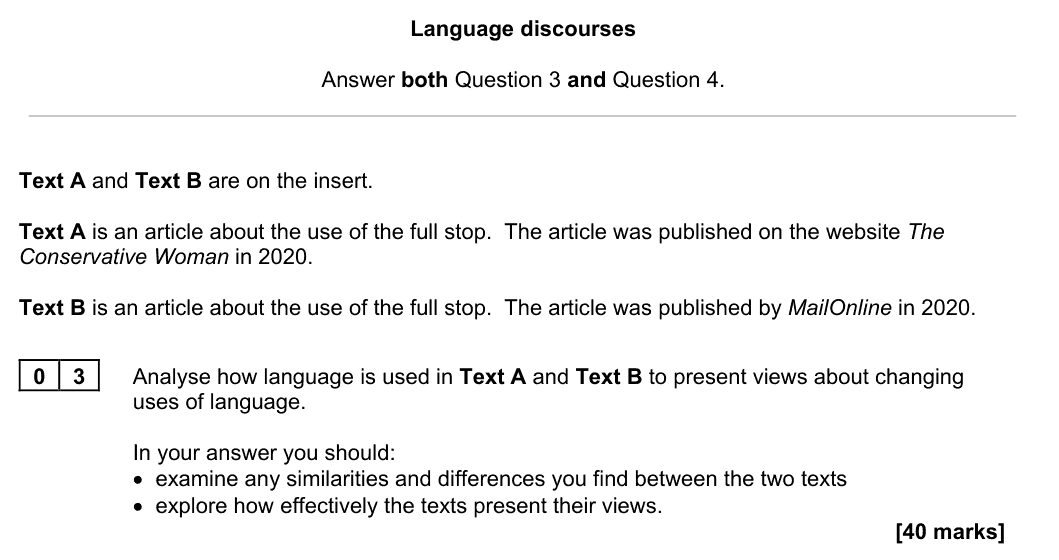
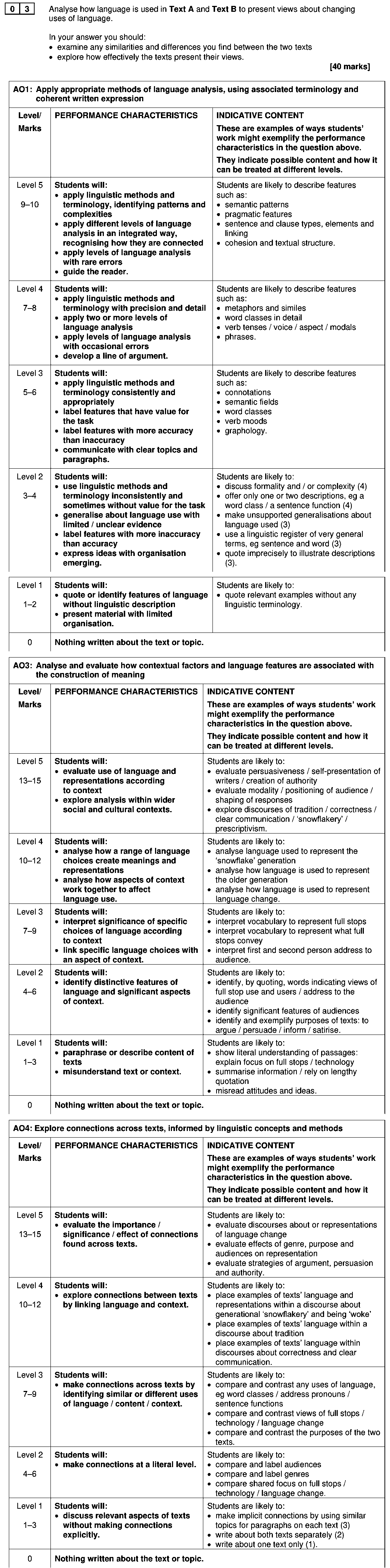
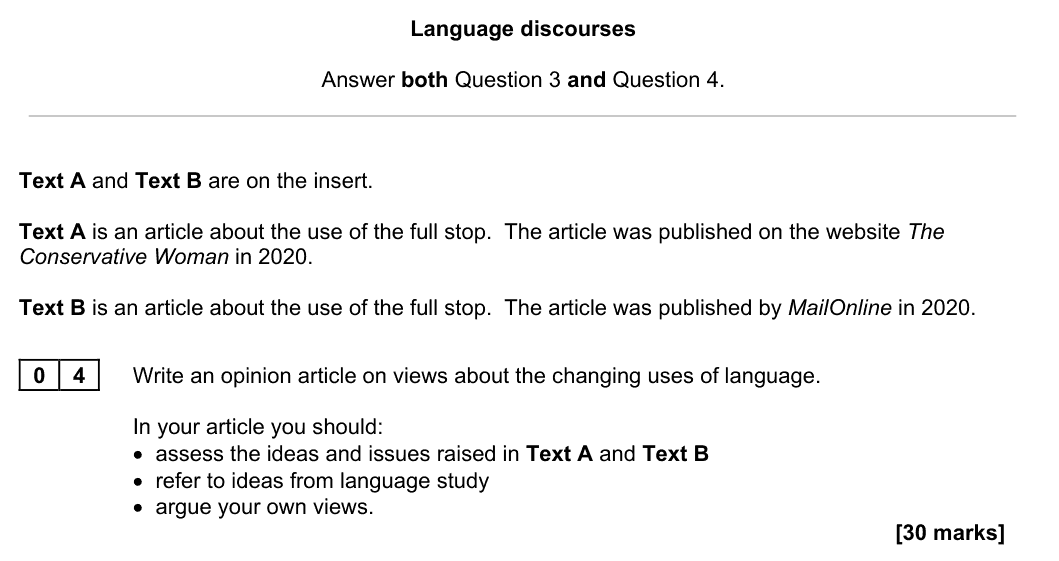
Question 3 focussed on discourses about language change and ‘snowflakery’. Students were expected to explore the two texts systematically by describing linguistic features (AO1) and analysing how they created meanings (AO3) in order to evaluate the ways, the texts represented ideas about changing uses of the full stop, showing connections between the texts as parts of wider discourses about language change and woke snowflakery (AO4). Both Text A and B provided students across the ability range with accessible material that enabled them to demonstrate their skills in exploring how discourses work. AO1 The large majority of students understood that they were expected to describe the linguistic features in the texts which they were analysing. Some students still only got marks of 3 or 4 for AO1 and did not seem to recognise the need to describe language features as part of their method of analysis. Generally, the features described were salient and significant for the construction of representations. In some responses linguistic features were identified every time a quotation was made but with little sense of how this feature was significant to the way representations and meanings were being created. Far fewer answers demonstrated the language feature-led technique which hinders Level 4 achievement on AO3 or AO4. Precise linguistic terminology was often in evidence with lots of references to verb types, with useful comments on mental and material processes (though there was frequent uncertainty in the application of these terms). Modal verbs were frequently identified and well analysed. There was good exemplification of sentence and phrase types and the identification of the precise extent of a clause was improved. Issues with pronoun person were less frequent than formerly. Students who looked at sentence and clause features were credited in Level 5 on AO1. These were, however, often the least salient descriptions in an answer. Very few students used these descriptions to analyse the effects the writers were achieving by their deployment of sentence and clause choices. Some things students could profitably address are: • identifying and showing the exact extent of a verb phrase • what counts as post-modification in phrase analysis • what counts as a predicate • distinguishing subordinating and co-ordinating conjunctions from co-ordinate and subordinate clauses • clarifying what the word ‘discourse’ means in the context of this question. AO3 and AO4 Students were generally clear about the purpose of the task and there were few general textual analyses. Almost all recognised the need to compare how the texts were part of discourses about language change, tradition, ‘correct’ English and ‘snowflakery’. There were lots of strong responses which recognised that AO4 is at the heart of this task about discourses by looking at the repetition of ideas across texts and their construction of social identities and reader positions. The most successful answers addressed all the AOs in an integrated way. Most did this throughout their answer, though less successful students confined their comparison to a paragraph at the end or wrote separate paragraphs about similar aspects text by text. Almost all compared the shared focus on changing uses of language, and the full stop in particular. Many reached Level 3 on AO4 because they compared the use of sentence functions, pronouns, the language of the headlines, the use of the term ‘snowflake’ and other features of language. The answers placed in Level 4 could link language with ideas about language change. Often students recognised prescriptivist discourses and made use of Aitchison’s terms to characterise them. They also recognised discourses about snowflakery and being woke. There was a clear improvement in the engagement with the ideas in the texts this year. Most students wrote effectively about how full stops and their use were presented as well as the ways in which young people were satirised and mocked. This enabled a more effective analysis of how the producers of the text created self- representations which affected how the text’s ideas were received by a reader. There was also a lot of work on how the texts positioned a potential reader and used language to shape their views. Modality was frequently looked at. Some students had difficulties disentangling the different views within the texts. The best answers had a clear understanding of how Bancroft positioned the views of Doctor Lauren Fonteyn and Professor Celia Clin and how Weaver presented the university research. Some students had difficulty disentangling the audiences of the texts from the imagined or ironic addressees within the texts. More successful answers: • placed the texts, and ideas within them, within prescriptivist and descriptivist discourses • analysed discourses of correctness, tradition, decay, snowflakery • identified and compared the views of Sheridan in Text A the presentation of the research findings by Bancroft in Text B • contrasted the views and ideas of Klin and Fonteyn with the views of the authors • contrasted the language of Klin and Fonteyn with that of the authors • compared and evaluated how Text B’s use of quotations gave the views more weight than the brief reference to Fonteyn’s ‘comments’ in A • considered how ‘according to experts’ and ‘academic paper’ might have negative connotations (in contrast to common sense and tradition) rather than being an endorsement and compared them with Sheridan’s passive ‘They are said to….’ • compared how both articles sensationalised the story: ‘under the spotlight again’ and ‘Feverish debate broke out last week….’ and evaluated the hyperbolic attempts to provoke disbelief and anger • compared the way both articles represented and judged the young’s views of the full stop as aggressive, abrupt, blunt, angry • compared the representation of the full stop as harmless, humble, innocent • compared the representation of the full stop as traditional, long-standing, useful, creating clarity • compared ways the texts infantilised younger people and treated them as immature with the intertextuality of ‘big bad full stop’ and the metaphor of being ‘weaned on text messages’ • compared the representation of the young as sensitive, easily intimidated, overly anxious • compared the positioning of the reader in the headlines • analysed the disbelieving tone of the thematised adverbial ‘Now’ and the capitalised ‘FULL STOPS’ in Text B’s headline and how these represented snowflakery and compared Sheridan’s use of ellipsis in her first paragraph to show her disbelief • compared how Text A assumed the position and voice of a young person or addressed them directly to satirise them with the use of address in the first sentence of Bancroft’s article • explored how both texts created a generational divide by the use of pronouns, the identification of a ‘generation’ and references to ‘youngsters’ and ‘Older people’ • explored how Text A created a nightmare vision of a totalitarian woke world run by woke chief constables and the Keypad Cops • evaluated Sheridan’s use of hyperbole, alliteration, punning, neologism, sentence shaping and punctuation use to make her points playfully yet powerfully • analysed Sheridan’s address to her imagined sympathetic reader at the end to position them and their response • analysed Sheridan’s self-presentation as put-upon traditionalist accused of being a stuffy stick-in-the-mud and compared Bancroft’s appeals to tradition and the length of time full stops have been used • considered how the reference to Aristophanes made the audience perceive the full-stop • noted the conventions regarding full stops in the headline and sub-editorial from the MailOnline. Less successful answers: • misread and misinterpreted the language of crime in Text A and thought young people were criminals because of their abandoning of the full stop • claimed that Sheridan and Weaver were creating their authority by quoting researchers, missing how the research findings were being treated • were uncertain about what constituted a verb phrase • were unclear about audiences and address in both articles • quoted material without linguistic description • quoted material without articulating what precise meanings and representations were being created • paraphrased the passages’ content • quoted very rarely • wrote at length about linguistic research rather than focussing on the passages.