Child language acquisition essays (30 marks)

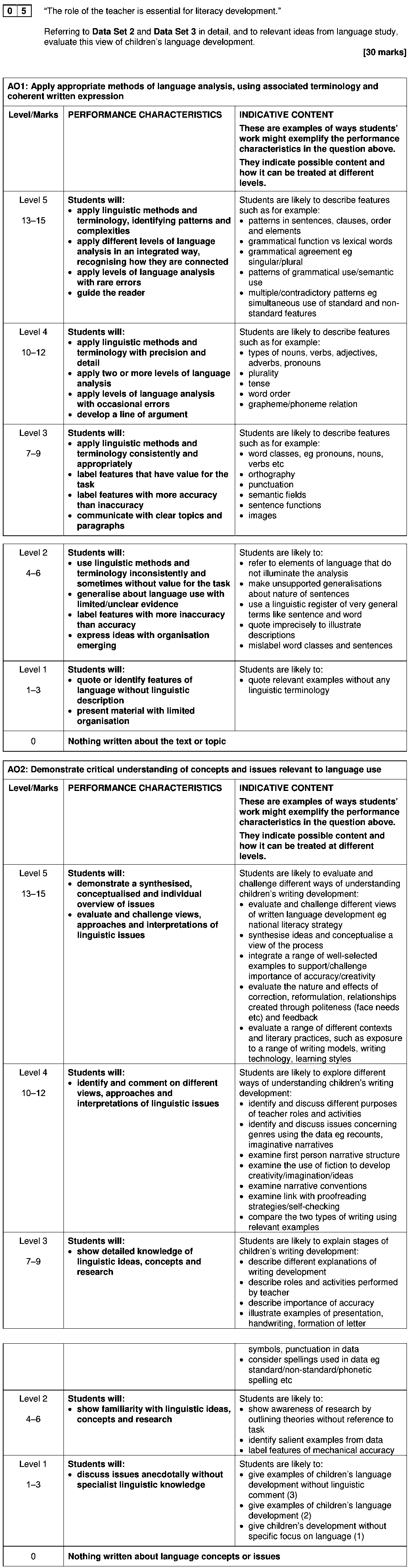
A-level Paper 1 Section B: an essay on children's language development, discussing a statement using the data provided and your knowledge of theories and research (AO1 and AO2). 18 questions.

Other types: Text analysis: meanings and representations (25 marks) · Comparing two texts (20 marks) · Language diversity and change essays (30 marks) · Language discourses: analysing two texts (40 marks) · Directed writing: the opinion article (30 marks)

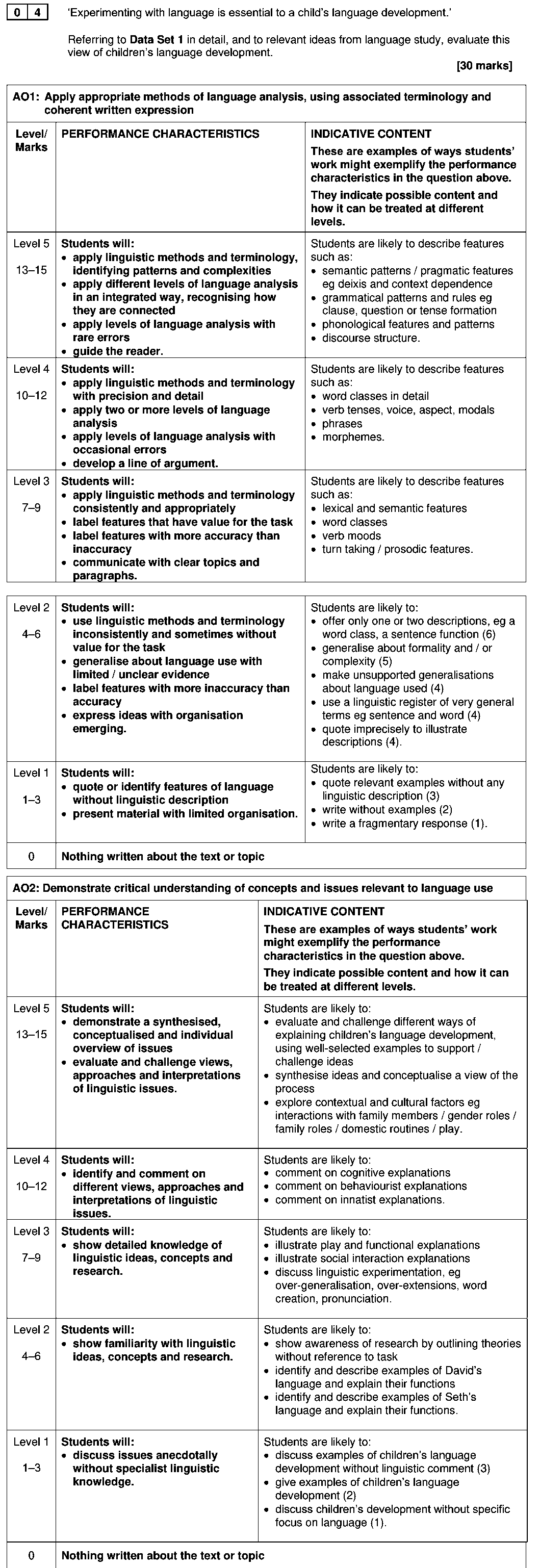
June 2025 · Paper 1 · Q4 30 marks AO1=15, AO2=15 Child language essay child language speechchild language theories
Children’s language development
Answer either Question 4 or Question 5 from this section.
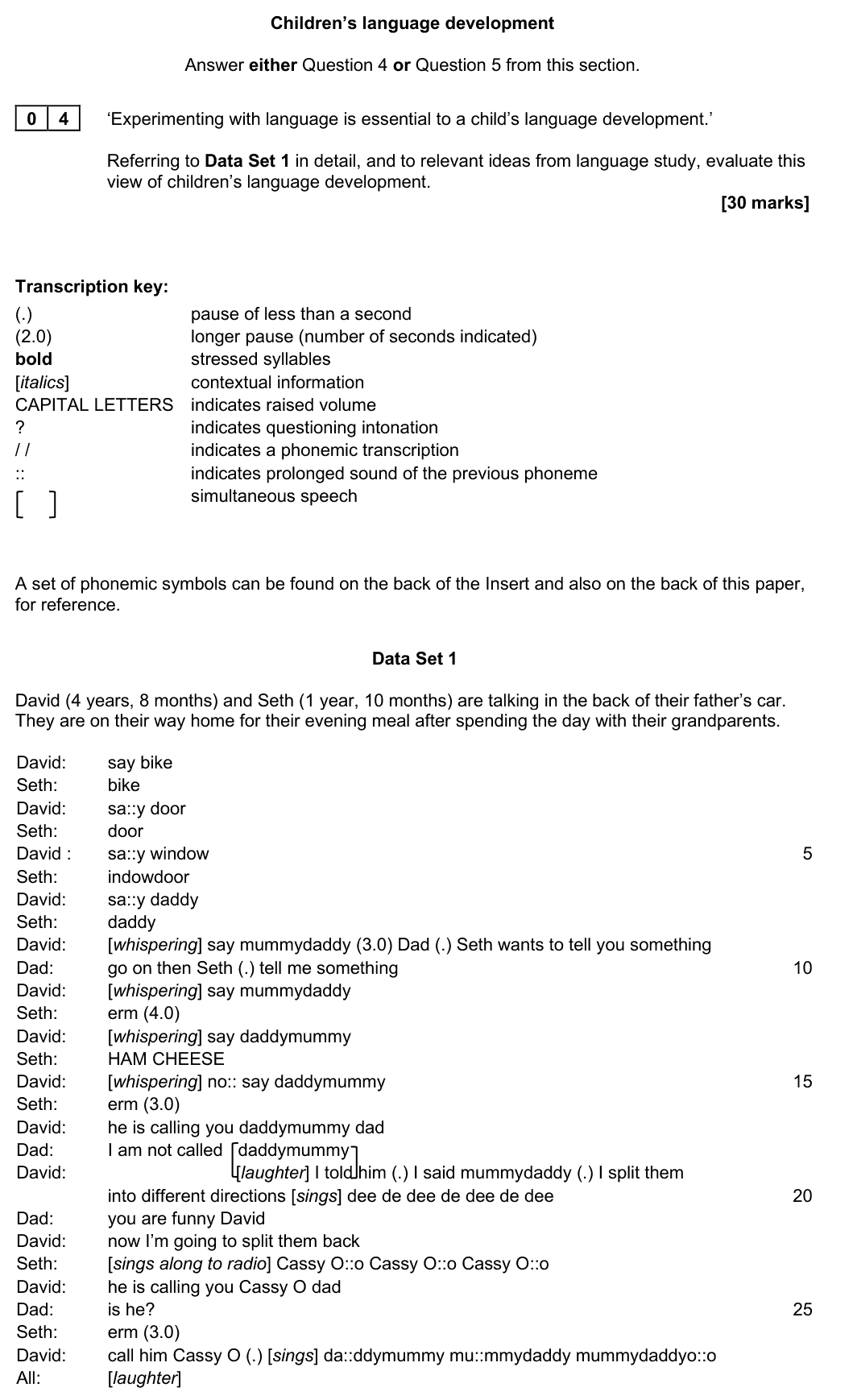
‘Experimenting with language is essential to a child’s language development.’
Referring to Data Set 1 in detail, and to relevant ideas from language study, evaluate this
view of children’s language development.
[30 marks]
Transcription key:
(.)
pause of less than a second
(2.0)
longer pause (number of seconds indicated)
bold
stressed syllables
[italics]
contextual information
CAPITAL LETTERS indicates raised volume
?
indicates questioning intonation
/ /
indicates a phonemic transcription
::
indicates prolonged sound of the previous phoneme
simultaneous speech
A set of phonemic symbols can be found on the back of the Insert and also on the back of this paper,
for reference.
Data Set 1
David (4 years, 8 months) and Seth (1 year, 10 months) are talking in the back of their father’s car.
They are on their way home for their evening meal after spending the day with their grandparents.
David:
say bike
Seth:
bike
David:
sa::y door
Seth:
door
David :
sa::y window
Seth:
indowdoor
David:
sa::y daddy
Seth:
daddy
David:
[whispering] say mummydaddy (3.0) Dad (.) Seth wants to tell you something
Dad:
go on then Seth (.) tell me something
David:
[whispering] say mummydaddy
Seth:
erm (4.0)
David:
[whispering] say daddymummy
Seth:
HAM CHEESE
David:
[whispering] no:: say daddymummy
Seth:
erm (3.0)
David:
he is calling you daddymummy dad
Dad:
I am not called daddymummy
David:
[laughter] I told him (.) I said mummydaddy (.) I split them
into different directions [sings] dee de dee de dee de dee
Dad:
you are funny David
David:
now I’m going to split them back
Seth:
[sings along to radio] Cassy O::o Cassy O::o Cassy O::o
David:
he is calling you Cassy O dad
Dad:
is he?
Seth:
erm (3.0)
David:
call him Cassy O (.) [sings] da::ddymummy mu::mmydaddy mummydaddyo::o
All:
[laughter]
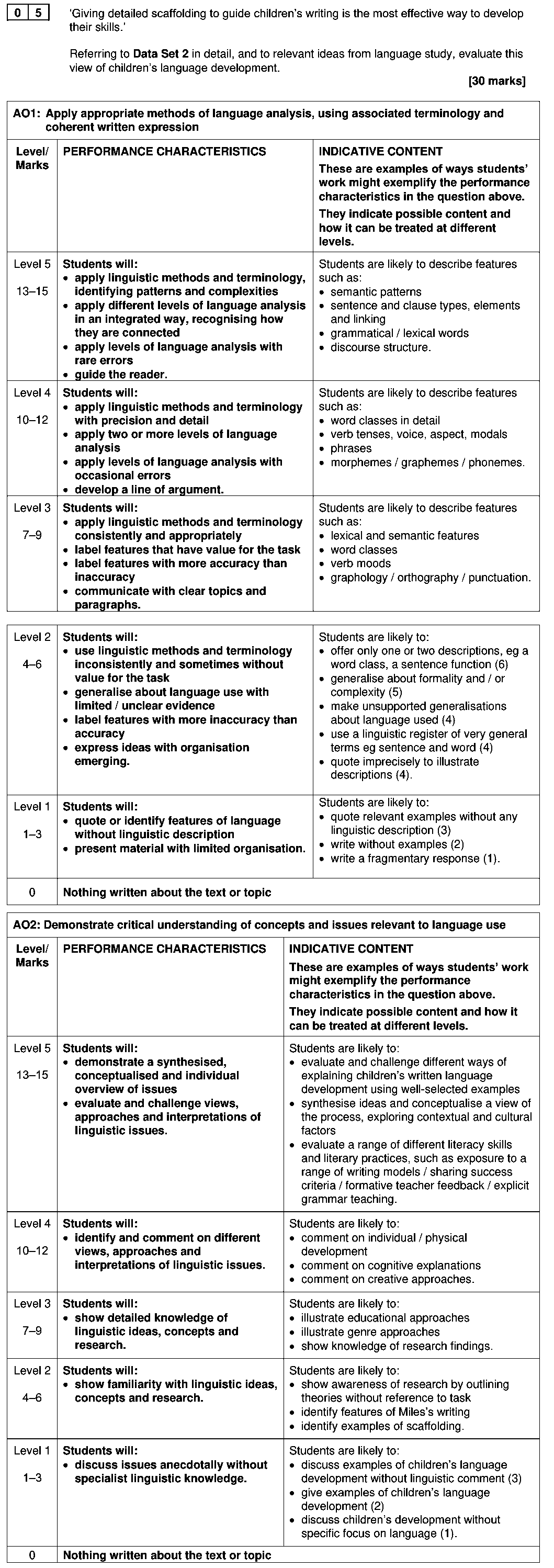
June 2025 · Paper 1 · Q5 30 marks AO1=15, AO2=15 Child language essay child language literacychild language theories
Children’s language development
Answer either Question 4 or Question 5 from this section.
‘Giving detailed scaffolding to guide children’s writing is the most effective way to develop
their skills.’
Referring to Data Set 2 in detail, and to relevant ideas from language study, evaluate this
view of children’s language development.
[30 marks]
Data Set 2
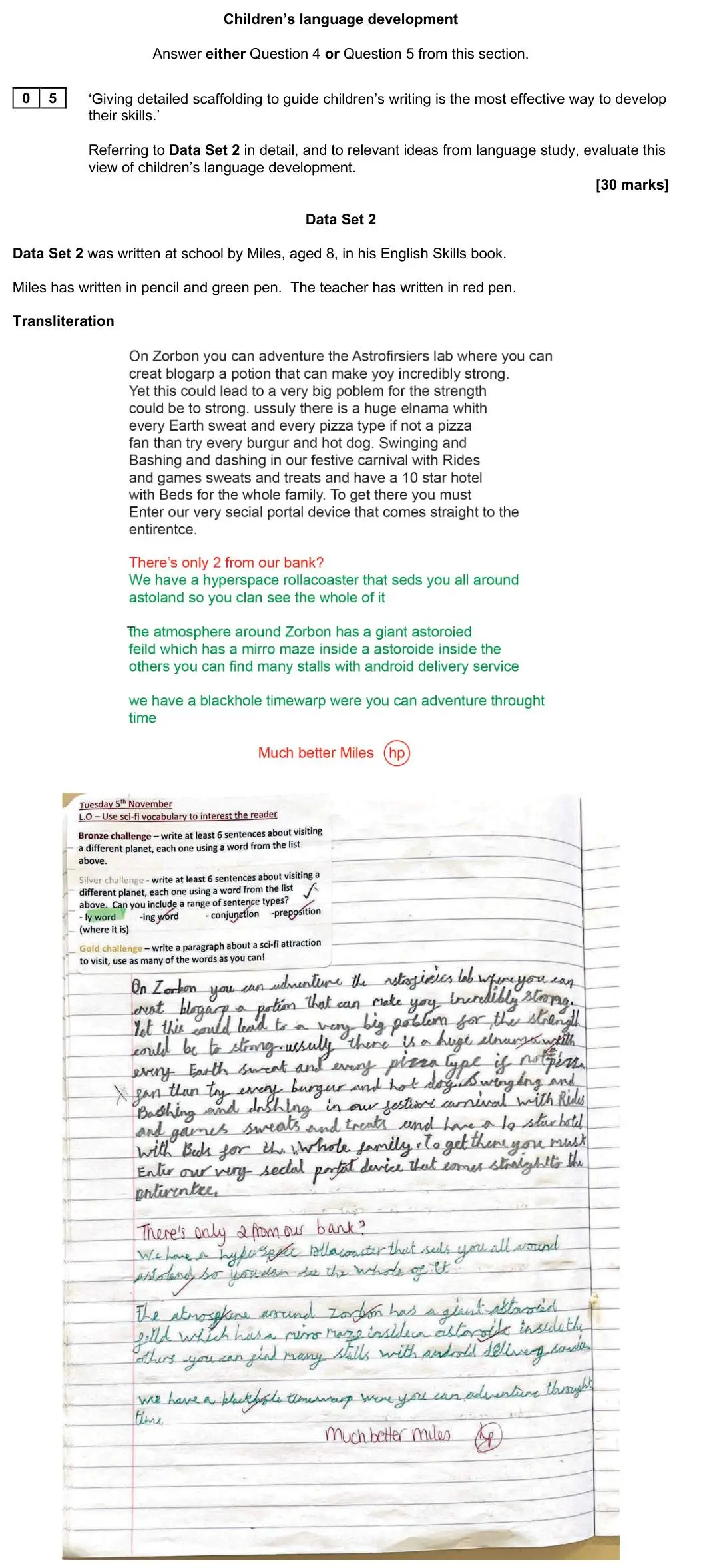
Data Set 2 was written at school by Miles, aged 8, in his English Skills book.
Miles has written in pencil and green pen. The teacher has written in red pen.
Transliteration
[image]
[image]
[image]
[image]
[image]
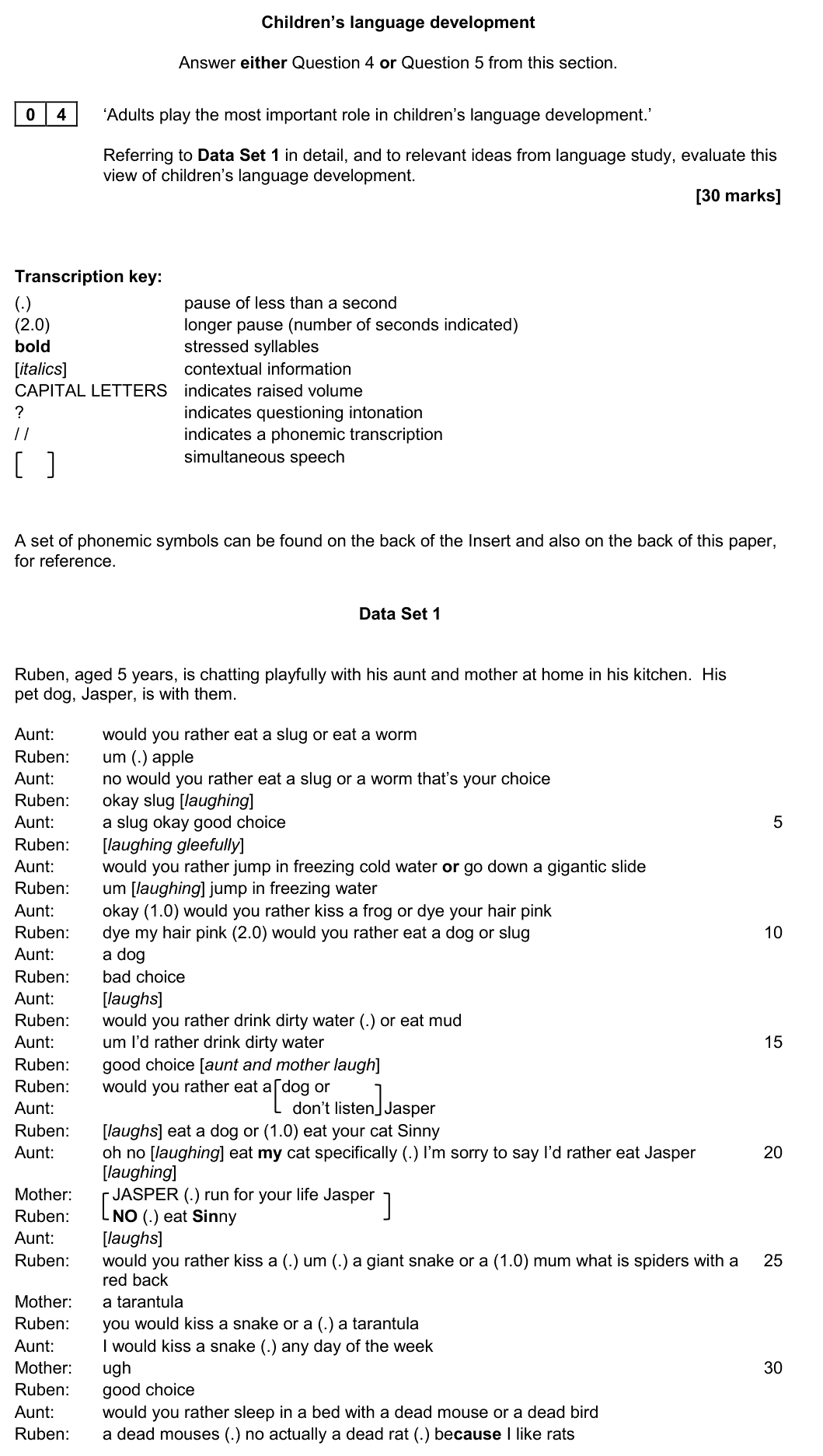
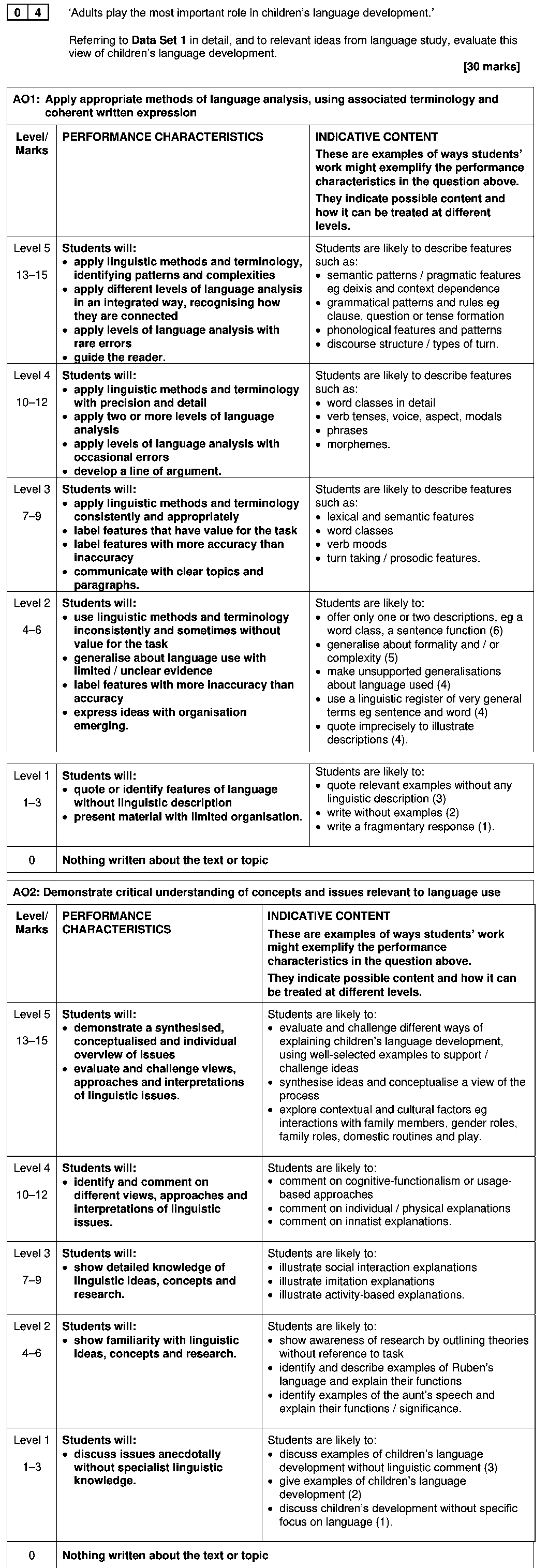
June 2024 · Paper 1 · Q4 30 marks AO1=15, AO2=15 Child language essay child language speechchild language theories
Children’s language development
Answer either Question 4 or Question 5 from this section.
‘Adults play the most important role in children’s language development.’
Referring to Data Set 1 in detail, and to relevant ideas from language study, evaluate this
view of children’s language development.
[30 marks]
Transcription key:
(.)
pause of less than a second
(2.0)
longer pause (number of seconds indicated)
bold
stressed syllables
[italics]
contextual information
CAPITAL LETTERS indicates raised volume
?
indicates questioning intonation
/ /
indicates a phonemic transcription
simultaneous speech
A set of phonemic symbols can be found on the back of the Insert and also on the back of this paper,
for reference.
Data Set 1
Ruben, aged 5 years, is chatting playfully with his aunt and mother at home in his kitchen. His
pet dog, Jasper, is with them.
Aunt:
would you rather eat a slug or eat a worm
Ruben:
um (.) apple
Aunt:
no would you rather eat a slug or a worm that’s your choice
Ruben:
okay slug [laughing]
Aunt:
a slug okay good choice
Ruben:
[laughing gleefully]
would you rather jump in freezing cold water or go down a gigantic slide
Aunt:
Ruben:
um [laughing] jump in freezing water
Aunt:
okay (1.0) would you rather kiss a frog or dye your hair pink
Ruben:
dye my hair pink (2.0) would you rather eat a dog or slug
Aunt:
a dog
Ruben:
bad choice
Aunt:
[laughs]
Ruben:
would you rather drink dirty water (.) or eat mud
Aunt:
um I’d rather drink dirty water
Ruben:
good choice [aunt and mother laugh]
Ruben:
would you rather eat a dog or
Aunt:
don’t listen Jasper
Ruben:
[laughs] eat a dog or (1.0) eat your cat Sinny
oh no [laughing] eat my cat specifically (.) I’m sorry to say I’d rather eat Jasper
Aunt:
[laughing]
Mother:
JASPER (.) run for your life Jasper
NO (.) eat Sinny
Ruben:
Aunt:
[laughs]
Ruben:
would you rather kiss a (.) um (.) a giant snake or a (1.0) mum what is spiders with a
red back
Mother:
a tarantula
Ruben:
you would kiss a snake or a (.) a tarantula
Aunt:
I would kiss a snake (.) any day of the week
Mother:
ugh
Ruben:
good choice
Aunt:
would you rather sleep in a bed with a dead mouse or a dead bird
a dead mouses (.) no actually a dead rat (.) because I like rats
Ruben:
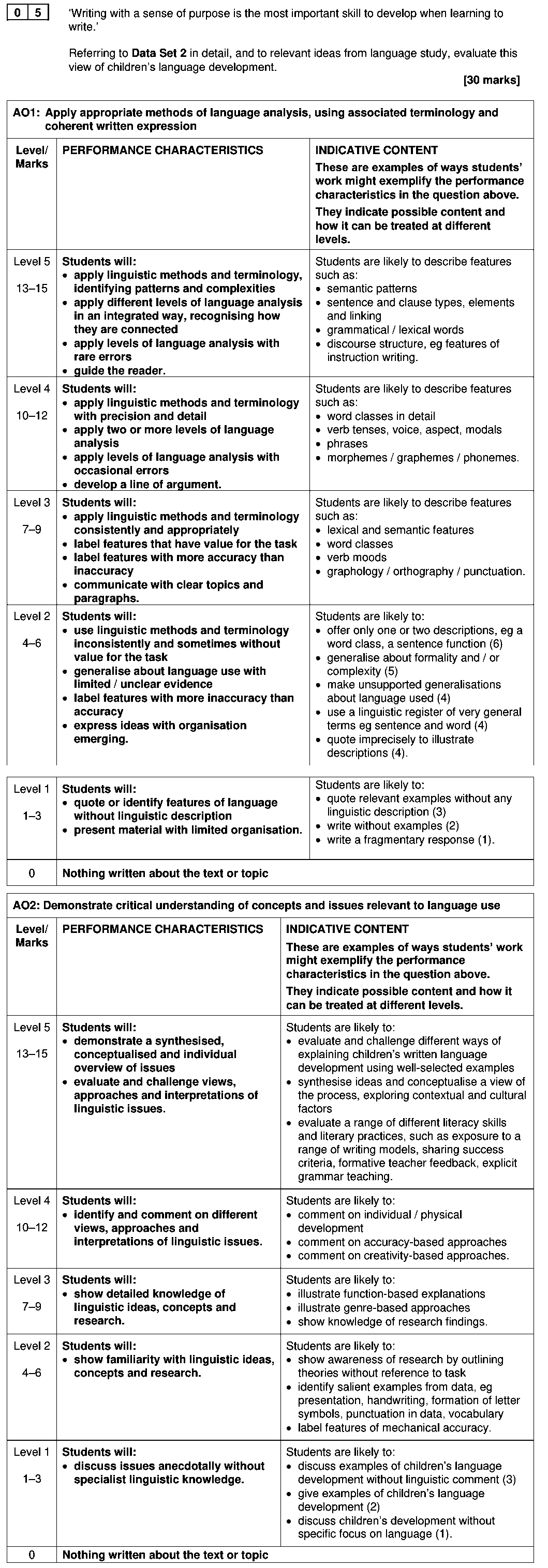
June 2024 · Paper 1 · Q5 30 marks AO1=15, AO2=15 Child language essay child language literacychild language theories
Children’s language development
Answer either Question 4 or Question 5 from this section.
‘Writing with a sense of purpose is the most important skill to develop when learning
to write.’
Referring to Data Set 2 in detail, and to relevant ideas from language study, evaluate this
view of children’s language development.
[30 marks]
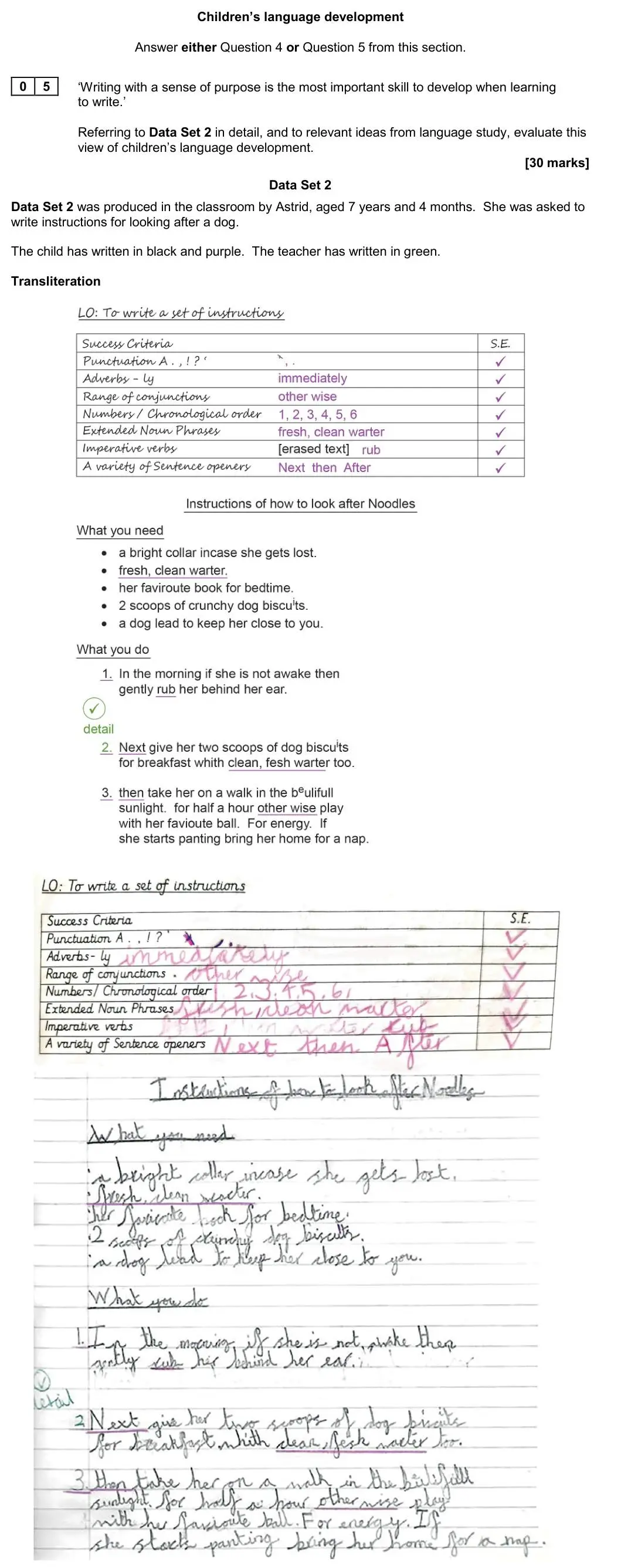
Data Set 2
Data Set 2 was produced in the classroom by Astrid, aged 7 years and 4 months. She was asked to
write instructions for looking after a dog.
The child has written in black and purple. The teacher has written in green.
Transliteration
[image]
[image]
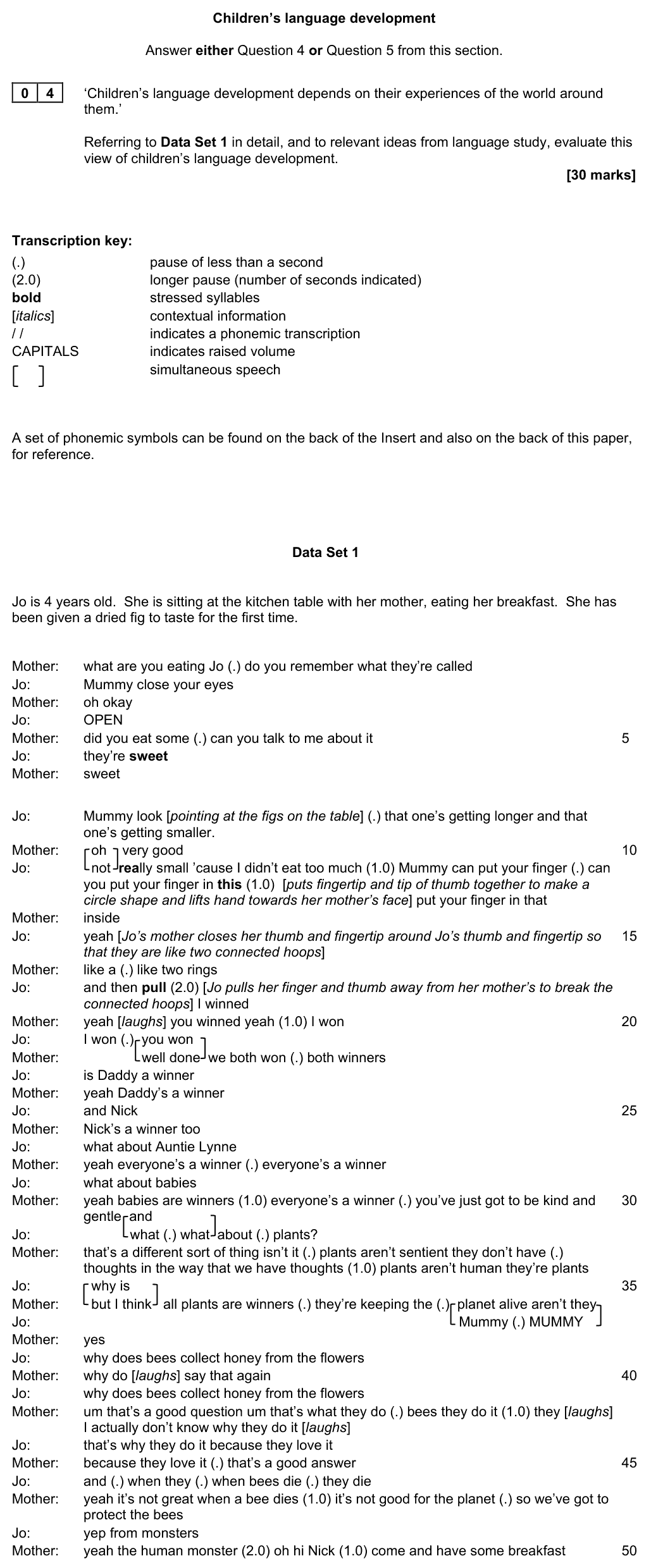
June 2023 · Paper 1 · Q4 30 marks AO1=15, AO2=15 Child language essay child language speechchild language theories
Children’s language development
Answer either Question 4 or Question 5 from this section.
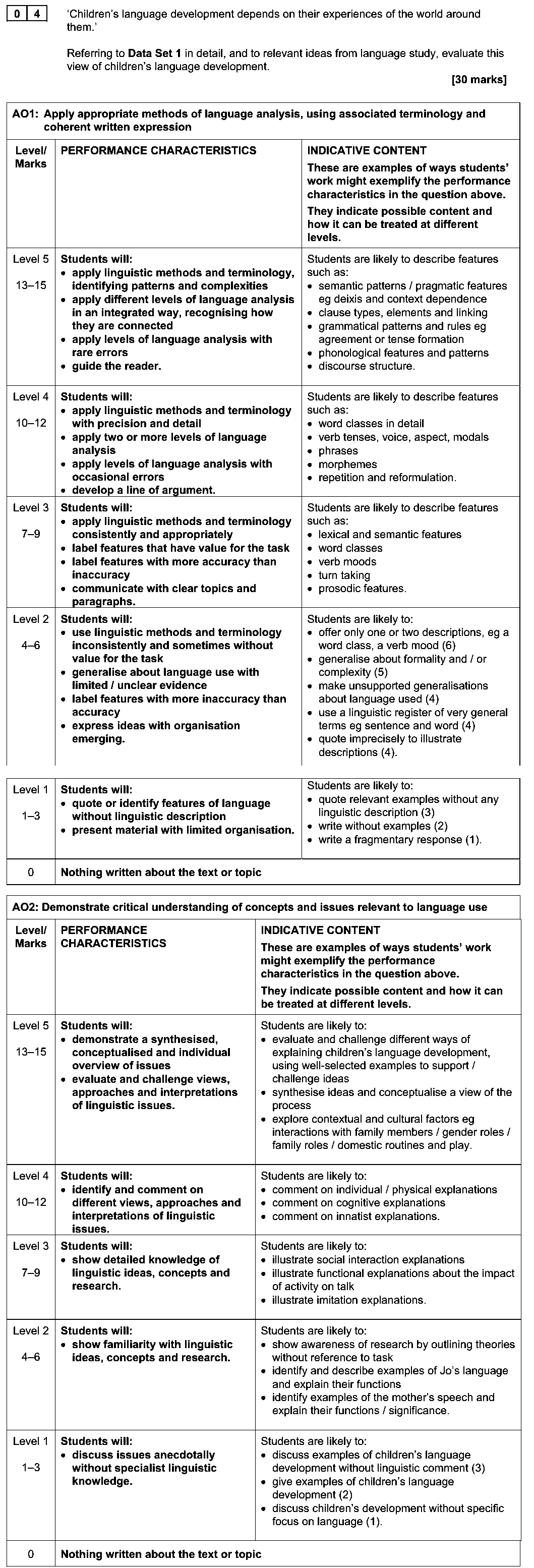
‘Children’s language development depends on their experiences of the world around
them.’
Referring to Data Set 1 in detail, and to relevant ideas from language study, evaluate this
view of children’s language development.
[30 marks]
Transcription key:
(.)
pause of less than a second
(2.0)
longer pause (number of seconds indicated)
bold
stressed syllables
[italics]
contextual information
/ /
indicates a phonemic transcription
CAPITALS
indicates raised volume
simultaneous speech
A set of phonemic symbols can be found on the back of the Insert and also on the back of this paper,
for reference.
Data Set 1
Jo is 4 years old. She is sitting at the kitchen table with her mother, eating her breakfast. She has
been given a dried fig to taste for the first time.
Mother:
what are you eating Jo (.) do you remember what they’re called
Jo:
Mummy close your eyes
Mother:
oh okay
Jo:
OPEN
Mother:
did you eat some (.) can you talk to me about it
they’re sweet
Jo:
Mother:
sweet
Jo:
Mummy look [pointing at the figs on the table] (.) that one’s getting longer and that
one’s getting smaller.
Mother:
oh very good
not really small ’cause I didn’t eat too much (1.0) Mummy can put your finger (.) can
Jo:
you put your finger in this (1.0) [puts fingertip and tip of thumb together to make a
circle shape and lifts hand towards her mother’s face] put your finger in that
Mother:
inside
Jo:
yeah [Jo’s mother closes her thumb and fingertip around Jo’s thumb and fingertip so
that they are like two connected hoops]
Mother:
like a (.) like two rings
and then pull (2.0) [Jo pulls her finger and thumb away from her mother’s to break the
Jo:
connected hoops] I winned
Mother:
yeah [laughs] you winned yeah (1.0) I won
Jo:
I won (.) you won
Mother:
well done we both won (.) both winners
Jo:
is Daddy a winner
Mother:
yeah Daddy’s a winner
Jo:
and Nick
Mother:
Nick’s a winner too
Jo:
what about Auntie Lynne
Mother:
yeah everyone’s a winner (.) everyone’s a winner
Jo:
what about babies
Mother:
yeah babies are winners (1.0) everyone’s a winner (.) you’ve just got to be kind and
gentle and
Jo:
what (.) what about (.) plants?
Mother:
that’s a different sort of thing isn’t it (.) plants aren’t sentient they don’t have (.)
thoughts in the way that we have thoughts (1.0) plants aren’t human they’re plants
Jo:
why is
Mother:
but I think all plants are winners (.) they’re keeping the (.) planet alive aren’t they
Jo:
Mummy (.) MUMMY
Mother:
yes
Jo:
why does bees collect honey from the flowers
Mother:
why do [laughs] say that again
Jo:
why does bees collect honey from the flowers
Mother:
um that’s a good question um that’s what they do (.) bees they do it (1.0) they [laughs]
I actually don’t know why they do it [laughs]
Jo:
that’s why they do it because they love it
Mother:
because they love it (.) that’s a good answer
Jo:
and (.) when they (.) when bees die (.) they die
Mother:
yeah it’s not great when a bee dies (1.0) it’s not good for the planet (.) so we’ve got to
protect the bees
Jo:
yep from monsters
Mother:
yeah the human monster (2.0) oh hi Nick (1.0) come and have some breakfast
June 2023 · Paper 1 · Q5 30 marks AO1=15, AO2=15 Child language essay child language literacychild language theories
Children’s language development
Answer either Question 4 or Question 5 from this section.
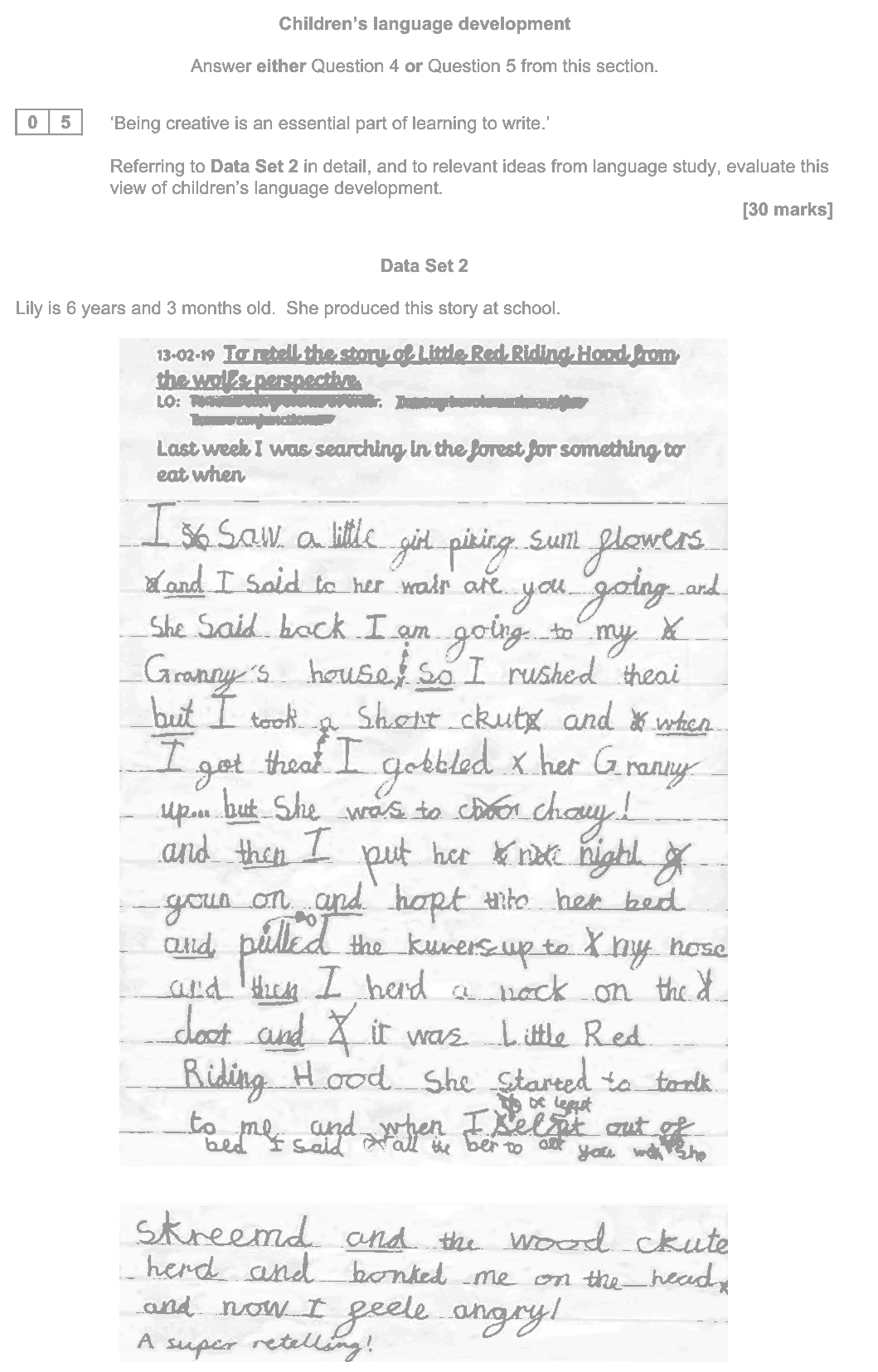
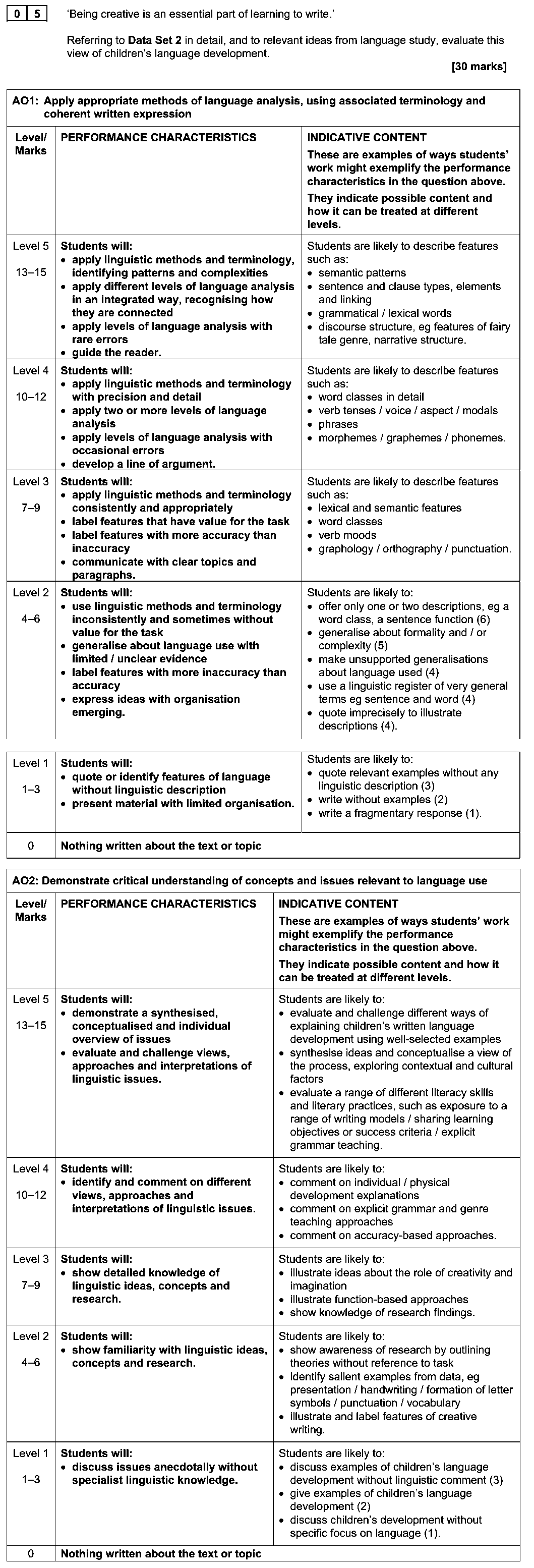
‘Being creative is an essential part of learning to write.’
Referring to Data Set 2 in detail, and to relevant ideas from language study, evaluate this
view of children’s language development.
[30 marks]
Data Set 2
Lily is 6 years and 3 months old. She produced this story at school.
[image]
June 2022 · Paper 1 · Q4 30 marks AO1=15, AO2=15 Child language essay child language speechchild language theories
Children’s language development
Answer either Question 4 or Question 5 from this section.
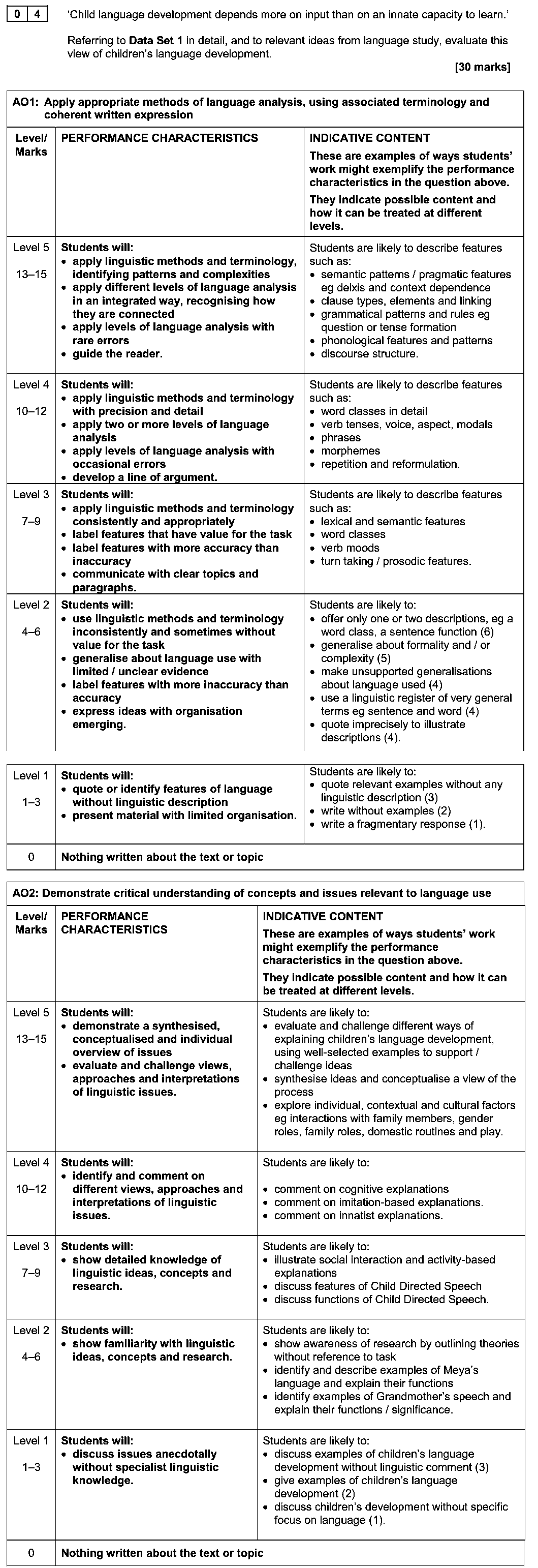
‘Child language development depends more on input than on an innate capacity to learn.’
Referring to Data Set 1 in detail, and to relevant ideas from language study, evaluate this
view of children’s language development.
[30 marks]
Transcription key:
(.)
pause of less than a second
(2.0)
longer pause (number of seconds indicated)
bold
stressed syllables
[italics]
contextual information
CAPITAL LETTERS indicate raised volume
?
indicates questioning intonation
/ /
indicates a phonemic transcription
simultaneous speech
A set of phonemic symbols can be found on the back of the insert and also on the back of this paper,
for reference.
Data Set 1
Meya is 24 months old. She is working on a jigsaw with her grandmother on the living room floor at
home. Her grandfather, sitting nearby, is reading. Meya’s mum is filming.
Grandmother: look (.) [points at the bees on jigsaw piece] (.) bzzzz (.) buzzy bees (.) MEYA
Meya:
hmm?
Grandmother: buzzy bees
Meya:
[points at jigsaw piece] BEES
Grandmother: bees bzz zz
Meya:
bzz zz [laughs]
Grandmother: what else have you got here [points at puzzle piece showing mouse’s tail] (2.0)
ooh (.) mouse’s tail
Meya:
/ɒ/ [picks up jigsaw piece with mouse’s tail and hands to grandmother]
Grandmother: /ɒ/ (.) where’s the other mouse
Meya:
um (1.0) other mouse
Grandmother: where’s the other picture of the mouse (1.0) where’s it gone
Meya:
where’s it gone [raises shoulders and arms to indicate uncertainty]
Grandmother: where is it (.) it’s here somewhere
Meya:
hmm?
Grandmother: it’s here somewhere
it’s gone (.) get it Nan (2.0)
Meya:
Grandmother:
where’s it gone (.) have you moved it (.) have you
moved it
get it
Meya:
Grandmother:
where’s the mouse
Meya:
/mɒg/ /ɪ/ lounge?
Grandmother: where is he
Mum:
in the lounge?
’sgone (1.0) [inaudible] it
Meya:
Grandmother: well where’s it gone (1.0) I can’t see it anywhere
Meya:
what
Grandmother: I can’t see the mouse
Grandfather:
the mouse is HERE
Grandmother:
AHH
Mum:
AHH
Grandmother: GO GET THE MOUSE (3.0) [Meya runs to fetch puzzle piece from her
grandfather and gives it to her grandmother] oh [laughs](.) thank you (.) [adds
piece to puzzle] there (3.0) now where’s the mouse’s nose (1.0) LOOK Meya (.)
where’s the nose
June 2022 · Paper 1 · Q5 30 marks AO1=15, AO2=15 Child language essay child language literacychild language theories
Children’s language development
Answer either Question 4 or Question 5 from this section.
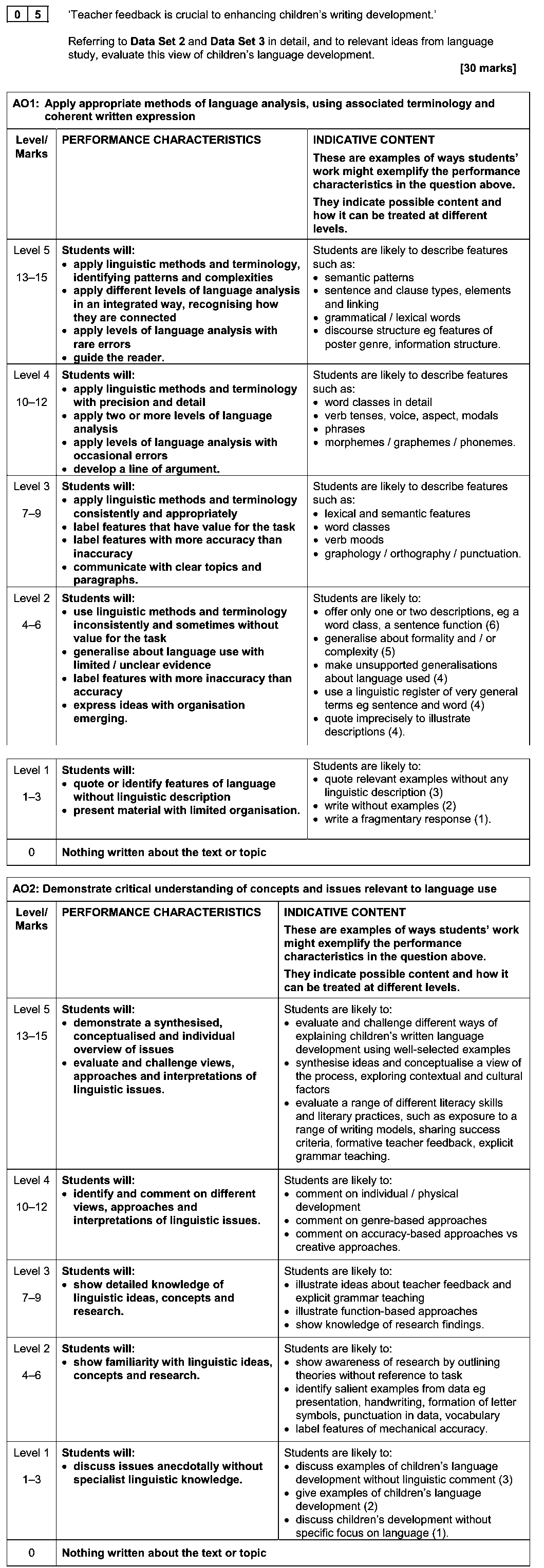
‘Teacher feedback is crucial to enhancing children’s writing development.’
Referring to Data Set 2 and Data Set 3 in detail, and to relevant ideas from language
study, evaluate this view of children’s language development.
[30 marks]
Data Set 2
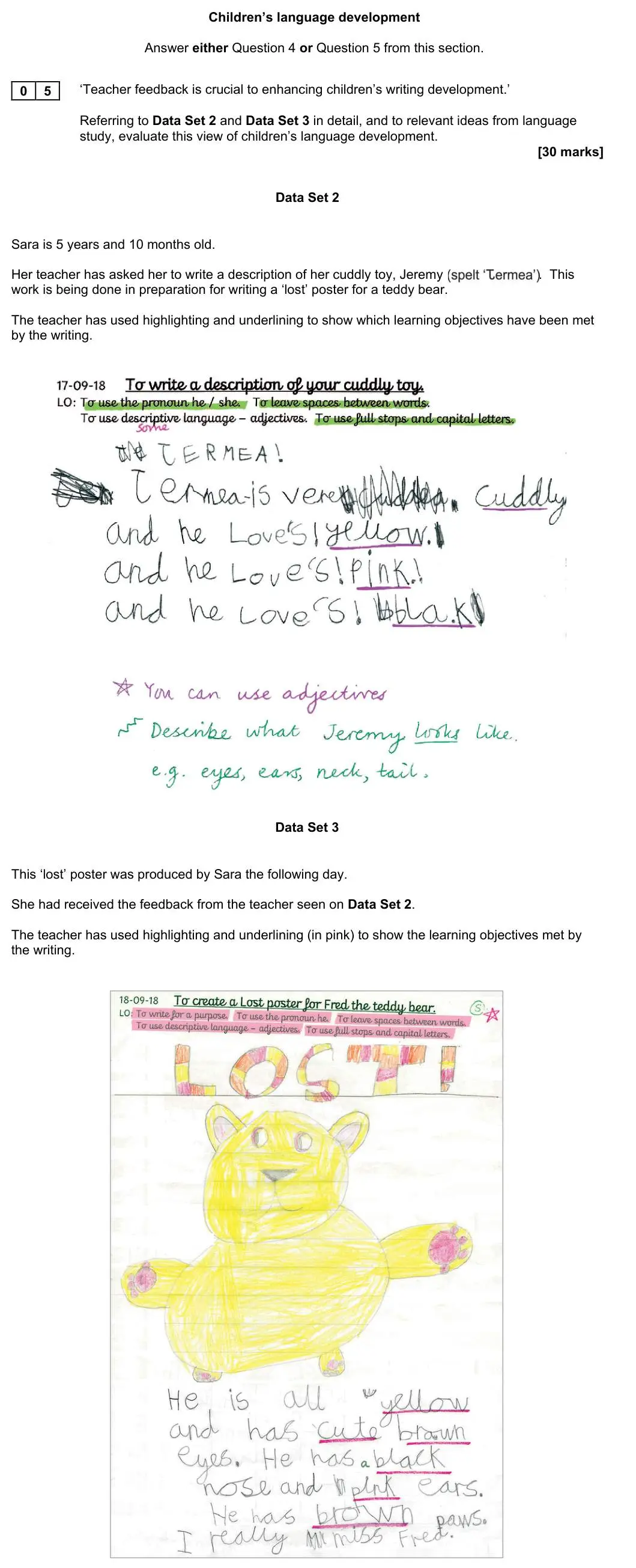
Sara is 5 years and 10 months old.
Her teacher has asked her to write a description of her cuddly toy, Jeremy . This
[image]
work is being done in preparation for writing a ‘lost’ poster for a teddy bear.
The teacher has used highlighting and underlining to show which learning objectives have been met
by the writing.
[image]
Data Set 3
This ‘lost’ poster was produced by Sara the following day.
She had received the feedback from the teacher seen on Data Set 2.
The teacher has used highlighting and underlining (in pink) to show the learning objectives met by
the writing.
[image]
November 2021 · Paper 1 · Q4 30 marks AO1=15, AO2=15 Child language essay child language speechchild language theories
Children’s language development
Answer either Question 4 or Question 5 from this section.
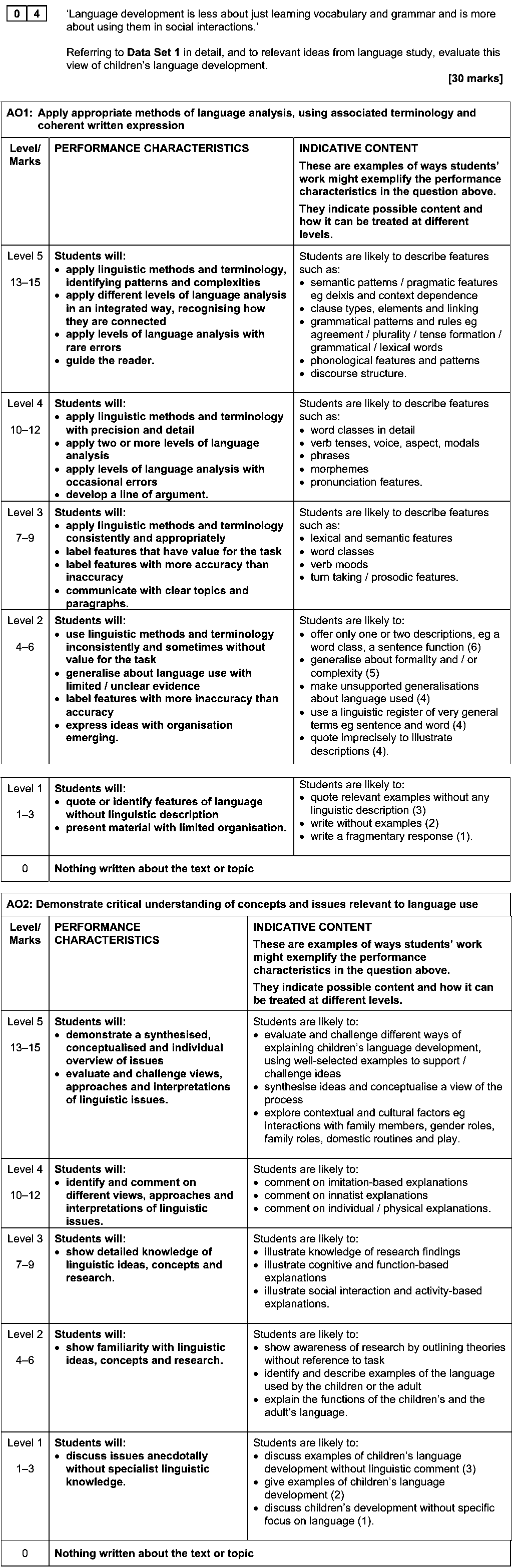
‘Language development is less about just learning vocabulary and grammar and is more
about using them in social interactions.’
Referring to Data Set 1 in detail, and to relevant ideas from language study, evaluate this
view of children’s language development.
[30 marks]
Transcription key:
(.)
pause of less than a second
(2.0)
longer pause (number of seconds indicated)
bold
stressed syllables
[italics]
contextual information
/ /
indicates a phonemic transcription
simultaneous speech
A set of phonemic symbols can be found on the back of the insert and also on the back of this paper,
for reference.
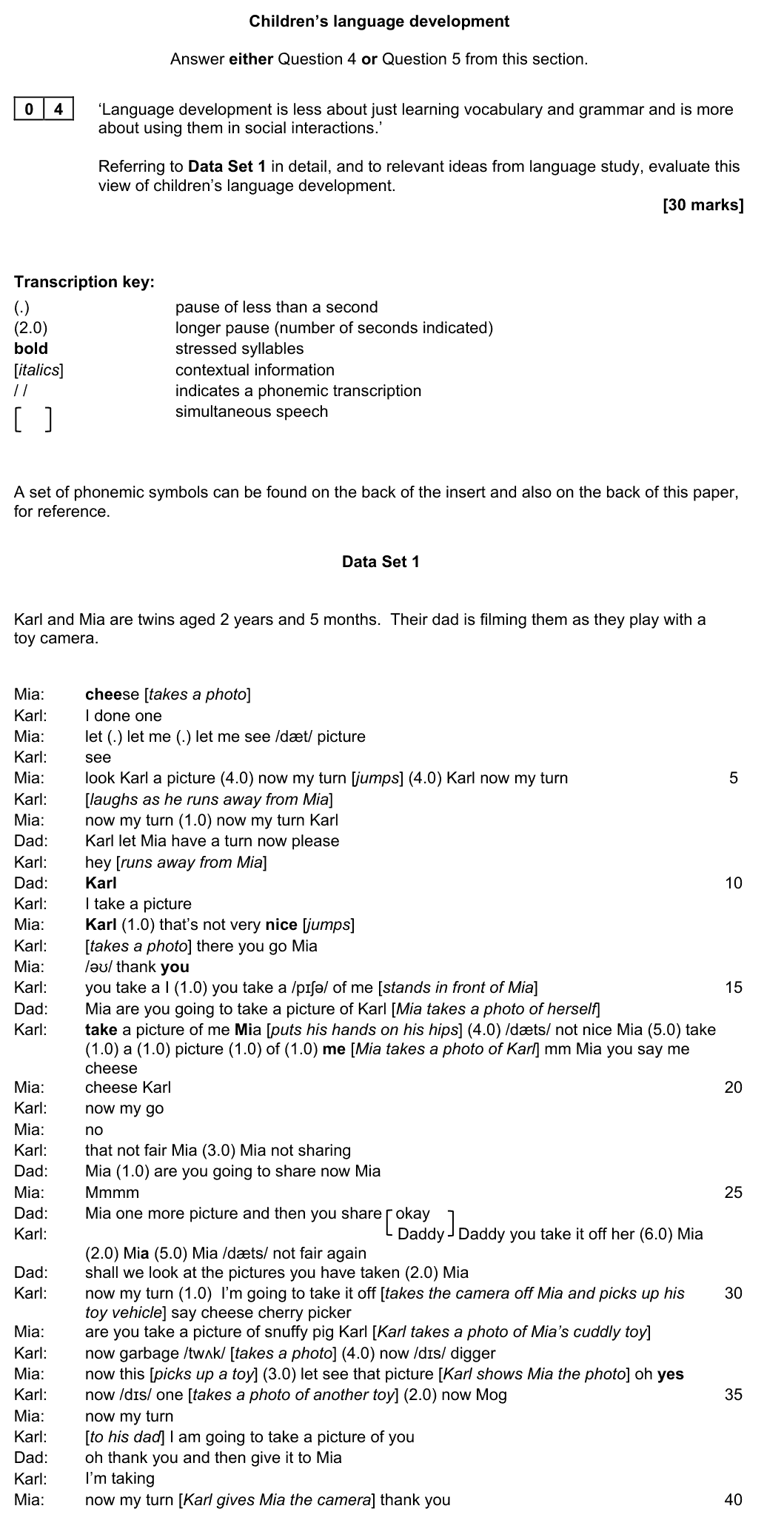
Data Set 1
Karl and Mia are twins aged 2 years and 5 months. Their dad is filming them as they play with a
toy camera.
cheese [takes a photo]
Mia:
Karl:
I done one
Mia:
let (.) let me (.) let me see /dæt/ picture
Karl:
see
Mia:
look Karl a picture (4.0) now my turn [jumps] (4.0) Karl now my turn
Karl:
[laughs as he runs away from Mia]
Mia:
now my turn (1.0) now my turn Karl
Dad:
Karl let Mia have a turn now please
Karl:
hey [runs away from Mia]
Karl
Dad:
Karl:
I take a picture
Karl (1.0) that’s not very nice [jumps]
Mia:
Karl:
[takes a photo] there you go Mia
/əʊ/ thank you
Mia:
Karl:
you take a I (1.0) you take a /pɪʃə/ of me [stands in front of Mia]
Dad:
Mia are you going to take a picture of Karl [Mia takes a photo of herself]
take a picture of me Mia [puts his hands on his hips] (4.0) /dæts/ not nice Mia (5.0) take
Karl:
(1.0) a (1.0) picture (1.0) of (1.0) me [Mia takes a photo of Karl] mm Mia you say me
cheese
cheese Karl
Mia:
Karl:
now my go
Mia:
no
Karl:
that not fair Mia (3.0) Mia not sharing
Mia (1.0) are you going to share now Mia
Dad:
Mia:
Mmmm
Dad:
Mia one more picture and then you share okay
Karl:
Daddy Daddy you take it off her (6.0) Mia
(2.0) Mia (5.0) Mia /dæts/ not fair again
Dad:
shall we look at the pictures you have taken (2.0) Mia
Karl:
now my turn (1.0) I’m going to take it off [takes the camera off Mia and picks up his
toy vehicle] say cheese cherry picker
Mia:
are you take a picture of snuffy pig Karl [Karl takes a photo of Mia’s cuddly toy]
Karl:
now garbage /twʌk/ [takes a photo] (4.0) now /dɪs/ digger
now this [picks up a toy] (3.0) let see that picture [Karl shows Mia the photo] oh yes
Mia:
Karl:
now /dɪs/ one [takes a photo of another toy] (2.0) now Mog
Mia:
now my turn
Karl:
[to his dad] I am going to take a picture of you
Dad:
oh thank you and then give it to Mia
I’m taking
Karl:
Mia:
now my turn [Karl gives Mia the camera] thank you
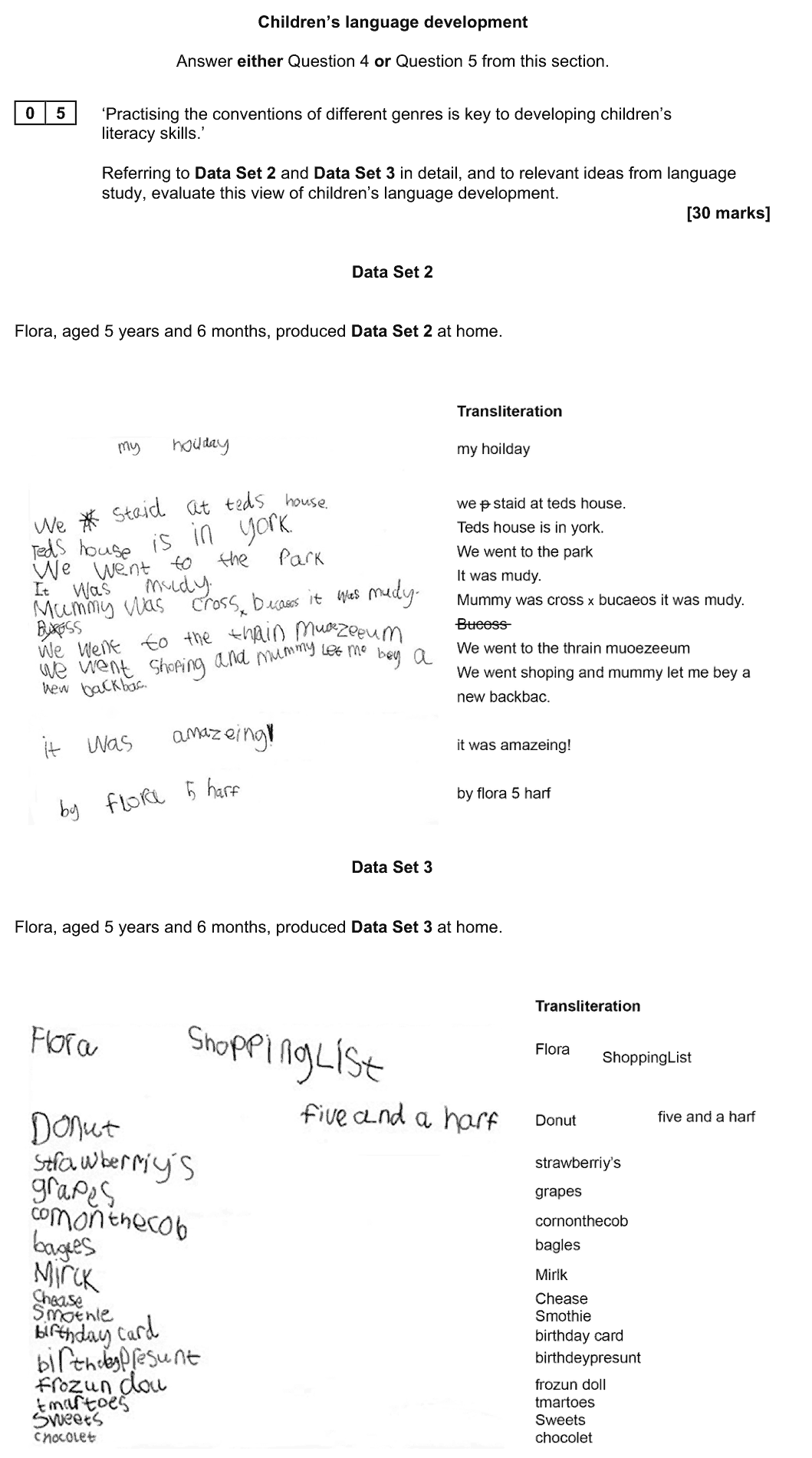
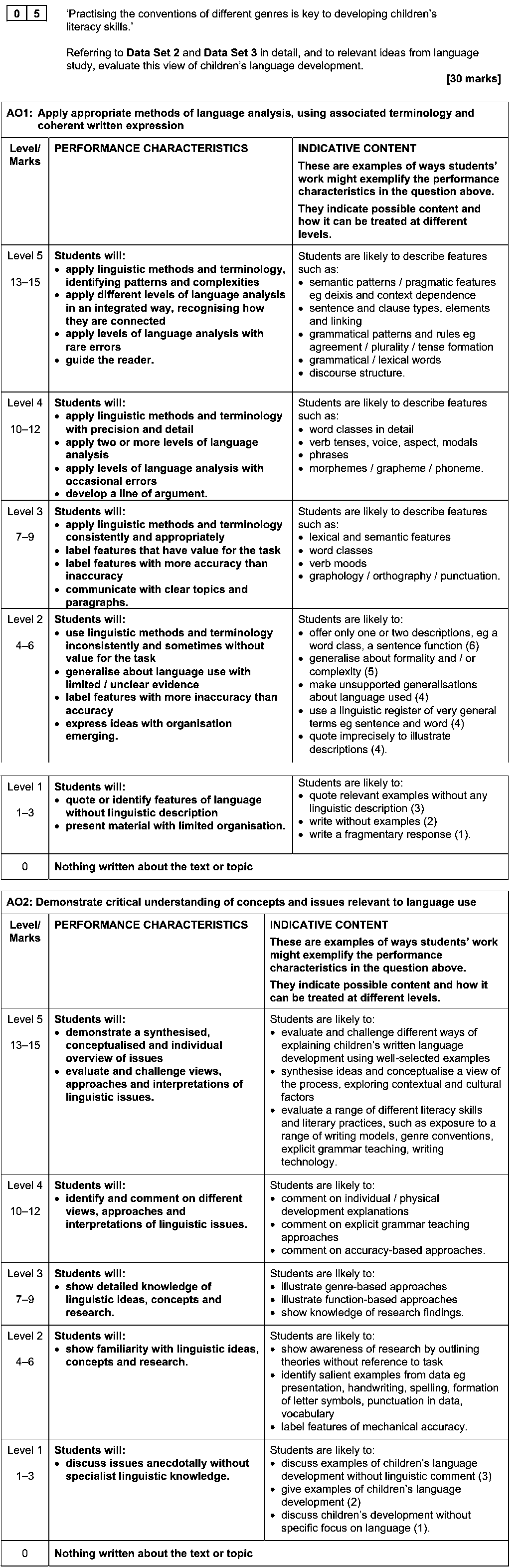
November 2021 · Paper 1 · Q5 30 marks AO1=15, AO2=15 Child language essay child language literacychild language theories
Children’s language development
Answer either Question 4 or Question 5 from this section.
‘Practising the conventions of different genres is key to developing children’s
literacy skills.’
Referring to Data Set 2 and Data Set 3 in detail, and to relevant ideas from language
study, evaluate this view of children’s language development.
[30 marks]
Data Set 2
Flora, aged 5 years and 6 months, produced Data Set 2 at home.
[image]
Data Set 3
Flora, aged 5 years and 6 months, produced Data Set 3 at home.
[image]
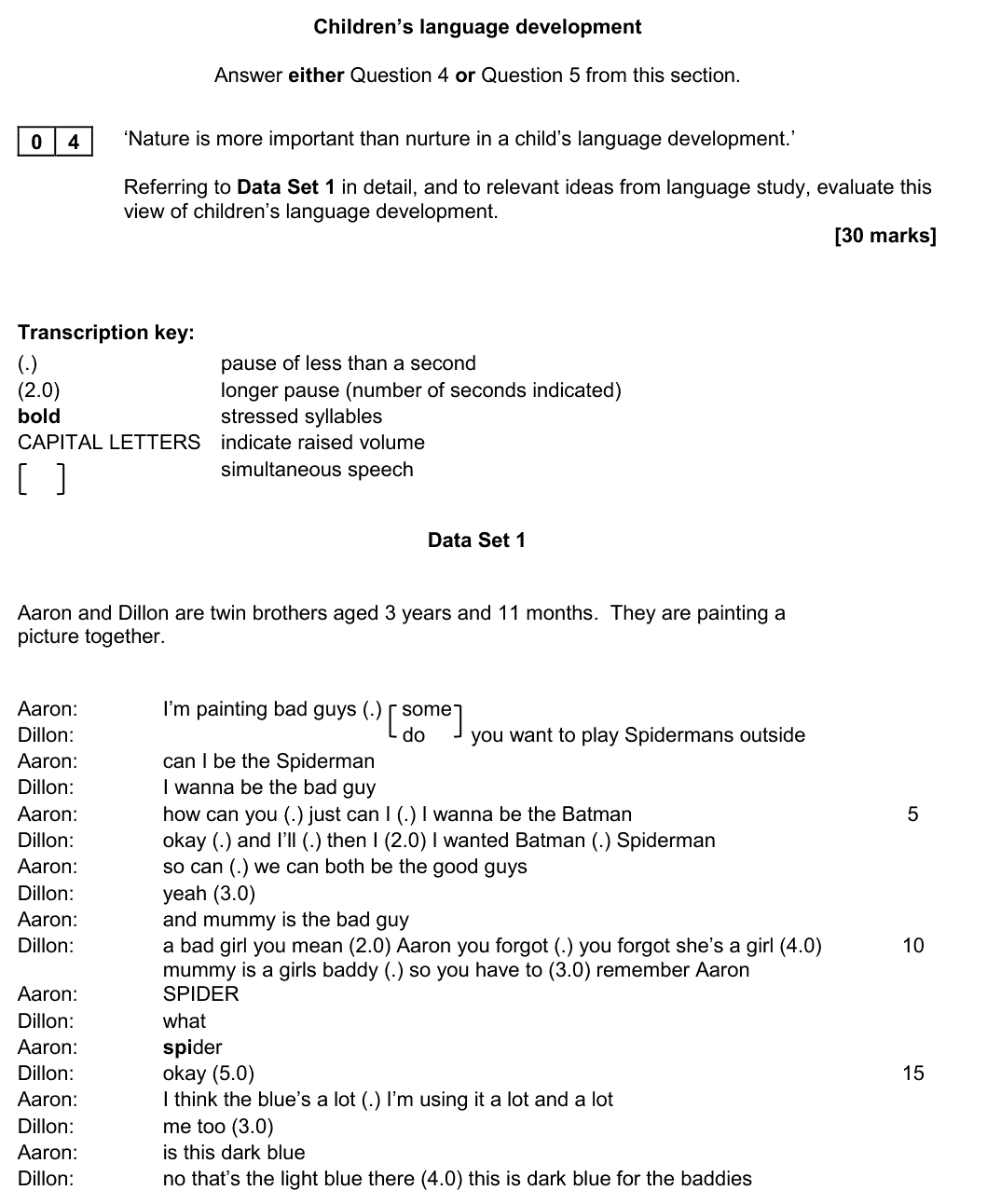
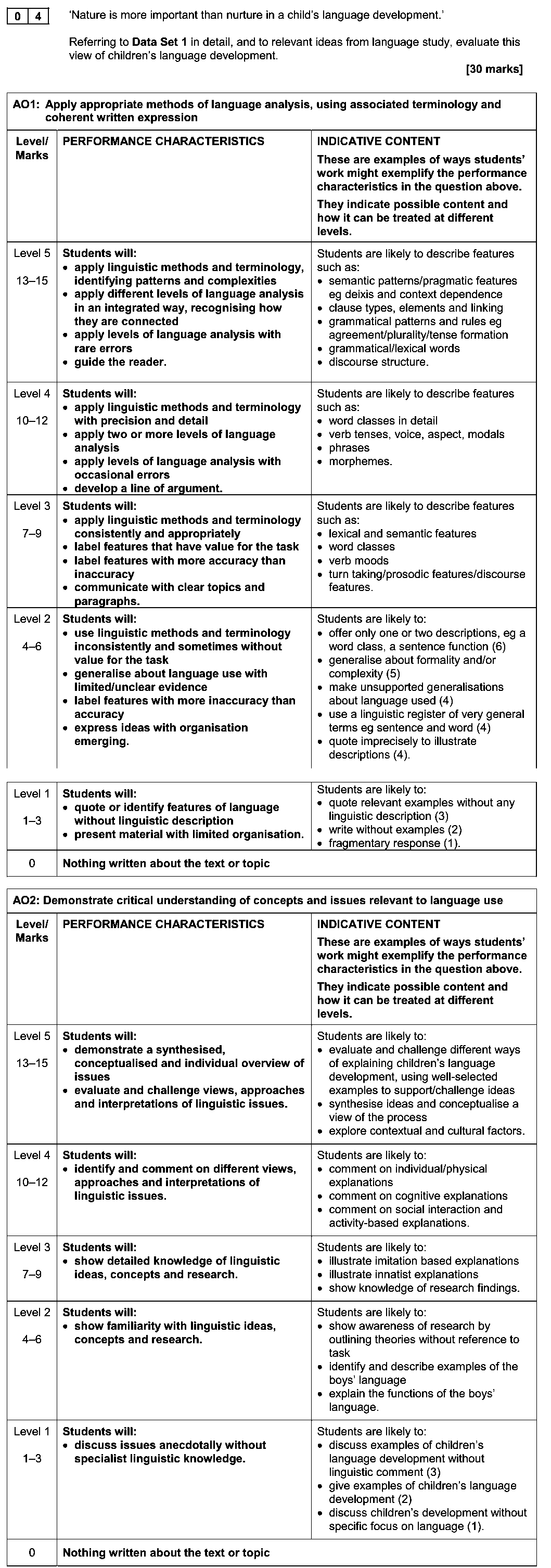
November 2020 · Paper 1 · Q4 30 marks AO1=15, AO2=15 Child language essay child language speechchild language theories
Children’s language development
Answer either Question 4 or Question 5 from this section.
‘Nature is more important than nurture in a child’s language development.’
Referring to Data Set 1 in detail, and to relevant ideas from language study, evaluate this
view of children’s language development.
[30 marks]
Transcription key:
(.)
pause of less than a second
(2.0)
longer pause (number of seconds indicated)
bold
stressed syllables
CAPITAL LETTERS indicate raised volume
simultaneous speech
Data Set 1
Aaron and Dillon are twin brothers aged 3 years and 11 months. They are painting a
picture together.
Aaron:
I’m painting bad guys (.) some
Dillon:
do you want to play Spidermans outside
Aaron:
can I be the Spiderman
Dillon:
I wanna be the bad guy
Aaron:
how can you (.) just can I (.) I wanna be the Batman
Dillon:
okay (.) and I’ll (.) then I (2.0) I wanted Batman (.) Spiderman
Aaron:
so can (.) we can both be the good guys
Dillon:
yeah (3.0)
Aaron:
and mummy is the bad guy
Dillon:
a bad girl you mean (2.0) Aaron you forgot (.) you forgot she’s a girl (4.0)
mummy is a girls baddy (.) so you have to (3.0) remember Aaron
Aaron:
SPIDER
Dillon:
what
spider
Aaron:
Dillon:
okay (5.0)
Aaron:
I think the blue’s a lot (.) I’m using it a lot and a lot
Dillon:
me too (3.0)
Aaron:
is this dark blue
Dillon:
no that’s the light blue there (4.0) this is dark blue for the baddies
November 2020 · Paper 1 · Q5 30 marks AO1=15, AO2=15 Child language essay child language literacychild language theories
Children’s language development
Answer either Question 4 or Question 5 from this section.
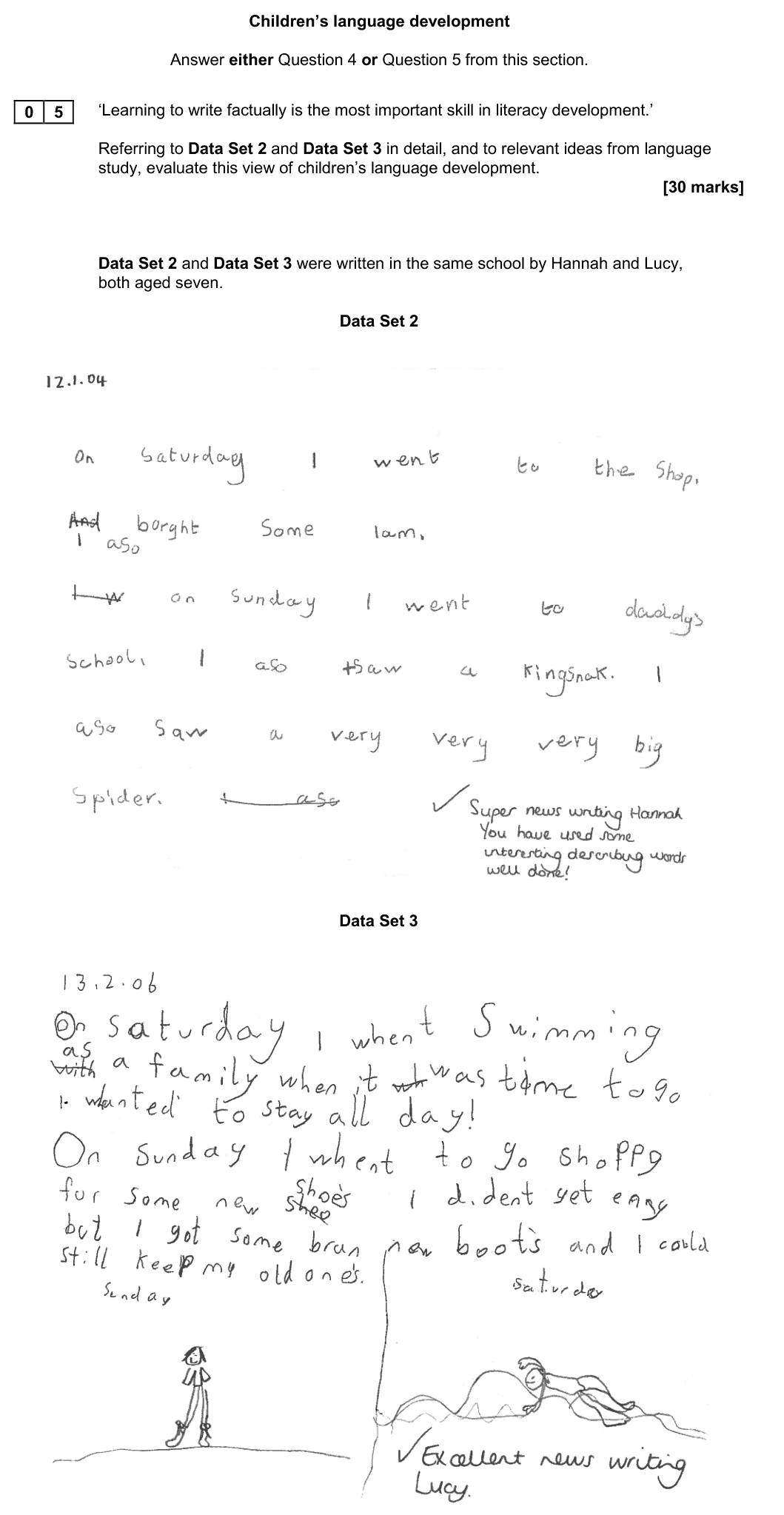
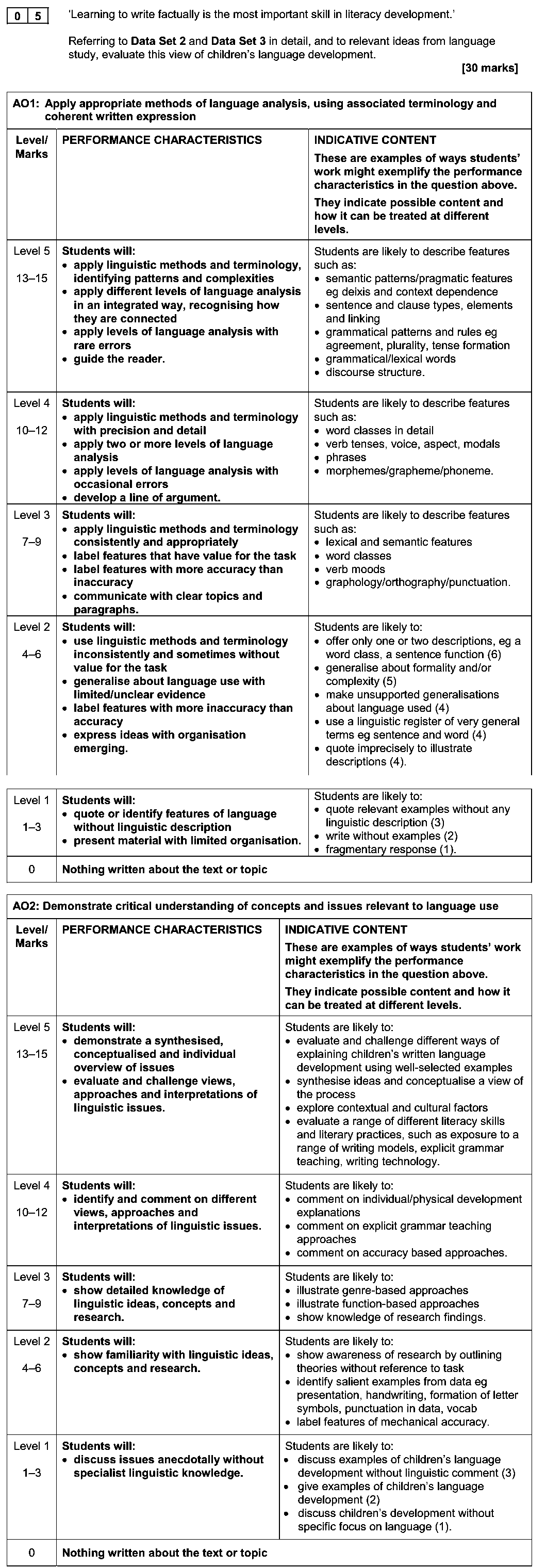
‘Learning to write factually is the most important skill in literacy development.’
Referring to Data Set 2 and Data Set 3 in detail, and to relevant ideas from language
study, evaluate this view of children’s language development.
[30 marks]
Data Set 2 and Data Set 3 were written in the same school by Hannah and Lucy,
both aged seven.
Data Set 2
[image]
Data Set 3
[image]
June 2019 · Paper 1 · Q4 30 marks AO1=15, AO2=15 Child language essay child language speechchild language theories
Children’s language development
Answer either Question 4 or Question 5 from this section.
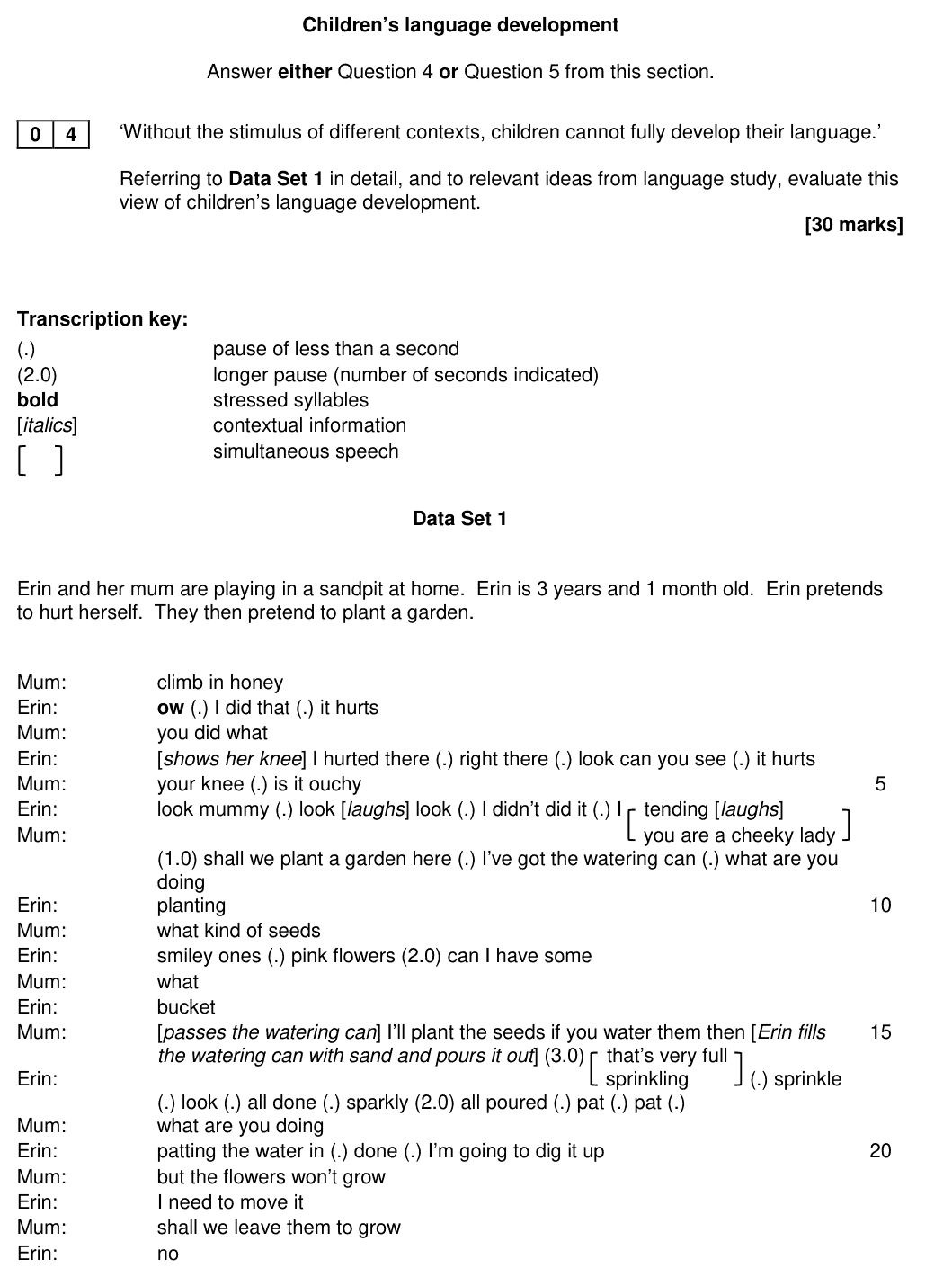
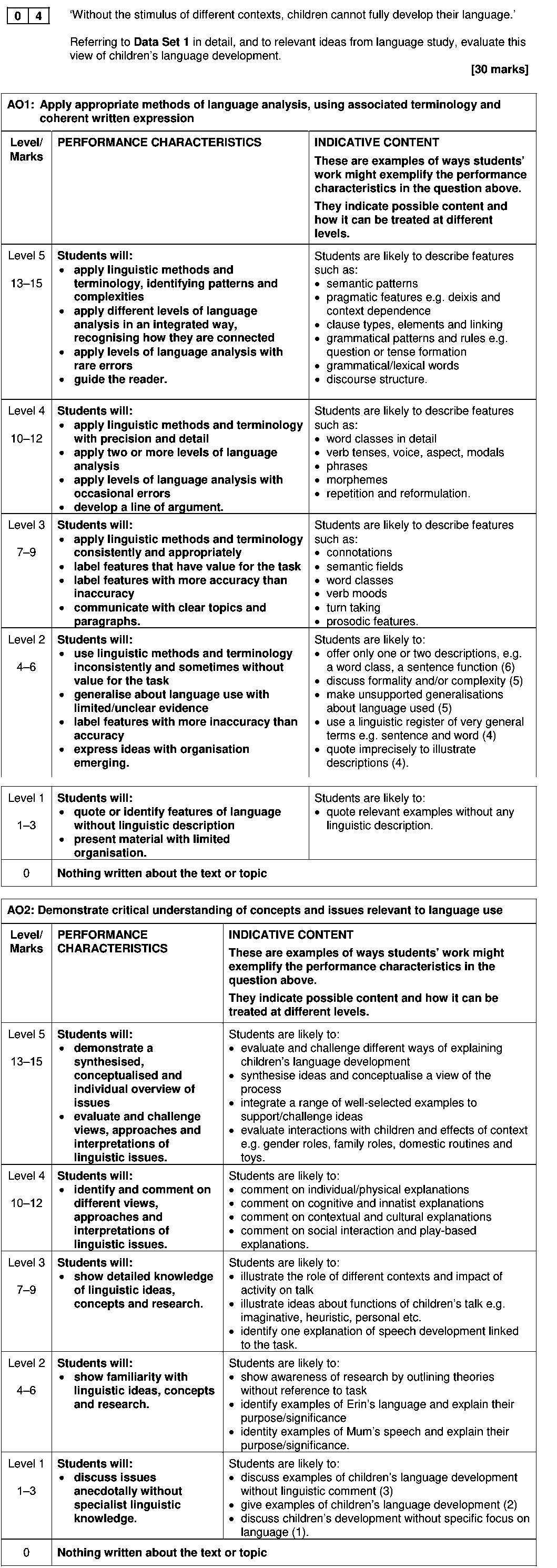
‘Without the stimulus of different contexts, children cannot fully develop their language.’
Referring to Data Set 1 in detail, and to relevant ideas from language study, evaluate this
view of children’s language development.
[30 marks]
Transcription key:
(.)
pause of less than a second
(2.0)
longer pause (number of seconds indicated)
bold
stressed syllables
[italics]
contextual information
simultaneous speech
Data Set 1
Erin and her mum are playing in a sandpit at home. Erin is 3 years and 1 month old. Erin pretends
to hurt herself. They then pretend to plant a garden.
Mum:
climb in honey
ow (.) I did that (.) it hurts
Erin:
Mum:
you did what
Erin:
[shows her knee] I hurted there (.) right there (.) look can you see (.) it hurts
Mum:
your knee (.) is it ouchy
Erin:
look mummy (.) look [laughs] look (.) I didn’t did it (.) I tending [laughs]
Mum:
you are a cheeky lady
(1.0) shall we plant a garden here (.) I’ve got the watering can (.) what are you
doing
Erin:
planting
Mum:
what kind of seeds
Erin:
smiley ones (.) pink flowers (2.0) can I have some
Mum:
what
Erin:
bucket
Mum:
[passes the watering can] I’ll plant the seeds if you water them then [Erin fills
the watering can with sand and pours it out] (3.0) that’s very full
Erin:
sprinkling (.) sprinkle
(.) look (.) all done (.) sparkly (2.0) all poured (.) pat (.) pat (.)
Mum:
what are you doing
Erin:
patting the water in (.) done (.) I’m going to dig it up
Mum:
but the flowers won’t grow
Erin:
I need to move it
Mum:
shall we leave them to grow
Erin:
no
June 2019 · Paper 1 · Q5 30 marks AO1=15, AO2=15 Child language essay child language literacychild language theories
Children’s language development
Answer either Question 4 or Question 5 from this section.
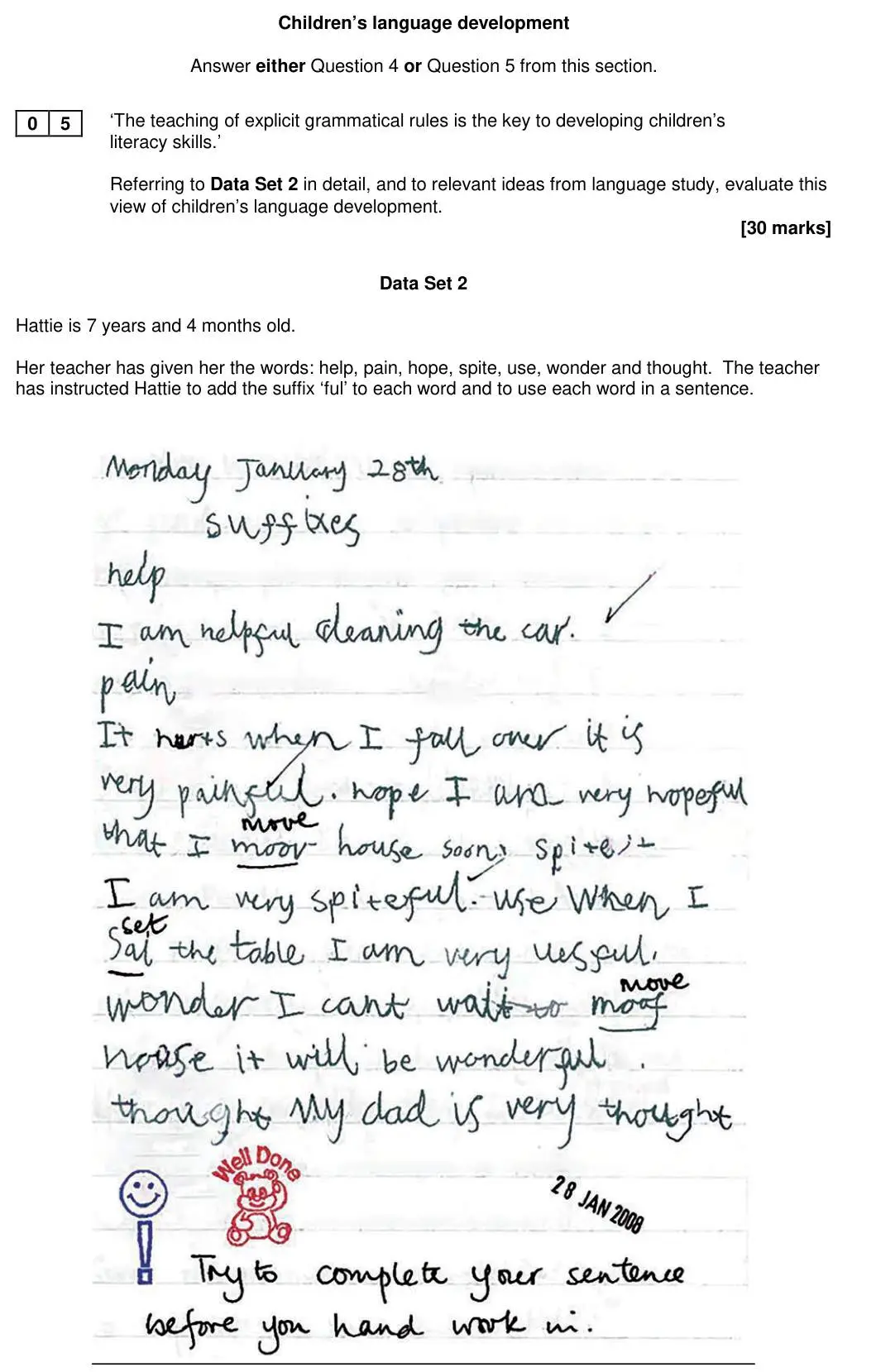
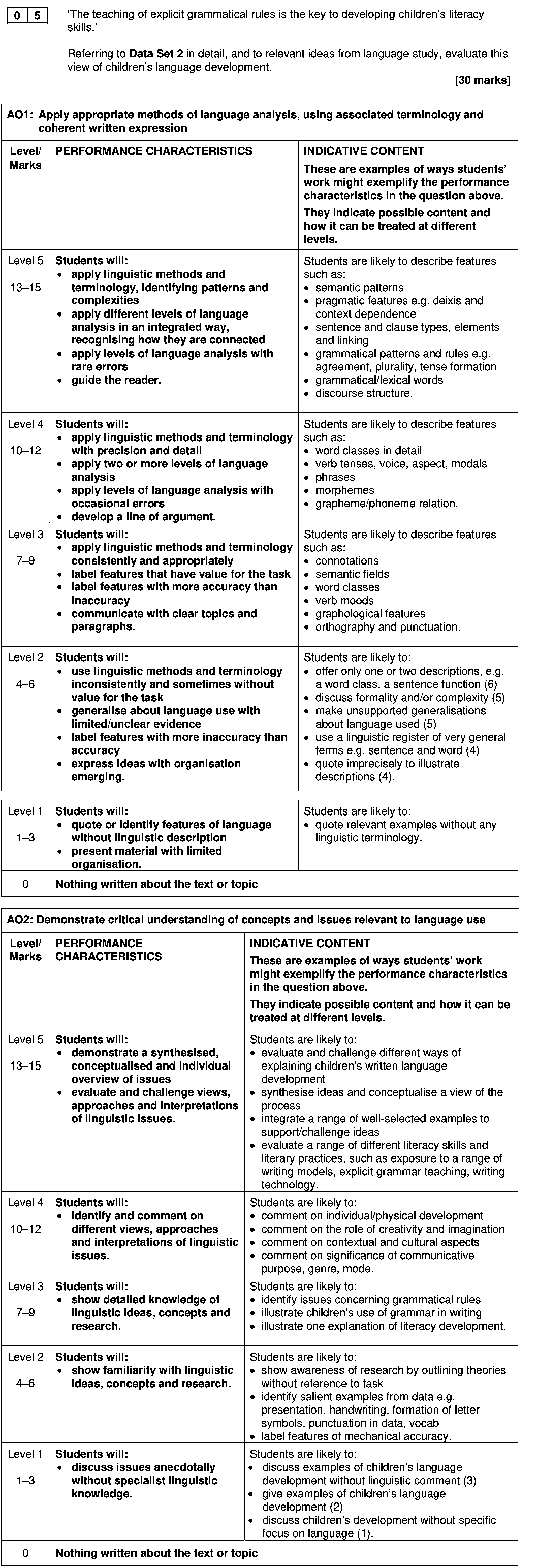
‘The teaching of explicit grammatical rules is the key to developing children’s
literacy skills.’
Referring to Data Set 2 in detail, and to relevant ideas from language study, evaluate this
view of children’s language development.
[30 marks]
Data Set 2
Hattie is 7 years and 4 months old.
Her teacher has given her the words: help, pain, hope, spite, use, wonder and thought. The teacher
has instructed Hattie to add the suffix ‘ful’ to each word and to use each word in a sentence.
[image]
June 2018 · Paper 1 · Q4 30 marks AO1=15, AO2=15 Child language essay child language speechchild language theories
Children’s language development
Answer either Question 4 or Question 5 from this section.
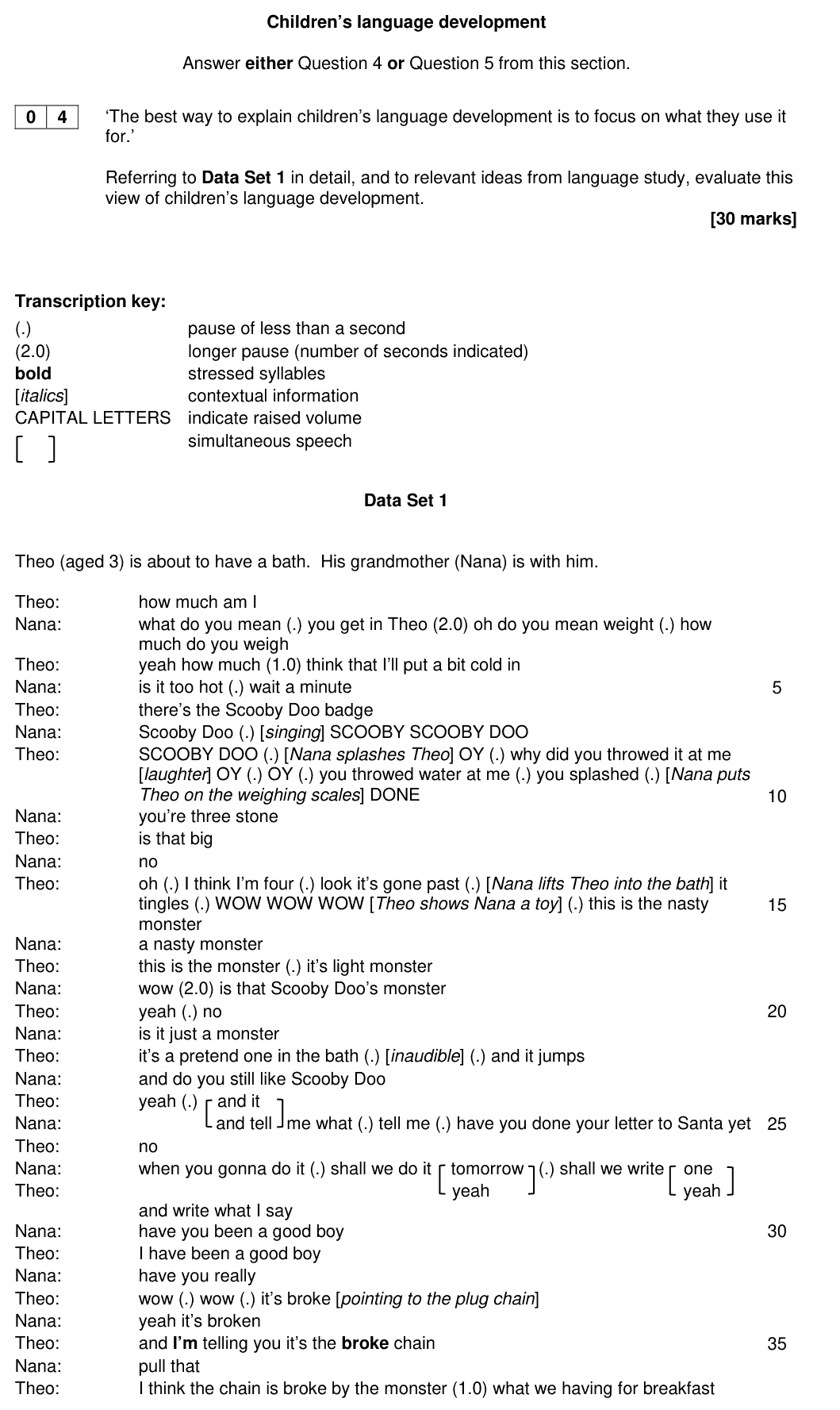
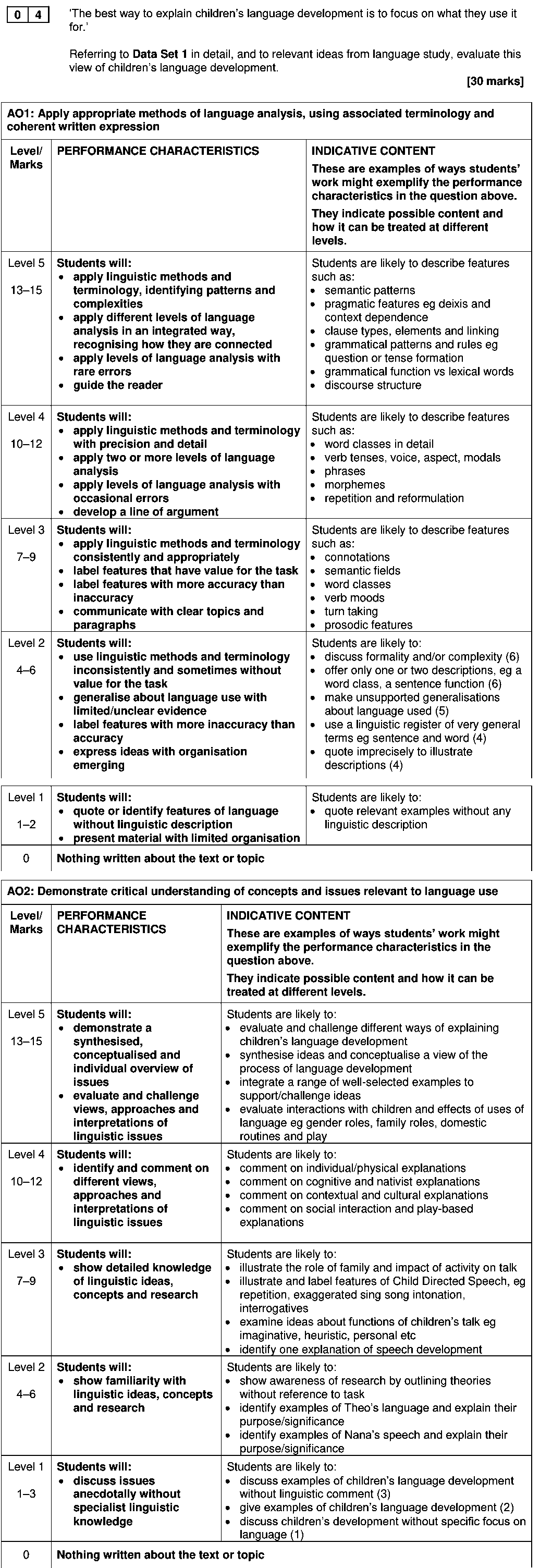
‘The best way to explain children’s language development is to focus on what they use it
for.’
Referring to Data Set 1 in detail, and to relevant ideas from language study, evaluate this
view of children’s language development.
[30 marks]
Transcription key:
(.)
pause of less than a second
(2.0)
longer pause (number of seconds indicated)
bold
stressed syllables
[italics]
contextual information
CAPITAL LETTERS indicate raised volume
simultaneous speech
Data Set 1
Theo (aged 3) is about to have a bath. His grandmother (Nana) is with him.
Theo:
how much am I
Nana:
what do you mean (.) you get in Theo (2.0) oh do you mean weight (.) how
much do you weigh
Theo:
yeah how much (1.0) think that I’ll put a bit cold in
Nana:
is it too hot (.) wait a minute
Theo:
there’s the Scooby Doo badge
Nana:
Scooby Doo (.) [singing] SCOOBY SCOOBY DOO
Theo:
SCOOBY DOO (.) [Nana splashes Theo] OY (.) why did you throwed it at me
[laughter] OY (.) OY (.) you throwed water at me (.) you splashed (.) [Nana puts
Theo on the weighing scales] DONE
Nana:
you’re three stone
Theo:
is that big
Nana:
no
Theo:
oh (.) I think I’m four (.) look it’s gone past (.) [Nana lifts Theo into the bath] it
tingles (.) WOW WOW WOW [Theo shows Nana a toy] (.) this is the nasty
monster
Nana:
a nasty monster
Theo:
this is the monster (.) it’s light monster
Nana:
wow (2.0) is that Scooby Doo’s monster
Theo:
yeah (.) no
Nana:
is it just a monster
Theo:
it’s a pretend one in the bath (.) [inaudible] (.) and it jumps
Nana:
and do you still like Scooby Doo
Theo:
yeah (.) and it
Nana:
and tell me what (.) tell me (.) have you done your letter to Santa yet 25
Theo:
no
Nana:
when you gonna do it (.) shall we do it tomorrow (.) shall we write one
Theo:
yeah
yeah
and write what I say
Nana:
have you been a good boy
Theo:
I have been a good boy
Nana:
have you really
Theo:
wow (.) wow (.) it’s broke [pointing to the plug chain]
Nana:
yeah it’s broken
and I’m telling you it’s the broke chain
Theo:
Nana:
pull that
Theo:
I think the chain is broke by the monster (1.0) what we having for breakfast
June 2018 · Paper 1 · Q5 30 marks AO1=15, AO2=15 Child language essay child language literacychild language theories
Children’s language development
Answer either Question 4 or Question 5 from this section.
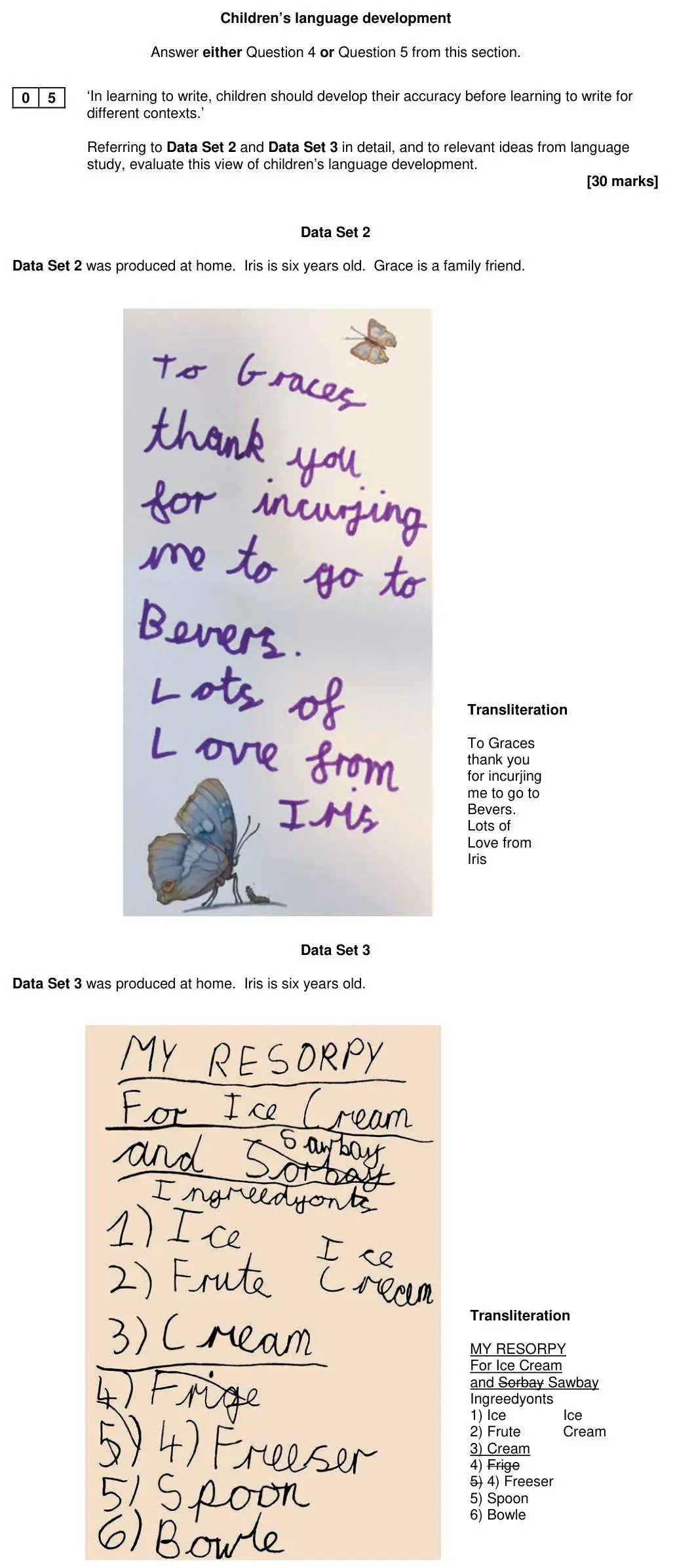
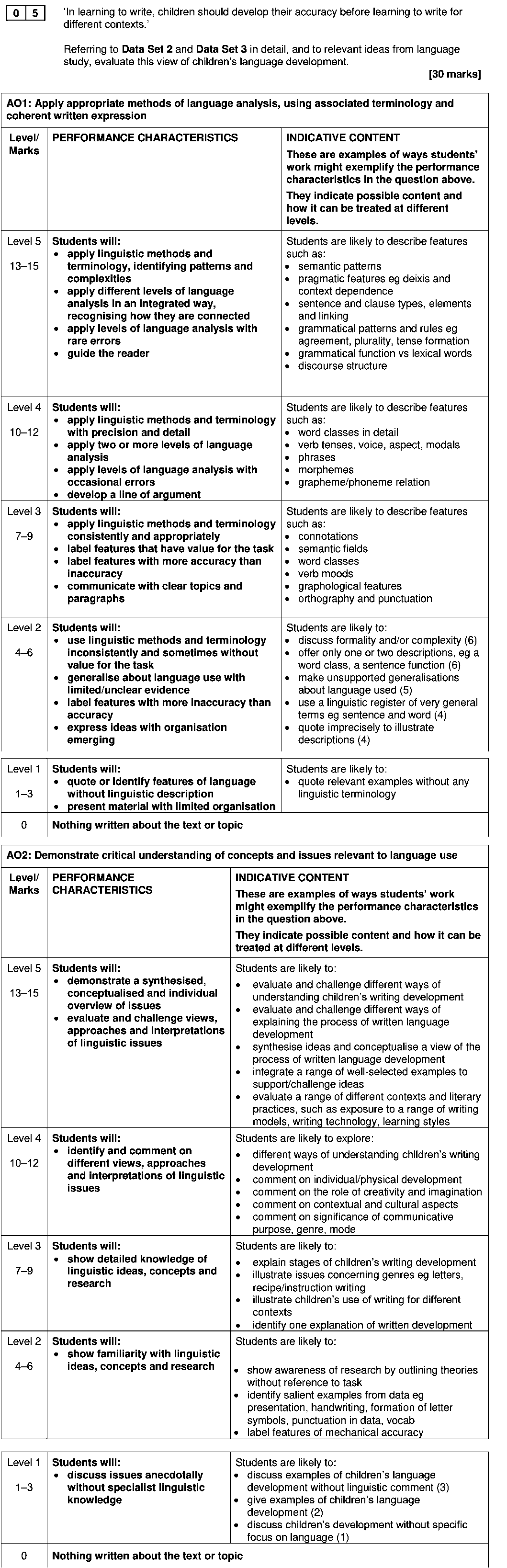
‘In learning to write, children should develop their accuracy before learning to write for
different contexts.’
Referring to Data Set 2 and Data Set 3 in detail, and to relevant ideas from language
study, evaluate this view of children’s language development.
[30 marks]
Data Set 2
Data Set 2 was produced at home. Iris is six years old. Grace is a family friend.
[image]
Transliteration
To Graces
thank you
for incurjing
me to go to
Bevers.
Lots of
Love from
Iris
Data Set 3
Data Set 3 was produced at home. Iris is six years old.
[image]
Transliteration
MY RESORPY
For Ice Cream
and Sorbay Sawbay
Ingreedyonts
1) Ice
Ice
2) Frute
Cream
3) Cream
4) Frige
5) 4) Freeser
5) Spoon
6) Bowle
June 2017 · Paper 1 · Q4 30 marks AO1=15, AO2=15 Child language essay child language speechchild language theories
Children’s language development
Answer either Question 4 or Question 5 in this section.
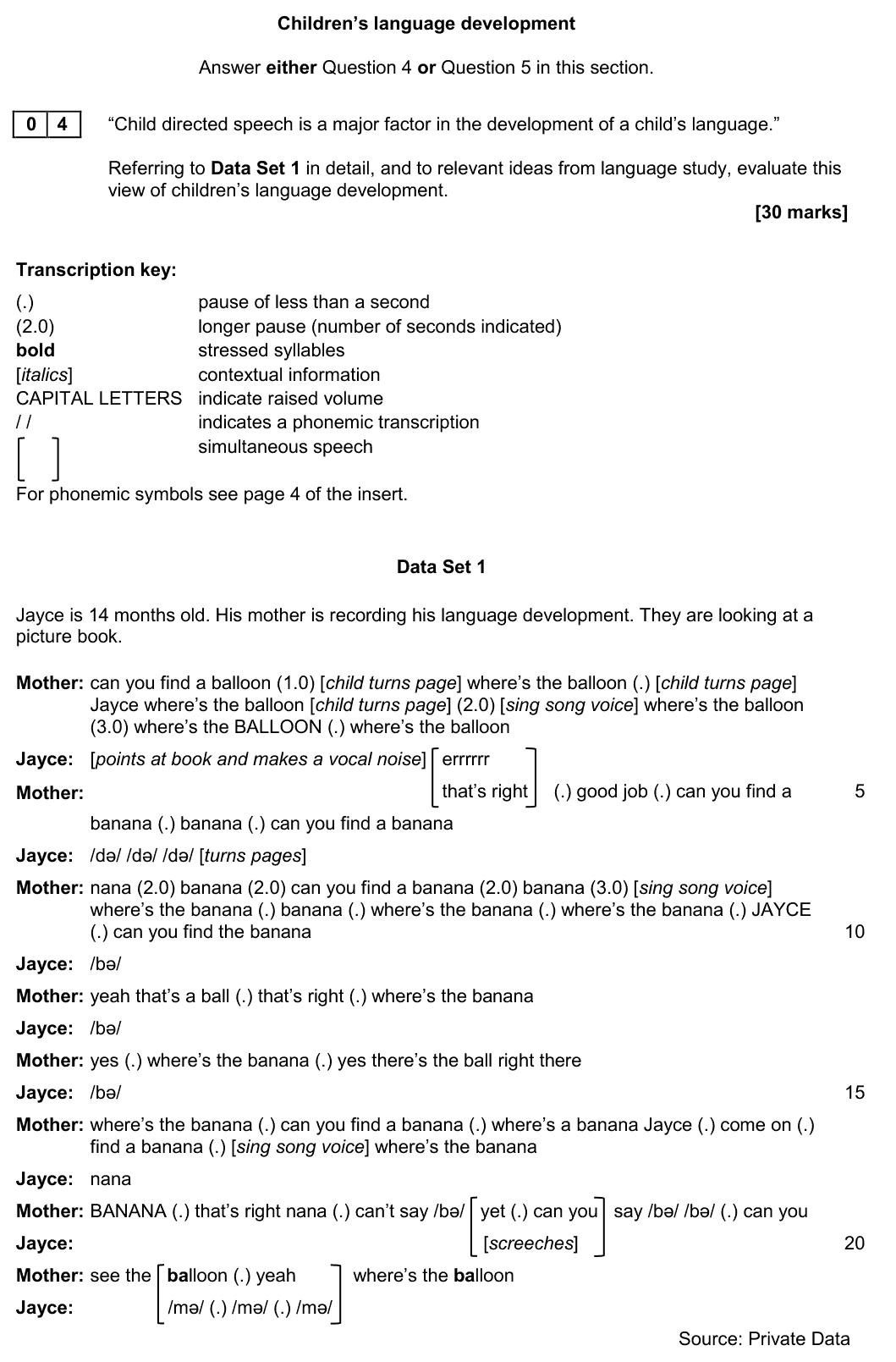
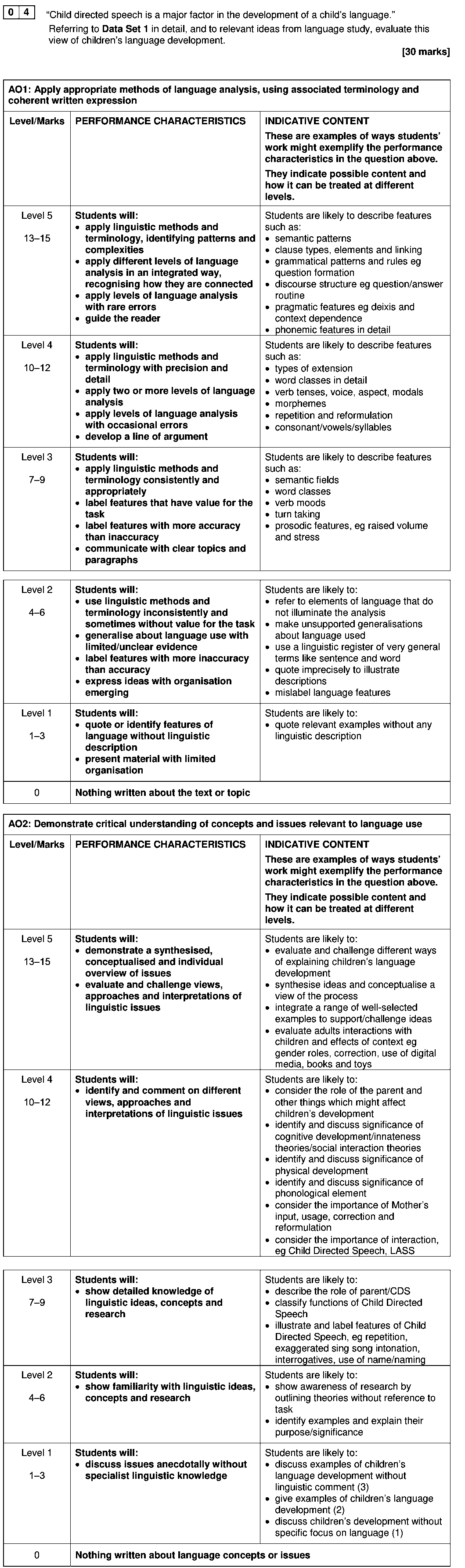
“Child directed speech is a major factor in the development of a child’s language.”
Referring to Data Set 1 in detail, and to relevant ideas from language study, evaluate this
view of children’s language development.
[30 marks]
Transcription key:
(.)
pause of less than a second
(2.0)
longer pause (number of seconds indicated)
bold
stressed syllables
[italics]
contextual information
CAPITAL LETTERS indicate raised volume
/ /
indicates a phonemic transcription
simultaneous speech
For phonemic symbols see page 4 of the insert.
Data Set 1
Jayce is 14 months old. His mother is recording his language development. They are looking at a
picture book.
Mother: can you find a balloon (1.0) [child turns page] where’s the balloon (.) [child turns page]
Jayce where’s the balloon [child turns page] (2.0) [sing song voice] where’s the balloon
(3.0) where’s the BALLOON (.) where’s the balloon
Jayce: [points at book and makes a vocal noise] errrrrr
that’s right (.) good job (.) can you find a
Mother:
banana (.) banana (.) can you find a banana
Jayce: /də/ /də/ /də/ [turns pages]
Mother: nana (2.0) banana (2.0) can you find a banana (2.0) banana (3.0) [sing song voice]
where’s the banana (.) banana (.) where’s the banana (.) where’s the banana (.) JAYCE
(.) can you find the banana
Jayce: /bə/
Mother: yeah that’s a ball (.) that’s right (.) where’s the banana
Jayce: /bə/
Mother: yes (.) where’s the banana (.) yes there’s the ball right there
Jayce: /bə/
Mother: where’s the banana (.) can you find a banana (.) where’s a banana Jayce (.) come on (.)
find a banana (.) [sing song voice] where’s the banana
Jayce: nana
Mother: BANANA (.) that’s right nana (.) can’t say /bə/ yet (.) can you say /bə/ /bə/ (.) can you
Jayce: [screeches]
Mother: see the balloon (.) yeah where’s the balloon
Jayce: /mə/ (.) /mə/ (.) /mə/
Source: Private Data
June 2017 · Paper 1 · Q5 30 marks AO1=15, AO2=15 Child language essay child language literacychild language theories
Children’s language development
Answer either Question 4 or Question 5 in this section.
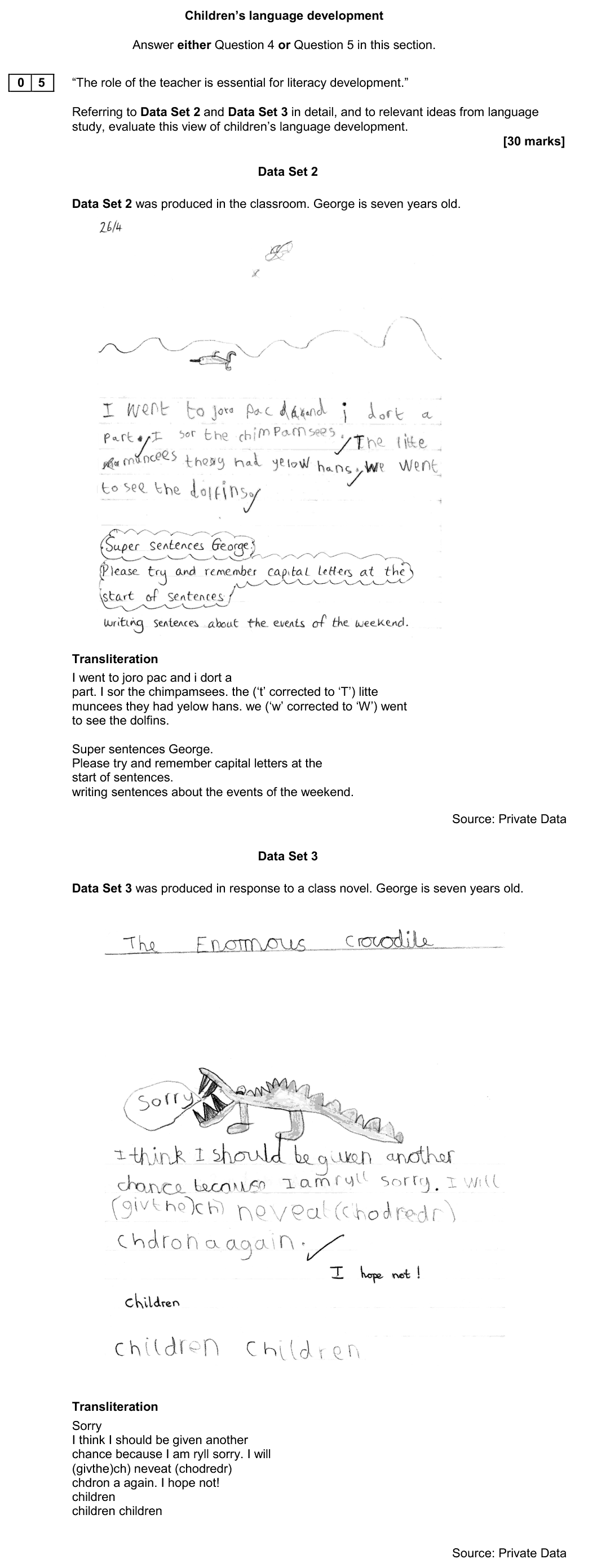
“The role of the teacher is essential for literacy development.”
Referring to Data Set 2 and Data Set 3 in detail, and to relevant ideas from language
study, evaluate this view of children’s language development.
[30 marks]
Data Set 2
Data Set 2 was produced in the classroom. George is seven years old.
[image]
Transliteration
I went to joro pac and i dort a
part. I sor the chimpamsees. the (‘t’ corrected to ‘T’) litte
muncees they had yelow hans. we (‘w’ corrected to ‘W’) went
to see the dolfins.
Super sentences George.
Please try and remember capital letters at the
start of sentences.
writing sentences about the events of the weekend.
Source: Private Data
Data Set 3
Data Set 3 was produced in response to a class novel. George is seven years old.
[image]
Transliteration
Sorry
I think I should be given another
chance because I am ryll sorry. I will
(givthe)ch) neveat (chodredr)
chdron a again. I hope not!
children
children children
Source: Private Data

Work with an AQA English Language tutor

Essays stuck in the middle bands, or not sure what the examiners want from an analysis? Book a trial lesson with a specialist AQA English Language tutor.

Prefer email? Send an enquiry

If you are under 18, please include a parent's contact details. Enquiries go to enquiries@alevelenglishtutor.com and are deleted once handled. All tutoring is online.