Examiner's comment
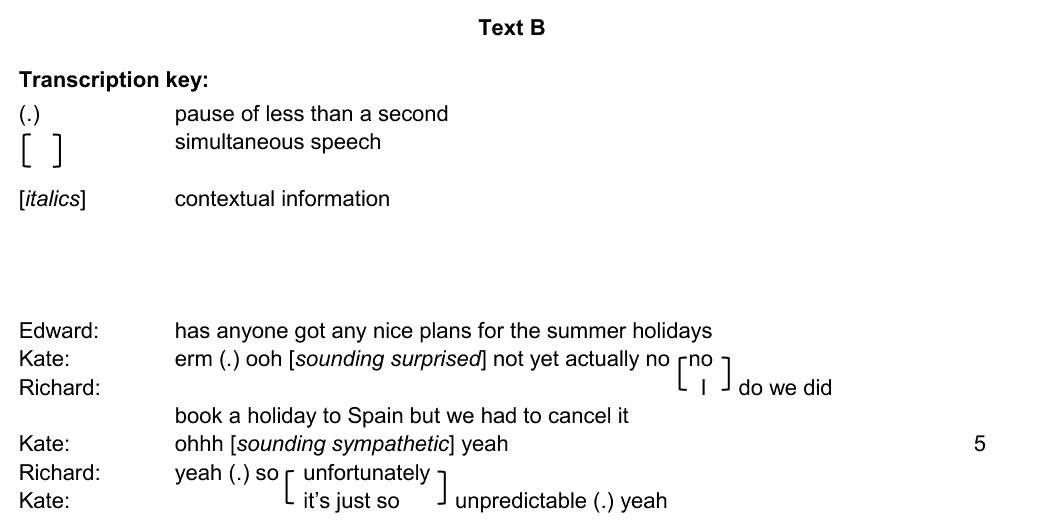
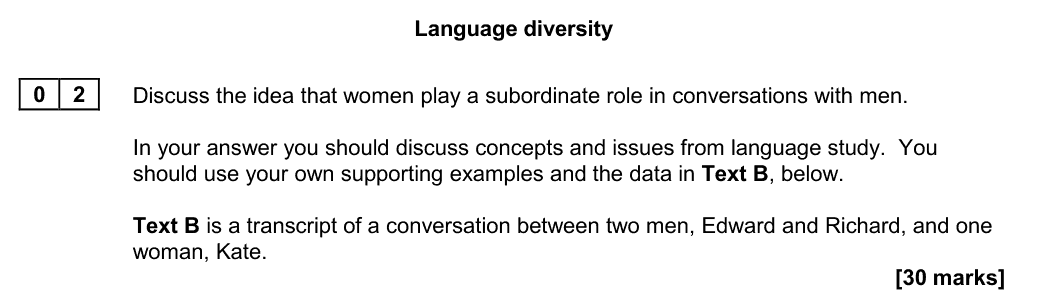
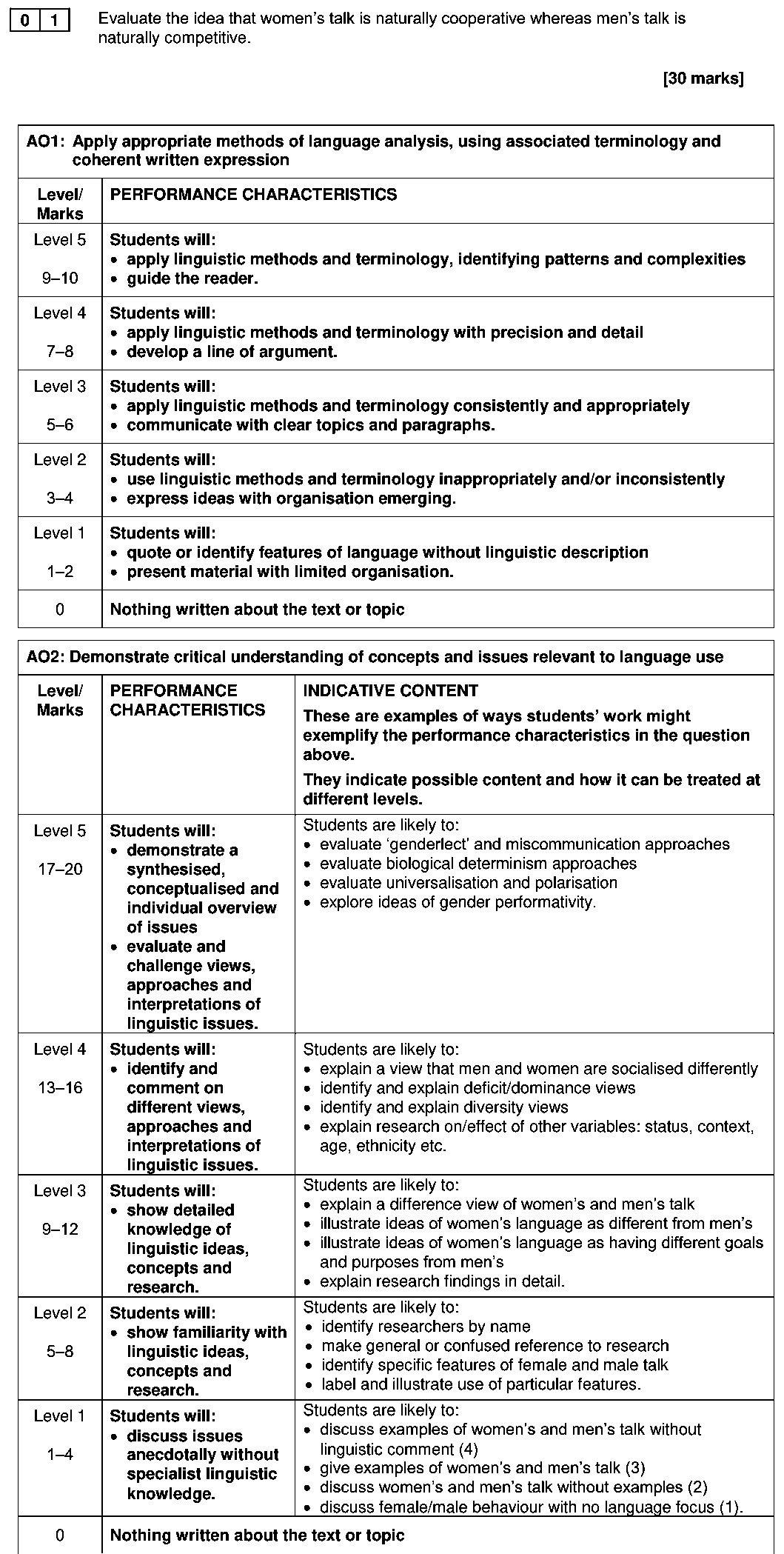
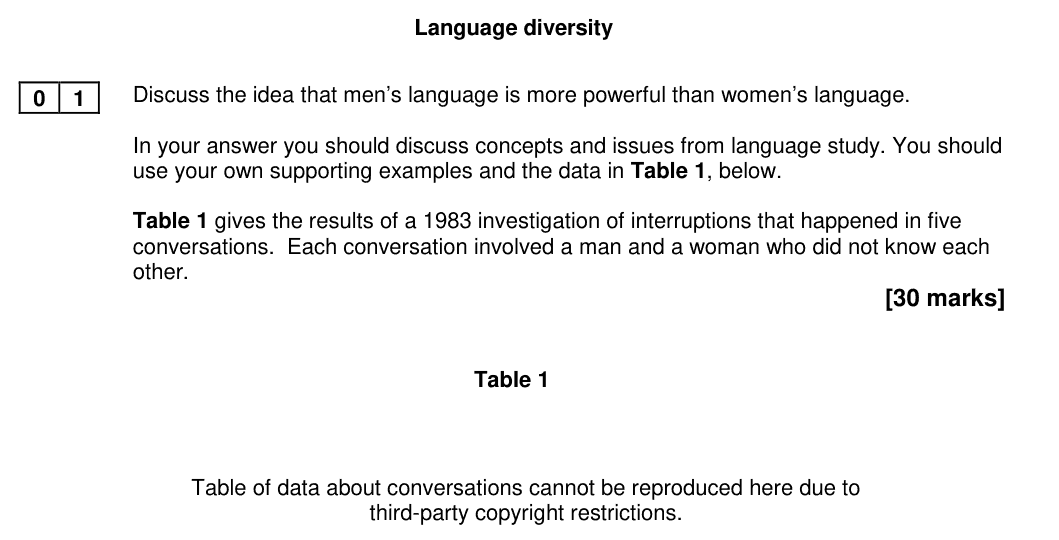
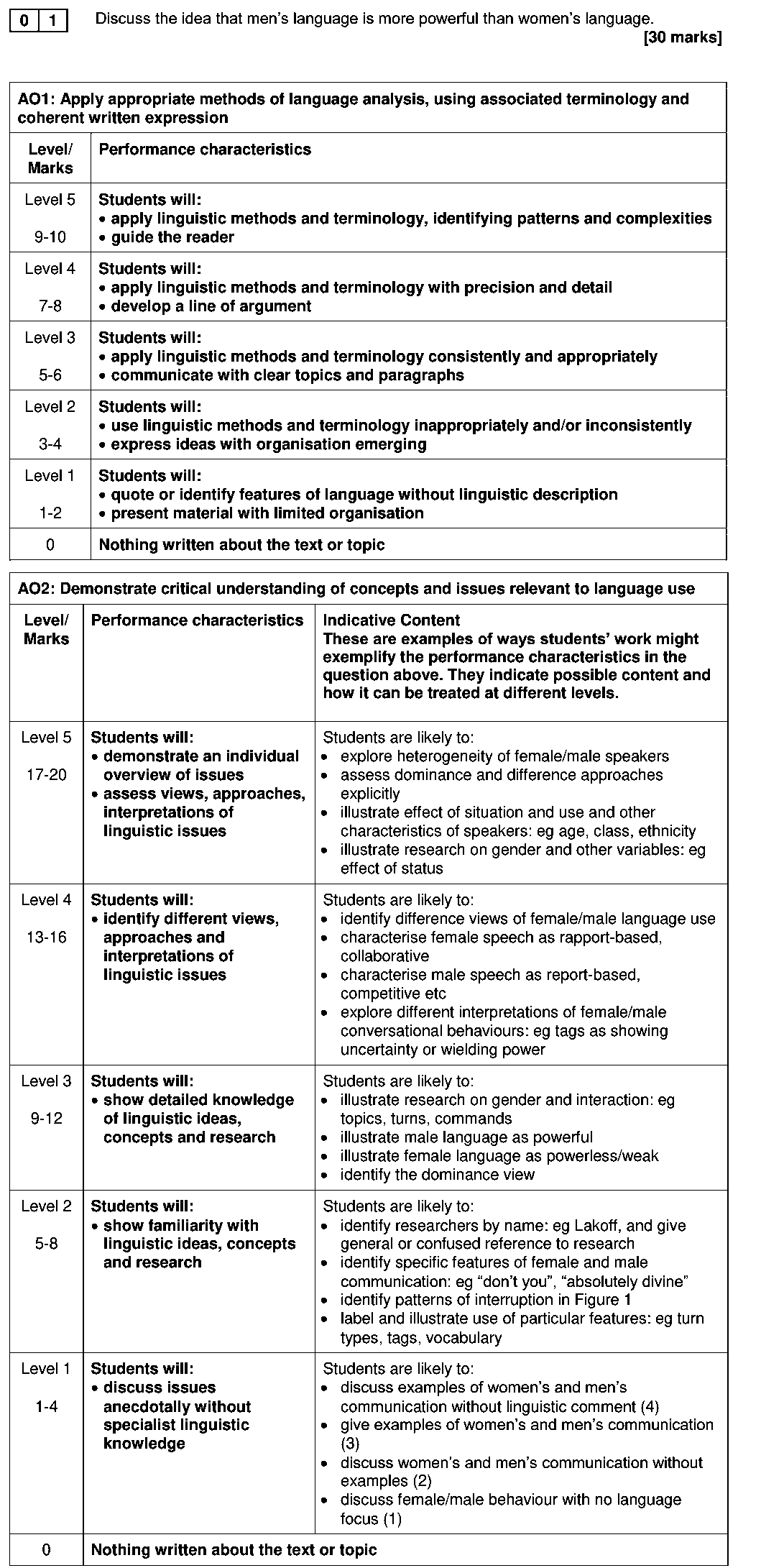
This series, the question asked students to “Discuss the idea that men’s language is more powerful than women’s language.” The data was statistical, focusing on research into interruptions in mixed-sex conversations. Over 80% of students chose to respond to this optional question. Many students appeared confident when handling qualitative data. This was often successfully linked to the work of Zimmerman and West, with the dominance model often considered in some detail. It is worth noting, however, that Zimmerman and West’s work is now quite dated. It would be pleasing to see students making use of more recent studies, such as the work of Hancock and Rubin, or Jackobi and Schweers’ US courtroom study. Students often engaged well with other AO2 ideas, showing understanding of the different models of gendered language. Many responses were based on a clear progression from dominance and/or deficit into studies of difference and (at the higher end) diversity or gender similarities. These were often well supported with reference to relevant spoken language studies including Lakoff, Spender, Zimmerman and West, Tannen’s difference model, Holmes, Cameron and Hyde. Some higher achieving students considered gender similarities and performativity to great effect. Less frequently considered, but often usefully applied, was the work of Kuiper, Fishman, or O’Barr and Atkins. Again, however, it is worth noting more recent work, including Tannen’s work on managerial styles and floor holding, is not frequently being discussed. Interesting angles included exploring the relationship between dominance and deficit models, with many students taking a ‘sideways’ approach and considering marked terms or the work of Dale Spender. Although this is not directly responding to the question (as it is language about genders, rather than the language of genders) some students were able to successfully consider the relationship between the two. Many students showed some awareness of challenge to methodologies, or engaged with criticisms about the studies themselves. Whilst this was rewarded appropriately, it is important to note that simply referencing studies as “outdated,” or stating that samples were “too small” is not fully “evaluating.” Students who engaged explicitly with how these limitations affected the findings tended to “evaluate” much more effectively and gained higher marks. More successful answers: • Used the data to draw a particular view of male/female language, and used this as a ‘way in’ to exploring the issues. Zimmerman and West were often referenced as a starting point. • Kept the data at the centre of the response, often returning to it and considering the same findings from different interpretive angles. • Engaged with complexities from the data, particularly the lack of context given. This was often well linked to the distinction between interruptions and overlaps, and the purpose of the speaker in making the interruption. Many students applied Beattie’s and Fishman’s work well to this idea. The strongest answers often engaged well with complexities of context aside from the data, considering the direct relationship between Lakoff and O’Barr and Atkins’ work, for example. • Built up responses, working with the idea of ‘power’ at the centre. These responses often explored how one model builds on the concerns of the earlier model, e.g. the ways in which dominance/deficit indicate women’s language as less powerful, but difference suggests there is no more ‘powerful’ language, but different motivations. Some students were able to use this notion critically, exploring perceived power biases within the terms used for this model. “Status” and “support” were used to argue that women’s language, even when given strength, is still weaker in comparison to men’s when such gender dichotomies are created. Cameron’s work was often well applied here. • Considered the notion of ‘power,’ exploring ways in which women’s language can be seen as more powerful. Trudgill was at times used to good effect, although it should be noted that some students omitted to acknowledge the complexities of class as a complicating variable. • Challenged simplistic stereotypes of men and women, with good discussion often made of how social expectations may have shaped the language used. This was at times well developed into an exploration of gender identities more broadly. • Considered the ‘difference’ model in some detail, with Tannen particularly well cited. • Explored Holmes’ work on tag questions, or Fishman’s research, in some detail, effectively considering alternative uses of features associated with deficit models. • Offered methodological challenges to the data in the question, or specific pieces of research, clearly considering how the limitation affected the findings and what the implications of this were. This was particularly well handled with Lakoff. Less successful answers: • Paraphrased the data, at times describing each pair in sequence, without bringing any learned knowledge to the response. • Described men as powerful, and women as powerless, without reference to language. This often became socially-driven, and at times quite emotive. • Made errors in associating researchers with particular models, or confused the genders of the researchers. This was particularly true of Spender and Lakoff. • Made reference to language features without exemplification, or failed to link researchers to the specific features considered. • Recited all the information they knew about different studies, sometimes in an almost bullet-point approach. These students tended not to shape their responses or engage with the issues raised, and answers at times read almost like revision notes. • Made errors in written accuracy, including women’s/women and woman/women. ‘Interruption’ was also frequently spelled inaccurately, despite being included in the data. • Misinterpreted the data, for example inferring that the 75% figure related to the number of speakers who interrupted, not the number of interruptions made. • Attempted to engage with complexities, such as O’Barr and Atkins work on ‘powerless’ language, but without linking these explicitly to gender. This was particularly true of students who attempted to consider Cameron’s critique of dichotomies. • Created a response which was lacking in conscious shaping, e.g. without using discourse markers or without explaining how one idea fed into the next. Some students did not use paragraphs.