AS: the love poetry anthology (25 marks)

AS Paper 1 Section B: one question on the pre-1900 or post-1900 anthology, with a named poem printed. 18 questions.

Other types: Shakespeare: extract and whole play (25 marks) · Paper 2 set-text essays (25 marks) · Unseen poetry comparison (25 marks) · AS: unseen prose (25 marks) · Comparing texts: love through the ages (25 marks) · Paper 2: the unseen extract (25 marks) · Paper 2: comparing two texts (25 marks)

June 2025 · AS Paper 1 · Q5 25 marks Anthology poetry love poetry pre 1900
AQA Anthology of love poetry through the ages pre-1900
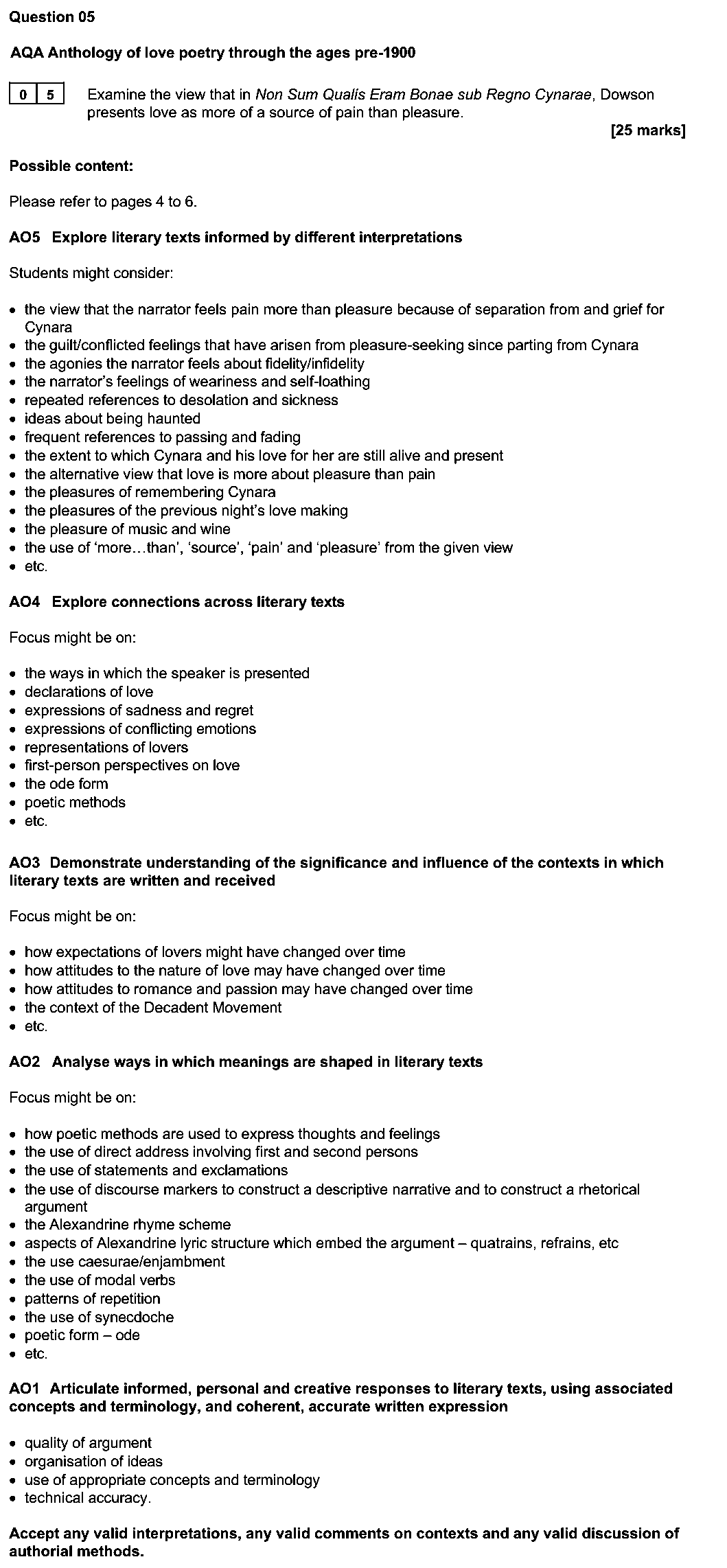
Examine the view that in Non Sum Qualis Eram Bonae sub Regno Cynarae, Dowson
presents love as more of a source of pain than pleasure.
[25 marks]
Non Sum Qualis Eram Bonae sub Regno Cynarae
Last night, ah, yesternight, betwixt her lips and mine
There fell thy shadow, Cynara! thy breath was shed
Upon my soul between the kisses and the wine;
And I was desolate and sick of an old passion,
Yea, I was desolate and bowed my head:
I have been faithful to thee, Cynara! in my fashion.
All night upon mine heart I felt her warm heart beat,
Night-long within mine arms in love and sleep she lay;
Surely the kisses of her bought red mouth were sweet;
But I was desolate and sick of an old passion,
When I awoke and found the dawn was gray:
I have been faithful to thee, Cynara! in my fashion.
I have forgot much, Cynara! gone with the wind,
Flung roses, roses riotously with the throng,
Dancing, to put thy pale, lost lilies out of mind;
But I was desolate and sick of an old passion,
Yea, all the time, because the dance was long:
I have been faithful to thee, Cynara! in my fashion.
I cried for madder music and for stronger wine,
But when the feast is finished and the lamps expire,
Then falls thy shadow, Cynara! the night is thine;
And I am desolate and sick of an old passion,
Yea hungry for the lips of my desire:
I have been faithful to thee, Cynara! in my fashion.
Ernest Dowson (1867–1900)
June 2025 · AS Paper 1 · Q6 25 marks Anthology poetry love poetry post 1900
AQA Anthology of love poetry through the ages post-1900
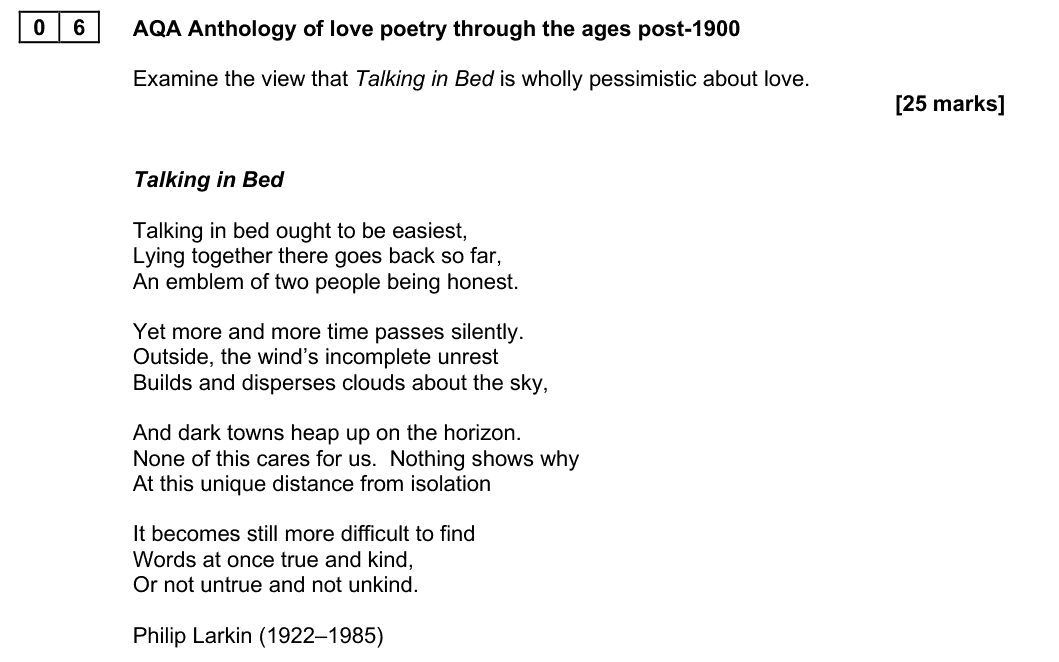
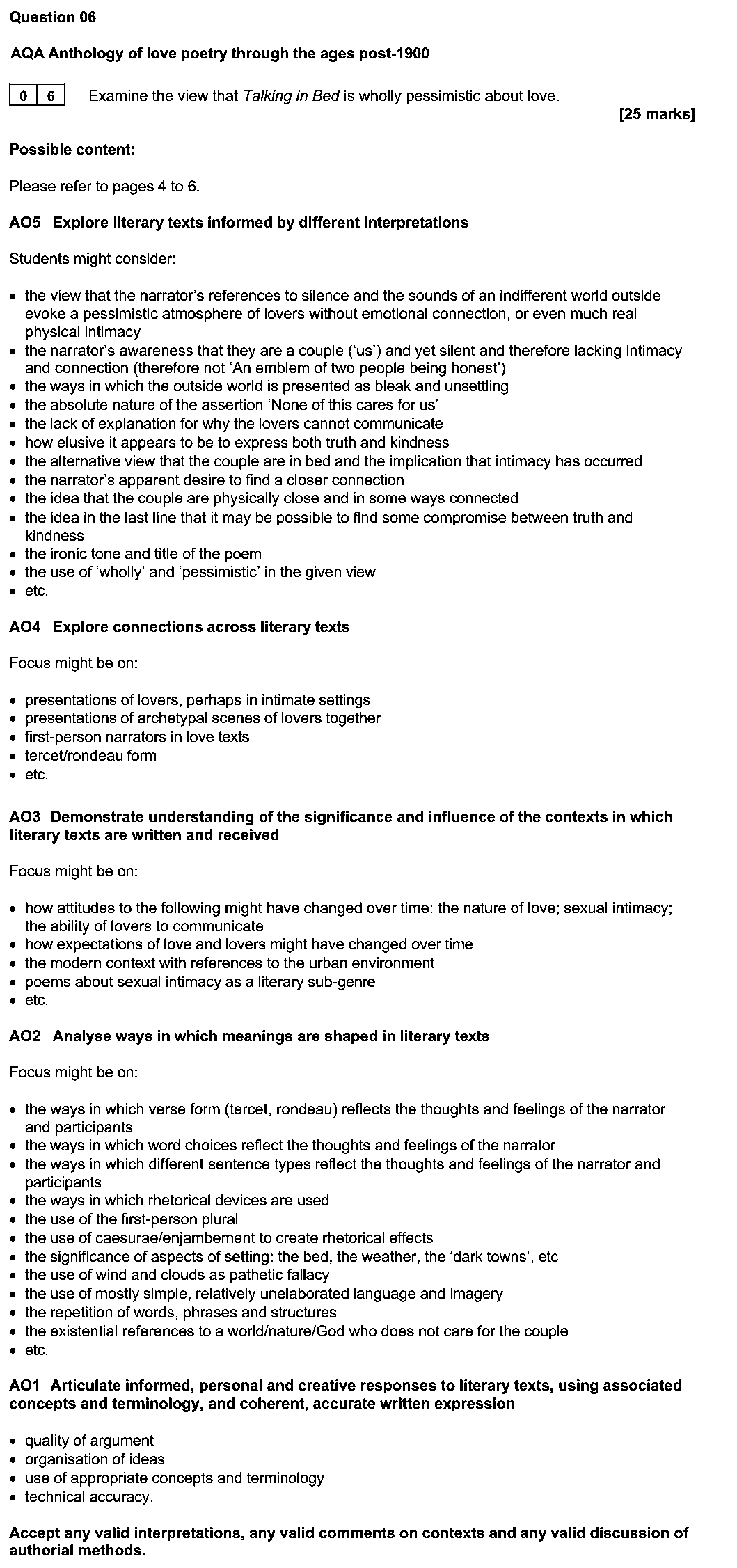
Examine the view that Talking in Bed is wholly pessimistic about love.
[25 marks]
Talking in Bed
Talking in bed ought to be easiest,
Lying together there goes back so far,
An emblem of two people being honest.
Yet more and more time passes silently.
Outside, the wind’s incomplete unrest
Builds and disperses clouds about the sky,
And dark towns heap up on the horizon.
None of this cares for us. Nothing shows why
At this unique distance from isolation
It becomes still more difficult to find
Words at once true and kind,
Or not untrue and not unkind.
Philip Larkin (1922–1985)
June 2024 · AS Paper 1 · Q5 25 marks Anthology poetry love poetry pre 1900
AQA Anthology of love poetry through the ages pre-1900
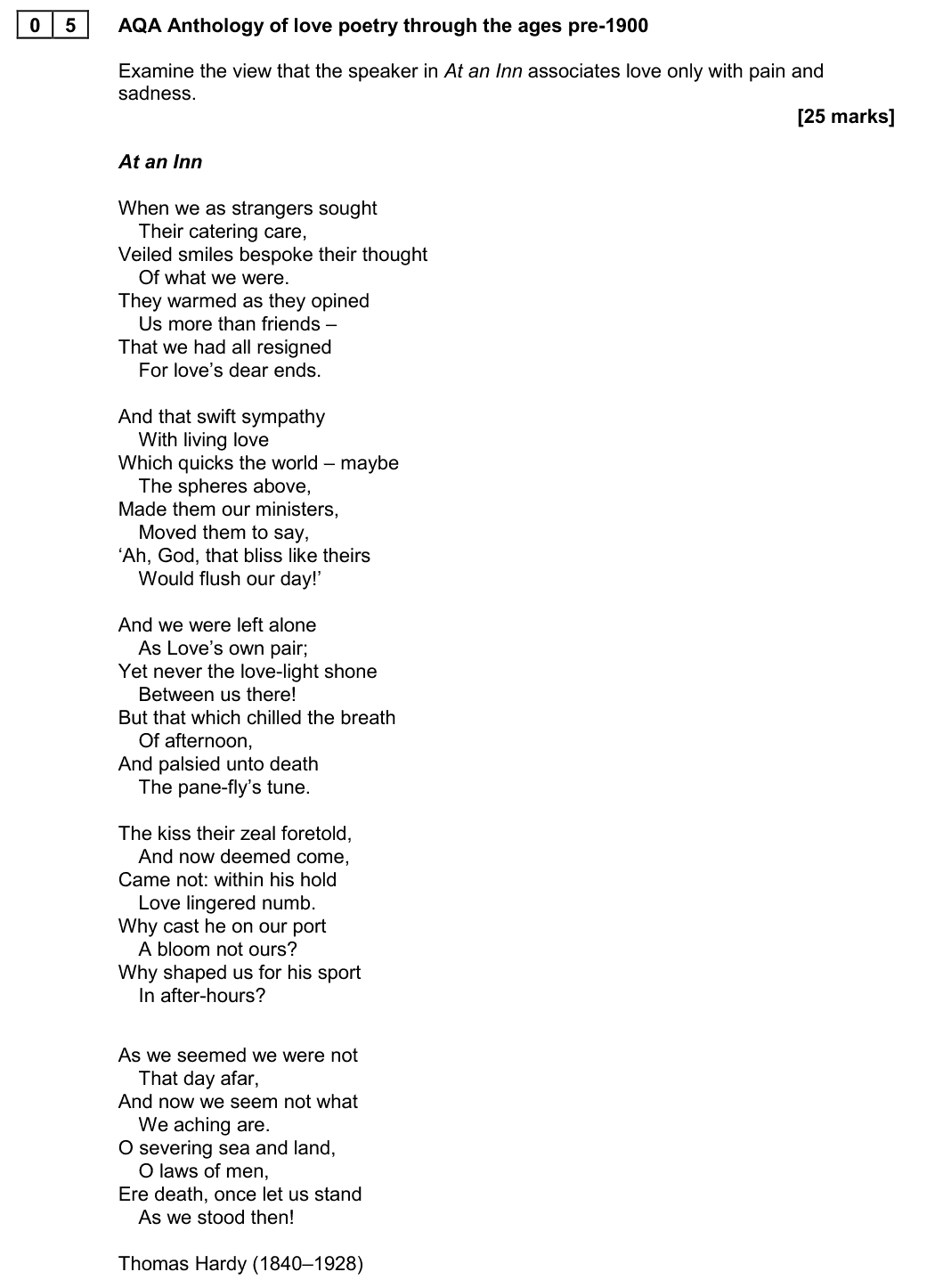
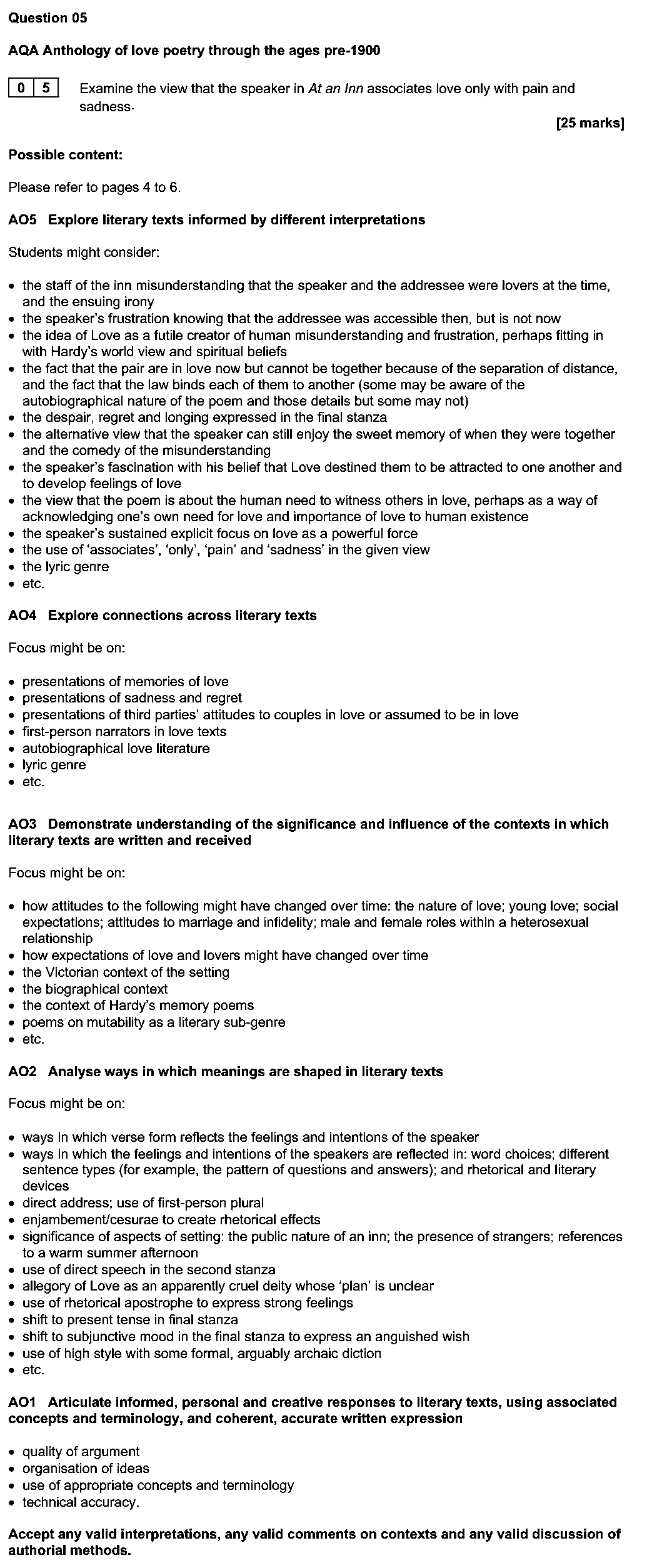
Examine the view that the speaker in At an Inn associates love only with pain and
sadness.
[25 marks]
At an Inn
When we as strangers sought
Their catering care,
Veiled smiles bespoke their thought
Of what we were.
They warmed as they opined
Us more than friends –
That we had all resigned
For love’s dear ends.
And that swift sympathy
With living love
Which quicks the world – maybe
The spheres above,
Made them our ministers,
Moved them to say,
‘Ah, God, that bliss like theirs
Would flush our day!’
And we were left alone
As Love’s own pair;
Yet never the love-light shone
Between us there!
But that which chilled the breath
Of afternoon,
And palsied unto death
The pane-fly’s tune.
The kiss their zeal foretold,
And now deemed come,
Came not: within his hold
Love lingered numb.
Why cast he on our port
A bloom not ours?
Why shaped us for his sport
In after-hours?
As we seemed we were not
That day afar,
And now we seem not what
We aching are.
O severing sea and land,
O laws of men,
Ere death, once let us stand
As we stood then!
Thomas Hardy (1840–1928)
June 2024 · AS Paper 1 · Q6 25 marks Anthology poetry love poetry post 1900
AQA Anthology of love poetry through the ages post-1900
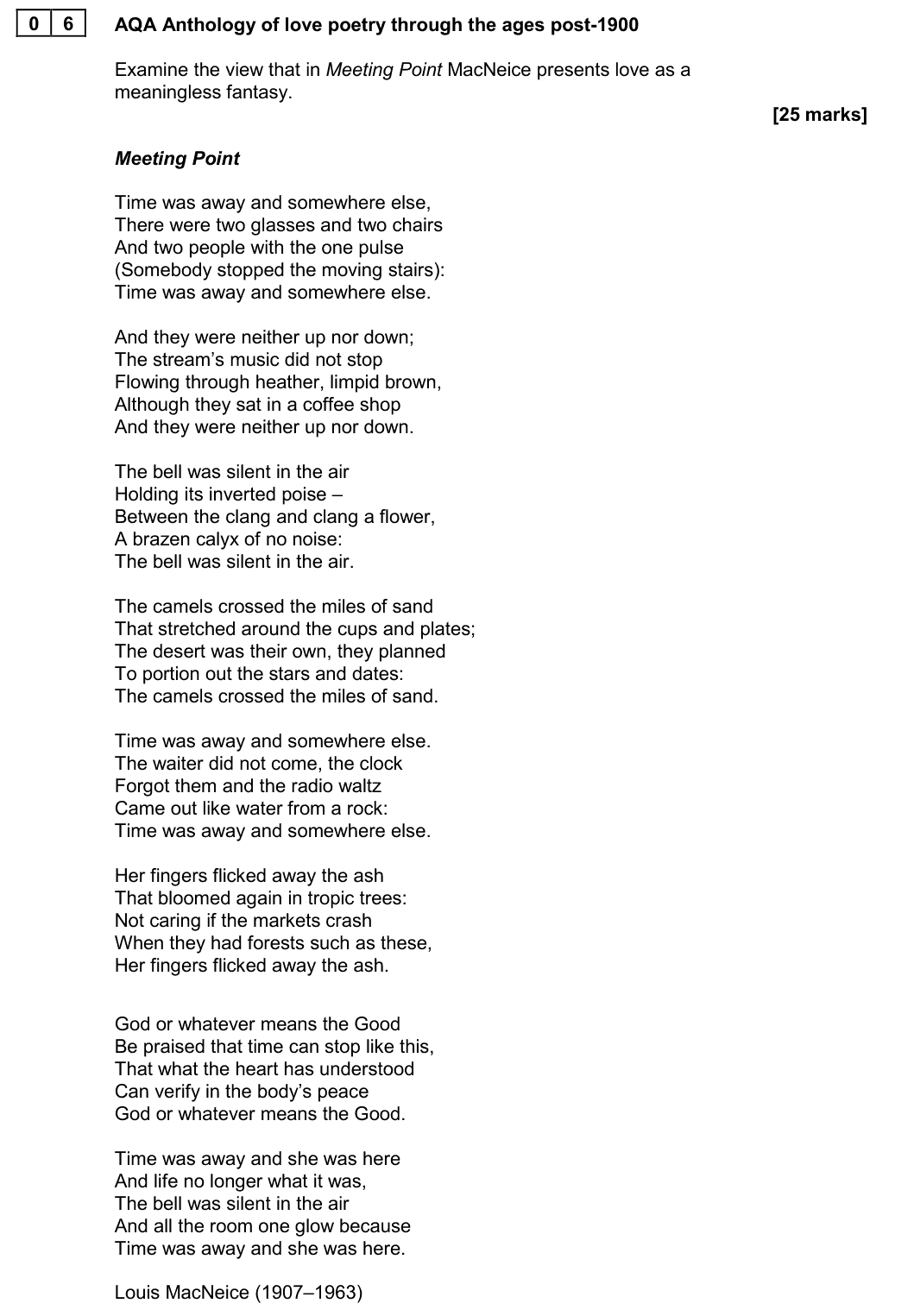
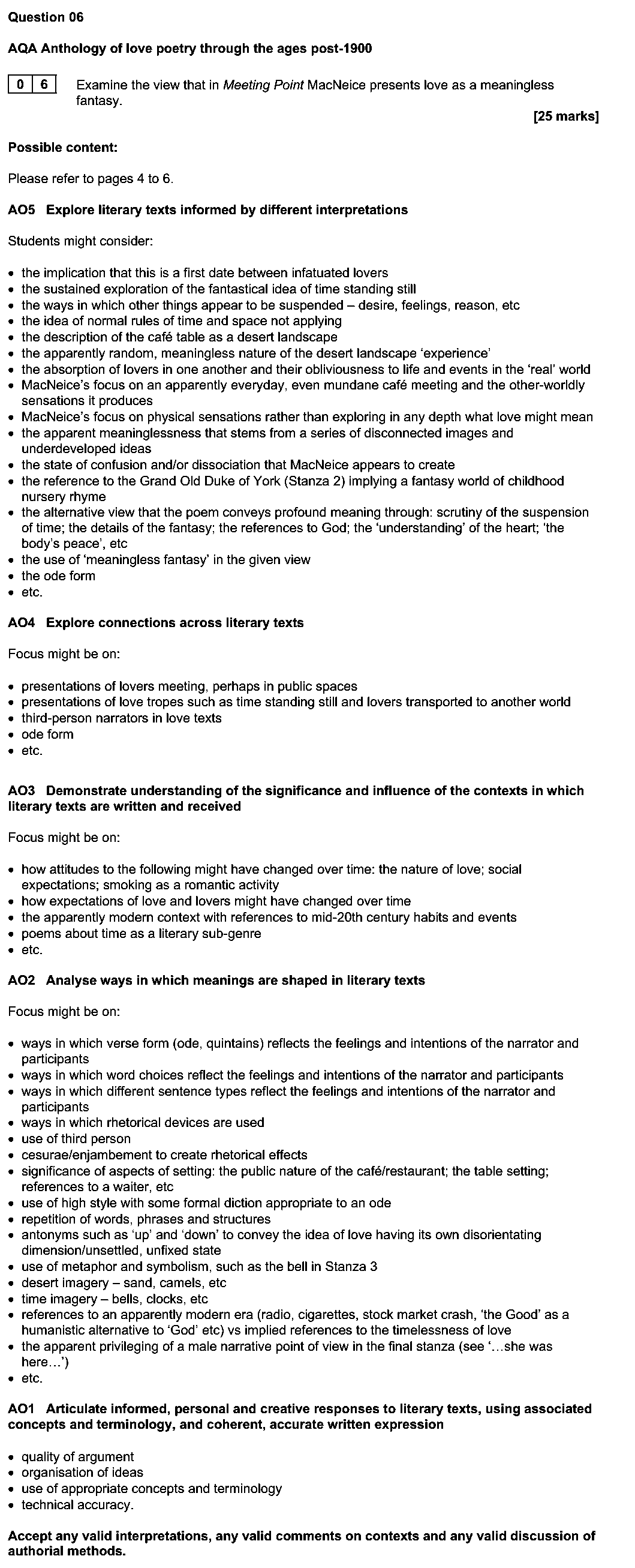
Examine the view that in Meeting Point MacNeice presents love as a
meaningless fantasy.
[25 marks]
Meeting Point
Time was away and somewhere else,
There were two glasses and two chairs
And two people with the one pulse
(Somebody stopped the moving stairs):
Time was away and somewhere else.
And they were neither up nor down;
The stream’s music did not stop
Flowing through heather, limpid brown,
Although they sat in a coffee shop
And they were neither up nor down.
The bell was silent in the air
Holding its inverted poise –
Between the clang and clang a flower,
A brazen calyx of no noise:
The bell was silent in the air.
The camels crossed the miles of sand
That stretched around the cups and plates;
The desert was their own, they planned
To portion out the stars and dates:
The camels crossed the miles of sand.
Time was away and somewhere else.
The waiter did not come, the clock
Forgot them and the radio waltz
Came out like water from a rock:
Time was away and somewhere else.
Her fingers flicked away the ash
That bloomed again in tropic trees:
Not caring if the markets crash
When they had forests such as these,
Her fingers flicked away the ash.
God or whatever means the Good
Be praised that time can stop like this,
That what the heart has understood
Can verify in the body’s peace
God or whatever means the Good.
Time was away and she was here
And life no longer what it was,
The bell was silent in the air
And all the room one glow because
Time was away and she was here.
Louis MacNeice (1907–1963)
June 2023 · AS Paper 1 · Q5 25 marks Anthology poetry love poetry pre 1900
AQA Anthology of love poetry through the ages pre-1900
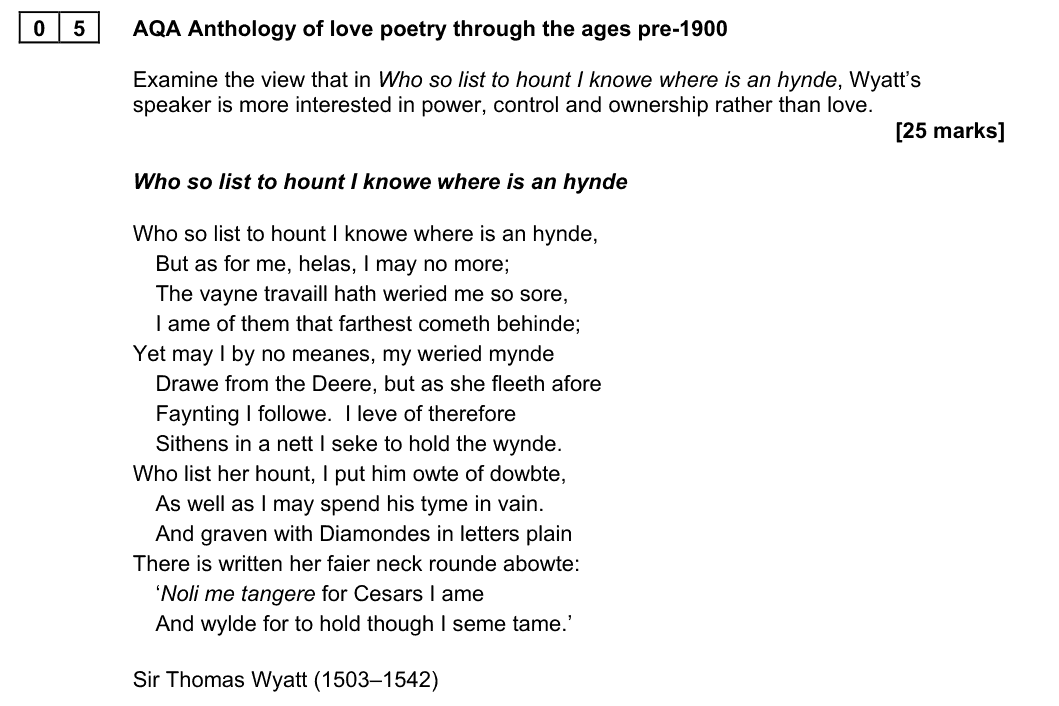
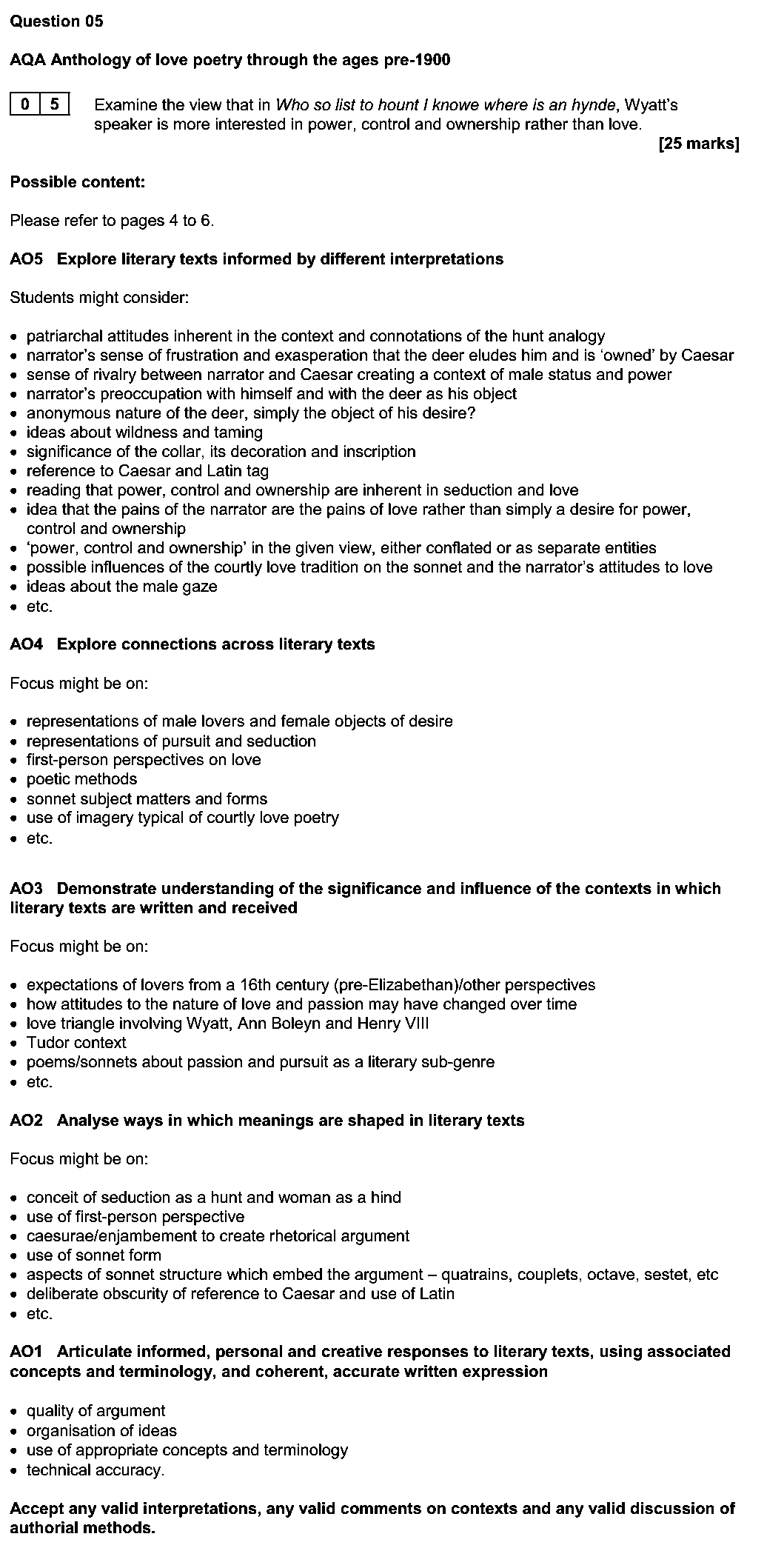
Examine the view that in Who so list to hount I knowe where is an hynde, Wyatt’s
speaker is more interested in power, control and ownership rather than love.
[25 marks]
Who so list to hount I knowe where is an hynde
Who so list to hount I knowe where is an hynde,
But as for me, helas, I may no more;
The vayne travaill hath weried me so sore,
I ame of them that farthest cometh behinde;
Yet may I by no meanes, my weried mynde
Drawe from the Deere, but as she fleeth afore
Faynting I followe. I leve of therefore
Sithens in a nett I seke to hold the wynde.
Who list her hount, I put him owte of dowbte,
As well as I may spend his tyme in vain.
And graven with Diamondes in letters plain
There is written her faier neck rounde abowte:
‘Noli me tangere for Cesars I ame
And wylde for to hold though I seme tame.’
Sir Thomas Wyatt (1503–1542)
June 2023 · AS Paper 1 · Q6 25 marks Anthology poetry love poetry post 1900
AQA Anthology of love poetry through the ages post-1900
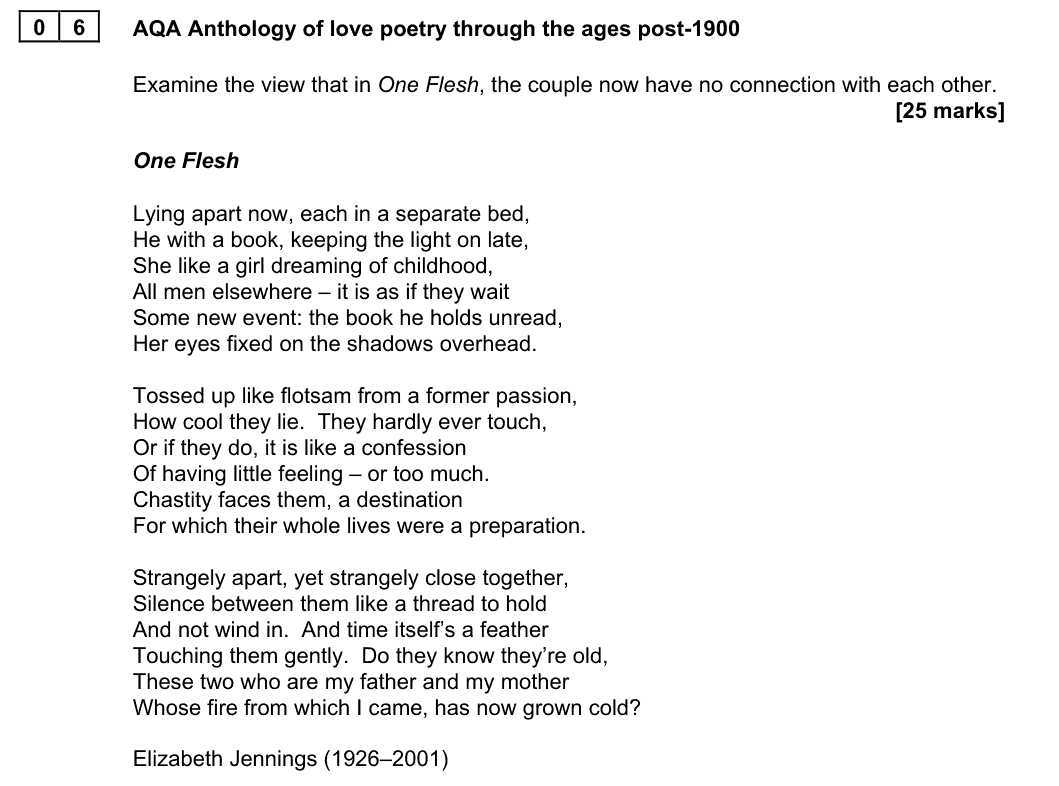
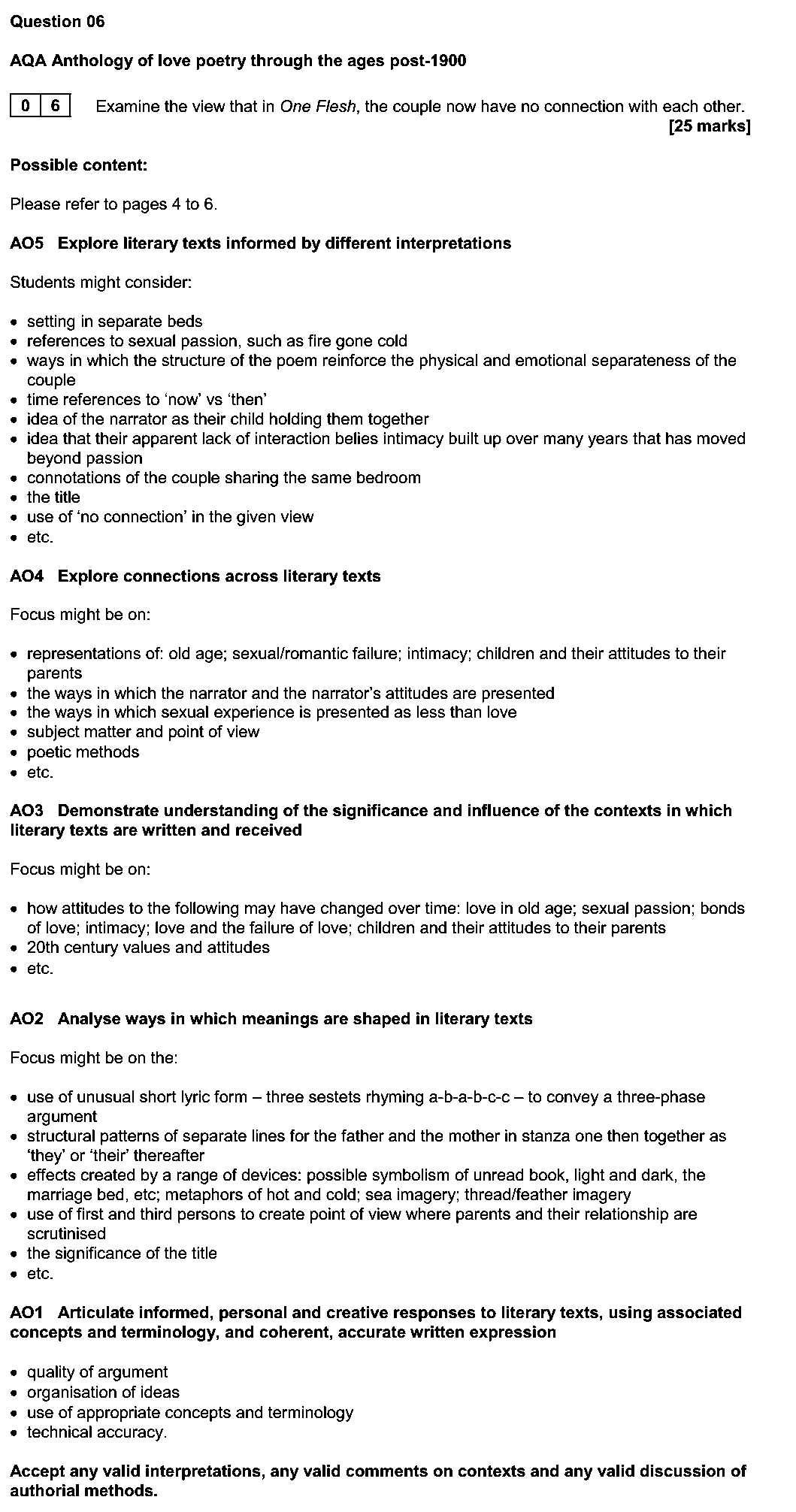
Examine the view that in One Flesh, the couple now have no connection with each other.
[25 marks]
One Flesh
Lying apart now, each in a separate bed,
He with a book, keeping the light on late,
She like a girl dreaming of childhood,
All men elsewhere – it is as if they wait
Some new event: the book he holds unread,
Her eyes fixed on the shadows overhead.
Tossed up like flotsam from a former passion,
How cool they lie. They hardly ever touch,
Or if they do, it is like a confession
Of having little feeling – or too much.
Chastity faces them, a destination
For which their whole lives were a preparation.
Strangely apart, yet strangely close together,
Silence between them like a thread to hold
And not wind in. And time itself’s a feather
Touching them gently. Do they know they’re old,
These two who are my father and my mother
Whose fire from which I came, has now grown cold?
Elizabeth Jennings (1926–2001)
June 2022 · AS Paper 1 · Q5 25 marks Anthology poetry love poetry pre 1900
AQA Anthology of love poetry through the ages pre-1900
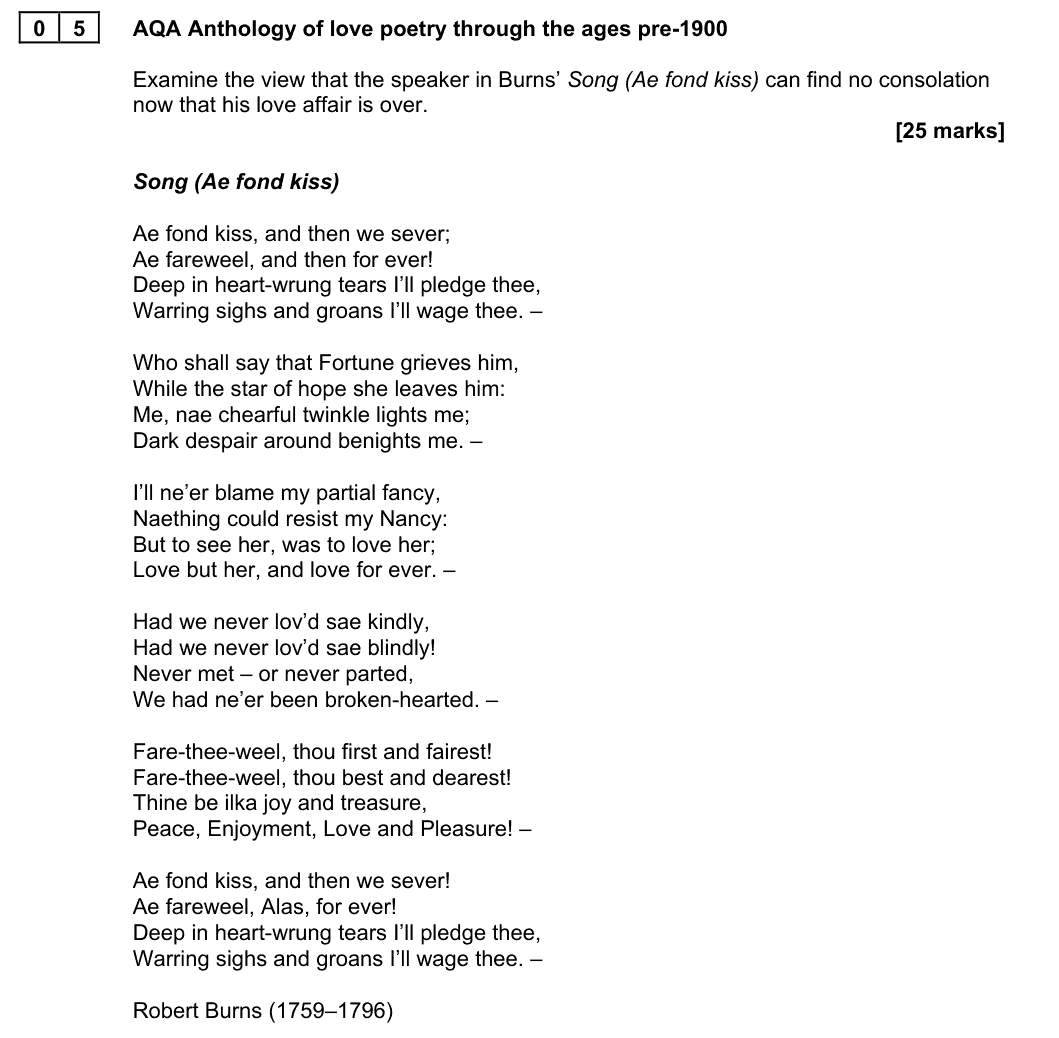
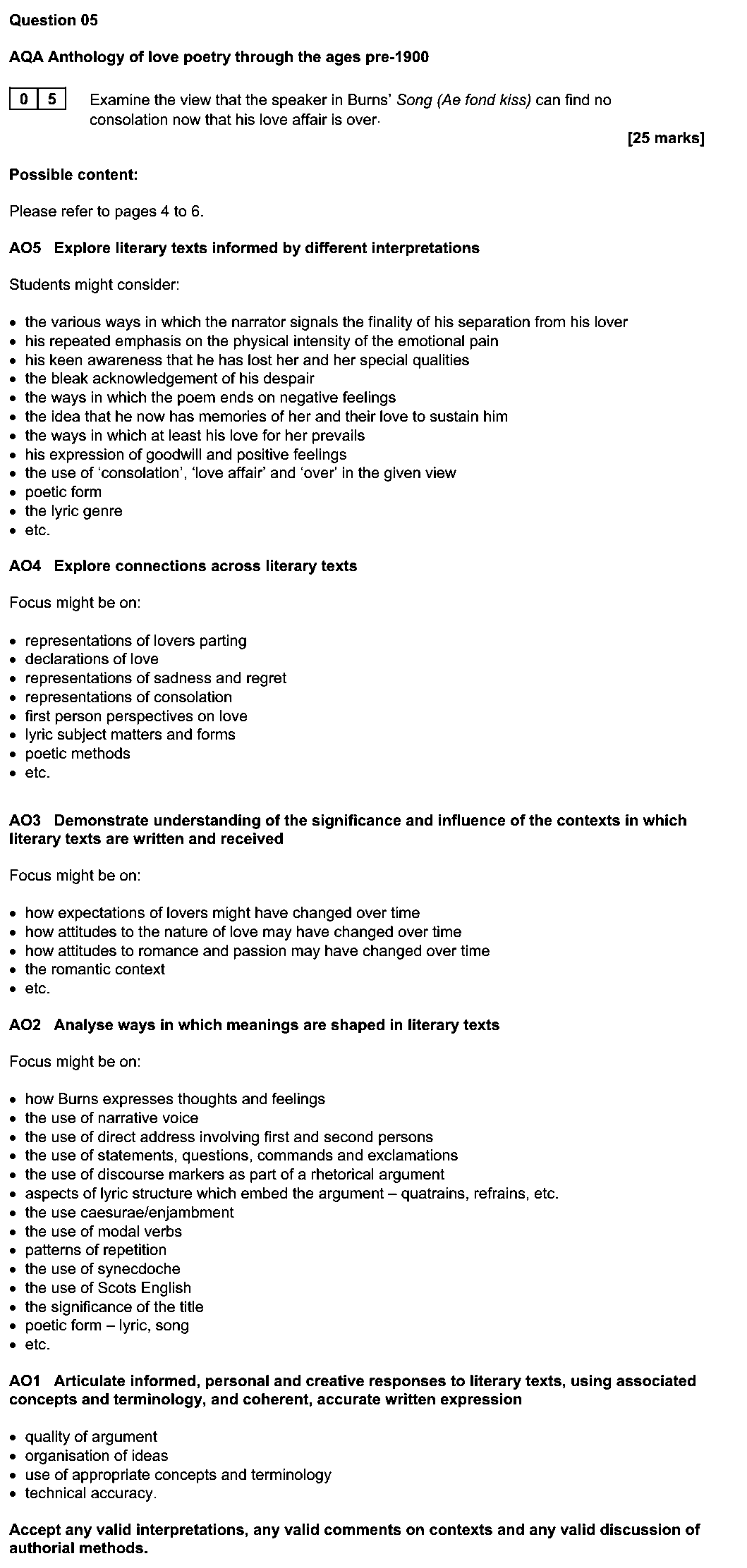
Examine the view that the speaker in Burns’ Song (Ae fond kiss) can find no consolation
now that his love affair is over.
[25 marks]
Song (Ae fond kiss)
Ae fond kiss, and then we sever;
Ae fareweel, and then for ever!
Deep in heart-wrung tears I’ll pledge thee,
Warring sighs and groans I’ll wage thee. –
Who shall say that Fortune grieves him,
While the star of hope she leaves him:
Me, nae chearful twinkle lights me;
Dark despair around benights me. –
I’ll ne’er blame my partial fancy,
Naething could resist my Nancy:
But to see her, was to love her;
Love but her, and love for ever. –
Had we never lov’d sae kindly,
Had we never lov’d sae blindly!
Never met – or never parted,
We had ne’er been broken-hearted. –
Fare-thee-weel, thou first and fairest!
Fare-thee-weel, thou best and dearest!
Thine be ilka joy and treasure,
Peace, Enjoyment, Love and Pleasure! –
Ae fond kiss, and then we sever!
Ae fareweel, Alas, for ever!
Deep in heart-wrung tears I’ll pledge thee,
Warring sighs and groans I’ll wage thee. –
Robert Burns (1759–1796)
June 2022 · AS Paper 1 · Q6 25 marks Anthology poetry love poetry post 1900
AQA Anthology of love poetry through the ages post-1900
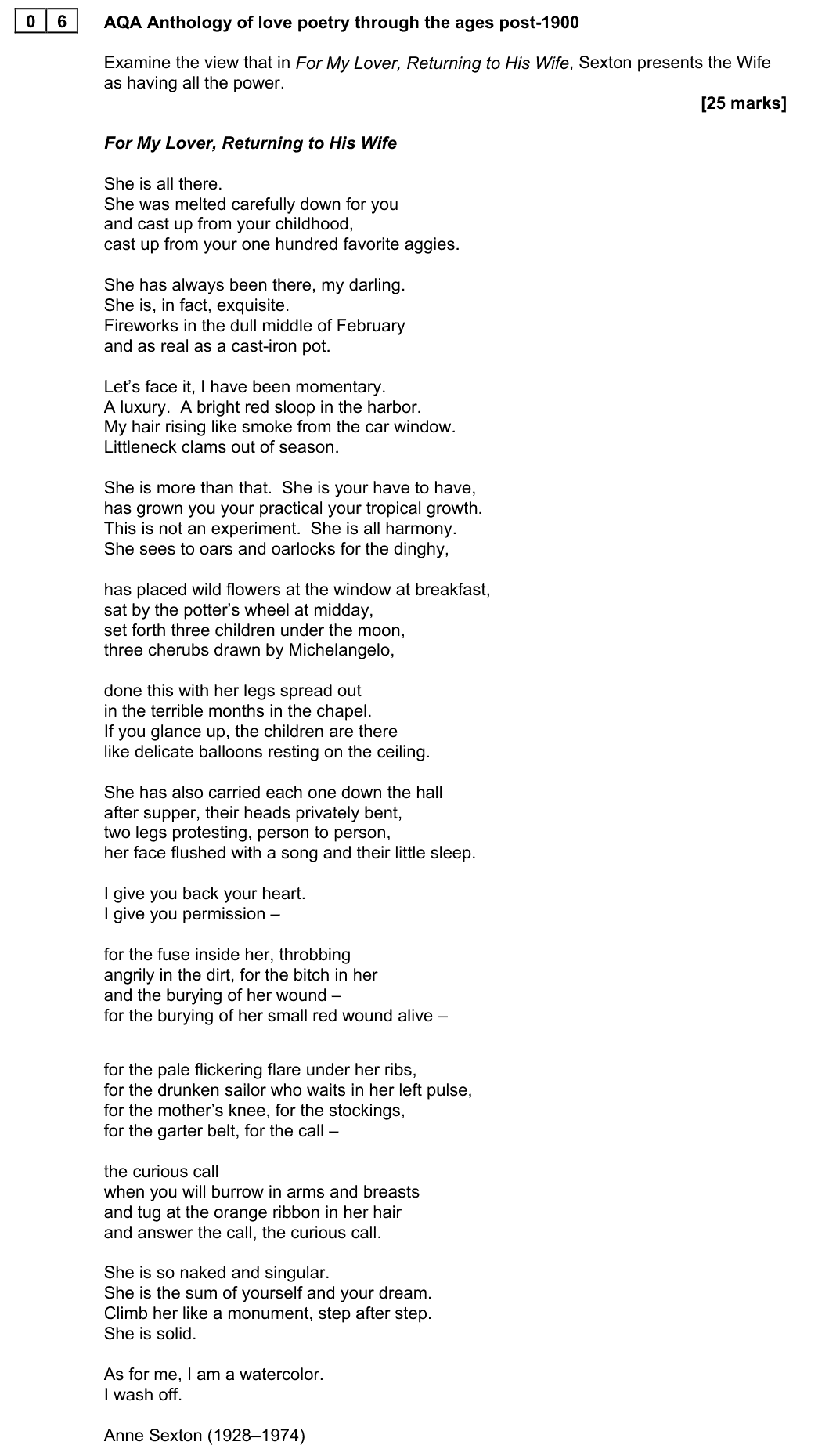
Examine the view that in For My Lover, Returning to His Wife, Sexton presents the Wife
as having all the power.
[25 marks]
For My Lover, Returning to His Wife
She is all there.
She was melted carefully down for you
and cast up from your childhood,
cast up from your one hundred favorite aggies.
She has always been there, my darling.
She is, in fact, exquisite.
Fireworks in the dull middle of February
and as real as a cast-iron pot.
Let’s face it, I have been momentary.
A luxury. A bright red sloop in the harbor.
My hair rising like smoke from the car window.
Littleneck clams out of season.
She is more than that. She is your have to have,
has grown you your practical your tropical growth.
This is not an experiment. She is all harmony.
She sees to oars and oarlocks for the dinghy,
has placed wild flowers at the window at breakfast,
sat by the potter’s wheel at midday,
set forth three children under the moon,
three cherubs drawn by Michelangelo,
done this with her legs spread out
in the terrible months in the chapel.
If you glance up, the children are there
like delicate balloons resting on the ceiling.
She has also carried each one down the hall
after supper, their heads privately bent,
two legs protesting, person to person,
her face flushed with a song and their little sleep.
I give you back your heart.
I give you permission –
for the fuse inside her, throbbing
angrily in the dirt, for the bitch in her
and the burying of her wound –
for the burying of her small red wound alive –
for the pale flickering flare under her ribs,
for the drunken sailor who waits in her left pulse,
for the mother’s knee, for the stockings,
for the garter belt, for the call –
the curious call
when you will burrow in arms and breasts
and tug at the orange ribbon in her hair
and answer the call, the curious call.
She is so naked and singular.
She is the sum of yourself and your dream.
Climb her like a monument, step after step.
She is solid.
As for me, I am a watercolor.
I wash off.
Anne Sexton (1928–1974)
November 2020 · AS Paper 1 · Q5 25 marks Anthology poetry love poetry pre 1900
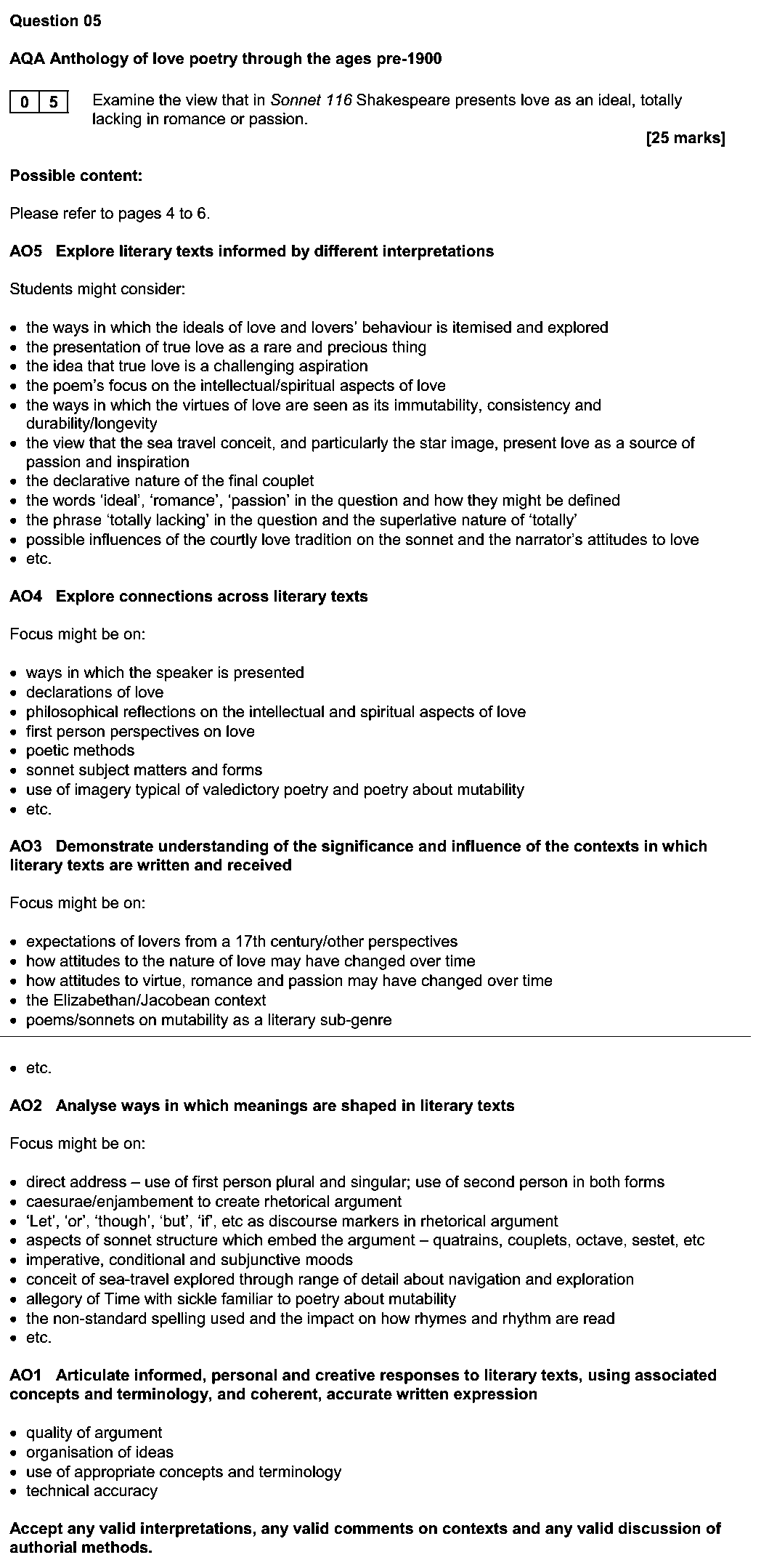
AQA Anthology of love poetry through the ages pre-1900
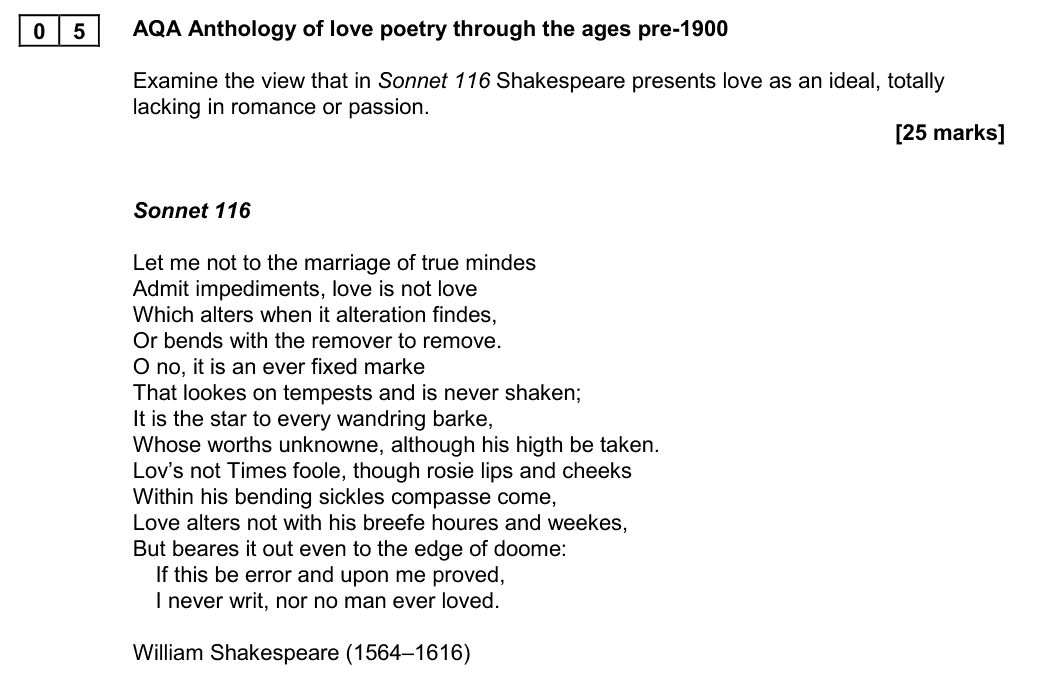
Examine the view that in Sonnet 116 Shakespeare presents love as an ideal, totally
lacking in romance or passion.
[25 marks]
Sonnet 116
Let me not to the marriage of true mindes
Admit impediments, love is not love
Which alters when it alteration findes,
Or bends with the remover to remove.
O no, it is an ever fixed marke
That lookes on tempests and is never shaken;
It is the star to every wandring barke,
Whose worths unknowne, although his higth be taken.
Lov’s not Times foole, though rosie lips and cheeks
Within his bending sickles compasse come,
Love alters not with his breefe houres and weekes,
But beares it out even to the edge of doome:
If this be error and upon me proved,
I never writ, nor no man ever loved.
William Shakespeare (1564–1616)
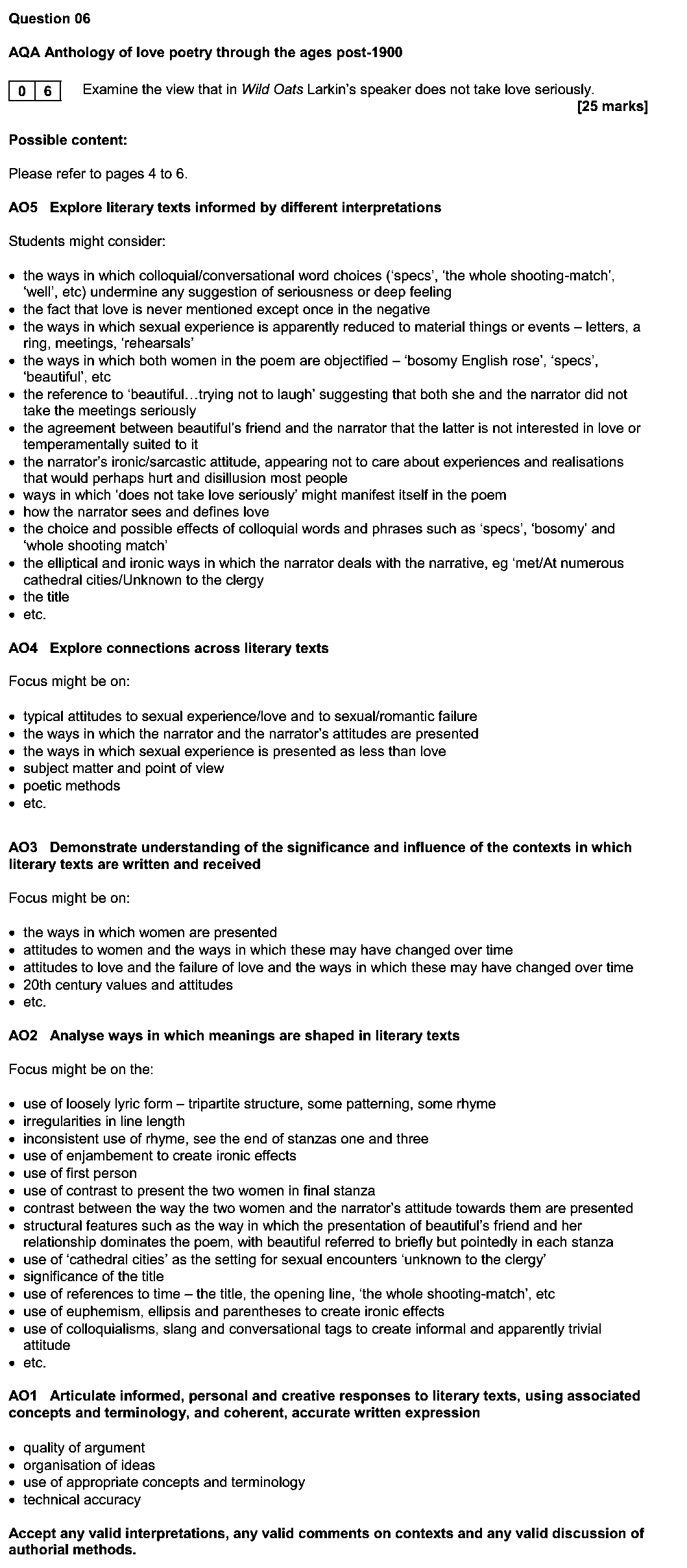
November 2020 · AS Paper 1 · Q6 25 marks Anthology poetry love poetry post 1900
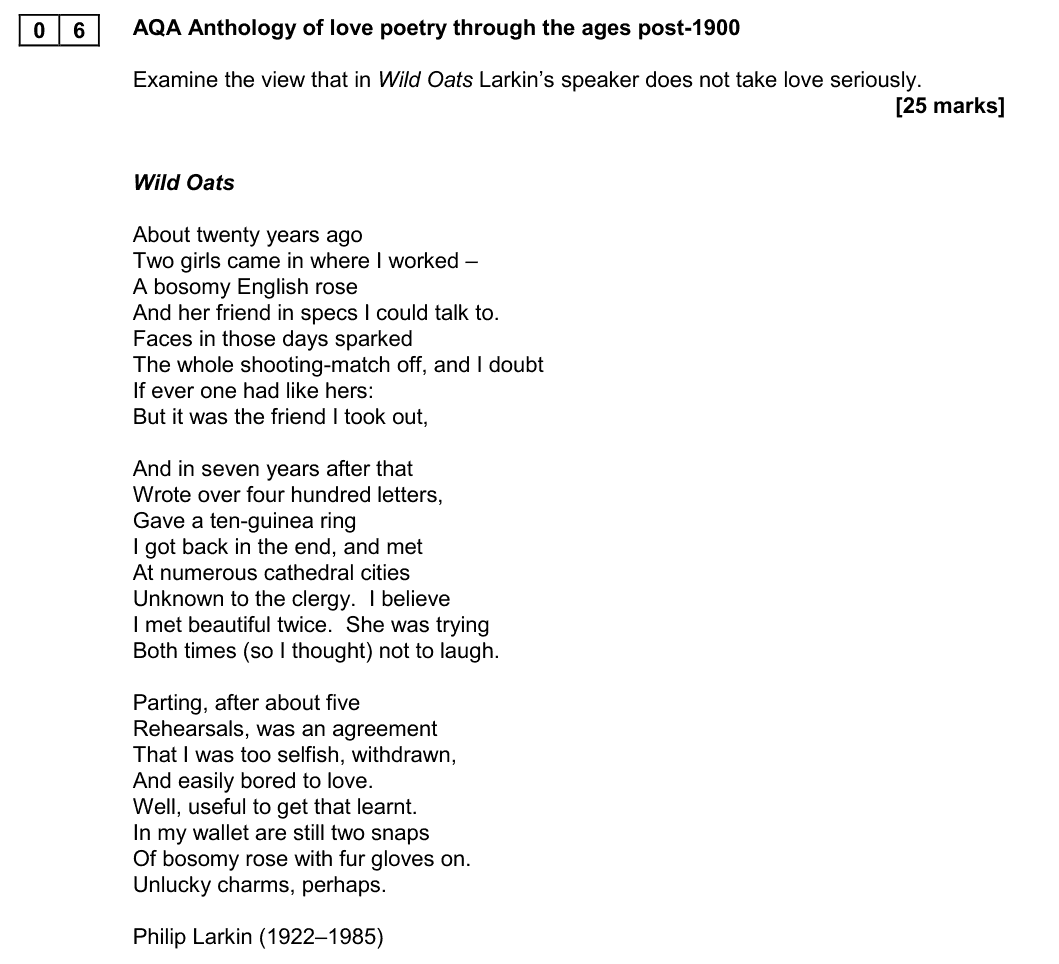
AQA Anthology of love poetry through the ages post-1900
Examine the view that in Wild Oats Larkin’s speaker does not take love seriously.
[25 marks]
Wild Oats
About twenty years ago
Two girls came in where I worked –
A bosomy English rose
And her friend in specs I could talk to.
Faces in those days sparked
The whole shooting-match off, and I doubt
If ever one had like hers:
But it was the friend I took out,
And in seven years after that
Wrote over four hundred letters,
Gave a ten-guinea ring
I got back in the end, and met
At numerous cathedral cities
Unknown to the clergy. I believe
I met beautiful twice. She was trying
Both times (so I thought) not to laugh.
Parting, after about five
Rehearsals, was an agreement
That I was too selfish, withdrawn,
And easily bored to love.
Well, useful to get that learnt.
In my wallet are still two snaps
Of bosomy rose with fur gloves on.
Unlucky charms, perhaps.
Philip Larkin (1922–1985)
June 2019 · AS Paper 1 · Q5 25 marks Anthology poetry love poetry pre 1900
AQA Anthology of Love Poetry through the Ages pre-1900
Examine the view that in La Belle Dame sans Merci. A Ballad Keats presents love as a
mysterious, deadly curse.
[25 marks]
La Belle Dame sans Merci. A Ballad
I
O what can ail thee, knight-at-arms,
Alone and palely loitering?
The sedge has withered from the lake,
And no birds sing.
II
Oh what can ail thee, knight-at-arms,
So haggard and so woe-begone?
The squirrel’s granary is full,
And the harvest’s done.
III
I see a lily on thy brow,
With anguish moist and fever-dew,
And on thy cheeks a fading rose
Fast withereth too.
IV
I met a lady in the meads,
Full beautiful – a faery’s child,
Her hair was long, her foot was light,
And her eyes were wild.
V
I made a garland for her head,
And bracelets too, and fragrant zone;
She looked at me as she did love,
And made sweet moan.
VI
I set her on my pacing steed,
And nothing else saw all day long,
For sidelong would she bend, and sing
A faery’s song.
VII
She found me roots of relish sweet,
And honey wild, and manna-dew,
And sure in language strange she said –
‘I love thee true’.
VIII
She took me to her elfin grot,
And there she wept and sighed full sore,
And there I shut her wild wild eyes
With kisses four.
IX
And there she lullèd me asleep
And there I dreamed – Ah! woe betide! –
The latest dream I ever dreamt
On the cold hill side.
X
I saw pale kings, and princes too,
Pale warriors, death-pale were they all;
They cried – ‘La Belle Dame sans Merci
Thee hath in thrall!’
XI
I saw their starved lips in the gloam,
With horrid warning gapèd wide,
And I awoke and found me here,
On the cold hill’s side.
XII
And this is why I sojourn here
Alone and palely loitering,
Though the sedge is withered from the lake,
And no birds sing.
John Keats (1795–1821)
June 2019 · AS Paper 1 · Q6 25 marks Anthology poetry love poetry post 1900
AQA Anthology of Love Poetry through the Ages post-1900
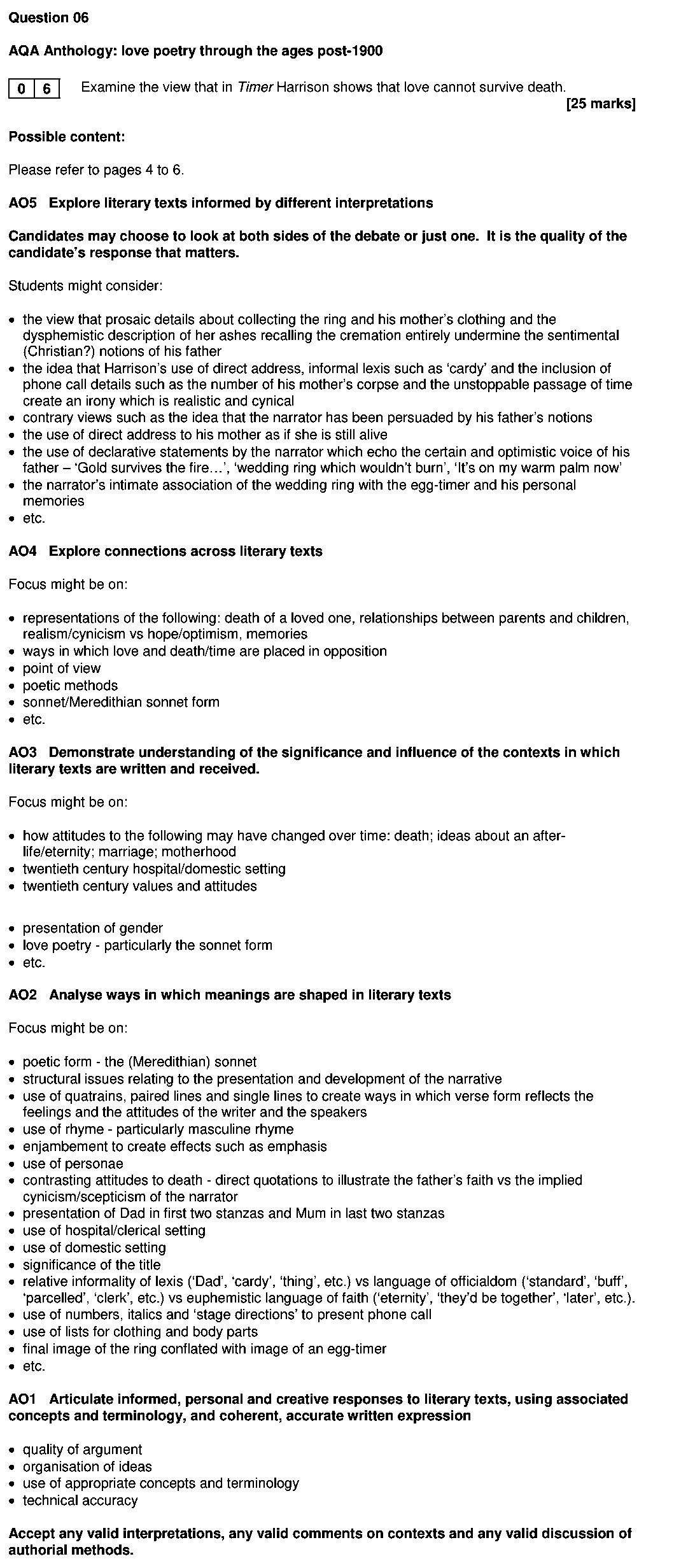
Examine the view that in Timer Harrison shows that love cannot survive death.
[25 marks]
Timer
Gold survives the fire that’s hot enough
to make you ashes in a standard urn.
An envelope of coarse official buff
contains your wedding ring which wouldn’t burn.
Dad told me I’d to tell them at St James’s
that the ring should go in the incinerator.
That ‘eternity’ inscribed with both their names is
his surety that they’d be together, ‘later’.
I signed for the parcelled clothing as the son,
the cardy, apron, pants, bra, dress –
the clerk phoned down: 6-8-8-3-1?
Has she still her ring on? (Slight pause) Yes!
It’s on my warm palm now, your burnished ring!
I feel your ashes, head, arms, breasts, womb, legs,
sift through its circle slowly, like that thing
you used to let me watch to time the eggs.
Tony Harrison (b. 1937)
June 2018 · AS Paper 1 · Q5 25 marks Anthology poetry love poetry pre 1900
AQA Anthology of Love Poetry through the ages pre-1900
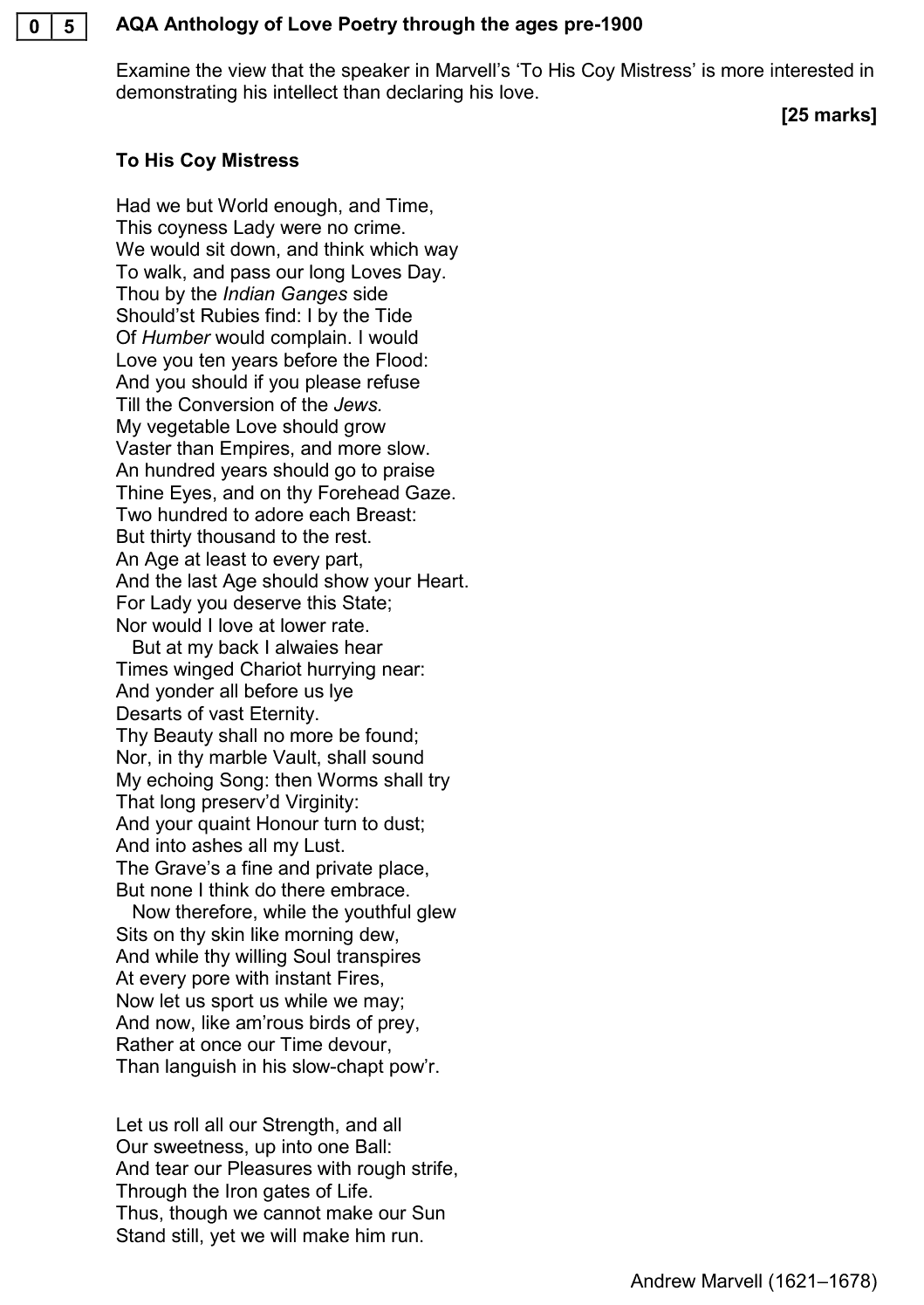
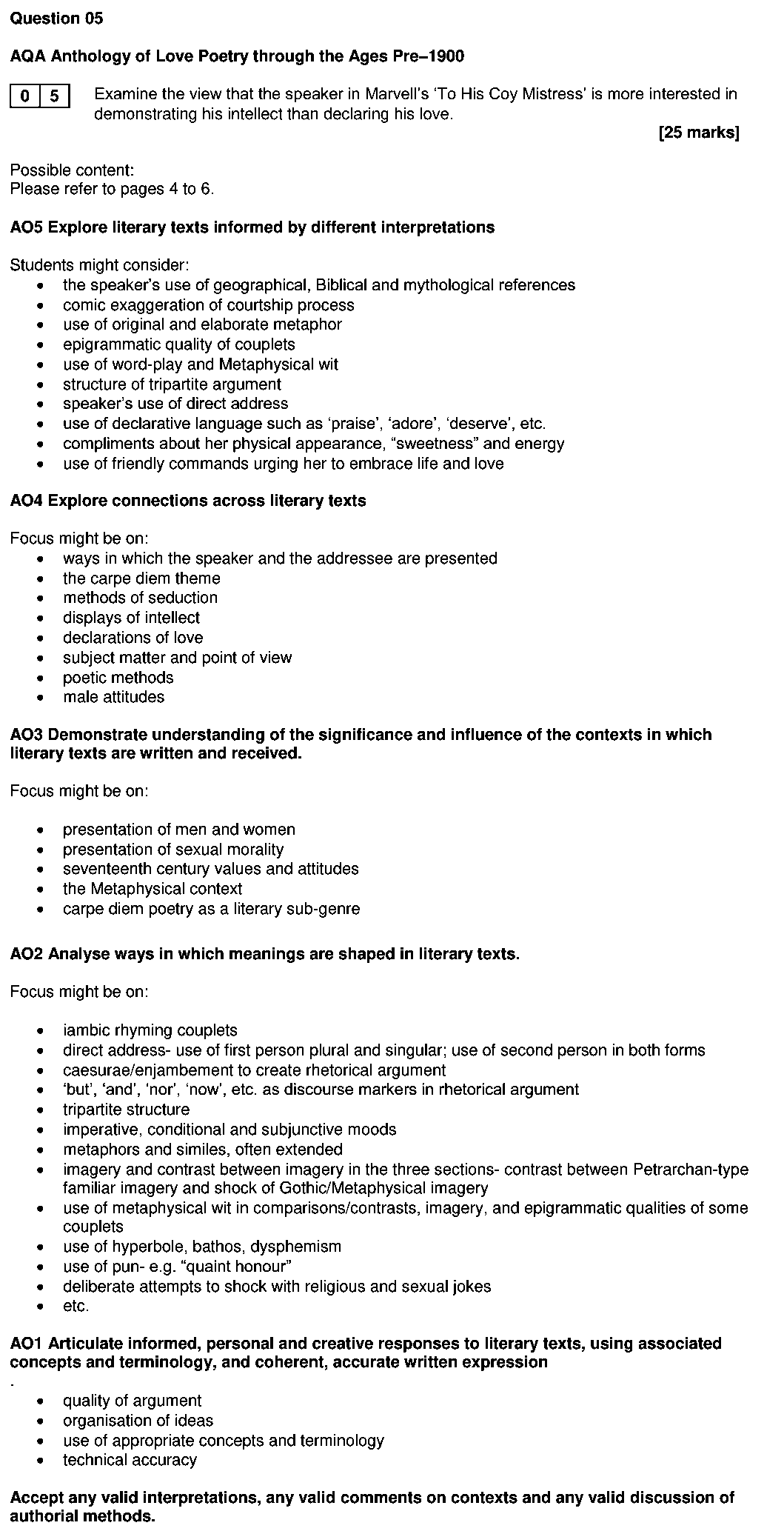
Examine the view that the speaker in Marvell’s ‘To His Coy Mistress’ is more interested in
demonstrating his intellect than declaring his love.
[25 marks]
To His Coy Mistress
Had we but World enough, and Time,
This coyness Lady were no crime.
We would sit down, and think which way
To walk, and pass our long Loves Day.
Thou by the Indian Ganges side
Should’st Rubies find: I by the Tide
Of Humber would complain. I would
Love you ten years before the Flood:
And you should if you please refuse
Till the Conversion of the Jews.
My vegetable Love should grow
Vaster than Empires, and more slow.
An hundred years should go to praise
Thine Eyes, and on thy Forehead Gaze.
Two hundred to adore each Breast:
But thirty thousand to the rest.
An Age at least to every part,
And the last Age should show your Heart.
For Lady you deserve this State;
Nor would I love at lower rate.
But at my back I alwaies hear
Times winged Chariot hurrying near:
And yonder all before us lye
Desarts of vast Eternity.
Thy Beauty shall no more be found;
Nor, in thy marble Vault, shall sound
My echoing Song: then Worms shall try
That long preserv’d Virginity:
And your quaint Honour turn to dust;
And into ashes all my Lust.
The Grave’s a fine and private place,
But none I think do there embrace.
Now therefore, while the youthful glew
Sits on thy skin like morning dew,
And while thy willing Soul transpires
At every pore with instant Fires,
Now let us sport us while we may;
And now, like am’rous birds of prey,
Rather at once our Time devour,
Than languish in his slow-chapt pow’r.
Let us roll all our Strength, and all
Our sweetness, up into one Ball:
And tear our Pleasures with rough strife,
Through the Iron gates of Life.
Thus, though we cannot make our Sun
Stand still, yet we will make him run.
Andrew Marvell (1621–1678)
June 2018 · AS Paper 1 · Q6 25 marks Anthology poetry love poetry post 1900
AQA Anthology of Love Poetry through the ages post-1900
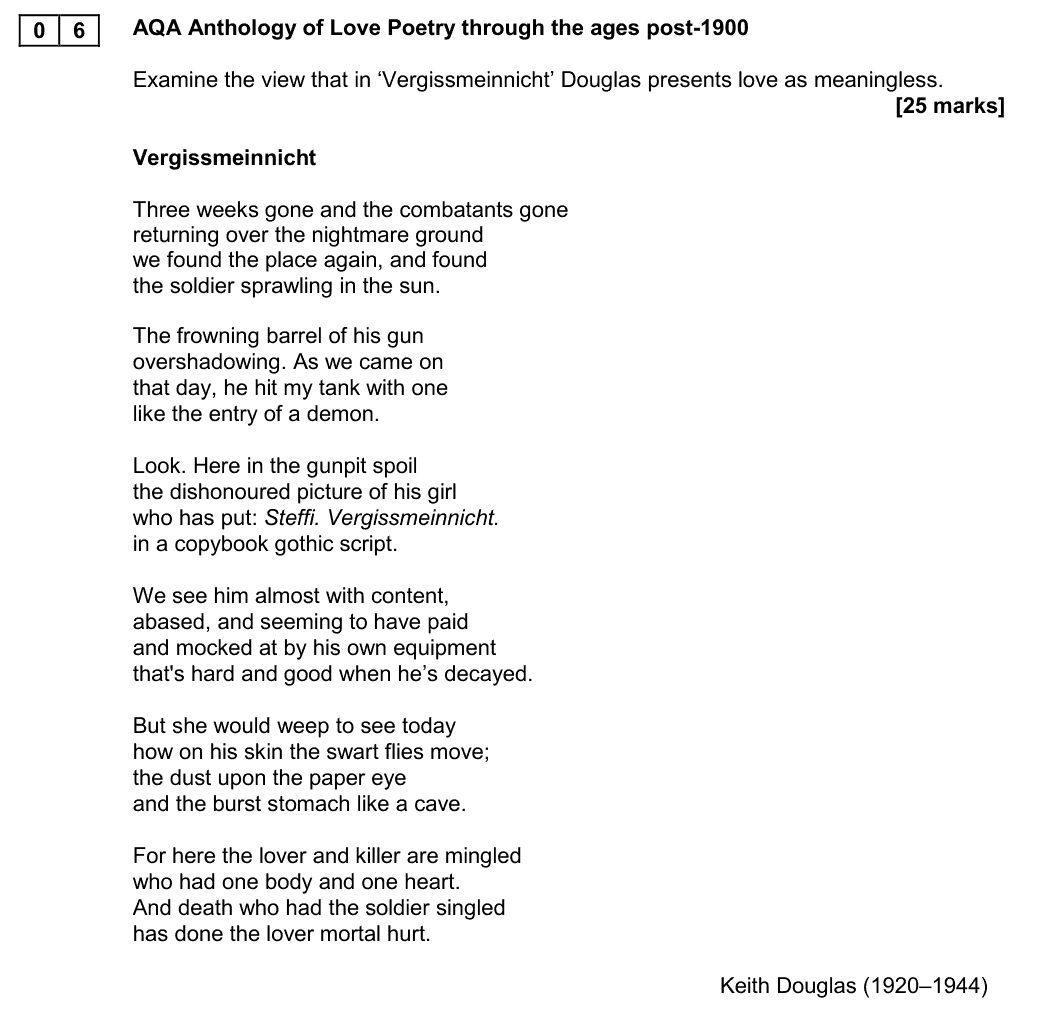
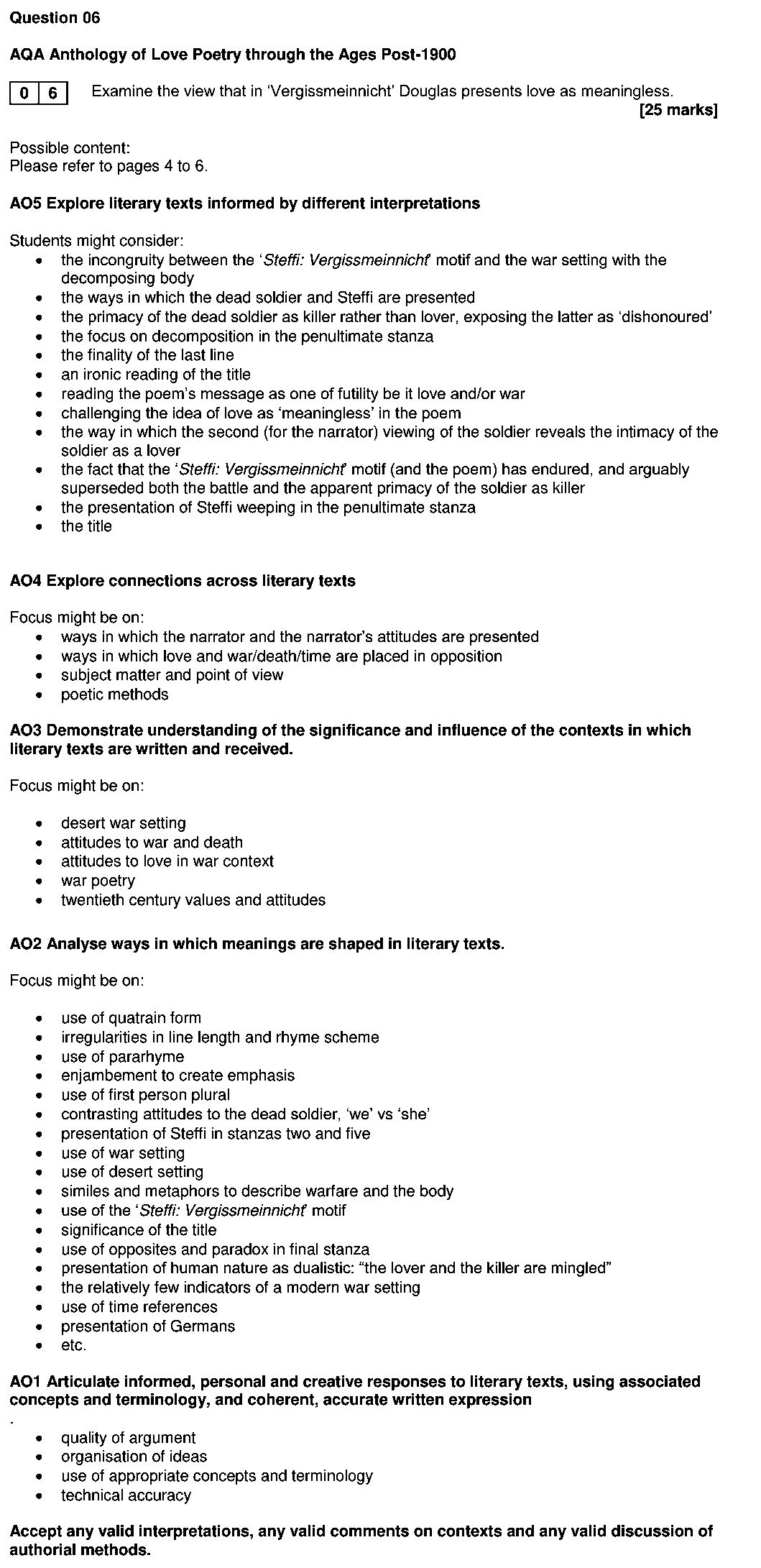
Examine the view that in ‘Vergissmeinnicht’ Douglas presents love as meaningless.
[25 marks]
Vergissmeinnicht
Three weeks gone and the combatants gone
returning over the nightmare ground
we found the place again, and found
the soldier sprawling in the sun.
The frowning barrel of his gun
overshadowing. As we came on
that day, he hit my tank with one
like the entry of a demon.
Look. Here in the gunpit spoil
the dishonoured picture of his girl
who has put: Steffi. Vergissmeinnicht.
in a copybook gothic script.
We see him almost with content,
abased, and seeming to have paid
and mocked at by his own equipment
that's hard and good when he’s decayed.
But she would weep to see today
how on his skin the swart flies move;
the dust upon the paper eye
and the burst stomach like a cave.
For here the lover and killer are mingled
who had one body and one heart.
And death who had the soldier singled
has done the lover mortal hurt.
Keith Douglas (1920–1944)
June 2017 · AS Paper 1 · Q5 25 marks Anthology poetry love poetry pre 1900
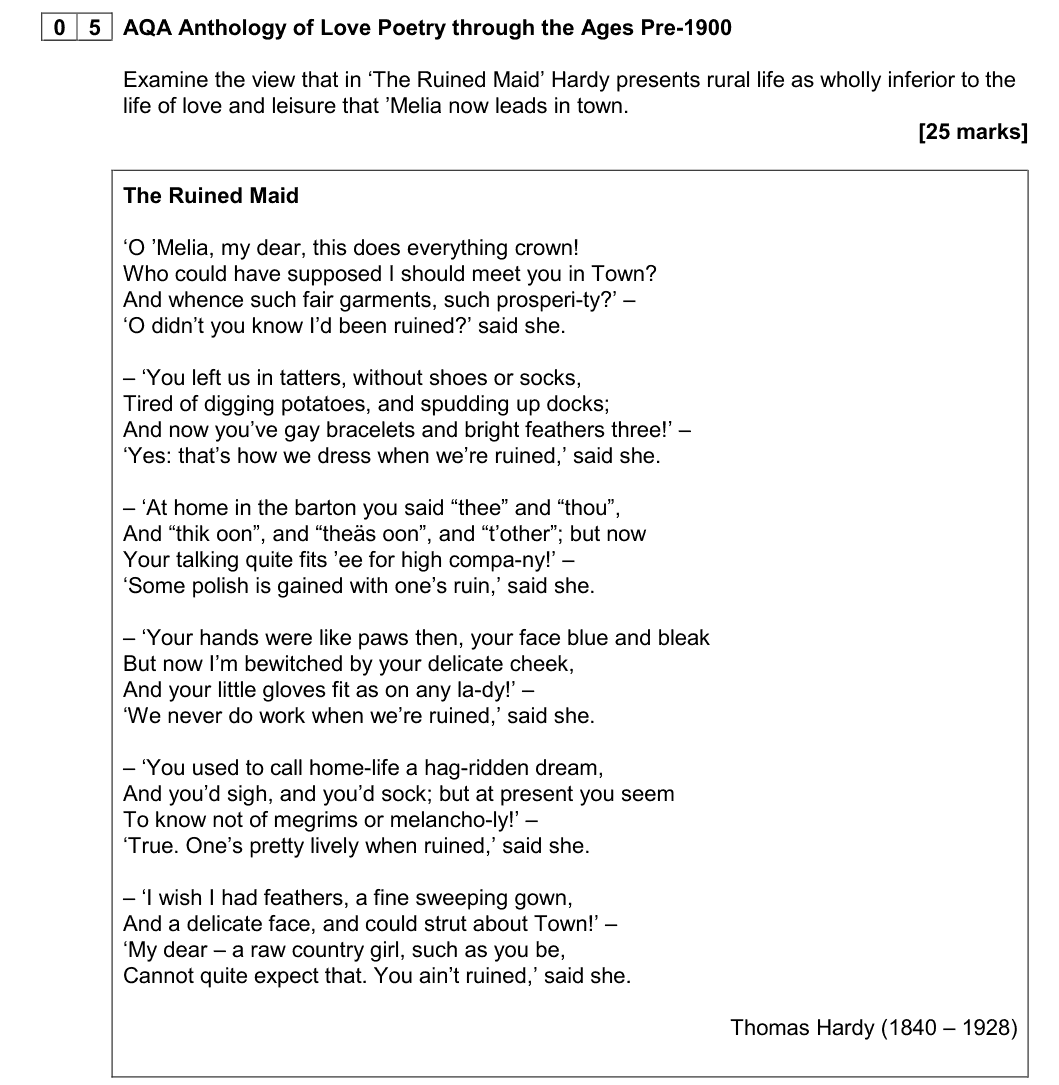
0 5 AQA Anthology of Love Poetry through the Ages Pre-1900
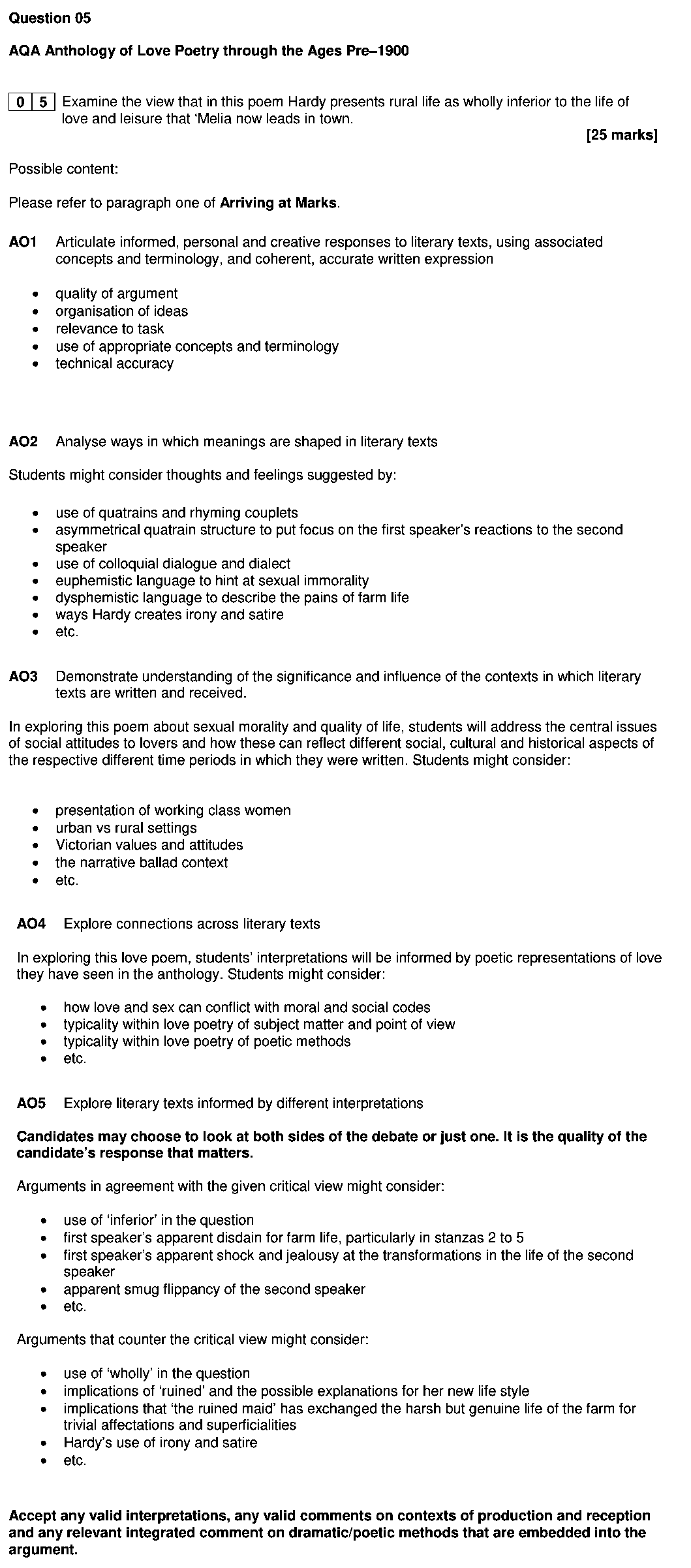
Examine the view that in ‘The Ruined Maid’ Hardy presents rural life as wholly inferior to the
life of love and leisure that ’Melia now leads in town.
[25 marks]
The Ruined Maid
‘O ’Melia, my dear, this does everything crown!
Who could have supposed I should meet you in Town?
And whence such fair garments, such prosperi-ty?’ –
‘O didn’t you know I’d been ruined?’ said she.
– ‘You left us in tatters, without shoes or socks,
Tired of digging potatoes, and spudding up docks;
And now you’ve gay bracelets and bright feathers three!’ –
‘Yes: that’s how we dress when we’re ruined,’ said she.
– ‘At home in the barton you said “thee” and “thou”,
And “thik oon”, and “theäs oon”, and “t’other”; but now
Your talking quite fits ’ee for high compa-ny!’ –
‘Some polish is gained with one’s ruin,’ said she.
– ‘Your hands were like paws then, your face blue and bleak
But now I’m bewitched by your delicate cheek,
And your little gloves fit as on any la-dy!’ –
‘We never do work when we’re ruined,’ said she.
– ‘You used to call home-life a hag-ridden dream,
And you’d sigh, and you’d sock; but at present you seem
To know not of megrims or melancho-ly!’ –
‘True. One’s pretty lively when ruined,’ said she.
– ‘I wish I had feathers, a fine sweeping gown,
And a delicate face, and could strut about Town!’ –
‘My dear – a raw country girl, such as you be,
Cannot quite expect that. You ain’t ruined,’ said she.
Thomas Hardy (1840 – 1928)
June 2017 · AS Paper 1 · Q6 25 marks Anthology poetry love poetry post 1900
0 6 AQA Anthology of Love Poetry through the Ages Post-1900
Examine the view that in ‘Punishment’ the speaker is more interested in himself than in the
female victim of forbidden love.
[25 marks]
Punishment
I can feel the tug
of the halter at the nape
of her neck, the wind
on her naked front.
It blows her nipples
to amber beads,
it shakes the frail rigging
of her ribs.
I can see her drowned
body in the bog,
the weighing stone,
the floating rods and boughs.
Under which at first
she was a barked sapling
that is dug up
oak-bone, brain-firkin:
her shaved head
like a stubble of black corn,
her blindfold a soiled bandage,
her noose a ring
to store
the memories of love.
Little adulteress,
before they punished you
you were flaxen-haired,
undernourished, and your
tar-black face was beautiful.
My poor scapegoat,
I almost love you
but would have cast, I know,
the stones of silence.
I am the artful voyeur
of your brain’s exposed
and darkened combs,
your muscles’ webbing
and all your numbered bones:
I who have stood dumb
when your betraying sisters,
cauled in tar,
wept by the railings,
who would connive
in civilized outrage
yet understand the exact
and tribal, intimate revenge.
Seamus Heaney (1939 – 2013)
June 2016 · AS Paper 1 · Q5 25 marks Anthology poetry love poetry pre 1900
AQA Anthology: love poetry through the ages pre-1900
AQA Anthology: love poetry through the ages post-1900
Examine the view that in this poem Blake presents love and religion as total opposites.
[25 marks]
The Garden of Love
I went to the Garden of Love,
And saw what I never had seen:
A chapel was built in the midst,
Where I used to play on the green.
And the gates of this chapel were shut,
And ‘Thou shalt not’ writ over the door;
So I turned to the Garden of Love,
That so many sweet flowers bore.
And I saw it was filled with graves,
And tomb-stones where flowers should be,
And priests in black gowns were walking their rounds,
And binding with briars my joys and desires.
William Blake (1757-1827)
June 2016 · AS Paper 1 · Q6 25 marks Anthology poetry love poetry post 1900
AQA Anthology: love poetry through the ages pre-1900
AQA Anthology: love poetry through the ages post-1900
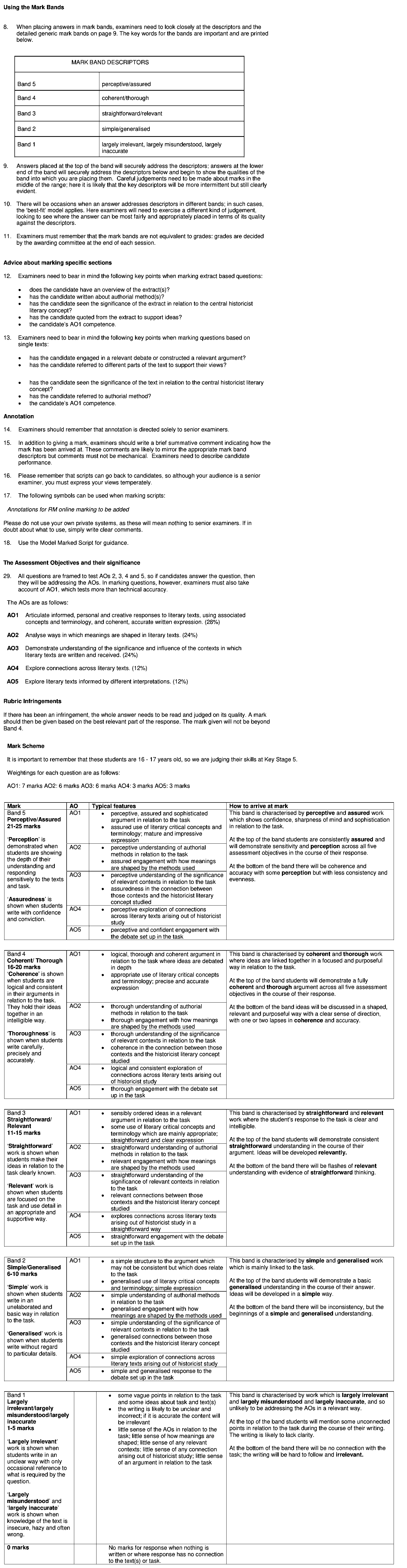
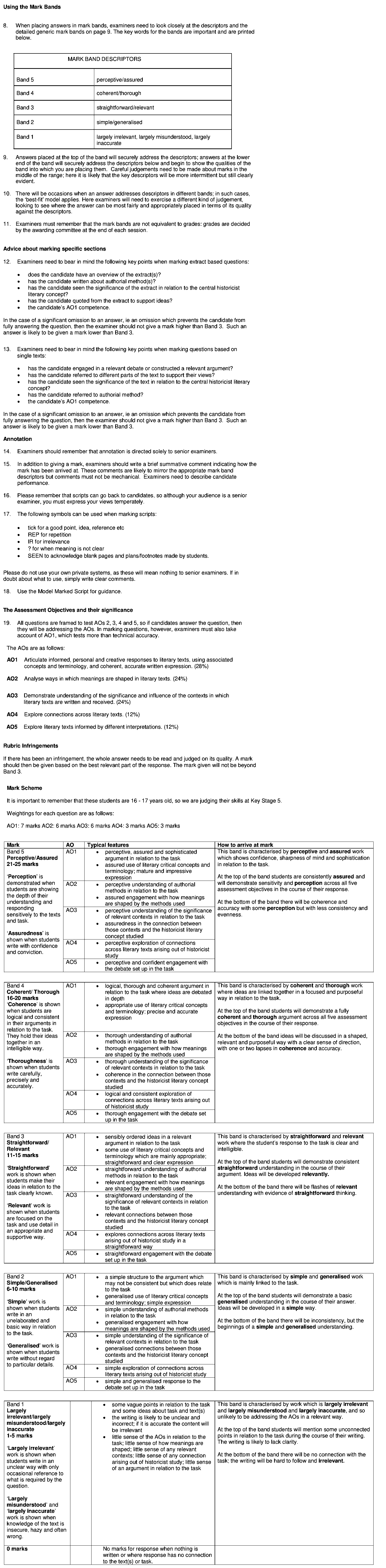
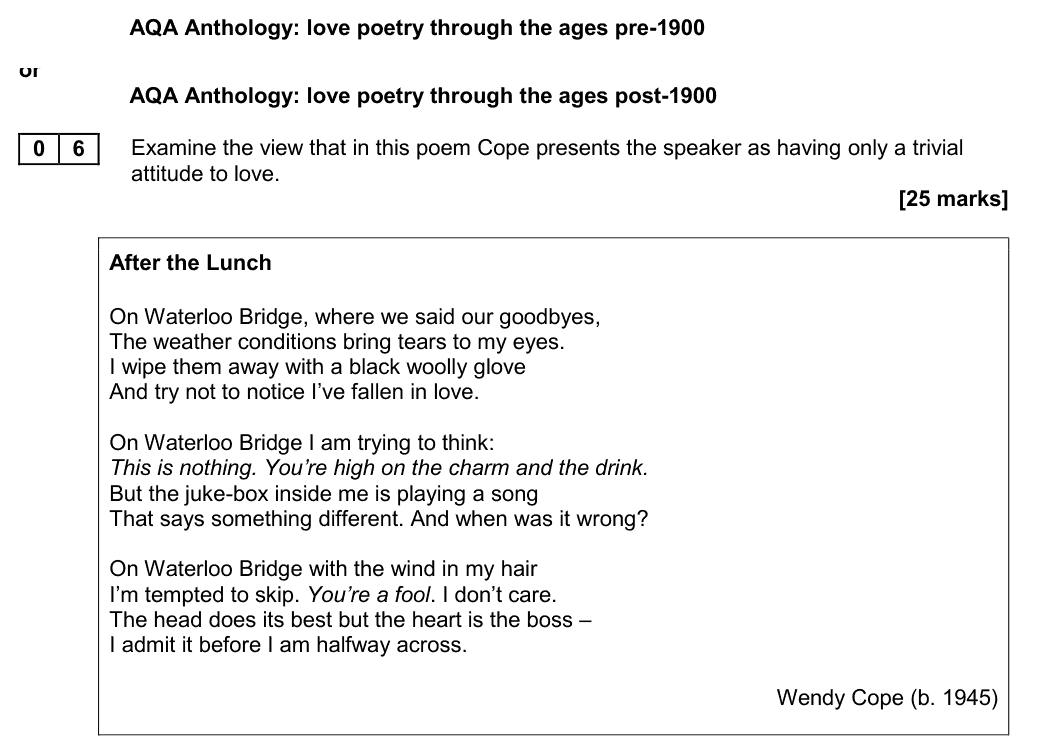
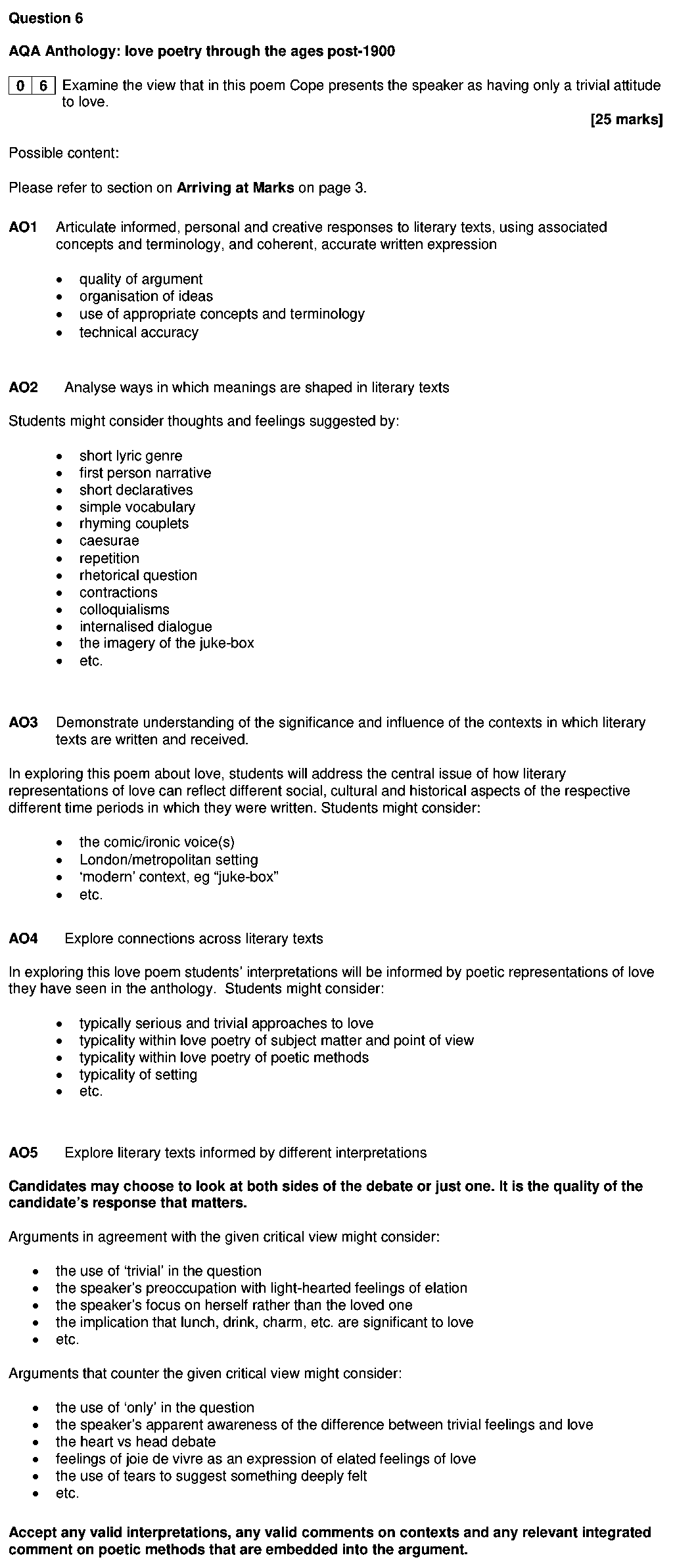
Examine the view that in this poem Cope presents the speaker as having only a trivial
attitude to love.
[25 marks]
After the Lunch
On Waterloo Bridge, where we said our goodbyes,
The weather conditions bring tears to my eyes.
I wipe them away with a black woolly glove
And try not to notice I’ve fallen in love.
On Waterloo Bridge I am trying to think:
This is nothing. You’re high on the charm and the drink.
But the juke-box inside me is playing a song
That says something different. And when was it wrong?
On Waterloo Bridge with the wind in my hair
I’m tempted to skip. You’re a fool. I don’t care.
The head does its best but the heart is the boss –
I admit it before I am halfway across.
Wendy Cope (b. 1945)

Work with an AQA English Literature A tutor

Essays stuck in the middle bands, or not sure what the examiners want from an analysis? Book a trial lesson with a specialist AQA English Literature A tutor.

Prefer email? Send an enquiry

If you are under 18, please include a parent's contact details. Enquiries go to enquiries@alevelenglishtutor.com and are deleted once handled. All tutoring is online.