AS: unseen prose (25 marks)

AS Paper 2 Section A: an unseen prose extract about love, analysed for how meanings are shaped. 9 questions.

Other types: Shakespeare: extract and whole play (25 marks) · Paper 2 set-text essays (25 marks) · AS: the love poetry anthology (25 marks) · Unseen poetry comparison (25 marks) · Comparing texts: love through the ages (25 marks) · Paper 2: the unseen extract (25 marks) · Paper 2: comparing two texts (25 marks)

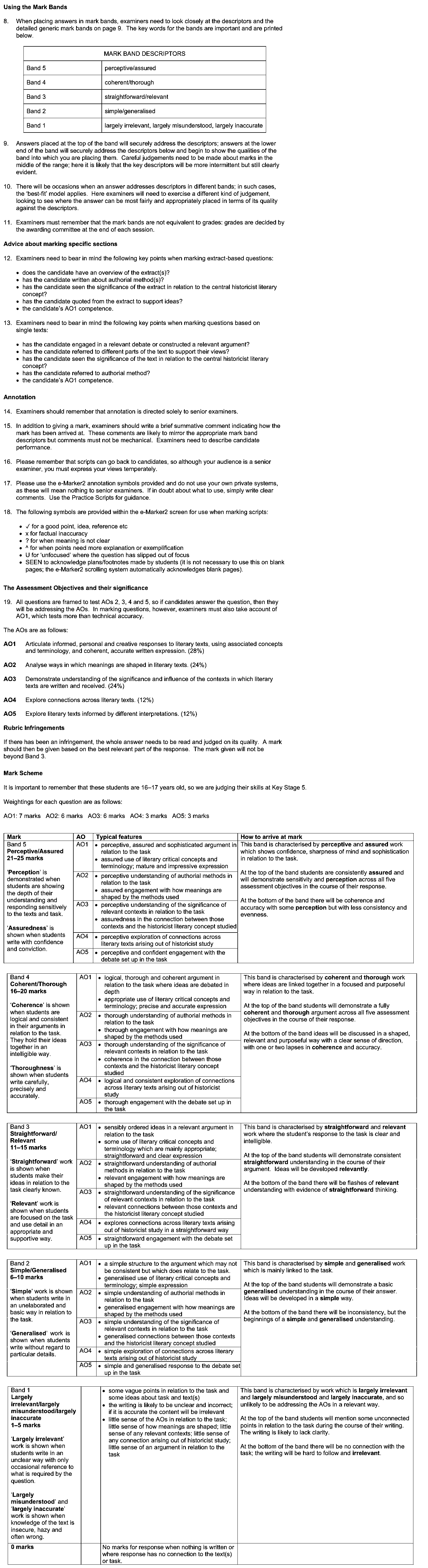
June 2025 · AS Paper 2 · Q1 25 marks Unseen prose unseen love prose
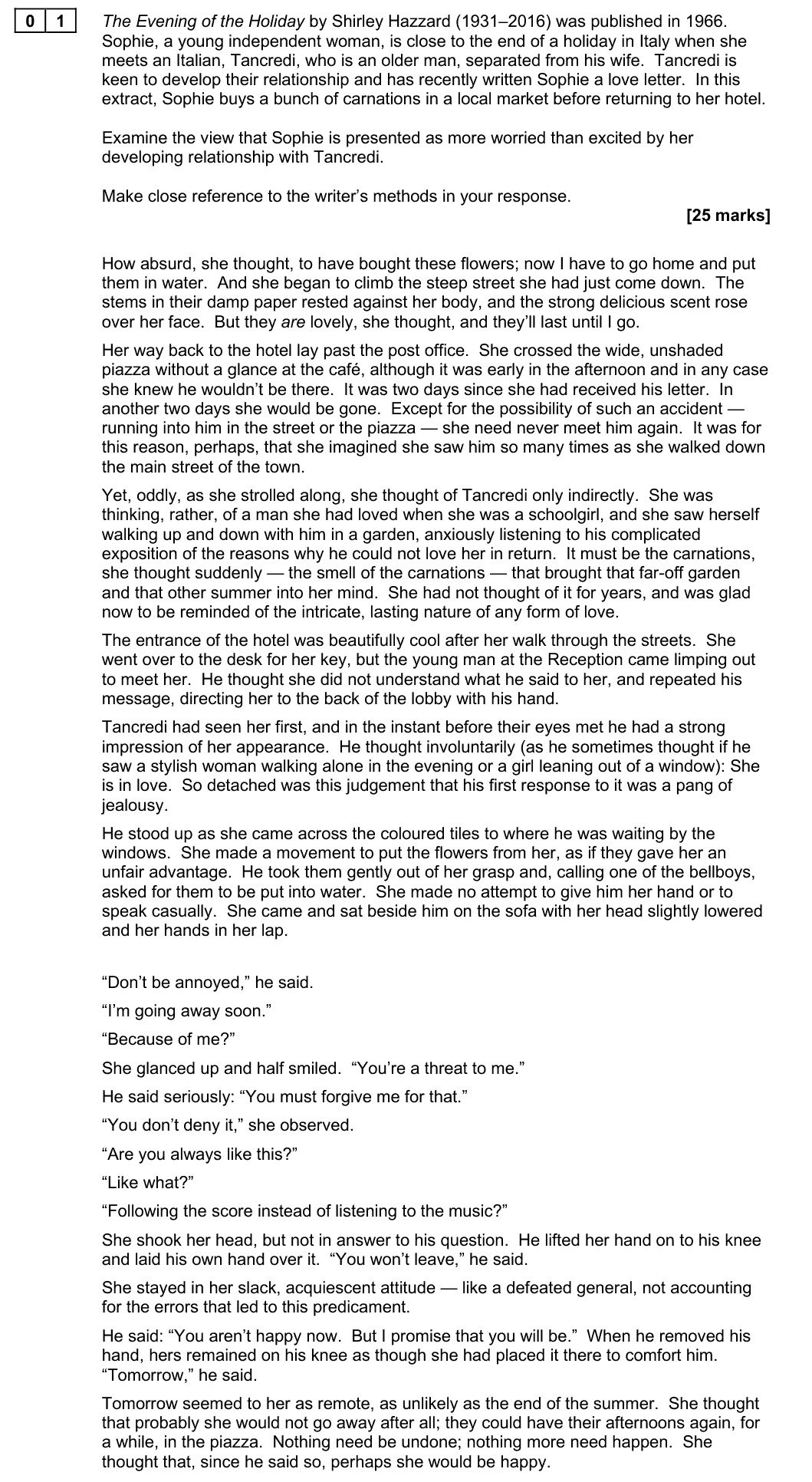
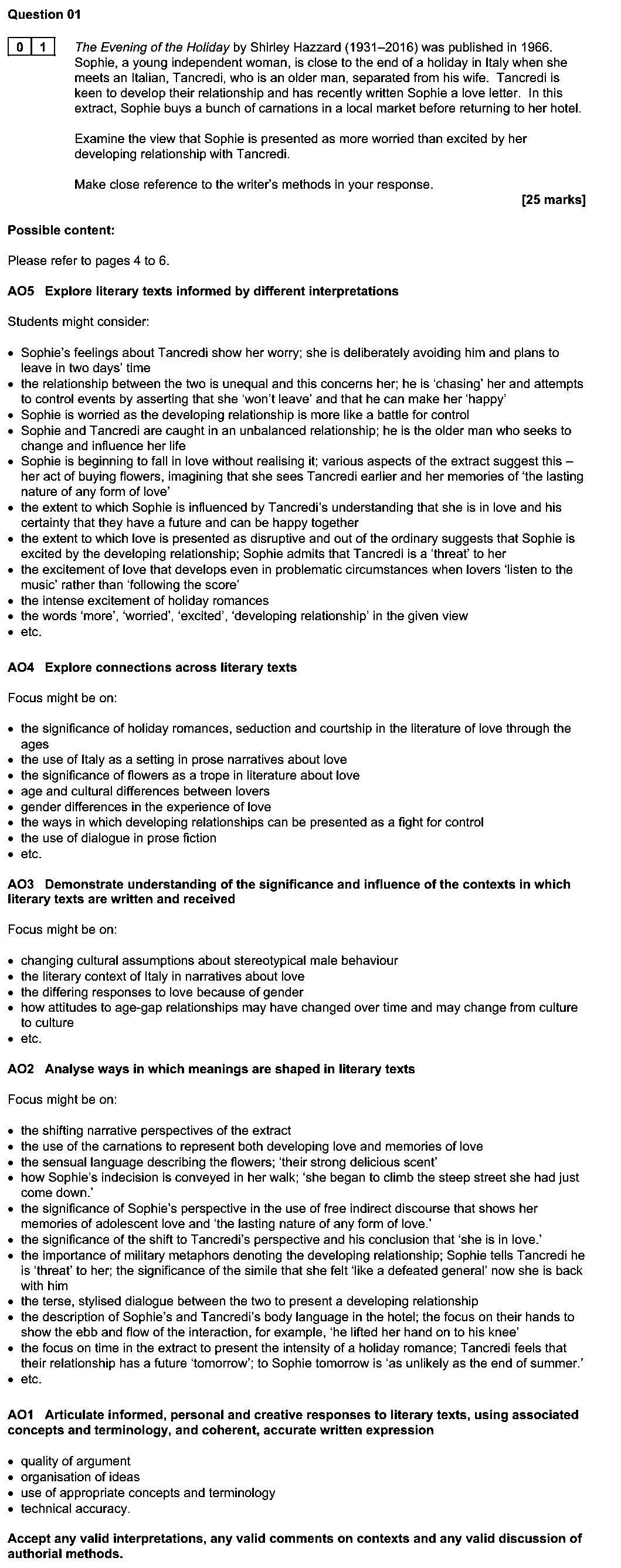
The Evening of the Holiday by Shirley Hazzard (1931–2016) was published in 1966.
Sophie, a young independent woman, is close to the end of a holiday in Italy when she
meets an Italian, Tancredi, who is an older man, separated from his wife. Tancredi is
keen to develop their relationship and has recently written Sophie a love letter. In this
extract, Sophie buys a bunch of carnations in a local market before returning to her hotel.
Examine the view that Sophie is presented as more worried than excited by her
developing relationship with Tancredi.
Make close reference to the writer’s methods in your response.
[25 marks]
How absurd, she thought, to have bought these flowers; now I have to go home and put
them in water. And she began to climb the steep street she had just come down. The
stems in their damp paper rested against her body, and the strong delicious scent rose
over her face. But they are lovely, she thought, and they’ll last until I go.
Her way back to the hotel lay past the post office. She crossed the wide, unshaded
piazza without a glance at the café, although it was early in the afternoon and in any case
she knew he wouldn’t be there. It was two days since she had received his letter. In
another two days she would be gone. Except for the possibility of such an accident —
running into him in the street or the piazza — she need never meet him again. It was for
this reason, perhaps, that she imagined she saw him so many times as she walked down
the main street of the town.
Yet, oddly, as she strolled along, she thought of Tancredi only indirectly. She was
thinking, rather, of a man she had loved when she was a schoolgirl, and she saw herself
walking up and down with him in a garden, anxiously listening to his complicated
exposition of the reasons why he could not love her in return. It must be the carnations,
she thought suddenly — the smell of the carnations — that brought that far-off garden
and that other summer into her mind. She had not thought of it for years, and was glad
now to be reminded of the intricate, lasting nature of any form of love.
The entrance of the hotel was beautifully cool after her walk through the streets. She
went over to the desk for her key, but the young man at the Reception came limping out
to meet her. He thought she did not understand what he said to her, and repeated his
message, directing her to the back of the lobby with his hand.
Tancredi had seen her first, and in the instant before their eyes met he had a strong
impression of her appearance. He thought involuntarily (as he sometimes thought if he
saw a stylish woman walking alone in the evening or a girl leaning out of a window): She
is in love. So detached was this judgement that his first response to it was a pang of
jealousy.
He stood up as she came across the coloured tiles to where he was waiting by the
windows. She made a movement to put the flowers from her, as if they gave her an
unfair advantage. He took them gently out of her grasp and, calling one of the bellboys,
asked for them to be put into water. She made no attempt to give him her hand or to
speak casually. She came and sat beside him on the sofa with her head slightly lowered
and her hands in her lap.
“Don’t be annoyed,” he said.
“I’m going away soon.”
“Because of me?”
She glanced up and half smiled. “You’re a threat to me.”
He said seriously: “You must forgive me for that.”
“You don’t deny it,” she observed.
“Are you always like this?”
“Like what?”
“Following the score instead of listening to the music?”
She shook her head, but not in answer to his question. He lifted her hand on to his knee
and laid his own hand over it. “You won’t leave,” he said.
She stayed in her slack, acquiescent attitude — like a defeated general, not accounting
for the errors that led to this predicament.
He said: “You aren’t happy now. But I promise that you will be.” When he removed his
hand, hers remained on his knee as though she had placed it there to comfort him.
“Tomorrow,” he said.
Tomorrow seemed to her as remote, as unlikely as the end of the summer. She thought
that probably she would not go away after all; they could have their afternoons again, for
a while, in the piazza. Nothing need be undone; nothing more need happen. She
thought that, since he said so, perhaps she would be happy.
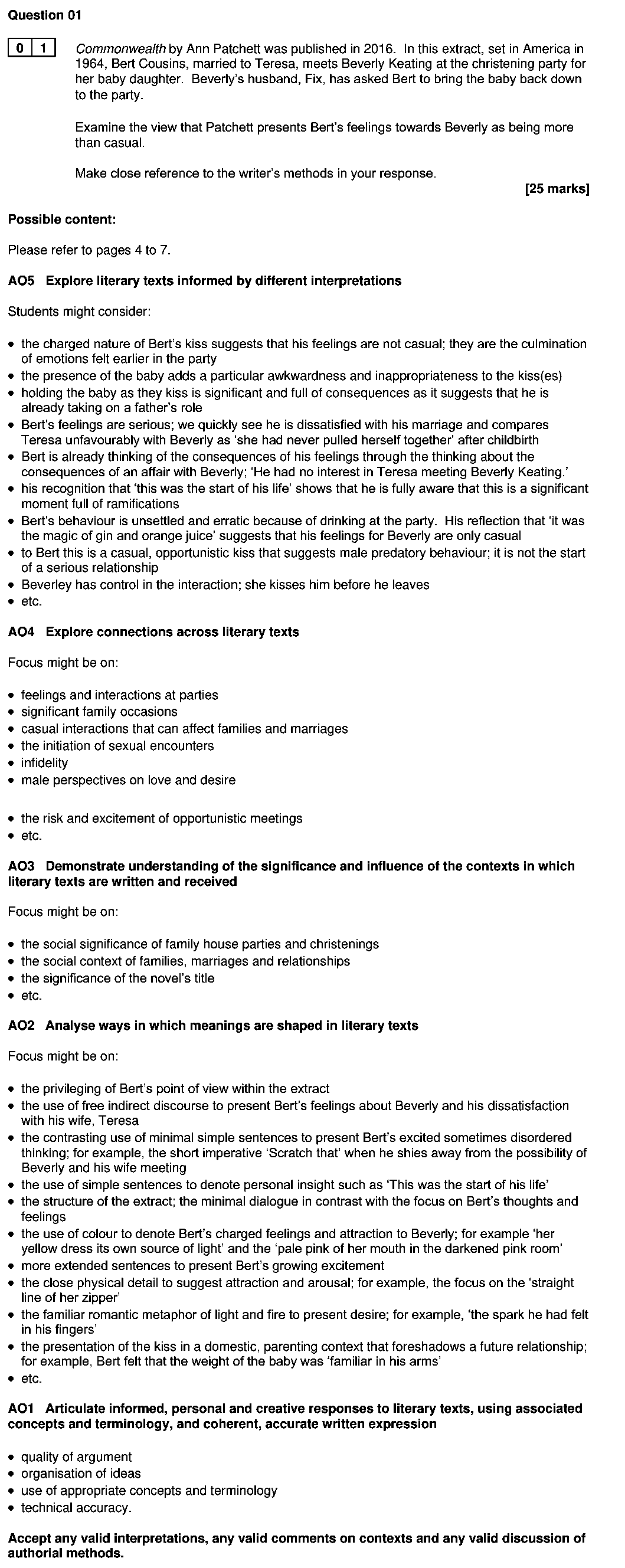
June 2024 · AS Paper 2 · Q1 25 marks Unseen prose unseen love prose
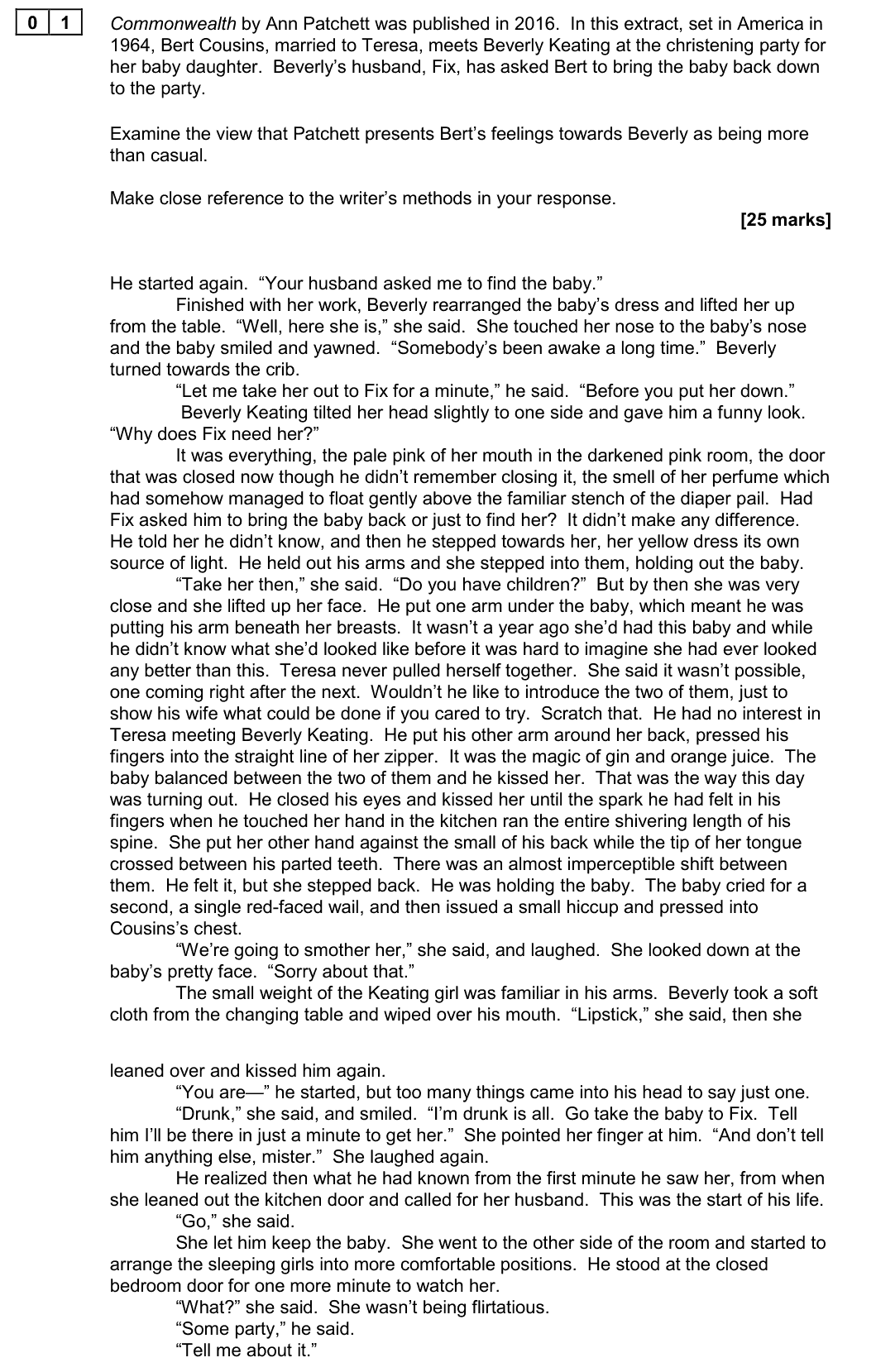
Commonwealth by Ann Patchett was published in 2016. In this extract, set in America in
1964, Bert Cousins, married to Teresa, meets Beverly Keating at the christening party for
her baby daughter. Beverly’s husband, Fix, has asked Bert to bring the baby back down
to the party.
Examine the view that Patchett presents Bert’s feelings towards Beverly as being more
than casual.
Make close reference to the writer’s methods in your response.
[25 marks]
He started again. “Your husband asked me to find the baby.”
Finished with her work, Beverly rearranged the baby’s dress and lifted her up
from the table. “Well, here she is,” she said. She touched her nose to the baby’s nose
and the baby smiled and yawned. “Somebody’s been awake a long time.” Beverly
turned towards the crib.
“Let me take her out to Fix for a minute,” he said. “Before you put her down.”
Beverly Keating tilted her head slightly to one side and gave him a funny look.
“Why does Fix need her?”
It was everything, the pale pink of her mouth in the darkened pink room, the door
that was closed now though he didn’t remember closing it, the smell of her perfume which
had somehow managed to float gently above the familiar stench of the diaper pail. Had
Fix asked him to bring the baby back or just to find her? It didn’t make any difference.
He told her he didn’t know, and then he stepped towards her, her yellow dress its own
source of light. He held out his arms and she stepped into them, holding out the baby.
“Take her then,” she said. “Do you have children?” But by then she was very
close and she lifted up her face. He put one arm under the baby, which meant he was
putting his arm beneath her breasts. It wasn’t a year ago she’d had this baby and while
he didn’t know what she’d looked like before it was hard to imagine she had ever looked
any better than this. Teresa never pulled herself together. She said it wasn’t possible,
one coming right after the next. Wouldn’t he like to introduce the two of them, just to
show his wife what could be done if you cared to try. Scratch that. He had no interest in
Teresa meeting Beverly Keating. He put his other arm around her back, pressed his
fingers into the straight line of her zipper. It was the magic of gin and orange juice. The
baby balanced between the two of them and he kissed her. That was the way this day
was turning out. He closed his eyes and kissed her until the spark he had felt in his
fingers when he touched her hand in the kitchen ran the entire shivering length of his
spine. She put her other hand against the small of his back while the tip of her tongue
crossed between his parted teeth. There was an almost imperceptible shift between
them. He felt it, but she stepped back. He was holding the baby. The baby cried for a
second, a single red-faced wail, and then issued a small hiccup and pressed into
Cousins’s chest.
“We’re going to smother her,” she said, and laughed. She looked down at the
baby’s pretty face. “Sorry about that.”
The small weight of the Keating girl was familiar in his arms. Beverly took a soft
cloth from the changing table and wiped over his mouth. “Lipstick,” she said, then she
leaned over and kissed him again.
“You are—” he started, but too many things came into his head to say just one.
“Drunk,” she said, and smiled. “I’m drunk is all. Go take the baby to Fix. Tell
him I’ll be there in just a minute to get her.” She pointed her finger at him. “And don’t tell
him anything else, mister.” She laughed again.
He realized then what he had known from the first minute he saw her, from when
she leaned out the kitchen door and called for her husband. This was the start of his life.
“Go,” she said.
She let him keep the baby. She went to the other side of the room and started to
arrange the sleeping girls into more comfortable positions. He stood at the closed
bedroom door for one more minute to watch her.
“What?” she said. She wasn’t being flirtatious.
“Some party,” he said.
“Tell me about it.”
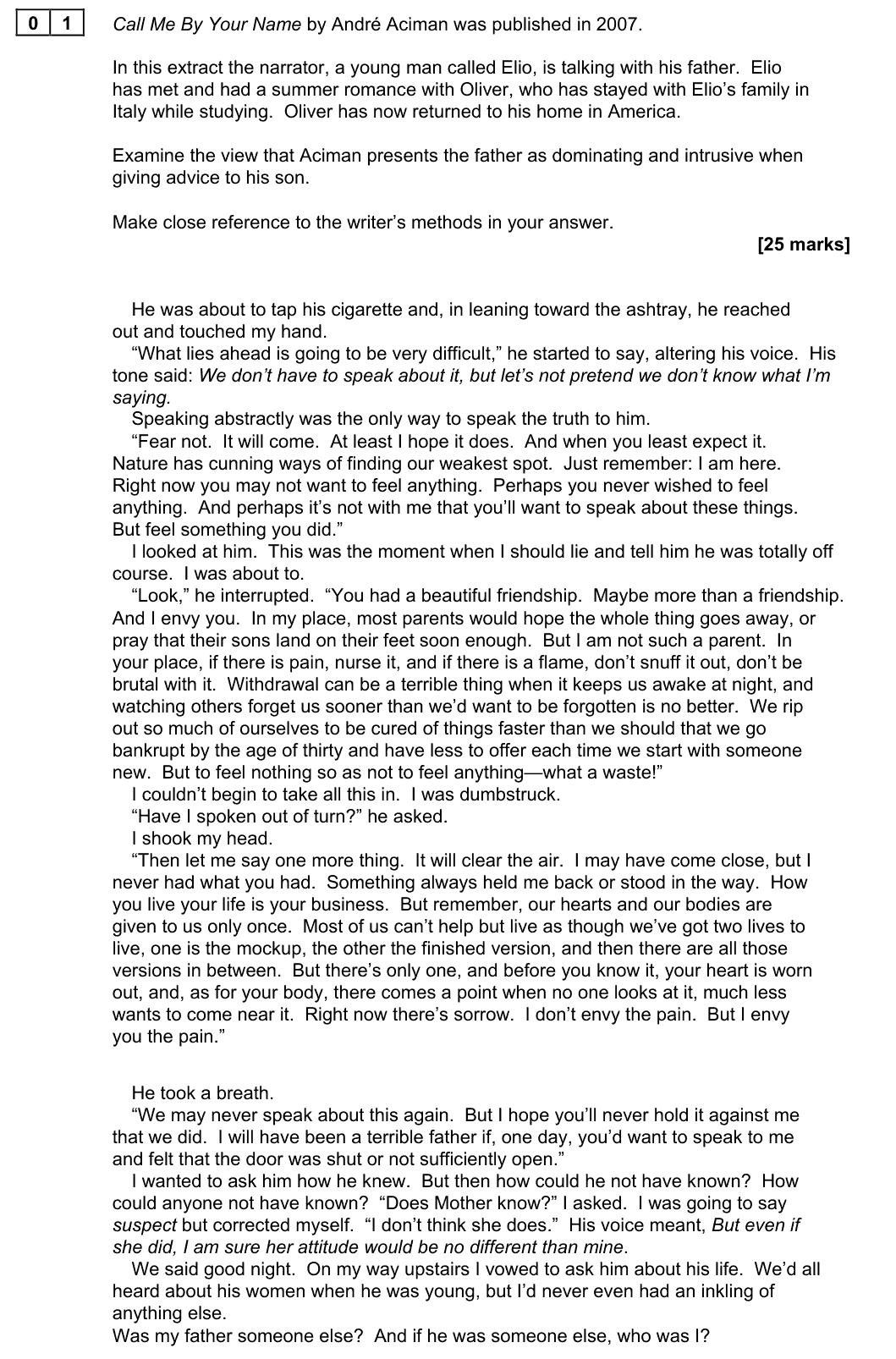
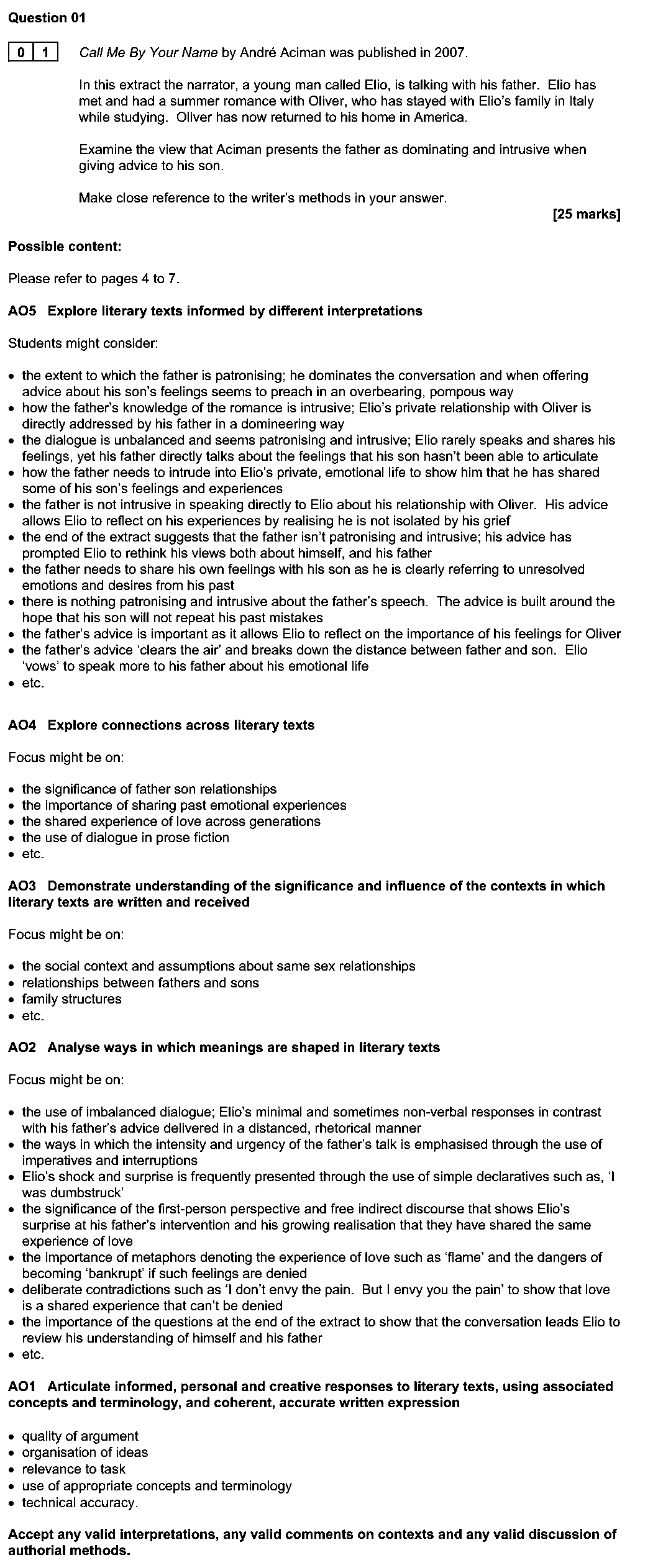
June 2023 · AS Paper 2 · Q1 25 marks Unseen prose unseen love prose
Call Me By Your Name by André Aciman was published in 2007.
In this extract the narrator, a young man called Elio, is talking with his father. Elio
has met and had a summer romance with Oliver, who has stayed with Elio’s family in
Italy while studying. Oliver has now returned to his home in America.
Examine the view that Aciman presents the father as dominating and intrusive when
giving advice to his son.
Make close reference to the writer’s methods in your answer.
[25 marks]
He was about to tap his cigarette and, in leaning toward the ashtray, he reached
out and touched my hand.
“What lies ahead is going to be very difficult,” he started to say, altering his voice. His
tone said: We don’t have to speak about it, but let’s not pretend we don’t know what I’m
saying.
Speaking abstractly was the only way to speak the truth to him.
“Fear not. It will come. At least I hope it does. And when you least expect it.
Nature has cunning ways of finding our weakest spot. Just remember: I am here.
Right now you may not want to feel anything. Perhaps you never wished to feel
anything. And perhaps it’s not with me that you’ll want to speak about these things.
But feel something you did.”
I looked at him. This was the moment when I should lie and tell him he was totally off
course. I was about to.
“Look,” he interrupted. “You had a beautiful friendship. Maybe more than a friendship.
And I envy you. In my place, most parents would hope the whole thing goes away, or
pray that their sons land on their feet soon enough. But I am not such a parent. In
your place, if there is pain, nurse it, and if there is a flame, don’t snuff it out, don’t be
brutal with it. Withdrawal can be a terrible thing when it keeps us awake at night, and
watching others forget us sooner than we’d want to be forgotten is no better. We rip
out so much of ourselves to be cured of things faster than we should that we go
bankrupt by the age of thirty and have less to offer each time we start with someone
new. But to feel nothing so as not to feel anything—what a waste!”
I couldn’t begin to take all this in. I was dumbstruck.
“Have I spoken out of turn?” he asked.
I shook my head.
“Then let me say one more thing. It will clear the air. I may have come close, but I
never had what you had. Something always held me back or stood in the way. How
you live your life is your business. But remember, our hearts and our bodies are
given to us only once. Most of us can’t help but live as though we’ve got two lives to
live, one is the mockup, the other the finished version, and then there are all those
versions in between. But there’s only one, and before you know it, your heart is worn
out, and, as for your body, there comes a point when no one looks at it, much less
wants to come near it. Right now there’s sorrow. I don’t envy the pain. But I envy
you the pain.”
He took a breath.
“We may never speak about this again. But I hope you’ll never hold it against me
that we did. I will have been a terrible father if, one day, you’d want to speak to me
and felt that the door was shut or not sufficiently open.”
I wanted to ask him how he knew. But then how could he not have known? How
could anyone not have known? “Does Mother know?” I asked. I was going to say
suspect but corrected myself. “I don’t think she does.” His voice meant, But even if
she did, I am sure her attitude would be no different than mine.
We said good night. On my way upstairs I vowed to ask him about his life. We’d all
heard about his women when he was young, but I’d never even had an inkling of
anything else.
Was my father someone else? And if he was someone else, who was I?
June 2022 · AS Paper 2 · Q1 25 marks Unseen prose unseen love prose
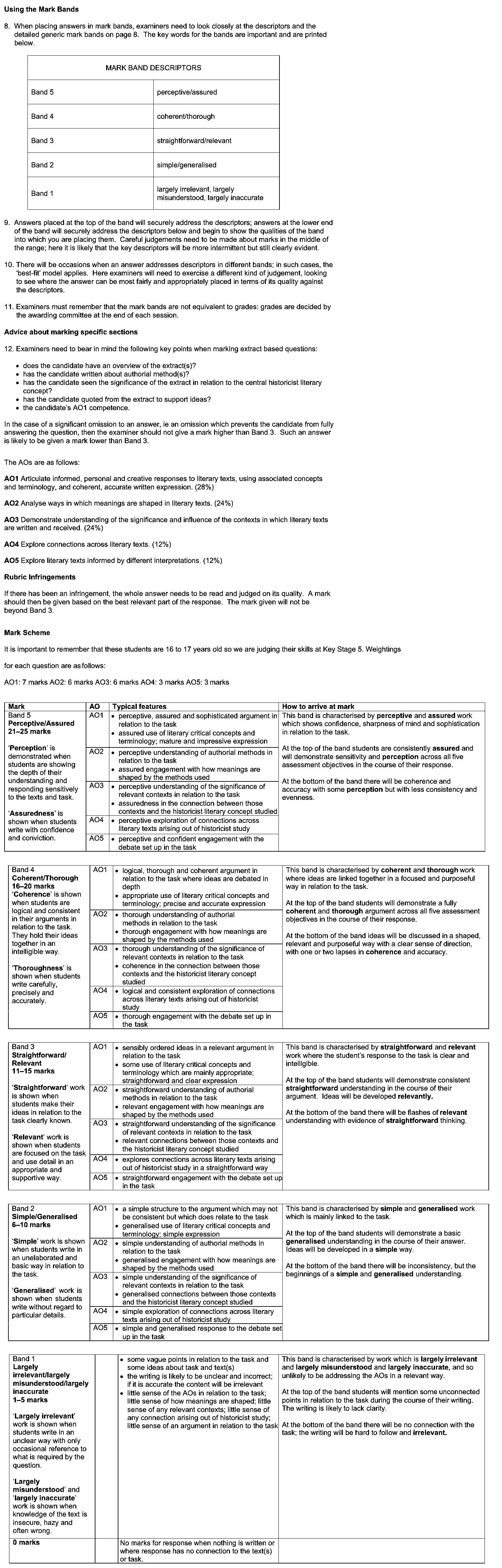
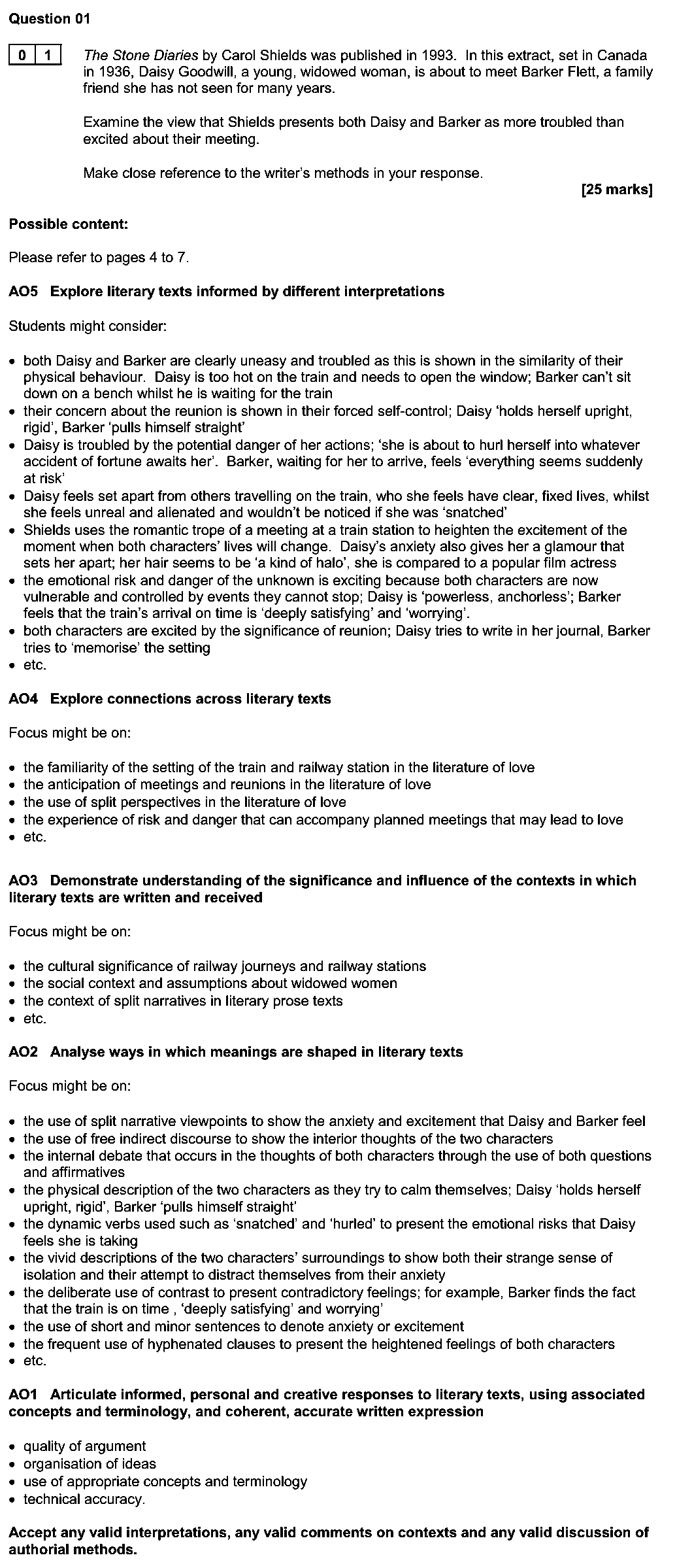
The Stone Diaries by Carol Shields was published in 1993. In this extract, set in Canada
in 1936, Daisy Goodwill, a young, widowed woman, is about to meet Barker Flett, a family
friend she has not seen for many years.
Examine the view that Shields presents both Daisy and Barker as more troubled than
excited about their meeting.
Make close reference to the writer’s methods in your response.
[25 marks]
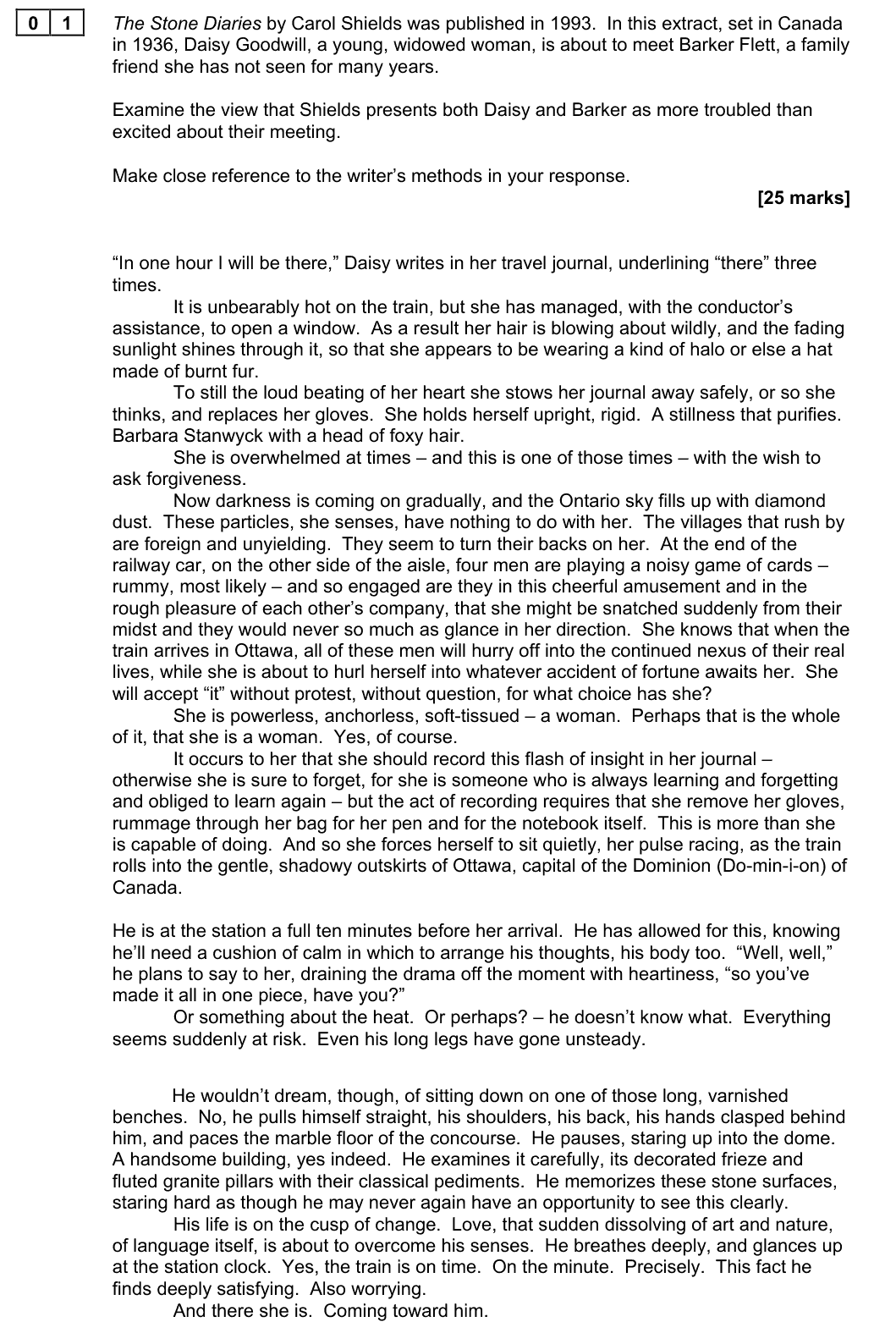
“In one hour I will be there,” Daisy writes in her travel journal, underlining “there” three
times.
It is unbearably hot on the train, but she has managed, with the conductor’s
assistance, to open a window. As a result her hair is blowing about wildly, and the fading
sunlight shines through it, so that she appears to be wearing a kind of halo or else a hat
made of burnt fur.
To still the loud beating of her heart she stows her journal away safely, or so she
thinks, and replaces her gloves. She holds herself upright, rigid. A stillness that purifies.
Barbara Stanwyck with a head of foxy hair.
She is overwhelmed at times – and this is one of those times – with the wish to
ask forgiveness.
Now darkness is coming on gradually, and the Ontario sky fills up with diamond
dust. These particles, she senses, have nothing to do with her. The villages that rush by
are foreign and unyielding. They seem to turn their backs on her. At the end of the
railway car, on the other side of the aisle, four men are playing a noisy game of cards –
rummy, most likely – and so engaged are they in this cheerful amusement and in the
rough pleasure of each other’s company, that she might be snatched suddenly from their
midst and they would never so much as glance in her direction. She knows that when the
train arrives in Ottawa, all of these men will hurry off into the continued nexus of their real
lives, while she is about to hurl herself into whatever accident of fortune awaits her. She
will accept “it” without protest, without question, for what choice has she?
She is powerless, anchorless, soft-tissued – a woman. Perhaps that is the whole
of it, that she is a woman. Yes, of course.
It occurs to her that she should record this flash of insight in her journal –
otherwise she is sure to forget, for she is someone who is always learning and forgetting
and obliged to learn again – but the act of recording requires that she remove her gloves,
rummage through her bag for her pen and for the notebook itself. This is more than she
is capable of doing. And so she forces herself to sit quietly, her pulse racing, as the train
rolls into the gentle, shadowy outskirts of Ottawa, capital of the Dominion (Do-min-i-on) of
Canada.
He is at the station a full ten minutes before her arrival. He has allowed for this, knowing
he’ll need a cushion of calm in which to arrange his thoughts, his body too. “Well, well,”
he plans to say to her, draining the drama off the moment with heartiness, “so you’ve
made it all in one piece, have you?”
Or something about the heat. Or perhaps? – he doesn’t know what. Everything
seems suddenly at risk. Even his long legs have gone unsteady.
He wouldn’t dream, though, of sitting down on one of those long, varnished
benches. No, he pulls himself straight, his shoulders, his back, his hands clasped behind
him, and paces the marble floor of the concourse. He pauses, staring up into the dome.
A handsome building, yes indeed. He examines it carefully, its decorated frieze and
fluted granite pillars with their classical pediments. He memorizes these stone surfaces,
staring hard as though he may never again have an opportunity to see this clearly.
His life is on the cusp of change. Love, that sudden dissolving of art and nature,
of language itself, is about to overcome his senses. He breathes deeply, and glances up
at the station clock. Yes, the train is on time. On the minute. Precisely. This fact he
finds deeply satisfying. Also worrying.
And there she is. Coming toward him.
November 2020 · AS Paper 2 · Q1 25 marks Unseen prose unseen love prose
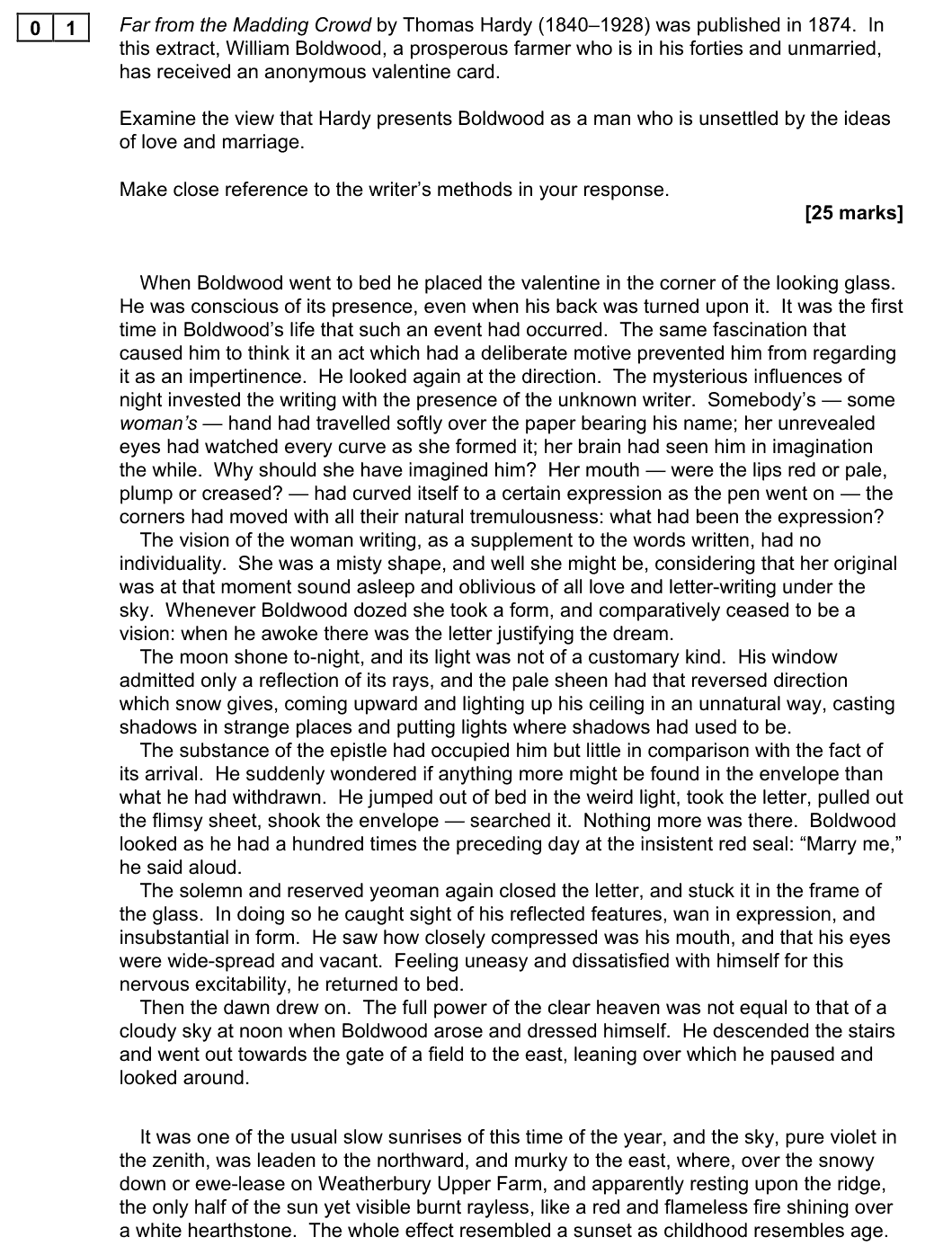
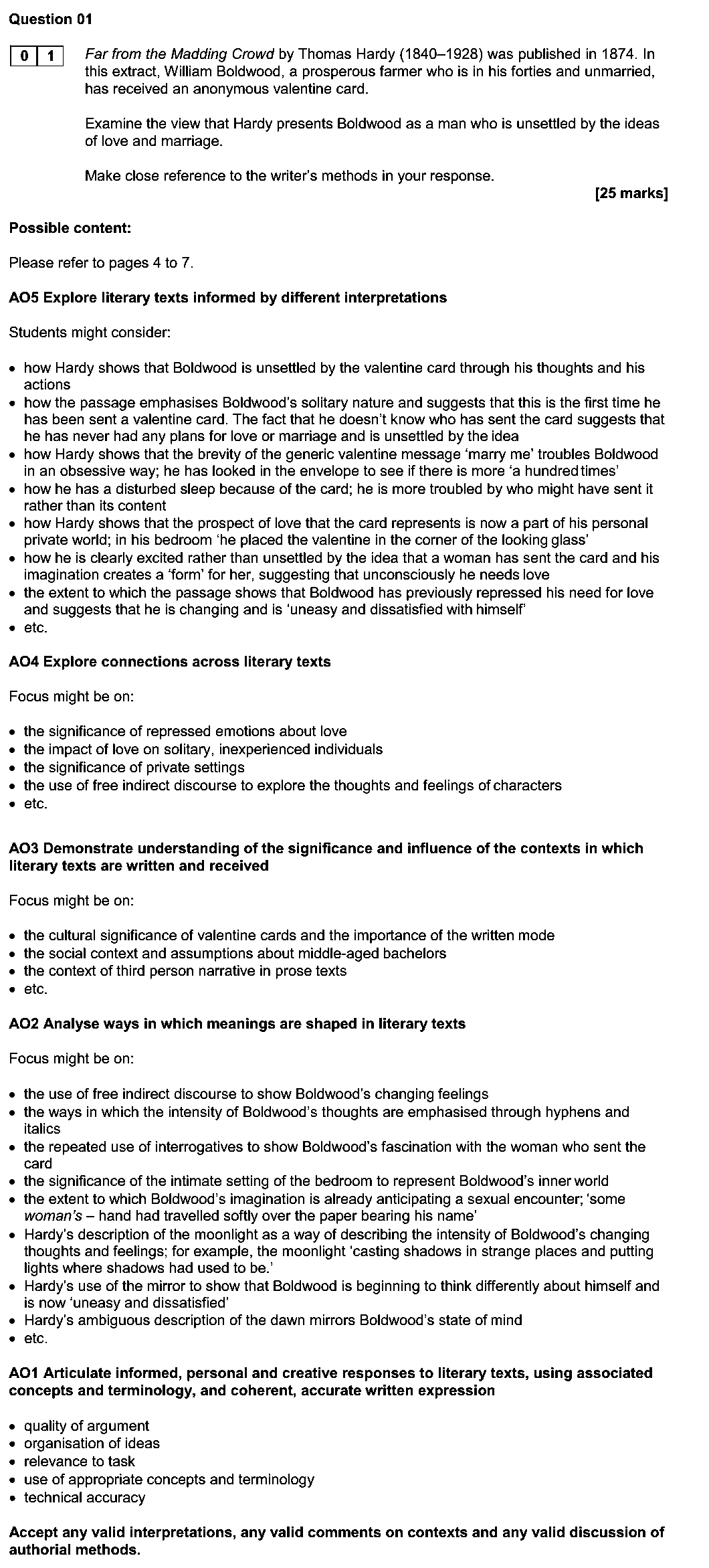
Far from the Madding Crowd by Thomas Hardy (1840–1928) was published in 1874. In
this extract, William Boldwood, a prosperous farmer who is in his forties and unmarried,
has received an anonymous valentine card.
Examine the view that Hardy presents Boldwood as a man who is unsettled by the ideas
of love and marriage.
Make close reference to the writer’s methods in your response.
[25 marks]
When Boldwood went to bed he placed the valentine in the corner of the looking glass.
He was conscious of its presence, even when his back was turned upon it. It was the first
time in Boldwood’s life that such an event had occurred. The same fascination that
caused him to think it an act which had a deliberate motive prevented him from regarding
it as an impertinence. He looked again at the direction. The mysterious influences of
night invested the writing with the presence of the unknown writer. Somebody’s — some
woman’s — hand had travelled softly over the paper bearing his name; her unrevealed
eyes had watched every curve as she formed it; her brain had seen him in imagination
the while. Why should she have imagined him? Her mouth — were the lips red or pale,
plump or creased? — had curved itself to a certain expression as the pen went on — the
corners had moved with all their natural tremulousness: what had been the expression?
The vision of the woman writing, as a supplement to the words written, had no
individuality. She was a misty shape, and well she might be, considering that her original
was at that moment sound asleep and oblivious of all love and letter-writing under the
sky. Whenever Boldwood dozed she took a form, and comparatively ceased to be a
vision: when he awoke there was the letter justifying the dream.
The moon shone to-night, and its light was not of a customary kind. His window
admitted only a reflection of its rays, and the pale sheen had that reversed direction
which snow gives, coming upward and lighting up his ceiling in an unnatural way, casting
shadows in strange places and putting lights where shadows had used to be.
The substance of the epistle had occupied him but little in comparison with the fact of
its arrival. He suddenly wondered if anything more might be found in the envelope than
what he had withdrawn. He jumped out of bed in the weird light, took the letter, pulled out
the flimsy sheet, shook the envelope — searched it. Nothing more was there. Boldwood
looked as he had a hundred times the preceding day at the insistent red seal: “Marry me,”
he said aloud.
The solemn and reserved yeoman again closed the letter, and stuck it in the frame of
the glass. In doing so he caught sight of his reflected features, wan in expression, and
insubstantial in form. He saw how closely compressed was his mouth, and that his eyes
were wide-spread and vacant. Feeling uneasy and dissatisfied with himself for this
nervous excitability, he returned to bed.
Then the dawn drew on. The full power of the clear heaven was not equal to that of a
cloudy sky at noon when Boldwood arose and dressed himself. He descended the stairs
and went out towards the gate of a field to the east, leaning over which he paused and
looked around.
It was one of the usual slow sunrises of this time of the year, and the sky, pure violet in
the zenith, was leaden to the northward, and murky to the east, where, over the snowy
down or ewe-lease on Weatherbury Upper Farm, and apparently resting upon the ridge,
the only half of the sun yet visible burnt rayless, like a red and flameless fire shining over
a white hearthstone. The whole effect resembled a sunset as childhood resembles age.
June 2019 · AS Paper 2 · Q1 25 marks Unseen prose unseen love prose
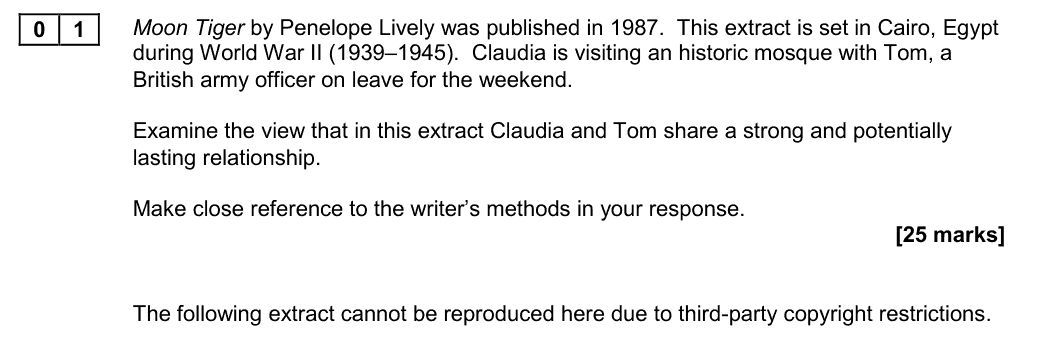
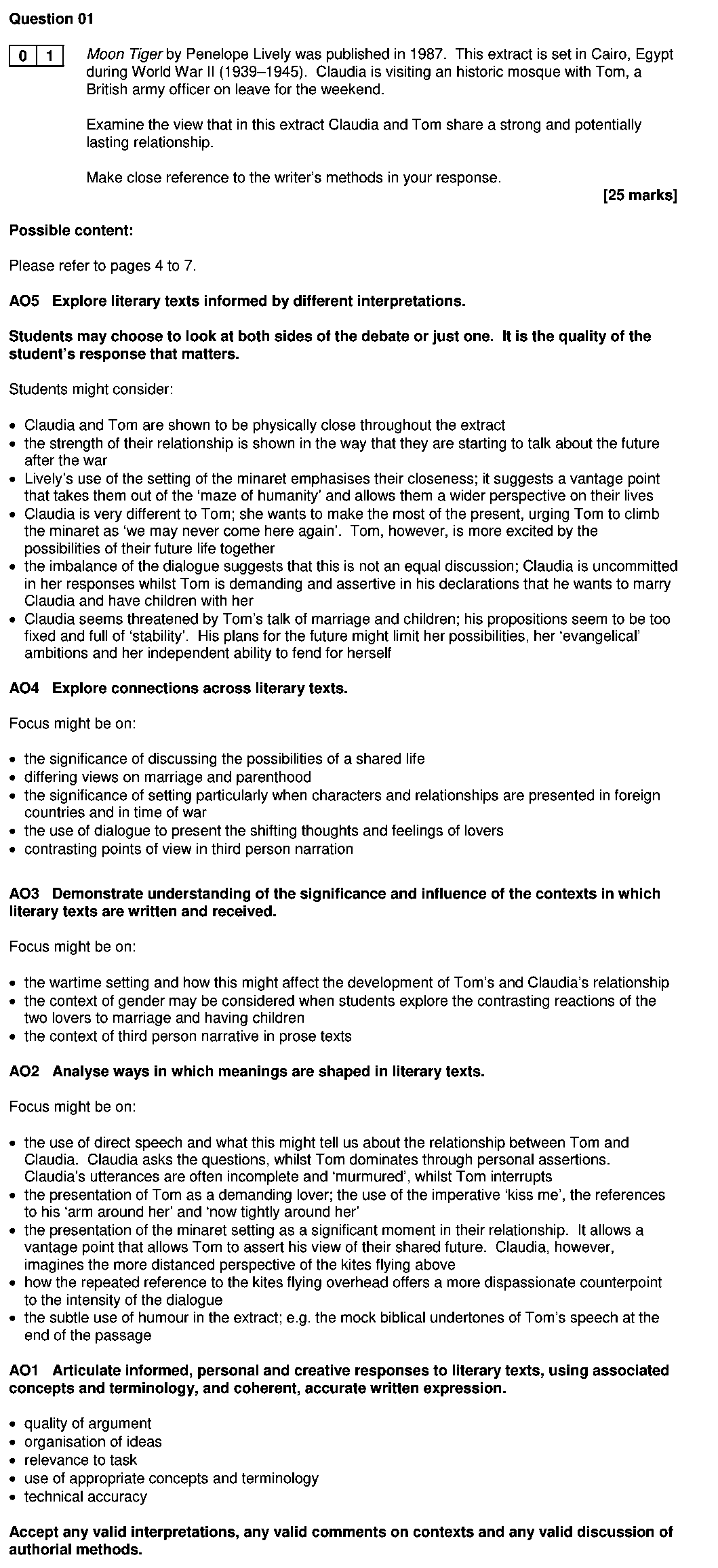
Moon Tiger by Penelope Lively was published in 1987. This extract is set in Cairo, Egypt
during World War II (1939–1945). Claudia is visiting an historic mosque with Tom, a
British army officer on leave for the weekend.
Examine the view that in this extract Claudia and Tom share a strong and potentially
lasting relationship.
Make close reference to the writer’s methods in your response.
[25 marks]
The following extract cannot be reproduced here due to third-party copyright restrictions.
June 2018 · AS Paper 2 · Q1 25 marks Unseen prose unseen love prose
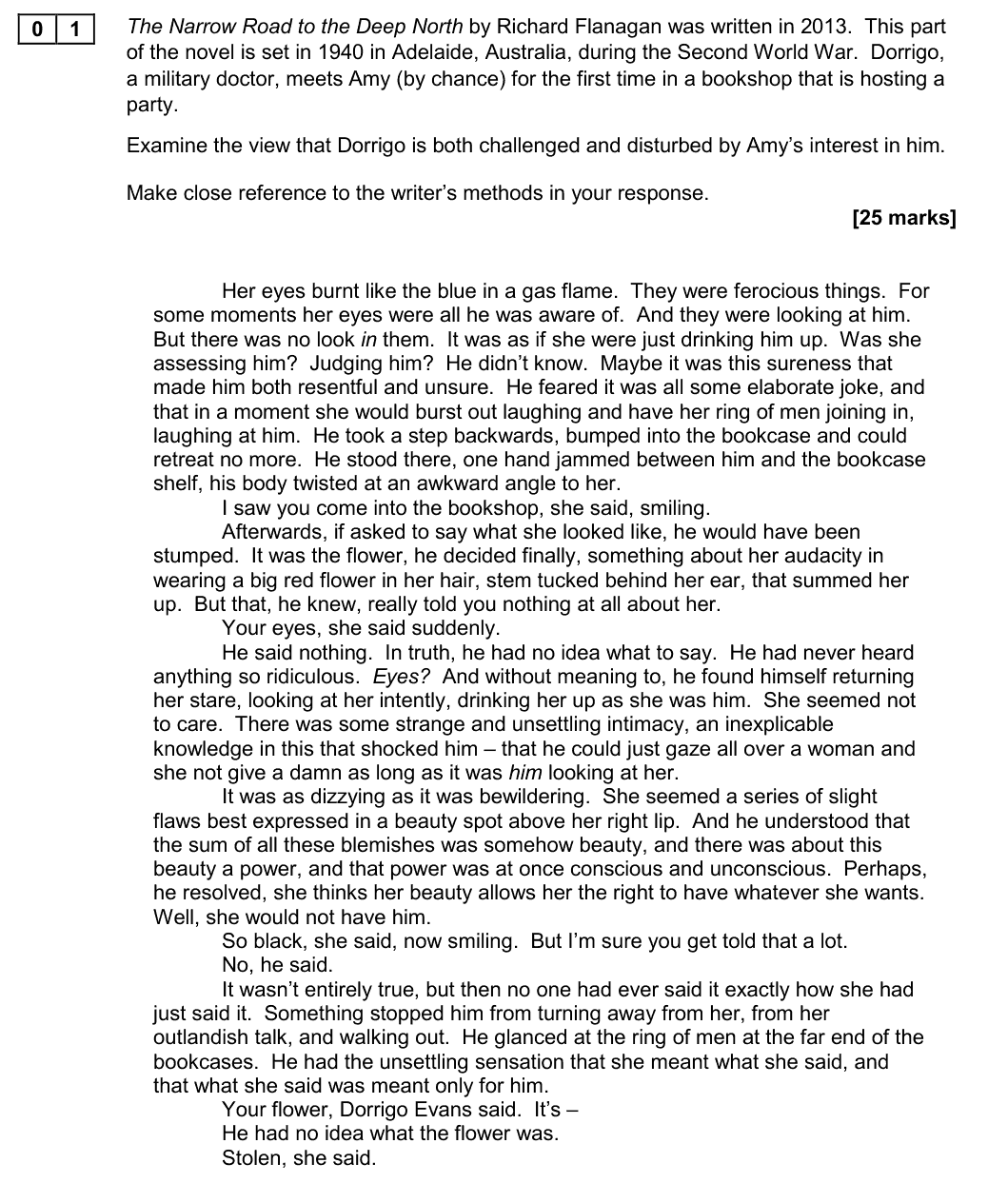
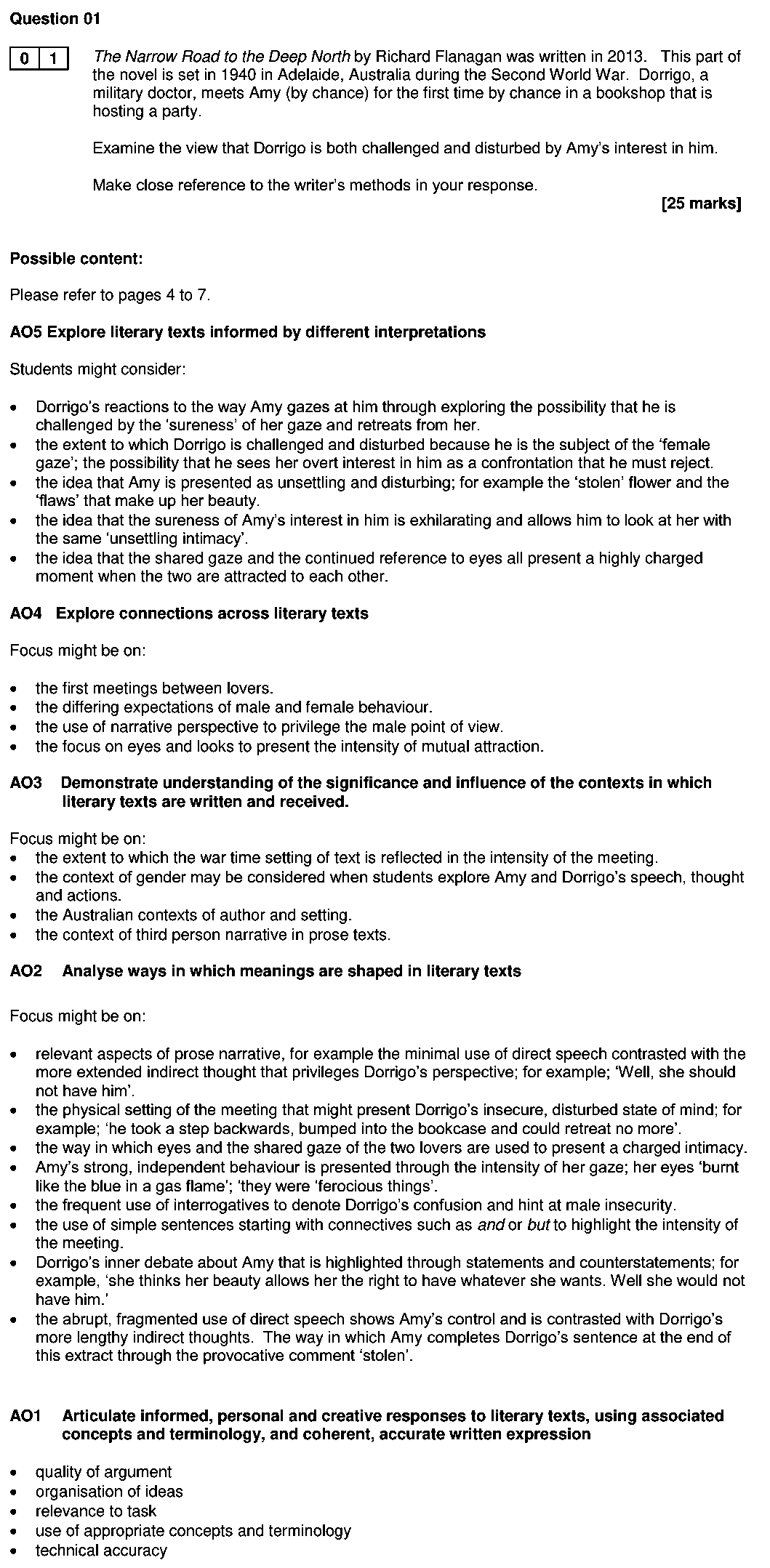
The Narrow Road to the Deep North by Richard Flanagan was written in 2013. This part
of the novel is set in 1940 in Adelaide, Australia, during the Second World War. Dorrigo,
a military doctor, meets Amy (by chance) for the first time in a bookshop that is hosting a
party.
Examine the view that Dorrigo is both challenged and disturbed by Amy’s interest in him.
Make close reference to the writer’s methods in your response.
[25 marks]
Her eyes burnt like the blue in a gas flame. They were ferocious things. For
some moments her eyes were all he was aware of. And they were looking at him.
But there was no look in them. It was as if she were just drinking him up. Was she
assessing him? Judging him? He didn’t know. Maybe it was this sureness that
made him both resentful and unsure. He feared it was all some elaborate joke, and
that in a moment she would burst out laughing and have her ring of men joining in,
laughing at him. He took a step backwards, bumped into the bookcase and could
retreat no more. He stood there, one hand jammed between him and the bookcase
shelf, his body twisted at an awkward angle to her.
I saw you come into the bookshop, she said, smiling.
Afterwards, if asked to say what she looked like, he would have been
stumped. It was the flower, he decided finally, something about her audacity in
wearing a big red flower in her hair, stem tucked behind her ear, that summed her
up. But that, he knew, really told you nothing at all about her.
Your eyes, she said suddenly.
He said nothing. In truth, he had no idea what to say. He had never heard
anything so ridiculous. Eyes? And without meaning to, he found himself returning
her stare, looking at her intently, drinking her up as she was him. She seemed not
to care. There was some strange and unsettling intimacy, an inexplicable
knowledge in this that shocked him – that he could just gaze all over a woman and
she not give a damn as long as it was him looking at her.
It was as dizzying as it was bewildering. She seemed a series of slight
flaws best expressed in a beauty spot above her right lip. And he understood that
the sum of all these blemishes was somehow beauty, and there was about this
beauty a power, and that power was at once conscious and unconscious. Perhaps,
he resolved, she thinks her beauty allows her the right to have whatever she wants.
Well, she would not have him.
So black, she said, now smiling. But I’m sure you get told that a lot.
No, he said.
It wasn’t entirely true, but then no one had ever said it exactly how she had
just said it. Something stopped him from turning away from her, from her
outlandish talk, and walking out. He glanced at the ring of men at the far end of the
bookcases. He had the unsettling sensation that she meant what she said, and
that what she said was meant only for him.
Your flower, Dorrigo Evans said. It’s –
He had no idea what the flower was.
Stolen, she said.
June 2017 · AS Paper 2 · Q1 25 marks Unseen prose unseen love prose
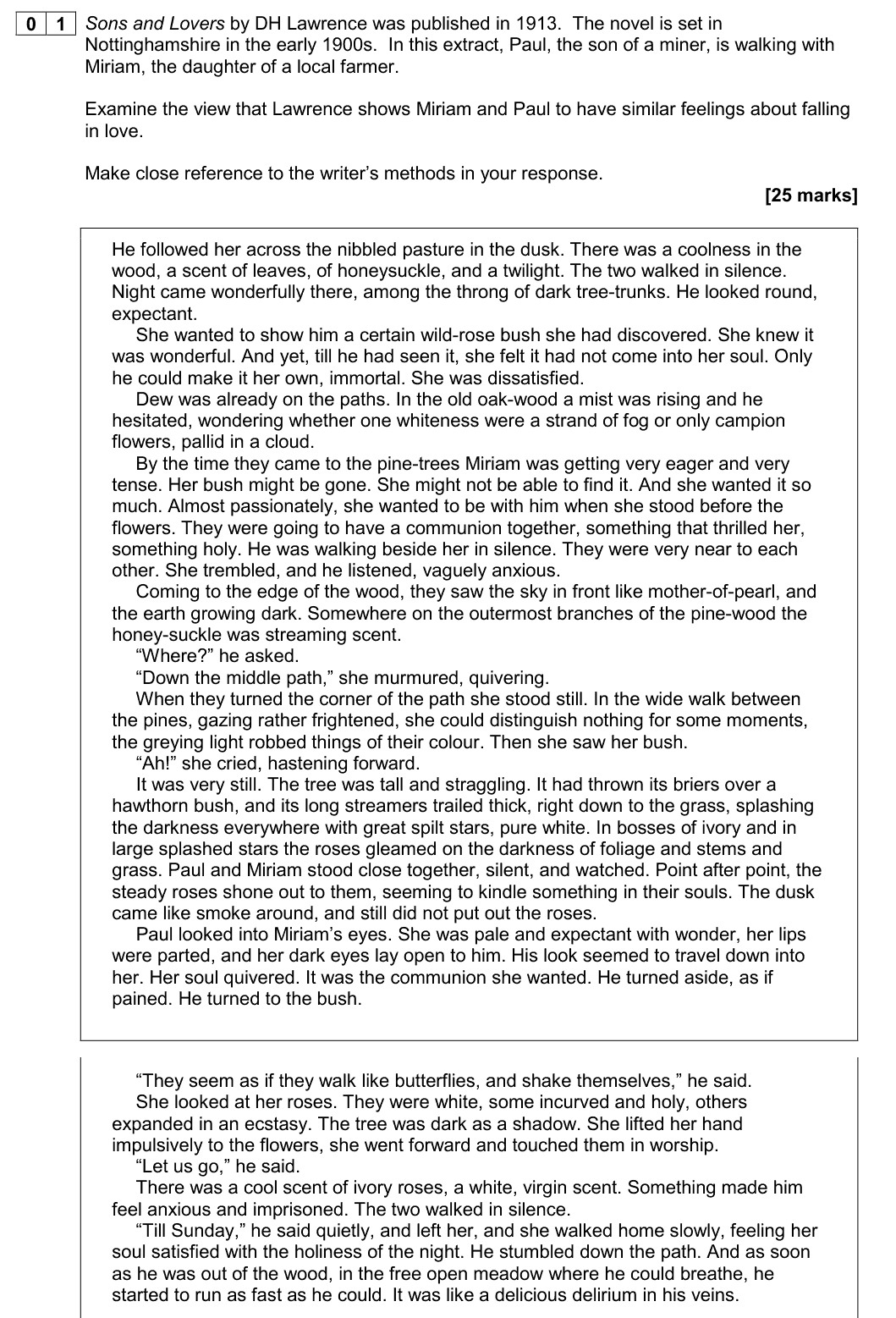
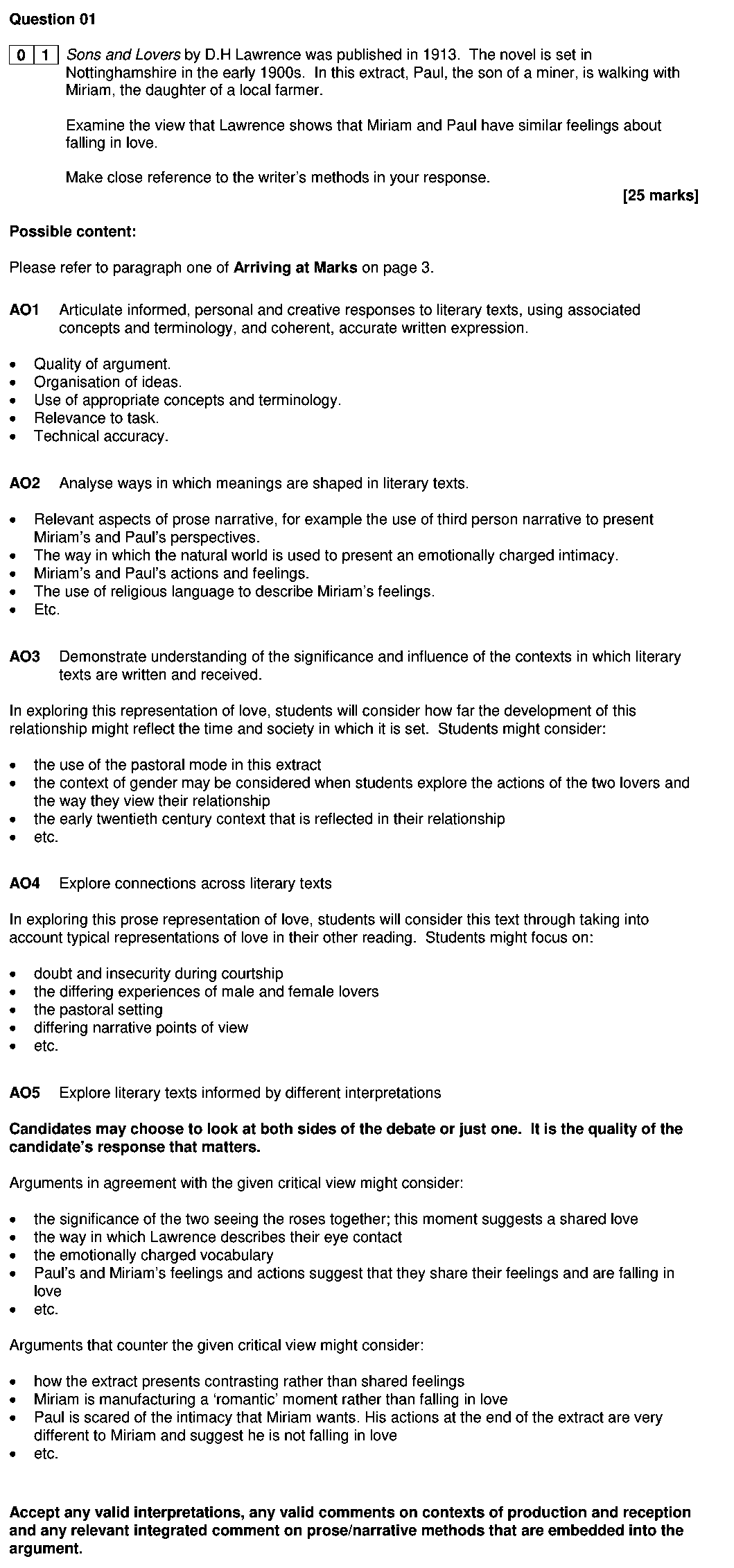
0 1 Sons and Lovers by DH Lawrence was published in 1913. The novel is set in
Nottinghamshire in the early 1900s. In this extract, Paul, the son of a miner, is walking with
Miriam, the daughter of a local farmer.
Examine the view that Lawrence shows Miriam and Paul to have similar feelings about falling
in love.
Make close reference to the writer’s methods in your response.
[25 marks]
He followed her across the nibbled pasture in the dusk. There was a coolness in the
wood, a scent of leaves, of honeysuckle, and a twilight. The two walked in silence.
Night came wonderfully there, among the throng of dark tree-trunks. He looked round,
expectant.
She wanted to show him a certain wild-rose bush she had discovered. She knew it
was wonderful. And yet, till he had seen it, she felt it had not come into her soul. Only
he could make it her own, immortal. She was dissatisfied.
Dew was already on the paths. In the old oak-wood a mist was rising and he
hesitated, wondering whether one whiteness were a strand of fog or only campion
flowers, pallid in a cloud.
By the time they came to the pine-trees Miriam was getting very eager and very
tense. Her bush might be gone. She might not be able to find it. And she wanted it so
much. Almost passionately, she wanted to be with him when she stood before the
flowers. They were going to have a communion together, something that thrilled her,
something holy. He was walking beside her in silence. They were very near to each
other. She trembled, and he listened, vaguely anxious.
Coming to the edge of the wood, they saw the sky in front like mother-of-pearl, and
the earth growing dark. Somewhere on the outermost branches of the pine-wood the
honey-suckle was streaming scent.
“Where?” he asked.
“Down the middle path,” she murmured, quivering.
When they turned the corner of the path she stood still. In the wide walk between
the pines, gazing rather frightened, she could distinguish nothing for some moments,
the greying light robbed things of their colour. Then she saw her bush.
“Ah!” she cried, hastening forward.
It was very still. The tree was tall and straggling. It had thrown its briers over a
hawthorn bush, and its long streamers trailed thick, right down to the grass, splashing
the darkness everywhere with great spilt stars, pure white. In bosses of ivory and in
large splashed stars the roses gleamed on the darkness of foliage and stems and
grass. Paul and Miriam stood close together, silent, and watched. Point after point, the
steady roses shone out to them, seeming to kindle something in their souls. The dusk
came like smoke around, and still did not put out the roses.
Paul looked into Miriam’s eyes. She was pale and expectant with wonder, her lips
were parted, and her dark eyes lay open to him. His look seemed to travel down into
her. Her soul quivered. It was the communion she wanted. He turned aside, as if
pained. He turned to the bush.
“They seem as if they walk like butterflies, and shake themselves,” he said.
She looked at her roses. They were white, some incurved and holy, others
expanded in an ecstasy. The tree was dark as a shadow. She lifted her hand
impulsively to the flowers, she went forward and touched them in worship.
“Let us go,” he said.
There was a cool scent of ivory roses, a white, virgin scent. Something made him
feel anxious and imprisoned. The two walked in silence.
“Till Sunday,” he said quietly, and left her, and she walked home slowly, feeling her
soul satisfied with the holiness of the night. He stumbled down the path. And as soon
as he was out of the wood, in the free open meadow where he could breathe, he
started to run as fast as he could. It was like a delicious delirium in his veins.
June 2016 · AS Paper 2 · Q1 25 marks Unseen prose unseen love prose
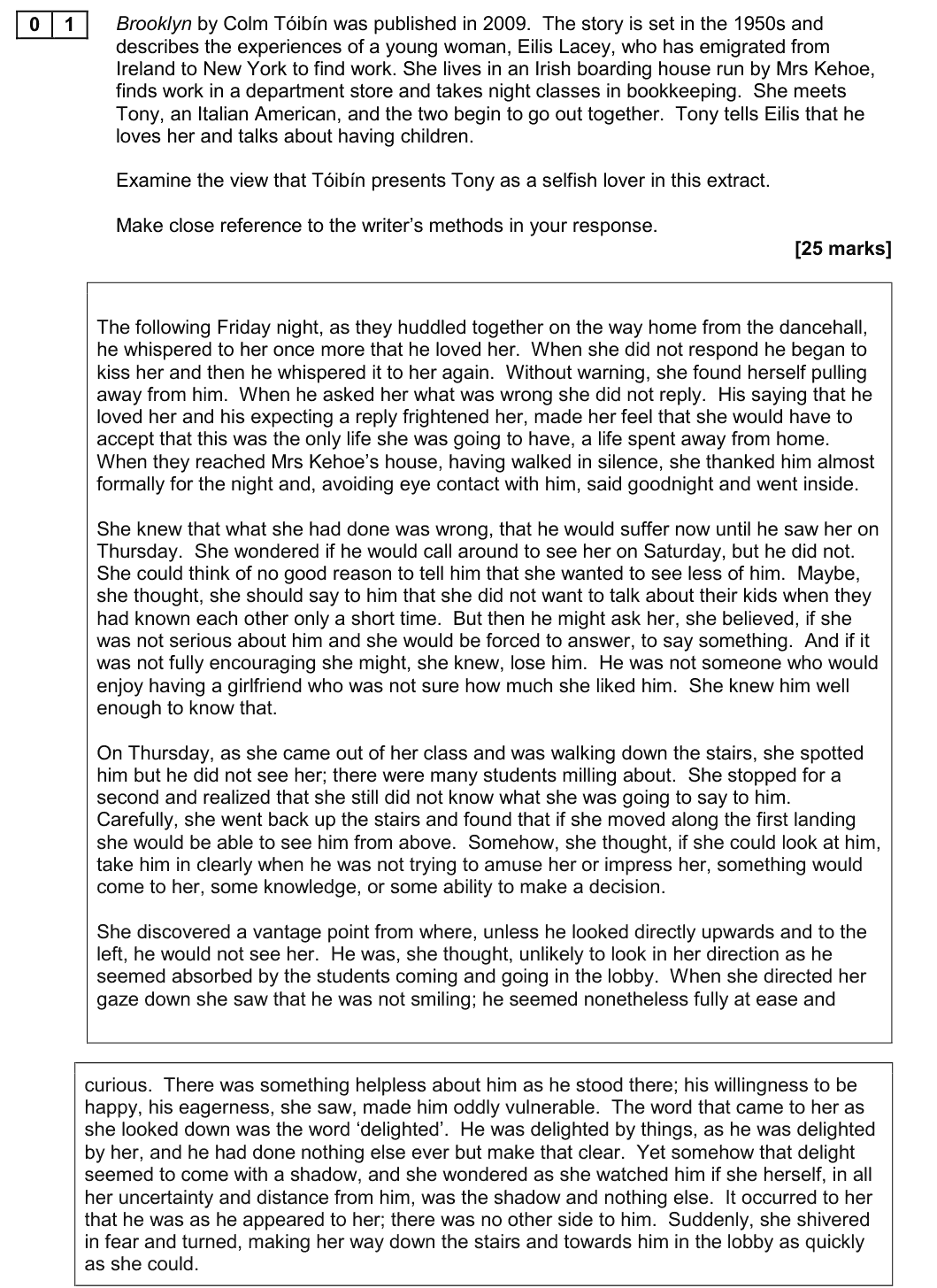
Brooklyn by Colm Tóibín was published in 2009. The story is set in the 1950s and
describes the experiences of a young woman, Eilis Lacey, who has emigrated from
Ireland to New York to find work. She lives in an Irish boarding house run by Mrs Kehoe,
finds work in a department store and takes night classes in bookkeeping. She meets
Tony, an Italian American, and the two begin to go out together. Tony tells Eilis that he
loves her and talks about having children.
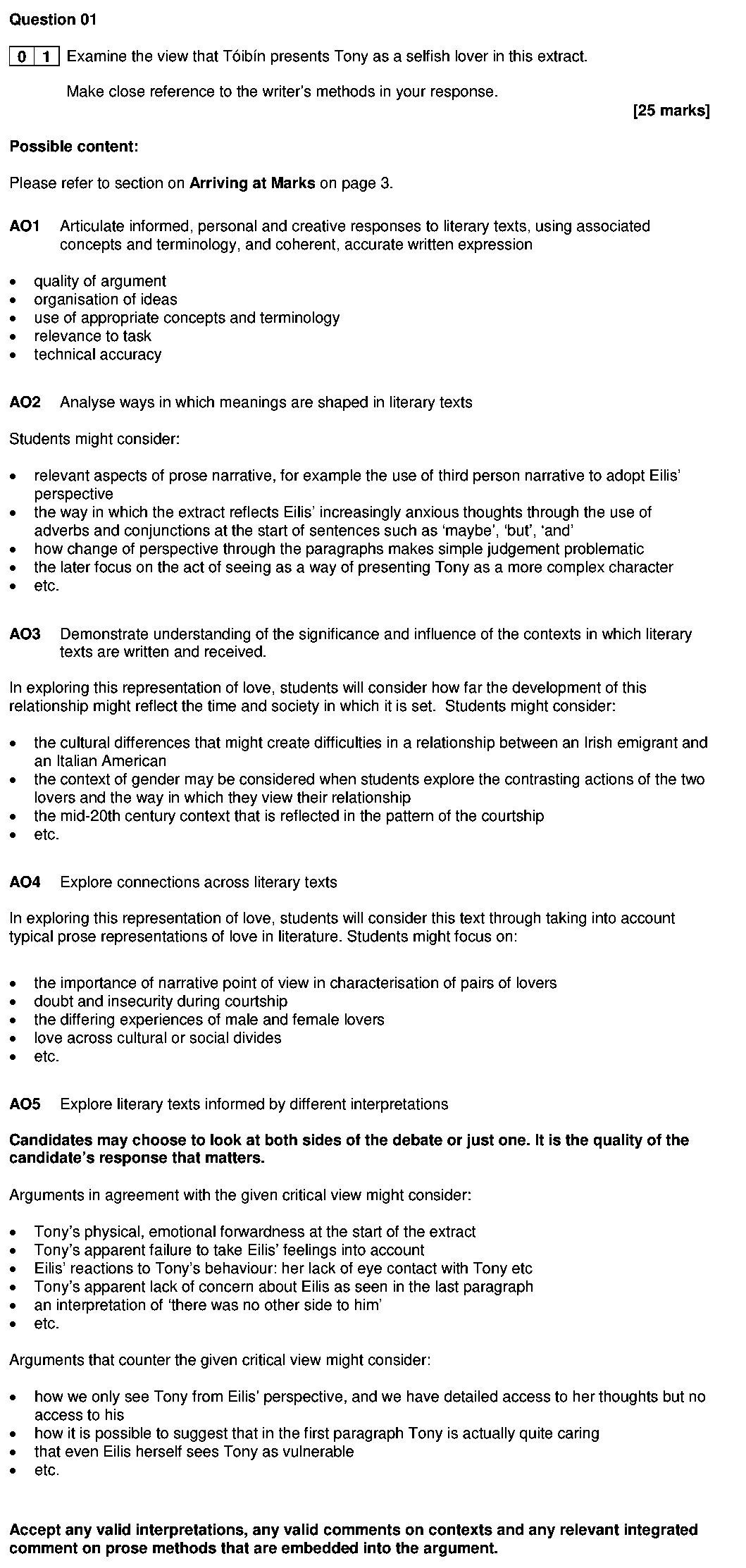
Examine the view that Tóibín presents Tony as a selfish lover in this extract.
Make close reference to the writer’s methods in your response.
[25 marks]
The following Friday night, as they huddled together on the way home from the dancehall,
he whispered to her once more that he loved her. When she did not respond he began to
kiss her and then he whispered it to her again. Without warning, she found herself pulling
away from him. When he asked her what was wrong she did not reply. His saying that he
loved her and his expecting a reply frightened her, made her feel that she would have to
accept that this was the only life she was going to have, a life spent away from home.
When they reached Mrs Kehoe’s house, having walked in silence, she thanked him almost
formally for the night and, avoiding eye contact with him, said goodnight and went inside.
She knew that what she had done was wrong, that he would suffer now until he saw her on
Thursday. She wondered if he would call around to see her on Saturday, but he did not.
She could think of no good reason to tell him that she wanted to see less of him. Maybe,
she thought, she should say to him that she did not want to talk about their kids when they
had known each other only a short time. But then he might ask her, she believed, if she
was not serious about him and she would be forced to answer, to say something. And if it
was not fully encouraging she might, she knew, lose him. He was not someone who would
enjoy having a girlfriend who was not sure how much she liked him. She knew him well
enough to know that.
On Thursday, as she came out of her class and was walking down the stairs, she spotted
him but he did not see her; there were many students milling about. She stopped for a
second and realized that she still did not know what she was going to say to him.
Carefully, she went back up the stairs and found that if she moved along the first landing
she would be able to see him from above. Somehow, she thought, if she could look at him,
take him in clearly when he was not trying to amuse her or impress her, something would
come to her, some knowledge, or some ability to make a decision.
She discovered a vantage point from where, unless he looked directly upwards and to the
left, he would not see her. He was, she thought, unlikely to look in her direction as he
seemed absorbed by the students coming and going in the lobby. When she directed her
gaze down she saw that he was not smiling; he seemed nonetheless fully at ease and
curious. There was something helpless about him as he stood there; his willingness to be
happy, his eagerness, she saw, made him oddly vulnerable. The word that came to her as
she looked down was the word ‘delighted’. He was delighted by things, as he was delighted
by her, and he had done nothing else ever but make that clear. Yet somehow that delight
seemed to come with a shadow, and she wondered as she watched him if she herself, in all
her uncertainty and distance from him, was the shadow and nothing else. It occurred to her
that he was as he appeared to her; there was no other side to him. Suddenly, she shivered
in fear and turned, making her way down the stairs and towards him in the lobby as quickly
as she could.

Work with an AQA English Literature A tutor

Essays stuck in the middle bands, or not sure what the examiners want from an analysis? Book a trial lesson with a specialist AQA English Literature A tutor.

Prefer email? Send an enquiry

If you are under 18, please include a parent's contact details. Enquiries go to enquiries@alevelenglishtutor.com and are deleted once handled. All tutoring is online.