Unseen poetry comparison (25 marks)

A-level Paper 1 Section B: compare two unseen love poems. No set text needed, so it rewards practice more than any other question. 9 questions.

Other types: Shakespeare: extract and whole play (25 marks) · Paper 2 set-text essays (25 marks) · AS: the love poetry anthology (25 marks) · AS: unseen prose (25 marks) · Comparing texts: love through the ages (25 marks) · Paper 2: the unseen extract (25 marks) · Paper 2: comparing two texts (25 marks)

June 2025 · Paper 1 · Q5 25 marks Unseen poetry unseen love poetry
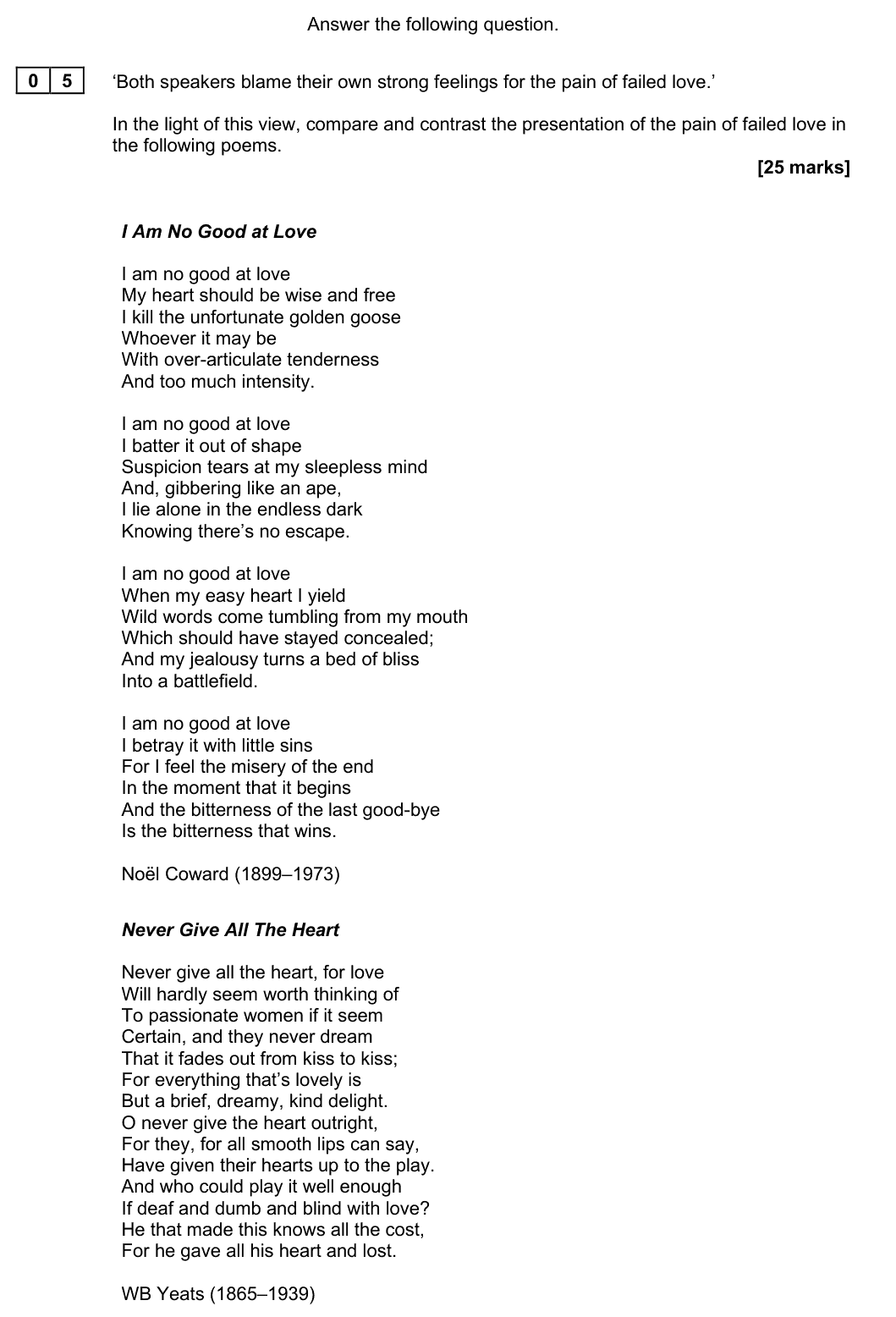
Answer the following question.
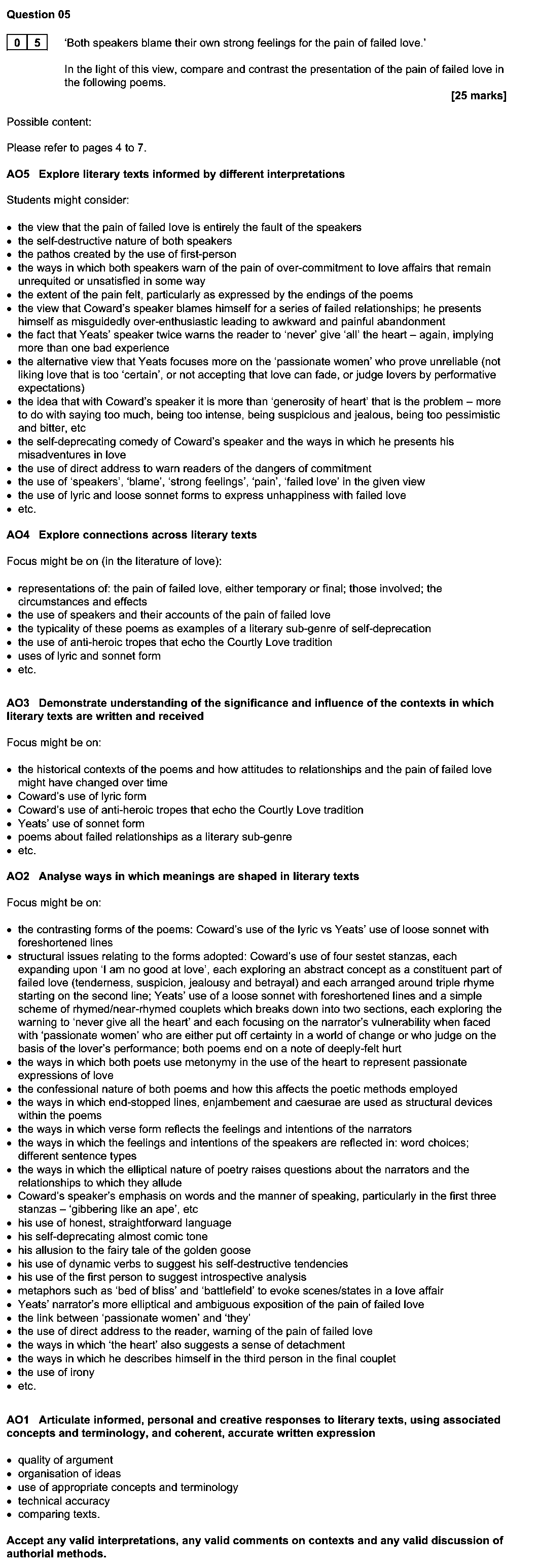
‘Both speakers blame their own strong feelings for the pain of failed love.’
In the light of this view, compare and contrast the presentation of the pain of failed love in
the following poems.
[25 marks]
I Am No Good at Love
I am no good at love
My heart should be wise and free
I kill the unfortunate golden goose
Whoever it may be
With over-articulate tenderness
And too much intensity.
I am no good at love
I batter it out of shape
Suspicion tears at my sleepless mind
And, gibbering like an ape,
I lie alone in the endless dark
Knowing there’s no escape.
I am no good at love
When my easy heart I yield
Wild words come tumbling from my mouth
Which should have stayed concealed;
And my jealousy turns a bed of bliss
Into a battlefield.
I am no good at love
I betray it with little sins
For I feel the misery of the end
In the moment that it begins
And the bitterness of the last good-bye
Is the bitterness that wins.
Noël Coward (1899–1973)
Never Give All The Heart
Never give all the heart, for love
Will hardly seem worth thinking of
To passionate women if it seem
Certain, and they never dream
That it fades out from kiss to kiss;
For everything that’s lovely is
But a brief, dreamy, kind delight.
O never give the heart outright,
For they, for all smooth lips can say,
Have given their hearts up to the play.
And who could play it well enough
If deaf and dumb and blind with love?
He that made this knows all the cost,
For he gave all his heart and lost.
WB Yeats (1865–1939)
June 2024 · Paper 1 · Q5 25 marks Unseen poetry unseen love poetry
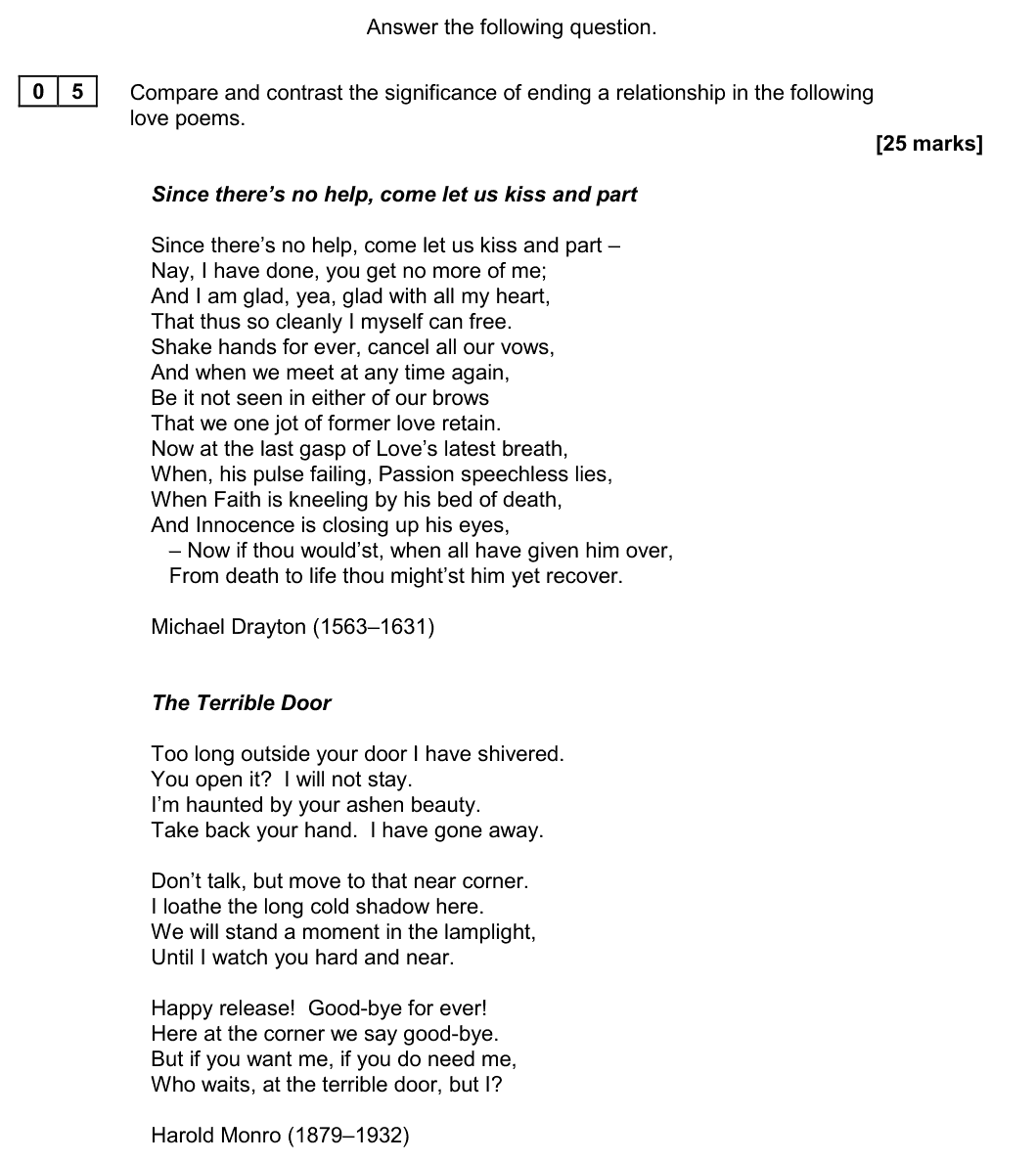
Answer the following question.
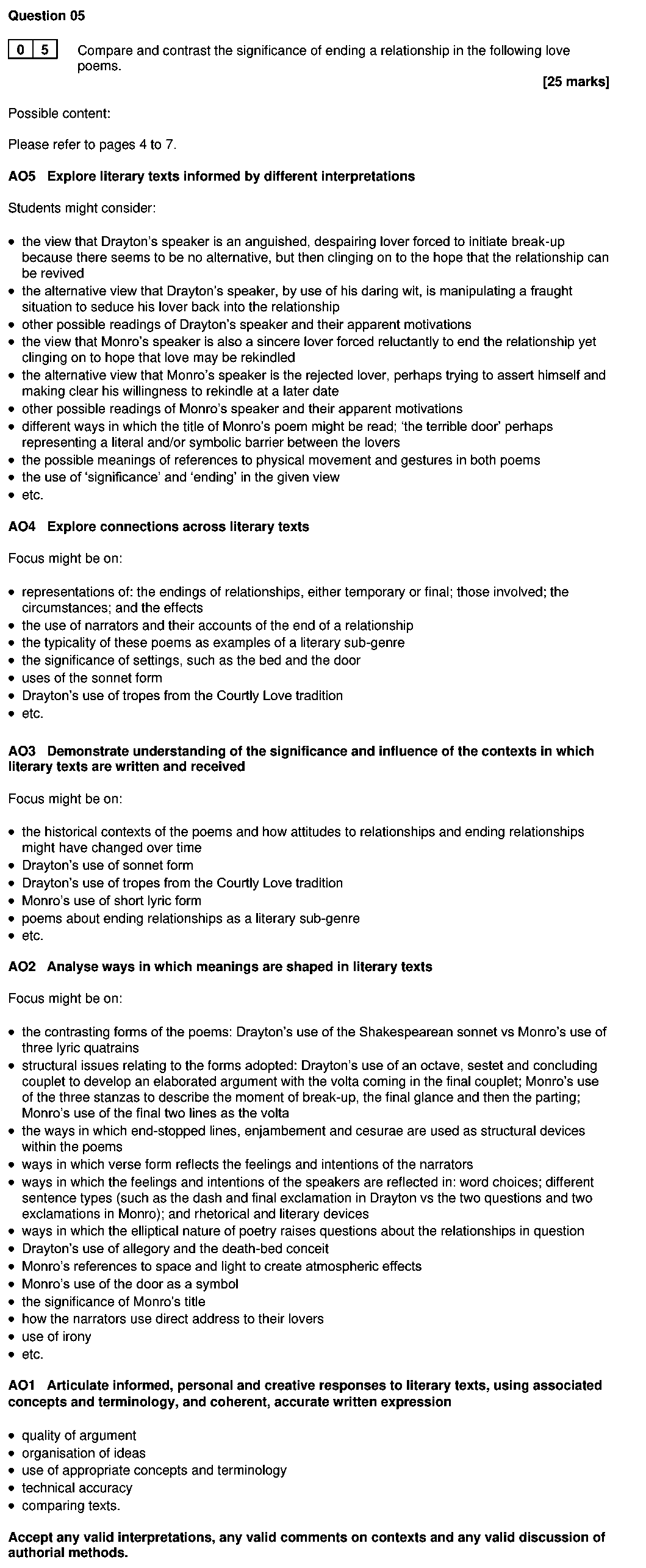
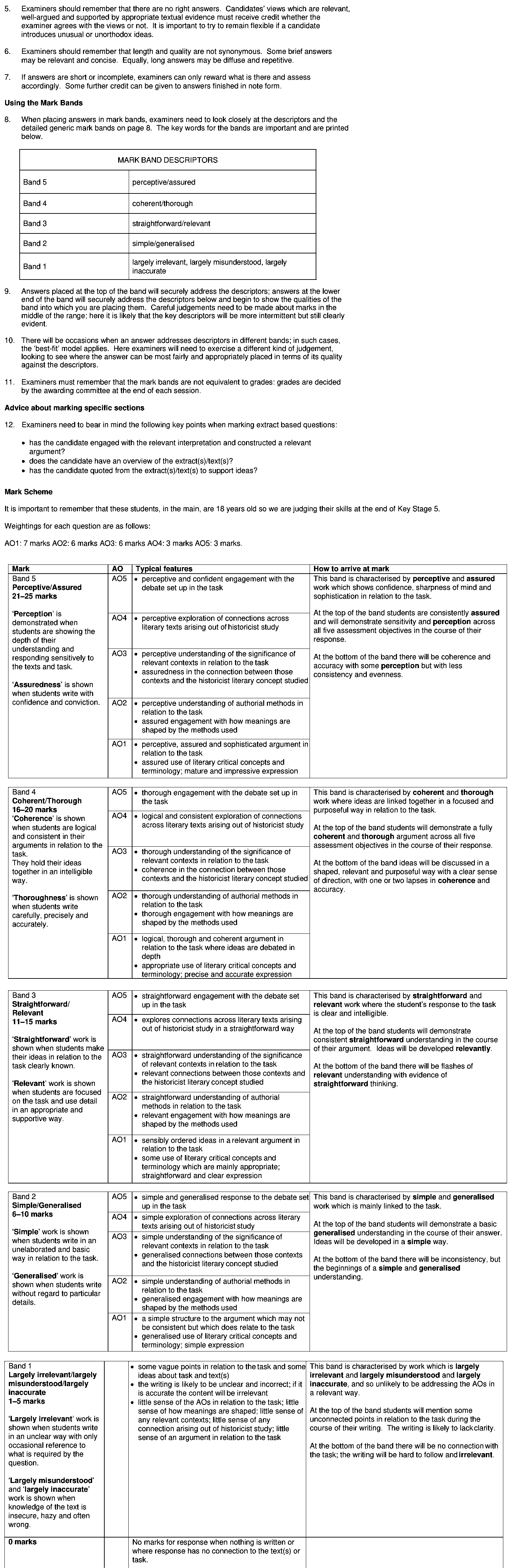
Compare and contrast the significance of ending a relationship in the following
love poems.
[25 marks]
Since there’s no help, come let us kiss and part
Since there’s no help, come let us kiss and part –
Nay, I have done, you get no more of me;
And I am glad, yea, glad with all my heart,
That thus so cleanly I myself can free.
Shake hands for ever, cancel all our vows,
And when we meet at any time again,
Be it not seen in either of our brows
That we one jot of former love retain.
Now at the last gasp of Love’s latest breath,
When, his pulse failing, Passion speechless lies,
When Faith is kneeling by his bed of death,
And Innocence is closing up his eyes,
– Now if thou would’st, when all have given him over,
From death to life thou might’st him yet recover.
Michael Drayton (1563–1631)
The Terrible Door
Too long outside your door I have shivered.
You open it? I will not stay.
I’m haunted by your ashen beauty.
Take back your hand. I have gone away.
Don’t talk, but move to that near corner.
I loathe the long cold shadow here.
We will stand a moment in the lamplight,
Until I watch you hard and near.
Happy release! Good-bye for ever!
Here at the corner we say good-bye.
But if you want me, if you do need me,
Who waits, at the terrible door, but I?
Harold Monro (1879–1932)
June 2023 · Paper 1 · Q5 25 marks Unseen poetry unseen love poetry
Answer the following question.
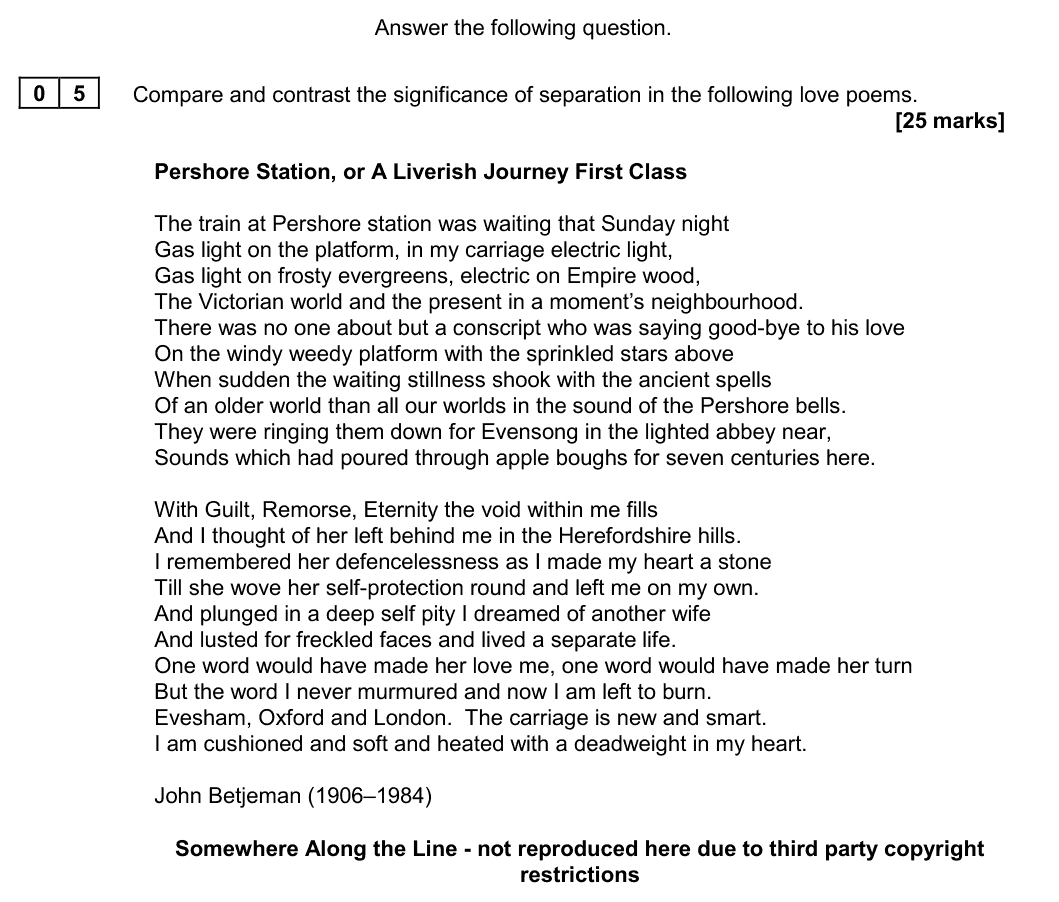
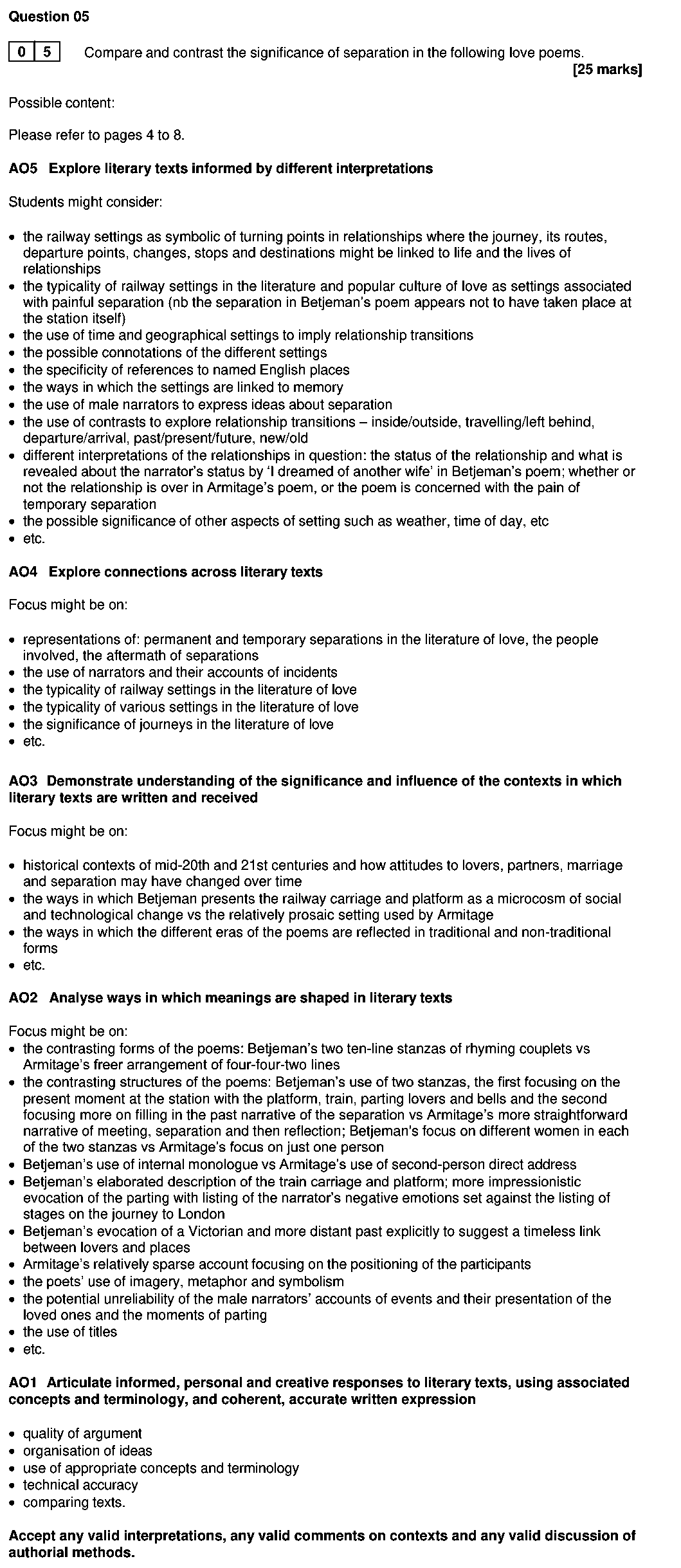
Compare and contrast the significance of separation in the following love poems.
[25 marks]
Pershore Station, or A Liverish Journey First Class
The train at Pershore station was waiting that Sunday night
Gas light on the platform, in my carriage electric light,
Gas light on frosty evergreens, electric on Empire wood,
The Victorian world and the present in a moment’s neighbourhood.
There was no one about but a conscript who was saying good-bye to his love
On the windy weedy platform with the sprinkled stars above
When sudden the waiting stillness shook with the ancient spells
Of an older world than all our worlds in the sound of the Pershore bells.
They were ringing them down for Evensong in the lighted abbey near,
Sounds which had poured through apple boughs for seven centuries here.
With Guilt, Remorse, Eternity the void within me fills
And I thought of her left behind me in the Herefordshire hills.
I remembered her defencelessness as I made my heart a stone
Till she wove her self-protection round and left me on my own.
And plunged in a deep self pity I dreamed of another wife
And lusted for freckled faces and lived a separate life.
One word would have made her love me, one word would have made her turn
But the word I never murmured and now I am left to burn.
Evesham, Oxford and London. The carriage is new and smart.
I am cushioned and soft and heated with a deadweight in my heart.
John Betjeman (1906–1984)
Somewhere Along the Line - not reproduced here due to third party copyright
restrictions
June 2022 · Paper 1 · Q5 25 marks Unseen poetry unseen love poetry
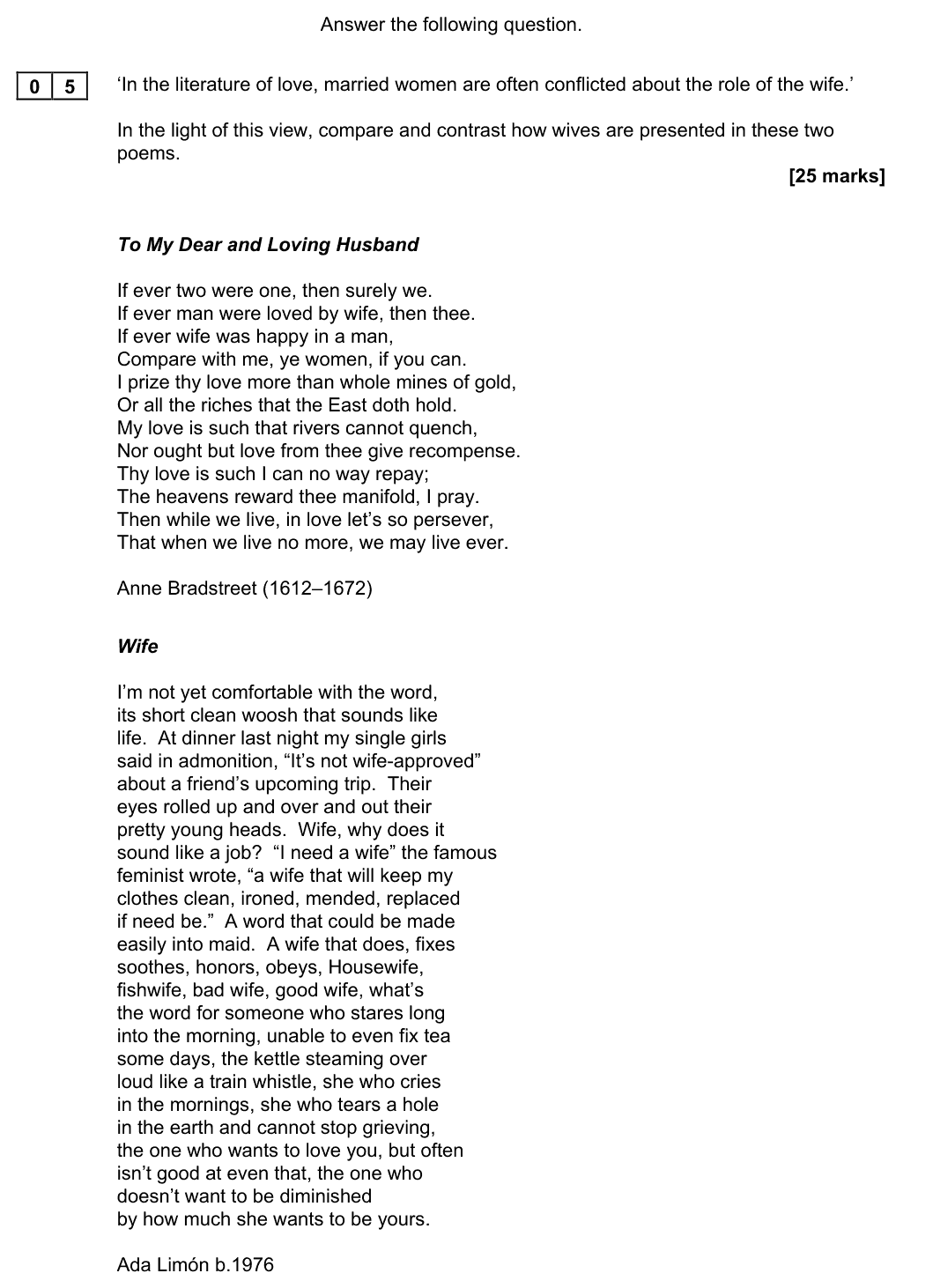
Answer the following question.
‘In the literature of love, married women are often conflicted about the role of the wife.’
In the light of this view, compare and contrast how wives are presented in these two
poems.
[25 marks]
To My Dear and Loving Husband
If ever two were one, then surely we.
If ever man were loved by wife, then thee.
If ever wife was happy in a man,
Compare with me, ye women, if you can.
I prize thy love more than whole mines of gold,
Or all the riches that the East doth hold.
My love is such that rivers cannot quench,
Nor ought but love from thee give recompense.
Thy love is such I can no way repay;
The heavens reward thee manifold, I pray.
Then while we live, in love let’s so persever,
That when we live no more, we may live ever.
Anne Bradstreet (1612–1672)
Wife
I’m not yet comfortable with the word,
its short clean woosh that sounds like
life. At dinner last night my single girls
said in admonition, “It’s not wife-approved”
about a friend’s upcoming trip. Their
eyes rolled up and over and out their
pretty young heads. Wife, why does it
sound like a job? “I need a wife” the famous
feminist wrote, “a wife that will keep my
clothes clean, ironed, mended, replaced
if need be.” A word that could be made
easily into maid. A wife that does, fixes
soothes, honors, obeys, Housewife,
fishwife, bad wife, good wife, what’s
the word for someone who stares long
into the morning, unable to even fix tea
some days, the kettle steaming over
loud like a train whistle, she who cries
in the mornings, she who tears a hole
in the earth and cannot stop grieving,
the one who wants to love you, but often
isn’t good at even that, the one who
doesn’t want to be diminished
by how much she wants to be yours.
Ada Limón b.1976
November 2021 · Paper 1 · Q5 25 marks Unseen poetry unseen love poetry
Answer the following question.
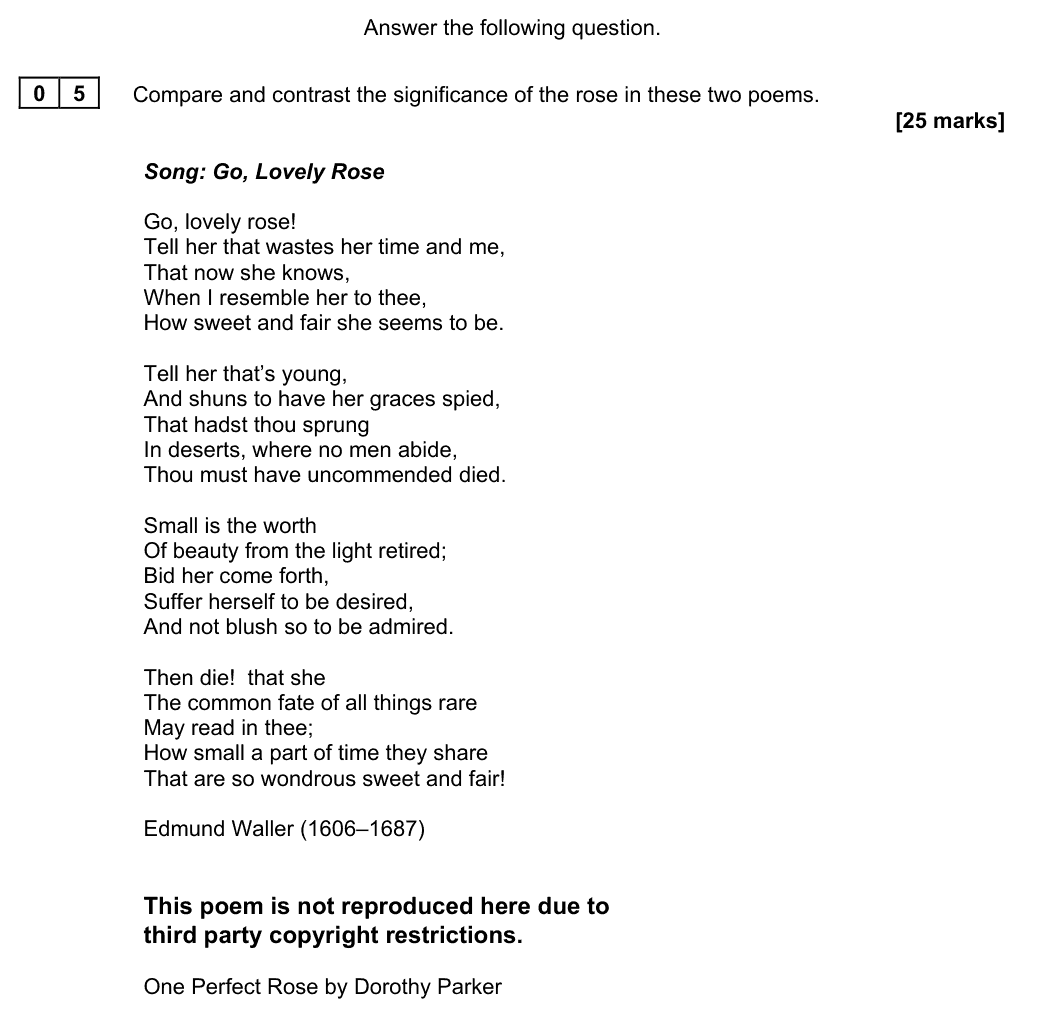
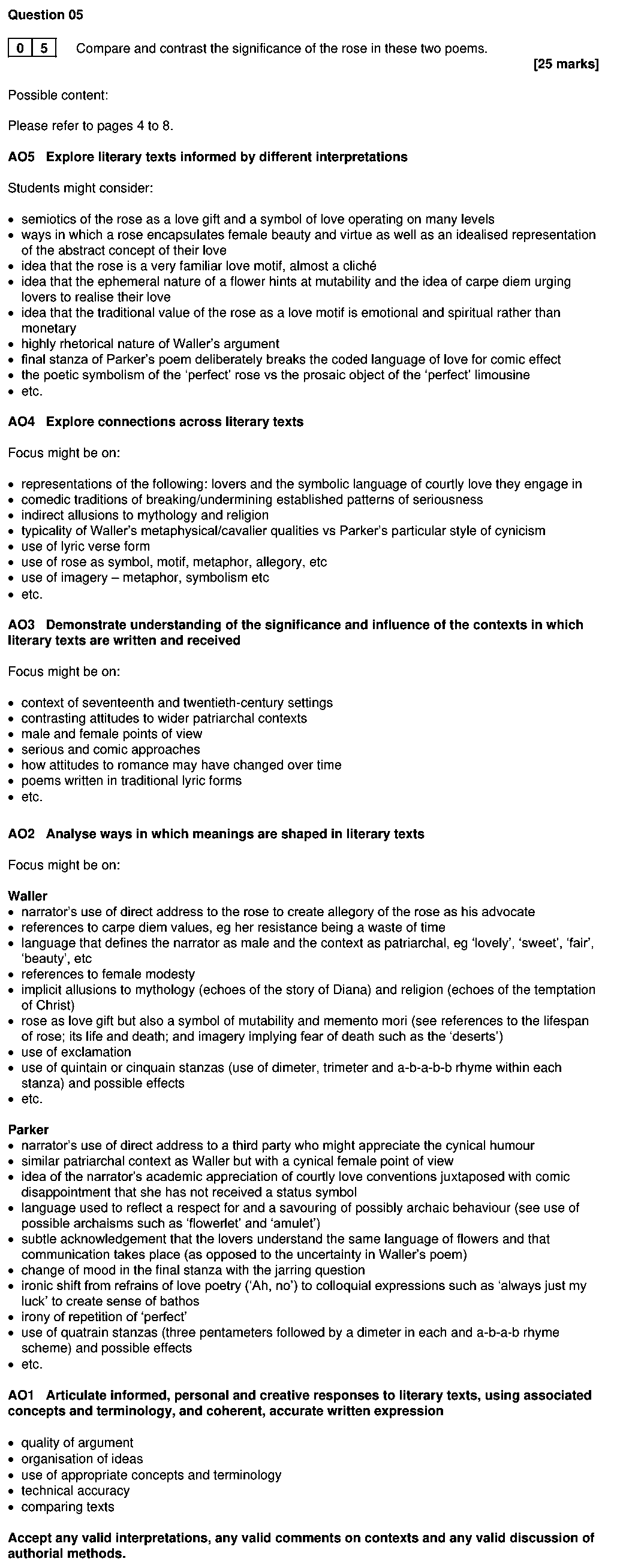
Compare and contrast the significance of the rose in these two poems.
[25 marks]
Song: Go, Lovely Rose
Go, lovely rose!
Tell her that wastes her time and me,
That now she knows,
When I resemble her to thee,
How sweet and fair she seems to be.
Tell her that’s young,
And shuns to have her graces spied,
That hadst thou sprung
In deserts, where no men abide,
Thou must have uncommended died.
Small is the worth
Of beauty from the light retired;
Bid her come forth,
Suffer herself to be desired,
And not blush so to be admired.
Then die! that she
The common fate of all things rare
May read in thee;
How small a part of time they share
That are so wondrous sweet and fair!
Edmund Waller (1606–1687)
This poem is not reproduced here due to
third party copyright restrictions.
One Perfect Rose by Dorothy Parker
November 2020 · Paper 1 · Q5 25 marks Unseen poetry unseen love poetry
Answer the following question.
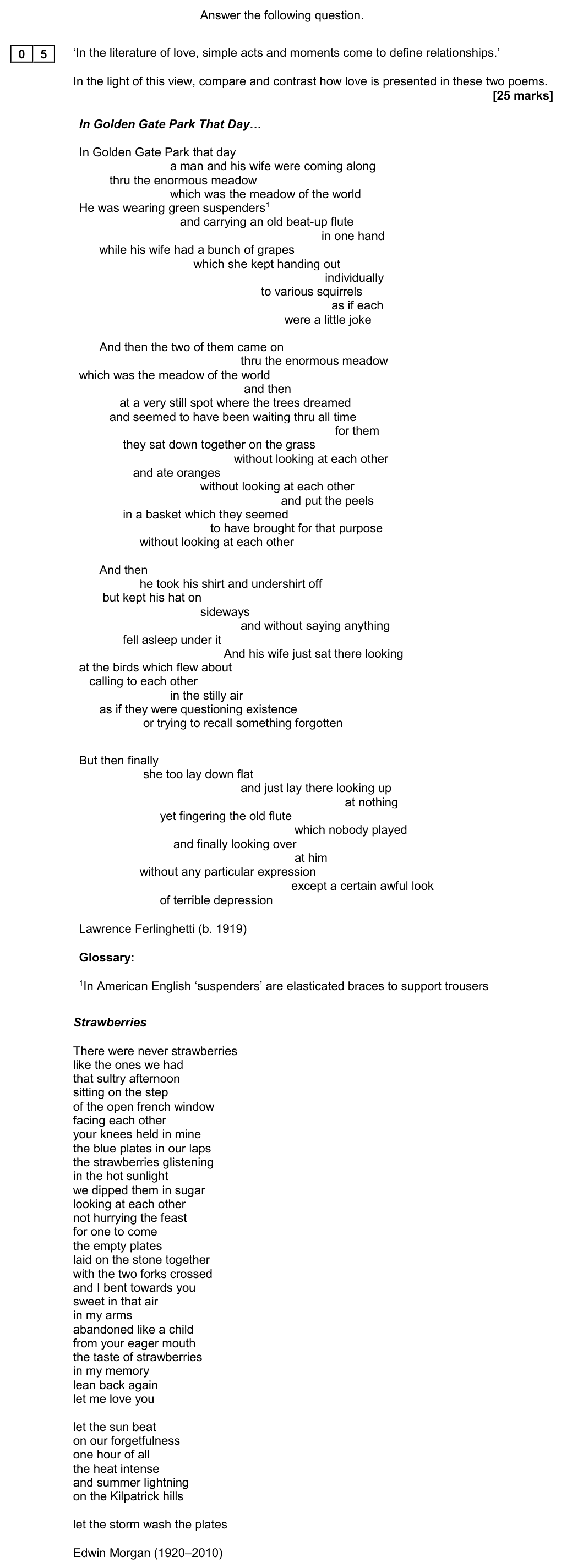
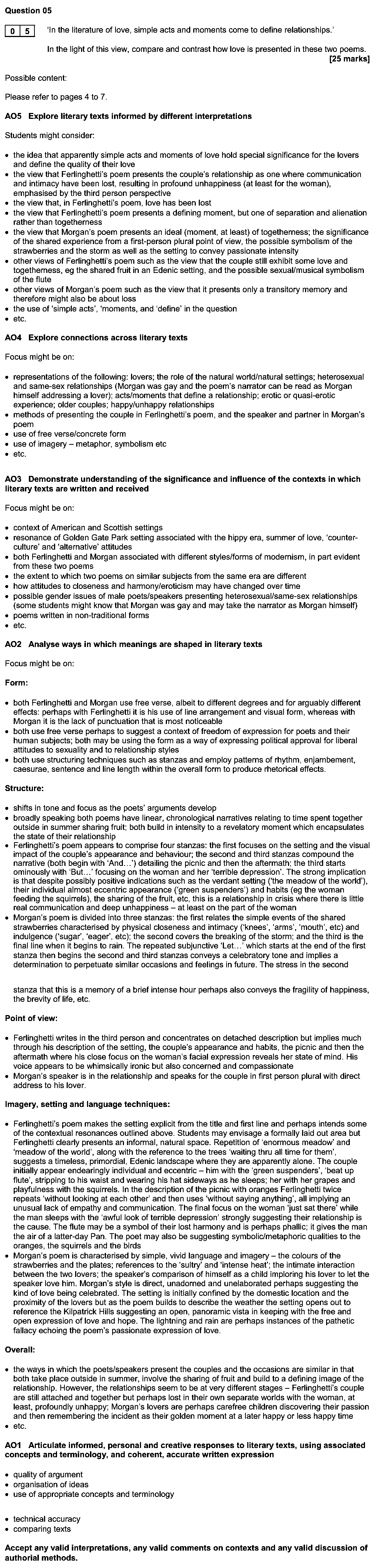
‘In the literature of love, simple acts and moments come to define relationships.’
In the light of this view, compare and contrast how love is presented in these two poems.
[25 marks]
In Golden Gate Park That Day…
In Golden Gate Park that day
a man and his wife were coming along
thru the enormous meadow
which was the meadow of the world
He was wearing green suspenders1
and carrying an old beat-up flute
in one hand
while his wife had a bunch of grapes
which she kept handing out
individually
to various squirrels
as if each
were a little joke
And then the two of them came on
thru the enormous meadow
which was the meadow of the world
and then
at a very still spot where the trees dreamed
and seemed to have been waiting thru all time
for them
they sat down together on the grass
without looking at each other
and ate oranges
without looking at each other
and put the peels
in a basket which they seemed
to have brought for that purpose
without looking at each other
And then
he took his shirt and undershirt off
but kept his hat on
sideways
and without saying anything
fell asleep under it
And his wife just sat there looking
at the birds which flew about
calling to each other
in the stilly air
as if they were questioning existence
or trying to recall something forgotten
But then finally
she too lay down flat
and just lay there looking up
at nothing
yet fingering the old flute
which nobody played
and finally looking over
at him
without any particular expression
except a certain awful look
of terrible depression
Lawrence Ferlinghetti (b. 1919)
Glossary:
1In American English ‘suspenders’ are elasticated braces to support trousers
Strawberries
There were never strawberries
like the ones we had
that sultry afternoon
sitting on the step
of the open french window
facing each other
your knees held in mine
the blue plates in our laps
the strawberries glistening
in the hot sunlight
we dipped them in sugar
looking at each other
not hurrying the feast
for one to come
the empty plates
laid on the stone together
with the two forks crossed
and I bent towards you
sweet in that air
in my arms
abandoned like a child
from your eager mouth
the taste of strawberries
in my memory
lean back again
let me love you
let the sun beat
on our forgetfulness
one hour of all
the heat intense
and summer lightning
on the Kilpatrick hills
let the storm wash the plates
Edwin Morgan (1920–2010)
June 2019 · Paper 1 · Q5 25 marks Unseen poetry unseen love poetry
Answer the following question.
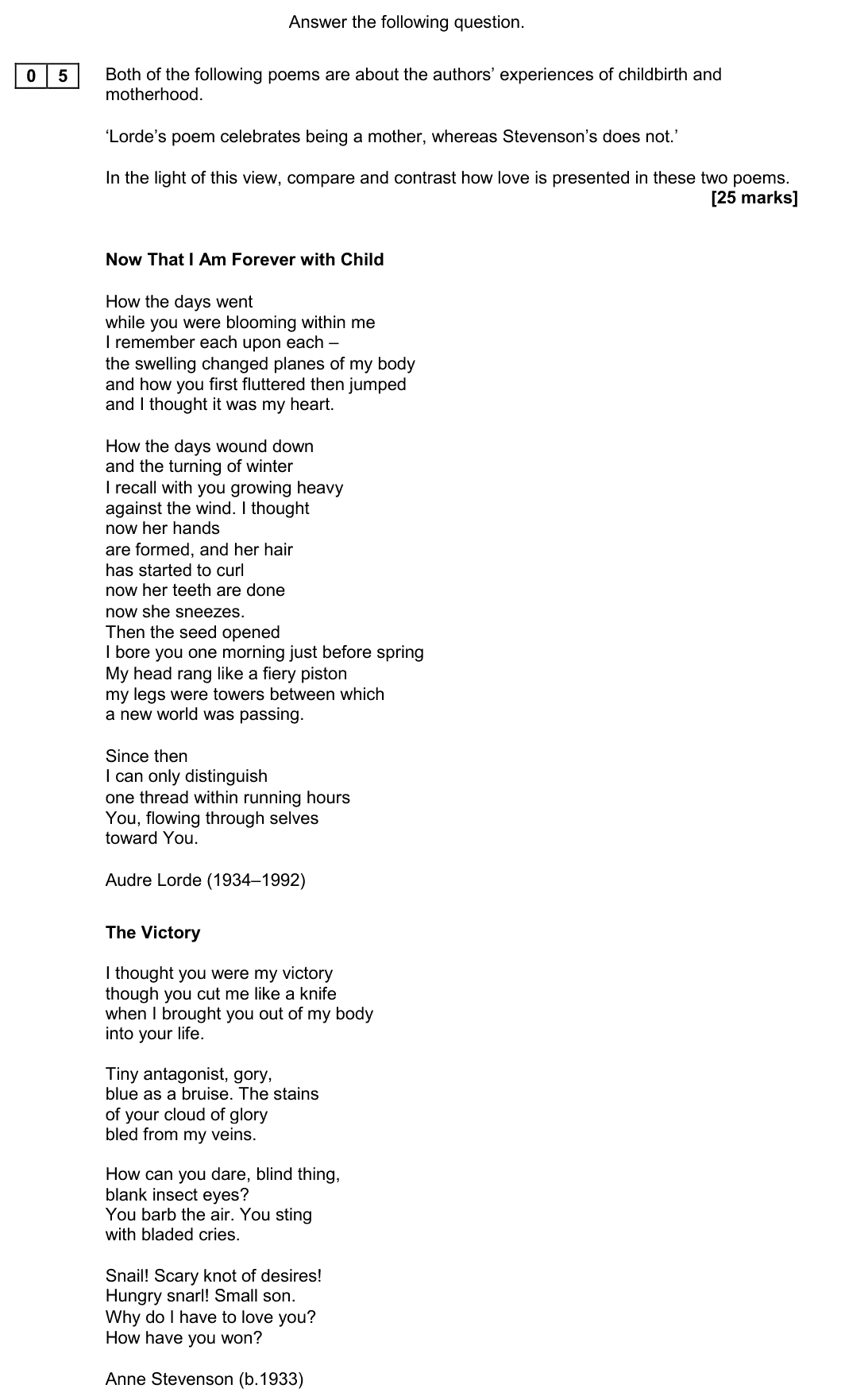
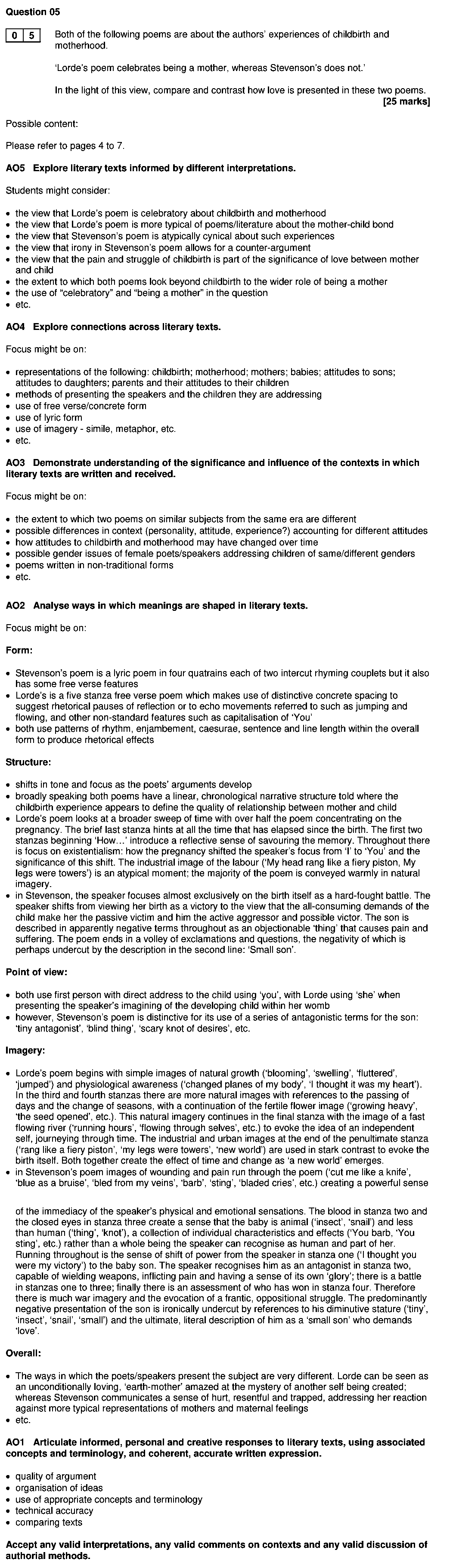
Both of the following poems are about the authors’ experiences of childbirth and
motherhood.
‘Lorde’s poem celebrates being a mother, whereas Stevenson’s does not.’
In the light of this view, compare and contrast how love is presented in these two poems.
[25 marks]
Now That I Am Forever with Child
How the days went
while you were blooming within me
I remember each upon each –
the swelling changed planes of my body
and how you first fluttered then jumped
and I thought it was my heart.
How the days wound down
and the turning of winter
I recall with you growing heavy
against the wind. I thought
now her hands
are formed, and her hair
has started to curl
now her teeth are done
now she sneezes.
Then the seed opened
I bore you one morning just before spring
My head rang like a fiery piston
my legs were towers between which
a new world was passing.
Since then
I can only distinguish
one thread within running hours
You, flowing through selves
toward You.
Audre Lorde (1934–1992)
The Victory
I thought you were my victory
though you cut me like a knife
when I brought you out of my body
into your life.
Tiny antagonist, gory,
blue as a bruise. The stains
of your cloud of glory
bled from my veins.
How can you dare, blind thing,
blank insect eyes?
You barb the air. You sting
with bladed cries.
Snail! Scary knot of desires!
Hungry snarl! Small son.
Why do I have to love you?
How have you won?
Anne Stevenson (b.1933)
June 2018 · Paper 1 · Q5 25 marks Unseen poetry unseen love poetry
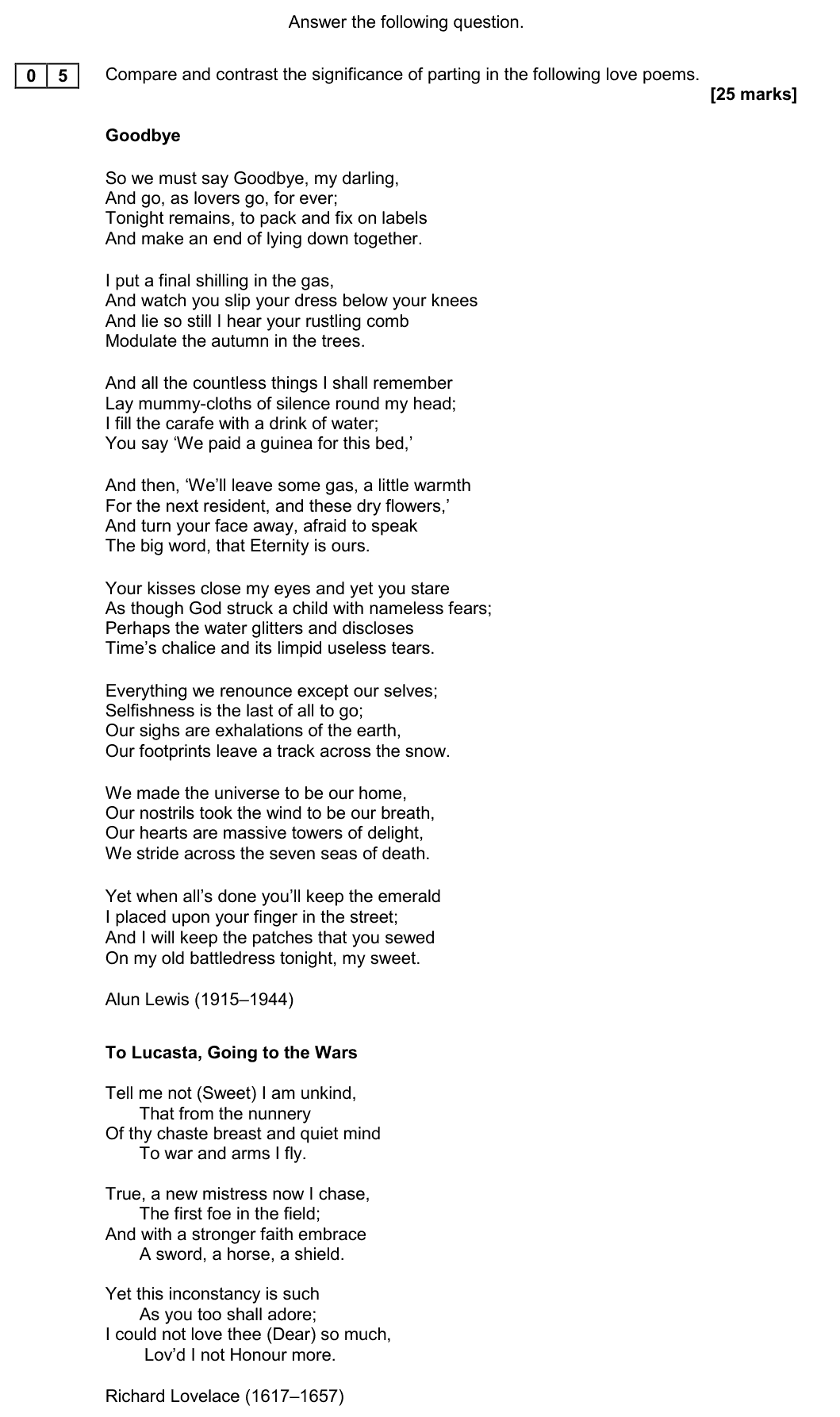
Answer the following question.
Compare and contrast the significance of parting in the following love poems.
[25 marks]
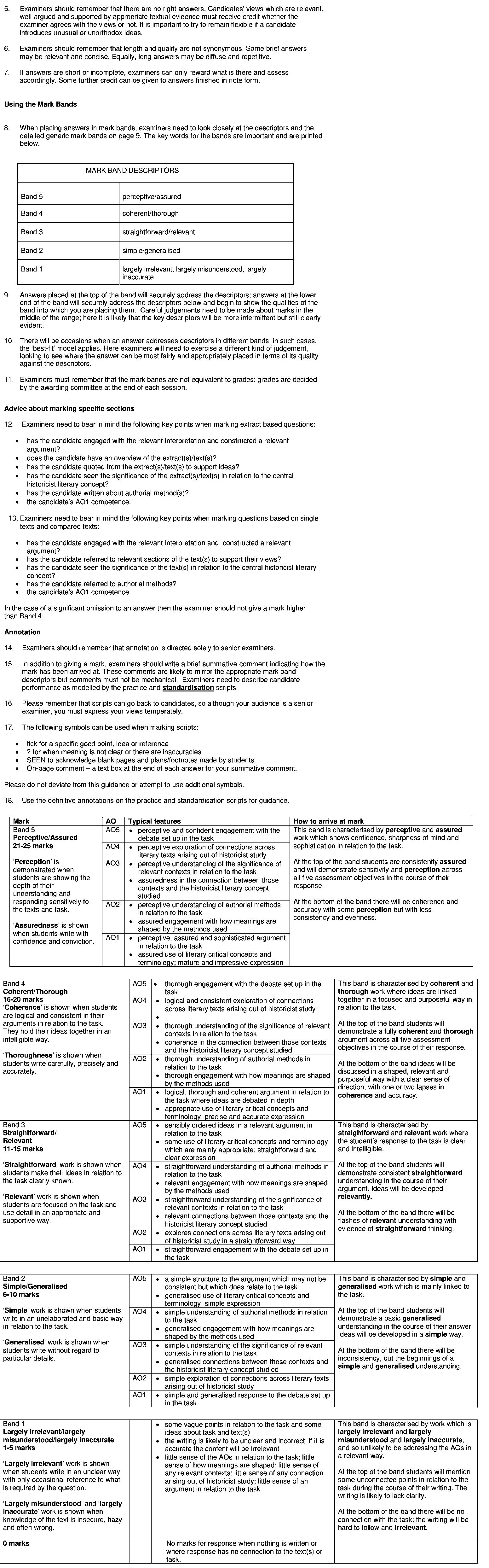
Goodbye
So we must say Goodbye, my darling,
And go, as lovers go, for ever;
Tonight remains, to pack and fix on labels
And make an end of lying down together.
I put a final shilling in the gas,
And watch you slip your dress below your knees
And lie so still I hear your rustling comb
Modulate the autumn in the trees.
And all the countless things I shall remember
Lay mummy-cloths of silence round my head;
I fill the carafe with a drink of water;
You say ‘We paid a guinea for this bed,’
And then, ‘We’ll leave some gas, a little warmth
For the next resident, and these dry flowers,’
And turn your face away, afraid to speak
The big word, that Eternity is ours.
Your kisses close my eyes and yet you stare
As though God struck a child with nameless fears;
Perhaps the water glitters and discloses
Time’s chalice and its limpid useless tears.
Everything we renounce except our selves;
Selfishness is the last of all to go;
Our sighs are exhalations of the earth,
Our footprints leave a track across the snow.
We made the universe to be our home,
Our nostrils took the wind to be our breath,
Our hearts are massive towers of delight,
We stride across the seven seas of death.
Yet when all’s done you’ll keep the emerald
I placed upon your finger in the street;
And I will keep the patches that you sewed
On my old battledress tonight, my sweet.
Alun Lewis (1915–1944)
To Lucasta, Going to the Wars
Tell me not (Sweet) I am unkind,
That from the nunnery
Of thy chaste breast and quiet mind
To war and arms I fly.
True, a new mistress now I chase,
The first foe in the field;
And with a stronger faith embrace
A sword, a horse, a shield.
Yet this inconstancy is such
As you too shall adore;
I could not love thee (Dear) so much,
Lov’d I not Honour more.
Richard Lovelace (1617–1657)
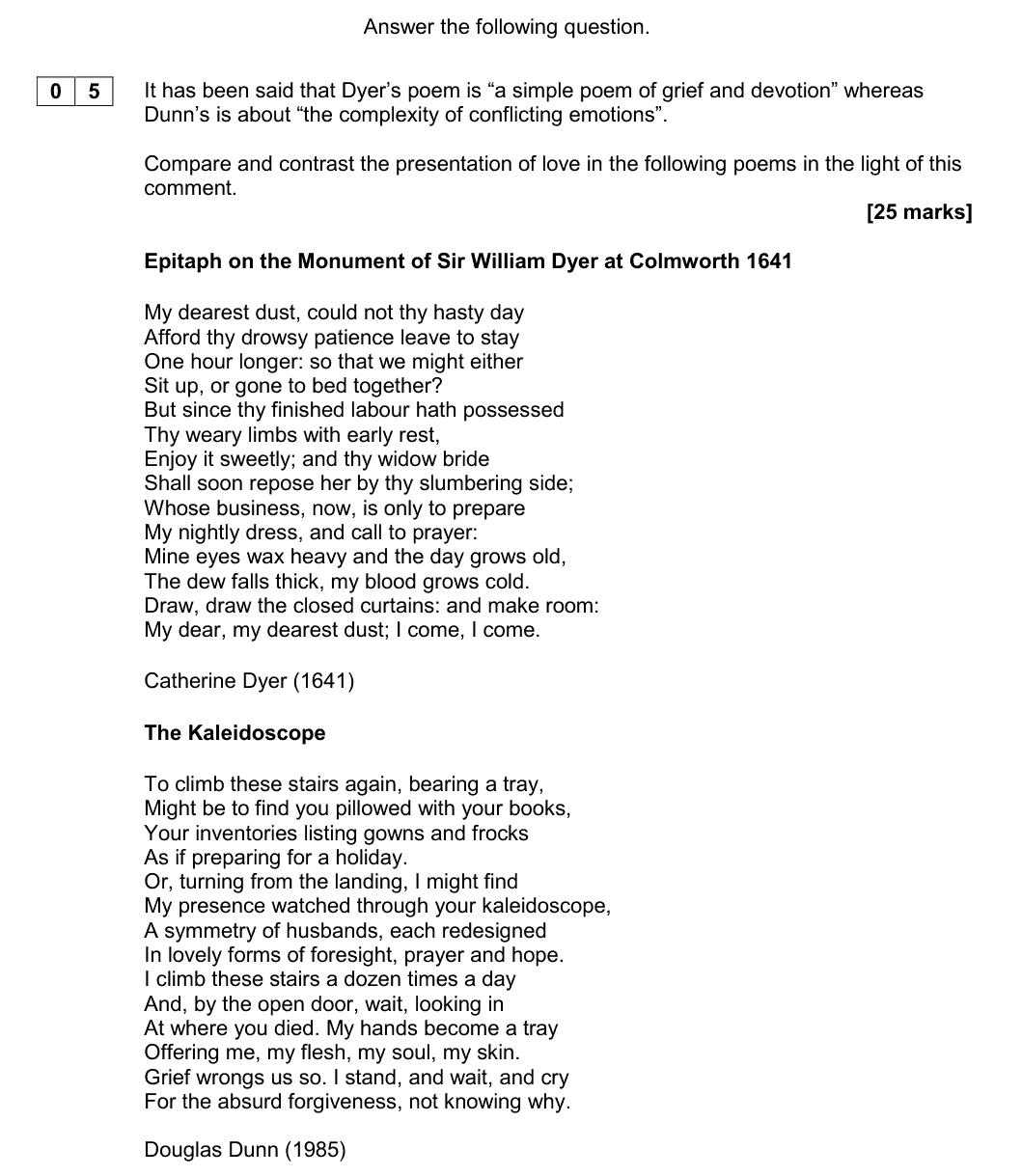
June 2017 · Paper 1 · Q5 25 marks Unseen poetry unseen love poetry
Answer the following question.
0 5
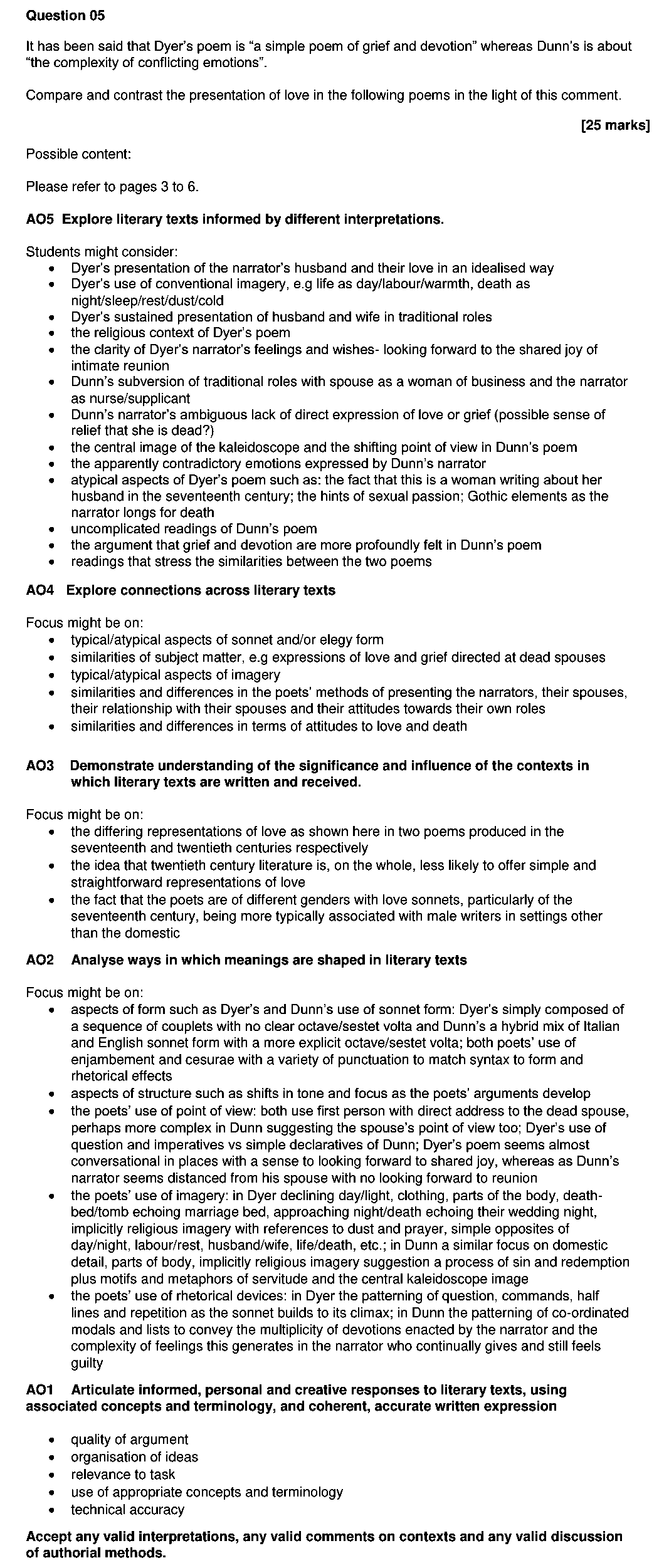
It has been said that Dyer’s poem is “a simple poem of grief and devotion” whereas
Dunn’s is about “the complexity of conflicting emotions”.
Compare and contrast the presentation of love in the following poems in the light of this
comment.
[25 marks]
Epitaph on the Monument of Sir William Dyer at Colmworth 1641
My dearest dust, could not thy hasty day
Afford thy drowsy patience leave to stay
One hour longer: so that we might either
Sit up, or gone to bed together?
But since thy finished labour hath possessed
Thy weary limbs with early rest,
Enjoy it sweetly; and thy widow bride
Shall soon repose her by thy slumbering side;
Whose business, now, is only to prepare
My nightly dress, and call to prayer:
Mine eyes wax heavy and the day grows old,
The dew falls thick, my blood grows cold.
Draw, draw the closed curtains: and make room:
My dear, my dearest dust; I come, I come.
Catherine Dyer (1641)
The Kaleidoscope
To climb these stairs again, bearing a tray,
Might be to find you pillowed with your books,
Your inventories listing gowns and frocks
As if preparing for a holiday.
Or, turning from the landing, I might find
My presence watched through your kaleidoscope,
A symmetry of husbands, each redesigned
In lovely forms of foresight, prayer and hope.
I climb these stairs a dozen times a day
And, by the open door, wait, looking in
At where you died. My hands become a tray
Offering me, my flesh, my soul, my skin.
Grief wrongs us so. I stand, and wait, and cry
For the absurd forgiveness, not knowing why.
Douglas Dunn (1985)

Work with an AQA English Literature A tutor

Essays stuck in the middle bands, or not sure what the examiners want from an analysis? Book a trial lesson with a specialist AQA English Literature A tutor.

Prefer email? Send an enquiry

If you are under 18, please include a parent's contact details. Enquiries go to enquiries@alevelenglishtutor.com and are deleted once handled. All tutoring is online.